2018 International Conference on Communication, Network and Artificial Intelligence (CNAI 2018) ISBN: 978-1-60595-065-5
A Capacity Allocation Algorithm for Optical Virtual Private Networks
Bin ZENG
1and Rui WANG
2,*1Department of Management, Naval University of Engineering, Wuhan, Hubei, China
2Library of Naval University of Engineering, Wuhan, Hubei, China
*Corresponding author
Keywords: Optical virtual private networks, Wavelength-Division Multiplexing, Quality of services, Capacity allocation.
Abstract. As the development of optical communication technologies such as Wavelength-Division Multiplexing (WDM), it is important to support virtual private networks (VPN) over WDM networks. In order to overcome the limits of WDM network capacity and achieving more revenue new VPNs, an optimal model supporting both optical VPN and IP VPN on WDM networks is proposed to admit the maximum number of new VPNs without influencing the QoS guarantee for the existing VPNs. Furthermore, three heuristic algorithms are designed to simplify the computation process of getting optimal solution. The simulation results over MESH WDM networks show the algorithm can takes advantage of the reliable transmission capability of WDM networks and provides diverse QoS for different traffic streams by different quality of optical transmission.
Introduction
Wavelength-Division Multiplexing (WDM) has emerged as a promising technique for opening up the Terahertz transmission bandwidth of the single-mode optical fiber [18]. A virtual private network (VPN) is provisioned over public or third party network infrastructure, for example a frame relay carrier network or the Internet, to provide dedicated connectivity to a closed group of users. For most users, VPNs are more economic than deploying and maintaining physical cables and equipment themselves [10]. A private network can be built through tunneling, encryption and authentication mechanisms. To the users, a VPN looks like a private network, even though it is sharing a web of cables with the traffic of other users at the same time.
As the technology of WDM progresses, we can build VPNs over WDM networks, which takes advantage of the reliable transmission capability of WDM networks and provides diverse QoS for different traffic streams by different quality of optical transmission. In [9], the authors propose a virtual topology design and lightpath routing algorithm based on the concept of loose virtual topologies, it pluses lightpaths generated by MaxSingleHop [4] algorithm for unsatisfied traffic in the ring. In [6], the authors split the virtual topology problems into several subproblems: virtual topology design, routing for lightpaths, wavelength assignment. Although these papers focus right on the IP over WDM traffic engineering problems, but all of their algorithms are based on heuristic approaches and can’t be analyzed mathematically. In this paper, we propose a VPN over WDM traffic engineering mathematical formulation and optimization algorithm for solving the problem.
Problem Description
In this paper, we want to provide a capacity allocation algorithm for the operators who have their own optical networks. This model is used for the decision making of admitting the maximum number of new VPNs without influencing the QoS guarantee for the existing VPNs and our objective is to maximize our total revenue.
The given parameters are as follows: 1. The optical layer topology.
3. The topologies for existing VPNs.
4. The set new VPNs of which each admittance is to be determined. 5. The average traffic of each O-D pair in each VPN.
The objective is to maximize the total revenue. Subject to:
1. The QoS constraint guaranteed by limiting the end-to-end mean delay, delay jitter and the maximum hop distance for each O-D pair in the network.
2. The number of lightpaths routing on a fiber link shouldn’t exceed the number of wavelengths of the fiber link.
3. The wavelength continuity constraint for each lightpath.
4. The ratio of lightpath reassignment cost and the total revenue should less than a given value. The results to determine are as follows:
1. The maximum total revenue.
2. The topologies of the VPNs in the network.
3. The route of each O-D pair of each VPN in the network.
The notations of the parameters are given below. V’ is denoted asthe set of existing VPNs. V’’ is denoted asthe set of new requesting VPNs. V is denoted as the total VPNs, i.e., the union of V’ and
V’’. K is denoted asthe set of WDM links. J is denoted as the set of candidate wavelength in WDM network. B is denoted asper wavelength capacity. (e.g. 10Gbps). σqkis denoted as1 if lightpath q uses
WDM link k; otherwise 0. Qlis denoted asCandidate lightpaths to support IP link l. L is denoted as
the set of all candidate IP links. δplis denoted as 1 if directed path p uses link l; otherwise 0. Pwis
denoted asthe set of candidate directed IP paths connecting O is denoted as D pair w. p’wis denoted
asan artificial path for the O is denoted as D pair w of the rejected VPNs. P’wis denoted asthe union
of Pw andp’w. Wvis denoted as the set of O is denoted as D pairs of VPN v. avis denoted asthe revenue
for admitting VPN v. rvwis denoted asthe mean traffic rate of O is denoted as D pair w of VPN v. θqk
is denoted as0 if WDM link k is on lightpath q and the currently assigned lightpath; otherwise 1. Clis
denoted asthe capacity of IP link l. anjis denoted as number of add ports for wavelength j in OXC
corresponding to router n. dnj is denoted as number of drop ports for wavelength j in OXC
corresponding to router n. Tnis denoted asthe set of candidate outgoing IP links from router n. Rnis
denoted as the set of candidate input IP links from router n. N is denoted asthe set of IP routers.
Fl(gl,Cl) is denoted as the average delay on IP link l, which is a function of fl and Cl. Hl(gl,Cl) is
denoted asthe average delay jitter on IP link l, which is a function of fland Cl. β is denoted asa given
value for the ratio of lightpath reassignment cost and the total revenue. kvwis denoted asa given hop
distance in terms of IP links for O is denoted as D pair w of VPN v. vw is denoted as a given packet overdue probability for O is denoted as D pair w of VPN v. (Dvw, Evw, )T is denoted as the
probability under the threshold T on link lL, which is a function of Dvwand E vw.
The notations of the decision variables are given below. xvp=1 if VPN v uses IP path p; otherwise 0. yqj=1 if lightpath q uses wavelength j; otherwise 0. zv=1 if VPN v is admitted; otherwise 0. gl is the
estimated aggregation flow on IP link l.bvwl=1 if link l is selected for O-D pair w of VPN v, and 0
otherwise. Dvw denotes end-to- end mean delay requirement for each O-D pair w in VPN v. Evw
denotes end-to-end delay jitter requirement for each O-D pair w in VPN v. Objective function is as below:
max
ob v v v v
F a z
. (1)Subject to:
,
v w
vw
vp pl l v V w W p P
g
l L
x r
,
l l
g
C
l L
(3)1, ,
w
v vp
p P
w W v V x
(4),
,
w
v vp v
p P
z
w W v V
x
(5)1 or 0 ,
v
z v V (6)
, ,
w
v vp pl vw
l L p P
h w W v V x
(7)l
qk qk l L q Q k K
v v v V a z
(8)1 or 0, w, v, vp
x p P w W v V (9)
1, ,
l qk qj l L q Q
k K j J y
(10)1 or 0
l,
,
qj
y
q Q
l
L j
J
(11), ,
n l
qj nj
l T q Q
y a j J n N
(12),
,
n l
qj nj
l R q Q
y
d
j J n N
(13),
l
l qj
j J q Q
C y B l L
(14)
0, , 2 , ,
,l B B J
C B l L (15)
( , ) , v,
l
vwl l l vw
l L
D w W v V g
b F C
(16)( , ) , v,
l
vwl l l vw
l L
E w W v V g
b H C
(17), , ,
w
v
vp pl vwl
p P
b w W v V l L x
(18)1 or 0,
v,
,
vwlb
w W v V l L
(19), ,
(Dvw E vwT) vw, w W v Vv, .
will have an IP path to transmit traffic. Constraint (4) is to ensure all each O-D pairs will be admitted or rejected jointly if the VPN is admitted or rejected. Constraint (5) represents the integer property constraint. Constraint (6) is to ensure the hop distance of each O-D pair is within a given value. Constraint (7) is to ensure the ratio of the lightpath reassignment cost and the total revenue should less than a given value. Constraint (8) is ro enforce the integer property. Constraint (9) is to ensure a specific wavelength in a specific WDM link will be used at most one time. Constraint (10) is to enforce the integer property. Constraint (11) is to ensure the number of each wavelength used by outgoing IP links of each router must not exceed the number of add ports of the corresponding OXC. Constraint (12) is to ensure the number of each wavelength used by incoming IP links of each router must not exceed the number of drop ports of the corresponding OXC. Constraint (13) is to ensure the capacity of each IP link must not exceed the aggregated capacity provided by the lightpaths. Constraint (14) is to ensure the capacity of all IP links must be a multiple of the capacity of a wavelength. Constraint (15) is to ensure the end-to-end mean delay of each O-D pair is within a given value. Constraint (16) is to ensure the end-to-end delay jitter of each O-D pair is within a given value. Constraint (17) is to ensure every IP link will be used by one IP path at most one time. Constraint (18) means the integer property constraint. Constraint (19) is ro guarantee the overdue probability caused by a specific set of delay and delay jitter should be restricted within a given value.
Algorithm Design
Due to the complexity of our primal problem and the purpose of simplifying the process of getting primal feasible solutions, we divide the primal problem into three parts: (1) VPN admission control subproblems, (2) IP layer routing subproblems, (3) WDM layer routing subproblems. We’ll derive some heuristics for solving these subproblems in the following sections.
VPN Admission Control Subproblems
As an admission control problem, we intuitively apply drop-and-add heuristics in this subproblem. While applying drop-and-add heuristics, we must decide the priority of each requesting VPN, which are used to determine the drop sequence. Similarly, some add criteria are used to decide the priority to construct the add sequence of the previously dropped VPNs. In our formulation, the set of decision variables zvare used to determine which requesting VPN can be admitted into our physical network.
While solving the subproblem 1 of the Lagrangean relaxation dual problem, we decide zv to be 1 if
( ) 1 3 2 0
w Wv f z u av u vw
, otherwise 0. So using f(z) as the criteria of dropping or adding isquite intuitively reasonable. We also provide some other criteria for drop-and-add heuristics, which demonstrates the multiple combinations of four criteria of drop and add by f(z), Traffic(z), Revenue(z) and Ratio(z), where Traffic(z) = total traffic of VPN z, Revenue(z) = the revenue brought by VPN z,
Ratio(z) = Revenue(z) / Traffic(z).
The algorithm is shown as follow:
Step 1. Choose a combination of criteria of drop-and-add heuristics.
Step 2. Sort the requesting VPNs by the chosen drop criterion. The ranking rule is as following:
If drop criterion = Traffic(z)
VPN j ranks higher than VPN j’ if Traffic(j) < Traffic(j’)
If drop criterion = Revenue(z)
VPN j ranks higher than VPN j’ if Revenue(j) > Revenue(j’)
If drop criterion = Ratio(z)
VPN j ranks higher than VPN j’ if Ratio(j) > Ratio(j’)
If drop criterion = f(z)
Step 3. According to the ranks given by Step 2, drop VPN j with the smallest rank one by one until all the constraints of the primal problem are satisfied.
Step 4. Sort the dropped VPNs given in Step 3 by the chosen add criterion. The ranking rule is as following:
If add criterion = Traffic(z)
VPN j ranks higher than VPN j’ if Traffic(j) < Traffic(j’)
If add criterion = Revenue(z)
VPN j ranks higher than VPN j’ if Revenue(j) > Revenue(j’)
If add criterion = Ratio(z)
VPN j ranks higher than VPN j’ if Ratio (j) > Ratio (j’).
Step 5. According to the ranks given by Step 4, add the VPN with largest rank one by one until some constraints of the primal problem are violated.
IP Layer Routing Subproblems
The set of decision variables xvpare used to decide the routing of each OD pair of each VPN in the IP
layer. Solving each routing problem of one specific OD pair is a typical shortest path problem. We apply Bellman-Ford algorithm in our implementation.
WDM Layer Routing Subproblems
Lightpaths, which are constructed from the WDM layer, are used to provide the capacity of physical transmission to each IP link. Consequently, the order of construction of each lightpath is highly related with the loading of the IP link the lightpath supports. In our implementation, K-shortest path algorithm is adopted to decide the K shortest lightpaths supporting one specific IP link. Similarly, the choices of arc weights can be made to determine the shortest paths. Like the previous section, there’re also some multipliers related with each lambda in a specific WDM link. The algorithm is shown as follow:
Step 1. Sort the IP links by the traffic on each IP link.
Step 2. Assign the arc weight of each link in the K-shortest path algorithm to be 1.
Simulation Results
240000 290000 340000 390000 440000 490000
1 2 3 4 5
R
eve
nu
e
Sample No. of VPNs = 60
CA OA DV
240000 290000 340000 390000 440000 490000
1 2 3 4 5
R
eve
nue
Sample No. of VPNs = 70
CA OA DV
240000 290000 340000 390000 440000 490000
1 2 3 4 5
R
eve
nue
Sample No. of VPNs = 80
CA OA DV
240000 290000 340000 390000 440000 490000
1 2 3 4 5
R
eve
nu
e
Sample No. of VPNs = 90
[image:6.612.97.522.89.372.2]CA OA DV
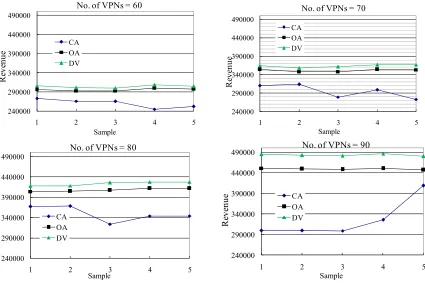
Figure 1. Comparison of different number of VPNs of MESH topology.
In order to show the difference between the results from our optimal algorithm (OA) and other primal heuristics (CA), we would like to do some experiments for the purpose of showing the effectiveness of results. Input parameters are configured as below. The number of existing VPNs is 4. The number of OD pairs per VPN is 3. The traffic of each OD pair is between 100 and 600. The capacity of each lambda is 1000. The ratio of lightpath modification cost and the total revenue is 0.8. The Rerouting cost per WDM link is 50. The revenue of each VPN is between 1000 and 10000. The End-to-end delay threshold is 0.5 sec. The number of supporting lightpaths per IP link is 2. The stop criteria are 500 iterations.
We have tested MESH topology in our simulation with the number of requesting VPNs equal to 60, 70, 80, 90, and 100. Compared with the results of algorithm SA, our Lagrangean-based algorithm LA has achieved improvements from 8.42% to 89.65% in the above three topologies, which can show the effectiveness of our approach.
Summary
In this paper, we try to develop an admission control algorithm jointly considering VPN admission control and the routing assignments of IP and WDM layers. The simulation results prove that the algorithm can efficiently solve the design problem of these three layers over WDM networks, which makes the problem more complicated then considering any single layer only.
References
[1] C.H. Kim, S.Y. Jung, S.K. Han., Microwave photonic filter based all-optical virtual private network supporting Dynamic bandwidth allocation in OFDMA-PON System, IEEE Photonics
Journal. 10(2018) 1-8.
[2] W. Xia, C. Gan, W. Xie, et al, Bandwidth-allocated mechanism and its algorithm for multi-subsystem-based virtual passive optical network in metro-access optical network, Iet Communications., 10(2016) 154-161.
[3] Q. Zhang, C. Zhang, W. Jin, et al, Enabled scalable and privacy wavelength division multiplexing-radio over fiber system based on optical virtual private networks, Optical Engineering., 53(2014) 99-105.
[4] S.K. Das, A.K. Samantray, S.K. Patra, Hybrid crosstalk aware Q-factor analysis for selection of optical virtual private network connection, International Journal of Electronics., 103(2016) 113-129. [5] A. Aguado, V. López, J. Marhuenda, et al, ABNO: A feasible SDN approach for multivendor IP and optical networks, IEEE/OSA Journal of Optical Communications and Networking. 7(2015) 356-362.
[6] A.S. Thyagaturu, A. Mercian, M.P. McGarry, et al, Software defined optical networks (SDONs): A comprehensive survey, IEEE Communications Surveys & Tutorials. 18(2016): 2738-2786. [7] D. Klonidis, F. Cugini, O. Gerstel, et al, Spectrally and spatially flexible optical network planning and operations, IEEE Communications Magazine., 53(2015) 69-78.