2018 International Conference on Physics, Computing and Mathematical Modeling (PCMM 2018) ISBN: 978-1-60595-549-0
An Approach for the Verification of Trusted Operation
on Automatic Control System
Li-tian XIAO
1,2,*, Meng-yuan LI
2and Nan XIAO
31
Beijing Special Engineering Design and Research Institute, Beijing 10028, China
2School of Software, TNList, KLISS, Tsinghua University, Beijing 10084, China 3China Aerospace Academy of System Science and Engineering, Beijing 10048, China
*Corresponding author
Keywords: Control system, Trusted operation, Trusted stamp, Verification protocol.
Abstract. The automatic control system is very important to space launch. Even if the control system has been tested, there is still no very effective method to ensure the trusted operation of the system. We propose an approach for the trusted operation and verification of control system. Based established control system model in the paper, the trusted elements of the core controller are configuration transformation and state transferring in the control system operation. The state transferring of each module inside each controller is stamped by the stamping method. The state stamps of output result are verified at the output port of each module. The trusted state transferring is used to ensure the credibility of the operation. The paper analyzes the approach’s security under environmental impact as well as independent and joint attack. The approach is tested by building a simulation platform. It is proved to be safe and reliable. Also, it is feasible to apply in launch site.
Introduction
Programmable Logic Controller is a kind of embedded system in the automatic control system. The controller’s trusted operation is vital to this kind of safety-critical applications. Conceptually, the trusted goal of the control system is to propose a running entity that can perform a special action surpassed the preset security rules, and how to verify the entity. Therefore, we need first ensure that the software and hardware systems can be quantified and verified by calculation. The critical core of a trusted system is the trusted computing. At present, trusted control system platform is mainly considered the security issues from the perspective of security architecture. The security of the user’s operating environment is ensured by the passive defense (i.e. security patching).
The paper proposes a control system model, and analyze the state change and transmitting of the control system. Based on the model, the security mechanism and the processes are set up by the critical elements for verifying the trusted operation. So the approach ensures the operation reliability and security of the whole system.
Related Work
Now, there are a few related papers and reports about the trusted research of control systems. The research of the related trusted system is mainly focused on the network, trusted computing and related software and hardware [1]-[8].
control model for evaluating the enabling technologies of trusted networks. In the progress of trusted computing technology hardware, the software on the computing platform is measured by enhancing the hardware architecture of the existing open platform.
In the control system field, the technical features of the trusted control system are integrated existing defensive measures. The researchers utilize linkage mechanism between the inside firewall of control systems, the intrusion detection system and the trusted connection server. It can improve the overall defense and security capability of control systems [9][10], but it doesn’t have the trusted verification and cannot ensure the trusted operation.
The credible risks are very high in actual applications at the aerospace launch site. Certainly, measures have generally been taken for these keys in the control system. Some have adopted redundant or hot backup methods. Some have added monitoring points and fault handling software. Others are strict with the test inspection and control the identity of software users. But there is no trusted verification in control system, whether the state transmission can be trusted exists the risk on the information source and host as well as terminal. Therefore, the untrusted verified system exists risks on safe and reliable. Correlated trusted research lags behind the application needs in actual control systems. It still lacks typical solutions.
Control System Modeling
Control system receives and processes the various sensor signals of controlled devices. These sensor signals (Sigsen) include analog signals (AI) and digital signals (DI), e.g. they are from coders (Cod), location detectors (Loc), operation inductors (Opt) and moving sensors (Mov), etc. They are converted and stored into data input port (PI) by A/D and D/A. The set is
Sigsen ={ AICod, AILoc, AIOpt, AIMov…, DICod, DILoc, DIOpt, DIMov…}; PI⊆ Sigsen.
According to control logic, initial configuration, task and interrupt, the control program processes and responds to port data. Then it updates system configuration (V) and gives the corresponding control data to data output port. After A/D or D/A conversion, the control data are converted into analog signals or digital drive ones (AO or DO) for moving drive mechanism such as relays, valves, transmission and etc. Finally, it achieves real-time control, i.e.
Sigdrv ={ AORly, AOValv, AOTrans, …, DORly, DOValv, DOTrans,…}; PO⊆ Sigdrv.
The communication between controllers is dependent on the bus network port. Control system is constructed by the components such as Fig.1. A control system can be composed of multiple controllers. Controller system features are decided by {PI, V, PO}, i.e. controller’s action is controlled by input, output, and configuration. The description of the controller can be defined as a tuple:
M=< V, v0, PI, PO, RPI, PM>, where V is the finite state set of non-empty configuration inside the
controller, PI is the finite set of non-empty input, PO is the finite set of non-empty output, RPI is the
mapping set of an input subset. v0⊆V, where v0 is the initial state of the control program.
RPI ⊂ β(PI) ∈{ri},(i=1,2,…), which β is the transform function set of confirmed generalized
verification. β filters an input subset that is effective in handling. ri is the subset of PI. PM describes
the incomplete mapping of the control program.
PM(a, b): β(V)×β(PO)×RPI→β(V)×β(PO), where a∈β(V)×β(PO), b∈RPI. v0∈β(V)×β(PO).
Trusted Elements in Control System
transformation, state transferring and programmable components. The network interface is outside the scope of the controller. We embed trusted verification computation in the controller to verify each input/output and state transfer.
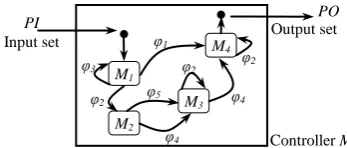
The model M of the example consists of four submodule Mi (i=1,2,3,4). φ={φ1, φ2, φ3, φ4}is the verified property, which φi (i=1,2,…4) is the state transferring property from the input set to output set. It needs to ensure that the transferring property is trusted from input to output.
[image:3.595.208.414.210.322.2]A group of submodule Mi transforms configuration according to transferring path. We utilize the principle of digital signatures based on Schnorr protocol [11]. The module members are marked particular stamps for output and verified stamps for input.
Figure 1. Work Pattern and System Model of Control System.
Figure 2. State transferring diagram of controller.
The Trusted Stamp and the Verification Protocol
φ1, φ2, …φn are defined as n state transferring to a controller.
a). Generating a key pair. To choose two large prime p and q, q is the prime factor of p-1. q≥(2140) and p≥(2512), and the primitive a (a≠1) of rank q is chosen in GF(p) and satisfies aq ≡1 mod p[11]. The one-way HASH function is chosen and makes function h→{0,1,…2t-1}. They are promulgated and shared by all state members Mj (j=1,2…L). Each φi chooses the private key Ki which is defined as a
random number less than q on GF(q). The public key is
Ui=a-Ki mod p (i=1,2,…n). (1)
b). Generating state stamp. Assumed that T is the scan period of a response in the controller, state transferring has the performance time Ti (i=1,2,…n), where T=T1+T2+ … +Tn. The designed scan
period should be abided, or else the design and Ti reset. T and Ti are the time mark of the system given
to every member states. It requires that the submodule should finish their work and state transferring at the given times. When state stamp being calculated, the system automatically gets corresponding system unify-time for consistency. Every time Ti exists the differences in precise time because of
different performances.
The process of state stamp is designed as below that n states transferring to result f. First, defined x0= aT (mod p). φi has choose the random number di on GF(q). Calculating
xi= xi-1 • a-Ti • adi (mod p) , (2) and xi is sent to the sub module Mj (j=1,2,…L) related φi. When j=L, ML send xn to PO. Then assuming
y0=0 and calculating is processed
M1
M2
M3
M4
φ1
φ2
φ2
φ2
φ3
φ5
φ4
φ4
Input set Output set
PI PO
Controller M
Controller Initialization
Read input
Program process
Output update Control program(PM)
Input port (PI)
Output port (PO)
Drive mechanism Sensor
Network
Monitor Remote control
V
[image:3.595.204.378.353.427.2]e=h(xn, f), yi= yi-1+(di+Kie) (mod q) (i=1,2,…n) . (3) Finally, {f, e , yn} is sent to PO and verified. {f, e, yn} is the group state stamp of the result f signed
by the state transferring φ1, φ2,…, φn in the controller.
c). Verifying state stamp. The PO receives the group state stamp {f, e, yn}, then verifies the whole
stamp with Ui of the state transferring. Calculating
𝑥𝑛′ = 𝑎𝑦𝑛(∏ 𝑈
𝑖 𝑛
𝑖=1 )𝑒(𝑚𝑜𝑑 𝑝) (4)
and further verifying e=h(xn’, f) whether or not comes into existence. If the verification equation
comes into existence, the output is confirmed that the result is valid and can process the next performance. If the verification fails, the control system refuses the result.
The equation showed below is proved the validity of the state stamp scheme. Because it is based on (3) and (1), it has
𝑥𝑛′ = 𝑎𝑦𝑛(∏𝑖=1𝑛 𝑈𝑖)𝑒(mod 𝑝) = 𝑎𝑦𝑛−1+(𝑑𝑛+𝐾𝑛𝑒)(𝑚𝑜𝑑 𝑞)∙ (∏𝑛−1𝑖=1 𝑈𝑖)𝑒∙ (𝑈𝑛)𝑒(mod 𝑝) = 𝑎𝑦𝑛−1∙
𝑎(𝑑𝑛+𝐾𝑛𝑒)(𝑚𝑜𝑑 𝑞)∙ (∏ 𝑈
𝑖 𝑛−1
𝑖=1 )𝑒∙ (𝑎−𝐾𝑛)𝑒(mod 𝑝) = 𝑎𝑦𝑛−1 ∙ (∏𝑛−1𝑖=1 𝑈𝑖)𝑒∙ (𝑎𝑟𝑛)(mod 𝑝)
The below equation can be obtained on the analogy of (3). 𝑥𝑛′ = 𝑎𝑑𝑛∙ 𝑎𝑑𝑛−1⋯ 𝑎𝑑1(mod 𝑝). Due
to (2) and initial condition x0 , the equation is xn’=[xn/( xn-1 a-Tn)][xn-1/( xn-2 a-Tn-1)]……[x1/( x0 a-T1)]
(mod p)= xn/( x0 a-Tn- Tn-1-…-T1) (mod p)= xn (mod p). So e= h(xn, f)= h(xn’, f) is verified.
During the state stamp, every state transferring φi apply the below equation to verifying the validity
of the stamp
yi-1. 𝑥𝑖−1′ = 𝑎𝑇−𝑇1−𝑇2…𝑇𝑖−1∙ 𝑎𝑦𝑖−1(∏ (𝑈
𝑗)𝑒(𝑚𝑜𝑑 𝑝) (𝑖 = 2,3, … 𝑛)
𝑖−1
𝑗=1 (5)
The validation is to judge whether or not xi-1’ = xi-1 comes into existence. In fact (4) is a special
example of (5). Similarly the validation can be capable of proof.
𝑥𝑖−1′ = 𝑎𝑇−𝑇1−𝑇2…𝑇𝑖−1∙ 𝑎𝑦𝑖−1(∏ (𝑈
𝑗)𝑒(mod 𝑝) = 𝑎𝑇−𝑇1−𝑇2…𝑇𝑖−1∙ 𝑎𝑟𝑖−1∙ 𝑎𝑟𝑖−2⋯ 𝑖−1
𝑗=1 ∙ 𝑎𝑟1 = 𝑥𝑖−1
The verification is considered that the group state stamp mentioned above is correct.
Analyzing the Security of the Trusted Stamp Protocol
Because a majority of calculation needed to produce a stamp can be finished in the phase of pretreatment and be independent of massages that are ready to be stamped, the calculation can be processed in idles and not influence the stamp speed. For the same level of security, the stamp length based on Schnorr protocol is much shorter than other signature protocol [11]. The security of the stamp and authentication scheme is founded on the computational difficulty of discrete logarithm.
There is randomness influence on trusted operation caused by environment or components performance. Because of state stamping, it is easy to verify these trusted problems during system operation. It will not cause a particular trusted problem. However, intentional attack on the controller is the biggest risk of the trusted operation. The following analysis of the protocol is faced with the trusted operation security under attack.
The Security on Exterior Independence Attack
The security of every single stamp is same as the Schnorr’s[12]. The attack on group stamp has the modes mentioned below. Under the mode a), b), c), d) and e) the computational difficulty is the equivalence of calculating discrete logarithm on GF(p).
a). Anyone can obtain the value p, a and Ui. Someone tries to obtain Ki from Ui=a-Ki mod p. It is
impossible to obtain the private key Ki that the attacker is directly started with generating the key.
b). Someone tries to obtain Ki or random number di by Ui, xi, and yi.
c). Someone tries to obtain Ki or random number di by the public information {f, e , yn } or {f, e , y }
and the verification equation (5).
e). The attacker has known x0, x1,… xi and tries to solve yi or has also known yi to solve di which are
met the equation 𝑥𝑖 = 𝑎𝑇−𝑇1−𝑇2…𝑇𝑖−1∙ 𝑎𝑦𝑖(∏𝑖𝑗=1(𝑈𝑗)𝑒(mod 𝑝) , who wants to make the whole group
stamp met verification equation by use of calculating a part of group stamps.
An attacker may try to personate or change φi under the condition of unknowing Ki. Because the
time mark Ti is added to the scheme and different every time, it is different from history and current
information. It means that xi of the same φi is different every time and e is different too. The history
stamp yi cannot be utilized.
Analyzing the Security of United Attack
The united attack is that the obtained some stamps are united to solve other stamps of module group. It is not repeated here to the analysis of security similar exterior independence attack.
If a part of stamps is united to forge one or several stamps, they need one or several Ki. If k stamps
are united to forge h stamps of φi(k+h≤n) and make the group stamp valid to the verification during
the state stamping, the verification equation needs to be met. They also face the computational problem of discrete logarithm. The replace attack is a kind of forging attack that has much danger. Because the security of φi’s stamp is the equivalence of Schnorr’s protocol, the replace attack is
invalidated in the scheme of the paper.
It can be summed up the discussion that it is secure to the group stamp based on the computational difficulty of discrete logarithm. According to conclusion proved by the theory of computational complexity, 2t is the difficulty of breaking the protocol (the probability is 2-t, and Schnorr suggested t≥72)[11][13]
. The attacker can calculate for several years to forge a stamp [11][12][14]. But time mark is added into the scheme and enhanced the capability of anti-attack. In the state stamp, every module verifies the previous stamp and then stamping after the verification is correct. So the capability of anti-attack is enhanced further.
Conclusion
In the experiment, we build a simulation environment to verify the operation of the protocol. A desk computer connects the controller with the interface of input/output and network. The computer sends out input driving at the input port of the controller. Each state transferring of the controller is uploaded through the network interface, which is stamped and returned to the controller. Finally, the computer accepts the output result and the verification module verifies the stamps. For accumulative total about 10000 state transferring, the calculating speed of the stamping and the verification is at most the microsecond order of magnitude or faster. The millisecond level control is enough to deal with at launch sites. With the controller performance improvement, the application of this protocol has a larger capacity.
We create a guarantee mechanism for trusted operation on the control system and design the trusted stamp and the verification protocol. The approach ensures the trustworthiness of the state migration, so as to obtain the credibility of the system. The trusted state transferring ensures the system trusted operation. In the next step, the actual algorithm of state stamp and verification will be optimized. It needs to study how to embed the algorithm chip into the controller. Although theoretical and experimental methods are feasible, there are still many issues to be studied in actual applications.
Acknowledgement
This work was funded by the project of General Technology on Test and Launch partially sponsored by the 973 program. We would like to thank Tsinghua’s Prof. Yu Liu who provided us with the helpful suggestions and some research resources in the research.
References
[2]Yudhi Biantoro, et al., A literature review of service computing system trust, C. 2017 Int. Conf. on Information Technology Systems and Innovation (ICITSI), (2017) 361-366.
[3]NG Mohammadi, et al., Trustworthiness Attributes and Metrics for Engineering Trusted Internet-Based Software Systems, C. Int. Conf. on Cloud Computing & Service Science, 453(2013)19-35.
[4]JB Michael, Trusted Computing: An Elusive Goal, J. Computer, 48 (3)(2015) 99-101.
[5]Z Lin, et al., Security Model Research Based on Trusted Computing in Ad Hoc Network, J. China Communications, 8 (4) (2011)1-10.
[6]J Noorman, et al., Sancus: low-cost trustworthy extensible networked devices with a zero-software trusted computing base, C. Usenix Conf. on Security , (2013) 479-494.
[7]P Maene, et al., Hardware-Based Trusted Computing Architectures for Isolation and Attestation, J. IEEE Transactions on Computers, 99(2017) 1-1.
[8]T Rauter, et al., Thingtegrity: A Scalable Trusted Computing Architecture for Resource Constrained Devices, C. Int. Conf. on Embedded Wireless System & Networks, (2016) 23-34.
[9]Morris T, et al., A retrofit network intrusion detection system for modbus RTU and ASCII industrial control systems, C. IEEE 45th Hawaii Int. Conf. on System Sciences, (2012) 2338-2345.
[10]Knowles W, Prince D, Hutchison D, et al. A survey of cyber security management in industrial control systems, J. International Journal of Critical Infrastructure Protection, 9 (2015) 52-80.
[11]C.P. Schnorr, Efficient Signature Generation for Smart Card, Journal of Cryptology, J. 4 (1991) 161-174.
[12]SJ Hwang, MS Hwang, F Tzeng, A New Digital Multi-signature Scheme With Distinguished Signing Authorities, J. Journal of Information Science & Engineering, 19 (5)(2010) 881-887.
[13]N Tahat, Z Mustafa, et al. New ID-based digital signature scheme on factoring and discrete logarithms, J. Applied Mathematical Sciences, 12 (25-28) (2012) 1363-1369.