p-HYPONORMAL AND
log-HYPONORMAL OPERATORS
CHANGSEN YANG AND JIANGTAO YUAN
Received 22 November 2004; Revised 27 April 2005; Accepted 10 May 2005
Firstly, we will show the following extension of the results on powers of p-hyponormal and log-hyponormal operators: letnandmbe positive integers, ifTisp-hyponormal for
p ∈ (0, 2], then: (i) in case m≥ p, (Tn+m∗Tn+m)(n+p)/(n+m) ≥(Tn∗Tn)(n+p)/n and (TnTn∗)(n+p)/n ≥ (Tn+mTn+m∗
)(n+p)/(n+m) hold, (ii) in case m < p, Tn+m∗
Tn+m ≥ (Tn∗Tn)(n+m)/nand (TnTn∗
)(n+m)/n≥Tn+mTn+m∗
hold. Secondly, we will show an estima-tion on powers of p-hyponormal operators for p >0 which implies the best possibility of our results. Lastly, we will show a parallel estimation on powers of log-hyponormal operators as follows: letα >1, then the following hold for each positive integernandm: (i) there exists a log-hyponormal operatorTsuch that (Tn+m∗Tn+m)nα/(n+m)≥(Tn∗Tn)α, (ii) there exists a log-hyponormal operatorTsuch that (TnTn∗)α≥(Tn+mTn+m∗
)nα/(n+m).
Copyright © 2006 C. Yang and J. Yuan. This is an open access article distributed under the Creative Commons Attribution License, which permits unrestricted use, distribution, and reproduction in any medium, provided the original work is properly cited.
1. Introduction
In this paper, letHbe a complex Hilbert space andB(H) be the algebra of all bounded linear operators inH, and a capital letter mean an element ofB(H). An operatorTis said to be positive (in symbol:T≥0) if (Tx,x)≥0 for anyx∈H, and an operatorTis said to be strictly positive (in symbol:T >0) ifTis positive and invertible.
An operatorT is said to be p-hyponormal for p >0 if (T∗T)p≥(TT∗)p, whereT∗ is the adjoint operator ofT. An invertible operatorT is said to be log-hyponormal if log(T∗T)≥log(TT∗). Ifp=1,Tis called hyponormal and if p=1/2,Tis called semi-hyponormal. It is clear that everyp-hyponormal operator isq-hyponormal for 0< q≤p
by the celebrated L¨owner-Heinz theorem and every invertiblep-hyponormal operator for
p >0 is log-hyponormal since logtis an operator monotone function. log-hyponormality is sometimes regarded as 0-hyponormal since (Xp−1)/p→logXasp→0 forX >0.
Recently, Furuta-Yanagida [6] showed the following results on powers ofp -hyponor-mal operators withp∈(0, 1] which is a generalization of Aluthge-Wang [1].
Hindawi Publishing Corporation Journal of Inequalities and Applications Volume 2006, Article ID 36919, Pages1–14
Theorem1.1 [6]. LetTbe ap-hyponormal operator forp∈(0, 1]. Then
Tn∗
Tn(p+1)/n
≥ ··· ≥T2∗T2(p+1)/2≥T∗Tp+1 ,
TT∗p+1
≥T2T2∗(p+1)/2
≥ ··· ≥TnTn∗(p+1)/n (1.1)
hold for all positive integern.
Very recently, Ito [8] showed thatTheorem 1.1holds forp >0.
Theorem1.2 [8]. IfTisp-hyponormal forp∈(k−1,k]wherekis a positive integer, then
T1+m∗
T1+m(1+p)/(1+m)
≥T∗T1+p
, TT∗1+p≥T1+mT1+m∗(1+p)/(1+m) (1.2)
hold for all positive integermsuch thatm≥p,
T1+m∗
T1+m≥T∗T1+m
, TT∗1+m≥T1+mT1+m∗
(1.3)
hold for all positive integermsuch thatm < p.
Yamazaki [13] also showed the following Theorem 1.3 which is a parallel result to Theorems1.1and1.2.
Theorem1.3 [13]. IfTislog-hyponormal, then
Tn+1∗
Tn+1n/(n+1)≥Tn∗
Tn, TnTn∗
≥Tn+1Tn+1∗n/(n+1)
(1.4)
hold for all positive integern.
We can rewriteTheorem 1.3into the following easily. Theorem1.4. IfTislog- hyponormal, then
Tn+m∗
Tn+mn/(n+m) ≥Tn∗
Tn, TnTn∗
≥Tn+mTn+m∗n/(n+m)
(1.5)
hold for all positive integernandm.
In fact, ifm >1, then byTheorem 1.3we have
Tn+m2(n+m−1)/(n+m)≥Tn+m−12,...,Tn+22(n+1)/(n+2)≥Tn+12,
Tn+12n/(n+1)≥Tn2,
Tn∗2
≥Tn+1∗2n/(n+1) ,
Tn+1∗2≥Tn+2∗2(n+1)/(n+2),...,Tn+m−1∗2≥Tn+m∗2(n+m−1)/(n+m),
so that
Tn+m∗Tn+mn/(n+m)≥Tn+m−1∗Tn+m−1n/(n+m−1)≥ ··· ≥Tn+1∗Tn+1n/(n+1)≥Tn∗Tn,
TnTn∗
≥Tn+1Tn+1∗n/(n+1)≥ ··· ≥Tn+m−1Tn+m−1∗n/(n+m−1)≥Tn+mTn+m∗n/(n+m) (1.7)
hold by L¨owner-Heinz inequality.
In this paper, we will show Theorem 2.1, the parallel result to Theorem 1.4, stated below which is an extension of Theorems1.1and1.2. We will also show an estimation on powers of p-hyponormal operators for p >0 which implies the best possibility of Theorem 2.1and discuss the best possibility ofTheorem 1.4.
2. An extension of Theorems1.1and1.2
Theorem2.1. IfTisp-hyponormal forp∈(k−1,k]wherekis a positive integer, then
(i)in casek=1, 2,
Tn+m∗
Tn+m(n+p)/(n+m)≥Tn∗Tn(n+p)/n, (2.1)
TnTn∗(n+p)/n
≥Tn+mTn+m∗(n+p)/(n+m)
(2.2)
hold for all positive integernandmsuch thatm≥p;
(ii)in casek=2, 3,
Tn+m∗Tn+m≥Tn∗Tn(n+m)/n, (2.3)
TnTn∗(n+m)/n
≥Tn+mTn+m∗
(2.4)
hold for all positive integernandmsuch thatm < p.
Corollary2.2. Letnandmbe positive integers, ifTis p-hyponormal for p∈(k−1,k], then
(i)in casek=1, 2andm≥p,
Tn+m∗Tn+m(n+p)/(n+m)≥ ··· ≥Tn+k∗Tn+k(n+p)/(n+k)≥Tn∗Tn(n+p)/n, (2.5)
TnTn∗(n+p)/n
≥Tn+k∗
Tn+k(n+p)/(n+k)
≥ ··· ≥Tn+mTn+m∗(n+p)/(n+m)
; (2.6)
(ii)in casek=3,
Tn+2∗
Tn+2(n+1)/(n+2) ≥Tn+1∗
Tn+1≥Tn∗
Tn(n+1)/n
, (2.7)
TnTn∗(n+1)/n
≥Tn+1Tn+1∗
≥Tn+2Tn+2∗(n+1)/(n+2)
. (2.8)
Remark 2.3. In casep∈(0, 1],Theorem 1.1follows fromCorollary 2.2(i) by takingk=1 andn=1.
In casek=1, 2, 3 andp∈(k−1,k],Theorem 1.2follows fromTheorem 2.1by taking
n=1.
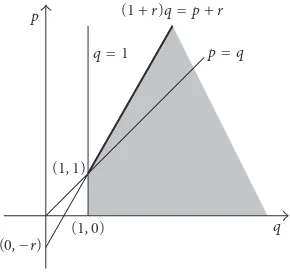
(1,1)
q=1
(1 +r)q=p+r
p=q
(1,0) (0,−r)
p
[image:4.468.162.307.72.209.2]q
Figure 2.1 The best possible domain for Furuta inequality.
Theorem2.4 (Furuta inequality [3] call it FI simply). IfA≥B≥0, then for eachr≥0,
(i)
Br/2ApBr/21/q
≥Br/2BpBr/21/q
, (2.9)
(ii)
Ar/2ApAr/21/q
≥Ar/2BpAr/21/q
(2.10)
hold forp≥0andq≥1with(1 +r)q≥p+r.
FI yields the following famous L¨owner-Heinz inequality by puttingr=0 in (i) or (ii) of FI. It was shown by Tanahashi [11] that the domain drawn forp,qandrinFigure 2.1 is the best possible for FI.
Theorem2.5 L¨owner-Heinz (L¨oner-Heinz inequality [7,10] call it L-H simply). Let1≥
α≥0.ThenA≥B≥0⇒Aα≥Bα.
Lemma2.6 [5]. Letα∈RandXbe invertible. Then(X∗X)α=X∗(XX∗)α−1Xholds,
espe-cially in caseα≥1Lemma 2.6holds without invertibility ofX.
Theorem2.7 [2,4,5,9]. LetA,B≥0such thatAα≥Bαforα >0. Then for eachq≥0and t≥0the following hold.
(1) ft,q(s)=
At/2BsAt/2(q+t)/(s+t)is decreasing fors≥q≥0. (2)gt,q(s)=Bt/2AsBt/2(q+t)/(s+t)is increasing fors≥q≥0.
Theorem2.8 [13]. LetTbe ap-hyponormal operator forp∈(0, 1]. Then
Tn∗
Tn1/n
≥ ··· ≥T2∗T21/2≥T∗T,
TT∗≥T2T2∗1/2≥ ··· ≥TnTn∗1/n (2.11)
Lemma2.9. IfTisp-hyponormal forp∈(k−1,k]wherekis a positive integer, then
T∗Tn+m2
T∗(n+1+p)/(n+1+m)
≥T∗Tn+m2(n+p)/(n+m)
T∗, (2.12)
|T|Tn+m∗2|T|)(n+1+p)/(n+1+m)≤ |T|Tn+m∗2(n+p)/(n+m)|T| (2.13)
hold for all positive integernandmsuch thatm≥k. Ifk=1, 2in addition, then
T∗Tn2(n+p)/nT∗
≥T∗Tn2
T∗(n+1+p)/(n+1)
, (2.14)
|T|Tn∗2(n+p)/n
|T| ≤|T||Tn∗2
|T|)(n+1+p)/(n+1) (2.15)
hold for all positive integern.
Proof ofLemma 2.9. Putγ=min{1,p}, then
Tn∗
Tnγ/n≥ ··· ≥T2∗T2γ/2≥T∗Tγ≥TT∗γ≥T2T2∗γ/2≥ ··· ≥TnTn∗γ/n (2.16)
holds byTheorem 2.8,p-hyponormality ofTand L-H.
Proof of (2.12). Since (|Tn+m|2/(n+m))γ≥(|T∗|2)γby (2.16), then for eacht≥0 andq≥0,
gt,q(s)=(|T∗|t|Tn+m|2s/(n+m)|T∗|t)(q+t)/(s+t)is increasing fors≥q≥0 byTheorem 2.7(2). Then by takingα=γ,t=1,q=n+pands=n+mwe have
T∗Tn+m2
T∗(n+1+p)/(n+1+m)
=T∗Tn+m2(n+m)/(n+m)T∗(n+1+p)/(n+1+m) =g1,n+p(n+m)
≥g1,n+p(n+p)
=T∗Tn+m2(n+p)/(n+m)T∗(n+p+1)/(n+p+1) =T∗Tn+m2(n+p)/(n+m)T∗.
(2.17)
Proof of (2.13). Since (|T|2)γ≥(|Tn+m∗
|2/(n+m))γby (2.16), similar to the proof of (2.12), (2.13) holds by takingα=γ,t=1,q=n+pands=n+minTheorem 2.7(1).
Proof of (2.14). Ifk=1, 2, then p∈(0, 1] or p∈(1, 2], thusγ+n≥γ+ 1≥p. So that
(1 +n/γ)((1 +n)/p)≥1/γ+n/γholds.
On the other hand, by applying (ii) ofTheorem 2.4to|Tn|2γ/nand|T∗|2γ for (1 +
n/γ)((1 +n)/p)≥1/γ+n/γ, we have
Tn2p/n
=Tn(2γ/n)(p/γ) ≥Tn(2γ/n)(n/2γ)
T∗2γ(1/γ)
Tn(2γ/n)(n/2γ)p/(n+1) =TnT∗2
Tnp/(n+1) ,
so that
T∗Tn2(n+p)/nT∗
=T∗TnTn2p/nTnT∗
≥T∗TnTnT∗2
Tnp/(n+1)
TnT∗
=T∗Tn2T∗(n+1+p)/(n+1).
(2.19)
Proof of (2.15). Since |T|2γ≥ |Tn∗|2γ/n by (2.16), similar to the proof of (2.14), (2.15) holds byLemma 2.6and takingp1=1/γ,r1=n/γandq1=(1 +n)/pinTheorem 2.4(i). Proof ofTheorem 2.1. Let T =U|T| be the polar decomposition ofT. Then it is well known that the polar decomposition ofT∗isT∗=U∗|T∗|.
Proof of (2.1). In casek=1, 2.
(i) We will prove that the following (2.20) holds for all positive integernby induction:
Tn+k∗
Tn+k(n+p)/(n+k)≥Tn∗
Tn(n+p)/n.
(2.20)
Firstly, we prove that (2.20) holds forn=1, that is, in casek=1,p∈(0, 1], then
T2∗
T2(1+p)/2
≥T∗Tp+1
(2.21)
and in casek=2,p∈(1, 2], then
T3∗T3(1+p)/3≥T∗Tp+1
. (2.22)
In casek=1, p∈(0, 1], since (T∗T)p≥(TT∗)p, by applying (i) ofTheorem 2.4to (T∗T)pand (TT∗)pfor (1 + (1/p))((1 + 1)/(1 +p))≥1/p+ 1/p, we have
T1+1∗T1+1(1+p)/(1+1)=U∗T∗T∗TT∗U(1+p)/(1+1)
=U∗T∗2p1/2p
|T|2p1/pT∗2p1/2p(1+p)/(1+1)
U
≥U∗T∗2p(1+p)/pU =U∗T∗2(1+p)
U
= |T|2(1+p) =T∗T1+p
,
(2.23)
so that (2.21) is proved.
In case k=2, if T is p-hyponormal for p∈(1, 2], then T is hyponormal (i.e., 1-hyponormal) by L-H; thusT2∗T2
≥(T∗T)2by (2.21), so (T2∗T2
ofTheorem 2.4to (T2∗T2
)p/2and (TT∗)pfor (1 + 1/p)((1 + 2)/(1 +p))≥2/p+ 1/p:
T1+2∗T1+2(1+p)/(1+2)=U∗T∗T2∗T2T∗U(1+p)/(1+2)
=U∗T∗2p1/2pT2p2/pT∗2p1/2p(1+p)/(1+2)
U
≥U∗T∗2p(1+p)/pU
=U∗T∗2(1+p)
U
=T2(1+p)
=T∗T1+p ,
(2.24)
so that (2.22) is proved.
Secondly, assumed that (2.20) holds for 1,...,n(≥1). We will prove that (2.20) holds forn+ 1.
In fact, we have
Tn+1+k∗Tn+1+k(n+1+p)/(n+1+k)=T∗Tn+k2T(n+1+p)/(n+1+k)
=U∗T∗Tn+k2T∗U(n+1+p)/(n+1+k)
=U∗T∗Tn+k2
T∗(n+1+p)/(n+1+k)
U
≥U∗T∗Tn+k2(n+p)/(n+k)T∗U
by (2.12)
≥U∗T∗Tn2(n+p)/(n)T∗U
by induction
≥U∗T∗Tn2
T∗(n+1+p)/(n+1)
U by (2.14)
=T∗Tn2
T(n+1+p)/(n+1)
=Tn+1∗Tn+1(n+1+p)/(n+1),
(2.25)
so that it is proved that (2.20) (i.e., casem=kof (2.1)) holds forn+ 1. (ii) We will prove that (2.1) holds form > k.
Ifk=1,p∈(0, 1], thenm >1 and by (2.20) we have
Tn+m∗
Tn+m(n+m−1+p)(n+m)≥Tn+m−1∗Tn+m−1(n+m−1+p)/(n+m−1),...,
Tn+2∗Tn+2(n+1+p)/(n+2)≥Tn+1∗Tn+1(n+1+p)/(n+1),
Tn+1∗Tn+1(n+p)/(n+1)≥Tn∗Tn(n+p)/n,
thus by L-H we have
Tn+m∗Tn+m(n+p)/(n+m)≥Tn+m−1∗Tn+m−1(n+p)/(n+m−1)≥ ···
≥Tn+1∗
Tn+1(n+p)/(n+1)≥Tn∗
Tn(n+p)/n. (2.27)
Ifk=2,Tisp-hyponormal forp∈(1, 2], thenTis hyponormal (i.e., 1-hyponormal) by L-H; thus
Tn+1∗Tn+1≥Tn∗Tn(n+1)/n (2.28)
holds by casek=1 andp=1 of (2.20), so we have
Tn+m∗Tn+m≥Tn+m−1∗Tn+m−1(n+m)/(n+m−1),...,
Tn+3∗Tn+3≥Tn+2∗Tn+2(n+3)/(n+2),
Tn+2∗
Tn+2(n+p)/(n+2)≥Tn∗
Tn(n+p)/n
(2.29)
by (2.28) and (2.20) (the last inequality holds by (2.20)), so that the following holds by L-H:
Tn+m∗Tn+m(n+p)/(n+m)≥Tn+m−1∗Tn+m−1(n+p)/(n+m−1)
≥ ··· ≥Tn+2∗
Tn+2(n+p)/(n+2)≥Tn∗
Tn(n+p)/n. (2.30)
Consequently, the proof of (2.1) is complete by combining (i) and (ii).
Proof of (2.2). The proof is similar to the proof of (2.1), so we omit it here.
Proof of (2.3). Ifk=2, we only need to showTn+1∗Tn+1
≥(Tn∗Tn)(n+1)/n, this is just (2.28), so that (2.3) holds fork=2.
Ifk=3, we need to showTn+1∗Tn+1≥(Tn∗Tn)(n+1)/nandTn+2∗Tn+2≥(Tn∗Tn)(n+2)/n. In fact T is p-hyponormal for p ∈(2, 3], then T is 1-hyponormal by L-H; thus
Tn+1∗Tn+1≥(Tn∗Tn)(n+1)/n holds by casek=1 and p=1 of (2.1); similarly, T is p -hyponormal for p ∈(2, 3], then T is 2-hyponormal by L-H; thus Tn+2∗Tn+2 ≥ (Tn∗Tn)(n+2)/nholds by casek=2,p=2 andm=2 of (2.1), so that (2.3) holds.
Proof of (2.4). The proof is similar to that of (2.3), so we omit it here.
Proof ofCorollary 2.2. We have (i) by the process of the proof of (2.1) and (2.2). (ii) is
3. Estimation on powers ofp-hyponormal andlog-hyponormal operators
The followingTheorem 3.1which is an estimation on powers ofp-hyponormal operators forp >0 implies the best possibility ofTheorem 2.1.
Theorem3.1. Letk,nandmbe positive integers,p∈(k−1,k]andα >1.
(1)In casem≥pthe following hold.
(i)There exists ap-hyponormal operatorTsuch that
Tn+m∗
Tn+m(n+p)α/(n+m) ≥Tn∗
Tn(n+p)α/n.
(3.1)
(ii)There exists ap-hyponormal operatorTsuch that
TnTn∗(n+p)α/n
≥Tn+mTn+m∗(n+p)α/n+m.
(3.2)
(2)In casem < pthe following hold.
(i)There exists ap-hyponormal operatorTsuch that
Tn+m∗
Tn+mα≥Tn∗
Tn(n+m)α/n.
(3.3)
(ii)There exists ap-hyponormal operatorTsuch that
TnTn∗(n+m)α/n
≥Tn+mTn+m∗α. (3.4)
The followingTheorem 3.2which is a parallel result toTheorem 3.1implies the best possibility ofTheorem 1.4.
Theorem3.2. Letα >1. Then the following hold for each positive integernandm.
(i)There exists a log-hyponormal operatorTsuch that(Tn+m∗Tn+m
)nα/(n+m)≥(Tn∗Tn )α.
(ii)There exists a log-hyponormal operatorTsuch that(TnTn∗)α≥(Tn+mTn+m∗)nα/(n+m). We need the following results to show Theorems3.1and3.2.
Theorem3.3 [12,14]. Letδ >0, p >0,r >0,andq >0. If0< q <1or(δ+r)q < p+r,
then the following assertions hold.
(i)There exist positive invertible operatorsAandBonR2such that
Aδ≥Bδ, Br/2ApBr/21/q
≥B(p+r)/q. (3.5)
(ii)There exist positive invertible operatorsAandBonR2such that
Theorem3.4 [14]. Letp >0,r >0,andq >0. Ifrq < p+r, then the following assertions
hold.
(i)There exist positive invertible operatorsAandBonR2such that
logA≥logB, Br/2ApBr/21/q≥B(p+r)/q. (3.7)
(ii)There exist positive invertible operatorsAandBonR2such that
logA≥logB, A(p+r)/q≥Ar/2BpAr/2)1/q. (3.8)
Lemma3.5. For positive operatorsAandBonH, define an operatorTon∞k=−∞Hkwhere
Hk∼=Has follows:
⎛ ⎜ ⎜ ⎜ ⎜ ⎜ ⎜ ⎜ ⎜ ⎜ ⎜ ⎜ ⎜ ⎜ ⎜ ⎜ ⎜ ⎝
. .. . .. 0
B1/2 0
B1/2 (0)
A1/2 0
A1/2 0
. .. ...
⎞ ⎟ ⎟ ⎟ ⎟ ⎟ ⎟ ⎟ ⎟ ⎟ ⎟ ⎟ ⎟ ⎟ ⎟ ⎟ ⎟ ⎠
, (3.9)
where(·)shows the place of the(0, 0)matrix element. Then the following assertions hold.
(i)Tisp-hyponormal forp >0if and only ifAp≥Bp.
(ii)Tislog-hyponormal if and only ifAandBare invertible andlogA≥logB.
Furthermore, the following assertions hold forβ >0and any positive integernandm:
(iii) (Tn+m∗Tn+m)β/(n+m)≥(Tn∗Tn)β/nif and only if
Bl/2An+m−lBl/2β/(n+m)≥Bl/2An−lBl/2β/n holds forl=1, 2,...,n−1.
Bl/2An+m−lBl/2β/(n+m)≥Bβ holds forl=n,n+ 1,...,n+m−1. (3.10)
(iv) (TnTn∗)β/n≥(Tn+mTn+m∗)β/(n+m)if and only if
Aj/2Bn−jAj/2β/n≥Aj/2Bn+m−jAj/2β/(n+m) holds forj=1, 2,...,n−1.
Aβ≥Aj/2Bn+m−jAj/2β/(n+m) holds forj=n,n+ 1,...,n+m−1.
Proof. By easy calculation, we have
T∗T=
⎛ ⎜ ⎜ ⎜ ⎜ ⎜ ⎜ ⎜ ⎜ ⎜ ⎜ ⎜ ⎜ ⎝ . .. B B
(A)
A A . .. ⎞ ⎟ ⎟ ⎟ ⎟ ⎟ ⎟ ⎟ ⎟ ⎟ ⎟ ⎟ ⎟ ⎠
, TT∗=
⎛ ⎜ ⎜ ⎜ ⎜ ⎜ ⎜ ⎜ ⎜ ⎜ ⎜ ⎜ ⎜ ⎝ . .. B B
(B)
A A . .. ⎞ ⎟ ⎟ ⎟ ⎟ ⎟ ⎟ ⎟ ⎟ ⎟ ⎟ ⎟ ⎟ ⎠ , (3.12) so that (i) is obvious by comparing the two (0,0) elements of (T∗T)pand (TT∗)p, sim-ilarly, (ii) is obvious by comparing the two (0,0) elements of logT∗Tand logTT∗. Fur-thermore, the following hold forn≥2:
Tn∗
Tn=
⎛ ⎜ ⎜ ⎜ ⎜ ⎜ ⎜ ⎜ ⎜ ⎜ ⎜ ⎜ ⎜ ⎜ ⎜ ⎜ ⎜ ⎜ ⎜ ⎜ ⎜ ⎜ ⎜ ⎜ ⎝ . .. Bn Bn
B(n−1)/2AB(n−1)/2 . ..
Bl/2An−lBl/2 . ..
B1/2An−1B1/2
An An . .. ⎞ ⎟ ⎟ ⎟ ⎟ ⎟ ⎟ ⎟ ⎟ ⎟ ⎟ ⎟ ⎟ ⎟ ⎟ ⎟ ⎟ ⎟ ⎟ ⎟ ⎟ ⎟ ⎟ ⎟ ⎠ (3.13)
so that we have (iii) by comparing the corresponding elements of (Tn+m∗Tn+m)β/(n+m) and (Tn∗Tn)β/n,
TnTn∗ = ⎛ ⎜ ⎜ ⎜ ⎜ ⎜ ⎜ ⎜ ⎜ ⎜ ⎜ ⎜ ⎜ ⎜ ⎜ ⎜ ⎜ ⎜ ⎜ ⎜ ⎜ ⎜ ⎜ ⎜ ⎝ . .. Bn Bn
A1/2Bn−1A1/2 . ..
Aj/2Bn−jAj/2 . ..
A(n−1)/2BA(n−1)/2
so that we have (iv) by comparing the corresponding elements of (TnTn∗)β/n and (Tn+mTn+m∗
)β/(n+m).
Proof ofTheorem 3.1. Put p1=m >0, r1=n >0, q1=(n+m)/(n+p0)α where p0= min{p,m}, andδ=p >0, then we haveq1<1 whenm < p; (δ+r1)q1=(n+p)((n+
m)/(n+p)α)< n+m=p1+r1whenm≥p.
By (i) ofTheorem 3.3, there exist positive invertible operatorsAandBonR2such that
Aδ≥Bδand (Br1/2Ap1Br1/2)1/q1≥B(p1+r1)/q1, that is,
Ap≥Bp, (3.15)
Bn/2AmBn/2)(n+p0)α/(n+m)≥B(n+p0)α. (3.16)
Define an operatorTon∞k=−∞HkwhereHk∼=R2as (3.9). ThenTisp-hyponormal by (3.15) and (i) ofLemma 3.5, and (Tn+m∗Tn+m
)(n+p0)α/(n+m)≥(Tn∗Tn
)(n+p0)α/n by (iii) of Lemma 3.5since the casel=nof (3.10) does not hold forβ=(n+p0)αby (3.16), so that Theorems3.1(1)(i) and3.1(2)(i) hold.
By (ii) ofTheorem 3.3, there exist positive invertible operatorsAandBonR2 such thatAδ≥BδandA(p1+r1)/q1≥(Ar1/2Bp1Ar1/2)1/q1, that is,
Ap≥Bp, (3.17)
A(n+p0)α≥An/2BmAn/2(n+p0)α/(n+m). (3.18)
Define an operatorTon∞k=−∞HkwhereHk∼=R2as (3.9). ThenTisp-hyponormal by (3.17) and (i) ofLemma 3.5, and (TnTn∗)(n+p0)α/n≥(Tn+mTn+m∗)(n+p0)α/(n+m) by (iv) of Lemma 3.5since the casej=nof (3.11) does not hold forβ=(n+p0)αby (3.18), so that
Theorems3.1(1)(ii) and3.1(2)(ii) hold.
Proof ofTheorem 3.2. Put p1=m >0,r1=n >0,q1=(n+m)/nα, then we haver1q1= (n+m)/α < n+m=p1+r1.
By (i) ofTheorem 3.4, there exist positive invertible operatorsAandBonR2such that
logA≥logB (3.19)
and (Br12Ap1Br1/2)1/q1≥B(p1+r1)/q1, that is,
Bn/2AmBn/2nα/(n+m)
≥Bnα (3.20)
By (ii) ofTheorem 3.4, there exist positive invertible operatorsAandBonR2 such that
logA≥logB (3.21)
andA(p1+r1)/q1≥(Ar1/2Bp1Ar1/2)1/q1, that is,
Anα≥An/2BmAn/2nα/(n+m). (3.22)
Define an operatorTon∞k=−∞HkwhereHk∼=R2as (3.9). ThenTis log-hyponormal by (3.21) and (ii) of Lemma 3.5, and (TnTn∗)nα/n≥ (Tn+mTn+m∗)nα/(n+m) by (iv) of Lemma 3.5 since the case j=nof (3.11) does not hold forβ=nαby (3.22), so that
Theorem 3.2(ii) and holds.
Acknowledgments
We would like to express our cordial gratitude to the referee for his valuable advice and suggestions. This work was supported in part by Education Foundation of Henan Province (2003110006).
References
[1] A. Aluthge and D. Wang,Powers ofp-hyponormal operators, Journal of Inequalities and Appli-cations3(1999), no. 3, 279–284.
[2] M. Fujii, T. Furuta, and E. Kamei,Furuta’s inequality and its application to Ando’s theorem, Linear Algebra and its Applications179(1993), 161–169.
[3] T. Furuta,AB0assures(BrAPBr)1/qBp+2qrforr0,p0,q1with(1 + 2r)qp+ 2r,
Proceedings of the American Mathematical Society101(1987), no. 1, 85–88.
[4] ,Applications of order preserving operator inequalities, Operator Theory and Complex
Analysis (Sapporo, 1991), Oper. Theory Adv. Appl., vol. 59, Birkh¨auser, Basel, 1992, pp. 180– 190.
[5] ,Extension of the Furuta inequality and Ando-Hiai log-majorization, Linear Algebra and its Applications219(1995), 139–155.
[6] T. Furuta and M. Yanagida,On powers ofp-hyponormal and log-hyponormal operators, Journal of Inequalities and Applications5(2000), no. 4, 367–380.
[7] E. Heinz,Beitr¨age zur St¨orungstheorie der Spektralzerlegung, Mathematische Annalen123(1951), 415–438 (German).
[8] M. Ito,Generalizations of the results on powers ofp-hyponormal operators, Journal of Inequalities and Applications6(2001), no. 1, 1–15.
[9] E. Kamei,A satellite to Furuta’s inequality, Mathematica Japonica33(1988), no. 6, 883–886. [10] K. L¨owner,Uber monotone Matrixfunktionen¨ , Mathematische Zeitschrift38(1934), no. 1, 177–
216 (German).
[11] K. Tanahashi,Best possibility of the Furuta inequality, Proceedings of the American Mathematical Society124(1996), no. 1, 141–146.
[12] ,The best possibility of the grand Furuta inequality, Proceedings of the American Mathe-matical Society128(2000), no. 2, 511–519.
[14] M. Yanagida,Some applications of Tanahashi’s result on the best possibility of Furuta inequality, Mathematical Inequalities & Applications2(1999), no. 2, 297–305.
Changsen Yang: College of Mathematics and Information Science, Henan Normal University, Xinxiang 453007, China
E-mail address:[email protected]
Jiangtao Yuan: College of Mathematics and Information Science, Henan Normal University, Xinxiang 453007, China