14th International Conference on Wireless Communications, Networking and Mobile Computing (WiCOM 2018) ISBN: 978-1-60595-578-0
Impact Analysis of Node Motion on the Performance of
FANET Routing Protocols
Jie Hong1,2, Dehai Zhang3 and Xiaona Niu4
ABSTRACT
The purpose of this paper is to analyze the impact of node motion on the performance of routing protocols of Flying Ad Hoc Network (FANET). Whether the classic MANET routing protocols are suitable for the highly dynamic scenarios is discussed based on experiments. Simulations are carried out in three mobility models summarized from real FANET application scenarios with highly dynamic environment. The concerned network performance metrics including average end-to-end delay, packet delivery fraction, network throughput and average jitter are compared respectively. The network shows different performance of different mobility models under the same conditions, the reason for which is that nodes do not have the same mobility behaviors.This paper reveals that the variation of the network topology caused by the relative speed of nodes is the main reason of the fluctuation of network performance.
Keywords: FANET, multi UAVs, high dynamic, mobility model, performance metrics
1. INTRODUCTION
Flying Ad-Hoc Network (FANET)[1] is defined as a combination of multi-UAVs (Unmanned Air Vehicles) and ad hoc networking through which UAVs-to-UAVs communications via ad hoc manners are commonly utilized
1
CAS Key Laboratory of Microwave Remote Sensing, National Space Science Center, Chinese Academy of Sciences, Beijing 100190, China
2
University of Chinese Academy of Sciences. Address: Haidian District, Beijing Zhongguancun South 2 on the 1st, Beijing 100049, China
(E-mail: [email protected]) 3
CAS Key Laboratory of Microwave Remote Sensing, National Space Science Center, Chinese Academy of Sciences, Address: Haidian District, Beijing Zhongguancun South 2 on the 1st, Beijing 100049, China. Beijing 100190, China
(Email: [email protected]) 4
without any infrastructures. Different from the traditional mobile ad hoc network (MANET), the prominent feature of FANET[2] is the highly dynamic scenario, which means nodes move in higher mobility and meanwhile the network topology changes faster, so protocols under such conditions are more challenging. Whether the classical MANET routing protocols are suitable for FANET? Among them which performs better in high dynamic circumstance? How nodes mobility affects network performance? Most of themare worthy of in-depth discussion.In this paper only the UAV-to-UAV communications are discussed. Each UAV is considered as a node with communication and routing functions in the wireless network.
This paper aims to answer questions above and to reveal relationships between node motion and the performance of routing protocols of FANET. To reveal why and how node mobility affect network performance, three typical mobility scenarios are summarized firstly according to real application scenarios of FANET. Then several experiments are designed and implemented in different mobility models and different node speed. Finally impacts and reasons on node motion to network performance are analyzed. The main contributions of this paper are: ⑴. Three typical mobility models suitable for FANET application scenarios are summarized; ⑵. Performances of traditional MANET route protocols in high dynamic scenario are discussed and compared. ⑶. Impacts and reasons of node motion on network performance are analyzed and concluded.
The remainder of this paper is organized as follows. In section 2 mobility models suitable for FANET are summarized. In section 3 the selected classic routing protocols of MANET are introduced. The related research work is elaborated in section 4. Simulations results are put forward in section5. Section 6 presents performance evaluation and analysis. Section 7 is conclusions and future work.
2. TYPICAL SCENARIOS AND MOBILE MODELS
TABLE I. APPLICATIONSCENARIOSOF FANET AND CORRESPONDING
MOBILITY MODELS.
Scenario mode Typical applications Nodes motion patterns Mobility model
Search Aerial photography,Resource
exploration, disaster
inspection, military
reconnaissance,
Individual, random,
no clear target
RWP[12]
Cruise Anti-terrorist rescue, Forest
fire prevention
move in groups,
static single or multiple
targets
RPGM[15]
Target tracking Military strike, Crime tracking move in groups, moving
target
Pursue model[15]
RWP (Random Waypoint) [12] mobility model belongs to Individual Mobility Models and has been the most commonly used mobility model in ad hoc network simulations. The analytical model of RWP has been proposed in [12]. The limitations of RWP are temporal dependency of velocity, spatial dependency of velocity and geographic restrictions of movement. In this paper the searching scenario is simplified to the RWP model.
RPGM (Reference point group mobility)[15] is a typical kind of group mobility models. It organizes mobile hosts into groups according to their local relationships. In RPGM model nodes can be divided to one or more groups. Each group has a logical “center” as the reference center whose movement is followed by all nodes in the group. Each node is assigned a reference point which follows the group movement.
PURSUE mobility [15] represents the mobility model where several mobile nodes pursue to capture a particular mobile target. The target mobile node moves randomly as if it is the reference point for a group. Actually the pursue mobility model is a special form of RPGM.
3. PROTOCOL DESCRIPTIONS
distance vector table to its neighbors, meanwhile updates its routing table in the light of the received distance vector broadcasts from the neighbor nodes on the basis of the minimum distance principle.
In OLSR (Optimized Link State Routing)[4],the concept of MPR (multi-point relay) node is of vital importance. Only the nodes within two-hop region in neighbors could be chosen to be the MPR nodes. Link state updates only disseminate between the MPR selector and the MPRs, which ensures the smaller updates size. Link state updates of a node are fractional and periodical, but each node must record the whole network topology structure, thus resulting in the large routing overhead.
Combining the source route of dynamic source routing and the route table of the DSDV protocol, AODV (Ad hoc On-demand Distance Vector)[5] uses the on-demand mechanism in routing discovery, but as to route maintaining, it adopts the routing table and the sequence number as in DSDV.
Each of the above agreements has its own characteristics and which is more suitable for high dynamic scenes, and no related literature has been seen yet. This paper will give answers through experiments and make analysis on it.
4. RELATED WORK
Most of the related routing protocol comparisons are scenario related, a considerable part of which is partial and not comprehensive enough. The limitations of the above are: ① They compared routing protocols from different perspectives, but their simulation scenarios and parameters were quite different from FANET's real scenarios, such as nodes movement speed and pause time. These parameters above could not make a complete reflection of the scenario of FANET.② Most of the comparisons are made in single scene or by one protocol. ③ There is no combination of protocols and mobility in the above literatures.
In this paper the simulation are considered and discussed more comprehensively and scenarios are more suitable for FANET and comparisons are made by combing factors of mobility and protocols together.
5. SIMULATION AND RESULTS
5.1 Parameter Descriptions
There are some prerequisites of the simulations. All the nodes can communicate directly within a certain transmission range. The transmission range of nodes is supposed as a circle with the radius of R. All nodes have enough energy to support its communication hardware. Only 2D scenarios are discussed here.
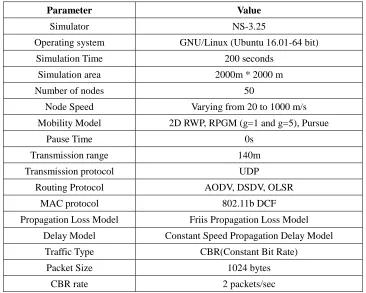
Simulations are carried out by using the customized discrete event driven simulator, Network Simulator (NS-3.25) [14], which is an object network test bed in C++, under the Ubuntu Linux operating system. 50 different mobile nodes are randomly distributed in a square field of 2000m * 2000m for 200 seconds simulation time. Each round of simulation ends after 200 seconds and in the next round the nodes speed will be faster with the step of 50. To get more obviously trend the speed of 20 m/s is especially added. The simulation repeats until the nodes speed is up to 1000 m/s. Nodes move in four ways: RWP, RPGM (group number equals 1 and 5 respectively) and Pursue Model. Both the RPGM and the Pursue model are generated by the mobility simulation tool, Bonnmotion (version 3.1)[17].The pause time is set to zero.
and the data rate is set to 2 packets per second for minimizing the influence of data traffic on network performance. Simulation parameters are listed in TABLE II.
TABLE II. BASIC SIMULATION PARAMETERS.
Parameter Value
Simulator NS-3.25
Operating system GNU/Linux (Ubuntu 16.01-64 bit)
Simulation Time 200 seconds
Simulation area 2000m * 2000 m
Number of nodes 50
Node Speed Varying from 20 to 1000 m/s
Mobility Model 2D RWP, RPGM (g=1 and g=5), Pursue
Pause Time 0s
Transmission range 140m
Transmission protocol UDP
Routing Protocol AODV, DSDV, OLSR
MAC protocol 802.11b DCF
Propagation Loss Model Friis Propagation Loss Model
Delay Model Constant Speed Propagation Delay Model
Traffic Type CBR(Constant Bit Rate)
Packet Size 1024 bytes
CBR rate 2 packets/sec
5.2 Simulation Results
The first experiment is implemented by using each route protocol and varying node velocity in the same mobility model. In the second experiment, the same performance metrics[12]including network throughput, packet delivery ratio, end-to-end delay and average Jitter are measured under the same condition in different mobile models.
5.2.1 COMPARISONS AMONG ROUTING PROTOCOLS
the highest average value and much higher than the others. In Pursue and RPGM (g=1) AODV has the lower value and DSDV and OLSR are up to 100%.
Average End-to-End Delay comparison is illustrated in Figure.2.The results revel two phenomena of the overall rising trend (in RWP and RPGM (g=5)) or smoothing trend (in Pursue and RPGM (g=1)). The former shows the significant differences among each protocol. In RWP, the increasing of OLSR is the most obvious and AODV is the slowest. In RPGM(g=5), the trend of AODV is gentle but when speed is more than 350m/s, it is overtaken by OLSR. DSDV is keeping smoothly increasing and has a moderate value. In the latter, the tendency is stable.
Figure1-(a).In RWP ModelFigure1-(b).In RPGM with g=1
Figure1-(c).In RPGM with g=5Figure1-(d). In Pursue Model
Figure2-(a)In RWP ModelFigure2-(b). In RPGM with g=1
Figure2-(c).In RPGM with g=5Figure2-(d). In Pursue Model
Figure 2. Average End-to-End Delay vs. Node Speed.
Network Throughput is showed in Figure 3. AODV has the highest value in any model at any speed. Throughput of AODV has an obvious descending trend in RWP and a comparatively stable trend in others. DSDV and OLSR have no obvious differences both numerically and on trends.
Figure.3-(a).In RWP ModelFigure.3-(b).In RPGM with g=1
[image:9.612.105.465.93.224.2]Figure.3-(c).In RPGM with g=5Figure.3-(d). In Pursue Model
Figure 3. Network Throughput (Kbps) vs. Node Speed.
[image:9.612.99.467.104.351.2] [image:9.612.100.473.253.386.2] [image:9.612.108.480.472.607.2]Figure.4-(c).In RPGM with g=5Figure.4-(d). In Pursue Model
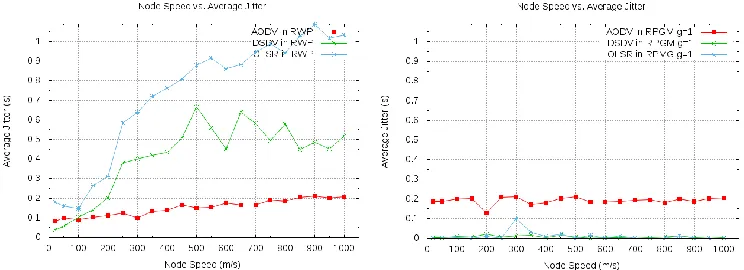
Figure 4. Average Jitter vs. Node Speed.
5.2.2 COMPARISONS AMONG MOBILITY MODELS
Packet Delivery Ratio. As is shown in Figure 5 ,packet delivery ratio ranking of AODV in different scenarios is Pursue >RPGM (g=1) > RPGM(g=5) > RWP. As to DSDV, the ranking is Pursue=RPGM (g=1) > RPGM (g=5) >RWP, OLSR the same. Results show that the ranking of packet delivery ratio is in the same order no matter what kind of protocol is. So the difference in packet delivery ratio comes from the difference of node mobile patterns.
Average End-to-End Delay. In Figure 6, when using AODV protocol the end-to-end delay in RWP is the lowest and growing more obvious than it in others. But for DSDV and OLSR, the conclusion is the opposite. The delay in RWP is more higher than in RPGM(g=1) and far more than in RPGM(g=5) and Pursue.
Network Throughput. In figure 7 the throughput changes significantly when using AODV protocol. It declines much in RWP model. When using DSDV and OLSR, the delay is more stable at its upper limit value. The ranking is Pursue > RPGM (g=1) >RPGM(g=5) > RWP.
[image:10.612.106.482.98.234.2]Figure.5-(a).AODV Figure.5-(b). DSDVFigure.5-(c).OLSR
Figure 5. Packet Delivery Ratio among different mobility models.
Figure.6-(a).AODVFigure.6-(b).DSDVFigure.6-(c).OLSR
Figure 6. Average End-to-end Delay among different mobility models.
Figure.7-(a).AODV Figure.7-(b).DSDV Figure.7-(c).OLSR
Figure 7. Network Throughput (Kbps) among different models.
[image:11.612.95.472.87.182.2] [image:11.612.111.482.237.329.2] [image:11.612.107.484.393.493.2] [image:11.612.107.485.547.656.2]6. ANALYSIS
6.1 Whether Traditional MANET Protocols are Suitable for High Dynamic Scenarios?
Simulation results reveal that the metrics have inner connections and are interrelated with each other. The protocols exhibit completely different performance on the delay and Jitter value at different speeds in RWP. The performance of the protocols in different motion modes is completely different too. The effect of node mobility on performance is higher than the effect of node speed on performance.
AODV is stable, OLSR is vulnerable, and DSDV is moderate. Among them AODV performs better and is more suitable for highly dynamic scenarios. The jitter of AODV is less affected by the mobility pattern and node speed. The other metrics of AODV have a clear trend when nodes speed and mobile pattern changes. The performance is relatively stable because of the reactive intrinsic mechanism. DSDV and OLSR are barely affected by the mobility model in terms of packet delivery ratio and throughput at high speeds. However, their delay and jitter value are very large at RWP and RPGM (g=5), and OLSR is more prominent with not only of large value but also of fast growth. DSDV also has this trend but the value is smaller. The inner mechanisms of OLSR and DSDV make them more sensitive to mobility models than to speed on delay and jitter.
6.2 Analysis of Mobility on Topology and Routing Performance
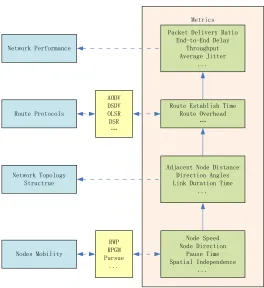
This issue will be discussed from the three aspects: mobility metrics, network topology metrics and route performance metrics.
the packet delivery ratio are more concerned because of their application oriented feature. Link stability and duration affects every indicator from the definitions.
Network topology metrics including connectivity metrics, coverage metrics, neighbor nodes metricsetc. These network topological features [12] reflect the network topology structure and connectivity. Among them the link duration time is closely related to mobility metrics.
Mobility metrics. Direct mobility metrics [12] can be measured directly including node distance, node speed, node direction and pause time etc. Derived mobility metrics are defined by using mathematical formulas including spatial dependency[15,16], temporal dependency and relative speed etc. [16] illustrated only the Degree of Spatial Dependence and average Relative Speed (RS) have been proved to measure different mobility models successfully. However, these metrics could not fully reveal the reasons for the impact of mobility on performance.
Movement causes changes in the distance and directions among nodes. The establishment and maintenance time of the route path largely depends on the distance and direction between adjacent nodes. The movement between nodes causes real-time changes in the distance and direction between nodes, which ultimately affects the network topology, and the network structure directly affects the continuity of the route. The breakage of the route path then directly affects the concerned network performance. It shows different performance by using the same protocol in different models due to different node motion behaviors.
Metrics
Nodes Mobility Network Performance
Network Topology Structrue
Adjacent Node Distance Direction Angles Link Duration Time
... Packet Delivery Ratio
End-to-End Delay Throughput Average Jitter
...
Route Protocols
[image:14.612.164.428.87.375.2]Route Establish Time Route Overhead … Node Speed Node Direction Pause Time Spatial Independence ... AODV DSDV OLSR DSR … RWP RPGM Pursue ...
Figure 9. Relationship among node mobility, network structure and performance.
7. CONCLUSIONS AND FUTURE WORK
According to the simulation results and the analysis above, conclusions can be summarized as below:
⑴In high speed the DSDV and OLSR protocols have perfect performance on end-to-end delay in Pursue model and RPGM (g=1) model due to the small relative speed of each node.In RWP and RPGM (g=5), AODV outperforms the other two. Whether a routing algorithm is suitable to the environment needs to refer to the application scenario.
⑵Node speed is not a major factor affecting performance. Rapid changes in topology caused by high-speed relative motion of nodes are the main reason for network performance changes.
Routing in the harsh scenarios still needs in-depth discussions. Solutions to the FANET will focus on minimize the high packets losing ratio. How to capture network topology changes quickly and accurately is the crux of the problem. Reliable metric needs to be proposed to measure network topology changes and the future work will focus on the network topology change aware and the substitute policy on routes discovery and maintenance.
REFERENCES
1. Bekmezci, I., Sahingoz, O.K. and Temel, S. 2013. “Flying Ad-Hoc Networks (FANETs): a survey”. Ad Hoc Netw. 11(3):1254–1270.
2. OzgurKoraySahingoz.2014. “Networking Models in Flying Ad-Hoc Networks (FANETs): Concepts and Challenges”, Journal of Intelligent & Robotic Systems,74:513-527.
3. C. E. Perkins and P. Bhagwat, August 1994. “Highly Dynamic Destination-Sequenced Distance-Vector Routing (DSDV) for Mobile Computers”.In Proceedings of ACM SIGCOMM, pp. 234-244.
4. T. Clausen, P. Jacquet.October 2003. “Optimized Link State Routing Protocol (OLSR)”, RFC 3626 (Experimental).https://www.ietf.org/rfc/rfc3626.txt..pdf
5. C.E. Perkins, E.M. Royer.1999.“Ad-hoc on-demand distance vector routing”, IEEE Workshop on Mobile Computing Systems and Applications (1999) 90, 25-26 Feb. 1999. 6. Samir R.Das, RobertCastañeda and JiangtaoYan.2000.“Simulation-based performance
evaluation of routing protocols for mobile ad hoc networks”. Mobile Networks and Applications.5 (2000).pp.179–189
7. S. R. Das, C. E. Perkins and E. M. Royer.2000. “Performance comparison of two on-demand routing protocols for ad hoc networks”, Proceedings IEEE INFOCOM 2000.Conference on Computer Communications.Nineteenth Annual Joint Conference of the IEEE Computer and Communications Societies.26-30 March 2000.
8. A. Tuteja, R. Gujral and S. Thalia. 2010. “Comparative Performance Analysis of DSDV, AODV and DSR Routing Protocols in MANET Using NS2”, 2010 International Conference on Advances in Computer Engineering.20-21 June 2010.
9. S.MohapatraandP.Kanungo, “Comparative Performance Analysis of MANET Routing Protocols Using NS2 Simulator”. November 7-8 2011.Computational Intelligence and Information Technology: First International Conference, CIIT 2011, Pune, India ,CIIT 2011, CCIS 250, pp. 731–736.
10. BanojKumarpanda, Bibhudatta Dash, Rupanita DasandAjitSarangi.“Mobility and its impact on Performance of AODV and DSR in Mobile Ad hoc Network”.2012.Third Asian Himalayas International Conference on Internet. 23-25 Nov. 2012.
11. S H Manjula, C N Abhilash, Shaila K, K R Venugopal and L M Patnaik. 19 -21 March 2008. “Performance of AODV Routing Protocol Using Group and Entity Mobility Models in Wireless Sensor Networks”.Proceedings of the International MultiConference of Engineers and Computer Scientists 2008 Vol II, IMECS.
12. RadhikaRanjan Roy,2011.“Handbook of Mobile Ad Hoc Networks for Mobility Models”, Springer New York Dordrecht Heidelberg London. pp. 65, pp637, pp.664.
15. Xiaoyan Hong, Mario Gerla, Guangyu Pei and Ching-Chuan Chiang.1999.A Group Mobility Model for Ad Hoc Wireless Networks. In Proceedings of the 2nd ACM international workshop on modeling, analysis and simulation of wireless and mobile systems. pp.53 -60. 16. Fan Bai a, Narayanan Sadagopan b, Ahmed Helmy. 2003. “The IMPORTANT framework
for analyzing the Impact of Mobility on Performance of RouTing protocols for AdhocNeTworks”. Ad Hoc Networks.1 (2003).pp.383–403.