2018 International Conference on Applied Mechanics, Mathematics, Modeling and Simulation (AMMMS 2018) ISBN: 978-1-60595-589-6
Integrated Multi-project Scheduling and Worker Allocation for the
Assembly of Steam Turbines
Chun JIANG, Xiao-feng HU*, Teng-fei JIN and Jun-tong XI
School of Mechanical Engineering, Shanghai Jiao Tong University, Shanghai 200240, China
*Corresponding author
Keywords: Multi-project scheduling, Worker allocation, Steam turbine.
Abstract. The steam turbine is typically an engineer-to-order product, the assembly of steam turbine is mainly performed by a group of workers. In this paper, we investigate the integrated multi-project scheduling and worker allocation for the assembly of steam turbine. These two problems are interrelated as the tasks durations are not predefined, but depend on the number of workers assigned to that task as well as their skill levels. We develop a mathematical model to represent the problem. In order to solve with the minimization of makespan as the objective, we propose the hybrid algorithm combining particle swarm optimization (PSO) and simulated annealing (SA). The proposed algorithm is tested on the case that uses industrial data from a steam turbine company. The experimental results show that the solution quality of the hybrid algorithm outperform the other three traditional metaheuristic algorithms.
Introduction
Engineer-to-order (ETO) products are manufactured and assembled in low volume to satisfy individual customers specifications[1]. The steam turbine is typically an engineer-to-order product, the assembly of steam turbine is mainly performed by a group of workers. Several products are assembled in parallel and in sequence, so that the number of workers assembling a product may vary. The release times and due dates of products are determined by a higher level production plan[2].
Project scheduling problem, scheduling a set of precedence-constrained tasks, where each task requires a set of resources to be performed, and the worker allocation problem which includes assigning workers as scare resources to the need of each task. The two problems are interrelated as the task durations are not predefined, but depend on the number of workers assigned to that task as well as their skill levels.
The decision problem is to determine the sequence of tasks and allocate the workers to the activity step in a multi-project environment in order to minimize the maximum completion time, i.e., the makespan. Due to its combinatorial nature, scheduling problems are computationally very complex and difficult to solve. Therefore, it is not always possible to find an optimal solution in a reasonable amount of time. Metaheuristics methods, such as genetic algorithm (GA), particle swarm optimization (PSO), and simulated annealing (SA), have been widely used to solve the static scheduling problems[3].The methods mentioned above have their different metrics and shortcomings. If we take the combination of several methods into account properly, a better balance between quality and efficiency may be achieved. Considering the convergence ability of the PSO and the exploitation ability of SA, in this study, we propose a hybrid discrete algorithm combined PSO with SA for solving this problem.
Literature Review
The resource-constrained project scheduling problem(RCPSP) is a classical problem in operation research, it has been proven to be NP-hard[4].The multi-mode resource-constrained multi-project scheduling problem(MRCMPSP) has a considerable practical relevance, especially in the manufacturing industry. It is a large combinational optimization problem. But it has not received much attention until Wauters[5] choose the the subject of the Multidisciplinary International Scheduling Conference: Theory and Applications (MISTA) Challenge 2013.
Attia[6] and Karam[7] considered simultaneously project scheduling and multi-skill worker allocation, they treat the integrated problem as a generalized case of the multi-mode resource constrained project scheduling problem, in which every task requires different qualification worker to be performed and there is a limited number of workers who master different skill levels.
To the best of our knowledge, the integrated multi-project scheduling and worker allocation for the assembly of stream turbine has not been tackled before in the existing literature. This has been a motivation of the current work.
Problem Formulation
Assumptions of the Decision Problem Are Described as Follows
(1)Preemption is not allowed during execution of a task, means during execution of each task, the assigned mode cannot be changed.
(2)All multi-skill resources used in the projects are manpower and are always available. In the combination solutions of human allocation in each task, personnel cooperation starts meanwhile, and finishes meanwhile, simultaneously personnel can evacuate until the task is completed.
(3)A task cannot start unless all of its predecessor tasks are completed.
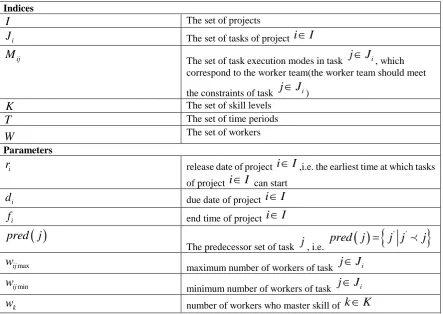
[image:2.595.78.522.475.789.2](4)Each worker cannot be allocated to more than one skill of a task at the same time. Table 1 shows the indices and notations that are used in the mathematical model.
Table 1. Notations.
Indices
I The set of projects
i
J The set of tasks of project iI
ij M
The set of task execution modes in task jJi, which
correspond to the worker team(the worker team should meet the constraints of task jJi)
K The set of skill levels
T The set of time periods
W The set of workers
Parameters
i
r release date of project iI,i.e. the earliest time at which tasks of project iI can start
i
d due date of project iI
i
f end time of project iI
pred j
The predecessor set of task j, i.e.
' '
pred j j j j
max ij w
maximum number of workers of task jJi
min ij w
minimum number of workers of task jJi k
mk
z number of workers who master skill of kK in mode
ij
m M
variables
0,1 , ,
0,
ijt i
x i I j J t T
If task j is performed at time t
0,T
; 0 otherwise{0,1} , ,
ijm i ij
y i I j J m M
If task j is executed in mode mMij; 0 otherwise ij
S
start time of task jJi ijm
d
processing time of task jJi in mode mMij
Objective Function
min max min
i i
i I
i I f r (1)
Constraint Conditions
,
ij i i
S r i I j J (2)
,
ij i i
S d i I j J (3)
1
,
M ij ijm ijm i i m
S y d D i I j J (4)
min max
1
, ,
K ij ijm mk ij i ij
k
w y z w i I j J m M (5)
1 1 10, ,
I J Mijt ijm mk k i j m
x y z w t T k K (6)
' ' '
'
1
if
M ijij ij m ij m m
S y d S j j (7)
1
1 ,
Mijm i
m
y i I j J (8)
1
, ,
T ijm ijt ijm i ij t
d x y i I j J m M (9)
The objective function(1) aims at minimize the total makespan, the duration of the whole
multi-project schedule. Constraint (2) is to ensure that start time of task jJi should be greater than
the starting time of task '
j j is to be greater than or equal the finishing time of its predecessor set of
tasks, Certain tasks may require the completion of other tasks prior to their start. Feasible solutions must obey all precedence relations. Constraint (8) ensure that each task is being performed only in one mode (i.e. cannot change or interrupt the execution mode). Constraint (9) describe that the
processing time of task jJi will be equal to the processing time of assigned execution mode for that task.
Solution Procedure
Particle swarm optimization (PSO) is an evolutionary algorithm introduced by Dr. Eberhart and Dr. Kennedy. PSO mimics the behavior of flying birds and their means of information exchange to solve optimization problems. Simulated Annealing(SA) is a generic probabilistic metaheuristic used in the optimization problems for locating a good global approximation of a function in a large search space.
Encoding Scheme
We have used the individual representation that consists of a precedence feasible activity list (AL) and a mode assignment. Here, an AL is defined as precedence feasible if any predecessor of an activity appears before this activity in the list. A schedule related to an individual is generated by applying the serial schedule generation scheme (serial SGS) to its precedence feasible AL with the mode assignment. The PSO could provide diverse and elite initial solutions to the SA for making a better search in the global space.
PSO Part
Initial population: In this approach, each individual in the population is produced in a random way without any experience. The advantage of this way is simple and easy to maintain population diversity. The disadvantage is less of experience.
Calculate the fitness function: Each particle's fitness function is expressed by the makespan of the corresponding schedule. Evaluate each particle in the population, and record each one as the local best. Select the best particle in the population as the global best.
Evolve approach: For each particle in the population, We apply the one-point crossover with AL sector and the two-point crossover with mode assignment sector. Evaluate each new generated particle, and record the local best for each particle. If the termination criterion satisfies, usually a sufficiently good fitness or a special number of generations, then stop PSO part; otherwise continue.
SA Part
Initial population: Randomly select some individuals of the best population and make sure that the global best solution is included.
The neighborhood structure: The neighborhood in SA defines a processing order of operations by randomly change the mode assignment of a task and apply a swap operation between two adjacent operations. The local search ability of SA is affected by the neighborhood structure. Update the result and check the termination criterion.
Case Study
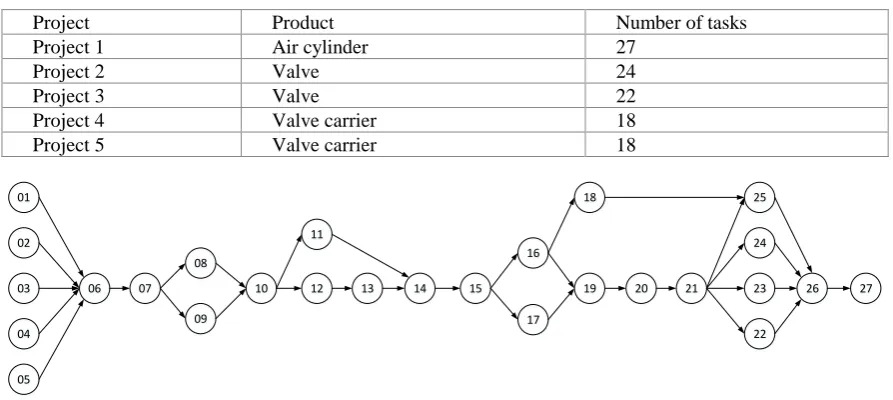
Table 2. Number of tasks in each project.
Project Product Number of tasks
Project 1 Air cylinder 27
Project 2 Valve 24
Project 3 Valve 22
Project 4 Valve carrier 18
Project 5 Valve carrier 18
01 02 03 04 05
06 07 09 08
10 12 11
13 14 15 16
17 19 18
20 21
24 23 22 25
26 27
Figure 1. Sequence diagram of project 1.
[image:5.595.127.479.367.560.2]We run our algorithm, GA, PSO and SA on the above case ten times, select the best result of each algorithm. The best result of PSO-SA, GA, PSO and SA is 5799min,5930min, 6381min,6990min. The PSO-SA is superior to the other three algorithms. The best scheduling result is shown in figure 2.
Figure 2. Gantt chart of PSO-SA scheduling.
Conclusions
In this paper, we present a mathematical model for the integrated multi-project scheduling and worker allocation for the assembly of steam turbines. Motivated by the inefficiency of exact approaches, we propose a hybrid approach combining improved particle swarm optimization and tabu search to solve the problem. The proposed algorithm is tested on the case that uses industrial data from a steam turbine company. The computational results obtained by the proposed algorithm are superior to the other three metaheuristic algorithms especially on large instances. The future work is to apply the hybrid algorithm to other kinds of combinatorial optimization problems.
References
[2] E. Niemi. Worker allocation in make-to-order assembly cells. Pergamon Press, Inc. (2009).
[3] L.P. Zhang. A hybrid intelligent algorithm and rescheduling technique for job shop; scheduling problems with disruptions. International Journal of Advanced Manufacturing Technology (2013).
[4] P.Brucker, A. Drexl and R. Möhring. Resource-constrained project scheduling: Notation, classification, models, and methods. European Journal of Operational Research (1999).
[5] T. Wauters, J. Kinable and P. Smet. The Multi-Mode Resource-Constrained Multi-Project Scheduling Problem. Journal of Scheduling (2016).
[6] E.A. Attia, P. Duquenne, J M Le-Lann. Considering skills evolutions in multi-skilled workforce allocation with flexible working hours. International Journal of Production Research(2014).