1
'Schultz's Rule' and the evolution of
tooth emergence and replacement
patterns in primates and ungulates
B. Holly Smith
15.1. Introduction pace with growth and changing diet, reptiles erupt mul
tiple waves of simple, ever-larger teeth (see Chapter 13). Paleontologists often reconstruct the sequence of erup Mammals, however, share a system of tooth emergence tion of teeth of fossil mammals (e.g., Stehlin, 1912; and replacement that accommodates rapid growth to a Gregory, 1920; Kellogg, 1936; Lamberton, 1938; Tattersall fixed body size (see Pond, 1977; MacDonald, 1984). Fixed and Schwartz, 1974; Wallace, 1977; Kay and Simons, body size probably allowed mammals to evolve a lasting 1983; Gingerich, 1984; Lucas and Schoch, 1990; Smith, adult dentition with heterodont teeth that occlude in a 1994; Martin, 1997). Evolutionary studies, however, have complex manner (see Zeigler, 1971; Osborn and contradictory traditions about the meaning of Crompton, 1973). The small mammalian neonate, quences. One tradition is that sequence of tooth eruption however, still must eat through a considerable size tran is a good phylogenetic character, capable of showing sition. To do this, eutherians (placental mammals) form genetic relatedness among species (e.g., Tattersall and small 'primary' or 'deciduous' teeth in utero, teeth which Schwartz, 1974; Schwartz, 1974; Byrd, 1981), and thus erupt around the time of birth in precocial mammals or presumably non-adaptive or conservatively adaptive. A after birth in altricial mammals (Smith et aI., 1994). Most second school of thought is that sequence of eruption is eutherians learn to eat with these teeth while still su an adaptive characteristic: either reflecting dental plemented with mother's milk. Larger, sturdier 'sec morphology (e.g., Slaughter et aI., 1974), ot. facial architec ondary' or 'permanent' appear later, including ture (Simpson et aI., 1990), or life history (Schultz, 1935, molars that fill in the back of the jaws and replacements 1956). Indeed Schultz saw the eruption sequence of teeth that erupt underneath deciduous teeth. Metatherians as highly adapted to rate of post-natal growth. The (marsupial mammals) probably once shared this strategy, obvious question is, does sequence of tooth eruption but subsequently reduced tooth replacement to a single inform us of species taxonomic affiliation, dental func tooth in each quadrant (Luckett, 1993; Cifelli et aI., 1996; tion, facial form, or life history? One approach to the Martin, 1997), coping with early growth stages by intense question is to re-examine Schultz's hypothesis on the lactation (Pond, 1977). For marsupial or placental, adaptive nature of tooth eruption sequence. Here, however, development and appearance of teeth must be Schultz's ideas are tested against newly gathered data on coordinated with growth. Mammals musts have teeth to primates and ungulates, with a few additional data on be weaned and the permanent teeth that erupt must be
small insectivorous mammals. able to acquire, prepare, and chew adult food for a life
time.
The order of emergence of mammalian teeth is highly patterned and a tiny fraction of theoretically possible
15.2. The dentition in a life-history context variants appear in life. In eutherians, the entire decid
uous set is typically erupted, sometimes with the Reptiles tend to grow throughout life, changing prey, tion of the first premolar (see below), before permanent and prey size slowly over thne (Dodson, 1975). To keep teeth appear. First molars are very commonly the first
ADDITIONS .... REPLACEMENTS TUPAIA MI M2 M3 I; l.t «:. 'P
~ ~ ~
AOTES MI M2 M3 II 12
~ ~ L I_ _--->,
LEMUR. PYGATHRIX MI M2 12 M3 [C P]
~ ~ L--.
MICROCEBUS MI M2 11. t M3 P
~ ~ L--.
SAIMIRI Ml M2 12 P M3 t
~ ~ L--.
TARSIUS MI M2 il 12 M3
~ L--.
PITHECIA. CACAJAO MI II M2 12 M3 P t
~ L--. L I- - - > ,
COLOBUS M1 .2 M2 Y It M3]
~ ~ ~
MAJORITY OF MONKEYS AND ALL APES
MI Ii
L--. I~ M2 L I---_->. P ! IC
M3)
~
HOMO (CHIEFLY WHITES) [:J MI) 12 W 7) M2 M3
Figure 15.1. Di.gr.mm.tlc repre.ent.tion of the .equence of eruption of the perm.nent teeth in prim.te., redr.wn from Schultz (1956, Figure 20). Repl.cement teeth .re .hown in light outline font to
emph.size molar progr•••ion. Par.nth•••• indicate that the
p.rticul.r teeth enclo.ed v.ry in po.ition. Arrow. follow progre•• of
molar. to later positions in .equence acro•• the primate sca/.
naturae.
permanent tooth to emerge. Molars emerge from front to-back and no mammal species, where tooth identifica tion is clear. is known to alter this order. Other teeth also tend to a front to back appearance, although there are exceptions (see Ziegler, 1971; Osborn and Crompton, 1973). Eruption order is similar in the maxilla and mand ible, but not identical, often with the mandibular tooth emerging slightly ahead ofits maxillary isomere. Beyond these similarities, however, there is real variation to explain. In extant mammals, incisors tend to emerge together and premolars tend to emerge together, but this seems not to be the case in early mammals (see Martin, 1997). And although the permanent dentition most often begins with the first molar, it may end with any tooth, an incisor, canine, premolar, or molar, varying even among closely related species.
It is worth keeping in mind that the fundamental mammalian plan of tooth number, kind, and replace ment evolved in some particular species which possessed some particular life history strategy and dento-facial morphology. Early eutherians were small, presumably rapidly growing, and had long dentaries with 11 tooth positions per quadrant (three incisors, one canine, four premolars, and three molars). Many lineages subse quently evolved larger body size, slower growth, shorter faces, and reduced tooth number. Mammals at extremes of body size or environment, notably the shrews, some bats, rodents, elephants, and sea mammals, greatly altered teeth and tooth replacement. Many lineages, however, including primates, ungulates, carnivores and larger insectivores continued to maintain fairly general ized eruption and replacement of teeth. Paradoxically, the breadth of mammals retaining a primitive system of
eruption and replacement testifies both to the flexibility and conservatism of the system.
15.2.1. Schultz's hypotheses
Adolph Schultz (1935) and others (Krogman, 1930; Benne jeant, 1936) clarified the basic outline of tooth eruption in primates and left us with a much simplified arena for testing hypotheses. Schultz (1956, 1960) went furthest to find meaning in sequence of eruption, proposing a very limited pattern that varied in a regular way across primates.
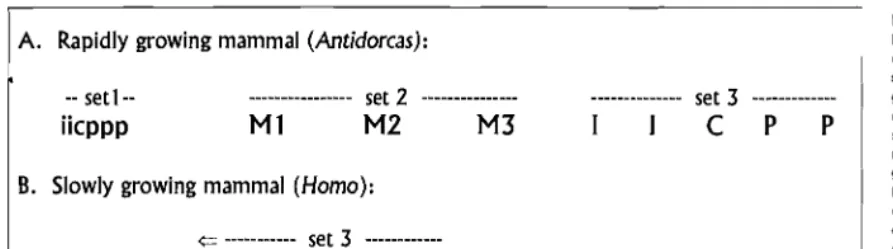
To understand eruption sequence (Figure 15.1), Schultz contrasted molars (Ml- M3), which are 'addi tions' to the deciduous dental arch, with 'replacement' teeth, the permanent incisors, canines and premolars that replace deciduous predecessors. When permanent teeth are so divided, primates showed a striking pattern across the scala naturae (Figure 15.1): at top, Tupaia, the tree shrew (then classified with primates) erupts all three molar'teeth before replacing any deciduous teeth. Moving to slower-growing, longer-lived primates, molars scatter to later and later positions, but little else changes in the progression. Humans, particularly 'white' populations, are shown with a particularly extreme se quence in which Ml is no longer the first permanent tooth to erupt and the two other molars are very last to emerge.
Schultz himself was convinced of the underlying cause of the trend: 'There can be little doubt that these ontogenetic specializations represent necessary adapt ation to the gradual prolongation of the period of post natal growth' (Schultz, 1960:13). On one point, however, his illustration overpowered the text. The dashed-in molar progression strongly suggests that primates are characterized by late molar appearance. The accompany ing text, however, proposes that long life places an extra load on deciduous teeth and that species adapt by repla cing them relatively early. Thus, Schultz's adaptive model might dash in, not the backward drift of molars, but a forward march of replacement teeth.
What I will call 'Schultz's Rule' is the tendency for replacing teeth to come in relatively early in slow-growing, longer-lived species. My first task is to try to replicate Schultz's observa tions on primates, and the second. to test his explanation against other mammals. If 'Schultz's Rule' is a powerful one, it should apply to more than just primates.
15.2.2, An adaptive model
A. Rapidly growing mammal (Antidorcas):
-- set1- set 2
iicppp
Ml
M2
M3
B. Slowly growing mammal (Homo):
{:= --- set 3 ---
-- set 1- --- set 2 ---
iicpp
Ml I C M2 PP
M3
(Figure 15.2B), replaces deciduous teeth before com pleting molar eruption. Although the Homo sequence appears to be quite different from that ofAntidorcas, we can account for it by a simple shift of replacement teeth. Whereas Antidorcas erupts sets 2 and 3 sequentially, Homo erupts them simultaneously.
As Schultz suggested, the shift of replacement teeth may be related to growth rate and life span. Antidorcas is a small (34 kg) bovid that grows to adult size in about 2 years (Rautenbach, 1971; Nowak and Paradiso, 1983). In Homo sapiens, the slowest-growing mammal, however, some 20 years pass before the face can accommodate third molars. If humans followed the springbok pattern, deciduous teeth would have to function for some "20 years before replacement-far longer than their size and structure allow. One solution to the problem of slow growth would be to evolve larger deciduous teeth, but these teeth are formed in utero, presumably under some size constraint. A less costly solution is to shift the repla cing set to a relatively early position.
TIle model in Figure 15.2 suggests that complexity of the human sequence (which switches bflck and forth between eruption of molars and replacement teeth) is superficial. The human sequence can be understood as a crossing over of sets of teeth adapting to different factors. In this view, the development of deciduous teeth and molars is primarily tilned to match growth of the face, a relatively invariant adaptive problem. Develop ment of replacement teeth, however, is on a sliding scale, adapting to demands on deciduous teeth.
Because early mammals were small and rapidly growing, Figure 15.2A or something close to it, is likely to be more 'primitive' in an evolutionary sense and Figure 15.2B is likely to be relatively 'advanced.' If tooth erup tion is a functional system adapted to life history, we might expect to find a scattering of both 'priInitive' and 'advanced' sequences through mammalian orders. Further, since the timing of events in life (e.g., age of maturation, life span) and the size of organisms (body weight, brain weight) are correlated (see Harvey and
Figure 15.2. Model of 'Schultz's Rule: the adaptation of tooth eruption sequence to fast and slow growth. Very rapidly
--- set 3 growing species (case A)
C
P
P
erupts the three sets of teeth sequentially: deciduous teeth,molars, replacement teeth. As growth and deveopment slows (case B), deciduous teeth wear out before growth is completed. Set 3 shifts to replace deciduous teeth relatively early and sets 2 and 3 become simultaneous. Little else changes.
Clutton-Brock, 1985), 'primitive' sequences might charac terize small mammals and 'advanced' sequences charac terize larger ones. Thus, if the simple model presented is a good one, extant species with identical eruption se quences may be only distant relatives.
15.3~ Materials and methods
Sequences of eruption of mandibular permanent teeth are described in the Appendix for a series of extant mammals with fairly generalized dentitions.
15.3.1. Definitions
Defining eruption sequence is not easy, since sequences of calcification, initial movement, emergence through alveolus or gingiva, and completed eruption are not necessarily in agreement (Garn and Lewis, 1963; Schwartz, 1974). In dentistry and many primate studies, the marker of tooth eruption preferred for clarity and replicability is appearance o~any part of the cusp or crown through the gingiva, usually called 'tooth emergence.' The sequences reported here are 'emergence sequences' as much as possible. This criterion is easily met for pri mates, although not so easily met for other orders. For ungulates, several stages of eruption were often described in original studies (e.g., tooth just above bone, mid-eruption, fully erupted). Since alveolar emergence can long precede gingival emergence for molariform teeth (Garn and Lewis, 1963), 'just above bone' was not taken as erupted. It was most helpful when studies noted whether teeth were faceted and in wear (e.g., Wallace, 1977; Kay and Simons, 1983).
15.3.2. Taxa
[image:3.612.23.470.39.163.2]adaptive similarity but not taxonomic coherence, since Primates and Scandentia (grouped in the grandorder Archonta) may be only distant relatives of soricomorph insectivores. Group one is referred to here in an informal sense as 'primates/insectivores.' Group two consists of herbivorous hoofed mammals, all members of the grand order Ungulata. Within orders, species chosen have com plete data for all permanent mandibular teeth and span, as much as possible, the largest available range of body size within wild taxa. Domestic mammals are excluded because artificial selection is presumed to have altered life history. Only the mandible is studied because rumi nant artiodactyls lack maxillary incisors.
Complete data and sources appear in the Appendix. Higher level taxonomy follows Eisenberg (1981); genus and species names follow Wilson and Reeder (1993) for ungulates and Smith et aI., (1994) for primates.
Within Primates, six of 11 families are known by complete data for gingival~emergence sequence, but Cal litrichidae are omitted here because members lack M3,
an important tooth in patterns under investigation. For anthropoids, sequences are based on very substantial samples and fine-grained studies except for the leaf eating monkey Alouatta, which is based on a single indi vidual. Lemurids have been studied on a fine scale, but sample size is also small. Unfortunately, data for the smallest primates (e.g., Microcebus, Tarsius) are preferen tially missing. Because comparable complete data could not be found for any tiny insectivorous primate, Urotti
chus (the Japanese shrew mole, order Soricomorpha) and Tupaia (the tree shrew, order Scandentia) are substituted to give some representation to very quickly growing generalized mammals.
Within Artiodactyla, data were located for seven of eight families. No data were located for Tragulidae (chev rotains), the smallest living members of the order. The Camelidae is omitted here because extant members are domestic (camel, llama), have reduced tooth number (guanaco), or ever-growing incisors (vicuna). Within Peri ssodactyla, two of three families are represented, Equidae and Rhinocerotidae. The latter contains the slowest-growing ungulates besides the elephant, but is of limited diagnostic value because the family has elimi nated all incisors, both deciduous and permanent. Data located for the Tapiridae (the tapir) were incomplete.
For ungulates, exceptional studies with excellent data include those of Sus (wild pig), Tayassu (peccary), and Odocoileus (white-tail deer), which are detailed, fine scaled, and backed up by large numbers of subjects; studies of Antilocapra (pronghorn), Bison, and Hemitragus (tahr) are also very good. For other ungulates, data are of lower quality overall; data were sometimes sketchy, and some sequences had to be based on combinations of
observations of gingival emergence, radiographs of living individuals, and skeletonized individuals.
15.3.3. Methods
All data were taken from the literature, constructing sequences from original publications. The goal was to construct a gingival sequence of emergence, building a sequence of the order of teeth appearing through the gingiva and in wear. Sequences were compiled from (1)
actual reports of sequences observed within individuals, and (2) mean ages of tooth emergence. The two methods (the most common sequence within individuals and se quences of means) are equivalent when samples are sub stantial and well spread out over juveniles (Smith and Garn, 1987). For three primate species, Macaca nemesttina, Pan troglodytes, and Homo sapiens, actual compilations of most likely sequences were available (Smith, 1994). Two sequences are given for Homo sapiens, from Australian Aborigine males and American white males, to represent the range offlndings for human populations. When sexes differ (as in humans), male sequences were used.
15.3.4. Appendix
In the Appendix, special notation gives some extra infor mation on variation, first premolars, and special dental adaptations: Whenever variants in sequence are known to be substantial, square brackets [ ] surround the tooth pair, following Schultz (1935). Parentheses ( ) mark cases in which the actual order has not been determined, i.e., the teeth are 'tied.'
Only five extant taxa studied here possess a mandib ular first premolar: Sus, Hippopotamus, Equus, Cera tothetium, and Procavia. These mammals, along with most others that retain a first premolar, typically erupt only a single tooth in this position, and it is unclear to which series the tooth belongs, deciduous or permanent. Kindahl (1967), Zeigler (1971, 1972), and Luckett (1993), all of whom considered the question over a range of mammals, allocate it to the deciduous dentition. Luckett (1993) regards Tapirus as the only unequivocal case in which a first premolar (upper jaw only) has two tooth generations. Extinct archaeocetes are thought to have a replacing permanent PI in the mandible (Kellogg, 1936; Uhen, 1996), although the evidence is not unequivocal. In the Appendix, emergence of pI appears if timing is known (it tends to appear between the deciduous and permanent dentitions or with M1 ), but the tooth is
dropped from further analysis.
Also in the Appendix, two life history variables appear alongside emergence sequences: age of emergence of the mandibular first molar (from Smith et aI., 1994) and life span (from Harvey and Clutton Brock, 1985 and Nowak and Paradiso, 1983). Age of M1 emergence serves as an
objective estimate of rate of postnatal growth: a low age of M1 emergence indicates fast growth and a high age indicates slow growth. In primates, age at which M1 erupts is highly associated with other measures of life history (Smith, 1989). In mammals studied here, emer gence of M1 ranges from about 1 month to over 6 years. Life span ranges from 11 to 100 years, although that of the little known Urotrichus may be much shorter.
For three genera with unknown age of M1 emergence (the insectivore Urotrichus, the primate Alouatta, and the ungulate Okapia), post-natal growth rate was approxi mated by comparing other aspects of life history among species (Nowak and Paradiso, 1983). In one case (Tupaia),
an unknown age of emergence of M1 was estimated with some confidence. It is known that the entire permanent dentition erupts between about 1 and 3 months of age in
Tupaia (Shigehara, 1980; Tsang and Collins, 1985; Herten
stein et aI., 1987). Further, it is likely that M1 appears after completion of the deciduous dentition (day 27) and before males begin puberty (day 40-50). Data on 24 primate species (Smith et aI., 1994) were used to calculate an equation predicting age ofM1 emergence from age.Qf completion of the deciduous dentition. The resulting equation predicts emergence ofM1 at day 31 in Tupaia, an estimate that fits well with other life history data for the genus.
15.3.5. Analysis
A glance at the appendix will show that complete se quences of tooth emergence are hard to ,evaluate. The first 'analysis' of data is simply to diagram sequences in a manner that brings out patterns in the data. Diagrams (see Figures 15.4-15.7) focus on seven non-canine teeth shared by almost all taxa (11-2, P3-4, Ml-3). Canines are discarded because they have heterogeneous special func tions, sometimes featured in male-male competition and sometimes serving only as an extra incisor. The 13 and P2' teeth that disappeared in the evolution of many mammalian taxa, are shown, but are collapsed with the tooth emerging nearest in tilne. Further, numbers are stripped from incisors because 11 and 12 always emerge in that order in present data. Numbers are stripped from premolars to silnplify comparison and premolar order is discussed separately. This notation amounts to a special language of reporting tooth eruption sequence, but it is a language that makes patterns clearer.
The second analysis quantifies aspects of sequence and looks for associations with age of M1 emergence, life
Urotrichus Ml M2 M3 PP P
-! -!
-!-Tupaia 0.09? Ml M2 M3 PIP I P
-! -!
Lemur 0.34 Ml M2 tc P PIP M3
-!
-!-Aotus 0.36 Ml M2 1 M3 1 P PP
-! -! )
Saimiri 0.37 Ml M2 1 I P PP M3
-! )
Eulemur 0.42 Ml tc M2 pM3 P P
-! -! ~
Varecia 0.48 Ml tc M2 PP M3 P
-! -! ~
Alouatta Ml I (I M2) PP P M3
Cercopithecus 0.8 Ml I 1 M2 P P M3
Cebus sp. 1.1 Ml I I M2 P P M3
Macaca 1.4 Ml I I M2 p P M3
Papio 1.6 Ml I I M2 (p p) M3
Pan 3.2 Ml 1 I [M2 P = p] M3
-! ~
J-Homo Austr.<6.0? [Ml I] I P [M2= p] M3
~ ~
J-Homo Wh.Am. 6.3 [I Ml] 1 [p [p] M2] M3
Figure 15.3. New (post-1960) data on sequences of gingival
emergence of mandibular teeth in primates plus two small insectivorous mammals (members of Soricomorpha and Scandentia). When.ranked by the age at which M1 emerges (at left), molars scatter to later positions, M3 greatly, M2 partly, and M1 in only the slowest growing mammal. The trend is imperfect at M3, as Schultz also found.
span, brain weight, and body weight, all aspects of 'life history.'
Brain and body weights for primates (not shown here) are taken from Harvey and Clutton-Brock (1985) and for other mammals from Gingerich (n.d.), a compendium which will be described elsewhere. With the exception of the predicted M1 emergence in Tupaia, all data analyses count time from birth. Repeating analyses with time counted post-conception did not change conclusions about emergence sequence, probably because most of the mammals studied here (excepting Tupaia and Urotrichus)
are precocial (born well developed after a long gestation), and share many characteristics of the timing of events in development. Broad comparisons of altricial and preco cial mammals, however, might need to count time from conception.
15.4. Results
15.4.1. Can Schultz'S findings be replicated?
[image:5.612.247.460.27.247.2]Urotrichus Ml M2
Tupaia 0.09? Ml M2
Lemur 0.34 Ml M2 tc P
Aotus 0.36 Ml M2
Saimiri 0.37 Ml M2 I I P
Eu/emur 0.42 Ml tc M2
Varecia 0.48 Ml tc M2
A/ouatta Ml I (I M2) PP P
Cercopithecus 0.83 Ml 1 I M2 P P
Cebus sp. 1.1 Ml 1 1 M2 P P
Macaca 1.4 Ml 1 I M2 P P
Papio 1.6 Ml I I M2 P P
Pan 3.2 Ml 1 I [M2 P p]
Homo <6.0? [Ml I] 1 P [M2 p]
Homo 6.3 [I MI] I [p [p] M2]
age of M1 emergence. and emergence sequences are
based on data published after Schultz's 1956 diagram. For anthropoids. Schultz's sequences were primarily based on skeletal sampies with j aw unspecified. Although new data are limited to mandibular gingival emergence. new and old data (Figure'S 15.1. 15.3) are in fair agree ment. As Schultz showed. little variation has been described between catarrhine species (see Smith. 1994).
Few new data have appeared since Schultz for colobine monkeys. but those available suggest colobines are more rapidly growing and have more primitive sequences than cercopithecines (Wolf. 1984). Large studies of living humans have substantiated Schultz on human sequence: the first incisor erupts before the first molar in many individuals. and may characterize some populations. In a study of 6000 American children. Smith and Garn (1987)
found that 11 M1characterizes just over half of males and
about a third to half offemales.
For prosimians and the tree shrew. Schultz's se quences were taken from Bennejeant (1936). and these data differ most from newer sources. More recently. Shigehara (1980) found premolars before incisors in
Tupaia. a reversal of Schultz's diagram. Urotrichus also
shows premolars before incisors (Usuki. 1967). as do some fast-growing ungulates. evidence that this is a real phenomenon. These two non-primate species. both small and rapidly growing. show eruption of all three molars before any tooth replacement. No living primate appears to maintain this primitive sequence as the dominant one (see also Schwartz. 1974). although it may appear as a variant. Lemurids all show some form of advancement, whether in early appearance of the incisor-eanine tooth comb or M3 (Eaglen, 1985).
In Figure 15.3. molars drift to late positions in step with life history evolution, as represented here by M1
emergence. Starting at the top and going down the chart. all species retain M1 as the first tooth until Homo sapiens.
The second molar shows a perfect trend, drifting from position 2 to 4, 5, and 6 as M1 emergence increases from
M3 PP P I Figure 15.4. Diagram of
P I PP
M3 pM3 M3 M3 pM3
PIP
1
P 1
P
P P
PP
1 mandibular tooth emergence
in primatelinsectivores. Molar.
(boldfaca) ara rapresented as stable and replacemant taath (outlina fontlas mobile. Extra
conventions: all replacement
PP M3 P taeth and teath within a fiald
M3 (premolars. incisors) are kept
M3 M3 M3
together if possible and left shifts of replacament teath ara
conservative; 13 and P2 are doubled with tooth nearest in
M3 time. When ordered by
M3 increasing age of M1
M3 emergence (at left),
M3 replacement teeth sweep
acro•• molar. to earlier positions.
0.4 to 6.3 years. Exceptions from the trend appear only with M 3 • which appears later than expected in Lemur and
Saimiri. Rankings here are tentative. however. because
Lemur, Aotus. and Saimiri erupt M1 at very nearly the same
time (0.34, 0.36. and 0.37 years) and a new study of any of these species might reorder them, improving the trend. But in any case, no rearrangement of taxa produces a perfect trend in M3 appearance.
For a new perspective on Schultz's rule. Figure 15.4
diagrams sequence in a manner that emphasizes replace ment teeth. In it, molars are kept in rigid alignment as if they are stable, attuned to facial. growth; replacement teeth are shown as if mobile. Although more cumber ,;;ome. this diagram shows the sweep of the changes
across taxa in a striking fashion. In Figure 15.4, replace ment teeth appear to march forward across columns of molars. Incisors traverse the greatest distance, crossing from the very last teeth to the very first teeth. Premolars have a more modest range. from just after M3 to just
before M z.With its resemblance to a scatter graph with a cloud of points, Figure 15.4 de-emphasizes imperfections and emphasizes an overall association between life history and position of replacement teeth in sequence. The answer to the question posed is clear: Schultz's primate pattern can be replicated, although lemurids show some specializations regarding the tooth comb.
15.4.2. Do ungulates follow 'Schultz's Rule?'
Ungulates (Figure 15.5) span a very similar range in age of M1 emergence and length of life as do the primates!
insectivores above (Figure 15.4). Discounting humans. M1
emergence ranges from 0.09 to 3.2 years in the primate! insectivore group and from 0.08 to 2.75 years in ungu lates; life span is known to range from about 11 to 50+
years in each. Primates certainly contain many more slowly growing species, however. A glut of bovids and cervids emerge M1 at about 0.2 year, whereas m'!ny
[image:6.612.18.472.31.195.2]UNGULATES
Antidorcas 0.08 MI M2
Antilocapra 0.17 MI M2
lJ1angifer 0.1 7 MI I M2
Odocoileus 0.18 MI I M2
Muntiacus 0.2? MI M2
Hemitragus 0.21 MI M2
Sylvicapra 0.23 MI M2
Aepyceros 0.33 MI M2
Okapia MI M2
Cervus 0.33? MI M2 I
Tayassu 0.40 MIl M2 I I P
Connochaetes 0.46 Ml M2
SUS 0.47 MI M2 I P PP
Taurotragus 0.53 MI M2
Bison 0.54 Ml M2
Procavia 0.54 MI I I (M2 PP p)
Giraffa 0.66 MI M2
Equus 0.88 MI M2 I
Hippopotamus -2 MI I I M2 (pp) P
Ceratotherium 2.75 Mlp [M2 P p]
the two charts were combined, anthropoid primates would fit in near the bottom.
The most striking finding is that ungulate tooth succession is much like that of the primates/insecti vores. Overall, replacement teeth range over similar positions in the two charts (Figures 15.4, 15.5). In each group, the first molar begins the sequence, but any tooth may end it. While incisors tend to emerge to gether and premolars tend to emerge together, incisqrs tend also to precede premolars except in very rapidly growing species. Like primates (Figure 15.4), ungulates (Figure 15.5) also replace teeth in a pattern relative to life history. Eruption of all three molars before any teeth are replaced is found in rapidly growing members
Antidorcas, Antilocapra, and Sylvicapra. Moving down the
chart towards large-bodied, slow-growing taxa, replace ment teeth begin to cross over molars. Most taxa show some incisor emergence before M3 , and' several even
erupt premolars before M3 , including Tayassu, Sus, Pro cavia, Hippopotamus, and Ceratotherium, a finding also
common in higher primates. The rhinoceros is especially interesting because its premolars emerge re latively early, as one would expect with slow growth, even though all incisors have been lost.
Despite similarities to primates/insectivores, ungu lates follow Schultz's Rule more intermittently. Figure
15.5 (ungulates) is much less tidy than Figure 15.4 (pri mates/insectivores) and substantial exceptions appear. Two deer (Odocoileus and Rangifer) show very early emer
gence of 11, more extreme even than the lemur tooth comb. The larger bovids Connochaetes, Taurotragus, and Bison delay M1 until about one-half year, but fail to adapt emergence sequence significantly. A striking exception to the rule is found in the giraffe. Sources (sometimes tables and text within a source) disagree on the giraffe sequence;
Figure 15.5. Diagram of
M3 I II P P mandibular tooth emergence
II II
I
M3 M3 M3 M3
I PP P I
P P PP PP
P
PI
IPI in ungulates. Molars are
represented as stable and replacement teeth as mobile. Conventions as in Figure 15.4. Replacement teeth in
I [M3 I] P PPI ungulates tend to shift to early
M3 PP P I II positions with slower growtb
I I I
M3 (M3 M3
I I) IPP
PP PI P
IP PP
and development, but major exceptions appear in large bovids and the giraffe.
PP M3
I M3 I P PI I M3
I M3 II PP P IP M3 P I IP
M3
[I M3] [p pp] II
PP M3 I PI
M3 M3
it may match that of its relative the okapi (M1 M2 11 M3 12
. ..) or it may have an even more primitive sequence (M1
M2 M3 11 12 ••• ). At 500 kg or more, the giraffe makes a
spectacular exception to any idea that body size alone predicts eruption sequence. At 2 kg, the hyrax Procavia has
a sequence far more 'advanced.' Overall, a tendency toward Schultz's rule can be seen in ungulates, but con siderable unexplained variation remains.
On closer examination, Figure 15.5 gives the distinct impression that ungulates are heterogeneous in response of eruption sequence to life history. In particular, the 'generalized' and 'specialized' herbivores are difficult to force into the same box. The specialized group might be thought of as ruminant artiodactyls (antilocaprids, cervids, bovids, giraffids) and perissodactyls. The former evolved selenodont cheek teeth to consume a low quality diet and the latter evolved lophodont cheek teeth to consume an extremely low quality diet (see MacDonald,
1984). If these specialized herbivores are separated from more generalized ones, two relatively homogeneous groups emerge. Taxa with more generalized adaptations, including artiodactyls of suborder Suina (suids, tayas suids, hippos) and the order Hyracoidea, interleave per fectly with Soricomorpha, Scandentia, and Primates (Figure 15.6). While Suina and Hyracoidea show a fluid adaptation of sequence to life history, specialized ungu lates (Figure 15.7) seem comparatively inert. Specialized ungulates do step up along with Schultz's Rule, but they take only one or two steps towards earlier tooth replace ment, rather than the several expected from their life histories.
15.4.3. Quantitative measures
[image:7.612.17.438.34.217.2]Urotrichus Ml
Tupaia 0.09 Ml
Lemur 0.34 Ml
Aotus 0.36 Mt
Saimiri 0.37 Ml
Tayassu 0.40 Mtl
Eulemur 0.42 Ml
Sus 0.47 Ml
Varecia 0.48 Ml
Procavia 0.54 Ml
Alouatta Ml
Cercopithecus 0.83 Mt
Cebus sp. 1.1 Ml
Macaca 1.4 Ml
Papio 1.6 Ml
Hippopotamus -2 Ml
Pan 3.2 Ml
Homo <6.0? [Mt
Homo 6.3 [I Ml]
GENERALIZED MAMMALS I] I I I I I I I I I I [p tc tc I (I I I I I I I P [p] M2 M2 M2 M2 M2 I
M2 I
M2 M2 I M2 (M2 PP
M2) PP
M2 P
M2 P
M2 P
M2 P
M2 (pp) [M2 P
[M2 p] M2] tc I I P p) P P P P P P p] P P P PP P I PP PP I PP M3 M3 pM3 M3 M3 M3 pM3 M3 M3 M3 M3 M3 M3 M3 M3 M3 M3 M3 M3 PP PIP I P P P I P P I P PP I
Antidorcas 0.08 Ml Antilocapra 0.17 Mt
Rangifer 0.17 Mt
Odocoileus 0.18 Ml Muntiacus 0.2? Ml Hemitragus 0.21 Ml Sylvicapra 0.23 Ml Aepyceros 0.33 Ml
Okapia Ml
Cervus 0.33? Ml
Connochaetes 0.46 Mt Taurotragus 0.53 Ml
Bison 0.54 Ml
GirafJa 0.66 Ml
Equus 0.88 Ml
Ceratotherium 2.75 Mlp SPECIALIZED UNGULATES ... I I M2 M2 M2 M2 M2 M2 M2 M2 M2 M2 M2 M2 M2 M2 M2 [M2 P p]
I I II II I I I I I I I IP 11 PP
M3 I
M3 I
M3 pp M3 P
M3 I
[M3 I] M3 PP
M3 I
(M3 I)
M3 IPP
M3 I
M3 II M3 P
M3] [p M3 I
M3 II P P PP PP P P PP PI P P PP I pp] PI P P PI PPI I IP PP PI P IP II P IPI II
Figure 15.6. Diagram of mandibular tooth emergence in generalized mammals (Soricomorpha, Scandentia, Primates, suine artiodactyls, Hyracoidea). Molars are represented as stable and replacement teeth as mobile. Conventions as in Figure 15.4. Generalized herbivores and primate/insectivores share a fluid adaptation of sequence to slow growth.
Figure 15.7. Diagram of mandibular tooth emergence in specialized ungulates (ruminant artiodactyls, Perissodactyla). Molars are represented as stable and replacement teeth as mobile. Conventions as in Figure 15.4. Premolars adapt much as expected in Schultz's Rule, but slowly growing specialized herbivores resist shifting incisors forward in sequence. Except for Equus, all lack upper incisors or all incisors (Ceratotherium) and may take over incisor function with soft tissues.
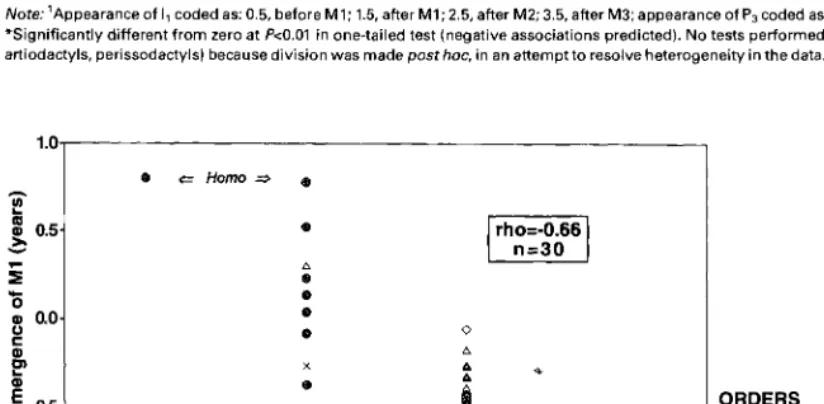
needed to allow statistical analysis. Several quantitative dicted to drop rank as timing and size measures increase. schemes might be tried, but since incisor position is As shown, 22 of24 correlations computed over all taxa or crucial to Schultz's Rule, emergence of the first incisor within grandorders were negative and 14 were signifi was ranked relative to molars as 0.5 (11 emerges before cantly so at P<0.05. Results for 11 and P3 tell a similar
M1), 1.5 (11 emerges after M1), 2.5 (after M2 ), or 3.5 (after story: for all taxa combined, advance of replacing teeth is
M3). In this scheme the two human populations have associated with a slowing of life history, as measured by advanced 11 to ranks 0.5 and 1.5; ranks 2.5-3.5 charac increasing age of M1 eruption and life span (rho = - 0.56
terize the other mammals. Advancement ofP3 relative to to -0.75). Thus, as mammals grow up more slowly and molars ('P3 position') was quantified in the same manner, live longer, their first incisors and third premolars ranking P3 as 1.5 in humans (P3 emerging after M1 ), and appear earlier in sequence. Both incisors and premolars
2.5-3.5 (after M2 or M3) in other mammals. Given rank tend to shift, shown by a positive correlation of11 and P3
order, correlation can readily demonstrate trend and position (rho = 0.60). When dissected into grandorders, direction, although it is a weak statistical approach given however, the strength of the trend lies within archontans the restricted number of assigned ranks. (rho = - 0.77 to - 0.87). Although in the proper direction, For numerical analyses, lack of life history data for correlation is weaker for ungulates (rho = -0.26 to
the little known Urotrichus restricts study to Archonta - 0.63). Combining taxa, correlations of tooth position (primates plus the tree shrew) and Ungulata. Table 15.1 with size (body weight, brain weight) were uneven in shows Spearman's correlation between rank of replace direction (rho = -0.16 to 0.11), a sign of underlying ment tooth position (0.5-3.5) and rank of a series of life heterogeneity.
history variables (1- N). Schultz's Rule predicts negative To try to resolve heterogeneity in the data, Table 15.1
[image:8.612.29.478.31.378.2]1.0
Table 15.1. Spearman's rank order correlation between eruption sequence (appearance of 11 or P3 relative to mandibular molars
1 )
and life history variables for extant taxa
Spearman's rho
Taxon/group Age M 1 emerges (N) Life span (N) Body weight (N) Brain weight (N)
Appearance of 11 relative to molars
All taxa -0.66* (30) -0.56* (30) 0.03 (32) -0.16 (29)
Archontans -0.87* (12) -0.85* (11) -0.84* (13) -0.84* (13)
Ungulates -0.32 (18) -0.26 (19) -0.21 (19) -0.08 (16)
Generalists -0.87 (16) -0.67 (15) -0.49 (17) -0.59 (17)
Specialists -0.13 (14) -0.46 (15) -0.31 (15) -0.23 (12)
Appearance of P3 relative to molars
All taxa -0.75* (31) -0.60* (31) 0.11 (33) -0.20 (30)
Archontans -0.77* (12) -0.77* (11) -0.80* (13) -0.83* (13)
Ungulates -0.63* (19) -0.40* (20) -0.09 (20) -0.13 (17)
Generalists -0.71 (16) -0.61 (15) -0.67 (17) -0.76 (17)
Specialists -0.59 (15) -0.49 (16) -0.41 (16) -0.51 (13)
Note: 1Appearance of I, coded as: 0.5, before M1; 1.5, after M1; 2.5, after M2; 3.5, after M3; appearance of P3 coded as: 1.5, after M1; 2.5, after M2; 3.5, after M3. *Significantly different from zero at P<0.01 in one-tailed test (negative associations predicted). No tests performed for 'generalists' and 'specialists' (ruminant artiodactyls, perissodactyls) because division was made post hoc, in an attempt to resolve heterogeneity in the data.
en
...
CO . ; O.S
•
c= Homo =>•
•
;
'0
CD 0.0 (,)
t: CD
0)
...
CD
i
-o.sl:>.
•
•
•
•
x
•
0
l:>.
A A
i
'<l,
'0
CD
0)
co
8'
-1.0..J
Rangifer
a
l:>. l:>.
l:>.
!
-1.S1
o.s 1:S
is
3.SEmergence of 11 relative to molars
Figure 15.8. Log (base 10) of the age of emergence of mandibular first molar for species different 11 positions: 0.5, before M1; 1.5, after M1; 2.5, after M2, and 3.5, after M3. Two deer (Rangifer and
OdocoileuB) appear as outliers for sequence 1.5. Despite considerable overlap in timing, age at first molar emergence steps up as incisors shift to early positions.
ORDERS
• Primates
+ Scandentia
l:>. Artiodactyla
o Perissodactya
J x Hyracoidea
[image:9.613.20.466.50.191.2]and specialist' (the same division as in Figures 15.6 versus evolution (rho
= -
0.87), whereas specialists either Figure 15.7). Tests were not performed because the divi eliminate incisors (the rhinoceros) or advance them little sion was made post hoc, but comparisons are still instruc (rho = -0.13).tive. Dividing species into adaptive categories reduces A stronger statistical approach to the influence of life heterogeneity, resulting in two groups with correlations history on tooth eruption is to sort taxa by sequence and of coherent direction and similar strength. Moreover, compare life histories. In Figure 15.8 (supporting data in results suggest that any and all life history variables - M1 Table 15.2), the logarithm of age of M1 emergence is
emergence, life span, body weight, and brain weight graphed for each position of 11 in the emergence se
are associated with emergence sequence. Thus, within quence. Variance of age of M1 emergence is particularly
adaptive categories, species that have larger bodies, high for taxa with sequence 1.5 (M1 11 M2 M3 ) where the
larger brains, grow up more slowly, and live longer, tend distribution is expanded by a human population at the to shift replacement teeth forward in sequence of emer high end and by two deer (OdocoiIeus and Rangifer) at the
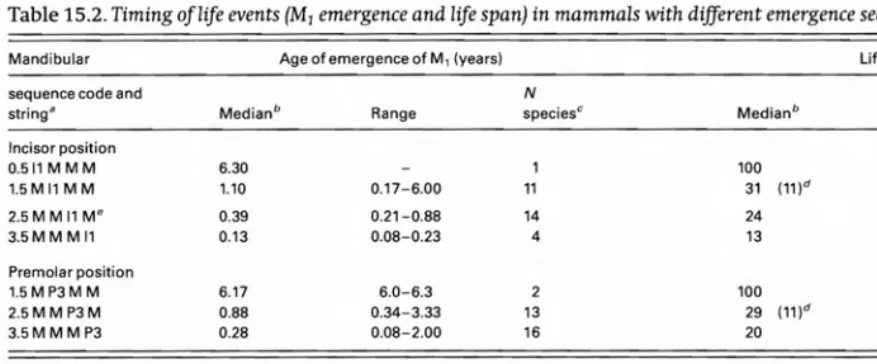
gence. Premolar progression is very similar in the two low end. The 'primitive' sequence, M1 M2 M3 11 (shortened
[image:9.613.23.435.245.447.2]Table 15.2. Timing of life events (M1 emergence and life span) in mammals with different emergence sequences
Mandibular Age of emergence of M, (years) Life span (years)
sequence code and N N
string Cl Medianb Range speciesc Median b Range speciesc
Incisor position
0.511MMM 6.30 1 100 1
1.5MllMM 1.10 0.17-6.00 11 31 (11)d 20-100 10
2.5MMllM" 0.39 0.21-0.88 14 24 13-36 15
3.5MM M 11 0.13 0.08-0.23 4 13 11-17 4
Premolar position
1.5MP3M M 6.17 6.0-6.3 2 100 2
2.5MMP3M 0.88 0.34-3.33 13 29 (11)d 21-45 12
3.5MMMP3 0.28 0.08-2.00 16 20 11-54 17
a Disregarding other teeth. Molars always erupt as Ml M2 M3. b Kruskal-Wallis test finds medians significantly different at P<O.Ol.
C Each population of Homo sap;ensentered separately.
d Hyrax life span (11 years) is an outlier, much shorter than expected given its protracted dental development. "Without specialized ungulates, values are, respectively: 0.37, 0.34-0.47, 5, 25,13-27,5.
the pace of life events slows and M1 is delayed, with median ages of emergence of 0.39, 1.10, and finally 6.3 years. Since variances are significantly different for se quence codes 1.5-3.5, non-parametric comparisons are in order. By the Kruskal-Wallis test, median age of M1
emergence differs in the three sequence groups with N>l (P < 0.01) as shown in Table 15.2. Also shown in Table 15.2, as 11 shifts forward, life span increases from 13 to 24, 31, and 100 years. Repeating the exercise for P3 position
produced a very similar reSUlt, showing systematic in crease in age of M1 emergence and life span as P3 ad
vances relative to molars (Table 15.2).
Comparisons in Figure 15.8 beg one further question, whether the age of M1 emergence associated with a particular sequence is the same regardless of taxon or adaptive group. To be brief, a series of two-way analyses of variance (ANOVAs) (with factors grandorder versus 11 position, adaptive group versus 11 position, grandorder versus P3 position, adaptive group versus P3 position)
demonstrated no strong evidence for taxonomic or adap tive effects across the board - thus no real evidence of different 'set points' for M1 timing. Until stronger evi dence emerges, it appears that a given sequence is associ ated with a particular age ofM1 emergence whatever the grandorder. An exception can be made for specialized ungulates, where a significant interaction points to unusual values for one particular category. Specialized ungulates drift into moderately slow growth while main taining the sequence MMIM, rather than the expected MIMM.
Given these analyses, it can be proposed that ungu lates tend to follow Schultz's Rule in tooth replacement patterns, but that slowly growing specialized ungulates resist shifting incisor position.
15.4-4. Early replacement teeth or late molars? Patterned changes in tooth eruption sequence observed here could be brought about by relatively early replace ment teeth or relatively late molars or both; sequence data alone cannot determine which. The ultimate resolu tion of which teeth are late and which early must come from numerical data on ages of emergence of teeth, While some such data support early replacing teeth as a major contributor to sequence variation in primates
~Smith, 1992), ungulate adaptations may be more varied, At least one genus, Procavia, the hyrax, shows several oddities in emergence timing. Its molars continue to erupt slowly over several years, completing eruption as late as 5 years of age (Steyn and Hanks, 1983), a value almost half its life span (Nowak and Paradiso, 1983), This is sufficiently out of proportion to other mammals to suggest that Procavia has initiated an elephant-like or kangaroo-like late progression of molars.
15-4.5. Does emergence sequence reflect facial architecture?
If Schultz's Rule holds good, life history should be a better predictor of eruption sequence than facial archi tecture or simply membership in a taxonomic group. In mammals collected here, primates/insectivores have a closed tooth row with either long or short faces, whereas ungulates tend to a more stereotyped long face, often with a large diastema between anterior and cheek teeth. Thus, if facial architecture is crucial, we might expect to see changes that correspond to face shape in the former and relatively fixed sequences of emergence within the latter. On the other hand, sequences that step up in pace with life history, no matter the taxonomic grouping, argue for a life history explanation.
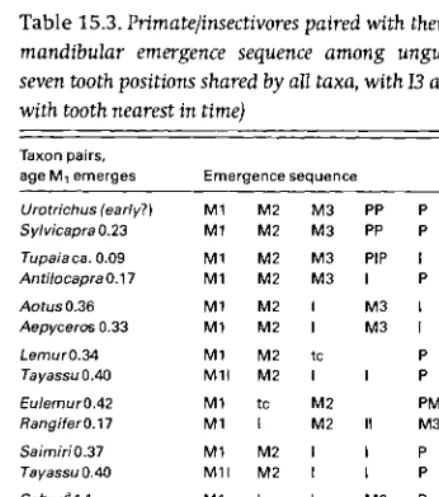
[image:10.612.31.470.45.227.2]Table 15.3. Primate/insectivores paired with their best match in mandibular emergence sequence among ungulates (showing seven tooth positions shared by all taxa, with 13 and P2 collapsed with tooth nearest in time)
Taxon pairs,
age M, emerges Emergence sequence
Urotrichus (early?) M1 M2 M3 PP P
Sylvicapra 0.23 M1 M2 M3 PP P
Tupaia ca. 0.09 M1 M2 M3 PIP I P I
Antilocapra 0.17 M1 M2 M3 I P P IPI
AotusO.36 M1 M2 I M3 I P PP
Aepyceros 0.33 M1 M2 I M3 I PP IP
LemurO.34 M1 M2 tc P P PM3
Tayassu 0.40 M11 M2 I I P PP M3
EulemurO.42 M1 tc M2 PM3 P P
RangiferO.17 M1 I M2 M3 PP P
"
Sa im iri 0.37 M1 M2 I I P PP M3
Tayassu 0.40 M11 M2 I I P PP M3
Cebus8
1.1 M1 I I M2 P P M3
Procavia 0.54 M1 I I M2 PP P M3
Pan 3.2 M1 I I M2 P P M3
Hippopotamus -2 M1 I I M2 PP P M3
Homo 6.3 11 M1 I P P M2 M3
(elephants?)
No adequate match was found for Alouatta or Homo, but all other primates could be matched approximately choosing from 20 ungulates.
a Cercopithecine monkeys all match Cebus or Pan. tc, tooth comb.
effect of gross facial form on emergence sequence. Pirst, within primates there is little silnilarity among emer gence sequences of Saimiri, Cebus, and Homo, although all
have short faces. Lemur and Papio, the more dog- faced
species, are equally mismatched in sequence (Figure
15.3). While it is true that mid-size ruminants seem relatively inert, ungulate emergence sequences step up through a considerable range despite comparatively stereotyped facial form (Figure 15.5).
In Table 15.3, primates/insectivores are paired with a best match in emergence sequence in ungulates. Close resemblance pairs the Japanese shrew mole with the duiker, the tree shrew with the pronghorn, the night monkey with the impala, the true lemur with the caribou, the squirrel monkey with the peccary, the cebus monkey with the hyrax, and the chimpanzee with the hippopotamus. It is difficult to imagine a hypothesis about facial morphology that could explain pairings such as these. Matched pairs, however, share aspects of life history, as shown by the correlation between their ages ofM1 emergence ofr= 0.65-0.98 (depending on how
matches are allocated in Cebus, Pan, Procavia, and Hippo potamus, which all share the same sequence). Humans
have no match in ungulates, perhaps because elephants, the only ungulate to grow up as slowly as humans, have greatly modified tooth succession.
Although gross facial morphology has no simple and obvious explanatory power for emergence sequence, more precise hypotheses about dental function remain promising. The specialized herbivores, including rumi nant artiodactyls and perissodactyls, for example, appear to slow growth without much advancement of incisors. These mammals make extensive use of the tongue and soft tissues in acquiring food (MacDonald, 1984) and incisors may be comparatively under used. Indeed, most of the Ruminantia have no upper incisors and the rhino ceros has no incisors whatsoever. Both dental function and dental morphology remain likely contributors to emergence sequences.
15.4.6. Can we predict life histories from sequences of tooth emergence?
If life history is a fundamental determinant of tooth eruption sequence, simple sequence strings preserved in teeth of fossil mammals might inform us whether a species lived and died on a fast time scale, like a small bovid, for example, or a slow one, like a monkey.
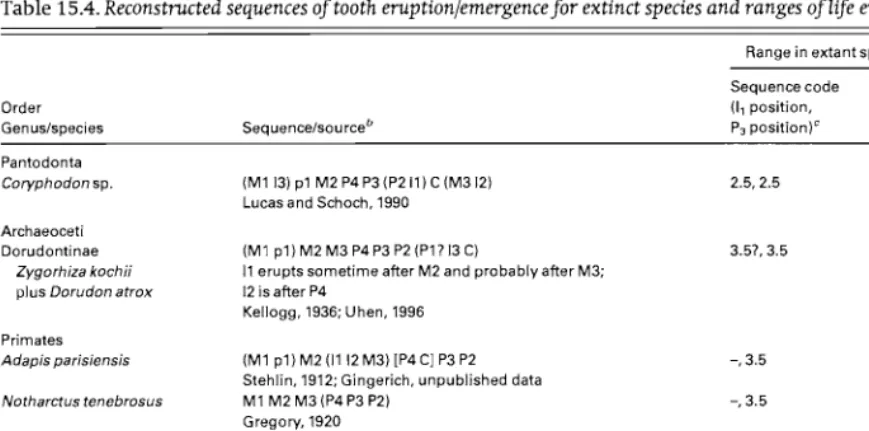
Table 15.4 contains test cases of eruption/emergence sequences for extinct mammals reconstructed from ori ginal illustrations or raw data in listed sources (although some uncertainty remains over the definitions of erup tion). Life histories of extant taxa which share the same sequence characteristics are tabulated for comparison.
One extra caution is needed before proceeding. Life histories may have been distributed uniquely in long extinct mammal faunas. For example, long life and slow growth were probably rare or absent in very early mammals (Lillegraven et aI., 1987). If underlying life history distributions differ between the present and the past, it is safer to compare fossils with the total range known in extant mammals rather than apply specific means from the present to the past. Mean values would be highly dependent on the particular distribution of mammals living today and sampled in the present study.
In Table 15.4 each case is of interest because it is not clear how to choose a living model for life history. Cory phodon is a primitive ungulate-like mammal of large body
size known from the Paleocene and Eocene of the northern hemisphere, only distantly related to extant mammals. Authors of an ontogenetic study compared
Coryphodon to hippos based on body size and habitat
(Lucas and Schoch, 1990). Judging from the hippo, we might expect that Coryphodon grew up very slowly, with
M1 emergence about 2 years of age and long life, perhaps
40- 50 years. However, II and P3 positions like that of Coryphodon are found today in mammals emerging M1
between 0.34-0.88 years, with life spans on the order of
[image:11.613.28.248.28.276.2]Table 15.4. Reconstructed sequences of tooth eruption/emergence for extinct species and ranges oflife events in similar extant taxa. a
Range in extant species matched for sequence code
Sequence code Age of
(I, position, emergence Life span
P3 position)C of M, (years)d (years) Sequence/sourceb
Order Genus/species
Notharctus tenebrosus
Archaeolemur majori Pantodonta Coryphodon sp.
Apidium phiomense Primates Adapis parisiensis Archaeoceti Dorudontinae
Zygorhiza kochii plus Dorudon atrox
Australopithecus africanus
(M1 13) p1 M2 P4 P3 (P211) C (M312) Lucas and Schoch, 1990
(M1 p1)M2(1112M3)[P4C] P3P2 Stehlin, 1912; Gingerich, unpublished data M1 M2 M3 (P4 P3 P2)
Gregory, 1920 M1 M21112M3P4P3P2 Lamberton, 1938 M1 M2 P2 P4 (P3 M3) C Kay and Simons, M 1 11 12 M2 P3 P4 C? M3 Smith, 1994
(M1 p1)M2M3P4P3P2(P1?13C)
11 erupts sometime after M2 and probably after M3; 12 is after P4
Kellogg, 1936; Uhen, 1996
2.5,2.5
3.5?,3.5
-,3.5
-,3.5
2.5,3.5
-,2.5?
1.5,2.5
0.34-0.88 21-35
0.34-0.47 21-27
0.08-0.66 11-36
0.09-0.42 12-31
0.08-0.66 11-36
0.09-0.42 12-31
0.08-0.66 11-36
0.09-0.42 12-31
0.21-0.66 13-36
0.36 13
0.34-3.33 (11 )e 21-55
0.54-3.33 (11 )e 26-55
a Living archontans and ungulates with same 11 and P3 position in sequence.
b Sequence uncertain ( ); sequence varies, [ ]; teeth omitted if no basis for assigning order.
C As in Table 15.3.
d First line, all taxa; second line, generalized mammals only (removing specialized herbivores).
e Procavia has an unusually short lifespan (11 years); other species with comparable sequences have lifespans >20 years.
mammals, the estimate becomes more restricted (M1 at 0.34-0.47 years and a 21-27 year life span), pointing to a life history considerably faster than a hippo, something more like a large deer or pig.
For several other cases in Table 15.4 more could be said if incisors could be placed relative to molars in sequence. Zygorhiza and Dorudon are both dorudontine archaeocetes (primitive whales) with body length some thing on the order of a mid-sized odontocete (toothed whale). Modern whales grow up fairly slowly, but are so transformed in adaptation from land mammal ancestors that they are questionable models for archaeocete life history. Since archaeocetes preserved primitive tooth replacement, however, their emergence sequence makes a place to start. As shown, the late appearance of premo lars in archaeocetes tends to rule out the longest lived models. If comparison is limited to generalized mammals, life history of dorudontine archaeocetes is predicted to have run a fast to moderate pace (M1 at 0.09-0.42 years, life span of12- 31 years).
The cases of two adapid primates Adapis parisiensis and Notharctus tenebrosus are instructive, although incisors have not been placed relative to M3 • Even in these Eocene primates, no hard data support a truly primitive emer gence sequence, with all molars before replacement teeth. Based on incisor alveoli, one specimen of Adapis parisiensis observed by Gingerich (unpublished data) sug
gests mandibular incisors were in place before M3 . If so, -"'Adapis parisiensis had the sequence shown for Archaeo
lemur, a subfossil indriid from Madagascar (also in Table 15.4). The Archaeolemur sequence suggests a life history on pace with a large lemur or small anthropoid.
Apidium phiomense is an anthropoid known from the Oligocene of Egypt. Kay and Simons (1983) were able to demonstrate that P4 and probably P3 erupt in an ad vanced position, which in turn suggests a life history somewhat slowed, at least not on the fastest pace.
A last prediction can be made for Australopithecus africanus, the extinct early hominid. Its growth rate was originally compared to Homo sapiens (Mann, 1975); its dental development and emergence sequence, however, place it with great apes and monkeys (Smith, 1994). From Table 15.4, the Australopithecus emergence sequence sug gests M1 erupted from 0.54 to 3.33 years with life span ranging up to 55 years - in other words, matching a chimpanzee perhaps, but not a human.
Predicted life histories are just that until they are supported by other data. Fortunately, study of increment allines in teeth promises to be able to establish the age of tooth eruption in many extinct species. One such study put M1 emergence at about 3 years in Australopithecus africanus (Bromage and Dean, 1985). Until such detailed and time-consuming work is done on a large s~ale
[image:12.612.35.470.50.265.2]for choosing a living model for life history of an extinct mammal.
, Other aspects of sequence than those studied here may prove productive in predicting life histories. For example, the tendency for some fossil mammals to erupt premolars before incisors is intriguing, but too few living mammals with this pattern have been sampled here to understand its meaning. Predictions should also improve as the data base for living mammals expands.
15.4.7. Unexplained variation
Schultz's Rule has some power of explanation in present data, but it cannot explain all variance in emergence sequence. Such unexplained variance may give infor mation about dental function or simply phylogenetic history. One unexplained feature is the characteristic 'backwards' emergence of premolars, the order P4 P3 , in primates (Schwartz, 1974; Tattersall and Schwartz,1974), tree shrews (Shigehara, 1980), many insectivores, some carnivore families (Slaughter et aI., 1974), and some other fossil mammals (Table 15.4). Most regard the distant ancestral order to be P3 P4, with the 'backwards' P4 P3 sequence the phylogenetic novelty (Slaughter et aI., 1974, Tattersall and Schwartz, 1974). In primates, pre molar order does revert to P3 P4 in apes and humans, a change which has been interpreted as a retardation of distal teeth in presence of slow growth (Smith, 1994). Looking at other mammals, however, no patterns emerge with respect to length of post-natal life. The ungulates erupt premolars in the 'front-to-back' order P3 P4 across the board (see Appendix), regardless of the pace
of growth.
Whereas the P3 P4 sequence tends to characterize groups of related mammals, Pz appearance is much more
variable. Kay and Simons (1983) cautioned ,that Pz is very
variable in primates. Although it tends to appear to gether with other premolars, Pz can jump position even in closely related species (see Appendix). In a study of insectivores and carnivores, Slaughter et aI. (1974) simply concluded that the tooth had so little functional import ance that it was more free to vary than other teeth.
Real exceptions to Schultz's Rule can be found in lemuriforms (lemurs and lorises) with tooth combs. Living lorisids (not included here because complete gin gival sequences are unavailable) are said to replace some anterior teeth very early, even before emergence of M1 (Schwartz, 1974). Clearly this cannot be because lorises grow up slowly; quite the opposite is true. Perhaps decid uous tooth combs are discarded early for functional reasons, as may also be true in Eulemur and Varecia. To generalize this finding, specialized dental functions should warn that Schultz's Rule might not apply.
Finally, patterns of emergence in other mammalian
orders, notably the Carnivora and Chiroptera (the latter also included in Archonta), remain to be explained. Pre liminary investigation finds very 'advanced' sequences in these orders. Such major differences between higher taxa may make eruption sequences useful in mammalian systematics. Even such major taxonomic differences, however, are likely to have adaptive explanations.
15.5. Conclusions
To understand Schultz's Rule, one can imagine that replacement teeth (11- P4) are on a sliding scale, adapting to demands on deciduous teeth. In slowly growing species, replacement teeth 'slide' to earlier positions to compensate for increased loads on deciduous teeth. The dampened response observed in specialized herbivores however, suggests that either their deciduous incisors manage to carry the load imposed by slow growth or that soft tissues have taken over some of the work of incisors.
Resemblance in tooth emergence sequence cross-cuts taxonomic group and facial form to a surprising degree. Sequences trend from (presumed) primitive (M M M P P I I) to (presumed) advanced (M I IMP P M) within two grandorders, Archonta (primates + tree shrew) and Ungu lata. The large range of sequences in each grandorder is strong evidence that tooth eruption is a highly func tional adaptive system. TIlUS, emergence sequence must
be used with care in phylogenetic analysis.
Finally, emergence sequences must be seen as limited data. While they can show an orderly response to life history, they cannot discern how change is brought about - which teeth are early and which late. Allochronic analyses of actual ages teeth erupt could answer many more questions (Smith, 1992). Complete data of that type, however, are still relatively scarce, although basic sequences allow some predictions about life histories of extinct mammals. For such predictions, the most impor tant datum appears to be position of incisors relative to molars, and secondly, position of premolars to molars. New approaches in histological study (Bromage and Dean, 1985; Dean, 1989; Swindler and Beynon, 1993) promise we will soon be able to test such hypotheses by reconstructing actual times of events in life history for extinct species. When such data are available, we will have a powerful tool for making inference about the evolution of life history in mammals.
Summary
Adolph Schultz's empiric search for a pattern in tooth emergence resulted in a general rule that is more widely applicable than he knew. 'Schultz's rule,' the tendency for replacing teeth to appear relatively early in slow growing, long-lived species, applies to a broad range of mammals. The rule successfully orders new data from the orders Primates, Scandentia, and Soricomorpha, and the more generalized menlbers of the grandorder Ungu lata (Hyracoidea and suine Artiodactyla). The rule applies in a more limited way to the specialized Ungulata (Peri ssodactyla and ruminant Artiodactyla). As growth rate slows (M1 emerges late) and life lengthens, generalized herbivores and omnivores fluidly adapt sequence of tooth emergence, whereas specialized herbivores adapt stiffly.
Acknowledgements
I thank Tristine 1. Smart for major work on the mammal project, in both assembling and interpreting the data base on which this work depends. Philip Gingerich pro vided unpublished data on body and brain weight in extant mammals and tooth emergence in fossil primates. I thank john Mitani for his contributions to the mammal library research project. This research supported by National Science Foundation grants SBR-9408408 and SBR-925390 and a grant from the University of Michigan Vice-President for Research.
References
Attwell, C. A. M. (1980). Age determination of the blue wildebeest
Connochaetes taurinus in Zululand. South African Journal of Zoology, 15, 121-130.
Bennejeant, C. (1936). Anomalies et Variations Dentaires chez les Primates. Paris: Clermont- Ferrand.
Bromage, T. G. and Dean, M. C. (1985). Re-evaluation of the age at death of immature fossil hominids. Nature, 317,525-27.
Byrd, K. E. (1981). Sequences of dental ontogeny and callitrichid taxonomy. Primates, 22, 103-118.
Caughley, G. (1965). Horn rings and tooth eruption as criteria of age in the Himalayan thar, Hemitragus jemlahicus. New Zealand Journal of Science, 8, 333-351.
Chapman, D. I., Chapman, N. G. and Colles C. M. (1985). Tooth eruption in Reeves' muntjac (Muntiacus reevesi) and its use as a
method of age estimates (Mammalia: Cervidae). Journal of Zoology, London (A), 205, 205-221.
Cifelle, R. 1., Rowe, T. B., Luckett, W. P., Banta,
J.,
Reyes, R. and Howes, R.1. (1996). Fossil evidence for the origin of the marsu pial pattern of tooth replacement. Nature, 379, 715-718.Dean, M. C. (1989). The developing dentition and tooth structure in hominoids. Folia primatologica, 53,160-176.
Dodson, P. (1975). Functional and ecological significance of rela tive growth in Alligator. Journal of Zoology, London, 175, 315-355.
Eaglen, R. H. (1985). Behavioral correlates of tooth eruption in Madagascar lemurs. American Journal of Physical Anthropology, 66,307-315.
Eisenberg,
J.
G. (1981). The Mammalian Radiations. Chicago: University of Chicago Press.
'tarn, S. M. and Lewis, A. B. (1963). Phylogenetic and intra-specific variations in tooth sequence polymorphism. In Dental Anthro pology, ed. D. R. Brothwell, pp. 53-73. Oxford: Pergamon. Gingerich, P. D. (1984). Dentition of Sivaladapis nagrii (Adapidae)
from the late Miocene of India. International Journal of Prima tology, 5, 63-79.
Gregory, W. K. (1920). The structure and relations of Notharctus,
an American Eocene primate. Memoirs of the American Museum ofNatural History, 3,49- 243.
Hall-Martin, A.
J.
(1976). Dentition and age determination of the giraffe Giraffa camelopardalis. Journal of Zoology, London, 180, 263-289.Harvey, P. H. and Clutton-Brock, T. H. (1985). Life history variation in primates. Evolution, 39,559-81.
Hertenstein, B., Zimmermann, E. and Rahmann, H. (1987). Zur Reproduktion und ontogenetischen Entwicklung von Spitz hornchen (Tupaia belangeri). Zeitschrift fur KOIner Zoo, 30, 119-133.
Hillman-Smith, A. K. K., Owen-Smith, N., Anderson,
J.
1., Hall Martin, A. j. and Selaladi,J.
P. (1986). Age estimtion of the White rhinoceros (Ceratotherium simum). Journal of Zoology, London (A), 210, 355-379.Hoover, R. 1., Till, C. E. and Ogilvie, S. (1959). The antelope of Colorado: a research and management study. Boulder: State of
Colorado Department ofGame and Fish (Technical Bulletin 4). jaspers, R. and DeVree, F. (1978). Trends in the development of
the skull of Okapia johnstoni (Sclater, 1901). Acta Zoologica PathologicaAntverpiensia, 71, 107-129.
Taurotragus oryx (Pallas, 1766) in the Natal Highveld. South AfricanJournal ofZoology, 16,113-122.
K:ay, R. F. and Simons, E. L. (1983). Dental formulae and dental eruption patterns in Parapithecidae (Primates, Anthrcr poidea). American Journal ofPhysical Anthropology, 62, 363 - 375.
Kellogg, R. (1936). A review of the Archaeoceti. Washington, DC:
Carnegie Institution ofWashington, Publication 482. 1- 366.
Kerr, M. A. and Roth, H. H. (1970). Studies on the agricultural utilization of semi-domesticated eland (Taurotragus oryx) in
Rhodesia. Rhodesian Journal ofAgricultural Research, 8,149-155.
Kindhal, M. (1967). Some comparative aspects of the reduction of the premolars in the Insectivora.Journal of Dental Research, 46, 805-808.
Kirkpatrick, R. D. and Sowls, L. K. (1962). Age determination of the collared peccary by the tooth-replacement pattern.
Journal ofWildlife Management, 26,214-217.
Krogman, W. M. (1930). Studies in growth changes in the skull and face of anthropoids. I. The eruption of the teeth in anthropoids and Old World apes. American Journal ofAnatomy, 46,303-313.
Lamberton, C. (1938). Dentition de lait de quelques lemuriens subfossiles Malagaches. Mammalia, 2, 57 - 80.
Laws, R. M. (1968). Dentition and ageing of the hippopotamus.
East African WildlifeJournal, 6,19-52.
Lillegraven,
J.
A., Thompson, S. D., McNab, B. K. and Patton,J.
L.(1987). The origin of eutherian mammals. Biological Journal of the Linnaean Society, 32, 281- 336.
Lucas, S. G. and Schoch, R. M. (1990). Ontogenetic studies of early Cenozoic Coryphodon (Mammalia, Pantodonta). Journal of Paleontology, 54, 831-841.
Luckett, W. P. (1993). An ontogenetic assessment of dental hot'ho logies in therian mammals, in Mammal Phylogeny, Vol. 1, ed. F.
S. Szalay, M.
J.
Novacek and M. C. McKenna, pp. 182 - 204.Berlin: Springer.
MacDonald, D. (1984). The Encyclopedia of Mammals. New York:
Fact