Network-Load Aware Adaptive Channel Access
Control for WLAN
*
Xiaoyan Wu1, Qinghe Du1,2, Pinyi Ren1
1
School of Electronic and Information Engineering, Xi’an Jiaotong University, Xi’an, China
2
National Mobile Communications Research Laboratory of Southeast University, Nanjing, China Email: [email protected], [email protected], [email protected]
Received June 2013
ABSTRACT
Wireless local area network (WLAN) brings us a low cost and high bandwidth experience and thus plays a critically important role in current/future networks to support high-rate transmissions. To better provide quality-of-service (QoS) for WLAN users, we in this paper propose an improved scheme called “A-EDCA” (adaptive EDCA), based on en-hanced distributed channel access (EDCA) of IEEE 802.11e under the infrastructure mode. Our proposed scheme aims at efficiently adapting the transmission over WLAN to the time-varying network conditions and mitigating the competi-tion ability unfairness between access point (AP) and non-AP stacompeti-tions (STAs). Specifically, all non-AP STAs adaptive- ly modify the contention window based on the network condition. Moreover, AP skips the backoff phase by setting its backoff counter as zero when non-AP STA completes transmission successfully to relieve the unfairness. At last, simu-lation results demonstrate the effectiveness of the proposed approach.
Keywords: Quality of Service (QoS); IEEE 802.11e; Enhanced Distributed Channel Access (EDCA)
1. Introduction
Due to the characteristics of the high bandwidth, low cost and easy deployment, WLAN has surrounded us every-where. WLAN has two kinds of modes, one with AP and the other without AP. The former mode is adopted in the most practical deployments. Hence, we consider the mode with AP (also called infrastructure mode). Traditional IEEE 802.11 protocol offers us two access policies, namely, DCF (distributed coordination function) and PCF (point coordination function) [1]. DCF is a policy based on competition and PCF is based on polling. Both DCF and PCF cannot provide QoS guarantees. To accommodate QoS, IEEE 802.11e is proposed including EDCA (en-hanced distributed channel access) mode and HCCA (HCF controlled channel access) mode [2]. Most network de-vices are based on EDCA due to its easy realization and good expansibility.
Therefore, we only discuss EDCA policy in this paper. In EDCA, some important parameters including AC (access
category), AIFS (arbitrary inter-frame space) and
TXOP-limit (transmission opportunity limit) are adopted.
Differ-ent services have differDiffer-ent parameters for QoS support. However, there are still some problems when using EDCA. Specifically, stations may suffer from performance de- gradations and radio resources are not fully utilized due to the fixed parameter settings. When the number of sta-tions increases, the probability of collisions increases leading to frequent retransmissions and a decrease of the overall throughput [3]. In addition, there exists unfairness of channel access competition ability between AP and non-AP stations (STAs) which is because that AP almost has the same channel access competition ability with one non-AP STA while the number of non-AP STAs is far larger than that of AP. This causes that AP cannot handle the data in time.
For providing better QoS, many analytical approaches are proposed. Bianchi [4] developed a simple DTMC (dis-crete time Markov chain) and the saturation throughput was obtained by applying regenerative analysis to a ge-neric slot time. In [5], authors represented an analytical model to analyze the performance of EDCA. Cali et al. [6] employed renewal theory to analyze a p-persistent variant of DCF with persistence factor p derived from the C.W. Tay et al. [7] instead used an average value ma-thematical method to model the DCF backoff procedure
*The research reported in this paper was supported by the National
and to calculate the average number of interruptions that the backoff timer experienced. The throughput and delay for EDCA were derived based on Markov Chain [8,9]. In order to realize QoS guarantees, researchers have pro-posed many approaches. A large proportion of these ap-proaches are based on EDCA [10-15].
In this paper, we propose an improved scheme “A- EDCA” based on EDCA with a low computation com-plexity. Firstly, we adjust the contention window (CW) adaptively according to the current network load condi-tion so as to make full use of the wireless channel re-source. Secondly, we adjust channel access policy of AP. The remainder of this paper is organized as follows: in Section 2, we present the system model and the brief summary of EDCA policy. The design and detailed pro- cedures of our proposed scheme are given in Section 3. The performance analysis is given in Section 4. We show and analyze the simulation results in Section 5. Finally, we conclude our work in Section 6.
2. System Model
2.1. System Model
We consider the infrastructure mode of WLAN. There are N non-AP STAs distributed randomly and one AP in WLAN. Each non-AP STA transmits/receives packets through AP and there are no packet transmissions be-tween non-AP STAs. We assume that the channel is ideal and that all STAs (including AP and non-AP STAs) are still for simplicity. The scenario is depicted in Figure 1. Without loss of generality, we consider two kinds of traffics: voice traffic and background traffic. As we know, voice traffic is delay-sensitive and has higher priority than back-ground traffic. Because some problems exist when E D-CA policy is used directly, we propose an improved chan-nel access scheme called “A-EDCA”.
2.2. Enhanced Distributed Channel Access
[image:2.595.307.541.468.709.2]This subsection briefly summarizes the operations of IEEE
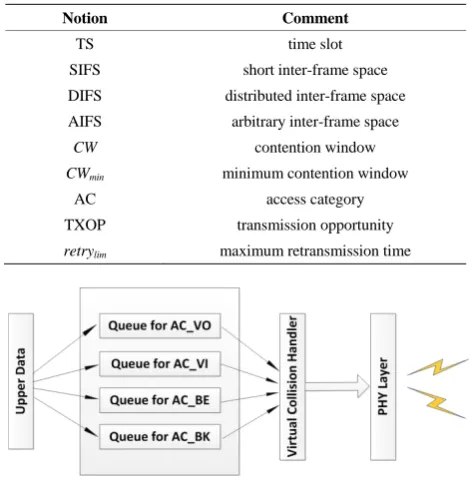
Figure 1. Scenario with N non-AP STAs and one AP.
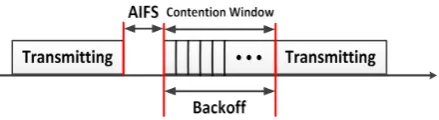
802.11e EDCA. For detailed description, readers may refer to [1,2]. EDCA is an enhanced policy of DCF. There are some important notions, as depicted by Table 1. The packets from upper layer are classified into four ACs. Each AC is corresponding to one queue. Each STA has four queues and each queue has a backoff counter. The mapping from upper layer to medium access control (MAC) layer is shown as Figure 2 (refer to [2]). In EDCA, the channel access process is described as following. STA which has packets to send senses the channel. If the channel is idle for AIFS period, the STA transmits pack-ets immediately. If the channel is busy, the backoff coun-ter is initialized and set as a value based on the backoff mechanism. The STA enters the backoff phase after it senses the channel idle for AIFS period. In the backoff phase, the backoff counter decreases by one if the chan-nel is idle for one time slot (TS) consecutively. If the channel becomes busy, the backoff counter is suspended. The counter resumes when the STA senses the channel idle for AIFS period again. The STA transmits packets if the backoff counter decreases to zero. The node can trans-mit multiple packets during TXOP. When the STA suc-cessfully transmits data, its CW is set as CWmin and its
backoff counter is set as a value from [0, CW − 1] ran-domly. The channel access process is illustrated as Fig-ure 3 (refer to [2]).
[image:2.595.305.540.471.712.2]There exist two kinds of collisions in EDCA, namely, virtual collisions and inter-STA collisions. The former occurs when more than two queues (including two queues) in a STA simultaneously attempt to transmit packets.
Table 1. Notions and Comments.
Notion Comment
TS time slot
SIFS short inter-frame space
DIFS distributed inter-frame space
AIFS arbitrary inter-frame space
CW contention window
CWmin minimum contention window
AC access category
TXOP transmission opportunity
retrylim maximum retransmission time
[image:2.595.69.270.574.712.2]463
Figure 3. Channel Access Process in Enhanced Distributed Channel Access (EDCA).
The queue with the highest priority wins and attempts to transmit data while the others do not send data but update their CWs according to the backoff mechanism depicted in Equations (1)-(2) and continue to sense the channel.
(1)
(2)
The latter collision happens when there are more than two STAs (including two STAs) simultaneously transmit data. The STAs participating in the collision all update their CWs according to the backoff mechanism depicted in Equations (1)-(2), and increase retry number (denoted
by retrynum) by one. Then all stations sense the channel
for the next attempt again.
3. A-EDCA Channel Access Policy
In this section, we present A-EDCA channel access pol-icy. To begin with, we present the general idea of A-EDCA. Then the detailed description is given.
3.1. Proposed A-EDCA Channel Access Policy
There exist problems when EDCA policy is used directly. It cannot indicate how crowded the channel becomes that a certain station either succeeds to transmit packets or collides with others. In order to adapt to the network load condition, we have to find a metric that can reflect what the current load condition is like. From the backoff me-chanism we know that the more crowded the WLAN is, the bigger the retrynum becomes. Therefore, we adopt the
average value of retrynum (denoted by E[retrynum]) as the
metric. In order to provide AP with the bigger channel access opportunity to relieve the unfairness, we adjust the channel access policy of AP. After a certain non-AP STA transmits packets successfully we set the backoff counter of AP as zero so as to make AP skip the backoff phase and attempt to transmit data in the next time.
3.2. Detailed Description of A-EDCA
3.2.1. CW Value Adjustment
When a certain STA (including AP) succeeds to transmit packets we calculate E[retrynum] using Equation (3).
(3)
Here, M is the number of stations whose retrynum > 0. The channel is not busy if E[retrynum] and the
channel becomes crowded if E[retrynum] . We com-
pare E[retrynum] with the threshold (denoted by ) and
update CW according to Equation (4).
(4)
When collision occurs, we compute E[retrynum] using
Equation (3) and update the CW of the stations partici-pating in the collision using Equations (1) (2) and (5).
(5)
3.2.2. Channel Access Policy Adjustment for AP
When a non-AP STA succeeds to transmit packets, AP sets its backoff counter as zero which makes AP skip the backoff phase. Then AP can attempt to transmit data af-ter AIFS period during which the channel is continuously idle. This adjustment relieves the unfairness between the channel access competition ability of non-AP STAs and that of AP, depicted in Figure 4. We emphasize that the policy that we set backoff counter of AP as zero is adopted only when non-AP STA completes transmission successfully, which is for the sake of avoiding AP occu-pying the channel all the time.
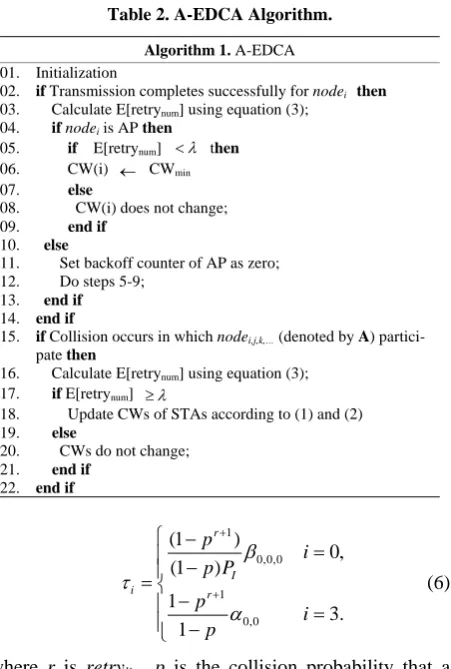
The algorithm is presented in pseudo-code in Table 2.
4. Performance Analysis
The section is based on [8]. For simplicity, we only con-sider two ACs without loss of generality, namely, AC0
which presents background traffic and AC3 which presents
voice traffic. We assume that each station only includes one AC. In order to obtain the expressions of perfor-mance metrics, some equations are given as follows. The probability that a station of ACi transmits data in a
[image:3.595.63.283.88.148.2]slot is shown by
Table 2. A-EDCA Algorithm.
Algorithm 1. A-EDCA 01. Initialization
02. if Transmission completes successfully for nodei then 03. Calculate E[retrynum] using equation (3);
04. ifnodei is AP then 05. if E[retrynum] <λ then
06. CW(i) ← CWmin
07. else
08. CW(i) does not change; 09. end if
10. else
11. Set backoff counter of AP as zero; 12. Do steps 5-9;
13. end if
14. end if
15. if Collision occurs in which nodei,j,k,… (denoted by A) partici-pate then
16. Calculate E[retrynum] using equation (3);
17. if E[retrynum] ≥λ
18. Update CWs of STAs according to (1) and (2) 19. else
20. CWs do not change; 21. end if
22. end if
1 0,0,0 1 0,0 (1 ) 0, (1 ) 1 3. 1 r I i r p i p P p i p β τ α + + − = − = − = − (6)
where r is retrylim, p is the collision probability that a
frame encounters, β0,0,0 and α0,0 are steady probabili-ties referred to [8], and PI is the probability that the
channel is idle in a time slot, given by PI = q1/(1+q1−q2).
Here, q1 and q2 is the probability that there are no
trans-missions in a slot during an AIFS period and during other period respectively, depicted as follows:
3
0 3
1 3
2 0 3
(1 )
(1 ) (1 )
n n n q q τ τ τ = −
= − − (7)
where ni is the number of stations of ACi. The probability
PB that a slot is busy is given by PB= 1 −PI. The
proba-bility Psi that a station of ACi succeeds to transmit data in
a slot time is shown by
3 0 1 3 1 1 0
(1 ) (1 ) 0,
(1 )
(1 ) (1 ) 3.
i i
i
n n
i i i
n
Si i i i B
n n
i i i
n i
P n P
n i
τ τ τ
τ τ
τ τ τ
− − − − − = = − + − − = (8)
The probability PC that collisions happen in a slot time
is given by PC = −1 PI −PS.
According to [8], throughput (denoted by S) is pre-sented as follows:
[ ] [ ]
S
S=P ∗E P E TS (9)
where PS is the probability that a successful transmission
occurs in a slot time depicted by PS =Ps0+Ps3, E P[ ]
is the average size of frame, and E[TS] is the average length of a time slot given by E[TS] = PIσ + PSTS +
PCTC. Here, σ is the length of a time slot, TS is the
av-erage time of successful transmission, and TC is the
av-erage time of collision. The TS and TC in the basic mode
are presented by
[ ]
[ ]
[
AC]
C timeout
S i
T H E P SIFS ACK
T H E P SIFS ACK AIFS
= + + +
= + + + + (10)
where H is the size including both MAC head and PHY head, E[P] is the size of frame. From (9) we know that S is a decreasing function of collision probability p.
The mean access delay (denoted by E[D]) is shown as follows: 1 1 0 1 ( ) 2 [ ] [ ] 1
i r i
r
r i
W
p p
E D E TS
p + + = + − = ⋅ −
∑
(11)We can derive that E[D] is an increasing function of collision probability p.
By using A-EDCA policy without considering AP pol-icy the collision probability can be decreased efficiently especially when the number of stations becomes large. From (9) (11) we can know that the throughput is im-proved and that delay is decreased by using A-EDCA policy. Taking AP policy adjustment into account, we can know that the downlink throughput can be improved and that the unfairness can be relieved.
5. Simulation Results
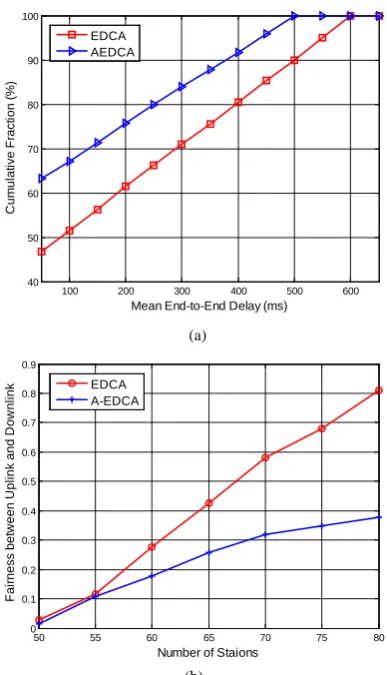
We adopt throughput, mean end-to-end delay and fair-ness of throughput to compare the performance between A-EDCA policy and EDCA policy. The fairness of throughput (denoted by I) is defined as the ratio of the difference between uplink throughput and downlink throughput to the throughput of uplink, depicted as Equ-ation (12).
(
up down)
upI= T −T T (12)
where Tup and Tdown denote uplink throughput and
down-link throughput, respectively.
We make some assumptions in our simulation. The channel is ideal and packet loss ratio (PLR) is only in-troduced by the event that the retransmission time is up
to retrylim. Only two kinds of traffic are considered which
are voice traffic (denoted by AC3) and background traffic
(denoted by AC0). TXOP is set as zero for all nodes,
which means that the node occupying the channel suc-cessfully can only transmit one packet. We adopt the basic access mode. Simulation parameters are listed in Table 3.
465
[image:5.595.58.282.170.696.2]be decreased and AP can get more opportunity to access the shared channel, which improves the performance of throughput, end-to-end delay and relieves the unfairness between AP and non-AP STAs.
Figure 5 shows the performance comparison between
Table 3. Simulation Parameters.
Parameters value
PHYHeader 192 bits
MACHeader 272 bits
SIFS 1 Time Slot
DIFS 3 Time Slot
AIFSN[AC0] 7
AIFSN[AC3] 2
ACK Frame PHY Header + 112 bits ACKtimeout ACK Frame + DIFS
Data Rate 11 Mbps
Time Slot 20 μs
retrylim 7
AC0 1500 bytes
AC3 200 bytes
CW[AC0] {31, 63, 127, 255, 511, 1023}
CW[AC3] {7, 15, 31, 63, 127, 255}
(a)
(b)
Figure 5. (a) Comparison of Throughput When No. of STAs Changes; (b) Comparison of Mean End-to-End Delay When No. of STAs Changes.
A-EDCA and EDCA when the number of stations changes.
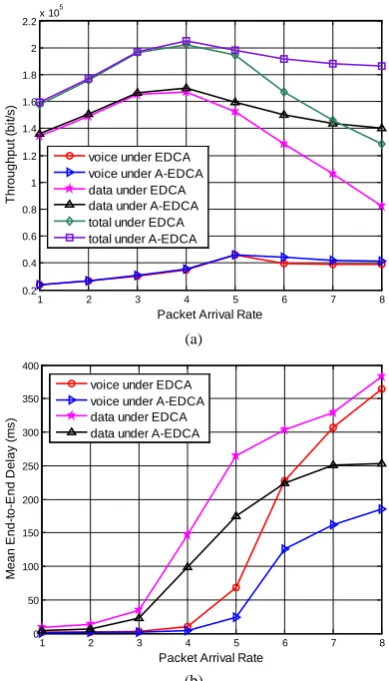
Figure 5(a) illustrates that throughput under A-EDCA is larger than that under EDCA. Figure 5(b) shows that mean end-to-end delay becomes smaller under A-EDCA. From Figures 6(a) and (b) we can see that our A-EDCA brings performance improvements when the packet ar-rival rate changes. The cumulative distribution function of mean end-to-end delay is shown in Figure 7(a). We can see that about 90 percent of delay is under 400 ms under A-EDCA policy while it is 500 ms under EDCA policy. Figure 7(b) shows us that the unfairness is re-lieved under A-EDCA especially when the number of stations is large.
6. Conclusion
This paper has considered the problem of IEEE 802.11e EDCA policy which includes not adapting to the time- varying network condition due to the fixed parameter settings and the channel competition ability unfairness between AP and non-AP STAs. In order to solve the problem, we proposed an improved scheme “A-EDCA”.
(a)
(b)
Figure 6. (a) Comparison of Throughput When Packet Arrival Rate Changes; (b) Comparison of Mean End-to-End Delay When Packet Arrival Rate Changes.
50 55 60 65 70 75 80
0 2 4 6 8 10 12 14 16x 10
4
Number of Staions
T
hr
oughput
(
bi
t/
s)
voice under EDCA voice under A-EDCA data under EDCA data under A-EDCA total under EDCA total under A-EDCA
50 55 60 65 70 75 80
0 50 100 150 200 250 300 350
Number of Staions
M
ean E
nd-
to-E
nd D
el
ay
(m
s)
voice under EDCA voice under A-EDCA data under EDCA data under A-EDCA
1 2 3 4 5 6 7 8
0.2 0.4 0.6 0.8 1 1.2 1.4 1.6 1.8 2 2.2x 10
5
Packet Arrival Rate
T
hr
oughput
(
bi
t/
s)
voice under EDCA voice under A-EDCA data under EDCA data under A-EDCA total under EDCA total under A-EDCA
1 2 3 4 5 6 7 8
0 50 100 150 200 250 300 350 400
Packet Arrival Rate
M
ean E
nd-
to-E
nd D
el
ay
(m
s)
[image:5.595.326.521.354.695.2](a)
(b)
Figure 7. (a) Comparison for Delay CDF; (b) Comparison for Fairness.
In the scheme CW of the node is adjusted dynamically for the sake of adapting to the current network condition, and AP skips the backoff phase by setting its backoff counter as zero when non-AP STA completes transmis-sion successfully to relieve the unfairness between chan- nel access competition ability of AP and that of non-AP STAs. Through the simulations, we verify the effective-ness of our approach. The performances of both through-put and mean end-to-end delay are improved effectively. The unfairness is relieved to a large extent. Future re-search will focus on how to satisfy hard QoS require-ments and how different kinds of access networks such as WLAN, LTE-A provide better services for users to-gether.
REFERENCES
[1] Wireless LAN Medium Access Control (MAC) and Physical Layer (PHY) Specifications, ISO/IEC IEEE 802.11 Standard, 2005.
[2] Wireless LAN Medium Access Control (MAC) and Physical Layer (PHY) Specifications: Medium Access
Control (MAC) Quality of Service Enhancements, ISO/ IEC IEEE 802.11 Standard, 2005.
[3] F. Cali, M. Conti and E. Gregori, “IEEE 802.11 Wireless LAN: Capacity Analysis and Protocol Enhancement,” 17th Annual Joint Conference of the IEEE Computer and Communications Societies, March 1998, pp. 142-149.
[4] G. Bianchi, “Performance Analysis of the IEEE 802.11 Distributed Coordination Function,” IEEE Journal on Selected Areas in Communications, Vol. 18, 2000, pp.
535-547
[5] Z.-n. Kong, D. H. K. Tsang and B. Bensaou, “Perfor- mance Analysis of IEEE 802.11e Contention-Based Channel Access,” IEEE Journal on Selected Areas in Communications, Vol. 22, No. 10, 2004, pp. 2095-2106.
[6] F. Cali, M. Conti and E. Gregori, “Dynamic Tuning of the IEEE 802.11 Protocol to Achieve a Theoretical Through- put Limit,” IEEE Transactions on Networking, December 2000, pp. 785-799.
[7] J. C. Tay and K. C. Chua, “A Capacity Analysis for the IEEE 802.11 MAC Protocol,” Wireless Networks, Vol. 3, No. 3, 2001, pp. 159-171.
[8] J. W. Tantra, H. F. Chuan and A. B. Mnaouer, “Through- put and Delay Analysis of the IEEE 802.11e ED CA Sa- turation,” IEEE International Conference on Communi- cations (ICC), Vol. 5, May 2005, pp. 3450-3454,
[9] X. Yang, “Enhanced DCF of IEEE 802.11e to Support QoS,” IEEE WCNC, 2003.
[10] A. Veres, A. T. Campbell, M. Barry and L. H. Sun, “Supporting Differentiation in Wireless Packet Networks Using Distributed Control,” IEEE Journal on Selected Areas in Communications, Vol. 19, No. 10, 2001, pp. 2081-2093.
[11] A. Leonovich and H.-W. Ferng, “A Time Slots Coordina- tion Mechanism for IEEE 802.11 WLANs,” IEEE Com- munications Letters, Vol. 14, No. 4, 2010, pp. 360-362.
[12] G. W. Wong and R. W. Donaldson, “Improving the QoS Performance of EDCF in IEEE 802.11e Wireless LANs,”
IEEE Pacific Rim Conference on Communications, Com- puters and Signal Processing (PACRIM), Vol. 1, August 2003, pp. 392-396,
[13] P. Patras, A. Banchs and P. Serrano, “A Control Theoret- ic Approach for Throughput Optimization in IEEE 802.11e EDCA WLANs,” Mobile Networks and Applica- tions, Vol. 14, No. 6, 2009, pp. 697-708.
[14] Y. Q. Dong, Y. Wang and Q. Xia, “A Load Adaptive IEEE 802.11e EDCA Backoff Scheme with Enhanced Service Differentiation,” IEEE International Conference on Communication Technology, November 2010, pp. 1056-1059,
[15] T. Nilsson and J. Farooq, “A Novel MAC Scheme for Solving the QoS Parameter Adjustment Problem in IEEE 802.11e EDCA,” IEEE International Symposium on a World of Wireless, Mobile and Multimedia Networks, 2008, pp. 1-9.
100 200 300 400 500 600
40 50 60 70 80 90 100
Mean End-to-End Delay (ms)
C
um
ul
at
ive
F
ract
io
n (
%
)
EDCA AEDCA
50 55 60 65 70 75 80
0 0.1 0.2 0.3 0.4 0.5 0.6 0.7 0.8 0.9
Number of Staions
F
ai
rness
bet
w
een U
pl
ink
and D
ow
nl
[image:6.595.75.269.82.420.2]