Estimation of Two-Dimensional Correction Factors for
Min-Sum Decoding of Regular LDPC Code
Ahmed A. Hamad
Department of Electrical Engineering, University of Babylon, Babel, Iraq. Email: [email protected]
Received August 17th, 2013; revised September 21st, 2013; accepted October 6th, 2013
Copyright © 2013 Ahmed A. Hamad. This is an open access article distributed under the Creative Commons Attribution License, which permits unrestricted use, distribution, and reproduction in any medium, provided the original work is properly cited.
ABSTRACT
In this paper, two-dimensional (2-D) correction scheme is proposed to improve the performance of conventional Min- Sum (MS) decoding of regular low density parity check codes. The adopted algorithm to obtain the correction factors is simply based on estimating the mean square difference (MSD) between the transmitted codeword and the posteriori in- formation of both bit and check node that produced at the MS decoder. Semi-practical tests using software-defined ra- dio (SDR) and specific code simulations show that the proposed quasi-optimal algorithm provides a comparable error performance as Sum-Product (SP) decoding while requiring less complexity.
Keywords: LDPC Code; Sum-Product; Min-Sum; 2-D Correction Factors; Software-Defined Radio (SDR)
1. Introduction
Due to its exceptional error performance, low density parity check code (LDPC) [1] has received significant attention recently. It is adopted by many new generation communication standards, such as wireless LAN (IEEE 802.11n) [2], WiMax (IEEE 802.16e) [3] and DVB-S2 [4]. Although Sum-Product (SP) algorithm [5] provides a powerful tool for iterative decoding of LDPC codes, it requires a large hardware complexity. Sub-optimal algo-rithms like Min-Sum (MS) [6] can significantly reduce the hardware complexity of SP at the cost of performance degradation. In MS decoding, the complex computations at the check nodes are approximated by using simple comparison and summation operations. The sub-optima- lity of the MS decoding comes from the overestimation of check-to-bit and thereby, bit-to-check node messages, which lead to performance loss with respect to the SP de- coding.
In many literatures like [7-11], various methods were proposed to elevate the performance degradation of the MS decoding which is considered as quasi-optimal algo-rithms. It has been noted that the degradation in error performance due to MS decoding can be compensated by linear post processing (normalization or offset) of the messages delivered by check and bit nodes.
In this study, a simple algorithm is presented to esti-mate the optimal correction factors for 2-D corrected MS
decoding of regular LDPC codes. In a previous work [12], it has been shown that the error performance loss of SOVA compared to Log-MAP decoding can be com-pensated by scaling the a-posteriori LLR values of the information bits based on the fact that the latter is a growing estimate to the transmitted codeword, and the correction factors can be derived based on minimizing the mean-square difference (MSD) between them. A similar approach is applied to find the optimal correction factors which are utilized to scale the message passing from check to bit and bit to check nodes. Extensive si-mulations are carried out using the specifications of the LDPC adopted by the IEEE 802.11n standards. A sig-nificant improvement in error performance is achieved by using the modified MS decoder compared to the ori- ginal one.
This paper is organized as follows. Section 2 briefly reviews the standard SP and MS decoding schemes. Sec-tion 3 presents the proposed 2-D corrected MS decoding. In Section 4, a simple SDR implementation for the modi-fied and unmodimodi-fied systems is demonstrated. Section 5 reports simulation and practical results and Section 6 concludes this paper.
2. Standard SP and MS Decoding
Algorithms
decoders which make use of the channel information. They are developed to deal with log-likelihood values (LLR) of the received signal. As proposed by [13] effi-cient encoding of the information bits with a reasonable complexity is achieved to produce the codeword
0,1 : 1 ton
cc n N. When a codeword is
trans-mitted through an AWGN channel the binary vector is first mapped into a transmitted signal vector
c
1, 1 : 1 ton
qq n N according to
1 2
n
q c
n. The received sequence is
n
y y qw
n
y
, where the samples of the received
sig-nal are given by
n n
y q n (1) The vector
n are statistically independentGaussian random variables with zero mean and two sided power spectral density of N0 2. The received signals
have to be scaled by the channel reliability
n y 4 b c o L R N
E before they deliver to the decoder. Here,
the notations R and b define the information rate and
the energy per information bit. Hence, n c n is the
log-likelihood ratio (LLR) of bit n which is derived from
the channel output .
E
y
r L y
n
Suppose a regular binary (N, K) LDPC code has a
bi-partite Tanner graph which can be defined by the sparse parity check matrix H
Hmn
1
. The set of neighbor
check nodes of the bit node n is .
While, the set of neighbor bit nodes of the check node m,
is m mn . The set of bits that participate in
check node m except for bit n is denoted by
: 1n mn
A m H
:B n H
m n
B . On
the other hand, the notation An m refers to the set of
checks in which bit n participates except for check m. For
each iteration i, the decoder calculates the following
variables:
i
mn
E : The LLR message of bit n which is passed from
check node m to bit node n (extrinsic information).
i
mn
M : The LLR message of bit n which is passed
from bit node n to check node m.
Mi: The a-posteriori LLR of bit n. n
The standard SP [5], [14] decoding algorithm can be summarized by the following steps.
Step 1: Initialization: set i mn n
M r
max i
for each m and n,
maximum number of iteration to , and failure
= 0.
1
i
Step 2: Check node update (Horizontal step): For each
m, n with Hmn= 1, compute
1 1 2tanh tanh 2 m n i i mn mn n B M E
(2)Step 3: Bit node update (vertical step): For each m, n
with Hmn= 1, compute
n m
i
mn n m n m A
i
M r
Ei n
(3)
n
i
n n m m A
M r E
(4)Step 3: Tentative decision: Let denote the estimated codeword bits as
0 if 1 if 0 0 i n n i n M ˆc M
If HcˆT 0 or
max
ii go to step 4, otherwise set
1
i i and go to step 2.
Step 4: Declare that is the decoded codeword. If ˆc
0
T
ˆ
Hc and iimax then set failure = failure + 1. The difference between MS and SP algorithm is the way by which MS decoder computes the check node up-date [6]. It is recognized that the term corresponding to
the smallest dominates the product term in
Equa-tion (2) and so the product can be approximated by a minimum. Hence Equation (2) can be modified to
i mn
E
1
sgn min
m n m n
i i
mn mn mn
n B n B
E M Mi1
(5)The product of sign and minimum operations are much simpler to implement and faster in time processing than the product of hyperbolic tan and its inverse. These ad-vantages spot a light on the MS decoding algorithm and make it more feasible and preferable in practical imple-mentations.
3. Proposed Corrected MS Decoder
Although the MS algorithm greatly reduces the decoding complexity for implementation, it suffers from a signifi-cant deterioration in its error performance compared to SP decoding. Many researches state that the correlation of the extrinsic information with the original a priori bit LLR (rn) is what prevents the resulting a-posteriori
prob-abilities from being exact. In line with the foundation that explored in [12], it is suggested that we scale the
marginal LLR values i and
mn
E i
mn
M by the correction
factors ai and bi to make the a-posteriori probabilities as
close as possible from the transmitted codeword, thereby reducing the probability of error. The corrected values
and
i mn
É Mˊmni are given by the following equations:
i i i mn mn
É a E (6)
i i i mn mn
Mˊ b M (7) It is possible to derive the correction factor by mi-
nimizing the mean square difference between the
a-posteriori probability
i
a
a
i n
M and the mapped codeword
2i i i
a E a sgn
q V (8)
E denotes the expected value. may be
considered as a measure of how efficient the algorithm is with the proposed modification. It is obvious that to get
better suboptimal decoding, the parameter should be
found to minimize . The value of is simply
found by derive with respect to and
equat-ing the result to zero.
a i a
i a i a
i
a
i ai
2
sgn sgn 0
i
i i
i
i
d a
a E
da E
V V q (9)
Considering that , the value of is
given by
2sgn i 1
V ai
sgn
i i
a E V q (10)
In similar manner, the value of can be found by
minimizing the MSD between the modulated codeword and the vector representing the vertical sum of
i
b
i mn
M .
Suppose that
n
i n
m A
U M
imn
i
(11)
and let the vector i , then
n
U Ui
sgn
i
b E U q (12)
It is worth mentioning that both Equations (10) and (12) need to be computed to the transmitted codeword q
and this is not available at the receiver in real-world sys-tems. It is suggested to solve this problem in three dif-ferent ways. First, it is possible to compute the values of
and offline for different channel characteristics and store their values in memory to be used latter by the decoder online. This will reduce the proposed modifica-tion to simple multipliers. Second, pilots and headers are known signals to the decoder, so they offer online esti-mation for the correction factors. Third, from the simula-tion of different systems, it is observed that the values of
and have nearly stationary values for certain
number of iterations, code parameters and channel char-acteristics. Thereby sending few known codewords to the receiver at the start of or in between transmission is suf-ficient to compute the correction factors with accepted accuracy.
i
a
i
a
i
b
i
b
Actually, for certain code H and channel
characteris-tics (s) (e.g., b o), the correction factors are function
of the iteration’s number (i) and the number of simulated
frames (t), (i.e., ,
E N
i s t
a and i,
s t
b ). The average values of
, i s t
a over all simulated codewords is given by
,
i i s t s t
a E a (13)
Further, if the average is done over all iterations, we get
i s i s
a E a (14)
And finally, the averaging over all simulated values of
b o
E N produces a constant
s s
aE a (15)
Different simulation tests are carried out to demon-strate the effect of averaging presented in Equations (13)- (15) on the error performance of LDPC.
4. Implementation by Software-Defined
Radio
To be close from the implementation issues of the real- world wireless communications, semi-practical tests to some of the simulated systems are experienced using the MATLAB data acquisition toolbox and PC sound card. Real-world passband signals for some of the modified and unmodified coded systems are transmitted and re-ceived via room-to-room audio sender operating in the 2.4 GHz industrial, scientific and medical (ISM) radio band. The acquired signal from the PC sound card can be directed to the RAM and/or the hard disk to be processed later by the SDR receiver. The SDR receiver takes con-sider of all the required DSP algorithms like modulation/ demodulation, pulse shaping filtering, synchronization and signal to noise power ratio (SNR) estimation in MATLAB code.
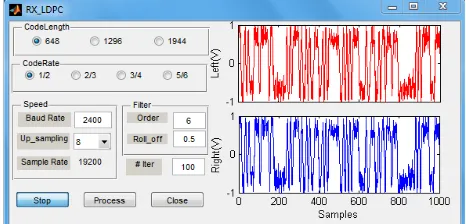
Figure 1 depicts simple Graphical User Interface (GUI) panel that used as SDR receiver.
The panel offers different options that can be changed to suit the desired test like codeword length (N), coding
rate (R), maximum number of iterations (imax), baud rate
and oversampling value. It is also possible to change the order and roll-off factor of the square root raised cosine filter which is used in pulse shaping process for the transmitted and received signals.
Figure 2 shows the block diagram of the proposed SDR system. While, Figure 3 depicts a picture for the set of SDR test system.
[image:3.595.306.539.602.714.2]In asynchronous data transmission, the frame and bit
synchronization are considered as a challenging problem. In this study, a simple frame construction is considered to cope with this problem as shown in Figure 4. In the front of any transmitted frame a header is generated by one or more Barker code(s) of thirteen bits in length. The length of the header determines the capability of the re-ceiver to mark the starting point of the received frame and reduces the probability of miss detection. However, the quality of the channel is the main factor in determin-ing the header length.
Intuitively, the data followed the header is random for the receiver which leads to a mismatch between the ac-tual and reference header at the receiver due to filtering process. This is manifested especially at the junction between the header and data fields. Since the header sig-nal is utilized to estimate the SNR, this undesirable dis-tortion will reduce the accuracy of estimation. Therefore, three bits (e.g., 101) are appended by the header bits. The padded bits should be omitted during the SNR estimation to get rid of this distortion. Figure 5 illustrates a section from the transmitted frame at the junction between head-er and data, received noisy signal, and the output of
AWGN BPSK
modulator
BPSK demodulator
Data generation
LDPC encoder
Frame construction
PC Sound card
Radio transmitter
Radio receiver
PC Sound card Frame
synchronization Pulse Shaping
Pulse Shaping LDPC
decoder SNR estimation BER
[image:4.595.56.285.360.464.2]calculation
[image:4.595.311.534.391.541.2]Figure 2. Block diagram of the proposed SDR system.
Figure 3. The experimental set of the SDR system.
Header Multiple of 13 bits
barker code
3 padding bits
Codeword
N bits
Figure 4. Frame construction.
square raised cosine filter. The estimated Eb No at the
receiver is around 15 dB for this case.
The SNR estimation technique presented here origi-nated from a method for measuring channel distortion errors in wideband telemetry systems [15], in which the noise in a signal at a point in a system is defined as the mean-square error (MSE) between the actual signal and a desired signal at that point. The estimated SNR is given by
2
2 DA m
D A DA m
R SNR
P P R
(16)
where PD and A represent the average powers in the
reference (desired) header and the actual (received) header, respectively. The maximum correlation
P
DA m
R between the actual and the desired header
sig-nals indicates the system time delay
m .Figure 6 demonstrates the correlation between the ref-erence and actual headers. The maximum correlation
DA m
R marks the beginning of the received frame. It
is worth mentioning that the abscissa of the BER per-formance graphs for the practical tests presented in sec-tion 5.2 is the average of the estimated SNR over all transmitted frames.
20 20.5 21 21.5 22 22.5 23 23.5 24 24.5 25 -1
-0.5 0 0.5 1
Time (ms)
A
m
plitu
de
TX data TX frame Header RX frame RX frame+filter Distortion
Padding bits
Figure 5. Transmitted data, transmitted pulse shaped, re-ceived noisy and filtered signals (part of).
-500 0 500 1000 1500 2000 2500 3000 -200
-100 0 100 200 300 400
Tau (in samples)
C
or
re
la
tio
n
[image:4.595.62.283.492.660.2]Max. Corr. Start of frame
[image:4.595.311.536.581.718.2]5. Simulation and Practical Results
5.1. Simulation Results
Simulations are carried out over the AWGN channel with BPSK modulation for the proposed 1-D and 2-D cor-rected MS decoding for LDPC code which is adopted by the standard IEEE 802.11n [2]. Figure 7 presents the BER performance of regular (1944, 1296) rate 2/3 LDPC with the decoding algorithms; SP, original MS, 1-D
MS-( i
s
a ), 1-D MS-(bsi) and 2-D MS-(a bsi, si
i
). The sys-tems in Figure 7 (excluding 1-D MS-(bs)) are retested using the regular (648, 324) rate 1/2 LDPC and depicted in Figure 8. It is obvious that the performance gap
be-tween the proposed 2-D MS-( i, i
s s
a b ) and the SP decoders
is only of 0.1 dB and 0.04 dB at BER = 10−4 for the
(1944, 1296) and (648, 324) codes, respectively. Table 1 illustrates the values of the correction factors
as, bs, a, b and the mean value of a and b, i.e., E a b
, ,for the (1944, 1296) rate 2/3 LDPC code.
1.4 1.6 1.8 2 2.2 2.4 2.6 2.8
10-4 10-3
10-2 10-1
E
b/No (dB)
BE
R
SP MS original 1-D MS-(ais) 1-D MS-(bis) 2-D MS-(ais ,b
i s)
Figure 7. BER performance of SP, original MS, 1-D MS-
is
a , 1-D MS-
i sb and 2-D MS- decoding algo-rithms for regular (1944, 1296) LDPC, .
i i
s s
a b,
max= 100
i
1 1.2 1.4 1.6 1.8 2 2.2 2.4 2.6
10-5
10-4
10-3
10-2
10-1
Eb/No (dB)
BER
SP MS original 1-D MS-(ais)
2-D MS-(ais ,b i s)
Figure 8. BER performance of SP, original MS, 2-D MS- and 1-D
MS-
i i
s s
a b,
ais= 100
decoding algorithms for regular
(648, 324) LDPC, .
max
i
It is interested to note that the values of as and as are
very close to each other, so it is possible to use the same correction factor at the bit and check node for more re-duction in complexity.
Figure 9 demonstrates the effect of applying the av-erage of correction factors over all iterations and further
over the whole tested range of b o. It is clear that
the averaging of the correction factors over all iterations (as, bs) results a deterioration in error performance, but
only about 0.02 dB.
E N
Applying a and b instead of as, and bs in MS decoding
gives a slight improvement especially at high SNR. This interested result urged on testing the proposed scheme by
applying a single correction factor = 0.889 at
the bit and check nodes for the whole range of SNR and along all decoding iterations. The 2-D
MS-
,E a b
,E a b
de-coding scheme shows a reduction in performance in
comparison with other schemes at low Eb No. After
=2
b o
E N dB the BER performance of this scheme
out-performs the 2-D MS-(as, bs) and 2-D MS-(a, b) systems
and becomes even better than the 2-D MS-
i, i
s s
a b scheme after Eb No=2.3 dB.
Figure 10 presents the probability of failure for the (1944, 1296) LDPC, for SP, original MS, and 2-D MS-
,
i i s s
a b decoding algorithms. Probability of failure can be
Table 1. Correction factors
a bs, s
, their average values (a,b) and the average of a and b of regular (1944, 1296) LDPC.
b
o
E N (dB)
Correction factors
1.4 1.8 2.2 2.6
a b E (a, b)
as 0.8526 0.8867 0.9137 0.9363
bs 0.8604 0.8910 0.9150 0.9363
0.8973 0.9007 0.899
1.5 1.6 1.7 1.8 1.9 2 2.1 2.2 2.3 2.4 2.5
10-4 10-3 10-2 10-1
Eb/No (dB)
BE
R
2-D MS-(as ,bs) 2-D MS-(a ,b) 2-D MS-E(a ,b) 2-D MS-(ais ,bis)
Figure 9. BER performance of 2-D MS-
i i
s s
a b, , 2-D MS-
i i
s s
a b, , 2-D MS-(a, b) and 2-D MS-E a b
,max= 100
decoding
defined as the probability of the decoder to reach the
maximum number of iterations without satisfying
the parity check equations, i.e., . Figure 11
shows the average number of iteration for each simulated system in Figure 10. It is clear from Figures 10 and 11 that the modified MS decoder demonstrates a comparable performance to the optimum SP decoder.
max
i
HcˆT 0
Figure 12 presents the variation of i s
a and bsi over
100 iterations with different values of b o. Figure
13 demonstrates the values of
E N
i s
a over the simulation of 50 and 500 frames. It is clear that the two curves are very close to each other which mean that it is possible to esti-mate the correction factors online with few known re-ceived frames without losing a lot of time in this process.
5.2. Practical Results
Experiments of wireless indoor transmission (utilizing the SDR approach explained in Section 4) are carried out to prove the effectiveness of the proposed systems. The tests are running over approximately the same environ-
1.4 1.6 1.8 2 2.2 2.4 2.6 2.8
10-4 10-3 10-2 10-1
100
Eb/No (dB)
Pr
ob.
of
f
ailur
e
SP MS original 2-D MS-(ais ,bis)
Figure 10. Probability of failure of SP, original MS and 2-D MS-
algorithms for regular (1944, 1296), 2/3 rate LDPC.
i i
s s
a b,
1.4 1.6 1.8 2 2.2 2.4 2.6
0 10 20 30 40 50 60 70 80 90 100
Eb/No (dB)
A
ver
ag
e n
um
ber
o
f i
ter
at
io
ns
SP MS original 2-D MS-(ai s ,b
i s)
Figure 11. Average number of iteration of SP, original MS and 2-D MS- algorithms for regular (1944, 1296), 2/3 rate LDPC.
i i
s s
a b,
ments. The transmitter and the receiver are fixed inside a
4 m 4 m room during the experiments. The data is
transmitted with a bit rate of 2400 bit/sec using BPSK modulation. The filter order and roll-off factor at both transmitter and receiver are adjusted to 6 and 0.5 respec-tively.
Figure 14 presents the resulted BER performance of original MS, 2-D MS-
i, i
s s
a b , and 2-D MS-E(a, b)
de-coding algorithms of the regular (1944, 1296) LDPC code. It is noted that the BER performance of the pro-posed 2-D MS-
i, i
s s , decoder outperform the original
MS by about 1.1 dB measured at BER = 10−3. Redu-
cing the complexity by using one correction factor a b
, 0 8E a b . 816 for both bit and check messages
re-sults in reduction of performance by about 0.12 dB in
compare with the 2-D MS-
i, i
s s
a b decoding. Table 2
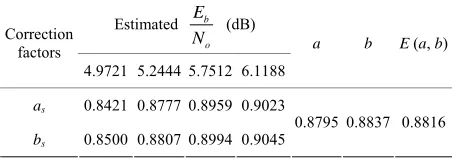
illustrates the correction factors (as, bs), their average
values (a, b) and the mean value of a and b, E(a, b) that
acquired from the practical test of the regular (1944, 1296) LDPC code.
0 10 20 30 40 50 60 70 80 90 100 0.82
0.84 0.86 0.88 0.9 0.92 0.94 0.96 0.98 1
Iterations
N
or
m
al
iz
at
io
n f
ac
to
r
Eb/No=2.6dB
Eb/No=1.8dB
Eb/No=1.4dB
bis ais
Figure 12. The correction factors and over 100 ite- rations with different
i s
a i
s
b
b
o
E N
.
0 5 10 15 20 25 30
0.85 0.86 0.87 0.88 0.89 0.9 0.91 0.92
Iterations
N
orm
aliz
atio
n fa
ct
or
E(ais,t ) over 500 frames.
E(ais,t ) over 50 frames.
Figure 13. The average of correction factor over t = 50 and 500 transmitted frames of regular (1944, 1296), 2/3 LDPC at
i s t
a,
= 2.2 dB
b
o
E N
5 5.25 5.5 5.75 6 6.25 6.5 6.75 7 7.25 10-3
10-2 10-1
Eb/No (dB)
BE
R
[image:7.595.65.280.88.240.2]MS original 2-D MS-(ais ,bis) 2-D MS- E(a ,b )
Figure 14. BER performance of original MS, 2-D MS- , and 2-D MS-E (a, b) decoding algorithms of the regular (1944, 1296) LDPC code.
i i
s s
a b,
Table 2. Correction factors (as, bs) and their average
val-ues (a, b) for practical test of the regular (1944, 1296) LDPC code.
Estimated b o
E N (dB)
Correction factors
4.9721 5.2444 5.7512 6.1188
a b E (a, b)
as 0.8421 0.8777 0.8959 0.9023
bs 0.8500 0.8807 0.8994 0.9045
0.8795 0.8837 0.8816
6. Conclusion
In this paper, a 2-D corrected MS decoding has been presented to improve the performance of standard MS decoding. Simulation and practical tests show that 2-D corrected MS provides a good performance versus com-plexity tradeoff for decoding regular LDPC codes. In comparison with the standard SP, the proposed method requires considerably less complexity while introducing small performance degradation, especially if a single correction factor for both check and bit nodes is consid-ered. Further analysis and hardware can be done for ir-regular LDPC codes.
REFERENCES
[1] R. G. Gallager, “Low-Density Parity Check Codes,” IRE
Transactions onInformation Theory, Vol. 8, No. 1, 1962,
pp. 21-28.http://dx.doi.org/10.1109/TIT.1962.1057683 [2] IEEE 802.11n, “Wireless LAN Medium Access Control
and Physical Layer Specifications: Enhancement for Hi- gher Throughput,” IEEE P802.11n/D1.0, 2006.
[3] IEEE 802.16e, “Air Interface for Fixed and Mobile Broad-
band Wireless Access Systems,” IEEE P802.16e/D12 Draft, 2005.
[4] European Telecommunications Standards Institude (ET-SI), “Digital Video Broadcasting (DVB) Second Genera-tion Framing Structure for Broadband Satellite Applica-tions,” EN 302 307 v1.1.1, 2005.
[5] N. Wiberg, “Codes and Decoding on General Graphs,” Ph. D. Thesis, Linkoping University, Linkoping, 1996. [6] M. P. C. Fossorier, M. Mihaljevic and H. Imai, “Reduced
Complexity Iterative Decoding of Low-Density Parity Check Codes Based on Belief Propagation,” IEEE Tran-
sactions on Communications, Vol. 47, No. 5, 1999, pp.
673-680.
[7] J. Chen and M. P. Fossorier, “Near Optimum Universal Belief Propagation Based Decoding of Low Density Par-ity Check Codes,” IEEE Transactions on
Communica-tions, Vol. 50, No. 3, 2002, pp. 406-414.
http://dx.doi.org/10.1109/26.990903
[8] J. Zhang, M. Fossorier, D. Gu and J. Zhang, “Two-Di-mensional Correction for Min-Sum Decoding of Irregular LDPC Codes,” IEEE Communications Letters, Vol. 10,
No. 3, 2006, pp. 180-182.
[9] V. Savin, “Self-Corrected Min-Sum Decoding of LDPC Codes,” ISIT 2008. IEEE International Symposium onin-
formation Theory, 2008. ISIT 2008, Toronto, 6-11 July
2008, pp. 146-150.
http://dx.doi.org/10.1109/ISIT.2008.4594965
[10] H. Wei, J. G. Huang and F. F. Wu, “A Modified Min- Sum Algorithm for Low-Density Parity-Check Codes,” 2010 IEEE International Conference on Wireless
Com-munications, Networking and Information Security (WCNIS),
Beijing, 25-27 June 2010, pp. 449-451.
[11] X. F. Wu, Y. Song, L. Cui, M. Jiang and Ch. Zhao, “Ada- ptive-Normalized Min-Sum Algorithm,” 2010 2nd Inter-national Conference on Future Computer and
Communi-cation (ICFCC), Wuhan, 21-24 May 2010, pp.V2-661-
V2-663.
[12] A. A. Hamad, “Performance Enhancement of SOVA Based Decoder in SCCC and PCCC Schemes,” Scientific
Research Magazine, Wireless Engineering and
Technol-ogy, Vol. 4, No. 1, 2013, pp. 40-45.
http://dx.doi.org/10.4236/wet.2013.41006
[13] T. J. Richardson and R. L. Urbanke, “Efficient Encoding of Low-Density Parity-Check Codes,” IEEE Transactions
on Information Theory, Vol. 47, No. 2, 2001, Article ID:
638456.
[14] D. J. C. MacKay, “Good Error-Correcting Codes Based on Very Sparse Matrices,” IEEE Transactions on
Infor-mation Theory, Vol. 45, No. 2, 1999, pp. 399-431.
http://dx.doi.org/10.1109/18.748992
[15] T. H. Shepertycki, “Telemetry Error Measurements Using Pseudo-Random Signals,” IEEE Transactions on Space
Electronics and Telemetry, Vol. 10, No. 3, 1964, pp. 111-
[image:7.595.59.285.329.408.2]