© 2015, IRJET ISO 9001:2008 Certified Journal
Page 2241
GETTING IT RIGHT IN AN OPEN AND DISTANCE LEARNING SYSTEM
Chitura Miriam
1. Manyanhaire Itai Offat
21
Senior Lecturer, Health Sciences, Zimbabwe Open University, Zimbabwe
2
Senior Lecturer, Geography and Environmental Studies, Zimbabwe Open University, Zimbabwe
---***---Abstract
Most lecturers and other staff members, whose training and experiences are anchored in the conventional system of education, are often employed in Open and Distance Learning (ODL) institutions. The employees are expected to deliver quality goods at all levels. Questions may be raised as to what ODL expertise these practitioners rely on to accomplish their daily activities in an ODL institution, and to what extent the ODL system is credible under such operations? A cross sectional survey was carried out in this study. The purpose of the study was to gain an understanding from employees, on how they manage to achieve effectiveness and efficiency in their current jobs as they endeavor to enhance ODL quality and credibility. A purposive sample was drawn from a population of senior employees who have been working in the institution for two years and more. Data was analyzed manually and results presented in cross tabulationsKey words:
Open and distance learning, quality, credibility, ODL practitioners
Background
The concept of distance education is a growing phenomenon in developing countries. Most lecturers and other staff members, whose training and experiences are anchored in the conventional system of education, are often employed in Open and Distance Learning (ODL) institutions. The employees are expected to deliver quality goods at all levels. One wonders as to what ODL expertise these practitioners rely on in order to efficiently and effectively accomplish their daily activities in an ODL institution. Whilst distance education has varying features of historical background from country to country, the basic concepts remain the same and are comparable. In general, and practically in every aspect, institutions are faced with challenges that are unique to their own settings.
It is common-place knowledge that distance education is not readily appreciated by many including those who teach on distance education programs. Staff development has been instrumental in bringing about change of view. The questions commonly raised about the credibility of distance education are variable. These could be categorized into those questions pertaining to administrative issues, questions related to the processes or ways the distance education programs are delivered and then, questions related to the credibility of the product that is the graduates.
© 2015, IRJET ISO 9001:2008 Certified Journal
Page 2242
developed from scratch and this takes time. Practitioners need to be trained on how to write relevant learning materials. The modules written, need to be periodically reviewed, in order to update and include latest information.
Literature Review
Currently, there has been a shift to engage in virtual tutoring which is a learner support system that offers guidance and assistance to learner through Information Communication Technologies [1]. All this calls for staff development in the use of the technologies. As practitioners from conventional institutions come together to share their ‘ignorance’ as they plod in Distance Education (DE), most of them need to learn new issues such as the role of assignments in distance learning, guiding students to search for information for research as well as the importance of student and peer evaluation. Staff development is critical to distance education practitioners as it gives knowledge on the basic issues related to DE.
Knowledge of what technology can do to influence distance education is vital. The availability of trained personnel in distance education compliant communication technology cannot be ignored. The use of technology requires that the tutor and the learner be trained, if effective communication and learning activities are to take place.
In an example of a computer or video conferencing, the student and tutor are networked. The learner can hear as well as see and talk to the tutor. Learners develop communication skills and, play a more active roles in guided construction of knowledge [2]. It is only through training that tutors can appreciate what technology can do to improve the scenario in distance education.
A fulfilling tomorrow can be achieved by creating an ideal today [2]. Distance education setting is a challenge to many developing countries. Before becoming a success story, distance education institutions are faced with an uphill struggle, in terms of fighting stigma and discrimination. The transition from known to the unknown is not easy. Members of communities who trained and are used to the conventional type of education, fail to appreciate distance education, and are likely to ask questions with regarding credibility of distance education. The researchers set out to understand the best ways an ideal situation could be created towards the attainment of distance education credibility. An important aspect to bear in mind is on the qualifications of the drivers of distance education programmes. Stakeholders may want to know who the staff members are, what qualifications they hold and where they received their training in ODL.
© 2015, IRJET ISO 9001:2008 Certified Journal
Page 2243
success stories on distance education. Questions related to the ability of distance education institutions to address national challenges, are also raised. Doubts on the ability of DE management to plan for successful future for the institutions and programs is always of great concern. Whether the institutions have the capacity to address their challenges is a critical question that may also be asked. To develop a DE system is to start or cause it to exist and make it grow and developing something involves planning for it [2]. Again questions are asked on the capacity of implementers to effect institutional growth and development. Project evaluation, is important at whatever stage. Questions related to whether product offered is of quality can best be addressed through evaluation as it will reveal the effects of our own actions so as to judge their value[3]. In terms of the products, questions are asked on comparability of graduates from distance education to those from the conventional institutions. Questions raised seek to know whether distance education graduates can perform to the same level or better. There are programs that train on practical skills competencies. Questions raised for such programs relate to whether graduates receive adequate exposure, mentoring and hands on experiences in their subject area. There has always been a challenge in trying to satisfy the requirements for practicals in distance education. Questions on whether the graduates are equally comparable on the job market are also raised. Whilst distance education has achieved to reach out to many people who might have missed the opportunity of going through tertiary education, a lot more needs to be done to educate populations as well as improve on quality. An awareness campaign would assist to reduce or remove stigma and discrimination against distance education graduates.The quality of distance education product is questioned by those who are not quite familiar with distance education. Questions may also be asked on the potential of research in distance education, and whether the findings can reliably be utilized for future planning purposes. However, no mater the number of questions people may ask about the credibility of DE, the onus is upon DE practitioners to prove their worth [4].
Problem Statement
Most Open and Distance Learning Practitioners are not experts in ODL issues. The need for staff development in ODL cannot be over-emphasized if institutions are to improve on quality issues as well as enhance ODL credibility.
Aim
To establish how ODL Practitioners are equipped to effectively and efficiently manage
their duties
Objectives
Do ODL practitioners have any training in ODL
What have the institutions put in place to enhance quality delivery in ODL
How do institutions address issues of ODL credibility
Methodology
© 2015, IRJET ISO 9001:2008 Certified Journal
Page 2244
Results
[image:4.595.38.484.195.295.2]Twenty senior members participated in the research. Return rate was 100%. Age range of respondents was 30 to 60 years with 15 (75%) falling in the 50 to 59 age category. Some members who were involved in this study joined the institution as far back as 1994 and some as late as 2012
Table 1: Respondents with ODL training
Category Number (N) Percentage (%)
ODL trained 4 20
Not trained 16 80
Total 20 100
[image:4.595.32.488.362.702.2]Only four of the respondents had received some ODL training
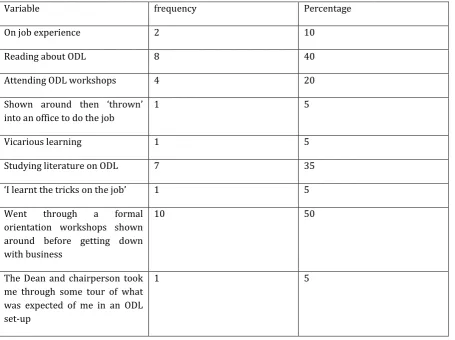
Table 2: Orientation to the job
Variable frequency Percentage
On job experience 2 10
Reading about ODL 8 40
Attending ODL workshops 4 20
Shown around then ‘thrown’ into an office to do the job
1 5
Vicarious learning 1 5
Studying literature on ODL 7 35
‘I learnt the tricks on the job’ 1 5
Went through a formal
orientation workshops shown around before getting down with business
10 50
The Dean and chairperson took me through some tour of what was expected of me in an ODL set-up
1 5
© 2015, IRJET ISO 9001:2008 Certified Journal
Page 2245
Table 3: Strategies used to meet job demands
Variable Frequency Percentage (%)
Planning ,consulting, meetings & workshops
4 20
Make reference to job
expectations
1 5
Conducting well planned
tutorials and review modules
3 15
Reading and researching 6 30
Understanding team members and working with teams
2 10
Developing personal plans 4 20
Use of internet 1 5
[image:5.595.30.489.452.685.2]The varied strategies used appear to indicate that workers are resorting to what they know best as individuals. There is need to standardise strategies
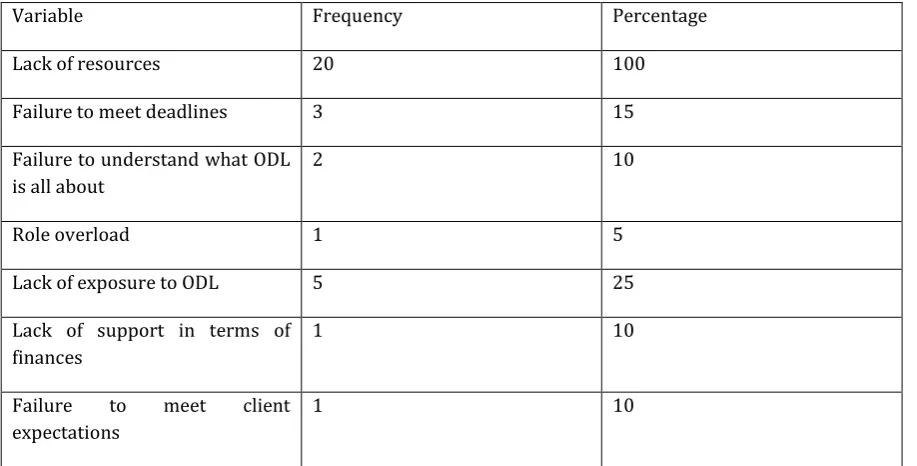
Table 4: Challenges that hinder job performance
The following were listed as challenges
Variable Frequency Percentage
Lack of resources 20 100
Failure to meet deadlines 3 15
Failure to understand what ODL is all about
2 10
Role overload 1 5
Lack of exposure to ODL 5 25
Lack of support in terms of finances
1 10
Failure to meet client
expectations
1 10
© 2015, IRJET ISO 9001:2008 Certified Journal
Page 2246
Table 5: Processes put in place to enhance ODL operations
Variable Frequency Percentage
Use of the internet 11 55
Student orientation day 10 10
Face to face tutorials 15 75
Exam questions preview 1 5
Quality assurance of the module writing process
3 15
Training of module writers 4 20
Use of committees to execute tasks
1 5
Giving students feedback on assignments
4 20
Having regional libraries 12 60
Use of the internet and availability of regional libraries appear to be useful in enhancing ODL
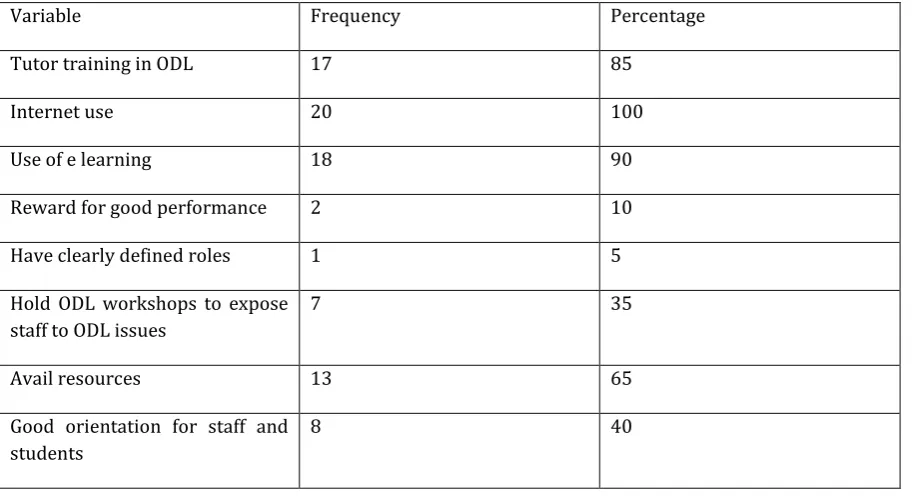
Table 6: Suggestions to improve performance
Variable Frequency Percentage
Tutor training in ODL 17 85
Internet use 20 100
Use of e learning 18 90
Reward for good performance 2 10
Have clearly defined roles 1 5
Hold ODL workshops to expose staff to ODL issues
7 35
Avail resources 13 65
Good orientation for staff and students
8 40
[image:6.595.31.488.473.721.2]© 2015, IRJET ISO 9001:2008 Certified Journal
Page 2247
Discussion
From the above findings ODL institutions seem to be faced with an array of issues that need to be addressed. These include training of tutors in ODL issues, availing of resources and servicing the student. Institutions joining ODL systems need to be able to define the field of this new system and discriminate between the various components which include identification of the critical elements of teaching and learning, and building a theoretical framework which will embrace the area of Distance Education [5]. This makes the need for ODL training critical as institutions cannot continue to be serviced by people who do not understand the ODL systems.
Recommendation
All new recruits (lecturers) to the ODL system need to receive some form of training.
Practitioners need to be exposed to other ODL institutions.
Computer training and e-learning need to be prioritised for both the learner and the lecturer
ODL institutions need to be equipped with well stocked libraries in order that students and tutors enjoy searching for information.
There is need to carry-out further research in the area of ODL.
Conclusion
Open and distance learning has made a positive impact to the lives of people. Many people who did not make it to higher education have benefited. The gaps identified need to be addressed in a holistic manner if quality and ODL credibility are to be achieved.
References
1.Ndereya , C. et al. (2003) A guide for tutors in open Learning and Distance Teaching.
Zimbabwe Open University, Harare; Zimbabwe.
2. Modesto, S. T. Tichapondwa and Tau, D. R. (2009): Introducing Distance Education.
VUSSC & BOCODOL.
3. Thorpe, M. (1993) Evaluating Open and Distance Learning. Longman Group. Redwood
Books, Trowbridge, Wiltshire.
4. Proser, R. (1970) What is Adult Education? In Mass Education: Edstrom, L.Erdds, R, and
Proser, R. Stockholm.
5. Keegan, D. (1996) Foundations of Distance Education. 3rd Edition. Routledge Studies, 29