Conditional gene targeting.
K Rajewsky, … , J Roes, F Schwenk
J Clin Invest. 1996;
98(3)
:600-603.
https://doi.org/10.1172/JCI118828
.
Perspective
Find the latest version:
J. Clin. Invest.
© The American Society for Clinical Investigation, Inc. 0021-9738/96/08/0600/04 $2.00
Volume 98, Number 3, August 1996, 600–603
Perspectives Series:
Molecular Medicine in Genetically Engineered Animals
“Molecular Medicine in Genetically Engineered Animals”
Series Editor, Kenneth R. Chien
January 1 Gene modification via “plug and socket” gene targeting... Jada Lewis, Baoli Yang, Biological insights through genomics: mouse to man... Pete Detloff, and Oliver Smithies January 15 Biological insights through genomics: mouse to man... Edward M. Rubin and Gregory S. Barsh February 1 In vitro differentiation of murine embryonic stem cells:
new approaches to old problems... Mitchell J. Weiss and Stuart H. Orkin February 15 Genes and physiology: molecular physiology in genetically
engineered animals ... Kenneth R. Chien March 1 Animal models of human disease for gene therapy... James M. Wilson March 15 Targeted mutagenesis: analysis of phenotype without germ line
transmission... Andras Nagy and Janet Rossant April 1 Transgenesis in the rat and larger mammals ... Linda Mullins and John Mullins April 15 The zebrafish: heritable diseases in transparent embryos ... Wolfgang Driever and Mark Fishman May 1 Recent advances in gene mutagenesis by
site-directed recombination... Jamey Marth
August 1 Conditional gene targeting... Klaus Rajewsky, Hua Gu, Ralf Kühn, ... Ulrich A.K. Betz, Werner Müller, ... Jürgen Roes, and Frieder Schwenk
Gene targeting: The classical approach
Central to an understanding of the in vivo function of genes is their analysis by mutation, that is, inactivation or modification of a gene by mutation and the study of the consequences of the mutation in the mutant organism. In mammals, before gene targeting, this approach was limited to the rare spontaneous mutations reflected in obvious phenotypes, as in the case of in-heritable diseases in the human. The targeted mutagenesis of the mouse germline was thus a fundamental breakthrough in this area of research. In its original form, gene targeting in-volves the inactivation of a given gene in the genome of em-bryonic stem (ES) cells by homologous recombination (1–3).
ES cells derive from an early stage of mouse development and have retained their totipotency, thus they can participate in the generation of cell lineages of the mouse (including germ cells) if transferred into an early mouse embryo. Transfer of mutant ES cells into mouse embryos thus allows the transmission of the mutation in question into the mouse germline.
In the classical experiment of Thomas and Capecchi (3) gene inactivation was achieved by replacing a predetermined gene segment with a mutant version of this segment, through homologous recombination. Since the latter is infrequent in mammalian cells, the isolation of the mutant ES cells requires stringent selection. This was achieved by placing a selectable gene (in that case the neomycin resistance gene) into the tar-geted locus in a manner that allows its expression (and hence cellular selection) while inactivating the target gene.
Refining classical gene targeting by the Cre-loxP recombination system
A limitation of classical gene targeting comes from the pres-ence of a selection marker gene in the targeted locus. Since this gene must be active in order to allow ES cell selection, it must always be considered that through its expression it might affect the mutant phenotype in an unpredictable way. A
par-Address correspondence to Klaus Rajewsky, Institute for Genetics, University of Cologne, Weyertal 121, D-50931 Cologne, Germany. Phone: 49-221-470-4586; FAX: 49-221-470-5185. Hua Gu’s present address is Laboratory of Immunology, National Institutes of Health, Rockville, MD. Jürgen Roes’ present address is University College London, Ryne Institute, London, WC1E, UK.
Received for publication 19 June 1996.
1. Abbreviation used in this paper: ES, embryonic stem.
Conditional Gene Targeting
Klaus Rajewsky, Hua Gu, Ralf Kühn, Ulrich A.K. Betz, Werner Müller, Jürgen Roes, and Frieder Schwenk
ticularly serious problem arises if gene targeting is used for the modification or elimination of regulatory DNA sequences, as the selectable gene brings in its own promoter and enhancer. For this reason, attempts have been made to eliminate the se-lection marker genes from the targeted locus (4–7).
We have used the bacteriophage-derived Cre-loxP recom-bination system (8, 9) for this purpose which had been shown to perform well in mouse cells in vitro (10) and in vivo (11, 12) and which appeared to offer a broad range of applications in gene targeting. The Cre enzyme, a member of a large family of recombinases (13), recognizes a sequence motif of 34 bp, called loxP (9). If a DNA segment is flanked by two loxP sites in the same orientation, Cre excises that segment from the DNA, leaving a single loxP site behind. (A piece of DNA flanked by loxP sites in opposite orientations will be inverted by the en-zyme, a reaction that waits to be exploited in the gene target-ing field [14, 15].) Considertarget-ing this site as innocent, “clean” de-letions can thus be produced. If in a gene targeting experiment the selection marker gene on the targeting vector (subse-quently inserted into the target locus by homologous recombi-nation) is flanked by loxP sites, it can later be removed from the ES cell genome via transient transfection of a Cre-expres-sion vector into these cells. By appropriately positioning the two loxP sites, one can use this system as a general system of mutagenesis, producing deletions (16–18), gene replacements, insertions (often called “knock-ins”) (19, 20), point mutations, (21) etc. However, we shall focus here on yet another and per-haps the most important aspect of Cre-loxP–mediated
tar-geted mutagenesis, namely conditional (rather than general) gene targeting.
Conditional gene targeting
Why do we want to achieve conditional, i.e., cell-type–specific and/or inducible, gene targeting beyond targeted mutagenesis of the mouse germline? There are several reasons. First, germ-line mutations may be lethal, in which case there is no mouse to study gene function. Second, genes may exert their function at several stages of ontogeny and in different cell types. In the latter case, complex phenotypes may result, where it is difficult to distinguish cell-autonomous from more complex lesions. In the former case, classical gene targeting will allow one to iden-tify the initial stage at which the target gene plays a critical role, but not necessarily later stages. Finally, in medical re-search, conditional gene targeting could allow one to generate models of somatically acquired genetic diseases (such as most forms of cancer) rather than of inherited ones.
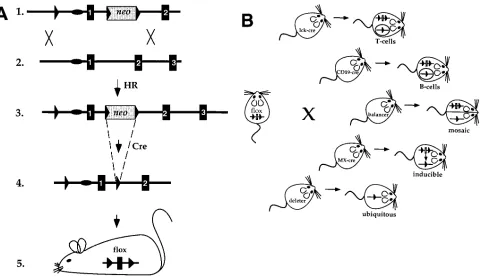
[image:3.612.63.546.386.663.2]The strategy of conditional targeting of endogenous genes that we have developed (16) consists of flanking a target gene or gene segment with loxP sites in ES cells by classical gene targeting and deleting the selection marker gene by transient transfection with a Cre-encoding plasmid. This protocol yields ES cell mutants in which the gene segment of interest is either flanked by loxP sites or deleted. Either mutation can be trans-mitted into the germline. In the former case, the mutant mice carry a functional, but loxP-flanked gene in their genome (Fig. 1 A). In the latter the gene is deleted in all cells of the body,
generating the situation of a classical knockout experiment, ex-cept that no selection marker gene remains in the mutant locus.
Conditional targeting of loxP-flanked genes or gene seg-ments can be achieved by crossing into the mutant animal a Cre-transgene from which Cre recombinase is expressed in a cell-type–specific or inducible manner (Fig. 1 B). The initial experiment, done in collaboration with J. Marth’s group, es-tablished that in principle, cell-type–specific gene targeting can be successfully performed in this manner (lck-cre; 16). We sub-sequently generated a Cre transgene under the control of an interferon a/b (IFNa/b) inducible promoter and showed that in this system 100% deletion of a loxP-flanked gene segment could be achieved in the liver upon injection of IFNa/b and up to 98% in lymphocytes, whereas lower degrees of deletion were seen in other tissues (MX-cre; 22). Thus, both cell-type– specific and inducible gene targeting are feasible using the Cre-loxP recombination system, the efficiency in the system can reach 100% (as also recently shown by J. Marth and col-leagues for T cell–specific gene targeting [23]) and Cre recom-binase can do its job in resting cells such as the liver. Note also that conditional as well as classical gene targeting can be used not only for gene inactivation, but also, by appropriately con-structing targeting vectors, for the introduction of subtle muta-tions (21) and also the activation of a gene (see reference 12).
The extent to which conditional gene targeting can be ap-plied in biological and medical research depends at this point, at a technical level, on the availability of Cre-transgenic strains in which Cre is expressed at sufficiently high levels, but under strict cell-type–specific and/or inducible control. Indeed, if Cre expression could be induced specifically in any given cell type, that would for many purposes represent an ideal system of conditional gene targeting. While this goal has not yet been reached, fusion proteins in which Cre is fused to the ligand binding domain of a steroid receptor and which can be acti-vated inside the cell by a steroid antagonist may allow for a successful approach to this problem (24–26). Alternatively, one may consider using systems of inducible, cell-type–specific transcriptional control like that developed by Bujard and col-leagues, with tetracycline as the inducer (27, 28).
At present, a limited number of Cre transgenic animals is available which allows gene targeting in T cells (23), B cells (CD19-cre; 29 and R. Rickert, J. Roes, and K. Rajewsky, un-published data), and, inducible by IFNa/b, in a variety of tis-sues but predominantly liver and lymphocytes (22). Many other such strains are presently being generated worldwide, so that one can expect that a large set of Cre transgenics will soon be at the disposition of the scientific community, making con-ditional gene targeting a routine approach in the analysis of mammalian gene function in vivo.
We have recently generated two Cre transgenic mouse lines which behaved unexpectedly, but still turn out to be par-ticularly useful in this context. The first is a strain, designated balancer, which allows partial gene inactivation in essentially all tissues of the body, generating a mosaic situation in which competition between wild-type and mutant cells can be stud-ied in situ. In a situation in which Cmediated deletion re-sults in homozygous mutant cells, a simple Southern analysis of the extent of deletion in various tissues of the mosaic mu-tant animal allows one to pinpoint the sites at which the gene in question plays a functionally critical role (Betz, U.A.K., C. Voßhenrich, K. Rajewsky, and W. Müller, manuscript submit-ted for publication). The second Cre-transgenic strain, called
deleter, mediates deletion of loxP-flanked gene segments in essentially all cells of the body, including germ cells (30). Crossing this strain to a strain in which a target gene is flanked by loxP sites on one or both homologous chromosomes, one obtains ubiquitous deletion which can also be transmitted into the germline, producing a classical knockout, again without a selection marker gene in the mutant locus.
Given these options of targeted mutagenesis through trans-genes encoding Cre under various kinds of genetic control, we now mostly perform gene targeting experiments such that only a single mutation of the target gene is transmitted into the germ-line, namely a loxP-flanked, functional version of the wild-type locus. The resulting animals are healthy and indistinguishable from the wild-type. However, by crossing them to the various Cre-transgenics, any type of conditional mutagenesis as well as a classical (general) knockout can be obtained. Since the pro-duction of a strain carrying a loxP-flanked allele represents only little more effort than that of a classical knockout, we rec-ommend that this protocol be generally considered when gene targeting experiments are being planned.
References
1. Capecchi, M.R. 1989. The new mouse genetics: altering the genome by gene targeting. Trends Genet. 5:70–76.
2. Koller, B.H., and O. Smithies. 1992. Altering genes in animals by gene targeting. Annu. Rev. Immunol. 10:705–730.
3. Thomas, K.R., and M.R. Capecchi.1987. Site-directed mutagenesis by gene targeting in mouse embryo-derived stem cells. Cell. 51:503–512.
4. Hasty, P., R. Ramirez-Solis, R. Krumlauf, and A. Bradley. 1991. Intro-duction of a subtle mutation into the Hox-2.6 locus in embryonic stem cells. Na-ture (Lond.). 350:243–246.
5. Valancius, V., and O. Smithies. 1991. Testing an “in-out” targeting proce-dure for making subtle genomic modifications in mouse embryonic stem cells. Mol. Cell. Biol. 11:1402–1408.
6. Wu, H., X. Liu, and R. Jaenisch. 1994. Double replacement: strategy for efficient introduction of subtle mutations into the murine Col1a-1 gene by ho-mologous recombination in embryonic stem cells. Proc. Natl. Acad. Sci. USA. 91:2819–2823.
7. Stacey, A., A. Schnieke, J. McWhir, J. Cooper, A. Colman, and D.W. Melton. 1994. Use of double replacement gene targeting to replace the murine alpha-lactalbumin gene with its human counterpart in embryonic stem cells and mice. Mol. Cell. Biol. 14:1009–1016.
8. Sternberg, N., and D. Hamilton. 1981. Bacteriophage P1 site-specific re-combination. I. Recombination between loxP sites. J. Mol. Biol. 150:467–486.
9. Hoess, R.H., M. Ziese, and N. Sternberg. 1982. P1 site-specific recombi-nation: nucleotide sequence of the recombining sites. Proc. Natl. Acad. Sci. USA. 79:3398–3402.
10. Sauer, B., and N. Henderson. 1988. Site-specific DNA recombination in mammalian cells by the Cre recombinase of bacteriophage P1. Proc. Natl. Acad. Sci. USA. 85:5166–5170.
11. Orban, P.C., D. Chui, and J.D. Marth. 1992. Tissue- and site-specific DNA recombination in transgenic mice. Proc. Natl. Acad. Sci. USA. 89:6861– 6865.
12. Lakso, M., B. Sauer, B. Mosinger, Jr., E.J. Lee, R.W. Manning, S.H. Yu, K.L. Mulder, and H. Westphal. 1992. Targeted oncogene activation by site-spe-cific recombination in transgenic mice. Proc. Natl. Acad. Sci. USA. 89:6232– 6236.
13. Argos, P., A. Landy, K. Abremski, J.B. Egan, E. Haggard-Ljungquist, R.H. Hoess, M.L. Kahn, B. Kalionis, S.V.L. Narayana, L.S. Pierson III, et al. 1986. The integrase family of site-specific recombinases: regional similarities and global diversity. EMBO (Eur. Mol. Biol. Organ.) J. 5:433–440.
14. Abremski, K., R. Hoess, and N. Sternberg. 1983. Studies on the proper-ties of P1 site-specific recombination: evidence for topologically unlinked prod-ucts following recombination. Cell. 32:1301–1311.
15. Hamilton, D.L., and K. Abremski. 1984. Site-specific recombination by the bacteriophage P1 lox-Cre system. Cre-mediated synapsis of two lox sites. J. Mol. Biol. 178:481–486.
16. Gu, H., J.D. Marth, P.C. Orban, H. Mossmann, and K. Rajewsky. 1994. Deletion of a DNA polymerase beta gene segment in T cells using cell type spe-cific gene targeting. Science (Wash. DC). 265:103–106.
18. Ramirez-Solis, R.R., P. Liu, and A. Bradley. 1995. Chromosome engi-neering in mice. Nature (Lond.). 378:720–724.
19. Zou, Y.R., W. Müller, H. Gu, and K. Rajewsky. 1994. Cre-loxP-medi-ated gene replacement: a mouse strain producing humanized antibodies. Curr. Biol. 4:1099–1103.
20. Hanks, M., W. Wurst, L. Anson-Cartwright, A.B. Auerbach, and A.L. Joyner. 1995. Rescue of the En-1 mutant phenotype by replacement of En-1 with En-2. Science (Wash. DC). 269:679–682.
21. Torres, R.M., H. Flaswinkel, M. Reth, and K. Rajewsky. 1996. Aberrant B cell development and immune response in mice with a compromised BCR complex. Science (Wash. DC). 272:1804–1808.
22. Kühn, R., F. Schwenk, M. Aguet, and K. Rajewsky. 1995. Inducible gene targeting in mice. Science (Wash. DC). 269:1427–1429.
23. Hennet, T., F.K. Hagen, L.A. Tabak, and J.D. Marth. 1995. T-cell-spe-cific deletion of a polypeptide N-acetylgalactosaminyl-transferase gene by site-directed recombination. Proc. Natl. Acad. Sci. USA. 92:12070–12074.
24. Metzger, D., J. Clifford, H. Chiba, and P. Chambon. 1995. Conditional site-specific recombination in mammalian cells using a ligand-dependent chi-meric Cre recombinase. Proc. Natl. Acad. Sci. USA. 92:6991–6995.
25. Zhang, Y., C. Riesterer, A.-M. Ayral, F. Sablitzky, T.D. Littlewood, and M. Reth. 1996. Inducible site-directed recombination in mouse embryonic stem cells. Nucleic Acids Res. 24:543–548.
26. Kellendonk, C., F. Tronche, A.-P. Monaghan, P.-O. Angrand, F. Stew-ard, and G. Schütz. 1996. Regulation of Cre recombinase activity by the syn-thetic steroid RU 486. Nucleic Acids Res. 24:1404–1411.
27. Furth, P.A., L. St. Onge, H. Böger, P. Gruss, M. Gossen, A. Kistner, H. Bujard, and L. Henninghausen. 1994. Temporal control of gene expression in transgenic mice by a tetracycline-responsive promoter. Proc. Natl. Acad. Sci. USA. 91:9302–9306.
28. Schultze, N., Y. Burki, Y. Lang, U. Certa, and H. Bluethmann. 1996. Ef-ficient control of gene expression by single step integration of the tetracycline system in transgenic mice. Nat. Biotechnol. 14:499–503.
29. Rickert, R., K. Rajewsky, and J. Roes. 1995. Impairment of T-cell-dependent B-cell responses and B1 cell development in CD19-deficient mice. Nature (Lond.). 376:352–355.