On statives and potentives in western Austronesian
(mostly Tagalog)
Nikolaus P. Himmelmann, Ruhr-Universität Bochum
1. Introduction
This contribution is concerned with prefixed forms in western Austronesian languages1 which have been called a wide variety of names including ‘stative’, ‘accidental’, ‘involuntary’, ‘potential’, ‘coincidence’, ‘momentary’, and so on. Although widely neglected in the literature,2 these formations are of major import to the grammar of many western Austronesian languages, where for all event expressions there is an obligatory choice between a neutral form and a form marked for ‘involuntariness’, ‘potentiality’, ‘coincidence’, or the like. Furthermore, this distinction has implications for a wide range of theoretical issues, including the nature of unaccusativity and causativity, split-intransitivity, and the grammar of control and complementation.
The main goal of this contribution is to bring some basic order to the fairly broad and, on first sight at least, somewhat heterogeneous range of uses and meanings associated with these forms. I will argue that the different uses can be grouped into two semantically and morphosyntactically quite different construction types, which I will call STATIVE (proper) and POTENTIVE, respectively.
Section 2 presents the major uses of the ‘stative’ prefix ma- in Tagalog. In section 3, it is shown that despite superficial similarities the various examples with
ma-marked predicates presented in section 2 involve two different constructions and that the prefix ma- belongs to two different morphological paradigms. Section 4, finally, provides a systematization of stative and potentive uses and discusses similarities and differences between the Tagalog system and superficially similar systems in so-called split-S languages.
2. Typical uses of ma- in Tagalog
In Tagalog, the prefix marking stative and related types of predicates is ma- in non-realis formations and na- in realis formations. There is also a variant with a long vowel which is orthographically represented as mà- (realis nà-). It is not unlikely that historically these two variants represent two different formations. But in current Tagalog there is no longer a systematic grammatical distinction between them (cp. Schachter & Otanes 1972:330, among others). As usual in the literature, ma- is used here as the citation form of the prefix.
The major uses of ma- can be roughly grouped into the following seven semantic classes.
First, ma- regularly occurs on property-denoting (‘adjectival’) predicates, regardless of whether these are used attributively (as in (1)) or predicatively (as in (2)). This usage differs formally from all the remaining uses in that ma- here is invariable, i.e. there is no mood alternation (ma- vs. na-).3
PROPERTY
(1) ang ma-liít na hayop SPEC ST-smallness LK animal ‘the small animal’
(2) ma-saráp ang pag-kain ST-satisfaction SPEC GER-eating ‘the food was good’
A closely related use is the occurrence of ma- on predicates denoting states or changes of state (more precisely: entering into the state denoted by the base). This includes positionals (as in (5)) or locationals (as in (6)). Locationals typically occur only in realis mood (i.e. with na-), while all other state expressions occur in both moods.
STATE/ENTERING STATE
(3) na-tà-takot silá RLS.ST-RDP1-fear 3.PL ‘they were afraid (of the snake)’ (4) na-pipe sya.
RLS.ST-dumb 3.SG
‘He got dumb.’ (Bloomfield 1917:285)
(5) isá-ng araw na-upó syá sa taburete one-LK day RLS.ST-sitting 3.SG LOC stool
‘One day he sat down on the chair (between the four pits) …’ (Bloomfield 1917:24)
(6) semantala-ng sya 'y na-sa tabí ng ilog meanwhile-LK 3.SG PM RLS.ST-LOC side GEN river ‘When he was close to the riverside, …’
A third major usage of ma- is with predicates denoting involuntary actions, i.e. eventualities which in principle involve a controlling agent but in the instance at hand this agent lacks full control. Lack of control may pertain to lack of physical control (as in (7) and (8)) but also to the lack of intention. In the latter case the agent performs a controlled action without intending its outcome (as in (9)).
ACCIDENTAL
(7) na-hulog siyá sa kabayo. RLS.ST-fall 3.SG LOC horse
‘S/he fell from a horse.’ (English 1986:664) (8) nà-ihí' akó sa kà-ta-tawa.
RLS.ST-urine 1.SG LOC ??-RDP-laugh
(9) na-dalá ko ang libró RLS.POT.PV-carried 1.SG.POSS SPEC book ‘I took the book by accident.’ (cp. Wolff et al. 1991:285)
Inanimate effectors by definition lack intentions as well as the ability for physical control. Events involving them are thus often also marked with ma-, as in (10).
INANIMATE EFFECTOR
(10) ang dahun ay na-dà-dalá ng tubig SPEC leaf PM RLS.POT.PV-RDP1-carried GEN water ‘The leaf was being carried along by the water, …’
Lack of control also plays a role for non-volitional or spontaneous per-ception predicates. In Tagalog, these are regularly marked with ma-, as in (11). SPONTANEOUS PERCEPTION
(11) nà-kíta niyá ang dugó' RLS.POT.PV-seen 3.SG.POSS SPEC blood ‘She saw (happened to see) the blood.’
A sixth use of ma- pertains to expressions conveying the ability of an agent to do or achieve something. This may refer purely to the (mental or physical) capabilities inherent in the agent, as in (12) or to the fact that the agent was successful in overcoming difficult circumstances in performing an action (as in (13), cp. English ‘manage to’ or ‘succeed in’).
ABILITY
(12) nà-kì-kíta ba ninyó yung iskinita? RLS.POT.PV-RDP1-seen Q 2.PL.POSS DIST.LK street corner ‘Can you (are you able to) see that corner? (Wolff et al 1991:286)
(13) ay na-kuha niyá ang dahon
PM RLS.POT.PV-getting 3.SG.POSS SPEC leaf ‘he was able to (managed to) get the leaf’
Finally, ma- is also used when asserting (or denying) that the possibility or opportunity to do something exists, regardless of the capabilities of the agent involved in the eventuality. In addition to the following example from a narrative, compare also more or less fixed expressions such as ma-basa (POT-reading) ‘can be read, legible’.
POSSIBILITY/OPPORTUNITY
(14) kung mà-bi-bilí iyán if POT.PV-RDP-sale MED ‘if that can be sold/if this is sellable’
3. Two different constructions and morphological paradigms: stative and potentive
The examples of ma- presented above involve two clearly different constructions and morphological paradigms. This is not immediately obvious when presenting the examples in the way it was done in the previous section (and in much of the literature). But the syntactic differences become obvious when comparing two semantically similar expression types, namely predicates for spontaneous perceptions and for emotions. Both expression types denote mental states of animate experiencers, usually directed at or caused by some entity outside of, or different from, the experiencer. It would thus not be very surprising if these two expression types were to be constructed morphosyntactically in the same or at least a similar way.
Tagalog, however, works differently. Let us first take a closer look at a perception predicate. In the following constructed example (which essentially repeats example (11) above), the perception predicate kita ‘seen’ is prefixed with na- and followed by an experiencer expression in possessive (or genitive) case, which in turn is followed by the stimulus (the thing seen) functioning as the subject of the overall construction (marked by the proclitic specific article ang).
(15) nà-kita niyá ang aso
RLS.POT.PV-seen 3.SG.POSS SPEC dog ‘She saw a/the dog.’
The emotion predicate galit ‘angry’ (see also takot in (3) above) is con-structed quite differently. Here the experiencer is the subject (being a pronoun in (16), it appears in ang-form), while the stimulus occurs in locative case marked by the general locativepreposition sa.
(16) na-galit siyá sa aso RLS.ST-anger 3.SG LOC dog ‘She was angry with the dog.’
A correlated difference pertains to the fact that with perception predicates the stimulus is obligatory in the sense that a stimulus is always understood to be present even if not overtly expressed. With emotion predicates, the stimulus is optional. Altogether, these differences suggest that despite the identical marking on the predicate, we are dealing with two different constructions in which semantic roles are differently aligned with syntactic functions.4 For reasons that will become obvious shortly, the perception predicate construction is called here a potentive construction, while the emotion predicate construction is called a stative construction.
Stative and potentive predicates also differ in that they allow for different voice alternations. An alternative way to express the state of affairs in (15) is to use a (potentive) actor voice construction. Here, the experiencer appears as the subject (in
ang-form) and the stimulus is marked as genitive. Concomitantly, the predicate is prefixed with an actor voice prefix (naka-).5
(17) nakà-kita siyá ng aso RLS.POT.AV-seen 3.SG GEN dog ‘She saw a dog.’
An alternative for the emotion construction in (16) is a (stative) locative voice construction, where the predicate is marked with the circumfix ka—an. Here the experiencer appears in the possessive form while the stimulus functions as subject (marked by ang):
(18) k<in>a-galit-an niyá ang aso ST<RLS(UG)>-anger-LV 3.SG.POSS SPEC dog ‘She was angry with the dog.’
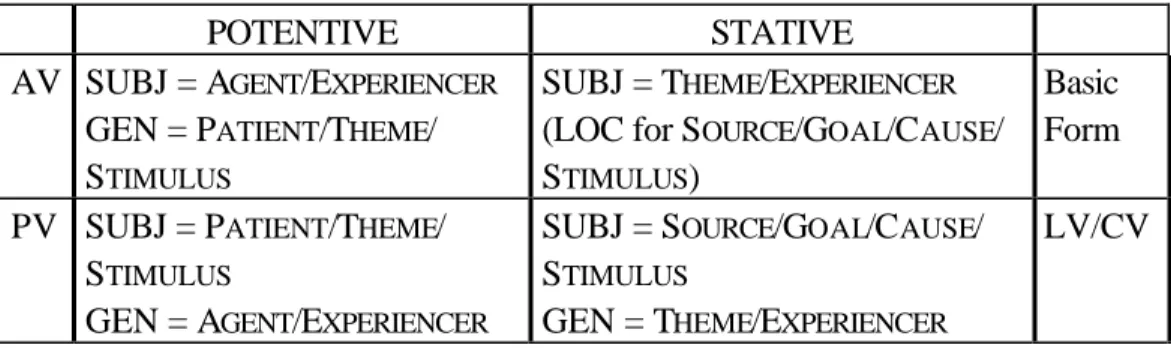
Table 1 summarizes the alignment differences between the two constructions. The form of the stative predicate which is marked with ma- (as in (16) above) is called basic form, because this is the most unmarked, frequent and widespread form of stative marking. The role repertoire indicated for each construction includes other possible roles, some of which are exemplified in the examples in the preceding section: Examples (9), (10), (13) and (14) illustrate potentives with agent and theme rather than experiencer and stimulus arguments. Example (7) involves a stative predicate with a theme and a source argument, and (8) one with a theme and a cause argument.
Table 1: Alignment of semantic role and syntactic function in (semantically) transitive potentives and statives
POTENTIVE STATIVE
AV SUBJ = AGENT/EXPERIENCER
GEN = PATIENT/THEME/ STIMULUS
SUBJ = THEME/EXPERIENCER
(LOC for SOURCE/GOAL/CAUSE/ STIMULUS)
Basic Form PV SUBJ = PATIENT/THEME/
STIMULUS
GEN = AGENT/EXPERIENCER
SUBJ = SOURCE/GOAL/CAUSE/
STIMULUS
GEN = THEME/EXPERIENCER
LV/CV
The voice alternations illustrated in (17) and (18) are part of the two more extensive morphological paradigms for statives and potentives shown in Table 2. This table also includes the well-known basic voice affixes -um-, -in, etc., which correlate directly with the potentive forms (see further section 4.2 below). Evidence for the correlations underlying these paradigms is provided in Himmelmann (forthcoming). Here it will be sufficient to take note of the following points.
Table 2: Dynamic and stative paradigms in Tagalog
NON-STATIVE (DYNAMIC) STATIVE NON-POTENTIVE POTENTIVE
AV -um-, mag- maka- (maka-) ST.AV
PV -in ma- ma- ST
LV -an ma--an ka--an ST.LV
First, note that potentive and stative formations are identically marked in the second row (both are simply prefixed with ma-), but they differ clearly in locative and conveyance voice. Potentives and statives also receive identical marking in actor voice (first row). Here, however, a further difference exists in that stative actor voice is not fully productive, as indicated by the fact that maka- appears in parentheses (see Wolff et al. 1991:419f and Himmelmann (forthcoming) for details).
Second, on first sight the occurrence of a ka- prefix and the lack of ma- in some forms of the stative paradigm may appear to be somewhat unusual. However, it is a well established fact that in many western Austronesian languages ma- regularly alternates with ka- in a number of grammatically defined environments which are not related to voice. Compare, for example, the following pair of clauses from Mantauran Rukai. In the first clause, the predicate denoting the property of being thick occurs as the single main predicate in clause-initial position and is marked with (stative) ma-. In the second clause, the same predicate occurs as the second predicate in a coordinate construction marked by la. In this environment, stative predicates in Mantauran Rukai are generally marked by ka-.
(19) Example 25 from Zeitoun (2000:429)
Based on the evidence provided by Mantauran Rukai and other languages it has been suggested that, historically at least, the prefix ma- is a clipped version of *kuma-, i.e. ka- infixed with -um- (cp. Ross 1995:740, Blust 2003:440 passim).
Note, however, that there are also western Austronesian languages where the ka- prefix occurs both in the potentive and in the stative paradigm, as illustrated by the paradigms from Ratahan given in Table 3. In this instance, the two paradigms are almost identical (for Ratahan examples and more discussion, see Himmelmann & Wolff 1999:52-63).
Table 3: Dynamic and stative paradigms in Ratahan
NON-STATIVE (DYNAMIC) STATIVE NON-POTENTIVE POTENTIVE
PAST NON-PAST
AV -im- -um- maka- ?? ST.AV
PV -in- -an - ma- ST
LV -in--an -an ka--an ka--an ST.LV
CV -in- 0 ka- ka- ST.CV
As an aside, it may be noted that the Ratahan data suggest the view that the potentive vs. stative distinction is an innovation which happened after the major
branches of Western Malayo-Polynesian (WMP) split. See Zobel (in prep.) for further data and discussion.
So far only constructed example pairs have been used in this section for reasons of clarity and ease of processing. The following examples are added to show that the voice alternations adduced above actually occur in natural discourse.
The pair of attested examples below illustrates the actor voice vs. patient voice alternation for potentive (perception) predicates
(20) nang mà-riníg itò ng Kastila' when POT.PV-audible PRX GEN Spaniard
‘When the Spaniard heard this, …’ (Bloomfield 1917:28/19)
(21) at nakà-riníg siyá ng mga huni ng ibon and RLS.POT.AV-audible 3.SG GEN PL chirping GEN bird ‘… and then he heard some birds chirping.’
The following two pairs of examples illustrate the alternation of basic stative voice and locative stative voice for stative (emotion) predicates:
(22) na-tà-tákot ako sa ahas RLS.ST-RDP1-fear 1.SG LOC snake ‘I am afraid of snakes …’
(23) k<in>a-tà-takut-an siyá ng mga tao dito. ST<RLS(UG)>-RDP1-fear-LV 3.SG GEN PL people PRX.LOC ‘People here are afraid of him.’ (cp. Wolff et al. 1991:699)
(24) na-mù-muhí' akó sa kanyá. RLS.ST-RDP1-detestation 1.SG LOC 3.SG.DAT
‘I am disgusted with him/loathe him/despise him.’ (English 1986:917) (25) k<in>a-mù-muhi-án ko siyá sa
ST<RLS(UG)>-RDP1-detestation-LV 1.SG.POSS 3.SG LOC g<in>awá' niyá-ng iyón
<RLS(UG)>act 3.SG.POSS-LK DIST ‘I hate him for doing that.’ (English 1977:439)
4. Subclassifying stative and potentive uses
While statives and potentives allow a number of different affixations as seen in Table 2 above, forms prefixed with ma- are by far the most frequent formations in Tagalog and other Philippine-type languages. Since ma-prefixed forms can be either stative or potentive, they are easily confused. But the preceding discussion provides for two independent diagnostics to keep stative and potentive formations apart:
1. Potentive formations with ma- allow for genitive-marked arguments (since they are in patient voice they usually will be (semantically) transitive). Statives with
1.2. Stative ma- alternates with ka—an or ika-, while potentive ma- alternates with maka-, ma—an or ma-i-.
The result of applying these diagnostics to the different uses of Tagalog
ma-reviewed in section 2 above is the proposal for a systematization of the different subclasses of statives and potentives given in (26).
(26) Subclasses of STATIVEs and POTENTIVEs in Tagalog STATIVE (-ACT)
property: have a certain property/quality (be red/good/small) state: be in/get into a state (be/become broken/flooded/ angry/ afraid/dumb/surprised etc.); includes alive/live, dead/die, sleep (?) and positionals (sit/lie/stand etc.) and locationals; a few (semanti-cally) transitive expressions for feelings: hate, fed up with, disgust, fear, like (?)
‘unaccusatives’: fall, drown, slide, collapse, directed motion (?) POTENTIVE (+ACT)
potential
abilitative: be able to do sth; succeed in doing possibility/opportunity: can be done/possible to do involuntary/non-intentional
accidental: do sth by accident, the action is done intentionally but the outcome is not intended (I took the wrong pills, hit ac-cidentally, etc.)
coincidental: happen to do sth without having any prior intentions to do so (to bump into someone); includes:
spontaneous perceptions (to notice/see/hear/sense, find) spontaneous cognitive acts (discover, understand, remember, forget, but see also section 4.1 below) inanimate effector (cp. example (10))
This classification implies that the distinction between potentives and statives in Tagalog involves two semantic parameters, i.e. the (aspectual) type of eventuality (state vs. event) and control/intentionality (or agency). As amply illustrated by Mithun (1991), these two parameters also play an important role in many languages with Split-S (active/stative) case or person marking systems. Tagalog and other western Austronesian languages with stative and potentive paradigms, however, are crosslinguistically somewhat unusual for the following interrelated reasons, all of which will be discussed in more detail in the ensuing subsections. First, unlike typical Split-S languages which have binary distinctions (agentive/eventive vs. stative), in Tagalog there is a three-way distinction between neutral (i.e. potentive, non-stative), potentive and stative forms (see Table 2 above). Second, the distinction is not restricted to intransitive predicates but applies to both (semantically) transitive and intransitive predicates. Third, both semantic parameters (type of eventuality and control/intentionality) play an equally important role but are distributed asym-metrically across the three categories.
Regarding the last point, note that states by definition lack actors (-ACT) and hence are by default non-controlled and non-intentional. However, the category
STATIVE in Tagalog is not restricted to states proper but also includes a few events which lack an actor-like core argument (for lack of a better term called
unaccusative in (26), which is further discussed in the next section). Potentive marking occurs on event-denoting predicates which include an actor (+ACT) but the potentive morphology indicates that this actor lacks full control or intentionality. Tagalog morphology thus suggests that one can downgrade agentivity/intentionality for event predicates without changing the event type or the semantic role structure. This is unusual from a crosslinguistic point of view in that in many split-S languages, lack of control or intentionality usually involves stative marking and hence a change in event type.
In this regard, it should be noted that examples (7)-(9), which from a purely semantic point of view can be characterized as accidental eventualities, actually belong to two distinct morphosyntactic classes. Examples (7) and (8) are statives (of the unaccusative variety), which means that they lack an actor-like core argument. Example (9), on the other hand, is potentive (of the accidental variety), i.e. the predicate includes an actor-like core argument but this actor is depicted as lacking intention. Note also that non-controlled (spontaneous) perceptions and other cognitive acts are potentive rather than stative, i.e. the morphology implies that these acts involve an actor (= experiencer) who lacks control rather than completely lacking an actor role.
The classification given in (26) raises a number of further issues, some of which are dealt with in the following subsections.
4.1. Further notes on statives
Stative is a marked category in two regards. On the one hand, it is marked in the superficial morphological sense of involving more morphological marking than non-statives, at least in locative and conveyance voice. On the other hand, it is marked in the functional sense of being the marked member in a binary opposition. Evidence for this status is provided by the fact that not all semantically stative eventualities require stative morphological marking. For example, all ‘copula-like’ expressions for ‘equal’, ‘weigh’ and ‘cost’ usually are not marked as statives, as seen in the following example:
(27) t<um>ì-timbáng akó ng 110 libra. RDP1<AV>-weight 1.SG GEN pound I weigh 110 pounds. (English 1977:1180)
Similarly, it is not the case that all expressions for involuntary bodily actions are marked with ma- (as in (8)) above). Instead, lexical bases denoting such actions generally do not occur with stative morphology. Examples include
sinìsinók/nagsìsinók ‘hiccup’ and umubó/ubuhín ‘cough’.
Furthermore, a set of predicates including tulog ‘sleep’ and the positionals allows for stative and non-stative affixation without an obvious difference in meaning (e.g. both na-tùtulog siyá and t<um>ùtulog siyá mean ‘s/he is sleeping’). Some positionals actually occur primarily with non-stative affixation (e.g. l<um>awít ‘be hanging down’). Note that the stative and non-stative forms usually differ in some of their senses (for example, only stative ma-tulog can be used in the expression for
oversleeping). The point here is that both forms can be used to refer to the state denoted by the base form.6
Finally, stative marking is also only one of several options for expressions referring to feelings (‘like’, ‘hate’, ‘love’, etc.). Impressionistically speaking, it seems that negative feelings in particular are referred to with stative predicates while positive feelings are often expressed by predicates with non-stative affixation. But this needs further research and is perhaps only of marginal interest because there is a strong tendency to use both positive and negative feeling predicates without any affixation. This holds true in particular for the two high-frequency items gustó ‘want, like’ and
ayaw ‘dislike’. Roughly the same comments apply to predicates for cognitive states, in particular alam ‘know’.
Of course, rather than saying that the ‘exceptions’ just mentioned show that
STATIVE is a marked category, one could also hold that reference to a state is not a major common semantic denominator of the predicates thus marked. This view would be supported by the fact that the category STATIVE includes a few event-type
predicates such as ‘fall’, etc. (see (7) and (8) above).
Reasoning along these lines, one could entertain the idea of calling the whole class unaccusative instead of stative. But note that here again one would have to take note of the fact that predicates such as ‘come’ and ‘arrive’ which are unaccusative in a great many languages where this distinction is clearly attested are generally not marked with ma- in Tagalog (a possible exception are some predicates of directed motion, including puntá ‘go’, which in some uses allow affixation with
ma- as an alternative to infixation with –um-). In this regard, it may also be noted that intransitive achievements are generally non-stative, e.g. pumutók ‘burst’,
sumabog ‘burst/explode’, magkalamat ‘crack’ (< lamat ‘crack’).
The use of the term unaccusative for ‘fall’, etc. in the above systematization is somewhat ad-hoc and mainly motivated by the lack of a better alternative. The basic point here is that these predicates are clearly stative according to the two diagnostics given at the beginning of section 4, but they do not denote states in terms of their aspectual characteristics. A more descriptive name for these predicates would be ‘actor-less event predicates’.
4.2. Further notes on potentives
The term potentive is an innovation, first used in Rubino 1997. The innovation is motivated by the fact that this category comprises two subclasses, i.e. potential and involuntary, which, on first sight at least, do not appear to have much in common. There is, however, little doubt that this is not a case of accidental homonymy but rather a perhaps unusual, but still coherent category. The two meanings are widely rendered by the same formative in western Austronesian languages, regardless of whether they have two paradigms as in Tagalog or render potentive and a smallish subset of stative meanings with the help of some other morphological marker (e.g. Malay ter- and its cognates in many languages of Indonesia). Furthermore, the combination of potential and involuntary meanings is also attested in languages outside the Austronesian family, including the involitive in Sinhala (Inman 1993) and
out of control morphology in Salishan languages (cp. Davis & Demirdache 2000). A major feature that distinguishes potentives from statives is the fact that there is an absolutely regular and fully productive relation between potentive and neutral (potentive) forms: for every potentive form there is a corresponding non-potentive one (with a few exceptions, the reverse also holds) and in terms of their
formal make-up, potentive forms are completely predictable on the basis of neutral forms and vice versa (see Schachter & Otanes 1972:331). This (almost) perfect match is the reason why in Table 2 potentive and neutral forms are represented as belonging to a single higher-level category (non-stative/dynamic) despite the fact that potentives and statives are more similar in terms of their formal make-up.
While use of the potentive form is usually obligatory when the actor of a given predicate is not in full control of the event denoted by the predicate, there are a few exceptions to this rule (far fewer though than in the case of statives). Most importantly, perhaps, for some predicates denoting cognitive acts such as isip ‘think’ neutral affixation or no affixation at all is the rule rather than exception. Similarly, not all clauses with inanimate effectors necessarily involve potentive morphology, as seen in the following example:
(28) ni-lunod ng sirena ng bapór ang RLS(UG)-drown GEN siren GEN boat SPEC s<in>à-sabi sa amin
RDP1<RLS(UG)>-statement LOC 1.PL.EX.DAT ng dalaga.
GEN young.woman
‘The boat's whistle drowned what the young woman was telling us.’ (English 1986:856)
4.3. Stative and potentive are (largely) orthogonal to lexical categories It is a matter of debate whether and to what extent lexical bases in Tagalog belong to different lexical categories. There is no need to review this debate here (see Himmelmann (in print) for a recent assessment) because the main point can be made without having to specify the relevant categories, if any: Stative as well as potentive affixations are not restricted to a specific class of lexical bases but both may, in principle, occur on any lexical base, provided the resulting form makes semantic and pragmatic sense. Thus, for example, lexical bases such as takot ‘fear’ are not restricted to stative formations but also occur in neutral (non-stative) forms as in: (29) Huwág mo-ng takut-in ang bata'.
NEG.IMP 2.SG.POSS-LK fear-PV SPEC child ‘Don't frighten/scare the child!’ (English 1986)
(30) Sino ang t<um>akot sa iyó? who SPEC <AV>fear LOC 2.SG.DAT ‘Who frightened you?’ (English 1986)
Consequently, one would also expect to find ‘minimal pairs’ of potentive and stative formations derived from the same lexical base. And this is indeed what we find. In the following two pairs of examples, the first example is potentive, the second stative:
(31) Hindí ma-hulug-an ng karayom ang lugar NEG POT-fall-LV GEN needle SPEC place sa dami ng tao.
LOC amount GEN people
‘One could not drop a needle in the place because of the amount of people.’ (google)
(32) iyón ang patibóng na k<in>a-hulug-an ni Gideon DIST SPEC trap LK ST<RLS(UG)>-fall-LV PN.POSS ‘that's the trap into which Gideon fell’ (google)
(33) Na-upu-án ko ang eyeglasses ko.
RLS.POT-sitting-LV 1.SG.POSS SPEC 1.SG.POSS ‘I happened to sit on my eyeglasses.’ (google)
(34) bundók na k<in>a-ù-upu-án ng babae. mountain LK ST<RLS(UG)>-RDP1-sitting-LV GEN woman ‘… the mountains where the women were sitting.’ (google)
With regard to ‘unaccusatives’ such as hulog ‘fall’ it may be of interest to note that here again Tagalog differs from typical split-S languages in that the non-stative form(s) do not mean ‘(let oneself) fall intentionally’ but rather ‘make fall, drop’. Self-induced falling is expressed by the prefix combinations magpati- or
magpaka-, both of which contain the causative prefix pa-.
4.4. Stative and potentive forms do not constitute a split-S system
In a number of recent publications the proposal has been advanced that some western Austronesian languages are split-S or split-intransitive (or “active”) languages in terms of the familiar division of languages into nominative-accusative, ergative, and split-intransitive languages. In typical split-intransitive languages, the main parameter determining the grammatical properties of core arguments in basic transitive and intransitive clauses pertains to the question of whether the participant-role is more ACTOR- or more UNDERGOER-like. That is, the single core argument of
some intransitive predicates (Sa) aligns with the more ACTOR-like core argument of
transitive predicates (A) while the single core argument of the remaining intransitive predicates (So) aligns with the more UNDERGOER-like core argument of transitive
predicates (O). Consequently, there is no grammatical relation or function which encompasses one of the core arguments of a transitive predicate and all core arguments of intransitive predicates.
It is a matter of debate whether any western Austronesian languages are split-intransitive languages in this sense. The most explicit and convincing case for a split-intransitive analysis has been made by Durie (1987) for Acehnese. In the previous section, it was already pointed out that the stative/potentive system in Tagalog differs from a typical split-intransitive system in a number of important ways. Perhaps the most important point is the fact that stative and potentive marking applies to (semantically) transitive and intransitive predicates alike. Hence, strictly speaking, the stative vs. potentive vs. neutral distinction cannot instantiate a split-intransitive system.
Nevertheless, (semantically) intransitive predicates in Tagalog show, of course, different kinds of morphological marking as seen in the following example pair:
(35) Natàtakot silá. They were frightened. Tumàtakbo silá. They are running (away).
But does this difference in morphological marking indicate a difference in basic clause structure? In the brief definition of split-S systems given above, the crucial characteristic for a split-S system is that it provides for two (or more) different intransitive clause structures, i.e. different constituent structures or, in LFG terms, different f- or c-structures. A difference in clause structure would mean that there are different positional regularities for the two clauses (e.g. in one clause the subject may be preposed, in the other it may not) or that the core arguments have clearly differing morphosyntactic properties (different case marking, different control properties, different constraints on zero anaphora, etc.). None of these differences applies to the two clauses in (35). They have exactly the same properties with regard to basic clause structure, the only major difference being that the subject arguments carry different semantic roles. Hence, they do not exemplify a split-S system as defined above.
Put in more general terms, the point here is that split intransitivity involves basic and pervasive differences in clause structure and not just minor, superficial differences in morphological marking. Otherwise the concept of split-intransitivity is in danger of loosing most of its empirical content and all typological relevance. In many, if not all languages stative and eventive intransitive clauses will differ with regard to one or two minor morphosyntactic features, most often in the morphological marking of the predicate. If such differences were to be taken as evidence for split-intransitivity then (almost) all languages are split-intransitive, which renders it a typologically uninteresting category.
Pursuing this point a bit further, it is in fact also not sufficient to make just any syntactic difference a pre-requisite for split-intransitive status. For example, inasmuch as the difference between unergativesand unaccusatives is considered to be universal and to be essentially a syntactic distinction (predicates with and without internal subject arguments), then again all languages would have to be regarded as split-intransitive languages. But obviously, the idea behind the three-way typological distinction between nominative-accusative, ergative7 and split-intransitive languages is that these languages differ in fundamental aspects of clause structural organization which cross-cut the distinction between transitive and intransitive clauses.
Endnotes
ACKNOWLEDGEMENTS: This paper owes much in spirit and actual fact to the work of John Wolff with whom I have had many discussions on the topic addressed here. Earlier versions were presented at the Linguistics Seminar Series at the RSPAS (Australian National University) and at AFLA 11 in Berlin. I am very grateful for the useful feedback from the audiences at these occasions. Thanks to Judith Köhne and Jan Strunk for checking the written version.
1. The term western Austronesian languages here refers to all non-Oceanic Austronesian languages. See Himmelmann (2004:111f) for more extensive definitions of this and other widely used terms for geographical groupings (e.g. Philippine languages, languages of western Indonesia, etc.).
2. Until quite recently, the only work specifically dealing with these formations appears to be Dell (1983), on which Kroeger (1993:80-85, passim) heavily draws. Despite its title, Gerdts (1978) hardly deals with statives or potentives at all but rather with the advancement analysis of Ilokano “passives” (in relational grammar terms). Recently, statives have attracted more attention as seen, for example, in work by Zeitoun (2000), Goddard (2003) and Blust (2003).
3. Unless indicated otherwise, all examples in this paper are taken from natural discourse. Sources are the author’s own corpus of spontaneous spoken narratives which includes stories from Wolff et al.’s (1991) textbook, Tagalog websites (coded as google) and the texts in Bloomfield (1917). Note that most example sentences in the dictionaries by English (1977, 1986) are from written literary sources. The examples from spoken narratives retain features of the spoken language (in particular common reductions).
4. One way in which this difference could be characterized for the examples given so far is to say that the perception construction is a transitive construction (with ng
marking a non-subject core argument) and the emotion construction is an intransitive one (with sa marking a peripheral argument). However, it is far from clear to what extent (semantic) transitivity is actually grammaticalized in Tagalog and whether the difference between ng- and sa-marking of non-subject arguments actually correlates with core vs. peripheral status (see Himmelmann 1999:259-261, 2004:147f passim). As we will see shortly, both predicate types allow voice alternations promoting non-subject arguments to non-subject position and also behave very much alike with regard to other morphosyntactic characteristics. Furthermore, as also noted later on in the text, all kinds of predicates, semantically transitive as well as intransitive ones, allow both stative and potentive marking. All of this makes it highly doubtful whether (syntactic) transitivity is of major relevance here.
5. Unless other factors interfere, the undergoer in an actor voice construction is interpreted to be indefinite, as indicated in the translation of this example. This is of no import to the point at hand. Note also that the claim frequently made in the literature that undergoers in actor voice constructions are always indefinite or even non-specific is not correct (cp. Himmelmann 2004:148, 172f).
6. The grammar of positionals and locationals is much more complex than indicated here (see Himmelmann (forthcoming) for some additional comments). It is not at all impossible that a more thorough investigation will reveal that it is preferable not to analyze them as statives.
7. As seen in the following quote from Dixon, the term ergative has been applied to such a heterogeneous variety of phenomena that it has lost its typological significance in the sense that the feature ergative does not correlate with any other morphosyntactic features:
“What then does it mean for a language to be ergative? Exactly what we said in the first paragraph of Chapter 1- that S is treated in the same way as O and differently from A in some part or parts of the grammar. Nothing else necessarily accompanies this.” (Dixon 1994:219, emphasis added)
Using split-intransitive in a similarly liberal way for all kinds of marking differences between intransitive predicates will have the same effect of rendering it typologically vacuous. Abbreviations ACT ACTOR AV ACTOR VOICE CV CONVEYANCE VOICE DAT DATIVE DIST DISTAL EX EXCLUSIVE GEN GENITIVE GER GERUND IMP IMPERATIVE LK LINKER LOC LOCATIVE LV LOCATIVE VOICE MED MEDIAL NEG NEGATION PL PLURAL PM PREDICATE MARKER PN PROPER NOUN POSS POSSESSIVE POT POTENTIVE PRX PROXIMAL PV PATIENT VOICE Q QUESTION MARKER RLS REALIS RDP REDUPLICATION (NUMBERS INDICATE DIFFERENT FORMAL TYPES OF REDUPLICATION) SG SINGULAR SPEC SPECIFIC ARTICLE ST STATIVE
UG UNDERGOER
References
Bloomfield, Leonard, 1917, Tagalog texts with grammatical analysis, Urbana: The University of Illinois
Blust, Robert A., 2003, ‘Three notes on early Austronesian morphology’, Oceanic Linguistics 42: 438-478
Davis, Henry & Demirdache, Hamida, 2000, ‘On lexical verb meanings: Evidence form Salish’, in: Tenny & Pustejovsky (eds), 97-142
Dell, Francois, 1983, ‘An aspectual distinction in Tagalog’, Oceanic Linguistics 22-23:175-206
Dixon, R.M.W., 1994, Ergativity, Cambridge: Cambridge University Press
Durie, Mark, 1987, ‘Grammatical relations in Acehnese’, Studies in Language
11:365-399
English, Leo J., 1977, English-Tagalog Dictionary, Manila: National Book Store English, Leo J., 1986, Tagalog-English Dictionary, Manila: National Book Store Gerdts, Donna B., 1978, ‘Out of control in Ilokano’, Berkeley Linguistic Society
5:81-93
Goddard, Cliff, 2003, ‘Dynamic ter- in Malay (Bahasa Melayu). A study in grammatical polysemy’, Studies in Language 27: 287–322
Himmelmann, Nikolaus P., 1999, ‘The lack of zero anaphora and incipient person marking in Tagalog’, Oceanic Linguistics 38:231-269
Himmelmann, Nikolaus P., 2005, ‘The Austronesian languages of Asia and Madagascar: Typological overview’, in: Alexander Adelaar & Nikolaus P. Himmelmann (eds), The Austronesian languages of Asia and Madagascar, London: Routledge, 110-181
Himmelmann, Nikolaus P., in print, ‘Lexical categories and voice in Tagalog’, in: Peter Austin & Simon Musgrave (eds), Voice and Grammatical Functions in Austronesian Languages, Stanford: CSLI
Himmelmann, Nikolaus P., forthcoming, ‘How to miss a paradigm or two: Multifunctional ma- in Tagalog’, in: Felix Ameka, Alan Dench and Nicholas Evans (eds) Catching Language, Berlin: Mouton de Gruyter [http://www.linguistics.ruhr-uni-bochum.de/~himmelmann/publications.html] Himmelmann, Nikolaus P. & Wolff, John U., 1999, Toratán (Ratahan), München:
Lincom (Languages of the World, Materials 130)
Inman, Michael V., 1993, Semantics and pragmatics of Colloquial Sinhala involitive verbs, PhD thesis, Stanford University
Kroeger, Paul R., 1993, Phrase Structure and Grammatical Relations in Tagalog, Stanford: Stanford University Press (CSLI publications)
Mithun, Marianne, 1991, ‘Active/agentive case marking and its motivations’,
Language 67:510-546
Ross, Malcolm D., 1995, ‘Reconstructing Proto-Austronesian verbal morphology: evidence from Taiwan’, in: Li, Paul J., Ho, Dah-an, Huang, Ying-kuei and Tsang, Cheng-hwa (eds), Austronesian studies relating to Taiwan, 727-791 [Symposium Series of the Institute of History and Philology, Academia Sinica 4. Taipei: Institute of History and Philology, Academia Sinica]
Rubino, Carl, 1997, A Reference Grammar of Ilocano, PhD thesis University of California, Santa Barbara
Schachter, Paul & Otanes, Fay, 1972, Tagalog Reference Grammar, Berkeley/Los Angeles: University of California Press
Tenny, Carol & Pustejovsky, James (eds), 2000, Events as grammatical objects, Stanford: CSLI
Wolff, John U. with Maria Theresa C. Centeno & Der-Hwa V. Rau, 1991, Pilipino through Self-Instruction, 4 vols., Ithaca: Cornell Southeast Asia Program Zeitoun, Elisabeth, 2000, ‘Dynamic vs. stative verbs in Mantauran (Rukai)’, Oceanic
Linguistics 39:415-427
Zobel, Erik, in prep., A diachronic study of Austronesian verb morphosyntax, PhD Thesis, Universität Frankfurt