P
ERSONAL
S
ECURITY
A
CCOUNTS AND
M
ANDATORY
A
NNUITIZATION IN A
D
YNASTIC
F
RAMEWORK
L
UISA
F
USTER
A
Y
Ş
E
İ
MROHORO
Ğ
LU
S
ELAHATTIN
İ
MROHORO
Ğ
LU
CES
IFO
W
ORKING
P
APER
N
O
.
1405
CATEGORY 3: SOCIAL PROTECTION
FEBRUARY 2005
An electronic version of the paper may be downloaded • from the SSRN website: www.SSRN.com
CESifo
Working Paper No. 1405
P
ERSONAL
S
ECURITY
A
CCOUNTS AND
M
ANDATORY
A
NNUITIZATION IN A
D
YNASTIC
F
RAMEWORK
Abstract
The aging of the populations in the OECD countries has prompted various calls for reforming
the existing pay-as-you-go (PAYG) pension systems. Currently, there is renewed discussion
in the United States about partial privatization where a fraction of the social security payroll
tax would be diverted to Personal Security Accounts. In this paper, we quantitatively evaluate
the welfare effects of reforming social security by introducing a PSA with and without
mandatory annuitization in an economic environment with bequests and borrowing
constraints. Our setup allows us to assess whether mandatory saving or mandatory
annuitization of accumulated PSA wealth at retirement is welfare enhancing, and if so, for
what type of individuals. Our setup follows Fuster, Imrohoroglu, and Imrohoroglu (2003) and
studies various pension schemes in a two-sided altruistic framework where social security
provides insurance against individual income and lifespan uncertainty. This framework is well
suited to consider the annuity role of social security for single individuals versus for
households where families also provide annuity insurance to their members.
Our main findings can be summarized as follows:
•
A majority of households prefer a PSA reform (with or without mandatory annuitization)
over the current PAYG pension system. Aggregate capital, output, and consumption, as
well as individuals' lifetime welfare, are higher in the reformed pension system.
•
Mandatory annuitization benefits most households.
In light of these findings, structuring the social security reform along a two-tiered system
with a safety net for low income households that do not have access to family insurance, and
allowing all households to accumulate retirement wealth faster through PSAs, and finally,
requiring some level of annuitization of this wealth appear welfare improving for a large
fraction of households.
JEL Code: E2, E6
Luisa Fuster
University of Toronto
150 St. George street
Toronto ON, M5S 3G7
Canada
Ayse Imrohoroglu
University of Southern California
Los Angeles, California 90089-1427
USA
Selahattin Imrohoroglu
University of Southern California
Los Angeles, California 90089-1427
USA
1
Introduction
The aging of the populations in the OECD countries has prompted various calls for reforming the existing pay-as-you-go (PAYG) pension systems. Al-most all European Union countries are already implementing reforms to min-imize the …scal burden of the demographic shock on the individuals. Similar reform proposals are also being discussed for the United States economy. In 2001, a President’s Commission to Strengthen Social Security was appointed to formulate proposals that would help maintain the current PAYG system’s bene…ts for current retirees while improving the future pensions of current workers through ‘personal security accounts’. The Commission proposed three plans. The …rst plan only recommended that workers make a volun-tary contribution out of their social security payroll taxes into a Personal Security Account (PSA), owned and managed by the worker and invested in a well-diversi…ed portfolio. The second plan extended this idea further and recommended diverting 4 percentage points of the social security payroll tax to PSAs while reducing the indexation of current pension by following price increases as opposed to wage increases. The third plan introduces a mix of add-on and carve-out approach such that a worker who chooses to voluntarily invest an additional 1 percent of earned income may divert 2.5 percent of social security payroll taxes, up to $1,000 annually, to PSAs.
Al-though plans 2 and 3 are clearly partial privatization plans, both plans also guarantee 30-year minimum-wage workers a retirement income above the poverty line. All 3 plans have the accounts owned by the participants and these accounts can be bequeathed to heirs.
The current debate on social security reform in the U.S. has therefore focused on the relative merits of the existing PAYG system versus some form of partial privatization with a safety net for low income workers. In its key features, the 2001 Commission’s proposals are similar to the reform recommendations made by the 1997 Advisory Council on Social Security, according to which there were three approaches formulated to solve the long-term …nancial imbalance in the program:1
Maintain Bene…ts: keep them essentially as is, but tax them.
Individual Accounts: an additional and mandatory contribution of 1.6% of payroll.
Personal Security Accounts: Convert the current system to a basic, ‡at bene…t program, and 5% of the existing payroll tax redirected to PSAs.
1The organization of the ‘Council’ has since changed. Now there is a Social
Secu-rity Advisory Board (SSAB), an independent, bipartisan board created by Congress and appointed by the President and the Congress to advise on matters related to the Social Security and Supplemental Security Inocme Programs. Its most recent report in 2003 suggest acting as soon as possible to reform the system.
All these political e¤orts are attempts to change the current PAYG de-…ned bene…ts program administered publicly into a two-tiered program with a …rst-tier ‡at basic pension …nanced in a PAYG manner, plus a privately managed de…ned contribution program. In the current de…ned bene…t sys-tem, individuals are given insurance against life span risk as they receive retirement bene…ts as long as they are alive. On the other hand, a switch to a de…ned contribution retirement program can be designed to provide the same insurance if the funds in the individuals’accounts are required to be annuitized. However, as Diamond (1998) points out, political feasibility ne-cessitates that the accounts’of the deceased be transferred to their estates. Clearly, setting the rules about the distribution of the accounts of workers who die before reaching retirement age is not a trivial task.2
A de…ned contribution plan must also specify rules about how the funds are withdrawn during retirement. There are several options: 1) the accumu-lations in PSAs are used to …nance real annuities, 2) lump-sum withdrawals
2Boskin (1986) proposed a de…ned contribution plan where individuals’ accounts are
mandatorily annuitized. His suggestion was to separate retirement policies into two parts; the annuity part would provide actuarily equivalent insurance for retirement annuities, disability, and catastrophic hospital care, where as the welfare (or transfer) part would guarantee a minimally adequate level of retirement income to all citizens. Huggett and Ventura (1999) studied the steady-state e¤ects of a Boskin type reform. Their treatment of the reform mimics the Boskin proposal and is quite di¤erent from the PSAs suggested above. First, the annuity part is …nanced in a PAYG basis. Second, bene…ts are set equal to the maximum of the ‡oor bene…t and the annuity part of the Boskin proposal. The ‡oor bene…t is proportional to output per worker, which is similar to the PSA reform. The social security tax rate that …nances the annuity part is set equal to the actual U.S. social security tax rate.
are made, or 3) a combination of the …rst two whereby phased withdrawals are made according to some formula and the remaining amount required to be annuitized. The Advisory Council in 1997 made two proposals for a de…ned contribution system that di¤ered in the way that bene…ts are paid to individuals. On the one hand, the PSA proposal places no restriction on the form of bene…t receipt. An intermediate position is the Chilean system where there is a limit in the size of monthly withdrawals for any part of the retirement account that is not annuitized.
As we mentioned above, Diamond (1998) argues that mandatory annu-itization may not be the best option on how funds are withdrawn during retirement if individuals care about leaving bequests to their descendents. Regulation about how to withdraw funds during retirement is also not a trivial issue if the individuals face binding borrowing constraints. Clearly, establishing such rules are an integral part of the design mechanism for reforming social security.
In this paper, we quantitatively evaluate the welfare e¤ects of reforming social security by introducing a PSA with and without mandatory annuitiza-tion in an economic environment with bequests and borrowing constraints. Our setup allows us to assess whether mandatory saving or mandatory an-nuitization of accumulated PSA wealth at retirement is welfare enhancing,
and if so, for what type of individuals.
Our setup follows Fuster, ·Imrohoro¼glu, and ·Imrohoro¼glu (2003) and stud-ies various pension schemes in a two-sided altruistic framework where social security provides insurance against individual income and lifespan uncer-tainty. The economy is populated by overlapping generations of individuals that di¤er in income and lifetime expectancy. The preferences are due to Laitner (1992) whereby individuals derive utility from their own lifetime consumption and from the felicity of their predecessors and descendents. In this framework, an unfunded social security system competes with family insurance to insure households members for the two types of risk mentioned above. The family insurance takes the form of intervivos transfers and be-quests. Overall, the economy consists of a rich set of households. There are three general types of households depending on the number of surviving household members. Type 1 households have only the children surviving and the parents have died. Type 2 households have only the parents around and the children have not survived. Type 3 households constitute the majority and have both the parents and the children in the household. Amongst this type, we do have further heterogeneity. Since the parents and the children receive the realization of generationally-persistent ‘ability’ shocks, type 3 households are further divided into four ability combinations depending on
the high-low ability realizations of the parents and the children.
This framework is well suited to consider the annuity role of social secu-rity for single individuals versus for households where families also provide annuity insurance to their members. Our goal is to quantitatively evaluate the proposed reforms along the lines of PSAs with or without mandatory annuitization of PSA wealth at retirement in this setup where some house-holds have higher desire to annuitize wealth than others. We calibrate our economy to the U.S. economy, use numerical, discrete state-space methods to solve the households recursive decision problem, and restrict attention on steady-states under various pension system.
Our main …ndings can be summarized as follows:
A majority of households prefer a PSA reform (with or without manda-tory annuitization) over the current PAYG pension system. Aggregate capital, output, and consumption, as well as individuals’lifetime wel-fare, are higher in the reformed pension system.
Mandatory annuitization bene…ts most households.
The paper is organized as followed. Section 2 presents the model in detail, Section 3 contains calibration. Numerical results are given in Section 4, and concluding remarks are presented in Section 5.
2
The Model
The economic environment in this paper follows Fuster, ·Imrohoro¼glu, and ·
Imrohoro¼glu (2003). It is an applied general equilibrium model with over-lapping generations facing lifespan and ability uncertainty, borrowing con-straints, and exhibiting two-sided altruism. In order for the paper to be self-contained, we will describe the model although some of the details can be obtained in Fuster, ·Imrohoro¼glu, and ·Imrohoro¼glu (2003).
2.1 Demographics and Endowments
Our setup is a stationary overlapping generations model where every period ta generation of individuals is born. Individuals face random lives and some live through the maximum possible age 2T: If the individuals survive, then his lifetime support overlaps during the …rstT periods with the lifetime sup-port of his father and during the lastT periods with the lifetime support of his children. The total population in the economy consists of2T overlapping generations of individuals with total measure one.
For each period, individuals are endowed with one unit of time which they supply inelastically to …rms as labor hours. Uncertainty at the individ-ual level is introduced by a random variablez2Z =fH; Lgthat determines lifetime labor ability; z is a two-state, …rst-order Markov process with the
transition probability matrix
(z0; z) = [ ij]; i; j2 fH; Lg;
where ij = Prfz0 =j j z=ig; z is the labor ability of the father andz0 is
the labor ability of the new born in the dynasty .
The realization of the ability shock determines two features of an in-dividual’s lifetime opportunities. First, z determines the individual’s age-e¢ ciency pro…lef"j(z)gj2T=1:If z=H;the individual enjoys a permanently
higher labor productivity throughout his life-span than an individual with z =L: Second, the realization of the labor ability shock determines an in-dividual’s life expectancy. We will use j(z) to denote the probability of surviving to agej+ 1conditional on having survived to agej for an individ-ual with abilityzfor agej= 1;2; : : : ;2T; where 2T(z) = 0andz2 fH; Lg: In order to develop economic intuition about how the model works, it is im-portant to note that there are no private insurance markets in the economy to diversify the risk of being born as a low ability-type individual. However, the informal family structure and some partial annuities, public or privately administered if they exist, do provide some partial insurance against this type of shock.
Cohorts shares are time invariant due to our assumptions of constant conditional survival probabilities and population growth rate n. Using
1(z) = (z)(1 +n)T to indicate the size of cohort 1 (newborns) with
ability z;relative to that of cohort (T + 1)(parents), where (1 +n)T is the number of children per parent and (z) is the measure of newborn individ-uals with abilityz;we can obtain the relative sizes of the other generations recursively:
j+1(z) =
j(z) j(z)
(1 +n) ; j= 1; : : : ;2T 1:
2.2 Technology
There is a representative …rm which rents capital, K; and hires labor, N; to produce a single good using a Cobb-Douglas production function Yt =
Kt(AtNt)1 , where 2(0;1) is the output share of capital, Yt is output
at time t, Kt is aggregate capital input at time t; Nt is aggregate labor
input at time t; and At is an exogenous labor-augmenting technological
progress growing at a constant rate . Capital depreciates at a constant rate 2(0;1):Firms maximize pro…ts so that factor prices are set equal to
marginal products
e
rt = Kt 1(AtNt)1 ; (1)
!t = (1 )Kt(AtNt) (2)
whereert is the rental price of capital and!tis the wage per e¤ective labor.
2.3 Social Security and Fiscal Policy
2.3.1 Personal Security Accounts without Annuitization
Under a PSA system, retirement bene…ts come from two distinct sources. The …rst tier is a ‡at pension bene…t equal to 18 percent of per capita GDP (a monthly payment of $410 in 1996). This portion of the total bene…t is …nanced in a pay-as-you-go fashion by taxing current labor income. Hence, the social security tax rate that …nances the …rst-tier system is set such that its aggregate revenue equals the aggregate …rst-tier bene…ts:
X z 2T X j=R j(z)b= s!N;
wherebdenotes the ‡at bene…t, sis the social security payroll tax to …nance
the …rst-tier bene…ts. We can obtain the following close form solution for the equilibrium tax rate by substitutingb= 0:18y and y =!N=(1 ) in
the above equation: s= 0:18 1 X z 2T X j=R j(z):
The second tier of retirement bene…ts is …nanced by forced saving. Every period, the individual deposits 5 percent of earnings in PSAs. These funds are owned and managed by the individuals, invested in the capital market and therefore earns the rate of return on capital, and cannot be withdrawn until the individual retires. The capital income accumulated in the PSA is not taxed during the individual’s working life. The amount of second tier bene…ts is determined by the wealth accumulated in these tax-favored personal security accounts.3 These assumptions de…ne the following law of
motion of the PSA (for an individual of abilityz)
(1 + )sj+1(z) = (1 +er)sj(z) + !"j(z); (3)
where = 0:05; sj+1(z) denotes the PSA funds of an age-j+ 1individual
with ability z and s1(z) = 0: At retirement the individual gets a
lump-sum transfer of the wealth accumulated in his account which amounts to
(1 +er)sR(z). If the individual does not survive to his retirement, his PSA
3
We do not analyze whether these tax-favored accounts produce new saving. See ·
Imrohoro¼glu, ·Imrohoro¼glu, and Joines (1998) for the impact of tax-favored Individual Retirement Accounts on saving in the United States.
funds are transferred to his estate. Note that this reform is essentially a partial privatization achieved by a mandatory saving program.
2.3.2 Personal Security Accounts with Mandatory Annuitization
In a modi…ed version of the above reform, we consider the case of partial privatization in which the funds accumulated in PSA are annuitized by the institution managing the PSAs. At retirement, individuals are entitled to an annuity payment, b(z); which we assume to be proportional to the wealth accumulated in the PSA at retirement, that is,b(z) =p(1 +re)sR(z);where
the proportionp is determined endogenously as we explain below:The an-nuity payment remains constant during retirement, just like the …rst-tier ‡at PAYG bene…t.
In order to compute the annuity payment of each individual, the social security system has to determine the proportion p of accumulated wealth that the individual receives during retirement. This variable p is set such that, the expected present value of the aggregate annuity payments of the generation that retires today equals the aggregate wealth held in PSA (the funds of individuals that are alive at retirement plus the funds of individuals that die before reaching retirement).4 The expected present value of the
aggregate annuity payments across individuals that retire today is given by X z p(1 +er)sR(z) (z) 2T X j=R 1 + 1 +er R j jY1 i=1 i(z);
the aggregate wealth accumulated in PSA by individuals, in this cohort, that survived to retirement,Pz(1+er)sR(z) (z)
RY1
i=1
i(z)and the aggregate
wealth of individuals who died before retirement isPz(1+er)
R X j=2 1+er 1+ R j sj(z) (z)(1 j 1(z)) j 1 Y i=1
i(z):As a result, the proportionpthe de…nes the annuity
pay-ments must satisfy the following condition:
p= P z(1 +er)sR(z) (z) RY1 i=1 i(z) + P z(1 +er) R X j=2 1+er 1+ R j sj(z) (z)(1 j 1(z)) jY1 i=1 i(z) P zp(1 +re)sR(z) (z)P2j=TR 1+ 1+er R jjY1 i=1 i(z) :
The above condition implies that the return of annuities is linked to the av-erage mortality rate across individuals with di¤erential mortality (high and low ability individuals) and, as a result, the return of annuities is not fair. This return could not be o¤ered by private annuities since it would not be accepted by individuals with high mortality rate (low ability). In contrast, the government can provide this return because annuities are mandatory. we do not indexpby time because we are assuming a stationary equilibrium.
In other words, the government can overcome an adverse selection problem (private information on di¤erential mortality) in the annuity market because PSA are mandatory annuitized.
The law of motion of the aggregate wealth held in PSA by the social security system is (1 +n)(1 + )Wt+1 = (1 +re)Wt+ 0:05!N B whereB =X z 2T X j=R
b(z)(1 + )R j j(z) denotes the aggregate annuity
pay-ments at period t; if they were given the option. At each period t; the aggregate funds in PSA,Wtare invested in the capital market.
2.3.3 Government Budget
In addition to the administration of the pension system, the government taxes labor income, capital income and consumption in order to …nance exogenously given government purchases. We assume that the government’s budget is balanced each period. Since tax rates and government expenditure are exogenous, the budget is balanced by an endogenous lump-sum transfer to the individuals. The government also collects the asset holdings and capital income of individuals that die without descendents. These resources
are transferred in a lump-sum fashion to all survivors.5
2.4 Preferences
The preference structure in our setup follows Laitner (1992)’s two-sided altruistic speci…cation in which individuals derive utility from their own lifetime consumption and from the felicity of their predecessors and descen-dants. This framework allows us to evaluate the annuity role of various social security institutions when families can also provide annuity insurance to their members. Furthermore, in this setup, strategic behavior between the father and the children does not arise because their decisions maximize the same objective function. Therefore, due to this commonality of interests during the periods when their lives overlap , the father and the children constitute a single decision unit by pooling their resources. We call this decision unit a ‘household’ which is constituted by an adult male, the fa-ther, of generation j and age T + 1; and his m = (1 +n)T adult children of generation j+T and age1. A household survives T periods or until the father and the children have died.6 A dynasty consists of a sequence of
5
In previous work, we have experimented with other distribution schemes for unin-tended bequests. Since the ‡ow of these is only a small fraction of per person income, our quantitative results are robust to other schemes.
6
We are assuming that, In a given household, all children are born at the same period and all of them die at the same period. Furthermore, we take all children in a given household to be identical regarding their labor abilities and vector of conditional survival probabilities.
households that belong to the same family line. If the children survive to ageT+ 1, each of them becomes a father in the ‘next-generation household’ of the same dynasty. Otherwise, the family line is broken, and this dynasty is over. Since the population experiences broken dynasties every period, we assume that these dynasties are replaced by new dynasties to maintain our assumption of a stationary demographic structure. Since mortality rates are higher for low ability individuals, the number of new dynasties of low ability is higher than the number of dynasties of high ability. A new dynasty begins with an individual of age 1 that holds zero assets.
Households are heterogeneous with respect to their asset holdings, age, abilities, and their composition. When the father or his m children die, the household composition changes. Because we assume that the life-span shocks that a¤ects each of the children are perfectly correlated, there are three types of households. Type-1 households are those where the father has died. Type-2 households consist only of the father since them children have died. Households of type-3 are those where both the father and the children are still alive.
1is the age of the youngest member(s), is given by
[ s(h) + f(h)](1 + c)cj+ (1 + )aj = [1 +r(1 k)]aj 1 (4)
+ej(h; z; z0) + [ s(h) + f(h)]( 1+ 2);
where sis an indicator function which takes the valuemif the children are alive and 0 otherwise, while f is an indicator function that takes the value unity if the father is alive and 0 otherwise; h 2 f1;2;3g is an indicator of household composition,r=er ; ej(h; z; z0)are the after tax earnings,cj is
the consumption of each household member; aj denotes the asset holdings
to be carried over to age j+ 1; 1 is the lump sum redistribution of unin-tended bequests left behind by fathers without sons and con…scated by the government, 2 is a lump sum transfer to balance the government’s budget, and c and kdenote the consumption and capital income tax rates,
respec-tively. All per capita aggregate quantities reported in the paper are divided by the level of the technology, At; and therefore represented in e¢ ciency
units. As we restrict attention to steady-states, consumption, asset hold-ings, lump-sum transfers, and earnings are in e¢ ciency units and constant over time.
functionej(h; z; z0): ej(h; z; z0) (5) = 8 > > > > < > > > > : s(h)!(1 s ` )"j(z0) + f(h)Bj+T(z) ifj R T; s(h)!(1 s ` )"j(z0) + f(h)!(1 s ` )"j+T(z); if not;
where sis the …rst-tier social security tax rate, ` is the personal tax rate on
labor income, and is the rate of mandatory saving. For the PAYG pension system,Bj+T(z)denotes the pension at agej+T, which depends on average
lifetime earnings calculated using the wage at the retirement period, that is,
!=(1 + )j+T R. For the PSA reform without annuitization, B
j+T(z) = b;
and for the PSA reform with mandatory annuitization, Bj+T(z) = b(z) as
described in the previous section. Note that an individual’s pension remains constant during retirement while technology grows at the rate :Thus the pension per e¤ective labor decreases during retirement at rate , that is,
Bj+T(z) = BR(z)=(1 + )j+T R: Put di¤erently, the retirement bene…ts of
Forj =T; the budget constraint of the household is given by
[ s(h) + f(h)](1 + c)cT + (1 +n)T(1 + )aT (6)
= [1 +r(1 k)]aT 1+eT(h; z; z0) +
[ s(h) + f(h)]( 1+ 2):
If the children survive to age T, (1 +n)T new households are constituted in the dynasty and each of them will holdaT assets. If the children do not
survive to ageT; the family line breaks.
The above budget constraints are designed for the PAYG social security system, with the additional assumption of = 0:To represent PSAs, we need to take = 0:05;and add(1 +er)sR(z) to the right hand side of the budget
for the …rst year of retirement, and also keep track of the accumulation of PSA wealth through equation (3).
It is assumed that households face borrowing constraints and cannot hold negative assets at any age:
aj 0; 8j: (7)
Individuals obtain utility from their consumption and from their prede-cessors and descendents consumption. We restrict the utility function to
the CRRA class because we assume a balanced growth path for our econ-omy. We will use the language of recursive economic theory to describe the household’s decision problem.
Let Vj(a; h; z; z0) denote the maximized value of expected, discounted
lifetime utility of an age-j household with the state vector(a; h; z; z0):For a
household of agej T; Vj(a; h; z; z0) (8) = max fc;a0g s(h) + f(h) c1 1 + (1 + ) 1 Ve j+1(a0; h0; z; z0) subject to (4)-(7),
where is the coe¢ cient of relative risk aversion and
e Vj+1(a0; h0; z; z0) = 8 > > > > < > > > > : P3 h0=1 j(h; h0;z; z0)Vj+1(a0; h0; z; z0) forj= 1;2; : : : ; T 1; T(z0)(1 +n)T P z002fH;Lg z0z00V1(a0;3; z0; z00) forj=T;
j(h; h0;z; z0)is the probability that a household of agejand typehbecomes
typeh0 the next period given that the father is of abilityzand the children
of abilityz0.7
7
We describe the computation of the measures of households in detail in the appendix. For a description of the solution method see Fuster (1999).
2.5 Steady State Equilibrium
A …scal policy is a setfG; B; `; k; c; s; g: Given …scal policy, a
station-ary recursive competitive equilibriumis a set of value functionsfVj(a; h; z; z0)gTj=1;
households’decision rulesfcj( ); aj( )gTj=1;time invariant measures of
house-holdsfXj(a; h; z; z0)gTj=1;relative prices of labor and capital f!; rg;a lump
sum distribution of unintended bequests 1, and a lump-sum government
transfer 2 such that the following conditions are satis…ed:
1. given …scal policy, prices and lump-sum transfers, households’decision rules solve households’decision problem (8);
2. …rms maximize pro…ts, i.e. (1) and (2) hold;
3. aggregation holds, e K = X j;a;h;z;z0 aj 1(a; h; z; z0)Xj(a; h; z; z0)(1 +n)1 j+W; e N = RX1 j=1 X z2fH;Lg "j(z) j(z); C = X j;a;h;z;z0 [ s(h) + f(h)]cj(a; h; z; z0)Xj(a; h; z; z0)(1 +n)1 j; where W = X z R X j=1
sj(z) j(z) is the aggregate PSA wealth in the
4. the set of age-dependent measures of households satis…es
Xj+1(a0; h0; z; z0) (9)
= X
fa;h:a0=aj(a;h;z;z0)g
Xj(a; h; z; z0) j(h; h0;z; z0); forj= 1; :::; T 1;
the invariant distribution of age-1 households is given by conditions
X1(a0;3; z0; z00) = z0z00 X fa;h;z:a0=aT(a;h;z;z0)g XT(a; h; z; z0) T(h;3;z; z0); (10) and X1(0;1; z0; z00) = (z0) z0z00 X a0 X1(a0;3; z0; z00); (11)
that is, new dynasties, holding zero assets, substitute for the family lines broken during any given period;
5. the lump-sum redistribution of unintended bequests satis…es
1= (1+r) T X j=1 aj(a; h; z; z0)Xj(a; h; z; z0) " 1 3 X h0=1 j(h; h0;z; z0) # (1+n)1 j;
6. the government’s budget is balanced
2 = kr Ke 1
7. the …rst-tier social security tax rate is such that the budget of the social security system is balanced
2T X j=R X z=H;L Bj(z) j(z) = s!Ne;
8. the goods market clears
C+
h
(1 +n)(1 + )Ke (1 )Ke
i
+G=Ke Ne1 :
3
Calibration and Solution
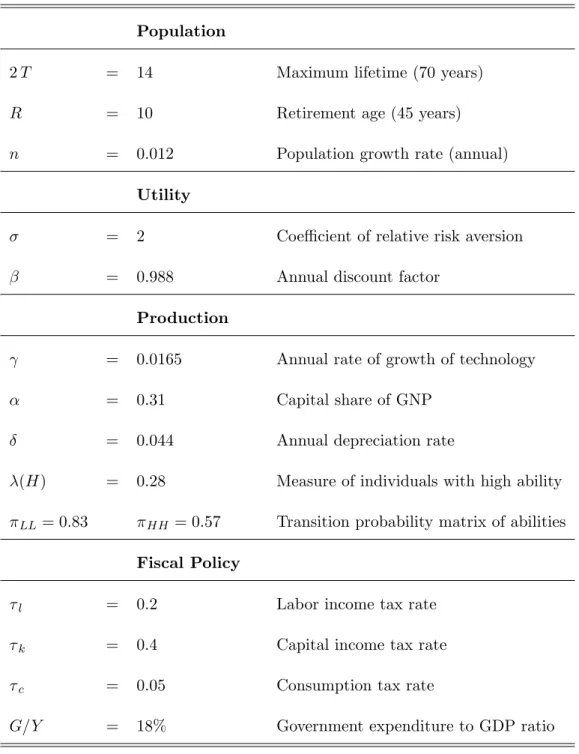
We are going to calibrate our model economy to the long run quantities in the U.S. economy in order to conduct our counterfactual experiments for reforming social security. Our main calibration target is the average capital-output ratio in the U.S. economy over the last …fty years, 2.5. Table 1 shows the major modeling and calibration choices made.
Table 1: List of Parameters Population
2T = 14 Maximum lifetime (70 years)
R = 10 Retirement age (45 years)
n = 0.012 Population growth rate (annual)
Utility
= 2 Coe¢ cient of relative risk aversion
= 0:988 Annual discount factor
Production
= 0:0165 Annual rate of growth of technology
= 0:31 Capital share of GNP
= 0:044 Annual depreciation rate
(H) = 0:28 Measure of individuals with high ability
LL = 0:83 HH = 0:57 Transition probability matrix of abilities
Fiscal Policy
l = 0:2 Labor income tax rate
k = 0:4 Capital income tax rate
c = 0:05 Consumption tax rate
A newborn in our setup is a 21 year old individual; a model period is …ve years. Retirement is mandatory at age 65, and maximum lifespan is 90 years. The population growth rate is 1.2% per year, and the productivity growth rate is 1.65% annually. Again, these are the averages from the U.S. economy over the last …fty years. The depreciation rate is taken as 4.4%, and capital’s share of GNP is 31%.
Fiscal policy is captured by a constant annual government-GNP ratio of 18%, and taxes on labor income, capital income, and consumption, at 20%, 40%, and 5%, respectively.
The coe¢ cient of relative risk aversion is set equal to 2, and the sub-jective discount factor is taken as 0.988 in order to obtain a capital-output ratio of 2.5.8
4
Numerical Findings
4.1 Aggregate Long Run E¤ects
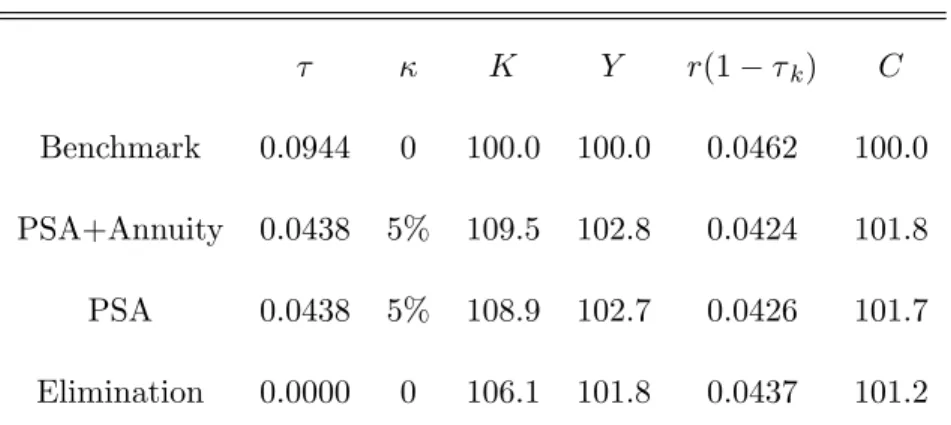
We summarize the long-run e¤ects of various types of reform in Table 2. The benchmark steady-state describes the current U.S. economy where pensions are provided by a PAYG system with a replacement rate of 44% and a payroll
8
tax rate of 9.44%. We set the values of aggregate variables in this steady-state equilibrium equal to 100 for easy comparison with other steady-steady-state equilibria under alternative reform proposals.
Table 2: Aggregate E¤ects of Reforms
K Y r(1 k) C
Benchmark 0:0944 0 100:0 100:0 0:0462 100:0
PSA+Annuity 0:0438 5% 109:5 102:8 0:0424 101:8
PSA 0:0438 5% 108:9 102:7 0:0426 101:7
Elimination 0:0000 0 106:1 101:8 0:0437 101:2
The steady-state labeled ‘Elimination’ is an equilibrium where there is no unfunded system at all and all individuals are left free to save the op-timal amounts desired to support old-age consumption. The steady-states labeled ‘PSA+Annuity’and ‘PSA’enforce mandatory saving at the rate of 5% of individuals’gross wage income in each of the years during their work-ing life. Not surpriswork-ingly, all three alternative steady-states exhibit higher capital stock than the benchmark economy since the distortion on saving is reduced with the decline of the payroll tax from 9.44% to 4.38%. Perhaps surprisingly, the steady-states with mandatory saving yield higher aggregate capital and consumption than the fully privatized equilibrium. This might be due to the fact that the combination of the two tiers for retirement
con-sumption under the PSA reforms with mandatory saving programs yields a higher aggregate saving rate than the steady-state in which there is no social security system.
4.2 Welfare E¤ects
Table 3 shows the lifetime utility of newborn households for di¤erent com-position and ability types. The …rst row describes the welfare of households at the benchmark steady-state. The second and third raws show the welfare levels under the partial privatization proposals, and the last row depicts the welfare of households under full privatization.
Table 3: Welfare of Newborns
Type 3 Type 1 s HH HL LH LL H L Benchmark 0:0944 0.00 48:66 56:13 55:72 66:85 46:89 59:03 PSA+Annuity 0:0438 0.05 48:24 56:74 53:69 65:39 46:01 60:06 PSA 0:0438 0.05 49:20 57:47 54:36 65:66 45:97 58:73 Elimination 0:0000 0.00 49:02 57:25 54:78 66:62 44:39 55:66 Measure of types 0:147 0:110 0:107 0:530 0:025 0:080
particular, they prefer elimination over partial privatization, with or without mandatory annuitization. There are at least two reasons for their preference. First, these households have no fathers who would generate the demand for annuity insurance, and since these households are very young they would rather not be subject to forced saving. Second, they might be facing binding liquidity constraints and mandatory saving would then reduce their welfare. Another way to get the same intuition is to compare their lifetime welfare under the two PSA reforms. They prefer the one without annuitization for the same reasons listed above. In addition, type 1 households prefer the PSA reform to the PAYG benchmark.
For type 3 households, the proposed PSA reform bene…ts those with low preference for annuity insurance. In particular, the households with low life expectancy fathers (LL and LH households) are better o¤, where as households with long life expectancy fathers (HH and HL households) are worse o¤, relative to the benchmark PAYG social security system.
A great majority of type 3 households prefer to be born into the steady-state labeled ‘PSA+Annuity’where there is mandatory saving at the 5% rate and wealth generated by this partial privatization program is annuitized at retirement.9 This …nding might seem surprising since our households care
9
Storesletten, Telmer, and Yaron (1999) also …nd annuitization welfare enhancing in their study of various social security reforms in a pure life cycle setting.
about leaving bequests to their relatives. However, since fathers are alive in these households, they like to hold annuities and therefore mandatory annuitization does not lower their welfare. Moreover, the fathers are very close to retirement age and the timing of annuitization is also in line with the households’ desire to hold annuities to insure the soon-to-be retirees. The HL households prefer the PAYG system. These households bene…t from the progressivity of the PAYG system because of the low ability son, and the and they also receive a generous pension for the high ability father.
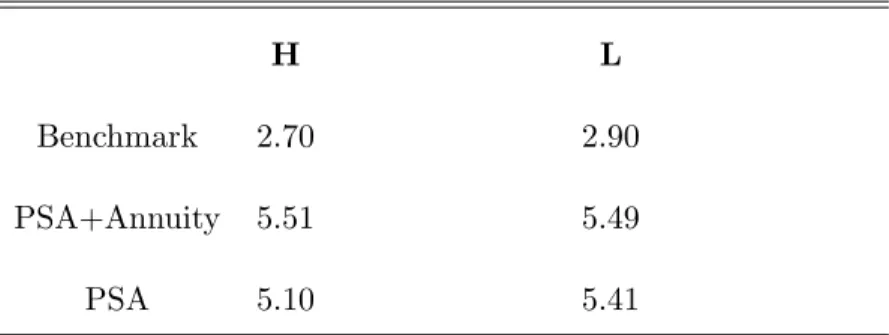
The proposed PSA reform bene…ts LH and LL type households and hurts HH and HL type households, relative to the benchmark equilibrium. This may be due to the fact that PSA does not provide annuity insurance against lifespan uncertainty while PAYG social security does so in the benchmark equilibrium. In fact, under PSA and mandatory annuitization, all ability types but HL enjoy higher lifetime welfare than in the benchmark economy. To see how type 1 households feel about the proposed reforms, Table 4 calculates the rate of return to ‘social security’for H and L types.10
1 0
With ‘social security’we mean the sum of the PAYG payroll tax and the mandatory saving rate. See the Appendix for the computation of the overall rate of return on social security.
Table 4: Return of ‘Social Security’for Type 1 HHs
H L
Benchmark 2.70 2.90
PSA+Annuity 5.51 5.49
PSA 5.10 5.41
In both steady-states with PSAs, the expected return on social security at birth is higher than the after tax return on capital. In the case of PSA without annuitization, there is some progressivity in the bene…ts since there is a …rst-tier which is a ‡at bene…t for every retiree. Indeed, the expected return of social security is higher for individuals with low ability (5.41%) than for the H types (5.10%). This di¤erence between the returns for low and high ability households disappears when part of the retirement wealth is annuitized. In this case, high ability households enjoy a higher rate of return (5.51%) than low ability households (5.49%) because H types have a longer life expectancy than L types. Therefore, when the part of wealth generated by mandatory saving is annuitized at retirement, a rationale for introducing a ‡at …rst tier pension is to compensate low ability individuals for the fact that their expected life is shorter.
5
Conclusions
The current debate on social security reform in the U.S. has focused on the relative merits of the existing PAYG system versus some form of partial privatization with a safety net for low income workers. In its key features, the 2001 Commission’s proposals are similar to the reform recommendations made by the 1997 Advisory Council on Social Security, according to which there were three approaches formulated to solve the long-term …nancial im-balance in the program:
Maintain Bene…ts: keep them essentially as is, but tax them.
Individual Accounts: an additional and mandatory contribution of 1.6% of payroll.
Personal Security Accounts: Convert the current system to a basic, ‡at bene…t program, and 5% of the existing payroll tax redirected to PSAs.
There is serious discussion to change the current PAYG de…ned bene…ts program administered publicly into a two-tiered program with a …rst-tier ‡at basic pension …nanced in a PAYG manner, plus a privately managed de…ned contribution program. In the current de…ned bene…t system, indi-viduals are given insurance against life span risk as they receive retirement
bene…ts as long as they are alive. On the other hand, a switch to a de…ned contribution retirement program can be designed to provide the same insur-ance if the funds in the individuals’accounts are required to be annuitized. However, as Diamond (1998) points out, political feasibility necessitates that the accounts’of the deceased be transferred to their estates. Diamond (1998) argues that mandatory annuitization may not be the best option on how funds are withdrawn during retirement if individuals care about leav-ing bequests to their descendents. Regulation about how to withdraw funds during retirement is also not a trivial issue if the individuals face binding borrowing constraints. Clearly, establishing such rules are an integral part of the design mechanism for reforming social security.
In this paper, we quantitatively evaluate the welfare e¤ects of reforming social security by introducing a PSA with and without mandatory annuitiza-tion in an economic environment with bequests and borrowing constraints. Our setup allows us to assess whether mandatory saving or mandatory an-nuitization of accumulated PSA wealth at retirement is welfare enhancing, and if so, for what type of individuals.
Our setup is a two-sided altruistic framework where social security pro-vides insurance against individual income and lifespan uncertainty. The economy is populated by overlapping generations of individuals that di¤er
in income and lifetime expectancy. Following Laitner (1992), we specify preferences so that individuals derive utility from their own lifetime con-sumption and from the felicity of their predecessors and descendents. In this framework, an unfunded social security system competes with family insurance to insure households members for the two types of risk mentioned above. The family insurance takes the form of intervivos transfers and be-quests. Overall, the economy consists of a rich set of households.
This framework is well suited to consider the annuity role of social secu-rity for single individuals versus for households where families also provide annuity insurance to their members. Our goal is to quantitatively evaluate the proposed reforms along the lines of PSAs with or without mandatory annuitization of PSA wealth at retirement in this setup where some house-holds have higher desire to annuitize wealth than others. We calibrate our economy to the U.S. economy, use numerical, discrete state-space methods to solve the households recursive decision problem, and restrict attention on steady-states under various pension system.
Our main …ndings can be summarized as follows:
A majority of households prefer a PSA reform (with or without manda-tory annuitization) over the current PAYG pension system. Aggregate capital, output, and consumption, as well as individuals’lifetime
wel-fare, are higher in the reformed pension system.
Mandatory annuitization bene…ts most households.
In light of these …ndings, structuring the social security reform along a two-tiered system with a safety net for low income households, and allowing all households to accumulate retirement wealth faster through PSAs, and …nally, requiring some level of annuitization of this wealth appear welfare improving for most households.
References
[1] Advisory Council on Social Security (1996), “Report of
the 1994-1996 Advisory Council on Social Security”, in
http://www.ssa.gov/policy/adcouncil/report/toc.htm.
[2] Boskin, Michael (1986), Too Many Promises: The Uncertain Future of
Social Security, New York: Dow-Jones-Irwin Publishers.
[3] Diamond, Peter (1998), ‘The Economics of Social Security Reform’, NBER Working Paper No. 6719.
[4] Fuster, Luisa (1999), ‘Is Altruism Important for Understanding the
Long-Run E¤ects of Social Security?’, Review of Economic Dynamics
2, No. 3, 616-637, (1999).
[5] Fuster, Luisa, Ay¸se ·Imrohoro¼glu, and Selahattin ·Imrohoro¼glu (2003), ‘A Welfare Analysis of Social Security in a Dynastic Framework,’
Interna-tional Economic Review, 1247-1274.
[6] Huggett, Mark, and Gustavo Ventura (1999), ‘On the Distributional E¤ects of Social Security Reform’, Review of Economic Dynamics, Vol.
[7] ·Imrohoro¼glu, Ay¸se, Selahattin ·Imrohoro¼glu, and Douglas Joines (1998), ‘The E¤ect of Tax-Favored Retirement Accounts on Capital Accumula-tion,’American Economic Review, September 1998, 88(4): 749-768.
[8] Laitner, John (1992), ‘Random Earnings Di¤erences, Lifetime Liquid-ity Constraints, and Altruistic Intergenerational Transfers,’Journal of
Economic Theory 58,135-170, (1992).
[9] Storesletten, Kjetil, Chris Telmer, and Amir Yaron (1999), ‘The Risk-Sharing Implications of Alternative Social Security Arrangements’,
Carnegie-Rochester Conference Series on Public Policy, Vol. 50,
Appendix
This transition probability matrix is a function of the age of the house-hold and of the abilities of the father and the son, and is given by
[ j(h; h0;z; z0)]h;h02f1;2;3g = 2 6 6 6 6 6 6 4 j(z0) 0 0 0 j+T(z) 0 j(z0)(1 j+T(z)) (1 j(z0)) j+T(z) j(z0) j+T(z) 3 7 7 7 7 7 7 5 :
CESifo Working Paper Series
(for full list see www.cesifo.de)
___________________________________________________________________________
1342
Johannes Becker and Clemens Fuest, A Backward Looking Measure of the Effective
Marginal Tax Burden on Investment, November 2004
1343
Heikki Kauppi, Erkki Koskela and Rune Stenbacka, Equilibrium Unemployment and
Capital Intensity Under Product and Labor Market Imperfections, November 2004
1344
Helge Berger and Till Müller, How Should Large and Small Countries Be Represented
in a Currency Union?, November 2004
1345
Bruno Jullien, Two-Sided Markets and Electronic Intermediaries, November 2004
1346
Wolfgang Eggert and Martin Kolmar, Contests with Size Effects, December 2004
1347
Stefan Napel and Mika Widgrén, The Inter-Institutional Distribution of Power in EU
Codecision, December 2004
1348
Yin-Wong Cheung and Ulf G. Erlandsson, Exchange Rates and Markov Switching
Dynamics, December 2004
1349
Hartmut Egger and Peter Egger, Outsourcing and Trade in a Spatial World, December
2004
1350
Paul Belleflamme and Pierre M. Picard, Piracy and Competition, December 2004
1351
Jon Strand, Public-Good Valuation and Intrafamily Allocation, December 2004
1352
Michael Berlemann, Marcus Dittrich and Gunther Markwardt, The Value of
Non-Binding Announcements in Public Goods Experiments: Some Theory and Experimental
Evidence, December 2004
1353
Camille Cornand and Frank Heinemann, Optimal Degree of Public Information
Dissemination, December 2004
1354
Matteo Governatori and Sylvester Eijffinger, Fiscal and Monetary Interaction: The Role
of Asymmetries of the Stability and Growth Pact in EMU, December 2004
1355
Fred Ramb and Alfons J. Weichenrieder, Taxes and the Financial Structure of German
Inward FDI, December 2004
1356
José Luis Moraga-González and Jean-Marie Viaene, Dumping in Developing and
Transition Economies, December 2004
1358
M. Hashem Pesaran and Paolo Zaffaroni, Model Averaging and Value-at-Risk Based
Evaluation of Large Multi Asset Volatility Models for Risk Management, December
2004
1359
Fwu-Ranq Chang, Optimal Growth and Impatience: A Phase Diagram Analysis,
December 2004
1360
Elise S. Brezis and François Crouzet, The Role of Higher Education Institutions:
Recruitment of Elites and Economic Growth, December 2004
1361
B. Gabriela Mundaca and Jon Strand, A Risk Allocation Approach to Optimal
Exchange Rate Policy, December 2004
1362
Christa Hainz, Quality of Institutions, Credit Markets and Bankruptcy, December 2004
1363
Jerome L. Stein, Optimal Debt and Equilibrium Exchange Rates in a Stochastic
Environment: an Overview, December 2004
1364
Frank Heinemann, Rosemarie Nagel and Peter Ockenfels, Measuring Strategic
Uncertainty in Coordination Games, December 2004
1365
José Luis Moraga-González and Jean-Marie Viaene, Anti-Dumping, Intra-Industry
Trade and Quality Reversals, December 2004
1366
Harry Grubert, Tax Credits, Source Rules, Trade and Electronic Commerce: Behavioral
Margins and the Design of International Tax Systems, December 2004
1367
Hans-Werner Sinn, EU Enlargement, Migration and the New Constitution, December
2004
1368
Josef Falkinger, Noncooperative Support of Public Norm Enforcement in Large
Societies, December 2004
1369
Panu Poutvaara, Public Education in an Integrated Europe: Studying to Migrate and
Teaching to Stay?, December 2004
1370
András Simonovits, Designing Benefit Rules for Flexible Retirement with or without
Redistribution, December 2004
1371
Antonis Adam, Macroeconomic Effects of Social Security Privatization in a Small
Unionized Economy, December 2004
1372
Andrew Hughes Hallett, Post-Thatcher Fiscal Strategies in the U.K.: An Interpretation,
December 2004
1373
Hendrik Hakenes and Martin Peitz, Umbrella Branding and the Provision of Quality,
December 2004
1374
Sascha O. Becker, Karolina Ekholm, Robert Jäckle and Marc-Andreas Mündler,
Location Choice and Employment Decisions: A Comparison of German and Swedish
Multinationals, January 2005
1375
Christian Gollier, The Consumption-Based Determinants of the Term Structure of
Discount Rates, January 2005
1376
Giovanni Di Bartolomeo, Jacob Engwerda, Joseph Plasmans, Bas van Aarle and
Tomasz Michalak, Macroeconomic Stabilization Policies in the EMU: Spillovers,
Asymmetries, and Institutions, January 2005
1377
Luis H. R. Alvarez and Erkki Koskela, Progressive Taxation and Irreversible
Investment under Uncertainty, January 2005
1378
Theodore C. Bergstrom and John L. Hartman, Demographics and the Political
Sustainability of Pay-as-you-go Social Security, January 2005
1379
Bruno S. Frey and Margit Osterloh, Yes, Managers Should Be Paid Like Bureaucrats,
January 2005
1380
Oliver Hülsewig, Eric Mayer and Timo Wollmershäuser, Bank Loan Supply and
Monetary Policy Transmission in Germany: An Assessment Based on Matching
Impulse Responses, January 2005
1381
Alessandro Balestrino and Umberto Galmarini, On the Redistributive Properties of
Presumptive Taxation, January 2005
1382
Christian Gollier, Optimal Illusions and Decisions under Risk, January 2005
1383
Daniel Mejía and Marc St-Pierre, Unequal Opportunities and Human Capital Formation,
January 2005
1384
Luis H. R. Alvarez and Erkki Koskela, Optimal Harvesting under Resource Stock and
Price Uncertainty, January 2005
1385
Ruslan Lukach, Peter M. Kort and Joseph Plasmans, Optimal R&D Investment
Strategies with Quantity Competition under the Threat of Superior Entry, January 2005
1386
Alfred Greiner, Uwe Koeller and Willi Semmler, Testing Sustainability of German
Fiscal Policy. Evidence for the Period 1960 – 2003, January 2005
1387
Gebhard Kirchgässner and Tobias Schulz, Expected Closeness or Mobilisation: Why
Do Voters Go to the Polls? Empirical Results for Switzerland, 1981 – 1999, January
2005
1388
Emanuele Bacchiocchi and Alessandro Missale, Managing Debt Stability, January 2005
1389
Assar Lindbeck and Dirk Niepelt, Improving the SGP: Taxes and Delegation rather than
1390
James J. Heckman and Dimitriy V. Masterov, Skill Policies for Scotland, January 2005
1391
Emma Galli & Fabio Padovano, Sustainability and Determinants of Italian Public
Deficits before and after Maastricht, January 2005
1392
Angel de la Fuente and Juan Francisco Jimeno, The Private and Fiscal Returns to
Schooling and the Effect of Public Policies on Private Incentives to Invest in Education:
A General Framework and Some Results for the EU, January 2005
1393
Juan C. Conesa and Carlos Garriga, Optimal Response to a Demographic Shock,
January 2005
1394
Christian Gollier, Optimal Portfolio Management for Individual Pension Plans,
February 2005
1395
Ruslan Lukach, Joseph Plasmans and Peter M. Kort, Innovation Strategies in a
Competitive Dynamic Setting, February 2005
1396
Gebhard Kirchgässner, (Why) Are Economists Different?, February 2005
1397
Marko Köthenbürger, Panu Poutvaara and Paola Profeta, Why are More Redistributive
Social Security Systems Smaller? A Median Voter Approach, February 2005
1398
Gabrielle Demange, Free Choice of Unfunded Systems: A First Assessment, February
2005
1399
Carlos Fonseca Marinheiro, Sustainability of Portuguese Fiscal Policy in Historical
Perspective, February 2005
1400
Roel M. W. J. Beetsma and Koen Vermeylen, The Effect of Monetary Unification on
Public Debt and its Real Return, February 2005
1401
Frank Asche, Petter Osmundsen and Maria Sandsmark, Is It All Oil?, February 2005
1402
Giacomo Corneo, Media Capture in a Democracy: The Role of Wealth Concentration,
February 2005
1403
A. Lans Bovenberg and Thijs Knaap, Ageing, Funded Pensions and the Dutch
Economy, February 2005
1404
Thiess Büttner, The Incentive Effect of Fiscal Equalization Transfers on Tax Policy,
February 2005
1405
Luisa Fuster, Ay
ş
e
İ
mrohoro
ğ
lu and Selahattin
İ
mrohoro
ğ
lu, Personal Security