in
Production Engineering
2014, No 4 (16), pp 157‐161
Abstract:
The ar cle presents the meaning of the data analysis in the context of risk management. Managers o en do not no ce the need of making deep analyses and they try to make decisions in a nonsystem way. The author pays a en on to the process of risk management that is aimed at facilita ng the func oning of the organiza on (by broadening one's knowledge about its func oning) and the significance of acquiring informa on from various sources.
THE
IMPORTANCE
THE
ANALYSIS
OF
DATA
IN
RISK
MANAGEMENT
INTRODUCTION
In every moment of their life cycle enterprises need
informa on on their func oning. On this basis they can
draw conclusions and make plans for further ac vity, taking
under considera on the incer tude of their func oning.
The men oned incer tude can be called threats; a er de‐
termining the probability of its occurrence, as well as ap‐ pearance of results of this incer tude – it can be named a risk. The risk can be related to the human ac vity, the func‐
oning of machines and to the nature [2, 8]. However, it has always influence on the system, in which it appears [13].
Risk management cons tutes an important element of
the aware enterprise management. It allows decision‐
makers making aware decisions that take under account
priori es and available alterna ves of ac ons. Systema c
applica on of policies, procedures and prac ce solu ons in
management in areas of communica on, consul ng, estab‐
lishing the context and iden fica on, analysis, evalua on,
dealing with the risk, monitoring and risk inspec on, cons ‐ tute the process of risk management [11, 13].
It is recommended that the input data for the process of
the risk management comes from various sources: histori‐
cal data, experiences, feedback informa on from stake‐
holders, observa on, forecasts and the opinion of experts.
The a en on is also paid on the necessity of exchanging
informa on between people making decision and taking
under considera on limita ons in data or in applied mod‐
els. This approach allows obtaining the proper view on the analyzed risk factor and assigning poten al results of this risk, with an accurately calculated probability. This way one can get a systemic (holis c) approach in the course of con‐
sidering possible disrup ons and eliminate irregulari es in
the transferred data (in obtained messages). Moreover, the
constant control of the process and the collec on of data
enables dynamic and itera ve reac ons to changes [3, 7,
10].
Although the manufacturing process is an ordered se‐
quence of opera ons that leads to the produc on of a
product, it can be subjected to many disrup ons, which
might delay the manufacture of the product (or force the
increase of use of assets), or even make the produc on
impossible [1, 13].
THE DATA ANALYSIS IN THE PROCESS OF RISK MANAGE‐ MENT
The collected data serve for gathering informa on on
poten al disturbances, but also enable designing a frame
structure of the risk management. The internal and exter‐
nal context of the organiza on and the understanding of its
essence cons tute a crucial element of the risk manage‐
ment present in processes. Collec ng data can be made
thanks to the assigned responsibility and established meth‐
ods of repor ng [11]. It should be adjusted to the form of
ac vity of the organiza on and it should be naturally
matched into its structure. The data analysis is o en
pushed into the margin of the func oning in Polish enter‐ prises [9]. The necessity of addi onal periodical inspec ons that enable verifying whether plans and frame structure of the risk management are s ll up to date is s ll not no ced.
Following aspects should be analyzed [11]:
the internal situa on of the company, including: the order in the organiza on, the structure of the
organiza on and its culture,
roles in the organiza ons and responsibili es (and se ling accounts on realized du es),
policies and strategies established for achieving
targets of the enterprise,
assets in the company and their deriva ves,
rela ons with business partners,
informa on systems enclosing informa on flows
and processes of making decisions,
norms and guidelines in the organiza on,
rela ons in the organiza on.
the company’s environment:
key factors and trends affec ng on objec ves of the enterprise,
Anna STASIUK‐PIEKARSKA Poznań University of Technology
Key words: quality management system, improvement, expert system
A. STASIUK‐PIEKARSKA ‐ The importance the analysis of data in risk management rela ons with external partners and their view and
values,
the social and cultural, legal, and poli cal, finan‐
cial, technological, economic and natural environ‐
ment, business partners and compe tors.
This allows making a risk analysis, which is defines
through the prism of [3, 11]:
the character and types of causes of the occurrence
of threats and disturbances that might result from
them,
the method of measurement of threats and assigning
them to groups from the por olio of iden fied risks, the probability of occurrence of disturbances,
the me horizon of the probability of disturbances
and threats ram,
ways of establishing the risk level,
views of business partners on examined issues, acceptable risk levels,
the combina on of various risks that might occur.
Documen ng processes for the purposes of the risk
management is an important element of the en re system.
Thanks to it, the organiza on can constantly learn and im‐
prove; registered recording facilitate making aware deci‐
sions and making inspec ons and reusing obtained infor‐
ma on in managerial processes. However, one should re‐
member that it is connected with certain costs and inputs,
including for example the necessity of regula ng nota ons
and methods of access to the data (especially to sensi ve data) and periods of its storage [11].
In the Figure 1 the risk management process is present‐ ed, specifying its basic stages and feedbacks.
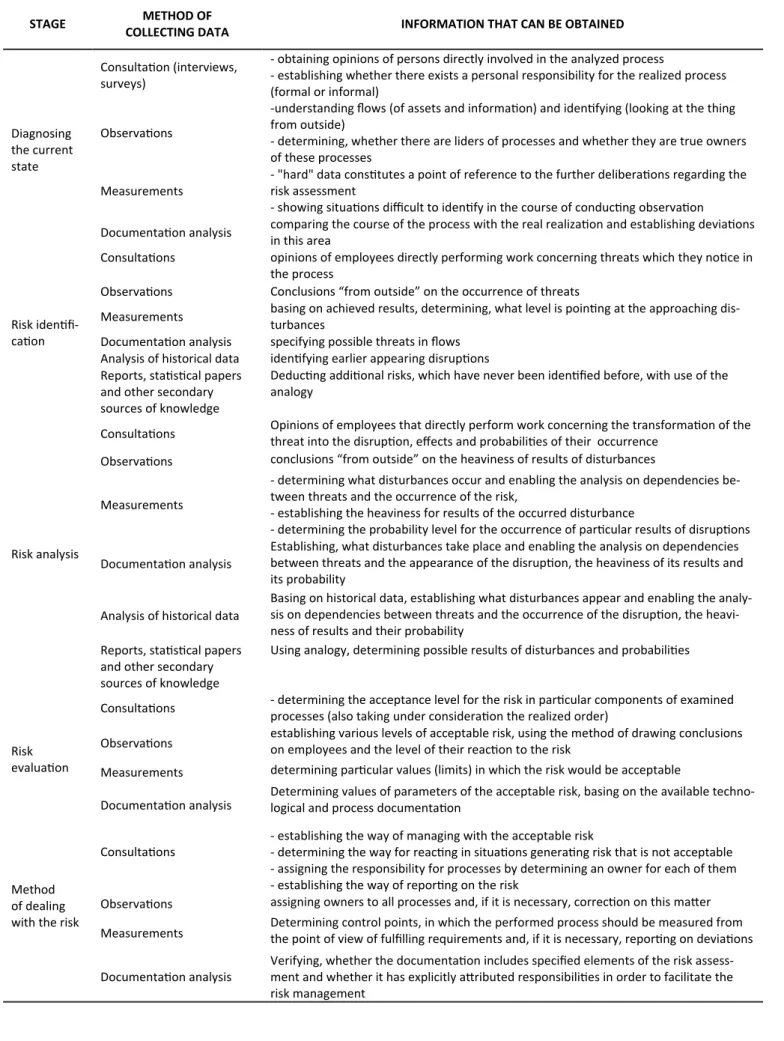
Informa on comes from data gathered in the process of acquiring them and it cons tutes a principal element of the risk management process. It is necessary to collect data on each stage; it allows enlarging the knowledge and enable a system approach to the iden fied risk.
Ways for collec ng data in the risk management pro‐
cess is presented in the Table 1.
Monitoring and effected inspec ons are supposed to
take the liberty of upda ng the state of the knowledge
about the current risk in processes. It will be required to
make constant monitoring and inspec ng, in par cular in
enterprises producing for customers’ orders, depending on
the difficulty of the determined order. This stage also al‐ lows repor ng disturbances that later can be use for up‐
da ng the risk management, also thanks to the categoriza‐
on of risk (crea ng the profile of the risk, i.e. the descrip‐ on of the set of risks) [10].
Thanks to the process of collec ng data, the earlier in‐ cer tude can be changed into an assessed risk that can be
managed with use of the prior planning ways of perfor‐
mance in situa ons of risk. There are following solu ons
that should be no ced in this process [10]:
avoiding risk by not‐beginning or not con nuing ac‐ ons that would lead to the occurrence of the threat, ini a ng, or even increasing the risk in order to take
the appearing chance,
elimina ng the source of the risk, affec ng the probability,
changing results of the threat,
co‐sharing the risk with other organiza ons (for ex‐
ample insurance).
Maintaining the risk on a defined level as a result of an
aware decision.
A system, pro‐ac ve approach allows predic ng disturb‐
ances and faster reac on to iden fied ones. CASE STUDY
The examined organiza on is in a group of big enterpris‐ es situated in Greater Poland. It has customers, which are
organiza ons represen ng over 25 countries in the en re
world. The company is specialized in the assembly of very
composite products. It is characterized with a very high
level of customiza on and con nuous product develop‐
ment and increase of the quan ty of products [4, 5, 12].
The company did not implement any system of risk man‐
agement. It is also no ceable that despite the fact of col‐ lec ng data, obtained informa on is not being analyzed in order to use it for constant improvement of the organiza‐
on.
The analyzed enterprise has determined its technologi‐
cal me periods, which allow it to plan the produc on. All
other me periods are determined as “unplanned me”
and they are reported to the Produc on Planning Sec on
by employees from the produc on department. The Pro‐
duc on Planning Unit has the obliga on to analyze causes
of the occurrence of this “unplanned me”. Despite the
established way of repor ng, employees can freely write in
note on causes. In result, the same unplanned me can
obtain different names; the person, who analyzes, has
o en to check circa 900 records before they can be system‐ ized. In addi on, some situa ons are difficult for iden fying
because during the process of repor ng employees do not
know how to name causes of appearing disturbances. In
result, they write various comments (like: “other”, “lack”, or they leave an empty space in the form).
RISK ASSESSMENT Communica on and consulta ons
Establishing the
current state and
rela ons inside
and outsider the
organiza on Risk iden fica on Risk analysis Risk evalua on Method of dealing
with the risk
Monitoring and the inspec on Fig. 2 Risk management process
A. STASIUK‐PIEKARSKA ‐ The importance the analysis of data in risk management
STAGE METHOD OF
COLLECTING DATA INFORMATION THAT CAN BE OBTAINED
Diagnosing the current state Consulta on (interviews, surveys) ‐ obtaining opinions of persons directly involved in the analyzed process ‐ establishing whether there exists a personal responsibility for the realized process (formal or informal) Observa ons
‐understanding flows (of assets and informa on) and iden fying (looking at the thing from outside)
‐ determining, whether there are liders of processes and whether they are true owners of these processes
Measurements
‐ "hard" data cons tutes a point of reference to the further delibera ons regarding the risk assessment
‐ showing situa ons difficult to iden fy in the course of conduc ng observa on
Documenta on analysis comparing the course of the process with the real realiza on and establishing devia ons in this area Risk iden fi‐ ca on Consulta ons opinions of employees directly performing work concerning threats which they no ce in the process
Observa ons Conclusions “from outside” on the occurrence of threats
Measurements basing on achieved results, determining, what level is poin ng at the approaching dis‐ turbances
Documenta on analysis specifying possible threats in flows Analysis of historical data iden fying earlier appearing disrup ons Reports, sta s cal papers
and other secondary sources of knowledge
Deduc ng addi onal risks, which have never been iden fied before, with use of the analogy
Risk analysis
Consulta ons Opinions of employees that directly perform work concerning the transforma on of the threat into the disrup on, effects and probabili es of their occurrence
Observa ons conclusions “from outside” on the heaviness of results of disturbances Measurements
‐ determining what disturbances occur and enabling the analysis on dependencies be‐ tween threats and the occurrence of the risk,
‐ establishing the heaviness for results of the occurred disturbance
‐ determining the probability level for the occurrence of par cular results of disrup ons Documenta on analysis Establishing, what disturbances take place and enabling the analysis on dependencies between threats and the appearance of the disrup on, the heaviness of its results and its probability Analysis of historical data Basing on historical data, establishing what disturbances appear and enabling the analy‐ sis on dependencies between threats and the occurrence of the disrup on, the heavi‐ ness of results and their probability Reports, sta s cal papers and other secondary sources of knowledge Using analogy, determining possible results of disturbances and probabili es Risk evalua on
Consulta ons ‐ determining the acceptance level for the risk in par cular components of examined processes (also taking under considera on the realized order)
Observa ons establishing various levels of acceptable risk, using the method of drawing conclusions on employees and the level of their reac on to the risk Measurements determining par cular values (limits) in which the risk would be acceptable
Documenta on analysis Determining values of parameters of the acceptable risk, basing on the available techno‐logical and process documenta on
Method of dealing with the risk Consulta ons ‐ establishing the way of managing with the acceptable risk
‐ determining the way for reac ng in situa ons genera ng risk that is not acceptable ‐ assigning the responsibility for processes by determining an owner for each of them ‐ establishing the way of repor ng on the risk
Observa ons assigning owners to all processes and, if it is necessary, correc on on this ma er Measurements Determining control points, in which the performed process should be measured from the point of view of fulfilling requirements and, if it is necessary, repor ng on devia ons Documenta on analysis
Verifying, whether the documenta on includes specified elements of the risk assess‐ ment and whether it has explicitly a ributed responsibili es in order to facilitate the risk management
Table 1
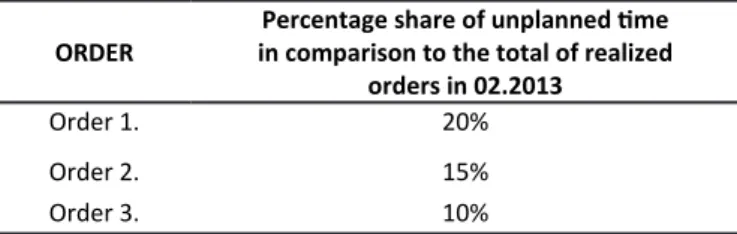
A. STASIUK‐PIEKARSKA ‐ The importance the analysis of data in risk management In the Table 2. data on three order that in February
2013 have generated the majority of hours called un‐
planned me are shown.
Table 2
Unplanned me in view to orders – percentage share of orders
The company analyzes unplanned me from the period
of a determined month from the point of view of contracts
and departments that generate it. However, it does not
analyze, whether cause of disturbances repeat in par cular
contracts, or what is causing them. In result, the firm does not draw conclusions whether it is possible to avoid disrup‐
ons in analogical contracts.
Below the author illustrates the analysis she has made,
and which enables observing certain regulari es.
The Table 3 shows qualita vely most important un‐
planned periods of me that have been noted in the Order no. 1.
Table 3
Main causes of unplanned me in the Order 1
In the Order 1, the general reason of the unplanned me (over 1/5 tunplanned t.) was the lack of parts necessary for
the realiza on of the assembly process. Lack of planned
me for a new opera on was also an important problem.
The realiza on of the correc on of the installa on was a significantly less important factor, as well as the incorrect
assembly. Moreover, there are no further conclusions on
the reason of the iden fied error – whether it was the fault
of an inexperienced or absent‐minded employee, mistake
in documenta on or also it could have another cause.
The Table 4 shows most important quan es of un‐
planned me that has been iden fied in the Order 2. Table 4
Main causes of unplanned me in the Order 2
In the Order 2 the main problem was the extension of me for the realiza on of the opera on resul ng from the
fact that it was made by an inexperienced employee. Un‐
fortunately, the organiza on did not establish any specific criteria in the process of collec ng data that would deter‐
mine, which employee is not experienced and when the
low efficiency of the worker results from other causes. This way, there appears a possibility to assign this category to each employee with low efficiency of work.
The second important cause of the extension of the
me of assembly is the lack of planned me for new opera‐ ons. The category tunplanned t. that shows the lack of coher‐
ence in the system collec ng data is the third main cause (almost 1/10 of the total registered unplanned me), it is determined here as “lack of data”. This term, because of its lack of precision, does not allow making further analysis of
disturbances in the assembly process.
The Table 5 illustrates most important quan es for the unplanned me iden fied in the Order no. 3.
Table 5
Main causes of unplanned me in the Order 3
Almost a half of the unplanned me in the order 3 re‐ sulted from the necessity of making the correc on of the
installa on. Along with the second reason, it cons tuted
almost 80%of all disturbances iden fied in this order. The
appearing next category that hampers making analyses is
determining the reason tunplanned t. as “other”.
Considering the context of all orders, one can no ce
one important share of the unplanned me, which is called “new opera on – lack of planned me”. In this context, the me determined as unplanned should not be a problem for the assembly (although it is a problem in the context of
planning the manufacturing process and it extends the me
of the realiza on of the order and of the use of planned assets). It is a disturbance of a different type than the prob‐ lem of lack of parts or inexperienced employee.
CONCLUSIONS
Collec ng data is supposed to be use in a company for analyzes that would facilitate planning its ac vity in the future (for example in maintaining the movement) [6]. The
process of gaining informa on by concluding is worth de‐
veloping, so that the collected data could be used in a way
that improves the manufacturing process the best way pos‐
sible, taking under considera on the system character of
the enterprise.
The company collects informa on that could cons tute
the basis for a pro‐ac ve approach to the risk; however, it does not use its poten al and it is losing two mes. First,
because me and other assets for the data collec ng are
being lost because of not making conclusions for further
changes. Second, because of the extension of the me for making decisions resul ng from lack of plan for the ac vity in the context of changes that could take place in the sys‐ tem.
ORDER
Percentage share of unplanned me in comparison to the total of realized
orders in 02.2013
Order 1. 20%
Order 2. 15%
Order 3. 10%
No.
Reason of the occurrence of the unplanned me
Percentage share of un‐ planned periods of me in reference to all reasons in the Order 1. 1. Lack of parts 23.23% 2. New opera on – lack of planned me 19.76% 3. Correc on of the installa on 6.94% 4. Incorrect assembly 6.21% No.
Reason of the occurrence of the unplanned me
Percentage share of un‐ planned periods of me in reference to all reasons
in the Order 2. 1. Inexperienced employee 26.32% 2. New opera on – lack of planned me 15.72% 3. Lack of data 9.57% 4. Lack of parts 8.77% No.
Reason of the occurrence of the unplanned me
Percentage share of un‐ planned periods of me in reference to all reasons
in the Order 3. 1. Correc on of the installa on 40.06% 2. New opera on – lack of planned me 38.06% 3. Repeated prepara on of the product for the client 5.55% 4. Other 4.27%
A. STASIUK‐PIEKARSKA ‐ The importance the analysis of data in risk management LITERATURE
[1] W. Błaszczyk. Metody organizacji i zarządzania. Kształ‐
towanie relacji organizacyjnych. Warszawa: Wyd. Nau‐ kowe PWN, 2005, p. 109.
[2] M. Butlewski, M. Smaruj. „Analiza porównawcza me‐
tod oceny ryzyka zawodowego z punktu widzenia inży‐
nierii ergonomicznej,” in Inżynieria ergonomiczna.
Praktyka. E. Tytyk, Ed. Poznań: Wydawnictwo Politechniki Poznańskiej, 2011.
[3] A. Fierla. Ryzyko w działalności przedsiębiorstw. Wy‐
brane aspekty. Warszawa, Szkoła Główna Handlowa w
Warszawie, 2009.
[4] Ł. Hadaś, G. Klimarczyk. „Wyniki analizy ABC/XYZ w
przedsiębiorstwie montażowym o wysokim stopniu
kastomizacji – studium przypadku.” Logistyka, no. 1,
pp.57‐58, 2010, .
[5] Ł. Hadaś, G. Klimarczyk. „Koncepcja budowy metodyki
systemu zarządzania zaopatrzeniem w przedsiębior‐
stwie montażowym o wysokim stopniu kastomizacji.”
Logistyka, no. 2, pp. 50‐51, 2010, .
[6] M. Jasiulewicz‐Kaczmarek, P. Drożyner. “The Role of
Maintenance in Reducing the Nega ve Impact of a
Business on the Environment,” in Sustainability Ap‐
praisal: Quan ta ve Methods and Mathema cal Techniques for Environmental Performance Evalua‐
on, EcoProduc on. M. G. Erechtchoukova, Ed. Berlin: Springer‐Verlag Berlin Heidelberg, 2013, p. 153.
[7] J. Kaźmierczak. “Produc on engineering in Poland: a
point of view.” Management Systems in Produc on
Engineering, no 1(9), p. 8, 2013.
[8] T. Lis, K. Nawrocki. Zarządzanie bezpieczeństwem i
higieną pracy w zakładzie przemysłowym. Gliwice: Wydawnictwo Politechniki Śląskiej, 2005, p. 60. [9] A. Misztal. “Data analysis as a base for improving of
processes and products,” in Theory of management 4.
The selected Problems for the Development Support of Management Knowledge Base, Št. Hi már, Ed. Žilina ‐ Slovak Republic: University of Žilina, 2011, p. 145.
[10] Polski Komitet Normalizacyjny, PKN‐ISO Guide
73:2012, Zarządzanie ryzykiem. Terminologia, Warsza‐
wa 2012.
[11] Polski Komitet Normalizacyjny, PKN‐ISO 31000:2012,
Zarządzanie ryzykiem. Zasady i wytyczne, Warszawa
2012.
[12] A. Stasiuk‐Piekarska, Ł. Hadaś, M. K. Wyrwicka.
„Analiza zakłóceń dla wybranych kategorii dostawców
w przedsiębiorstwie o wysokim stopniu kastomizacji.”
Gospodarka Materiałowa i Logistyka, 2014.
[13] A. K. Stasiuk, K. Werner‐Lewandowska. „Rola ryzyka w
zarządzaniu produkcją,” in Innowacje w zarządzaniu i
inżynierii produkcji, R. Knosala, Ed. Opole: Oficyna
Wydawnicza Towarzystwa Zarządzania Produkcją,
2013.
mgr inż. Anna Stasiuk‐Piekarska
Poznan University of Technology
Faculty of Engineering Management
ul. Strzelecka 11, 60‐965 Poznań, POLAND
Artykuł w polskiej wersji językowej dostępny na stronie
internetowej czasopisma.
The ar cle in Polish language version available on the web‐ site of the journal