Controlling Corruption in Europe
The Anticorruption Report
Volume 1
Controlling Corruption
in Europe
written by Alina Mungiu-Pippidi Roxana Bratu Nicholas Charron Valentina Dimulescu Madalina Doroftei Mihály Fazekas Aare Kasemets Lawrence Peter King Roberto Martínez B. Kukutschka Raluca Pop István János TóthBarbara Budrich Publishers Opladen • Berlin • Toronto 2013
The Anticorruption Report 1
All rights reserved. No part of this publication may be reproduced, stored in or introduced into a retrieval system, or transmitted, in any form, or by any means (electronic, mechanical, photocopying, recording or otherwise) without the prior written permission of Barbara Budrich Publishers. Any person who does any unauthorized act in relation to this publication may be liable to criminal prosecution and civil claims for damages.
You must not circulate this book in any other binding or cover and you must impose this same condition on any acquirer.
A CIP catalogue record for this book is available from Die Deutsche Bibliothek (The German Library)
The information and views set out in this publication are those of the author(s) only and do not reflect any collective opinion of the ANTICORRP consortium, nor do they reflect the official opinion of the European Commission. Neither the European Commission nor any person acting on behalf of the European
Commission is responsible for the use which might be made of the following information.
© 2013 by Barbara Budrich Publishers, Opladen, Berlin & Toronto www.barbara-budrich.net
ISBN 978-3-8474-0125-4 (Paperback) eISBN 978-3-8474-0381-4 (e-book)
Das Werk einschließlich aller seiner Teile ist urheberrechtlich geschützt. Jede Verwertung außerhalb der engen Grenzen des Urheberrechtsgesetzes ist ohne Zustimmung des Verlages unzulässig und strafbar. Das gilt insbesondere für Vervielfältigungen, Übersetzungen, Mikroverfilmungen und die Einspeicherung und Verarbeitung in elektronischen Systemen.
Die Deutsche Bibliothek – CIP-Einheitsaufnahme
Ein Titeldatensatz für die Publikation ist bei Der Deutschen Bibliothek erhältlich.
Verlag Barbara Budrich Barbara Budrich Publishers Stauffenbergstr. 7. D-51379 Leverkusen Opladen, Germany 86 Delma Drive. Toronto, ON M8W 4P6 Canada
www.barbara-budrich.net
Jacket illustration by Bettina Lehfeldt, Kleinmachnow, Germany – www.lehfeldtgraphic.de
Printed in Germany on acid-free paper by Strauss GmbH, Mörlenbach, Germany
Contents
Executive summary . . . 7
1.Methodology . . . 9
2.European Union Member States . . . 14
3.THe South-Eastern Europe . . . 48
4.THe Former Soviet Union . . . 55
5.Top of the Class. THe Case of Estonia . . . 68
6.Hidden Depths. THe Case of Hungary . . . 74
7. Bottom of the Heap. THe Case of Romania . . . 83
8. European Perceptions of Quality of Government: A Survey of 24 Countries . . . 99
9 .Lessons Learned. THe Good, the Bad and the Ugly . . . 121
74
6. Hidden Depths. The Case of Hungary
1MIHÁLY FAZEKAS, LAWRENCE PETER KING AND ISTVÁN JÁNOS TÓTH
This report investigates corruption risk of EU funds spending in Hungary within the framework of the Public Procurement Law. Its finding is that in spite of what is a tight regulatory framework EU funds are likely to fuel the abuse of public spend-ing. Even though public procurement using EU funds faces considerably more stringent regulation, their use poses much greater corruption risks when compared with funds procured domestically and corruption risks are particularly pronounced for large projects. The report also argues that large-scale institutionalized corrup-tion in Hungary may be widespread and driven primarily by political cycles. Such corruption, often labelled “legal corruption”, typically involves neither bribery nor collusion between lower level bureaucrats and private individuals; rather, it operates through contractual relationships which benefit the highest echelons of the politi-cal and business elite. There are a small number of new anti-corruption initiatives of the new government which entered office in 2010, but while they might indicate a positive step towards higher public sector integrity, their results are yet to be seen.
Introduction
Hungary scores as one of Central and Eastern Europe’s most corrupt countries accord-ing to the widely used but hotly contested Worldwide Governance Indicators2 (see chapter
3 of this book) as well as when measured in the Quality of Goverment EU Regional Data survey (see chapter 8 of this book) . Research looking at Hungarian corruption in more detail using qualitative methods or media content analysis reveals a great deal of additional evidence relating to the phenomenon’s structure and its evolution over time .
Taking the available information together, Hungary appears to be a borderline case between limited and open access orders with considerable movements or swings be-tween these ideal types (Mungiu-Pippidi et al . 2011) . There are islands of excellence in the state which exercise a great deal of autonomy from potential societal captor agents; however, those institutions are regularly contested as for example in the recurrent at-tacks on the Hungarian National Bank in the last decade or so .
1 The research was made possible by support from two EU funded projects at the Corvinus University of
Budapest (TAMOP 4 .2 .2 .B and ANTICORRP: Grant agreement no: 290529) and the authors’ voluntary contributions .
2 For a more detailed discussion of criticism see: Kaufmann, Kraay, & Mastruzzi, 2007; Kurtz & Schrank,
75
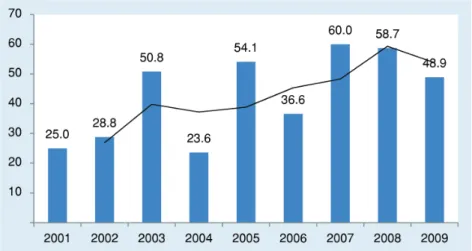
Even though the exact path of evolution is yet to be fully documented, there is con-siderable evidence pointing to the increased institutionalisation of corruption in Hun-gary (Figure 1) . Networks of private and public actors appear to have evolved for pursu-ing particularistic goals uspursu-ing public resources (Jancsics & Jávor, 2012; Szántó, Tóth, & Varga, 2012; Szántó & Tóth, 2008) . A clear sign of increased institutionalisation is the emergence of the role of the ‘broker’ who sells an understanding of corrupt transactions and knowledge of actors in a wide range of sectors and institutional contexts .
Figure 1. Ratio of occurrence of multiplayer, chain-like corruption cases in the Hungarian media, 2001-2009, % (548 cases of suspected corruption) .
Source: Szántó et al ., 2012 p . 148 .
Based on court proceedings and interview evidence, it seems that corrupt networks have reached the highest echelons of the political and business elite, and they have contributed to political election campaigns as well as benefiting individual members . Corruption has become a top priority and a frequently quoted objective in election campaigns, and corruption scandals which hit the previous government most prob-ably contributed to the landslide victory of Fidesz in 2010 .
EU funds have become the single most important source of public investment in Hungary and by now they play a major role in overall public spending . Their dis-bursement is certainly affected by the competing principles of particularism and uni-versalism so strikingly present in the functioning of the Hungarian state . In order to explore further the dynamics and evolution of the governance regime of Hungary this chapter delivers preliminary evidence on large-scale institutionalized corrup-tion3 in EU funds spending in Hungarian public procurement based on data from
2009-2012 . We looked only at EU funding which is spent by Hungarian public and semi-public organisations (i .e . mixed public-private owned) through public procure-ment regulated by the Public Procureprocure-ment Law . Hence, our study almost entirely covers the Cohesion Fund and much of the Structural Funds spending, but not the Common Agricultural Policy funds .
76
Our findings come from the analysis of interviews with key individuals who have witnessed corrupt transactions and from a large database recording every public pro-curement procedure in Hungary which was conducted under national or EU public procurement law between 1st of January 2009 and 31st of December 2012 . This
data-base contains over 56,000 contract awards, allowing for an unprecedentedly detailed view of public spending and high-level corruption .
This analysis of a borderline governance regime occurs at the onset of a new anticorrup-tion campaign . The Fidesz government has launched a range of policies aimed at curbing corruption in the public sector, integrated into the Corruption Prevention Program of the Public Administration launched in early 2012 (for full list of recent initiatives check the online version of this Article on www .againstcorruption .eu) . While these initiatives may represent a positive step towards greater public sector integrity, results are yet to be seen . Our analysis can explore only the baseline before any of the policies could actually take serious effect, but future research employing similar methodology will be able look into changes potentially attributable to the new initiatives .
Hungary is one of the top beneficiaries of EU cohesion policies with allocated per capita spending close to 3,000 EUR for 2007-2013 . However, EU funds absorption has been an issue with contracted ratio of 64% by the end of 2011 falling slightly be-low the Central and Eastern Europe (CEE) average of 67% (KPMG, 2012) .
1. Government favouritism evidence
Change of government and the corresponding turnover of political leadership seems to drastically alter the winning chances of companies in the public procurement market, both EU- and non-EU funded . In interviews, top managers of large construction, IT, and health care companies supplying public organisations all supported the view that the swings in market shares of companies reflect the changing preferences of the politi-cal leadership for particular well-connected companies . According to this interpretation, success in the public procurement market depends much more on political connections than on the competitiveness of companies, implying a predominantly particularistic al-location of public resources . Such corruption, often described as “legal corruption”, typi-cally does not involve bribery nor collusion between lower level bureaucrats and private individuals; rather, it operates through contractual relationships benefiting the highest echelons of the political and business elite (Kaufmann & Vicente, 2005) .
Such claims are demonstrated by tracking the changes in market shares of the larg-est companies before and after the new government entered office (Figure 2), but they are also underpinned by regression analysis looking at the whole public procurement market financed from EU funds (Annex 1) . Figure 2 amply demonstrates that the companies with the largest market share throughout the one and a half years leading up to the elections in the first half of 2010 lost about 25-30% of their combined mar-ket share . This change was accompanied by a comparable increase in the total marmar-ket share of companies dominating the post-election market between the second half of 2011 and 2012 (the one year period between 2010H2 and 2011H1 was excluded as it was a transitory period between the two governments) .
77
Figure 2. Changes in market shares of the top 30 firms of 2009-2010H1 and of 2010H2-2012, EU funded construction projects, 2009-2012 (%)4
Source: MaKAB
Note: market share of company i in time t=total value of contracts won by company i in EU funded construction in time t / total value of contracts won in EU funded construction in time t
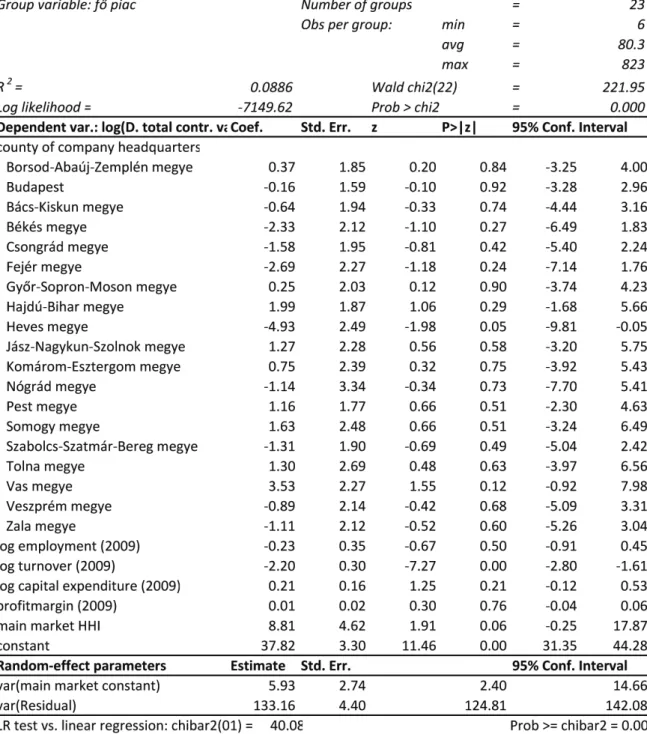
One of our previous reports found similar patterns throughout the public procurement market, albeit the magnitude of seemingly politically driven spending is comparatively greater for EU-funded contracts (Fazekas & Tóth, 2013) . Regression analysis in Annex 1 supports the same conclusions while looking at the entire EU-funded public procurement market and taking into account the effects of companies’ main market size, company size, amount of prior capital investment, location of headquarters, and profit margin .
Thus, based on the available evidence, it is likely that at least 25-30% of EU-fund-ed construction spending is driven directly by politics in Hungary, but it is conceiv-able that the proportion is as high as 80-90%, for several interviewees suggested that contracts going to the opposite political camp’s companies function as “payment” for future contracts for companies whose political connections currently hold the power, but might lose it in the future . Evidence to date indicates that large-scale institutional-ized corruption is widespread in Hungary .
2. EU funds spending compared to national public procurement
When comparing public procurement contracts financed from EU funds to those without any EU sources on some elementary corruption risk indicators5, EU funds
perform considerably worse than national funds . This underpins the claim that EU funds fuel the abuse of public spending in spite of a tight regulatory framework . 4 It is possible to adjust the combined market share of the top 30 companies of 2009-2010H1 in 2012H2
be-cause the figure is highly upwards-distorted by a single highway construction contract . In addition, interview evidence points to strong political involvement in the management of that contract award procedure .
78
33 .8% of contracts awarded for projects financed by EU funds throughout 2009-2012 received only one bid as opposed to 29% of contracts financed from purely national funds (Table 1) . This implies that in spite of strong support for effective competition, a third of EU funds spending by Hungarian authorities through public procurement is conducted with no competition whatsoever . Modifying contracts after contract award is also much more frequent with EU-funded projects than nationally funded ones (17 .7% and 6 .5% respectively), a surprising difference as contract modifications are allowed only in a few un-foreseen situations such as extremely bad weather or unusually high exchange rate fluctua-tions . As contract modificafluctua-tions allow for pushing the prices up and quality down after the competitive contract award process ends, we may suspect that EU funds are much more prone to corrupt rent extraction . Interview evidence supports this interpretation, pointing out the lack of incentives for contracting parties (i .e . issuers of tenders and contract win-ners) to reveal corruption as it would imply that funding is returned to the national EU funding disbursement agency, i .e . loss of external funding for both parties .
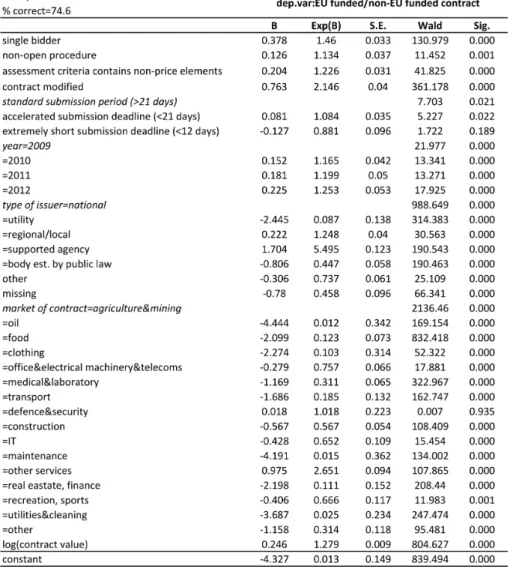
Regression results underline that such differences between contracts awarded for projects with and without EU funding cannot be attributed to some obvious alterna-tive explanation such as contract size, market of spending, or type of issuer (Results of regressions on the differences between EU funded and nationally financed public procurement contracts are available in the online version of this Article on www .again-stcorruption .eu) .
Table 1. Selected corruption risk indicators of public procurement contract awards with and without EU funds (2009-2012)
Source: MaKAB
Note: differences deemed substantive are highlighted in grey .
Period 2009 2010 2011 2012 Total 2009-2012
Proportion of occur-rence among contracts with/without EU funds Public procurement contracts using EU funds? Public procurement contracts using EU funds? Public procure-ment contracts using EU funds? Public procure-ment contracts using EU funds? Public procure-ment contracts using EU funds?
NO YES NO YES NO YES NO YES NO YES
single bidder 30 .9% 40 .2% 30 .6% 43 .4% 25 .7% 28 .0% 28 .1% 24 .9% 29.0% 33.8%
non-open procedure 43 .5% 39 .7% 32 .9% 32 .2% 36 .9% 36 .6% 45 .4% 56 .9% 39.2% 40.9%
no call for tenders in
Official Journal 48 .7% 38 .9% 25 .4% 23 .8% 56 .2% 66 .5% 55 .2% 73 .5% 44.7% 50.9% accelerated submission
deadline (<21 days) 17 .7% 20 .8% 26 .5% 28 .4% 24 .0% 40 .7% 19 .9% 26 .4% 23.2% 29.2% extremely short
sub-mission deadline (<12 days) 2 .7% 3 .1% 2 .3% 1 .9% 2 .3% 3 .5% 2 .6% 3 .4% 2.4% 2.6% contract modification 4 .6% 16 .2% 9 .8% 25 .4% 8 .0% 22 .0% 2 .5% 4 .6% 6.5% 17.7% assessment criteria contains non-price elements 47 .2% 52 .0% 48 .4% 64 .3% 35 .8% 40 .4% 34 .0% 34 .1% 41.8% 48.0% Total N 7,711 3,144 11,019 6,467 8,148 5,904 8,514 5,340 35,392 20,855
79
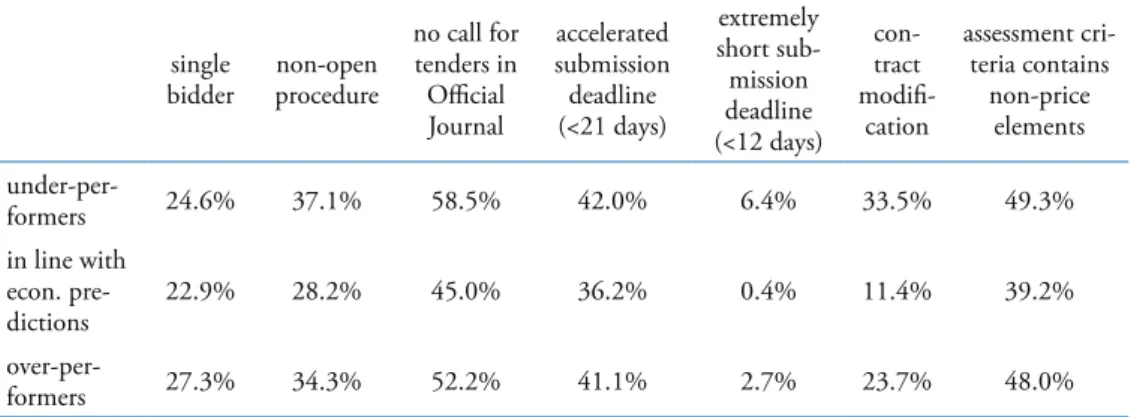
The most striking characteristic of these corruption risk indicators, called ‘irregu-larities’ by the European Court of Auditors (European Court of Auditors, 2012), is that they are not irregular nor are they random . They are particularly high for those companies whose market share appears to be driven by the political cycle as identi-fied in the previous section and in Annex 1 . This can be interpreted as meaning that those companies which win public procurement contracts funded by the EU with the help of their political connections tend to win under conditions prone to corruption . The point is well demonstrated in the differences among companies which perform according to what a standard economic logic would predict and those which consider-ably under- or over-perform compared to a pure economic model6 (Table 2) .
For example, companies under- or over-performing are 2 to 3 times more likely to experience contract modification after their contract has been approved than those which perform according to a standard economic logic . But differences are similarly striking in the frequency of accelerated and extremely short submission deadlines .
Table 2. Selected corruption risk indicators according to company groups, EU funded public procurement, 2011
single
bidder procedurenon-open
no call for tenders in Official Journal accelerated submission deadline (<21 days) extremely short sub-mission deadline (<12 days) con-tract modifi-cation assessment cri-teria contains non-price elements under-per-formers 24 .6% 37 .1% 58 .5% 42 .0% 6 .4% 33 .5% 49 .3% in line with econ . pre-dictions 22 .9% 28 .2% 45 .0% 36 .2% 0 .4% 11 .4% 39 .2% over-per-formers 27 .3% 34 .3% 52 .2% 41 .1% 2 .7% 23 .7% 48 .0% Source: MaKAB Note: N=266
All this evidence underpins the hypothesis that EU funds represent much high-er corruption risks than spending of Hungarian funds in spite of considhigh-erably more stringent regulation . As corruption risks are particularly pronounced for large projects and for companies dependent on their political connections for winning contracts, EU funds-related corruption is most probably driven by national politics . Our find-ings are confirmed by data from the previous and the current governments; that is the whole period of 2009-2012, pointing to the potentially systemic nature of corruption in post-communist Hungary .
6 Under-performance is defined as large negative error in the regression of Annex 1 taking into account
stan-dard economic variables determining market performance, while over-performance is large positive error in the same regressions . Those companies which have regression error close to zero are deemed as performing according to what is expected .
80
Recommendations
In order for the EU and Hungary to combat corruption in EU funds spending and to avoid waste of public resources they might consider the following:
• Ensure effective transparency and active access to information on public procure-ment
Timely information provision in a format readily comprehensible and at a location easily accessible is the only way to fight corruption; in other words through trans-parency . Information which is outdated, barely comprehensible to non-experts, and accessible only after a large investment of time and effort helps fighting cor-ruption little more than no transparency at all .
• Close loopholes in public procurement regulation .
Exceptions, emergency regulations, and minimum thresholds are abused far too often . By closing those routes and ensuring a minimum level of transparency for the currently loosely regulated purchases would make hiding corruption much more difficult .
• Review the quality of outcomes and prices of inputs rather than the procedures of spending .
The current administrative framework focuses largely on procedural and financial compliance, which makes the administration of EU funded projects costly while achieving little in preventing corruption . Refocusing audits or reviews on the qual-ity of outcomes and the price of inputs might work better in revealing and so curbing corruption .
References
European Court of Auditors . (2012) . Annual Report on the Implementation of the Budget con-cerning financial year 2011 . Brussels .
Fazekas, M ., & Tóth, I . J . (2013) . Political Influence in the Public Procurement Market? Analysis of market share 2009-2011 – preliminary results . Corruption Research Centre, Budapest . Fazekas, M ., Tóth, I . J ., & King, L . P . (2012) . When government serves the interests of the few:
Corruption and state capacity in Hungarian public organisations . Hungarian Economic As-sociation: Annual Conference 2012 . Budapest: Hungarian Economic Association .
Jancsics, D ., & Jávor, I . (2012) . Corrupt Governmental Networks . International Public Man-agement Journal, 15(1), 62–99 . doi:10 .1080/10967494 .2012 .684019
Kaufmann, D ., Kraay, A ., & Mastruzzi, M . (2007) . Growth and Governance: A Reply . The Journal of Politics, 69(2), 555–562 .
Kaufmann, D ., & Vicente, P . C . (2005) . Legal Corruption .
Kaufmann, D ., & Vincente, P . D . (2011) . Legal Corruption . Economics & Politics, 23(2), 195–219 . doi:10 .1111/j .1468-0343 .2010 .00377 .x
KPMG . (2012) . EU Funds in Central and Eastern Europe. 2011 . Warsaw, Poland: KPMG . Kurtz, M . J ., & Schrank, A . (2007a) . Growth and Governance: Models, Measures, and
Mech-anisms . The Journal of Politics, 69(2), 538–554 .
Kurtz, M . J ., & Schrank, A . (2007b) . Growth and Governance: A Defense . Journal of Politics,
81
Mungiu-Pippidi, A . et al . (2011) . Contextual Choices in Fighting Corruption: Lessons Learned . Oslo: Norwegian Agency for Development Cooperation .
Szántó, Z ., & Tóth, I . J . (2008) . Business corruption in Hungary: From various angles Re-search summary . Trento .
Szántó, Z ., Tóth, I . J ., & Varga, S . (2012) . The social and institutional structure of corruption: some typical network configurations of corruption transactions in Hungary . In B . Vedres & M . Scotti (Eds .), Networks in Social Policy Problems . Cambridge, UK: Cambridge Uni-versity Press .
Annex A: Anti-Corruption Initiatives of Hungarian Government
Briefing (in Hungarian):
http://www.kormany.hu/hu/gyik/osszefoglalo-a-kormany-korrupcioellenes-intezkedeseirol
September 2010.
Hungary joined the International Anti Corruption Academy (IACA).
The government has strengthened the Department of Public Prosecution. The government has founded the anti-corruption working group into Department of Public Prosecution and added more than 3 billion HUF (10 million EUR) to his budget in 2011.
December 9 2010.
Anti-Corruption Measures of Hungarian Government in 2010 Press release:
http://www.kormany.hu/en/ministry-of-public-administration-and-justice/news/government-measures-to-combat-corruption-summary-for-world-anti-corruption-day-9-december
November 18 2011.
Deputy Prime Minister Tibor Navracsics signs anti-corruption cooperation agreement with Presi-dent of the State Audit Office of Hungary, the PresiPresi-dent of the Supreme Court of Hungary and the Chief Prosecutor
Press release: http://www.kormany.hu/en/ministry-of-public-administration-and-justice/news/deputy-prime- minister-tibor-navracsics-signs-anti-corruption-cooperation-agreement-with-president-of-the- state-audit-office-of-hungary-the-president-of-the-supreme-court-of-hungary-and-the-chief-prosecutor January 2012.
The government has published by internet the first draft of his anti-corruption plan (in Hungarian): http://www.kormany.hu/download/e/da/70000/korrupcio_megelozes_program_v1_01.pdf
March 28 2012.
The government has adopted its “Two-year programme on preventing corruption in central govern-ment institutions”
Press release:
http://www.kormany.hu/en/ministry-of-public-administration-and-justice/news/govt-launches-2-year-anti-graft-programme
April 6 2012.
Government decision on anti-corruption measures and programme for preventing corruption in central government institutions (Official Journal of Hungary, in Hungarian), Government Deci-sion 1104/2012 (IV. 6.)
http://kozlony.magyarorszag.hu/pdf/12506
April 16 2012.
82 Press release:
http://www.kormany.hu/en/ministry-of-public-administration-and-justice/news/open-govern-ment-declaration-a-major-step-in-the-fight-against-corruption
June 28 2012.
Parliament has passed the New Penal Code (law no. C/2012 [VI. 25]). More stringent rules to sanc-tion crimes of corrupsanc-tion
Press release:
http://www.kormany.hu/en/ministry-of-public-administration-and-justice/news/parliament-has-passed-the-new-penal-code
July 5 2012.
Hungary declares its intention to join the Open Government Partnership Press release:
http://www.kormany.hu/en/ministry-of-public-administration-and-justice/news/another-anti-cor-ruption-measure-hungary-declares-its-intention-to-join-the-open-government-partnership
October 8 2012.
On-the-job training programmes for public service workers in the Public Administration Develop-ment Programme. The future training courses will contain knowledge on ethical norms specific to the profession and a methodology for recognising phenomena or evidence of corruption. Press release:
http://www.kormany.hu/en/ministry-of-public-administration-and-justice/news/on-the-job-train-ing-of-public-service-workers-also-forms-part-of-public-administration-reform
December 17 2012.
Civil society organisations are also participating in the anti-corruption working group Press release:
http://www.kormany.hu/en/ministry-of-public-administration-and-justice/news/civil-society-or-ganisations-are-also-participating-in-the-anti-corruption-working-group
January 22 2013.
The Ministry of Public Administration and Justice prepared a Green Book laying down ethical guide-lines for state agencies. The document serves as an occupational code of ethics under the auspices of the Government’s fight against corruption.
Press release:
http://www.kormany.hu/en/ministry-of-public-administration-and-justice/news/social-consulta-tion-to-begin-on-ethical-guidelines-in-the-public-sector
January 24 2013.
The Ministry of Public Administration and Justice prepared an Action Plan that contains the under-takings in conjunction with accession to the Open Government Partnership (OGP).
Press release:
http://www.kormany.hu/en/ministry-of-public-administration-and-justice/news/action-plan-in-the-making-regarding-undertakings-of-accession-to-open-government-partnership
February 25 2013.
Government Decree (50/2013. [II.25]) on the Integrity Structure in Public Administration and the Regulation of Meetings with Lobbyists
See:
83
Annex B: Regression results
B1. Results of regressions on change in total contract value
Multilevel modelling results for individual companies’ change in total contract value before and after the change of government are reported. Our analytical approach is similar to Goldman, Eitan, Jörg Rocholl, and Jongil So. 20131 looking at US data. We estimated the coefficients using the following
system of equations:
Yij = b0 j + b1 j Xi j + ri j (1)
b0 j = g00 + g01 Z0 j + u0 j (2)
where Yij is the logarithm of the difference of total contract value won in 2009 and 2011 by the ith
company which operates on jth public procurement market2, b
0j is the constant characterising the jth
market, Xij is the characteristics matrix of the ith company operating on the jthmarket
encompass-ing characteristics such as county of company headquarters, log employment (2009), log turnover (2009), log capital expenditure (2009), and profit margin (2009), rij stands for the regression error of
the company level regressions (first level regressions), g00 is the constant of the market level regres-sions (second level regresregres-sions), Z0j represents the vector characterising the jth market that is market
concentration (Hirschman-Herfindahl Index (2009)), and u0j is the error term of the market level
regressions.
1 See Goldman, Eitan, Jörg Rocholl, and Jongil So. 2013. “Politically Connected Boards of Directors and
The Allocation of Procurement Contracts.” Review of Finance, January.
2 We carried out the logarithmic transformation of the change in contract value according to Goldman
et al.: when the difference was positive, we took its logarithm; if it was negative (in 2009 the contracted amount was higher than in 2011) we calculated its absolute value, then took its logarithm, and the resulting value was multiplied by minus one. There were no differences in contract values falling between -1 and +1.
84
Table 3. Multilevel regression results
Source: MaKAB
B2. Results of regressions on the differences between EU funded and nationally financed public procurement contracts
Binary logistic regression results explaining whether a contract is financed by EU funds or not are reported below. We estimated the following equations:
85
Pr(EU funded contracti=1) = (3)
Z
i=
β
0+
β
1jX
ij+
β
2k ikY
+
ε
i (4)where EU funded contracti equals 1 if the ith contract awarded was partially or fully fi-nanced by EU funds and 0 if not; Zi represents the logit of a contract being financed from EU funds; 0 is the constant of the regression; Xij is the matrix of j corruption risk indicators for the ith contract such as single bidder, non-open procedure, assessment criteria contain-ing non-price elements, contract modification, and submission period category; Yik stands for the matrix of k control variables for the ith contract such as year, type of issuer, market of the contract, and size of the contract; i is the error term; and 1j and 2k represent the vectors of coefficients for explanatory and control variables.
Table 4. Binary logistic regression results
Acknowledgments
Th e present policy report: Th e Anticorruption Report 1: Controlling Corruption in Europe
is the fi rst volume of the policy series “Th e Anti-Corruption Report” produced in the frame-work of EU FP7 ANTICORRP Project. Th e report was edited by Prof. Dr. Alina Mungiu-Pippidi from Hertie School of Governance, head of the policy pillar of the project.
ANTICORRP is a large-scale research project funded by the European Commission’s Seventh Framework Programme. Th e full name of the project is “Anti-corruption Policies Revisited: Global Trends and European Responses to the Challenge of Corruption”. Th e project started in March 2012 and will last for fi ve years. Th e research is conducted by 21 research groups in sixteen countries.
Th e fundamental purpose of ANTICORRP is to investigate and explain the factors that pro-mote or hinder the development of eff ective anti-corruption policies and impartial govern-ment institutions. A central issue is how policy responses can be tailored to deal eff ectively with various forms of corruption. Th rough this approach ANTICORRP seeks to advance the knowledge on how corruption can be curbed in Europe and elsewhere. Special emphasis is laid on the agency of diff erent state and non-state actors to contribute to building good governance.
Project acronym: ANTICORRP
Project full title: Anti-corruption Policies Revisited: Global Trends and European Responses to the Challenge of Corruption
Project duration: March 2012 – February 2017 EU funding: Approx. 8 million Euros
Th eme: FP7-SSH.2011.5.1-1 Grant agreement number: 290529 Project website: http://anticorrp.eu/
Due to the number and density of the annexes and references to sources we had to exclude many of them from the print version of this policy publication. Th e online versions of print-shortened chapters (2, 4, 6, 7, 8) including all the annexes and full references are available at http://anticorrp.eu/ and www.againstcorruption.eu.