Volume XXI, Issue 1, 2018
pp. 663-674
Innovation Process and Control Function in Management
Elvir Munirovich Akhmetshin
1, Vladimir Lvovich Vasilev
2,
Denis Sergeevich Mironov
3, Alexei Valerievich Yumashev
4,
Aidar Sultangalievich Puryaev
5, Vladislav Valerevich Lvov
6 Abstract:Currently, in terms of the need to improve business competitiveness in world markets, the problem of innovative development and the control function of Russian enterprises becomes more relevant. The authors’ approach, revealing the role of management control in solving the problem of innovative development of an enterprise, is presented herein. As the main method of study, the multilevel approach is used, while the innovation process is explored in various representations. As a set of stages from an innovational concept to a market product; as a set of resources and motivations for the participants in an innovational project; as a set of rules and procedures aimed to achieving the goals and requiring constant monitoring. Managerial control is considered as a factor of integration of the conditions required for the successful implementation of an innovative project at the enterprise. For the integrated support of the innovative processes, the enterprise internal control system is proposed, based on the polyadministrative matrix structure and the frame functioning model of the enterprise using information technologies.
The systems of internal control during innovative development, which is implemented in different conditions and in different national economic systems, are also considered. The advantages and disadvantages of various approaches to the organization of control over the innovation activity at the enterprise are revealed. The recommendations are formulated to improve the model of internal control in the conditions of innovative development of the enterprise.
Keywords: Innovation development, internal control system, controlling the innovations. JEL Classification: O31, O32,M11.
1Kazan Federal University, Elabuga Institute of KFU, Elabuga, Russia, [email protected] 2Kazan Federal University, Elabuga Institute of KFU, Elabuga, Russia, [email protected] 3Ural State University of Economics, Yekaterinburg, Russia, [email protected]
4I.M. Sechenov First Moscow State Medical University, Moscow, Russia, e-mail: [email protected] 5Kazan Federal University, Naberezhnye Chelny Institute of KFU, Naberezhnye Chelny, Russia, [email protected]
1. Introduction
Currently, the problem of innovational development of Russian enterprises is most relevant. The products and services of Russian companies and enterprises are of low competitiveness in world markets. Currently in the Western developed countries, new technologies, equipment and other products containing innovations account for 70 to 85% of the economic growth in terms of Gross Domestic Product. They concentrate more than 90% of the world's scientific potential and control 80% of the global high-tech market, which is estimated at 3 trillion USD exceeding the total market of raw materials and energy resources. The profit received from the sales of high technology products is huge. Annually, the volume of exports of science-intensive products brings the US about 700 billion dollars, Germany 530 billion dollars, Japan 400 billion dollars (Tsertseil et al., 2017).
According to the research, the innovation development of the country depends on the creation of a sustainable, deep and constant information exchange between the population of the country and the rest of the world based on modern information technologies. This makes possible the use of the effects of globalization in the national interest, borrowing capital and technology, and promoting innovative solutions and products to world markets. In this regard, the strategy of innovation development of private companies becomes a national problem. The success of private firms in the innovation development depends on the result of their integration into global network innovation structures (Ferraro and Iovanella, 2017).
Many scientists note that to increase business competitiveness, the companies must enter new markets, master the innovation business processes, integrate into trading and social networks. To ensure the successful implementation of an innovative project, scientists propose to improve the mechanisms of motivation, the management style and the control system as well. The point is that innovation activities, unlike the traditional business processes, depend to a higher degree on the level of trust, cooperation and mutual assistance in the work. Only certain management styles, types of incentives and control procedures allow to support and develop the innovation activities in the enterprise (Bibarsov et al., 2017).
According to scientists, control in the innovation processes has a different purpose. First, control is required to maintain the high quality and safety of innovative products when they are introduced to the market (Prodanova et al., 2017). In the authors' study, control is understood as one of the basic functions of management on one hand, and as a factor for the implementation of the innovation process stages, redistribution of resources and regulation of the motivations on the other. Control primarily contributes to the coordination of the use of limited and unique economic resources in the innovational processes. In this regard, scientists note that innovation is characterized by high risks, restricting the private investment and necessary public funding (Qu et al., 2017). Accordingly, it is required to investigate the specifics of control in private and state structures supporting the innovative activity.
2. Methodplogy
In this study the multi-level approach is used, with the help of which the innovation processes are explored in various representations. As a set of stages from an innovational concept to a market product; as a set of resources and motivations for the participants in an innovative project; as a set of rules and procedures aimed to achieving the goals by constant monitoring. The theoretical basis of this work is the relevant literature focusing on innovation development, the formation of an effective management system at the enterprise, the study of the institutional foundations of innovation and effective enterprise management.
3. Results
To identify and eliminate the problems, hampering the successful innovation development, the innovation process should be explored in terms of its different representations.
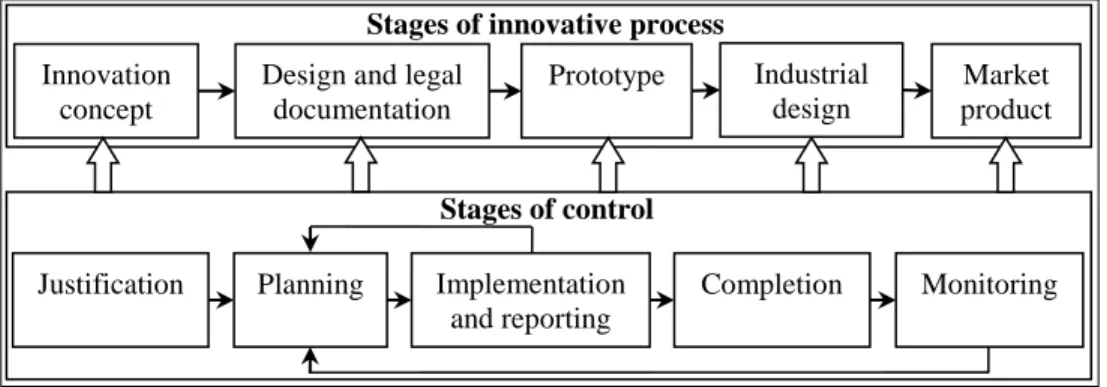
First, let us consider the innovation process as a set of stages of the innovation movement of a novelty from an innovation concept to a market product. In this view, the innovation process consists of the following stages; innovation concept, design and legal documentation, a prototype, an industrial design and a market product. To implement efficiently the stages of the innovation process, it is required to monitor constantly their implementation. In this connection, the control process can consist of five main stages as shown in Figure 1.
Figure 1. Control as a factor of integration of the stages of the innovation process
1) Justification: To integrate the innovative project into the annual investment
program, the innovation project management bodies (project working group and project manager) are formed at the enterprise. The innovation project manager prepares the technical assignment for the project, selecting the feasibility study executive. The completion of the justification stage of the innovation project is the decision of the investment activity body of the enterprise on the approval and the beginning of the implementation of the innovation project.
Design and legal documentation Innovation concept Prototype Market product (service ) Stages of control Planning Justification Implementation and reporting Monitoring Completion Industrial design
2) Planning: The working group and the manager of the innovation project prepare the schedule of works and the financing schedule for the innovation project in the form of a calendar-network schedule. Enters in this stage are: the adjustment of timing and scope of supply of the equipment and materials as the procedures for selecting a counterparty and contracting, changing the terms and amounts of construction, installation work as soon as the design and estimate documentation is ready.
3) Implementation and reporting: Reporting on the implementation of plans for the
implementation of the innovative project is prepared by the manager and the working group, to be submitted to the relevant investment activity body for monitoring the implementation of the innovative project. The current report on the execution of the schedule of work and financing schedule is completed monthly and contains all the necessary economic, legal and technical information.
4) Completion: The innovation project is fully completed upon completion of all
activities and facilities provided for by the approved schedule and design and estimate documentation. The completion date of the innovation project is the end of the hot tests (testing under load). After the completion of the innovation project, the project manager prepares a report on the completion of the innovation project, which contains a comparison of the parameters approved at the stage of justification.
5) Monitoring: The monitoring of the innovation project is carried out from the
beginning of production activity at the investment site (Korableva et al., 2017b). In the monitoring format, the compliance of the actual performance indicators of the investment object with the indicators planned for the justification of the innovation project is checked. The moment of achievement of the payback period is determined by the current execution of the planned indicators of the innovation project, which is defined in the reports every six months.
Innovation activity is an activity with a high level of uncertainty. When we consider the stages of the innovation process and try to control the achievement of the targets, the first task is to control the resources and motivation of the employees. For this purpose, the described stages of the innovation process must be combined with the formal and informal rules for resource management and the motivation of the employees.
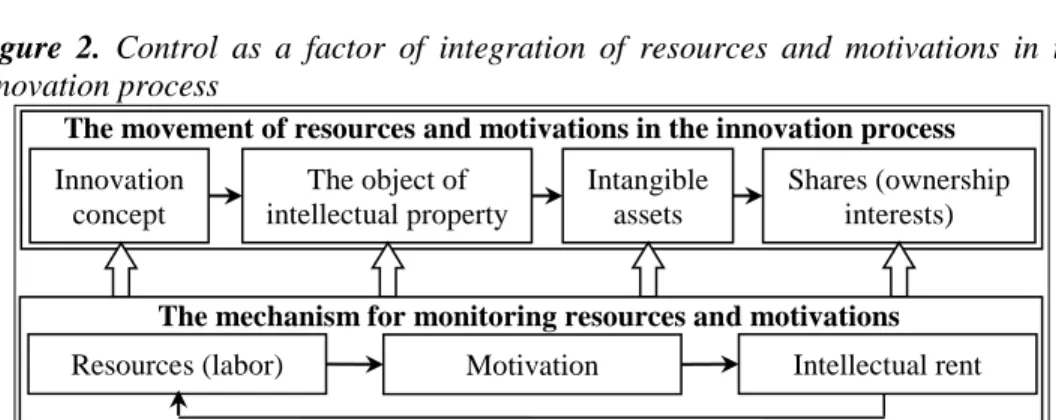
Secondly, let us consider the innovation process as a set of resources and motivations for the participants in the innovation project. According to this view of the innovation process, it is important to invest in resources (labor), provide the necessary motivation and receive the intellectual rent for the owners of the innovation. The owners of the innovation are the participants in the innovation process who invest their resources (labor) in promotion of the innovation to the market and receive, in return, a reward in the form of intellectual rent. At the same time, the investment of resources (labor) at the earlier stages of the innovation process has the highest multiplier of the intellectual rent (McKelvie et al., 2017).
Control must be carried on at the beginning and at the end of each stage. In terms of this presentation, the innovation process consists of the following stages: the concept or knowledge → the object of intellectual property → the intangible assets → the shares as shown in Figure 2.
Figure 2. Control as a factor of integration of resources and motivations in the innovation process
Such an approach transfers the innovation process into a legal, economic and accounting plane. The participants of the innovation process are: the author, the patent owner, the owner of the intangible asset, the shareholder, and the corresponding structures as universities, firms and state institutions of innovation support. In this case, the innovation process develops through the redistribution of private property rights. At the university and enterprise level, the intellectual property objects acquire a valuation, turn into intangible assets and become the main capital of the modern economy in the form of shares or other securities.
This logic shows which private property rights are obtained by each participant in the innovation process, and how the process of investments attraction is carried out to promote the intellectual property and to transform the innovation concept into an intangible asset and a stock of a highly profitable enterprise. This approach makes it possible to control and manage the motivation of participants in the innovation process, to reduce the risks and to attract investments.
Many enterprises try to carry out the innovation activity independently, through auxiliary structures or innovation centers specially created for this purpose. To ensure a mutually beneficial exchange of economic goods and control in the innovation process, the value of the created intangible assets should also be determined.
Currently, all countries have the opportunities for joint participation of universities and enterprises in the innovation process. The innovation activity of the enterprise should be considered as the development and implementation of scientific and technological achievements, the effective use of the enterprise's potential to improve the competitiveness of products and to maximize the profits. It is well known that products and technologies have a limited lifespan (Sapozhkov et al., 2016). Most
Innovation concept The object of intellectual property Intangible assets Shares (ownership interests)
The movement of resources and motivations in the innovation process
Resources (labor) Motivation Intellectual rent
companies pay great attention to the extension of the product life cycle. They are guided by the desire to maximize the return on invested capital. The registration of the property rights makes it possible to reduce the investment risks and to terminate timely the release of obsolete products. The control over the economic and innovation activities also contributes to risk reduction.
The limited product lifetime of goods means that enterprises must effectively organize the sale of manufactured goods at all stages of their life cycle, considering their obsolescence, and develop the new products and expand the range in a timely manner (Korableva et al., 2017a). The achievement of a balance between the improvement of the existing and developing new products is important, but extremely difficult for any enterprise. Therefore, the enterprises should establish a sustainable cooperation with the university, buy jointly the knowledge or exchange the property rights, to promote the integration of scientific developments in production (Kilinc et al., 2018).
Thirdly, let us consider the innovation process as a set of rules and procedures aimed at achieving the goal and requiring constant monitoring. From the point of view of this approach, the system of internal control in the innovation activity of the company consists of the following managed objects; the goal and strategy, the organizational and managerial structure and the functional lines of business, business processes and business operations, the internal documents and standards, risks and information, material and not material resources, personnel and products, financial and other indicators of effectiveness and efficiency. The following can be used as the monitoring approaches; collection and processing of the information, measurement and evaluation, interviewing and consulting, analysis and synthesis, audit, planning, modeling, forecasting, expert examination, standardization. The following can be used as the monitoring methods; reconciliation, verification, benchmarking, SWOT analysis, mathematical methods, observation and examination, communication methods, audit, information methods, inventory (Korableva and Kalimullina, 2016). The following can be used as the standards for monitoring; Russian accounting standards, International Financial Reporting Standards (IFRS), audit standards, COSO IC-IF, ISO 9000, ISO 19011. Because of the organization of the internal control system, the following should be defined at the enterprise; who, what, when, based on what, guided by what, what and how must be controlled.
To date, dozens of methodologies have been developed to build the formalized models of functioning of the enterprise and the concepts of building the management and control systems. The specificity of management information needs the provision of data according to the current requirement – it can be both the information about the workload of an individual object and the progress of a certain production (innovation) process. This consideration is most consistent with the classical matrix structure.
An integrated approach to the automation of the management and control system makes it possible to support all the aspects of managerial activities and subsystems in a single information space. The centralization of data in a single database, close to the real-time mode of operation, and support for geographically distributed structural units of the enterprise are desirable features of an integrated information management and control system.
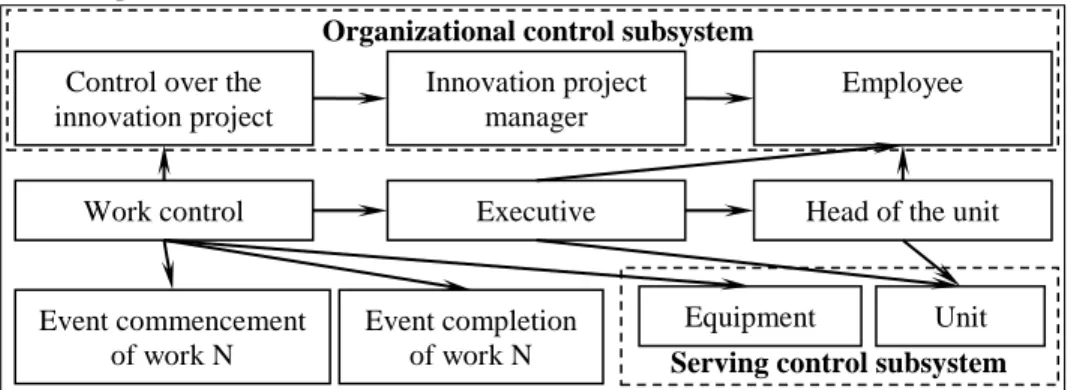
A mathematical apparatus capable of displaying dynamically the matrix relationships among the performers, project managers and department heads is the semantic networks or their more formalized modification, frames. Frame theory makes it possible to create the hierarchical sequences of objects, work with the inheritance of properties from higher-order frames (prototypes) and simultaneously reflect the existing structural relationships. The term "frames" is relatively new in control and management theory. Similar semantic methods began to be applied when classical logic showed its unfitness in practice. The frames, formalizing the knowledge in a form suitable for further processing, retain their significance for the decision-making process. Let us consider the frame model of realization of the innovation project within the framework of the matrix organizational-administrative structure as shown in Figure 3.
Figure 3. Control as the integration factor for the management system components of the enterprise
The central element here is the individual work in terms of implementation of the innovation project stages. Each work corresponds to two frames of the "event" type, in which the information is stored about the planned and actual commencement date and completion date. These data are used for further calculations of the planned and actual duration of work, as well as for their control. Each work determines the employment of certain equipment belonging to a unit. Similarly, the account of performers is made according to their subdivision. Individual, standardized subsystems are responsible for the maintenance of production and for its organization. In the scheme, such prototype frames as the "Innovation project", the "Innovation project manager", the "Work", the "Executive", the "Event", the "Equipment", the "Unit", the "Unit manager" and the "Employee" are used.
Control over the innovation project
Innovation project manager
Employee
Organizational control subsystem
Head of the unit
Work control Executive
Event commencement of work N
Event completion of work N
Equipment Unit
Most enterprises have the sufficient statistics, enabling in the framework of complex analysis to identify and analyze the "bottlenecks", to optimize the overall production scheme. Typically, this is such data as the "planned work duration" and "actual work duration" for individual production units. In this case, if the planned duration is a previously known value, then the actual duration is an initially nondeterministic random variable. Similar work may have similar values of the discrepancies between the actual and planned duration. Forecasting the significance of discrepancies is of practical importance, both for assessment and for monitoring of the actual future work duration and for identification of the bottlenecks in production, and in the long term, justification for making the required managerial decision (Thalassinos et al., 2013).
The results of this research can be a complex automated system of management and control of the innovation projects of the enterprise. This system is based on the frame implementation of the matrix representation of the organizational and managerial structure and modern methods of processing and analyzing the information. This will allow the enterprise to move to a fundamentally new level of internal control of the innovation projects, monitoring the current state of the innovation processes and production system. At the same time, the ability to provide the reporting and analytical data in different sections increases, which can improve the efficiency of both innovation activities and internal control.
4. Discussion
Many scientists have studied the innovation process. The results of the formation of a two-factor approach to decision-making when introducing an innovation product to the market were published (Yusuf et al., 2015). The authors propose to consider the supply and demand factors. The supply factors are the product, the promotion, the location and the price. The demand factors are the mean relative advantage, the compatibility, the complexity, the feasibility and the observation. The authors note that this two-factor approach makes it possible both to satisfy the consumer expectations and to improve the efficiency of industrial innovation strategies. In comparison with this study, the authors suggest using a three-factor approach for decision-making. In this case, such factors are the stages of the innovation process, the interconnection of resources and motivations, the control in the enterprise management system. This approach makes it possible to increase the probability of success of the innovation, gradually moving from stage to stage of the innovation process, allocating the resources, regulating the motivation and exercising control. The results of research on the conditions for the efficiency improvement of the innovation process are known. The need for a deep and systematic analysis of the innovation process, the possibilities for its implementation is justified by the scientists. The objects of analysis should be the innovation projects, business processes, assets and resources. This analysis is carried out in three representations
of the innovation process; by its stages, by the movement of resources and motivations, by procedures and standards of control by the authors herein.
Special attention is paid to labor resources, labor motivations, social levels, formal and informal governance structures. It is noted in the study that the organization of the innovation process depends on the characteristics of the social environment and social relations in the workforce. In the authors' study, the presentation of the innovation process at the level of exchange of resources and regulation of motivations implies the organization of a special social environment.
A separate problem is to study the features of the organization and control of innovation projects of the enterprise in various national economic systems. Particularly noteworthy is the Japanese model of internal control. The Japanese system implies a highly developed control system in the process of innovation development, which has a close relationship with the corporate governance system. All the personnel of the enterprise are involved in the system of internal control from the average executive to the top managers. Special departments and committees are involved in the work on special important issues related to innovation (Giannakopoulou et al., 2016). Japanese legislation provides for the submission of special reports on the introduction of internal control, including the information on innovation activities. The management of the company, when forming the report, evaluates its efficiency and effectiveness of implementation of the innovation projects, reports directly to the Prime Minister of Japan. This report is mandatory audited.
European companies use the information technologies in the implementation of the innovation processes. As scientists note, this allows solving a set of problems. First, the information systems allow organizing free information exchange, which is necessary for the innovation process. Secondly, the information systems make it possible to perform more efficiently the current economic tasks and to monitor the performance of the set indicators. In the authors' study, based on the frame model of the internal control information system, the authors propose to manage the innovation projects effectively. This will solve the whole complex of management problems.
At American enterprises, the systemic approach is actively used to organize the innovation processes. The US innovation support system consists of three elements. First, they are the state organizations responsible for coordinating and financing the research at the early stages. Secondly, they are the scientific organizations that develop the scientific research. Thirdly, they are private enterprises that are the consumers of technology and need the innovations. In the authors' study, such an organization of the innovation process is represented and consists in the exchange of resources and the regulation of motivations for the stages of the promotion of the innovation from the concept to the market with constant monitoring of this promotion.
Russian enterprises show extremely low innovation activity. This is a consequence of the lack of an efficient system of use of the human capital in an innovation economy. Recently, a significant number of governmental programs have been implemented to promote the innovation development of private enterprises (Veselovsky et al., 2017; Havlicel et al., 2013). The authors' study suggests an approach to the multidimensional presentation of the innovation process, which, with the help of modern information systems of internal control, will increase the efficiency of innovation development of Russian enterprises.
5. Findings
The study conducted makes it possible to formulate several findings:
1) The innovation process is a complex socio-economic phenomenon with a high level of uncertainty and market risk. This leads to the complexity of the organization of innovation activities in the enterprise.
2) To solve the problems of innovation development of an enterprise, it is required to explore the innovation process through a multi-level approach.
3) The effectiveness of the management system of the enterprise and of the innovation processes is determined by the quality of management control, promptness and adequacy of response to the identified market and internal changes.
4) To improve the effectiveness of the managerial control of the innovation development of an enterprise, it is advisable to consider various representations of the innovation process; as a set of stages of innovation from an innovation concept to a market product; as a set of resources and motivations of participants in an innovation project; as a set of rules and procedures aimed at achieving the goal and in need of constant monitoring.
5) The innovation process includes such stages as; the innovation concept, the technical and economic-legal documentation, the prototype, the industrial design, and the market product. At the same time, it is important to distinguish the stages of control over the implementation of the innovation project; the justification, the planning, the implementation and reporting, the completion, the monitoring. 6) It is also important to explore the innovation process based on the movement of
resources and the motivations of its participants. The control mechanism in this case should be directed to such stages of the innovation process as; the innovation concept, the object of intellectual property, the intangible assets, the shares (ownership shares). This makes it possible to determine the amount of necessary investment at each stage of the innovation project and to adjust the quantitative and qualitative composition of its participants.
7) The innovation process, which is implemented at the enterprise in terms of the market strategy and traditional indicators of the economic activity, must be constantly monitored. This is achieved through a matrix organizational and managerial structure and automated information system.
8) The automated information system of internal control over the innovation development of an enterprise should be built using the "frame" concept. The frame is a complex concept that includes the parameters of the work, the employee, the unit, the equipment, the manager, who are currently involved at a certain stage of the innovation project, consume certain resources and generate certain motivations. Managing the flow of information in the form of "frames" enables the increase in the efficiency of control over the innovation development of the enterprise.
6. Conclusions
This study makes it possible to reveal the multi-level representation of the innovation process as well as the role and importance of managerial control in it. Through various representations of the innovation process, the authors reduced the uncertainty and market risk of future innovation. The identification of the stages of the innovation process, the stages of its control, the stages of the movement of the resources and motivations, the stages of monitoring of this movement, makes it possible to improve the enterprise management system and its innovation development. The significant reserves for improving the effectiveness of internal control over the innovation development of the enterprise are contained in the automation of the information flows. The automated information system, based on the matrix organizational and management structure and frame representation of knowledge, enables the improvement of the quality of internal control of the company's innovation activity.
Acknowledgements:
The work is performed according to the Russian Government Program of Competitive Growth of Kazan Federal University.
References:
Bibarsov, R.K., Khokholova, I.G., Okladnikova, R.D. 2017. Conceptual Basics and
Mechanism of Innovation Project Management. European Research Studies Journal, 20(2B), 224-235.
Ferraro, G. and Iovanella, A. 2017. Technology transfer in innovation networks: An empirical study of the enterprise europe network. International Journal of Engineering Business Management, 9, DOI:10.1177/1847979017735748. Giannakopoulou, N.E., Thalassinos, I.E. and Stamatopoulos, V.T. 2016. Corporate
governance in shipping: An overview. Maritime Policy and Management, 43(1), 19-38.
Havlíček, K., Thalassinos. I.E. and Berezkinova, L. 2013. Innovation Management and Controlling in SMEs. European Research Studies Journal, 16(4), 57-70, Special Issue on SMEs.
Kilinc, E., Tarman, B. and Aydin, H. 2018. Examining turkish social studies teachers’ beliefs about barriers toTechnology integration. TechTrends, 62(3), 221-223.
Korableva, O.N. and Kalimullina, O.V. 2016. Strategic approach to the optimization of organization based on BSC-SWOT matrix. Paper presented at the 2016 IEEE International Conference on Knowledge Engineering and Applications, ICKEA 2016, 212-215, doi:10.1109/ICKEA.2016.7803021.
Korableva, O.N., Razumova, I.A. and Kalimullina, O.V. 2017a. Research of innovation cycles and the peculiarities associated with the innovations life cycle stages. Paper presented at the Proceedings of the 29th International Business Information Management Association Conference - Education Excellence and Innovation Management through Vision 2020: From Regional Development Sustainability to Global Economic Growth, 1853-1862.
Korableva, O., Kalimullina, O. and Kurbanova, E. 2017b. Building the monitoring systems for complex distributed systems: Problems & solutions. Paper presented at the ICEIS 2017 - Proceedings of the 19th International Conference on Enterprise Information Systems, 2, 221-228.
McKelvie, A., Brattström, A. and Wennberg, K. 2017. How young firms achieve growth: Reconciling the roles of growth motivation and innovative activities. Small Business Economics, 49(2), 273-293, 10.1007/s11187-017-9847-9.
Prodanova, N.A., Smolentsev, V.M., Norkina, A.N., Shukshina, Y.A. and Polyanskaya, O.A. 2017. Formation of system of internal control and features its functioning in the innovative development of industrial enterprises. International Journal of Applied Business and Economic Research, 15(13), 179-189.
Qu, Y., Qu, T. and Wu, Y. 2017. The role of regional formal institutions and foreign direct investment in innovation in chinese enterprises. Asia Pacific Business Review, 23(1), 27-43.
Sapozhkov, S.B., Burakova, E.M., Tesleva, E.P. 2016. Three-stage character of molten metal drop and A hard substrate contact interaction. Paper presented at the IOP
Conference Series: Materials Science and Engineering, 142(1).
Thalassinos, I.E., Hanias, P.M., Curtis, G.P. and Thalassinos, E.J. 2013. Forecasting financial indices: The Baltic Dry Indices. Marine Navigation and Safety of Sea Transportation: STCW, Maritime Education and Training (MET), Human Resources and Crew Manning, Maritime Policy, Logistics and Economic Matters; Code 97318, 283-290, ISBN: 978-113800104-6.
Tsertseil, J.S., Kookueva, V.V., Gryzunova, N.V. and Khashchuluun, C. 2017. Analysis and prospects of infrastructure development of innovation regional clusters in russia through the example of specific economic zones of industrial production and technology innovation types. Journal of Applied Economic Sciences, 12(7), 1896-1905.
Veselovsky, M.Y., Izmailova, M.A., Bogoviz, A.V., Ragulina, Y.V. and Lobova, S.V. 2017. Fostering the engagement of corporate establishments in the innovation-driven development of Russia’s regions. Journal of Applied Economic Sciences, 12(4), 945-959.
Yusuf, M., Xie, J. and Trondsen, T. 2015. Decision process for adoption of innovative products in the european seafood market: The importance of supply and demand factors. Journal of International Food and Agribusiness Marketing, 27(4), 255-272.