Georgia State University
ScholarWorks @ Georgia State University
Public Health Theses School of Public Health
Spring 5-11-2013
Use of Antenatal and Skilled Care During Delivery:
A Systematic Review and Meta-analysis of
Effectiveness of Interventions Implemented in
Developing Countries
Calister Peter Imeda Ms
Institute of Public Health
Follow this and additional works at:https://scholarworks.gsu.edu/iph_theses
This Thesis is brought to you for free and open access by the School of Public Health at ScholarWorks @ Georgia State University. It has been accepted for inclusion in Public Health Theses by an authorized administrator of ScholarWorks @ Georgia State University. For more information, please contact
Recommended Citation
Imeda, Calister Peter Ms, "Use of Antenatal and Skilled Care During Delivery: A Systematic Review and Meta-analysis of Effectiveness of Interventions Implemented in Developing Countries." Thesis, Georgia State University, 2013.
U
SE OF ANTENATAL AND SKILLED CARE DURING DELIVERY:
A
SYSTEMATICREVIEW AND META
-
ANALYSIS OF THE EFFECTIVENESS OF INTERVENTIONSIMPLEMENTED IN DEVELOPING COUNTRIES
.
BY
C
ALISTERP
ETER IMEDAMPH., GEORGIA STATE UNIVERSITY
Thesis Submitted to the Graduate Faculty Of A
Georgia State University in Partial Fulfillment Of the
Requirements for the Degree MASTER OF PUBLIC HEALTH
ATLANTA, GEORGIA 30303
APPROVAL PAGE
U
SE OF ANTENATAL AND SKILLED CARE DURING DELIVERY:
A
SYSTEMATICREVIEW AND META
-
ANALYSIS OF THE EFFECTIVENESS OF INTERVENTIONSIMPLEMENTED IN DEVELOPING COUNTRIES
.
BY
C
ALISTERP
ETER IMEDAApproved:
Dr. Ike Solomon Okosun
_______________________________ Committee Chair Dr. Rodney Lyn ______________________________ Committee Member April 29, 2013
iii
Dedication
I dedicate this thesis to the Almighty God who gave me all the divine helpers in GSU, good health and peace of mind. I also dedicate this thesis to my son Benjamin for being a good boy and study hard which helped me do my studies without worrying much about him.
iv
Table of contents
Dedication ... iii
List of tables ... vi
List of figures ... Error! Bookmark not defined.vii Acknowledgements ... viii Author’s Statement ... ix Curriculum vitae ... xi CHAPTER I ... 1 INTRODUCTION ... 1 1. 1.1 ... Overview ... 1
2. 1.2 ... Statement of the problem and Purpose of the study ... 3 CHAPTER II ... 5 LITERATURE RIVIEW ... 5 3. 2.1 Antenatal care ... 6 4. 2.2 Delivery care ... 9 2.2.1 Socio-cultural beliefs ... 9
2.2.2 Perceptions regarding risks of the condition and benefits of using skilled heath care services. 10 2.2.3 Socioeconomic status and physical accessibility to the health facility ... 10
2.2.4 Quality of care ... 11
CHAPTER III ... 14
METHODOLOGY ... 14
5. 3.1 Search Strategy ... 14
6. 3.2 Types of Outcome/dependent variables ... 14
7. 3.3 Initial selection criteria ... 14
8. 3.4 Criteria for quality assessment ... 15
9. 3.5 Data collection. ... 15
10. 3.6 Data entry and analysis ... 15
v
RESULTS ... 17
11. 4.1 General search results ... 17
12. 4.2 Delivery care services ... 21
4.2.1 General information extracted on delivery services ... 21
4. 2.2 Data presentation and Meta-analysis ... 22
13. 4.3 Antenatal care services ... 29
4.3.1 General information from ANC studies ... 29
4.3.2 Data presentation and meta-analysis. ... 31
14. 4.4 Discussion of results ... 47
CHAPTER V ... 51
Conclusion and recommendations ... 51
15. 5.1 Conclusion ... 51
16. 5.2 Limitations of study ... 51
17. 5.3 Authors recommendations ... 51
vi
List of Tables
Table Page
1. Summary of search terms by database and number of articles ... 17
2. Summary of selected article authors, country of study, study design and reported outcomes of interest ... 19
3. Quality assessment ... 20
4. Summary of author by type of intervention and targeted factor ... 22
5. Summary of extracted data by author. ... 23
6. Summary of authors and type of intervention with a targeted factor ... 31
7. Summaries of authors and reported number of antenatal visits ... 32
8. Data for intervention and control groups on ANC>=1 ... 33
vii
List of Figures
Figure Page
1. The interaction model between factors and level of care delivery affected ... 12
2. Forest plot for the effect sizes and overall effect size for interventions to increase use of delivery services ... 24
3. Funnel plot of standard error by log risk ratios for publication bias of interventions to increase use of delivery services ... 25
4. Forest plot for subgroup analysis with outcome as a moderator variable ... 27
5. Forest plot for subgroup analysis with study design as a moderator variable Summaries of authors and reported number of antenatal visits ... 28
6. Forest plot for subgroup analysis with region of study as a moderator variable ... 29
7. Forest plot for random effect weights for ANC>=1 ... 34
8. Funnel plot of standard error by log risk ratios for publication bias of interventions to increase use of delivery services ... 35
9. Forest plot for subgroup analysis with outcome as a moderator variableData for intervention and control groups on ANC>=1 ... 37
10. Forest plot for subgroup analysis with study design as a moderator variable ... 38
11. Forest plot for subgroup analysis with region of study as a moderator variable ... 39
12. Forest plot for random effect weights for ANC>=4... 43
13. Funnel plot of standard error by log odds ratio for ANC>=4 interventions ... 44
viii
Acknowledgements
I acknowledge my chair Dr. Ike Solomon Okosun, my committee Dr. Rodney Lyn, IPH faculty and staff, Dr. Gordon Warren and the US government through Fulbright scholarship for all the support I needed during my stay and study in Georgia State University and development of this thesis.
ix
Author’s Statement
In presenting this thesis as a partial fulfillment of the requirements for an advanced
degree from Georgia State University, I agree that the Library of the University shall make it available for inspection and circulation in accordance with its regulations governing materials of this type. I agree that permission to quote from, to copy from, or to publish this thesis may be granted by the author or, in his/her absence, by the professor under whose direction it was written, or in his/her absence, by the Associate Dean, College of Health and Human Sciences. Such quoting, copying, or publishing must be solely for scholarly purposes and will not involve potential financial gain. It is understood that any copying from or publication of this dissertation which involves potential financial gain will not be allowed without written permission of the author.
Calister Peter Imeda ______________________ Signature of Author
x
Notice to Borrowers page
All these deposited in the Georgia State University Library must be used in accordance with the stipulations prescribed by the author in the preceding statement.
The author of this thesis is
Student’s Name: Calister Peter Imeda Street Address: Settlers Grove Road
City, state and zip Code: Cumming, GA, 30028 The Chair of the committee for the thesis is: Professors Name: Dr. Ike Solomon Okosun Department: Institute of Public Health College: Health and Human Sciences Georgia State University
P.O.BOX 3995
Atlanta Georgia 30302-3995
Users of this thesis who not regularly enrolled as students at Georgia State University are required to attest acceptance of the preceding stipulation by signing below. Libraries borrowing this thesis for the use of their patrons are required to see that each user records here the
information requested.
Name of user Address date Type of use ( examination only or
xi
Calister Imeda
Curriculum vitae
Permanent Address Current Address National Institute for Medical Research 4430 Settlers Grove Road
P.O.BOX 9653 Cumming, GA, 30028 Dar Es Salaam
Tanzania Phone: 404-396 8115
Email: [email protected]
Current Position
Research Scientist National Institute for Medical Research-Tanzania
Supervisor: Dr. Malebo, H Academic Preparation MPH 2013 Georgia State University
(Expected) Specialty Track: Health Promotion
Thesis: Use of antenatal care and skilled care during delivery: A
systematic review and meta-analysis of the effectiveness of interventions implemented in developing countries.
M.A. 2012 University of Dar Es salaam
Dissertation: Social-Cultural and Demographic effects on the use of
maternal health services in Bariadi district
Major: Demography
BSc. 2000 University of Dar Es Salaam, Tanzania Majors: Mathematics, Chemistry, Education
Publications
Mhame, p.p.,Nyigo,V.A., Mbogo,G.P., Wiketye,V.E., Kimaro,G.,Mdemu,A., Ogondiek,J.W.,
Imeda,C.P., Katani,S.J., Sunguruma,R., Kitufe.N.A. (2005) Determination of safety of
MUHANSE M4® a traditional herbal preparation used to treat HIV/AIDS-related conditions and diseases in Tanzania. Tanzania Health Research Bulletin 7 (3) 168
Hamisi M Malebo, Calister Imeda, Nteghenjwa A Kitufe, Shaaban J Katani, Richard
Sunguruma, Frank Magogo, Patrick K Tungu, Vitus A Nyigo, Victor Wiketye, George L Mwaiko, John W Ogondiek, Gloria P Mbogo, Paulo P Mhame, Daniel Z Matata, Robert Malima, Stephen M Magesa, Julius J Massaga, Mwelecele N Malecela, Andrew Y Kitua (2013) .
Repellence effectiveness of essential oils from some Tanzanian Ocimum and Hyptis plant species
against afro-tropical vectors of malaria and lymphatic filariasis. Journal of Medicinal Plants
Research Vol. 7(11), pp. 653-660
Skills
Language: English, Swahili
xii
ABSTRACT Background
Complications due to pregnancy and child bearing are among the leading causes of death and disability among women of child bearing age in developing countries. Maternal Mortality Rate (MMR) is still high in most developing countries even though there is an overall decrease in MMR worldwide. In 2010 MMR in developing countries was 15 times that of developed countries. Skilled antenatal care (ANC) and care during delivery are indispensably important in the reduction of MMR. Interventions to increase use of maternal care have been implemented in different countries however there is a need for a meta-analysis to ascertain the effectiveness of these interventions so as to have evidence for scale up.
Purpose
The objective of this study was to conduct a systematic review and meta-analysis of the effectiveness of interventions implemented in developing countries to improve use of antenatal services and skilled care during delivery.
Methods
Interventions were identified from MEDLINE, PAIS INTERNATIONALA and GLOBAL HEALTH databases. Searches were done between December 2012 and January 2013. No restrictions were put on study date, design, or language of publication. Abstracts reporting results of interventions regarding use of maternal health care in developing countries were examined and data was extracted for meta-analysis. Effect sizes (ES) were calculated as odds ratios. Random effects model was used for meta-analysis.
Main results
A total of 1960 articles were retrieved from Medline and Global Health data bases. Final selection of articles with relevant outcomes and reported data that could be extracted for meta-analysis was 12 articles for delivery care and 13 articles for antenatal care. Articles were published between 1993 to 2012. Results for delivery and antenatal care interventions show that the overall effect size was significant; 2.406 (95% CI 1.847 - 3.135), P-value <=0.001 and 2.548 (95% CI 1.207-5.382), P=0.014 respectively. However heterogeneity between studies was found to be significantly high for both delivery and antenatal care with Q= 285.361, I-square = 96.145 P<=0.001 and Q = 659.426, P<001, I-square=98.635
respectively. Subgroup analysis was performed with moderator variables such as study
design, types of outcomes and region of study. Results show that there was no evidence of these variables to have contributed to the observed high heterogeneity.
Conclusion
Interventions implemented to improve use of maternal services such as ANC and services during delivery were significantly effective in improving uptake of such services, however heterogeneity between studies was found to be substantially high and subgroup analysis with selected moderator variables did not show the evidence of such variables to have contributed to the observed heterogeneity.
1
CHAPTER I
INTRODUCTION
1.1Overview
Complications due to pregnancy and child bearing are among the leading causes of death and disability among women of child bearing age in developing countries (WHO, 2012). It is estimated that for every maternal death occurring, there are 20 other women getting disabilities due to pregnancy and childbirth complications (UNFPA, 2010). The fifth Millennium Development Goal (MDG5) aims at improving maternal health with the targets of reducing Maternal Mortality Ratio (MMR) by 75% of 2009 rate by 2015 and achieving universal access to reproductive health services (UN, 2011).
MMR is still high in most developing countries even though there is an overall decrease in MMR worldwide. It is estimated that in 2010 MMR in developing countries was 15 times that of developed countries. Eighty five percent of the global burden of all maternal deaths occurs in Sub-Saharan Africa and Southern Asia. The lifetime risk of maternal death in developing countries is 1/150 whereas that of developed countries is 1/3800 (WHO, UNICEF, UNFPA, World Bank, 2012). During the period 1990 to 2008 Southern Asia made a progress of 53% reduction in MMR while Sub-Saharan Africa made a progress of only
26% reduction (UN, 2011). Most maternal deaths are due to obstetric hemorrhage during
delivery or just after delivery, sepsis as well as complications of unsafe abortion. Other causes are indirect causes such as malaria and HIV.
Maternal deaths due to these complications are avoidable by presence and attendance of trained health-care workers before, during and after delivery where a skilled health worker can administer interventions to prevent and manage those complications (UN, 2011). There is
2
a disparity in attendance to child birth among developing and developed countries. On average, only 65% of child births were attended by skilled personnel in 2009 in developing countries as compared to 99% in developed countries. Sub-Saharan Africa and Asia who bear the biggest burden of maternal deaths had 46% and 50% respectively (UN, 2011).
Skilled health care attendance during pregnancy (antenatal care) is indispensably important because conditions which complicate pregnancy and child birth can be detected and managed. However in developing countries antenatal care is still low; only 51% of pregnant women attend the recommended four visits or more. Sub-Saharan Africa and Southern Asia, the proportion of women who receive the recommended skilled attendance of four visits or
more during pregnancy is only 43% and 26% respectively (UN, 2011).
Apart from skilled attendance during pregnancy and at birth, the MDG5 insists on reaching adolescents with the aim of reducing adolescent pregnancies. Childbearing at young age (15-19 years) increases the risks of pregnancy and birth complications which subsequently increases the likelihood of deaths. Again Sub-Saharan African has the highest birth rates among adolescents (122 per 1,000 births) which is high above the average for developing countries (54 per 1,000 births) (UN, 2011).
Another area of concern in the question of improving maternal health is the use of contraceptives and child birth control. Reducing the risk of having unintended or closely spaced pregnancies can be achieved by having access to and use of safe contraception methods which in turn improves maternal and infant health (UN.2011).
3
1.2Statement of the problem and Purpose of the study
Use of antenatal care and skilled care during delivery has remained unacceptably low in most developing countries. It is estimated that in 2009 only 51% of pregnant women in developing countries attended the recommend antenatal visits and only 65 % of child births were attended by a skilled personnel. This situation has led into low reduction of maternal mortality. Only three years away from the target, most developing countries have not achieved the goal of reducing maternal mortality by 75% of 2009 rates and having universal access to maternal services. It is estimated that only fifty countries are in progress while 25 countries are either making insufficient progress or are not making any progress and if no accelerated interventions are put in place these countries are likely to miss the MDG5 target
(UN, 2011;WHO, UNICEF, UNFPA, World Bank, 2012). Several intervention studies have
been implemented in developing countries with the aim of increasing use of maternal services in the areas of ANC and care during delivery but their effectiveness in increasing use of such services is less known. Meta-analysis on these interventions is important so as to ascertain the effectiveness and variations of these studies so as to have a base for scale up.
Goal
The goal of this study is to conduct a systematic review and analysis of the effectiveness of interventions implemented in developing countries to improve the use of antenatal services and skilled care during delivery.
4 Objectives
1. To conduct a systematic review and analysis on the effectiveness of interventions
implemented in developing countries to increase use of antenatal care (ANC) services.
2. To conduct a systematic review and analysis of effectiveness of interventions
5
CHAPTER II
LITERATURE RIVIEW
“Maternal death is the death of a woman while pregnant or within 42 days of termination of pregnancy, irrespective of the duration and site of the pregnancy, from any cause related to or aggravated by the pregnancy or its management but not from accidental or incidental causes”(WHO. 2012).
Maternal services are all services given to a woman during pregnancy, during delivery, immediately after giving birth and contraception methods. Being a leading cause of death and disability among women of child bearing age in developing countries, maternal complications could be greatly reduced by increased use of maternal services and reduction of adolescent pregnancy (UNFPA. 2010). This has been shown by examples of developing countries which have significantly reduced maternal mortality. These countries are Egypt, which decreased maternal mortality from 174 to 45 women per 100,000 within the period between 1990 and 2008; Jordan decreased from 150 to 38 women per 100,000 during the same period. These changes occurred due to the large contribution of increased skilled attendance during delivery, increased use of recommended antenatal visits and use of modern contraceptive methods (UNFPA. 2010). Use of maternal health care services in developing countries varies within and between countries. These differences are due to variations in individual factors, residential location, and economic differences. Individual factors such as age, education of a woman and parity have shown to influence location of delivery where younger women are found to opt for skilled care attendance compared to older women. More educated women tend to seek more skilled care than less educated women. Location of residence has shown to act in favor of urban located women as compared to rural women. Economic differences are also found to favor those in higher social
6
economic status than those in lower social economic. Women with higher parity tend to use less maternal service compared to women with lower parity probably due to perceived experience. (Say and Raine, 2007). Other factors affecting use of maternal health services are education of the husband, marital status, media exposure, cultural beliefs and history of obstetric complications (Simkhada et al, 2008). Simkhada and others found that availability of services alone does not guarantee use of the service and instead the overall economic, social and political interactions of a woman needs to be explored while considering interventions to increase use of maternal services (Simkhada et al, 2008).
2.1 Antenatal care
Antenatal care services include tetanus immunization, syphilis screening and treatment, malaria prophylaxis, HIV information and testing, nutrition education and management and monitoring of possible complications (Mrisho et al, 2009 and Shah & Say, 2007).Use of antenatal services has been linked to increased use of skilled attendance during delivery. Bloom and others (1999) found that women who used antenatal care are more likely to opt for skilled attendance during delivery and subsequently reduce maternal mortality.
Despite its importance, antenatal care has remained low in most developing countries where on average only 51% of pregnant women attend the recommended four visits or more for pregnant women with no complications. Sub-Saharan Africa and Southern Asia, the proportion of women who receive the recommended skilled attendance of four visits or more during pregnancy is only
7
Factors affecting use of antenatal clinic services for maternal services in general vary between
and within countries.One factor may be a determining factor for using or not using the services
in one country while the same factor may not be the case in another country or another region within the country. These factors are availability, accessibility, affordability, characteristics of healthcare services, women’s position in the household and society as well as knowledge, attitudes, culture and beliefs (Simkhada et al, 2008).
Availability and accessibility of antenatal services is associated with the use of the service. Women who live a short distance from the health facility offering antenatal services are more likely to use the service compared to women who live in the settings with no service close to them. Opening time and waiting time to receive services is also associated with use. (Simkhada et al. 2008, Chowdhury et al. 2003, Magadi et al. 2000). Inconsistence has been found between studies regarding place of residence , for example a study done in Ethiopia shows that, women who lived in urban areas were more likely to use antenatal services (Mekonnen & Mekonnen 2003) while another study done in India shows that, women who lived in urban areas were less likely to use antenatal services than the rural residents (Navaneetham & Dharmalington 2002).
Another factor that affects use of antenatal services is affordability. Financial difficulties are found to hinder use of services. Women who could afford transport costs and required laboratory tests are more likely to use the services as compared to those who cannot afford (Simkhada et al.2008).
Characteristic of Health care services also affects use of antenatal care where health insurance coverage may affect positively use of services. Poor quality of care and poor relationship
8
between care providers has a negative effect on the use of service; this was found to be the case in Zimbabwe (Simkhada et al. 2008).
Women’s position in the household is another factor that may affect the decision on use or non-use of services. Women who are more independent are more likely to non-use services as compared to those who depend entirely on their husbands or other members of the family to decide. Studies done in India and Nepal found that women’s autonomy was highly related to use or nonuse of services (Pallikadavath et al. 2004, Matsumura & Gubhaju, 2001). Social support also influences use of care; for example a woman with a mother in-law who does not consider antenatal care as necessary is more likely to be discouraged to attend antenatal clinic (Chowdhury et al. 2004). Husbands’ refusal was also found to be a major reason for not seeking care in Nigeria (Adam &Salihu, 2002).
Women’s knowledge, attitude, beliefs and culture also affect use of antenatal clinic. Women with higher level of media exposure, family planning knowledge and nutritional knowledge are more likely to use antenatal clinic than their counter parts (Simkhada et al. 2008). Perception concerning the importance of antenatal services also was found to affect use of services in India where pregnancy is regarded as a natural process and care is necessary only when a problem arises (Griffith &Stephenson 2001). The same case was found in South Africa where women did not see the necessity of attending antenatal clinic at early stage if they had no problems in their previous pregnancies, instead they sought service at a late stage of their pregnancy while perception of the risks associated with obstetric complications is associated with increased use of antenatal services (Myer & Harrison, 2003). Perception of the risks associated with obstetric complications is associated with increased use of antenatal services. Fear of witchcraft and fear of testing for HIV were also reasons for not attending antenatal clinic in Zimbabwe (Mathole et
9
al. 2004). A woman’s experience in the previous pregnancy also affects use of antenatal services for the current pregnancy where if a woman experienced fetal loss in the previous pregnancy she is likely to attend clinic earlier than if she had no complications ( Matthews et al 2001, Simkhada et al. 2008).
2.2 Delivery care
The International Conference on Population and Development (ICPD) aims at having at least 90% of deliveries (births) attended by skilled health care providers by 2015 as a strategy in reducing maternal mortality (UNFPA, 2008). However, in 2009 about 6 years away to 2015, on average only 65% of child births were attended by skilled personnel in developing countries as compared to 99% in developed countries. Sub-Saharan Africa and Asia who bear the biggest burden of maternal deaths had 46% and 50% respectively of births attended by skilled personnel (UN, 2011).
Factors affecting use of maternal health services can be categorized into groups such as (i)
Socio-cultural(ii) Perceptions regarding risks of the condition and benefits of using skilled heath
care services (iii) Socioeconomic status and physical accessibility to the health facility (iv) Quality of care. The interaction between these factors is complex since there are different levels that are affected concerning service uptake and more than one factor may interact to affect one level (Thaddeus &Maine, 1994 and Gabrysch & Campbell.2009).
2.2.1 Socio-cultural beliefs
Decision to seek skilled care may be affected by the community’s belief on the cause of the problem as defined by the society which does not necessarily agree with biomedical definitions. Societal perception may agree with experts or biomedical definitions on the risk of the condition but not on the causes of the condition; for example supernatural linkage to causes
10
of the conditions is frequently cited as a reason not to seek skilled care attention. Prolonged labor for example is considered to be associated with infidelity in some cultures thus skilled care is not required but traditional rituals which need to be performed by the woman’s husband will help her deliver safely (Kowalewski et al. 2000, Thaddeus and Maine, 1994).
2.2.2 Perceptions regarding risks of the condition and benefits of using skilled heath care services.
Perception of the characteristic of the disease/illness by an individual affects their decision to seek care. Before a person decides to seek care they need to recognize that there is a condition which needs skilled care attention; this is not an exception for obstetric conditions (Thaddeus & Maine.1994). In most societies pregnancy and delivery have been regarded as natural conditions which do not require skilled care unless abnormal conditions or complications occur (Thaddeus & Maine, 1994). Moreover most women in developing countries do not have a broad understanding of danger signs and symptoms which could eventually help them make decision to seek care. A study done in Senegal found that one quarter of the interviewed women cold not mention even one symptom which could be regarded as a danger sign and some women claimed that fever, dizziness and pallor were normal pregnancy signs (Dia et al 1989). Another study done in Benin found that labor pains that last for up to twenty four hours are regarded as normal and do not require skilled care attention ( Sargent, 1998).
2.2.3 Socioeconomic status and physical accessibility to the health facility
Distance from the facility, lack of reliable transport and costs associated with transport are barriers to reaching the facility on time. Most rural areas in developing countries do not have reliable roads and most people do not own private care which could take them to the health facility on time. Public transport may not be available during emergencies and if found and hired, it will be more expensive to compensate running costs with only one or a few passengers.
11
This leads to women walking long distances seeking for care. The journey may take several minutes to hours to reach the facility. This situation discourages women from seeking skilled care unless complications arise, and even if a woman decides to seek care she might not reach the facility on time (Kandeh et al.1997, Thaddeus & Maine. 1994).
2.2.4 Quality of care
Quality of care is found to surpass concerns about physical accessibility or distance to the facility. The decision to seek care can be greatly affected by the quality of care they receive in the facility and the experiences they have had or people close to them. A facility with inadequate trained staff, inadequate drugs and supplies, poor record keeping, poor hygiene, bad attitude of care givers and long waiting time were found to affect the motivation to use skilled care services (Kandeh et al. 1997, Thaddeus & Maine. 1994). Thaddeus and Maine (1994) found that quality of care was a more important factor for decision to seek care as compared to costs of transport as well as costs of services in Nigeria and Ethiopia. A study done in Tajikistan revealed that women prefer to deliver at home although health facilities are accessible and with no cost for services because health facilities are considered to be of low quality and not safe ( Say & Raine,2007)
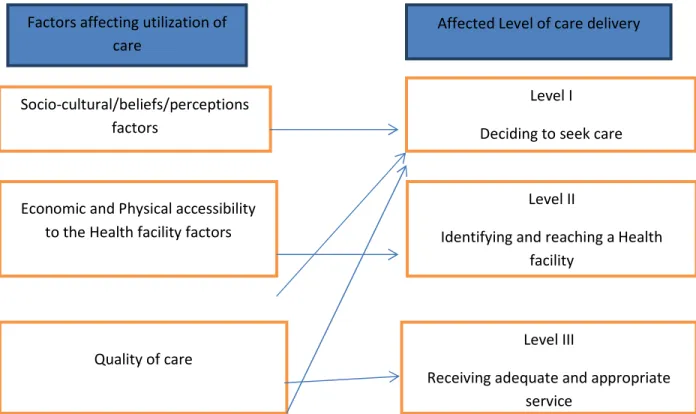
A summary of the interaction between socio-cultural/beliefs/perceptions, economic, physical accessibility and quality of care with the levels of care delivery are presented in figure one below.
12
Fig 1: The interaction model between factors and level of care delivery affected (Adopted from Thaddeus &Maine and modified
Summary of literature review
Despite its importance in reducing maternal mortality use of antenatal care and skilled care during delivery has remained unsatisfactorily low in developing countries. WHO recommends four or more antenatal visits for women with no complications but on average only 51% of pregnant women attend the recommended visits. Sub-Saharan Africa and Southern Asia, the proportion of women who receive the recommended skilled attendance of four visits or more
during pregnancy is only 43% and 26% respectively (UN, 2011). The International Conference
on Population and Development (ICPD) aims at having at least 90% of deliveries (births) attended by skilled health care providers by 2015 as a strategy in reducing maternal mortality (UNFPA, 2008). However, only 65% of child births were attended by skilled personnel in developing countries as compared to 99% in developed countries. Sub-Saharan Africa and Asia
Factors affecting utilization of care
Affected Level of care delivery
Socio-cultural/beliefs/perceptions factors
Level I Deciding to seek care
Economic and Physical accessibility to the Health facility factors
Quality of care
Level II
Identifying and reaching a Health facility
Level III
Receiving adequate and appropriate service
13
who bear the biggest burden of maternal deaths had 46% and 50% respectively of births attended by skilled personnel (UN, 2011).
Factors affecting use of antenatal care and skilled care during delivery can be divided into socio-economic factors, physical accessibility of the health facilities, socio-cultural factors and quality of care available in the health facilities. To address this situation there is a need for evidence based interventions to accelerate use of services so as to reduce the existing higher rates of maternal mortality in developing countries. Several interventions to increase use of maternal services have been implemented in developing countries. However the evidence of effectiveness of these interventions is not known as there has been none or little evidence through systematic review and meta- analysis to ascertain the effectiveness of these studies.
This study will add knowledge on which interventions are effective in increasing use of antenatal care and skilled care during delivery. It will also add knowledge on the variations of effectiveness between different strategies and study designs used in different intervention studies.
14 CHAPTER III
METHODOLOGY
3.1 Search Strategy
Systematic review was done in Medline, PAIS International Global Health using search terms
pairing the aspects of intervention and services, with delivery or natal, antenatal or prenatal and use or utilization. Below is a full list of search terms as they were paired during electronic search.
1. Intervention AND delivery AND services AND use
2. Intervention AND delivery AND services AND Utilization
3. Intervention AND antenatal AND services AND use
4. Intervention AND antenatal AND services AND utilization
5. Intervention AND prenatal AND services AND use
6. Intervention AND prenatal AND services AND Utilization
3.2 Types of Outcome/dependent variables
Primary outcome variables for this study are attendance to antenatal care services, and
institutionalized care during delivery or attendance to skilled care during delivery.
3.3 Initial selection criteria
Intervention studies or evaluation of intervention studies which were done to increase use of maternal services in general were included for further screening. Restriction was done on studies done in developing countries only. There was no restriction on the year of publication or year of study. Only articles from peer reviewed journals were included in this study. There was no restriction on the language of publication although no articles published in other languages were retrieved by the search terms used.
15
3.4 Criteria for quality assessment
Quality of selected studies with outcomes of interest was done by considering the following criteria.
• Was the purpose stated clearly?
• Was relevant background literature reviewed?
• Was the sample described in detail
• Was there randomization of selection of participants
• Were results reported in terms of statistical significance?
• Were the conclusions appropriate considering study methods and results
3.5 Data collection.
One author did screening of retrieved articles. Searches were done in December 2012, January and February 2013. Titles and abstracts were screened to include only interventions studies or evaluation of interventions implemented to increase use of maternal services. Articles with available full articles were retrieved and selected for further analysis. Further analysis examined specifically reporting of variables of interest such as use of antenatal and delivery care.
3.6 Data entry and analysis
Data extracted from the articles was then recorded on Excel 2010 for further analysis. Extracted data included Data analysis was performed by using Comprehensive Meta-analysis software (CMA version 2). Analysis was performed with random effects model due to the fact that studies were conducted at different countries, researchers, study designs and different strategies. Data extracted and recorded on excel for further analysis were;
16 • Authors • Year of publication • Number of participants • Country of study • Study design • Outcomes • Type of intervention
• Data on the effect of the intervention ( odds ratios or data from which odds ratios could
17 CHAPTER IV
RESULTS
4.1 General search results
A total of 1960 articles were retrieved from Medline Global Health and PAIS International databases using a combination of search terms as listed below.
Table1 Summary of search terms by database and number of articles
Database Search terms
Number of articles found
Medline Intervention AND delivery AND services AND use 465
Intervention AND delivery AND services AND Utilization 181
Intervention AND antenatal AND services AND use 68
Intervention AND antenatal AND services AND utilization 35
Intervention AND prenatal AND services AND use 112
Intervention AND prenatal AND services AND Utilization 66
Global
Health Intervention AND delivery AND services AND use 490
Intervention AND delivery AND services AND Utilization 161
Intervention AND antenatal AND services AND use 137
Intervention AND antenatal AND services AND utilization 61
Intervention AND prenatal AND services AND use 80
Intervention AND prenatal AND services AND Utilization 33
PAIS
International Intervention AND delivery AND services AND use 38
Intervention AND delivery AND services AND Utilization 10
Intervention AND antenatal AND services AND use 8
Intervention AND antenatal AND services AND utilization 5
Intervention AND prenatal AND services AND use 5
18
Additional searches with search terms “Intervention AND natal AND services AND use” As well as “Intervention AND natal AND services AND utilization” did not yield any additional results. Searches with the same terms in the Web of Knowledge database did not yield any results.
A total number of articles with relevant initial selection criteria were 22 articles of which three articles reported delivery without ANC, three article reported ANC only and 16 articles reported both ANC and delivery services.
Final selection of articles with relevant outcomes and reported data that could be extracted for meta-analysis excluded 6 articles which resulted in 16 articles.
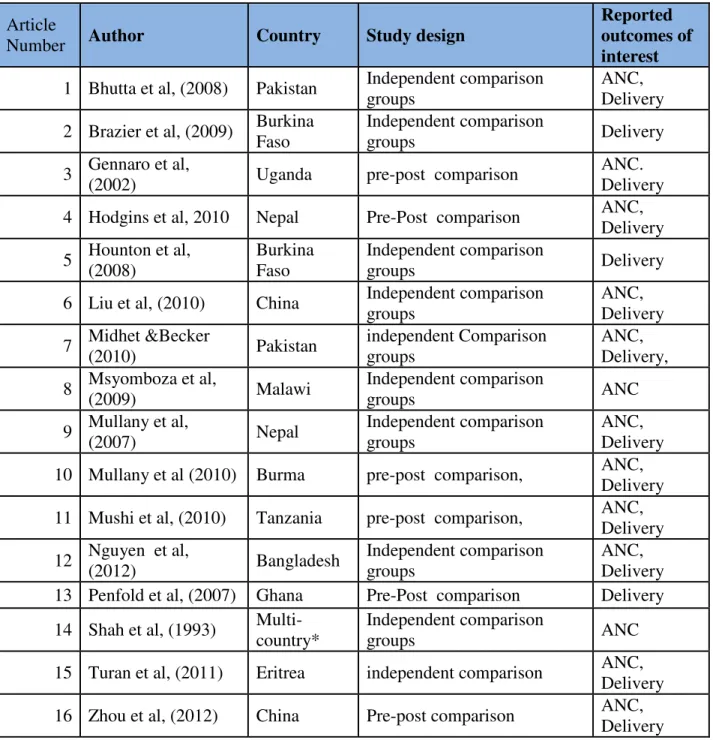
Table 2 below summarizes the selected articles with authors, study country, and reported outcomes of interest.
19
Table 2: Summary of selected article authors, country of study, study design and reported
outcomes of interest.
Article
Number Author Country Study design
Reported outcomes of interest
1 Bhutta et al, (2008) Pakistan Independent comparison
groups
ANC, Delivery
2 Brazier et al, (2009) Burkina
Faso
Independent comparison
groups Delivery
3 Gennaro et al,
(2002) Uganda pre-post comparison
ANC. Delivery
4 Hodgins et al, 2010 Nepal Pre-Post comparison ANC,
Delivery 5 Hounton et al, (2008) Burkina Faso Independent comparison groups Delivery
6 Liu et al, (2010) China Independent comparison
groups ANC, Delivery 7 Midhet &Becker (2010) Pakistan independent Comparison groups ANC, Delivery, 8 Msyomboza et al, (2009) Malawi Independent comparison groups ANC 9 Mullany et al, (2007) Nepal Independent comparison groups ANC, Delivery
10 Mullany et al (2010) Burma pre-post comparison, ANC,
Delivery
11 Mushi et al, (2010) Tanzania pre-post comparison, ANC,
Delivery 12 Nguyen et al, (2012) Bangladesh Independent comparison groups ANC, Delivery
13 Penfold et al, (2007) Ghana Pre-Post comparison Delivery
14 Shah et al, (1993)
Multi-country*
Independent comparison
groups ANC
15 Turan et al, (2011) Eritrea independent comparison ANC,
Delivery
16 Zhou et al, (2012) China Pre-post comparison ANC,
Delivery
20 Table 3 Quality assessment
Author Purpose clearly stated relevant backgroun d and literature reviewed sample size describe d randomizatio n of participants results reported in statistical significanc e conclusion appropriat e as per results study design Bhutta et al, (2008)
yes yes yes no yes yes
compariso n groups
Brazier et al, (2009)
yes yes yes no yes yes
compariso n groups
Gennaro et al, (2002)
yes yes yes no yes yes
pre-post compariso n
Hodgins et al, 2010
yes yes yes no yes yes
pre-post compariso n
Hounton et al,
(2008) yes yes yes no yes yes
compariso n groups
Liu et al, (2010)
yes yes yes yes yes yes
compariso n groups
Midhet &Becker
(2010) yes yes yes yes yes yes
compariso n groups
Msyomboza et
al,(2009) yes yes yes no yes yes
compariso n groups
Mullany et al, (2007)
yes yes yes yes yes yes
compariso n groups
Mullany et al (2010)
es yes yes no yes yes
pre-post compariso n
Mushi et al, (2010)
es yes yes no yes yes pre-post comparison
Nguyen et al,
(2012) es yes yes no yes yes comparison groups
Penfold et al, (2007)
es yes yes yes yes yes
pre-post compariso n
Shah et al, (1993)
es yes yes no yes yes
compariso n groups
Turan et al, (2011)
yes yes yes no yes yes
compariso n groups
Zhou et al, (2012)
es yes yes no yes yes
pre-post compariso n
21 4.2 Delivery care services
4.2.1 General information extracted on delivery services
A total of 14 articles from the final selection were found to have reported delivery care services as the outcome of interest. However 2 articles (Liu eta al, 2010 and Mullany et al. 2010) were excluded in the analysis on the basis of reported data which was either incomplete or reported in the format that could not be extracted for inclusion in Meta-analysis. This resulted into 12 articles from 12 studies which were included for meta-analysis.
Interventions to increase uptake of delivery services were found to fall in one of the four groups;
(i) Education, sensitization and counseling: These interventions targeted to bridge
the gap on socio-cultural factors as well as perceptions regarding risks of the
condition and benefits of using skilled heath care services
(ii) Fee exemption or cost reduction through voucher programs: These programs
aimed at reducing a burden on the costs of services and/or costs of transport to the facility
(iii) Combination of quality of improvement and community sensitization:
Targeted to bridge the gap on quality of care, socio-cultural factors as well as perceptions regarding use of skilled care.
(iv) Combination of fee exemption and community sensitization and/counseling:
These programs aimed at reducing the burden of costs of care and transport to the facility as well as social-cultural factors and perceptions regarding use of skilled care.
22
Table 4: Summary of author by type of intervention and targeted factor
Author and year of publication
Type of intervention and targeted factor that determine use of delivery service
Bhutta et al, (2008) Education, sensitization and/or counseling(social-cultural factors, perceptions)
Brazier et al, (2009) Education, sensitization and/or counseling (social-cultural factors, perceptions)
Gennaro et al, (2002) Education, sensitization and/or counseling (social-cultural factors, perceptions)
Hodgins et al, (2010) Education, sensitization and/or counseling (social-cultural factors, perceptions)
Hounton et al, (2008) Quality improvement, community sensitization
Midhet &Becker
(2010) Education, sensitization and/or counseling (social-cultural factors, perceptions)
Mullany et al (2007) Education, sensitization and/or counseling (social-cultural factors, perceptions)
Mushi et al, (2010) Education, sensitization and/or counseling (social-cultural factors, perceptions)
Nguyen et al, (2012) Fee exemption, cost reduction or voucher program ( socioeconomic factors)
Penfold et al, (2007) Fee exemption, cost reduction or voucher program
Turan et al, (2011) Education, sensitization and/or counseling(social-cultural factors, perceptions)
Zhou et al, (2012) Fee exemption &community sensitization (Both economic and socio-cultural
factors
4. 2.2 Data presentation and Meta-analysis
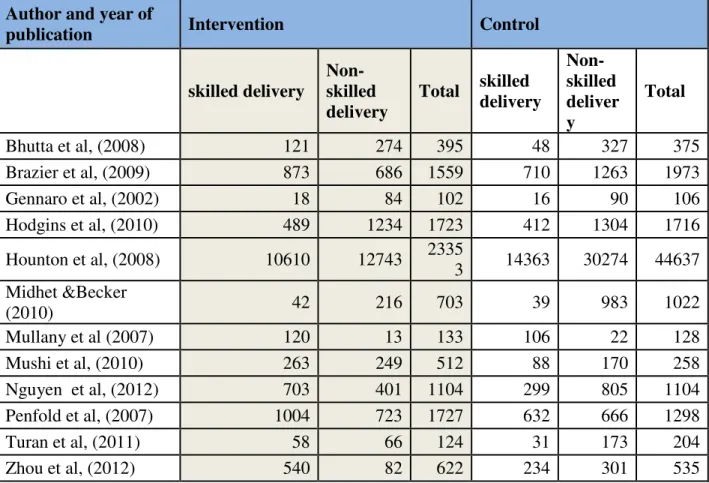
Table 4 summarizes extracted data from the articles as was reported or was calculated from the reported data. The number of women who used skilled care delivery combines those who had institutionalized care delivery and those delivered at home with an assistance of a skilled attendant.
23
Table 5 Summary of extracted data by author
Author and year of
publication Intervention Control
skilled delivery Non-skilled delivery Total skilled delivery Non-skilled deliver y Total Bhutta et al, (2008) 121 274 395 48 327 375 Brazier et al, (2009) 873 686 1559 710 1263 1973 Gennaro et al, (2002) 18 84 102 16 90 106 Hodgins et al, (2010) 489 1234 1723 412 1304 1716 Hounton et al, (2008) 10610 12743 2335 3 14363 30274 44637 Midhet &Becker (2010) 42 216 703 39 983 1022 Mullany et al (2007) 120 13 133 106 22 128 Mushi et al, (2010) 263 249 512 88 170 258 Nguyen et al, (2012) 703 401 1104 299 805 1104 Penfold et al, (2007) 1004 723 1727 632 666 1298 Turan et al, (2011) 58 66 124 31 173 204 Zhou et al, (2012) 540 82 622 234 301 535
Meta-analysis for delivery care data
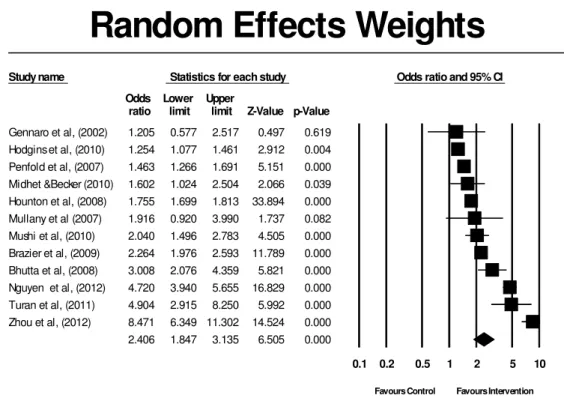
Meta-analysis was performed using a random effects model on the 12 final selected studies. Random effects model was chosen by considering the fact that these studies were implemented in different areas, with different strategies and study designs therefore it was assumed that there will be multiple true effect sizes for this studies. The overall effect size for the 12 studies was found to be 2.406 (95% CI 1.847 to 3.135) and P-value <=0.001. The effect sizes ranged from 1.205 to 8.471. Figure one below represents a forest plot for the random effects model
24 Heterogeneity
Heterogeneity for the effect sizes of 12 studies on use of delivery care services was found to be significantly high with Q=285.361
Degree of freedom (df) = 11 P<0.001, I-square = 96.145
Study name Statistics for each study Odds ratio and 95% CI
Odds Lower Upper
ratio limit limit Z-Value p-Value
Gennaro et al, (2002) 1.205 0.577 2.517 0.497 0.619 Hodgins et al, (2010) 1.254 1.077 1.461 2.912 0.004 Penfold et al, (2007) 1.463 1.266 1.691 5.151 0.000 Midhet &Becker (2010) 1.602 1.024 2.504 2.066 0.039 Hounton et al, (2008) 1.755 1.699 1.813 33.894 0.000 Mullany et al (2007) 1.916 0.920 3.990 1.737 0.082 Mushi et al, (2010) 2.040 1.496 2.783 4.505 0.000 Brazier et al, (2009) 2.264 1.976 2.593 11.789 0.000 Bhutta et al, (2008) 3.008 2.076 4.359 5.821 0.000 Nguyen et al, (2012) 4.720 3.940 5.655 16.829 0.000 Turan et al, (2011) 4.904 2.915 8.250 5.992 0.000 Zhou et al, (2012) 8.471 6.349 11.302 14.524 0.000 2.406 1.847 3.135 6.505 0.000 0.1 0.2 0.5 1 2 5 10
Favours Control Favours Intervention
Random Effects Weights
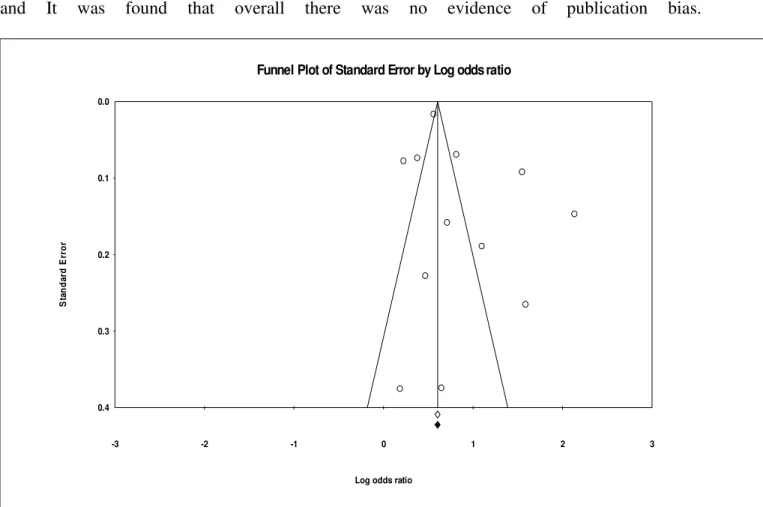
25 Publication Bias:
Assessment of publication bias was done using a combination of funnel plot and Duval and Tweedie’s Trim and fill method. Analysis was done with random effects/random effects option and It was found that overall there was no evidence of publication bias.
Fig: 3 Funnel plot of standard error by log risk ratios.
Subgroup analysis
Having a significantly high heterogeneity, subgroup analysis was performed to check if moderator variables could explain part or all of the observed heterogeneity. The moderator
variables were targeted outcome, study design and region of study. Analysis on type of
-3 -2 -1 0 1 2 3 0.0 0.1 0.2 0.3 0.4 S ta n d a rd E rr o r
Log odds ratio
26
intervention used to increase use of delivery care was not performed due to the fact that some groups did not have enough studies to perform a meaningful subgroup analysis.
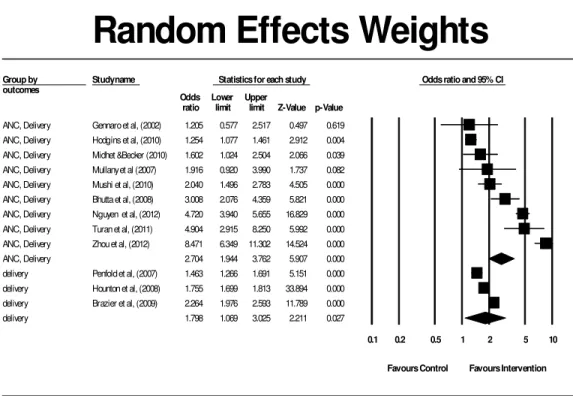
(a) Subgroup analysis with “outcome” as a moderator variable.
Nine studies implemented their interventions with the aim of improving both ANC and Delivery care while 3 studies implemented their interventions with the aim of increasing delivery care only. The two groups were analyzed where the effect sized for the those implemented interventions with the aim of improving both ANC and delivery were found to have slightly higher but not significantly different effect size from those targeted only delivery care.
ANC and delivery interventions had effect size of 2.704 ( 95% CI 1.944 -3.762),
P<=0.001, while that of delivery only had the effect size of 1.798 ( 95% CI 1.06-3.025), P=0.027.
The Q statistic for the difference between the two groups was found to be 1.686 with df=1 and P=0.194
27
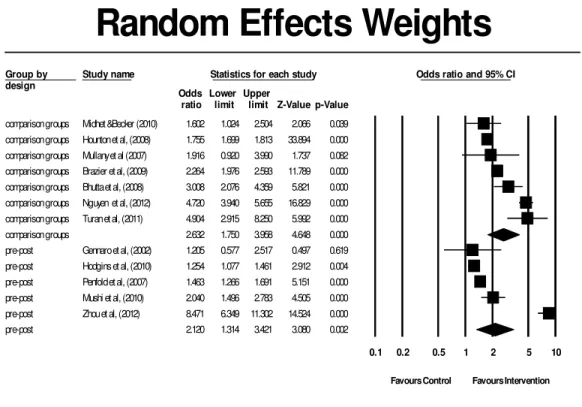
(b)Subgroup analysis for “study design” as a moderator variable
Seven studies implemented their interventions with unmatched comparison groups while five studies used pre-post comparison studies. Unmatched comparison groups’ studies had a slightly higher but not significantly different overall effect size as compared to those with pre-post design studies.
Unmatched comparison groups effect size was 2.632 (95% CI 1.750 -3.958), P<=0.001 while pre-post design studies had the effect size of 2.120 (95% CI 1.314 -3.421), P=0.002.
The Q statistic for the difference between the two groups was 0.454, df= 1 and P=0.501
Group by outcomes
Study name Statistics for each study Odds ratio and 95% CI Odds Lower Upper
ratio limit limit Z-Value p-Value
ANC, Delivery Gennaro et al, (2002) 1.205 0.577 2.517 0.497 0.619 ANC, Delivery Hodgins et al, (2010) 1.254 1.077 1.461 2.912 0.004 ANC, Delivery Midhet &Becker (2010) 1.602 1.024 2.504 2.066 0.039 ANC, Delivery Mullany et al (2007) 1.916 0.920 3.990 1.737 0.082 ANC, Delivery Mushi et al, (2010) 2.040 1.496 2.783 4.505 0.000 ANC, Delivery Bhutta et al, (2008) 3.008 2.076 4.359 5.821 0.000 ANC, Delivery Nguyen et al, (2012) 4.720 3.940 5.655 16.829 0.000 ANC, Delivery Turan et al, (2011) 4.904 2.915 8.250 5.992 0.000 ANC, Delivery Zhou et al, (2012) 8.471 6.349 11.302 14.524 0.000 ANC, Delivery 2.704 1.944 3.762 5.907 0.000 delivery Penfold et al, (2007) 1.463 1.266 1.691 5.151 0.000 delivery Hounton et al, (2008) 1.755 1.699 1.813 33.894 0.000 delivery Brazier et al, (2009) 2.264 1.976 2.593 11.789 0.000 delivery 1.798 1.069 3.025 2.211 0.027
0.1 0.2 0.5 1 2 5 10
Favours Control Favours Intervention
Random Effects Weights
28
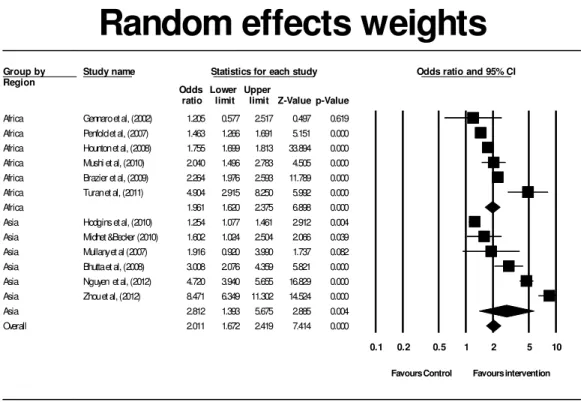
(a) Subgroup analysis for “ region ” as a moderator variable
Six studies were implemented in Africa and six studies were implemented in Asia. Subgroup analysis with region as a moderator variable showed that studies implemented in Asia had slightly higher but not significant effect size as compared to those
implemented in Africa. Intervention studies implemented in Asia had overall effect size 2.812 (95% CI 1.393 – 5.675) while those implemented in Africa had the overall effect size of 1.961 (95%CI 1.620 – 2.375), Q statistic =0.943, P= 0.332.
Group by design
Study name Statistics for each study Odds ratio and 95% CI Odds Lower Upper
ratio limit limit Z-Value p-Value
comparison groups Midhet &Becker (2010) 1.602 1.024 2.504 2.066 0.039
comparison groups Hounton et al, (2008) 1.755 1.699 1.813 33.894 0.000
comparison groups Mullany et al (2007) 1.916 0.920 3.990 1.737 0.082
comparison groups Brazier et al, (2009) 2.264 1.976 2.593 11.789 0.000
comparison groups Bhutta et al, (2008) 3.008 2.076 4.359 5.821 0.000
comparison groups Nguyen et al, (2012) 4.720 3.940 5.655 16.829 0.000
comparison groups Turan et al, (2011) 4.904 2.915 8.250 5.992 0.000
comparison groups 2.632 1.750 3.958 4.648 0.000
pre-post Gennaro et al, (2002) 1.205 0.577 2.517 0.497 0.619
pre-post Hodgins et al, (2010) 1.254 1.077 1.461 2.912 0.004
pre-post Penfold et al, (2007) 1.463 1.266 1.691 5.151 0.000
pre-post Mushi et al, (2010) 2.040 1.496 2.783 4.505 0.000
pre-post Zhou et al, (2012) 8.471 6.349 11.302 14.524 0.000
pre-post 2.120 1.314 3.421 3.080 0.002
0.1 0.2 0.5 1 2 5 10
Favours Control Favours Intervention
Random Effects Weights
29
4.3 Antenatal care services
4.3.1 General information from ANC studies
A total of 13 articles were found to have reported use of ANC services as the outcome of interest. Interventions to increase uptake of ANC services were found to fall in one of the four groups of type of intervention applied.
(v) Education, sensitization and counseling. These interventions targeted to bridge
the gap on Socio-cultural factors as well as perceptions regarding risks of the
condition and benefits of using skilled heath care services
Group by Region
Study name Statistics for each study Odds ratio and 95% CI Odds Lower Upper
ratio limit limit Z-Value p-Value
Africa Gennaro et al, (2002) 1.205 0.577 2.517 0.497 0.619 Africa Penfold et al, (2007) 1.463 1.266 1.691 5.151 0.000 Africa Hounton et al, (2008) 1.755 1.699 1.813 33.894 0.000 Africa Mushi et al, (2010) 2.040 1.496 2.783 4.505 0.000 Africa Brazier et al, (2009) 2.264 1.976 2.593 11.789 0.000 Africa Turan et al, (2011) 4.904 2.915 8.250 5.992 0.000 Africa 1.961 1.620 2.375 6.898 0.000 Asia Hodgins et al, (2010) 1.254 1.077 1.461 2.912 0.004 Asia Midhet &Becker (2010) 1.602 1.024 2.504 2.066 0.039 Asia Mullany et al (2007) 1.916 0.920 3.990 1.737 0.082 Asia Bhutta et al, (2008) 3.008 2.076 4.359 5.821 0.000 Asia Nguyen et al, (2012) 4.720 3.940 5.655 16.829 0.000 Asia Zhou et al, (2012) 8.471 6.349 11.302 14.524 0.000 Asia 2.812 1.393 5.675 2.885 0.004 Overall 2.011 1.672 2.419 7.414 0.000
0.1 0.2 0.5 1 2 5 10
Favours Control Favours intervention
Random effects weights
30
(vi) Fee exemption or cost reduction through voucher programs; These programs
aimed at reducing a burden on the costs of services and/or costs of transport to the facility
(vii) A combination of Education, sensitization, counseling and fee exemption or
cost reduction through voucher programs.
(viii) Combination of quality of improvement and fee exemption or cost
reduction; these programs targeted to bridge the gap on quality of care as well
socioeconomic factors.
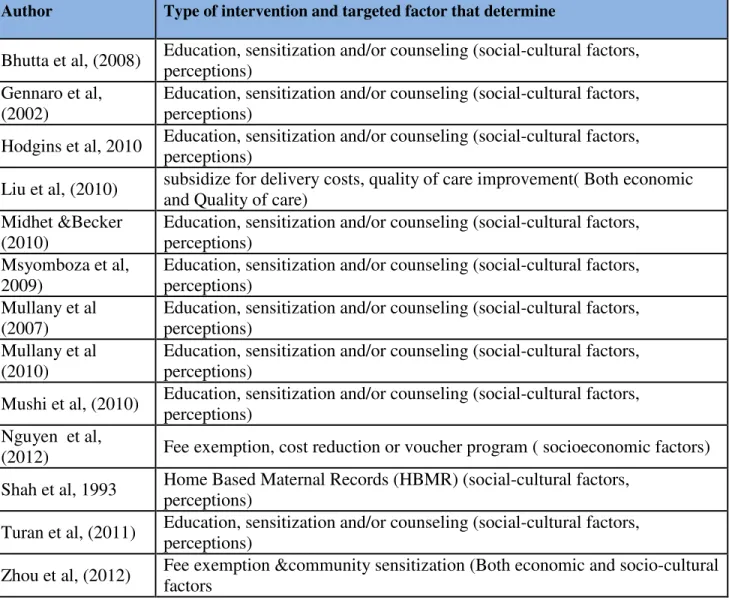
Table 6 gives a summary of selected studies with strategies used to increase use of antenatal care and a targeted factor that determine uptake of care.
31
Table 6 Summary of authors and type of intervention with a targeted factor
Author Type of intervention and targeted factor that determine
Bhutta et al, (2008) Education, sensitization and/or counseling (social-cultural factors,
perceptions) Gennaro et al,
(2002)
Education, sensitization and/or counseling (social-cultural factors, perceptions)
Hodgins et al, 2010 Education, sensitization and/or counseling (social-cultural factors,
perceptions)
Liu et al, (2010) subsidize for delivery costs, quality of care improvement( Both economic
and Quality of care) Midhet &Becker
(2010)
Education, sensitization and/or counseling (social-cultural factors, perceptions)
Msyomboza et al, 2009)
Education, sensitization and/or counseling (social-cultural factors, perceptions)
Mullany et al (2007)
Education, sensitization and/or counseling (social-cultural factors, perceptions)
Mullany et al (2010)
Education, sensitization and/or counseling (social-cultural factors, perceptions)
Mushi et al, (2010) Education, sensitization and/or counseling (social-cultural factors,
perceptions) Nguyen et al,
(2012) Fee exemption, cost reduction or voucher program ( socioeconomic factors)
Shah et al, 1993 Home Based Maternal Records (HBMR) (social-cultural factors,
perceptions)
Turan et al, (2011) Education, sensitization and/or counseling (social-cultural factors,
perceptions)
Zhou et al, (2012) Fee exemption &community sensitization (Both economic and socio-cultural
factors
4.3.2 Data presentation and meta-analysis.
The World Health Organization (WHO) guideline on the recommended number of ANC visits is greater than or equal to four visits, therefore data for ANC was extracted from articles that reported use of ANC >=4, However it was also found that most articles reported uptake of ANC
32
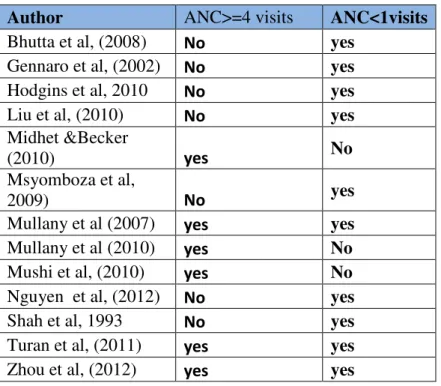
as “ANY” number of visits for ANC ( That is to say any ANC visits >=1) or both. It was found that three articles reported data for both ANC visits >=1 and ANC visits >=4. Three articles reported ANC visits>= 4 only and seven articles reported ANC visits >= 1 only. Table 7 gives a summary of the selected articles and the number of visits reported.
Table 7 summaries of authors and reported number of visits
Author ANC>=4 visits ANC<1visits
Bhutta et al, (2008) No yes
Gennaro et al, (2002) No yes
Hodgins et al, 2010 No yes
Liu et al, (2010) No yes
Midhet &Becker
(2010) yes No
Msyomboza et al,
2009) No yes
Mullany et al (2007) yes yes
Mullany et al (2010) yes No
Mushi et al, (2010) yes No
Nguyen et al, (2012) No yes
Shah et al, 1993 No yes
Turan et al, (2011) yes yes
Zhou et al, (2012) yes yes
Table 8 gives a summary of data on ANC>= 1 from ten articles reported data for ANC>=1 or both ANC>=1 and ANC>=4.
33
Table 8: Data for intervention and control groups on ANC>=1
Study name Intervention Control
ANC >=1 No ANC visits Total ANC>=1 No ANC visit
Total Strategy Study design outcomes
Bhutta et al, (2008) 313 82 395 247 128 375 A* comparison
groups ANC,Delivery
Gennaro et al, (2002) 88 7 95 94 6 100 A* pre-post ANC,Delivery
Hodgins et al, 2010 1554 186 1740 1336 404 1740 A* pre-post ANC,Delivery
Liu et al, (2010) 2991 52 3043 6629 108 6737 BC* comparison
groups ANC
Msyomboza et al,
2009) 586 302 888 831 64 895 A* ANC
Mullany et al (2010) 1099 432 1531 885 1367 2252 A* pre-post ANC,Delivery
Nguyen et al, (2012) 1011 93 1104 835 269 1104 B* comparison
groups ANC,Delivery
Shah et al, ( 1993) 936 216 1152 472 993 1465 A* comparison
groups ANC
Turan et al, (2011) 128 1 129 226 23 249 A* comparison
groups ANC,Delivery
Zhou et al, (2012) 615 7 622 433 121 554 AB* pre-post ANC,Delivery
A*=Education, sensitization and/or counseling (social-cultural factors, perceptions), B*= Fee exemption, cost reduction or voucher program (socioeconomic factors), AB*= Fee exemption &community sensitization (Both economic and socio-cultural factors, BC=subsidize for delivery costs, quality of care improvement (Both economic and Quality of care)
34 Meta-analysis results for ANC visits >=1
Meta-analysis was performed using random effects weights for ten studies which reported ANC>=1 as the outcome variable. Articles which reported both ANC>=1 and ANC>=4, data for ANC>=1 was taken for this analysis.
Results from a random effects model shows that the overall effect size is 2.548 ( 95%CI 1.207-5.382), P=0.014. The overall effect size ranged from 0.149 to 24.552. Fig 7 below shows a forest plot for the random effect weights on the 10 studies.
Study name Statistics for each study Odds ratio and 95% CI
Odds Lower Upper
ratio limit limit Z-Value p-Value
Msyomboza et al, 2009) 0.149 0.112 0.200 -12.861 0.000 Gennaro et al, (2002) 0.802 0.260 2.480 -0.382 0.702 Liu et al, (2010) 0.937 0.671 1.308 -0.382 0.703 Bhutta et al, (2008) 1.978 1.431 2.734 4.132 0.000 Hodgins et al, 2010 2.526 2.093 3.050 9.640 0.000 Nguyen et al, (2012) 3.502 2.719 4.510 9.711 0.000 Mullany et al (2010) 3.930 3.417 4.519 19.189 0.000 Shah et al, 1993 9.117 7.584 10.959 23.528 0.000 Turan et al, (2011) 13.027 1.739 97.594 2.498 0.012 Zhou et al, (2012) 24.551 11.347 53.120 8.128 0.000 2.548 1.207 5.382 2.452 0.014 0.1 0.2 0.5 1 2 5 10
Favours Control Favours Intervention
Random Effects Weights
35 Heterogeneity
Heterogeneity was found to be substantially high with Q statistic = 659.426, degree of freedom (df) = 9, P<001 and I-square=98.635.
Publication bias
Assessment of publication bias was done using Duval and Tweedie’s Trim and fill method. It was found that overall there was some evidence of publication bias. Adjusting the effect size by publication bias resulted to one study trimmed and the overall effect size reduced slightly from the observed effect size of 2.548 ( 95% CI 1.207 -5.38) to an adjusted effects size of 1.9971 (95%CI 0.9578-4.1638). Fig 8 below shows the funnel plot of standard error by log odds ratios for the 10 studies and their observed and adjusted effect sizes.
Fig 8: Funnel plot of standard error by log odds ratios
-4 -3 -2 -1 0 1 2 3 4 0.0 0.5 1.0 1.5 2.0 S ta n d a rd E rr o r
Log odds ratio
36 Subgroup analysis
Having a substantially high heterogeneity, subgroup analysis was performed to check if moderator variables could explain part or all of the heterogeneity. The moderator variables were targeted outcome, study design used and region of study. Strategy used was excluded in subgroup analysis due to the fact that some groups did not have enough number of studies to have a meaningful subgroup analysis.
(a) Subgroup analysis with “outcomes” as moderator variable
Three studies implemented their studies to increase use of ANC only as the variable of interest while seven studies implemented their interventions with the aim of increasing use of both ANC and delivery care. Results from subgroup analysis on the outcome of interest variable show that the effect size on the use of ANC services for studies that aimed at increasing uptake of both ANC and delivery care was slightly but not significantly higher than those aimed at increasing ANC only.
Effect size for ANC only= 1.091 ( 95% CI 0.254 - 4.679)
Effect size for ANC and delivery interventions= 3.839 (95%CI 1.416 - 10.404)
Q statistic for the difference between the two groups was 1.92 with degree of freedom (df) =1 and P=0.162. Figure seven below is a forest plot for region as a moderator variable
37
(b) Subgroup analysis with “study design” as a moderator variable
Four studies designed the interventions as pre-post designs while six studies did comparison groups design. Results from subgroup analysis for study design as a moderator variable show that studies with pre-post design had slightly higher but not significant overall effect size as compared to those with comparison groups. Overall effect size for pre-post interventions = 3.837 (95% CI 1.023 - 14.383) and that of comparison groups interventions =1.965 (95% CI 0.664 - 5.816).
The Q statistic for the difference between the two groups was 0.588, degree of freedom (df) = 1 and P=0.443.
Group by outcomes
Study name Statistics for each study Odds ratio and 95% CI Odds Lower Upper
ratio limit limit Z-Value p-Value
ANC Msyomboza et al, 2009) 0.149 0.112 0.200 -12.861 0.000 ANC Liu et al, (2010) 0.937 0.671 1.308 -0.382 0.703 ANC Shah et al, 1993 9.117 7.584 10.959 23.528 0.000 ANC 1.091 0.254 4.679 0.117 0.906 ANC,Delivery Gennaro et al, (2002) 0.802 0.260 2.480 -0.382 0.702 ANC,Delivery Bhutta et al, (2008) 1.978 1.431 2.734 4.132 0.000 ANC,Delivery Hodgins et al, 2010 2.526 2.093 3.050 9.640 0.000 ANC,Delivery Nguyen et al, (2012) 3.502 2.719 4.510 9.711 0.000 ANC,Delivery Mullany et al (2010) 3.930 3.417 4.519 19.189 0.000 ANC,Delivery Turan et al, (2011) 13.027 1.739 97.594 2.498 0.012 ANC,Delivery Zhou et al, (2012) 24.551 11.347 53.120 8.128 0.000 ANC,Delivery 3.839 1.416 10.406 2.644 0.008
0.1 0.2 0.5 1 2 5 10
Favours Control Favours Intervention