An Integrated Project Evaluation Tool for
Public-Private Partnership Projects
By
Fredy Kurniawan
B.Eng., M.Eng. (PCU), M.Eng (AIT).
Submitted for the degree of Doctor of Philosophy
Heriot-Watt University
School of the Built Environment
October 2013
The copyright in this thesis is owned by the author. Any quotation from the
thesis or use of any of the information contained in it must acknowledge
this thesis as the source of the quotation or information.
ABSTRACT
The evaluation of a large infrastructure project is a critical activity for bidders and governments under traditional procurement or through Public Private Partnership. When a project requires huge capital investment, public-private partnership (PPP) is often sought as an alternative in cases of shortage of public funds. Nevertheless, the complexity of the PPP arrangement has constituted a dilemma for government authorities to balance the interests between the public and the private parties (stakeholders). High capital burdens in terms of PPP bidding cost, construction cost, and operation and maintenance cost are part of the major challenges for private sponsors to get involved in PPP projects. Meanwhile, PPP scheme projects, believed to deliver better value for money, have been criticised by many as the product of highest influence level from either political patronage or corporate political power.
There is an apparent need for a tool to help the government agency evaluate the delivery of value for money on PPP projects while still sustaining the interests of private parties. The aim of this research is to assist government agencies in evaluating bids and making decision efficiently for PPP seaport development projects through the use of an integrated project evaluation tool (IPET). A computer (MS excel program) based tool was developed to evaluate the project financial viability and negotiate the risk sharing mechanism of PPP Seaport Project at five different project stages. The stakeholders’ expectations, financial indicators, financial risks, and mitigation measures are considered and developed into the following modules: (1) Financial viability module; (2) Financial risk analysis module; and (3) Financial risk mitigation module.
A triangulation strategy was justified with caution due to the possibility of error. A qualitative method (i.e. literature review and interview to explore stakeholders’ expectation and preferred indicators of PPP financial models) was undertaken prior to performing a quantitative technique (i.e. questionnaire survey to narrow down the preliminary findings). Then, the proposed tool was validated by comparing the results with secondary data and interviewing experts regarding their opinion on its applicability.
The findings from the statistical analysis indicate that an efficient negotiation is possible if: (1) PPP financial models were used at the pre-proposal stage to examine the project’s ability in generating enough cash flow; (2) All stakeholders know the most important expectations and the most preferred financial indicators of other stakeholders; and (3) IRR, NPV, Revenue, Operating Cost, and Principal Payback are not considered as the only financial indicators for evaluating PPP projects. By knowing the mutual agreement among stakeholders, any conflicting expectations can also be identified early and it may be possible to accommodate such expectations in the negotiation process.
The IPET has been confirmed that it has several implications: (1) possibility to facilitate an efficient negotiation and effective evaluation process; (2) applicability in evaluating PPP seaport projects; and (3) potentially to be extended to other sectors. However, the IPET is designed to be used with financial model, hence it will require an actual PPP financial model.
DEDICATION
To
PALESTINA DORA
My soulmate, teacher, wife and mother of two little angles:
Muhammad Ghaza Al-Farabi Kurniawan
My son, the inspired striver and
Nasyamah Azka Eydin Kurniawan
My daughter, the purified soul
and
ACKNOWLEDGEMENTS
A L L T H A N K S A N D P R A I S E T O A L L A H T H E A L M I G H T Y , T H E C H E R I S H E R A N D S U S T A I N E R O F T H E W O R L D ,
M O S T M E R C I F U L , M O S T G R A C I O U S .
I would like to express my sincere gratitude and thanks to my first supervisor Prof. Stephen Ogunlana for his support, encouragement, and patience in dealing with my frustrations throughout the course of this research. Special appreciation is also extended to my second supervisor, Dr. Ibrahim Motawa, for teaming up with my first supervisor to provide guidance.
I would express my gratitude to the Directorate General of Higher Education, Ministry of Education, Republic of Indonesia which has provided full scholarship funds for my PhD. I would like to extend my appreciation to Dr. Ivan Wing-Hong Fung and all my colleagues and friends for their contributions, comments, and support. I owe very special thanks to Mr. Hussain Akhtar not only for offering me a flexible part-time job as a Marketing Manager at Silicon Edinburgh, but also helping me and my family during my study. Special thanks and gratitude are addressed to my parents Prof. Dr. Sadjijono and Mrs. Luluk Wigati who have bestowed ceaseless love, support and understanding. This acknowledgement will be incomplete without appreciating my soul mate Palestina Dora and our beloved children for motivating and cheering me up whenever I was down. Your moral and spiritual support all added up in making the entire program a success.
TABLE OF CONTENTS
LISTS OF TABLES ... v
LIST OF FIGURES ... viii
GLOSSARY ... xi
LIST OF PUBLICATIONS ... xiii
CHAPTER ONE: INTRODUCTION ... 1
1.1 Introduction ... 2
1.2 Background ... 2
1.3 Problem statement ... 4
1.4 Motivations ... 6
1.5 Research questions ... 6
1.6 Aim and objectives ... 7
1.7 Scope of the study ... 8
1.8 Research design and methodology... 9
1.9 Structure of the thesis... 11
CHAPTER TWO: PUBLIC-PRIVATE PARTNERSHIP: THEORIES, DEBATES, AND ANALYSES ... 15
2.1 Introduction ... 16
2.2 Exploring the partnership concept ... 16
2.3 PPP approaches ... 19
2.4 Theories in Public-Private Partnerships ... 20
2.5 Evaluating the financial viability of large infrastructure projects ... 23
2.6 Problems in evaluating a large infrastructure project ... 26
2.7 Project evaluation tools and techniques ... 27
2.8 Risk management in PPP projects ... 33
2.9 Chapter Summary ... 37
CHAPTER THREE: PPP FINANCIAL MODEL AND THE EXPECTATIONS OF ITS STAKEHOLDERS ... 39
3.1 Introduction ... 40
3.2 Financial Model ... 40
3.3 Developing the best practice of PPP financial models ... 42
3.4 Stakeholders and their expectations in utilising PPP financial models ... 43
3.5 PPP financial models as tool for evaluation and negotiation ... 45
3.6 Stakeholders’ expectations in using PPP financial models at pre-proposal stage 46 3.7 Stakeholders’ expectations in using PPP financial models at contract negotiation stage ... 51
3.8 Stakeholders’ expectations in using PPP financial models at finance-raising stage ... 59
3.9 Stakeholders’ expectations in using PPP financial models at the construction stage ... 64
3.10 Stakeholders’ expectations in using PPP financial models at the operation stage 65 3.11 Chapter Summary ... 69
CHAPTER FOUR: RESEARCH DESIGN AND METHODOLOGY ... 70
4.1 Introduction ... 71
4.2 Understanding research methodology: research design, strategy, and method 71 4.3 Research design and methodology decision ... 76
4.4 Research Strategy... 79
4.5 Data Collection Method ... 83
4.6 Data Analysis ... 89
4.7 Model development ... 97
4.8 Verification and validation ... 101
4.9 Chapter Summary ... 102
CHAPTER FIVE: CASE STUDY ANALYSIS AND DISCUSSION ... 104
5.1 Introduction ... 105
5.2 Public private partnership seaports in India ... 105
5.4 Case Studies ... 121
5.5 Chapter Summary ... 133
CHAPTER SIX: INTERVIEW ANALYSIS – EXPLORING STAKEHOLDERS’ EXPECTATIONS ... 134
6.1 Introduction ... 135
6.2 Research Approach and Technique ... 136
6.3 Content Analysis: PPP Stakeholders Identification ... 136
6.4 Content Analysis: Stakeholders expectations from PPP financial modelling 140 6.5 Content analysis findings ... 152
6.6 Chapter summary ... 157
CHAPTER SEVEN: QUESTIONNAIRE SURVEY ANALYSIS ... 158
7.1 Introduction ... 159
7.2 Sampling Adequacy Test ... 159
7.3 Principal component analysis ... 161
7.4 Validity Analysis ... 164
7.5 Internal consistency reliability test ... 170
7.6 Agreement analysis one-way ANOVA test, post hoc test and means plot ... 172
7.7 Discussion of research findings ... 194
7.8 Chapter summary ... 200
CHAPTER EIGHT: DISCUSSION AND FRAMEWORK CONSTRUCTION .. 203
8.1 Introduction ... 204
8.2 The approach used in developing IPET ... 204
8.3 The financial viability module ... 206
8.4 Comparison of PPP financial models ... 209
8.5 Financial risk analysis module ... 225
8.6 Financial Risk Mitigation Module ... 234
8.7 Chapter summary ... 275
CHAPTER NINE: VERIFICATION AND VALIDATION ... 276
9.2 Verification ... 277
9.3 Validation ... 289
9.4 Summary ... 302
CHAPTER TEN: CONCLUSIONS AND RECOMMENDATIONS ... 303
10.1 Introduction ... 304
10.2 Research background ... 304
10.3 Methodology ... 305
10.4 Achievement of the aim and objectives ... 306
10.5 Limitations of the research ... 312
10.6 Value of the findings ... 313
10.7 Originality of the proposed IPET and contribution to knowledge ... 315
10.8 Recommendations for further research ... 317
APPENDICES ... 337
Appendix 1: Pilot Questionnaire Survey and Interview ... 338
Appendix 2: Questionnaire Survey ... 346
Appendix 3: Systematic Statistical Analyses of the Survey Responses ... 355
LISTS OF TABLES
Table 2.1 Risk analysis tools and techniques... 27
Table 2.2 Methods for evaluating competitive tenders... 29
Table 2.3 Summary of previous works on financial analysis and risk management...30
Table 2.4 Summary of risk classification in PPP projects... 34
Table 2.5 Risk attitude in PPP projects...35
Table 3.1 Stakeholders who are utilising financial models in PPP projects... 44
Table 3.2 Key issues in the project economic feasibility...52
Table 4.1 Fundamental beliefs of research paradigms in social sciences...75
Table 4.2 Various forms of research methods...80
Table 4.3 Three selected PPP seaport projects in Indian case studies...82
Table 4.4: Case study tactics for four design tests...82
Table 4.5 Research problems, limitations and necessary actions... 87
Table 5.1 Financial and economic viability checklist... 114
Table 5.2 Main stakeholders in the PPP seaports projects in India... 122
Table 5.3 Post facto VFM analysis of Gangavaram port project... 126
Table 6.1 Participating institutions for interviews in India...136
Table 6.2 Experts participants of PPP projects... 136
Table 6.3 Participants’ expectations at the pre-proposal stage... 140
Table 6.4 Participants’ expectations at the contract negotiation stage... 142
Table 6.5 Participants’ expectations at the finance-raising stage... 143
Table 6.6 Participants’ expectations at the operation stage... 145
Table 6.7a The expectation of major participants at the pre-proposal stage... 152
Table 6.7b The expectation of major participants at the contract negotiation stage.... 153
Table 6.7c The expectation of major participants at the finance-raising stage... 154
Table 6.7d The expectation of major participants at the construction stage... 155
Table 6.7e The expectation of major participants at the operational stage... 155
Table 6.8 Participants’ preferred financial indicators... 156
Table 7.1 Participating respondents and their organisations... 159
Table 7.2 KMO measure of sampling adequacy... 160
Table 7.3 Total variance explained at the pre-proposal stage... 161
Table 7.4 Rotated component matrix... 162
Table 7.6 Stakeholders’ expectations correlations at the pre-proposal stage... 165
Table 7.7 Reliability statistics... 169
Table 7.8 Item-total statistics of stakeholders’ expectations and financial indicators at the contract negotiation stage...170
Table 7.9 Test of homogeneity of variances at the pre-proposal stage……...……... 174
Table 7.10 ANOVA test at the pre-proposal stage……… 174
Table 7.11 Robust tests of equality of means at the pre-proposal stage……...…... 175
Table 7.12 ANOVA test at the contract negotiation stage……….……….. 177
Table 7.13 Robust tests of equality of means at the contract negotiation stage... 178
Table 7.14 Post hoc tests of stakeholders’ expectations at the contract negotiation stage………. 179
Table 7.15 ANOVA test at the finance-raising stage……….... 181
Table 7.16 Robust tests of equality of means at the finance-raising stage………... 182
Table 7.17 ANOVA test at the construction and operation stages……….. 184
Table 7.18 Robust tests of equality of means at the construction and operation stages……….... 185
Table 7.19 Post hoc tests of stakeholders’ expectations at the construction and operation stages……….... 185
Table 7.20 ANOVA test of stakeholders’ preference on input assumptions…….... 187
Table 7.21 Robust tests of equality of means of stakeholders’ preference on input assumptions... 188
Table 7.22 Post hoc tests of stakeholders’ preference on input assumptions... 188
Table 7.23 ANOVA test of stakeholders’ preference on financial model output.... 190
Table 7.24 Robust tests of equality of means of stakeholders’ preference on financial model output... 190
Table 7.25 Post hoc tests of stakeholders’ preference on financial model output... 191
Table 7.26 Comparison of the top rank preferred input assumptions... 193
Table 7.27 Comparison of the top rank preferred financial model outputs... 194
Table 8.1 Comparison of four input financial model... 210
Table 8.2 Comparison of four output financial model... 211
Table 8.3 Financial risk variables of financial viability module... 213
Table 8.4 Input assumptions and financial risks... 228
Table 8.5 Output indicators and financial risks... 230
Table 8.7 Financial risks and mitigation measures...233
Table 8.8 DSCR strength criteria... 272
Table 9.1 Sample of output consistency between financial viability module and La Paz container financial model... 278
Table 9.2 Mean and standard deviation of the applicability category... 292
Table 9.3 Mean and standard deviation of the comprehensiveness category... 292
Table 9.4 Mean and standard deviation of the practical relevance category... 293
Table 9.5 Mean and standard deviation of the intelligibility category... 293
Table 9.6 Respondent’s designation and organisation... 300
Table 10.1a Summary of the findings from authority perspective... 317
Table 10.1b Summary of the findings from consultant perspective... 317
Table 10.1c Summary of the findings from sponsor perspective... 318
LIST OF FIGURES
Figure 1.1 The top 10 countries with the highest number of seaport...2
Figure 1.2 Intensity of world shipping routes in 2004 and Indonesia (Inset)...3
Figure 1.3 Summary of sub-chapter 1.1 up to 1.8...10
Figure 1.4 Outline of the study...11
Figure 2.1 conceptual framework of public-private partnership in chapter 2... 18
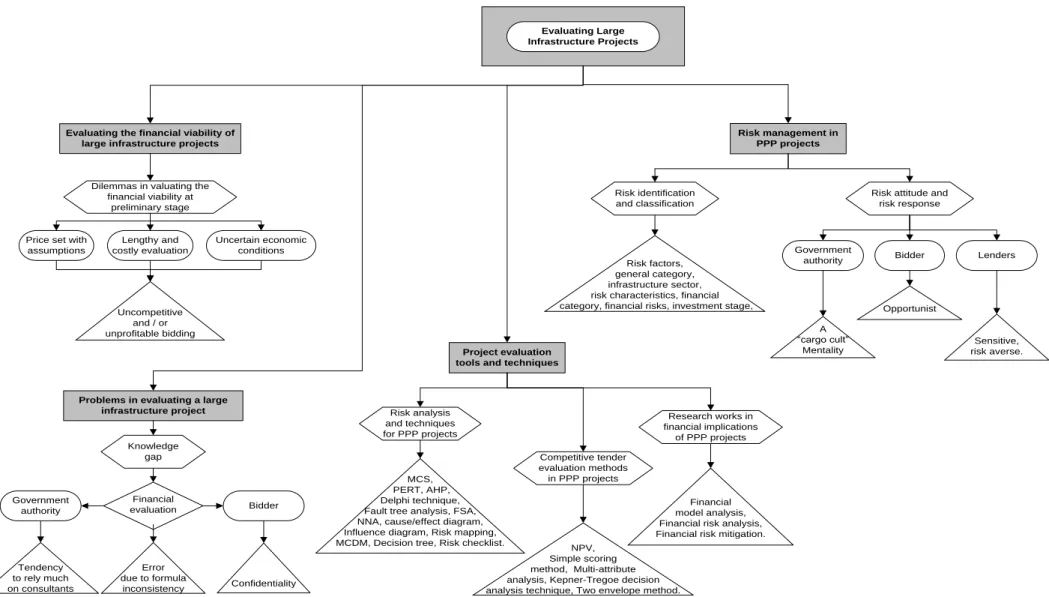
Figure 2.2 conceptual framework of evaluating large infrastructure projects... 24
Figure 2.3 Decision support framework (DSF) in the planning stage of a BOT project...33
Figure 2.4 A life-cycle risk management framework for PPP infrastructure projects... 36
Figure 3.1 Current use of PFI financial modelling... 41
Figure 4.1 Research design framework... 72
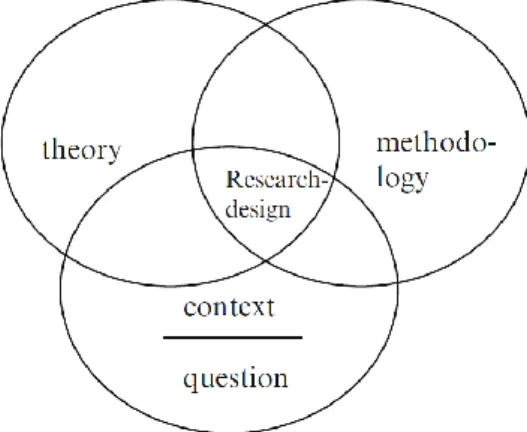
Figure 4.2: The relationship among research design, methodology, theory, question, and context... 73
Figure 4.3 The Research Pyramid... 74
Figure 4.4 Research design and methodology framework... 78
Figure 4.5 Research process framework... 81
Figure 4.6 Qualitative data analysis continuum... 92
Figure 5.1 Indian map seaport... 106
Figure 5.2 Indian major seaports capacity and traffic (in million tonnes)... 107
Figure 5.3 The PPP process and decision tools... 110
Figure 5.4 Typical structure and information flows in Indian PPP financial model... 117
Figure 5.5 PPP projects process management in India... 120
Figure 5.6 Important milestones of three PPP seaport projects in India... 121
Figure 6.1 The triangle of major actors in a PPP project... 139
Figure 7.1 Participating respondents by percentage... 159
Figure 7.2 Scree plot for principal component analysis... 161
Figure 7.3 Means plots of stakeholders’ expectations at the pre-proposal stage... 176
Figure 7.4 Means plots of stakeholders’ expectations at the contract negotiation stage... 180
Figure 7.6 Means plots of stakeholders’ expectations at the construction and operation
stages... 186
Figure 7.7 Means plots of stakeholders’ preference on input assumptions...189
Figure 7.8 Means plots of stakeholders’ preference on financial model output...192
Figure 7.9 Systematic statistical analyses... 200
Figure 7.10 The links between stakeholders and financial indicators...201
Figure 8.1 Integrated project evaluation tool framework... 204
Figure 8.2 An integrated view of the capital budgeting process... 206
Figure 8.3 Architecture of a financial model... 207
Figure 8.4 BOT financial flows... 209
Figure 8.5 Correlation framework for financial viability module at the pre-proposal stage... 215
Figure 8.6 Correlation framework for financial viability module at the contract negotiation stage... 217
Figure 8.7 Correlation framework for financial viability module at the finance-raising stage... 218
Figure 8.8 Correlation framework for financial viability module at the construction stage... 221
Figure 8.9 Correlation framework for financial viability module at the operation stage... 223
Figure 8.10 Hierarchy diagram of financial risk variables... 225
Figure 8.11 Influence diagram notation and conventions: (a) notation; (b) relationships... 227
Figure 8.12 Influence diagram of project costs, risks, and mitigation measures... 238
Figure 8.13 Influence diagram of traffic, risk, and mitigation measures... 241
Figure 8.14 Influence diagram of revenue forecast, risk, and mitigation measures... 244
Figure 8.15 Influence diagram of operating and maintenance cost, risk, and mitigation measures... 247
Figure 8.16 Influence diagram of loan repayment schedule, risk, and mitigation measures... 249
Figure 8.17 Influence diagram of financing cost, risk, and mitigation measures...250
Figure 8.18 Influence diagram of project time lines, risk, and mitigation measures... 252
Figure 8.19 Influence diagram of capital structure, risk, and mitigation measures.... 253
Figure 8.21 Influence diagram of IRR, risk, and mitigation measures... 257
Figure 8.22 Influence diagram of net cash flow, risk, and mitigation measures... 259
Figure 8.23 Influence diagram of EBITDA, risk, and mitigation measures... 260
Figure 8.24 Influence diagram of CADS, risk, and mitigation measures... 262
Figure 8.25 Influence diagram of LLCR, risk, and mitigation measures... 264
Figure 8.26 Influence diagram of Interest Covering Ratio, risk, and mitigation measures... 266
Figure 8.27 Influence diagram of repayment period, risk, and mitigation measures... 267
Figure 8.28 Relationship between the concession period and NPV... 269
Figure 8.29 Influence diagram of NPV, risk, and mitigation measures... 270
Figure 8.30 Influence diagram of ROE, risk, and mitigation measures... 271
Figure 8.31 Influence diagram of DSCR, risk, and mitigation measures... 273
Figure 9.1 Screenshot of integrated project evaluation tool cover... 277
Figure 9.2 Screenshot of introduction of integrated project evaluation tool... 279
Figure 9.3 Screenshot of financial viability module and stakeholders’ expectations... 281
Figure 9.4 Screenshot of second part of financial viability module: financial viability analysis... 282
Figure 9.5 Screenshot of financial risk analysis module: risk identification... 283
Figure 9.6 Screenshot of financial risk analysis module: input simulation... 284
Figure 9.7 Screenshot of financial risk analysis module: output simulation... 285
Figure 9.8 Screenshot of project synthesis: base case vs. single random simulated scenario... 286
Figure 9.9 Screenshot of project synthesis: a single random simulated scenario result in a graph... 287
Figure 9.10 Screenshot of financial risk mitigation module...289
Figure 9.11 Concept rating for integrated project evaluation tool... 291
Figure 9.12 Frequency of the applicability category... 292
Figure 9.13 Frequency of the comprehensiveness category... 292
Figure 9.14 Frequency of the practical relevance category... 293
Figure 9.15 Frequency of the intelligibility category... 293
Figure 9.16 Screenshot of respondents’ background... 299
Figure 9.17 Distribution of respondent’s country origin... 300
GLOSSARY
AHP Analytic Hierarchy Process
ANOVA Analysis of Variance
BOO Build Own Operate
BOOT Build Own Operate Transfer
BTO Build Transfer Operate
BOT Build Operate Transfer
CADS Cash Available for Debt Service
CAPEX Capital Expenditure
DBFO Design, Build, Finance and Operate
DEA Department of Economic Affairs
DEA Data Envelopment Analysis
DSC Discounted Cash Flow
DSF Decision Support Framework
DSCR Debt Service Cover Ratio
EBITDA Earnings before Interest, Tax, Depreciation, and Amortisation FAST Flexible Accurate Structured and Transparent
FTA Fault Tree Analysis
GoAP Government of Andhra Pradesh
GPL Gangavaram Port Limited
IDA International Development Association
IIFCL India Infrastructure Finance Company
ISPL International Seaports Pte Limited
IPET Integrated Project Evaluation Tool
IRR Internal Rate of Return
JNPT Jawaharlal Nehru Port Trust
LLCR Loan Life Cover Ratio
KDWP Kakinada Deep Water Port
KMO Kaiser-Meyer-Olkin
KSPL Kakinada Sea Ports Ltd
MAC Material Adverse Change
MCDM Multi-criteria decision making
MCS Monte Carlo Simulation
MIRR Modified Interest Rate of Return
MRG Minimum Revenue Guarantee
NPC Net Present Cost
NPV Net Present Value
NSICT Nhava Sheva International Container Terminal
OPEX Operational Expenditure
PCA Principal Component Analysis
PERT Program Evaluation and Review Technique
PFI Private Finance Initiative
PLCR Project Life Coverage Ratio
PPP Public-Private Partnership
PPIAF Public-Private Infrastructure Advisory Facility
PSC Public Sector Comparator
RCP Revenue Cap
RFP Request for Proposal
RFQ Request for Qualification
ROA Return on Asset
ROE Return on Equity
SLR Self-Liquidation Ratio
SPC Special Purpose Company
SPV Special Purpose Vehicle
TAMP Tariff Authority for Major Ports
TCE Transaction Cost Economics
TEU Twenty-feet Equivalent Unit
VFM Value for Money
LIST OF PUBLICATIONS
Kurniawan, F, Ogunlana, S and Motawa, I (2013) "Stakeholders’ expectations in utilising financial models for public private partnership projects”. Built Environment Project and Asset Management, 2013, (Accepted).
Kurniawan, F, Ogunlana, S, Motawa, I, and Dada, M (2013) Public-Private Partnership Projects Implementation: Three Case Studies of Seaport Projects in India, International Conference on PPP Body of Knowledge, Preston, 18-19 March 2013.
Kurniawan, F. (2010) "A Review: Exploring Stakeholders’ Expectations from PFI Financial Modelling at Different Stages", paper presented at PMI India Conference 2010, Mumbai, 19-21 November 2010 .
Kurniawan, F, Ogunlana, S and Motawa, I (2010) An integrated project evaluation tool for PFI seaport projects. In: Egbu, C. (Ed) Procs 26th Annual ARCOM Conference, 6-8 September 2010, Leeds, UK, Association of Researchers in Construction Management, 1317-1327.
CHAPTER ONE: INTRODUCTION
“Read! In the Name of your Lord, Who has created (all that exists). He has created man from a clot (a piece of thick coagulated blood).
Read! And your Lord is the Most Generous. Who imparted knowledge by means of the pen.
He has taught man that which he knew not.” (Quran 96: 1-5)
Chapter 1: Introduction
1.1 Introduction
This chapter introduces the background and the problem statements which motivate this research to be undertaken. Research questions are addressed in this chapter, together with research aim, objectives, scope of the study, and a brief overview of the thesis structure.
1.2 Background
Government has the responsibility of providing public services; including infrastructure facilities. Various types of infrastructure constitute essential public services, for instance: transportation, energy, telecommunications, water, waste disposal, hospital, school, and housing facilities. In the context of the transportation sector, and especifically in the seaport sector, Kakimoto and Seneviratne (2000); Bichou and Gray (2005); Kulkarni and Prusty (2007) have meticulously described the role of port infrastructure as economic catalysts, promoter of seaborne trade activity and generator of benefits and socio-economic wealth in developing countries.
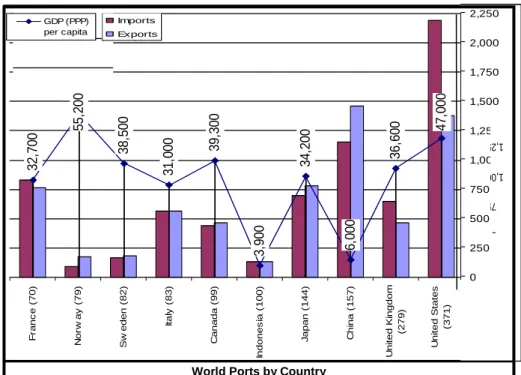
Figure 1.1 The top 10 countries with the highest number of seaport Sources: World Port Source (2008) and CIA (2004)
0 250 500 750 1,0 00 1,2 50 1,5 00 1,7 50 2,0 00 2,2 50 U n it e d S ta te s (3 7 1 ) U n it e d K in g d o m (2 7 9 ) C h in a ( 1 5 7 ) J a p a n ( 1 4 4 ) In d o n e s ia ( 1 0 0 ) C a n a d a ( 9 9 ) It a ly ( 8 3 ) S w e d e n ( 8 2 ) N o rw a y ( 7 9 ) F ra n c e ( 7 0 ) $ b il li o n Im p o rt s E x p o rt s 4 7 ,0 0 0 3 6 ,6 0 0 6 ,0 0 0 3 4 ,2 0 0 3 ,9 0 0 3 9 ,3 0 0 3 1 ,0 0 0 3 8 ,5 0 0 5 5 ,2 0 0 3 2 ,7 0 0 GDP (PPP) per capita 0 250 500 750 1,0 00 1,2 50 1,5 00 1,7 50 2,0 00 2,2 50 U n it e d S ta te s (3 7 1 ) U n it e d K in g d o m (2 7 9 ) C h in a ( 1 5 7 ) J a p a n ( 1 4 4 ) In d o n e s ia ( 1 0 0 ) C a n a d a ( 9 9 ) It a ly ( 8 3 ) S w e d e n ( 8 2 ) N o rw a y ( 7 9 ) F ra n c e ( 7 0 ) $ b il li o n Im p o rt s E x p o rt s 0 250 500 750 1,000 1,250 1,500 1,750 2,000 2,250 U n ite d St a te s (3 7 1 ) U n ite d Ki n g d o m (2 7 9 ) C h in a (1 5 7 ) Ja p a n (1 4 4 ) In d o n e s ia (1 0 0 ) C a n a d a (9 9 ) Ita ly (8 3 ) Sw e d e n (8 2 ) N o rw a y (7 9 ) F ra n ce (7 0 ) Im p o rt s ( $ b ill io n ) E x p o rt s ( $ b ill io n ) 47 ,0 00 36 ,6 00 6, 00 0 34 ,2 00 3, 90 0 39 ,3 00 31 ,0 00 38 ,5 00 55 ,2 00 32 ,7 00 GDP (PPP) per capita 0 250 500 750 1,000 1,250 0501, 1,750 2,000 2,250 United States (371) United Kingdom (279) China (157) Japan (144) Indonesia (100) Canada (99) Italy (83) Sw eden (82) Norw ay (79) France (70) $ billion Imports Exports 0 250 500 750 1,0 00 1,2 50 1,5 00 1,7 50 2,0 00 2,2 50 U n it e d S ta te s (3 7 1 ) U n it e d K in g d o m (2 7 9 ) C h in a ( 1 5 7 ) J a p a n ( 1 4 4 ) In d o n e s ia ( 1 0 0 ) C a n a d a ( 9 9 ) It a ly ( 8 3 ) S w e d e n ( 8 2 ) N o rw a y ( 7 9 ) F ra n c e ( 7 0 ) $ b il li o n Im p o rt s E x p o rt s
Indonesia is the largest archipelago country in the world. It has 17,508 islands which are mainly connected only by 100 seaports (World Port Source, 2008). Thus, it is very important for Indonesia to develop her seaport infrastructure since Indonesia is one of the countries with the lowest export and import capacities among top 10 countries with the highest number of seaports (see figure 1.1).
Figure 1.2 Intensity of world shipping routes in 2004 and Indonesia (Inset) Source: World Bank (2009)
The number of ports in each country will foster the development process of its country significantly. Figure 1 also shows the top 10 countries with the highest number of ports, with the majority having high GDP per capita while Indonesia has the lowest GDP per capita. Figure 1.2 shows the intensity of world shipping routes where Indonesia plays an important role in world shipping service routes. These facts justify the need for research into seaport infrastructure development especially for Indonesia. Seaports have contributed wide-ranging economic impacts and have been developed as an important transportation service for the world’s transportation industry. For instance, Baird (1999) stated that 95% of all trades in UK rely on seaports to international markets. Alderton (2005) recorded that the capacity growth of containerisation and bulk carriage has been tremendously increased and continued since the 1950s to meet the growing demand.
Seaports, as the engine of the economy, are growing in line with the increasing demand on the shipping industries, collectively with up-surging cost of construction and
maintenance, uncertain demand and world trade. Consequently, the financial viability of seaports should be carefully secured and examined from the preliminary project stage.
1.3 Problem statement
When there is lack of infrastructure facilities in a country and national budgets are limited, private participation is considered as an alternative strategy thereof. This approach is known worldwide as Public-Private Partnership (PPP) which involves a long contractual relationship between a public sector authority and a private party. In 2010, 12 of the 63 developing countries under International Development Association (IDA) reached financial or contractual closure for 24 transport, energy, and water projects with private investment commitments of US$7.5 billion. PPP provides the opportunities for the government such as: (1) provide more public service facilities; (2) the fact that the increasing number of PPP projects worldwide with its variants can enhance efficient services and value for money to some extent (Grimsey and Lewis, 2005; and Sadka, 2007). However, PPPs have been criticised by many due to its inability to deliver better value for money (VfM) and excessive profits for the private companies at the expense of taxpayer (e.g. Newberry and Pallot, 2003; Cartlidge, 2006; Shaoul et al., 2006; Coulson, 2008; Shaoul et al., 2010; and Shaoul et al., 2011). Moreover, the complexity of project finance arrangement and the uncertainty over long term concession period have generated more risks not only to the government but also to the private parties (Dey and Ogunlana, 2004; Zhang, 2005a; Jin and Doloi, 2008; Fischer et al, 2010). Thus, PPP projects require adequate allocation of the risks, associated with the complex financial, legal, organisational and socio-political structure, between the public sector authority and the private parties.
Numerous researches have been conducted to evaluate the PPP project from various perspectives (e.g. Grimsey and Lewis, 2005; Demirag at al. 2004; Jin and Zhang, 2011; and Alexander, 2011). However, few have concerned on the tendency to rely much on consultants in formulating and managing the policy on PPPs, which has been frequently practiced by public sector authorities. Shaoul et al. (2007) addressed this problem by using an example from UK’s experience dealing with big four accounting firms such as PwC, Deloitte and Touche, KPMG, and Ernst and Young. Conflict of interests was, thus, revealed to exist not only within the stakeholder but also among stakeholders. For instance, when the firms also have an equity stake and/ or they are hired by the sponsor
companies on the same project, they prepare evaluative reports to favour their interest. Moreover, in the context of negotiating the project, the conflict of interests among the stakeholders predominantly has a tendency to be quasi-monopolistic pricing that reduces social welfare (Trailer et al., 2004). Therefore, it is important to study how the public sector authority independently decides which PPP strategy is the best choice (if proven to have better value for money) based on the type, size and condition of the project.
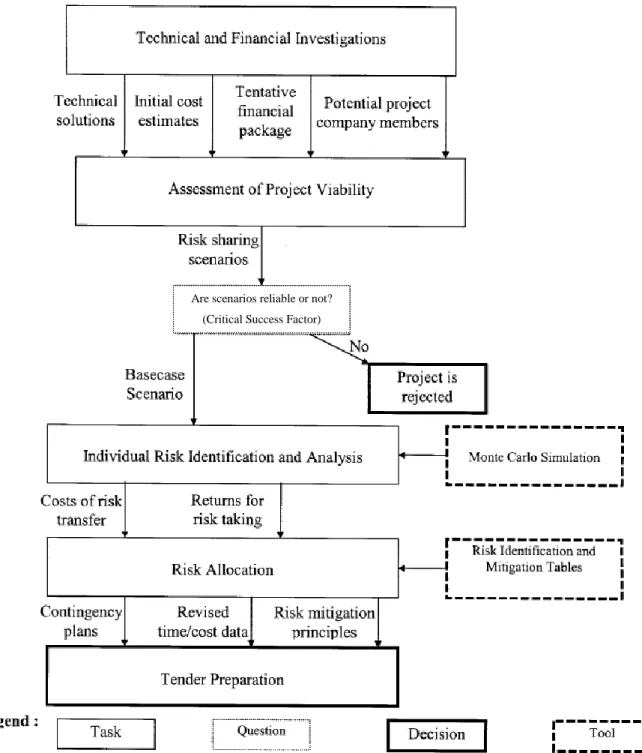
The complexity of financial evaluation and long bidding process could make the bid either uncompetitive or unprofitable. Meanwhile, many government projects have suffered from time and cost overruns, quality issues, noneconomic allocation criteria, irregular cash flows from budgets, and shortage of competent people (African Development Bank, 2008). In this regard, an effective project evaluation tool is important to be developed in order to resolve these problems and to facilitate negotiation between the bidder or project company members and the government at the contract stage. Ozdogan and Birgonul (2000) developed a decision support framework (DSF) for helping the project company in the planning stage of a hydropower plant to check project viability against several predefined critical success factors. However, a further research needs to be undertaken to adopt and modify the previous DSF into an integrated project evaluation tool for a PPP seaport project. The proposed project evaluation tool also necessitates to be verified whether it can be practically used in worldwide seaports or not. Therefore, a research in developing a framework of an integrated project evaluation tool, which is combining the evaluation of the financial viability of the project and revealing the risks with possible options of financing strategies in a computer-based model, is important and beneficial to all of the project participants during the bidding period.
Primary data from several interviews, questionnaires to seaport risk managers, port authorities and PPP experts were planned to be conducted in the UK and Indonesia. However, the majority of the primary data was gathered in India because it was not possible to collect sufficient data about PPP seaport in the UK and Indonesia.
1.4 Motivations
In regard to the necessity of developing infrastructure facilities coupled with the national budget pressures, PPP as an alternative procurement strategy shall not be overlooked. Even so, the public sector authority must be extra cautious in selecting the right strategy among the variance of PPPs for the project. From the background and the problem statements described earlier, there are several motivating factors in addition to the above for undertaking this research. The factors are as follows:
Since all risks of the PPP projects could affect the financial viability of the project, the evaluation of the project from the perspective of financial implications is a very important subject to study.
Project financing arrangements for PPP projects involve many participants with complex transactions and involve diverse interests. In order to accommodate all key interests of the stakeholders, financial model is one of the most common tools used for evaluating a new project and facilitating negotiations among the lenders, the sponsor(s) and the public sector authority (Khan and Parra, 2003). Therefore, it is important to study how financial models are used for negotiations between the public sector authority and the other stakeholders within reasonable time.
Rigorous studies on how to evaluate the project financial viability and how to manage the risks in PPP projects have been carried out. However, there are no specific studies on how to use financial model not only as a tool for evaluating the project financial viability but also as a tool for negotiating the risk sharing mechanism and monitoring the PPP project over a long term concession period.
1.5 Research questions
Developing large infrastructure projects either by using traditional procurement method or PPP strategy, the projects still encounter many risks in several aspects. Since the existence of risk cannot be eliminated, alternatively the expected risks can be mitigated by managing them. The main challenge of this research was to find out the best strategy on how the stakeholders manage the risks by using PPP financial models. This challenge was addressed with the following research questions:
Who are the stakeholders who are going to manage those risks? The identification of the stakeholders in this study is limited to the user and developer of the PPP financial models.
Since a PPP financial model is not only a tool for evaluating the project but also a tool for negotiating and monitoring the project over concession period, what are the most important stakeholders’ expectations in utilising PPP financial models?
As the exploration of the risks in this study was attributed to the identification financial risk variables. The subsequent research question was “What are the financial risk variables within PPP financial models?”
In order to ensure that the stakeholders’ expectation can be effectively reconciled through a PPP financial model, with reference to the Nash Equilibrium Theory (Gibbsons, 1992), it is important to identify the risk related to financial risk variables that should be managed by each stakeholder. Therefore, the next research question was “What are the possible risks related to the financial risk variables (input and output of PPP financial models)?”
When the term “managing the risks” means identify, evaluate, and respond to the risks by using PPP financial models, how are those risks managed?
1.6 Aim and objectives
This research aims to ascertain the rationale of the public sector authority in evaluating PPP projects through an integrated project evaluation tool (IPET). This tool is expected to assist stakeholders in utilising PPP financial models at different project stages. The objectives set to achieve this aim are:
To explore the concept of PPP and the use of PPP financial models. To explore risks and their mitigation measures in PPP projects.
To develop an integrated project evaluation tool (IPET) fitted to PPP seaport project.
To ensure that the IPET is valid in terms of applicability, comprehensiveness, practical relevance, and intelligibility through the evaluation process by academics and expert practitioners.
1.7 Scope of the study
The scope of the study is limited in order to allow the undertaken study completed within reasonable time and budget constraints. In the context to the partnership, there are many interpretations and an over use of partnership term for public-private partnership (PPP). Weihe (2008) identified that there are four approaches of partnership concept between public and private with different interpretations: 1) the urban regeneration approach; 2) the policy approach; 3) the infrastructure approach; and 4) the development approach. This research is limited to the infrastructure approach, where private investment is involved, and where different elements such as construction, operation and maintenance are integrated. In conjunction with previous descriptions, the study of PPP projects concentrates on the financial implications. Financial models are selected as the object of the study for identifying, evaluating, and managing the risks in PPP projects. Hence, the context of managing risks in this study is limited to the quantitative perspective.
Although this research benefits from previous case studies on the identification of various risks in general PPP projects (e.g. Bing et al., 2005; Schaufelberger and Wipadapisut 2003; Wang et al., 2000; Xenidis and Angelis, 2005; Askar and Gab-Allah, 2002; Zhang, 2005c; etc.), it specifically reviews financial indicators of PPP financial model which are associated with the risks especially for PPP seaport projects. The exploration of the risks is attributed to the identification financial risk variables from PPP seaport financial models. Nevertheless, in order to gain different perspective over seaport development project, this research is not limited only to PPP seaport projects. By considering this approach, the risk sharing mechanism among the stakeholders can be determined comprehensively in any financial negotiation.
In this study, the definition of stakeholders is also limited to the actors (e.g. sponsor(s), lenders, government authority, consultant companies, insurance company, contractor, operator, etc.) who are using financial models as a tool for project evaluation, contract negotiation, appraisal report, tariff adjustment, and project performance monitoring.
1.8 Research design and methodology
A research can be defined as a set of activities for the advancement of knowledge. In order to justify the truth to be believed as knowledge, a sound research should be designed in such a way through constant reasoning. Jonker and Pennink (2010) suggested that the first and foremost step in setting up a research is to determine the research paradigm of how the researcher views ‘reality’. It was perceived that the problem (ontologically) belongs to nominalism reality. Meanwhile, the method employed to solve the problem was based on objectivist epistemology. As results, both positivism and interpretivism approaches were considered. This combination is called a pragmatic paradigm, which utilises combination of qualitative and quantitative techniques or triangulation technique (Jupp, 2006). A triangulation strategy has been adopted to meet the research objectives.
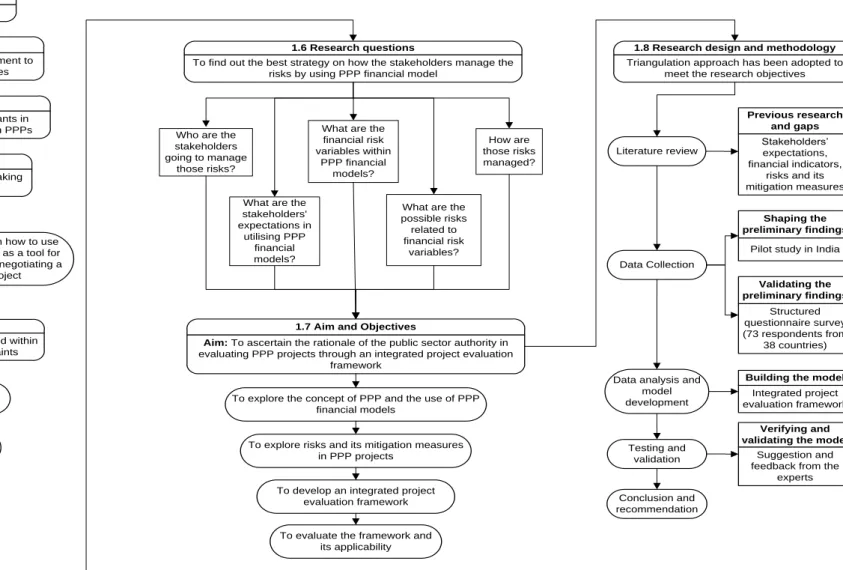
A literature review has been undertaken to identify previous research and gaps which needed to be studied and filled. A pilot study was conducted in India through a series of semi-structured interviews for shaping and validating the preliminary findings. Then, from the recommendations concluded from the pilot study, a structured questionnaire survey of international expert opinions was carried out to identify the most important stakeholders’ expectations in utilising PPP financial model and the most important financial indicators. Based on the results from the survey, an integrated project evaluation tool (IPET) was developed to model the best PPP strategy based on stakeholders’ expectations in utilising PPP financial model at different stages, and to produce the information needed for decision making, such as the most important financial risk variables, mitigation measures and its alternatives. The applicability of the proposed IPET was validated by using experts’ opinion. The summary of sub-chapter 1.1 up to 1.8 is illustrated in figure 1.3.
Evaluation of financial implications CHAPTER 1 1.1 Introduction 1.2 Background
PPP provides opportunities for Government to provide more public service facilities
1.3 Problem statements
The tendency to rely much on consultants in formulating and managing the policy on PPPs
Contribution on how to use financial model as a tool for evaluating and negotiating a
new project
1.5 Scope of the study
To allow the undertaken study completed within reasonable time and budget constraints
1.4 Motivations
Several motivation factors for undertaking the research
PPP in term of infrastructure approach
Financial model as the object of the study
Financial indicators associated with risks in
PPP projects
Risk sharing mechanism
1.6 Research questions
To find out the best strategy on how the stakeholders manage the risks by using PPP financial model
1.7 Aim and Objectives
Aim: To ascertain the rationale of the public sector authority in evaluating PPP projects through an integrated project evaluation
framework
To explore the concept of PPP and the use of PPP financial models
To explore risks and its mitigation measures in PPP projects
To develop an integrated project evaluation framework
To evaluate the framework and its applicability
1.8 Research design and methodology
Triangulation approach has been adopted to meet the research objectives
Literature review
Data Collection
Data analysis and model development Conclusion and recommendation Testing and validation Previous research and gaps Stakeholders’ expectations, financial indicators,
risks and its mitigation measures
Shaping the preliminary findings
Pilot study in India
Validating the preliminary findings Structured questionnaire survey (73 respondents from 38 countries)
Building the model
Integrated project evaluation framework
Verifying and validating the model
Suggestion and feedback from the
experts Who are the
stakeholders going to manage
those risks?
What are the financial risk variables within
PPP financial models?
What are the possible risks related to financial risk variables? How are those risks managed?
What are the stakeholders' expectations in
utilising PPP financial models?
1.9 Structure of the thesis
The thesis consists of ten chapters, which is outlined in figure 1.4 below, and the chapters’ overviews are structured as follows:
- Research Paradigm:
Pragmatic Approach (Nominalist Ontology and Objectivist Epistemology)
- Research Methodology:
Triangulation approach (Quantitative and Qualitative Method) Survey Anal ysis Testing and Implementation Literature review In tro d u c tio n Res earch methodo logy C o n c lu s io n
- Aim: To explore the concept of PPP and the use of PPP financial models - Sample: 3 PPP Seaports in India - Technique: Cross case analysis
- Aim: To validate the findings from interview and literature review
- Sample: 73 respondents from 38 countries - Technique: Systematic statistical analysis
- Sample: 15 experts - Technique: Prototype Presentation and Online Survey
Public-Private Partnership: Theories, Debates and Analyses
PPP financial model and the expectations of its stakeholders Mo del Deve lopme nt
- Aim: To develop an integrated project evaluation tool fitted to PPP seaport project
- Sample: 3 financial model spreadsheets
Case S
tudy Analy sis
- Aim: To shape the preliminary findings - Sample: 10 PPP Stakeholders India - Technique: Content analysis
Intervie
w analy sis
Figure 1.4 Outline of the study
Chapter One: Introduction to the thesis
This chapter introduces an overview to the background, the problem statements, the motivations, the scope of the study, the research questions, the aim and objectives, the research design and methodology, the research findings, and the structure of the thesis.
Chapter Two: Public-Private Partnership: Theories, Debates, and Analyses
This chapter reviews the concept of Public-Private Partnership (PPP), discusses the rationale for PPP projects, reviews several theories underlying the partnership approach and addresses the debate on PPP. This chapter also deliberates on the important aspects and the problems in evaluating large infrastructure projects. A review of the risk management literature in terms of project evaluation tools and techniques used in the construction industry is presented as well.
Chapter Three: PPP financial model and expectations of its stakeholders
This chapter explores stakeholders who utilise financial models in PPP projects and their expectations from PPP financial models are then presented. This chapter also highlights and discusses the most important ones.
Chapter Four: Research Design and Methodology
This chapter presents the approach to discover a suitable research design and methodology (including research method, data collection, and data analysis) in answering the research questions and problems addressed in the literature review. This chapter also provides further emphasis and description of the data needed and the methodology selected for this research.
Chapter Five: Case Study Analysis and Discussion
Chapter five reports the findings of cross case analysis of three PPP seaport projects in India. The primary aim of this chapter is to study the implementation of PPP seaport projects. In order to achieve the aim of this chapter, this chapter identifies typical procedures used for evaluating PPP seaport projects in India.
Chapter Six: Interview Analysis – Exploring Stakeholders’ Expectations
This chapter provides information about the stakeholders’ expectations and then presents several analyses that are divided into two major parts: 1) PPP Stakeholders; 2) Stakeholders’ Expectations. The first part analyses the actor and the influence of PPP stakeholders who are identified from literature and interviews. Then, the next part
analyses the importance of the pre-determined 44 expectations, which are identified through literature and verified through semi-structured interview with key participants of PPP projects in India.
Chapter Seven: Questionnaire Survey Analysis
This chapter follows up the findings from literature review, cross case analysis, and interview analysis. As part of the triangulation process, a structured questionnaire survey was also considered to be the second validation process of the preliminary findings from literature review and interview. The questionnaire aims to answer the second and third research questions: “what are the most important stakeholders’ expectations in utilising PPP financial models?” And “what are the financial risk variables within PPP financial models?” (see 1.6). To answer these questions, this chapter presents a systematic statistical analysis of the collected data.
Chapter Eight: Discussion and Framework Construction
This chapter discusses the findings obtained from chapters six and seven. An integrated project evaluation tool (IPET) is developed based on the findings from literature review, interview, and questionnaire survey. This chapter also highlights the concept and development of the model framework.
Chapter Nine: Verification and Validation
This chapter will verify and validate the proposed IPET into framework that can be generalised to the construction industry. This chapter begins with discussion of the deployed methods to verify and validate the research findings. Then, the verification and validation of IPET by using a hypothetical data of PPP financial model and online survey are presented in this chapter.
Chapter Ten: Conclusions and Recommendations
The last chapter synthesises the research findings and the influence of the IPET in evaluating and negotiating projects effectively and efficiently. It concludes the research and the achievements of the research objectives. Limitation of this research and
recommendations for future research are presented in this chapter. This chapter also highlighted the contributions to the body of knowledge at the end of this chapter.
CHAPTER TWO: PUBLIC-PRIVATE PARTNERSHIP:
THEORIES, DEBATES, AND ANALYSES
- Research Paradigm:
Pragmatic Approach (Nominalist Ontology and Objectivist Epistemology)
- Research Methodology:
Triangulation approach (Quantitative and Qualitative Method) Survey Anal ysis Testing and Implementation Literature review In tro d u c tio n Res earch methodo logy C o n c lu s io n
- Aim: To explore the concept of PPP and the use of PPP financial models - Sample: 3 PPP Seaports in India - Technique: Cross case analysis
- Aim: To validate the findings from interview and literature review
- Sample: 73 respondents from 38 countries - Technique: Systematic statistical analysis
- Sample: 15 experts - Technique: Prototype Presentation and Online Survey
Public-Private Partnership: Theories, Debates and Analyses
PPP financial model and the expectations of its stakeholders Mo del Deve lopme nt
- Aim: To develop an integrated project evaluation tool fitted to PPP seaport project
- Sample: 3 financial model spreadsheets
Case S
tudy Analy sis
- Aim: To shape the preliminary findings - Sample: 10 PPP Stakeholders India - Technique: Content analysis
Inte
rview analysis
Chapter 2: Public-Private Partnership: Theories, Debates, and
Analyses
"Make things easy for the people and do not put hurdles in their way, and give them glad tiding, and don't let them have aversion (i.e. to make people to hate good deeds)
and you both should work in cooperation and mutual understanding" Muhammad (570 – 632)
2.1 Introduction
Public-private partnership (PPP) has been widely adopted by governments to finance the acquisition of infrastructure assets and the operation of their facilities (Xu et al., 2012; Auriol and Picard, 2011). PPP is an alternative procurement strategy that can enhance efficient services supplied before solely by government authorities (Sadka, 2007). Nevertheless, the implementation of efficient partnership concept between government authorities and private entities in PPP projects was not always necessarily delivered in practice (Diamond, 2006; Friend, 2006; and Jacobson and Choi, 2008). Several unsuccessful PPP projects1 in many countries, especially in developing countries, have been recorded by many (e.g. Handly, 1997; Hayllar and Wettenhall, 2010; Bernardino et al., 2010). These failures are a consequence of the complex arrangements and incomplete contracting in PPP projects, which have led to increased risk exposure for both public and private partners. Since the core of PPP is based on a partnership concept between public and private entities, this chapter reviews the rationalisation for PPP projects including several theories underlying the partnership concept, addresses the debate on PPP, and deliberates on important aspects in evaluating PPP projects.
2.2 Exploring the partnership concept
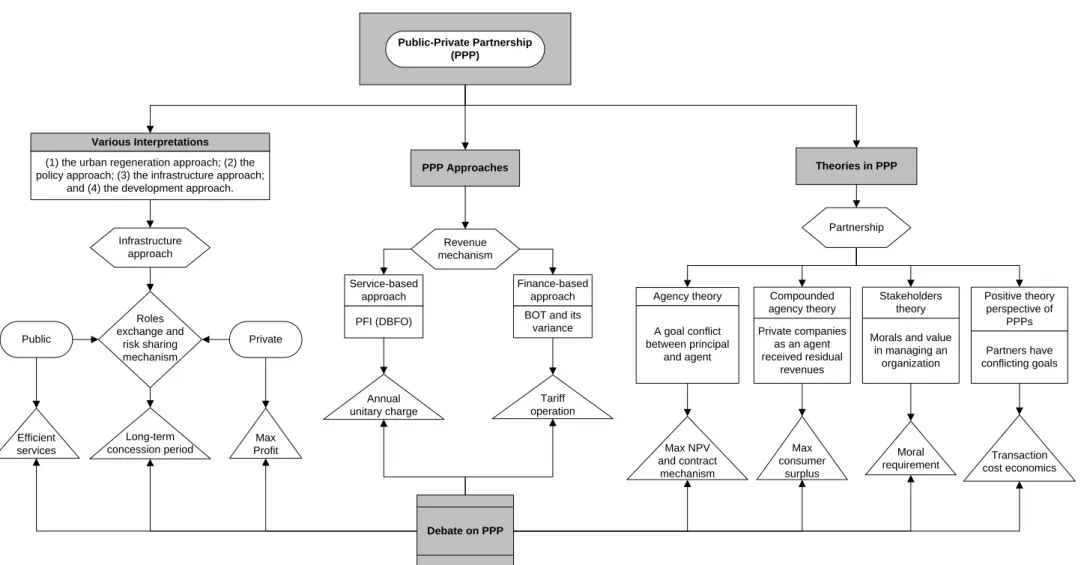
Various interpretations of partnership concept between public and private can be categorised into four approaches such as (1) the urban regeneration approach; (2) the policy approach; (3) the infrastructure approach; and (4) the development approach
1 E.g. Pakistan’s Hub Power Project, Thailand’s Mass Transit System Project, India’s
Telecommunications and Power Project, China’s Power Project, Thailand’s Power Project, Indonesia’s Power Project, Malaysia’s Power project, England’s National Health Service (NHS), Sydney Cross-City Tunnel PPP, Britain’s Channel Tunnel Rail Link, etc.
(Weihe, 2008). As described in the earlier chapter, this research is limited to the infrastructure approach, where private finance is involved, and where different elements such as construction, operation and maintenance are integrated. Figure 2.1 shows the conceptual framework of PPP that will be discussed in this chapter. Private involvement in developing public infrastructures implies contractual relationship between the government and the special purpose vehicle (SPV) company.
This contractual relationship is regarded as risks sharing mechanism and roles exchange between government authorities and private parties in delivering public services over long-term concession period. Furthermore, the partnership concept of PPP differs from traditional procurement in construction projects; PPP as partnership method denotes an equal power relationship between public and private parties, where majority of the project risks is transferred to the private parties. Traditional procurement entails a top-down relationship, where the private companies (e.g. contractors, operators, suppliers, etc.) work for and earn from the government with limited liability.
The term PPP is often mainly overlooked as a method of procurement. Cartlidge (2006) argued that PPP can also be seen as a method to raise finance off balance sheet, a strategy to achieve greater efficiency, and a politically motivated tool to drive a social change. However, PPP projects do not always demonstrate an efficient partnership concept into practice (Diamond, 2006; Friend, 2006; and Jacobson and Choi, 2008). The failure of the implementation of PPP projects is either contributed by the government authorities or private parties. Government authorities of the host country have jurisdiction over project initiation, construction process, and concession period, play a significant role in the success of PPP projects.
Infrastructure approach Public Private Roles exchange and risk sharing mechanism Service-based approach PFI (DBFO) Finance-based approach BOT and its
variance PPP Approaches Agency theory A goal conflict between principal and agent Compounded agency theory Private companies as an agent received residual revenues Theories in PPP Stakeholders theory Morals and value
in managing an organization Positive theory perspective of PPPs Partners have conflicting goals Annual unitary charge Tariff operation Revenue mechanism Max NPV and contract mechanism Max consumer surplus Moral
requirement cost economicsTransaction Various Interpretations
(1) the urban regeneration approach; (2) the policy approach; (3) the infrastructure approach;
and (4) the development approach.
Max Profit Efficient services Debate on PPP Partnership Public-Private Partnership (PPP) Long-term concession period
In the history of PPP development, the policy initiatives undertaken by the government authorities do not always favour the private parties (Bing et al., 2005; Schaufelberger and Wipadapisut, 2003; and Wang et al,. 2000). On the other hand, the influence from corporate political power towards government roles in delivering public services is prioritizing maximum profit for their business initiatives (Heald and Georgiou, 2000; Crane and Matten, 2003; Johnston, 2010; Beh, 2010; Siemiatycki, 2010; and Wilks, 2013). Commercialisation of public services is obvious evidence that ‘partnership’ is overly turned into a new business opportunity. Thus, the effectiveness of PPP as an alternative procurement strategy to deliver better value for money is open to question. In order to evaluate the effectiveness of the partnership concept, the next section briefly discusses how PPP approaches are used worldwide.
2.3 PPP approaches
Though the involvement of private investment in public infrastructure can be traced back to the 18th century in European countries, there is no definite information about the exact period of time when the Public-Private Partnership (PPP) term was initially launched. Kumaraswamy and Morris (2002) stated that the earliest private investment was concession contracts to supply drinking water to Paris in 18th century. Nevertheless, Private Finance Initiative (PFI) as a type of PPP was introduced into the United Kingdom in 1992. Furthermore, numerous acronyms (such as BOT, BOOT, BTO, BRT, BLT, BOOM, DBOM, and DBFO) also have been used to describe PPP as its variations. Although PPP has various types of partnerships, each partnership concept is not always implemented effectively in every country.
In order to illustrate the effectiveness of the partnership concept, it is worth giving examples of PPP projects across the world. There are two approaches to PPP projects worldwide (Aziz, 2007): (1) Service-based approach; and (2) Finance-based approach. The first approach is private finance initiative (PFI). Design, Build, Finance and Operate (DBFO) is a variation of partnership strategy mostly used in the UK under PFI. PFI allows private parties to undertake the same activities like other PPP projects. However, the difference lies in the concept that the private company receives payment from the government based on the annual unitary charges for both the initial capital spent and the on-going maintenance and operation costs. This partnership approach has been criticised by many because of its ability to deliver better value for money and
excessive profits for the private companies at the expense of taxpayers (e.g. Newberry and Pallot, 2003; Cartlidge, 2006; Shaoul et al., 2006; Coulson, 2008; Shaoul et al., 2010; and Shoul et al, 2011).
The second approach is Build-Operate-Transfer (BOT) Project Delivery and its variance. The BOT and its variance allow private companies to build and manage the project with private funds and collect revenue during the operation period to the users directly through tolls and/or other charges as a reward over their capital investment. Since the government is not obliged to pay the private companies for developing infrastructure projects, this partnership approach is mostly used in developing countries such as India, China, Thailand, Korea, etc. However, Algarni et al. (2007), investigated why some government authorities in United States avoided using BOT in their large projects. The main reasons were the availability of proven alternatives and enough funds, the existence of political barriers, and resistance to change both on the part of government agencies and private sponsors.
Based on the two major approaches of PPP projects worldwide, the selection of each approach should be customised according to the situation and condition of the host country. Therefore, it is essential to review partnership theories before selecting the best PPP approach. This will be discussed in the next section.
2.4 Theories in Public-Private Partnerships
This section will discuss several theories underlying the partnership concept.
2.4.1 Agency Theory and Compounded Agency Theory
Ross (1973) introduced a theory in the agency relationship, in which an efficient alignment of principal and agent’s interests will be ensured by selecting appropriate governance mechanisms between principal and agents. The main objective is to ensure that agents serve the interests of the principal, e.g. maximising firm Net Present Value, so that agency costs are minimised through an efficient contract mechanism. The essence of agency theory assumes that there is goal conflict between principal and agent-called an agency problem. Trailer et al. (2004) proposed a compounded agency view to add a new dimension to the agency theory applied to PPPs. They discovered that the agency problems exist in PPPs because the private companies as an agent
received residual revenues, which triggered conflict of interest with the public interest of maximising consumer surplus2.
2.4.2 Stakeholder Theory
In conjunction with agency problems, there is another theory that reviews the conflict of interests in different theoretical perspectives. In 1984, Freeman introduced stakeholder theory which addresses morals and value in managing an organization (Donaldson and Preston, 1995). Donaldson and Preston (1995) argued that “the ultimate managerial implication of the stakeholder theory is that managers should acknowledge the validity of diverse stakeholder interests and should attempt to respond to them within a mutually supportive framework, because that is a moral requirement for the legitimacy of the management function”. Despite of the fact that agency and stakeholder views are being seen as opposing ideological frameworks, Shankman (1999) argues that stakeholder theory is a logical conclusion of agency theory when: 1) recognition of stakeholders is included; 2) a moral minimum to be upheld; 3) consist of contradictory assumptions about human nature which give rise to the equally valid assumptions of trust, honesty and loyalty to be embedded in the agency relationship. While the implications for practice of agency theory in PPPs are to align interests between private parties and government agencies (i.e. taking actions to maximise the project’s NPV, and using efficient contracting mechanism to minimise agency costs), the practice’s implication of stakeholder theory is to balance the agency problems (i.e. adjusting its development strategies and management activities under the guidance of the national policies so that the interests or claims of all relevant stakeholders will be in conformity with rules and regulations).
2.4.3 Transaction Cost Economics Theory and Positive Theory Perspective of PPPs
The other theory related to the agency problems which can be viewed based on the transaction cost economics (TCE) is positive theory perspective of PPPs. Here, it is worth explaining the definition of TCE before discussing a positive theory perspective of PPPs. TCE is a theory that not only concerns the economisation of transaction costs, but is also related to the governance of ongoing contractual relations (Williamson, 2007). Transaction costs are the total costs of doing a transaction or making an
2
Consumer surplus is an economic measure of consumer satisfaction, which is the difference between what consumers are willing to spend more for a good or service than the current market price (Investopedia, 2012).