Contents lists available atSciVerse ScienceDirect
Computers and Mathematics with Applications
journal homepage:www.elsevier.com/locate/camwaA business strategy selection of green supply chain management via an
analytic network process
✩Chiau-Ching Chen
a, Hsu-Shih Shih
a,∗, Huan-Jyh Shyur
b,1, Kun-Shan Wu
c,2 aGraduate Institute of Management Sciences, Tamkang University, Tamsui, New Taipei 25137, Taiwan, ROCbDepartment of Information Management, Tamkang University, Tamsui, New Taipei 25137, Taiwan, ROC cDepartment of Business Administration, Tamkang University, Tamsui, New Taipei 25137, Taiwan, ROC
a r t i c l e i n f o
Article history:
Received 17 August 2011
Received in revised form 13 April 2012 Accepted 13 June 2012
Keywords:
Management decision making Ranking and selection Sensitivity analysis Limiting process Analytic network process Green supply chain management
a b s t r a c t
This study designates green supply chain management (GSCM) strategies to effectively direct business functions and activities in the electronics industry. Enterprises conduct environmental scanning to understand the external environment and internal functions; a successful strategy identifies unique firm-owned resources and transforms them into capabilities. This study proposes a network to clarify managerial levels and firm-related content. It derives four business functions from product lifecycle management: design, purchasing, manufacturing, and marketing and service—and associates their related activities with ‘‘greenness’’. These functions and activities are a network’s clusters and elements in an analytic network process (ANP) model with dependent relations. A detailed procedure solves complex GSCM strategy-selection problems and evaluates the most important activity in each business function. A case study takes a leading Taiwanese electronics company to identify the proposed procedure’s stability.
©2012 Elsevier Ltd. All rights reserved.
1. Introduction
Environmental deterioration and global warming have prompted public concern over sustainability and environmental issues. In response to increased worldwide attention on the overall conditions of natural resources and the environment, several countries have adopted regulations such as the Restriction of Hazardous Substance in Electrical and Electronic Equipment (RoHS), Waste Electrical Electronic Equipment (WEEE), Eco-design Requirement for Energy Using Product (EuP), etc. Such legislation forces manufacturers to decrease pollution during the whole production process [1,2]. It is especially applicable for the electronics industry, with its rapid technology development, consumers’ desire for the newest products, shorter product life-cycles, and indirect e-waste. Since hazardous materials are the greatest concern in electronics products, this study develops a green strategic selection guideline to aid company decisions.
✩The paper has been evaluated according to old Aims and Scope of the journal.
∗Corresponding author. Tel.: +886 2 8631 3221; fax: +886 2 8631 3214.
E-mail addresses:[email protected](C.-C. Chen),[email protected](H.-S. Shih),[email protected](H.-J. Shyur), [email protected](K.-S. Wu).
1 Tel.: +886 2 2621 5656x2881; fax: +886 2 2620 9737. 2 Tel.: +886 2 26215656x3374; fax: +886 2 2620 9742.
0898-1221/$ – see front matter©2012 Elsevier Ltd. All rights reserved. doi:10.1016/j.camwa.2012.06.013
Many manufacturers have adjusted their manufacturing philosophies and introduced environmental programs into their organizations. Through social and environmental responsibility (SER), some firms proactively recognize the urgency of environmental protection and have integrated environmental goals into their corporate strategies. Xerox and IBM have set up environmental criteria to manage end-of-life (EOL) products or to appraise their value. Sony has required all related suppliers to follow Green Partner Activities since 2001, and has improved its own green management efforts [3].
With rapid international business development, firms with relatively limited resources must outsource some business functions or operations, or purchase raw materials or components/sub-components from other suppliers to establish an interrelated supply-chain network. To advance their environmental performance, they must monitor their own operations and coordinate with other partners in their supply networks, including material suppliers, manufacturers, distributors, users, and so on. Supply-chain managers consider both traditional performance criteria and environmental criteria, or GSCM [3]. Taiwan’s electronics manufacturing companies, such as Original Equipment Manufacturing (OEM) and Own Branding & Manufacturing (OBM), are essential players in the global supply chain and now proactively realize GSCM. An investigation of green businesses will be beneficial to them and the environment as well.
A literature review of GSCM yields studies linking green, environmental, or sustainable concepts to traditional supply-chain management, demonstrating how GSCM practices, definitions, and decision frameworks affect business operations [4–6]. Most studies emphasize reduction, re-manufacturing, recycling product design, process design, manufacturing practices, procurement, and some mixture of items across managerial levels. Integrating environmental concepts into these business functions ameliorates environmental pollution. However, a more elaborate and organized analysis allows efficient implementation of GSCM strategy.
Poole and Simon [7] suggested life-cycle analysis as a method of examining the overall environmental impact of a product. Kurk and Eagna [8] also extracted environmental attributes from each phase of a product’s lifecycle, including raw-material extraction, product manufacturing, packaging and transport, use and service, and final disposal.
Few studies until now have emphasized developing GSCM strategies from an overall organizational perspective. Handfield et al. [9] observed the increasing importance of supply-chain strategy as management increasingly adopts environmental practices. Effectively achieving corporate green goals means linking an environmental corporate strategy with every business functional strategy, thus eliminating obstacles to environmental integration. Decision-makers should appropriately modify the contents and aims of environmental practices to match changes in business development. Many companies have just begun exploring environmental concerns and implemented environmentally-friendly activities, so they have not yet identified many environmentally-related factors. Rethinking the relationships between each factor of environmental practices is therefore necessary.
Key ingredients for a successful corporate strategy depend on whether resources or capabilities are rare, durable, or difficult to imitate. This study extends this concept, utilizing the product lifecycle management (PLM) viewpoint to choose business functions related to this process (design, purchasing, manufacturing, and marketing and service), and constructing a fundamental decision-making framework for ‘‘green’’ practices.
Past studies use MCDM approaches to analyze environmental problems [10,11]. This study chooses a single network of analytic network process (ANP) [12] to address the problem for several reasons. First, AHP and ANP are appropriate analytical tools for addressing locations, programs or strategy-selection problems, such as choosing an ideal location, program, or strategies [13–16]. Second, ANP permits a suitable analytical model to evaluate suppliers and minimize potential risks [17–19]. Third, ANP’s more structured network not only helps decision makers understand the problem more clearly [20,21] but also saves more time than normal discussion without an organized process. It focuses the dependent and feedback relations among factors in the network, so that the dominance of influence among stakeholders, alternatives, criteria, and other specific elements is organized to mimic the actual decision-making environment. Finally, a single network maintains group focus on internal relationships and influences between core influential factors (main business functions).
Section2discusses key business functions, the factors of each function, and alternatives. Section3proposes a systematic ANP procedure and Section4demonstrates a case study with sensitivity analysis. Finally, the study draws conclusions and indicates directions for future research.
2. Literature review
To establish an adequate analytical network, this paper reviews green management perspectives, clarifies their definitions, and surveys the influential factors of each function based on the stages of PLM: green design, green purchasing, green manufacturing, and green marketing and service. Then, it examines GSCM strategy.
2.1. Green management perspective
Van Hoek [22] believed a business should face up to environmental issues and create competitive advantages through green initiatives. He used three approaches in green management [23]: reactive, proactive, and value-seeking. Noci [24] initially involved the green perspective in the supplier-selection process and divided corporate green strategies into reactive and proactive types. The former requests that suppliers only defer to regulators, while the latter expects suppliers to assist
Table 1
Types of green management perspectives and their characteristics. Green management perspective Characteristics
Proactive innovation 1. Raise the green management capabilities and then become part of the corporate strategy 2. Strengthen green management performance through innovation
Active integration 1. Outer: develop cooperative relations with partners in the supply chain 2. Inner: incorporate environmental programs with other business functions Receptive learning 1. Introduce environmental initiatives non-spontaneously
2. Take a benchmark (organization) as a model
Reactive response 1. Behave in conformity with environmental regulations 2. Obey customers’ environmental instructions
in green-product development and to align with any environmental requirements from the firm. Newman and Hanna [25] showed four continuous stages of a firm’s environmental awareness: (i) reactive, (ii) receptive, (iii) constructive, and (iv) proactive.
In accordance with these classifications, this study suggests that a firm estimate situations to determine how many resources to invest in green management, allowing a strategic green attitude to develop GSCM strategies.Table 1proposes four distinct green management perspectives and explains their characteristics.
2.2. Green design
During the design stage, the new product development (NPD) team usually determines the most essential material selection, production procurements, package design, and energy usage. These all influence the primary costs and profits of the new product and affect its environmental impact in each life-cycle phase [26]. Considerations include design-for-environment (DfE), eco-design, life-cycle design (LCD), or green design [8,27]. Some environmentally-friendly firms also design for disassembly, reuse, and recycling (DfDRR), because this ‘‘design for’’ concept not only enables the product and its components to be easily reused, remanufactured, or recycled at the end of its lifetime (EOF), but also helps to easily separate and replace electronic parts with longer life expectancies [28,29].
Although many companies have introduced DfE and DfDRR programs and modified new product designs toward environmental protection, conflicts exist between green requirements and traditional product performance (speed and convenience). Therefore, companies need innovations that balance between green considerations and practical functions, developing green products with multiple objectives [30]. Green design organizations should possess DfE concepts and control the following key factors: (i) abstaining from utilizing toxic substances, (ii) saving energy, (iii) complying with DfDRR principles, and (iv) increasing innovation capabilities.
2.3. Green purchasing
Companies traditionally see the purchasing function as playing a supportive role in achieving business objectives. However, many organizations introducing green programs have observed that green purchasing significantly eliminates waste, and therefore firms can re-evaluate the purchasing function to improve green management performance. In other words, companies do perceive the importance and strategic influences of green purchasing [31].
Green purchasing means focusing more on environmentally-conscious practices, including reducing resources, eliminating waste, recycling and reuse, purification, and substituting materials without affecting material property [32–34]. A firm implementing green purchasing can establish environmental standards in its purchasing policies for suppliers that involve supplier selection, evaluation, and relation development [32–34]. Some studies explore vendor selection from environmental managerial perspectives to qualitative and quantitative considerations [35]. This study claims that any organization conducting green purchasing should rate alternative suppliers according to the following three crucial factors: (i) green competencies, (ii) green image, and (iii) green management abilities.
2.4. Green manufacturing
As mentioned previously, green design outcomes affect sequential stages across the entire supply chain, but they rely on green manufacturing techniques and processes. Manufacturing processes consume a lot of energy acquired from burning various natural resources, such as coal, coke and natural gas, and combustion causes air pollution [36]. Electronics technology generates a large amount of waste. Previous green-manufacturing studies mainly discuss enhancing current production processes or techniques to decrease the generation of toxic matter [21,37,38].
Almost all current green-manufacturing studies explore two directions: (1) supplying a greener source of energy and saving energy via new technologies; and (2) extending the life-cycle of pollutants and wastes, and increasing the production
efficiency via new processes [36]. To sum up, successful green manufacturing should master four key factors in the production process: (i) the amount of energy and resource utilization; (ii) the green degree of energy; (iii) the amount of hazardous waste; and (iv) the number of reuses of hazardous waste.
2.5. Green marketing and service
Consumers experience the effect of global warming and climate change, and respond by reevaluating what they buy. These ‘‘green consumers’’ adjust their living habits and assess the green attributes of a product or service through their purchases. For example, green consumers save electric energy, recycle paper, return bottles or cans, and buy more environmentally-friendly products [39].
Green marketing emphasizes green characteristics during sale or promotion of products and services, and highlight reduced environmental destruction [40]. Green marketing should evolve into a strategic activity, including manipulating STP (segmenting, targeting, and positioning) and 4P (product, price, place, and promotion) activities, greening logistics, and developing green alliances [41]. Ginsberg and Bloom [39] reminded managers implementing green marketing strategies to continuously interact with internal and external customers, and then accumulate credibility for the products and services their companies create. A successful approach to green marketing and services requires organizations to: (i) make good use of information and communication technology tools, (ii) disclose environmental information of products and services, and (iii) apply extended producers’ responsibility.
2.6. Green supply chain management strategy
Past studies have largely discussed and classified green manufacturing strategies or environmental strategies according to attitudes that companies hold toward green management. The simplest strategies are proactive and reactive [24]. After observing the ways that different industries ‘‘green’’ their supply-chain activities and how developing supply-chain relationships influences resources accumulation and varied performance outcomes, Simpon and Samon [42] proposed a broad range of strategies for GSCM. Depending on the degree of resource commitment and the complexity, their approach used risk-based strategy, efficiency-based strategy, innovation-based strategy, and closed-loop strategy.
(1) Risk-based strategy
Companies choosing this GSCM strategy invest minimal organizational resources in green management and ask their suppliers to comply with environmental requirements. Although some international environmental rules are difficult to refer to, it is the simplest GSCM strategy compared to other types. This strategy’s ultimate goal is risk-minimization by passively accomplishing environmental programs.
(2) Efficiency-based strategy
Compared to the risk-based strategy above, this strategy is more complicated due to efficiency improvement through specific approaches. It not only allows for increased economic benefits, but also waste reduction and efficient resource use. Hence, environmental programs in this strategy type are primarily directed at firms to simultaneously reduce cost, meet operational optimization, and decrease environmental degradation.
(3) Innovation-based strategy
This strategy type guides companies to develop products from product life-cycles, enact stricter environmental requirements upon their suppliers, and even trains them to adjust operational processes to follow the newest environmental regulations. As a result, the innovation-based strategy forces companies to invest more resources and cultivate innovative capabilities for green management.
(4) Closed-loop strategy
This is the most complicated GSCM strategy. It links environmental performance to the entire supply chain. The simplest form is the closed-loop strategy: taking back materials produced from any production processes and end-of-life products and disposing of them. However, it requires much effort to be highly-integrated, cooperate with many parties, and develop specialized knowledge and technology. Therefore, this approach is the final goal for firms wishing to execute green management completely.
After reviewing green management perspectives, green business functions, and green supply-chain management strategies, the elements and their influences are organized as the core of the analysis structure for further development. 3. Proposed procedure for GSCM strategy selection
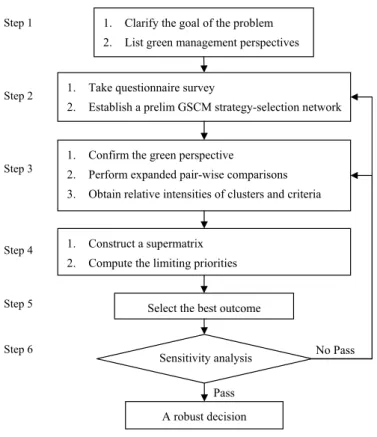
Because green strategies, regulations, and related activities are implicitly expressed in previous research, this study clarifies managerial levels and firms’ related contents and directs a strategy-selection problem. It further proposes a systematic decision-support procedure. Two types of questionnaire clarify the influential dimensions and their factors, and gauge intensity among the manipulated factors. After obtaining the limiting priorities regarding the factors, the study executes a sensitivity analysis to guarantee a robust decision. The proposed procedure is easier to follow than Saaty’s brainstorming [12] for tracing criteria and their interactions in a systematic way. The detailed procedure is presented as the following seven steps and in the flowchart (Fig. 1).
Fig. 1. Flowchart of the proposed approach.
Step1: Clarify the goal of the problem and list different green management perspectives.
The first step of problem-solving is to identify the problem and detect the circumstance under which it occurs. Here, the problem is choosing suitable green strategies for an organization. The decision-makers consider inner and outer factors, including political, economical, and social development, and the risks the companies could face. These factors influence the company’s green management direction. A similar concept also exists in the ANP, which is the control hierarchy. It assists decision makers in thinking about the spread of influence to all relevant factors. If the influencing relations are complicated, then it considers sub-criteria associated with the hierarchy.
Step2: Take a questionnaire survey from experts to establish a preliminary GSCM strategy-selection network.
After identifying the objective, establish a network to represent the problem. The problem’s structure is smaller, but relevant, and has precise pieces for ease of management [43]. Such a network probably considers the uncertainty and situations that will occur. Therefore, a questionnaire survey from experts helps subdivide the problem into several dimensions and establishes an appropriate set of network clusters and their elements, which are relevant to the control hierarchy.
As mentioned previously, it is possible to build group clusters in the analytical network according to green business functions derived from the PLM perspective, and elements included in each cluster with the literature review. Hence, the original framework was developed on the basis of the literature review; the researchers designed the first questionnaire and emailed it to the experts to collect their modifications to revise the definition of each cluster and criterion and confirm the relationships between each cluster to enhance the workability and practicability of the GSCM strategy-selection network.
Step3: Confirm the green management perspective, perform expanded pair-wise comparisons, and obtain priorities of the clusters and their element in the network.
Researchers employed another questionnaire, Saaty’s fundamental scale, to aggregate experts’ opinions concerning how important or dominant one element is over another with respect to the criterion that compares them [44]. These opinions are realized by pair-wise comparisons to obtain a ranking of priorities. The survey illustrates the work in three stages: (i) check environmental activities performed in the company and then verify the green management perspective according to the characteristics of each green management perspective (Table 1); (ii) make pair-wise comparisons among related clusters which are judged by experts; and (iii) deal with the interactions, including outer dependence among clusters and inner dependence among elements, conduct further
pair-wise comparisons between the elements of any two clusters by experts to get priorities represented by the ratio scale. In the third step, this will be zero when there is no influence or interaction, which is an extra questionnaire beyond the analytic hierarchy process. All reciprocal matrices should pass the consistency check, whose value is less than 0.1.
Step4: Construct a supermatrix and compute the limiting priorities.
Arrange all priority vectors, representing the impact of a given set of elements in a cluster on another element in the network, from the previous step as sub-columns of the corresponding column of an unweighted supermatrix,
W. Here, W is composed of k clusters (i.e.,
{
C1,C2, . . . ,Ck}
) and linkages of these clusters Wij, where Ck=
{
ek1,ek2, . . . ,ekn}
are the elements of the clusterk,(1) where Wij
=
Wi1j1 Wi1j2· · ·
Wi1jnk Wi2j1 1Wi2j2· · ·
Wi2jnk...
...
· · ·
...
Winij1 Winkj2· · ·
Winijnj
.
If there is no linkage between clustersCa and Cb, then Wab equals zero. Each column of the unweighted supermatrix is then normalized and synthesized to account for the overall clusters’ influence by column, and this operation makes the supermatrix’s column stochastic, known as a weighted supermatrixWa. Afterwards, the limiting supermatrixWncan be obtained with almost identical elements column-wise following this equation.
Wn
=
lim a→∞Wa
.
(2)The derived weights weight the elements of the corresponding column blocks of the weighted supermatrix. Two types of outcome are possible. One can obtain limiting priorities by multiplying the weighted supermatrix by itself ntimes until the columns stabilize [45]. The limiting priorities are the corresponding column values to each cluster and their elements.
Step5: Select the best outcome.
The limiting supermatrix provides the priorities’ information for the elements of each individual cluster. The strategy outcome with the highest value should be selected from the cluster of alternatives. Other priorities ranking in the different clusters are also provided.
Step6: Execute sensitivity analysis on the final outcome (to ensure the stability of the model).
Sensitivity analysis shows how the optimal solution responds to changes in the input parameters or elements in the network. It systematically changes the elements’ input parameters to see if the final selection is stable. One particular consideration is whether these changes alter the order of the final outcome by ANP [12].
Model validation verifies whether the model is sufficiently valid or credible [46]. Because the GSCM is a new issue with a broad spectrum, this study exerts sensitivity analysis by checking the strategy selection, with respect to possible inputs, to see if it fits top management’s company strategy. The proposed validation step may generate some important study in the future.
The quantitative results derived from ANP can indicate the ranking of elements included in each cluster. The decision makers thus should realize the most important activity and view it as the starting point to carry out green programs, or combine other compatible and important activities of other business functions to support the decision-making process. After defining the comprehensive steps, this study demonstrates the procedure by an example.
4. Case study
Company X is one of Taiwan’s leading electronics Original Equipment Manufacturing (OEM)/Own Branding & Manufacturing (OBM) companies. Its total revenue in 2007 was more than US$23 billion and it became a Fortune 500 company. As environmental concerns are increasing in the EU, CompanyXhad to obey related rules and legislation to make sure their products could be sold in European countries. It discovered, however, that the cost of some green activities owing to legal controls would affect its high-profit achievement. To simultaneously adapt to social environmental concerns and remain sustainable, top management decided to adjust its profit goal and become a corporation devoted to the community, committing itself to social responsibilities. As this kind of transformation is very difficult, CompanyXneeded to investigate how many environmental-related programs to implement in the organization and to understand the ‘‘green’’ degree of each core business function. Therefore, decision-makers organized a steering committee, built Green IT systems, and put DfE concepts into the design process for manufacturing environmental-friendly electronics products. It also disposes of EOF products and increases energy efficiency to reduce environmental degradation. The company still endeavors to enhance its green management capabilities, to become one of the most green electronics technology firms in the world, and to develop a better GSCM strategy to contribute to earth’s environmental sustainability.
This study targets both key managers related to the green programs of CompanyXand some outside experts, hoping to assist CompanyXin confirming the best GSCM strategy. Since the relations are quite vague and complex, ANP can evaluate tangible and intangible factors and represent relations by a dependence and feedback network. ANP can thus help Company Xchoose the appropriate GSCM strategy.
Step1: Clarify the goal of the problem and consider which green management perspective is similar to CompanyX’s real situation.
The problem is to choose a suitable GSCM strategy for Company X. The control hierarchy involves green management perspectives. The PLM identifies four business functions – design, purchasing, manufacturing, and marketing and service – and their related ‘‘green’’ activities. These functions and activities under strategies are organized into clusters and elements of the network, respectively.
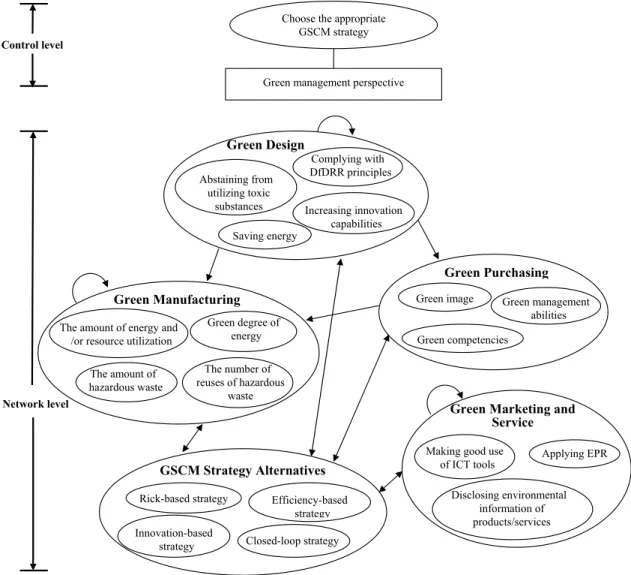
The proposed model includes the upper control level (the goal and the control hierarchy of the firm), and the lower network level consisting of five clusters: green design, green purchasing, green manufacturing, green marketing and service, and GSCM strategies. CompanyXshould confirm its green strategic attitude and then arrange other parts in the network level in sequence.
Step2: Conduct a questionnaire survey from experts to establish a preliminary GSCM strategy-selection network. To determine a network with the proper breadth and depth, this study asked five experts from inside and outside the company for their opinions via a questionnaire. Part A of the survey corrects the definition of each cluster, and Part B asks experts’ opinions about the relationships between each cluster (Appendix A).Fig. 2 illustrates the proposed network after organizing their opinions and confirming the validity of the GSCM strategy-selection network.
Step3: Confirm the green management perspective, perform expanded pair-wise comparisons, and obtain relative priorities of the clusters and their elements in the network.
The second questionnaire identifies the intensity and dependence relations among the clusters and criteria (Appendix B). Part A confirms Company X’s green management perspective; Part B and Part C are pair-wise comparisons between clusters and elements.
After querying five key managers responsible for planning and implementing green programs in the company, confirming that their green management perspective is proactive innovation, this study used Saaty’s 1–9 fundamental scales to make pair-wise comparisons. The number of questions, other than AHP’s, increased dramatically to check many dependent relations. Each matrix is measured by the inconsistency ratio (C.R) and then passed the check.
Step4: Construct a supermatrix and compute the limiting priorities.
After checking the consistency of each pair-wise comparison from the above five managers, this study calculates the geometric mean of individual judgments to specify the group judgments for each pair-wise comparison [47]. Next, it inserts the priorities derived from the paired comparisons into the corresponding positions of the unweighted supermatrix (Eq. (1)). Then, it derives the weighted supermatrix by multiplying each block in the unweighted supermatrix by the corresponding cluster weight (Table 2). Finally, this study multiplies the weighted supermatrix by itself until all the columns of the matrix are identical and then obtains a limiting supermatrix (Eq.(2)),
[
D1,
D2,
D3,
D4,
P1,
P2,
P3,
M1,
M2,
M3,
M4,
K1,
K2,
K3,
A1,
A2,
A3,
A4]
T=
[
0.
0243,
0.
0498,
0.
1119,
0.
0301,
0.
0275,
0.
1891,
0.
0720,
0.
0231,
0.
0373,
0.
0424,
0.
0341,
0.
0129,
0.
0215,
0.
0478,
0.
0428,
0.
0186,
0.
1402,
0.
0746]
T.Table 3shows an abbreviated explanation of the five clusters and their 18 elements. Step5: Select the best outcome.
The normalized priorities of the four GSCM strategies captured fromTable 4are 0.1550, 0.0674, 0.5076, and 0.2699, respectively. The ideal mode sets the highest priority at one and rearranges the rest in proportion. The result
Fig. 2. The GSCM strategy-selection network.
Table 2
The cluster weights of the analysis.
Green design Green purchasing Green manufacturing Green marketing and service GSCM strategy
Green design 0.27582 0.00000 0.00000 0.00000 0.48955
Green purchasing 0.10967 0.75000 0.00000 0.00000 0.18599
Green manufacturing 0.05722 0.25000 0.20000 0.00000 0.15640
Green marketing and service 0.00000 0.00000 0.00000 0.25000 0.16806
GSCM strategy 0.55729 0.00000 0.80000 0.75000 0.00000
shows that the innovation-based GSCM strategy is most suitable for CompanyX. In addition, the priorities of other elements in each cluster (i.e., green design, green purchasing, green marketing and service, and green manufacturing) are also advisable for the company.
Step6: Execute sensitivity analysis on the final outcome to ensure the model’s stability.
The sensitivity analysis is to understand if any parameter is more important in altering the final result. This study individually chooses one element and one cluster with higher priority for analysis.
6-1Criteria of the green design cluster:
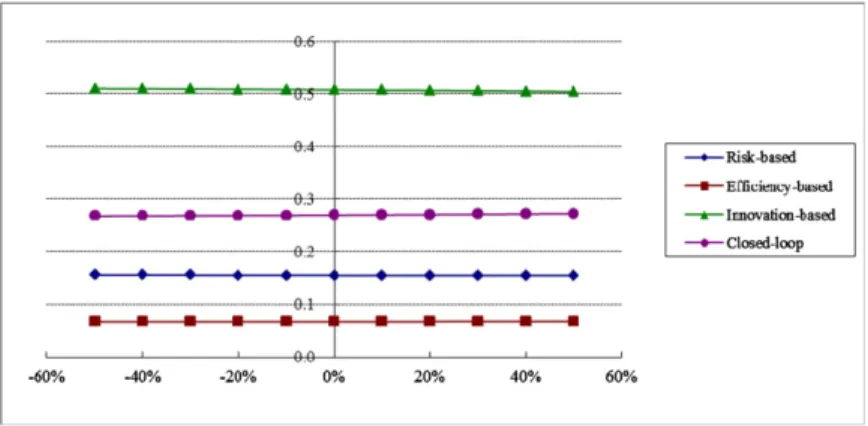
The priority of ‘‘green competencies’’, which is the highest priority in the limiting supermatrix, is increased and decreased by 10%–50%, respectively, but does not affect the overall rank of the green strategy much (Fig. 3).
Fig. 3. Sensitivity analysis w.r.t. the change of the weight of ‘‘green competencies’’ of green purchasing. (For interpretation of the references to colour in this figure legend, the reader is referred to the web version of this article.)
Table 3
Explanation of abbreviations.
D1 Abstaining from utilizing toxic substances D2 Complying with DfDRR principles D3 Increasing innovation capabilities D4 Saving energy
P1 Green image P2 Green competencies P3 Green management abilities
M1 The amount of energy and/or resource utilization M2 Green degree of energy
M3 The amount of hazardous waste M4 The number of reuses of hazardous waste K1 Make good use of ICT tools
K2 Disclose environmental information of products and services K3 Apply EPR A1 Risk-based strategy A2 Efficiency-based strategy A3 Innovation-based strategy A4 Closed-loop strategy Table 4
The overall results of the analysis.
GSCM strategy (alternatives) Ideal Normal Risk-based 0.3054 0.1550 Efficiency-based 0.1328 0.0674 Innovation-based∗
1.0000 0.5076 Closed-loop 0.5317 0.2699
6-2The cluster of green design:
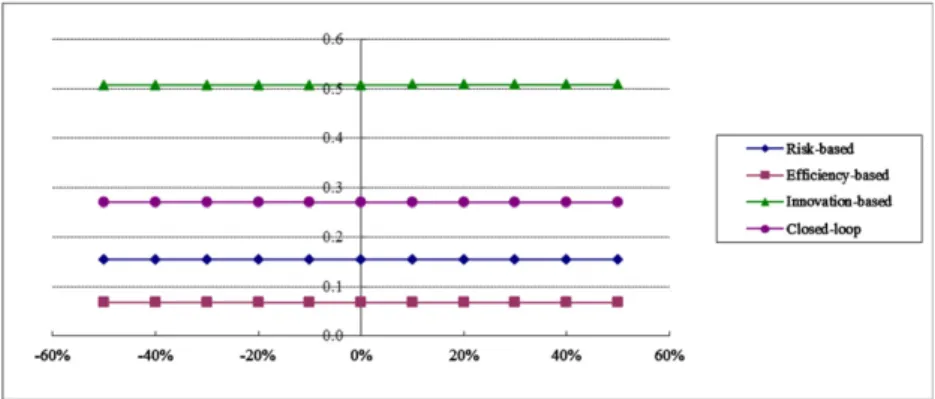
This study also increases and decreases the priority of the ‘‘green design’’ cluster by 10%–50%, respectively. The ‘‘innovation-based strategy’’ is still best for the company (Fig. 4).
Finally, this study uses the quantitative result of ANP analysis to draw a strategic coordinate graph (Fig. 5). First, it spreads four business functions on the four quadrants and places activities of the individual function in proper sequence according to their priorities obtained from the limiting supermatrix (the further ‘‘out’’ the position, the more important the activity).
The appropriate GSCM strategy for CompanyXis still the innovation-based strategy. The most important factor in the green design is thus innovation capabilities, and a company implementing green purchasing should understand the green competencies of each qualified supplier. In green manufacturing, the company should endeavor to decrease the amount of hazardous waste, and in green marketing and service, the company should apply extended producer responsibilities such as buying or taking back their products.
5. Discussion
One of the key components of a successful strategy is a thorough understanding of the competitive environments, especially during dynamic and unstable times. Using PEST (political, economic, social, and technological) analysis of the
Fig. 4. Sensitivity analysis w.r.t. the change the weight of ‘‘green design’’. (For interpretation of the references to colour in this figure legend, the reader is referred to the web version of this article.)
Fig. 5. Coordinate graph of each activity of the four business functions.
firm’s external environment, this systematic framework could help firms monitor changes in the macro-environment. After assessing industry attractiveness, the firm can consider which industry is better or more suitable to invest in, helping form a corporate strategy for the firm. Top management should then identify the industry’s competitiveness. Porter’s ‘‘five-forces’’ analysis allows decision makers to understand the dynamics and relationships existing in the industry, and therefore to choose the best competitive strategy. Though strategic competitive analysis is the most widely utilized, it lacks an internal-factors analysis. Therefore, many companies use SWOT (strength, weakness, opportunity, and threat) analysis to self-assess competitive advantage.
This study uses a single ANP network with strategic thinking to provide a guideline for the electronics industry on how to choose an appropriate GSCM strategy and achieve an effective green management. Saaty’s ANP methodology [12] is a popular MCDM technique that could help decision-makers to clarify the problem. It can classify criteria and alternatives
into each cluster, presented the relationships between each cluster by one-way or two-way arrows. Through this network, decision-makers may clearly understand a complex problem in a systematic way [21]. The ANP network is composed of two parts: (i) the upper lever is a control hierarchy or network, including the goal and control criteria, which affect the pair-wise calculations in the second part; and (ii) clusters and their interactions, which form a network of influence. After a series of pair-wise comparisons and calculations based on the network, the final limiting supermatrix yields the priorities [48,49].
For the components of the analytical network to be more practical and easier to understand for companies, this study uses PLM to investigate critical stages in the present procedures of most organizations. First, a firm must formulate a plan for the product or service it provides. ‘‘Design’’ is the core: designers or design departments of companies encompass DfE concepts as much as they possibly can to avoid using hazardous chemicals and to reduce costs that result from wastewater and solid waste disposal. Bhat [29] pointed out that an intelligent company should view green design as an approach to improve the competitiveness of its products. Second, because a large number of materials or parts are necessary to make up a product or to become a part of a service, companies should select sound suppliers to ensure the materials and components they buy satisfy environmental regulations, helping prevent hazardous substances from being created throughout the production process. Therefore, ‘‘purchasing’’ is another essential segment of the whole procedure. ‘‘Marketing and service’’ describe how a firm delivers finished goods to the market or a service to the consumer to attract consumers. As the electronics firm this study explores is involved in the manufacturing industry, ‘‘manufacturing’’ is the last and prerequisite function to take into consideration. To sum up, our analytical network defines ‘‘green design’’, ‘‘green purchasing’’, ‘‘green manufacturing’’, and ‘‘green marketing and service’’ as the main clusters of the network, and the remaining cluster is the ‘‘GSCM strategy’’, which presents four choices for decision-makers to choose.
As mentioned previously, if organizations want to choose an appropriate GSCM strategy, top management could refer to the results from several comprehensive analyses with a balance between short-term and long-term profits in business operations. The case company confirmed that the green management thinking is proactive, and the appropriate GSCM strategy presented in the final result is ‘‘innovation-based strategy’’. Companies utilizing the ‘‘innovation-based strategy’’ should possess professional environmental expertise and integrate specific relevant green activities, such as green design, green procurement to improve current processes, and product developments. In general, this strategy is more suitable for companies very concerned about environmental issues, which must invest some money or manpower into internal environmental improvement and promotion programs. One advantage of utilizing the ANP technique is to effectively evaluate which cluster and which factor are most important for achieving the chosen GSCM strategy in accordance with the green management perspective.
Empirical study demonstrates the effectiveness of the proposed model. Sensitivity analysis shows the optimal strategy to be robust. The rank of each GSCM strategy is very stable regardless of an increase or decrease in the priorities of one major element of the green manufacturing cluster, within a change of
±
50% of the original priority value. The final step validates the workability of the model. After such analysis, the company under study has a clear understanding of how business functions affect the GSCM strategy selection, and which one is more critical than others. If CompanyXchooses the innovation-based strategy, then the key elements of each business function are: ‘‘increasing innovation capabilities’’ in green design, strengthening ‘‘green competencies’’ in green manufacturing, decreasing ‘‘the amount of hazardous wastes’’, and ‘‘applying extended producer responsibility’’ in green marketing and service from the graph-based analysis. Therefore, top management can allocate resources according to the weight of each element in the four business functions. For example, ‘‘green design’’ and ‘‘green manufacturing’’ could be key development departments. ‘‘Innovation’’ and ‘‘hazardous waste reduced’’ are the most influential factors of the two business functions from the analytical model. Therefore, when top management decides to implement the GSCM strategy, they should increase the innovation capabilities of the staff in the design or R&D department, demand that they know the manufacturing procedures, and discuss innovative and feasible ways to cut the amount of e-waste with colleagues in the manufacturing department. If the business and competitive environments change, then the decision makers can also adjust their GSCM strategy to respond to such changes. In addition, the procedure has potential application for any other electronics manufacturer in choosing an appropriate environmentally-friendly strategy to direct future management.6. Conclusions
ANP is an appropriate technique to process an unstructured problem by considering mutually influential factors. It deals with tangible and intangible factors and represents the relations of dependence and feedback. Its result is stable through input changes and the convergence of the limiting supermatrix provides an advantage over other tools.
This study focuses on a green strategy selection for industry from the internal environment viewpoint. One could further consider external factors, such as social, legal, political, and regulatory factors, and establish the BOCR network for an elaborate analysis. It can also be extended to other activities, such as supplier selection, by adding more clusters in the network. The precise formulations of a real-world problem and well-established networks are difficult work. Although the results from the questionnaire survey can clarify the relations, efforts to investigate dependent and feedback relations in the network are cumbersome, and thus consistency in their judgments may not be enough. A systematic procedure might identify dependence relations among the clusters and their elements in the future. Therefore, it is important to revise the analytical procedure through other quantitative methods (i.e., ISM [50]) to simplify the dependence relations among the clusters and their elements more precisely.
Acknowledgement
The authors are very grateful to Mr. Frank Lin at one electronics firm for his great help during the analysis.
Appendix A
References
[1] B.M. Beamon, Designing the green supply chain, Logistics Information Management 12 (4) (1999) 332–342.
[2] K.F. Pun, Determinants of environmentally responsible operations: a review, International Journal of Quality & Reliability Management 23 (3) (2006) 279–297.
[3] L.Y.Y. Lu, C.H. Wu, T.C. Kuo, Environmental principles applicable to green supplier evaluation by using multi-objective decision analysis, International Journal of Production Research 45 (18) (2007) 4317–4331.
[4] A.A. Hervani, M.M. Helms, J. Sarkis, Performance measurement for green supply chain management, Benchmarking: An International Journal 12 (4) (2005) 330–353.
[5] J. Sarkis, A strategic decision framework for green supply chain management, Journal of Cleaner Production 11 (4) (2003) 397–409.
[6] Q. Zhu, J. Sarkis, Relationships between operational practices and performance among early adopters of green supply chain management practices in Chinese manufacturing enterprises, Journal of Operations Management 22 (3) (2004) 265–289.
[7] S. Poole, M. Simon, Technological trends, product design and the environment, Design Studies 18 (3) (1997) 237–248.
[8] F. Kurk, P. Eagan, The value of adding design-for-the-environment to pollution prevention assistance options, Journal of Cleaner Production 16 (6) (2008) 722–729.
[9] R.B. Handfield, R. Sroufe, S.V. Walton, Integrating environmental management and supply chain strategies, Business Strategy and the Environment 14 (1) (2005) 1–19.
[10] P. Salminen, J. Hokkanen, R. Lahdelma, Comparing multicriteria methods in the context of environmental problems, European Journal of Operational Research 104 (3) (1998) 485–496.
[11] I. Lipušček, M. Blhanec, L. Oblak, L.Z. Stirn, A multi-criteria decision-making model for classifying wood products with respect to their impact on environment, International Journal of Life Cycle Assessment 15 (4) (2010) 359–367.
[12] T.L. Saaty, Decision Making with Dependence and Feedback: The Analytic Network Process, RWS Publications, Pittsburgh, 1996.
[13] W. Bernhard, V. Harald, Evaluating sustainable forest management strategies with the analytic network process in a pressure-state-response framework, Journal of Environmental Management 88 (1) (2008) 1–10.
[14] G. Tuzkaya, S. Önüt, U.R. Tuzkaya, B. Gülsün, An analytic network process approach for locating undesirable facilities: an example from Istanbul, Turkey, Journal of Environmental Management 88 (2008) 970–983.
[15] G. Marianna, F.-M. Laia, B. Alessandra, T. Simona, Multi-criteria analysis for improving strategic environmental assessment of water programmes. A case study in semi-arid region of Brazil, Journal of Environmental Management 92 (2011) 665–675.
[16] G. Wang, L. Qin, G. Li, L. Chen, Landfill site selection using spatial information technologies and AHP: a case study in Beijing, China, Journal of Environmental Management 90 (2009) 2414–2421.
[17] R. Handfield, S.V. Walton, R. Sroufe, S.A. Melnyk, Applying environmental criteria to supplier assessment: a study in the application of the analytical hierarchy process, European Journal of Operational Research 141 (1) (2002) 70–87.
[18] T.J. Kull, S. Talluri, A supply risk reduction model using integrated multicriteria decision making, IEEE Transactions on Engineering Management 55 (3) (2008) 409–419.
[19] Q. Zhu, Y. Dou, J. Sarkis, A portfolio-based analysis for green supplier management using the analytical network process, Supply Chain Management: An International Journal 15 (4) (2010) 306–319.
[20] T.L. Saaty, K. Peniwati, Group Decision Making: Drawing Out and Reconciling Difference, RWS Publications, Pittsburgh, 2007.
[21] P. Aragonés-Beltrán, F. Chaparro-González, J.P. Pastor-Ferrando, F. Rodríguez-Pozo, An ANP-based approach for the selection of photovoltaic solar power plant investment projects, Renewable and Sustainable Energy Reviews 14 (1) (2010) 249–264.
[22] R.I. van Hoek, From reversed logistics to green supply chains, Supply Chain Management: An International Journal 4 (3) (1999) 129–134.
[23] R. Kopicki, M.J. Berg, L. Legg, V. Dasppa, C. Maggioni, Reuse and Recycling-Reverse Logistics Opportunities, Council of Logistics Management, Oak Brook, 1993.
[24] G. Noci, Design green vendor rating systems for the assessment of a supplier’s environmental performance, European Journal of Purchasing & Supply Management 3 (2) (1997) 103–114.
[25] W.R. Newman, M.D. Hanna, An empirical exploration of the relationship between manufacturing strategy and environmental management: two complementary models, International Journal of Operations & Production Management 16 (4) (1995) 69–87.
[26] C. Chen, Design for the environment: a quality-based model for green product development, Management Science 47 (2) (2001) 250–263. [27] R. Karlsson, C. Luttropp, EcoDesign: what’s happening? an overview of the subject area of EcoDesign and of the papers in this special issue, Journal of
Cleaner Production 17 (15–16) (2006) 1291–1298.
[28] P. Veerakamolmal, S. Gupta, Design for disassembly, reuse, and recycling, in: L. Goldberg, W. Middleton (Eds.), Green Electronics/Green Bottom Line: Environmentally Responsible Engineering, Newnes, Boston, 2000.
[29] V.N. Bhat, Green marketing begins with green design, The Journal of Business & Industrial Marketing 8 (4) (1993) 26–31. [30] M.J. Polonsky, P.J. Rosenberger III, Reevaluating green marketing: a strategic approach, Business Horizons 44 (5) (2001) 21–30.
[31] K. Green, B. Morton, S. New, Green purchasing and supply policies: do they improve companies’ environmental performance? Supply Chain Management: An International Journal 3 (2) (1998) 89–95.
[32] H. Min, W.P. Galle, Green purchasing practices of US firms, International Journal of Operations & Production Management 21 (9) (2001) 1222–1238. [33] S.V. Walton, R.B. Handfield, S.A. Melnyk, The green supply chain: integrating suppliers into environmental management processes, International
Journal of Purchasing and Materials Management 34 (2) (1998) 2–11.
[34] G.A. Zsidisin, S.P. Siferd, Environmental purchasing: a framework for theory development, European Journal of Purchasing & Supply Management 7 (1) (2001) 61–73.
[35] C.W. Hsu, A.H. Hu, Applying hazardous substance management to supplier selection using analytic network process, Journal of Cleaner Production 17 (2) (2009) 255–264.
[36] U. Pal, Identifying the path to successful green manufacturing, JOM Journal of the Minerals, Metals and Materials Society 54 (5) (2002) 25. [37] X.C. Tan, F. Liu, H.J. Cao, H. Zhang, A decision-making framework model of cutting fluid selection for green manufacturing and a case study, Journal of
Materials Processing Technology 129 (1–3) (2002) 467–470.
[38] Y. Zhang, Z.H. Li, T. Qi, S.L. Zheng, H.Q. Li, H.B. Xu, Green manufacturing process of chromium compounds, Environmental Progress 24 (1) (2004) 44–50. [39] J.M. Ginsberg, P.N. Bloom, Choosing the right green marketing strategy, MIT Sloan Management Review 46 (1) (2004) 79–84.
[40] M.J. Polonsky, An introduction to green marketing, Electronic Green Journal 1 (2) (1994) 1–10.
[41] A. Prakash, Green marketing, public policy and managerial strategies, Business Strategy and the Environment 11 (5) (2002) 285–297. [42] D. Simpon, D. Samson, Developing strategies for green supply chain management, Decision Line 39 (4) (2008) 12–15.
[43] K. Peniwati, Criteria for evaluating group decision-making methods, Mathematical and Computer Modelling 46 (7–8) (2007) 935–947. [44] T.L. Saaty, Decision making with the analytic hierarchy process, International Journal of Services Sciences 1 (1) (2008) 83–98. [45] T.L. Saaty, Theory and Applications of the Analytic Network Process, RWS Publications, 2005.
[46] H.G. Daellenbach, Systems and Decision Making: A Management Science Approach, John Wiley & Sons Ltd., New Jersey, 1994.
[47] T.L. Saaty, Group decision making and the AHP, in: B.L. Golden, E.A. Wasil, P.T. Harker (Eds.), The Analytic Hierarchy Process: Applications and Studies, Springer-Verlag, Berlin, Heidelberg, New York, 1989.
[48] Ş. Erdoğmuş, H. Arasb, E. Koç, Evaluation of alternative fuels for residential heating in Turkey using analytic network process (ANP) with group decision-making, Renewable and Sustainable Energy Reviews 10 (2006) 269–279.
[49] O. Bayazita, B. Karpakb, An analytical network process-based framework for successful total quality management (TQM): an assessment of Turkish manufacturing industry readiness, International Journal of Production Economics 105 (2007) 79–96.
[50] J. Thakkar, S.G. Deshmukh, A.D. Gupta, R. Shankar, Development of a balanced scorecard: an integrated approach of interpretive structural modeling (ISM) and analytic network process (ANP), International Journal of Productivity and Performance Management 56 (1) (2006) 25–59.