of SMP N 1 Timang Gajah).
THESIS
Submitted by: YUNI MAHTAWARMI
NIM. 140203134
Student of Faculty of Education and Teacher Training Department of English Language Education
FACULTY OF EDUCATION AND TEACHER TRAINING AR-RANIRY STATE ISLAMIC UNIVERSITY
DARUSSALAM – BANDA ACEH 2019 M/ 1440 H
iv
problem based learning (PBL) is an appropriate strategy to help the students improve their speaking skills. Therefore, the researcher conducted the research entitled “Improving Students‟ Speaking Skills by using problem based learning (PBL) Model. The aims of of this quantitative research are to investigate whether problem based learning improves students‟ speaking skills and to investigate the students‟ responses about problem based learning model. The location of this study was SMP N 1 Timang Gajah and the total sample were 19 students of class VIII- 1 in academic year 2018/2019. In collecting the data, the researcher used teaching experiment, pre-test, post-test and questionnaire. The findings show that the PBL improves students‟ speaking skills. This can be understood from the t-test result, where the calculated value of t-score is higher than t-table (8.66>1.73). In addition, the result of the questionnaire indicates that the majority of students are happy in learning speaking by using PBL model and most of them believe that the PBL model could help them to express their ideas in speaking and also motivate them in highly learning English.
v
In the name of Allah, the Most Gracious and the Most Merciful.
Alhamdulillah, all praises belong to Allah who has given the writer strength and health so that she can finish this thesis. Furthermore, abundance of peace is upon our prophet Muhammad S.A.W, his family, and companions who have guided the mankind of the world of knowledge.
Her deepest gratitude is dedicated to her supervisors, Mr. Habiburrahim, S.Ag, M.Com, MS, Ph.D, and Mr. Abdul Manar, M.Hum who taught and guided the researcher in writing this thesis.
Then, she would like to express her appreciation to Dr. T. Zulfikar, S.Ag.,M.Ed as the Chief of English Department and all staff, all lecturers and all of her friends in English Department for every help and support during her study in this University.
The writer dedicates her greatest gratitude to her beloved father and mother Sabcud and Sistiarti who keep praying for the writer‟s success. She also dedicates her special thanks and love to her auntie Erni Salwari and her uncle Mursaha and also her lovely brother and sister Anggion Rizka, Alfinoza Elhaya, Evi Sartika Rona and Rita Devi who supported the writer until thesis was completed. Their presence always motivates the writer‟s life.
vi
friends Elza, Uci, Fini, Ayu, Ike, Ara, Rizah, Shintia, and Rika who motivated her in finishing her study. A lot of thanks for everyone who helped and supported the researcher, may Allah SWT bless them all.
Ultimately, she sincerely hopes that the readers will give constructive critics and responses for the revision of this study.
May Allah always bless all of us, Amin.
Banda Aceh, December 2nd, 2018 The writer
vii CONTENTS APPROVAL LETTERS DECLARATION OF ORIGINALITY ABSRTACT ... iv ACKNOWLEDGEMENT ... v CONTENTS ... vii LIST OF TABLES ... xi LIST OF APPENDICES ... x CHAPTER I : INTRODUCTION A. Background of Study ... 1 B. Research Questions ... 3 C. Aims of Research ... 3
D. Limitation of the Study ... 4
E. Hypotheses ... 4
F. Terminology ... 4
G. Research Significance ... 5
CHAPTER II : LITERATURE REVIEW A. Previous Studies ... 6
B. Concept of Speaking ... 7
1. Definitions of Speaking... 7
2. The Functions of Speaking ... 9
3. Components of Speaking ... 11
4. Types of Speaking ... 13
5. Teaching Speaking ... 14
C. Concept of Problem Based Learning (PBL) ... 15
1. Definitions of PBL ... 15
2. Characteristics of PBL ... 16
3. Schema of the PBL Process in Teaching ... 18
4. Teacher‟s and Student‟s Role in PBL ... 20
a. Teacher‟s Roles ... 20
viii
CHAPTER III : RESEARCH METHODOLOGY
A. General Description of Research Location ... 24
B. Research Design ... 25
C. Population and Sample ... 26
D. Techniques of Data Collection ... 27
E. Techniques for Data Analysis ... 33
CHAPTER IV: FINDINGS AND DISCUSSIONS A. Findings of the Research ... 39
1. The Results of the Tests ... 39
a. Result of Pre-Test ... 40
b. Result of Post-Test ... 41
2. Examining Hypotheses ... 42
3. The Result of Questionnaire ... 44
B. Discussions ... 49
CHAPTER V: CONCLUSIONS AND SUGGESTIONS A. Conclusions ... 51
B. Suggestions ... 51
BIBLIOGRAPHY...52 APPENDICES
ix
LIST OF TABLES
Table 3.1 English Teachers of SMP N 1 Timang Gajah ... .... 24
Table 3.2 The total number of students in SMP 1 Timang Gajah... .... 25
Table 3.3 The Scoring Rubric for Speaking ... .... 28
Table 4.1 The Result of Pre-test and Post-test ... .... 40
Table 4.2 The Frequency Distribution of Students‟ Pre-test Score ... .... 41
Table 4.3 The Frequency Distribution of Students‟ Post-test Score ... .... 42
Table 4.4 Students‟ Pre-test and Post-test Score ... .... 43
Table: 4.5 English Lesson is One of Favorite Lessons ... .... 45
Table: 4.6 Student Interested in Speak in English ... .... 45
Table: 4.7 Student Difficulties in Speaking English. ... .... 45
Table. 4.8 The Student Opinion about English Materials That were Given by Teacher. ... .... 46
Table. 4.9 The Teacher Give Methods and Models in Learning Speaking... .... 46
Table: 4.10 The Technique Used by Teacher Make Students Easy to Learn Speaking ... .... 47
Table: 4.11 PBL Model Can Improve Speaking Ability... .... 47
Table: 4.12 Advantages of Learning Speaking by Using Problem Based Learning Model ... 48
Table: 4.13 PBL Model Can Help Expressing Idea of Speaking ... .... 48
x
LIST OF APPENDICES
1. The Consent Letter by the Dean of Tarbiyah and Teacher Training Faculty 2. The Recommendation Letter of Conducting Research From SMP N 1
Timang Gajah
3. Rencana Pelaksanaan Pembelajaran 4. Pre-test and Post-test
5. Data Analysis 6. Questionnaire 7. Rubric
8. Table of Degree of Freedom 9. Documentation of the research 10.Autobiography
1 CHAPTER I
INTRODUCTION
A. Background of Study
In studying English, learners have to master four skills, namely speaking listening, writing and reading. Speaking is a skill used as a mean of interaction to express and transfer ideas and emotions. According to Richards (2008), English language teaching speaking activities need to focus on how to help students to use and to communicate in English (as cited in Eyesus, 2015). This skill is considered important because most students often evaluate their success in English based on their proficiency in speaking. Therefore, developing effective methods to increase the students‟ performance as both language learner and language user can help enhance the students‟ English learning achievement in speaking skill
According to Brown (2001), oral communication competence or speaking skill is a goal of English learning. It has been considered as an initial skill that leads the learners to develop the other communication competences. Speaking also involves communicative performance and other important elements such as, pronunciation, grammar and vocabulary. However, it is assumed that developing speaking skill to young learners in Indonesia is not an easy task because English is a foreign language and it is not used in daily life.
To investigate young learners‟ proficiency in speaking English, the researcher conducted a preliminary study to one of the public junior high schools in SMP N 1 Timang Gajah. The researcher found that the students had several problem in speaking such as reluctance to speak, shyness, fear of committing oral mistakes, poor speaking ability, and lack peers or social circles with whom they can explore their speaking potentials.
The researcher considered the use of problem based learning (PBL) as an appropriate strategy to help the students improve their speaking skill. As states by Preetha (2006), PBL is a constructivist pedagogy in which the students learn to develop critical thinking skills by solving real world problem in small groups. In the learning process of PBL, the students work with classmates to solve complex and authentic problems that help develop content knowledge as well as problem-solving, reasoning, communication, and self-assessment skills (Watson, 2001, as cited in Duch, Groh & Allen, 2001).
PBL can be incorporated into any learning situation. According to Duch and Allen (2001), course content of PBL can promote the development of critical thinking skills, problem-solving abilities, and communication skills. It can also provide opportunities for working in groups, finding and evaluating research materials, and life-long learning. Mufaidah‟s (2014) study concluded that applying problem based learning (PBL) could potentially motivate, empower and challenge the language learners, which usually resulted in building the learners‟ confidence, improving the students‟ language skills, and learning become fruitful
for the learners because they exhibited their abilities to plan, manage, and accomplish projects through their content knowledge and language skills.
Departing from the discussion above, the researcher wanted to apply the PBL in the process of teaching English speaking skills at a junior high school in Aceh. The findings of this study are reported in this minor thesis entitled “Improving Students‟ Speaking Skills by Using The Problem Based Learning (PBL) Model (A Study at Second Grade Junior High School of SMP N 1 Timang Gajah).”
B. Research Questions
Based on the background outlined above, the questions of the current research are:
1. Could the Problem Based Learning improve the students‟ speaking skills? 2. What are the students‟ responses about Problem Based Learning in
improving their speaking skills?
C. Aims of the Study
The aims of this research are shown below:
1. To investigate whether Problem Based Learning can improve the students‟ speaking skills.
2. To investigate the students‟ responses about Problem Based Learning in improving their speaking skills.
D. Limitation of the Study
This research focused on the speaking skill by using the PBL model in teaching and learning process. The location of this research was SMP N 1 Timang Gajah and the subjects of this research were 19 students of class VIII-1 in academic year 2018/2019 .
E. Hypotheses
The hypotheses of this research can be stated as follows:
Ha : The implementation of the PBL model has a statistically significant effect at the level of significance ( =0.05) in improving the students‟ ability in speaking.
H0 : The implementation of the problem based learning model does not have a statistically significant effect at the level of significance ( =0.05) in improving the students‟ ability in speaking.
F. Terminologies
To provide a better understanding of this research, it is necessary to explain some terms in order to help the readers understand them more easily. They are:
1. Improve
Webster (2012) says that improve is to make something that has been learned continuously. In this context, improve means the progress in what is desirable and to enhance the value or quality in speaking.
2. Problem Based Learning
Boud and Feleeti (1997) explain that the PBL is a way of constructing and teaching courses using the problem as the stimulus and focus for the student activity. In PBL the students have learned the knowledge related to the problem as well as having skills to solving some problems in speaking.
3. Speaking
Levey (2002) define speaking as an interactive process of communication that involves producing, receiving and processing meaning in formation. Moreover, speaking is a tool as a survival skill in life. In this study, the focuses were four aspects of speaking: grammar, pronunciation, word choice, and fluency.
4. Skill
Harmer (2001), states that skill is a special ability to do something. In particular, this study discusses only skill in English, called speaking skill.
G. Research Significance
The study is expected to be a contribution for several aspects. First, English teachers can refer to PBL model as an alternative in teaching speaking and improve students‟ in speaking competences. Second, the students can develop the ability in speaking English, increase their activity in learning, and develop cooperative skill. Third, researchers, can have insights and experiences as well as input for future research in PBL model.
6 CHAPTER II
LITERATURE REVIEW
A. Previous Studies
Several studies have been conducted in terms of PBL model. A study by Othman and Shah (2013) entitled “Problem Based Learning in the English Language Classroom” aimed to investigate the effects of PBL to the language class students in term of the course and content language development. The findings from this research showed that in the PBL group the student had improvement in their essay, while, in non-PBL group had no improvement.
Another study conducted by Mufaidah (2014) entitled “Problem Based Learning: Enhancing Students‟ Speaking Skill on the Second Year Student of SMP N 1 Atap Bandung in the Academic Year 2013/2014” aimed to investigate how PBL could enhance the students‟ speaking skill through bazaar activity. The study found the students‟ speaking skill in bazaar activity was good and bazaar could increase the students‟ activeness, student motivation, and also vocabulary. In addition, the study concluded the PBL method with bazaar activities provided more knowledge about English in learning process.
Inel and Balim (2015) conducted a study entitled “The Effects of Using Problem-Based Learning in Science and Technology Teaching Upon Students‟ Academic Achievement and Levels of Structuring Concepts”. This study explored the impact of the problem-based learning method used in science and technology teaching upon elementary school students‟ construction levels for
the concepts concerning the “Systems in Our Body” unit in the science and technology course and their academic achievement. The study showed that the PBL was more effective in improving students in the science and technology and more positive developments in teaching.
These previous studies contributed a lot in helping the researcher got through the research. These studies have similarities with the present study; however, there was a difference and new problems set by the researcher in order to produce original new work in the term of sample, teaching material and the activities in the learning process.
B. Concept of Speaking
This section discusses of the definitions, the functions, the compenents, the types of speaking, and teaching the speaking.
1. Definitions of Speaking
Fulcher (2013), states that speaking is the verbal use of language to communicate with others. According to Adam (2005), speaking is “an oral communication between two or more person to express ideas talking together” (p. 78). Hybel, Richard and Weaver (2001) explain that speaking is a process in share the information, opinions, and feelings.
In addition, Rizkiah (2014) says that speaking is the action in conveying information and expressing the feeling. Mufaidah (2004) adds that, “speaking is an interactive process of constructing meaning that involves producing, receiving and processing the information” (p. 8). In addition, Brown (2001) states that
speaking is one of language skill which is very important to be mastered by students in order to be good communicators.
The ability to use the language as a means of communication often becomes one of the indicators of success speaking. Bailey and Nunan (2005) argue that speaking is the important aspect of language learning whether it is as a second or a foreign language that can be measured from the ability of the students in the learning process. To improve the speaking skill, the students should practice their speaking in learning because without the ability to speak, it would be impossible to have a natural communication among people.
Based on the above definition, speaking can be said as the way of someone or people in describing something with oral communication as an activity. Speaking also used in many different purposes and each purpose involved the different skill such as, to express our ideas, clarify the information, persuade someone or someting.
In addition, speaking is one important skill in expressing ideas, opinions, or feelings to others. Speaking also plays an important role in life because all activities of life are done with communication. By communication, people are able to create a relationship, to inform, to share, and to find information. In other words, people can do whatever they need through communication. In this case, speaking is the skill needed by the students in order to convey their ideas for easy communication.
2. The Functions of Speaking
Several language experts have attempted to categorize the functions of speaking in human interaction. Brown and Yule (2000), as cited in Richards (2008), explain that the functions of speaking are divided into three categories including are talk as interaction, talk as transaction and talk as performance. Below are the explanations of each function of speaking:
a.Talk as interaction
The main function of this type is to focus on social interaction in communication. This is about how people delivers the messages to the others and therefore, they must use their speaking skill to communication. b. Talk as transaction
In this type, the focus is to convey the information to make people understand what we want to say clearly and accurately. For example, student may be involved in some activities in language lesson to explore concept associated with tenses and reduction. Furthermore, talk as transaction has several main features as follows:
1). Focus to the main information
2). Only focus to the message and not the participants
3). Use communication strategy to make someone understood 4). Use the frequent questions, repetitions, and comprehension
checks
5). Use the negotiation and digression
Richards (2008 p. 4) also mentions some of the skills involved in using talk for transactions, they are:
1). Explaining a need or intention 2). Describing something 3). Asking-questioning 4).Confirming information 5). Justifying an opinion 6). Making suggestions 7). Clarifying understanding 8). Making comparision. c. Talk as performance
In this case, speaking activities are more focused on monolog rather than dialog. The function of speaking as performance occurs at speeches, public talks, public announcements, and story tellings. For examples, giving a class report about student experience, conducting a class debate, and making a sales presentation. The main features of talk as performance are:
1). Focus to the message and the participant 2). It reflects organization and sequencing 3). Form and accuracy is always important 4). Language is more like written language 5). It is often monologic
Some of the skills involved in using talk as performance include: 1). Using an appropriate format
2). Presenting information in an appropriate sequence 3). Maintaining audience engagement
4). Using correct pronunciation and grammar 5). Creating an effect on the audience
6). Using appropriate vocabulary
7). It uses appropriate opening and closing
In conclusion, there are three functions of speaking that are categorized by the expert including “talk as interaction, talk as transaction, and talk as performance”. These are the kinds of speaking activities that people usually use in daily life according to their different functions.
3. Components of Speaking
There are a number of speaking components in English as stated by Wipf (1982, p. 2), namely:
a. Pronunciation
Pronunciation is the most important element in determining the success of communication. Without a good pronunciation the listener will difficult to understand and get the point of what the speaker says.
b. Vocabulary
Vocabulary is one of the important components in learning speaking. According to Craff (1998), vocabulary is classified into two types. The first is active vocabulary which is the words used by students
to understand the meanings and used constructively in speaking. The second one is passive vocabulary which is the word that the students can recognize and understand when they are used in context.
c. Grammar
Grammar is generally thought to be a set of rules specifying the contact ordering of words at the sentence level (Nunan, 2003). In addition, grammar is the ordering of words arranged into a sentence to give a meaning.
d. Fluency
Fluency can be defined as the ability to speak smoothly and readily. According to Lambardo (1994) states that fluency has the meaning as the way of someone speak with normal speed, like native speaker or they who own the language because the one who own the language can dispose the language skill.
e . Comprehension
Manser (1991) defines Comprehension as the ability to understand something. In speaking, Comprehension is certainly needed so that the speaker can initiate the communication and the listener can respond to it. Comprehension is important to avoid misunderstanding between a speaker and a listener so that communication can be achieved successfully.
4. Types of Speaking
As stated by Brown (2004, p. 141) the basic types of speaking are divided into five categories, namely:
a. Imitative
Imitative is the skill to imitate a word, a phrase or possibly a sentence. Imitative is not only part of phonetic level and oral production, but also includes a number of prosodic, lexical, and grammatical properties of language.
b. Intensive
Intensive is the production of short tense of oral language designed to demonstrate competence in a narrow band of grammatical, phrasal, lexical, or phonological relationship such as, prosodic elements-intonation, stress, rhythm, and juncture. For example, reading aloud sentence and dialogue completion.
c. Responsive
Responsive includes a short conversation, standard greetings, small talk, and simple request and comments. On the other hand, responsive is the interaction and the test of comprehension.
d. Interactive
Interactive speaking is in the length and complexity of interaction, which sometimes includes multiple exchanges and or multiple participants. For instance, interview, discussion, game and role play.
e. Extensive (monologue)
Extensive type includes speeches, oral presentations, and story-telling during which opportunity for oral interaction from listener is either highly limited or ruled out together. This type needs more action and interaction to the listener.
5. Teaching Speaking
Teaching speaking is not always easy to do, especially in teaching young learners. The teacher provided the opportunity for the students to learn and to think. The teacher needs to find the method that can encourage the students in learning speaking actively in the classroom.
Harmer (1998, p. 87) explains that there are three basic reasons to give the students speaking tasks which can provoke them to use all and any language at their command. The three basic reasons are:
a. Rehersal: getting students to have free discussion gives them a chance to rehearse having discussions outside the classroom.
b. Feedback: speaking tasks where the students are trying to use all and any language they provide feedback for both teacher and students. c. Engagement: good speaking activities can and should be motivating. If
all the students are participating fully and if the teacher has set up the activity properly and give sympathetic and useful feedback, they will also get satisfaction from it.
In addition, Basher (2011, p. 36) describes that language learners need to recognize that speaking involves three areas of knowledge:
a. Mechanics (pronunciation, grammar, and vocabulary): using the right words in the right order with the correct pronunciation.
b. Functions (transaction and interaction): knowing when clarity of message is essential (transaction/information exchange), and when precise understanding is not required (interaction/relationship building).
c. Social and cultural rules and norm (turn taking, rate of speech, length of pauses between speakers, and relative roles of participants).
Understanding how take into account who is speaking to whom in what circumstances, what about, and the reason for.
Thus, there are three areas of language knowledge that should be known by the language learners. It includes mechanism, functions, and social-cultural rules and norms.
B. Concept of Problem Based Learning (PBL)
This section discusses the definition, the characteristics, and the schema of the PBL process in teaching, as well as the teacher‟s and student‟s role in PBL.
1. Definitions of PBL
Baded and Major (2004) explain that the problem based learning (PBL) is an approach in which the students to develop metacognitive skills and to expect students in use reasoning abilities to solve complex problem. Tan (2003) says that PBL includes the life-wide learning goals of self-directed learning,
information-mining skills, collaborative - team learning reflective and evaluative thinking skills.
On the other hand, Torp & Sage (2002) said the PBL is a powerful strategy for curriculum, instruction and assessment that rich foundations both in experiential learning theory and philosophy at the professional school level. Pursuant to Delisle (1997, p.7) explained that “the problem based learing can work well with all students, making ideal strategies for heterogeneous classroom where students with mixed abilities can pool their talents collaboratovelly to invent a solution” (as cited in Tan 2003, p. 30).
In consequence, the problem based learning is an approach can develop students abilities in learning, students learn to find the information based on the real world problems, and learn from their experience to work in group and how to solves some problems.
2. Characteristics PBL
PBL approaches in a curriculum usually include the following characteristic (Tan, 2002):
a. The problem is the main point of learning
b. The problem is usually used a real-world problem that appears unstructured, it is meant to be as authentic as possible.
c. The problem of PBL promotes the solution by taking into consideration knowledge from several subject and topics.
d. The problem challenges students‟ current knowledge, attitudes and competencies, the calling for identification of learning needs and new areas of learning.
e. Self-directed learning is primary. Thus students assume major responsibility for the acquisition of information and knowledge. f. Learning is collaborative, communicative and cooperative. Students
work in small group with a high level of interaction for peer learning, peer teaching and group presentation.
g. Development of investigation and problem-solving skills is as important as content knowledge to solve the problem. The PBL tutor thus facilitates and traines through questioning and cognitive coaching
h. Closure in the PBL process includes synthesis and integration of learning
i. PBL also includes with an evaluation and review of the learner‟s experience and the learning processes.
The goals of PBL are content learning, acquisition of discipline related heuristic and development of problem-solving skills. PBL also includes the life-wide learning goals of self-directed learning, information- mining skills, collaborative and team learning, and reflective and evaluative thinking skills (Tan, 2002).
3. Schema of the PBL Process in Teaching.
The following are the schema of PBL in teaching process (Tan, 2003) a. Meeting the problem
At this stage, the problem scenario acts as a stimulus to scaffold and extend a realistic contex students might encounter in the future. The activities in this first tutorial includes:
1). developing collegiality
2). individual reading, reflection and inquiry 3). commitment to team roles and to the group 4). brainstorming and articulation of probable issues
5). commitment to deliberate on problem scenario and problem analysis
b. Problem analysis and learning issues
At this stage, the students‟ prior knowledge is activaties and ideas are generated that call for futher learning. Students are required to work independently on their own problem, searching for information through various resources. This tutorial also involves:
1). Brainstorming and analysis of problem (e.g. generation of possible explenations and hyphothesee)
2). Identification of learning issues and formulation of learning objectives
In short, the tutor emphasizes the ideas that real life issues are often fuzzy and, faced with the problems, we need to seek theories and sometimes multidisciplinary knowladge bases to address the various issues we have to tackle.
c. Discovery and reporting
In this part, the students report their discovery of learning in their groups. At this peer-teaching stage, the students gather to share the new information they have individually discovered. The students practice group collaboration and communication skills through question and seeking of futher information from one another.
d. Solution presentation and reflection
This involves contextualization and application of the knowledge to the situation. The students rephrase and paraphrase the knowledge acquired and demonstrated their new knowledge. Sometimes they asked some questions and tutor helps them to clarify the hasitation.
e. Overview, integration and evaluation
The review and evaluation is forms an integral part of learning. Students are encouraged to critique in their learning resources (their velue, reliability and usefulness for future learning). The student reflect on the new knowledge they have learnt as a result of the problem. The totor helps them to summarize and integrate major principles and concepts. The group members also evaluate their activity in terms of being a problem solver, a self-directed learner and as members of the team.
The schema of the PBL process could be part of a curriculum that takes about six weeks with one sesion each week. Following the formal PBL tutorials and meeting sessions, time is needed for sel-directed learning. If the problem is more complex, it may take a longer period with more iterations of problem analysis, learning issues and discovery and reporting before the groups move on to the other solution presentation.
4. Teacher‟s and Student‟s Roles in PBL
a. Teachers Roles
As stated by Tan (2003, p. 43) the theory and practice of the teacher as facilitator role in problem based learning as followed:
1). Facilitating the PBL process of learning (e.g. changing mindsets, developing investigation skill, engaging in collaborative learning) 2). Training students in problem solving (e.g. deep reasoning,
metacognition, critical thinking, and system thinking)
3). Designing the problem or the scenario using the real world problem. 4). Mediating the proces of obtain infomation (e.g. scanning the
information environment, accessing multiple information sources, making connections).
In conclusion, PBL teacher have a role to manage the learing environment and encourage students‟ engagement with and immersion in the problem. The teacher also plays an active role in facilitating collabortive inquiry and students‟ learning process.
b. Students Roles
As stated by Baden & Major (2004, p. 83) there are two roles of student‟s in problem based learning:
1). Individual roles and responsibilities
The student follows the list of individual roles that given any time to assume, the students also have a chance to undertaken more than one role at the same time
2). Practical, real-world problem solver
The student in a problem based learning course serves first as a practical problem-solver. In this role that a student analyses the situation, identifies the overarching structure of the problem and develops solutions to the problem.
3). Expert or decision-maker
The student analyses the situation in order to make a variety of decision and identifies the learning issues within a given situation. The student may also suggest team member assignments and appraise the credibility of the infomation shared in team sessions.
4). Self-directed learner
Self-directed learners are independent motivated individuals who set clear goals, plan ahead, seek challenges and push normal limits to achieve high standards.
5). Communicator
As the communicator, students learn to speak effectively and directly to the team and present their ideas clearly. They communicating in a language that make their peers understand.
6). Advocate
Students in PBL teams become supporters in finding reasons for clients, defending a stance or a cause, and encouraging team members to agree with a position or with new information. Students prepared to offer representation, help and advice to constituents of the problem and to follow team members.
7). Participator in a community of learners
Students as facilitator works to meaningful ways to enhance, enrich and celebrate other team members. Students seek share learning and then act on what they have learned.
8). Scientist of scholar
Students as a promblem solver is the producer of knowledge and develop strong background knowledge in order to solve the problem. They establish clear goals to guide their direction and use appropriate procedures for investigation. They obtain significant results and are given opportunities to reflect the findings.
9). Apprentice
In this case, the students play a role in observing and applying thought processes in certain fields or disciplines. The Students also
become tutors for themselves by transmitting what they have learned to order students in the team.
10). Explorer
In this role, student engage to find a new problem and explore possible solutions. They try to think „out-the-box‟ and have time to reflect upon their discoveries and compare them with existing knowledge.
11). Creative and critical thinker
As creative thinkers, students analyze the information by clarifying and setting the purpose and then selecting a strategy to achieve the purpose. They also evaluate the information, which they do through applying knowledge, making connections and formulating questions. They also evaluate information, monitor and manage learning and revise purpose and strategy.
In conclusion, students in PBL is the center of teaching and learning process. Student shere the resposibility for their learning and take some ownership as well as assuming multiple and changing roles within a new context as the face in many resposibility.
24 CHAPTER III
RESEARCH METHODOLOGY
A. General Description of Research Location
The location of this research took place in SMP Negeri 1 Timang Gajah. Located at Jl. Bireun – Takengon, Reronga, Gajah Putih Sub-distruct, Bener Meriah District. Futher information about this school is provided below:
1. The School
This school was established in 1981, and is currently led by Mrs. Sistiarti S.pd. The school has thirteen rooms, consisting of eight classrooms, one head master‟s and assistant‟s office, one teacher room, and one administration office. It has also one library, one natural science laboratory, one computer laboratory, one language laboratory, four bathrooms, one parking area, and one canteen.
2. The Teachers
In the teaching learning process, the teachers play an important role in guiding the students to reach the goal of curriculum. SMPN 1 Timang Gajah has two English teachers.
Table 3.1 English Teachers of SMP N 1 Timang Gajah
No Name Graduated from
1 Mayang Murni S.Pd. SERAMBI MEKKAH
2 Radiah S.Pd. ABULYATAMA
3. The Students
Based on the data obtained on August 5th, 2018, the total numbers of the students‟ at SMP N 1 Timang Gajah were 180 students. They were divided into three classes for all grades. The distribution of the students in each class is provided in the following table:
Table 3.2. The total number of students in SMP 1 Timang Gajah No Grade Total Class Male Female Total
1 First 3 25 30 55 2 Second 3 28 32 60 3 Third 3 30 35 65 Total 3 83 9 7 180 Source: The administration office of SMPN 1 Timang Gajah, August5
th 2018
4. Curriculum
Curriculum is a set of plan and the controller of the objective, content, and subject material. SMPN 1 Timang Gajah implements the 2013 curriculum which uses scientific approach. Scientific approach consisted of five steps: observing, questioning, associating, exploring, and communicating.
B. Research Design
The method used in this research was quantitative research. Quantitative research is a method of using statistical and computational data operasional variables and statistics that used to describe variables; to examining the relationship among variables and to determine caused and effect interactions between variables of research (Meizalia, 2009).
In this research the researcher conducted an experimental method. Experimental method is the one of the quantitative research which measures the causality of relationship strongly (Prasetyo, 2005). According to Cresswell (2014), there are four main types of experimental research designs including true experimental, quasi experimental, pre-experimental, and single subject design. In this study, the researcher selected experimental design, with one group pre-test and post-pre-test design.
In addition, the researcher used experimental teaching in order to find out whether the model effective or not in improving the student achievement in speaking skill. In this research, pre-test was given to know student ability before implementing the problem based learning as a model in teaching. After all materials were taught, the students were given a post-test in order to know their learning outcomes after the PBL.
C. Population and Sample
1. Population
Acording to Sugiyono (2008), the population is a general area including of object/subject which has specific characteristics decided by researcher to be studied and concluded. The population of this research was all students at the second grade of SMPN 1 Timang Gajah. The school has 3 classes for the second grade: VIII 1, VIII 2, dan VIII 3. The total number of three classes was 60 students
2. Sample
The sample of this study was VIII 1 of SMPN 1 Timang Gajah that consisted of 19 students. In selecting the sample, the reseracher used purposive sampling as a technique to determine the sample. Purposive sampling is a technique to determine the sample with a certain aims in accordance to needs of the research with a certain characteristics.
The sample characteristics were as follow:
a. Teacher recommended doing a treatment to the class VIII 1.
b. The class was intended for good learners and has good motivation especially in learning English.
D. Techniques of Data Collecting
In this study, the researcher used several instruments in collecting the data: tests, experimental teaching, and questionnaire.
1. Test
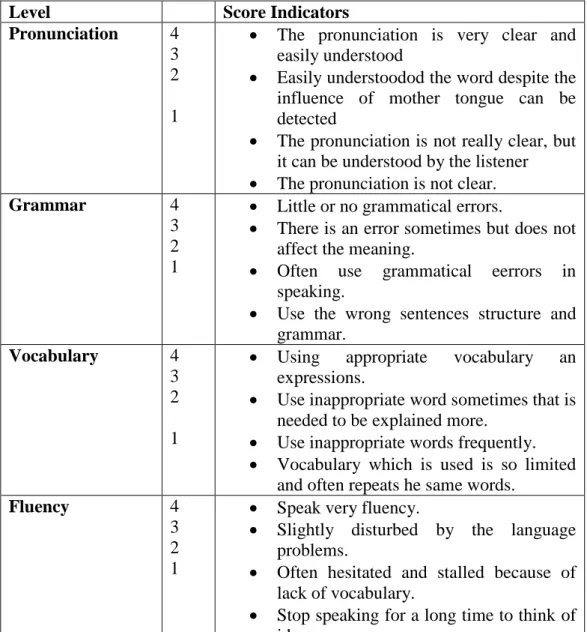
Test was one of the instruments used to collect the data and information needed in this research. It was intended to find out the students‟ ability before and after the treatment was carried out. Specifically, the tests were used to find out the students‟ achievement in terms of fluency, grammar, word chosen and pronunciation.
The rubric system for the tests adopted from Theresa (2001) the rubric was used for measuring students‟ achievement in speaking in pre-test and post-test. In order to find out the student‟s ability in speaking English, each student would get the maximum of 16 points if they speak clearly. In contrast, the
students would get the minimum score of 4 point if they could not utilize their English well.
Table 3.4 The Scoring Rubric for Speaking
Level Score Indicators
Pronunciation 4 3 2 1
The pronunciation is very clear and easily understood
Easily understoodod the word despite the influence of mother tongue can be detected
The pronunciation is not really clear, but it can be understood by the listener
The pronunciation is not clear.
Grammar 4
3 2 1
Little or no grammatical errors.
There is an error sometimes but does not affect the meaning.
Often use grammatical eerrors in speaking.
Use the wrong sentences structure and grammar.
Vocabulary 4 3 2 1
Using appropriate vocabulary an expressions.
Use inappropriate word sometimes that is needed to be explained more.
Use inappropriate words frequently.
Vocabulary which is used is so limited and often repeats he same words.
Fluency 4
3 2 1
Speak very fluency.
Slightly disturbed by the language problems.
Often hesitated and stalled because of lack of vocabulary.
Stop speaking for a long time to think of idea.
Theresa (2011). Tool and Technique for classroom Assessment
The test was conducted twice; before and after applying problem based learning in teaching speaking. Information about the tests is explained in detail as in the following.
a). Pre-test
Pre-test is used in the first meeting to measure the ability of students before given t he treatment. The researcher asked t h e students to speak free topics in front of the class for two minute. The researcher recorded the video of what they were talking during the presentation. This record was used to analyze the ability of students speaking skill interm of pronunciation, grammar, vocabulary and fluency.
b). Post-test
Post-test was used to find out the improvement of students speaking after given the treatment. The researcher also asked the students to speak about “specific topics” and they had to prepare in their group and practice the conversation in front the class. The researcher did the same steps as in the pre-test. The recording of students‟ presentation was analyzed to find whether or not there was the improvement after given the treatment.
2. Experimental Teaching
During the study, the researcher conducted an experimental teaching in the second grade students of SMP N 1 Timang Gajah. The researcher used problem based learning (PBL) as a model in teaching speaking of experimental class. The researcher used PBL to know the progress of students‟ achievement in speaking skills. Each meeting took 1 hour and 40 minutes and the students have taught step by step through several techniques, including simulation and role play. The
researcher provided opportunities to the students to understand learning before starting the teaching and learning process. The following are the details of each meeting in experimental teaching:
1. First Meeting
In the first meeting, the researcher introduced herself as well as told the students about the purpose of her presence. Then, the researcher explained what is the PBL model and how its role of model in the learning process. Then, the researcher did the pre-test to measure the ability of students before giving t he treatment. The researcher asked the students to speak about free topics in front of the class for two minutes. The researcher recorded the video of what they were talking during the presentation. The recording was used to analyze the ability of students speaking skill interm of pronunciation, grammar, vocabulary and fluency.
2. Second Meeting
At this meeting, the researcher started to apply PBL as a model in teaching the greeting card by using some techniques such as simulation and role play. The first, the researcher showed the picture and the short video about greeting card, the researcher attracted students by asking some questions such as, “Have you ever seen this card?”, “What do you think about this card?”. This process was a kind of simulations aimed to activate students‟ background knowledge as the main purpose of PBL model. The second, the researcher explained more about the types, generic structure and functions of text greeting card. Then, the researcher divided students into some groups that consit of 4 or 5 students. The researcher tried to provide students some problem such as giving a short story about football
championship, and ask the students to solve the problem from the story and to make some expression based on the story. The last, the students would present some expression that they had created based on story in their groups. This process was kind of role play aimed to give the opportunity to students to improve students‟ speaking skill as the main purpose of PBL model.
3. Third Meeting
At this meeting, before starting the learning process, the researcher gave the simulation like showing the short video about conversation related to the materi of greeting card. The researcher asked some questions to the students such as “what this video talking about?”, “can you mention the expression about congratulation?”. After giving the simulations, the researcher asked the students to write some vocabularies related to the expression in greeting card.
In addition, the researher divided students into some groups and provided a short text about greeting card and each group has different occasion as the problem for students to work in group and discuss what is the card talking about, they shared the information that they got in the learning process related to the type, generic structure, and function of greetng card. The researcher gave the opportunity to the groups to explain what they have discussed and share the information to other groups, then the other groups gave some comments and opinions to the groups that were presenting in front of the class.
4. Fourt Meeting
The last meeting, before starting the class, the researcher asked students to mention some vocabularies related to the expression of greeting card. The
researcher showed some pictures of greeting card with some expression. The researcher divided students into some groups and provided the different pictures to each group. The researcher gave some instructions before the students worked in groups. The researcher asked students to guess the appropriate topic based on the picture and students should make a short greeting card and short conversation by using an approriate expressions. The researcher managed the class and group during the discussion process. The students and their groups took 25 minutes to complete their work.
The groups that would present their projects in front of the class should put their greeting cards on the board. Every member must take a part in presenting their project. Each group has a total time about 10 minutes to present the project related to the topic and function of greeting card. Then, the researcher gave the post-test to each member in 2 minutes to talk and take a role in the conversation. The researcher did the same steps as in the pre-test and record the students‟ presentation by using the rubric to analyzed a n d to find the improvement students‟ speaking skills after getting the treatment.
3. Questionnaire
Questionnaire had the list of questions needed to be filled out by the respondents. The role of this technique was to obtain the data of the respondents of the research. The aim of the questionnaire in this study was to find out the student‟s perception about applying PBL to improve their speaking skill.
The form of the questionnaire was close – ended questionnaire comprising the alternative answers prepared to be chosen by the respondents. The
questionnaire consisted of 10 questions related to the perception about PBL in learning process.
E. Techniques for Data Analysis
In analyzing the collected data, the writer used basic statistics formula. 1. Analysis of Test Result
In order to analyze the result of the test, the researcher used statistics formula to find out the range of the data, the interval class, frequency distribution, and the mean of the score. To avoid misunderstanding of the definition terms, the writer explained them one by one.
a. The range of the data
Range is the difference between the highest and lowest scores. Sudjana (2008) explains that the range of pre-test and post-test score can be determined by using the formula below:
R = H – L Where:
R : the range of the score H : the higher score L : the lowest score
b. The number of Interval class
The number of interval class can be determined by using the following formula:
Where:
I : the amount of interval class n : the amount of sample c. Frequency distributions.
The frequency disrtibution is shows below:
No Score fi xi fixi Where:
Fi : Frequency
Xi : Median of score interval class
Fi xi : Frequency and multiply by median scores of interval class. d. The mean of the score
Mean is the average score of the student. Mean is calculated by using the following formula:
In which: X : mean
∑fixi : the total result of multiplying between midpoint and the frequency
∑fi : frequency
By using the mean score of the pre-test and the post-test, the researcher could compare the score of the students before and after problem based learning applied.
2. Analysis of Hypotheses
In examining hypothesis, the researcher used t- test as used to determine any significant difference in the students‟ scores (Sudijono, 2011). The alternative hypothesis (Ha) and null hypothesis (H0) were determined as follows:
a. If t-test is higher then t-table, it means Ha is accepted and Ho is rejected b. If t-test is lower then t-table, it means Ho is accepted and Ha is rejected In order to analyze the hypotheses, the researcher used statistical formula by (Sudijono, 2011). The function was to find out the standard deviation, the mean of score, the standard eror of mean difference, t- score and the degree of freedom. To avoid misunderstanding of the term definition, the writer explained them one by one.
a. The difference score between pre-test and post-test
The difference score between pre-test and post-test is shown below: NO Students‟
Initial
Pre-test Post-test (x-y) (D) (x-y)2 (D)2 In which: D : difference score N : total sample
b. The standard deviation
The standard deviation is to find out the difference between of two variables, X and Y. The standard deviation is calculated using the following formula:
SD = √
(
)
2In which :
SD : standard deviation difference ∑D : Total of difference score
N : total sample c. The mean of difference
Mean is utilized to find out the average of the whole sample. In order to know the mean of difference, the researcher used formula
M
D =In which:
MD: mean difference
∑D : Total of difference score N : total sample
d. The standard error of the mean difference (SEMD)
To calculate the standard error of the mean difference (SEMD) between two variables: X and Y. Use the following formula:
SEMD =
√
In which :
SEMD: standard error of the mean difference : standard deviation difference
e. T-score
The researcher used t–score to find out whether pre-test and post-test have a significant difference. To find score of t-test can be calculated by using formula:
t
o= In which : to : “t” testM
D : Mean of DifferenceSEMD : Standard Deviation of mean Difference f. The degree of freedom
The degree offreedom is used to determine the probability of difference between both test, pre-test and post-test. The degree of freedom can be calculated by using the following formula:
df = N-k In which:
N: total sample
k: variable
3. Questionnaire
The questionnaire was analyzed in chapter four, consisting of 10 questions. The acquired data of the questionnaire were also analyzed statically by counting the percentage of the students‟ answer in each item of the questionnaire.
To count the percentage of the answer chosen by the participants, the researcher refered to the statistical formula by Sudjana (2008), as follows:
Note: P : Percentage F : Frequency of respondents N : Number of sample 100% : Constant value
39 CHAPTER IV
FINDINGS AND DISCUSSIONS
A. Findings of the Research
In this chapter, the researcher discussed about the finding of the research related to the implementation of problem based learning model in improving students‟ speaking skill that was done at SMP N 1 Timang Gajah. The discussion includes the result of tests, examining hypothesis, and questionnaire.
1. Results of the Tests
The test was given to the students in order to measure the students‟ improvement in speaking skill before and after treatment. The data obtained from both pre-test and post-test were statistically calculated in order to identify the mean of the scores and the reliability of the tests, and to analyze whether there was a significant difference between pre-test and post-test.
The first step of calculating the data was tabulating the results of both pre-test and post-pre-test as described in the following table:
Table 4.1. The Result of Pre-test and Post-test
No. Student‟s Initial Pre-test Score Post-test Score 1 AG 25 31 2 AB 25 31 3 AH 31 50 4 AA 31 45 5 HR 45 56 6 IN 69 88 7 HJ 31 50 8 LS 45 56 9 QB 56 81 10 RH 45 50 11 RM 31 56 12 RA 38 50 13 RT 38 50 14 RR 25 38 15 ST 31 38 16 SR 25 31 17 SD 38 45 18 US 50 75 19 YS 50 75
Based on the table presented above, it can be seen that the highest score for the pre-test was 69 and the lowest one was 25. Meanwhile, the highest score for post-test was 88 and the lowest one was 31. Following the further statistical analysis of each test result: pre-test and post –test.
a. Result of Pre-Test
The raw scores of pre-test are shown below, starting from the lowest to the highest score:
25, 31, 38, 45, 50, 56, 69.
The range of pre-test scores presented above is 44 (69-25) and the number of interval class was 5.
Based on the calculated data, the frequency distribution of pre-test can be formulated as follows:
Table 4.2. The Frequency Distribution of Students‟ Pre-test Score No. Students‟ Score Fi Xi Fi.Xi
1. 25 – 33 9 29 261 2. 34 – 42 3 38 304 3. 43 – 51 5 47 235 4. 52 – 60 1 56 56 5. 61 – 69 1 65 65 Total: N= 19 235 921
The mean score from the pre-test was 49, as shown below:
X
=
X = (taken = 49)
b. Result of Post-Test
The raw scores of post-test were: from low to high scores
31, 38, 45, 50, 56, 75, 81, 88.
The range of post-test was 57 (88-31) and the number of interval was 5.
Based on the calculated data, the frequency distribution of post-test can be formulated as follows:
Table 4.3. The Frequency Distribution of Students‟ Post-test Score No. Students‟ Score Fi Xi Fi.Xi
1. 31 – 40 5 51 255 2. 41 – 52 7 67 469 3. 53 – 64 3 85 255 4. 65 – 76 2 103 206 5. 77 – 88 2 121 242 Total: N= 19 427 1.427
The mean of post-test scores was 75, as shown below: X =
X = ( )
From above results, it can be seen that the mean score of pre-test was 49, while that of post-test score was 75.
2. Examining Hypotheses
In examining hypothesis, t-test was used to determine any significant difference in the students‟ scores (Sudjono, 1994). The alternative hypothesis (Ha) and null hypothesis (Ho) were determined follows:
a. If t-test is higher then t-table, it means Ha is accepted and Ho is rejected b. If t-test is lower then t-table, it means Ho is accepted and Ha is rejected The pre-test and post-test scores are described in table below:
Table 4.4. Students‟ Pre-test and Post-test Score NO STUDENTS‟
INITIAL
PRE-TEST POST-TEST (x-y) (D) (x-y)2 (D)2 1 AG 25 31 6 36 2 AB 25 31 6 36 3 AH 31 50 19 361 4 AA 31 45 14 196 5 HR 45 56 11 121 6 IN 69 88 19 361 7 HJ 31 50 19 361 8 LS 45 56 11 121 9 QB 56 81 25 625 10 RH 45 50 5 25 11 RM 31 56 25 625 12 RA 38 50 12 144 13 RT 38 50 12 144 14 RR 25 38 13 169 15 ST 31 38 7 49 16 SR 25 31 6 36 17 SD 38 45 10 100 18 US 50 75 25 625 19 YS 50 75 25 625 N = 19 - - ∑D= 270 ∑D2= 4.760
After finding the difference score, the standard deviation of two variables, X and Y was calculated as in the following:
SD = √ ( )2 SD = √ SD = √
Then the mean of difference (MD) was calculated and found as 14.21 while standard error of the mean difference (SEMD) between two variables, X and Y was 1.64. After that, to find the score of t-test can calculated in the following:
t
o=
=
=
8.66The next is degree offreedom was 17. Using the following formula: df = 19-2 = 17
To examine the hyphotheses, the scores from t-test and t-table were compered. The t-table at the df=17 in the level of 5% was 1.73. Therefore, it can be viewed to>tt (8.66>1.73). It can be concluded that the score of ttable in significant level of 5%, where 8,66 > 1,73. (Ha) was accepted and (H0) was rejected. It can also be infered that there was a significant difference between pre-test and post-pre-test scores after the treatment. On the other words, the problem based learning model can improve the students‟ speaking skill at SMP N 1 Timang Gajah.
3. The Result of Questionnaire
A set of questionnaire consisted of 10 questions, divided into three parts. The parts included the students‟ interest in learning English, the method in teaching, and the students‟ opinion in the use of PBL model in classroom. The questionnaire was given at the fourth meeting after the researcher completed the treatment. The questionnaire results can be seen in the following tables:
Table: 4.5. English Lesson is One of Favorite Lessons
Option Frequency Percentage
Yes 7 36. 84 %
Sometimes 12 63.15%
No 0 0%
Other 0 0%
Total 19 100%
The table shows that 36.84 % of students have had appreciation in learning English. However, 63.15% of them said that their desire in learning English depended on the condition. While, there was no students who did not like English. It can be concluded that most of students were interested in learning English although it can be depended on some condition.
Table: 4.6. Student Interested in Speak in English
Option Frequency Percentage
Yes 10 52.63% Sometime 7 36.84% No 2 10.52% Other 0 0 % Total 19 100%
The table above illustrates that there were 10.52% of students who had no interest in speaking English. However, almost half of students were interested in speaking English. Based on these results, the researcher concluded that most students have had a high interest in speaking English.
Table: 4.7. Student Difficulties in Speaking English.
Option Frequency Percentage
Material are difficult 8 36.84%
Lack of facilities 5 5.26%
Lack of motivation 7 21.05%
Other 0 0 %
The table mentions that 36.84% of the students felt that the materials were difficult, 5.26% of them said that the difficulties in their speaking was caused by the lack of facilities. On the other hand, 21.05% of them said that the difficulties was become of the lack of motivation. It can be concluded that students difficulties in speaking is caused by the leck of facilities.
Table. 4.8. The Student Opinion about English Materials That were Given by Teacher.
Option Frequency Percentage
Very easy 8 42.10%
Not really 9 47.36%
Very difficult 2 10.52%
Other 0 0 %
Total 19 100%
The table indicates that there were 42.10% of the students said that the teacher gave them easy materials. However, there were 47.36 % of the students stated that sometimes the teachers gave them easy but sometime their teacher gave them the difficult materials. It can be concluded that the materials would influence of students‟ interested toward English lesson.
Table. 4.9. The Teacher Give Methods and Models in Learning Speaking.
Option Frequency Percentage
Yes 11 52.63% Not really 8 36.84% No 0 0 % Other 0 0 % Total 19 100%
The table mentions that 52.63% of the students agreed that the teacher gave many methods and models in helping them to improve speaking skill. Nevertheless, 36.84% of the students not really sure their teacher used method
and model in teaching. Moreover, 10.52% of students said that their teacher did not gave them the methods and models in teaching.
Table: 4.10. The Technique Used by Teacher Make Students Easy to Learn Speaking
Option Frequency Percentage
Yes 16 84.21%
Not really 3 15.78%
No 0 0 %
Other 0 0 %
Total 19 100%
Table 4.10 shows that almost all of students agreed that the technique used by the teacher made them easier in speaking English. However, only a few of them felt that the teacher‟s technique was not helpful.
Table: 4.11. PBL Model Can Improve Speaking Ability
Option Frequency Percentage
Yes 17 89.47%
Not really 2 10.52%
Not 0 10.52%
Other 0 0 %
Total 19 100%
The table above indicates that the majority of the students had positive response on PBL model. Whereas only a few students did not agree the PBL model could improve them in speaking ability.
Table: 4.12. Advantages of Learning Speaking by Using Probl em Based Learning Model
Option Frequency Percentage
Materials are useful 8 42.10%
Increasing material 11 57.89%
No advantage 0 0 %
Other 0 0 %
Total 19 100%
Based on the table above showns that 42.10% of the students agreed that the use of PBL model the teacher offered good materials in learning. Whereas, 57.89% students stated that the model interested and excited to learn speaking.
Table: 4.13. PBL Model Can Help Expressing Idea of Speaking
Option Frequency Percentage
Yes 16 84.21%
Not really 2 10.52%
Not 0 0
Other 0 0 %
Total 19 100%
In table above, the majority of students felt that PBL model helps them to express their ideas in speaking. However, there were 10.52% students who did not felt the same way. It can be concluded that PBL model is helpful enough in enhancing speaking skill.
Table: 4.14. PBL Model Can Motivate Students in Speaking English.
Option Frequency Percentage
Yes 16 89.47%
Less 2 10.52%
Not 0 0%
Other 0 0 %