CRSC / NEFEJ
with support of UNESCO, Kathmandu
2011
Assessing Community Radio
Performance in Nepal
Community
MHz
2 Community MHz
Community MHz: Assessing Community Radio Performance in Nepal
A Pilot Assessment of 15 Stations Design
Rabin Sayami
First Edition 2011
Publisher
Community Radio Support Center (CRSC)/ Nepal Forum of Environmental Journalists (NEFEJ With the Support of UNESCO, Kathmandu.
PO. BOX NO. 5143 Kathmandu, Nepal E-mail : [email protected]
Website : www.nefej.org
ISBN:- 978-9937-2-4148-0
Printed at
Sthapit offset, Kathmandu
ISBN: 978-9937-2-4148-0
ISBN 978-9937-2-4148-9
Foreword
Due to the low literacy rate and lack of basic infrastructure, mainstream media reach only few people in the hilly and mountainous areas of Nepal. In these parts of the country, community radios play a particularly important role in disseminating information. They are the most effective media to enable people to participate in policy and decision-making processes, and to protect and promote the diversity of their cultural expressions. And they are in the frontline defending freedom of expression and right to information.
Through community radios, community members can voice their concerns and receive information that concerns them directly. Community radio stations can expose weak governance and corruption and encourage open dialogue and transparency of administration at local level. Many community radio stations have pinpointed failures in decision making, and questioned the use of public funds.
However, community radios function not only as watchdogs – they also provide entertainment during the long days of work and contribute to create solidarity among community members,
Since the establishment of Radio Sagarmatha in 1997, the first community radio in South Asia, the number of community radio stations in Nepal’s has started to grow rapidly. Today they are almost 200, showcasing an exceptional spirit of pioneerism and ambition in creating avenues for free flow of information.
With this thriving and vibrant radio landscape, Nepal’s community radio actors have lead the way for other South Asian countries.
However, the challenges for Nepal’s community radios has been the lack of legal framework and the lack of a clear definition of what community radios actually are, and how they differ from the privately or government owned radio stations.
The Community Radio Performance Assessment System offers one of the first tools to address these and other challenges in a systematic way. They help define community radios and establish how community oriented they actually are. The indicators are a clear and practical tool for assessing community radios – both for the community radios themselves, as well as the external stakeholders promoting community radios.
Ever since the establishment of Radio Sagarmatha, community radios have been one of the priority areas for the UNESCO Office in Kathmandu. UNESCO has regularly supported projects that have catalyzed the growth of the sector by promoting replicable models and building the capacity of key organizational players. Therefore it is only natural that we now support the pilot project of the first application of the Community Radio
4 Community MHz
Performance Assessment System. I am sure that this methodology will further strengthen Nepal’s community radios, and offer them a tool to grow, not only in numbers but also in terms of the quality of their work.
Axel Plathe
Remarks
This report on a pilot study undertaken in connection with the Community Radio Performance Assessment (CR-PAS), based on the indicators developed by the Community Radio Support Centre/Nepal Forum of Environmental Journalists (NEFEJ), is the first of its kind not only in Nepal but the whole of Asia. The unique venture with such timely and positive impact could serve as a model for the Government of Nepal and other organizations and governments committed to community radio development. The CR-PAS is a manual designed to enable community radio managements to gauge the strengths and shortcomings for consolidation, improvement and refinement of the quality of their overall functioning, including the contents carried, the infrastructure developed, the participation and ownership, the composition of the staff members and inclusive nature of programmes and different units of the target community.
The study, covering 15 community radio stations spread over different regions of Nepal, could not have been more timely and appropriate in that Nepal earned the distinction of becoming the home to the first private radio station in South Asia when NEFEJ launched Radio Sagarmatha that debuted as a community FM radio in 1997 after a long and relentless struggle to obtain the licence from the government. This paved way for other FM radio stations to spring up, at first in trickles and later in a rush. Today, more than 330 such broadcasting services are on air, about 60 per cent of them asserting themselves as community radio.
Against the backdrop of the Government of Nepal having not yet defined and categorized radio services as community, commercial or other types, the initiatives taken by the Community Radio Support Centre/NEFEJ to define and develop what a community radio is and how it should function are a significant step in the positive direction. The lead thus taken and the response received from radio broadcasters have been highly encouraging. Once it gains ground as a regular in-house exercise among individual community radio stations, this sector can be seen to be distinctly transparent, accountable, responsive and reliable—qualities that are critically relevant for the community radio movement.
Encouraging is also the fact that the legitimacy of the CR-PAS has not been questioned by the community of community radio broadcasters, chiefly because representatives of radio broadcasters have been involved in various stages of the formulation of the manual
6 Community MHz
and the stages leading to the pilot assessment commissioned to The Writing Workshop that has submitted this report in a fairly comprehensive manner and within the specific mandate and deadline.
It may also be mentioned that the Community Radio Support Centre/NEFEJ organized a meeting of stakeholders in Kathmandu earlier in 2011 in preparation of forming a Steering Committee. In a demonstration of their commitment to the cause of community radio movement, the Committee members included parliamentarians and members of National Human Rights Commission, National Women’s Commission, representative of Ministry of Information and Communications, Asociation of Community Radio Broadcasters Nepal, World Association of Community Radio Broadcasters (AMARC), Federation of Nepalese Journalists, Federation of Community Forestry Users, Nepal (FECOFUN), Nepal Press Institute, Central Department of Journalism and Mass Communication/Tribhuwan University and NEFEJ .
I am indebted to the distinguished colleagues from different sectors for their active participation and valuable suggestions during the Committee’s work, which included the selection of the community radio stations for participation in the all-important pilot assessment and the selection of the team for undertaking the study and submitting the report.
Prof. P. Kharel
Acknowledgements
Absence of concrete and well articulated definitions, norms and standards for community radios has led to a crisis of identity for community broadcasters in Nepal. Furthermore, silence and ambiguity in the part of the law has led to opportunistic and exploitative use of community radios. Distinction between community and commercial broadcasting is becoming increasingly unclear.
On the other hand, there are clearly defined and internationally accepted standards that distinguish a community broadcaster from a commercial radio station. Community radios deserve a distinct identity of their own which can be achieved by following internationally accepted and well defined norms and standards of community broadcasting. Paving way for achieving true identity as a community broadcaster is long overdue in Nepal.
Resources invested in community broadcasting sector in the past have yielded impressive rise in the number of local radios in Nepal. It is now time to focus the efforts on enhancing their quality. Performance and quality, as integrally related as they are, will truly define the path that community broadcasters will have to tread to achieve the goals and objectives of community broadcasting. It is a well established fact that performance based incentive can ensure sustainable and continuous growth of an institution. It greatly enhances chances of success and there by increases interest of potential supporters. This is equally if not more applicable to a community based endeavor. Increasing community’s interest and participation has direct bearing over a community radio’s chances of sustainability.
Therefore it is only reasonable to seek a clear and well defined space for community participation in the governance, management, and operation of a community radio station. Only when a community owns and benefits from the radio that it will also nourish and protect the station. This is about addressing sustainability at a higher sphere. Healthy development of the community radio sector can be achieved only when due considerations are given to community involvement and downward accountability.
Community Radio Performance Assessment System (CRPAS) is a tool to help community radios become better community broadcasters. CRPAS is the result of work carried out by the Community Radio Support Centre (CRSC/NEFEJ) in the last one decade for enabling, facilitating, and promoting community radio in Nepal. More precisely,
8 Community MHz
it is a direct result of consultations carried out between 2009 and 2010 at local and regional levels and at all levels of stakeholders about state of community broadcasting in Nepal, key challenges faced by the sector, and ways of resolving the challenges. Complementing those consultations were studies, reviews and researches about community radio sectors in other countries and continents. CRPAS is a complete diagnostic tool of a community radio station. It measures performance of radios on the basis of nationally and internationally accepted norms and standards and is based on the underlying concept and principles of community broadcasting. It is founded on widely accepted good practices of participation, organization management, and the prevalent national regulatory requirement. CRPAS is a set of well defined and objectively measurable indicators, based on which performance of community radios can be measured.
CRPAS was launched in Nepal in 2010 and 2011 on a pilot basis covering 15 community radio stations. The pilot project was supported by UNESCO Nepal. We hope the study serves as a roadmap for the community radio practitioners and provides insights to all stakeholders – communities, policy makers, regulators, activists, academics and donors – to more effectively and sustainably channelize their support for the sector.
CRSC/NEFEJ would like to thank UNESCO Nepal for its valuable support that has made this report a reality. We are grateful to The Writing Workshop, a consulting firm and its Managing Director and media expert Binod Bhattarai, development management and evaluation expert Yadav Chapagain and Strategic planning and evaluation expert Bikram Subba for their painstaking efforts in carrying out the pilot assessments. Thax goes to Binod Bhattarai for editing the report. Thanks are also due to the assessors who travelled to different parts of the country to collect data.
We would like to thank Axel Plathe, Head of Office and UNESCO Representative to Nepal and Professor P Kharel for their important remarks which will definitely encourage us to continue our efforts for the improvement of the community radio sector.
Special thanks are for Wijayananda Jayaweera (Director, Division for Communication Development UNESCO, Paris until 2010), Hara Prasad Padhy, Program Specialist, Division for Communication Development UNESCO, Paris; and Terhi Ylikoski, Associate Expert Communication and Information Unit, UNESCO Office in Kathmandu for inspiring and motivating us to conduct the study. We thank Laxman Upreti, President, NEFEJ and Tika Ram Rai, Executive Director, NEFEJ for facilitating this work. Similarly, thanks go to graphic designer Rabin Sayami for his work on this report.
We would also like to thank individuals who led this process as members of the CRPAS Implementation Steering Committee. They include: Prof. P. Kharel, Central Department of Journalism and Mass Communication, Tribhuwan University; Hon. Gauri Pradhan, Member National Human Right Commission of Nepal; Prof. Amuda Shrestha, Member, National Women Commission of Nepal (until September 2011); Hon. Binod Pahadi, Member Constituent Assembly of Nepal; Mr. Mahendra Guragai, Joint Secretary, Ministry of Information and Communication; Suman Basnet, Regional Coordinator, AMARC Asia Pacific; Shiva Gaunle, President, Federation of Nepalese Journalist; Min Bahadhur Shahi, President, Association of Community Radio Broadcasters Nepal; Gopal Guragai, Executive President, Communication Corner Pvt. Ltd.; Apsara Chapagai, President,
Federation of Community Forest Users Nepal (FECOFUN); Krishna Murari Bhandary, Vice-President (until October 2011), Nepal Forum of Environmental Journalists (NEFEJ). Finally, we wish to thank all community radio stations that participated in the pilot assessment and the focal persons appointed by the stations for their cooperation and engagement throughout the process.
Lastly, we hope that this study contributes to increase the number of sustainable community radios in Nepal.
Raghu Mainali
Cordinator, CRPAS Implementation Project CRSC/NEFEJ
11 Assessing Community Radio Performance in Nepal
1.0. EXECUTIVE SUMMARY 15
2.0. OVERVIEW OF COMMUNITY RADIO IN NEPAL 21
2.1. Ownership 24
2.2. About this report 26
3.0. COMMUNITY RADIO AND CR-PAS 33
3.1. CR-PAS assessment framework 35
3.1.1. Objectives of CR-PAS 36
3.1.2. CR-PAS Performance areas and Indicator 37
4.0 ASSESSMENT PROCESS 43
4.1 Management and organization of the assessment 43
5.0 ANALYSIS AND FINDINGS 49
5.1 Overall performance 49
5.2 Performance of stations by composites 53
5.3 Indicator wise Performance 54
5.3.1 Performance in participation and ownership 55
5.3.2 Performance in radio governance 57
5.3.3 Performance in radio program 59
5.3.4 Performance in resource structure and resource management 62
5.3.5 Performance in station management 63
5.3.6 Performance in financial management 65
5.3.7 Performance in networking 67
5.4 Performance Individual Stations 68
5.4.1 Radio Sagarmatha 68 5.4.2 Radio Menchhyayem 70 5.4.3 Radio Marsyangdi 72 5.4.4 Sumhatlung FM 74 5.4.5 Radio Jagaran 76 5.4.6 Vijaya FM 78 5.4.7 Radio Lumbini 80
Contents
5.4.8 Bheri FM 82
5.4.9 Himchuli FM 84
5.4.10 Namobuddha 86
5.4.11 Rupakot Community Radio 89
5.4.12 Radio Purbanchal 91
5.4.13 Samad FM 93
5.4.14 Radio Sindhuligadhi 95
5.4.15 Solu FM 97
6.0 CONCLUSIONS AND DISCUSSIONS 105
6.1 Justification of the seven performance composites 105
6.2 Interrelationship of performance with other factors 106
6.3: Factors important for performance in the composites 107
6.3.1 Law and policy 108
6.3.2 Ownership 108
6.3.3 Organization and management 108
6.3.4. Programming 108
6.3.5 Other factors 109
6.4 Feedback on the CR-PAS assessment 109
7.0. RECOMENDATIONS 115 7.1 POlicymakers 115 7.2 Development partners/promoters 116 7.3. individual stations 117 7.3.4. CRSC/NEFEJ 118 8.0 REFERENCES 119 9.0. ANNEX 121
13 Assessing Community Radio Performance in Nepal
EXECUTIVE
SUMMARY
1.0. EXECUTIVE SUMMARY
1. Independent FM radio is fairly recent in Nepal. The first few radios were established in the mid-1990s. Most of them were licensed and established after 2006. Until late August 2011, the government had issued 393 licenses. The licensees include non-government organizations (NGOs), cooperatives, local non-government bodies, commercial entities and the state-run broadcaster. Nepal still lacks a comprehensive law on broadcasting, despite specific guarantees for broadcasting in the Interim Constitution 2007.
2. This document reports on the pilot assessment of 15 community radio stations – or of radios that claim to be community radios – based on the Community Radio Perfor-mance Assessment System (CR-PAS) developed by the Community Radio Support Centre (CRSC)/ Nepal Forum of Environmental Journalists (NEFEJ). The CR-PAS seeks to assess community radio stations in seven performance areas: participation and ownership, governance, programs, resource structure and management, station man-agement, financial management and networking. It uses a set of 60 indicators and is intended to be a practical tool that the stations could eventually adopt for continuous self-assessment.
3. Following a brief overview of radio in Nepal, this report provides an overview of the CR-PAS and the assessment process. Thereafter, it reports on the findings and analysis both of all the radios that were assessed and also of individual stations, leading to conclusions and recommendations.
4. The CR-PAS provides a basis for rating stations – based on their performance scores, from A to E. A being model radios and others between those endeavoring to become community radios to those that are close to becoming model radios. None of the assessed stations scored enough points to come under category A. Eight of the assessed
16 Community MHz
stations came under category E, three under D, two under C, and two under category B. Though some of the stations under category E had obtained the minimum points required by the CR-PAS, they did not meet the minimum requirements in one or more of the seven composites or performance areas. Further, one station that obtained the highest aggregate score did not obtain the minimum points required under one set of indicators.
5. Among the findings, there were stations that did not produce their own newscasts, those that had political and/or business interests in their boards, and also those that did not have separate bank accounts. There also were stations that had produced much of their own content, had independent representatives in their executive boards and had begun establishing financial systems and procedures. Only three stations had scores that was above the minimum required by the CR-PAS as well as the prescribed minimum for all seven composites. There are also variations in the performance of the stations across indicators. Overall, the findings provide a snapshot of the state of com-munity radio, including both the positive aspects as well as those areas that need to be rectified.
6. Generally, the stations that scored well on the CR-PAS had good programming and good governance systems. Radio program was a weak point for some stations, for other it was resource mobilization and financial management. Though there were weak-nesses in terms of participation and ownership, it was attributable to lack of law and policy to some extent, and not necessarily something entirely under the control of the stations.
7. Even though the CR-PAS was not intended to be a rating system, the pilot assessment suggests that it can be developed into one that could be of use to regulators and also for stakeholders supporting the independent radio movement in Nepal. Further, an assess-ment tool like the CR-PAS has to be a living docuassess-ment, one that can accommodate improvements as radio stations also improve. Its major strength is its acceptance by community radios. Therefore the study recommends continuously revis-iting the CR-PAS and refining and simplifying its indicators to prepare tools that can be used to assess the performance of community radios as well as other broadcasters – after fine-tuning the indicators for measuring specific issues say in commercial radio or television. This assessment has provided some feedback for revising and updating the indicators.
8. The findings suggest that stations that have been in operation for a longer period or have narrowly defined audience groups they want to serve cannot necessarily perform better unless they address to other performance areas. Further, despite everything that has been said about local radio in Nepal, there was a major gap in the efforts of com-munity radios to promote local languages and cultures, and volunteerism.
10. The assessment report has 14 specific recommendations relating to law and policy, those addressed to donors, individual stations and CRSC/NEFEJ. Briefly, the recom-mendations are:
Law and policy
a. Formulate a comprehensive broadcasting law, incorporating a definition for commu-nity radios in consultation with stakeholders and taking into account the CR-PAS rec-ommendations.
b. Fix the term for licenses of radios to ensure equal opportunity for all citizens to par-ticipate in broadcasting.
c. Ensure clear provisions that apply to different types of broadcasters in law as well as regulations and policies.
d. Review the existing distribution of frequencies to ensure that single stations do not have multiple frequencies and same organizations are not operating multiple stations. e. Adopt the CR-PAS framework for developing an assessment system for use in
regu-lating broadcasting and for directing support to community radios.
Support to CR-PAS and community radio
f. Support the continuation of the CR-PAS assessment at all stations
g. Make the CR-PAS assessment mandatory for community radios seeking government and donor support (and support from agencies that use national public funds).
Capacity development
h. Support capacity building programs in areas where the stations are weak, as pointed out by the CR-PAS assessment.
i. Encourage all community radios or radios that claim to be community radios to vol-untarily sign up for a CR-PAS assessment
j. Focus urgently on program improvement and financial management. k. Establish mechanisms to begin enlisting members.
Updating CR-PAS
l. Update the CR-PAS using feedback from the pilot assessment.
m. Make CR-PAS assessments mandatory for assisting/supporting the development of community radios.
n. Prepare training manuals, particularly process manuals for use by assessors while carry-ing out the assessments.
19 Assessing Community Radio Performance in Nepal
Overview of
Community Radio
in Nepal
2.0. Overview of Community Radio in Nepal
Independent FM radio is fairly recent in Nepal. The first few radios were established in the mid-1990s but the growth stagnated thereafter, owing largely to delays in licensing.1 Some more stations were licensed in the years that followed but the licenses were issued based largely on ministerial discretion rather than a predictable process. The government eased licensing after 20062 and there has been no looking back since – about 150 licenses were issued between April 2006 and July 2007.3 In early August 2011, the government had issued 393 licenses; of these, 228 were community stations and the remainder commercial radios.4 Technically, "any person or corporate body"5 can obtain a broadcasting license though the present licensees include only institutions including com-mercial enterprises, cooperatives, non-government organizations (NGOs) and local gov-ernment bodies.
Nepal’s Interim Constitution 2007 has included the term "broadcasting" in the section on rights accorded to the Nepali media. Article 15 has four sub-clauses specifying media rights. Article 15(1) bars prior censorship, 15(2) has guarantees against closure of media for the content that is printed or broadcast, 15(3) guarantees against cancellation of registration and seizure of the press and Article 15 (4) guarantees that the government will not "obstruct" any means of communication – "the press, electronic broadcasting and tele-phone".6 That said the government retains the right to place "reasonable restrictions" on matters that have not been defined narrowly7. Similarly, Article 27 guarantees the Right to Information and Article 28, the Right to Privacy.
Nepali law does not define "community radio" but various models of community broadcasting have evolved over time and are based on or follow the model (with modifications as needed) of the first independent station – Radio Sagarmatha – that was established in 1997. It took five years since the National Communication Policy permitted independent radios in Nepal to the actual establishment of such stations. The policy in-cluded a clause to allow, "corporate bodies from the private sector" to be permitted to set up FM "broadcasting systems in any defined area and broadcast education and recreational
22 Community MHz
programs."8 The beginnings of independent broadcasting in Nepal therefore did not envi-sion communities coming into broadcasting. It, therefore, is essentially a space that has been created by radio activists, and mainly the by its first proponents at the Nepal Forum of Environmental Journalists (NEFEJ). The United Nations Educational Scientific and Cultural Organization (UNESCO) supported these initial efforts.
Almost 15 years after the licensing of the first station, Nepal’s law and policies on broadcasting remain largely unchanged. For example, the licenses are non-transferable and remain effective as long as the licensee renews them every year. The law is silent on the license term, which exists in many other countries as it serves as a window that could provide other interested groups to bid for a license upon expiry of the initial term for providing better services to listeners (and viewers in the case of television). Further, until October 2011 even the guarantees included in the Interim Constitution had not been incor-porated in the broadcasting law.
A long-term government policy on the information and communication sector (2003) does have some provisions on ownership, including cross-ownership but it remains to be reflected in law and practice. Clause 2.19 of the document says permission would be granted to any individual or organization to operate "a maximum of any two" media types from among publication companies, news agencies, radio and television. It also states that a licensee investing in two media would be allowed to own only 40 percent of the shares in the second medium.9 These provisions had not been implemented in Au-gust 2011.
The High Level Media Commission formed to recommend media policy after the change of regime in 2006 had made specific recommendations on classification and ownership of radio. However, its recommendations also remain to be translated into law and policy. The Commission had recommended classifying broadcasters in terms of their objectives either as public service, commercial and community; and reach – national, regional or local – and to make arrangements from the state to provide "special facilities" to community broadcasters. It also recommended that local elected bodies and educational institutions be permitted to operate FM stations with 30-watt transmitters. Another recom-mendation suggested introducing fixed-term licenses (as opposed to open licenses that can last for perpetuity as long as they are renewed annually) and putting up the frequencies used by national commercial broadcasters for fresh bidding after the expiry of the terms – the Commission did not recommend the same for other types of stations.10
Both the broadcasting law and regulations date back to the early 1990s and there has been little or no policy attention on independent radio since the National Broadcasting Regulations (NBR) were last amended in 2001. The amended regulations require broad-casters to pay an annual "royalty", among others, which is four percent11 of the gross income (NBR 2052, Clause 11-1). The rules also say that the government would "pre-scribe" a fee that broadcasters could charge "consumers" (NBR 2052, Clause 12-2). The second provision is supposed to apply to cable operators but the fact that such a clause exists is indication of the little policy attention to broadcasting, which has remained one of the fastest growing sectors in the media after 2006. This is because the second clause can be extended (in interpretation) to include advertising rates (Clause 13).12
The National Broadcasting Act, enacted in 1993, had won praise of UNESCO that said, it could "serve as a model for broadcasting worldwide."13 But the government did not interpret it in the same spirit, and therefore, actual licensing of independent radio also took much longer because of delays in formulating the necessary by-laws or regulations. The NBR issued on 11 June 1995 had a clause that also gave government a right to impose "special conditions". And Rule 9 (i) allowed it to ban broadcast of, undefined, "other materials" from time to time.14 Using this clause the government had imposed 19 conditions on Radio Sagarmatha – the first independent radio licensee.15 One condition barred "commercial programming" or advertising; another one required the inclusion of a representative of the Ministry of Information and Communication (MOIC) as a member of the board of directors. The station was also barred from broadcasting news.
Radio Nepal – the state broadcaster – introduced FM broadcasting in Nepal in 199516 but the channel was used only for entertainment programming. The FM station was to be used as a vehicle for raising revenue, by selling air time blocks to private broadcasters,17 to cross-subsidize the short and medium wave broadcasts of the government. This changed after the government began licensing independent stations in 1997.
In early August Nepal had issued 393 radio licenses of which around 334 were broad-casting. Of those stations broadcasting, about 190 were community radios. The radio sector comprised of large commercial FM stations broadcasting content produced in Kathmandu to over 50 of Nepal’s 75 districts and smaller ones that produced their own content and/or used a mix of locally-produced and externally-supplied programs. The growth in FM stations has also led to the establishment of a number of content production organizations. These groups produced and distributed programs na-tionwide. Some content producers/distributors are radio stations that distribute centrally produced content to affiliates while others are NGOs and private companies. The state broadcaster Radio Nepal also uses FM to relay its national and regional broadcasting across the country.
Table 1.1: Radios licensed in Nepal (August 2011)
Radio type East Central West Mid-west Far-West Total
Private 36 63 31 8 12 150 150 Community 28 53 35 48 19 183 242 10 13 18 12 1 54 3 3 1 1 1 1 Government 1 1 1 Total 74 134 85 68 32 393
Source: CRSC. VDC= Village Development Committee, NGO = Non Government Organization
NGO Cooperative Edu. Institutes VDC
24 Community MHz
2.1. Ownership
Ownership-wise, Nepal’s FM radios can generally be grouped into three categories: community, commercial and state-run.18 This, however, is not a result of government policy but a classification used by radio enthusiasts and activists to differentiate between stations that are purely commercial ventures and those run by non-profits, cooperatives and local government bodies19. Nepal has no laws governing ownership and for regulating broad-casting, therefore, the sector remains free and largely unregulated.
The local radios may not strictly be "community" in terms of licensing or organization, and governance, but are closer to the communities they serve, than for example, a state-run national broadcaster or a large Kathmandu-based commercial station. The radios run by locally elected bodies (local governments) can be grouped as community radios, provided their content is about the community, and is not influenced and/or directed by the politi-cians in the local bodies, the licensee.20 However, there are no content studies available that measure the political influence in programming.
Till October 2011 Nepal had no control on multiple ownership of broadcasting li-censes. A review of data at the MOIC website by Raghu Mainali, CRSC coordinator,
Table 1.2: Distribution of radio licensees in Nepal
As of August 2011 Source: CRSC/NEFEJ.
Development Zone Community Commercial Government Total Region EAST Mechi 9 11 20 Koshi 12 20 32 Sagarmatha 17 5 22 Sub-total 38 36 74 CENTRAL Janakpur 21 6 27 Bagmati 30 32 1 63 Narayani 19 25 44 Sub-total 70 63 1 134 WEST Lumbini 24 13 37 Gandaki 21 15 36 Dhaulagiri 9 3 12 Sub-total 54 31 85 MID-WEST Rapti 27 1 28 Bheri 22 7 29 Karnali 11 11 Sub-total 60 8 68 FAR-WEST Seti 10 11 21 Mahakali 10 1 11 Sub-total 20 12 32 Total 242 150 1 393
suggests that some institutions operating community stations had acquired as many as five licenses, which puts into question the very notion of "community" which no longer seems to have local connectedness in its meaning, but instead, suggests that it is becoming some sort of a brand name. (Table 1.3)
Donors like UNESCO, Free Voice The Netherlands and the Danish development agency DANIDA had supported the growth of radio in the 1990s by helping procure equipment and in capacity building.
The government eased restrictions – written and unwritten – on licensing after the political changes of April 2006. As result Nepal now has stations of almost every size (with transmitters ranging from 50 watts to 10,000 watts). In early-August 2011, only one of Nepal’s 75 districts did not have a radio licensee (Manang) and there were local stations broadcasting in 72 districts. After 2006 the government also made major changes in the license and renewal fees. The fees were reduced by almost five times for those using a 100-watt transmitter, and 25 times for those using a 50-watt transmitter (to NRs 1000 or US$15) and 20 times for those using 30-watt transmitters from (NRs 10000 to NRs 500 or US$8). The changed fee structure for smaller stations indicated the government’s desire to promote local stations rather than those broadcasting to larger audiences (mainly commercial stations).21 However, only a handful of community stations qualify for the reduced fees because most of them broadcast using transmitters over 100-watts and have been focused on expanding reach rather than serve their immedi-ate communities.
Some radio stations – irrespective of whether they are community or commercial – have clear links with political parties. Some members of parliament have used constituency development funds to make cash grants to radio stations, even though the funds are supposed to be used for local infrastructure building and development activities. Since accounts on how MPs spend their constituency development funds are held at the District Development Committees (with no central reporting mechanism), it is difficult to say how much of such funds have gone to radio and whether or not there are strings
Districts
Table 1.3: Multiple licensing of community radios
Source: CRSC Organization 3 2 2 5 Manav Bikas tatha
Samudayik Sewa
Karnali Integrated Rural Develop-ment and Research Centre Bheri Multipurpose Cooperative Ltd.
Janasanchar Kendra Nepal
Jumla and Kalikot. The license for Mugu has been cancelled. Surkhet (One license is used for up linking)
Dadeldhura and Okhaldhunga are operational. Others have been cancelled.
Morang and Sunsari
26 Community MHz
attached to such support. This is also alarming given that radio advocates suggest that politicians own between 40-60 percent of radios. Says Raghu Mainali, "If only zonal lead-ers are to be taken into account, 40 percent of the radio stations are owned by party activists, if district level party members are taken into account, they own 60 percent of the radio stations."22
Nepal also has radios that were used for propaganda by the Maoists during the armed insurgency (February 1996-April 2006) that were licensed as regular FM stations on 20 September 2009. A cabinet decision approved a "special provision" for "regularizing" the clandestine broadcast units23 following which five licenses were issued. The new licensees were Janasandesh P. Ltd. Kirtipur; Janasanchar Kendra (Radio Ganatantra), Dhankuta; Janasanchar Kendra, Morang; Naya Nepal Sanchar Sahakari Sanstha, (Jana Awaj), Nepalgunj; and Naya Karnali Bikas Kendra, (Bhe-Ka Awaj), Kalikot. The equipment used by the Maoist radios was transferred to these organizations as part of the regularization.24 All, except Janasandesh P. Ltd. in Kirtipur, claim to be community radios.
By early 2009, almost all available frequencies in Kathmandu Valley had been allotted and those in many urban centers were becoming scarce. Because Nepal has no rules on when the licenses would come up for reallocation (not renewal), others wishing to establish and operate radio stations just cannot.25
Radio ownership in Nepal has also largely remained restricted to the elite. According to Gopal Guragain, a radio journalist and entrepreneur who is managing director of Com-munication Corner P. Ltd. and Ujjyalo FM 90, "Ownership-wise, all of Nepal’s FM stations are under the control of the well-off, the street smart (Tatha-batha) and influential individu-als."26 Raghu Mainali, the coordinator of the Community Radio Support Centre (CRSC), agreed: "Those with money have opened local radios." He added that the radios are con-trolled by the local rich and are emerging as the new power centers in the districts.27 These observations by some of the strongest advocates of independent radio are indications of some degree of elite capture that could also be taking place.
The association of Community Radio Broadcasters Nepal (ACORAB) was estab-lished in 2002 and serves as a representative organization of its members. Its membership had reached 171 in end-August 2011 and it had members in 68 of Nepal’s 75 districts. Since May 2009 ACORAB has also been sharing news programs with member stations. In terms of distribution, 32 percent of its member stations were located in the Mid-western Devel-opment Region, 27 percent in the Western region, 21 percent in the Central region, 14 percent in the Eastern region and six percent in the Far-western region. Among these sta-tions, NGOs owned and operated 77 percent, cooperatives 23 percent and local govern-ment bodies one percent.28 The general assembly of ACORAB meets every year and elects a 21-member executive committee every third year.
2.2. About this report
Radio Sagarmatha (1997) and the CRSC (2000) have been major milestones in Nepal’s independent and community radio movement. The station was established to demonstrate that responsible, community broadcasting was possible, and the CRSC was set up to ensure
there would be a mechanism to continuously support community radio stations as the movement expanded. In the past decade, the CRSC has been involved in building a shared understanding of the principles of community radio, in demonstrating a mobile radio station in different parts of the country to demystify FM technology, in lobbing and advo-cacy for enabling policies and laws, in supporting aspirants with paperwork and processes for obtaining licenses, and was also involved in initiating the formation of the ACORAB. The CRSC was also directly involved in promoting over 100 community stations by en-couraging community groups to set up their own media and providing them technical expertise and even financial support for equipment and start-up costs. The CRSC has also begun work towards developing a full-fledged resource center on community broadcast-ing and has published about 20 books on different aspects of community radio and broad-casting. In this process, it realized the need for an assessment tool to measure the effective-ness of radio stations in an objective manner, and discussions towards the same led to the CR-PAS.
This document reports on the pilot assessment of 15 community radio stations based on the CR-PAS developed by the CRSC/NEFEJ. The CR-PAS seeks to measure perfor-mance of radio stations by assessing their community nature (see: Chapter-3) and is also an attempt to gauge the social capital that the radios have contributed in forming. This social capital can provide communities a basis for overall progress through access to good quality relevant information that is believed to be a key input in most successful development initiatives.
The assessors asked questions that are generally assumed but left unasked, and there-fore, unanswered, to understand the organizational and programmatic situation of the stations and their place in their communities. Some examples of the questions asked were, "What is the target community of the radio?’’ "Is the radio managing board elected demo-cratically?" "How much of the broadcasting time is dedicated to news and informative programs?" and "Has the radio assessed local resource potentials?" etc.
The CR-PAS offers a means to record and analyze such responses. The performance of stations in seven key performance areas – participation and ownership, governance, radio programs, resource management, station management, financial management, and networking – aim at providing indications on the relevance, efficiency, effectiveness and sustainability of a community radio station. The CR-PAS is intended to be a practical tool that the stations could adopt for continuous self-assessment. The assessment of the partici-pating community radio stations was carried out in August-September 2011.
Following a brief overview of radio in Nepal, this report provides an overview of community radio in Nepal, the CR-PAS, and the assessment process. Thereafter, it reports on the findings and analysis both of all the radios that were assessed and also of individual stations, leading to conclusions and recommendations.
28 Community MHz
1 Binod Bhattarai. Ghanendra Ojha. (2010). What’s On Air: A Study of the Content of Community FM Radios
in Nepal. CRSC/NEFEJ has a more discussions on the content.
2 This took place after the change in regime and reestablishment of democracy after a brief spell of direct royal
rule from February 2005. For a full discussion of the situation of media freedoms during direct rule see: Binod Bhattarai. “Censored: Nepal’s Press Under King Gyanendra’s Regime.” Studies in Nepali History and Society 10(2): 359-401. December 2005.
3 Bikram Subba and Ian Pringle. 2007. Ten Years On: The State of Community Radio in Nepal. (unpublished).
UNESCO. pp. 8.
4 http://www.moic.gov.np/pdf/fm-list.pdf. The term ‘community radio’ is used as a conveinence to
differen-tiate the types of radios in Nepal, and is not something defined by law.
5 Clause 3. National Broadcasting Regulation (NBR) 2052 (1995) (downloaded from MOIC website on
17Au-gust 2010)
6 UNDP Nepal. 2008. Interim Constitution of Nepal, 2063 (2007). pp 66
7 On matters that may “undermine the sovereignty or integrity of Nepal, or which may jeopardize the
harmo-nious relations subsisting among peoples of various castes, tribes or communities; or on any act of sedition, defamation, contempt of court or incitement to an offense; or on any act which may be contrary to decent public behavior or morality.”
8 His Majesty’s Government, Ministry of Information & Communication, 1992. pp. 6
9
http://www.moic.gov.np/policies-directives/Long-term-Policy-of-Information-and-Communication-Sector-2059-eng.pdf (viewed 10 October 2011)
10 http://www.moic.gov.np/reports/final_report_of_hlmac.pdf (accessed 10 October 2011) (pp. 14-16) 11 This has been changed to two percent.
12 The rule of fixing the charge supposedly applies to cable operators but remains worded in a manner that could
apply to other broadcasters.
13 Carlos, Arnaldo. Kjell, Linder 1994. Nepal: Establishment of FM community radio. UNESCO Paris
(Tech-nical Report, provisional version) cited in Bhattarai (2000), pp110
14 His Majesty’s Government. 2052. Nepal Gazette. Vol 45, Jestha 28, 2052 (June 11, 1995). p3 (Unofficial
translation). The clause remained unchanged in 2011 and also included special protections for the King and royal family even though monarchy was abolished in 2008.
15 See B. Bhattarai (2000). “Radio: Sounds of openness” in Kharel, P (Eds.) Media Nepal 2000. Nepal Press
Institute for a rough translation of the conditions. pp 104-105
16 Ghamaraj Luitel, Madhu Acharya. (2061 BS) Nepalka Samudayik radio itibrittanta. pp12
17 Many of the broadcasters that had purchased block time slots later began independent broadcasting, mainly
as commercial stations.
18 Raghu Mainali. 2002. Radio Pledge. Community Radio Support Centre/ Nepal Forum of Environmental
Journalists categorizes stations into four groups: government, community, commercial and public radio. pp 40. Since Nepal did not have a broadcaster with a clear public service remit and receives a budget that is indepen-dent of government approval till October 2011, the fourth type in Mainali’s definition has been excluded as a category.
19 Since local bodies are elected periodically by the immediate constituents, the argument is that they also qualify
as having some community involvement, or are closer to their audiences.
20 Bhattarai and Ojha, 2010. pp 15
21 Bikram Subba and Ian Pringle. 2007. pp. 9
22 In Parsuram Kharel. 2010. Political Communication: Media, Message and Meaning. Sangam Institute. pp 228 23 Published in the Nepal Gazette on September 17, 2007
24 According to records of the Ministry of Information and Communication, CPN (M) central committee
member Ananta (Barsha Man Pun) had signed the letter requesting the ministry to transfer the equipment to the first station listed above. The head of the Koshi Regional Bureau Gopal Kirati had signed off the equipment to the second and third stations.
25 In developed countries this right is ensured to all because radio operators are required to rebid for the licenses
after a certain period, which theoretically also provides space for new broadcasters to bid. This remains a major oversight in legislation on radio in Nepal.
26 Shekhar Parajuli. 2007. Media Sambad: Nepali Patrakaritabare Antarbarta. Interview with Gopal Guragain.
Mainali. Martin Chautari. Kathmandu. pp 122
27 Ibid, pp 100
31 Assessing Community Radio Performance in Nepal
Community Radio
and CR-PAS
3.0. Community Radio and CR-PAS
Community is a concept that links people to particular values. When UNESCO began promoting community radio in 1980s, the "idea was using the airwaves as a key to knowl-edge and information, as a means of cultural expression and independence, a forum for dialogue and participation."29 Generally, the term community is associated with territoriality, which however, is dynamic and is changing with the multiple interactions taking place be-tween people and groups, often through the media. Community therefore is also about shared values, and community media, according to Crispin C Maslog, have the following characteristics – that also apply to community radio:30
z Owned and controlled by people in the community z Usually smaller and low-cost
z Provides interactive two-way communication
z Non-profit and autonomous, therefore non-commercial z Limited coverage or reach
z Utilize appropriate, indigenous materials and resources z Reflect community needs and interests, and
z Programs or content support community development.
A 2007 UNESCO report recommended a way of classifying community radio in Nepal. The suggested areas were (1) Transmitter and effective radiated power, (2) Degree of remoteness of the licensee (3) Number and type of radio services in the local areas, including whether a station is the only FM or community service (4) Type of ownership: cooperative, non-profit organization, local government, educational institution (5) Approach to programming: proportion and priority of a) community access and volunteerism, b) local news, issue of community/public interest, c) local arts and culture, d) syndicated public interest programming, e) commercial entertainment, f) indigenous languages, and (6)
34 Community MHz
Approach to revenue generation: proportion and priority of a) local voluntary contribu-tions (membership, donacontribu-tions, etc.), b) local services (announcements, equipment rental, multimedia services, etc.), c) development contracts, d) commercial advertising and corpo-rate underwriting, e) donor grants.31
The World Association of Community Broadcasters (AMARC) has a definition that encompasses many of the ideas discussed above: "Community radio responds to the needs of the community it serves, contributing to their development within progressive perspec-tives in favor of social change. Community radio strives to democratize communication through community participation in different forms in accordance with specific social con-text."32
The definitions of community radio vary slightly from country to country, but accord-ing to W. Jayaweera, former director, Division for Communication Development UNESCO, they have the following common features:
- "Community radio is constituted as a not-for-profit (nor for loss) operation. - "It is intended to serve specific communities, either geographically-based or commu-nities of interest.
- "It has a management structure that is representative of the community that the station is designed to serve and to which it should therefore be accountable.
- "It provides programming that is relevant to the community being served, with emphasis on local content and community empowerment.
- "Community radio actively involves community members in its operations – both as audience members and as participants.33
Jayaweera added, "The praxis of community radio is about generating and sustaining social capital," or the ability of people to work together for common purposes in groups and organizations.
CRSC/NEFEJ has been continuously working to keep the notion of community alive in Nepal’s independent radio movement, and has an operational definition of its own. According to Raghu Mainali, coordinator, CRSC, "Community broadcasting is a commu-nity heritage that is owned, internalized and legitimized by the commucommu-nity with commucommu-nity stewardship of its operations, and where community members interact freely and actively with each other to achieve collective goals". In other words, CRSC believes, there is an active relationship between individuals involved in the interaction and that helps in building mutual trust, friendship and attachment. This can occur within similar geographical, cultural and natural settings, which also bring them closer emotionally while pursuing common objectives. The basis for this community spirit is shared values, common needs and localness. Such communities don’t compete but cooperate and all learn to work together.
While Nepal is said to be the leader of the community radio movement in South Asia, little is known about the "community-ness" of the stations in the true sense of the term. An attempt by ACORAB to study "management-aspects" of 32 community stations reported the positive aspects as well as some problems. Among others, the study found that most of the stations were "autonomous", were attempting to be inclusive and were participatory in
management decision-making. However, the same study also found that the stations had weak internal management systems and more than 66 percent faced difficulties in recover-ing operatrecover-ing costs. Only 10 out of the 32 stations had written/formal editorial policies.34 The CR-PAS is an attempt to translate the ideals of community radio discussed in various definitions into measurable indicators taking into account the context and the expe-rience with community radio in Nepal. The indicators were prepared in consultation with community radio staffs, managers and owners and draw from both the grassroots experi-ence in the context of Nepal’s community media as well as good practices in international broadcasting.
The CR-PAS is therefore expected to serve as a benchmark for assessing the commu-nity-ness of community stations,35 with adjustments based on the feedback from this pilot assessment and other stakeholders it could also be developed into a tool that could be used by regulators. Its indicators seek to measure all the key facets of community radio grouped under the seven categories.
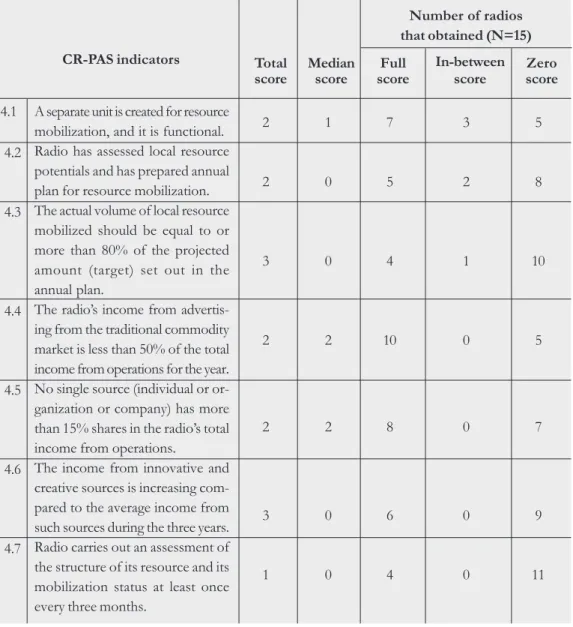
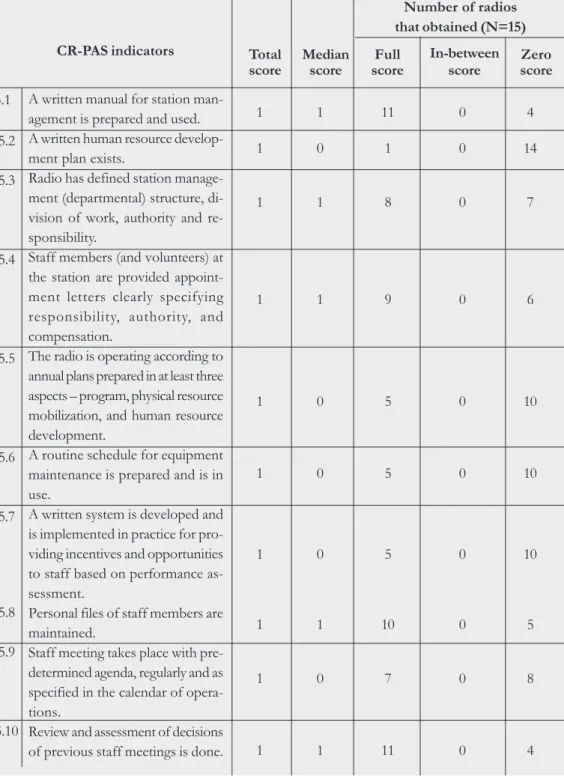
For example, the performance assessment manual grants 25 out of 100 points to programming, the soul of any radio. This category has 14 indicators for assessing programs in terms of diversity, local relevance and mix, among others. The assessment framework requires stations to devote 15-25 percent of broadcast time to news and information, 25-35 percent for education, and 40-60 percent time for musical/entertainment programs. It also requires them to allot specific time (percentage) to local language programming. All the seven categories have indicators such as those discussed in the example above and the stations are graded based on a point system that comes with the framework. The aggregate scores and that for each of the indicators provide a basis for arriving at conclusions on areas where the stations are strong and where they need to focus efforts for improvement.
3.1. CR-PAS assessment framework
The performance of each participating radio station had been assessed based on the 100 points that are allotted to the indicators. Based on the points acquired, the aggregate scores serve as a basis for suggesting their performance in terms of a ranking. The ranks are not intended for comparison across stations but seek to serve the participating stations as self-assessment, and to provide them information on areas they can begin corrective measures.
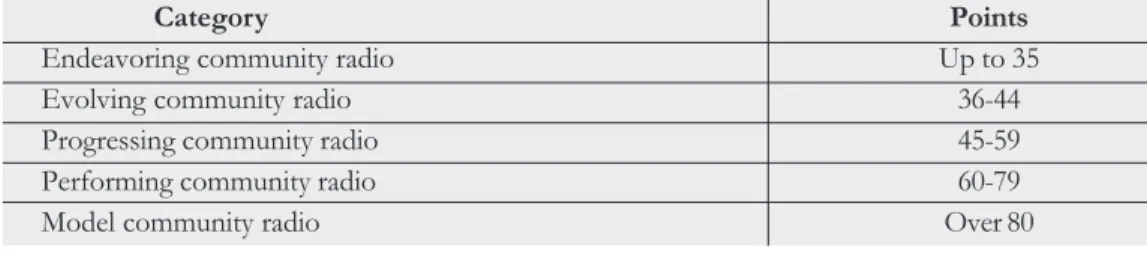
By the CRPAS framework, a station would require a minimum of 35 points to "qualify" as a community radio. A score between 35 to 44 would suggest that it is a station "evolv-ing" towards being a community radio, while a score of 45 to 59 would suggest that it is a station "progressing" towards meeting the community radio ideal. Likewise, a score of 60 to 79 would place the radio as a "performing" community radio or one that is close to reaching the ideal, and a score of over 80 would place it as a model radio. (Table 3.2)
When assessed over time, the CR-PAS is expected to provide participating stations a basis to compare their performance and analyze whether the performance has improved, remained the same or deteriorated compared to the earlier assessments. The exercise also allows comparisons across radios, if required. Because the CR-PAS is intended to be a tool
36 Community MHz
to assist radios to assess themselves, it also provides detailed guidelines on the marking system and the type of information needed to qualify for certain points.
3.1.1. Objectives of CR-PAS
Essentially, the assessment system aims to reward good performance. The CR-PAS is designed to provide positive reinforcement to participating community radios. The logic is that if and when radios know beforehand what behaviors lead to winning recognition of being a community station they will make efforts to improve, which can ultimately result in better overall performance. The system objectively measures the radios in terms of indica-tors that are directly attributable to their performance and are in their control – indicaindica-tors that demand contributions of other social actors are not included. The assessment focuses on the efforts of the participating stations and therefore is equally applicable to all radios urban and rural, and those located in the hills and the plains irrespective of their broadcast hours.
The underlying idea adopted while preparing the framework was that good operating processes eventually lead to better performance and results. Therefore, it is based on the belief that the operating structure, system and processes with regard to various aspects of radio management are critical determinants of an effective radio. The main objectives of the CRPAS are to:
1. Promote incentives for community radio (as corporate bodies) to improve in key per-formance areas
2. Supplement capacity needs assessment and monitoring and evaluation systems 3. Improve management and organizational learning
4. Strengthen the capacity development efforts (focus and incentives for efficient use), and
5. Improve accountability (upwards and downwards), and 6. Improve community ownership and participation.
The CR-PAS was developed at a time when Nepal lacked (and still lacks) a clear legal definition and policy on community radios, even though community stations differ from other FM radios in terms of their nature and objectives. The assessment promises to pro-vide the guideposts needed for framing policies and laws to define community radios, and also to continuously monitor their performance to ensure that the stations continue to serve their communities in the manner the community wants them to.
Additionally, the assessment framework can serve the interest of a wide range of stakeholders. For promoters and supporters of community radio in Nepal it can provide information to identify capacity gaps to determine a basis for support. It can serve indi-vidual stations by providing them a road map to identify and address areas that need attention. The CR-PAS can also serve an independent regulator (when Nepal has one) as a basis for continuously monitoring performance of the individual stations. For the state, and development agencies, the assessment outcomes can serve as a basis it to select partners for development messaging and support
Table 3.1: CR-PAS composites and indicators
3.1.2. CR-PAS Performance areas and indicators
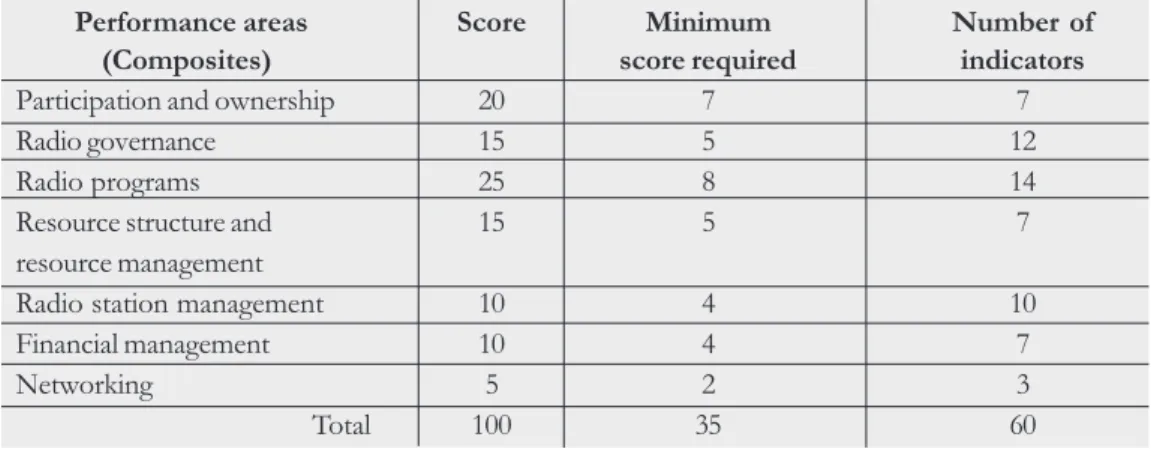
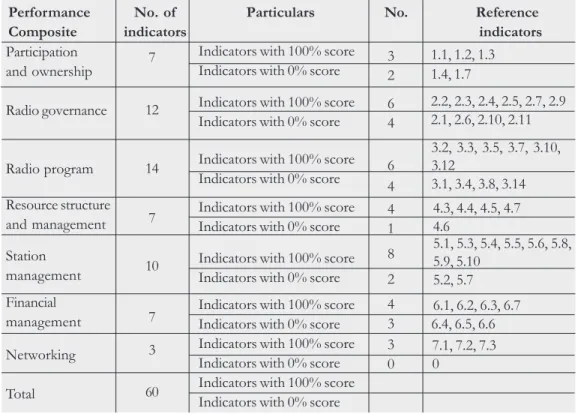
The CR-PAS involves an assessment of the performance of community radios based on 60 indicators grouped under seven performance areas or broad categories – commu-nity participation and ownership, governance, radio programs, station management, re-source structure and rere-source management, financial management, and networking. The framework brings together nationally and internationally accepted norms and standards of good broadcasting combined with the ideals of community media that have been trans-lated into objectively measurable performance indicators.
The composites seek to optimize balance, adequacy, and simplicity. And the system embraces all the important performance areas while focusing on the indicators that are critical for stations to function as true community radios. The assessment framework is easy to understand and the indicators are simple and easy to measure. They are clearly defined and are verifiable while also being sufficiently demanding because they require radios to maintain the performance level all times, while improving on indicators where they are weak. Essentially, the scoring system allots higher scores to key performance areas and associated indicators. The scores were developed and adopted in consultation with practi-tioners, experts and other stakeholders. The scoring system and corresponding indicators are summarized in Tables 3.1 and 3.2.
Each performance area has three to 14 indicators and each score depends on the importance of the indicator for an effective community radio. The CR-PAS has also de-fined the score that can be assigned to an indicator for a given performance level. The scores are evidence based: non-availability of concrete evidence to prove performance is taken as non-performance, even if the radio may be doing well in practice. This approach is expected to force radios that operate on an ad-hoc basis to set up and rely on systems.
Based on the scores the participating radio stations can obtain a maximum of 100 points and based on the aggregate scores, they are then categorized into five groups – Endeavoring, Evolving, Progressing, Performing, and Model community radios. The quali-fying points needed for each category is given in Table 3.2.
Performance areas Score Minimum Number of (Composites) score required indicators
Participation and ownership 20 7 7
Radio governance 15 5 12
Radio programs 25 8 14
Resource structure and 15 5 7
resource management
Radio station management 10 4 10
Financial management 10 4 7
Networking 5 2 3
38 Community MHz
The results provide a basis for assessing comparative performance over time. The stations can, for example, use it to set performance benchmarks in any or many indicators and use it to determine if overall performance has improved, remained the same or dete-riorated over time. The stations can also focus on specific indicators needing improvement, and even compare their overall performance with other stations.
Table 3.2: CR-PAS evaluation categories and qualifying points
28 Martin Allard. 1997. “On the Air: The development of community Radio”. In Maslog, Navarro, Tabing and
Teodoro (eds.) Communication for people power: An introduction to community communication. UNESCO-Project TAMBULI, Institute of Development Communication, UPLP. College of Mass Communication, UP Diliman. UNESCO National Commission, Philippines. pp 1-12
29 Crispin C. Maslog. 1997. “Community communication: The Concepts and Practices”. In Maslog, Navarro,
Tabing and Teodoro (eds.) Communication for people power: An introduction to community communication. UNESCO-Project TAMBULI, Institute of Development Communication, UPLP. College of Mass Communi-cation, UP Diliman. UNESCO National Commission, Philippines.
30 In Bhattarai and Ojha. 2010. pp. 192-195
31 Ian Pringle and Bikram Subba. 2007. Ten years on: The state of community radio in Nepal. UNESCO. pp 27 32 Felix Loibrero. 1997. “Community broadcasting in the Philippines”. In Maslog et. al (eds). pp 27-33. 33 Foreword in Community Radio Performance Assessment System (CRPAS). CRSC/NEFEJ. 2009 34 ACORAB. Community Radio. September 2008 - February 2009. pp. 5
35 Raghu Mainali, Yadav Chapagain, Bikram Subba. 2009. Community Radio: Performance Assessment System.
CRSC/NEFEJ.
Foot notes
Category Points
Endeavoring community radio Up to 35
Evolving community radio 36-44
Progressing community radio 45-59
Performing community radio 60-79
Assessment
Process
43 Assessing Community Radio Performance in Nepal
4.0 Assessment Process
The assessment was carried out based on the requirements spelled out in the CR-PAS manual. A Steering Committee appointed by CRSC/NEFEJ led and guided the ment. It committee solicited applications for stations wanting to participate in the assess-ment and selected the radios that were included and sought proposals from consulting and research firms to carry out the assessment. Under the coordination and supervision of CRPAS secretariat, the consulting firm consulting firm was responsible for carrying out the assessment, quality assurance and reporting. The assessment methodology and process is described in the following sections.
4.1 Management and organization of the assessment
Steering Committee: The CRSC/NEFEJ formed a Steering Committee to manage and steer the assessment. The committee consisted of representatives of key stakeholders (members of parliament, government, member of the National Human Rights Commis-sion, community and social activist groups, AMARC-Asia Pacific, ACORAB, NEFEJ and academics). P. Kharel, professor of journalism and mass communication, Tribhuwan Uni-versity, a senior journalist, chaired the committee. The CRSC/NEFEJ, with Raghu Mainali as coordinator, served as the member secretary and secretariat of the Steering Committee (See: Annex 9.1 for list of committee members).
Selection of consulting firm: As a measure to ensure impartiality and produce a high-quality assessment, the Steering Committee published a public notice seeking applica-tions from firms interested in carrying out the task, and selected the consulting firm.
Selection of participating stations: The Steering Committee solicited applications from community radios interested in participating in the assessment. Radios that had declared themselves as community stations and had renewed their licenses were eligible to apply. Twenty-three stations had expressed an interest to be assessed of which the Steering Committee selected 15. The selection for piloting the CR-PAS was based on the following criteria: Own-ership (cooperatives and NGOs, the license holders), years of broadcasting (above three
years), location (Mountain, Hill, Terai; eastern, central, western and mid-western regions), and stations broadcasting to different (specified) target (Dalit, women, general).
Appointment of focal persons: The CRSC requested the selected radios to appoint a focal person (senior person, knowledgeable about the operation of the radio) to work closely with the external assessors. This was an in-built capacity-building mechanism be-cause the focal person served as the "internal" assessor and link between the visiting asses-sors and the station management. Most of the radios appointed the Station Manager as the focal person.
47 Assessing Community Radio Performance in Nepal
Analysis and
Findings
5.0 Analysis and Findings
5.1 Overall Performance
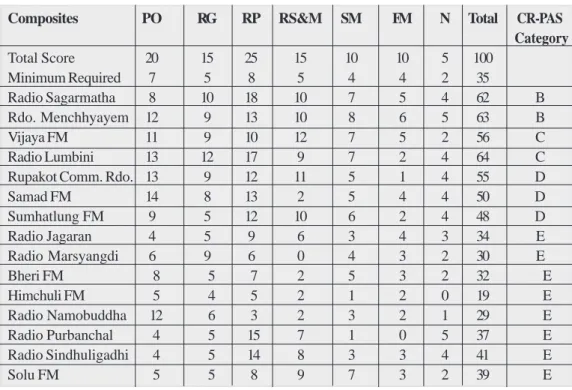
The CR-PAS uses seven key composites or categories to measure the performance of radios. The categories are: Participation and ownership, governance, programming, re-source structure and management, station management, financial management and net-working. For the purpose of this report, the radios are categorized from A to E, with "E" being stations scoring the lowest in the assessment and "A" being stations scoring the high-est. Table 5.1 provides the overall scores of the assessed stations and the categories.
50 Community MHz
Note: PO: Participation and ownership, RG: Radio governance, RP: Radio programs, RS&M: Resource structure and management, SM: Station management, FM: Financial management, N: Networking, Rdo: Radio, Comm: Community
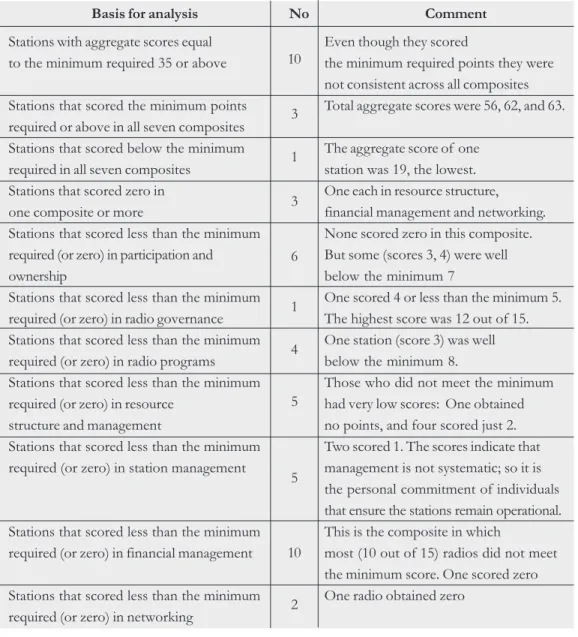
None of the assessed stations scored enough points to come under category A, one reserved for a model community radio (Table 5.2). The summary of the performance of the participating radios in the different categories is provided in the following section.
Table 5.2: Assessed Radios and CR-PAS categories
Table 5.1: Overall scores of participating stations
Composites PO RG RP RS&M SM FM N Total CR-PAS
Category Total Score 20 15 25 15 10 10 5 100 Minimum Required 7 5 8 5 4 4 2 35 Radio Sagarmatha 8 10 18 10 7 5 4 62 B Rdo. Menchhyayem 12 9 13 10 8 6 5 63 B Vijaya FM 11 9 10 12 7 5 2 56 C Radio Lumbini 13 12 17 9 7 2 4 64 C
Rupakot Comm. Rdo. 13 9 12 11 5 1 4 55 D
Samad FM 14 8 13 2 5 4 4 50 D Sumhatlung FM 9 5 12 10 6 2 4 48 D Radio Jagaran 4 5 9 6 3 4 3 34 E Radio Marsyangdi 6 9 6 0 4 3 2 30 E Bheri FM 8 5 7 2 5 3 2 32 E Himchuli FM 5 4 5 2 1 2 0 19 E Radio Namobuddha 12 6 3 2 3 2 1 29 E Radio Purbanchal 4 5 15 7 1 0 5 37 E Radio Sindhuligadhi 4 5 14 8 3 3 4 41 E Solu FM 5 5 8 9 7 3 2 39 E
Categorization criteria according to CRPAS
Total score below 35; or between 35 to 44, but not meeting the minimum score in all 7 composites Total score between 35 to 44; or between 45 to 59 but not meeting the minimum score in all 7 composites Total score between 45 to 59; or between 60 to 79 but not meeting the minimum score in all 7 composites Total score between 60 to 79; or between 80 but not meeting the minimum score in all 7 com-posites
Total score above 80 and meeting the minimum score in all 7 composites
Category of Radios Category E (Endeavoring) Category D (Evolving) Category C (Progressing) Category B (Performing) Category A (Model) No. of radios 8 3 2 2 0
Performance of eight stations under category E (Endeavoring)
Five stations (Namobuddha, Bheri, Himchuli, Marsyangdi and Jagaran) could not ob-tain the minimum aggregate score of 35 out of 100 required by the CR-PAS. These are stations that are making efforts to become community radios but have still a long way to go.
z One station (score 34) obtained the minimum score in five composites, but could
not core the minimum in two - participation and ownership and resource struc-ture.
z One station (score 32) obtained the minimum score in four composites, but could
not score the minimum in three - program, resource structure and financial man-agement (Zero in resource structure).
z One station (score 30) fulfilled the minimum requirement in three composites but
could not meet the requirements in four - participation and ownership, program, resource structure, and financial management.
z One station (score 29) met the minimum requirement in two composites, but
failed to do the same in five - program, resource structure, station management, financial management and networking.
z One station (score 19) could not meet the minimum requirement in all seven
com-posites.
Three radios (Solu, Sindhuligadhi, Purbanchal) obtained or surpassed the minimum total points on aggregate but were still placed in category E because they could not meet the minimum required for all composites.
z Two stations (scores 41 and 39) met the minimum requirements in five composites
but could not meet the minimum in two - in participation and ownership, and one each in station management and financial management.
z One radio (score 37) met the minimum requirements in four composites but failed
in three - participation and ownership, station management and financial manage-ment.
(The minimum required benchmark is 35 out of 100) Aggregate score of radios
52 Community MHz
Performance of three stations under category D (Evolving)
Three stations (Sumhatlung, Rupakot and Samad) came under category D (Evolving radios). The aggregate score of all three was enough for being categorized as C (Progress-ing CR), but because they did not meet the minimum required score in all composites, they have been categorized under Category D (Evolving).
z All three (scores 48, 55, 50) could not meet the minimum requirements in one
composite each – in resource structure, station management, and financial man-agement.
Performance of two stations under category 'C' (Progressing)
Two stations (Lumbini and Vijaya) came under category C (Progressing radios). The aggregate score of one was enough for being categorized as B (Performing radio), but it did not qualify for the category because it failed to meet the minimum required score in one composite.
z Lumbini FM, (score 64) scored highest aggregate score among all radios assessed,
but it did not meet the minimum score in financial management. It would have been categorized as B if it had met minimum requirements in all composites.
z Vijaya FM (score 56) scored the minimum required in all composites.
Performance of two stations under category 'D' (Performing)
Two stations (Menchhyayem and Sagarmatha) fell under category D (Performing ra-dios). Both had the aggregate scores required, and also met the minimum requirement in all composites.
Observations
z Only three stations scored well at the aggregate level and also in terms of the
prescribed minimum scores in all seven composites. Most stations (8 out of 15) fell under category E or stations evolving towards becoming community radios.
z The composites where the stations were weakest were radio program and financial
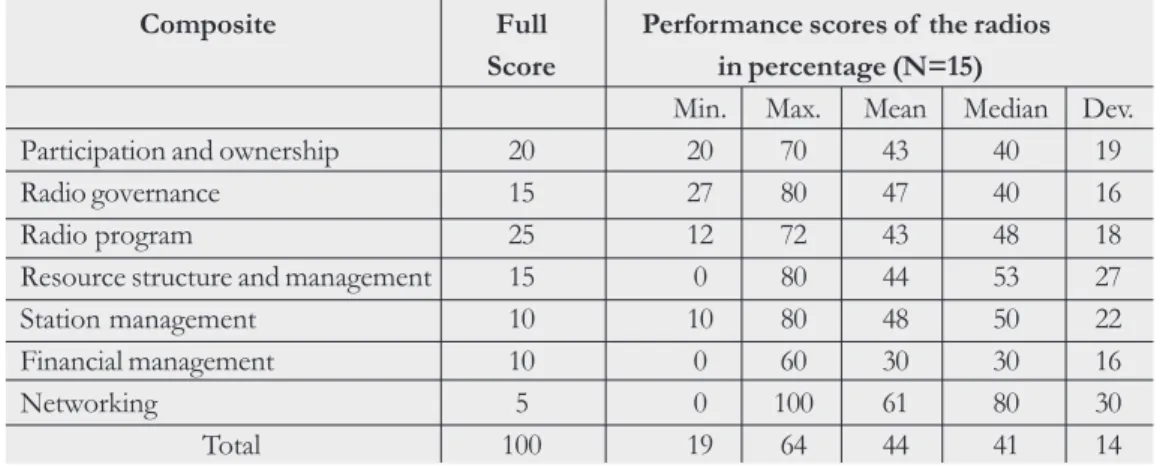
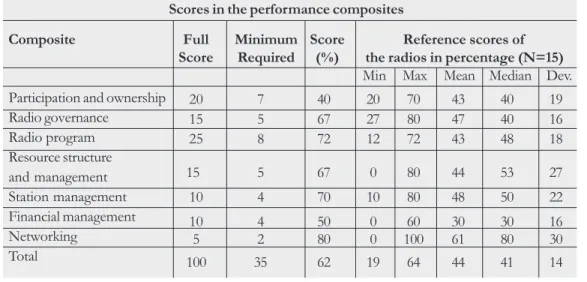
management, followed by resource structure, station management, and participa-tion and ownership.
z Room for improvement – the highest total score ob