SLEC: A NOVEL SERVERLESS RFID
AUTHENTICATION PROTOCOL BASED ON
ELLIPTIC CURVE CRYPTOGRAPHY
Rania Baashirah
Under the Supervision of Dr. Abdelshakour Abuzneid
DISSERTATION
SUBMITTED IN PARTIAL FULFILMENT OF THE REQUIREMENTS FOR THE DEGREE OF DOCTOR OF PHILOSOPHY IN COMPUTER SCIENCE
AND ENGINEERING THE SCHOOL OF ENGINEERING
UNIVERSITY OF BRIDGEPORT CONNECTICUT
iii
SLEC: A NOVEL SERVERLESS RFID AUTHENTICATION
PROTOCOL BASED ON ELLIPTIC CURVE
CRYPTOGRAPHY
iv
SLEC: A NOVEL SERVERLESS RFID AUTHENTICATION
PROTOCOL BASED ON ELLIPTIC CURVE
CRYPTOGRAPHY
ABSTRACT
Radio Frequency Identification (RFID) is one of the leading technologies in the Internet of Things (IoT) to create an efficient and reliable system to securely identify objects in many environments such as business, health, and manufacturing areas. Since the RFID server, reader, and tag communicate via insecure channels, mutual authentication between the reader and the tag is necessary for secure communication. The central database server supports the authentication of the reader and the tag by storing and managing the network data. Recent lightweight RFID authentication protocols have been proposed to satisfy the security features of RFID communication. A serverless RFID system is a new promising solution to alternate the central database for mobile RFID models. In this model, the reader and the tag perform the mutual authentication without the support of the central database server. However, many security challenges arise from implementing the lightweight RFID authentication protocols in the serverless RFID network. We propose a new robust serverless RFID authentication protocol based on the Elliptic Curve Cryptography (ECC) to prevent the
v
security attacks on the network and maintain the confidentiality and the privacy of the authentication messages and tag information and location. While most of the current protocols assume a secure channel in the setup phase to transmit the communication data, we consider in our protocol an insecure setup phase between the server, reader, and tag to ensure that the data can be renewed from any checkpoint server along with the route of the mobile RFID network. Thus, we implemented the elliptic curve cryptography in the setup phase (renewal phase) to transmit and store the data and the public key of the server to any reader or tag so that the latter can perform the mutual authentication successfully. The proposed model is compared under the classification of the serverless model in term of computation cost and security resistance.
vi
ACKNOWLEDGEMENTS
My thanks are wholly devoted to God, who has helped me all the way to complete this work successfully. It is all his grace, mercy, and blessings that make this work possible.
I am honored that my work has been supervised by Dr. Abdelshakour Abuzneid for his patient guidance, motivation, and advice he has provided throughout my research. I have been fortunate to have a supervisor who cares and believes in my work, and who responded to my questions and concerns so promptly. I also would like to thank all my professors, friends, and colleagues at the University of Bridgeport, who helped me to accomplish this work.
I owe a debt of gratitude to my parents for their love and encouragement to pursue my studies in the first place, and my sisters for their immense support.
I finally dedicate this work to my loving and caring daughters; Yara and Maria for their tolerance about being apart from them all this time. My words cannot express how grateful I am to have them both in my life.
vii
TABLE OF CONTENTS
ABSTRACT ... iv
ACKNOWLEDGEMENTS ... vi
TABLE OF CONTENTS ... vii
LIST OF TABLES ... ix
LIST OF FIGURES ... x
CHAPTER 1: INRTODUCTION ... 13
1.1 Research Problem and Scope... 15
1.2 Motivation behind the Research ... 16
1.3 Potential Contributions of the Proposed Research ... 17
CHAPTER 2: RELATED WORK ... 19
2.1 Recent RFID Authentication Protocols ... 19
2.1.1 Heavyweight Protocols ... 19
2.1.2 Simple Weight Protocols ... 24
2.1.3 Lightweight Protocols ... 28
2.1.4 Ultra-Lightweight Protocols ... 46
2.2 Analysis and Security Evaluation ... 52
2.2.1 Comparison of Computation Cost ... 52
2.2.2 Comparison of Security Threats ... 52
2.2.3 Comparison of Security Requirements ... 54
viii 3.1 Network Model ... 58 3.2 Serverless Model ... 59 3.3 Communication Model ... 60 3.3.1 Setup Phase ... 61 3.3.2 Authentication Phase ... 63 3.3.3 Recovery Phase ... 65 CHAPTER 4: METHODOLOGY ... 66 4.1 Experiment Design ... 66
4.2 Serverless Authentication Based on Elliptic curve Algorithm ... 66
CHAPTER 5: RESULTS AND ANALYSIS ... 68
5.1 Analysis of System Requirements ... 68
5.2 Analysis of Security Requirements ... 70
5.3 Analysis of Computation Cost ... 75
CHAPTER 6: FORMAL VERIFICATION ... 77
6.1 Adversary Model ... 77
6.2 Reachability and Secrecy ... 78
6.3 Correspondence Assertion ... 83
CHAPTER 7: CONCLUSION ... 88
ix
LIST OF TABLES
Table 2.2.1 Comparison of the Computation Cost on Tag 53
Table 2.2.2 Comparison of Various Security Requirements 55
Table 2.2.3 Comparison of the Security Requirements 56
Table 3.1 Protocol Notations 61
Table 5.1 Comparison of the System Requirements 71
Table 5.2 Comparison of the Security Threats Resistance 75
x
LIST OF FIGURES
Figure 1.1 Basic radio frequency identification (RFID) model 14
Figure 2.1 Session-based authentication protocol (SB-A) by Wang and
Sarma
21
Figure 2.2 Session-based authentication protocol (SB-B) by Wang and Sarma
21
Figure 2.3 Elliptic curve cryptography-based untraceable authentication protocol (ECU) by Ryu
22
Figure 2.4 The reviving-under-denial of service authentication protocol (RUND) by Yao
24
Figure 2.5 Mutual authentication-based on elliptic curve cryptography (IECC) by Farash
25
Figure 2.6 Role-based access control protocol (RBAC) by B.Chen 27
Figure 2.7 Mutual authentication protocol for networked RFID systems
(NRS++) by X. Chen
29
Figure 2.8 Anti-counting security protocol (ACSP++) by X. Chen 30
Figure 2.9 Lightweight authentication protocol (LAP) by Chien 32
xi
Figure 2.11 Lightweight protocol based on synchronized secret (MASS)
by S. Lee
34
Figure 2.12 Efficient passively-untraceable authentication protocol (EP-UAP) by K. Lee
35
Figure 2.13 Desynch attack-resistant robust authentication protocol (DRAP) by Rahman and Ahamad
36
Figure 2.14 Grouping proofs-based authentication protocol (GUPA) by Liu for a single-reader—single-tag case
37
Figure 2.15 Batch authentication protocol based on frame slotted aloha (FTest) by Rahman and Ahamad
39
Figure 2.16 Anti-collision security protocol (ACS) by Keqiang 40
Figure 2.17 Hash-based mutual authentication (HBA+) protocol by
Chang
41
Figure 2.18 Variable linear shift-based authentication protocol (VLP) by Z.Liu
42
Figure 2.19 Passive tag ownership authentication protocol (OMP)
Protocol by Niu
43
Figure 2.20 Efficient authentication protocol (SEAS) by Dass and Om 44
Figure 2.21 Serverless security authentication protocol (SAP) by Mtita 45
Figure 2.22 Ultra-lightweight serverless authentication protocol (STS) by Sundaresan
xii
Figure 2.23 Improved authentication protocol (CWH+) by Aggarwal and
Dass
48
Figure 2.24 Ultra-lightweight mutual authentication protocol (MACC) by Huang and Jiang
49
Figure 2.25 Mutual authentication protocol (MACD) by Huang and
Jiang
50
Figure 2.26 A variant of HB protocol based on permutation function (HBPER) by Ouaskou
51
Figure 6.1 Verification results of reachability and secrecy 78
13
CHAPTER 1: INRTODUCTION
The wireless sensor network (WSN) has expanded recently to employ new technologies in the Internet of Things (IoT). The purpose of this evolution is to create a low-cost, reliable, and secure communication network for current and future applications using radio waves most conveniently. Radio Frequency Identification (RFID) is a technology where the detection of the electromagnetic signals in the wireless sensor network identifies objects or people. Hundreds and thousands of RFID applications have been used to improve business efficiency and productivity in a variety of business operations, including supply chain management, access control limitation, product tracking, merchandise allocation, toll collection, and so on. It is also considered an integral part of daily life where its applications not only are limited to business activities, but also everyday life activities that are integrated into cell phones, household, automobile, etc.
The primary system of RFID includes a receiver (reader), transponder (tag), and back-end database (server) to store and manage data. The RFID tag is a label that is placed into the object to be identified and located among hundreds and thousands of objects. It consists of a small antenna attached to a microchip with a small memory to store the object’s identity and data [1]. The RFID reader is a scanner placed in a fixed location to interrogate the tag whenever the tag exists in the scanning environment. The
14
Request Respond
Database RFID Reader RFID Tags
back-end database server operates as a data processor that manages, controls, and stores the data from the tag and reader. An RFID system is depicted in Figure 1.1 [2]. Since the communication channel between the reader and tag is assumed to be insecure, messages in RFID communication are transmitted in clear, and thus are vulnerable to security attacks such as replay attack, impersonation, traceability, man-in-the-middle, desynchronization, denial of service, cloning, and disclosure attack. A secure RFID system must be able to resist different types of attacks through maintaining system requirements of mutual authentication, confidentiality, integrity, availability, privacy, forward and backward secrecy.
Figure 1.1: Basic radio frequency identification (RFID) model [2]
Since the RFID passive tag has limited resources to compute complex operations [3], the heavyweight protocols are not feasible for practical implementation [4]. On the other hand, lightweight and ultra-lightweight protocols use only simple operations within the tag computation limits and show the lowest tag computation overhead level, so they are mostly used in the current applications. Many RFID protocols are proposed to defend against different attacks. However, several vulnerabilities are detected in the lightweight protocols because it is easy to break out the security of their simple operations.
15
1.1 Research Problem and Scope
The advanced development of RFID system leads to introducing the concept of serverless RFID where the communication between the RFID reader and tag does not involve a central database. This innovative scheme arises major security issues in the RFID system because both the reader and tags should form an autonomous communication. Multiple serverless RFID protocols are proposed using lightweight operations such as pseudo-random number generator and exclusive-OR operations [5]. Even though these protocols conform to the RFID passive tags limited resources, they are still exposed to security breach due to the lightweight operations used mainly in the reader and tag authentication.
Elliptic curve cryptography (ECC) is a public key scheme for low constrained devices that meet the requirements of the RFID tags. It can provide a security level that is similar to RSA with a smaller key size since their functions are easy to be calculated but hard to be factored back to the original values [6]. ECC is considered in the proposed
SLEC protocol because it is feasible on the passive tag and provides higher security than other lightweight schemes.
The basic idea behind the SLEC protocol is as follows. In the mobile RFID system, a reader and a tag start communicating by authenticating each other without a central database to perform the necessary calculations to establish a secure communication channel. In the authentication session, the reader and tag transmit
16
challenging messages that can only be computed and verified by a legitimate entity. The transmitted messages should be confidential, and they require encryption and decryption using secure and low-cost operations within the ability of the passive tag to process. The privacy of the tag is also needed to protect the tag secret information and location from being exposed to adversaries. Since the secure algorithms require extensive computations, it is essential to minimize the communication signals in the network, especially when the number of tags is high. We developed a secure and appropriate authentication algorithm that maintain the security of the system and privacy of the tags while minimizing the communication signals in the network to reduce the computation overhead on both the reader and the tag. The proposed protocol is compared with extensive simulations to demonstrate a secure mutual authentication over the currently available protocols. Also, analysis models are developed to validate the proposed solution.
1.2 Motivation behind the Research
Identifying products, humans, or information and authenticate their validity is a crucial matter, especially in mobile RFID systems where the readers and tags exit in a location away from the location of the central database server. In events such as the car dealership industry, a large number of cars needs to be identified and located off the dealership facilities and during the trips between departure and arrival destinations. Identifying asset starts by authenticating the real asset from a fake one along the transportation route. This is done using a secure authentication technique that can be done successfully by a legitimate and registered car. Tracking a car can use the owner’s
17
information to manage transportation securely to avoid stealing cars or losing routes to inventory locations. Authorized facilities must control access to the car's information by allowing only authorized personnel or users to access the car's information. The privacy of the owners is important, so any adversary should not be able to obtain any valuable information to the vehicles or their location. Privacy can be achieved by confusing the adversary by sending noise signals from different locations to avoid capturing the real information or positions of the assets and prevent tracing back the original signal by analyzing the network traffic.
1.3 Potential Contributions of the Proposed Research
Many of the current RFID authentication protocols are proposed to assume a secure setup between the server, the reader, and the tags attached to the cars, which is not realistic in most cases. In our work, we provide a secure setup phase that works as checkpoints through the transportation routes that the cars pass with along their routes to the destination. The setup phase updates the protocol with new values to perform the authentication of the assets. We mislead the adversary about the location of the asset, which will lead subsequently to the location of the source tag. The proposed SLEC
protocol can handle a group of real and fake signals that are sent from a group of tags at the time to avoid tracing the actual signal. We also secure the asset information using keys that are known only to the reader and tag. The elliptic curve cryptography (ECC) is used in both setup and authentication phases to secure the data forming a noval serverless system. For the fairness of our comparison, we compare the authentication phase of the proposed model with other serverless protocols and ECC-based protocols to validate the
18
results of our work. Different analysis models are developed to prove the novelty of proposed work.
19
CHAPTER 2: RELATED WORK
In this chapter, we present the existing authentication protocols in the literature, which mainly rely on the mutual authentication between the reader and tag in the RFID systems. A classification of these protocols and their analysis in term of security, computation, and communication cost is conducted.
Since a passive tag is a tiny chip with scarce resources, it can do only low computations. Hence, RFID protocols are classified in this literature into four categories based on the complexity of the algorithm that is used to compute the tag responses: heavyweight, simple weight, lightweight, and ultra-lightweight [7]. Heavyweight algorithms use symmetric and public key cryptography that is beyond the scale of the passive tag ability to process. Simple-weight algorithms use hash functions that are also not feasible for passive tag resources. Lightweight algorithms use simple one-way hash functions, cyclic redundancy checks, and pseudo-random number generators [8]. Finally, ultra-lightweight algorithms use bitwise operations, which can be performed at low cost.
2.1 Recent RFID Authentication Protocols
2.1.1 Heavyweight Protocols
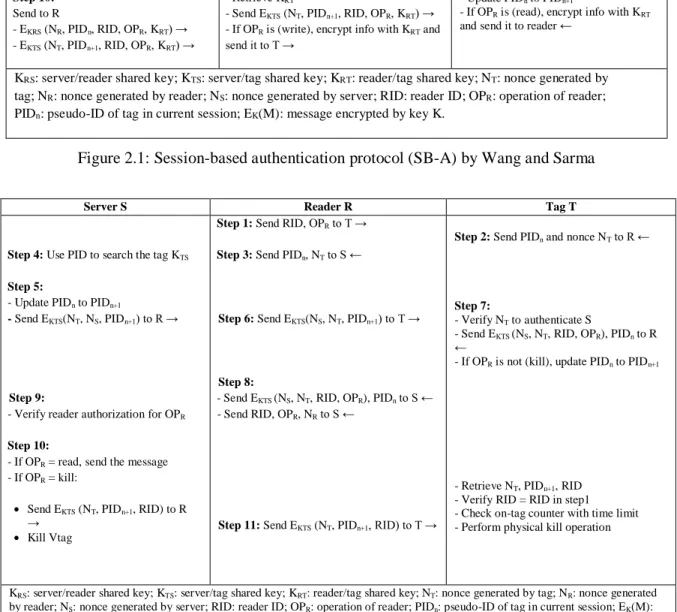
Wang and Sarma [9] proposed two session-based authentication protocols, SB-A
20
privacy and access control using two types of passive tags. The protocols are based on symmetric cryptography algorithm to provide low-cost authentication such as the Advanced Encryption Standard (AES) and Data Encryption Standard (DES). Protocol
SB-A in Figure 2.1 includes two processes. The first phase involves mutual authentication between server and tag according to the three-pass mutual authentication protocol according to the International Organization of Standardization and the International Electrotechnical Commission - ISO/IEC 9798-2 [10]. The second phase is for generating a session key between the reader and tag according to the Otway–Rees protocol and updating the pseudo-tag identity (PID). Protocol SB-B in Figure 2.2 uses tags with no memory or ID so that all of the tag’s information is stored in the server. A physical tag operation is mapped with the virtual digital tag in the server that can do all of the tag’s executions. The protocol uses tag nonce and counter control for synchronization, and not the server, because of the limited power of the tag. The protocols proved to be secure against major types of attacks; however, the protocols are considered to be heavyweight, since DES and AES are expensive operations that require a lot of computational overhead.
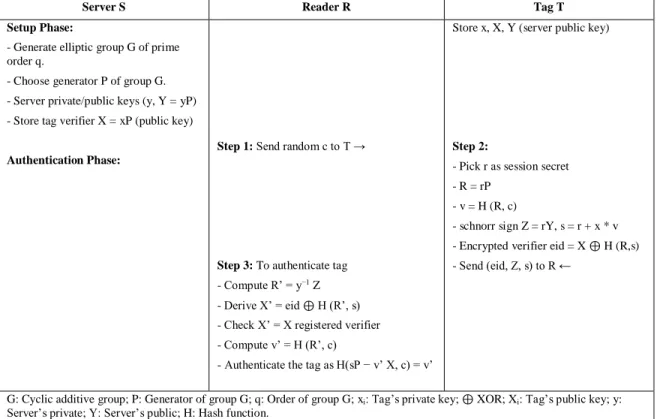
For traceability issues in RFID, Ryu et al. [11] proposed elliptic curve cryptography-based untraceable authentication protocol (ECU) using the Schnorr signature scheme. The elliptic curve cryptography is considered to be public key cryptography for RFID systems with low constrained tags. It is used to solve the issues of three recent elliptic curve-based untraceable RFID authentication protocols: Strong Privacy-preserving Authentication protocol (SPA) [12], Efficient Mutual Authentication
21
Server S Reader R Tag T
Step 4: Use PID to search the tag KTS
Step 5:
-Update PIDn to PIDn+1
- Send EKTS(NT, NS, PIDn+1) to R →
Step 9:
- Verify reader authorization for OPR
Step 10:
- If OPR = read, send the message
- If OPR = kill:
• Send EKTS (NT, PIDn+1, RID) to R
→
• Kill Vtag
Step 1: Send RID, OPR to T →
Step 3: Send PIDn, NT to S ←
Step 6: Send EKTS(NS, NT, PIDn+1) to T →
Step 8:
- Send EKTS (NS, NT, RID, OPR), PIDn to S ←
- Send RID, OPR, NR to S ←
Step 11: Send EKTS (NT, PIDn+1, RID) to T →
Step 2: Send PIDn and nonce NT to R ←
Step 7:
- Verify NT to authenticate S
- Send EKTS (NS, NT, RID, OPR), PIDn to R
←
- If OPR is not (kill), update PIDn to PIDn+1
- Retrieve NT, PIDn+1, RID
- Verify RID = RID in step1 - Check on-tag counter with time limit - Perform physical kill operation KRS: server/reader shared key; KTS: server/tag shared key; KRT: reader/tag shared key; NT: nonce generated by tag; NR: nonce generated
by reader; NS: nonce generated by server; RID: reader ID; OPR: operation of reader; PIDn: pseudo-ID of tag in current session; EK(M):
message encrypted by key K; Vtag: virtual tag in the server.
Figure 2.2: Session-based authentication protocol (SB-B) by Wang and Sarma
Server S Reader R Tag T
Step 4: Use PID to search the tag KTS
Step 5: Send EKTS (NT, NS, PIDn) to R →
Step 9:
- Verify OPR
- Generate KRT
- Update PIDn to PIDn+1
Step 10: Send to R
- EKRS (NR, PIDn, RID, OPR, KRT) →
- EKTS (NT, PIDn+1, RID, OPR, KRT) →
Step 1: Send RID, OPR to T →
Step 3: Send PIDn, NT to server ←
Step 6: Send EKTS (NT, NS, PIDn) to T →
Step 8: Send to server ← - EKTS (NS, NT), PIDn
- RID, OPR, NR
Step 11:
- Retrieve KRT
- Send EKTS (NT, PIDn+1, RID, OPR, KRT) →
- If OPR is (write), encrypt info with KRT and
send it to T →
Step 2: Send PIDn and nonce NT to R ←
Step 7:
- Verify NT to authenticate S
- Send EKTS (NS, NT), PIDn to R ←
Step 12:
- Retrieve KRT, PIDn+1, RID, OPR
- Verify OPR = OPR in Step1
- Check the on-tag counter - Decode OPR and execute it
- Update PIDn to PIDn+1
- If OPR is (read), encrypt info with KRT
and send it to reader ←
KRS: server/reader shared key; KTS: server/tag shared key; KRT: reader/tag shared key; NT: nonce generated by
tag; NR: nonce generated by reader; NS: nonce generated by server; RID: reader ID; OPR: operation of reader;
PIDn: pseudo-ID of tag in current session; EK(M): message encrypted by key K.
22
protocol EMA [6], and ECC-based authentication protocol PII [13]. Ryu’s protocol generates a digital signature with an appendix on the binary message of arbitrary length, and requires a cryptographic hash function, as shown in Figure 2.3. The sender’s session key is combined with the receiver’s public key to provide privacy, in which the message can be verified by only the receiver’s private key. Ryu’s protocol is secure against replay attacks, impersonate attacks, traceability attacks, and it maintains forward security. It requires two scalar multiplications, two hash functions, a message total size of 544 bits, and two communications between tag and reader. Even though this protocol requires complex computations associated with scalar multiplications and a hash function, it does not authenticate the reader.
Server S Reader R Tag T
Setup Phase:
- Generate elliptic group G of prime order q.
- Choose generator P of group G. - Server private/public keys (y, Y = yP) - Store tag verifier X = xP (public key)
Authentication Phase:
Step 1: Send random c to T →
Step 3: To authenticate tag - Compute R’ = y−1 Z - Derive X’ = eid ⊕ H (R’, s) - Check X’ = X registered verifier - Compute v’ = H (R’, c)
- Authenticate the tag as H(sP − v’ X, c) = v’
Store x, X, Y (server public key)
Step 2:
- Pick r as session secret - R = rP
- v = H (R, c)
- schnorr sign Z = rY, s = r + x * v - Encrypted verifier eid = X ⊕ H (R,s) - Send (eid, Z, s) to R ←
G: Cyclic additive group; P: Generator of group G; q: Order of group G; xi: Tag’s private key; ⊕ XOR; Xi: Tag’s public key; y:
Server’s private; Y: Server’s public; H: Hash function.
23
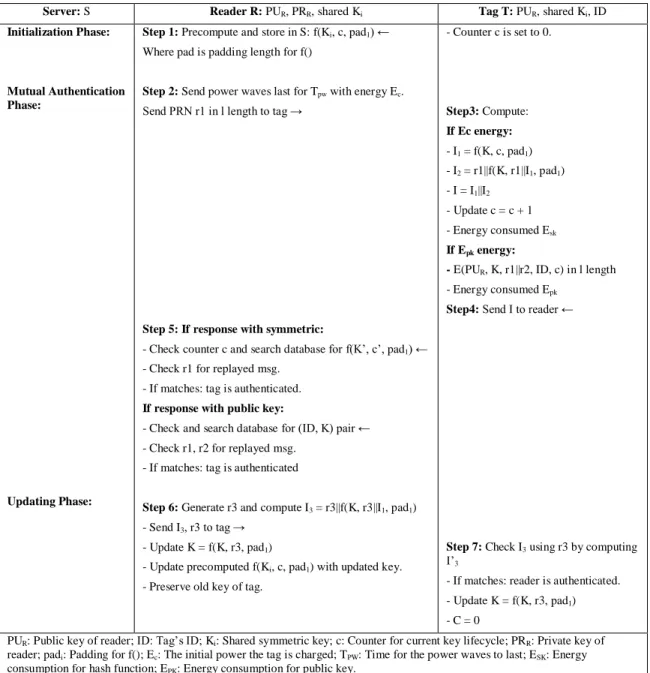
To reduce the tag’s overhead in heavyweight protocols, Yao et al. [14] introduced The Reviving-UNder-DoS (RUND) authentication protocol to defend against denial of service (DoS) and preserve user privacy by powering up the tag to do complex computing for symmetric and public key cryptography. It leverages the power in DoS scans to enable the tag to respond in two ways: either using simple encryption when low signals from a reader activate the tag, or using public key encryption (higher security) when the backscattered signals are high in an insecure environment. The more signals there are in communication, the more power charges the tag. The option of using public key encryption in RUND protocol is to overcome the problem of breaking up the synchronization state between the reader and tag in symmetric key encryption. The protocol is secure because secret information is not sent in the clear, so no useful information can be gained if any message is compromised. Moreover, the parameters used in communication are changed and updated in every session, as shown in Figure 2.4, to prevent replay attacks, maintain forward security, and resist tracking. Even though the overall efficiency of RUND is O(1), it is still not compliant with the Electronic Product Code Class1 Generation2 (EPC C1 G2) standard [3], which is defined by EPCGlobal Inc. for RFID data communication.
24
Server: S Reader R: PUR, PRR, shared Ki Tag T: PUR, shared Ki, ID
Initialization Phase:
Mutual Authentication Phase:
Updating Phase:
Step 1: Precompute and store in S: f(Ki, c, pad1) ←
Where pad is padding length for f()
Step 2: Send power waves last for Tpw with energy Ec.
Send PRN r1 in l length to tag →
Step 5:If response with symmetric:
- Check counter c and search database for f(K’, c’, pad1) ←
- Check r1 for replayed msg. - If matches: tag is authenticated.
If response with public key:
- Check and search database for (ID, K) pair ← - Check r1, r2 for replayed msg.
- If matches: tag is authenticated
Step 6: Generate r3 and compute I3 = r3||f(K, r3||I1, pad1)
- Send I3, r3 to tag →
- Update K = f(K, r3, pad1)
- Update precomputed f(Ki, c, pad1) with updated key.
- Preserve old key of tag.
- Counter c is set to 0. Step3: Compute: If Ec energy: - I1 = f(K, c, pad1) - I2 = r1||f(K, r1||I1, pad1) - I = I1||I2 - Update c = c + 1 - Energy consumed Esk If Epk energy:
- E(PUR, K, r1||r2, ID, c) in l length
- Energy consumed Epk
Step4: Send I to reader ←
Step 7: Check I3 using r3 by computing
I’3
- If matches: reader is authenticated. - Update K = f(K, r3, pad1)
- C = 0
PUR: Public key of reader; ID: Tag’s ID; Ki: Shared symmetric key; c: Counter for current key lifecycle; PRR: Private key of
reader; padi: Padding for f(); Ec: The initial power the tag is charged; TPW: Time for the power waves to last; ESK: Energy
consumption for hash function; EPK: Energy consumption for public key.
Figure 2.4: The reviving-under-denial of service authentication protocol (RUND) by Yao
2.1.2 Simple Weight Protocols
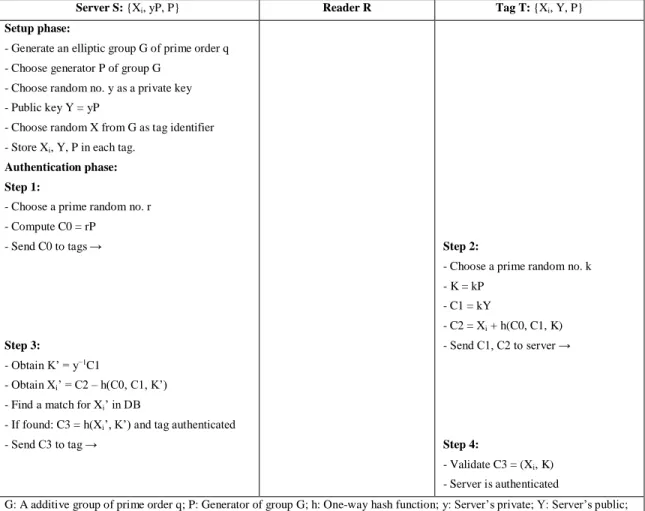
To better improve the performance of RFID protocols and reduce the power that is needed for complex operations in ECC-based protocols, Farash [15] proposed a mutual authentication protocol (IECC) based on the elliptic curve. The protocol enhances Chou’s authentication protocol (EMA) [6], which does not fulfill the security requirement of
25
forward security, mutual authentication, tag privacy, and security against location tracking, impersonating attacks, and tag cloning attack for an RFID system. The main idea behind the protocol is to use the server’s public key to create the authentication message to avoid breaking the system privacy, as depicted in Figure 2.5. The IECC protocol is secure against major attacks, even though the computation cost is the same as in Chou’s protocol that needs to be reduced for practical implementation.
Server S: {Xi, yP, P} Reader R Tag T: {Xi, Y, P}
Setup phase:
- Generate an elliptic group G of prime order q - Choose generator P of group G
- Choose random no. y as a private key - Public key Y = yP
- Choose random X from G as tag identifier - Store Xi, Y, P in each tag.
Authentication phase: Step 1:
- Choose a prime random no. r - Compute C0 = rP
- Send C0 to tags →
Step 3:
- Obtain K’ = y−1C1
- Obtain Xi’ = C2 – h(C0, C1, K’)
- Find a match for Xi’ in DB
- If found: C3 = h(Xi’, K’) and tag authenticated
- Send C3 to tag →
Step 2:
- Choose a prime random no. k - K = kP - C1 = kY - C2 = Xi + h(C0, C1, K) - Send C1, C2 to server → Step 4: - Validate C3 = (Xi, K) - Server is authenticated
G: A additive group of prime order q; P: Generator of group G; h: One-way hash function; y: Server’s private; Y: Server’s public; Xi: Identifier of ith tag which is a random point in G.
Figure 2.5: Mutual authentication-based on elliptic curve cryptography (IECC) by Farash
Zhang and Qi [16] also proposed another protocol (EECC) to withstand the security weaknesses of Chou’s protocol, EMA [6]. EECC protocol enhances patient
26
medication safety by also using elliptic curve cryptography. In comparison to the EMA protocol, EECC protocol resulted in better performance and security resistance to impersonate and forward security attacks. However, Baashirah et al. [17] found that Zhang and Qi protocol is vulnerable to forward traceability and reader impersonate attack since an adversary can compromise the private key of the reader by obtaining the tag’s secret identifier.
Baashirah et al. improved Zhang and Qi protocol and proposed HBEC protocol that is based on securing the tag’s secret identifier using a one-way hash function. HBEC protocol overcomes the security flaws in EECC protocol to provide high security even though the extra hash function adds more overhead to the computation, which should be addressed for the network scalability.
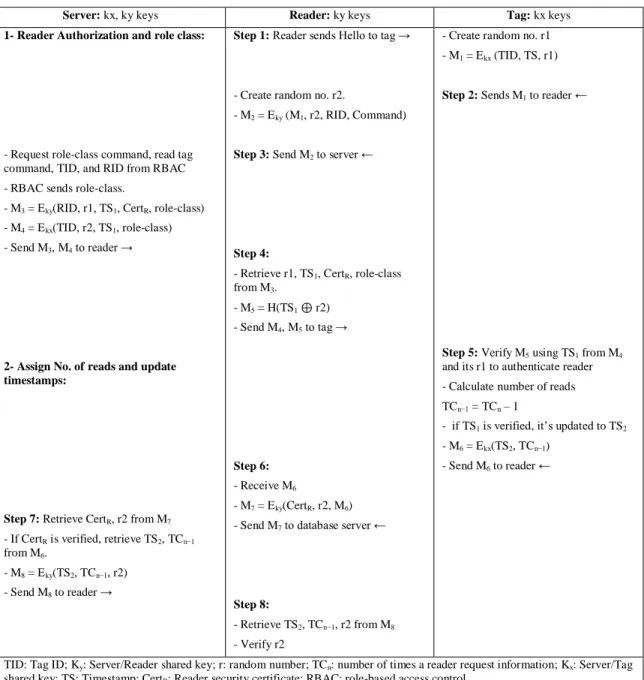
B.Chen [18] proposed a role-based access control (RBAC) protocol for mobile RFID to enable user privacy, role, and access control through the back-end server based on a certification mechanism. RBAC assigns role classes as keys to control the information and the number of times each reader can read a tag. RBAC authorizes readers, assigns role classes to control the reader’s authority to request tag information, and updates timestamps using random numbers and different shared keys between the database server and reader and tag ad, as depicted in Figure 2.6. Traceability and replay attacks are prevented using updated random numbers in every session; access control is provided using shared keys to prevent unauthorized readers from requesting or reading any tag’s information, and integrity is ensured using timestamps. However, RBAC uses one encryption mechanism that is excessive for low-cost passive tags.
27
The dispersion spectrum of the conventional single-mode silica fiber has a minimum at 1300 nm region. An increase in the signal attenuation and dispersion will cause a decrease in the fiber length. So at some points in an optical fiber communication link, the optical signal will be regenerated.
Server: kx, ky keys Reader: ky keys Tag: kx keys
1- Reader Authorization and role class:
- Request role-class command, read tag command, TID, and RID from RBAC - RBAC sends role-class.
- M3 = Eky(RID, r1, TS1, CertR, role-class)
- M4 = Ekx(TID, r2, TS1, role-class)
- Send M3, M4 to reader →
2- Assign No. of reads and update timestamps:
Step 7: Retrieve CertR, r2 from M7
- If CertR is verified, retrieve TS2, TCn−1
from M6.
- M8 = Eky(TS2, TCn−1, r2)
- Send M8 to reader →
Step 1: Reader sends Hello to tag → - Create random no. r2.
- M2 = Eky (M1, r2, RID, Command)
Step 3: Send M2 to server ←
Step 4:
- Retrieve r1, TS1, CertR, role-class
from M3. - M5 = H(TS1⊕ r2) - Send M4, M5 to tag → Step 6: - Receive M6 - M7 = Eky(CertR, r2, M6)
- Send M7 to database server ←
Step 8:
- Retrieve TS2, TCn−1, r2 from M8
- Verify r2
- Create random no. r1 - M1 = Ekx (TID, TS, r1)
Step 2: Sends M1 to reader ←
Step 5: Verify M5 using TS1 from M4
and its r1 to authenticate reader - Calculate number of reads TCn−1 = TCn – 1
- if TS1 is verified, it’s updated to TS2
- M6 = Ekx(TS2, TCn−1)
- Send M6 to reader ←
TID: Tag ID; Ky: Server/Reader shared key; r: random number; TCn: number of times a reader request information; Kx: Server/Tag
shared key; TS: Timestamp; CertR: Reader security certificate; RBAC: role-based access control.
28
2.1.3 Lightweight Protocols
Successful businesses demand an efficient RFID system that is mainly based on a low computation at a low cost. Many recent RFID protocols use low-cost operations that are handled by low-cost passive tags for practical implementations.
Fernando and Abawajy [19] proposed a mutual authentication protocol for Networked RFID Systems NRS, which is a lightweight mutual authentication scheme for an RFID system using low operations such as exclusive OR operation (XOR) and one-way hash functions. However, Alagheband and Aref [8] reported NRS to be vulnerable to major attacks and specifically a full disclosure attack that compromises the whole RFID system. Alagheband and Aref improved NRS protocol and proposed NRS+ by adding three more hash functions to the authentication message to increase the system security. X. Chen et al. [20] noted that the NRS+ protocol is exposed to desynchronization and traceability attacks by using one random number for the tag and reader. Thus, X. Chen proposed NRS++ to improve the security flaws in the previous versions of NRS by generating two different random numbers, r1 and r2, for the tag and reader using a pseudo-random number generator (PRNG) to defend against replay attack. In Figure 2.7, the authentication message M3 is encrypted using the tag’s random number r1 and reader’s random number r2 to provide message integrity, so the tag cannot verify any modified message. NRS++ uses fewer hash functions, which resulted in less computation overhead and storage space than the other versions, with more security power.
29
Server S Reader R Tag T
- Update secrets in Database IDnew = ID ⊕ (r2right||K1left)
K1new = H[(K1right||r1left) ⊕ r2]
Step 1:
- Generate random no. r - Calculate M1 = H(EPC ⊕ K1||r) M2 = r ⊕ K1 - Send to tag M1||M2 → Step 3: - Extract r1 = N ⊕ K1 - Compute C2 = H(EPC ⊕ K1||r||r1) - Verify C2 = M3 If equal:
Generate random no. r2
M4 = r2⊕ K1
M5 = H(EPC ⊕ K1||r1||r2)
If not equal: terminate - Send M4||M5 → Step 2: - Extract r as r = M2⊕ K1 - Compute C1 = H(EPC ⊕ K1||r) If C1 = M1, generate r1 N = r1⊕ K1 M3 = H(EPC ⊕ K1|| r||r1) Else termination - ← Send M3||N to reader Step 4: - Extract r2 as r2 = M4⊕ K1 - Compute C3 = H(EPC ⊕ K1||r1||r2) - Verify C3 = M5
If equal: Update the secrets. If not equal: terminate
ID, EPC: Tag identifier; H(): one-way hash function; K1: Server/Tag shared key; r, r1, r2: random No; ⊕/||: XOR and concatenation
operation.
Figure 2.7: Mutual authentication protocol for networked RFID systems (NRS++) by X. Chen
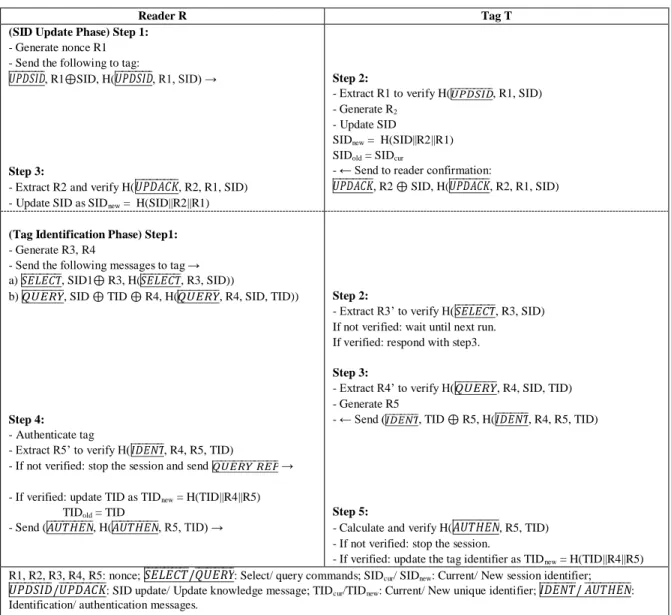
C. Chen [21] proposed Anti-Counting Security Protocol (ACSP) as another lightweight protocol for RFID systems to defend from a counter attack, which is defined as the attacker’s ability to count the number of objects in a system. Safkhani et al. [22] reported ACSP to be vulnerable to major attacks, including the forward/backward traceability attack. Safkhani further proposed ACSP+ to improve Chen’s protocol. Later, X. Chen [20] pointed out that ACSP protocol is not secure and proposed ACSP++ to withstand DoS and forward/backward traceability attacks. ACSP++ enhances the session identifier (SID) update, which is used to verify the current session, and tag identification
30
phases that suffer from different attacks in ACSP and ACSP+ versions. In ACSP++ as depicted in Figure 2.8, a tag identifier (TID) is added to the identification message as (
, R4, R5, TID) instead of ( , R4, R5), and the authentication message ((
, R4, R5, TID) is replaced with ( , R5, TID) to overcome DoS attack
and to modify the TID in the identification phase. The update phase of every key is associated with two separate nonce values to avoid forward and backward traceability.
Reader R Tag T
(SID Update Phase) Step 1:
- Generate nonce R1 - Send the following to tag:
, R1⊕SID, H( , R1, SID) →
Step 3:
- Extract R2 and verify H( , R2, R1, SID) - Update SID as SIDnew = H(SID||R2||R1)
Step 2:
- Extract R1 to verify H( , R1, SID) - Generate R2
- Update SID
SIDnew = H(SID||R2||R1)
SIDold = SIDcur
- ← Send to reader confirmation:
, R2 ⊕ SID, H( , R2, R1, SID)
(Tag Identification Phase) Step1:
- Generate R3, R4
- Send the following messages to tag → a) , SID1⊕ R3, H( , R3, SID))
b) , SID ⊕ TID ⊕ R4, H( , R4, SID, TID))
Step 4:
- Authenticate tag
- Extract R5’ to verify H( , R4, R5, TID)
- If not verified: stop the session and send → - If verified: update TID as TIDnew = H(TID||R4||R5)
TIDold = TID
- Send ( , H( , R5, TID) →
Step 2:
- Extract R3’ to verify H( , R3, SID) If not verified: wait until next run. If verified: respond with step3.
Step 3:
- Extract R4’ to verify H( , R4, SID, TID) - Generate R5
- ← Send ( , TID ⊕ R5, H( , R4, R5, TID)
Step 5:
- Calculate and verify H( , R5, TID) - If not verified: stop the session.
- If verified: update the tag identifier as TIDnew = H(TID||R4||R5)
R1, R2, R3, R4, R5: nonce; : Select/ query commands; SIDcur/ SIDnew: Current/ New session identifier;
: SID update/ Update knowledge message; TIDcur/TIDnew: Current/ New unique identifier; :
Identification/ authentication messages.
31
Even though the protocol improved the security weaknesses of all of the ACSP versions, it did not lower the computation overhead nor the storage space.
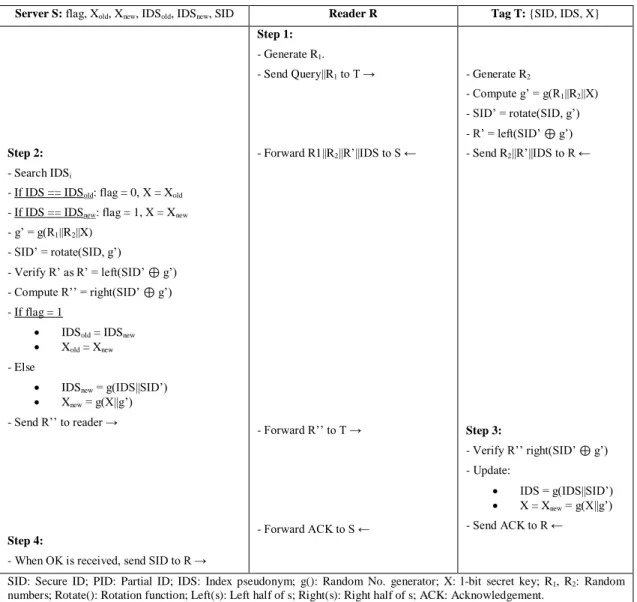
Chien and Huang [23] presented LAP, which is a lightweight authentication protocol to solve the vulnerabilities in the authentication protocol of Li et al. [24] and enhance the computational cost from O(n) to O(1) in identifying tags in RFID systems. The security of LAP protocol is based on a synchronized PRNG between the reader and tag using a secret key, secret ID, and index pseudonym. In Figure 2.9, LAP protocol uses the rotate operator on the message and left/right operator for the divided rotation during the messages that were exchanged to form a secure permutation. Random numbers are used to shift the secret values of the tag to be used safely in communication. Then, the random number is XORed with the shifted secret value to retrieve a tag by the server securely. The server uses the index pseudonym (IDS) to quickly identify the tag in the database instead of computing PIDL ⊕ PIDR for every tag to make the computation O(1).
LAP protocol is resistant to replay attack, DoS, and forward security. It can be employed easily by different standards such as EPC Gen2 and ISO 15693 [25] for practical implementation. However, the protocol was noted as being partially secure against traceability and synchronization attacks, since a tag can be traced between two successful sessions if the tag could not update its IDS.
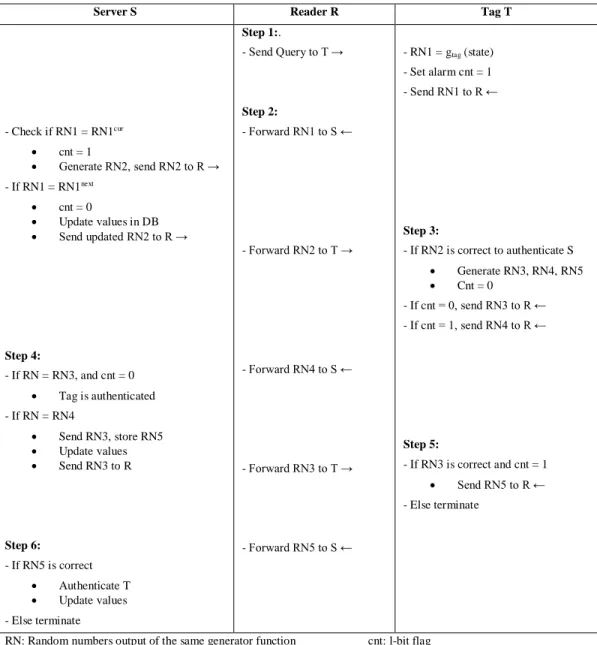
Burmester and Munilla [26] proposed a lightweight mutual authentication protocol called Flyweight that is based on exchanging messages using only PRNG. Their
32
protocol is based on a shared PRNG algorithm between the tags and back-end server that takes the same seed to produce the same output. The concept of the protocol is to use three consecutive numbers—RN1, RN2, and RN3—generated by the same PRNG in the server, and the tags of five numbers if an active adversary is presented, such as in Figure 2.10. Furthermore, RFID tags precompute the values to the server challenging the response so that an adversary can be detected based on the response time from the tag. The protocol can provide mutual authentication, integrity, confidentiality, and forward
Server S: flag, Xold, Xnew, IDSold, IDSnew, SID Reader R Tag T: {SID, IDS, X}
Step 2:
- Search IDSi
- If IDS == IDSold: flag = 0, X = Xold
- If IDS == IDSnew: flag = 1, X = Xnew
- g’ = g(R1||R2||X)
- SID’ = rotate(SID, g’)
- Verify R’ as R’ = left(SID’ ⊕ g’) - Compute R’’ = right(SID’ ⊕ g’) - If flag = 1
• IDSold = IDSnew
• Xold = Xnew
- Else
• IDSnew = g(IDS||SID’)
• Xnew = g(X||g’)
- Send R’’ to reader →
Step 4:
- When OK is received, send SID to R →
Step 1: - Generate R1. - Send Query||R1 to T → - Forward R1||R2||R’||IDS to S ← - Forward R’’ to T → - Forward ACK to S ← - Generate R2 - Compute g’ = g(R1||R2||X) - SID’ = rotate(SID, g’) - R’ = left(SID’ ⊕ g’) - Send R2||R’||IDS to R ← Step 3: - Verify R’’ right(SID’ ⊕ g’) - Update: • IDS = g(IDS||SID’) • X = Xnew = g(X||g’) - Send ACK to R ←
SID: Secure ID; PID: Partial ID; IDS: Index pseudonym; g(): Random No. generator; X: l-bit secret key; R1, R2: Random
numbers; Rotate(): Rotation function; Left(s): Left half of s; Right(s): Right half of s; ACK: Acknowledgement.
33
and backward security. Besides, it provides robust synchronization, since the server keeps a record for the current and next response value of the tag.
Server S Reader R Tag T
- Check if RN1 = RN1cur • cnt = 1 • Generate RN2, send RN2 to R → - If RN1 = RN1next • cnt = 0 • Update values in DB • Send updated RN2 to R → Step 4: - If RN = RN3, and cnt = 0 • Tag is authenticated - If RN = RN4 • Send RN3, store RN5 • Update values • Send RN3 to R Step 6: - If RN5 is correct • Authenticate T • Update values - Else terminate Step 1:. - Send Query to T → Step 2: - Forward RN1 to S ← - Forward RN2 to T → - Forward RN4 to S ← - Forward RN3 to T → - Forward RN5 to S ← - RN1 = gtag (state) - Set alarm cnt = 1 - Send RN1 to R ← Step 3: - If RN2 is correct to authenticate S • Generate RN3, RN4, RN5 • Cnt = 0 - If cnt = 0, send RN3 to R ← - If cnt = 1, send RN4 to R ← Step 5: - If RN3 is correct and cnt = 1 • Send RN5 to R ← - Else terminate
RN: Random numbers output of the same generator function cnt: l-bit flag
Figure 2.10: Flyweight mutual authentication protocol by Burmeter and Munilla
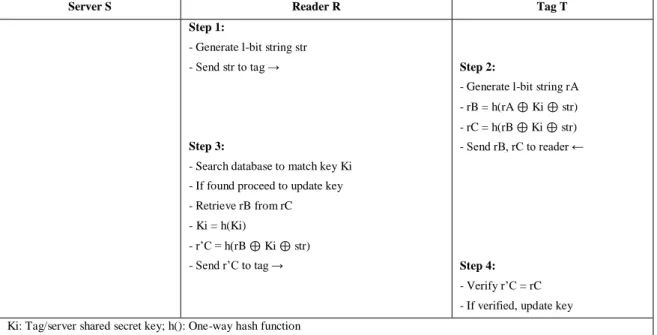
S. Lee et al. [27] proposed a lightweight protocol (MASS) for RFID systems using XOR and a one-way hash function to conform to the scarce resources of RFID tags. The concept of the MASS protocol is to challenge the tag with a fresh random string
34
every session, and the tag responds using the reader’s value and its own random key to authenticate the reader ad, as depicted in Figure 2.11. The secret key is shared between entities, and all of the messages are encrypted during transmission. However, Zuo [28] conducted a survivability experiment on the authentication protocol proposed by S. Lee et al. and defined the vulnerability of the protocol to replay, desynchronize, and impersonate attacks. Zuo concluded from his experiment that the system could employ two different values for the keys (old, new) to recognize the tag and overcome the desynchronization problem.
Server S Reader R Tag T
Step 1:
- Generate l-bit string str - Send str to tag →
Step 3:
- Search database to match key Ki - If found proceed to update key - Retrieve rB from rC
- Ki = h(Ki)
- r’C = h(rB ⊕ Ki ⊕ str) - Send r’C to tag →
Step 2:
- Generate l-bit string rA - rB = h(rA ⊕ Ki ⊕ str) - rC = h(rB ⊕ Ki ⊕ str) - Send rB, rC to reader ←
Step 4:
- Verify r’C = rC - If verified, update key Ki: Tag/server shared secret key; h(): One-way hash function
Figure 2.11: Lightweight protocol based on synchronized secret (MASS) by S. Lee
To reduce the communication time during the authentication session, K. Lee et al. [29] proposed Efficient Passively-Untraceable Authentication Protocol (EP-UAP). The concept of EP-UAP is that the system precomputes all of the necessary computations before the system initialization, so only low computation overhead is required on the tag side during the process phase. The protocol is based on Randomized Hash-Lock protocol,
35
which uses a static identifier, and its strong security against traceability depends mainly on PRNG to randomize the responses, as explained in Figure 2.12. Since precomputing all of the possible random numbers and responses requires a storage memory for all of the precomputed data in the database, EP-UAP is preferred for small to medium networks, as the storage memory increases when the number of tags increases. The protocol shows considerable improvement over the randomized hash lock protocol in terms of computation time, in that only requires 40 ms for authentication; this is similar to LRMAP, which is the most efficient one in stateful protocols. However, it requires 100 MB of database storage memory. The protocol provides integrity due to the two randomly generated nonce values that are used from both tag and reader and is secure against passive attacks and traceability due to the random responses. However, the EP-UAP protocol seems to be vulnerable to active attacks such as impersonate and replay attacks, since the random responses depend on the database/reader. It also requires high storage capacity in the database side.
Reader Tag
Step 1:
- Generate RR
- Send Query, RR to tag →
Step 3:
- Search for IDi 1R
- Verify H(IDi
1R||RR) = mTR to authenticate the tag.
- Compute mRT = H(IDi2R||RT) - Send mRT to tag→ Step 2: - Generate RT - Compute mTR = H(ID1T||RR) - Send mRT, RT to reader ← Pre-compute cT = H(ID2T||RT) Step 4: - If mRT = cT, reader is authenticated.
H: One-way hash function; ID: Tag identifier; RR, RT: nonce generated by reader/tag; m: Authentication challenge; c:
Authentication challenge response.
36
To defend against a desynchronization attack, Rahman and Ahamad [30] proposed a Desynchronization attack-resistant Robust Authentication Protocol (DRAP) in the wireless identification and sensing platforms (WISP), where RFID technology is combined with sensor nodes. Their protocol mechanism is to decrease the tag collision that leads to DoS attack, as shown in Figure 2.13. The technique is to reduce the collision rate at the link layer and maintain the system’s efficiency. The protocol also detects the DoS attack and recovers the synchronization state of the system. It has higher resources than passive tags, which allow higher security implementation. Yet, it has a short distance limitation, where tags can only function less than 1–2 m away from readers.
Server S Reader R: IDi: Kiprev, Ki, Diprev Tag T: Ki, IDi, Δ
Step 1:
- Generate random nr.
- Send nr to tag →
Step 3:
- Generate P(Ki⊕ nr||ni) for all tags to verify αi.
If there is a match: - Decrypt αi and βi
- Retrieve D
- If Dnewi is not equal to Dnew then update:
Kiprev = Ki
X = h(Ki) αj = P(X ⊕ nr||ni)
Ki = h(x) Dipev = Dinew
- Else ignore the message and αj = rand If there is no match:
- Generate P(Kiprev⊕ nr||ni) for all tags to verify αi
- If correct: - Decrypt αi and βi
- If Dnewi is not equal to Doldi then update:
αj = P(h(Kiprev) ⊕ nr||ni)
Diprev = Dinew
- Else ignore the message and αj = rand Else ignore the message and αj = rand - Send αj to tag →
Step 2:
If (Δ ≤ Dnew – Dold)
- Generate random ni
- αi = P(Ki⊕ nr||ni)
- βi = EKwti(h(IDi) ⊕ Dnew)
- Send αi, βi, ni to reader ←
Step 4:
- Y = h(Ki)
- Generate P(Y ⊕ nr||ni) to verify αj
- if correct: Ki = h(Y)
P(): Pseudorandom No. generator; Δ: Activity threshold; D: Sensor value; Ki: Secret number; ID: Tag identifier; h(): One-way hash
function.
37
Authentication in most RFID protocols is executed between one reader and one tag at a time. Liu et al. [31] proposed a grouping proofs-based authentication protocol (GUPA) to enable authenticating multiple tags and multiple readers simultaneously, such that multiple readers can authenticate a single tag, and a single reader can authenticate multiple tags in large-scale RFID. GUPA protocol is based on hierarchical identification between independent subgroups in a distributed RFID system, and the use of an asymmetric denial mechanism to resist denial-of-proof attack (DoP). For the anonymous authentication of a new entity, GUPA deploys a ring signature using lightweight cryptography (elliptic curve). It also uses lightweight bitwise operations for readers and tags secret information updates, PRNGs, one-way hash functions, timestamps for session freshness, and access lists for each legal reader/tag during system initialization as identity flags to prevent forgery and tracking attack, as fully explained in Figure 2.14. Since the flags are chosen randomly from the pseudonym index, queries and responses are independent for each session to resist DoP attack; hence, illegal proofs are eliminated during authentication.
Database: DB Reader: Rj Tag: Ta
Initialization Phase:
1- Generate PRN rDB
2- Send rDB to tag →
6- Verify H1 in database for match
7- H1 = (ΔRj||LR||rTy) 8- PRNG (ΔRj) 9- Send H1||PRNG (ΔRj) to tag → Authentication Phase: 3- Generate rTy 4- H1(LR||rDB) 5- Send rTy||H1(LR||rDB) to DB ← 10- PRNG−1(ΔRj) to obtain ΔRj 11- H1 = (ΔRj||LR||rTy) to authenticate DB 12- Add ΔRj to LR
LR: Local access list; ΔRj: Reader’s information; H(): One-way hash function.
Figure 2.14: Grouping proofs-based authentication protocol (GUPA) by Liu for a single-reader—single-tag case
38
Since tag collision is a major problem in the large-scale networks, Rahman and Ahamad [32] proposed two probabilistic batch authentication protocols to determine the valid tags efficiently and accurately in large-scale systems. FTest is a protocol based on Frame Slotted Aloha algorithm that is used to reduce the probability of collision slots. The other protocol is GTest, which is a protocol based on group batch authentication that is used to reduce the cost of detecting counterfeit tags. Their protocols use simple lightweight operations such as XOR and cyclic redundancy checks (CRC) with a shared key for each group of tags. The theory in both protocols is not to send the tag ID when responding, but rather accept or reject a tag by estimating the number of fake tags. In the FTest protocol that is depicted in Figure 2.15, a counterfeit threshold parameter is used in the system to reduce the number of rounds in the detection process and response time of the protocol, so that the entire tag responses do not need to be checked. Instead, the detection will stop if the percentage of counterfeit tags exceeds the counterfeit threshold. In GTest, the reader randomly selects a population of tags to authenticate. If one counterfeit tag is detected, the batch of tags will be considered invalid. The reader needs to read a large amount of data to identify the validity of a batch in GTest, so the reader still consumes time through the computation overhead from the tag search. Both FTest and GTest protocols are proved to be secure against tracking and privacy attacks since tags responses are based on dynamic frame size, random numbers, and ID that is not transmitted during communication. However, the FTest shows less execution time and better performance over GTest.
39
Server S Reader R Tag T: Shared group key ki
Group Identification Phase:
Authentication Initialization Phase:
Counterfeit Detection Phase:
4- Reconstruct RVS as only valid tags can
compute correct h()
5- Accept valid tags if RVS = RV
1- Send nonce nr to tag→
3- Find a group key to decrypt the message. 4- Identify the group of tags based on the group key. 1- Send to server “Start authentication” ← 2- Receive (f, r) from server
3- Broadcast frame size and random no. 6- Generate RV based on responses 0, 1, coll. 7- Turn collision slot into singleton by removing one tag (removed tags remain silent until next phase) 8- Send RV to server for verification.
1- Send random nr from server to rem tags →
3- Forward RV to server ←
2- Respond by h(ki||nr) ←
4- Each tag compute its slot position SP = h(id, r) mod f = 0 or 1
5- Send SP to reader with random bits ←
2- Respond h(id||nr)
n: Nonce value; ki: Shared group key; h(): One-way hash function; SP: Slot position within frame; id: Tag ID; f: Frame size; r: Random N;
RV: Response vector generated by reader; RVs: Response vector generated by server; rem: Set of tags removed to reduce collision slot.
Figure 2.15: Batch authentication protocol based on Frame Slotted Aloha (FTest) by Rahman
Another anti-collision security protocol (ACS) is proposed by Keqiang et al. [33] for a high-efficiency RFID system combining the chaotic sequence generator with the dynamic frame-slotted ALOHA algorithm for fast tag identification. The protocol scheme is based on a logistic mapping structure with XOR operation and spreading operation to generate real-time keys in a chaotic sequence that are used in authentication messages. Keys are updated in each response from tag to reader and reader to tag during the same session using iteration equations that are known only to the server and tag, such as in Figure 2.16. The protocol is effective against counterfeits and impersonates attacks, as the authentication scheme not only depends on the iterated key but also on spreading
40
code and random numbers, so faking at least one of them will result in a wrong response. The protocol requires only four message exchanges, low hardware cost, and low computation cost on the tag side. It also has lower energy consumption than other heavy and simple weight protocols because XOR uses less energy than symmetric encryption and hash functions.
Server S: K0 Reader R Tag T: K’0
- K0 = Master key, x0 = K0 to compute xi
- Verify ChaosSpec using xi:
• If there is collision, go to step5.
• If no collision, proceed. - Perform one-time iteration to get xi+1 = Ki+1
- Extract R’0 from H’(R0) and verify
R’0 = R0
- Tag is authenticated. - Extract ID from H’(ID) - Perform R1 iteration to get xj,
j = (r+R1+R0)
- Kj = xj
- H(R1) = R1⨁ Kj
- Send to reader (H(R1)) ⊗ ChaosSpec →
Step 1:
- Generate and send a frame size R0
to tag →
Step 3:
- Send (H’(R0)||H’(ID)||R1) ⊗
ChaosSpec, and R0 to S ←
- Send (H(R1)) ⊗ ChaosSpec →
Step 5: Collision case
- Increase tag’s slot counter by 1 - Restart identification process in Step2
Step 6: No authentication occurs
- Issue AdjustQuery command - Adjust R0 to decide a new frame
size
- Send search signal to rest of tags →
Step 2:
- Receive R0.
- Choose slot index with the value in [1, R0]
- Reset time slot counter = slot-index - r = 20, i = (r+R0), x’0 = K’0
- x’k+1 = rx’k (1-x’k) iteration = x’i
- x’i = ChaosSpec
- Perform one-time iteration to get K’i+1 = x’i+1
- H’(R0) = R0⨁ K’i+1
- H’(ID) = K’i+1⨁ ID
- Generate random R1
- Send (H’(R0)||H’(ID)||R1) ⊗ ChaosSpec ←
Step 4:
- Perform the equations to get K’j = x’j
- Calculate R’1 = H(R1) ⨁ K’j
- If R’1 = R1, then K’j = Kj
- R is authenticated
R0: Frame size; i: Number of iterations; K’0: Tag key; K0: Server master key; K’i+1: Real-time key; H(), H’(): One-way hash
functions; ChaosSpec: Spreading code; ID: Tag’s ID; R1: Random number generated by tag; r: Constant value to put the equation in
chaotic state.
41
Cho et al. [34] proposed a hash-based mutual authentication protocol (HBA) to defend against the brute force attack. This protocol was reported by Chang et al. [35] to be vulnerable to denial of service (DoS) and replay attacks. Later, Chang et al. proposed an improved (HBA+) protocol to avoid DoS and replay attacks using a shared PRNG algorithm between the server and tag to produce the same output that is used in updating the protocol values, as in Figure 2.17. Also, the confidentiality in the protocol is based on protecting the secret value datai using reader ID (Rid), which is only known to a legitimate reader and server. The improved protocol of Chang is considered to be efficient and secure against DoS attack, traceability, and forward secrecy.
Server S Reader R Tag T
Step 4:
Search the database using I: - Found:
I = Inew {EPCi, Auknew, Acknew, datai}
I = Iold {EPCi, Aukold, Ackold, datai}
M1’ = Auknew⨁ Inew⨁ PRNG(EPCk⨁
Acknew⨁ Rt⨁ Rr) to authenticate T.
- Not Found: termination. - B = datai⨁ Ridk
- M2 = PRNG(Auknew⨁ Rt) ⨁ Acknew
- C = H(datai⨁ Rr)
- Update database values and keys: Aukold = Auknew
Auknew = PRNG(Auknew)
Ackold = Acknew
Acknew = PRNG(Acknew)
Iold = Inew
Inew = PRNG(Acknew⨁ Inew)
- send {B, C, M2} →
Step 1:
- Generate random No. Rr →
Step 3:
- A = H(Rid ⨁ Rr)
- ← {M1, Rt, I, A, Rr}
Step 5:
- Obtain datai from B
- C’ = H(datai⨁ Rr)
- send M2 →
Step 2:
- Generate random No. Rt
- M1 = Auk ⨁ I ⨁ PRNG (EPC ⨁ Ack ⨁
Rr⨁ Rt)
- ← {M1, Rt, I}
Step 6:
- Compute M2’ = PRNG(Auk ⨁ Rt) ⨁
Ack
- Update tag values and keys
Rr, Rt: Random No. of reader/tag; Auk: Authentication key of tags shared with server; Rid: Reader ID; EPC: Electronic product
code of tag; Ack: Access key of tags shared with server; I: Index value of tag; H(): One-way hash function; datai: Secret
information of the tag’s object.
42
Z.Liu et al. [36] proposed variable linear shift-based authentication protocol (VLP) to support the implementation of RFID for the new EPC Gen2v2 standard, satisfy its security features of untraceability and access control, and reduce a tag’s read range. In Figure 2.18, the protocol is based on a lightweight encryption function called Variable Linear Feedback Shift Register (VLFSR), which is implemented at the application-specific integrated circuit (ASIC) level. In every session, mutual authentication involves different random numbers from the tag and reader combined with the new secret value SID stored in the database to provide resistance against active attacks.
Server S Reader R Tag T
Step 5: Authenticate and Update
1- Find an SIDj match in database based on UID
2- Extract Rt1, Rt2
3- (Rt2||Rt1) ⨁ SIDj
4- Find mj from Mj table based on SIDj
5- Bb = VLFSR (Rt1||Rr, mj)
6- If Bb = Bt, proceed to update
• mj+1 = (Rt2||Rt1) ⨁ mj
• SIDj+1 = VLFSR (Rt1||Rt2, mj)
• Store new values in Mj and keep the old in
Mj−1 tables.
7- If Bb ≠ Bt, find mj and SIDj from Mj−1 table
and do step3
8- If no match is found, protocol will stop.
Step 6:
- Send to reader VLFSR (Rt1||Rr, SIDj) →
Step 1:
- Generate random Rr
- Send Rr to tag →
Step 4:
- Send to server Rr, Bt, (Rt2||Rt1) ⨁ SIDj and
UID ←
Step 7:
- Send to reader VLFSR (Rt1||Rr, SIDj) →
Step 2:
- Generate random Rt1, Rt2
- Secret value = mj
- Bt = VLFSR (Rt1||Rr, mj)
Step 3:
- Send to reader Bt, (Rt2||Rt1) ⨁ SIDj ←
Step 8: Authenticate R and S
- Authentication via received msg. - mj+1 = Rt2||Rt1) ⨁ mj
- SIDj+1 = VLFSR (Rt1||Rt2, mj)
SID: Session secure ID of tag; UID: Unique ID of tag; Rr: Reader random No.; Rt1, Rt2: Random No. generated by tag; mj: Secret value used
in a session; VLFSR(): Variable LFSR function.
43
Another protocol (OMP) is proposed by Niu et al. [37] mainly for passive tag ownership transfer using a lightweight authentication mechanism to support EPC Gen2 standard. Since the ownership transfer is based on transferring the keys, the OMP protocol aims to prove the possession of the shared secret key to a tag and reader without disclosing it using ultra-lightweight permutation operation (Per), as in Figure 2.19. Yet, the protocol has no mechanism to check the freshness of the message that is sent by a legitimate reader.
Server S Reader R: K, KM, EPC, RID1 Tag T: K, KM, EPC, RID, IDS
Mutual
Authentication: 1- Generate random rnd
1, rnd2 of 96 bits 2- Ai = rnd1i⨁ PRNG(Ki⨁ RID1i) ⨁ PRNG(Ki⨁ RID2i) 3- Bi = rnd2i⨁ PRNG(rnd1i⨁ Ki) 4- Ci PRNG(rnd1i⨁ RID1i) ⨁ PRNG(rnd2i⨁ RID2i) 5- Send Ai, Bi, Ci to tag → 9- Verify D:
- D’i = PRNG(Ki+1⨁ IDSi+1), where i = 1 to 6
- If D is verified, tag is authenticated
6- Extract rnd1, rnd2 - rnd1i = Ai⨁ PRNG(Ki⨁ RID1i) ⨁ PRNG(Ki⨁ RID2i) - rnd2i = Bi⨁PRNG(rnd1i⨁ Ki) - C’i = PRNG(rnd1i⨁ RID1i) ⨁ PRNG(rnd2i⨁ RID2i) 7- If C = C’, reader authenticated - Ki+1 = Per(rnd1i, Ki) ⨁ K(i+1 mod 6)
- IDSi+1 = Per(rnd2i, Ki) ⨁ Ki
- Di = PRNG(Ki+1⨁ IDSi+1), where i = 1 to 6
8- Send D to reader←
K: Secret shared key for owners; KM: Master key to modify K. EPC: Static ID of a tag. RID: ID of reader owning tag. IDS: Pointer to
tag database.
Figure 2.19: Passive tag ownership authentication protocol (OMP) by Niu
Dass and Om [38] also proposed an efficient authentication protocol (SEAS) that uses lightweight operations and a pseudo-random number generator (PRNG) for a low computational cost. Their scheme is based on a secure channel between the back-end
44
server and reader, prestored tags’ secret (SIDs) in the side of the tag, a one-way hash function of the tag ID in the server side, and rewritable memory with a flag indicator in the server side to update the secret values. Any change to the messages transmitted leads to terminate the communication during the verification to resist security attacks, as shown in Figure 2.20.
Server S Reader R Tag T
Step 4:
Search the database using h(ID): - Not Found: termination - Found: verify V
V’ = PRNG(Snew⨁ NR⨁ NT)
Send Snew to reader →
Flag = 0
V” = PRNG(Sold⨁ NR⨁ NT)
Send Sold to reader →
Flag = 1 Step 6: - Flag = 0 → S = Snew U = h (Snew||M) Sold = Snew Snew = Snew⨁ U - Flag = 1 → S = Sold U = h (Sold||M) Sold = Sold Snew = Sold⨁ U Step 1:
- Generate random No. NR →
Step 3:
- ← {V,H, NR, NT}
Step 5:
- Reader takes Snew or Sold
- M = PRNG(Snew, old, NR)
- N = PRNG(M) - Send N to tag → - ← send M to server
Step 2:
- Generate random No. NT
- V = PRNG (S ⨁ NR⨁ NT) - H = h (ID) - ← {V, H, NT} Step 6: - To authenticate reader: Calculate M’ = PRNG(S, NR) Calculate N’ = PRNG(M’) Verify N’ = N - If equal calculate U = h (S||M’) - Update S = S ⨁ U
h(): One-way hash function; NR, NT: Random No. generated by reader/tag; S: Secret value of tag; ID: ID pseudonym of tag;
Snew, Sold: Current and old session secrets of tag.
45
An alternative solution to replace the central database in the RFID system is to use a serverless model in which the database server does not maintain a connection with the readers and tags during the communication. Regarding this challenge, Mtita et al. [39] proposed (SAP), a serverless security protocol used for the mass authentication of RFID tags in the presence of untrusted readers. In SAP protocol, the reader and tag do not communicate with the back-end server; instead, they authenticate each other using only ephemeral of the tag’s secrets that expire within a given time, as shown in Figure 2.21. Verification and authentication between the reader and tag are done during the authentication phase to exchange the data and generate the session key locally in both tag and reader for their next communication. The protocol has also been proved using the
CryptoVerif tool [40], which was shown to have low computation overhead and resources.
Server: S Reader: Rj Tag: Ti
Initialization Phase:
2- Generate Kij, tempij, ARij (access right) for
each tag derived from time window and start date
Kij = HMACidi(Wsj||ARij)
3- Build lists of authenticated tags Lj for Rj
Lj − {(temp1j, K1j), (temp2j, K2j),.., (tempij,
Kij)}
4- Send Lj, ARij, Wsj to Rj →
Mutual Authentication Phase:
1- Request permission from server S.
1- Generate rj
2- Send to tag A= WSj, ARij, rj →
6- Verify H’ij = HMACKij (ri||rj)
If equal: Ti is authenticated
If not equal: Kij is not in the list and tag is
not authorized
7- Generate timestamp tj and calculate
Vij = HMACKij (ri||tj)
9- Send to tag C = ti, Vij →
12- Generate session key KS = HMACKij (tj||ri WSj)
- Ti has Timestamp TSYS and idi
3- Generate ri
4- Hij = HMACKij (ri||rj)
5- Send to reader B = Hij, ri ←
10- Verify V’ij = HMACKij (ri||tj)
If equal: Rj is authenticated
11- Update TSYS = tj
13- Generate session key KS = HMACK’ij (tj||ri WSj)
TSYS: Tag static timestamp; tj: Reader timestamp; idi: Tag ID; Kij: Tag’s key; tempij: Temporary tag ID; ARij: Access rights; Wsj:
Time window; Ks: Session key; Lj: List of authorized tags; ri, rj: Reader/Tag random No.