21 S. Lamb et al. (Eds.), School Dropout and Completion:International Comparative
Studies in Theory and Policy, DOI 10.1007/978-90-481-9763-7_2,
© Springer Science+Business Media B.V. 2011
Over recent decades, many western nations have stepped up their efforts to increase secondary school completion rates while maintaining high standards. How systems have approached this, and how successful they are, varies. One of the key differ-ences is in the range of programs that are offered and the different pathways to completion. In some systems there is a menu of separate certificates and qualifica-tions, each tied to a different strand of learning, and each representing a different pathway. In other systems there is a single certificate or qualification, but with structured options producing academic, general, and vocational tracks that work as pathways to different post-school options. This chapter compares some of the dif-ferent pathways to completion of upper secondary qualifications offered by difdif-ferent countries. What are the main qualifications and pathways? How do they work? For whom do they work? Are they of equal value? Answers to these questions require an evaluation of the various options nations offer students to complete secondary school qualifications. The evaluation needs to consider criteria such as content, rigor and graduation requirements as well as how effectively the different options work to reduce dropout rates and deliver real benefits to those who participate. There is little use providing alternatives to deal with pupil diversity if the alterna-tives simply function to promote stratification by working as sources of relegation and offering only weak returns. For this reason, it is important to consider the extent to which different pathways are inclusive (who gets included) and promote equiva-lent standards of learning and outcomes. The discussion begins by comparing school-based pathways across countries, and then moves on to look in more detail first at academic pathways, then at alternatives such as vocational education. Finally, the discussion turns to alternative pathways to completion specifically available to dropouts.
Chapter 2
Pathways to School Completion:
An International Comparison
Stephen LambS. Lamb ()
Centre for Post-Compulsory Education and Lifelong Learning, The University of Melbourne, Australia
22 S. Lamb
School-Based Pathways
Differences in Provision
The provision of upper secondary education tends to vary across two main dimensions. The first is the level of program diversification or the variety of programs that are offered. This can include differently focused strands or streams such as academic programs, professional and technical courses, vocational education, and in some countries, subject-based strands such as specialist art, music, humanities and science programs (as in Italy, for example). The different programs orient students toward different post-school outcomes. The second main dimension is the extent of institu tional segregation (or integration), which refers to the extent to which young people are separated into different schools or streams and tracks on the basis of the programs or qualifications in which they enrol.1 In some systems this can occur early and
extends well back into lower secondary or even primary school. In Germany, for example, it is common at the end of the primary school years for many students to be separated into different schools based on interests and aptitudes. Schools tend to be divided into those offering a more academic, university-preparatory curriculum (Gymnasium), those offering specialist technical training (Realschule) and those with a more vocational focus (Hauptschule). Alternatively, in other systems, such as in Sweden, Canada and the United States, students tend to remain in the same type of school through both the lower and upper secondary years, able to pursue a variety of programs or courses within one institution.
Institutional segregation and program diversification are mutually linked. Both are driven by curriculum requirements, and the demands of the academic curricu-lum are central to this. All systems give pre-eminence to academic knowledge. Some call it general education, while others refer to it more directly as academic. Even when alternative programs and curricula are developed, the academic curricu-lum enjoys the highest prestige. This is in part because of its role in preparing and selecting students for highly valued and sought after places in university. This func-tion has worked against the development of truly democratic, inclusive and univer-sal programs of teaching and learning built around a common curriculum. The stratifying effect of providing academic programs geared to university preparation operates in all countries, with the extent varying by the structure and number of alternative programs and the organisation of schools.
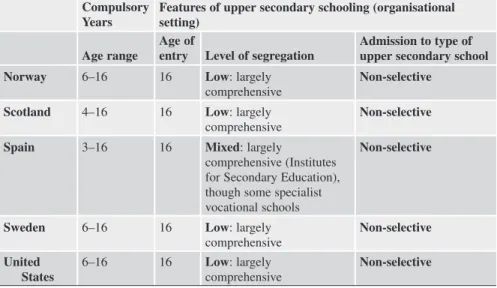
Table 2.1 presents information for a number of OECD countries on features of school organisation. It reports on school settings including the ages at which
1 This is different to the process of residential segregation which produces marked divisions in
some systems, separating students on the basis of where they live and their racial and social back-grounds. Regional or residential segregation can create sharp divisions between schools in terms of intake, separating students almost as effectively as selective schooling. It also has a marked impact on student progress and outcomes, at least according to a range of school effectiveness studies (see, for example, Willms, 2006).
23 2 Pathways to School Completion: An International Comparison
(continued)
Table 2.1 Comparisons of pathways to completion: features of school organisation
Compulsory
Years Features of upper secondary schooling (organisational setting) Age range Age of entry Level of segregation Admission to type of upper secondary school Australia 5–16 16 Mixed: largely
comprehensive, some selective-entry schools
Partly selective: some schools use ability testing for entry
Austria 5–15 14 High: academic, technical, vocational, specialist schools
Selective: entry is dependent on type of school attended and academic achievement
Denmark 4–16 16 Mixed: some integration, though largely separate: general (gymnasium), technical, vocational
Partly selective: entry is dependent on completion of formal exams at the end of compulsory education and teacher recommendation
England 4–16 16 Low: largely
comprehensive Non-selective
Finland 6–16 16 Mixed: general (gymnasium) and vocational schools
Non-selective
France 3–16 15 Mixed: general (general and technological lycées) and vocational schools
(lycées professionnels)
Partly selective: entry is dependent on completion of formal exams at the end of compulsory education
Germany 6–18 15 High: academic (gymnasium), technical, vocational, specialist schools
Selective: entry is dependent on type of school attended and academic achievement
Iceland 3–16 16 Mixed: some integration, though largely separate: general (gymnasium), comprehensives, vocational
Partly selective: Varied admission based on results
at end of compulsory education
Italy 3–15 14 Mixed: general (liceo) and
vocational schools (istituti) Non-selective
Japan 4–15 15 High: academic senior high school and vocational and technical schools
Selective: highly competitive entrance exams
Netherlands 5–18 12 High: academic (VWO), general (HAVO), vocational (VMBO) schools
Selective: entry is dependent on type of school attended and academic achievement, selection at end of primary school
24 S. Lamb
Table 2.1 (continued)
Compulsory
Years Features of upper secondary schooling (organisational setting) Age range Age of entry Level of segregation Admission to type of upper secondary school Norway 6–16 16 Low: largely
comprehensive Non-selective
Scotland 4–16 16 Low: largely comprehensive
Non-selective
Spain 3–16 16 Mixed: largely
comprehensive (Institutes for Secondary Education), though some specialist vocational schools
Non-selective
Sweden 6–16 16 Low: largely
comprehensive Non-selective
United
States 6–16 16 Lowcomprehensive: largely
Non-selective
Sources: OECD (2006); Qualifications and Curriculum Authority, International Review of Curriculum and Assessment Frameworks Archive; Eurydice: Eurybase – the information database on education systems in Europe.
young people enter secondary school and the level of institutional differentiation or segregation. High levels of segregation operate where young people attend different schools either because of the streams or courses that they enter, or because they are divided across schools on academic ability lines. Low levels of segregation occur in systems that more often operate comprehensive schools, catering for a range of student skills and interests within one type of school. There are also countries that have mixed arrangements in which there is some separation across schools on the basis of academic skills or program choices, though there also are integrated or comprehensive schools that cater to a wide variety of students. Admission requirements vary depending on the types of schools and their level of differentiation.
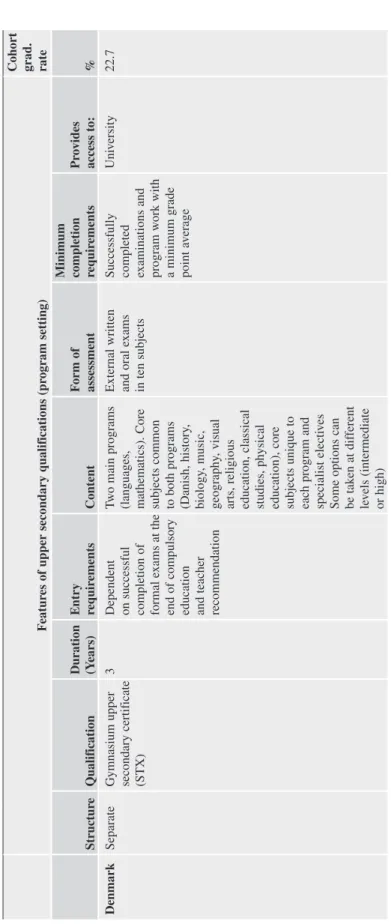
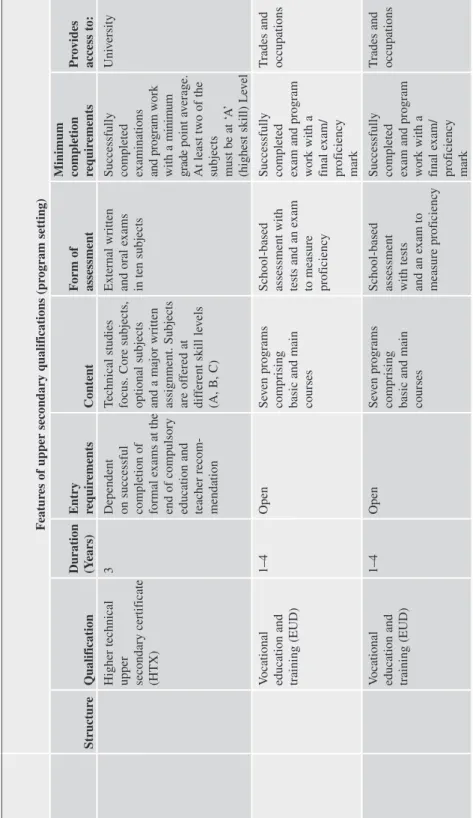
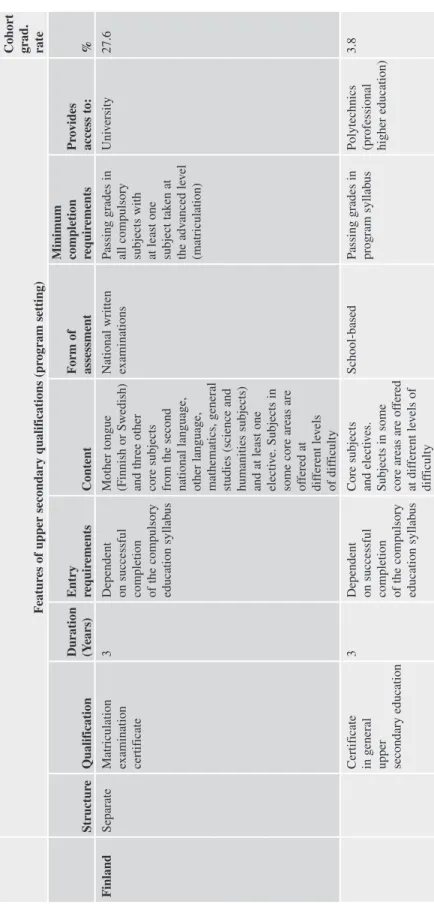
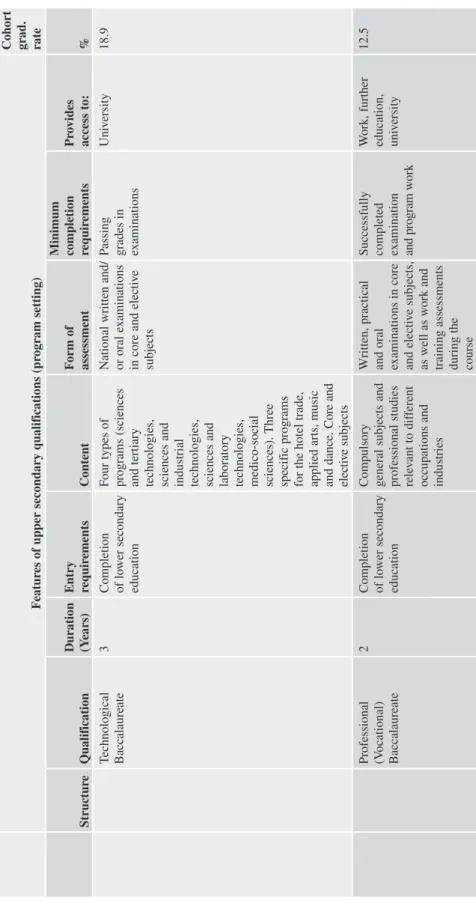
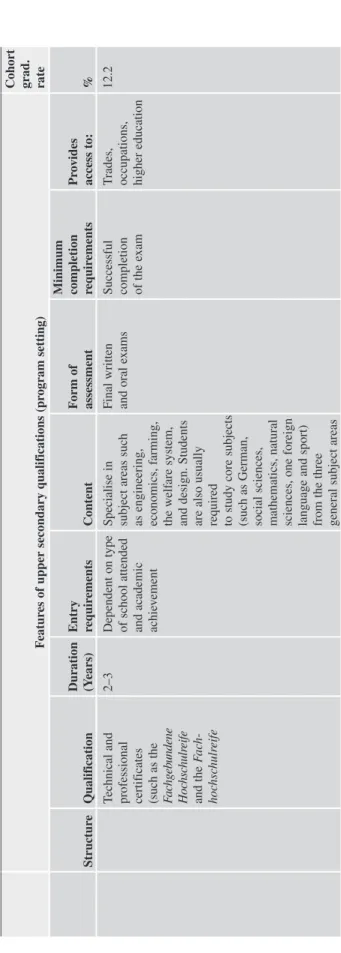
Table 2.2 presents features of secondary school programs and qualifications. It provides details on the various programs and qualifications that are offered in each country. This includes information on the typical duration of courses, pro-gram-specific entry requirements (what criteria are set to enter each type of program and qualification), broad course content (in terms of core subjects and electives and associated arrangements) and the main form of assessment (whether exams, school-based assessment or other forms). To compare differences in qualifications standards, which can vary both within and across national systems, it is important to consider the formal completion criteria – what the requirements are to graduate and obtain a qualification. These can affect both the post-school opportunities, such as entry to university, and the rates of completion. Details on these are
25 2 Pathways to School Completion: An International Comparison
provided together with completion rates expressed in terms of the typical age cohort, revealing the proportions of young people in each country who are likely to graduate with each type of qualification.
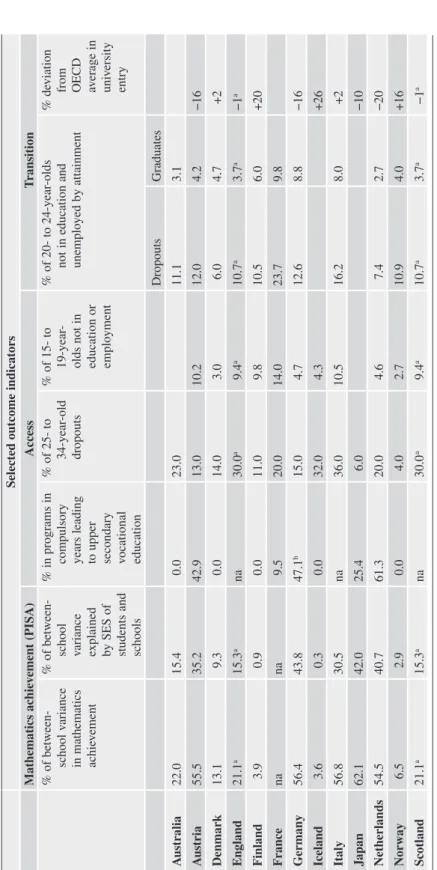
Table 2.3 presents some broad outcome indicators. These are provided at a system level rather than at a qualification level, since qualification-specific outcomes are not available either widely or consistently in an appropriate form for valid comparison. The broad indicators that are presented give some insight into the overall function and performance of system arrangements. Measures include
achievement levels (mathematics achievement measured through the Programme for International Student Assessment [PISA]), access indicators (how inclusive are the qualifications and programs for the whole student population) and transi tion outcomes (what the upper secondary arrangements deliver in terms of labour market experience). The levels of PISA achievement relate to 15-year-olds and, there-fore, achievement prior to upper secondary schooling in many systems. However, they provide a measure of the impact of school organisation and differentiation. The measures selected for inclusion are those that relate to between-school differ-ences in achievement (percentage of variation in student achievement that is linked to differences between schools rather than students, all else equal). The second PISA measure is the percentage of between-school differences accounted for by the SES backgrounds of students and schools. This gives us an indication of the extent to which school arrangements and diversification work to stratify or separate students along social lines. The access indicators include measures of the percent-ages of young people who have left school without obtaining a qualification. They provide an assessment of the capacity of secondary school programs to accommodate and retain students. The transition indicators assess returns to study. They report rates of unemployment for dropouts and for graduates. Also included is the university entry rate, expressed as a percentage difference from the OECD average.
Academic Pathways to Graduation
Every system provides programs and courses that work to prepare or select students for university, and this influences school and program organisation. Even so, there is considerable variation in the requirements for graduation and access to higher education.
In some systems, neither the number of subjects nor the disciplines to be studied for accreditation are prescribed. For example, students in England and Scotland may achieve accreditation in a single subject of their own choosing. In these systems, there are no compulsory subjects at upper secondary level – only electives, with the breadth of subject offerings dependent on school size and student demand. Students choose from a range of subjects available at General Certificate of Education (GCE) Advanced Level (‘A level’) and GCE Advanced Subsidiary Level (‘AS level’). Assessment is academic and competitive, involving external examinations controlled
Table 2.2 Comparisons of pathw ays to completion: features of qualifications F eatur es of upper secondary qualif ications (pr ogram setting)
Cohort grad. rate
Structur e Qualif ication Duration (Years) Entry requir ements Content F orm of assessment
Minimum completion requir
ements Pr ovides access to: % A ustralia V aries by state Senior school certif icate (v aries by state) 2 Open Electi ve-based system, English compulsory in some states External and school-based Pass grades in at least four subjects Uni versity , w ork, further education 68.0 * VET certif icates,
school-based apprenticeships (single
or dual) 1–2 Open Module-based, industry specif ic
School/module- based assessment Successfully completed course
w ork W ork, further education 14.0 * Certif icate of Applied Learning (V ictoria only) 1–2 Open Electi ve-based system, VET focus School-based assessment Successfully completed course
w ork W ork, further education 4.8 A ustria Separate Certif icate of
Secondary Education (Reifeprüfung certif
icate) 4 Dependent on type of school attended and academic achie vement Core subjects
(mathematics, German, foreign language)
and small number of electi ves School-based written and oral exams with examination panel including at least one external panel member Passing grades in compulsory subjects and electi ves (matriculation) Uni versity and professional schools 12.8
CSE and TVE Diploma (Reifeprüfung and TVE Diploma) 4 Dependent on type of school attended and academic achie vement Core subjects (mathematics, German, foreign language) and electi ves
School-based written, practical
and oral exams with examination panel Passing grades in compulsory subjects and electi ves (matriculation) Uni versity and professional schools 8.6
Professional matriculation certif
icate ( Berufsr eife prüfung ) 4 T raining certif icate completion Core subjects (mathematics, German, foreign language) and professionally rele vant subject External examination Passing grades in compulsory subjects and electi ves (matriculation) Uni versity and professional schools 20.5 Apprenticeship certif icate (dual system) 3–4 Open Core subjects (mathematics, German, foreign language) and professionally rele vant subjects Examination Passing grades in compulsory subjects T
rades, occupations, higher education
30.2 V ocational certif icates 2–4 Open Core subjects (mathematics, German, foreign language) and professionally rele vant subjects
School-based written, practical
and oral exams with examination panel Passing grades in compulsory and practical subjects T
rades, occupations, Berufsr
eife
prüfung
17.9
Table 2.2 (continued) F eatur es of upper secondary qualif ications (pr ogram setting)
Cohort grad. rate
Structur e Qualif ication Duration (Years) Entry requir ements Content F orm of assessment
Minimum completion requir
ements Pr ovides access to: % Denmark Separate Gymnasium upper secondary certif icate (STX) 3 Dependent on successful completion of formal exams at the end of compulsory education and teacher recommendation Tw o main programs (languages, mathematics). Core subjects common to both programs (Danish, history , biology , music, geograph y, visual arts, religious education, classical studies, ph ysical education), core subjects unique to each program and specialist electi ves Some options can be tak en at dif ferent le vels (intermediate or high) External written and oral exams in ten subjects
Successfully completed examinations
and program w ork with a minimum grade point av erage Uni versity 22.7
Higher preparatory upper secondary certif icate (HF) 2 Dependent on successful completion of formal exams at the end of compulsory education and teacher recom -mendation Common core subjects, three optional subjects and a major
written assignment Some
options can be tak en at dif ferent le vels (intermediate or high) External written and/or oral exams in ev ery subject studied
Successfully completed examinations and
pr og ra m w ork with a m in im um gr ad e point av erage Uni versity 4.0 Higher commercial upper secondary certif icate (HHX) 3 Dependent on successful completion of formal exams at the end of compulsory education and teacher recommendation Business and commercial studies focus. Core subjects, optional subjects and a major written assignment. Subjects are of fered at dif ferent skill le vels (A, B, C) External written and oral exams in ten subjects
Successfully completed examinations and p
ro gr am w ork with a m in im um gr ad e point av erage. At least tw o of the subjects must be at ‘A ’ (highest skill) Le vel Uni versity 7.9 (continued)
Table 2.2 (continued) F eatur es of upper secondary qualif ications (pr ogram setting)
Cohort grad. rate
Structur e Qualif ication Duration (Years) Entry requir ements Content F orm of assessment
Minimum completion requir
ements Pr ovides access to: % Higher technical upper secondary certif icate (HTX) 3 Dependent on successful completion of formal exams at the end of compulsory education and teacher recom -mendation Technical studies focus. Core subjects, optional subjects and a major written assignment. Subjects are of fered at dif ferent skill le vels (A, B, C) External written and oral exams in ten subjects
Successfully completed examinations and
pr og ra m w ork with a m in im um gr ad e point av erage. At least tw o of the subjects must be at ‘A ’ (highest skill) Le vel Uni versity 2.8 V ocational education and training (EUD) 1–4 Open Se ven programs comprising basic and main courses School-based assessment with tests and an exam to measure prof icienc y
Successfully completed exam
and program w ork with a final exam/ prof icienc y mark T rades and occupations 42.8 V ocational education and training (EUD) 1–4 Open Se ven programs comprising basic and main courses
School-based assessment with
tests and an exam to measure prof icienc y
Successfully completed exam
and program w ork with a final exam/ prof icienc y mark T rades and occupations 42.8
England Separate General Certif icate of Education (GCE) Adv anced Le vel (A Le vels). Single subject qualif ications 2 GCE AS Le vels Range of electi ve subjects, commonly between tw o and four tak en by a student External examination Pass grade in exam Uni versity 42.4 GCE Adv anced
Subsidiary Level (AS
Le vels). Single subject qualif ications 1 No of ficial criteria, though General Certif icate of Secondary Education (GCSE) results can be considered Range of electi ve subjects, co ver half of the content of ‘full’ A Le vels. Commonly four or more subjects selected External examination Pass grade in exam Uni versity and further education General Certif icate of Education A Le vels in Applied Subjects. Four qualif ications av ailable. 2 No of ficial criteria, though GCSE results can be considered Courses are av ailable in ten vocational subject areas and are or ganised on the lines of the GCE AS and A format External tests and internal assessment Pass grade in requisite subjects W ork and further education 8.2 (continued)
Table 2.2 (continued) F eatur es of upper secondary qualif ications (pr ogram setting)
Cohort grad. rate
Structur e Qualif ication Duration (Years) Entry requir ements Content F orm of assessment
Minimum completion requir
ements Pr ovides access to: % Finland Separate
Matriculation examination certif
icate 3 Dependent on successful completion of the compulsory education syllab us Mother tongue (Finnish or Swedish) and three other core subjects from the second national language, other language, mathematics, general studies (science and humanities subjects) and at least one electi ve. Subjects in some core areas are of fered at dif ferent le vels of dif ficulty National written examinations Passing grades in all compulsory subjects with at least one subject tak en at the adv anced le vel (matriculation) Uni versity 27.6 Certif icate in general upper secondary education 3 Dependent on successful completion of the compulsory education syllab us Core subjects and electi ves. Subjects in some core areas are of fered at dif ferent le vels of dif ficulty School-based Passing grades in program syllab us
Polytechnics (professional higher
education)
Certif
ication
in
V
ocational Upper Secondary Education and
T raining 3 Dependent on successful completion of the compulsory education syllab us Mixture of core general studies (same as national core curriculum), electi ves and w orkplace learning. 52 qualif ications, 113 study programs ac ro ss e ig ht b ro ad industry sectors School w ork, theory and
competence- based assessments Successful completion of studies
W ork and polytechnics 36.5 Apprenticeship qualif ication certif icate 1–4 Dependent on successful completion of th e co m pu ls or y education syllab us Mixture of core general studies (s am e as n at io na l core curriculum), electi ves and w orkplace learning School w ork, theory and
competence- based assessments Successful completion of studies
W ork and polytechnics 11.5 France Separate General Baccalaureate 3 Completion of lo wer secondary education Three types of programs (literary , economic and social sciences, scientif ic). Minimum of eight or nine compulsory subjects plus a maximum of tw o optional subjects in each program National written and/ or oral examinations in core and electi ve subjects Passing grades in examinations Uni versity 34.6 (continued)
Table 2.2 (continued) F eatur es of upper secondary qualif ications (pr ogram setting)
Cohort grad. rate
Structur e Qualif ication Duration (Years) Entry requir ements Content F orm of assessment
Minimum completion requir
ements Pr ovides access to: % Technological Baccalaureate 3 Completion of lo wer secondary education Four types of programs (sciences and tertiary technologies, sciences and
industrial technologies, sciences
and
laboratory technologies, medico-social sciences).
Three specif ic programs for the hotel trade, applied arts, music and dance. C or e an d el ec tiv e subjects National written and/ or oral examinations in core and electi ve subjects Passing grades in examinations Uni versity 18.9
Professional (Vocational) Baccalaureate
2 Completion of lo wer secondary education Compulsory general subjects and professional studies rele vant to dif ferent occupations and industries Written, practical and oral examinations in core and electi ve subjects, as well as w ork and training assessments during the course
Successfully completed examination and
pr og ra m w ork W ork, further education, uni versity 12.5
Certif icat d’aptitude pr ofessionnelle (CAP) or Br evet d’etudes pr ofessionnelles (BEP) 2 Completion of lo wer secondary education Compulsory general subjects and professional studies rele vant to dif ferent occupations and industries Tests or ex ercises based on compulsory subjects and professional studies
Successfully completed examination and
pr og ra m w ork W ork, further education 17.0 Germany Separate Zeugnis der Allg emeinen Hoc hsc hulr eife 3 Dependent on type of school attended and academic achie vement Small number of majors selected from three areas (languages, literature and the arts; social sciences; mathematics, natural sciences and technology) with each area needing to be included Abitur examination (written and oral exams) Passing grades in at least four subjects Uni versity 27.3 V ocational lea ving and apprenticeship certif icates (Dual System) 2–4 Open W orkplace training an d sc ho ol -b as ed formal curricula established by the lander . T raining co vers 350 professions Final examination before an examination board rele vant to the training industry . Practical and written component
Successful completion of the
exam T rades and occupations 48.5 (continued)
Table 2.2 (continued) F eatur es of upper secondary qualif ications (pr ogram setting)
Cohort grad. rate
Structur e Qualif ication Duration (Years) Entry requir ements Content F orm of assessment
Minimum completion requir
ements Pr ovides access to: % Technical and professional certif icates (such as the Fac hg eb undene Hoc hsc hulr eife and the Fac h hoc hsc hulr eife 2–3 Dependent on type of school attended and academic achie vement Specialise in subject areas such as engineering, economics, farming, the welf are system, and design. Students are also usually required to study core subjects (such as German, social sciences, mathematics, natural sciences, one foreign language and sport) from the three general subject areas Final written and oral exams
Successful completion of the
exam T rades, occupations, higher education 12.2
(continued)
Iceland
Separate
Matriculation examination certif
icate ( studentspr of ) 4 V aried admission based on results at end of compulsory education Three main academic programs:
foreign languages, natural
sciences and social sc ie nc es . St ud en ts required to tak e core subjects (re gardless of program), specialised subjects according to particular program of study , and electi ves Examination and continuous assessment
Successfully completed examinations.
Can also be aw arded from the
accumulation of internally set
unit-credits. Uni versity 39.4 Journe yman’ s examination certif icate ( sveinspr of ) 4 Open Study comprises general academic subjects, theoretical vocational subjects and practical vocational subjects. Students must tak e a certain number of cr ed its in g en er al academic subjects Journe yman’ s examination and continuous assessment of practical and theory w ork Passing grades in exam and course w ork T rades and occupations 40.6
F eatur es of upper secondary qualif ications (pr ogram setting)
Cohort grad. rate
Structur e Qualif ication Duration (Years) Entry requir ements Content F orm of assessment
Minimum completion requir
ements Pr ovides access to: % Italy Separate Upper secondary lea ving certif icate ( diploma di Stato ) (
Classica/ Linguistica/ Scientif
ica/T ecnica/ Pr ofessionale/ Ma gistr ale/Artistica ) 5 Lo wer secondary diploma (primo ciclo di istruzione ) Core and electi ve subjects, with electi ves varying by specialisation Three written examinations and one oral examination
Successful completion of exams with
a minimum grade point av erage Uni versity 63.5 Professional skills qualif ication ( Diploma di Qualif ica Pr ofessionale ) 3–5 Lo wer secondary
diploma (primo ciclo
di istruzione ) Core and electi ve subjects, with electi ves varying by vocational
specialisation. Specialisation involv
es basic training in either agriculture, industry and crafts, or the service sector Examination
Successful completion of exam and
course w ork W ork, further vocational education 5.8 Table 2.2 (continued)
(continued) Japan Separate Upper secondary school lea ving certif icate (academic) 3 Entrance exam Credit-based system of core subjects (Japanese language; geograph y and history; ci vics; mathematics; science; health and ph ysical education; art; ho m e ec on om ic s) and small number of possible electi ves School-based assessment Achie ving threshold of credits (80) by successfully completing the
required number of core and
electi ve subjects Uni versity entrance exam 66.1 Upper secondary school lea ving certif icate (v ocational/ technical) 3 Entrance exam Credit-based system of core subjects and specialised vocational or technical electi ves School-based assessment Achie ving threshold of credits (80) by successfully completing the required number of core and electi ve subjects Uni versity and w ork 24.7 High school graduation qualif ication test Indi viduals who ha ve not
graduated upper secondary school
Exams co ver core subjects in the general upper secondary curriculum Examination Passing grades in exams Uni versity entrance exam
F eatur es of upper secondary qualif ications (pr ogram setting)
Cohort grad. rate
Structur e Qualif ication Duration (Years) Entry requir ements Content F orm of assessment
Minimum completion requir
ements Pr ovides access to: % Nether -lands Separate Upper Secondary Preparatory Diploma (VW O) 5 Achie vement and school recom -mendation Four programs (science and technology; science and health; economics and society; culture and society) with some common core subjects
National examination and
school exam/ assessment Passing final grades with minimum overall grade Uni versity 22.9 Upper Secondary General Education Diploma (HA V O) 6 Achie vement and school recom -mendation Four programs (science and technology; science and health; economics and society; culture and society) with some common core subjects
National examination and
school exam/ assessment Passing final grades with minimum overall grade Professional higher education, VW O 21.2 Upper Secondary V ocational Diploma (VMBO) 4 Achie vement and school recom -mendation Four programs associated with four industry or business sectors, ea ch w ith it s ow n combination of exam subjects National and school-based examinations Passing final grades with minimum overall grade W ork, further education 41.0 Table 2.2 (continued)
(continued) Norway Separate Upper Secondary Lea ving Certif icate (general) 3 Initially open, promotion can depend on achie vement Three general programs (general and business studies; music, dance and drama; sports and ph ysical education) Written and/ or oral examinations and school-based assessment Passes in all subjects and exams required for each program with minimum le vel of achie vement in core subjects Uni versity 44.0 V ocational qualif ication/trade or journe yman’ s certif icate 3 Open Twelv e vocational streams Centrally set theoretical and practical examinations Passes in all subjects and exams required for each program with minimum le vel of achie vement in core subjects W ork, further education 29.9 Scotland Inte grated National Qualif ication Certif icates 1–3 Initially open, le vel of study depends on achie vement National Qualif ications are av ailable at fi ve le vels: Access, Intermediate 1, Intermediate 2, Higher , and A dv an ce d H ig he r. Courses co ver both general and vocational subjects. There are no compulsory subjects. National courses often in volv e three subject-related units Internal and external assessment National Course Qualif ications are aw arded to those who pass all of the internally assessed components and achie ve a passing grade in the external exam for the course Uni versity , w ork, further education
F eatur es of upper secondary qualif ications (pr ogram setting)
Cohort grad. rate
Structur e Qualif ication Duration (Years) Entry requir ements Content F orm of assessment
Minimum completion requir
ements Pr ovides access to: % Spain Separate Baccalaureate Certif icate ( Bac hiller ato ) 2 Lo wer secondary certif icate ( Gr aduado en Educación Secundaria) Four programs (arts; natural science and health; humanities and social studies; technology) with some common or core subjects School-based assessment Pass grade in all subjects Uni versity
entrance exam, adv
anced le vel specif ic vocational training 45.0 Intermediate Specif ic V ocational T raining Certif icate ( Técnico ) 1–2 Lo wer secondary certif icate ( Gr aduado en Educación Secundaria)
Modules of theoretical and
practical training based on 22 vocational fi el ds , with some co re su bj ec ts a nd f ield-specif ic options. W orkplace module is compulsory School-based and w orkplace assessment Pass grade in all subjects and modules W ork, adv anced le vel specif ic vocational training 21.0 Table 2.2 (continued)
(continued) Sweden Inte grated Upper secondary lea ving certif icate ( Slutbetyg fr ån gy m na si es ko la n ) 3 Lo wer secondary certif icate ( grundsk ola ) Tw o academic and 16 vocational strands. There are core subjects
(Swedish, English, mathematics,
ci vics, religion, science studies, ph ysical education and health, and artistic acti vities) common to all strands plus specialist subjects School-based with national tests in three core
subjects (Swedish, English, mathematics)
Requisite number of credits with a pass grade in at least 90% fo r a co m pl et ed
course of studies, including
a pass in a compulsory upper secondary certif icate project Uni versity , w ork, further education 88.0
F eatur es of upper secondary qualif ications (pr ogram setting)
Cohort grad. rate
Structur e Qualif ication Duration (Years) Entry requir ements Content F orm of assessment
Minimum completion requir
ements Pr ovides access to: % United States Inte grated High School Diploma (Re gular/ Standard, Vocational, Honor/ Re gents, Colle ge Preparatory) 3 Open Subjects can be clustered into vocational, general and academic tracks based on system of core subjects (often English, mathematics, social studies, science, health and ph ysical education) and electi ves School assessment on the basis of grades and w ork ov er the year Satisf actory completion of a specif ied number of subjects (credits), designated for each diploma, varying by State. Minimum exit exam achie vement scores in some states. Higher education and w ork 75.0 General Educational De velopment Certif icate (GED) Indi viduals who ha ve not graduated from high school Tests co ver writing, social studies, science, reading and mathematics Examination Pass grade in all tests Higher education and w ork 11.0 *= Not mutually exclusi ve Sources: Qualif ications and Curriculum Authority , International Re vie w of Curriculum and Assessment Frame w orks Archi ve; Eurydice: Eurybase – the information database on education systems in Europe; National Ministries of Education – Austria, Denmark, France, Finland, German y, Iceland, Italy , Japan, Netherlands, Norw ay , Spain, Sweden; U.S. Department of Education, National Center for Educational Statistics; Department for Children, Schools and Families, England; National Statistics Bureaus: Australia, Austria, Denmark, France, Finland, German y, Iceland, Italy , Japan, Netherlands, Norw ay , Spain, Sweden. Table 2.2 (continued)
Table 2.3 Comparisons of pathw ays to completion: selected outcome indicators Selected outcome indicators Mathematics achie vement (PISA) Access T ransition % of between-school variance in mathematics achie vement % of
between-school variance explained by
SES of students and schools % in programs in compulsory years leading to upper
secondary vocational education
% of 25- to 34-year -old dropouts % of 15- to 19-year - olds not in education or emplo yment % of 20- to 24-year -olds not in education and unemplo yed by attainment % de viation
from OECD average
in uni versity entry Dropouts Graduates A ustralia 22.0 15.4 0.0 23.0 11.1 3.1 A ustria 55.5 35.2 42.9 13.0 10.2 12.0 4.2 −16 Denmark 13.1 9.3 0.0 14.0 3.0 6.0 4.7 +2 England 21.1 a 15.3 a na 30.0 a 9.4 a 10.7 a 3.7 a −1 a Finland 3.9 0.9 0.0 11.0 9.8 10.5 6.0 +20 France na na 9.5 20.0 14.0 23.7 9.8 Germany 56.4 43.8 47.1 b 15.0 4.7 12.6 8.8 −16 Iceland 3.6 0.3 0.0 32.0 4.3 +26 Italy 56.8 30.5 na 36.0 10.5 16.2 8.0 +2 Japan 62.1 42.0 25.4 6.0 −10 Netherlands 54.5 40.7 61.3 20.0 4.6 7.4 2.7 −20 Norway 6.5 2.9 0.0 4.0 2.7 10.9 4.0 +16 Scotland 21.1 a 15.3 a na 30.0 a 9.4 a 10.7 a 3.7 a −1 a (continued)
Selected outcome indicators Mathematics achie vement (PISA) Access T ransition % of between-school variance in mathematics achie vement % of
between-school variance explained by
SES of students and schools % in programs in compulsory years leading to upper
secondary vocational education
% of 25- to 34-year -old dropouts % of 15- to 19-year - olds not in education or emplo yment % of 20- to 24-year -olds not in education and unemplo yed by attainment % de viation
from OECD average
in uni versity entry Dropouts Graduates Spain 17.2 9.8 0.0 39.0 7.3 7.3 2.8 −6 Sweden 10.9 5.8 0.0 9.0 4.2 11.9 8.2 +26 United States 27.1 18.7 0.0 13.0 7.0 11.3 5.1 +10 a = Figures are for United Kingdom b = Figure from Secretariat of the Standing Conference of the Ministers of Education and Cultural Af fairs of the Länder , Federal Republic of German y (2009) na = not av ailable Sources: OECD (2004, 2006). Table 2.3 (continued)
47 2 Pathways to School Completion: An International Comparison
and administered by GCE examining boards. High standards are required to pass a subject and gain accreditation, but the subjects can be of the student’s own choosing. In terms of accreditation, this could be described as a system of standards, but stan-dards without subject or knowledge prescription. For example, students could achieve high levels of learning in particular fields, such as history, while having poorly developed skills in other areas, such as mathematics. University preparation is sponsored in the areas of intensive study, and supported through a rigorous system of external examinations. However, accreditation is not based on a minimum number of subjects designed as a ‘course’ and covering a range of learning areas.
In other systems, the academic curriculum at upper secondary level is much more prescribed. In Austria, for example, students undertaking the matriculation certificate (Reifeprufung) must study three compulsory subjects – mathematics, German, and a foreign language – and additional subjects from a range of specialist and interdisciplinary electives. The electives provide for some specialisation in certain areas depending on the school. The focus can be on classical languages, mathematics and the sciences, economics and business, instrumental music or art. Similarly, in Finland, students are required to study four compulsory subjects (mathematics, general studies, mother tongue, foreign language) and at least one elective. In both systems, assessment involves academically competitive examinations and graduation based on minimum grades.
Another common model is one involving a range of core and elective subjects grouped into specialist programs, with the course requirements varying depending on the length or duration of study. Denmark, for example, offers two main types of academic programs, one focused on languages and the other on mathematics. There are core subjects common to both programs (Danish, history, biology, music, geography, visual arts, religious education, classical studies, physical education) as well as core subjects unique to each program and specialist electives within each program. Graduation requires successful completion of externally administered written and oral exams with a minimum grade point average. France, Italy, the Netherlands, Norway, Spain, Sweden and Iceland all operate versions of this model of provision – separate specialist academic programs with core subjects common across all strands and either prescribed subjects or electives within each specialist course. Graduation is largely based on examinations, sometimes competitive national exams as in France and the Netherlands, with minimum passing grades or scores for individual subjects and a minimum overall score. Some systems, such as Sweden and Spain, use school-based assessment, though even in these systems there is sensitivity and pressure related to the issue of ‘academic standards’. In Sweden, this has seen the introduction of national tests in key core subjects (mathe-matics, English, Swedish) which have to be used by teachers in the awarding of grades in these subjects.
Graduation (sometimes referred to as matriculation, or matura) in most coun-tries requires successful completion of a minimum number of subjects. In Sweden, this means gaining a requisite number of subject credits through successfully com-pleting a course of study. In many systems the requirement is for achieving mini-mum grades in at least five subjects including a set number of compulsory subjects
48 S. Lamb
covering different key learning areas (such as mathematics and native language). An overall score, the equivalent of a grade point average derived from a minimum number of subjects, is sometimes used to set a threshold or standard for the success-ful completion of the award.
The function of academic programs in all systems, and the requirements around graduation and certification, are influenced by the process and needs of university selection. But there are some important differences in how this works. In some systems, successful completion of academic credentials at the end of schooling automatically qualifies students for entry to university without the need for further selection. In Germany, for example, candidates who are success-ful in the Abitur (the achievement examination taken on completion of upper secondary education) are awarded a general higher education entrance qualifica-tion (Allgemeine Hochschulreife). The Abitur grants access to all courses of study at universities and other higher education institutions. Similarly, in Austria, the Reifeprüfung or Matura entitles its holders to enrol in university studies of their choice, even though access to some specialist courses may require addi-tional subject study and assessment. In the Netherlands, there may be different programs of academic study, but the VWO (matriculation) certificate qualifies pupils to enter university and higher professional education without further selection.
The onus of selection for university is removed from universities themselves in such countries because the whole organisational structure of schooling, programs and qualifications works to regulate the quality of students, delivering to universities a pool of academically selected and prepared students, homogeneous in skills, training and orientation. Numbers of students are also regulated because academic selection tends to occur early, more rigorously and more overtly than in other sys-tems. The universities can distance themselves from involvement in the business of selection for entry because school organisation from an early stage is geared to the needs of academic recruitment and the promotion through matriculation of a minor-ity of highly selected students. In all three systems (Germany, Austria and the Netherlands), the separation of students along academic lines occurs at the end of primary school or shortly thereafter. The majority of students in each system are channelled away from academic programs into vocational, professional and techni-cal education paths at an early age. Table 2.3 shows that the three systems have the highest proportions of students in primary school and junior secondary years enrolled in programs leading to vocational education in high school (42.9% in Austria, 61.3% in the Netherlands and 47.1% in Germany). A minority of students – between 20% and 40% – are grouped into schools delivering intensive academic training leading to matriculation and university entry. The differentiation mainly occurs on the basis of students’ ability and preference, and already orients students towards post-school study (university, higher education or other forms) or to the labour market on completion of school. Consequently, the rates of entry to univer-sity tend to be well below OECD averages in the three systems (see Table 2.3). These countries also tend to have high levels of variation in academic achievement across schools. Approximately 56% of the variance in mathematics achievement
49 2 Pathways to School Completion: An International Comparison
among 15-year-olds in Germany is due to between-school differences (compared to 27.1% in the United States, 10.9% in Sweden and 3.9% in Finland, see Table 2.3).2
In Austria, the rate was 55.5% and in the Netherlands 54.5%. Social differences in intake account for much of the between-school differences in all three countries (43.8% in Germany, 40.7% in the Netherlands and 35.2% in Austria). This is an indication that the school systems are highly segregated along social as well as academic lines.
University selection also influences the graduation requirements in other coun-tries. However, where systems are more comprehensive and secondary education less differentiated, both in terms of school organisation and program structure, universities tend to undertake their own selection process or be heavily involved in the establishment of selection criteria. They are less likely to rely on school quali-fications as the sole requirement for admission. In Sweden, for example, which has some similar features in school organisation to the United States, all upper secondary programs give access to higher education, formally at least. Admission decisions on the selection of students are made by the individual universities. This occurs within a national framework of credit points based on teacher assessment, other specific tests such as the university standard aptitude test, and previous education and work experience. In Spain, successful completion of the bachillerato (bacca-laureate) grants access to the university selection process. To enter university, students must currently, in addition to obtaining the bachillerato, pass a national admissions examination.
The academic courses and graduation criteria work in such systems to provide access to the opportunity to compete for university selection, rather than to a university place itself (as would happen in Austria or Germany). The most extreme version of this is in Japan where, despite highly competitive academic exams at different stages of schooling, at which success is necessary for access to the next stage, students who graduate with a high school ‘leaving certificate’ still have to sit for a competitive national university entrance exam in order to be considered for admission to university.
In such systems, the universities do not rely on the school qualification alone as the entry status marker. This is in part because the number of university places falls far short of the numbers of students graduating from the academic school programs. In some countries, such as Australia, the response is to use high school subject grades translated into a university entrance score. In other systems, such as in Sweden and Spain, it is to impose further selection requirements such as entry exams. It may be no coincidence that such practices occur in countries that have
2 These figures were derived through an analysis of mathematics achievement using the PISA
mathematics scale (see OECD, 2004, pp. 161–163 for an explanation of method). Variance was measured based on percentages of the average variance between OECD countries in student performance. For example, the total variance in student performance in the United States was 9,016 compared to the average OECD variance level of 8,593 giving a percentage of 104.9. For each country, variance is divided between that attributable to achievement levels of students in different schools (between-school differences) and that attributable to the range of student results within schools (within-school differences).
50 S. Lamb
been successful in promoting higher proportions of students into academic programs in secondary school by delaying selection of branches of study to much later in schooling. A sizeable group of countries possess a largely comprehensive model in which students continue with a core curriculum until the end of the compulsory years (often at age 16). This is the model that exists in England and Scotland, many of the Nordic countries, as well as Spain, France and Italy. In these countries, stu-dents only choose a particular branch or type of schooling at the end of the com-pulsory phase, often following exams or assessments that lead to an accredited school certificate or qualification. Few countries have the system of secondary schooling that characterises the United States, Canada and most states of Australia in which there is no secondary school certificate or formal assessment to mark the end of the compulsory years.
Countries that postpone the point at which students have to choose a particular branch or type of schooling (those with no or low percentages of students in pro-grams in the junior years tracking to high school vocational courses, see Table 2.3) do tend to encourage more students into academic programs leading to higher edu-cation. This can operate within the structure of a single certificate arrangement, as in the United States, where all students who graduate formally or technically qualify for higher education, or in a diversified high school program and accredita-tion structure as in Norway, Denmark, Spain, Japan and France where there are academic and alternative qualifications and only part of the student population enters a program oriented to university entry, even though the latter tends to be the majority of students.
Systems that defer the point of program choice tend to encourage more stu-dents into academic courses. But it would be wrong to conclude that institutional and program arrangements in such systems are not geared around the selective requirements of academic preparation for university entry. Even the most integrated and formally open secondary school systems tend to be organised around the needs of academic selection. Norway, for example, offers a wide range of general and vocational upper secondary programs which work to accommodate diversity in aptitudes and interests, while maintaining a more homogeneous group of the most academically skilled in the university-preparatory courses. Graduation from the academic preparatory courses is based on examination success and minimum grades in core subjects. In the United States, tracking serves the same purpose. Subject selection or more formal ability selection can work to group higher achieving students together in higher tracks, usually in mathematics and science classes, and low achieving students in lower track classes. The system of college preparatory classes for advanced students and general education and vocational classes for others sifts and sorts along academic lines, working to serve the needs of academic selection as the primary function.
The standards debate around graduation, and the push in the United States to install hurdle requirements through exit examinations and high-stakes testing, is usually focused on the standards of those who are not college-bound and the minimum skill levels they should possess or display in order to earn a diploma. A problem is that if higher standards are set (and high-quality learning and
51 2 Pathways to School Completion: An International Comparison
achievement for all is a worthy national goal for education), it is important to ensure that the conditions are in place to deliver that high-quality learning for all. Currently, the upper secondary structures in most countries effectively prepare selected numbers of students for academic pathways. The challenge is around how effectively they deal with the learning needs and achievement standards of the remaining groups of students.
Alternative Pathways
Not all students are able to or want to pursue academic pathways leading to univer-sity. While traditionally upper secondary courses were designed mainly for an aca-demic elite, most countries have developed alternative courses and qualifications to enable an increasing number of young people, with a wider range of abilities, to complete school and graduate with a relevant qualification. The alternatives mainly involve technical or vocational education. In these developments, one challenge for systems has been to ensure that the programs are of high quality, fostering commit-ment to learning and personal developcommit-ment, and having valued employcommit-ment or fur-ther education and training outcomes. Anofur-ther challenge has been to ensure that the programs provide standards of learning that enable continued study in further educa-tion once students leave school, rather than being terminal opeduca-tions. The quality of programs is critical in addressing the problems of dropout because it is often the sorts of students at risk of dropping out – those who are not achieving well, those who have tended to become disaffected with school and formal academic work – who are likely to be attracted to available alternatives.
Countries have taken different approaches to these challenges. They differ, for example, in terms of whether vocational and general streams run in parallel or in integrated programs, in terms of the range and organisation of vocational qualifica-tions, in terms of the timing and nature of the choices that young people have to make between distinct pathways and post-school destinations, and in terms of assessment and graduation requirements. Three broad approaches are evident, and these are discussed in detail below.
The first type of approach is to integrate or incorporate vocational options within the general structure and organisation of a more traditional school curriculum. This often involves offering a menu of vocational subject or unit options from which students choose, in combination with general and academic subjects, options that can be used as part of credit sequences which accumulate and are counted with other credits to meet completion requirements. This approach could be described as an ‘education or school-based’ model of vocational provision because it attempts to incorporate vocational education into the existing structure and logic of more traditional secondary school studies. Even though vocational units or subjects can be organised around areas of employment, industry or occupation, the modules of study tend to be school-based and school-delivered, designed in line with assess-ment and syllabus requireassess-ments of traditional school subjects. This approach is
52 S. Lamb
more frequently provided in systems that have comprehensive school settings in the upper secondary years attended by university-bound students as well as those pur-suing other destinations.
One example is provided by the United States where students have vocational choices as part of a menu of subject options. The vocational subjects tend to be designed around specific occupations in particular industries such as agriculture, business or health care. The sort of pathway vocational-track students would follow to graduation is to take a minimum number of credits in compulsory areas (such as English, mathematics, social studies, science, health and physical education), along with a number of credits in elective subjects from a menu including vocational options. The vocational electives can represent as much as one third of the required high school study. Alternatively, students may choose not to take any vocational subjects, since most high school students are free to take as much – or as little – vocational coursework as they want. This means that there can be varying levels of intensity of study in vocational education. Figures from the 1990s reveal that while the majority of high school students in the United States took at least one vocational education course (defined very broadly to cover a range of subjects from occupa-tionally specific labour market preparation subjects to consumer education and technology), about 21% took a concentrated sequence of units that could be described as a vocational program or track (Laird et al., 2006). The rest enrolled in either a preparatory track (38%) or a general track (neither college-preparatory nor vocational, 41%). Of those taking largely a vocational program, about a quarter also completed a college-preparatory curriculum.
Based on outcomes data, vocational programs would appear to deliver some ben-efits as an alternative pathway for potential dropouts. Bishop and Mane (2004) reported that compared to other course takers, students taking larger numbers of vocational education units or subjects were more often lower achievers (based on Grade 8 grade point average) and from lower socioeconomic status (SES) back-grounds. Even so, in an analysis of short- and long-term returns to high school study, Bishop and Mane found that compared to other school leavers, those who opted for more vocational education tended, all else equal, to spend more time employed both in the initial post-school years and 8 years later. Other studies report equivalent employment outcomes, through lower levels of participation and completion in post-secondary education and lower earnings for those with stronger vocational prepara-tion in school (Laird et al., 2006; Levesque et al., 2000). Bishop and Mane (2004) noted that stronger emphasis on vocational preparation courses in upper secondary education tended to increase school attendance of 15- to 19-year-olds. Other work also suggests that, all else equal, the more vocational education classes the students take, the less likely they are to drop out (Mertens et al., 1982, for example), and that part of the reason for this is the positive effects of vocational education courses on student engagement resulting from participation in applied, work-based learning (Hughes et al., 2001; Steinberg, 1998).
A similar model of vocational education to that found in the United States operates in Australian schools. The majority of young people enter a general education path-way at the end of compulsory education (Year 10 in most states). Usually completed
53 2 Pathways to School Completion: An International Comparison
over 2 years, students can take vocational education subjects as part of their senior school certificate. To qualify for a certificate, students must generally complete a sequence of elective units or subjects with most final year students needing to successfully complete a minimum number of subjects, including English. One difference from the United States is that as well as obtaining a secondary school certificate, students enrolled in vocational education courses can also obtain a sepa-rate certificate for their vocational study, effectively providing a dual qualification. Vocational education programs can consist of stand-alone, nationally recognised, industry-specific courses based on industry training packages, which are also accredited for the secondary school certificate, though integration into school cer-tificates varies across states. Some of the vocational education programs contain structured workplace learning with expected competency-based learning outcomes included in assessment.
In 2001, about 21% of Year 12 (final school year) students in Australian schools enrolled in at least one vocational education subject or course (Lamb & Vickers,
2006).3 The rate was 29% for students from low SES backgrounds, and 11% for
those from high SES backgrounds. The chances of unemployment in the first post-school year were lower among graduates who had undertaken some vocational preparation than among dropouts, and about the same as graduates who did not take any vocational education, though this varied depending on the type of program studied. There is also some evidence that students who studied vocational educa-tion courses in school were more likely to complete school because their study (including experiences in the workplace) helped them to form more positive views about learning and school. Students in Year 9 who reported plans to drop out more often completed school if they entered vocational courses rather than academic or general programs (Lamb & Vickers, 2006).
A second broad approach to the provision of alternative upper secondary pathways is to provide stand-alone vocational education qualifications where there is little or no attempt at integration with the academic or general high school curriculum. Instead, the alternative pathways have much stronger connections to employment and enter-prises. The content of programs (including identified occupation skills and competen-cies) and assessment are often designed by agencies associated with employer and craft guilds, usually accredited or administered by labour and commerce ministries rather than education departments, and often legally governed by vocational training or commerce acts rather than education statutes. In such systems, vocational pro-grams and qualifications have close links with the labour market and weak links with higher education, even though further education is often possible in the same voca-tional area. The programs are therefore sharply differentiated from academic pro-grams where the main focus is preparing students for university. The propro-grams and qualifications are mainly provided in separate schools. It is also a feature of such systems that separation based on selection or preferences tends to occur earlier in
3 The rate is closer to 14% using the approach applied in the United States by Laird et al. (2006)
in defining a vocational program or course as a concentrated sequence of vocational units or subjects.