Volume 6 | Issue 2 July 2016
Bringing Students Back to Mathematics: Classroom Knowledge
Bringing Students Back to Mathematics: Classroom Knowledge
and Motivation
and Motivation
Giang-Nguyen T. Nguyen University of West Florida Joel B. Goodin
Athens State University
Follow this and additional works at: https://scholarship.claremont.edu/jhm
Part of the Science and Mathematics Education Commons
Recommended Citation Recommended Citation
Nguyen, G. T. and Goodin, J. B. "Bringing Students Back to Mathematics: Classroom Knowledge and Motivation," Journal of Humanistic Mathematics, Volume 6 Issue 2 (July 2016), pages 47-83. DOI: 10.5642/jhummath.201602.06 . Available at: https://scholarship.claremont.edu/jhm/vol6/iss2/6
©2016 by the authors. This work is licensed under a Creative Commons License.
JHM is an open access bi-annual journal sponsored by the Claremont Center for the Mathematical Sciences and published by the Claremont Colleges Library | ISSN 2159-8118 | http://scholarship.claremont.edu/jhm/
The editorial staff of JHM works hard to make sure the scholarship disseminated in JHM is accurate and upholds professional ethical guidelines. However the views and opinions expressed in each published manuscript belong exclusively to the individual contributor(s). The publisher and the editors do not endorse or accept responsibility for them. See https://scholarship.claremont.edu/jhm/policies.html for more information.
Cover Page Footnote Cover Page Footnote
We would like to thank Dr. Kathleen M. Clark from Florida State University for her support and guidance.
Classroom Knowledge and Motivation
Giang-Nguyen T. Nguyen
Department of Teacher Education & Educational Leadership, University of West Florida, USA
Joel B. Goodin
Psychology Department, Athens State University, Athens, Alabama, USA [email protected]
Abstract
This paper reports part of a larger research study that investigated how teach-ers motivate students to learn mathematics at the college level. Findings from the study indicated that teachers have the power to influence and reinvigorate students who had given up learning mathematics. In the framework of Self-Determination Theory (SDT), the researchers analyzed five students’ motiva-tional levels based on intrinsic and extrinsic motivation to see how each student was motivated by their teacher. Findings from the study could provide some directions for future research on students’ motivation to learn mathematics.
1. Introduction
Promoting students’ mathematics learning has become a priority in re-cent years, as STEM areas are increasingly emphasized in public education. Motivation seems to be a crucial deficit at the heart of so many students’ struggles with mathematics learning and affective issues related to learn-ing mathematics. Motivation-related issues with mathematics have been reported throughout extant literature [13, 43, 45, 47]. Indeed, many college students, although focused on goals beyond mathematics, cannot reach said goals due to being “stuck” in introductory mathematics courses [26]. In the year 2000, more than 400,000 students enrolled in College Algebra courses in Journal of Humanistic Mathematics Vol 6, No 2, July 2016
the United States [40]. Despite the fact that the curriculum in these courses was centered on middle and high school curricula, a large number of these students, due to failing grades, were forced to repeat the course more than twice. In some cases, students repeated the course as many as five or six times before succeeding or giving up. Passing College Algebra is a prerequisite to many STEM degree programs and was viewed by students as a “gatekeeper” course [31].
We believe that the struggle in students’ attempts to confront and squeeze through this “gate” is an issue of insufficient motivation to expend the nec-essary effort. In our study, we explored what a teacher can do to influence student motivation to learn mathematics. Specifically, we investigated how an individual teacher, henceforth referred to asMr.Algebra, influenced at-risk students (those who were struggling with depleted motivation to learn math-ematics). In order to elucidate potential motivational strategies that can be replicated, we discuss a case study of Mr.Algebra, a community college in-structor who managed to reach several of his students who might otherwise be lost to a sort of learned helplessness’ [35] specific to mathematics.
Mathematics seems to be a discipline especially prone to what Seligman [35] described as learned helplessness, or a depletion of all volition and mo-tivation toward a goal after repeated failure. Generally, students must be motivated and expend great amounts of effort to succeed in a mathematics course. Due to the ability of Mr.Algebra to engage his students, we believe his case may elucidate motivational techniques that can be used by teachers to enhance student learning. Therefore, we seek to use the case study to do the following:
1. share backgrounds of individual students’ experiences in learning math-ematics and the impacts of those experiences on their motivation, 2. provide evidence of what the teachers can do to influence students’
motivation, and
3. discuss how influential factors could contribute to our understanding of the human dimension of mathematics motivation.
More specifically, this article will emphasize motivational techniques em-ployed by Mr. Algebra, who effectively attended to what we feel are three necessary facets of a successful classroom:
2. Students’ motivation (on an extrinsic and intrinsic continuum) prior to the course
3. Influential attention to student motivation during course progression We do not believe there is a perfect “recipe” for a successful classroom or that these three facets are an exhaustive list. However, we think that highlighting, discussing, and analyzing stories of success such as that of Mr. Algebra will serve to help administrators, educators, and researchers be cog-nizant and knowledgeable of good tools that may make sense to them as they strive to reach their students.
2. Theoretical Frameworks
The fundamental goal of this study is to understand strategies that may influence “motivation-depleted” students’ success in mathematics. Motiva-tion plays an important role in learning. McLeod [23] suggested, “Research in mathematics education can be strengthened if researchers will integrate affective issues into studies of cognition and instruction” (page 575). Simi-larly, Hannula [12] claimed that the realization of needs, as one of the goals in the mathematics classroom, is greatly influenced by students’ beliefs about themselves, as well as beliefs about mathematics and learning. He suggested using a motivational system as a “lens” for looking at mathematics behavior. Therefore, mathematics education can be examined using different theoreti-cal perspectives borrowed from disciplines outside of mathematics education to inform our research and practice.
Hence, mathematics education may benefit from the motivational per-spective in explaining how teachers’ understanding of student learning may draw upon different kinds of knowledge in their teaching, such as knowl-edge about their students, knowlknowl-edge about pedagogy, and knowlknowl-edge about classroom discourse, including student interaction in group work. Thus, teachers can create more meaningful activities that enhance student learning [16,18, 22, 32,38].
Mathematics instruction would benefit from multiple perspectives. Dif-ferent lenses allow “researchers and teachers to assume difDif-ferent points of view, in order to better understand students’ behaviors” [47]. Paas, Tuovi-nen, van Merrienboer, and Darabi [29] argued that meaningful learning oc-curs only if it is coupled with motivation. In this respect, they suggested applying motivational perspectives in order to “identify the task
characteris-tics that motivated students to invest more mental effort and achieve higher performance” (page 31). To guide our study, we applied several frameworks borrowed from educational psychology includingSelf-Determination Theory,
Attribution Theory, and the ARCS Model.
2.1. Self Determination Theory
Self-Determination Theory (SDT) is the theoretical basis for understand-ing how students were motivated to learn mathematics. SDT distunderstand-inguishes motivation based on different goals: intrinsic and extrinsic motivation. In-trinsic and exIn-trinsic motivation can be thought of as two ends of the contin-uum while the middle shows previously extrinsically motivated individuals that have internalized the motivations for their tasks [32]. An intrinsically motivated student in a mathematics course would be motivated by the “joy of learning,” gaining personal satisfaction from the process of solving prob-lems and self-gratification from success in gaining expertise and skill. In contrast, an extrinsically motivated student in the same course might be equally motivated, but for different reasons. Perhaps, their parents praise them or give them money for good grades. They may enjoy knowing that they are at the “top of the class.” Extrinsically motivated students are moti-vated by external (societal) rewards. While it is not uncommon for students to be motivated by both intrinsic (inward) and extrinsic (outward) rewards, extrinsic rewards are often more plentiful and palpable and often supplant intrinsic motivation.
Even though intrinsic motivation results in a high quality of learning and creativity, extrinsic motivation is equally important. Extrinsic motivation has traditionally been viewed as “pale and impoverished,” in contrast with intrinsic motivation. Yet SDT proposes that some form of extrinsic motiva-tion should “represent active, agentic states” [32, page 55]. Understanding different types of extrinsic motivation and what fosters them is important for those who cannot always rely on intrinsic motivation to foster learning (e.g., educators). Since many academic tasks are not readily interesting or enjoyable to all students, Ryan and Deci [32] proposed that knowing how to promote more active learning and volitional forms of extrinsic motivation is an essential strategy for successful teaching and learning.
The basic assumption in studies of intrinsic motivation is that people are “active organisms working to master their internal and external environment” [5, page 35]. This foundational premise became known asself-determination.
The Cognitive Evaluation Sub-Theory of SDT has great empirical validation [5] because the theory highlights critical roles of competence and autonomy supported by fostering intrinsic motivation.
Self-determination requires people to act on their environments. As we previously stated, intrinsic and extrinsic motivation can be thought of as two ends of a continuum. In the middle are behaviors that originally were ex-trinsically motivated, but have are internalized and self-determined to some degree. For example, students who do not want to work on academic activi-ties may work on them in order to obtain rewards. As students develop skills and realization of their own competence, they perceive a sense of control (i.e., self-determination) over learning. When students gain control and the ability to self-determine their own learning, activities become more intrinsi-cally motivated. Ryan [34] explained that choices affect intrinsic motivation. Therefore, when people believe they have control over their environments (i.e., agency), they perform higher and tolerate aversive stimulation better. This aversive stimulation is exactly what we are referring to as a cause for mathematics learned helplessness that may be overcome by better under-standing the case study of Mr.Algebra.
2.1.1. Intrinsic Motivation.
According to Ryan and Deci [32], Hull’s [15] Learning Theory asserted that all behaviors were motivated by physiological drives, so intrinsically mo-tivated activities could provide “satisfaction or innate psychological needs” [32, page 57].1 There are many measures of intrinsic motivation. One oper-ational definition, the behavioral measure, measures intrinsic motivation as “free choice.” SDT suggests that social and environmental factors may facil-itate or undermine, reflecting the tenet that intrinsic motivation is catalyzed rather than caused.
Cognitive Evaluation Theory (CET) argues that interpersonal events and structures such as rewards, communication, and feedback are conducive to feelings of competence. However, a feeling of competence will not enhance intrinsic motivation unless it is accompanied by a sense of autonomy. There-fore, people must experience perceived competence (i.e., self-efficacy) and experience their behavior to be self-determined in order to maintain and en-1Self-Determination Theory (SDT) focuses on three basic psychological needs: compe-tence, autonomy, and relatedness.
hance their intrinsic motivation [32]. Earlier studies (e.g. [6]) have shown that positive performance recognition (e.g., feedback) enhances intrinsic mo-tivation. However, a majority of the studies focused on the issue of autonomy versus control, rather than competence. CET contends that intangible fac-tors, including threats, deadlines, directives, and competition pressure could diminish intrinsic motivation because people view these as controllers of their behaviors. CET suggests that classroom environments can facilitate or fore-stall intrinsic motivation. Intrinsic motivation can occur for activities that create an intrinsic interest for an individual such as novelty, challenge, or aesthetic value for that individual. CET does not apply for activities that do not hold such appeal. In contrast, many activities that people do are not intrinsically motivated, so we need to give due attention to the influence and encouragement of extrinsic motivation.
2.1.2. Extrinsic motivation.
Extrinsic motivation is “a construct that pertains whenever an activity is done in order to attain some separable outcome” [5, page 60]. SDT proposes that extrinsic motivation can vary in the degree to which it is autonomous. For example, a child chooses to do his homework because she fears parental sanctions. Thus, the child is implicitly choosing the outcome of “no sanc-tions.” Moreover, a student who does her work because she personally be-lieves it is valuable for her chosen career is doing it for instrumental value rather than because she finds it interesting.
Given that many educational activities in school are not designed to be intrinsically interesting, a central question we ask is how to motivate students to value and self-regulate such activities without external pressure. SDT de-scribed this problem and its solution in terms of fostering the internalization and integration of values and behaviors [5]. Internalization “is the process of taking in a value or regulation”, whereas “integration is the process by which individuals more fully transform the regulation into their own so that it will emanate from their sense of self” [32, page 60]. The internalization concept described how individual motivation for behavior can range from a motivation to an active personal commitment (see [32] for a review).
In SDT, a regulation that has been internalized may only be interjected, rather than intrinsic, and could lead to satisfaction of competence and re-latedness needs [32]. However, this is not enough for people to feel self-determined since autonomy is key to internalization. Ryan and Deci [32]
argued that controlling contexts may yield interjected regulation if tasks support competence and relatedness. However, only an autonomy support-ive context will yield integrated self-regulation. Therefore, to fully internalize a regulation, people must inwardly grasp its meaning and value, to fully inter-nalize a regulation. The meanings that become interinter-nalized and integrated in the environment provide support for the needs for competence, relatedness, and autonomy.
Ryan and Deci [32] concluded that intrinsically motivated behaviors are performed based on interest, and satisfy the innate psychological needs for competence and autonomy, forming the foundation of self-determined behav-iors. Even though extrinsically motivated behaviors are executed because they are instruments to some separable outcome, internalization and inte-gration are the processes by which extrinsically motivated behaviors become more self-determined. They [32] stated that the facilitation of intrinsically-motivated learning requires classroom conditions that promote satisfaction of the three basic human needs to enable student connectedness, compe-tence, and autonomy. In such a classroom, students could feel connected (relatedness), effective (competence), and agentic (autonomy) as each stu-dent is exposed to new ideas and skills. Given that many academic tasks are not intrinsically motivating to students, facilitating extrinsic motivation and reward systems may be more suitable to the student in this context.
In order to better understand the continuum of motivation and its dy-namics, consider the case of a teenage boy who enjoys reading and does so on his own time without any external pressure or reward. He is intrinsically motivated to read. Now, consider that his summer ends and his teacher must evaluate his reading skill and comprehension through the use of a book report on assigned reading. The teacher’s assignment reframes the boy’s reading as a task (rather than a choice) and an evaluation (rather than free from judgment). He may still enjoy reading, but his reading is now mo-tivated by external sources and the grade he will need to get on his book report. While most educational psychologists consider intrinsic motivation to be better, there is no true evidence to say that intrinsically-motivated efforts produce better results than those that are extrinsically-motivated. In truth, most of our educational systems naturally cater to a system of ex-trinsic rewards. We use SDT as a theoretical lens to better understand the motivational characteristics of the students in our case study.
2.2. Attribution Theory
The Attribution Theory explains how people perceive the cause of their actions and those of others [46]. According to Graham and Weiner [11], Attri-bution Theory is rooted in the works of Heider [14], Kelley [21], and Weiner [46]. Attribution theorists strive to understand the world around them to reach causal conclusions. Attribution Theory falls under the expectancy-value approach to motivational understanding that suggests that an individ-ual’s motivation is a product of their success expectations and their value of the task outcome. According to Middleton and Spanias [24], this theoretical orientation is widely applied in mathematics education. Attribution Theory, when applied to learned helplessness individuals’ perceptions of success as be-ing unattainable, helps explain their lack of motivation for challengbe-ing tasks. Indeed, Cortes-Suarez and Sandiford [4] found that there is a significant dif-ference between the performance attributions of passing and failing students in a mathematics course. We apply the Attributional theoretical framework to view how students attributed success or failure in College Algebra.
2.3. ARCS Model
The ARCS Model was developed from a set of motivation principles that Keller developed in 1979. The four categories in the ARCS (Attention, Rel-evance, Confidence, and Satisfaction) emphasize four primary areas for mo-tivating students in a classroom environment:
(a) gaining learner attention,
(b) establishing the relevance of the instruction to learner goals and learn-ing style,
(c) building confidence with regard to realistic expectations and personal responsibility for outcomes, and
(d) making the instruction satisfying by managing learners’ intrinsic and extrinsic outcomes.
Also, Keller [19] asserted that to maximize the learning environment instruc-tors need to determine motivational characteristics of the students and how to strengthen the areas in which students are weak. He suggested a system-atic motivational design process to maximize the learning environment.
3. Methodology
3.1. Setting
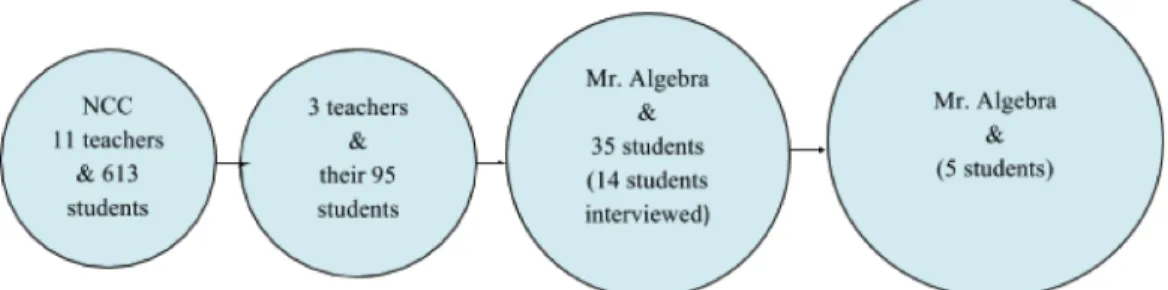
This study took place at Northeastern Community College (NCC, pseudo-nym), located in the southeastern United States. NCC has approximately 14,000 students with approximately 4,000 students enroll in the College Al-gebra course each year. At the time of our study, 613 students were enrolled in the course and were instructed by 11 full-time and adjunct teachers. Three teachers out of the eleven were selected as potential cases, but we chose one teacher, Mr.Algebra, to explore intrinsic learning to identify strategies used for successful teaching.
3.2. Purposeful Sampling
Participants were selected using a purposeful sampling method [30] to obtain an in-depth understanding. Participants were referred as potential participants by the first participant. If their teaching methods were consis-tent with theoretical frameworks of the study, they were considered eligible for testing said frameworks and we invited them to participate [26]. Thus, one teacher (Mr. Algebra) and five students were selected. At the time that the study began, there were five students who varied in their performance: Tyrone (“A” student), Daisy (“B” student), Nicole (“C” student), Brittany (previously withdrew), and Wendy (“repeated”). A flowchart of the sampling process is displayed in Figure 1.
3.3. Instruments
We administered the Course Interest Survey (CIS) to “measure students’ reactions to teacher-led instruction” [17, page 277]. The CIS instrument is aligned with Keller’s ARCS Model of the motivational design process and can be modified to use Likert-type scales and electronic scoring methods. The CIS measures four dimensions of classroom motivation:
Attention: degree of students’ consistent interest, curiosity, and attention toward the subject matter;
Relevance: the degree to which students found the course content to be applicable to their own lives;
Confidence: the degree to which students were confident that they could reach clearly defined goals and strategies for success; and
Satisfaction: the degree to which students felt they would apply the course material to their future career and life challenges.
With the goal of evaluating a class that showed the highest ratings on each of the four dimensions, we used the results of each category to compare participant teachers. It should be noted that we do not believe the ratings to be entirely the result of teacher strategies. There may have been some self-selection of more highly-motivated students into the course with the highest ratings and vice versa. However, we administered the CIS a month later (i.e., after the first test) into the semester after which time there was reason for us to believe the motivational ratings of the students would more clearly reflect the ability of the instructor to facilitate growth, maintenance, or decline in student motivation. Furthermore, we re-administered the CIS near the end of the semester. From administration 1 to administration 2, response rates dropped a moderate amount in Class 1 (15%), a large amount in Class 2 (93%), and a minimal amount in Class 3 (7%). Response rates may be an indirect indicator of student motivation, showing Class 3 to be more highly motivated throughout the semester (see [26] for a review). In a later section, we will discuss more details of the case of Mr. Algebra and his five students.
4. Results and Discussion
We collected data using various procedures including classroom obser-vations, interviews, surveys, and artifacts. We visited class daily for the entire semester to collect field notes. We interviewed the teacher regarding his views on mathematics teaching and motivation. Student interviews were comprised of three sections including student experience prior to enrolling in the course, motivation toward learning mathematics, and content-based tasks that were consistent with the curriculum.
We compared the qualitative data [25] usingin vivoand open coding sys-tems [44]. Particularly, we triangulated the data through multiple interviews and sources. Additionally, interpretations of data were confirmed with the help of our colleague with a doctorate in mathematics education. Also, we analyzed students’ motivation based on SDT to investigate how students’ motivations varied based on their experience [27]. Then, using the ARCS model framework, students’ perceptions of their teacher were analyzed for motivational influence that we discuss as three key foci:
Focus 1: The Impact of Students’ Prior Experience on Their Motivation
Through multiple interviews with students, we observed that students have many negative experiences prior to enrolling in college algebra. Discussion of individual student experiences is outside the scope of this paper [26] so we provide a snapshot of their experiences. All five students reported that they had negative experiences in grade school and in college which they attributed to their teachers’ attitudes and teaching styles. The following examples illustrate four of the students’ perspectives:
1. Daisy reported that her fourth grade teacher would yell at her if she did not get the correct answer to problem.
2. Brittany’s college mathematics teacher rushed through materials and exhibited negative facial expressions in response to student questions and performance on math tasks.
3. Nicole’s high school Algebra teacher was “mean and rude,” only want-ing students to solve problems the way she taught them.
4. Wendy’s College Algebra teacher struck the chalkboard when students asked questions.
The situations that students experienced negatively influenced their moti-vation toward learning mathematics. The Attribution theoretical framework could explain why these students attributed their negative experiences toward mathematics and mathematics teachers. Regardless of the validity, their at-tributions negatively impacted the students’ motivation toward engagement and learning of mathematics in their respective future math courses. As a re-sult of such experiences, students had decreased levels of motivation toward learning mathematics prior to enrolling in Mr. Algebra’s course. Through multiple interviews and observations of students in class, we provide an anal-ysis of students’ motivation levels based on the SDT sub-theory, Organismic Integration Theory (OIT). Table1shows students’ motivational levels on the extrinsic and intrinsic continuum based on OIT.
Focus 2: Students’ Motivation (on an extrinsic-intrinsic contin-uum) prior to the course
In this section, we describe students’ motivation (on an extrinsic and intrinsic continuum) prior to the course. We summarize the data below in Table 1. Tyrone. Tyrone perceived mathematics problems to be something that he could just look at and tell what the answer was. Tyrone wanted teachers to tell him exactly what he should do to make a good grade. He also wanted the teacher to explain every step of the lesson. Tyrone felt confident about his mathematics knowledge and he liked to challenge himself. He thought he had strong mathematics ability, saying, “As soon as he [Mr.Algebra] showed the problem, I knew how to do it.” Also, he admitted that he was lazy because he took notes in class, but he “never looked at the notes.” He said, “I could be one of the best students that you ever knew, but I’m lazy.” When we asked why he procrastinated, he said, “I know I will get an A’.” Tyrone said that he enjoyed doing mathematics and he was good at it. However, evidence showed that he was not intrinsically motivated to do mathematics. He said that the teacher played a role in his performance. He said that one of the roles the teacher played was keeping him in school and keeping him motivated. Tyrone believed that Mr.Algebra’s teaching and guidance influenced him to stay in school and continue to study Chemistry and Biology. On the continuum of extrinsic and intrinsic motivation of the OIT, Tyrone was at theinterjected
level (see Table 1). Tyrone needed to put in some effort to keep up with his goals and, hence, needed someone to influence his motivation to perform better.
Table 1: Organismic Integration Theory (Self-Determination Sub-Theory). Student (grade performance) Organismic Integration Theory Explanation
Tyrone (A) Interjected •Participated in class, but lazy about doing homework, and generally waited until the last minute to complete the homework
•Wanted the teacher to tell him exactly what to do to get a good grade •Liked to put forth the effort when there was an audience
•Was less motivated when alone •Suggested ego involvement and need for approval to elicit motivation (by maintaining self-worth)
Daisy (B) Intrinsic •Exhibited joy in learning mathematics •Hoped to take other mathematics courses
Nicole (C) Identified •Valued the importance of learning mathematics
•College Algebra served the purpose of earning a business degree
•Worked hard to accomplish the goals of the course
Brittany (Previously
Withdrew)
Integrated •Enjoyed doing mathematics to get some instrumental value (getting her degree in architecture)
•Understood that mathematics has an endogenous instrumentality toward her future goal of becoming an archi- tect (i.e., she will use mathematics as an architect)
Wendy (repeated the course)
Identified •Valued the goal of learning mathematics
•Understood that the course served her purpose of earning a teaching degree •Worked hard to accomplish the goals of the course
Daisy. Daisy thought of mathematics as puzzles. She loved to see where everything came from and how one concept related to another. When she had questions about the course content, she tried to figure things out on her own using resources such as the internet, notes, and Mr.Algebra’s YouTube videos before she sought help from Mr.Algebra. She loved how Mr.Algebra provided background information and discussed how concepts were interre-lated. Daisy’s views of mathematics were different compared to the other four participating students. She viewed her assignments as problem-solving tasks [7], where she would seek out the answer. Even though she failed the course twice, she related that she still enjoyed mathematics and was willing to learn it again. Thus, according to OIT, Daisy was intrinsically motivated
to study mathematics (see Table 1).
Nicole. Nicole “hated” mathematics because she had negative experiences with a mathematics teacher in high school. Her teacher preferred that the students only use the approach she taught. Nicole thought that she should be able to use her own approach if it made sense to her and if there was more than one way to solve a problem (i.e., lack of autonomy). She did not like mathematics, especially word problems. If she saw them on tests, she would leave the word problems until the end. However, she knew she needed college algebra for her business major, so she tried her best to complete all home-work assignments and quizzes. When it came to the tests she ”went blank” (i.e., was unable to think of solution techniques) and did not do well. Her confidence diminished because her expectations for the tests were different than her outcomes. To Nicole, mathematics problems must be interesting in order to gain and keep her attention, and mathematics problems should be easy enough that she could succeed. She would work on the problem, but when she could not get the answer, she skipped it. She said, “Math is not my strongest subject.” She was deciding between repeating the course, and changing her major from business to some other major that would not require mathematics. She was on the identified level on the continuum of OIT (see Table 1).
Brittany. According to Brittany, mathematics should be fun, should in-clude hands-on experiences, and should go beyond the walls of the classroom setting. She would do anything she had to do to get a good grade, but she wanted to be able to use what she learned in her career. She suggested, “Math shouldn’t be like a typical class. I think you should experiment
out-side of the classroom, outout-side of the four walls, just like Ms. Fizzle in the
Magic School Bus television show. She taught science outside of the class-room.” Brittany shared that she felt more determined to study mathematics in Mr.Algebra’s class because she could relate to him. He made her realize that failing one test could not make her bad in mathematics. Brittany felt that she controlled her learning. She said, “I can do it now. No matter where or what . . . I have to go through as far as math is concerned. I believe I can do it.” Brittany liked doing mathematics because it would help her get to where she wanted to be. She enjoyed doing mathematics, but the teacher had to make it fun for her. She said, “I love math as long as I have a teacher who can teach it right like [Mr.Algebra].” She passed the course and enrolled in Trigonometry in the consecutive semester. According to OIT, Brittany was at the integratedlevel (see Table 1).
Wendy. Mathematics did not come easy to Wendy, but she tried her best to pass the course and to achieve her goal of becoming an elementary school teacher. Wendy knew that mathematics is challenging, so she used cognitive techniques to better encode and process new mathematics concepts. She stated that when Mr.Algebra showed her class a “trick” for how to derive the Quadratic Formula, it helped her remember it. Wendy put effort into the course, communicated with Mr.Algebra, and informed him she needed help along the way. She shared that she had taken a mathematics disability test so she would not have had to take any more mathematics courses. The disability test results were negative and helped her realize that maybe she was “not bad at mathematics.” Hence, she was determined to take any mathematics course in the future. She reported that her experiences were great except for Mr. Cold [pseudonym], who told her to change her major after she failed an exam in his College Algebra course. Nevertheless, she was determined to do well in Mr. Algebra’s course. She claimed that she would model her future teaching off Mr. Algebra. With regard to the OIT continuum, Wendy was also in the identified level (see Table1).
Analysis of each student’s motivation level based on SDT showed differences in student motivation, which required flexibility in strategies of teaching. The study revealed the following:
1. Many students had unpleasant experiences in grade school or in col-lege, which they attributed to their teachers’ attitudes and actions.
As a result, their experiences in previous mathematics courses influ-enced their views about mathematics. In particular, their mathemat-ics teachers represented a strong, negative influence. None of the five students shared that the mathematics content was difficult. Hence, stu-dents’ motivation levels in learning mathematics were discouraged by their previous mathematics teachers, which led to difficulty in learning mathematics.
2. In this educational setting, many students had given up (i.e., learned helplessness [35]) with respect to their study of mathematics, but Mr. Algebra had the ability to renew their confidence to study mathemat-ics, using his knowledge about students. Hence, knowledge of students is essential and it is an important component of teacher knowledge [9]. Therefore, understanding teacher knowledge in this framework would inform mathematics educators and researchers. Ernest’s [8] model can be used to inform how teachers can support students’ three essential psychological needs of competence, autonomy, and relatedness that support students in becoming self-determined learners [32, 33].
Students were motivationally-challenged prior to enrolling in College Alge-bra. However, the teacher had the ability to renew their motivation to learn mathematics. Each of the five students had different views of mathematics, and they were motivationally challenged in different ways. Therefore, teach-ers need to incorporate their knowledge of students as they design tasks and assignments.
Ideal classrooms to motivate students. According to the five student participants, an ideal mathematics classroom should have four essential com-ponents: the physical set up, comfortable setting, the teacher, and the stu-dents (see [26] for a review). To them, a comfortable classroom environment involves a teacher who captures students’ attention, allowing them time to work on tasks, and letting them converse. An ideal class should be struc-tured to allow students to take control of their own learning (i.e., student autonomy).
Students’ descriptions of an ideal learning space were illustrated in Mr. Algebra’s classroom. He captured students’ attention because he was con-sistent, direct, and concerned about students’ safety. His approach helped mitigate confusion toward what each student should do, thus minimizing the demotivating influence that uncertainty can play in the academic setting [10,27,28]. The five students reported that Mr.Algebra was straightforward
about the difficulty of the course and the availability of other alternatives (e.g. Liberal Arts Mathematics). In attempts to assuage the difficulty of the material, Mr.Algebra was energetic in his presentation. He showed en-thusiasm in teaching the content. He encouraged students to work hard and articulated that they need to attend class, complete assignments, ask ques-tions, and seek help. Additionally, he provided extra material such as class notes, YouTube videos, office hours, and his personal cellular phone number. Mr. Algebra further encouraged self-determination through the way he supported student autonomy, encouraging them to be responsible for their own learning. Knowing that most students enrolled in the course worked full-time or part-time, he only had one deadline for students to complete the online assignments and quizzes (four of the five students worked part-time). Those who had jobs often spent their weekends working on homework. There-fore, having one deadline helped students pace out their schedules without falling behind in the course or becoming at risk of failure.
Also, Mr.Algebra was concerned about each student’s safety and always made sure that students walked with someone at night after class. One stu-dent, Daisy, thought it was nice that he was genuinely concerned for his students’ safety. His caring behavior encouraged one important psychologi-cal need, a sense of relatedness [5] that motivates students. Relatedness is described in [5] as a feeling of having a supportive, caring community.
Additionally, Mr.Algebra related his own experiences to his students. He shared that he once had a teacher who questioned his ability, but he was determined to try his best. Brittany, in particular, was inspired by his story, realizing that her failure on one exam did not mean she was not good in mathematics. Brittany related her experience: “He was determined to prove that teacher wrong. That’s an encouragement.”
Mr. Algebra’s teaching style stimulated students’ interest and provided meaning to mathematics. For each concept he taught, he built on students’ prior knowledge. For example, he used the concept of binary operations such as multiplication of numbers to introduce binary operation of functions and composition of functions. He used the technique for how one can multiply 2×3×4 to explain how to expand the cubic binomial (x+ 1)3.
He also demonstrated the relevance of the materials to help students feel more confident in their ability. With each concept he introduced, he emphasized questions such as
• “What is it called?”
• “Why do we have them?” and
• “Why do we have to use them?”
to keep students focused on the lesson. Although he provided enough infor-mation, he still left room for students to explore and generate more questions to answer.
Students were engaged in learning the materials and found meaning in do-ing mathematics. Mr.Algebra presented background information to demon-strate the relevance of course materials and built student confidence in learn-ing mathematics. For example, when he talked about the Pythagorean The-orem, he presented the historical context of the discovery of the theorem and how they derived the formula. Tasks such as finding the Distance Formula using the Pythagorean Theorem helped students see the relevance. This is evident in Daisy’s comment:
He told us how it [Pythagorean Theorem] worked, and where it came from. How does that theorem go into the Distance Theorem [Formula] and then the Distance Formula goes to the Midpoint [Formula]. He tied it all together. (Interview, June 2010)
Daisy shared that the way Mr. Algebra talked about the theorem gave her information, but she wanted to know more about it. In the case of Daisy, meaning motivated her to learn.
Wendy recalled how she liked that Mr.Algebra provided opportunities for students to learn the concept instead of just telling students,
“Here is the formula x= −b±
√
b2−4ac
2a .”
She indicated the task he asked them was to solve by completing the square method. According to Wendy, solving the quadratic equation with the in-dicated method helped her remember it. According to Sfard [36] meaning is the basic driving force for any intellectual activity. Therefore, establish-ing meanestablish-ing (i.e., relevance) is a primary need in learnestablish-ing mathematics as emphasized by Daisy and Wendy’s experiences.
With regard to Keller’s ARCS Model [17], Mr. Algebra gained student attention, and stimulated both Daisy and Wendy to learn to find meaning behind each concept that was taught. With regard to motivation, Mr. Al-gebra’s example is evidence that a teacher can motivate students through different instructional strategies, such as using different tasks and providing various methods of instruction [19,22]. Such teaching styles provide meaning for learning mathematics and create meaningful experiences for students.
Focus 3: Influential factors for students’ motivation changes dur-ing the course progression
In this section, we will provide some background about the particular teacher to give readers ideas of how his teaching changed student’s motivation during the progression of the course.
Mr. Algebra’s Background and Experience. Mr. Algebra was a full-time teacher at NCC. At the full-time of the study, he was teaching College Algebra and served as the course coordinator for Intermediate Algebra, a prerequisite course for College Algebra. Mr.Algebra earned both a bachelor’s degree and a master’s degree in mathematics. He began his teaching career in 1978 as a graduate student. Upon completion of his master’s degree, he obtained teaching certification and taught at a private high school for five years, teaching Algebra, Geometry, Trigonometry, and Advanced Placement (AP) Calculus. During his last three years at the private school, Mr.Algebra served as the department chair. He indicated that was where he ‘got his feet wet.’ He shared:
That’s really where I learned how to teach. You had to learn how to handle discipline problems, and you had to relate to parents’ problems with your teaching. You had to really learn how to teach because you didn’t learn that in college. You had to really figure out how to teach, how to control the classroom, what is appropriate, what is inappropriate. (Mr.Algebra, Interview, May 2010).
When we asked about his first years of teaching, he recalled he was the one who talked the most, and wrote many formal book definitions out for students, but as he gained more experience, he involved students in class
discussions. Mr.Algebra admitted that he had poor teaching skills early in his career. Then, he realized that he needed to take time to explain the concepts to students and create a classroom setting where students were involved in discussion.
Mr. Algebra’s Mathematics Classroom. Mr. Algebra emphasized the need for a comfortable classroom. It does not mean there are no standards of decorum, but students have to know that it is okay for them to ask questions. Teachers need to acknowledge students’ questions and answer them, even if some of the questions are “a little silly.” A teacher cannot let students know those questions are silly. Rather, they have to honor these questions. If a teacher cuts off one student, other students may feel intimidated about asking questions.
A classroom needs to have structure. Structure is necessary in classrooms. Mr.Algebra allowed students to talk while they were working on the problems. In his view, it was fine for the students to talk when he gave them time to work on the problems, but not when he was in front of the classroom talking and pulling it all together. He indicated the importance of having balance between comfort in asking questions and respect for instructional time. Building that structure into the classroom will enable students and teachers to respect each other.
Everyone has respect for others. Mr.Algebra believed that a teacher could be very polite, while also being firm. He often said to disruptive students, “You know, I need you to be listening. I don’t want you to not hear what I am saying.” He suggested that it is the classroom that makes a difference. Students need to respect each other so that when it is time for them to talk, others will have the same respect.
Teachers acknowledge students’ experiences. At the beginning of the semester, Mr. Algebra would identify students who he thought might per-form low in the course. He remarked that some students were taking College Algebra when they should be re-auditing the Intermediate Algebra Course. In the semester in which the study took place, he had students with whom he communicated by email. He sent resources to help them with the materials, but he said, “You can’t catch all of them!”
Teachers must influence student motivation. According to Mr. Algebra, motivation has to come from within, so he could not do anything with a
student who did not have some internal (i.e., intrinsic) motivation. He also knew that it was his responsibility to acknowledge and encourage students’ motivation. Mr.Algebra indicated that students have a little spark already, and as a teacher, he must make the spark bigger by helping them understand the material. He did this by saying “good job” or “excellent question,” but some initial motivation had to exist first. He noted that a “spark” is not tantamount to saying that students have to be fascinated about learning mathematics, but they have to be willing to put in the effort to study. As he began teaching, he did not know this and he thought that no matter what, he could make it happen. Eventually, he learned that he could not. Thus, he confirmed that that there has to be some spark already present in students, and then worked to make it brighter.
Teachers play a role in making student motivation go in either direction, influencing them to learn or totally discouraging them depending on the feed-back that a teacher provides to students. Mr. Algebra said, “Students will not want to perform for you. You have to make them want to make you happy.” He shared, “It should be all about them [the students].” He said that students do not want to let teachers down. Therefore, he would say to his students, “Look! I’m not trying to make you a mathematics teacher, but you have to have a willingness to remain open to learning the material and not shut the door.” What Mr.Algebra liked most about student motivation is that, at the beginning of the semester, students do not know that they can succeed, but as the semester progresses, he could see that they were learning and that they could succeed. He saw that students were motivated to learn mathematics through their performance, through their facial expressions and eye contact, and he heard it through their words and the ways they were talk-ing. He saw that, at the beginning of the semester, some students that were antagonists started asking questions and become calmer. He witnessed the change and personally shared in the joy of his students’ success.
Knowledge that Constitutes Successful Teaching in College Alge-bra. Teachers must know where their students are coming from (i.e., back-ground). Referring to his time as a coordinator, Mr. Algebra said, “You [teachers] have to know what they [students] are already supposed to know.” Sometimes, he noticed that teachers did not know whether students had been taught a certain concept in a previous course. A teacher needs to know his/her students’ knowledge base and make them draw upon it. Therefore,
sometimes Mr.Algebra answered questions that he considered a bit of a re-view, but he made it clear to students that, “This is the knowledge that you learned in your previous course.” Or he remarked, “This is based upon the knowledge [used when] the college placement test put you in here.” He stated that students are responsible for acquiring a certain knowledge base before teachers can take them to the next level. Mr.Algebra indicated that remind-ing students of what they should already know helped students understand their own responsibility for their own learning.
Mr.Algebra knew that many of his students had not enrolled in an algebra course for years, so he provided resources for them. He would refer students to take advantage of the free tutoring opportunities on campus, or to use the Google search engine to find answers to questions. When he referred students to a resource, he usually provided students with directions for accessing that resource. For example, he might tell students what questions to ask to get help during tutoring. Specifically, he might tell a student to go there and ask for a copy of a “factoring handout.” This way, students would not feel that they are being passed on to someone else or that the teacher is not interested in helping.
Characteristics of Tasks that Mr.Algebra Plans for His Students
Expectations for Students. Mr. Algebra said that he made a point to students that there are other options available rather than taking College Algebra. He made it clear to students that they might find out that this [College Algebra] is not the correct path if they are not willing to put in the time. He indicated that by telling his students about his expectations at the beginning of the semester, he raised their awareness about the course. He said, “Until students go into the class, they don’t believe” what their teachers have said. He shared that he also told students that if they were willing to put in the time, it would pay off. He emphasized to students that it was their choice to be in the course.
Incorporating Students’ Prior Knowledge into Planning. When we asked Mr.Algebra to describe the characteristics of the tasks he plans for his students, he shared that he primarily considers the material that he needs to teach according to the curriculum. He could not incorporate their prior knowledge into his planning and had to “incorporate where they [students] should be into my [his] planning” because we [NCC] are not on a model or
a system where we can go back and pick students up on a remedial level.” Students had to be at the expected level. “They have to,” Mr. Algebra reiterated.
When he planned, he assumed students had mastered the knowledge from the previous course. In the first classes, he made it clear to students that there is a certain knowledge base that they need to have to succeed in the course. He offered an analogy for illustration.
[It’s like] you [students] are in French II. You had French I. We can’t keep going back over all the verb conjugations . . . There is a certain knowledge base you need to have to succeed in here. You can’t build on a foundation that is set upon sand.
Therefore, when he planned, Mr. Algebra considered the mathematics con-tent. He said, “I plan for what I have to teach and what they should have seen.” When delivering the lesson, if there were loose ends, he would not cut students off. He referred to what he called his 30-second reviews. He would walk to the board on the side and say, “back in Intermediate Algebra, we used this rule. Somebody remind me.” He would not make reviewing a major portion of the course. He said, “It is not fair to the people that met the prerequisite. I can’t take time away from the new material to go back to Intermediate Algebra stuff that they should have known, but at the same time, I don’t want to make them feel they are stupid.” Mr.Algebra had seen some College Algebra teachers tell students “no” when asked to go back to review material from Intermediate Algebra. He felt that this position was a little harsh, so he was more understanding when students got stumped. He said students laughed sometimes if they did not remember, and he would say, “See? You forgot that, didn’t you?”
Students also laughed and proceeded to note what he reviewed in order to relearn it. He said that he planned with the assumption that students remember the material, but he is realistic, knowing that they would have to be prodded a little along the way about what they already knew, or should have known. He had to follow the curriculum from the department, which prevented him from considering students’ knowledge of what they might not have mastered in the previous course. Still, he tried to consider it as much as he could. But, he said, “We have a departmental curriculum.” He meant that what he teaches is not his choice, and there was a certain level of knowledge
and skill he was responsible for imparting. He could not go back to reviewing for five people and not complete the current course material for the other thirty-five students. Thus, he told his students, “Okay, this is where I know we need to get, based on the departmental curriculum. We have to get here.”
Mr. Algebra would send emails to students ahead of time and say: You are in a College Algebra course. There are other options. If you were weak in Intermediate Algebra, or if you have not had Intermediate Algebra in a while, that may be a barrier to you.
If students came up to him the first day in College Algebra and said, “I had no idea what you did [in class].” He would ask, “When did you take Intermediate Algebra?” If students replied that they took it ten years ago, he would suggest that they audit the course. He would try to give them suggestions, but he could not slow down for those people because he had other students, and he had to get them through the course. To illustrate this point, Mr. Algebra said to a class, “How many of you are going to Pre-Cal [sic]?” Or he could ask, “How many of you are going to Trigonometry?” This let other students see that he needed to get them there. He did not believe telling them so was harsh. He considered it a reality that they need to know to get through the course. He shared that, in the past, some teachers in the division slowed down in College Algebra and did not finish the curriculum. He posed the question, “What happens to the thirty-five people that needed the curriculum?” So there comes a point where he told students the prerequisites from this course were so and so, and he would honor them.
Keeping Students Involved in Class. Mr.Algebra kept his classes lively. He let students know that he liked mathematics and it was fun. He also gave students ideas on how to study and made students feel part of a group. He thought that if they feel part of a class, they would respond to him. As a teacher, he had to keep students awake and let them show some interest. He called this teaching his “dog and pony show.” He felt that he was on stage when he was teaching, and for those hours, he had to keep his momentum high, so as to not to lose his students’ interest. He said keeping students motivated was not too difficult in an hour-long class, but in two hours, he would begin to get tired. Still, he tried to always keep upbeat, smile, and not to ever look away.
As participant observers in Mr. Algebra’s class, we saw that he tried to maintain consistent eye contact with students. He frequently scanned the room from left to right and did not stare at one group of students, but looked over here and there and said, “Are you okay? How about you guys?” He made students feel included. He viewed it as a stage play. He said, “We [teachers] are on stage and it is a one-person show and it is up to you to keep that show going.” He liked to use jokes even if they were silly. He liked to get students talking because he thought that it is important to get them to say something. Even if it was wrong, they were at least talking and the class could laugh. “That’s interaction!”
Mathematics Teacher versus Mathematics. The five student partici-pants had positive learning experiences when teachers possessed the ability to make mathematics enjoyable. Mr.Algebra used motivational strategies that resulted in greater student effort to learn the course materials. Specifically, Wendy convinced herself to study because she saw his efforts in providing students with resources. Daisy wanted to do well so she would not disappoint the teacher. This was true, even for the students who were not doing well like Nicole. She still enjoyed the class and stated:
The class is not bad. It is just me . . . He is not even a bad teacher. He is a good teacher. It’s just when I get to the test. Everything just goes away. (Nicole, Interview, June 2010)
When Nicole did not do well on her test, her confidence suffered. How-ever, she continued to enjoy the class and explained that it was her fault for not doing well instead of attributing her failing to Mr. Algebra. In the framework of Attribution Theory, students attribute their success and failure differently (i.e., internally or externally). Students that have internal attri-butions are more likely to have the option to change the outcome in similar future circumstances (e.g., the student did not study hard enough for a test). In contrast, a student that makes external attributions does not believe they have control of their outcome, regardless of their motivation to change the outcome (e.g., the teacher’s tests were unfair). Nicole made internal attribu-tions when she stated that she felt that the teacher was not at fault for her low motivation. She shared, “He can teach you the work. He can show you how to do it, but it’s all on you, to excel to pass his test.”
5. Revelations and Implications
In our study, we attempted to explore what a teacher does to influence student motivation to learn mathematics. We applied Self-Determination Theory as a framework to understand student’s motivation. In this theory, a teacher must meet students’ three psychological needs to motivate them (relatedness, autonomy, and competence). To do so, a teacher must have a good knowledge about the students. Within the school-setting context, a teacher must understand the backgrounds of the students. Hence, the body of knowledge that Ernest [8] described is essential. Our study showed that a teacher must have strong content knowledge alongside a knowledge of the context in which they are to teach in order to meet student psychological needs to learn mathematics.
The study was conducted in one of the mathematics courses in which we observed Mr. Algebra and his five students. We tried to provide our analysis based on the five students who had given up their motivation to learn mathematics. We can learn from Mr.Algebra that teachers have the power to renew student motivation to learn mathematics. Why not try to learn how to capture and maintain that motivation more proactively for students who have not lost their motivation to learn mathematics for a long period of time (eight years in the case of Daisy)? Our study emphasizes the necessity to for research that examines how to maintain and influence students to learn mathematics. We also think that strong, theoretical frameworks like SDT are essential to examine the issues.
According to Keller [19], to maximize a learning environment, a teacher needs to determine the motivational characteristics of the students, and how to strengthen them. Mr. Algebra tried to strengthen his students’ critical areas (their motivation and basic skills) in which they were weak. In so doing, he motivated them to learn. He knew not to add any difficulties or anxieties to this group of students. He encouraged his students to ask questions and showed concern for them. Mr.Algebra’s knowledge of the context of teaching the mathematics course (understanding his students) allowed him to create a classroom that fostered student learning. Thus, his students performed at their best. We believe Mr. Algebra’s statement that “Students will not want to perform for you. You have to make them want to make you happy” is especially noteworthy. Knowing that students were motivationally and mathematically challenged, Mr. Algebra structured his classroom to foster
students’ motivation to learn mathematics. The example of Mr. Algebra motivating his students to learn is indicative of the SDT concept that a teacher needs to meet student psychological needs [5]. Additionally, a teacher must fulfill the four categories in Keller’s ARCS model (Attention, Relevance, Confidence, and Satisfaction). Our study illustrated the alignment of Mr. Algebra’s techniques with the motivational theoretical framework of ARCS as seen in the following sections:
5.1. Gaining and Maintaining Student Motivation
Ordinarily, Mr. Algebra captured student attention by being energetic while teaching and maintained their attention by fostering curiosity through prompting questions of how the course material could be used in their future or outside the classroom. In support of his strategy’s success, none of the five students missed a class session. Maintaining student motivation requires that the teacher possess knowledge of their students (e.g., student areas of weakness or anxiety [8]).
5.2. Establishing Material as Relevant to Students
Making course materials relevant to students remains a significant issue. Specifically, when students found the class meaningful to them, they tried their best. Meaningful ideas stimulated students’ interest to pay attention [17]. Mr.Algebra also emphasized how the course content would be relevant to students depending on their future career goals so each of students felt motivated.
1. Daisy was honest when she shared that she did not know how these materials were relevant to her now, but she would need it to become a nurse;
2. Similarly, Brittany observed the instrumental value of the course con-tent as she was pursuing an architect degree;
3. Instead of changing his major, Tyrone decided to continue with his goal of getting a degree in chemistry and biology;
4. Nicole claimed that she needed to know College Algebra content to take Business Calculus; and
5. By renewing Wendy’s motivation, Mr. Algebra played a vital role in promoting Wendy’s self determination to learn mathematics and to be a teacher.
Evidently, all five students acknowledged some level of relevance of the course material to their future goals. Keller [17] suggested that the relevance of the material could be projected to some future values so students might not see its benefits immediately.
5.3. Building Student Confidence
A teacher can build student confidence by using their informal knowledge. For example, using multiplication of 2×3×4 was used to explain (x+ 1)3.
Mr. Algebra did not teach to the test, but emphasized learning objectives that would be the focus of a later test. Therefore, students avoided rote memorization and focused on understanding the content. This decreased student anxiety as they prepared for tests. Some instructional strategies Mr.Algebra used including posting videos of test reviews online and posting solution keys to test reviews.
Building student confidence was evidenced in our research as the stu-dents shared that they not only earned high grades, but also benefited in the following long-term ways:
1. what Nicole shared when she said, “I will take this course again;” 2. what Tyrone shared when he said, “I will stay in school;”
3. when Brittany showed confidence in explaining that if she failed one exam, it did not make her bad in mathematics;
4. when Wendy said, “I am determined, and I will be an elementary teacher;” or
5. when Daisy said, “I started to enjoy mathematics again.”
These expressions of motivation showed how Mr. Algebra built students’ motivation. We suggest that such findings are meaningful for mathematics educators and teachers to consider because it is vitally important to change students’ negative attitudes toward learning mathematics.
The most important thing Mr. Algebra did for these students was posi-tively impacting their attitude toward learning mathematics after their pre-vious unpleasant experiences by rebuilding confidence. He created a learning environment where students:
1. looked forward to coming to class; 2. made friends in class;
3. engaged in class discussion; 4. took part in their learning; 5. remained in school;
6. were determined to learn; and 7. enjoyed doing mathematics.
Students began to believe that they could succeed in mathematics.
5.4. Providing Satisfaction
Regardless of their performance in the course, all five students gained “satisfaction” in the course. Mr. Algebra had provided them with satis-faction by presenting the material so that it was relevant to their lives and building confidence in them to continue going forward in their career choices. Satisfaction levels were different:
1. Daisy gained her motivation. She looked forward to completing the course and planning to take more mathematics course.
2. Tyrone did not change his major and felt that the teacher had some-thing for his students to learn;
3. Nicole was satisfied with the course, but she said her confidence level decreased when she did not do well on exams. Yet, she was willing to take the course again;
4. Brittany was satisfied and enjoyed the course. She was ready to enroll in another mathematics course; and
5. Wendy was satisfied and determined to complete more courses to be-come an elementary teacher where she would model her teaching after Mr.Algebra.
Yet, Keller’s [17] “satisfaction” is more than being pleased with the outcome. Satisfaction emphasizes the long-term usefulness of the current learning as a component of student motivation. Wendy’s connection of the course to her future teaching goals and overall life satisfaction is the most specific reference to motivation that aligns with student satisfaction as Keller intended.
6. Conclusion and Future Research
Motivation is important, but it is more important to the students in the setting described in our study because these students were more likely to give up (i.e., at-risk). According to the Self-Determination Theory [32], from an OIT point-of-view, these students were at different stages on the extrinsic and intrinsic motivation continuum. A teacher must fulfill their educational needs for them to put in their best effort while engaging in classroom tasks. Having a caring teacher helped students concentrate on learning mathematics and becoming responsible for their own learning. Because of what their teacher did to motivate them, the students were determined to learn and perform. Evidently, the negative experience that required Daisy to take more than eight years of mathematics was substantial. Mathematics educators should take measures to help students avoid such negative experiences. To decrease the stigma felt by many students toward mathematics, teachers need to build bridges for students to succeed in mathematics, thus encouraging students to maintain an internal locus of control, rather than attributing their outcomes, positive or negative, to the teacher. Teachers make decisions every day, and these decisions are effected by a variety of factors [1] including student motivation.
This study also confirmed the perceptions shown in previous research at the college level in which the course was considered to be a “gatekeeper course.” The five students discussed in the paper had to take the course twice or more. Such instances call for different forms of support from teach-ers and institutions. Earlier research has focused on students’ frustration in pre-university level prerequisite mathematics courses, suggesting that math-ematics education should make an effort to “treat students as partners” [37, page 317] in research to improve student learning of mathematics. By listen-ing to what students shared about their experiences and how their teacher motivated them to learn, this study called for similar attention more than before to involve students in research to improve teaching and learning math-ematics. As Even and Tirosh [9] indicated, research on teaching and teachers has been following separate tracks for a long time. They suggested it is now the time to look at both teachers’ and their students’ experiences to un-derstand how students are motivated to learn. Therefore, future research is needed to understand the motivational strategies that are used to design mathematical tasks.
Moreover, our study provides insight into students learning mathemat-ics at the college level and calls for contribution from different individu-als, especially mathematics educators to use such understanding to improve mathematics instruction by (1) evaluating student motivation; (2) providing additional assistance for students to help them understand course content to move forward; and (3) providing professional development for mathematics teachers at the college level. With regard to community college adminis-trators, our study calls for institutional support to help at-risk students. To successfully motivate students to learn mathematics, it is important for teachers to fulfill students’ psychological needs and apply the ARCS model for classroom motivation. In order to do so, it is necessary for a teacher to know their students enough to scaffold the content in flexible ways that can lead to greater learning outcomes. This study indicated that to meaning-fully motivate students to engage in mathematical tasks, it is necessary for a community college mathematics teacher to (1) make the content relevant; (2) have fluency in the content; and (3) be flexible in teaching strategies and or approaches.
According to Calderhead [2], knowledge lies behind the practice of teach-ing. Mr. Algebra possessed the knowledge beyond what he taught. This research shows that he had the ability to motivate students because he has a strong knowledge of the content and flexibility in his teaching strategy when instructing students. He enacted motivational strategies in the course so his students started to enjoy mathematics and engaged in meaningful activities. Regardless of how students attributed their negative experience to their former mathematics teachers, none of the five students shared that the math-ematics content was difficult to them. It is noteworthy that a mathemat-ics teacher assessing students’ attitudes toward learning mathematmathemat-ics could overcome such affective challenges. To better assist students, mathematics educators should understand students’ prior mathematics learning experi-ences. However, teachers need to know students’ prior knowledge, motiva-tional needs, and mathematical experience in order to fully motivate them. To expand this research, we call for future collaboration in research that aims to understand students’ motivations.
Teachers who attend to student learning orientations foster student au-tonomy. This study provided evidence of teacher practices that affect mo-tivation using the framework of relatedness [3, 5]. This study showed that students’ feelings of relatedness to their teachers were strong predictors of