2019
Occupational Therapy Student Conceptions of
Self-Reflection in Level II Fieldwork
Susan L. Iliff Belmont University Gaylene Tool University of New Mexico Patricia Bowyer Texas Woman's University Diane Parham University of New Mexico Tina S. Fletcher Texas Woman's University See next page for additional authors
Follow this and additional works at:https://encompass.eku.edu/jote
Part of theHigher Education Commons,Medical Education Commons,Occupational Therapy Commons, and theOther Medicine and Health Sciences Commons
This Original Research is brought to you for free and open access by the Journals at Encompass. It has been accepted for inclusion in Journal of Occupational Therapy Education by an authorized editor of Encompass. For more information, please [email protected]. Recommended Citation
Iliff, S. L., Tool, G., Bowyer, P., Parham, D., Fletcher, T. S., & Freysteinson, W. M. (2019). Occupational Therapy Student Conceptions of Self-Reflection in Level II Fieldwork.Journal of Occupational Therapy Education, 3(1).https://doi.org/10.26681/jote.2019.030105
Abstract
Self-reflection is paramount to the development of professionalism and serves as the foundation of adult education and lifelong learning. Pedagogical approaches in health sciences programs that promote reflection are growing in popularity. Current literature identifies a gap in what and how students conceive self-reflection and whether self-self-reflection is creating professionals that meet the challenges of today’s healthcare climate. This qualitative study explores the conceptions of self-reflection for occupational therapy students in Level II Fieldwork. The use of phenomenographic methodology guided the collection of information-rich data through semi-structured interviews. Twenty-one occupational therapy graduates volunteered to
participate in the interviews. Verbatim transcripts were coded to identify categories and patterns in the data. A focused discussion was employed as a member-checking method to ensure accuracy of study outcomes. Participants identified that self-reflection may serve to inform personal and professional practices during occupational therapy student clinical rotations. Although universally defined, student self-reflection occurred in countless ways and took many forms. Participants valued its function in expanded decision making, self-awareness, and competence in fieldwork and everyday occupations. These findings facilitate further research and the creation of new self-reflection educational methods or interventions designed to build or remediate self-reflective capacity of health sciences students during academic and clinical programming.
Keywords
Self-reflection, student, fieldwork, qualitative, phenomenography
Creative Commons License
This work is licensed under aCreative Commons Attribution-Noncommercial-No Derivative Works 4.0 License.
Acknowledgements
The researchers wish to acknowledge the participants for their involvement in the study and Heidi Rishel Brakey, a qualitative analyst at the University of Mexico, for her expertise and in-depth NVivo training. We also acknowledge the Scholarship in Education Allocations Committee at the University of New Mexico and the Jean A. Spencer Occupational Therapy Fund at Texas Woman’s University-Houston for providing their generous awards to fund this research.
Authors
Volume 3, Issue 1
Occupational Therapy Student Conceptions of Self-Reflection in Level II Fieldwork
Susan L. Iliff, Ph.D., OTR/L1, Gaylene Tool, MOTS, COTA/L2,
Patricia Bowyer, EdD, M.S.3, OTR, FAOTA, Diane Parham, Ph.D., OTR/L, FAOTA2, Tina Fletcher Ed.D., MFA, OTR3, and Wyona M. Freysteinson, Ph.D., MN3 Belmont University1, University of New Mexico2, and Texas Woman’s University3
United States
ABSTRACT
Self-reflection is paramount to the development of professionalism and serves as the foundation of adult education and lifelong learning. Pedagogical approaches in health sciences programs that promote self-reflection are growing in popularity. Current
literature identifies a gap in what and how students conceive self-reflection and whether self-reflection is creating professionals that meet the challenges of today’s healthcare climate. This qualitative study explores the conceptions of self-reflection for
occupational therapy students in Level II Fieldwork. The use of phenomenographic methodology guided the collection of information-rich data through semi-structured interviews. Twenty-one occupational therapy graduates volunteered to participate in the interviews. Verbatim transcripts were coded to identify categories and patterns in the data. A focused discussion was employed as a member-checking method to ensure accuracy of study outcomes. Participants identified that self-reflection may serve to inform personal and professional practices during occupational therapy student clinical rotations. Although universally defined, student self-reflection occurred in countless ways and took many forms. Participants valued its function in expanded decision
making, self-awareness, and competence in fieldwork and everyday occupations. These findings facilitate further research and the creation of new self-reflection educational methods or interventions designed to build or remediate self-reflective capacity of health sciences students during academic and clinical programming.
INTRODUCTION
Self-reflection is an integral part of adult education and the development of
professionalism in the workplace (Adam, Peters, & Chipchase, 2013; Brown, Williams, & Etherington, 2016; Embo, Driessen, Valcke, & Van der Vleuten, 2015; Mann, Gordon, & MacLeod, 2009). Healthcare demands and complexity have made it essential for new graduates to demonstrate the clinical reasoning skills necessary to become a reflective practitioner. Schön (1983) and Parham (1987) conceptualized the “reflective
practitioner” as one who uses self-reflection as a tool for revisiting an experience to learn from it. Reflective practitioners embody the ability to critique their own clinical thinking about the myriad of dilemmas that arise in professional practice.
Health sciences programs are implementing more self-reflective practices in coursework everyday (Schwind et al., 2014), but is self-reflection actually creating autonomous, qualified, and self-directed professionals who can meet the challenges of today’s
healthcare climate? Research on the subject is insufficient in nursing, physical therapy, and medicine and conflicting evidence exists on whether self-reflection practices are effective in promoting academic and clinical success (Andonian, 2013; Brown et al., 2016; Embo et al., 2015; Mann et al., 2009; Mason, Vitkovitch, Lambert, & Jepson, 2014). Furthermore, evidence on self-reflection practices in the field of occupational therapy (OT) education is non-existent, thus supporting the need for this study and the opportunity to examine student conceptions of self-reflection in Level II Fieldwork.
REVIEW OF LITERATURE Self-Reflection Defined
Education scientists Boud, Keogh, and Walker (1985) defined self-reflection as “a deliberate affective activity in which individuals engage to explore their experiences in order to lead to new understanding and appreciation” (p.19), including recapturing the experience, thinking about it, mulling it over, and evaluating it. Currently, in health sciences professions, self-reflection is seen as mental processing with a purpose to review an experience of practice in order to develop greater emotional intelligence and an understanding of both the self and the situation so that future encounters with the situation are informed from previous encounters (Brown et al., 2016; Schwind et al., 2014; Stephens et al., 2012).
Characteristics of Self-Reflection
Self-reflection falls under the umbrella of reflective practice, which develops in stages and must be systematically taught (Bolton, 2014). Narrative writing, storytelling, journaling, meditation, verbal feedback, videotaping sessions, and problem-based learning are specific techniques used to promote self-reflective thinking and clinical reasoning skills of health science students and professionals (Constantinou & Kuys, 2013; Lasater & Nielsen, 2009; Mason et al., 2014). Like most practices, self-reflection has positive and negative attributes. Mann et al. (2009) stated that self-reflection can connect theory to practice but that it takes up too much class time. Davies (2012) stated that self-reflection promotes deep problem solving but that students can misunderstand the reflective process.
Self-Reflection in Level II Fieldwork
Fieldwork education is designed to promote self-reflection, occupational competence, and clinical performance in OT students in a variety of clinical settings (American Occupational Therapy Association [AOTA], 2012). Occupational competence is one’s
ability to balance all of life’s demands, sustaining a pattern of occupational behavior that is productive and self-satisfying. This addresses engagement in all areas of one’s life (e.g., at work or home, during stressful or relaxing activities, with family or friends, etc.; Kielhofner, 2008; Taylor, 2017). Ideally during fieldwork, students respond positively to feedback and make the necessary emotional or physical changes to increase client and team engagement and generate a therapeutic environment (Andonian, 2013; Brown et al., 2016; Campbell & Corpus, 2015; Hackenburg & Toth-Cohen, 2018; Mason et al., 2014). Self-reflection builds a student’s occupational competence and clinical
performance by enhancing therapeutic use of self and strengthening the efficacy of client interventions (Hackenburg & Toth-Cohen, 2018; Taylor, 2008). Leadership potential is unlocked and a feeling of success and confidence results as each student embarks on a rewarding OT career (Campbell & Corpus, 2015).
Despite the evidence discussed in the literature review, it is unknown how OT fieldwork students conceptualize self-reflection and its relationship to their own occupational competence and job-related clinical performance. This is important to examine because a deeper understanding of student self-reflection can inform how self-reflection is taught and whether it is a useful tool for preparing OT students for the workplace. To explore this issue, this research was designed to answer the following research questions: (1) What do OT students conceive as self-reflection? and (2) How do OT students
conceptualize and understand self-reflection in relation to their performance in Level II Fieldwork?
METHODS
Research Design
The Institutional Review Boards (IRBs) of the University of New Mexico and Texas Woman’s University-Houston approved this study and written informed consent was obtained from each participant. The study used a qualitative design to address the research questions about self-reflection. The research team employed a
phenomenographic approach to analyze the ways participants experience self-reflection and how they went about it.
Phenomenography is a research method that qualitatively maps different ways in which people experience, conceptualize, perceive, and understand the world around them (Marton,1986). In phenomenographic studies, the term “conception” is used to refer to people’s ways of experiencing a specific aspect of reality (e.g. self-reflection) and that conceptions are typically presented in the form of categories of description. Therefore, in this study, the basic idea of the phenomenographic approach is to identify and describe individuals’ conceptions of self-reflection as faithfully as possible in order to understand how it relates to learning, teaching and other kinds of human action within society (Sandberg, 1996).
Role of the Researcher
The professional relationship between the researcher (first author) and the participants was an instructor/student role when the participants were recruited in the study. Ethical concerns about the professional relationship were addressed in four ways. First,
participants were recruited on a voluntary basis and only those volunteers who graduated from their OT program were eligible to participate in the research study. Second, interviews were conducted post-graduation to eliminate any perceived coercion or power relationship over the participants. In other words, the researcher no longer had any ability to influence grades or completion of the program if the volunteer decided to participate or decline. Third, the IRB and voluntary participants reviewed informed consent forms that included predetermined semi- structured interview questions to determine potential conflicts of interest. Finally, to minimize misinterpretation, a
voluntary sample of participants participated in a focused discussion where initial inquiry results were reviewed to confirm how quotes were used and how they were interpreted through the development of categories.
Participants and Sampling
Entry-level graduate OT students were recruited using convenience sampling. Inclusion criteria were entry-level graduate students who (1) had completed formal academic OT coursework, (2) were enrolled in their last Level II Fieldwork, and (3) gave consent to participate in this study. Exclusion criteria was if the participant did not complete their second Level II Fieldwork rotation and/or graduate from the OT program for any reason. Twenty-one OT students volunteered to participate in individual, in-depth, open-ended, semi-structured interviews, as this is the recommended number of participants for rigor according to these other phenomenographic studies (Andersson, Willman, Sjöström-Strand, & Borglin, 2015; Holmstrom, Halford & Rosenqvist, 2003; Larsson & Holmstrom, 2007).
Procedures
Recruitment flyers and consent forms were emailed introducing the study to all second-year OT students during their last Level II Fieldwork experience. Recruited participants followed a secure link, allowing them to provide informed consent electronically. Prior to interviewing, the interview protocol was piloted with five first-year OT students who were diverse in age and gender, to ensure clarity and understanding of the interview
questions and procedures. This allowed for any necessary revisions to the protocol prior to the implementation of the study. Then in-depth, semi-structured interviews were conducted in-person or via telephone in a private office. Each interview was audio-recorded and transcribed verbatim and interview recordings and transcripts were de-identified prior to analysis. Contact information for each participant was stored in a secure location to ensure anonymity. All participants were informed that they could leave the study at any time.
Nineteen interviews occurred in-person and two via telephone, due to participants living out-of-state. Participants were asked to describe their self-reflective experiences during Level II Fieldwork, and what they conceive as self-reflection and how they conceptualize and understand self-reflection in relation to their own occupational competence and
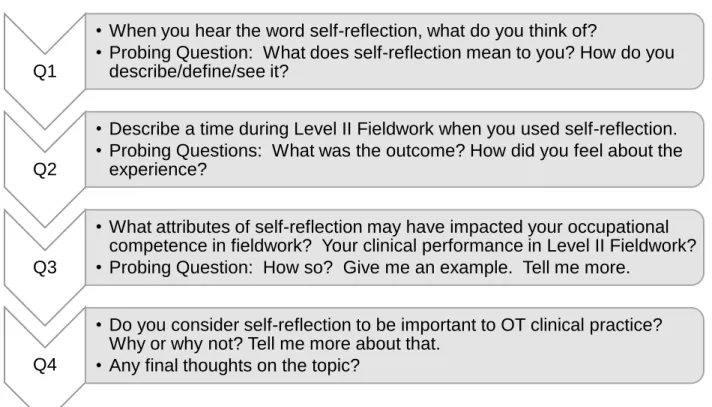
clinical performance in Level II Fieldwork. Figure 1 shows the semi-structured, set interview questions used with each participant; however, when appropriate, the
interviewer sought additional information such as examples of specific experiences or ideas to gain a fuller understanding of what the participant was trying to convey. The interviewer also collected field notes during the interviews to ensure accuracy and to document participant affect and other non-verbal communications that might influence interpretation of the data (Patton, 2015).
Figure 1: Individual interview guide for study participants.
Data Analysis
The phenomenographic methods of analysis used in this study was based on classic works in this field (Akerlind, 2005; Andersson et al., 2015; Bowden & Walsh, 2000; Larsson & Holmstrom, 2007; Marton, 1986; Sandberg, 1996). All interviews were transcribed verbatim from audio recordings with validation checks for accuracy. Transcripts were de-identified and imported into qualitative analysis software NVivo 10 (QSR International, 2012) for coding. Training was provided for qualitative analysis and the use of NVivo 10 by a qualitative analyst (QA) from the Clinical and Translational Science Center from the University Health Sciences Center.
Interview data were coded in NVivo 10 to explore the range of meanings within the context of the whole sample, specifically the “what” and “how” aspects of the
phenomenon of self-reflection: when students talked about self-reflection, what did they talk about, and how did they talk about it? The coding team was comprised of the first and second authors, and the QA. The initial coding structure was created based on the
Q1
• When you hear the word self-reflection, what do you think of?
• Probing Question: What does self-reflection mean to you? How do you describe/define/see it?
Q2
• Describe a time during Level II Fieldwork when you used self-reflection. • Probing Questions: What was the outcome? How did you feel about the
experience?
Q3
• What attributes of self-reflection may have impacted your occupational competence in fieldwork? Your clinical performance in Level II Fieldwork? • Probing Question: How so? Give me an example. Tell me more.
Q4
• Do you consider self-reflection to be important to OT clinical practice? Why or why not? Tell me more about that.
interview guide. A stepwise method was used to independently review and code the transcripts. After consensus in codes was reached, the first and second authors each independently coded all transcripts and met regularly throughout the coding period to discuss coding discrepancies. Simultaneously, the QA coded 30% of all transcripts, selected randomly. This process served as a quality control check. The QA provided consultation on resolving discrepancies throughout the iterative process. Overall agreement among the coders was a minimum 88% across all transcripts. As new
descriptive categories in the data emerged, the coding team met and revised the coding structure until category saturation was achieved (see Appendix A). Once saturation occurred, salient categories were summarized and supported with participant
quotes. The research team held several meetings to refine the collective “pool of
meanings” (Bowden & Walsh, 2000) for each summary. Final review of summaries and in-depth discussions led to the creation of the outcome space, or collective ways of understanding the categories generated in the analysis (Bowden & Walsh, 2000; Marton & Booth, 1997).
Reliability was ensured through coder and dialogic checking. Coder reliability was conducted by the coding team, through NVivo 10, who coded all interview transcripts and compared categorizations. Dialogic checks were employed by having a discussion or mutual critique of the data with the coding team until consensus and saturation was reached about the researcher’s interpretive hypotheses or understandings of the
data. The coding team also made their interpretive steps clear to each other by verbally detailing how they determined their understandings. The coding team also presented examples or supporting quotes that illustrated their interpretations in order to minimize bias and ensure data accuracy.
Further credibility checks were conducted by member checking. The researchers invited all participants back for this final focused discussion and five volunteered to participate in the discussion. The researchers followed a focus group protocol to conduct the discussion (see Appendix B). Preliminary qualitative results were shared with the participants and they were asked whether the findings supported their collective understandings of self-reflection, and if any conceptions were missing and needed to be added to the data. The focus group recording was transcribed, coded, and analyzed by the researchers. As new categories emerged, they were later added to the category summaries to either confirm or expand the overall findings of the study. This process of member checking confirmed that the interpretations of the participant’s experiences reflected his or her perspective and provided an accurate interpretation of the data (Patton, 2015).
RESULTS
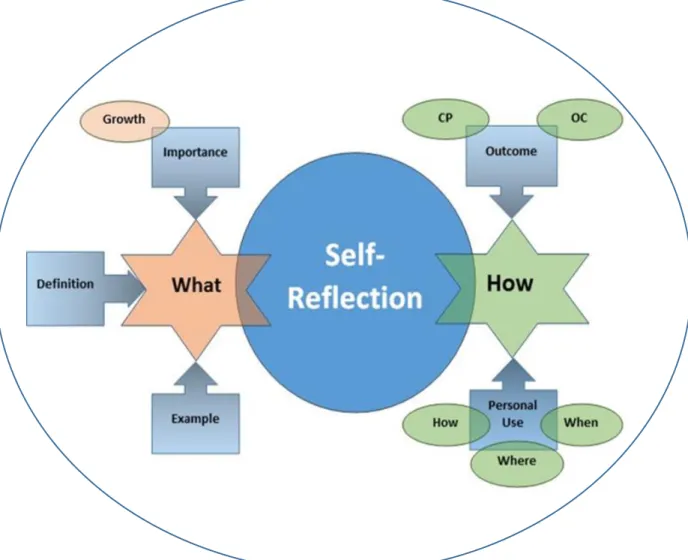
Findings from the qualitative analysis are visually mapped in Figure 2. On either side of the central construct of self-reflection are star-shaped spaces representing the two main questions that drove data collection and analysis: (1) What do OT students conceive as self-reflection? and (2) How do OT students conceptualize and understand
self-reflection in relation to their own occupational competence and performance in Level II Fieldwork? The square boxes that point to What and How represent general categories
summarizing the content of student conceptions of self-reflection. Three primary categories represent student conceptions of the What aspects of self-reflection. These are Importance, Definition, and Example. Two primary categories represent student conceptions of the How aspects of self-reflection: Outcome and Personal Use.
Some of the categories for the What and How of self-reflection are further delineated by sub-categories identified within like-colored oval shapes in Figure 2. With regard to the
What of self-reflection, growth is a sub-category that elaborates on the Importance of self-reflection. The sub-categories addressing the How of self-reflection elaborated on both Outcome and Personal Use. With regard to Outcome, sub-categories of clinical performance and occupational competence emerged. Sub-categories for Personal Use
addressed how participants self-reflected, where self-reflection occurred, and when
participants self-reflected.
Figure 2. Phenomenographic categorization of the main categories and sub-categories and their relationship with self-reflection. CP = clinical performance; OC = occupational competence.
The “What” Aspects of Self-reflection
Participants described the nature of self-reflection, i.e., what it is, in terms of Definition, by way of Example, or as something Important to do. Overall, participants defined self-reflection similarly and shared a variety of specific examples of what self-self-reflection looked like to them on Level II Fieldwork. Some discussed their self-reflective process with specific clients while others gave general examples or spoke about a time when they used self-reflection. Other participants found performing self-reflection with a clinical instructor to be valuable during their fieldwork experience.
Self-reflection was also seen as an important activity that can foster personal and professional growth. Participants maintained it is important for all healthcare
professionals to self-reflect because it influences a student’s personal growth and skill development during fieldwork. Self-reflection was also considered an important vehicle for advancing clinical skills in practice in their everyday wellness and self-awareness. Salient participant quotes that best represent the descriptive categories and sub-categories of Definition, Example, and Importance-growth are expressed in Table 1. Table 1
Selected Examples of the Analysis of “What” Students Conceive as Self-Reflection
Categories/Sub-categories Supporting Statements
Definition [Self-reflection] is “taking the time to understand my actions, my thoughts, or my feelings.” Or similarly it is “a time to dig deeper into yourself; what worked well or what didn’t; just a deep analysis of how that (situation or task) went...more importantly, thinking about “ways that I am doing the things I’m doing, do I need to change anything, and am I okay with what I’m doing.”
In [self-reflection] there are “multiple components to it; thinking of my thoughts in my head, my body
language, also the back and forth of interacting with someone, and how they’re responding to me.” [Self-reflection] is “a conscious and subconscious process or evaluation of what I’m doing, why I’m doing it or how I’m doing it.”
Example “I learned I should have a variety of activities [in a therapy session] …I self-reflected on finding things that [the client] would be interested in and what to do when [the client] wasn’t.”
“I felt really stupid when I wasn’t up to par with
everyone, so I asked myself, what could I do to not to feel this way and be in the conversation and
knowledgeable about these sorts of clients...the outcome of the self-reflection was to act, study, read the textbook, and make notes.”
“We used the sheet where you write what you do well, what you need help with, and that seemed to help me go back and reflect on the areas that I am still
struggling with but also whether I am making improvements.”
Importance
Growth “Self-reflection is definitely needed for [professional] growth and improvement...being able to adapt to different types of people, and better yourself for the next person you see.”
“[Self-reflection is] what can keep you from getting stuck in a rut and doing the same repetitive thing for each client...if you’re constantly self-reflecting, not only can you be a better OT for your clients, but also a better OT for yourself in your own life.”
“It [self-reflection] makes me realize that I do have confidence and the tools I need to get through difficult situations.”
The “How” Aspects of Self-reflection
Participants described how they engaged in self-reflection in terms of the logistics of their personal use of self-reflection, as well as the valued outcomes of this engagement. Participants said they use self-reflection at various times, for several reasons, and in numerous places in their personal and professional lives. When describing how they self-reflect, they described the process as either internal or external, sometimes thinking through things on their own or talking to others. Internally, some participants described using prayer meditation, or journaling to focus on thoughts and feelings about a
situation. Externally, students sought input and discourse with others to support self-reflection. When describing when and where they reflect, students shared that self-reflection happens when they are alone, driving, exercising, or outside in nature. Some participants discussed the “how” aspects of self-reflection by focusing on the outcomes of engaging in self-reflection. Participant comments indicated that valued outcomes included positive changes in occupational competence as well as in clinical performance. Two sub-categories of occupational competence emerged from
interviews: balanced and unbalanced. For balanced occupational competence,
students shared that having a routine and structure was beneficial. Conversely, others said they had unbalanced occupational competence because of the high demands in Level II Fieldwork.
Participants had multiple insights on how self-reflection influenced their clinical performance during Level II Fieldwork. Two sub-categories of clinical performance emerged from interviews: positive and negative. Most students felt positively about the effect of self-reflection on clinical performance. They discussed how self-reflection was an outlet for “letting go” allowing them to be more organized, present, and therapeutic for their clients. Participants also felt self-reflection offered positive, new perspectives or viewpoints, allowing freedom to be authentic and learn from clients. Conversely, there were times that students felt self-reflection may have a negative impact on clinical performance. Some students expressed that self-reflection during a session can be a distraction and effected being present and attentive to clients. Participants also felt that the absence of self-reflection could lead to ineffective client-based treatment planning and interventions. Lastly, participants communicated that a clinical instructor’s
feedback can negatively influence their view of self-reflection. These findings are expressed in Table 2 using relevant quotes representing the descriptive categories and sub-categories of Personal Use (how, when, where) and Outcome (occupational
competence—balanced/unbalanced and clinical performance—positive and negative effects).
Table 2
Selected Examples of the Analysis of “How” Students Conceive of Self-Reflection
Categories/Sub-categories Supporting Statements
Personal Use
How “…now my focus is, if I am going to think of a negative [thought], I have to also think of a positive as well.”
“I self-reflect a lot when I’m just interacting with
people in general...the back and forth of conversation and what I’m saying or doing and how they’re
responding to that.”
When “at the end of the day I would think about each of the clients that I saw and write down the things...thought about what I said and any non-verbal
communication...looked at it from all perspectives.” “when I run to blow off steam and understand for myself what’s been going on.”
“whenever I have anxiety or stressed about
something…more often I do it when things have gone bad rather than when they have gone good.”
Where “I self-reflect at a deeper level if I’m outside in nature.” “in the shower at the end of the day…it’s a kid-free zone.”
Outcome
Occupational Competence
(Balanced) “…I went over my schedule the night before… I’m going to get up at this time, be out the door by this time…to take care of myself, get enough sleep, get ready in the morning, be presentable.”
“…once I realized if I meal prep at the beginning of the week, this gives me time through the rest of the week to go to the gym or be more outgoing with the people at [work].”
(Unbalanced) “I think that I wasn’t as mindful of my routines. I let the daily things I needed to do around the house fall to the wayside because I had to shift focus on what I felt and reflect on those more important (fieldwork).” “I think because my life was so focused on the fieldwork, and I didn’t really have much occupational competence…So, I wasn’t able to really be competent in other areas of my everyday life like relaxation, having fun, and taking care of my health.”
Clinical Performance
(Positive effects) “It is ok to not know everything!” and, “Self-reflection definitely helped me to be competent in all my roles during fieldwork because I didn’t let the hard parts of fieldwork bring me down, and I processed it and told myself I was going to try it differently next time or learn from the experience and move on.”
“thinking through before the next day what I could try differently that may be more beneficial to the patient.”
“evaluating where I am and constantly asking for feedback from CIs helped me establish multiple viewpoints [in a clinical situation] …everyone could have a very different approach with a similar goal, and that not all is black and white.”
(Negative effects) “self-reflection during a session can be a distraction and effects being present and attentive to
clients…there is a time and place for it.”
“if you don’t have that time to self-reflect... might lead
to intervention planning that isn’t client-centered or occupation-based...only based on what you think that person needs.”
“If the clinical instructor is always telling you what you
did wrong it could make you focus more on the negative…. how they view self-reflection and ways they provide feedback to students also varies the way you see self-reflection.”
Outcome Space
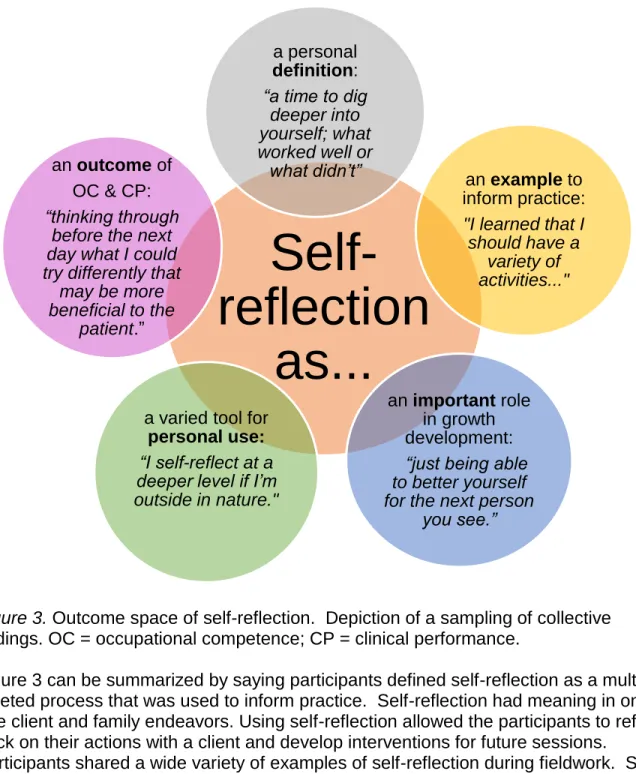
The phenomenographic approach explores the broad range of different meanings within the context of the whole sample called the outcome space. For this study, the collective interpretations of the “what” and “how” aspects of the phenomenon of self-reflection were of central importance: When students talk about self-reflection, what do they talk about, and how do they talk about it? Figure 3 illustrates the outcome space or how specific student responses reflected some of the constructs depicted in Figure 2.
Figure 3. Outcome space of self-reflection. Depiction of a sampling of collective findings. OC = occupational competence; CP = clinical performance.
Figure 3 can be summarized by saying participants defined self-reflection as a multi-faceted process that was used to inform practice. Self-reflection had meaning in one to one client and family endeavors. Using self-reflection allowed the participants to reflect back on their actions with a client and develop interventions for future sessions.
Participants shared a wide variety of examples of self-reflection during fieldwork. Some discussed their self-reflective process with specific clients while others gave general examples or spoke about a time when they used self-reflection. Other participants found performing self-reflection with a clinical instructor to be valuable during their fieldwork experience. Self-reflection was considered essential to personal growth and professional development. Participants maintained it is important for all healthcare professionals to self-reflect because it influences a student’s personal growth and skill development during fieldwork. Self-reflection was also considered an important vehicle for advancing clinical skills in practice in their everyday wellness and self-awareness.
Self-reflection
as...
a personal
definition:
“a time to dig deeper into yourself; what worked well or
what didn’t” an exampleto
inform practice:
"I learned that I should have a variety of activities..." an important role in growth development:
“just being able to better yourself for the next person
you see.”
a varied tool for
personal use:
“I self-reflect at a deeper level if I’m outside in nature."
an outcomeof OC & CP:
“thinking through before the next day what I could try differently that
may be more beneficial to the
DISCUSSION
Study findings indicated that participants had similar thoughts about what they
conceived as self-reflection. Their wide-ranging illustrations of self-reflection suggested that self-reflection is a complex process, having multiple elements that can be different for everyone depending on the situation (e.g. a challenging therapy session or feedback session with a supervisor). The participants used self-reflection to assess and gauge why they were doing what they were doing, so that transformation and professional and personal growth could occur in their life roles, routines, and clinical performance
patterns. Extant literature has also expressed the advantages of self-reflection and suggest that continued practice in self-reflection may have long term benefits (Adam et al., 2013; Davies, 2012; Hackenburg & Toth-Cohen, 2018; Mason et al., 2014).
Results also revealed how participants conceived of self-reflection. The majority of participants valued self-reflection and thought it might be a key ingredient to a balanced lifestyle as one becomes more occupationally competent in life. However, they
expressed times when occupational competence may be a struggle (e.g. when a student is overloaded and stressed) and felt self-reflection may be useful as a
mechanism for change to better the situation (e.g. being kind to oneself and thinking about coping strategies for how to better handle stress; Adam et al., 2015; Campbell & Corpus, 2016).
Moreover, comparable to previous studies, participants also felt that self-reflection mostly had a positive impact on their clinical performance, specifically, problem solving, clinical reasoning, and confidence in skills (Andonian, 2013; Brown et al., 2016;
Constantinou & Kuys, 2013). They saw self-reflection as an outlet for letting go of expectations and adopting new perspectives which allowed them to flourish in fieldwork and adopt a greater therapeutic use of self with clients and families (Schwind et al., 2014). However, a cautionary note was also evident in participant comments that indicated that self-reflection may be detrimental if it does not occur at optimal times or places (e.g., during a therapy session, distracting from being present in the immediate situation), or if the student focuses on negative rather than successful
interactions. Overall, the use of self-reflection guided the students’ fieldwork experiences. Through introspection (internal self-reflection) and talking with their clinical supervisors and colleagues (interactive reflection), students progressed in their knowledge of self and clinical skills, learned their strengths and growth areas, and how to better handle change and the unexpected (Campbell & Corpus, 2016; Embo et. al., 2015; Lasater & Nielsen, 2009).
Educational and Clinical Implications
The findings of this research study have implications for educational and clinical
practice. In OT education, self-reflection could be considered a vehicle or interventional approach to promote increased performance skills and patterns in students who are preparing for Level II Fieldwork. If self-reflection is routinely imbedded within OT curricula, students may develop healthy habits of mind that contribute to their maturation as health professionals. Providing explicit instruction and multiple
written feedback, and group reflective discussions may be useful to incorporate within the classroom. These experiences may help students start noticing which self-reflection methods are most effective for them personally. This may be of critical importance, as it is plausible that individual differences in self-reflection style influence the effectiveness of particular self-reflection techniques for a particular student in the classroom as well as in future clinical experiences.
On the other hand, students expressed the potentially negative impact that
self-reflection can have on their performance, such as being overly self-critical or ruminating on the negative outcomes of a test or practical exam. Therefore, instructors might find it beneficial to explicitly teach structured and guided reflections throughout formal
coursework to foster the self-awareness needed to move on so students do not get stuck in a self-critical pattern that could potentially harm their well-being and academic or clinical success. Providing opportunities for students to evaluate their peers and instructor gives them the needed practice of providing clear and constructive feedback.
This study also has clinical implications for OT practice. Participants indicated that feedback from a clinical instructor (CI) during fieldwork was important to their clinical performance. Providing information and training on self-reflection to CIs prior to accepting fieldwork students may be beneficial. These resources may assist CIs in developing and implementing more effective self-reflection methods for students and for themselves in their practice settings. Training would offer CIs insight into the effects of their own self-reflection practices as well as the effects of their practice setting
characteristics on students’ self-reflective practices. This understanding might shape a student’s view of self-reflection and could impede or facilitate the supervisory
relationship and student progress in fieldwork. It might also be useful for CIs to establish routine times and opportunities for feedback and reflection so that students can potentially increase their awareness and accountability for their personal and clinical performance.
Several self-reflection models currently are available for training purposes in education and clinical practice. The Gibbs Reflective Cycle (Gibbs, 1988) and the Kolb Reflective Cycle (Kolb, 1984) are models designed for beginners who are trying to analyze and evaluate a situation. The Schön Model (Schön, 1983) and the Framework for Reflexive Learning (Rolfe, Freshwater, & Jasper, 2001), which resonate most with the study findings, are best suited for developing professional artistry and increasing professional confidence by consistently asking three basic questions: “What?, so what?, and now what?” More complex models, such as the Brookfield Model (Brookfield, 2005), Johns’ Model for Structured Reflection (Johns, 2000), and the Mezirow Model of
Transformative Learning (Mezirow, 2003) build on the basics of self-reflection and aim to elicit change in personal beliefs and to challenge assumptions. Any of these models can build self-reflective capacity if taught effectively through application and
implemented in the classroom or clinic consistently.
Another resource for fostering self-reflection in health professionals comes from Bolton (2014), who authored creative ways to reflect in her book Reflective Practice: Writing and Professional Development. Her book explains how reflective writing can widen perspectives, develop political and social authority, and give clarity of professional roles, responsibilities, and principles. She offers step-by-step methods, grounded in theories drawn from professional development, pedagogy, and narrative studies to help guide the professional student in reflective inquiry.
The National Society for Experiential Education (NSEE, 2011) offers several instructional resources on reflection. The NSEE regards reflection as one of eight principles underlying the pedagogy of experiential education. The society
acknowledges reflection as the element that transforms a simple experience to a
learning experience. For knowledge to be discovered and internalized the learner must test assumptions and hypotheses about the outcomes of decisions and actions taken, then weigh the outcomes against past learning and future implications. This reflective process is integral to all phases of experiential learning, from identifying intention and choosing the experience, to considering preconceptions and observing how they change as the experience unfolds. Reflection is also an essential tool for adjusting the experience and measuring outcomes. These resources may be possible methods to teach self-reflection and are easily accessible on the worldwide web.
Limitations and Future Directions
There are several limitations in this study. One limitation is the small convenience sample. It is representative of one cohort of students at one American state university, making generalization of these findings limited. Interviews were conducted after
students completed questionnaires on self-perceived occupational competence and occupational performance skills as part of another study, so participant exposure to the measures may have influenced the participants’ responses to the interview questions and focus group discussion.
It is hoped that results of this study will stimulate further research, both qualitative and quantitative. Research that examines the effects of self-reflection on an OT
practitioner’s occupational competence and performance skills may be
illuminating. Additionally, OT educators’ conceptions about the use of self-reflection in the classroom and clinic need to be investigated. Overall, studying how people reflect and exploring the processes of self-reflection will expand our understanding of the complexity of self-reflection and how it influences the student experience and effectiveness of OT fieldwork education.
CONCLUSION
Results of this study suggest that self-reflection may serve to inform personal and
professional practices during OT student clinical rotations. Although universally defined, student conceptions of self-reflection occurred in countless ways and took many forms. Students valued its function in expanded decision making, self-awareness, and
competence in fieldwork and everyday occupations. These findings might stimulate the creation of new self-reflection educational methods or interventions designed to build or
remediate self-reflective capacity of health sciences students during academic and clinical programming, so they are better prepared for the healthcare climate and workforce.
References
Adam, K., Peters, S., & Chipchase, L. (2013). Knowledge, skills and professional behaviours required by occupational therapist and physiotherapist beginning practitioners in work-related practice: A systematic review. Australian
Occupational Therapy Journal, 60, 76-84. https://doi.org/10.1111/1440-1630.120006
Akerlind, G. S. (2005). Variation and commonality in phenomenographic research methods. Higher Education Research and Development, 24(4), 321-334. https://doi.org/10.1080/07294360500284672
American Occupational Therapy Association. (2012). 2011 Accreditation Council for Occupational Therapy Education (ACOTE®) Standards. American Journal of Occupational Therapy, 66(Suppl.), S6–S74.
https://doi.org/10.5014/ajot.2012.66S6
Andersson, K., Willman, A., Sjöström-Strand, A., & Borglin, G. (2015). Registered nurses’ descriptions of caring: A phenomenographic interview study. BMC Nursing, 14(16), 1-10. https://doi.org/10.1186/s12912-015-0067-9
Andonian, L. (2013). Emotional intelligence, self-efficacy, and occupational therapy students' fieldwork performance. Occupational Therapy in Health Care, 27(3), 201-215. https://doi.org/10.3109/07380577.2012.763199
Bolton, G. (2014). Reflective practice: Writing and professional development. London: Sage Publications, Inc.
Boud, D., Keogh, R., & Walker, D. (1985). Reflection: Turning experience into learning.
London: Kogan Page.
Bowden, J. A., & Walsh, E. (2000). Phenomenography. Melbourne: RMIT Publishing. Brookfield, S. (2005). Becoming a critically reflective teacher. San Francisco: Jossey
Bass.
Brown, T., Williams, B., & Etherington, J. (2016). Emotional intelligence and personality traits as predictors of occupational therapy students’ practice education
performance: A cross-sectional study. Occupational Therapy International, 23, 412-424. https://doi.org/10.1002/oti.1443
Campbell, M.K., & Corpus, K. (2015). Fieldwork educators’ perspectives: Professional behavior attributes of Level II fieldwork students. Open Journal of Occupational Therapy, 3(4), 1-13. https://doi.org/10.15453/2168-6408.1146
Constantinou, M., & Kuys, S.S. (2013). Physiotherapy students find guided journals useful to develop reflective thinking and practice during their first clinical placement: A qualitative study. Physiotherapy, 99(1), 49-55.
https://doi.org/10.1016/j.physio.2011.12.002
Davies, S. (2012). Embracing reflective practice. Education for Primary Care 23 (1), 9–
Embo, M., Driessen, E., Valcke, M., & van der Vleuten, C. P. M. (2015). Relationship between reflection ability and clinical performance: A cross-sectional and retrospective-longitudinal correlational cohort study in midwifery. Midwifery, 31(1), 90-94. https://doi.rg/10.1016/j.midw.2014.06.006
Gibbs, G. (1988). Learning by Doing:A guide to teaching and learning methods. London: FEU.
Hackenberg, G. R., & Toth-Cohen, S. (2018). Professional behaviors and fieldwork: A curriculum based model in occupational therapy. Journal of Occupational Therapy Education, 2(2). https://doi.org/10.26681/jote.2018.020203
Holmstrom, I., Halford, C., & Rosenqvist, U. (2003). Swedish health care professionals’ diverse understandings of diabetes care. Patient Education and Counseling, 51(1), 53-58. https://doi.org/10.1016/S0738-3991(02)00212-4
Johns, C. (2000). Becoming a reflective practitioner. Oxford: Blackwell.
Kielhofner, G., (2008). Model of human occupation: Theory and application (4th ed.). Baltimore, MD: Lippincott Williams & Wilkins.
Kolb, D. (1984). Experiential learning. New Jersey: Jossey-Bass.
Larsson, J., & Holmstrom, I. (2007). Phenomenographic or phenomenological analysis: Does it matter? Examples from a study on anesthesiologists’ work. International Journal ofQualitative Studies on Health and Well-being, 2, 55-64.
https://doi.org/10.1080/17482620601068105
Lasater, K., & Nielsen, A. (2009). Reflective journaling for clinical judgment development and evaluation. Journal of Nursing Education, 48(1), 40-44. https://doi.org/10.3928/01484834-20090101-06
Mann, K., Gordon, J., & Macleod, A. (2009). Reflection and reflective practice in health professions education: A systematic review. Advances in Health Sciences Education, 14(4), 595-621. https://doi.org/10.1007/s10459-007-9090-2
Marton, F. (1986). Phenomenography: A research approach to investigating different understandings of reality. Journal of Thought, 21(3), 28-49. Retrieved from https://www.questia.com/library/p67425/journal-of-thought
Marton, F., & Booth, S. (1997). Learning and awareness. Mahwah, New Jersey: Lawrence Erlbaum Associates.
Mason, R., Vitkovitch, J., Lambert, R., & Jepson, J. (2014). Knowing about and performing professionalism: Developing professionalism in interprofessional healthcare education. PBLH, 2(1), 96-107.
https://doi.org/10.11120/pblh.2013.00027
Mezirow, J. (2003). Transformative learning as discourse. Journal of Transformative Education, 1(1), 58-63. https://doi.org/10.1177/1541344603252172
National Society of Experiential Education. Retrieved from http://www.nsee.org
NVivo qualitative data analysis Software, (2012). QSR International Pty Ltd. (Version 10) [Computer software]. Retrieved from http://www.qsrinternational.com/
Parham, D. (1987). Toward professionalism: The reflective therapist. American Journal of Occupational Therapy, 41(9), 555-561. https://doi.org/10.5014/ajot.41.9.555 Patton, M. (2015). Qualitative research & evaluation methods (4th ed.). Thousand Oaks,
CA: Sage.
Rolfe, G., Freshwater, D., & Jasper, M. (2001). Critical reflection in nursing and the helping professions: a user’s guide. Basingstoke: Palgrave Macmillan.
Sandberg, J. (1996). Are phenomenographic results reliable? Higher Education Research & Development, 16, 203-212.
https://doi.org/10.1080/0729436970160207
Schön, D. (1983). The reflective practitioner. San Francisco, CA: Jossey-Bass.
Schwind, J. K, Beanlands, H., Lapum, J., Romaniuk, D., Fredericks, S., LeGrow, K., … Crosby, J. (2014). Fostering person-centered care among nursing students: Creative pedagogical approaches to develop personal knowing. Journal of Nursing Education, 53(6), 343-347.
https://doi.org/10.3928/01484834-20140520-01
Stephens, M. B., Reamy, B. V., Anderson, D., Olsen, C., Hemmer, P. A., Durning, S. J., & Auster, S. (2012). Writing, self-reflection, and medical school performance: The human context of health care. Military Medicine, 177(9), 26-30.
https://doi.org/10.7205/MILMED-D-12-00235
Taylor, R. R. (2008). The intentional relationship: Occupational therapy and use of self.
Philadelphia: FA Davis.
Taylor, R. R. (2017). Kielhofner’s model of human occupation (5th ed.). Baltimore, MD: Williams & Wilkins.
Appendix A Coding Structure
1) Self-Reflection (SR): General comments about self-reflection that do not apply to other codes.
2) Definition: of reflection – definition or description. When you hear the word
self-reflection, what do you think of? How do you describe/define/see it? 3) Example: Specific examples of self-reflection.
4) Outcome: What was the outcome of using self-reflection? How did you feel about the experience? General outcomes of self-reflection, not directly related to occupational competence or clinical performance.
a) Occupational competence (OC): What attributes of self-reflection may have affected your occupational competence in fieldwork? Occupational Competence is sustaining a pattern of occupational behavior which is productive and satisfying—i.e., taking care of self, handling responsibilities, or doing activities you like
i) Balanced or positive: SR has a positive effect on OC (i.e. not being so hard on myself; accepting of a break for self, exercise, having a balance between work and life) ii) Unbalanced or Negative: SR has a negative effect on OC (i.e. work/life balance out of
sync, not taking care of home-life, ruminating on negative thoughts)
b) Clinical performance (CP): What attributes of self-reflection may have influenced your clinical performance in Level II Fieldwork?
i) More SR: not doing enough SR; wished they would have done more
ii) Negative impact on CP: SR that interfered with CP (i.e. too much SR bringing self down; negative self-talk; impacting confidence in clinical skills)
iii) Positive impact of CP: SR leading to self-learning and awareness of performance or changes needed for improvements
5) Importance: Do you consider self-reflection important to OT clinical practice? Why or why not? Tell me more about that.
a) Growth development: becoming a better OT/professional/clinician; learning more about self; being comfortable with self and skill sets
6) Personal Use: How one uses/experiences self-reflection within personal self (does not include specific outcomes)—how, when, and where.
a) How i) Internal (1) Mental thinking (2) Talking to self (3) Writing-journaling ii) External (1) Talking to others b) When/Where
i) Alone ii) Driving iii) Exercise
Appendix B
Focus Group Protocol and Questions Introduction:
Thank you for agreeing to participate in this focus group.
You were invited to participate in this focus group because you have already completed individual interviews about self-reflection for the study. This focus group will be a
discussion about whether or not the preliminary findings from your interviews support your own conceptions of self-reflection and their impact on your competence and clinical performance in fieldwork. This will act as one of the trustworthiness measures in the study.
Before we get started, I’d like to review some logistics with you -
• Please silence your mobile devices; if an emergency arises and you must leave immediately, please do so quietly.
• You will not discuss personal information of any participants outside of the group. • We will use first names only.
• Each person will speak one at a time and introduce themselves by their first name prior to speaking.
• We will treat everyone with respect at all times.
• As a reminder the focus group will take about 1-2 hours and be tape
recorded. The information you provide will be kept confidential and your name will not be linked to your responses in any analyses.
• We will have a 15 minute break about half way through if needed. Before turning on the tape recorder, do you have any questions?
To remind you—the questions for the individual interviews were as follows:
1. When you hear the word self-reflection, what do you think of? Probing Question: What does self-reflection mean to you? How do you describe/define/see it?
2. Describe a time during Level II Fieldwork when you used self-reflection.
Probing Questions: What was the outcome? How did you feel about the experience?
3. What characteristics of self-reflection/ How might self-reflection have impacted your occupational competence in fieldwork? Your clinical performance in Level II Fieldwork?
Probing Question: How so? Give me an example. Tell me more.
4. Do you consider self-reflection to be important to OT clinical practice? Why or why not? Tell me more about that.
Now we will go through the preliminary findings for each question to see if you agree or disagree with them.
For each question ask yourself the following:
• Do the findings thoroughly answer the questions? Yes/No/ Maybe—and Why?
• Is there anything missing? Additions you would make?