Concept of Operations
for the Next Generation Air Transportation System
Joint Planning and Development Office
I
Version 3.2
Concept of Operations
for the Next Generation Air Transportation System
including suggestions for reducing this burden, to Washington Headquarters Services, Directorate for Information Operations and Reports, 1215 Jefferson Davis Highway, Suite 1204, Arlington VA 22202-4302. Respondents should be aware that notwithstanding any other provision of law, no person shall be subject to a penalty for failing to comply with a collection of information if it does not display a currently valid OMB control number.
1. REPORT DATE
2011 2. REPORT TYPE
3. DATES COVERED
00-00-2011 to 00-00-2011 4. TITLE AND SUBTITLE
Concept of Operations for the Next Generation Air Transportation System. Version 3.2
5a. CONTRACT NUMBER
5b. GRANT NUMBER
5c. PROGRAM ELEMENT NUMBER
6. AUTHOR(S) 5d. PROJECT NUMBER
5e. TASK NUMBER
5f. WORK UNIT NUMBER
7. PERFORMING ORGANIZATION NAME(S) AND ADDRESS(ES)
Joint Planning and Development Office,Next Generation Air Transportation System (NextGen),1500 K St NW Ste
500,Washington,DC,20005
8. PERFORMING ORGANIZATION REPORT NUMBER
9. SPONSORING/MONITORING AGENCY NAME(S) AND ADDRESS(ES) 10. SPONSOR/MONITOR’S ACRONYM(S)
11. SPONSOR/MONITOR’S REPORT NUMBER(S)
12. DISTRIBUTION/AVAILABILITY STATEMENT
Approved for public release; distribution unlimited 13. SUPPLEMENTARY NOTES
14. ABSTRACT
15. SUBJECT TERMS
16. SECURITY CLASSIFICATION OF: 17. LIMITATION OF
ABSTRACT Same as Report (SAR) 18. NUMBER OF PAGES 153 19a. NAME OF RESPONSIBLE PERSON a. REPORT unclassified b. ABSTRACT unclassified c. THIS PAGE unclassified
Standard Form 298 (Rev. 8-98) Prescribed by ANSI Std Z39-18
Preface
1 2 3 4 5 6 7 8 9The Joint Planning and Development Office (JPDO) is continuing to refine a Concept of Operations (ConOps) for the Next Generation Air Transportation System (NextGen). This version of the ConOps provides an overall, integrated view of NextGen operations for the 2025 time-frame, including key transformations from today’s operations.
The development of the ConOps is an iterative and evolutionary process that encompasses the input and feedback of the aviation community. Version 3.2 of the document includes accepted comments resulting from an internal review and an expanded vision of the NextGen concepts and capabilities. Interested individuals can find details of the JPDO comment and review process at jpe.jpdo.gov under the Joint Planning Environment (JPE) section.
10 11
Document Revision Register
12Version Document Content Added Reviewer Release Date
0.1
Initial document that includes the major “day-of-flight” air navigation elements that support operational activities of a flight moving from “block to block”
JPDO Staff and Integrated Product Teams
May 9, 2006
0.2 Major comments from Version 0.1 review Aviation Stakeholder
Community July 24, 2006 1.0 Major comments from Version 0.2 review Submitted to JPDO
Board for Approval Unreleased
1.1
Initial addition of remaining key NextGen Concepts that support operations from “curb to curb” as well as planning and strategic support functions
JPDO Staff and Integrated Product Teams
November 14, 2006
1.1a
Revised Version 1.1, including air navigation and flight operation concepts as well as revised Executive Summary
JPDO Staff and Integrated Product Teams
December 6, 2006
1.1b Major comments from Version 1.1/1.1a review Integrated Product
Team Leads January 29, 2007 1.2 Major comments from Version 1.1/1.1a/1.1b review Aviation Stakeholder
Community February 28, 2007 2.0 Major comments from Version 1.2 review Submitted to JPDO
Board for Approval June 13, 2007 3.0 Incorporated NextGen Capabilities, Comments from
Version 1.2 review, SSA and NCO ConOps
JPDO Staff and
Working Groups October 1, 2009 3.1 Addressed Deferred Comments from Version 3.0 JPDO Staff and
Working Groups April 10 2010 3.2 Addressed comments from 3.1 and revised section 3.2
“Airside Operations”
JPDO Staff and Working Groups
September 30, 2010 13
TABLE OF CONTENTS
14 15 16 17 18 19 20 21 22 23 24 25 26 27 28 29 30 31 32 33 34 35 36 37 38 39 40 41 42 43 44 45 46 47 48 49 50 51 PREFACE ... IDOCUMENT REVISION REGISTER ... II
TABLE OF CONTENTS ... III
EXECUTIVE SUMMARY ... 1
1 INTRODUCTION... 1-1
1.1 NEXTGEN ENVIRONMENT ... 1-1
1.2 BACKGROUND ... 1-2
1.2.1 Key Characteristics of NextGen ... 1-3
1.2.2 NextGen Planning Organization ... 1-7
1.3 NEXTGEN STAKEHOLDERS ... 1-9 1.4 OVERVIEW OF NEXTGEN CONCEPTS AND CAPABILITIES ... 1-10
1.5 DOCUMENT SCOPE AND ORGANIZATION ... 1-14
2 AIR TRAFFIC MANAGEMENT OPERATIONS ... 2-1
2.1 INTRODUCTION ... 2-1 2.2 COLLABORATIVE AIR TRAFFIC MANAGEMENT ... 2-8 2.2.1 Capacity Management ... 2-10
2.2.2 Flow Contingency Management ... 2-12
2.3 TRAJECTORY-BASED OPERATIONS ... 2-13
2.3.1 Trajectory Management (TM) Process ... 2-15
2.3.2 Separation Management Process ... 2-15
2.3.3 TBO Aircraft Procedures ... 2-17
2.4 TRANSFORMED ROLES AND RESPONSIBILITIES ... 2-25
2.4.1 Functional Task Allocation ... 2-26
2.4.2 Human-to-System Interactions ... 2-26
2.4.3 Flight Operator Roles and Vehicle Types ... 2-27
2.4.4 Transformations in ANSP Processes ... 2-32
3 AIRPORT OPERATIONS AND INFRASTRUCTURE SERVICES ... 3-1
3.1 INTRODUCTION ... 3-1
3.2 AIRSIDE OPERATIONS ... 3-2 3.2.1 Enhanced Airside Safety & Security ... 3-3
3.2.2 Improved Airside Operational Efficiency Especially in Non-Movement Areas .... 3-4
3.2.3 Enhanced Airside Facility Management ... 3-5
3.2.4 Enhanced Airside Maintenance ... 3-6
3.2.5 Enhanced Winter Operations ... 3-6
3.2.6 Surface Data Availability and Management ... 3-7
3.3.1 Landside Resource and Passenger Flow Management ... 3-7 52 53 54 55 56 57 58 59 60 61 62 63 64 65 66 67 68 69 70 71 72 73 74 75 76 77 78 79 80 81 82 83 84 85 86 87 88 89
3.3.2 Passenger Processing and Security ... 3-8
3.3.3 Off-Airport Passenger and Baggage Processing Enabled through Integrated Trip Tracking ... 3-8
3.3.4 Intermodal Ground Access ... 3-8
3.4 TRANSFORMED AIRPORT DEVELOPMENT ... 3-9 3.4.1 Airport Preservation ... 3-9
3.4.2 Catalysts for Airport Development Actions ... 3-11
3.4.3 Efficient, Flexible, and Responsive Airport Planning Processes ... 3-11
3.4.4 Regional System Planning ... 3-12
3.4.5 Flexible Terminal Design ... 3-14
3.4.6 Optimized Airfield Design ... 3-14
3.4.7 Airport Congestion Management ... 3-16
3.5 CHALLENGES TO NEXTGEN AIRPORTS ... 3-17
4 NET-CENTRIC OPERATIONS ... 4-1
4.1 INTRODUCTION ... 4-1 4.2 TRANSFORMED NET-CENTRIC OPERATIONS ... 4-3 4.2.1 NextGen Enterprise Network ... 4-4
4.2.2 Network Management & Security ... 4-5
4.2.3 Air-Ground Networking ... 4-6
4.3 INTEGRATED NEXTGEN INFORMATION ... 4-7 4.3.1 Transformed Network-Enabled Trajectory Management (TM) ... 4-7
4.3.2 Transformed Network-Enabled Collaborative Capacity Management ... 4-8
4.3.3 Transformed Network-Enabled Collaborative Flow Contingency Management ... 4-9
4.3.4 Transformed Network-Enabled Weather ... 4-9
4.4 AIR DOMAIN AWARENESS ... 4-9
5 SHARED SITUATIONAL AWARENESS SERVICES ... 5-1
5.1 INTRODUCTION ... 5-1 5.2 INTEGRATED NEXTGEN INFORMATION ... 5-1
5.2.1 Integrated Surveillance Information ... 5-1
5.2.2 Positioning, Navigation, and Timing Services ... 5-3
5.2.3 Aeronautical Information Services ... 5-6
5.3 INTEGRATED AIR DOMAIN AWARENESS ... 5-7 5.3.1 Coordinated Security ... 5-8
5.3.2 Domain Awareness ... 5-10
5.4 INTEGRATED WEATHER INFORMATION ... 5-11 5.4.1 Weather Information Operations ... 5-12
6 LAYERED, ADAPTIVE SECURITY SERVICES ... 6-1 90 91 92 93 94 95 96 97 98 99 100 101 102 103 104 105 106 107 108 109 110 111 112 113 114 115 116 117 118 119 120 121 122 123 6.1 INTRODUCTION ... 6-1 6.1.1 NextGen Security Management and Collaborative Framework ... 6-2
6.2 INTEGRATED RISK MANAGEMENT (IRM) ... 6-4
6.3 SECURITY SERVICES ... 6-5 6.3.1 Secure People ... 6-5
6.3.2 Secure Airports ... 6-6
6.3.3 Secure Checked Baggage ... 6-7
6.3.4 Secure Cargo/Mail ... 6-7
6.3.5 Secure Airspace ... 6-8
6.3.6 Secure Aircraft ... 6-9
7 ENVIRONMENTAL MANAGEMENT FRAMEWORK ... 7-1
7.1 INTRODUCTION ... 7-1
7.2 IMPROVED ENVIRONMENTAL PERFORMANCE OF SYSTEM COMPONENTS ... 7-2
7.2.1 Environmental Operations ... 7-2
7.2.2 Environmental Management Framework Policies and Capabilities ... 7-5
7.2.3 Environmental Management Framework Support ... 7-9
8 SAFETY OF AIR TRANSPORTATION SERVICES ... 8-1
8.1 INTRODUCTION ... 8-1
8.1.1 National Aviation Safety Strategic Plan ... 8-2
8.1.2 Safety Improvement Culture ... 8-2
8.1.3 Safety Risk Management ... 8-2
8.1.4 Safety Information Integration ... 8-3
8.1.5 Enhanced Safety Assurance ... 8-3
8.2 SAFETYMANAGEMENTENTERPRISESERVICESANDCAPABILITIES ... 8-4
8.2.1 Aviation Safety Strategic Plan Service ... 8-4
8.2.2 Safety Promotion Service ... 8-4
8.2.3 Safety Risk Management Service ... 8-4
8.2.4 Safety Information Integration Service ... 8-5
8.2.5 Safety Assurance Service ... 8-5
8.3 INTEGRATIONOFSMSINTONEXTGENSERVICES ... 8-5
APPENDIX A: ACRONYMS ... 1
124 125 126 127 128 129 130 131 132 133 134 135 136 137 138 139 140 141 142 143 144 145 146 147 148 149 150 151
LIST OF FIGURES
Figure 2-1 Air Traffic Management Operations and Services ... 2-3 Figure 2-2 ATM Decisions—Interactive and Integrated Across Time Horizons ... 2-6 Figure 2-3 Collaborative ATM Among the ANSP and Operators ... 2-10 Figure 2-4 Four-Dimensional Trajectory ... 2-19 Figure 2-5 Flow Corridors ... 2-21 Figure 2-6 High-density Operations ... 2-23 Figure 2-7 Relative Influence of the ANSP and Aircraft/Pilot in ATM Decisions ... 2-26 Figure 2-8 Space Operations in the NextGen NAS ... 2-31 Figure 4-1 NextGen Information Users ... 4-1 Figure 4-2 Net-Centric Infrastructure Overview ... 4-2 Figure 4-3 NextGen Enterprise Network ... 4-5 Figure 5-1 Positioning, Navigation, and Timing Overview ... 5-4 Figure 5-2 Surveillance Overview ... 5-8 Figure 5-3 NextGen Weather Dissemination Foundation ... 5-14 Figure 6-1. Net-CentricOperations with Shared Situational Awareness………..6-2 Figure 6-2. Secure Airspace - Security Restricted Airspace ... 6-9 Figure 7-1. Environmental Management Framework ... 7-6
LIST OF TABLES
Table 1-1 NextGen Goals and Objectives ... 1-3 Table 2-1 Summary of En Route and Oceanic Trajectory-Based Operations ... 2-21 Table 2-3 NextGen Surface Operation Transformations ... 2-24 Table 2-4 Flight Operator Roles ... 2-29 Table 2-5 Air Navigation Service Provider Personnel Roles ... 2-33 Table 2-6 Personnel Management Transformations ... 2-34
Executive Summary
152153
The U.S. air transportation sys emand in aircraft operations
154
expected to grow significantly through the 2025 time frame, there are well-founded concerns that 155
e current air transportation system will not be able to accommodate forecasted growth. Many 156 157 158 159 r 160 cesses 161 y 162 163 164 165 tails 166 eline, 167
f the 2025 NextGen goals, objectives, concepts, 168
169 170
171
tem is under significant stress. With d th
legacy systems are unable to process and provide flight information in real-time. Current processes and procedures do not provide the flexibility needed to meet these growing requirements. New security requirements are affecting the ability to move people and cargo efficiently. In addition, the growth in air transportation has heightened community concerns ove aircraft noise, air quality and climate impacts, and congestion. New technologies and pro are necessary to meet the need for increased capacity and efficiency, while maintaining safet and mitigating environmental impacts. In response to these concerns, the Joint Planning and Development Office (JPDO) developed the Next Generation Air Transportation System (NextGen) Concept of Operations (ConOps).
The ConOps serves as a steering vision for 2025. It is not intended to describe the specific de needed for program planning or implementation. Its intended outcome is to provide a bas that forms a widely understandable summary o
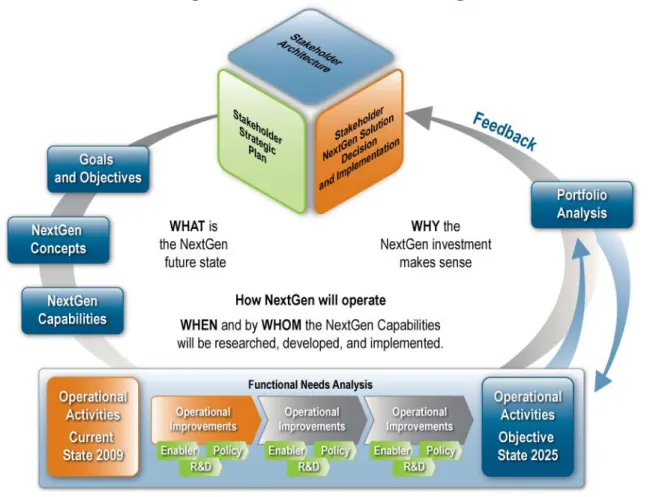
capabilities, and planned transformations needed to realize the NextGen vision. Figure ES-1 JPDO NextGen Planning
A combination of new procedures and technological advances currently developed, deployed or 172
planned for the National Airspace System (NAS) make NextGen Goals attainable. The Next 173
Generation Air Transportation System’s Integrated Plan (2004) and NGATS 2005 Progress 174
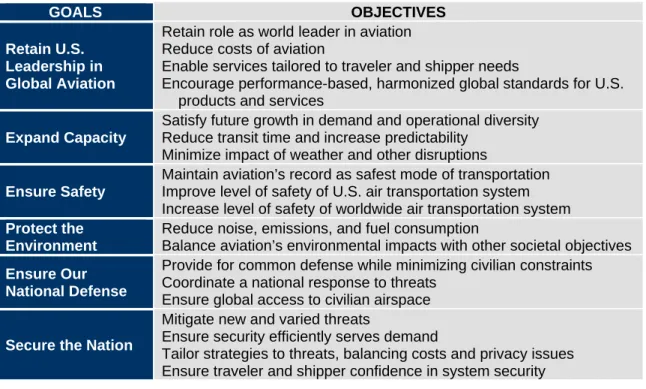
Report detailed the problems facing the NAS and identified six goals, and 19 objectives to 175
achieve the NextGen vision: 176
Table ES-1 NextGen Goals and Objectives 177
GOALS OBJECTIVES
Retain U.S. Leadership in Global Aviation
Retain role as world leader in aviation Reduce costs of aviation
Enable services tailored to traveler and shipper needs
Encourage performance-based, harmonized global standards for U.S. products and services
Expand Capacity
Satisfy future growth in demand and operational diversity Reduce transit time and increase predictability
Minimize impact of weather and other disruptions
Ensure Safety
Maintain aviation’s record as safest mode of transportation Improve level of safety of U.S. air transportation system Increase level of safety of worldwide air transportation system
Protect the Environment
Reduce noise, emissions, and fuel consumption
Balance aviation’s environmental impacts with other societal objectives
Ensure Our National Defense
Provide for common defense while minimizing civilian constraints Coordinate a national response to threats
Ensure global access to civilian airspace
Secure the Nation
Mitigate new and varied threats
Ensure security efficiently serves demand
Tailor strategies to threats, balancing costs and privacy issues Ensure traveler and shipper confidence in system security
The following eight key NextGen concepts were identified as necessary to achieve the NextG goals and objectives. A brief description of the NextGen concepts is contained below:
• Net-Centric Operations (Network-Enabled Information Access) - provides secu information access, ava
en 178
179
re 180
ilable in real-time for Communities of Interest (COI) and air 181
transportation dom istribution of
182
tion and improves the speed, effic lity of the decision-making 183 184 ance-185 nts in ls are 186 a 187
providers can d ing equipage
188
th nvestments.
189
• Weather Assi robabilistic and
190
weat ision tools,
191
increasing the verse effects.
192
d, Ada 193
194
ains. This greater accessibility enables better d informa
process.
iency, and qua
• Perform
requireme required to m
Based Operations and Services – through regulations and procedural addition to technology or equipment, minimum performance leve
sted airspace during specific periods. Service ximize capacity in conge
efine capability improvements in terms of users’ exist e value of the service providers’ and users’ i
maximizing
milated into Decision Making – directly applies both p her information to Air Traffic Management (ATM) dec effective use of weather information and minimizing the ad observed
• Layere
techniques, tools, sensors, processes,
ptive Security – deploys a multi-layered security system (including information, and a robust integrated risk
manag sharing to d ement [I ation 195 ete k. 196
• Positioning, N Services (Broad-Area Precision
197
- and precisely determine one’s
198 tio ion. 199 200 201 202 203 204 205 206 207 208 209 210 tGen. They 211 212 213 214 215 216 217 218 lementation of specific 219 O 220 221 y perations
ent (SM) Ramp Operations
RM] system) that leverages technology and net-centric inform r threats proportional to the assessed ris
avigation, and Timing (PNT)
utilizes satellite navigation to accurately
n and orientation in relation to one’s desired path and posit Navigation)
current loca
• Trajectory-Based Operations (TBO) - dynamically adjusts a flight path in space (longitude, latitude, altitude) and time using a known position and intent; more accurately allowing the decrease in separation and increase in NAS capacity.
• Equivalent Visual Operations (EVO) - provides aircraft operators with the critical visual information needed to maintain safe distances from other aircraft, terrain, and airport infrastructure during night and instrument metrological conditions utilizing advanced cockpit technologies supported by ground based infrastructure.
• High-density Arrival/Departure Operations – utilizes advanced technologies and procedures in congested airspace/airports to improve terminal aircraft movements, reducing spacing and separation requirements, while improving arrival and departure sequencing.
These transformational concepts described above are the driving factors for Nex
encompass air traffic management, airports, security, and environmental management, to achieve greater safety and efficiency; protect our airspace, people and infrastructure; and leverage
innovative technologies, such as satellite-based navigation and surveillance in order to create a scalable NAS. Furthermore, these concepts are flexible enough to manage variations in demand, capacity, and aircraft fleet types both manned and unmanned, seamlessly integrating civil, commercial, and military operations.
Building upon the NextGen concepts, this ConOps is organized around a set of NextGen capabilities which detail the overall effect desired through the imp
standards, processes and conditions. The nine NextGen capabilities identified by the JPD provide:
Collaborative Capacity
Management Air Transportation Securit
Collaborative Flow Contingency Management Improved Environmental Performance Efficient Trajectory Improved Safety O Management (TM) Flexible Separation Managem
Integrated NextGen Information
NextGen capabilities emphasize system flexibility, scalability, robustness, and resiliency. also stress the importance of distributed decision making, international coordination, incre user focus, and the provisioning of information to users while reducing the need for governm intervention and resource control.
They 222 ased 223 ent 224 225
NextGen capabilities create a top-down, architectural perspective, laying out a performance-226
based ration each capability in operational terms that are implemented 227
through vari tional improvements, e
228
programs, and system O incorporates a planning framework
229
to organize the collectio 230
proposition for the 2025 air transportation system. The nine NextGen capabilities provide clear 231
alignment between the investment portfolio and the resulting v wing stakeholders: 232
• Airport Communities - wns located in the vicinity of airports that have a 233
vested interest in and are affected by the operation of t 234
• Airport Op r, flight, and cargo operations
235
conducted w consideration for safety, e
236
and l ues
237
• Airport Tenants - who are involved in airport operations, such as fueling, maintenance 238
or catering services 239
• Air N ) -engaged in providing ATM and Air Traffic
240
Control (ATC) services for flight operators for the purpose of safe and efficient flight 241 242 243 244 245 246 247 d air 248 249 , 250 251 252 t 253 254 255 256 national trade. 257
ale. The ConOps expresses ous combinations of opera
s. With NextGen capabilities, the JPD
nabling solutions, policies, n of pertinent information to provide a coherent and compelling value
alue to the follo cities and to
erators -responsible for enabling passenge
he airport ithin an airport with
ocal environmental iss
fficiency, resource limitations,
avigation Service Provider (ANSP
operations. ATM responsibilities include Communications, Navigation, and Surveillance (CNS). They also include ATM facility planning, investment, and implementation; procedure development and training, and ongoing system operation and maintenance of seamless CNS/ATM services.
• Users - including civil, government, and military, using NAS services.
• Flight Operators -responsible for planning and operating a flight within the NAS. This includes flight crews, Flight Operations Centers (FOC), private, business, schedule transport, government, and military operators.
• Manufacturers -who produce items that support flight operations to include: airframes aircraft engines, avionics, aircraft systems and parts, airport and ATM equipment and infrastructure, Decision Support Systems (DSS), and other components.
• Resource Owners - responsible for making investment decisions related to developmen and implementation.
• Regulatory Authorities -responsible for governing aspects of the overall performance of the aviation industry including safety, security, standardization, certification,
• Researchers - engaged in conducting Research and Development (R&D) activities that support the evolution
258
of the air transportation system, including academia and 259 260 261 262 263 264 265 266
The transformation from clear demand and
267
complexity, increases system capacity, flow management, and efficiency. Advancements in 268
aircraft systems allow for reduced separation and facilitate the transition from rules-based 269
operations to performance-based operations. In addition, the transition of separation 270
responsibility from the controller to the flight crew, in certain areas, allows controllers to focus 271
on overall flow instead of individual flight management. 272
Airports, which incorporate Air Traffic Management (ATM), security, and environmental goals, 273
are the nexus of many of the NextGen transformational elements. New technology and 274
procedures will improve access to airports, enabling better utilization of existing infrastructure. 275
Accordingly, the sustainability and advancement of the airport system is critical to the growth of 276
the NAS. A preservation program to increase community support and protect against 277
encroachment will enhance sustainability of existing airports. Finally, new airport infrastructure 278
will be developed using a comprehensive planning architecture that integrates facilities, finance, 279
government organizations.
• Security and Defense Providers -responsible for national security and homeland defense, law enforcement, and information security, as well as the physical and operational security of the NAS.
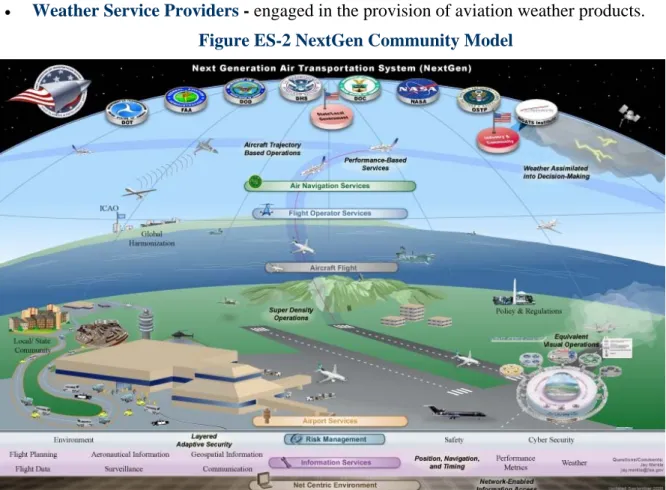
• Weather Service Providers - engaged in the provision of aviation weather products. Figure ES-2 NextGen Community Model
regional systems, and environmental improvements to enable a more efficient, flexible, and 280
responsive system. 281
At the heart of the NextGen concept is an information-sharing component known as Net Centric 282
Operations (NCO). Its features adapt to growing operations and shifts in demand, making 283
NextGen a scalable system. NCO also provides the foundation for robust, efficient, secure, and 284
timely flow of information to and from a broad community of users and individual subscribers. 285
This flow results in a system that minimizes duplication, achieves integration, and facilitates 286
distributed decision making by ensuring that all users have relevant and reliable information 287
upon which to base a decision. 288
Embedded in NCO is Shared Situational Awareness (SSA). SSA offers a suite of tools and 289
information designed to provide participants with real-time aeronautical and geospatial 290
information, communicated and interpreted electronically without the need for human 291
intervention. A reliable, common weather picture provides data and automatic updates to a wide 292
range of users, aiding optimal air transportation decision making. Additionally, PNT services 293
reduce dependence on costly, ground-based navigational aids by providing users with a more 294
precise and reliable source of global positioning and timing information. This allows users to 295
accurately and efficiently determine their orientation, course, and speed necessary to arrive at 296
their desired destination. Real-time situational awareness integrates cooperative and non-297
cooperative surveillance data from all air vehicles to safely navigate in the NAS. 298 299 300 ing 301 gh-yield 302 303 304 305 uring 306 307 308 309 310 311 312
odate the anticipated growth in air traffic through 313 314 315 316 317 318 will 319
Security services are provided by a risk-informed security system that deploys multiple technologies adaptively scaled and arranged to defeat a given threat. New policies and procedures also aid in passenger screening and checkpoint responsibilities. Baggage screen improvements include integrated Chemical, Biological, Radiological, Nuclear, and hi Explosives (CBRNE) detection in a range of sizes that facilitates portability and remote screening.
The development and implementation of an integrated environmental management system proactively addresses aviation ecological issues. Technologies incorporated before and d operations enable optimized route selection, as well as landing and take-off patterns based on a range of data feeds to reduce noise, air emissions and fuel burn, while increasing operational efficiency. At airports, a flexible, systematic approach identifies and manages environmental resources that are critical to sustainable growth. Additionally, aircraft design continues to incorporate environmental considerations that proactively address noise reduction, while reducing aircraft engine emissions.
Aviation safety steadily improves to accomm
an integrated Safety Management System (SMS). A national aviation safety policy implements and oversees safety requirements for all participants. This policy encourages a safety
improvement culture and uses non-reprisal reporting systems to identify concerns or incidents. Safety assurance focuses on a holistic view of operators’ processes and procedures, rather than the individual pieces of the system. Prognostic assessments using modeling, simulation, data analysis and data sharing improve Safety Risk Management (SRM). Technological advances
320 321 322 323 324 325 326 of the 327 NAS. 328
Implementation of these integrated NextGen capabilities will enable us to meet the nation’s 329 . 330 331 332 333
be utilized in both airborne and ground systems to provide improved decision making by improving situational awareness and safety for the flight crews and controllers.
NextGen is a complex system with many public and private sector stakeholders that must smoothly, promptly, and capably integrate with the envisioned changes to the global air transportation system. Federal agencies, national defense, homeland security, ATM, scheduled air transport and General Aviation (GA) operators, and airports must work together to support passenger, cargo, recreational, and military operations. Through a seamless and transparent information infrastructure and shared services environment, users gain a common picture operational information necessary to safely and efficiently perform in the NextGen future demand for the most effective, efficient, safe, and secure air transportation system
1 Introduction
334 335 336 337 338 339 340 341 342 343 344 345 346 347 348 349 350 351 352 353 354 355 356 357 358The Next Generation Air Transportation System (NextGen) Concept of Operations (ConOps) describes the operational concept as envisioned in the 2025 time frame. It provides a robust framework for the aviation stakeholder community to discuss the vision of improvements needed to achieve national and global goals for air transportation. The concepts and capabilities
presented in this ConOps provide an operational view of how air traffic and airports are managed and how security is provided to protect our airspace and people. It also depicts how goals for protecting and enhancing our environment are achieved, and how advanced technologies and processes in government and civil organizations provide increased safety and efficiency.
1.1
N
EXTG
ENE
NVIRONMENTIn the NextGen time-frame, demand for air transportation and other airspace services will grow from today’s levels, in terms of passenger volume, amount of cargo shipped, and overall flights. With respect to air traffic, changes will occur not only in the number of flights, but also in the characteristics of those flights. NextGen planning is required to meet anticipated demand.
Figure1-1 illustrates some of the potential variations in demand characteristics. NextGen must be flexible enough to manage variations in number of passengers, types of aircraft flown, and overall number of flights.
Figure 1-1 Planning for a Range of Futures
Overall, NextGen will accommodate significantly increased traffic levels with broader aircraft performance envelopes and more operators within the same airspace, increasing the complexity and coordination requirements of ATM. The NextGen concepts and capabilities will be critical to meet NextGen goals and objectives.
Flights 1.4-3X Passengers 1.8-2.4X Passengers 1.8-2.4X 2004 20252025 Baseline Values 2004 Baseline
• Current Flight Schedule • Current Capacities
2004 Baseline
• Current Flight Schedule • Current Capacities
1X ~3X
Shift in passengers per flight (e.g., A380, reverse RJ trend, higher load factor)
Shift in passengers per flight (e.g., A380, reverse RJ trend, higher load factor)
20?? 20??
~2X
Biz shift
• Smaller aircraft, more airports
Biz shift
• Smaller aircraft, more airports
Term inal Area Fore cast (TAF ) Gro wth Proj ectio n
2014 and later Baseline analysis will use OEP & FACT Capacities
TAF G row th R atio s, Hi gher Rat e TAF G rowth R atios, L ower R ate 2014 2014 Biz shift
• 2% shift to micro jets
Biz shift
• 2% shift to micro jets
Increase of over 10 passengers per flight Increase of over 10 passengers per flight
1.2
B
ACKGROUND359
Public Law 108-176, Vision 100--Century of Aviation Reauthorization Act, December 12, 2003, established a mandate for the design and deployment of an air transportation system to meet the nation’s needs in 2025.The legislation also established the Joint Planning and Development Office (JPDO) to manage the public/private partnership and coordinate the transformation efforts required to carry out the NextGen mission.
360 361 362 363 364 365 366 367 368 369 370 371 372 373 374 375 376 377 378 379 380 381 382 383 384 385 386 387 388 389 390 391 392 393 394 395 396 397 398 399 400 401
The JPDO is a joint initiative of the Departments of Commerce (DOC), Defense (DOD), Homeland Security (DHS), and Transportation (DOT), as well as the Federal Aviation Administration (FAA), the National Aeronautics and Space Administration (NASA), Office of the Director of National
Intelligence (ODNI), and the White House Office of Science and Technology Policy (OSTP). In addition to these government agencies, the JPDO includes the NextGen Institute, which provides access to the knowledge, skills, and subject matter expertise of the private aviation stakeholder communities.
Furthermore, the NextGen Institute facilitates, two-way communication process between the government and the private sector.
In accordance with the requirements of the legislation, on December 12, 2004, the Secretary of Transportation and the FAA Administrator delivered to Congress the Next Generation Air Transportation System Integrated Plan(NGATS Integrated Plan). This plan sets forth the National Vision for Air Transportation in 2025, as well as JPDO’s approach to achieving air transportation system transformation. The vision emphasizes a shift in how information is accessed, allowing those who use the air transportation system to have more direct access to information affecting their operations.
The NGATS Integrated Plan clearly defines the problem: The U.S. air transportation system, as we know it, is under significant stress. With demand in aircraft operations expected to grow significantly through the 2025 time frame, there are well-founded concerns that the current air transportation system will not be able to accommodate this growth. Many legacy systems are unable to process and provide flight information in real time, while current processes and procedures do not provide the flexibility needed to meet growing demand. New security requirements are affecting the ability to move people and cargo quickly and efficiently. In addition, the growth in air transportation has elicited community concerns over aircraft noise, air quality, and congestion. New technologies and processes are required to meet the need for increased capacity and efficiency while maintaining safety.
The NGATS Integrated Plan recognizes these national needs and identifies six national and international goals and 19 objectives for successful NextGen implementation (Table 1-1.)
The U.S. aviation system must transform itself and be more
responsive to the tremendous social, economic, political, and technological changes that are evolving worldwide. We are entering a critical era in air transportation, in which we must either find better, proactive ways to work together or suffer the
consequences of … [losing] $30B annually due to people and products not reaching their destinations within the time periods we expect today. – NGATS Integrated Plan, 2004
Separately, each goal represents an ambitious agenda. Meeting these NextGen goals and objectives requires a transformation that embraces new concepts, technologies, networks, policies, and business models.
402 403 404
405 Table 1-1 NextGen Goals and Objectives
GOALS OBJECTIVES
Retain U.S. Leadership in Global Aviation
Retain role as world leader in aviation Reduce costs of aviation
Enable services tailored to traveler and shipper needs
Encourage performance-based, harmonized global standards for U.S. products and services
Expand Capacity
Satisfy future growth in demand and operational diversity Reduce transit time and increase predictability
Minimize impact of weather and other disruptions
Ensure Safety
Maintain aviation’s record as safest mode of transportation Improve level of safety of U.S. air transportation system Increase level of safety of worldwide air transportation system
Protect the Environment
Reduce noise, emissions, and fuel consumption
Balance aviation’s environmental impacts with other societal objectives
Ensure Our National Defense
Provide for common defense while minimizing civilian constraints Coordinate a national response to threats
Ensure global access to civilian airspace
Secure the Nation
Mitigate new and varied threats
Ensure security efficiently serves demand
Tailor strategies to threats, balancing costs and privacy issues Ensure traveler and shipper confidence in system security
406 407 408 409 410 411 412 413 414 416 417 419 420 421 422
The NGATS Integrated Plan lays out challenges facing the air transportation system. It also highlights the motivation for the air transportation system to grow and continue to serve the national and international community while responding to tremendous social, economic, political, environmental, and technological changes worldwide. During the next two decades, demand is expected to increase, creating a need for a system that (1) supports increased capacity, (2) is agile enough to accommodate a changing fleet that includes Very Light Jets (VLJ),
Unmanned Aircraft Systems (UAS), and space vehicles, (3) addresses security and national defense requirements, and (4) can ensure that aviation remains an economically viable industry.
1.2.1 Key Characteristics of NextGen
415
To meet the goals and objectives, the NextGen vision involves a transformed air transportation system that allows all communities to participate in the global marketplace.
1.2.1.1 User Focus
418
A major theme is an emphasis on providing more flexibility and tailored information to users, while reducing the need for government intervention and control of resources. NextGen enables operational and market freedom through greater situational awareness and data accessibility. It aligns government structures, processes, strategies, and business practices with customer needs.
With a focus on users, NextGen is also more agile in responding to user needs. Capacity is expanded to meet demand by investing in new infrastructure and shifting resources (e.g., airspace structures and other assets). More efficient procedures allow reductions in separation between aircraft to safely increase airport throughput thereby minimizing the effects of constraints such as weather on overall system capacity. The system will be flexible enough to cost effectively adjust to varying levels of demand, allowing more creative sharing of airspace capacity for law enforcement, military, scheduled air transport, and General Aviation (GA) users. Users will have greater access to airspace unless restrictions are required to address a safety or security need. 423 424 425 426 427 428 429 430 431 432 433 434 435 436 437 438 439 440 441 442 443 444 445 446 447 448 449 450 451 452 453 454 455 456 457 459 460 461 462 463 464
Aircraft must have a wider range of capabilities (e.g. improved avionics, airframes, and engines) than are available today. These capabilities must support varying levels of total system
performance via onboard systems and associated crew training. Many aircraft will have the ability to perform self-separation, spacing, and merging tasks to precisely navigate and execute 4DT. Along with navigation accuracy, these aircraft will have improved levels of cooperative surveillance performance via transmission and receipt of real-time cooperative surveillance information. Aircraft will also have the ability to observe and share up-to-date weather
information. In terms of flight operational performance, a wider range of improvements in cruise speed, cruise altitudes, turn rates, climb and descent rates, stall speeds, reduced noise/ emissions will exist. Aircraft without an on-board pilot (e.g., Remotely Piloted Aircraft [RPA], UAS) will operate among traditional manned, piloted aircraft. Domestic supersonic cruise operations are also expected to be more prevalent.
Operators will have a diverse range of abilities and modes that will focus on the user. Many operators will have sophisticated flight and fleet planning capabilities to manage their operations. Operations will include traditional hub/spoke operations, point-to-point flights, military, training, and recreational flying. Operational demand may vary among highly structured flights (e.g., today’s air carrier, cargo, or operators), irregularly scheduled flights with frequent trips to regular destinations with variable dates and times (e.g., air taxi operators or business operators with regular customers), and unscheduled, itinerant flights driven by individual events (e.g., lifeguard flights, personal trips, or law enforcement missions). In addition, new types of operations, including widespread UAS activity that perform various government and civil missions (e.g., National Defense, border security, disaster response, public safety, search and rescue,
environmental research, and cargo delivery) and more frequent commercial space vehicle operations (e.g., suborbital flights to low-earth-orbit payload delivery and return missions) will make the skies more diverse. Commercial space transport operations will grow, increasing pressures to balance competing needs for airspace access and efficiency.
1.2.1.2 Distributed Decision Making
458
To the maximum extent possible, decisions are made at the local level with an awareness of system-wide implications. This includes an increased level of decision-making ability by the flight crew and Flight Operations Centers (FOC). Stakeholder decisions are informed by access to a comprehensive information exchange environment and a transformed Collaborative
Decision-Making (CDM) process that allows wide access to information by all parties (both airborne and on the ground). Information is timely, relevant, accurate, quality assured, and within
established security procedures. Decision makers have the ability to request information when they need it, publish information as appropriate, and use subscription services to receive desired information automatically. This information environment enables more timely access to
information and increased situational awareness while providing consistency of information among decision makers. As a result, decisions can be made more quickly, required lead times for implementation can be reduced, responses can be more specific, and solutions can be more flexible to change. To ensure that locally developed solutions do not conflict, decision makers use National Airspace System (NAS)-wide objectives and test solutions to identify interference and conflicts with other initiatives.
465 466 467 468 469 470 471 472 473 475 476 477 478 479 480 481 482 483 484 485 486 487 488 489 490 491 493 494 495 496 497 498 499 500 501 503 504
1.2.1.3 Integrated Safety Management System (SMS)
474
Safety is promoted through use of an integrated SMS approach for identifying and managing potential hazards. This includes equipment, organizational, operational or systems problems. Specifically, NextGen uses a formal, top-down, business-like approach to manage safety risk, which includes systematic procedures, practices, and policies for safety management.
Components of SMS include the following items:
• Safety Policy. Defines how the organization will manage safety as an integral part of its operations, and establishes SMS requirements, responsibilities, and accountabilities.
• Safety Risk Management (SRM). The formal process within the SMS that consists of describing the system; identifying the hazards; and assessing, analyzing, and mitigating the risk. The SRM process is embedded in the processes used to provide the product or service—it is not a separate process.
• Safety Assurance.SMS process management functions that systematically ensure that organizational products or services meet or exceed safety requirements. This includes the processes used to ensure safety, including audits, evaluations, and inspections and
encompasses data tracking and analysis.
• Safety Promotion.Training, communication, and dissemination of safety information to strengthen the safety culture and support integration of the SMS into operations.
1.2.1.4 International Harmonization
492
The ATM system is globally harmonized through collaborative development and implementation of identified best practices in both standards and procedures. International harmonization also requires advocating for the highest operational standards for aircraft operators and Air
Navigation Service Providers (ANSP) to ensure a safe and secure global air transportation system. International Civil Aviation Organization (ICAO) Planning and Implementation
Regional Groups (PIRG) or multilateral agreements enable the planning and implementation of NextGen transformations to harmonize the application of technology and procedures. This harmonization allows airspace users to realize the maximum benefits of the NextGen transformations.
1.2.1.5 Taking Advantage of Human and Automation Capabilities
502
NextGen capitalizes on human and automation capabilities to increase airspace capacity,
by building processes and systems that help humans do what they do best—choose alternatives and make decisions. Additionally, automation systems accomplish what they do best—acquire, compile, monitor, evaluate, and exchange information. Research and analysis will determine the appropriate functional allocation of tasks among ANSP, flight operators, and automation. This includes determining when decision support tools are necessary to support humans (e.g., identifying conflicts and recommending solutions for pilot approval) and when functions are necessary to be completely automated.
505 506 507 508 509 510 511 513 514 515 516 517 518 519 520 521 522 523 524 525 526 527 529 530 531 532 533 534 535 536 537 538 539 540 542 543 544 545 1.2.1.6 Weather Operations 512
Users stop seeing weather information as separate data viewed on a “stand-alone” display. Instead, weather information is integrated with decision-oriented automation and human decision-making processes. Improved communications and information sharing allows all stakeholders access to a single authoritative weather source. Weather data is translated into information presented to NAS users and service providers, such as the likelihood of flight deviation, airspace permeability, and capacity. Flight trajectory plans have an increased understanding of the potential severity and probability of weather hazards. As a result, less airspace is constrained because of weather. Operators of aircraft equipped with capabilities to mitigate the effects of weather may choose to fly through certain weather-impacted areas. Decision Support Systems (DSS) directly incorporate weather data and bypass the need for human interpretation. This allows decision-makers to determine the best response to weather’s potential operational effects (both tactical and strategic) and minimizes the level of traffic restrictions. This integration of weather information, combined with the use of probabilistic forecasts to address weather uncertainty and improved forecast accuracy, minimizes the effects of weather on operations.
1.2.1.7 Environmental Management Framework
528
Environmental management is performed in the context of the NextGen objectives. Capacity increases will be consistent with environmental protection goals to allow for sustained aviation growth. New technology, procedures, and policies reduce impacts on community noise and local air quality. They also mitigate water quality impacts, energy use, and climate effects.
Environmental compatibility combines improvements in aircraft design, aircraft performance and operational procedures, land use around airports, and policies and incentives to accelerate
technology introduction into the fleet. Intelligent flight planning and improved flight
management enables the optimization of route selection, landing, and approach procedures based on a range of data, including noise, emissions, and fuel burn, thereby reducing environmental effects. Research and Development (R&D) and refined technology implementation strategies balance near-term technology development and maturity needs with long-term cutting-edge research, helping aircraft keep pace with changing environmental requirements.
1.2.1.8 Robustness and Resiliency
541
NextGen is more resilient and robust in responding to failures and/or disruptions to the NAS. This includes contingency measures to provide continuity of operations in the face of major outages, natural disasters, security threats, or other unusual circumstances. Moreover, increased reliance on automation pairs will not require full reliance on human cognition as a backup.
NextGen maintains a balance of reliability, redundancy, and procedural backups to ensure safety in the event of individual systems or component failure. Ultimately NextGen provides a system that has high availability and requires minimal time to restore functionality.
546 547 548 550 551 552 553 554 555 556 557 558 559 561 562 563 564 565 566 567 568 569 570 571 572 573 574 575 576 577 1.2.1.9 Scalability 549
NextGen is adaptable to meet the changes in traffic loads and demands that occur every day and for decades to come, providing an overall system design that can handle a wide range of
operations. Increased use of automation, reduced separation standards, high-density
arrival/departure operations, and additional runways allow busy airports to move a large number of aircraft through the terminal airspace during peak traffic periods. Each of these features contributes to an environment that supports growth in operations. New improvements, such as Staffed NextGen Towers (SNT), enable the cost-effective expansion of services to a significantly larger number of airports than is possible with traditional methods of service delivery. Because of its scalability, NextGen is able to adapt to changes in short-term or long-term demand, even when the changes are not predicted.
1.2.2 NextGen Planning Organization
560
To achieve the 2025 vision, goals, and objectives identified in the NGATS Integrated Plan, today’s systems and processes must be rigorously and systematically transformed through the sustained, coordinated, and integrated efforts of many stakeholders. The NextGen goals identified in the NGATS Integrated Plan will be achieved through the deployment of new operational concepts and capabilities as well as procedures and technologies to manage
passenger, cargo, and aircraft operations. To support this endeavor, the JPDO has developed and will continue to refine key areas of planning which include:
• ConOps
• Enterprise Architecture (EA)
• Integrated Work Plan (IWP)
• Portfolio Analysis
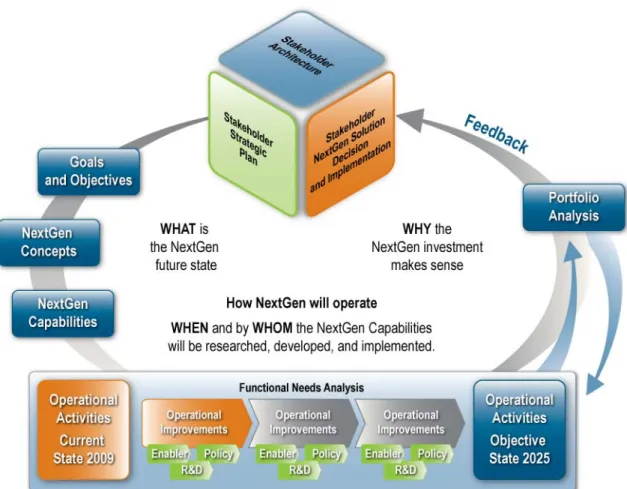
As identified in Figure 1-2, these planning areas describe “what” the NextGen end-state will be, “how” it will operate, and “when” capabilities and improvements will be introduced, They also reference “who” will be responsible for implementing the capabilities and improvements, and “why” the investment is beneficial to the nation.
Figure 1-2 JPDO NextGen Planning 578 579 580 581 582 583 584 585 586 587 588 589 590 591 592 593 594
The intent of this ConOps is to describe a vision that meets these national goals and to establish how to transform the air transportation system. Part of this transformation involves integrating and reshaping air transportation so that the entire system operates as an interconnected structure. In many cases, this builds on visionary material that captures the aviation community’s goals for different aspects of transportation. For ATM, many of the concepts build on the National
Airspace System (NAS) Concept of Operations and Vision for the Future of Aviation and the ICAO Global ATM Operational Concept, which represents a globally harmonized set of concepts for the future.1
The JPDO recognizes the need to develop an interoperable system with the international community because the effects of implementing NextGen technologies and procedures
throughout the NAS will extend far beyond the borders of the United States. Coordination and collaboration on policy, system standards, operational procedures, avionics capabilities, and equipage milestones across international borders will promote global harmonization.
The overarching international aim of NextGen is the harmonization of systems and procedures to ensure civil and military interoperability across international boundaries and timely adoption of 1
global standards and operational procedures that satisfy U.S. requirements. In order to realize NextGen’s full benefits, efforts must be taken to ensure it will be capable of transcending borders. 595 596 597 598 599 600 601 603 604 605 606 607 608 609 610 611 612 613 614 615 616 617 618 619 620 621 622 623 624 625 626 627 628 629
NextGen encompasses all aerospace transportation, not just aviation, and not just ATM. In addition to technological innovation, NextGen emphasizes changes in organizational structure, processes, strategies, policies, and business practices. Where applicable, NextGen includes shifts in government and private sector roles that are required to exploit new technological solutions.
1.3
N
EXTG
ENS
TAKEHOLDERS602
The list of key NextGen stakeholders includes:
• Airport Communities - Cities and towns located in the vicinity of airports that have a vested interest in and are affected by the operation of the airport.
• Airport Operators -responsible for enabling passenger, flight, and cargo operations conducted within an airport with consideration for safety, efficiency, resource limitations, and local environmental issues.
• Airport Tenants - who are involved in airport operations, such as fueling, maintenance or catering services.
• ANSP2 -engaged in providing ATM and Air Traffic Control (ATC) services for flight operators for the purpose of safe and efficient flight operations. ATM responsibilities include Communications, Navigation, and Surveillance (CNS). They also include ATM facility planning, investment, and implementation; procedure development and training, and ongoing system operation and maintenance of seamless CNS/ATM services.
• Users - including civil, government, and military, using NAS services.
• Flight Operators -responsible for planning and operating a flight within the NAS. This includes flight crews, FOC, private, business, scheduled air transport, government, and military operators.
• Manufacturers -who produce items that support flight operations to include: airframes, aircraft engines, avionics, aircraft systems and parts, airport and ATM equipment and infrastructure, DSSs, and other components.
• Resource Owners - responsible for making investment decisions related to development and implementation.
• Regulatory Authorities -responsible for governing aspects of the overall performance of the aviation industry including safety, security, standardization, certification,
environmental effects, and international trade.
• Researchers - engaged in conducting R&D activities that support the evolution of the air transportation system, including academia and government organizations.
2
• Security and Defense Providers -responsible for national security and homeland defense, law enforcement, information security, as well as the physical and operational security of the NAS.
630 631 632 633 634 635 636 637 638 639 640 641 642 643 644 645 646 647 648 649 650 651 652 653 654 655 656 657 658 659 660 661 662 663 664 665 666 667 668
• Weather Service Providers - engaged in the provision of aviation weather products.
1.4
O
VERVIEW OFN
EXTG
ENC
ONCEPTS ANDC
APABILITIESAs previously described, this ConOps provides an overall, integrated view of operations in the 2025 time frame. Many future outcomes are possible but they will depend on the insights gained by the evolution of this ConOps.
The NextGen goals significantly increase the safety, security, capacity, efficiency, and environmental compatibility of air transportation operations. These benefits can be achieved through a combination of new procedures and advances in the technology deployed to manage passenger, air cargo, and air traffic operations. The NGATS 2005 Progress Report identifies the following concepts that will help achieve these goals and objectives:
• Net-Centric Operations (Network-Enabled Information Access). Through network-enabled information access, information is available, securable, and usable in real-time for Communities of Interest (COI) and air transportation domains. This greater
accessibility enables better distribution of information and improves the speed,
efficiency, and quality of this process. Information can be automatically provided to users with a known need and be available to users not previously identified as new needs arise. Information access improves operational decision making, enabling system operators the use of risk management practices to enhance safety. Cooperative surveillance for civil aircraft operations, where aircraft constantly transmit their position, is used with a separate sensor-based, non-cooperative surveillance system as part of an overall integrated federal surveillance approach.
• Performance-Based Operations and Services. Performance-based operations provide a foundational transformation of NextGen. Regulations and procedural requirements are described in performance terms rather than in terms of specific technology or equipment. Minimum performance levels are expected to be required to maximize capacity in
congested airspace during specific periods of time. Service providers can use service tiers to create guarantees for different performance levels so that users can make the
appropriate tradeoffs between investments and level of service desired to meet their needs. A benefit of performance-based operations and services is that service providers can define capability improvements in terms of users’ existing equipage, thus potentially maximizing the value of the service providers’ and users’ investments.
• Weather Assimilated into Decision Making. By assimilating weather into decision making, weather information becomes an enabler for optimizing NextGen operations. Directly applying both probabilistic and observed weather information to ATM decision tools increases the effective use of weather information and minimizes the adverse effects of weather on operation.
• Layered, Adaptive Security. Layered, adaptive security includes a security system that consists of “layers of defense” (including techniques, tools, sensors, processes,
information, and a robust Integrated Risk Management [IRM] system). This type of security system helps reduce the overall risk of a threat reaching its objective while minimally affecting efficient operations. Layered security is additive; failures in any one component should not have a catastrophic effect on other components. For that reason, the system is well suited to handle attacks and incidents, intrusions or attacks with
minimal overall disruption. Layered, adaptive security adjusts the deployment of security assets in response to the changing IRM profile of risks; responses to anomalies and incidents are proportional to the assessed risk.
669 670 671 672 673 674 675 676 677 678 679 680 681 682 683 684 685 686 687 688 689 690 691 692 693 694 695 696 697 698 699 700 701 702 703 704 705 706 707 708 709 710
• Positioning, Navigation, and Timing (PNT) Services (Broad-Area Precision Navigation). PNT services are near ubiquitous, in accordance with demand and safety considerations, to enable reliable aircraft operations in nearly all conditions. Rather than being driven by the geographic location of a ground-based Navigational Aid (NAVAID), NextGen PNT services allow operators to define the desired flight path based on their own objectives.
• Trajectory-Based Operations (TBO). The basis for TBO is knowing each aircraft’s expected flight profile and time information (such as departure and arrival times)
beforehand. The specificity of 4DT matches the mode of operations and the requirements of the airspace in which an aircraft operates. A major benefit of 4DT is that it enables service providers and operators to assess the effects of proposed trajectories and resource allocation plans, allowing service providers and operators to understand the implications of demand and identify where constraints need further mitigation.
• Equivalent Visual Operations (EVO). Improved real-time information allows aircraft to conduct operations in less than direct visual observation. For aircraft, this capability, in combination with PNT, enables increased accessibility, both on the airport surface and during arrival and departure operations. This capability also enables those providing services at airports (such as ATM or other ramp services) to provide services in all visibility conditions, leading to more predictable and efficient operations.
• High-density Arrival/Departure Operations. An even greater need exists to achieve peak throughput performance at the busiest airports, in the most crowded airspace, during peak times. New procedures to improve airport surface movements, reduce spacing and separation requirements, and better manage overall flows in and out of busy metropolitan airspace, maximize the use of the highest-demand airports. Airport terminals also
optimize efficiency of egress and ingress, matching passenger and cargo flow to airside throughput while maintaining safety and security levels.
These concepts have been further incorporated into the NextGen capabilities (described further below). These concepts are used as a common framework among the JPDO planning elements to describe, organize, and align the NextGen portfolio.
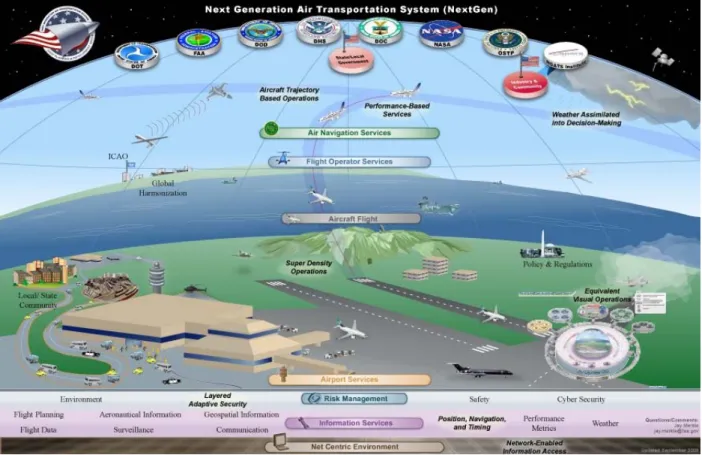
Figure 1-3 provides an overall operational view of the environment envisioned in 2025. The air transportation system is a complex global system with many public and private sector
harmonized services to both civil and military users. The integrated concepts provide the
capacity needed to meet the nation’s need for an optimized air transportation system in the most effective, efficient, safe, and secure manner possible.
711 712 713 714 715 716 717 718 719 720 721 722
To help further describe the NextGen concept, the JPDO has identified a comprehensive set of capabilities to provide a framework for synthesizing and aligning the advanced concepts with the NextGen EA and IWP. The capabilities represent transformational improvements to the current air transportation system. Employing various combinations of enabling solutions, such as policies, programs, and systems will make NextGen capabilities a reality.
The nine NextGen cap 723 724 725 726 727 728 729
other air transportation system resources. 730
Collaborative Flow Contingency Management(FCM)- provides
731 the 732 733 rs, 734 735 s. 736 741 e. ation (e.g., DSS) while also introducing reduced separation
standard 748 Flexible o 749 realloca 750 accepta 751 and carg , 752 through 753
improve nd DSS) and procedures.
754 tric envi 760 infor 761 com 762
abilities defined by the JPDO provide:
Collaborative Capacity Management (CM) - provides the ability to
dynamically balance anticipated/forecasted demand and utilization. It allocates NAS resources through proactive and collaborative strategic planning with enterprise stakeholders and automation (e.g., DSS), that consider airspace and airport design requirements, standards, and
configuration conditions. This is all conducted with the consideration of
optimal, synchronized, and safe strategic flow initiatives and ensures efficient management of major flows of traffic while minimizing the impact on other operations in collaboration with enterprise stakeholde through real- or near-real-time resolutions informed by probabilistic decision making within established Capacity Management (CM) plan
Efficient Trajectory Management (TM) - provides the ability to assign
737
trajectories that minimize the frequency and complexity of aircraft 738
conflicts through the negotiation and adjustment of individual aircraft 739
trajectories and/or sequences when required by resource constraints. 740
Flexible Separation Management (SM) - provides the ability to
742
establish and maintain safe separation minimums from other aircraft, 743
vehicles, protected airspace, terrain and weather by predicting conflicts 744
and identifying resolutions (e.g., course, speed, altitude, etc.) in real tim 745
It facilitates increased capacity demands and traffic levels by using 746
autom 747
s into the trajectory equation.
Airport Facility and Ramp Operations - provide the ability t
te or reconfigure the airport facility and ramp assets to maintain ble levels of service that will accommodate increasing passenger
o demands. This includes changes in operational requirements infrastructure development, predictive analyses, and
ments to technology (e.g., automation a
Integrated NextGen Information - provides authorized aviation
755
stakeholders timely, accurate, and actionable information (e.g., weather, 756
surveillance, aeronautical information, operational and planning 757
information, and position, navigation and timing information), shortening 758
and improving decision cycles situational awareness using a net-cen 759
ronment managed through enterprise services that meet the mation exchange requirements of the NextGen stakeholder munity.
Air Transportation Security - provides layered, adaptive security, based 763
on IRM that
764 yields the ability to identify, prioritize, and assess risks and effectively allocates resources in support of national defense and homeland 765
security to facilitate the defeat of an evolving threat critical to the NAS 766 767 768 769 770 771
is accomplished, through a CDM process, 772
improved tools, technologies, operational policies, procedures, and practices 773 774 775 ment 776 777 778 nology 779 tion al ze the 783 784
n for the 2025 air 785
transportation system. The NextGen capabilities allow the JPDO and stakeholders to 786
clear alignment between the investment portfolio and the resulting value to the stakeholders and the Nation.
788 789
s, describes the operational concepts for the 790
2025 time frame. The implementation, research, and policy issues fundamental to the 791
infrastructure or key resources.
Improved Environmental Performance - provides the ability to
proactively identify, prevent, and address environmental impacts in, the air transportation system. This
that are consistent and compatible with national and international environmental regulations.
Improved Safety Operations - provides integrated safety manage
throughout the air transportation system by increased collaboration and information sharing tools, equipment, and products for stakeholders. This capability employs improved automation (e.g. DSS), tech
innovations, prognostic safety risk analysis, and enhanced safety promo 780
and assurance techniques that are consistent and compatible with nation 781
and international regulations, standards, and procedures. 782
With these capabilities, the JPDO has an effective joint planning framework to organi significant collection of information in NextGen planning documents. This collection of information will provide a coherent and compelling value propositio
communicate using common terminology and provide 787
1.5
D
OCUMENTS
COPE ANDO
RGANIZATIONThis document, organized into the following chapter
information contained in this document are available at www.jpdo.gov and within the Joint Planning Environment (JPE) at
792 http://jpe.jpdo.gov. 793 794 795 tructure 796 797
able enterprise services 798
799 800
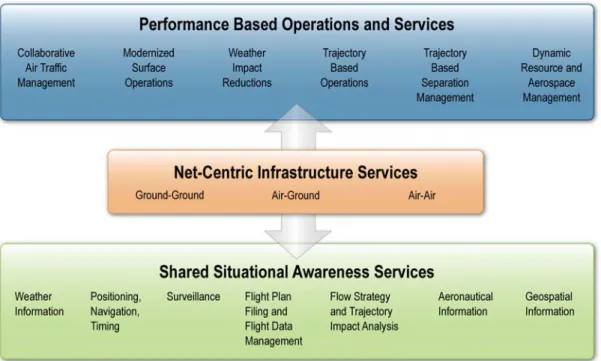
• Chapter 2.Provides a description of Air Traffic Management Operations, including interactions among the ANSP and operators
• Chapter 3. Provides a detailed overview of the Airport Operations and Infras Services that address the activities surrounding the airport
• Chapter 4. Addresses Net-Centric Operations that en
• Chapter 5.Provides an initial overview of specific Shared Situational Awareness Services that support the ATM-related concepts
801
Describes how environmental impacts will be addressed and reduced in an 802
803
r 8. Addresses the Safety Management Services, including risk management 804
805
ices, which contain supplemental information 806
for the reader: 807 808 809 810 811 812 813 814 l 815 816
ally as research, implementation, models, policy, 817
budget realities, and other findings are assessed and as further dialogue helps refine common 818
goals and priorities. This document also serves as the official record and repository for 819
operational concept insights that emerge from the in-progress national debate on the scope, 820
characteristics, and capabilities of NextGen. 821
• Chapter 6. Provides a detailed perspective of Layered, Adaptive Security Services
• Chapter 7.
Environmental Management Framework
• Chapte efforts
Included in the document are the following append
• Appendix A.Provides a list of acronyms used in this document
• Appendix B. Provides a glossary of terms
Additional information on the glossary of terms and acronyms is located within the NAS/JPDO Enterprise Architectures Controlled Vocabulary contained within the JPDO JPE, in addition to supplemental information for the reader for all of the JPDO products.
This ConOps is part of the overall EA and will help formulate roadmaps and research
recommendations to improve overall inter-governmental collaboration to achieve national goals for air transportation. This document, along with other engineering artifacts is applicable to al stakeholders and provides the basis for deriving top-level requirements.
2 Air Traffic
Management Operations