Fairfield University Fairfield University
DigitalCommons@Fairfield
DigitalCommons@Fairfield
Nursing and Health Studies FacultyPublications Marion Peckham Egan School of Nursing and Health Studies
2016
Revising a Doctor of Nursing Practice Program in Response to
Revising a Doctor of Nursing Practice Program in Response to
Student Focus Group Feedback
Student Focus Group Feedback
Sheila GrossmanFairfield University, [email protected] Meredith Wallace Kazer
Fairfield University, [email protected] Nancy Moriber
Fairfield University, [email protected] Patricia E. Calderwood
Fairfield University, [email protected]
Follow this and additional works at: https://digitalcommons.fairfield.edu/nursing-facultypubs
Copyright 2016 Springer Publishing Company. Archived here with permission from the copyright holder. Official version available at http://dx.doi.org/10.1891/2380-9418.9.1.51
Peer Reviewed Peer Reviewed Repository Citation Repository Citation
Grossman, Sheila; Kazer, Meredith Wallace; Moriber, Nancy; and Calderwood, Patricia E., "Revising a Doctor of Nursing Practice Program in Response to Student Focus Group Feedback" (2016). Nursing and Health Studies Faculty Publications. 93.
https://digitalcommons.fairfield.edu/nursing-facultypubs/93
Published Citation
Grossman, Sheila, Meredith Wallace Kazer, Nancy Moriber, and Patricia Calderwood. "Revising a Doctor of Nursing Practice Program in Response to Student Focus Group Feedback." Journal of Doctoral Nursing Practice 9, no. 1 (2016): 51-54. 10.1891/2380-9418.9.1.51
This item has been accepted for inclusion in DigitalCommons@Fairfield by an authorized administrator of DigitalCommons@Fairfield. It is brought to you by DigitalCommons@Fairfield with permission from the rights-holder(s) and is protected by copyright and/or related rights. You are free to use this item in any way that is You are free to use this item in any way that is permitted by the copyright and related rights legislation that applies to your use. For other uses, you need to obtain permitted by the copyright and related rights legislation that applies to your use. For other uses, you need to obtain permission from the rights-holder(s) directly, unless additional rights are indicated by a Creative Commons license permission from the rights-holder(s) directly, unless additional rights are indicated by a Creative Commons license in the record and/or on the work itself.
data were collected through a focus group process and used to revise the program in response to feedback. Pro-gram evaluation and improvement is a necessary com-ponent of a DNP program, and it is our hope the evalu-ation and revisions discussed here may serve as a model for other programs also undergoing their formative years.
Background
Consistent with the AACN (2006) White Paper on DNP education, our program evolved with a strong emphasis on development of expert clinical practice. Although formal clinical experiences were planned to prepare clinicians, DNP students must also acquire in-creased knowledge, leadership, and practice expertise from immersion experiences. Riley and Beal (2013) suggest professional practice evolves, and this requires continuous learning. They found in their study on schol-arly practice that nurses developed from unknowing to knowing that they needed more experience and learning. Certainly, master’s of science in nursing (MSN) to DNP students realize, after graduating from their master’s pro-gram, that, as advanced practice nurses, they require more knowledge and expertise than what they have been using in their practice. Bachelor of science in nursing (BSN) to DNP students do not have this experience prior to enter-ing the DNP program. But they do readily differentiate between competencies gained from their direct patient clinical rotations versus indirect immersion hours.
Revising a Doctor of Nursing
Practice Program in Response to
Student Focus Group Feedback
Sheila Grossman, PhD, FNP-BC, APRN, FAAN
Meredith Wallace Kazer, PhD, CNL, APRN, A/GNP-BC, FAAN
Nancy Moriber, PhD, CRNA, APRN
Patricia Calderwood, PhD
Fairfield University, Connecticut
Keywords: doctor of nursing practice education; doctor of nursing practice; evaluation; immersion
Introduction
Throughout the history of professional nursing, changes in practice environments have guided changes in nursing educational systems. Over the past 50 years, advanced practice nurse roles have progressed in clinical practice and professional role requirements. The need to enhance the educational preparation in response to these re-quirements was addressed by the American Association of Colleges of Nursing (AACN, 2006). These “formative years in the development of the DNP” (Brown & Crab-tree, 2013, p. 330) resulted in several programs across the country with varying approaches to both advanced practice specialization and doctoral degree education. In addition, The Doctor of Nursing Practice: Current
Is-sues and Clarifying Recommendations, the report from
the Task Force on the Implementation of the DNP (AACN, 2015) suggests several recommendations to assist doctor of nursing practice (DNP) educators in the areas of DNP graduate scholarship, DNP project, re-sources, curriculum, practice rotations, and partnerships. Although extensive work was done by faculty to de-velop the program, prepare for accreditation, and provide a quality program, continued data collection and response to student feedback is a necessary component of quality education and continuing accreditation. The purpose of this project is to describe the continued data collection process of the program, specifically regarding the immer-sion hours and development of the final project. Student
52 Grossman et al.
Carper’s (1978) fundamental ways of knowing (em-pirical knowing, esthetic knowing, ethical knowing, and personal knowledge) provides a rationale for the signifi-cance of these immersion studies. In addition, Kendall-Gallagher and Breslin (2013) recommend providing the DNP students opportunities to build a portfolio of adaptive leadership skills they can build throughout clinical practice and refine in immersion experiences. Thus, it is essential to evaluate and improve immer-sion experiences because this learning will greatly im-pact the ability of DNP graduates to transform health care. Clark and Allison-Jones (2011) cite new nursing roles are frequently identified because of local needs but often prior to developing standardized goals. Continu-ous development and improvement of the immersion component of DNP clinical hours will ultimately gen-erate much needed leadership in increasing the quality of health care.
Method
After university institutional review board approval was obtained, all DNP students in their final year were invited to attend the focus groups. Students were told attendance is optional, informed consent would be required, and all data would be aggregated to provide anonymity. This sampling frame was chosen to ensure participants had sufficient time in the program to pro-vide reliable reflections.
Focus groups were conducted during each seminar by a researcher from the Center of Academic Excel-lence. The 90-min focus meetings included introduction of the focus group facilitator and students, completion of informed consent, demographic form, a written focus survey (Table 1), and the oral focus group.
Results
Three groups of students (N 5 19) participated. The av-erage age of the student participants was 37 years, and all were female except one. Fifteen of the participants (79%) were BSN to DNP students, and the remaining 4 (21%) were MSN to DNP students. As a result of the oral focus group, aggregated written responses pro-duced four dominant themes: confusion about program requirements and expectations, a need for improved mentoring and advisement, a decided preference for a deepening rather than broadening of knowledge and skills required for advanced practice in their specialty, and reconfiguration of the scope and sequence of the courses.
Theme 1—Confusion About Program Requirements and Expectations
Feelings of confusion and anxiety about requirements and expectations, particularly about the final project/ presentation sequence were commonly expressed. Not every adviser was deemed sufficiently knowledgeable about requirements. Candidates agreed the catalog alone was not informative enough about the program struc-ture. Participants suggested a flow chart be added to in-clude when key choices occur throughout the program.
Theme 2—Need for Improved Mentoring and Advisement
Some students noted the importance of adviser ability to use portfolio, adviser responsiveness and availability, and especially the comprehensiveness of adviser knowl-edge about the program as a key factor in good advising. Many felt improved mentoring would assist in coordi-nating the immersion, choosing which patients to do case narratives, and developing personal objectives to create more of a seamless journey through the program. Most participants recommended partnering of the stu-dent and portfolio adviser in the first year. This would foster the identification of ideas to use for required course projects that would relate to final projects.
Theme 3—Desire for a Deepening Rather Than Broadening of Knowledge and Skills
There was a range of satisfaction among the students with their progress toward a culminating final project. Satisfac-tory progress seemed to mean all or most of the projects, papers, and professional experiences of their program were aligned conceptually and developed as a narrowing and deepening scope of a singular focus. Many have en-joyed making the immersion semesters “a more personal, tailored, independent experience.” Some chose a focus at
TABLE 1. Written Doctor of Nursing Practice Focus Group Questions
1. Do you feel you are receiving helpful advice and feedback from your faculty CPA during your immersion semesters? Any recommendations to improve this learning process? 2. Is there anything you would like to share about your
immer-sion semesters and clinical preceptors?
3. Is there anything you would like to share about how your final project and presentation learning experience is going? 4. What were some of the best learning experiences that
you had in your DNP seminar experience? How did your assigned faculty make for a positive experience?
5. How do you plan on making some practice improvements in your new role as a DNP?
6. Do you have any questions about your seminar, immer-sion experiences, or final project and presentation learning experience?
seemed redundant, and MSN to DNP students felt more content on advanced pharmacology and patho-physiology was needed. They recommended one DNP seminar remain in the final year and the other be intro-duced in the first year. In addition, nurse practitioner BSN to DNP students suggested the direct patient care clinical courses be taken before immersion.
Discussion
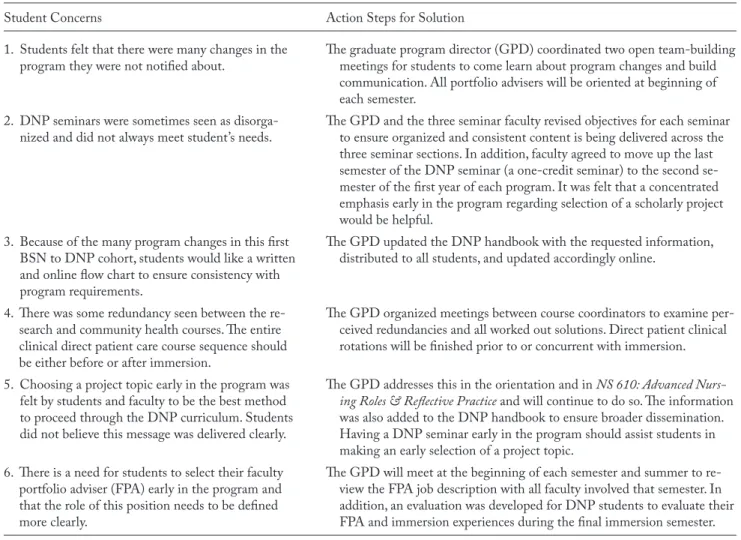
Standard IV-A, of the Commission on Collegiate Nursing Education (CCNE, 2013) criteria for the ac-creditation of DNP programs requires that “data on program effectiveness are used to foster ongoing pro-gram improvement” (p. 17). The survey undertaken represents our school’s partial efforts to address these criteria. In addition, Standard III-H states “curriculum and teaching–learning practices are evaluated at regu-larly scheduled intervals to foster ongoing improve-ment” (CCNE, 2013, p. 16). In other words, once the data were collected, it is essential the faculty respond with meaningful changes to improve the program. Fac-ulty agreed to the following changes (Table 2) based on the beginning of their program and continued to study
it in greater depth over time. These students were more successful in their progress than students who were not strategically directed in this way. Participants reinforced well-timed advice from the portfolio adviser to take this approach would have been helpful to those who didn’t discover this path on their own. Several noted they had taken a somewhat scattershot approach (choosing new topics for each course because they seemed interesting) across courses, thus building a broad but comparatively shallow knowledge base. When asked if they would have preferred to be forced to choose a single focus at the out-set of their program, most said yes. They explained their time, energy, and finances were limited, and a straight line to the finish would have made the most optimal use of all three. Students stressed they wanted more direction to hone in rather than expand outward across their studies.
Theme 4—Reconfiguration of Scope and Sequence of Courses
There was consensus the courses were not sequenced optimally, that research and community health content
TABLE 2. Responses and Solutions to Doctor of Nursing Practice Students’ Feedback
Student Concerns Action Steps for Solution
1. Students felt that there were many changes in the
program they were not notified about. The graduate program director (GPD) coordinated two open team-building meetings for students to come learn about program changes and build communication. All portfolio advisers will be oriented at beginning of each semester.
2. DNP seminars were sometimes seen as
disorga-nized and did not always meet student’s needs. The GPD and the three seminar faculty revised objectives for each seminar to ensure organized and consistent content is being delivered across the three seminar sections. In addition, faculty agreed to move up the last semester of the DNP seminar (a one-credit seminar) to the second se-mester of the first year of each program. It was felt that a concentrated emphasis early in the program regarding selection of a scholarly project would be helpful.
3. Because of the many program changes in this first BSN to DNP cohort, students would like a written and online flow chart to ensure consistency with program requirements.
The GPD updated the DNP handbook with the requested information, distributed to all students, and updated accordingly online.
4. There was some redundancy seen between the re-search and community health courses. The entire clinical direct patient care course sequence should be either before or after immersion.
The GPD organized meetings between course coordinators to examine per-ceived redundancies and all worked out solutions. Direct patient clinical rotations will be finished prior to or concurrent with immersion. 5. Choosing a project topic early in the program was
felt by students and faculty to be the best method to proceed through the DNP curriculum. Students did not believe this message was delivered clearly.
The GPD addresses this in the orientation and in NS 610: Advanced Nurs-ing Roles & Reflective Practice and will continue to do so. The information was also added to the DNP handbook to ensure broader dissemination. Having a DNP seminar early in the program should assist students in making an early selection of a project topic.
6. There is a need for students to select their faculty portfolio adviser (FPA) early in the program and that the role of this position needs to be defined more clearly.
The GPD will meet at the beginning of each semester and summer to re-view the FPA job description with all faculty involved that semester. In addition, an evaluation was developed for DNP students to evaluate their FPA and immersion experiences during the final immersion semester. Note. DNP 5 doctor of nursing practice; BSN 5 bachelor of science in nursing.
54 Grossman et al.
student feedback. DNP students have shared apprecia-tion for the feedback, planned soluapprecia-tions, and suggested evaluation criteria regarding immersion experiences and scholarly project advisement.
Conclusion
The recent Institute of Medicine (IOM, 2011) report on the Future of Nursing states nurses must achieve higher levels of education and training in response to “ . . . increasing [healthcare] demands” (p. 2). DNP pro-grams are developing quickly in response to a need for expanding knowledge for advance practice nurses. This expanded knowledge is essential to position advanced practice nurses to become leaders across health care en-vironments, consistent with the IOM (2011) report on the Future of Nursing.
Although students are meeting the program out-comes, challenges during the process were revealed through the focus group findings. Because of the vari-ety of student rotations, clinical sites, preceptors, type of patients seen, and health care delivery systems expe-rienced during immersion, it is difficult to standardize the evaluation of this part of the program, so using a focus group format to solicit immersion feedback was built into the evaluation plan. Many indirect clinical ex-periences in DNP education cannot be duplicated and often occur only in the clinical setting. Thus, continuous program evaluation and revision are essential toward positioning students to attain competency in the most efficacious manner possible.
References
American Association of Colleges of Nursing. (2006). The essentials
of doctoral education for advanced nursing practice. Retrieved from
http://www.aacn.nche.edu/education-resources/essential-series American Association of Colleges of Nursing. (2015). The doctor of
nursing practice: Current issues and clarifying recommendations.
Retrieved from http://www.aacn.nche.edu/news/articles/2015/ dnp-white-paper
Brown, M. A., & Crabtree, K. (2013). The development of practice scholarship in DNP programs: A paradigm shift. Journal of
Pro-fessional Nursing, 29, 330–337.
Carper, B. A. (1978). Fundamental patterns of knowing in nursing.
Advances in Nursing Science, 1(1), 13–23.
Clark, R. C., & Allison-Jones, L. (2011). The doctor of nursing prac-tice graduate in pracprac-tice. Clinical Scholars Review, 4(2), 71–77. Commission on Collegiate Nursing Education. (2013). Standards
for accreditation of baccalaureate and graduate nursing programs.
Washington, DC: Author.
Institute of Medicine. (2011). The future of nursing: Leading change,
advancing health. Washington, DC: National Academies Press.
Kendall-Gallagher, D., & Breslin, E. (2013). Developing DNP stu-dents as adaptive leaders: A key strategy in transforming health care. Journal of Professional Nursing, 29(5), 259–263.
Riley, J., & Beal, J. (2013). Scholarly nursing practice from the pers-pectives of early-career nurses. Nursing Outlook, 61(2), e16–e24.
Correspondence regarding this article should be directed to Sheila Grossman, PhD, FNP-BC, APRN, FAAN, professor and coordinator, family nurse practitioner program, director, evalu-ation, faculty scholarship and mentoring, Fairfield University, Marion Peckham Egan School of Nursing and Health Studies, Fairfield, CT 06824. E-mail: [email protected]