III
DISCUSSION PAPER NO. 020625507
Child
Labor
Handls.
X:ri
Alessandro Cigno,
Furio Cl Rosati and
Zafiris Tzannatos
May 2002
Public Disclosure Authorized
Public Disclosure Authorized
Public Disclosure Authorized
CHILD LABOR HANDBOOK Alessandro Cigno Furio C. Rosati & Zafiris Tzannatos May 2002
Executive Summary
This survey is no more than an introduction to child labor issues, a fast expanding research and policy area. It deals with the many aspects of child labor, including its causes and effects as well as policies associated with it.
Child labor is as old as humanity - no age group was spared from the harsh survival effort in primitive societies. And child labor was not always necessary "bad" in the environment it operated. But as development accelerated and, in fact, the incidence of child labor declined, child labor has come to be considered increasingly an expression of poverty, both a cause and an effect of underdevelopment. The debate on and commitment to reduce and eliminate child labor gathered speed in the second half of the 20'h century especially at the international level with the landmark Convention on the Rights of the Child (1989), the universal ratification of the ILO's Convention ... on the Elimination of All Forms of Harmful Child Labor (1998) and the universal adoption of the Millennium Development Goals (2000) of which many relate to children's education and health. If the admittedly partial bibliography of our survey is anywhere closer to reality, it shows that almost 80 percent of publications relating to child labor came in the
1990s of which a full one-quarter appeared in the third millennium.
The survey takes the reader from the definition and measurement of "child" and "labor" (our first chapter) to what we call the "pathology" of child labor, the extreme forms of child exploitation, the use of children in activities that are morally repugnant or dangerous to the child's health and even life. Between these two extremes, from the methodological aspects to the vulgar realities, we examine
* Why do children work?
* How failures in the capital markets affect child labor? * What is the role of household income?
* How does child labor interplay with education?
* What is the effect of household structure on child labor? * How does parental education affect child labor?
* What other policies affect child labor
* How is the market for child labor determined?
Some topics receive a short treatment often reflecting the paucity of analysis or evidence given the "infant industry" nature of this part of economics. Others are covered in greater length only to produce ambiguous theoretical predictions and prima facie contradictory evidence.
Clearly this is work in progress. This is why we gave the sub-title "Version 2002" to this survey. Our hope is that the literature on this important topic will continue to mushroom, and increasing awareness and better design and execution of projects, programs and policies will contribute to the elimination of child labor. This has happened already. For example, there are practically no working children in Europe today though in the not too distant past the employment rates of children were as high there as they are in many of the developing countries today. The share of children who were working in Italy in 1950 was above the world average. In 1995 the world average stood at 13 percent but in Italy the figure was less than half of one percent. Child labor is an endangered species but, as long as it exists, it can endanger many children.
We very much hope not provide a more comprehensive, more in depth treatment of the subject in the future. More importantly, we hope to be able to be in a position to provide a more adequate menu of policy options than those covered in this volume. The complexity of the issue and the sporadic evaluations undertaken so far allow- only for limited generalizations. Hopefully, by the time these generalizations become valid, child labor will no longer exist. Child labor should not be a development policy issue but should become the subject of economic history.
Policies Discouraging Child Labor
The analytics and arguments of many aspects of child labor are explain in some length in the main survey. No need to summarize here the many nuances of theoretical approaches studies or qualifications of empirical evaluations. But it might be useful to
provide the reader with a summary view of various policies and their established or suspected effects.
Two caveats are in order. First, child labor cannot be viewed in isolation from educational, health, fertility, and technological issues. Second, leaving aside extreme forms of exploitation, child labor is not necessarily an aberration but a rational household response to an adverse economic environment.
With this in mind, the following proposition receives consistent empirical support:
Forbidding children to work or making school attendance compulsory without
changing the economic environment may, if effectively enforced, leave children
worse off.
If so, one can identify (indirect) policy measures which can change the economic environment in the desired direction and (direct) policy measures that remove children from the labor market. Taken together, these measures have the potential reduce child labor without compulsion or prohibition.
Indirect measures
* Providing schools close to communities reduces the incidence of child labor and increases household expenditure on the education of their children. It also
reduces fertility and improves child nutrition.
* Universal income subsidies to parents are an expensive way of discouraging child labor because some of the subsidy will end up as adult consumption, and are counter-effective in families where children would otherwise study full time. Income subsidies targeted at poorer families, whose children are unlikely to attend school in the absence of policy interventions, are more cost-effective. Therefore, income redistribution could help to reduce child labor, encourage school attendance, and improve the nutritional status of children.
* Land redistribution could increase the incidence of child labor because it would increase the productivity of labor in households that receive additional land and reduce it in those from which land is taken away. This would increase the probability of work for children in lower-income households and reduce it for children in higher-income households where parents are unlikely to make their children work anyway.
* Policies that increase a child's chances of surviving into adulthood reduce the probability that a school-age child will work and increase the probability that the child will go to school. These policies also increase the consumption of school-age children and the amount spent by households on the education of each child who attends school.
* Increasing the education of women has positive but uneven effects on school attendance and child labor.
* The extension of old-age security and credit availability to poor parts of the community, primarily the rural poor, which is where most child labor comes from, reduces fertility and child labor and increases school attendance.
* Economic growth helps to reduce child labor, but policies fostering economic growth cannot be relied upon to reduce child labor in the short run.
Therefore, several of the policies that help to reduce child labor in the short run also have a beneficial long-term effect via higher growth. How large is the second effect? The evidence is not very clear cut but from some country specific results we tend to believe that income redistribution from the rich to the poor is more powerful for reducing child
labor than a universal income rise. This is so because the income elasticity of child labor
decreases as income increases. This suggests that growth without re-distribution may take too long to have a noticeable effect on child labor. Having said this, there are some spectacular cases of child labor decrease (for example, in Thailand in the 1980s and Viet Nam in the 1990s) as well as some promising ones where the Government is placing its weight behind the issue (such as In Brazil).
Direct measures
In addition to the general, rather indirect, policies discussed above, we selectively survey more direct ways of reducing child labor, for example, offering households direct payments conditional on the child not working and/or attending school. Even if school attendance is a condition for obtaining the payment, such payments differ from conventional scholarships in that their primary purpose is to discourage child labor and only secondarily to allow talented children or young people of modest means to obtain an education. While a scholarship is usually conditional on a high level of scholastic or academic performance, such conditionality is either absent or set at a very basic level in schemes that have the child's withdrawal from the labor force as their primary objective. What these schemes do, essentially, is "buy" a child's time. By way of example, we briefly describe three projects carried out respectively in Morocco (the BAJ program),
Bangladesh (the FFE - Food-for-Education - program) and Mexico (the Progresa
program).
The BAJ aims to increase access of the rural poor to basic social services, such as
preventive and curative health care, maternal and neonatal care, and primary education. The BAJ has three features that distinguish it from similar social investment initiatives: it is targeted to the provinces that rank lowest in terms of poverty, has a multi-sector approach designed to exploit potential synergies, and decentralizes service delivery and decision making, holding provincial authorities responsible for the planning, implementation, and monitoring of the program.
The FFE promotes school attendance by "buying" children's time. Households participating in the program receive monthly food rations so long as they send their children to school. Potential participants are selected in two stages. First, central authorities choose areas on the basis of their degree of underdevelopment and, then, the local communities are then left to decide which of the households in their locality should participate in the program.
The Progressa subsidises education, health care, and nutrition in poor rural households and aims to reduce poverty and increase investment in human capital, thus breaking intergenerational poverty. It provides grants to poor families for children enrolled in school between the third grade of primary and the third grade of secondary school who do not miss more than a threshold number of school days in a single month.
With respect to the BAJ, the provinces that are covered by the program do not show significant overall gains in access to health facilities (as measured by clinic visits and medicine acquisition) or in school enrollment. However, an analysis of girls' school enrollment indicates that a majority of the provinces covered by the program experienced a significant improvement. The FFE program seems to have increased school attendance by about 16 percent but reduced child labor much less (by about 4 percent).
All these findings are subject to limitations. For example, the fact that schooling is not actually displacing work but leisure may be a natural assumption to make in the developed world but not necessarily in the impoverished developing world, especially in a rural context. Also, the interpretation of data is often blurred as a relatively large number of children are reportedly neither attending school nor going to work. It could be that the many (or even most) children who are affected by a program are those who fall into that category. In addition, as is well known, targeting is essential to these kinds of program but it often emerges that observable household characteristics are a very poor predictor of placement in the program. This could mean either that the community adopted criteria other than need to select households for the program or that observable characteristics are poor indicators of actual need.
In this respect we cannot but emphasize the need for monitoring and evaluation of various programs. This also includes adequate supervisory mechanisms. There is an understandable desire on the part of program financers to ensure that as much of the funds allocated to a program as possible should go to the intended beneficiaries. This is all very well, but it has to be understood that the success of a program, as of any other activity, is measured by the output not by the input. Spending 10 percent more, say, on buying children's time is no guarantee that child labor will decrease more than if the same amount of money were spent in other ways. Hypothetically speaking, better results might
be achieved if that extra 10 percent were used to increase the cost-effectiveness of existing expenditure.
It could happen, for example, that money is misspent on buying the time of children who would not work anyway or buying the time of boys who would otherwise help with the harvest rather than of girls at risk of ending up, say, in prostitution. It could also happen that parents send their children to school in order to qualify for the subsidy and then make their children work as much as possible outside school hours. If this were the case, child labor would not be reduced, and school attendance would not produce good educational results because the children would be exhausted to take advantage of it. Better results might be obtained by spending less for buying children's time and more on ensuring that the children selected are the right ones or that parents deliver on their side of the contract. Thus, there is a potential trade-off between resources that are directly distributed and resources that are used to increase the effectiveness of the program. In fact, an analysis of nearly 1,500 World Bank projects suggests the marginal benefit of program supervision tends to exceed the marginal cost.
Concluding remarks
The arguments and evidence that we have assembled in this Handbook suggest that child labor is not a problem that can be solved with slogans and ringing declarations. They also make it clear that child labor cuts across policy boundaries: health, education, labor market, capital market, social security, criminal law, international peace keeping, income growth, and distribution all have a bearing on child labor. Therefore, reducing child labor cannot be regarded as just another policy issue alongside others; it is only one dimension of many, possibly all, policies in the field of development.
Direct forms of intervention, based on the idea of "buying" children's time, obviously have an immediate effect, and are highly appropriate in crisis situations where children are at risk of ending up in physically, socially or morally hazardous situations - such as soldiers or prostitutes. In other situations, however, the long-term effect of such measures has yet to be proven. The evidence suggests that indirect forms of intervention, which ensure that it is no longer in the interests of parents to send their children to work, have
more certain and, above all, longer lasting effects. Measures that reduce child labor as a by-product of increased productivity of adults and social equity are particularly desirable and advisable. Among such measures that are particularly worthy of consideration, we have identified health policies that directly and indirectly reduce morbidity and mortality, educational policies that reduce the marginal cost of school attendance, and social security policies that reduce the demand for children as a form of investment. Many of these policies, are conducive to economic growth, which is itself reduces child labor. However, growth alone is not the solution because it takes too long to have any effect child labor. Also, growth achieved by other types of policy may make matters a lot worse during the adjustment period.
This Handbook makes it clear that child labor, in all its forms, has common causes worldwide but that the efficacy of the same policy can differ substantially across countries and between rural and urban areas of the same country. Therefore, interventions should be based on a detailed knowledge of the characteristics of the target area.
Child Labor Handbook
Alessandro Cigno, Furio. Rosati and Zafiris Tzannatos' Introduction
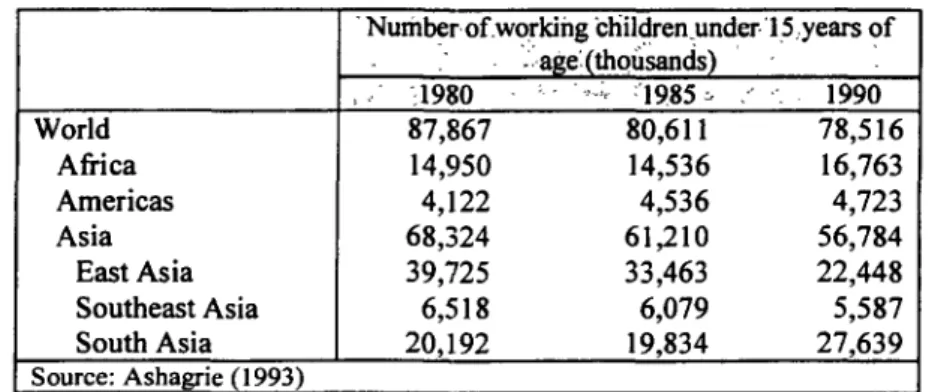
What is child labor? The International Labor Office answers: any activity other than study or play, remunerated or unremunerated, carried out by a person under the age of 15. According to this definition, 78 million individuals in 1990, 8 percent of this age group, are engaged in child labor (see Table 1). Most of them are in Africa, South Asia, and Latin America, but they can also be found in the rich north of the world, for example, in US agriculture. This grand total includes comparatively harmless activities such as housework at one end but also extremely harmful ones like begging, thieving, prostitution, and soldiering at the other. In the middle, there is a continuum of work activities, characterized by varying degrees of harmfulness.
TABLE 1: CHILD LABOR IN THE WORLD
Numnber of working children-under 15 years of
- , ..' age (thousands) .1980 1985 1990 World 87,867 80,611 78,516 Africa 14,950 14,536 16,763 Americas 4,122 4,536 4,723 Asia 68,324 61,210 56,784 East Asia 39,725 33,463 22,448 Southeast Asia 6,518 6,079 5,587 South Asia 20,192 19,834 27,639 Source: Ashagrie (1993)
All forms of labor, even if morally and physically innocuous, take children's time away from schooling and homework and, thus, can have a cost in terms of foregone education. All except the most harmful types of labor can be a form of learning by doing. Leaving aside the worst abuses, therefore, they can constitute a valuable alternative or complement to formal education. Where children are under the control of their family of origin, their labor brings immediate benefits to the family as a whole. In some cases, it is
' University of Florence, CESifo and IZA; University of Rome "Vergate" and UNICEF, and The World
Bank. The views expressed in this paper are the authors and should not be attributed in any manner to the World Bank or its affiliated institutions or the countries they represent. The authors acknowledge useful comments and suggestions by Amit Dar, Carol Rogers, University of Florence, CESifo and IZA.
the only way in which the child can receive any formal education at all or even to remain within the family. The issue is thus extremely complex. There are no simple solutions.
TABLE 2: LABOR PARTICIPATION RATES OF CHILDREN AGED 10-14 YEARS
'1950 1960~ 1970 1980 990' 1995' 2000 2010
World 27.57 24.81 22.30 19.91 14.65 13.02 11.32 8.44
Africa 38.42 35.88 33.05 30.97 27.87 26.23 24.92 22.52
Lat. Am. & Carib.. 19.36 16.53 14.60 12.64 11.23 9.77 8.21 5.47
Asia 36.06 32.26 28.35 23.42 15.19 12.77 10.18 5.60 Europe 6.49 3.52 1.62 0.42 0.10 0.06 0.04 0.02 Ethiopia 52.95 50.75 48.51 46.32 43.47 42.30 41.10 38.79 Brazil 23.53 22.19 20.33 19.02 17.78 16.09 14.39 10.94 China 47.85 43.17 39.03 30.48 15.24 11.55 7.86 0.00 India 35.43 30.07 25.46 21.44 16.68 14.37 12.07 7.46 Italy 29.11 10.91 4.12 1.55 0.43 0.38 0.33 0.27 Source: ILO (1996)
Note: Numbers for 2000 are estimates and numbers for 2010 are projections
These brief considerations set the agenda for what follows. In Chapter 1, we deal with observation and measurement issues. How does one go about identifying the different kinds of child labor? Which clues should one look for in order to establish the consequences of labor on the child's health, life expectancy, education, and so on?
In Chapters 2 and 3, we look for explanations of child labor. If children are still with their family of origin, the reasons why the children are working have to be traced back to parental decisions. If they are not, the causes go back to a parental decision to expel the child from the home, to the child's decision to leave the household, or to a catastrophic event that left the child without a family.
Chapters 4 to 8 provide empirical evidence of the factors affecting parental decisions in the great majority of cases where children are under parental control and at the consequences of these decisions for various aspects of the child's welfare. Throughout, we draw primarily on country studies for which we were directly responsible but also on the work of others.
Chapter 9 looks at the structure of child labor markets and at their interrelations with adult labor markets and with the economic system as a whole.
Chapter 10 examines the effects of different combinations of policies and tries to establish which policy is more appropriate in different circumstances.
Chapter 11 is dedicated to the pathology of child labor, in other words, those activities that can do no possible good to the child. The reason for treating these activities last is partly that the sources of information are different from those on which we draw in
the preceding chapters but also that the lessons learned from the analysis of non-pathological activities also apply to the non-pathological ones.
Finally, Chapter 12 draws the various threads together, and the Bibliography provides a guide to the literature on this increasingly but not yet extensively cultivated field.
Chapter 1
Identifying Child Labor and Measuring Child Welfare
How does one go about identifying the different kinds of child labor? Which clues should one look for in order to establish the consequences of labor on the child's health, life expectancy, education, and so on? A major source of information about children living with a family, not necessarily the one of origin, are household surveys. Children living on their own are a different story. If they are not institutionalized, information about them is inevitably sketchy. Apart from special studies, such as Chatterjee (1992), one has to rely on local authority estimates, often impressionistic, and on police or press reports.
1.1 How to get the information
One major source of information about children living with their families is household surveys. In some cases, these surveys have children as their primary objective; more commonly, they are multi-purpose investigations that happen to include questions about children. Good examples, widely used in the present handbook, are the NCAER (National Council for Applied Economic Research) survey of rural Indian households and the LSMS (Living Standard Measurement Study) surveys of Vietnam and Morocco. Well-aimed questions and the way in which the answer is obtained can elicit a great deal of information. It cannot be over-stressed that, given cost limitations, in-depth questioning and accurate reporting on a sensitive subject like the status of children should be given very high weight in designing the sample.
A general rule is that questions should be addressed to the household member who is most likely to give a well-informed answer. Thus, questions concerning fertility and child care are better addressed to the mother than to the father. Also, wherever possible (cost considerations here come to the fore), answers should be cross-checked with different household members or with independent sources. For example, information given by parents about school attendance should be cross-checked with the child or with the child's teacher. When the respondent tells the survey interviewer about children who
live with the family, the interviewer should actually see and count those children for verification purposes. With some plausible excuse, the interviewer should ask the parents to fetch the child. If the survey requires the child to be measured and weighed (more about this later), this should be done by or in the presence of the interviewer.
1.2 What age limits define a child?
Fixing the borderline between childhood and adulthood is a daunting task. Many aspects need to be considered: physical and psychological development, social norms, economic environment, and so on. To a certain extent, the borderline is endogenous while there is no doubt that a 6-year old is a child, a 14-year old may be regarded as a child if attending school and depending on parental support but may well be regarded as an adult if working for a living.
Little is gained by getting involved in this type of discussion. Therefore, we shall follow the approach (common to most of the analyses of child labor) of defining child labor as work performed by people between the age of 6 or 7 and 15 or 16. This time span coincides, more or less, with that of primary and middle-secondary education. Children below the age of 6 are unlikely to be capable of performing any useful work other than pathological activities like begging. Children older than the age at which children normally complete secondary education can no longer unarguably be considered a child.
1.3 How to establish a child's labor status
The child labor supply has many dimensions, and it is important to be clear about the kind of information that is needed to establish its extent and characteristics. The data collected should account in as much detail as possible for the child's entire day. At a minimum, it should make it possible to classify a child as working, attending school, or doing both. It should also provide a breakdown of his or her work activities, in the first place between work within the home or on the family farm or business and work outside the household. The nature of the work performed by the child should also be specified, not only to establish how damaging it might be but also for the sake of comparability. For example, performing household chores and looking after younger siblings is counted as work in some surveys but not in others, and it is sometimes difficult to distinguish domestic chores from work on the family farm. Ideally, one would also want information on the intensity of the work, because this, together with the number of hours dedicated to
it, is what determines whether the work is really in competition with formal education. Working conditions also influence the outcome of education.
Analyses of child labor and education that do not take these various dimensions into account can yield contradictory results. Here, too, it is essential that the interviewer cross-checks the information provided by parents with the child, maybe by indirect questioning (independent corroboration is unfortunately more difficult on the subject of work conditions than on the subject of school attendance). The length of the child's working day and the sector in which he or she is employed are obviously important pieces of information for evaluating the intensity of the work and the hazards to which the child is exposed. The former also helps analysts to evaluate how much the child's labor contributes to the household's income and to the household's welfare. The main problem, in this respect, is finding out how much time children spend performing household chores, as this is typically not asked about in surveys, except in those that contain a time budget module.
TABLE 3A: CHILD LABOR PARTICIPATION RATES IN RURAL INDIA, BY SECTOR, AGE, AND SEX (1994) All 6 7 8 9 10 11 12 13 14 15 16 Agriculture 1.93 2.31 3.44 3.25 3.65 4.03 4.73 5.74 7.17 8.06 12.06 Non Agric. 1.02 0.88 1.44 1.35 1.64 1.67 2.28 2.26 2.82 3.11 4.39 Household 4.11 4.41 4.91 5.91 7.04 6.3 7.81 8.53 10.33 12.57 16.31 Total 7.06 7.6 9.79 10.51 12.33 12.0 14.82 16.53 20.32 23.74 32.76 Male 6 -7 8 9 10 11. 12 13- 14 15 16 Agriculture 1.67 2.16 3.82 3.36 3.23 4.27 5.19 5.81 7.83 9.05 13.31 Non Agric. 0.82 0.80 1.38 1.49 1.47 1.82 2.47 2.43 3.59 3.96 6.12 Household 4.52 4.20 4.46 4.26 5.26 5.40 6.35 5.55 6.40 5.43 6.56 Total 7.01 7.16 9.66 9.11 9.96 11.49 14.01 13.79 17.82 18.44 25.99 Female 6 .7 8 9 10 11 12 13 14 15 16 Agriculture 2.22 2.45 3.01 3.13 4.13 3.77 4.20 5.67 6.41 6.78 10.45 Non Agric. 1.25 0.97 1.51 1.19 1.84 1.51 2.05 2.08 1.93 2.01 2.19 Household 3.66 4.63 5.42 7.67 9.05 7.28 9.51 11.86 14.85 21.73 28.79 Total 7.13 8.05 9.94 11.99 15.02 12.56 15.76 19.61 23.19 30.52 41.43
As an example of the kind of information that a household survey can provide, we show in Table 3A, the age profile of children's labor in the already mentioned NCAER
survey of rural India. For children of any age, the place where they are most frequently reported to be employed is in the household itself. Leaving this information out would result in a serious underestimation of the work commitment of children, particularly of girls.
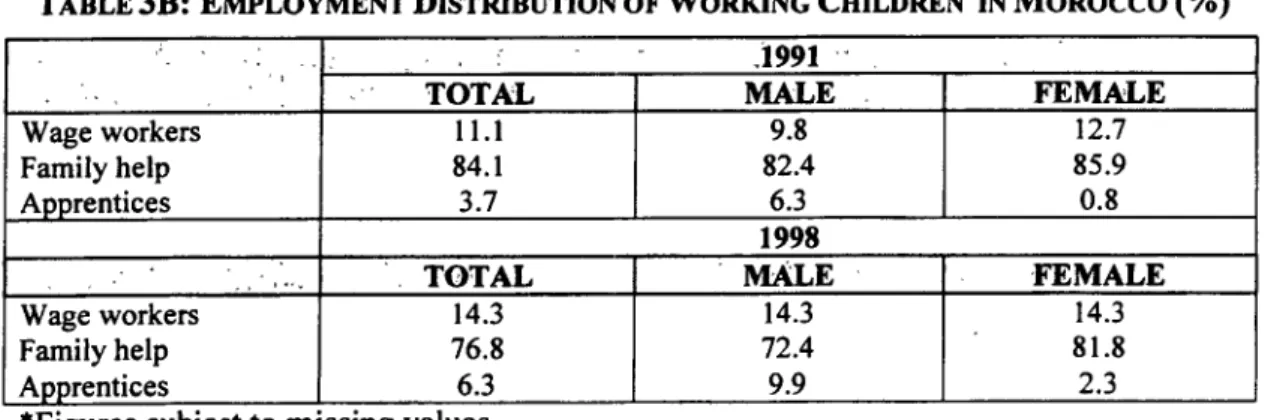
Table 3B, based on the 1991 and 1998 LSMS surveys, gives similar information for Morocco. Here, "family help " is the child's most frequent form of work (curiously, it becomes predominantly female only in the second of the two surveys). The percentage of Moroccan children engaged in this activity is much larger than that of rural Indian children engaged in household work, but this is only because "family help" does not just include household work. It also includes all cases in which the child works for his or her own parents and does not receive a wage. This is an example of the ambiguities and comparability problems that arise in measuring and categorizing child labor.
TABLE 3B: EMPLOYMENT DISTRIBUTION OF WORKING CHILDREN IN MOROCCO (%)
.. . ,.-
- 1991
.___________ o TOTAL MALE r FEMALE
Wage workers 11.1 9.8 12.7
Family help 84.1 82.4 85.9
Apprentices 3.7 6.3 0.8
1998
-____._______TOTAL MALE FEMALE
Wage workers 14.3 14.3 14.3
Family help 76.8 72.4 81.8
Apprentices 6.3 9.9 2.3
*Figures subject to missing values
In many developing countries, a number of children are reported as doing nothing (in other words, as neither working, nor attending school). These groups of children can sometimes be relatively large (20 percent or more of the age group in rural India or in the whole of Morocco, for example) and require careful scrutiny. Three alternative interpretations of this "idle" condition are possible.
First, these children may really be doing nothing. Project officials in developing countries maintain that some children are not sent to school (maybe for lack of money or because there is no school sufficiently close to home) and cannot be usefully employed in productive activities. This is certainly possible, but it is not always true.
Second, parents may report their children as being idle even though in fact they are actually working, either (at best) because work by children under a certain age is forbidden or (at worst) because their children are engaged in illegal or dangerous
activities. In extreme cases, the child might not even be in the household any more-having even been sold.
Third, parents may have misinterpreted the question, and reported a child as not working simply because he or she is not doing so at the time of the interview, although he or she may work (perhaps even intensely) at other times of the year.
Another area where misreporting can be a problem is household chores. For example, in the Morocco survey that has already been mentioned, the questionnaire only asked whether the child works or not. If the answer was negative, no further questions were asked. In cases such as this, it is most likely that those children who were reported as neither attending school nor working actually performed household chores. In the India survey, by contrast, the questionnaire asked about the activities performed by each household member, including help with domestic chores. It is thus more difficult to be confident that the children reported as neither going to school nor working were doing household chores.
By making the questionnaire unambiguous and cross-checking the answers as far as possible, survey designers can thus eliminate or drastically reduce the incidence of apparent idleness and make it easier to measure and analyze actual idleness (with all attendant hazards). It must be kept in mind that children who neither attend school nor engage in any verifiable activity are not visible to the wider community and, thus, may be more exposed to physical and moral risks. In extreme cases, they may even have been expelled from the family. This is why it is important, as already indicated, that children should be actually seen and counted by the interviewer. Where the condition of children is the primary objective of the survey, accuracy of information should take precedence over all other considerations. Tables 4A, 4B, and 4C illustrate the point by showing the distribution of children by work/study category and by sex in India, Vietnam, and Morocco.
TABLE 4A: WORK/STUDY STATUS OF CHILDREN IN INDIA BY SEX (%), 1994
Boys Giirls, All
Work only 7.9 13.2 10.4
Neither work nor study 20.5 29.7 24.9
Study only 66.7 53.7 60.5
According to the NCAER survey of rural India (Table 4A), nearly two-thirds of all children (but just over half of girls) attend school. A majority of children (over 60 percent) only studies but does not work. The second largest category (25 percent) is that of children reported as doing nothing. The rest of them only work (about 10 percent) or attend school and work at the same time (less than 5 percent). Despite the inclusion of domestic chores in the work category, girls are still more likely to be reported as doing nothing than boys.
The enrollment rate is substantially higher, more than 90 percent, in the Vietnam surveys (Table 4B). Boys are more likely to go to school than girls, but gender differences are not as large as in India and decrease between 1993 and 1998. Between those two dates, the number of children studying full time sharply increased. For children of primary-school age, this change was associated with a reduction in the number of those who were working and attending school at the same time. In the older age range, the increase in the number of children studying full time was at the expense of those only working as well as of those both working and studying.
TABLE 4B: WORK/STUDY STATUS OF CHILDREN IN VIETNAM BY SEX (%)
1993 1998
_____ Boys _ Girls Boys Girls
School and work 23.9 20.7 17.1 15.4
School only 64.3 60.5 75.7 75.1
Work only 9.8 14.8 5.3 6.6
Neither work nor study 2.1 4.1 1.6 2.9
In Morocco (Table 4C), by contrast, the number of children working and attending school at the same time is negligible. The share of "idle" children is higher than in India, but the Moroccan figure probably includes a large proportion of children, especially girls, who are actually engaged in household worlc. It is interesting to observe that the increase in school attendance between 1991 and 1998 came mainly from a reduction in the "idleness" rate.
TABLE4C: WORK/STUDY STATUS OF CHILDREN IN MOROCCO BY SEX (%)
1991 1998
Boys Girls Boys Girls
School and work 0.2 0.1 1.1 0.4
School only 68.3 48.1 72.2 59.3
Work only 18.1 15.9 13.9 13.5
The Moroccan data also contain large gender and regional differences. Table 5 shows that child labor participation is much higher in rural than in urban areas. Gender differences, substantial everywhere, are particularly large in rural areas. In 1991, only a quarter of rural girls, as opposed to more than half of rural boys and nearly 80 percent of urban girls, attended school. In 1998, schooling increased substantially for all, especially for girls in rural areas, but both gender and regional differentials remained large.
TABLE 5: WORK/STUDY STATUS OF CHILDREN IN MOROCCO BY SEX AND AREA
1991 Urban Rural
Boys Girls Boys Girls
School and work 0.1 0.1 0.2 0.2
School only 86.3 79.3 56.3 25.7
Work only 4.9 4.3 27.1 24.2
Neither school nor work 8.6 16.3 16.5 49.9
1998
School and work 0.4 0.1 1.9 0.8
School only 87.5 81.5 56.9 37.5
Work only 5.6 3.5 22.3 23.4
Neither school nor work 6.6 14.9 18.8 38.4
The intensity of work performned is an important indicator of the potential dangers of child labor, in terms of both school achievement and/or health hazards. Some data sets contain information on the number of hours worked, and this makes it possible to
construct some measure of work intensity. Table 6 illustrates this point using data from
the Vietnam LSMS surveys.
TABLE 6: HOURS OF WORK SUPPLIED IN VIETNAM (WEEKLY AVERAGES)
Adults Children Children Children working
(all)
workingonly
and attending school1993 33 21 L 28 16
1998 33 1_ 7 22 1_1
In 1993, working children supplied an average of 21 hours per week,2just over 60 percent of the adult average. However, the labor supply of "work only" children (in other
words, of children who did not attend school) -- 28 hours -- was about 90 percent of the
adult average. "Work and study" children supplied substantially fewer hours. In 1998, the number of hours supplied by children was about 30 percent lower than in 1993. While it is easy to interpret the reduction in the hours supplied by "work and study" children as a shift towards human capital investment, the reduction in the hours worked by "work only" children may be due to a change in the age or gender composition of the labor supply or in the type of employment in which the children were engaged.
TABLE 7: HOURS WORKED BY CHILDREN IN VIETNAM AS PERCENTAGE OF HOURS WORKED BY ADULTS BY FORM OF EMPLOYMENT (WEEKLY AVERAGES)
All sectors Family farm Family business Wage
employment
1993 10.6 12.5 5.8 3.6
1998 1.8 2.2 1.9 1.6
In the absence of reliable earnings or productivity measures, the importance of child labor for family income is captured by the ratio of work hours supplied by children to work hours supplied by adults. As Table 7 shows in the case Vietnam, in 1993, child labor was almost 11 percent of adult labor.3 The share of child labor, while low in the wage employment sector, was substantially higher among the self-employed, particularly in farming where it amounted to about 13 percent of the hours supplied by adults. Between 1993 and 1998, there was a dramatic fall in the child/adult labor ratio (with child labor at less than 2 percent of adult labor), especially in far m self-employment (from 12 to 2 percent).
1.4 Measuring children's welfare
Child labor may be regarded as an ill in itself, but it can also be evaluated also in terms of its effects on children's welfare. We shall be concerned primarily with the material aspects of welfare (such as life and health expectancy and future earning capacity). Other dimensions of welfare, related to the child's "capabilities" and with the concept of "freedom", pose problems of measurement that have hardly been dealt with until now, by researchers of the subject.
3The ratio was computed considering the total aduli labor supply. Had we considered only households with
In the case of children, even material welfare is difficult to evaluate. In the absence of information on the allocation of consumption among household members, overall household income or consumption is not a reliable predictor of the material welfare of its individual members, particularly of weaker ones like children. Especially in developing countries, one comes across situations where resources are very unequally allocated between adults and children and between males and females within a given household. Even direct questioning about intra-household allocation of food and other resources might not elicit truthful or, at any rate, sufficiently accurate responses. Indirect indicators are, therefore, needed to evaluate even food intake.4 Only indirect indicators
can be used when trying to measure capabilities in a broader sense.
The child's current health status is of primary importance in any definition of welfare. Information on past morbidity is sometimes gathered in surveys. The NCAER India survey, for example, has a separate questionnaire seeking detailed information about the incidence of various kinds of symptoms and what actions were consequently taken to alleviate them. Life and morbidity expectancy are other obvious candidates. Indeed, the probability of survival (or its complement, the probability of death) is arguably the best composite indicator of economic success or failure (Sen, 1995).
The probability of surviving into the next stage of life (school age or adulthood as the case may be) is not directly observable, but various predictors, based on simple height and weight measurement, have been developed in the biometric literature (see, for example, de Onis and Habicht, 1996). Unless the survey provides retroactive information about the child's height and weight, however, knowing the child's present and past health status does not allow one to establish a link between these outcomes and the said measurements using the data provided by the survey itself. To establish that link, one would need to have a set of longitudinal data, following a panel of individuals through time. Such data are often collected in developed countries, but the conclusions that can be drawn from developed country data5 are generally not applicable to developing countries.
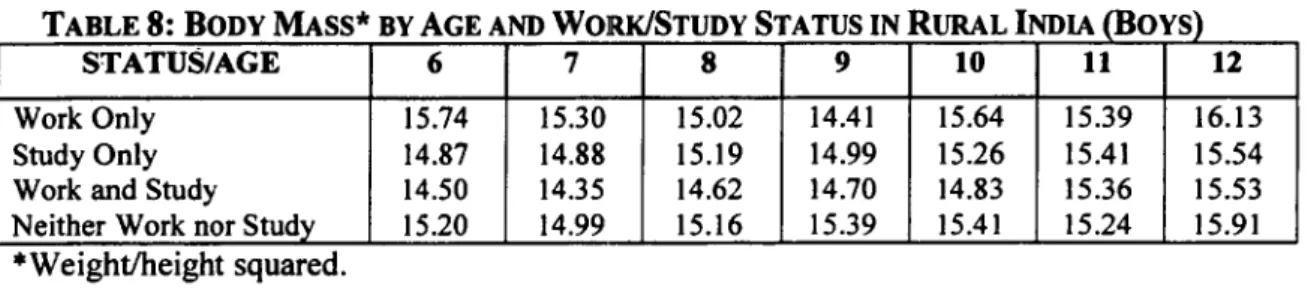
Tables 8-9 show how an indicator of nutritional status, body mass (weight divided by height squared), varies with the work/study status of the child in the India survey. Body mass is a predictor of the child's probability of survival to, and health status in,
4 Anthropometric indices, based on simple height and weight measurement, provide useful information on
nutritional status. For an example of how they can be used to infer living standards and the effects of policy, see Ismail and Micklewright (1997) and Cigno, Rosati, and Tzannatos (2000).
subsequent stages of life.6 Looking at the raw data, we cannot say that working children fare worse than children who attend school. Working girls up to the age of 10 and working boys up to the age of 7 have higher body mass than their contemporaries who attend school (children who work and attend school at the same time fare worst of all). At higher ages, there is no clear pattern.7
TABLE 8: BODY MASS* BY AGE AND WORK/STUDY STATUS IN RURAL INDA (BoYs)
STATUS/AGE 6 7 8 9 10 11 12
Work Only 15.74 15.30 15.02 14.41 15.64 15.39 16.13
Study Only 14.87 14.88 15.19 14.99 15.26 15.41 15.54
Work and Study 14.50 14.35 14.62 14.70 14.83 15.36 15.53
Neither Work nor Study 15.20 14.99 15.16 15.39 15.41 15.24 15.91
*Weight/height squared.
TABLE 9: BODY MASS BY AGE AND WORK/STUDY STATUS IN RURAL INDIA (G mLS
STATUS/AGE 6 7 8 9 10 11 12
Work Only 15.30 15.64 14.79 15.11 15.24 15.04 15.49
Study Only 14.82 14.66 14.78 14.71 14.85 15.08 15.63
Work and Study 14.77 14.43 15.05 13.95 14.64 15.02 15.43
Neither Work nor Study 14.80 15.75 14.91 15.09 15.05 15.41 15.40
The raw data reported in these tables do not reveal obvious differences in the nutritional status of boys and girls. Econometric analysis (Cigno, Rosati, and Tzannatos, 2000) reveals, however, that the body mass of girls is systematically lower than that of
8
boys when all other factors are held constant. More to the point, these data refer to school-age girls, in other words, to girls whose families valued them sufficiently to give them the resources necessary to survive to that age. There is ample evidence, on the other hand, that in some parts of the developing world the proportion of women to men is lower
6 See, for example, de Onis and Habicht (1996), Klasen (1996), and Waaler (1984). Fogel (1993) argues
that weight and height enter separately into the determination of the survival probability, so that the same body-mass ratio could be associated with different survival rates. Indeed, Fogel and Waaler report evidence that the relationship between survival and body mass has a reverse-U shape where adults in developed countries are concerned. Given the age-range we are considering, however, and the fact that practically all of the children in our sample are undernourished by western standards, we may reasonably take the relationship to be upward-sloping throughout in our case.
7 Of course, a child engaged in energetic forms of work is likely to have a higher ratio of muscle to fat and,
thus, to weigh more than a non-working contemporary with the same body volume. Also, a child born with more muscle is more likely to be selected for energetic work activities (Dasgupta, 1997). On the other hand, other things being equal, a working child needs more food to reach any given body volume. It thus seems unlikely that, of two children with the same sex, age, and body mass, the one who works will have received less nutrition than the one who does not.
than demography would lead one to expect. This imbalance, present also in the Indian survey from which Tables 5 and 6 are drawn, is symptomatic of excess female (compared to male) mortality due to infanticide and to undernourishment in the crucial early stages of life.9
Chapter 2
Why Do Children Work?
Most children are under the control of their own parents or, at any rate, of their family of origin. Therefore, their welfare cannot be regarded in isolation from that of their parents and other relatives. Even if the child was expelled from his or her family of origin or ran away from it, his or her present condition can be traced back to parental decisions (it makes little difference whether the child jumped or was pushed). The situation when a child leaves a family because of some catastrophic event is different. For example, large numbers of African children are, or are expected to become, orphans as a result of wars, famines, and the AIDS epidemic.
We will discuss children who are on their own for such external, catastrophic reasons in Chapter 11. In the present chapter and in the next, we will be concerned with the way in which parents make their decisions and how these affect children. What we really mean in asking why do children work is why do parents make them work. At this stage, we do not go into the issue of the balance of power among father, mother, and other adult family members, but we are aware that these people may have differing and possibly contradictory objectives. A change in the balance of power in favor of the mother, for example, is thought to benefit children ("women's agency").'°
2.1 The structure of household decisions
Households have multiple objectives. For a start, as mentioned at the beginning of the last chapter, material consumption is not the only dimension of welfare. Other factors, such as health, "freedom", and so on also affect the happiness or satisfaction of each household. Moreover, the household faces a problem of inter-temporal resource allocation; the decisions it makes today will influence the quantity of resources available to it in the future. This is particularly relevant in the case of child labor, where the choice
10 For empirical evidence, see Haddad and Hoddinott (1994) and Hoddinott and Haddad (1995). For the theoretical argument, see Manser and Brown (1980). Eswaran (2001), however, argues that, while
is not only between consumption and other activities today but also between present and future consumption.
We may assume that parents care about the present and future well-being of their children. However, as they care also about their own well-being, this does not imply that parents will do everything in their power to foster their children's interests. Their decisions will be a compromise between ultimately conflicting objectives. Indeed, many aspects of parental behavior cannot be fully explained by the alternative (and, on the face of it, opposite) hypothesis that parents are totally self-interested, and that they expend resources on in their offspring only because they get some direct return from that expenditure.'
For example, there is ample evidence that pension coverage discourages fertility.'2 Taken together with evidence that aging parents receive support from their grown-up children,'3 this phenomenon is consistent with the hypothesis that parents regard having
children as a way to re-allocate their resources over their own lifecycle. In other words, if the parents invest in their children's welfare, their children will look after the parents when they are old. Of course, this attitude is most likely to prevail in situations where capital markets are not sufficiently developed to provide a viable alternative to filial support (more about this in the next chapter). However, the need for offspring to support their elderly parents can still be relevant even when capital markets are well developed, because the market does not offer perfect substitutes for some of the services provided by one's own children. A remarkable finding of recent research is that, even in the highly developed economies of North America, Western Europe, and Japan, household saving and fertility behavior is consistent with the hypothesis that children are regarded by their parents as a kind of capital asset.'4
In practice, it is not very helpful to dwell on whether parental motivations are altruistic or egoistic. What matters is how much value parents put on resources invested in their children, not whether this evaluation reflects love or simply the expectation of a share in the fruits of the investment. Parental decisions concern, essentially, the
benefiting children generally, female empowerment could have negative effects on the survival probability
offemale children.
" See Cigno (1993) and Rosati (1996).
12 Among others, Nugent and Gillaspy (1983), Entwisle and Winegarden (1984), and Cigno and Rosati
(1992, 1996).
13 For example, Cigno, Giannelli, and Rosati (1998).
allocation of resources among alternative uses, in particular the use of each household member's own time, the distribution of income over time and across household members, and the number of births. All these decisions are interrelated and cannot be studied in isolation.
Two points have to be kept in mind where fertility decisions are concerned. The first is that parents cannot determine the number and timing of births with certainty. The second is that parents are not so much interested in the number of births as in the number of children who will survive into adulthood. By one set of actions (frequency of sexual intercourse, adoption of contraceptive or fertility-inducing practices, and so on), parents then condition the probability distribution of fertility outcomes. By another (the health care and nutrition that they give to the child), they condition each child's probability distribution of survival to each subsequent stage of life.'5 Both sets of actions also affect,
directly or indirectly, the lifetime morbidity prospects of surviving children.'6
The complexity of the household problem does not permit us to draw simple schematizations. Even intuitively appealing ones can be highly misleading. Consider, for example, the "children first" implicit or explicit assumption, often made in child labor analyses. In a nutshell, this is what is assumed. Parents are concerned about their children's welfare. In all circumstances, children are better off if they go to school than if they go to work. Hence, parents will send their children out to work only if the household's income falls below a certain critical level. Even if this were a correct representation of parental preferences (in other words, if it were true that parents put their children's interests before their own, come what may), the approach would still be flawed because it implies that it is necessarily better for the child to go to school and have a subsistence level of consumption than not to go to school and enjoy a higher level of consumption. This is far from necessarily being the case in general.
Consider the following example. Suppose that a child is working. Suppose that his or her wage rate rises enough to bring household income above the critical threshold. The children-first approach implies that the child's labor supply should be reduced until household income is back to the critical level. This is not necessarily in the child's best interest: the extra income could buy the child more food or, if s/he goes to school, more educational material. Indeed, if the child does go to school, better nutrition would
'I See Cigno (1998) and Cigno and Pinal (2001).
improve his or her educational performance. Up to a point, child labor could thus help, rather than hinder, human capital accumulation.'7 The child's extra income could also buy more maternal attention by reducing the amount of time his or her mother has to spend working. In that case, another response to the wage rise might be to reduce the mother's, rather than the child's, labor supply, so that the mother could spend more time with her child(ren).
There are thus no short cuts. One needs to recognize that parents attach weight to their own and to each of their children's lifetime consumption stream. The weights attached to each of these consumption streams and the rate at which the future is discounted may vary from household to household, depending on the parents' altruism and foresight or on their ability to appropriate part of their children's future incomes.
We define children's consumption to include not only food and clothes but also medical care. We exclude educational inputs, which we regard as an investment and consider as a separate item. Strictly speaking, health expenditures also should be treated as an investment. So should nutrition, because the amount of food consumed in the pre-school period is known to have a positive effect on the probability that the child will survive to school age and, more generally, on his or her current and future health prospects. As it is difficult to separate these long-term effects from the more immediate ones, however, we keep health expenditure in with current consumption, and look for links between this and health/survival probabilities. The amount that a person is able to earn, as an adult, is positively related to that person's health (dependent on past consumption) and personal skills (dependent on human capital). Therefore, saying that parents give weight to each of their children's lifetime consumption streams is equivalent to saying that they care about how much their children consume today and about the size of the stock of health and human capital that they will carry into adult life.
Human capital is partly a reflection of native talent and partly the fruit of education. The second part is "produced" with time (which includes not only school attendance but also homework) and other educational inputs (books, tuition fees, and writing materials but also travel to school). The opportunity cost of the time that the child spends being educated is equal to the child's wage rate and/or the child's marginal product in the family farm or business. Assuming this to be constant, the marginal cost of human capital is constant up to the point where the child's time is fully devoted to
education. From that point onward, the marginal cost rises, as more and more has to be spent on educational inputs, in combination with a fixed time endowment, to provide the child with an extra unit of human capital.
2.2 Fertility choice and decisions concerning pre-school children
Parents decide whether to have an additional child and how much to spend on the new child until he or she reaches school age under conditions of uncertainty about whether the child will live to school age. For any given set of environmental and hereditary conditions, the child's survival probability will be positively conditioned by health-enhancing public policies (sanitation, mass immunization, and so on), which parents take as given, but also by the amount that the child consumes between birth and school age,'8 which is decided by the parents. Therefore, a child's chances of living until he or she reaches school age depend not only on external conditions but also on actions taken by the child's own parents. It is open to debate whether, in choosing their fertility behavior and allocating consumption to their children, parents are actually aware that their decisions will affect the probability of those children surviving and take account of how their children's time will be allocated between study and work if they do reach school age. Empirical evidence 9 suggests that parents behave as if they were aware of the consequences of their actions, and that is all that matters for our purposes.
Combined with random events, these parental decisions determine the number of births in the family and the consumption levels of pre-school children. Under plausible conditions,2 0 direct health-enhancing policies (such as public expenditure on health and sanitation etc, or rise in the price of the goods consumed by pre-school children) would reduce fertility and raise the consumption of pre-school children if public expenditure is a net complement for pre-school child consumption or raise fertility and reduce pre-school child consumption if it is a net substitute. If it is a net complement, fertility and infant mortality move in the same direction, which is what the empirical evidence seems to suggest.
In conclusion, the household takes the following, strictly interrelated decisions simultaneously: how many births to procure; the consumption level of pre-school children; the consumption, labor supply, and time and money spent on educating
school-'s This, remember, is defined to include medical care as well as nutrition.
'9 For example, Cigno and Pinal (2001).
age children; and the consumption of adult household members. Reviewing the different ways in which child labor and welfare can be influenced by changes in economic circumstances and policy actions will help us to understand the complexity of the decision process as well as highlight policy options. We will see that important changes may be due to events that are not so "close" to the variable(s) of interest.
2.3 Decisions concerning school-age children
Parents decide how to allocate the time of their school-age children and how much to spend on each of them with the aim of achieving as far as possible their objectives (which, remember, include the well-being of the children), subject to the family budget constraint. Different types of solution are possible.
Figure 1
cXr
h
The first type of solution occurs when the marginal cost of human capital is higher than the maximum that parents are willing to pay.2' If this is the case, the child is made to work full time. The second type of solution arises when the marginal cost of human capital is lower than the minimum, below which parents want their children to study full time. If that is the case, the child does not work at all. In between these extremes, we have a third type of solution, where parents invest the child's time and expend other
household resources to the point where the marginal cost of human capital is equal to the price that parents are subjectively willing to pay (the amount of consumption that they are willing to give up, in order to endow the child with one more unit of human capital). If this occurs, the child works and studies at the same time. If parents send their children to school at all, they also have to bear the educational costs such as tuition fees and the cost of books.
The possibilities are illustrated in Figure 1, where the vertical axis measures the amount consumed by a school-age child, c, and the horizontal axis the amount of human capital, h, with which he or she have upon entering adult life. The broken line through points I and L is the production frontier, representing all the possible outcomes of (efficient) household decisions. Its slope is equal to the marginal cost of human capital. The line is truncated at point I to indicate that parents cannot push the child's stock of human capital below a certain minimum ("natural talent"). The first type of solution, where the child works full time, is represented by point I. The second, where the child's time is fully occupied in education, can be at L or at any point to the right of it (to the right of L, parents spend money for the child's education over and above the necessary minimum). The third type of solution, where the child works and attends school at the same time, can be anywhere between I and L. The choice depends on parental preferences, represented by a map of indifference curves,22 such as the convex-to-the-origin curve through point T, as well as on resource restrictions (reflected in the production frontier). In the figure, parents choose point T. This is a situation in which the child goes to school, thus ending up with more human capital than he or she was born
with, but also works, thus consuming more, given the limitations imposed by the
household budget constraint, than if he or she studied full time.
Chapter 3
Child Labor and the Capital Market
We have reasoned, so far, as if education were the only means of transferring resources from the present to the future. If a capital market exists, however, parents can buy assets in addition or as an alternative to having children and investing in their education. These assets may be financial instruments, such as stocks and bonds, but in a developing country they are more likely to be real assets, such as land and cattle, or personal credit. As it widens the range of possible choices open to parents, the availability of these alternative vehicles of inter-temporal reallocation raises the household's wealth. It does not necessarily follow, however, that children will be better off. Irrespective of whether parents are animated by love of their children or by self-interest, the availability of an alternative raises the opportunity costs of raising children and implicitly or explicitly lending to them. Whether the net effect of a wealth increase and the substitution of capital for human capital is favorable or unfavorable to children depends on many factors including the value that parents attach to the resources transferred to their children (see last chapter). In what follows, we limit our analysis to the situation in which parents have a given number of children23 and face the choice between investing in their children's human capital or in other assets.
3.1 The role of the capital market
Let us allow for the possibility that a capital market exists. Suppose that the assets traded in such a market earn a fixed return, represented by the interest factor r.24 Parents can then choose between two different ways of providing for their children's and/or their own future: schooling and asset accumulation. Suppose, for the sake of argument, that are indifferent between endowing their adult children with tangible assets or with human
23 See Cigno (1993) for a more general analysis where would-be parents decide on the number of children
to have and Rosati (1996) for the introduction of differential risks of human and non-human capital investments.
24 Considering variable returns would not change the conclusion, so long as the return on the asset did not