IMPROVING IMBALANCED QUESTION CLASSIFICATION USING
STRUCTURED SMOTE BASED APPROACH
ALAA MOHASSEB1, MOHAMED BADER-El-DEN1, MIHAELA COCEA1, HAN LIU2 1School of Computing, University of Portsmouth
2School of Computer Science and Informatics, Cardiff University
wq E-MAIL: [email protected], [email protected], [email protected], [email protected]
Abstract:
Questions Classification (QC) is one of the most popular text classification applications. QC plays an important role in question-answering systems. However, as in many real-world clas-sification problems, QC may suffer from the problem of class im-balance. The classification of imbalanced data has been a key problem in machine learning and data mining. In this paper, we propose a framework that deals with the class imbalance using a hierarchical SMOTE algorithm for balancing different types of questions. The proposed framework is grammar-based, which in-volves using the grammatical pattern for each question and us-ing machine learnus-ing algorithms to classify them. Experimental results imply that the proposed framework demonstrates a good level of accuracy in identifying different question types and han-dling class imbalance.
Keywords:
Information Retrieval, Text classification, Question classifica-tion, Machine Learning, Class Imbalance.
1
Introduction
Questions Classification (QC) is the main task in any question-answering systems. However, as in many real-world classification problems, QC may suffer from the problem of class imbalance [1]. The classification of imbalanced data has been a key problem in machine learning and data mining [2], [3]. Class imbalance occurs when one of the two classes having more instances than other classes in which the algorithm usu-ally focuses on the classification of instances of the majority class, while ignoring or misclassifying instances of the minor-ity class. The lack of information caused by a small sample size in the training set is one of the challenges in imbalance classifi-cation [4], [5] in which an insufficient number of instances will
result in the difficulty for the algorithm to learn from similar patterns in the instances of the minority class.
The Synthetic Minority Over-sampling TEchnique (SMOTE) [6] is one of the most popularly used sampling technique to handle imbalance data [7], [8], [2], [9], [3]. SMOTE over-samples instances of the minority (abnormal) class which helps for achieving better classifier performance.
In this paper, we propose a framework which deals with the class imbalance issue using the hierarchical SMOTE algorithm when classifying different types of questions. The proposed framework is grammar-based, which involves using the struc-ture of the question by identifying a grammatical pattern for each question and using machine learning algorithms to clas-sify them. Experimental results imply that the proposed frame-work demonstrates a good level of accuracy in identifying dif-ferent question types and handling class imbalance. The aim of the research presented in this paper is to:”Evaluate the impact of handling class imbalance in the classification accuracy.”
The rest of the paper is organized as follows. Section 2 out-lines previous work in question classification. Section 3 de-scribes the proposed question classification framework. The experiments setup and results are presented in Section 4. Fi-nally, section 5 concludes the paper and outlines directions for future work.
2
Question Classification
In many recent studies, users’ question is classified using dif-ferent features. Authors in [10] proposed head word features, which is one single word specifying the object that the ques-tion seeks. In [11], a framework has been proposed, which integrates a question classifier with a simple document/passage retriever, and proposed context-ranking models. In [12], a hy-brid approach was proposed, named ATICM which is based
on dependency tree analysis by utilizing both syntactic and se-mantic analysis. In addition, authors in [13] proposed a method of using a feature selection algorithm to determine appropriate features using Support Vector Machine (SVM) for the classifi-cation algorithm. In [14], a statistical classifier has been pro-posed which is based on SVM. Furthermore, [15] propro-posed a SVM-based approach for question classification, a dependency relations and high-frequency words are incorporated into the baseline system.
Authors in [16] proposed an approach for question classifica-tion through using three different classifiers. Similarly, in [17] five machine learning algorithms were used such as SVM and Naive Bayes, with using two kinds of features bag-of-words and bag-of-ngrams. In [18] authors classified open-ended ques-tions through training SVM to recognize the occurrence of cer-tain keywords or phrases in a question class. Moreover, [19] proposed a neural network for a question answering system. In [20] a classification method was proposed for community ques-tion answering (CQA) system based on ensemble learning. Fi-nally, authors in [21] proposed two trained recurrent neural net-works to detect the entities in the question and to classify the question.
Unlike the previous approaches which ignore the problem of class imbalance in question classification, we propose a grammar-based framework which deal with the class imbal-ance using hierarchical SMOTE algorithm for questions clas-sification. Details of the framework are presented in the next section.
3
Proposed Approach
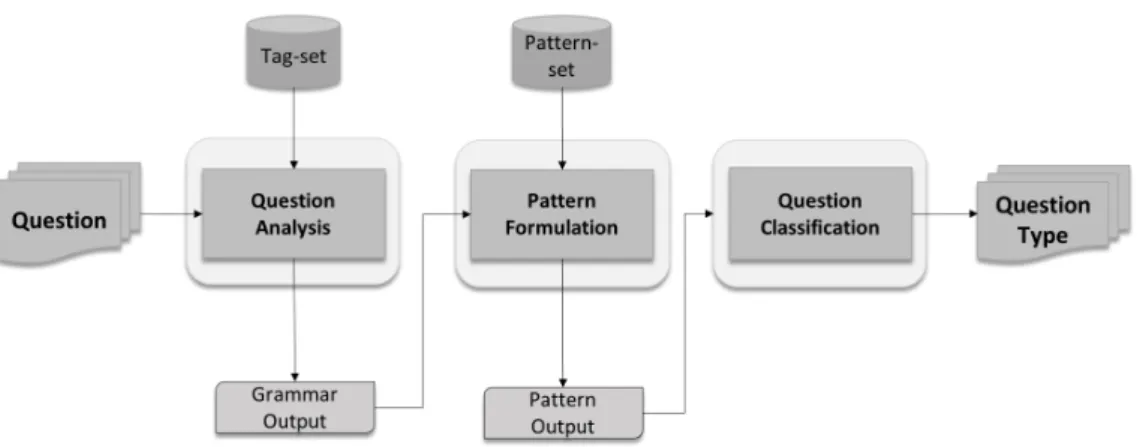
We propose a framework, shown in Figure 1, which deal with the class imbalance issue when classifying different types of questions. The proposed framework transforms the given question to a pattern meaning that each term in the ques-tion is represented as its grammatical category. For exam-ple, the question ”Who is Tim Berners-lee?” will be trans-formed to question word who (QWW ho), linking verb (LV)
and proper noun celebrity (P NC), ”QWW ho+LV +P NC”.
The grammatical categories contain in addition to typical egories of English grammar, domain-related grammatical cat-egories [22][23]. This new representation helps in the process of dealing with class imbalance and the final categorization and classification of the given question.
The three phases of the proposed framework for imbalance question categorization and classification are described as fol-low:
Phase 1: Question Analysis: this phase is executed using a
simple version of the English grammar combined with domain-specific grammatical categories since domains such as question answering systems do not perceive the formal English gram-mar and natural language. First, the given question is analyzed, and this step is done by identifying each of the keywords and phrases in the question. Next, the grammar is generated. After this step a grammatical rule is generated, in which a question domain specific grammar will be created.
Phase 2: Pattern Formulation: this phase consists of three steps. (1) the system parses the given question to facilitate the tagging of each word to the right term category. (2) each term in the question will be tagged to its term category, (3) the question is transformed to a pattern [24].
Phase 3: Question Classification: in this phase the patterns generated from the previous phase are used for machine learn-ing, in this phase a model for automatic classification is built. The classification is done by splitting of the data set into (1) a training set which is used for building the model, and (2) a test set which is used to evaluate the performance of the model, be-fore the model is used for classifying unseen instances, SMOTE Sampling technique is applied to over-sample instances of the minority class in the training set by constructing new instances of the minority class, which helps for achieving better classifier performance. One of SMOTE limitations is that it is designed for binary labels. When dealing with multiple labels, SMOTE will only over-sample for the label with the lowest number of instances. In order to overcome this limitation, in this study, SMOTE is applied several times in a hierarchical way to over-sample all the non-majority classes.
4
Experimental Study and Results
Naive Bayes (NB)was used as the machine learning algo-rithm for the automatic classification. The classification accu-racy is obtained by using the implementation of the above al-gorithm from the Weka software. The effectiveness of the clas-sification algorithm was evaluated in terms of Precision, Recall and F-Measure, i.e. typical metrics for the evaluation of clas-sifiers, using 10-fold cross-validation and SMOTE with value of K=5. To show the effectiveness of handling imbalance data on the classification performance, two experiments were con-duct (1) using NB without applying SMOTE algorithm and (2) using NB with the implementation of SMOTE algorithm.
1,160 questions were randomly selected from three data sets (1) TREC 2007 Question Answering Data 1 and (2) a Wikipedia dataset 2 and (3) Yahoo Non-Factoid Question
1http://trec.nist.gov/data/qa/t2007_qadata.html 2
FIGURE 1.Framework
Dataset3. Their distribution is given in Table 1. Ques-tions used in this experiment are labelled to six different cat-egories,namely; causal, choice, confirmation (Yes-No Ques-tions), factoid (Wh-QuesQues-tions), hypothetical and list. These classifications were proposed by [25].
TABLE 1.Data distribution
Question type Total
Causal 31 Choice 12 Confirmation 321 Factoid 688 Hypothetical 7 List 101
4.1
Results
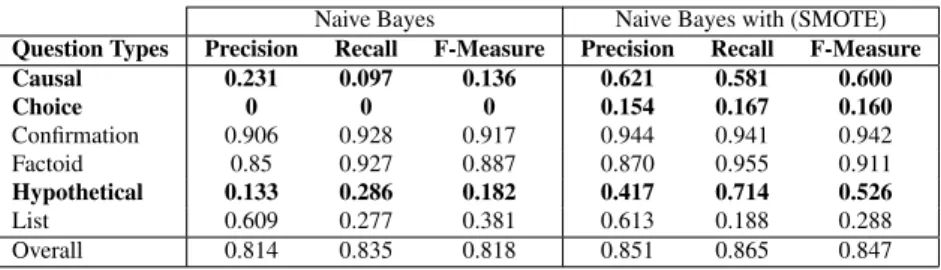
Table 2 presents classification performance details (Preci-sion, Recall and F-Measure) of the NB classifier and the perfor-mance details of the NB classifier with the use of the SMOTE algorithm. The results indicate that when handling imbalance classes the performance of the classifier is improved, as shown in Table 1. Choice, causal and hypothetical questions have much fewer instances, and without applying the SMOTE algo-rithm the classifier had poor performance especially with these three classes. However, when the SMOTE algorithm is applied, the performance of the classifier has been improved and the overall accuracy has increased.
Furthermore, these results show that NB is effective in the identification and classification of confirmation and factoid
3https://ciir.cs.umass.edu/downloads/nfL6/
questions. In addition, NB could not distinguish between causal, choice, hypothetical and list types of questions and in-correctly classified most of them as confirmation and factoid questions. However, when applying SMOTE algorithm classi-fication of most question types and the performance has been improved. For example, when the SMOTE algorithm is not ap-plied, NB could correctly classified (Recall) less than 1% of the causal questions, and could not identify any of the choice questions. Furthermore, NB classified correctly 92.8% of the confirmation questions and 92.7% of the factoid questions. In addition, 28.6% of the hypothetical questions were correctly classified while the classification accuracy of the list questions were 27.7%.
On the contrary, when hierarchical SMOTE algorithm is ap-plied, NB correctly classified 58.1% of the causal questions and 16.7% of the choice questions. In addition, classification of fac-toid, confirmation and hypothetical questions achieves a higher recall when handling imbalance classes, i.e. 95.5%, 94.1% and 71.4% accuracy respectively. Moreover, classification of list questions shows a lower recall (18.8%) with the implementa-tion of SMOTE but higher precision. Overall, the results vali-date that the proposed approach is an effective method for ques-tion classificaques-tion as well as for the distincques-tion between dif-ferent question types and handling the problem of imbalance classes.
5
Conclusion and Future Work
In this paper, we proposed a framework for question clas-sification, which deals with the class imbalance issue using the hierarchical SMOTE algorithm by utilizing the structure of the question, based on the grammatical pattern of each ques-tion. The results show that our proposed solution led to a good
TABLE 2.NB classifier performance without/with the implementation of SMOTE algorithm
Naive Bayes Naive Bayes with (SMOTE)
Question Types Precision Recall F-Measure Precision Recall F-Measure Causal 0.231 0.097 0.136 0.621 0.581 0.600 Choice 0 0 0 0.154 0.167 0.160 Confirmation 0.906 0.928 0.917 0.944 0.941 0.942 Factoid 0.85 0.927 0.887 0.870 0.955 0.911 Hypothetical 0.133 0.286 0.182 0.417 0.714 0.526 List 0.609 0.277 0.381 0.613 0.188 0.288 Overall 0.814 0.835 0.818 0.851 0.865 0.847
performance in classifying questions and handling class imbal-ance. As a future work, we will apply different imbalance algo-rithms e.g (cost-sensitive) and compare the performance of dif-ferent classifiers, when difdif-ferent class imbalance methods are applied. In addition, we will test the proposed framework in other text classification domains with similar class imbalance problems.
References
[1] Y. Li, G. Sun, and Y. Zhu, “Data imbalance problem in text classification,” in Information Processing (ISIP), 2010 Third International Symposium on. IEEE, 2010, pp. 301–305.
[2] Z. Zheng, Y. Cai, and Y. Li, “Oversampling method for imbalanced classification,” Computing and Informatics, vol. 34, no. 5, pp. 1017–1037, 2016.
[3] K. Jiang, J. Lu, and K. Xia, “A novel algorithm for imbal-ance data classification based on genetic algorithm im-proved smote,” Arabian Journal for Science and Eng., vol. 41, no. 8, pp. 3255–3266, 2016.
[4] S. Visa and A. Ralescu, “The effect of imbalanced data class distribution on fuzzy classifiers-experimental study,” inFuzzy Systems, 2005. FUZZ’05. The 14th IEEE Inter-national Conference on. IEEE, 2005, pp. 749–754. [5] N. Japkowicz and S. Stephen, “The class imbalance
prob-lem: A systematic study,”Intelligent data analysis, vol. 6, no. 5, pp. 429–449, 2002.
[6] N. V. Chawla, K. W. Bowyer, L. O. Hall, and W. P. Kegelmeyer, “Smote: synthetic minority over-sampling technique,” Journal of artificial intelligence research, vol. 16, pp. 321–357, 2002.
[7] N. V. Chawla, A. Lazarevic, L. O. Hall, and K. W. Bowyer, “Smoteboost: Improving prediction of the mi-nority class in boosting,” in European Conference on
Principles of Data Mining and Knowledge Discovery. Springer, 2003, pp. 107–119.
[8] F. Chang, J. Guo, W. Xu, and K. Yao, “A feature selection method to handle imbalanced data in text classification,” J. Digit. Inf. Manage, vol. 13, no. 3, pp. 169–175, 2015. [9] J. Wang, M. Xu, H. Wang, and J. Zhang, “Classification
of imbalanced data by using the smote algorithm and lo-cally linear embedding,” inSignal Processing, 2006 8th International Conference on, vol. 3. IEEE, 2006. [10] Z. Huang, M. Thint, and Z. Qin, “Question classification
using head words and their hypernyms,” inProceedings of the Conference on Empirical Methods in Natural Lan-guage Processing. Association for Computational Lin-guistics, 2008, pp. 927–936.
[11] S.-J. Yen, Y.-C. Wu, J.-C. Yang, Y.-S. Lee, C.-J. Lee, and J.-J. Liu, “A support vector machine-based context-ranking model for question answering,”Information Sci-ences, vol. 224, pp. 77–87, 2013.
[12] T. Hao, W. Xie, Q. Wu, H. Weng, and Y. Qu, “Leveraging question target word features through semantic relation expansion for answer type classification,” Knowledge-Based Systems, vol. 133, pp. 43–52, 2017.
[13] N. Van-Tu and L. Anh-Cuong, “Improving question clas-sification by feature extraction and selection,” Indian Journal of Science and Technology, vol. 9, no. 17, 2016. [14] D. Metzler and W. B. Croft, “Analysis of statistical
ques-tion classificaques-tion for fact-based quesques-tions,” Information Retrieval, vol. 8, no. 3, pp. 481–504, 2005.
[15] S. Xu, G. Cheng, and F. Kong, “Research on question classification for automatic question answering,” inAsian Language Processing (IALP), 2016 International Confer-ence on. IEEE, 2016, pp. 218–221.
[16] M. Mishra, V. K. Mishra, and H. Sharma, “Question clas-sification using semantic, syntactic and lexical features,” International Journal of Web & Semantic Technology, vol. 4, no. 3, p. 39, 2013.
[17] D. Zhang and W. S. Lee, “Question classification using support vector machines,” inProceedings of the 26th an-nual international ACM SIGIR conference on Research and development in informaion retrieval. ACM, 2003, pp. 26–32.
[18] J. Bullington, I. Endres, and M. Rahman, “Open ended question classification using support vector machines,” MAICS 2007, 2007.
[19] T. Sagara and M. Hagiwara, “Natural language neural net-work and its application to question-answering system,” Neurocomputing, vol. 142, pp. 201–208, 2014.
[20] Y. Li, L. Su, J. Chen, and L. Yuan, “Semi-supervised learning for question classification in cqa,”Natural Com-puting, vol. 16, no. 4, pp. 567–577, 2017.
[21] F. Ture and O. Jojic, “Simple and effective question an-swering with recurrent neural networks,” arXiv preprint arXiv:1606.05029, 2016.
[22] A. Mohasseb, M. Bader-El-Den, H. Liu, and M. Cocea, “Domain specific syntax based approach for text classi-fication in machine learning context,” in 2017 Interna-tional Conference on Machine Learning and Cybernetics (ICMLC), vol. 2. IEEE Systems, Man and Cybernetics, 2017, pp. 658–663.
[23] A. Mohasseb, M. Bader-El-Den, A. Kanavos, and M. Co-cea, “Web queries classification based on the syntactical patterns of search types,” inInternational Conference on Speech and Computer. Springer, 2017, pp. 809–819. [24] A. Mohasseb, M. El-Sayed, and K. Mahar, “Automated
identification of web queries using search type patterns.” inWEBIST (2), 2014, pp. 295–304.
[25] A. Mohasseb, M. Bader-El-Den, and M. Cocea, “Ques-tion categoriza“Ques-tion and classifica“Ques-tion using grammar based approach,” Information Processing and Manage-ment, 2018.