T H E N A M E S O F architects such as
Richard Meier, Robert A. M. Stern, Daniel Libeskind, and Jean Nouvel have been prominently featured in advertise-ments for high-end residential properties. Harnessing architectural design in the service of commercial real estate is not new, of course. In the 19th century, a firm such as McKim, Mead & White, best known for its mansions, private clubs, and public libraries, frequently designed prestigious commercial build-ings, especially banks. More recently, in the 1970s and 1980s, developers, led by Gerald Hines and George Klein, com-missioned A-list architects such as Philip Johnson, I. M. Pei, and Kevin Roche to
Architectural
Branding
Star architects add value to a high-end residential property, don’t they?
build office towers. These class-A build-ings derived their prestige in great meas-ure from their design quality. The differ-ence today is that employing a famous architect is not only about adding design value; it is also about adding cachet, since individual architects have achieved a much greater measure of celebrity than in the past. In some cases, their names are so well-known to the public that they have achieved the status of brands. The ques-tions are: How did branding come to architecture in the first place, and how much value does a big-name architect actually add to a real estate project?
P E R S O N A L I T Y
What makes an architect into a brand? The British architect Norman Foster built a number of technically sophisticat-ed buildings in Britain in the 1970s and 1980s, including a head office and a plant for IBM and a distribution center for Renault. His first design that attract-ed worldwide attention was a striking headquarters for the Hongkong and Shanghai Bank, an early example of the so-called Hi-Tech architectural style. This was followed by airports, university buildings, telecommunications towers, conference centers, and office buildings (Figure 1). The Foster website currently lists commercial projects that include a
Zurich hotel, an Amsterdam office build-ing, and mixed-use developments in Sydney, Australia, and St. Petersburg, Russia. In addition, Foster & Partners was recently hired to design one of the office towers at the World Trade Center site. Part of the recognition of a brand depends on what people who study such things call its “personality.” London-based Foster & Partners has become an international architectural brand with a definite personality: Innovative Technical Solutions to Complex Problems.
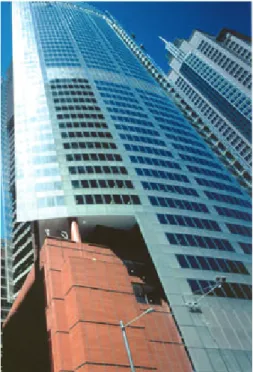
Foster and Partner’s chief rival is the Renzo Piano Building Workshop (RPBW), based in Genoa and Paris. Piano came to the fore when (with Richard Rogers) he won the competition to build the Pompidou Center in Paris. Since then Piano has established an international practice that, like Foster & Partners, specializes in large, complex projects such as Kansai, the new Osaka airport. RPBW also designs cultural proj-ects (currently museums in Boston, New York, Chicago, and Atlanta) as well as commercial buildings, including a mixed-use development in Berlin, the New York Times office tower in Manhattan, a mixed-use tower in London, and residential and office com-plexes in Lisbon and Sydney (Figure 2). The Piano brand, which conveys a sense of bespoke elegance, is something like Stylish Solutions to Any Problem.
Piano’s one-time partner, Richard Rogers, has also emerged as an
interna-tional force. The Richard Rogers
Partnership (RRP), which is based in London but also has offices in Tokyo, Barcelona, and Madrid, has built airport terminals in London and Madrid, office towers in London, as well as the Millennium Dome. RRP is also active in the United States, where it is renovating and expanding the Jacob K. Javits Convention Center in Manhattan and building commercial projects in New York and Washington, D.C., and an office tower at the World Trade Center site. Lord
Rogers, who at an early age had a brief partnership with Foster, is the most flam-boyant designer of the trio, as the irre-pressible Lloyd’s Building in London demonstrates (Figure 3).
Although the work of Foster, Piano, and Rogers is grounded in highly sophisti-cated, technologically based building con-struction, these architects do not have a house style. Instead, their designs are a function of programmatic requirements. This goes against the conventional idea that the work of a celebrated architect must have an identifiable, or so-called sig-nature, style. But style can be a trap, as Figure 1: Hearst Building, New York City,
Foster & Partners, architects.
Figure 2: Aurora Place, Sydney, Australia, Renzo Piano Building Workshop, architects.
Richard Meier, with his persistent white walls and expanses of glass, found at the Getty Center. Although this large complex of buildings is exquisitely built, it has not captured the public’s attention in the man-ner of other recent art museums, such as the Bilbao Guggenheim or the Tate Modern in London.
Although architects in the past success-fully used the same historical style (Gothic, Romanesque, or Classical) for many differ-ent commissions, it is risky to apply a per-sonal style to a variety of buildings such as court houses, campus buildings, museums, hotels, office blocks, and condominiums. The danger is that the buildings become stylistic parodies. Michael Graves, for example, is an architect with a distinctive style—simplified, almost cartoonish, Classical forms and warm Tuscan colors—
that sometimes appears to overwhelm the problem at hand. When I mentioned to a friend that Graves had recently built a building in Philadelphia, she said, “I didn’t know that it was a real Graves—I thought it was a knock-off.”
C E L E B R I T Y
A recognizable brand depends on more than merely name recognition. The Dutch architect Rem Koolhaas has tried to trans-form his personal celebrity into an interna-tional brand, which he calls the Office of Metropolitan Architecture, or OMA. OMA, with offices in Rotterdam, Beijing, and New York, has produced a variety of work, from a big-box convention center in Cordoba to a crystalline library in Seattle and an unusual skyscraper in Beijing. A large, mixed-use complex in Louisville, Kentucky, will include a hotel, offices, res-idences, and an art museum. Like Foster, Piano, and Rogers, OMA has avoided architectural style as a branding tool, although its designs are distinctly fashion-able, in an edgy sort of way. The buildings are frequently not conventionally attrac-tive, and they often challenge established taste. But OMA also demonstrates the per-ils of turning avant-garde architecture, usually associated with individual design-ers, into an international brand. Recently the entire New York City office broke Figure 3: Lloyd’s Building, London,
away from the OMA organization and set up on its own, as if Diet Coke had split off from Coca Cola.
Another firm that is making the tran-sition from an avant-garde, boutique prac-tice to an international brand is Basel-based Herzog & de Meuron, founded by Jacques Herzog and Pierre de Meuron. They began as self-styled artists, and seemed ill-suited to become an interna-tional branded practice. But after a suc-cessful series of art museums, including the celebrated Tate Modern in London and the recent de Young Museum in San Francisco, they expanded into distinctly non-cultural buildings: a soccer stadium in Munich, the Olympic stadium in Beijing (Figure 4), and a luxury condo-minium building in New York. Like Foster and Piano, Herzog & de Meuron have avoided a signature style. Their designs are less technological than Foster, RPBW, or RRP, but considerably more fashionable, which may be why they were commissioned to do a series of buildings for Prada.
Frank Gehry has perhaps the strongest architectural franchise in the world today. Although he has built a number of small commercial projects in Prague, Berlin, and Boston, he is chiefly known for his cultur-al monuments, notably the Guggenheim Museum in Bilbao and the Disney Concert Hall in Los Angeles. The Gehry brand is unmistakable: whimsical,
sculp-tural, quirky buildings that don’t look like buildings (and, incidentally, are difficult and expensive to build). It will be a chal-lenge to successfully adapt Gehry’s approach to a large commercial develop-ment, such as the ones that he is planning for Brooklyn (Figure 5) and downtown Los Angeles.
It is not difficult to explain why archi-tects are attracted to branding. Like lawyers, doctors, and accountants, archi-tects are essentially professional workers who are paid highly, by the hour. Although they create organizations that are able to produce many projects at once (most of the firms being discussed here have between one hundred and two hundred employees), when all is said and done, they are only as solvent as their next commis-sion. How can architects who have devel-oped widely recognizable brands capitalize on that recognition? Put another way, can architects follow in the footsteps of other creative individuals, such as celebrity chefs? Where once a successful cook could rise no higher than owning his own restau-rant, starting in the 1990s, a modern celebrity chef with a recognized brand, such as Wolfgang Puck, Mario Batali, or Emeril Lagasse, could become a wealthy entrepreneur, writing cookbooks, endors-ing culinary products, hostendors-ing television programs, opening restaurants in different cities, and franchising his name to a national chain.
V A L U E
Architectural branding has proved benefi-cial to cultural institutions. This is not simply the so-called Bilbao Effect, the ability of unusual architecture to attract visitors (cultural tourists) from great dis-tances; having a recognized architectural brand helps raise public interest in a proj-ect at its inception. Even before the design of the museum or the concert hall is unveiled, the anticipation that it will be a “signature” building is established. Having a recognizable architectural brand is also a key ingredient in fund-raising. That is why the pool of architectural firms that are regularly invited to compete in archi-tectural competitions is relatively small. A survey of two architectural journals (one American, one Spanish) between 1994 and 2003 turned up 71 invited interna-tional competitions. Of the 548 Figure 4: Olympic stadium, Beijing, Herzog & de Meuron, architects.
Figure 5: Atlantic Yards, Brooklyn, Frank Gehry & Partners, architects.
invitations that were issued to 332 firms, 30 percent went to the top 20 firms, and fully 20 percent were to the top 10 firms (Steven Holl, Rem Koolhaas, Zaha Hadid, Peter Eisenman, Daniel Libeskind, Foster & Partners, Jean Nouvel, Thom Mayne, Dominique Perrault, Cesar Pelli).
The question of how much value an architectural brand adds to a commercial building is harder to answer. Does an architectural brand reduce marketing budgets, add to the speed of lease-up, or generate greater resale value? According to the Wall Street Journal, the answer is “prob-ably not.” Reviewing several luxury resi-dential projects in Manhattan and else-where, the Journal concluded that “high-end developers are discovering that it takes more than a name to move the merchan-dise.” What is takes is conventional: a good location, strong demand, and competitive pricing. One project designed by Robert A. M. Stern in Manhattan, facing Central Park, is selling well; the sales in another, in downtown Stamford, Connecticut, are sluggish. Apartments in a Manhattan condo designed by Charles Gwathmey are selling slowly, but those in another, designed by French architect Jean Nouvel are doing well. In some cases, it is likely that the addition of a name architect has simply been overvalued: some sales prices of the Manhattan buildings designed by star architects are approaching $3,000 per
square foot, in a market where the average for luxury residential buildings in the fourth quarter of 2005 was $1,610 per square foot.
The lesson is that architectural brand-ing has to be very carefully positioned with respect to demand. The market for a bou-tique hotel or a small residential project may appreciate—and even be willing to pay extra for—a name-brand architect. The broader market, even the luxury sec-tor, may be more value-oriented. Luxury automobiles have shown that high-end consumers are responsive to good design. To the extent that a name architect delivers a superior product, a truly better and more efficient building, he will add value to the project. The name may bring the cus-tomers in the door, but traditional values—location, price, quality—will close the deal.