Playing Games in School
Video Games and Simulations for
Primary and Secondary Education
Edited by Atsusi “2c” Hirumi
Playing Games in School collects the best current research on using games and simulations in education. Atsusi “2c” Hirumi compiled this book because he strongly believes that interactive games have the potential to capture student engagement, encouraging them not only to learn, but to be excited about learning. Hirumi and the other contributors provide in-depth analysis on why games should be a part of education, the availability of games in four core subjects and physical education, the selection and integration of games in school, and alternate perspectives on game-based learning.
Chapter 10, “Integrating Games and Facilitating Game-Based Learning,” written by Hirumi, explains the importance of determining which games are appropriate for which type of instruction, as well as how those games will facilitate teaching and learning. The first part of the chapter compares the structure and function of classroom instruction to that of games, while the second provides five steps for integrating instructional video games into the classroom.
10
Integrating Games
and Facilitating
Game-Based Learning
Atsusi “2c” HirumiVideo games differ greatly in scope and nature. In addition, the relationship between gameplay and the achievement of curricular objectives may not always be readily apparent. To effectively integrate games into primary and secondary classes educators must see how specific games fit in with their instruction and facilitate important instructional events before and/or after gameplay. The first part of this chapter relates the basic structure and function of classroom instruction to the structure and function of games to illustrate different ways games may be applied in educational settings to facilitate learning. The second part of the chapter presents five steps for integrating instructional video games into classes, based on both teacher-directed and student-centered instructional strategies, to facilitate game-based learning.
A
ll video games are not created equally. Some games immerse players in elaborate, three-dimensional (3-D) environments that simulate laboratories, battles, cities, and planes, challenging players to think logically and make strategic decisions, based on multiple inputs, as they progress through different levels of gameplay. Other relatively simple (frame) games assess learners’ abilities to recall facts or complete simple math computations by presenting players with conventional multiple-choice, true-false, fill-in-the-blank, and matching type ques-tions in a format like a game show such as Jeopardy! or Deal or No Deal. Some may be viewed as action-adventure games, while others may be classified as first-person shooter games, role-playing games (RPG), or massive, multiplayer, online role-playing games (MMORPG). With such diver-sity, how do teachers select games and integrate gameplay with coursework, applying what we know about teaching and learning, to enhance student achievement and motivation?In this chapter, I present a “grounded” approach for integrating digital video games with class-room instruction to facilitate learning in educational settings. The approach is grounded in that key pedagogical decisions (e.g., what to do before and after gameplay) are based on research and theories on human learning and instructional design. The chapter is divided into two major parts. In the first part, I relate the structure and function of games to the structure and function of classroom instruction to illustrate different ways games may be applied within a lesson or a course. In the second part, I posit five steps for selecting and integrating games, applying both teacher-directed and student-centered instructional strategies to facilitate game-based learning in educational settings. Examples are provided throughout the chapter to illustrate further the application of the grounded approach.
relating Structure and Function
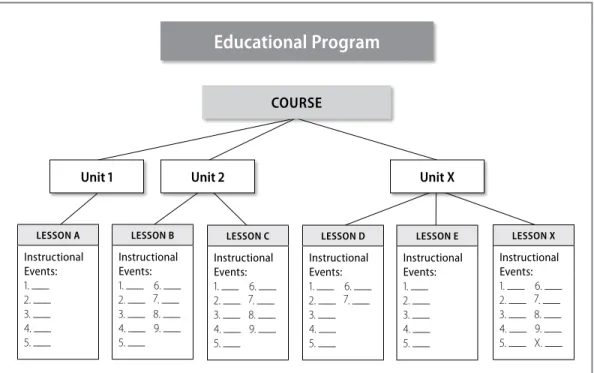
To effectively facilitate game-based learning in K–12 classes, it’s important to see how games may be played and integrated at different levels of instruction and to relate these levels to how educators organize courses in terms of structure and function. Typically, training and educa-tional programs are composed of courses that are divided into instruceduca-tional units or modules. Depending on scope, an instructional unit may be equivalent to a “lesson” or may be further broken down into two or more lessons. Lessons, in turn, may be viewed as a series of instruc-tional events. Figure 10.1 illustrates how a course may be divided into instrucinstruc-tional units, and how instructional units may be divided into lessons, and how lessons may be viewed as a series of instructional events. Of course, the specific number of events, lessons, and units contained in a course will vary by course. As depicted in Figure 10.1, a course may consist of two to X number of units. A unit may consist of one lesson or may be broken down into two or more lessons, and each lesson may consist of a varying number of instructional events depending on the strategy that is used to guide the design and sequencing of events.
To integrate gameplay into courses, let’s consider how a new game may be designed or an existing game may be applied at various levels:
Level I (event Level). Game played to address one or more instructional events within a lesson or across lessons;
Level II (Lesson Level). Game played to complete one or more instructional lessons;
Level III (Unit/Module Level). Game played to complete one or more instructional units, across lessons within the unit/module;
Level IV (Course Level). Game played as an entire course, including all lessons and units; and
Level V (program Level). Game played as an instructional program of study made up of two or more courses.
At the Event Level (Level I), a new educational video game may be designed or an existing video game may be integrated to facilitate one or more instructional events within an instructional lesson or across lessons. For example, a relatively simple drill and practice or frame-game may be designed or an existing game may be played to help students recall factual content or to promote their active involvement and discussion (Dempsey, Lucassen, Haynes, & Casey, 1996; Blake and Goodman, 1999). A similar game may also be played at Level I to address the same events across lessons. At the Lesson Level (Level II), a game may be played in place of an instructional lesson or multiple lessons, addressing all of the key events and activities associated with the lesson or lessons. At the Unit Level (Level III), a game may be played to complete one or more, but not all, instructional units contained in a course, addressing all of the events and activities including in the unit or units. At the Course Level (Level IV), one game may be played as an entire course of instruction, incorporating all units, lessons, and events associated with the course. It is also conceivable that a game may be designed or an existing game may be played at a Program Level FIgUre 10.1 ▶ Educational course divided into events, lessons, and units
LeSSon a Instructional Events: 1. ___ 2. ___ 3. ___ 4. ___ 5. ___ LeSSon B Instructional Events: 1. ___ 6. ___ 2. ___ 7. ___ 3. ___ 8. ___ 4. ___ 9. ___ 5. ___ LeSSon C Instructional Events: 1. ___ 6. ___ 2. ___ 7. ___ 3. ___ 8. ___ 4. ___ 9. ___ 5. ___ LeSSon D Instructional Events: 1. ___ 6. ___ 2. ___ 7. ___ 3. ___ 4. ___ 5. ___ LeSSon e Instructional Events: 1. ___ 2. ___ 3. ___ 4. ___ 5. ___ LeSSon x Instructional Events: 1. ___ 6. ___ 2. ___ 7. ___ 3. ___ 8. ___ 4. ___ 9. ___ 5. ___ X. ___
educational program
Unit x Unit 2 Unit 1 CoUrSe(Level V) where completion of the game would satisfy the requirements specified for two or more courses associated with a certificate, degree, or training program. However, the likelihood of such a large-scale game being developed or played at Level V seems remote, at least at this time. To further illustrate the five levels of gameplay, let’s consider the relationship between course structure and grounded instructional strategies. A grounded instructional strategy consists of a set of instructional events that are designed and sequenced based on learning or instructional theories and research. In other words, the strategy is grounded in research and theory. To see how video games may be integrated with instruction, let’s look at two examples: one applying what may be considered as a traditional teacher-directed instructional strategy, Gagné’s Nine Events of Instruction, and the other applying what may be viewed as a student-centered instructional strategy, the 5E instructional model.
Gagné’s (1974, 1977) Nine Events of Instruction are grounded in cognitive information processing (CIP) theories of human learning. Each of Gagné’s nine events is associated with and designed to facilitate a specific step in the cognitive information processing theory of learning and should be addressed to facilitate achievement of the objectives specified for an instructional lesson or unit. The following are Gagné’s Nine Events of Instruction:
1. Gaining learners’ attention
2. Informing learners of objectives
3. Recalling prior knowledge
4. Presenting stimulus (Content information)
5. Providing learning guidance
6. Eliciting performance
7. Providing feedback
8. Assessing performance
9. Enhancing retention and transfer
Gagné’s instructional strategy is considered “teacher-directed” because the instructor takes primary responsibility for specifying objectives; selecting, organizing, and delivering the content information; defining student assessment methods and criteria; and otherwise directing the learning process to ensure that students retain the content learned as they transfer and apply it toward accomplishing meaningful work or research.
The relationship between course structure (i.e., event, lesson, unit, course, program) and instruc-tional function, based on application of a grounded instrucinstruc-tional strategy, is important for understanding the design and integration of games. Applying Gagné’s nine events, for example, we can see that a game may be played at Level I to present stimulus, elicit performance, and/ or assess performance (in other words, a subset of events within an instructional lesson or lessons). At Level II, gameplay would address all nine of Gagné’s events to facilitate achievement
of objectives specified for a lesson or lessons. At Level III, a game would be played to complete an entire unit or several units within a course that may, in turn, consist of multiple lessons. At level IV, a game would be played to fulfill the requirements associated with an entire course, addressing all of the instructional events specified for the units and lessons contained in the course. At Level V, the game would transcend multiple courses and either be played as a part of or form an entire program of study.
Now, consider another example of how a grounded approach can be used to design and integrate video games into instruction. Let’s say you decide to apply the 5E instructional model to promote inquiry-based learning (BSCS, 2005). The 5E model calls for the instructor to design and facilitate five types of instructional events within an instructional lesson or unit, including:
1. Engage learners in problem or topic;
2. Learners Explore key skills, concepts, and content information;
3. Learners Explain what they have learned from their exploration;
4. Elaborate key concepts and skills with learners by filling in gaps, correcting misconcep-tions, and otherwise clarifying and adding to what was learned; and
5. Evaluate learners’ skills and knowledge, including learners’ self-assessment.
Like the first example, at the Event Level, a new game may be designed or an existing game may be played to facilitate one or more instructional events within a lesson or lessons. For instance, a relatively simple game show (e.g., Jeopardy!) may be played to evaluate learners’ acquisition of key concepts and verbal information. Or an adventure game may be used to engage learners and facilitate the exploration of key concepts, principles, and/or procedures, leaving the instructor to work with students to explain, elaborate, and evaluate what was learned from gameplay outside of the game environment. At the Lesson Level, a game would address all five events (i.e., engage, explore, explain, elaborate, and evaluate) contained in one or more lessons within a course. At the Unit Level, a game may be played in place of one or more, but not all, units in a course; in other words, the game would address all five events related to the 5E model multiple times. At the Course Level, a game would be played to address all of the events, lessons, and units contained in a course. And at Program Level IV, a game may cover all courses associated with a certificate, degree, or training program.
The two examples of instructional strategies illustrate how the grounded approach may be applied within the structure of a traditional, teacher-directed approach to teaching and learning, as well as within a relatively modern, learner-centered approach. In the first example, based on the application of Gagné’s Nine Events of Instruction, the teacher informs students of learning objec-tives, organizes and presents content information, and directs the instructional process. (Note that some games are designed to tell students what they will be learning as they play the game.) In the second example of a learner-centered approach, based on the 5E instructional model, the teacher (and sometimes the game itself) may introduce one or more learning events, and then the students take more responsibility for and have more control over the learning process.
The two examples also depict the varying roles the teacher may take during instruction to guide and monitor game-based learning. In the first example, applying Gagné’s Nine Events of Instruction, the teacher may do something at the beginning of a class to gain learners’ attention, informing them of objectives and helping them to recall prior knowledge. The teacher may then ask learners to play a game that presents content information, provides learning guidance, elicits performance, and provides feedback. After gameplay, the teacher may step in to assess learners’ performance and enhance retention and transfer. In the second example, applying the 5E instruc-tional model, the teacher may use a game to engage students’ interest and to encourage them to explore key skills, concepts, and questions and to design a research inquiry. After gameplay, the teacher may ask learners to explain what they learned from gameplay and then work with students to elaborate on explanations of how this knowledge can be applied to real-world situa-tions. The instructor may then use different tools and techniques to evaluate student achievement, possibly asking students to assess how well the game delivered its objectives.
In the first part of this chapter, I related the structure and function of courses to the structure and function of games to distinguish five levels of gameplay, noting how (a) courses may be broken down into instructional units, lessons, and events; (b) grounded instructional strategies consist of a set of instructional events; (c) grounded strategies may be applied to a course; and (d) games may be played as a course, unit, lesson, and/or event. Two examples of how games may be applied at varying levels were presented, based on a traditional, teacher-directed strategy and on a more modern, learner-centered strategy for teaching and learning. In the second part of the chapter, I detail five steps for integrating games to facilitate learning in classroom settings based on grounded instructional strategies.
Five Steps for Integrating gameplay
For teachers who are just beginning to use video games to enhance learning, the process for integrating gameplay into the curriculum may be easier to understand and apply by initially breaking it down into five relatively simple steps. As teachers increase their knowledge of games and gain experience playing and integrating games for educational purposes, these steps can be transformed into a set of guidelines that may be applied concurrently or in different combinations and sequences, depending on the context.
Step 1. Select a grounded instructional strategy, based on specified objectives, learners’ characteristics, classroom context, and epistemological beliefs.
Step 2. Play games and determine their suitability and instructional purpose. (Is gameplay appropriate? What instructional events are addressed by the game?)
Step 3. Operationalize instructional strategy by describing how each event will be applied and noting when a game should be played.
Step 4. Address technical and logistical issues (e.g., scheduling student access to computers and game).
Step 5. Pilot test gameplay and formatively evaluate instructional materials.
Step 1. Select a grounded Instructional Strategy
I believe the selection and application of an appropriate instructional strategy is important for stimulating learning in general and essential for facilitating game-based learning. An instruc-tional strategy consists of a comprehensive set of instrucinstruc-tional events and activities necessary to help students achieve a specified set of objectives. This strategy guides the design and sequencing of events included in a lesson or unit. The strategy, whether it is teacher directed or learner centered, determines the nature of the learning environment. For game-based learning, the application of instructional strategy helps ensure that vital instructional events before and after gameplay are included to support learning in a lesson or unit; support which has been shown to be just as important as playing the game itself to facilitate learning.
Table 10.1 outlines a number of instructional strategies grounded in educational research and learning theories published over the past 10 to 15 years. The strategies range from traditional, teacher-directed methods to more learner-centered approaches to teaching and learning. For teachers, selection of an appropriate strategy requires thinking about the desired learning outcomes and key contextual factors, as well as their personal values and beliefs about teaching and learning. Selecting an instructional strategy may also push teachers to step out of their comfort zones, possibly experimenting with a different strategy, one never experienced as students or as educators.
A fundamental instructional design principle is that the nature of the desired learning outcome(s) should drive the instructional design process. For instance, the specific technique used to analyze an instructional situation should be based on targeted learning outcomes (Jonassen, Tessmer, & Hannum, 1999). Similarly, learner assessment methods should be determined by the nature of specified objectives (Berge, 2002; Hirumi, 2002a). The same principle applies to the selection of a grounded instructional strategy.
For example, for instruction on the use of a new photocopying machine, a direct instructional strategy (e.g., Joyce, Weil, & Showers, 1992) may be most effective and efficient. When a problem has basically one correct answer and/or one correct method for deriving the answer, learners may not need to interact with others to derive meaning and construct knowledge through social discourse. In the case of the photocopying machine, the instruction may direct learners to push Button A, then Button B, and if something goes wrong, to check Buttons C and D. In contrast, if the desired learning outcome requires higher-order thinking and if more than one correct answer or more than one method for deriving the correct answer exists, then a student-centered approach that encourages learners to interact with experts and other learners to interpret and apply targeted skills and knowledge may be appropriate.
taBLe 10.1 ▶ Primary instructional events associated with grounded instructional strategies Learner-CentereD approaCheS BSCS 5e Model (Bybee, 2002; BSCS, 2005) 1. Engage 2. Explore 3. Explain 4. Elaborate 5. Evaluate WebQuest (Dodge, 2007) 1. Introduction 2. Task 3. Process 4. Resources 5. Evaluation 6. Conclusion Constructivist Learning (Jonassen, 1999) 1. Select problem
2. Provide related cases
3. Provide information
4. Provide cognitive tools
5. Provide conversation tools
6. Provide social support
Learning by Doing
(Schank, Berman, & Macpherson, 1999)
1. Define goals
2. Set mission
3. Present cover story
4. Establish roles 5. Operate scenarios 6. Provide resources 7. Provide feedback Collaborative problem-Solving (Nelson, 1999) 1. Build readiness
2. Form and norm groups
3. Determine preliminary problem
4. Define and assign roles
5. Engage in problem-solving
6. Finalize solution
7. Synthesize and reflect
8. Assess products and processes
9. Provide closure
eight events of
Student-Centered Learning
(Hirumi, 2002b, 1996, 1998)
1. Set learning challenge
2. Negotiate goals and objectives
3. Negotiate learning strategy
4. Construct knowledge
5. Negotiate performance criteria
6. Assess learning
7. Provide feedback (steps 1–6)
8. Communicate results
Case-Based reasoning
(Aamodt & Plaza, 1994)
1. Present new case/problem
2. Retrieve similar cases
3. Reuse information
4. Revise proposed solution
5. Retain useful experiences
Simulation Model
(Joyce, Weil, & Showers, 1992)
1. Orientation
2. Participant training
3. Simulation operations
4. Participant debriefing
5. Appraise and redesign the simulation
Interplay Strategy
(Stapleton & Hirumi, in press)
1. Expose 2. Inquire 3. Discover 4. Create 5. Experiment 6. Share teaCher-DIreCteD approaCheS nine events of Instruction
(Gagné, 1974, 1977)
1. Gain attention
2. Inform learner of objective(s)
3. Recall prior knowledge
4. Present stimulus materials
5. Provide learning guidance
6. Elicit performance
7. Provide feedback
8. Assess performance
9. Enhance retention and transfer
Direct Instruction
(Joyce, Weil, & Showers, 1992)
1. Orientation
2. Presentation
3. Structured practice
4. Guided practice
5. Independent practice
elements of Lesson Design
(Hunter, 1990)
1. Anticipatory set
2. Objective and purpose
3. Input
4. Modeling
5. Check for understanding
6. Guided practice
7. Independent practice
Contextual factors, such as learner characteristics and the number and nature of learning sites, also affect the selection of an instructional strategy. In some situations, learners may have greatly varying prior knowledge of the subject matter. For example, it is not uncommon for some students to begin an introductory computer course with considerable computer experience, while others may start with few or no computer skills. In such cases, a learner-centered approach that allows students to negotiate their own learning objectives, strategies, and assessments based on their particular needs and interests can be useful (see Hirumi, 2002b). Whenever it is important for students to work at their own varied paces, a self-instructional strategy benefits the students and the teacher. Self-instructional materials that guide students to monitor and regulate their own learning, with few learner-instructor interactions, can be more appropriate than a collabora-tive approach that requires a high number of planned learner-learner and/or learner-instructor interactions.
In selecting an appropriate strategy, it is also important for educators to take into account their educational philosophies and epistemological beliefs. If you believe that people derive meaning and construct knowledge through social interactions, then a constructivist instructional strategy that includes some form of collaboration among your students may best support your beliefs and values. Similarly, if you believe people learn best by “doing,” then an experiential approach may resonate with your educational philosophy.
Selecting an appropriate instructional strategy is neither simple, nor straightforward. The desired learning goals and objectives need to be considered above all, yet concerns for the learner, the context of the classroom, and the instructor’s fundamental beliefs about teaching and learning also mediate the selection process. Perhaps even stronger influences are time and expertise. With insufficient time or training, educators often revert to what they know best; that is, teacher-directed methods and materials. To select an appropriate instructional strategy, the instructor and/or designer must have the time and skills necessary to analyze several important variables and to develop a good understanding of alternative strategies. They must also have the confidence, desire, and opportunity to apply alternative instructional strategies within the context of their jobs.
Step 2. play games and Determine
their Suitability and Instructional purpose
After selecting a grounded instructional strategy, teachers should play and select games for poten-tial use in their classes by determining (a) the suitability of gameplay in general and of specific games in particular, and (b) the instructional nature and purpose(s) of each of the selected games. How can teachers determine whether playing games in general is suitable for their classes? How can they decide whether particular games fit their students’ needs or are engaging? And how can the selected games meet the course’s instructional objectives? In Chapter 5, Dieterle identified a series of logistical and instructional questions to help teachers determine whether games can and should be played to facilitate student learning in their classes. I also encourage teachers to answer the questions he poses regarding instructional logistics and learning objectives to help decide whether and when to play games in classes. In an analysis of websites designed to support the use of instructional games, Kebritchi, Hirumi, Kappers, and Henry (2008) noted key technical and logistical issues that must be addressed before playing games in schools, including compatibility
with preexisting systems; the availability of necessary hardware, software, and technical support; and time/scheduling. Furthermore, as Hays notes in Chapter 11, studies with a wide range of learners in a variety of training and educational settings show that students can learn from playing games if appropriate games are used and properly integrated with instruction. Now that we have covered the preliminary issues for teachers to consider before deciding to incorporate gameplaying into their classes, I am going to address each of you in a more personal manner. Assuming that you have considered key technical and logistical issues and have found that your students, classroom, and support system are suited for gameplay and that you know or have learned how to integrate games with instruction properly (as discussed in this chapter and throughout Section III of this book), how do you find appropriate games for your class?
Section II (Chapters 5–9) of this book identified a number of games that may be appropriate for math, science, social studies, language arts, and physical education. In those chapters, as well as in Chapter 11, the authors further stress the importance of selecting games that match students’ skills and knowledge and present them with an appropriate level of challenge. We also know that the contents of the game should be current, accurate, and free of bias and that the game should support the achievement of specified instructional objectives. So, let’s say you have played several games and have found one or more that may be appropriate for your class, then what? To integrate gameplay, it is also essential to understand the game’s instructional nature and determine its purpose(s) within the context of your course, unit, and/or lesson.
What types of instructional events are facilitated by the game, or what role will it play within particular lesson(s) or unit(s)? In other words, what specific instructional purpose(s) will the game serve during a lesson, unit, or course? Is the game best suited to engage learners and capture their attention at the beginning of a lesson or unit? Does the game present relevant scenarios or simulations that students may operate to test hypotheses, identify trends and issues, or gain insights on how a system functions? Does the game teach new skills and content, or is it better suited to reinforce and give students opportunities to practice recently learned skills? Does the game include appropriate learner assessments and feedback?
Answering the aforementioned questions and determining the instructional nature and purposes of the selected games will help you decide how and when gameplay fits with your instructional strategy. You will also know what you must do before and after gameplay to facilitate learning. Note the instructional purposes of your game; that is, when and why you are going to integrate the game within your lesson, unit, or course, and go to Step 3.
Step 3. operationalize Instructional Strategy
Operationalize each event of your selected instructional strategy, noting when and how games should be played and what additional instructional events must be addressed before and after gameplay. To complete Step 3, list the instructional events associated with your selected instruc-tional strategy in one column and then describe how you plan to facilitate each event in a second column. Step 3 is best illustrated through a couple of examples.
example 1—Integrating a Math game with hunter’s elements of Lesson Design
For this example, let’s say a math teacher has been applying Hunter’s (1990) elements of lesson design and wants to integrate gameplay with her pre-algebra class to enhance student motivation and achievement.For Step 1, the teacher decides to keep using Hunter’s elements of lesson design throughout most of her course because (a) she believes that a teacher-directed approach is the most efficient and effective way of achieving course objectives, given the nature of the objectives, which are applying basic math formulas and relatively simple math concepts, (b) it suits the number of students and classes, five classes with approximately 30 students per class, and (c) Hunter’s elements are familiar and appear similar to how she has been teaching the class for the past three years. For Step 2, the teacher finds that Tabula Digita publishes a set of single and multiplayer pre-algebra math games (DimensionM) that addresses many of the topics covered in her course. She plays the games and finds out that they play just like a modern video game, with 3-D immersive graphics, game worlds, and characters she thinks students will really like. She sees that the games provide a lot of good practice for applying many of the pre-algebra concepts she covers in class, but she realizes that the games do not actually teach the concepts. She notes that the games’ primary instructional purposes would be for practice, reinforcement, and self-assessment. Table 10.2 depicts the two-column table recommended earlier for operationalizing the instruc-tional strategy selected during Step 1. It presents an example of how a teacher may apply an instructional strategy for a lesson on adding and subtracting integers that integrates the use of a math video game. Column 1 lists the key events associated with Hunter’s elements of lesson design. Column 2 provides a short description of how the instructor plans to teach each event.
taBLe 10.2 ▶ An example of how a teacher would apply Hunter’s elements for a lesson on adding and subtracting integers that integrates the use of a math video game
eVentS DeSCrIptIonS oF teaCher’S aCtIonS
anticipatory set Gain attention by informing students they will be playing a video game for this lesson and others if this trial works out well. Note that to successfully complete one of the missions in the game, students must know how to add and subtract integers. Stimulate students’ recall of prior knowledge by reviewing definitions and examples of related terms and concepts, such as integers, negative numbers, positive numbers, and opposite of numbers.
objectives and purpose Inform students that they will be expanding their understanding of integers by distin-guishing negative and positive numbers and learning how to add and subtract integers. Have students identify and discuss real-life applications of integers and operations on these numbers, like temperature, acceleration, sports, finances, and altitude.
Input Explain basic concepts by providing examples that combine saving and debts. Illustrate how the examples are similar to adding positive and negative numbers.
Modeling Go over several additional situations involving positive and negative numbers as addends in a mathematical sentence. Also use number lines to represent the relationship between the addends using arrows and integers. Use examples such as calculating change in temperature, acceleration, and/or altitude.
Check for understanding Distribute a handout and ask students to complete problems alone. Give students time to complete problems and then review them with class.
eVentS DeSCrIptIonS oF teaCher’S aCtIonS
guided practice Present problems and work through their answers together. Review the differences between each question and how positive and negative numbers affect the outcome of the total. Relate examples to the number line to give students a better understanding of the concept of positive and negative integers.
Independent practice Have students go to the computer lab and complete Mission 09 of the Single Player Pre-Algebra Game. Explain to students that in the game the government is planning to use a satellite laser to erase the mistakes they made on Xeno Island, and the students’ mission is to get to the Communication Center and cut off the satellite link by adding and subtracting integers. Ensure they know how to access and start the game. Considering printing and giving each student a short handout listing steps for accessing the game and getting to Mission 09. Be sure to tell students that they must complete the mission to earn credit. If they don’t have time to complete it today, they can complete it by accessing the game from home or going to the lab later in the day or sometime tomorrow.
Closure Ask students to write what they have learned about integers. Have students write any ques-tions they may have. Also ask students to write down what, if anything, they would like to do differently the next time they play a game as a part of class.
As Table 10.2 indicates, it is important for the teacher to teach a number of important instruc-tional events before and after students play the game because simply playing the game will not ensure that students will achieve the specified objectives. The teacher must (1) prepare for and facilitate events to gain students’ attention and help them recall prior knowledge (anticipatory set), (2) inform students of the learning objectives and illustrate the importance of achieving the objectives, (3) teach and model application of the targeted math concepts, and (4) check for under-standing and give some guided practice—all before playing the game! Additionally, the teacher must spend some time to explain how gameplay relates to the lesson, ensure students know how to access the game, and communicate expectations for playing the game. After gameplay, the teacher must also provide closure to enhance retention and reinforce knowledge and skills. The next example illustrates how a game may be integrated with a learner-centered instructional strategy.
example 2—Integrating a Science game with the 5e Instructional Model
For Example 2, let’s say a high school science teacher wants to integrate gameplay into his classes to enhance student learning. He decides to apply the 5E instructional model for an instructional unit on immunology. The teacher believes that a learner-centered, inquiry-oriented approach may be an effective way to achieve specified lesson objectives. He has heard that the 5E model is based on the natural inquiry process of children and problem-solving among adults.
Surfing the web, using the keywords “immunology” and “video game,” the teacher discovers that the Federation of American Scientists (FAS) has published a game called Immune Attack (2008). He downloads the game, which is free for educational purposes, plays the game, and finds that it actually consists of five separate but interrelated games about different aspects of immunology. He is excited and relieved to see that FAS has published a teacher’s guide, a game guide, and a tech-nical support manual with FAQs for the game, and provides a mechanism for reporting problems.
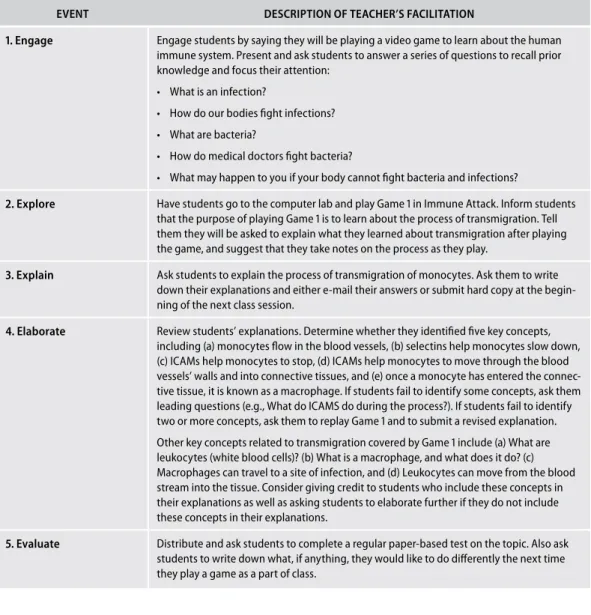
Like Table 10.2, Table 10.3 illustrates how the teacher plans to apply the instructional strategy selected in Step 1 of the game integration process for an instructional unit on immunology. Column 1 lists the five key E words associated with the 5E instructional model, and Column 2 provides a short description of how the teacher plans to facilitate each event. Suggestions for engaging (Event 1) and elaborating on students’ explanations (Event 4) were derived from a sample lesson plan posted by FAS (2008).
As Table 10.3 indicates, it is important for teachers to begin the unit or lesson and set up gameplay by asking students a series of questions. In this particular example, the questions are asked to get them to recall prior knowledge, to focus their attention, and to engage them as interested learners. The teacher then gives students time to play the selected game and explore its contents, ensuring they know why they are playing the game and what is expected of them.
taBLe 10.3 ▶ An example of how a teacher would apply the 5E instructional model for a unit on immunology, integrating the use of a science video game
eVent DeSCrIptIon oF teaCher’S FaCILItatIon
1. engage Engage students by saying they will be playing a video game to learn about the human immune system. Present and ask students to answer a series of questions to recall prior knowledge and focus their attention:
• What is an infection?
• How do our bodies fight infections? • What are bacteria?
• How do medical doctors fight bacteria?
• What may happen to you if your body cannot fight bacteria and infections?
2. explore Have students go to the computer lab and play Game 1 in Immune Attack. Inform students that the purpose of playing Game 1 is to learn about the process of transmigration. Tell them they will be asked to explain what they learned about transmigration after playing the game, and suggest that they take notes on the process as they play.
3. explain Ask students to explain the process of transmigration of monocytes. Ask them to write down their explanations and either e-mail their answers or submit hard copy at the begin-ning of the next class session.
4. elaborate Review students’ explanations. Determine whether they identified five key concepts, including (a) monocytes flow in the blood vessels, (b) selectins help monocytes slow down, (c) ICAMs help monocytes to stop, (d) ICAMs help monocytes to move through the blood vessels’ walls and into connective tissues, and (e) once a monocyte has entered the connec-tive tissue, it is known as a macrophage. If students fail to identify some concepts, ask them leading questions (e.g., What do ICAMS do during the process?). If students fail to identify two or more concepts, ask them to replay Game 1 and to submit a revised explanation. Other key concepts related to transmigration covered by Game 1 include (a) What are leukocytes (white blood cells)? (b) What is a macrophage, and what does it do? (c) Macrophages can travel to a site of infection, and (d) Leukocytes can move from the blood stream into the tissue. Consider giving credit to students who include these concepts in their explanations as well as asking students to elaborate further if they do not include these concepts in their explanations.
5. evaluate Distribute and ask students to complete a regular paper-based test on the topic. Also ask students to write down what, if anything, they would like to do differently the next time they play a game as a part of class.
Event 3 in the 5E instructional model represents a significant departure from traditional, teacher-directed instructional methods. Rather than having the teacher lecture and explain key principles, concepts, and facts to students, the students are to explain what they learned from playing the selected game and exploring its contents. Student-generated explanations provide valuable insights into what they have learned, what they have not learned, and what misconcep-tions they may have about what they have learned. The teacher then uses this information to fill in any gaps in students’ learning and correct misconceptions by asking them to elaborate on their explanations as described for Event 4 in Table 10.3, for example. Finally, the teacher evaluates students’ learning and their reactions to the instructional unit/lesson to assess their achievement and progress, as well as the effectiveness and appeal of gameplay as a tool to convey the instruc-tional unit/lesson.
Together, the two examples illustrate how teachers may operationalize their selected instructional strategy and integrate gameplay with their instruction. The examples also show how games may be played in the contexts of what may be considered a traditional, teacher-directed approach and a more student-centered approach to teaching and learning. Now that you have a basic plan for playing and integrating the use of games in your class, it’s time to address technical and logistical issues to help ensure that all goes as planned.
Step 4. address technical and Logistical Issues
In Step 2 (Play Games and Determine Their Suitability), you considered a series of technical and logistical issues to determine whether gameplay in general and specific games in particular are suitable for your class. In short, you selected potential games for use in your class by determining whether you, your school, and/or students have the (a) hardware, software (e.g., operating system), and network infrastructure necessary to access and play the games; (b) money necessary to acquire the game(s); (c) basic technical skills to learn how to play the game(s) readily; and (d) time to play the game and resources necessary to provide sufficient access to the game(s). Now it’s time to address the technical and logistical issues.
First, you must determine when and where students are to access the game(s). Are students to access the game at the beginning, at the end, or throughout an instructional unit? Are students to access the game in class, in computer labs, at home, and/or at community centers, such as in nearby libraries? Are students to access the game individually, in pairs, and/or in small groups? How much time do students need to play the game(s)? The answers to these questions will help you establish a schedule and, if necessary, a rotation for students to access the game(s).
Second, work with your school’s administrators, technology coordinator, and technology support staff to acquire and set up the game(s) for use in class, library, and/or computer lab(s). If you plan to provide access to games in community centers, such as a local library, also be sure to contact the person in charge of the computers to ensure that the facility has the means and desire to provide access to the selected game(s). Make sure the school’s tech support staff know when students are to access the games and how to contact technical support for the games’ publisher to troubleshoot problems and maintain the games. Also, ensure that students know how to down-load the game(s) (if necessary) and what to do if they have problems setting up, accessing, or
playing the games, particularly if they are expected to play at home. Consider writing out instruc-tions for the school’s tech staff as well as for your students and posting them on your own website or the school’s website for easy access. Giving students a printed handout to take home is another option.
Third, work with your school’s administrators, technology coordinator, technology support staff, and community center representative (if necessary) to ensure proper policies and procedures are in place to regulate and monitor gameplay and access to the games. Make sure the policies and procedures are properly documented and communicated to your students and their caregivers. Fourth, make sure you know how to access your students’ data so that you can monitor their gameplay. Many games record when and how long students access the game. Many also keep records of students’ scores. If your unit or lesson requires students to complete certain missions, puzzles, and/or other activities within the game, make sure you know how to access and record relevant student data.
Finally, acquire and/or develop the instructional materials necessary to support, properly
integrate, and facilitate the use of games in your class. In Step 3, you operationalized your instruc-tional strategy and determined what instrucinstruc-tional events must be addressed before, during, and after gameplay. Review your instructional strategy and either acquire or develop the materials that are necessary to facilitate each instructional event.
You should now be ready to play games in class to enhance student learning and motivation. However, before you actually implement your unit or lessons, I encourage you to run a pilot test of the game and your instructional materials with a group of students who represent the various academic and technological ability levels of your target learner population.
Step 5. pilot test gameplay and Formatively evaluate
Instructional Materials
If students do not achieve specified instructional objectives or simply do not like the instruction built into playing video games, teachers often blame the students, and students typically blame the teacher. The fact is, neither the students nor the teacher may be to blame; rather, gameplay may not go as well as everyone originally thought it would, or the instructional materials used before, during and/or after gameplay may be the reasons why students did not learn or did not enjoy their experience. To ensure the effectiveness of gameplay before you actually use the game in class, you should pilot test each game and formatively evaluate the instructional materials. No matter how often you have played a game with classes in the past or how much fun you think students will have playing the game, students are likely to differ in terms of their abilities to use the game and their gameplay preferences. Before you spend valuable class time playing the game, it’s always a good idea to test the game with a few students who represent your learner population first. Take notes as they play the game and ask the following questions at the end of each test session: Are students readily able to learn how to play the game? How much time did it take before they felt comfortable playing the game? How much time did it take for students to complete targeted portions of the game? Is additional training necessary for some or all students?
Did they enjoy playing the game? The answers to each of these questions are important to verify the feasibility of integrating the game with instruction.
I encourage you to formatively evaluate the instructional materials you plan to use before, during, and/or after gameplay. Formative evaluation occurs prior to actual instructional delivery to ensure the effectiveness and efficiency of the instruction (Dick, Carey, & Carey, 2005). Specifically, the instructional materials should be tested with representative members of the target learner population for (a) clarity—is the message or what is being presented clear to individual learners? (b) impact—what is the impact of the instruction on various individuals’ attitudes and achieve-ment of the objectives and goals? and (c) feasibility—how feasible is the planned instruction given the available time and resources?
Summary
Like the use of other emerging technologies, the proper integration of games requires plan-ning and the possible development of supporting instructional materials. In this chapter, I have presented a grounded approach to integrating instructional video games with instruction and facilitating game-based learning. In the first part, I analyzed the structure and function of classroom instruction and related them to the structure and function of games to illustrate how games may be applied at five levels, including Event Level I—as an instructional event or events; Lesson Level II—as an instructional lesson; Unit Level III—as an instructional unit or module, played across lessons; Course Level IV—as an instructional course, across all lessons and units; or Program Level V—as a program of study made up of two or more courses. Then, in the second part of the chapter, I presented five steps for integrating instructional video games with instruc-tion based on teacher-directed and student-centered instrucinstruc-tional strategies.
Similar to the other approaches for integrating games posited in Section III of this book, I also stress the importance of providing instructional support and facilitating key instructional events before and after gameplay to optimize game-based learning. Unlike the other approaches, I recommend selection and use of a grounded instructional strategy to determine when and how games are played and to ensure students experience all of the instructional events necessary to optimize game-based learning before, during, and after gameplay. This is not to say that the other approaches to integrating games are not as valid; rather, I provide an alternative approach to integrating games with instruction for teachers to consider.
While playing games in schools may not motivate all students or ensure that all of them achieve high academic standards, I do believe games offer a valuable addition to our arsenal of tools and techniques for enhancing individual and group learning, particularly as we compete with cell phones, entertaining video games, and the Internet for our students’ time and attention. So, go ahead, play some games, and have some fun; you may find that you enjoy teaching with games as much as your students enjoy learning with them.
references
Aamodt, A., & Plaza, E. (1994). Case-based reasoning: Foundational issues, methodological variations,
and systems approaches. Artificial Intelligence Communications, 7(1), 39–59. Retrieved April 8,
2010, from www.gaia.fdi.ucm.es/people/pedro/aad/Aamodt_Plaza94.pdf
Berge, Z. (2002). Active, interactive and reflective elearning. Quarterly Review of Distance Education,
3(2), 181–190.
Blake, J., & Goodman, J. (1999). Computer-based learning: Games as an instructional strategy.
The Association of Black Nursing Faculty Journal, 10(2), 43–46.
BSCS Center for Professional Development. (2005). Learning theory and the BSCS 5E instructional
model. Colorado Springs, CO: BSCS Center for Professional Development. Published for the
NSTA Professional Development Institute’s National Convention, Dallas, TX, March 31, 2005. Retrieved April 6, 2010, from http://iisme.5ecommunity.org/members/aliciab/images/5-E%20 Instructional%20Model.pdf
Bybee, R. W. (2002). Scientific inquiry, student learning, and the science curriculum. In R. W. Bybee
(Ed.), Learning science and the science of learning (pp. 25–36). Arlington, VA: NSTA Press.
Dempsey, J. V., Lucassen, B. A., Haynes, L. L., & Casey, M. S. (1996). Instructional applications of
computer games. New York: Annual Meeting of the American Educational Research Association.
(ERIC Document Reproduction Service No. ED 394 500)
Dick, W., Carey, L., & Carey, J. O. (2005). The systematic design of instruction (6th ed.). Boston: Allyn
& Bacon.
Dodge, B. (1998). Webquest.Org. Retrieved July 14, 2010, from http:///webquest.org
Federation of American Scientists (FAS). (2008). Immune attack general lesson plan, version 3.0,
for Grades 9–12, covering immune system, disease, and infection. Available at http://fas.org/ immuneattack/wp-content/uploads/2008/05/ia-lesson-plan-v30.pdf
Gagné, R. M. (1974). Principles of instructional design. New York, NY: Holt, Rinehart, and Winston.
Gagné, R. M. (1977). The conditions of learning (3rd ed.). New York, NY: Holt, Rinehart, and Winston.
Hirumi, A. (1996, February). Student-centered, technology-rich learning environments: A
cognitive-constructivist approach. Presentation at the Association for Educational Communication and
Technology Conference, Indianapolis.
Hirumi, A. (1998, March). The systematic design of student-centered, technology-rich learning
environments. Guest presentation given at the first Education Graduate Students and Academic
Staff Regional Meeting, Guadalajara, Mexico.
Hirumi, A. (2002a). A framework for analyzing, designing and sequencing planned e-learning
interactions. Quarterly Review of Distance Education, 3(2), 141–160.
Hirumi, A. (2002b). Student-centered, technology-rich learning environments (SCenTRLE):
Operationalizing constructivist approaches to teaching and learning. Journal of Technology
and Teacher Education, 10(4), 497–537.
Hunter, M. (1990). Lesson design helps achieve the goals of science instruction. Educational
Jonassen, D. (1999). Designing constructivist learning environments. In C. M. Reigeluth (Ed.),
Instructional-design theories and models: A new paradigm of instructional theory. Volume II.
(pp. 215–239). Mahwah, NJ: Lawrence Erlbaum.
Jonassen, D. H., Tessmer, M., & Hannum, W. H. (1999). Task analysis methods for instructional design.
Mahwah, NJ: Lawrence Erlbaum.
Joyce, B., Weil, M., & Showers, B. (1992). Models of teaching (4th ed.). Boston, MA: Allyn & Bacon.
Kebritchi, M., Hirumi, A., Kappers, W., & Henry, R. (2008). Analysis of the supporting websites for
the use of instructional games in K–12 settings. British Journal of Educational Technology, 40(4),
733–754. Available from www3.interscience.wiley.com/journal/122455207/issue
Nelson, L. (1999). Collaborative problem-solving. In C. M. Reigeluth (Ed.), Instructional-design
theories and models: A new paradigm of instructional theory. Volume II. (pp. 241–267).
Mahwah, NJ: Lawrence Erlbaum.
Schank, R. C., Berman, T. R., & Macpherson, K. A. (1999). Learning by doing. In C. M. Reigeluth (Ed.),
Instructional-design theories and models: A new paradigm of instructional theory. Volume II.
(pp. 161–179). Mahwah, NJ: Lawrence Erlbaum.
Stapleton, C., & Hirumi, A. (in press). Interplay instructional strategy: Engaging learners with
interactive entertainment conventions. In M. Shaughnessy & S. Veronikas (Eds.), Implications