INEEL/CON-02-00569
PREPRINT
Lessons Learned: Using Low Cost, Un-Cooled
Infrared Cameras For The Rapid Liquid Level
Assessment Of Chemical UXO And Storage
Vessels
Kevin L. Young
September 3, 2002
The UXO/Countermine Forum 2002
This is a preprint of a paper intended for publication in a journal or proceedings. Since changes may be made before publication, this preprint should not be cited or reproduced without permission of the author.
This document was prepared as a account of work
sponsored by an agency of the United States Government. Neither the United States Government nor any agency thereof, or any of their employees, makes any warranty, expressed or implied, or assumes any legal liability or responsibility for any third party's use, or the results of such use, of any information, apparatus, product or process disclosed in this report, or represents that its use by such third party would not infringe privately owned rights. The views expressed in this paper are
LESSONS LEARNED: USING LOW COST, UN-COOLED INFRARED CAMERAS FOR THE
RAPID LIQUID LEVEL ASSESSMENT OF CHEMICAL UXO AND STORAGE VESSELS
by
Kevin L. Young
Idaho National Engineering and Environmental Laboratory, Idaho Falls, Idaho
ABSTRACTDuring the fall of 2001, the U.S. Army used low-cost infrared cameras provided by the INEEL to image 3190 aging ton shipping containers to determine if any contained liquid, possibly trace amounts of hazardous mustard agent. The purpose of the scan was to provide quick, “hands-off” assessment of the water-heater-sized containers before moving them with a crane. If the thermal images indicated a possible liquid level, extra safety precautions would be taken prior to moving the container.
The technique of using infrared cameras to determine liquid levels in large storage tanks is well documented, but the application of this technique to ton shipping containers (45 to 1036 liters) and even smaller individual chemical munitions (2 to 4 liters) is unique and presents some interesting challenges. This paper describes the lessons learned, problems encountered and success rates associated with using low-cost infrared cameras to look for liquid levels within ton shipping containers and individual chemical munitions.
Keywords: liquid level, infrared, IR, thermography, cameras, uncooled camera, microbolometer, ton containers, chemical munitions, chemical weapons, U.S. Army.
1. BACKGROUND: A BRIEF DESCRIPTION OF THE U.S. CHEMICAL DEMILITARIZATION EFFORT
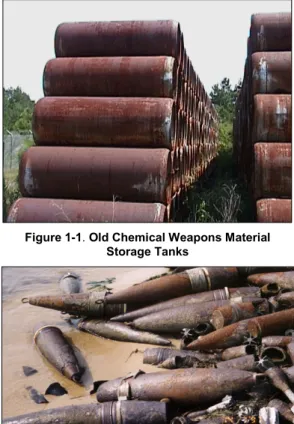
The United States has developed, stored, and tested various forms of chemical munitions for several decades. The remnants of these activities have resulted in the potential of suspect chemical weapons material (CWM) at 224 sites in the United States, the District of Columbia, and the U.S. Virgin Islands. Public Law 99-145 directs the Department of Defense (DoD) to destroy U.S. CWM (see Figure 1-1 and Figure 1-2). The Secretary of Defense designated the Secretary of the Army as the DoD executive agent to establish a program for chemical demilitarization.
After World War II the U.S. Army conducted extensive chemical weapons storage testing. Unfortunately, records were not always kept indicating the status of the old test items. These items included storage and shipping containers, test munitions and other items used for chemical warfare training.
The chemical weapons demilitarization effort can be broken down into three main tasks; 1) locate old chemical weapons material, 2) assess condition of items and identify content and 3) destroy chemical weapons material. The second task of assessing the condition of items and identifying content must be
Figure 1-1.Old Chemical Weapons Material Storage Tanks
conducted with non-intrusive assessment equipment whenever possible to help ensure personnel safety and protection of the environment. The use of infrared imaging for the detection of liquid levels within chemical weapons storage containers is novel and described within this paper.
2.THE PROBLEM: DETERMINING IF OLD CHEMICAL WARFARE AGENT STORAGE TANKS CONTAIN LIQUID BEFORE MOVING THEM
In a secure storage yard on Pine Bluff Arsenal, Arkansas, 3190 chemical weapons material storage containers have been stored for more than 40 years. The containers are made of mild steel, approximately the size of a large
household water heater and have a side wall thickness of 0.41 inches with the end walls measuring 0.75 inches thick. They are stored in rows from one to five high and
exhibit varying degrees of corrosion (see Figure 2-1). These containers are scheduled for reclamation and must be moved to a new location in preparation for decontamination. All the containers were supposed to be empty, having been previously rinsed with
decontamination (decon) solution more than 20 years ago. Some of the containers were known to have liquid in them and Army personnel suspected there were several other containers in the yard with liquid inside. The liquid was most likely decon solution possibly containing trace amounts of mustard agent, but the possibility exists for the liquid to be full strength chemical warfare agent.
Moving the aging containers presented personnel safety as well as environmental concerns, and the US
Army was looking for a hands-off technique that could quickly determine which containers held liquid before those containers were moved.
Personnel Safety and Environmental Concerns
Over time, any shipping container with liquid inside could build up internal pressure as the liquid interacts with the corroding inner wall. In fact, the end caps on one of the containers in the storage yard were bulging, possibly from internal pressure. If the end plugs on a pressurized container were heavily corroded, moving that container might cause one of the end plugs to pop out, like a champagne cork, allowing liquid under pressure to spray out of the container possibly contaminating workers. Anytime an unknown liquid is sprayed on a worker at a chemical weapons storage facility there is a reason for concern. Another safety concern was that of the “flying” steel end plug hitting a worker.
The environmental concern for a chemical agent spill on the arsenal was secondary to personnel safety, yet still a very significant issue. Even if the spilled liquid was nothing more than decon solution (water and bleach), the entire container removal and disposal operation would be shut down for several months while samples were collected and verified. If the samples indicated any amount of chemical warfare agent, the contaminated soil would have to be cleaned up resulting in an even longer delay in completing the disposal mission.
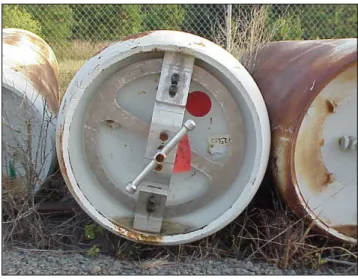
Mission planners decided the safety and environmental concerns would be best addressed by using a special fixture to secure the corroded end plugs on any container prior to movement if that container was suspected of holding liquid (see Figure 2-2). The workers would also dress in a higher level of personal protective equipment (PPE) whenever moving a container with liquid inside. A hands-off approach was needed to quickly determine which containers held liquid and which did not. If a technique could not be found to identify those containers with liquid
then all the containers would have to be treated as if they contained liquid. The additional time and expense associated with putting the safety fixtures on all containers and having workers dress in full PPE for the entire removal process would be very costly to the mission. Plus, moving all 3190 containers in full PPE especially during the hot Arkansas summer would put an increased level of heat stress on the workers.
The US Army asked INEEL engineers to assist in finding a method for quickly and safely assessing the 3190 shipping containers to determine which containers held liquid.
3. THE SOLUTION: USING LOW-COST INFRARED CAMERAS TO QUICKLY LOOK FOR LIQUID LEVELS
At the time the Army requested help on assessing the ton shipping containers, INEEL engineers were experimenting with infrared thermography to determine if old process tanks located throughout INEEL were empty prior to removing them for disposal. Since the technique was proving successful at INEEL and the assessment problems were similar to those faced by the Army, INEEL engineers proposed using the technique for assessing the Army’s ton shipping containers.
A Simple Description: How An Infrared Camera Detects the Liquid Level In a Steel Tank.
The technique works based on the large difference in specific heat capacities for water and air. “The specific heat capacity is the amount of heat that must be supplied to a unit mass of material to increase its temperature through one degree.”1 A material’s thermal conductivity determines how quickly the energy of thermal motion is passed from one atom to the next. The decon solution within the shipping containers is predominately water and can be considered to have the same specific heat capacity as water. The headspace in the shipping container is air. The shipping container is made of mild steel. Table 3-1 gives the representative specific heat capacity and thermal conductivity for air, water and steel. These values will vary somewhat with composition and impurities.
Material (at ambient temperature) Specific Heat Capacity J/(kg-K) Thermal Conductivity kcal/(s-m-K)
water 4186 0.00014
air 1005 0.0000056
Steel (mild) 450 0.012
Materials with high specific heat capacity will heat up and cool down more slowly and store more heat energy than materials with a lower specific heat capacity. Figure 3-1 shows a cross sectional diagram of the ton shipping container representing the thermal system.
Figure 2-2. Ton Container With Fixture Securing End Plugs
Since water has a high heat capacity it heats more slowly than the air above it and acts as a “heat sink” for the steel container below the water line. As the ambient temperature increases, the outer surface of the tank above the waterline will heat more rapidly than the surface below the waterline. Depending on the temperature gradient, the amount of water in the tank, the headspace in the tank and the emmissivity of the container surface, a thermal camera can “see” this water line. An excellent example of this is shown in Figure 3-2. A visible light image and a thermal image of the same water tower are shown.
Steel Container Air Chemical Agent/Water Radiant and convective heating ('T)
Relatively high heat transfer from steel into a high heat capacity liquid
(chemical agent / water) Relatively low heat transfer from
steel into a low heat capacity material (air)
Relatively low heat transfer from liquid into
air
Figure 3-1. Cross Sectional Diagram of the Ton Shipping Container Showing the Thermal System
Figure 3-2. Visible Image, on left, of Water Tower During Summer Morning and Infrared Image, on Right, Taken at Approximately the Same Time Showing the Tank’s Liquid Level
The images were taken within seconds of each other on a summer morning in Arkansas as the day’s temperature was increasing. The thermal image clearly shows the water level inside the tank. In the thermal image, light areas are hotter than dark areas.
Camera Selection
Camera selection was based on cost, availability, ease of use and temperature sensitivity. Since Army personnel with very little (if any) experience with infrared cameras would complete the actual scanning of containers at Pine Bluff, the camera had to be simple to operate. Long battery life was necessary since power in the storage yard was not readily available. A small, un-cooled camera made by Indigo Systems, Inc. was selected as a best fit for the job. Some of the camera specifications are given below.
x 160(H) x 128(V) un-cooled microbolometer sensor array, 51 x 51 micron pixels x 40q Horizontal FOV, 11 mm focal length lens, f/1.6 aperture
x Wavelength: 7.5 – 13.5 microns
x NETD: <= 100 mK for both temporal and spatial (High Gain Mode)
Visible or infrared images are stored by the camcorder on a Sony Memory Stick. The complete set-up was relatively inexpensive, costing approximately $20,000.
4. TESTING THE SOLUTION: MAKING SURE THE APPROACH WORKS ON TON SHIPPING CONTAINERS
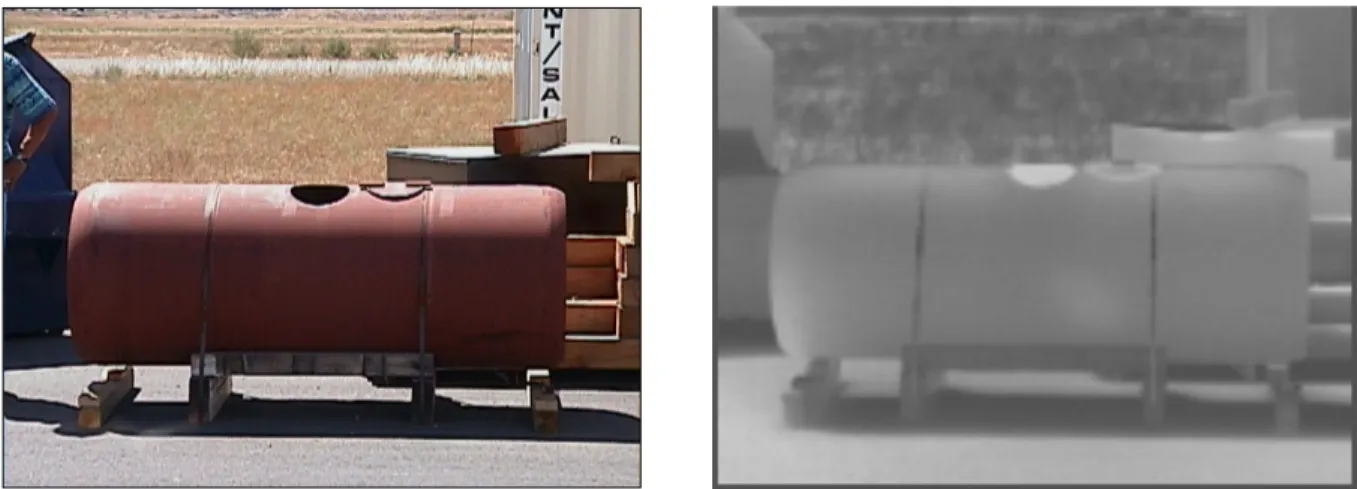
Before the Army purchased an infrared camera, they wanted to make sure it would work for their application. A camera was obtained on loan from a distributor for testing at the INEEL in Idaho Falls, Idaho. An actual ton container was obtained from Dugway, UT to be used as the test target. This container had been modified for testing purposes. It contained a portal on top for adding liquid easily and a valve on the low point allowing liquid to be easily drained. A visible and thermal image of the empty test container is shown in Figure 4-1.
The Test
The test was simple. The container was filled with water to a height of 12 cm (approximately 22 gallons) and the water temperature allowed to stabilize for two days. Thermal images were then taken at different times during the diurnal cycle to determine if a liquid line could be seen. At the time each thermal image was taken, the water temperature inside the container and the ambient air temperature were recorded. The Army established the 12-cm liquid height as the success threshold for detecting a liquid line. A fill height of 24-cm (approximately 59 gallons) was also tested. The 24-cm water height test was conducted on 2 Aug 2001 and the 12-cm water height test was conducted on 6 Aug 2001. Both days were warm, cloud-free days with a light breeze. The long axis of the
Figure 4-1. Empty Test Container Visible Image is Shown on the Left and the Associated Thermal Image is Shown on the Right. Notice the Cavity Effect in the Thermal Image
container was oriented in a north/south position. Sunrise was approximately 6:30 am and the entire container was in full sunlight by 8:15 am.
Test Results
The thermal imaging camera was able to identify the liquid level in the ton test container for both fill levels. In each test, the liquid level was most easily detected with the thermal camera whenever the ambient temperature was changing faster than the temperature of the liquid within, such as during sun rise. Figure 4-2 shows the graph and associated thermal images for the 24-cm test. As was expected, the liquid line was easier to see in the 24-cm water height test due to the larger thermal mass of water.
Lessons Learned
The testing proved the technique would work with a high degree of confidence. There were several lessons learned during the testing. The first lesson learned was that the best time to “see” the liquid line during the day was three to five hours after sunrise.
A second lesson learned was, at times, shadows or reflections caused a false liquid line appearance. Moving the angle of the camera could identify the shadows or reflections. If the apparent liquid line moved as the angle of the camera moved then it was a shadow or reflection. A true water line did not move when the camera angle was moved.
The third lessons learned was that cooling the container during the hottest part of the day by pouring cold water over the surface greatly enhanced the ability to see a liquid line. Figure 4-3 shows the effects of pouring cold water over the container. This idea of enhancing the liquid line on a hot container was proposed to the Army but rejected on the grounds that for environmental purposes, no additional liquid was permitted to be sprayed on the containers and allowed to fall onto the ground.
A fourth lessons learned came from extrapolating the air temperature versus water temperature graph into the night time hours and studying the early morning thermal images taken during the tests, especially for the 24-cm height
Air vs. W ater Temperature for 24-cm Test
0 20 40 60 80 100 7:10 8:40 9:07 15:37 16:00
T ime (not to scale )
Tem
p
deg F W ater Tem p
Air Tem p
7:10 am
9:07 am
4:00 pm
water test. The information suggests that another optimal time to look for water lines with a thermal camera would be sometime during the night while the air temperature is cool and the water temperature still holds heat from earlier in the day. Unfortunately, we were not able to obtain the extra funding to perform nighttime testing, and the Army indicated they prefer the testing take place during the day.
All the lessons learned and test data were documented in a test report and delivered to the Army. Based on information in the test report, the Army then purchased three infrared camera systems, exactly like the one used during testing, for scanning the 3190 containers at Pine Bluff Arsenal.
5. DOING THE WORK: SCANNING TON SHIPPING CONTAINERS AT PINE BLUFF ARSENAL
In early September, I traveled to the Pine Bluff Arsenal and trained six soldiers in how to operate the infrared cameras and instructed them in the best time and method for taking infrared images of the ton shipping containers. Over the next two months, thermal images of all the containers in the yard were taken along with an accompanying visible image. Any containers determined to contain liquid would be tagged red, the identified liquid line would be marked on the end of the container using a permanent marker. If the thermal image indicated the possibility of liquid, then the container would be tagged yellow. And, if the thermal image indicated no liquid, then the container would be tagged green.
Results of Pine Bluff Scans
It was expected that most of the 3190 containers would be empty and the results of the scans indicated this to be so. A summary of the results is listed below:
Red (liquid indicated) - 80, Yellow (suspect) - 72, Green (empty) - 3038 Figure 5-1 shows a thermal image and it’s associated visible image for one of the containers tagged red.
Figure 4-3. Pouring Cold Water Over the Hot Container is One Way to Enhance the Visibility of the Water Line
The next step for the Army was to use a crane to lift the containers onto a flatbed truck for transport to the decontamination staging area. Any container tagged red or yellow would be fitted with the end plug restraining device (see Figure 2-2) as an added safety precaution. A scale would be in line with the crane hook to weigh the ton container as it was being lifted. An empty ton container weighs approximately 1600 lbs. A weight greater than 1600 lbs would indicated the presence of liquid or some other fill material.
This process would provide a means for measuring the success of using a low-cost thermal camera to detect liquid levels in ton shipping containers. At the time this paper was written, the Army has moved approximately half of the ton containers. Only two of the yellow and red tagged containers have been moved. The remaining red and yellow tagged containers are scheduled to be moved last. So far, the predictions made using the thermal camera have been verified 100% correct. All the green tagged containers moved have been verified empty and the one yellow and one red tagged containers were each verified to contain some sort of liquid or fill material.
More Lessons Learned
The scanning of ton containers at Pine Bluff went relatively smoothly with results similar to what was experienced during the testing at INEEL. The one lesson learned dealt with the paint still remaining on some of the old containers. Drawings indicated the paint was Rust-Oleum No. 53 Heat-Proof Ready Mixed Aluminum Paint. In many cases, the container surface had paint remaining while the rest was rusted (see Figure 5-1). The emmissivity of rust is generally 0.80 while that of aluminum paints ranges from 0.27 to 0.67. The boundaries between paint and rust are clearly visible in the infrared images and often made it difficult to detect a water line.
6. RELATED APPLICATIONS: USING THE APPROACH FOR INDIVIDUAL CHEMICAL MUNITIONS
The success of using a thermal camera to detect liquid levels in ton containers led to testing on individual munitions. This would be a much more difficult problem since the amount of liquid would typically be about a gallon or less and the headspace in the munition would be small, about 10% of the volume. The wall thickness on some of these munitions is 0.5 inches thick. The munitions were made from mild steel. Several tests were conducted on 155mm and 4.2-inch munitions using varying degrees of water fill. An external heat source and cold packs were used to achieve a large change in temperature.
All the tests on individual munitions proved unsuccessful. We were unable to determine a liquid line using the thermal camera. There just didn’t seem to be enough liquid mass compared to the mass of the steel walls of the munition.
7. CONCLUSION
Low cost, un-cooled infrared cameras are effective for non-intrusively finding the presence of liquid in ton shipping containers. Testing at the INEEL and initial results from thermal scans made on 3190 ton shipping containers at Pine Bluff, Arkansas, indicate the technique is simple to employ and provides reliable results. Factors that must be taken into account when scanning ton containers for liquid levels include time of day, minimum amount of liquid to detect, surface condition of container and angle of thermal camera. Initial results from testing on individual munitions indicate thermal cameras are not able to distinguish a liquid line.
8. References