Strategic Plan 2014–2019 1
STRATEGIC
PLAN
2014–2019
Strategic Plan 2014–2019 2
Contents Page
Page
Section 1: Introduction 3
Section 2: Declaration of Sustainability 7
Section 3: Market Analysis and Context 9
Section 4: Service Line Strategic Options 28
Section 5: Strategic Plan 39
Strategic Plan 2014–2019 3
SECTION ONE
INTRODUCTION
Strategic Plan 2014–2019 4 The intention of this Strategic Plan is to set out the ambitions for Western Sussex Hospitals NHS Foundation Trust (WSHFT) over the next five years, demonstrating how we intend to ensure we provide the best possible care for our patients, and ensure a sustainable future for the Trust, both on a clinical and a financial basis.
In developing our Strategic Plan, we have engaged with a number of stakeholders. We have spoken to a broad range of clinicians and other staff throughout the Trust, and taken their views into account. We have also taken account of the requirements of our
commissioners, in particular our main commissioner, Coastal West Sussex Clinical
Commissioning Group (CWS CCG) and held two sessions with the Trust’s Governors which were devoted to the development of the Plan. Our engagement with the staff and wider public will continue to grow as we further develop the programmes within our plan.
The starting point for us as a Trust is our vision, ‘We Care’. This vision, described in more detail in Section 3 of this document, puts the compassionate care of patients first and foremost, and drives the rest of our actions. In all that we do, we must remember that our prime responsibility is to deliver high quality, safe and responsive care to the population we serve.
The Trust has a track record of improvement that it can be proud of. For the past four years it has consistently achieved strong performance in terms of keeping waiting times low, improving the environment for patients and visitors, reducing mortality and delivering high quality care. All of this has been achieved whilst delivering a significant financial surplus year-on-year.
Improving the quality of care is central to our Strategic Plan. The Trust has recently published its quality report and account, which sets out the quality priorities for the Trust. These include improving stroke care for patients, improving the hospital care for patients with dementia, reducing avoidable mortality, in particular through reviewing acute kidney injury (AKI) and early recognition of clinical deterioration, and infection control.
We understand the scale of the challenge that faces us as a Trust. The NHS as a whole can expect minimal growth over the next five-year period, with increased patient expectations and demographic pressures which will put further demands on the Local Health Economy (LHE), and a shift away from acute care provision to more preventative and community based models of care. This results in an expected efficiency challenge for us over the five-year period totalling £78.9m.
This level of efficiency saving is not possible through the delivery of traditional internal cost improvement programmes (CIP) alone, although these remain a very important aspect of our efficiency programme. We understand that in order to be a sustainable, high quality
organisation, we need to develop a range of transformational programmes, involving the entirety of the LHE, to ensure that full benefits of streamlining patient pathways are realised. These are explored in detail in the Strategic Plan.
In order to deliver the programmes set out in this plan, the Trust is embarking on a new approach to service transformation. This will involve the introduction of a new ‘EXCEL’ (EXcellent, Compassionate, Effective, Leadership) programme, which will feature the following:
Strategic Plan 2014–2019 5
Genuinely putting care for the patient, and patient safety in particular, at the heart of what we do
Building a culture of kindness, compassion, professionalism, improvement and respect amongst our staff
Through continuous, incremental improvements, ruthlessly eliminating waste, inefficiency and variation
Transforming our approach to leadership to support those closest to patients to make continuous improvements to patient care.
The Strategic Plan should be read in conjunction with the Trust’s Operational Plan 2014–16. The Operational Plan, approved by the Trust Board in April 2014, provides detailed
programmes of work which the Trust is pursuing over the next two years to ensure that it delivers on its quality, performance and financial targets, outlining the steps that need to be taken in the short- to medium-term to ensure the Trust is successful. Rather than repeat much of the content here, our Strategic Plan focuses on the medium- to longer-term plans for the Trust, which will deliver the transformational programmes of work required.
Section 2 of this document is the Trust’s Declaration of Sustainability that, in summary form, outlines the basis on which the Board is able to declare the sustainability of the organisation over the next five years. The combination of the Trust’s successful track record, the
transformational programmes proposed and the new approach to service transformation underpin this declaration.
Section 3 contains our Market Analysis and Context. In this section we look at the drivers for change over the next five years, including a healthcare needs assessment. This allows us forecast the likely demand for secondary health care services over the planning period. As well as looking at demographics, this includes some known service developments such as the NHS Bowel Cancer Screening Programme (NHSBCSP) and the development of
Southlands Hospital. This section also contains an analysis of our capacity requirements to meet future demand.
The section continues with a funding analysis, using the information from our main
commissioner’s (CWS CCG) plans to estimate the level of funding likely to be available to the Trust. Together with the forecast capacity and demand analysis, this gives us an estimate of the likely financial challenge facing both the Trust and the LHE, and
demonstrates the need for a transformational approach to delivering healthcare in Western Sussex over the five-year period.
We have also undertaken a competitor analysis, looking at the current market share and the risks from other NHS and non-NHS providers. Finally in this section we have undertaken a refreshed SWOT analysis, in order to identify the key strengths, weaknesses, opportunities and threats to the organisation.
In Section 4, building on our market analysis, we look at the challenges and opportunities for our services at a service line level. Through a series of discussions with Clinical Directors and managers we have reviewed each of our services to identify the strategic options for change, which are presented in summary form.
In Section 5, we look at the priority programmes for service change. This outlines the key implications for the Trust in the light of the market analysis and service line review. The
Strategic Plan 2014–2019 6 plans outline the proposed future shape of WSHFT, outlining the essential building blocks necessary at both of our main sites, and the implications for our estate. We then outline our five prioritised workstreams for the period of the strategic plan. These are:
Unscheduled care integration
Reconfiguration of surgical services
Developing Southlands as an ambulatory care centre
Exploiting our commercial opportunities
Reshaping our cancer services.
We also highlight our approach to workforce planning, how we propose to communicate our plans as they develop, and how these will be programme managed. In this section we also outline our proposed approach to service transformation.
Finally in Section 6, we provide some detail on the Trust’s financial plans which support the Trust’s Strategic Plan, including the capital requirements.
Strategic Plan 2014–2019 7
SECTION TWO
DECLARATION OF
SUSTAINABILITY
Strategic Plan 2014–2019 8 WSHFT can declare that the Strategic Plan will ensure sustainability of the organisation over the next five years, on a clinical, operational and financial basis.
We can make this declaration on the basis of:
A clear and deliverable clinical services strategy which addresses issues of sustainability
A strong track record of delivering performance, quality and financial targets
A clear and robust efficiency programme designed to deliver both the transactional and transformational change programmes required
A range of innovative programmes aimed at improving patient care, increasing productivity and performance and exploiting market opportunities
Developing our new systematic approach service improvement.
Nevertheless, as is explained further within the Strategic Plan, improving the quality of care and managing the money over the next five years will be a significant challenge for the organisation due to the increasing size of the population we serve, the increase in the age of our population and the acuity of care required, and the cost of delivering modern medical healthcare against a background of flat or even reducing levels of NHS income for the Trust. In order to deliver a sustainable future for the WSHFT we will therefore need to ensure the following transformational changes are implemented:
A move towards a radically different and truly integrated unscheduled care system across the LHE, with the Trust playing a central role. Not only will this improve the quality and seamlessness of care, it is an essential step if we are to drive through the efficiency and productivity gains required by the LHE
Reconfiguration of a range of services across the Trust, including not only urology, breast, stroke and ophthalmology services, but also potential further reconfiguration of surgical services for both elective and emergency care
A successful expansion of our commercial programme, securing key elements of business for the Trust enlarging our catchment area for a range of services, seeking to increase the range of services we offer and expanding our private patient service.
Strategic Plan 2014–2019 9
SECTION THREE
MARKET ANALYSIS
AND CONTEXT
Strategic Plan 2014–2019 10 In this section we provide an overview of the market assessment for the Trust over the next five years, looking initially at the drivers for change, including a healthcare needs analysis. OUR VISION - ‘WE CARE’
Our key driver for change is our vision, ‘we care’, which sets out our intention to provide excellence in all that we do. Our vision has seven complementary themes:
1. Firstly, and most importantly, we care about YOU, the patient. We will do all we can to make sure we treat you with kindness, respect and compassion. We are here to serve you and your needs and we will never forget this
2. We care about quality. We want to improve our services, achieve the best
experience and outcomes for our patients and respond positively to their feedback 3. We care about safety. We are committed to providing the safest care possible,
eradicating avoidable hospital acquired infections, reducing mortality and providing the best environment for our patients
4. We care about serving local people. Wherever possible we want to provide a comprehensive, locally based service to the 450,000 population we serve, so that when they need care they will choose to come to us
5. We care about being stronger together. We know how important it is for patients to receive integrated care across primary, secondary, community and social care. We will work relentlessly with partners to make sure this happens
6. We care about improvement. We want to continually strive to be better, to make sure that we are providing modern evidence based care to our population
7. We care about the future. We want to be an organisation that people can rely on, both now and in the future. That's why it is important we make sure that we operate within our means and invest for the future.
HEALTHCARE NEEDS ASSESSMENT
We have worked closely with CWS CCG in looking at our healthcare needs assessment and have ensured that planning is supported by robust information and analysis including:
CWS Joint Strategic Needs Assessment - providing robust quantitative data
CWS CCG healthcare needs assessment in their strategic plan
West Sussex Health and Wellbeing Board - supporting strategic alignment to the LHE
National priorities including improving the standard of care following the Francis Inquiry (2013) and developing more seven-day services as set out by Sir Bruce Keogh (2013)
Stakeholder engagement - ensuring services are continued to be shaped by the patients and carers that use them.
Strategic Plan 2014–2019 11 The Population we Serve
CWS CCG working with Public Health England, and via the undertaking of the CWS Joint Health Needs Assessment (JSNA 2012), have highlighted that within the Trust’s catchment area we have mixed demographics. As a whole and compared to the rest of the country, the population is relatively affluent, with health outcomes above the England average in most areas. Life expectancy for both males and females has continued to improve year-on-year. However, the local area also includes:
One of the oldest populations in England. Nationally, 16.5% of the population are aged 65 years or over; by comparison 23.5% of registered patients in the CWS CCG area are aged 65 years or over (JSNA 2012)
Some of the most deprived urban and rural areas in England
Some large and growing ethnic minority communities
Social isolation and wide health inequalities are a very real problem – for example, average life expectancy is 10 years longer in Arundel than in Worthing and
approximately one in six people has a mental health problem at any given time. Of 5,736 total deaths in 2011, the highest occurring causes of death in the locality were:
Circulatory diseases (1713)
Cancer (1640)
Respiratory disease (761). How the Population is Changing
Local Demographics
The GP registered population in June 2011 was 483,230 (Source: Exeter)
The CWS CCG is predicting a local demographic growth of 1.6% over the next five years and an overall healthcare activity growth of 2.6% over the next five years (including both demographic and non-demographic growth factors)
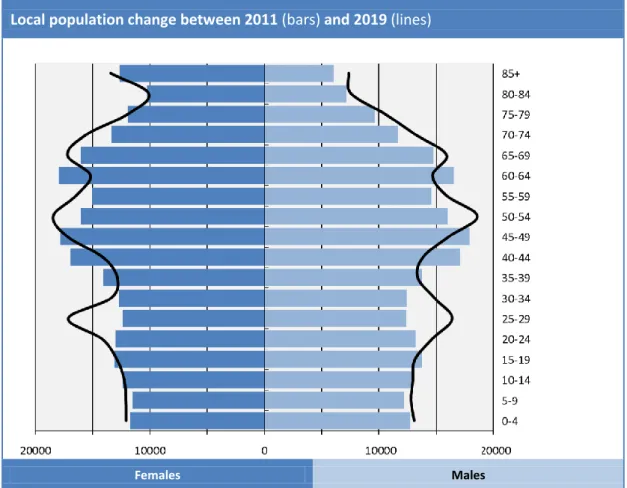
It is forecast by 2019 there will be 13% more people aged over 85 years living in CWS
There will also be an 8% increase in the young population that, together with an increasingly elderly population, will reduce the proportion of working age people living locally.
Strategic Plan 2014–2019 12 Local population change between 2011 (bars) and 2019 (lines)
Females Males
Figure 3.0: CWS local population change 2011–19
Source: CWS CCG five-year strategic and two-year operational plan Long-term Conditions
As our population becomes more elderly we expect to see an increase in the number of people with long-term conditions such as chronic obstructive pulmonary disease (COPD), diabetes and dementia. It is estimated that 25% of the local population are currently living with a long-term condition. By 2026 it is estimated there will be a further 3,200 people living with dementia in CWS all contributing to increased pressures on LHE resources.
Unscheduled Care
There are continued demands on local urgent and emergency care with changes in patterns of disease. In 2013/14 there were over 130,000 attendances to WSHFT emergency departments and almost 47,000 emergency admissions. The table below details WSHFT emergency admissions for the last five years demonstrating the positive impact of local actions across the LHE to reduce episodes of unscheduled care, particularly in short-stay patients. However, with continued forecast population growth projections the pressures on urgent care departments will remain. There is also strong evidence that the acuity of the patients being admitted to hospital has increased over the past two years.
Strategic Plan 2014–2019 13 Year 2009/10 2010/11 2011/12 2012/13 2013/14 St. Richard’s Hospital 21,961 22,574 22,859 22,814 22,119 Worthing Hospital 25,843 27,328 26,352 26,019 24,872 Total 47,804 49,902 49,211 48,833 46,991 % Increase/ Decrease - 4.4% -1.4% -0.8% -3.8%
Table 3.1: WSHFT emergency admissions Source: Sema Helix
There is a high concentration of nursing homes along the CWS strip (283 in June 2011, with approximately 7,300 beds), which contributes to the increasing numbers of frail elderly patients and associated increased pressures on healthcare within the LHE.
Cancer Care
In CWS CCG (JSNA 2011) cancer is the most common cause of death for people under 75 years of age (and second highest causal factor for deaths irrespective of age) with a higher proportion of deaths than in similar areas (NHS England
Commissioning for Value tool 2013)
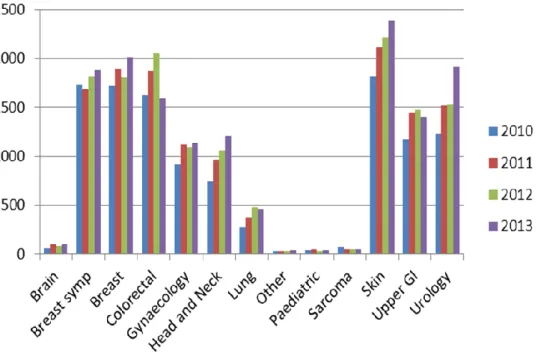
New referrals to WSHFT for cancer care have been rising significantly over the past three years. A breakdown by tumour group is given in the graph below:
Figure 3.2: WSHFT two-week rule referrals by tumour site (2010–2014) Source: WSHFT data
Strategic Plan 2014–2019 14
The prevalence of cancer care is forecast to double between 2012 and 2030 (Macmillan 2012). Although all areas of cancer care are increasing in demand, it is clear that the largest area of growth will be within the early and on-going monitoring of patients. Cancer is becoming a chronic disease requiring services to change in response to the change in disease trajectory
The National Radiotherapy Advisory Group predicts a 16% increase in cancer incidence requiring radiotherapy overall by 2016, compared with 2006. This includes a 20% increase in breast cancer and 23% increase in prostate cancers. Carcinomas of unknown primary are also increasing
National increases in screening programmes will also have resource implications, in particular the NHSBCSP. The Trust has recently become the Bowel Cancer
Screening Centre for the Trust’s catchment area. Other screening programmes such as lung and prostate cancer may be introduced nationally with currently unknown impact.
Circulatory Disease
Circulatory disease is the highest common cause of deaths (JSNA 2011) linked to a higher than average level of obesity and low success rates in smoking cessation. This is likely to lead to increased pressures on cardiovascular service and on the Trust’s specialist bariatric surgery service.
Children, Young People and Maternity
The numbers of births has been increasing locally, and this trend is expected to continue, although not dramatically over the five-year period. In 2010 there were approximately 4,677 births to mothers registered to CWS GP practices. In the most recent year the Trust has helped to deliver approximately 5,900 births, attracting a number of parents from outside its traditional catchment population, particularly Hampshire
In its strategic plan, CWS CCG is seeking greater choice for maternity care, in particular the option to give birth in a midwifery-led unit
The local area has higher than the national average emergency admissions for children with asthma and diabetes (NHS England CCG Outcomes Tool 2013), which requires further analysis and review.
Increasing Patient Expectations
The community we serve are becoming better informed with increased choice and higher expectation of their local healthcare services. Patients rightly want to receive the most up-to-date treatments, have access to the right information and to be
involved in decisions about their care. To deliver this the NHS must change the way it is organised to increase access seven days a week and adopt more innovative ideas
Strategic Plan 2014–2019 15 to ensure the NHS offers improved convenience as well as safe care and excellent outcomes.
Strategic Approach of our Commissioners
In their five-year strategic plan and two-year operational plan ‘Delivering the Vision’, CWS CCG have outlined their commissioning strategy, which responds to the demographic challenges outlined above and aims to transform the way in which healthcare is delivered in order to provide a high-quality sustainable service to patients. This explicitly involves a reduced acute footprint, with more care being provided in the community and in preventative measures in order to reduce demand on acute services. This will be supported by an
increased role for telemedicine.
The CWS CCG have outlined, in their five-year strategy and two-year operational plan, six areas of transformation, four of which will directly impact the Trust, are summarised below:
1. Patient Participation in their NHS: There will be continued emphasis on putting patients at the heart of both service planning and delivery but also in greater control of their own care. Through appropriate support and education, patients will be able to better manage their conditions and effectively reduce the risk of their need for
hospital care. Emphasis will also continue to be focused on meaningful patient and public engagement
2.
Urgent and Proactive Care: There is a commitment to continue to developProactive Care services in order to support patients who have more complex needs to be in control and live well with their medical condition. In conjunction with early identification (via risk stratification tools) there will be continued development of urgent care services to facilitate rapid access, appropriate advice and care to enable a swift recovery. Services will be supported to be more responsive, with integrated urgent and emergency care services for all patients, recognising that urgent care, Proactive Care and long-term conditions are all intrinsically linked
To tackle existing pressures on emergency services there will be promotion of the NHS 111 service and support for primary care to improve accessibility for the local population to get the right care, at the right time and in the right place.
It is envisaged that there will be a lead provider for both Proactive Care and for reactive (unscheduled) care. Joint commissioning with West Sussex County Council (WSCC), supporting the joint provision of adult social care and community services will also be vital to support plans to see a fundamental shift of care from hospital into the community and into patients’ own homes
3. Planned Care: Large scale service redesign includes the procurement and implementation of the musculoskeletal (MSK) Integrated Care Service. This prime provider model is hoped to allow for better integration across the MSK pathway with single accountability for the patient journey, in conjunction with delivery of shared decision making, achievable goals, improved access to imaging and multi-disciplinary team (MDT) working. Other clinical areas already identified as requiring
Strategic Plan 2014–2019 16 improvement include: dermatology, cardiology, neurology, cancer care and
ophthalmology services.
There will be a focus on demand management through innovation and integration across primary care, community care and secondary care, to achieve a balance between demand and supply and meet the challenges of caring for the population over the next five years.
There will be a shift in the focus of care away from hospital services, into integrated primary and community care. Once referred, CWS CCG will work with providers to minimise the number of outpatient appointments required by each patient by
developing ‘one-stop’ assessment, diagnostic and treatment clinics and providers will be supported to shift elective surgery from inpatient operations to a day case setting wherever clinically appropriate.
There is an additional commitment to support all providers in primary, community and secondary care to achieve compliance with all ten of the seven-day Service Clinical Standards by 2016/17
4. Children, Young People and Maternity: Together with WSCC, CWS CCG will ensure that services around children are more joined-up across the following three areas:
Maternity Care: Providing choice in the place of delivery. This will include a choice of homebirth, a midwife-led or a consultant-led unit. All consultant-led units should have a co-located midwife-led unit to enhance the choices and options available. The CCG also aim to ensure that all women have an assessment to establish health and social care needs and risks within the first 12 weeks of pregnancy, and one-to-one care from a midwife when women are in established labour regardless of the care setting Children’s Urgent and Acute Care: Supporting families when their child becomes suddenly unwell the CCG proposes to develop the capacity and capability of primary care and community services in assessing and managing an unwell child. The CCG is now reviewing a longer term and sustainable solution further developing primary care services in the community .This will be supported by rapid access for GPs to a senior paediatrician for advice when assessing children within the community. Where acute phase care is deemed clinically appropriate CWS CCG will review
commissioning to ensure consistent pathways in children’s short-stay and assessment units, as well as ensuring workforce standards are always met Children’s Community Services (including services for children with complex needs): CWS CCG have committed to ensure Children and Young People’s
Emotional Health and Wellbeing Services and Child Development Services work in a more integrated way as clinical teams across CWS. Children’s community nursing teams will also facilitate access from hospital care for those children with complex needs who can be cared for at home and will work closely with schools and other children’s services
5. Mental Health and Learning Disabilities: The CCG together with Crawley, Horsham and Mid-Sussex CCG and WSCC has developed a strategy to improve
Strategic Plan 2014–2019 17 mental health services by 2019. The strategy sets a new direction focused on
localised commissioning for prevention and community services
6. Primary Care: The CCG sets out the pivotal role of primary care in delivering their vision for transformation and plan to develop a strategy to ensure it is ready to meet the challenges of working at greater scale through improving access, services and collaborative working between practices in partnership with NHS England.
National Guidance
The Trust needs to continue to respond to evolving guidance, both from the Department of Health, the Royal Colleges and from other external bodies such as the National Institute for Health and Care Excellence (NICE). Over recent years, the direction of travel has been to locate specialist low volume care within larger centres of excellence, such as vascular surgery, paediatric surgery and major trauma. There is an increasing focus nationally and locally to provide greater integration of services across acute, mental health community, primary and social care.
CAPACITY ANALYSIS
As part of its Market Analysis, the Trust has undertaken a five-year capacity analysis, based upon the likely demographic and other changes that have been highlighted above. The Trust has factored in demographic changes in age and sex over the next five years, using Office of National Statistics (ONS) population growth figures, together with the changes in demand the Trust has experienced over the past three years. Taken with the expected reductions in demand from Quality, Innovation, Productivity and Prevention (QIPP) schemes, the average growth is calculated as 0.7%
As well as the changes outlined above, the Trust has made some specific adjustments due to known service changes, which affect the figures. These are:
NHSBCSP: The Trust is forecasting an increase in the demand for bowel screening due to age extension
Ophthalmology: The siting of ophthalmology services on the Southlands site is likely to impact on the Trust’s catchment area for this service. The likely impact on activity and capacity is included in the Trust forecast.
In terms of change over the five-year period, the Trust is forecasting the following changes in demand:
Strategic Plan 2014–2019 18 2013/14 2014/15 2015/16 2016/17 2017/18 2018/19 Bed Growth % Change % Change per Annum A&E Attend. 136,645 140,112 143,667 147,312 151,050 154,882 18,237 13.3% 2.5% Non-Elective Spells 57,798 58,341 58,890 59,446 60,007 60,575 2,777 4.8% 0.9% Elective Spells 10,108 10,333 10,354 10,414 10,474 10,534 427 4.2% 0.8% Day Case Spells 49,079 55,845 56,152 58,033 59,563 61,108 12,030 24.5% 4.5% Out-patients 469,750 536,076 536,784 541,594 545,512 549,466 79,715 17.0% 3.2%
Table 3.3: Forecast of change in demand for unscheduled care, elective and day case admissions and outpatient appointments
Source: WSHFT data
With the current utilisation rates, prior to the impact of our strategic plan programmes, this would imply the following changes in our capacity. The bed numbers reduce during 2015/16 due to the impact of the efficiency programme (outlined in our Operational Plan).
Beds 2013/14 Beds 2014/15 Beds 2015/16 Beds 2016/17 Beds 2017/18 Beds 2018/19 Bed Growth % Change % Change per Annum Surgery 228 232 223 226 228 230 2 0.8% 0.2% Medicine 606 603 585 591 597 604 -3 -0.4% -0.1% Women & Children 99 99 98 99 100 101 2 1.8% 0.4% Core Services 10 10 9 10 10 10 0 1.4% 0.3% Total 943 944 915 926 935 945 1 0.1% 0.0% Outpatient Clinics 80,076 82,483 82,650 82,546 82,696 82,844 2,768 3.5% 0.7% Theatre Operations 26,976 31,057 30,363 30,339 30,549 30,760 3,785 14.0% 2.7% Table 3.4: Forecast capacity changes
Strategic Plan 2014–2019 19 FUNDING ANALYSIS
CWS CCG have shared and discussed their financial planning assumptions for the next five years. This includes their assessment of the impact of the Better Care Fund (BCF) on their commissioning plans with WSHFT over the next few years.
In the absence of detailed plans regarding the investments into the BCF and their consequential impact on local acute providers the Trust has made some very high-level assumptions, incorporating the information shared by CWS CCG.
Overall, the expectations of the CCG and the Trust are closely aligned as summarised in the table below.
Table 3.5: CWS and WSHFT forecast assumptions
Source: CWS CCG five-year strategic and two-year operational plan/WSHFT financial modelling
COMPETITOR ANALYSIS
The Trust faces competition from providers in the public and private sector including:
NHS competition: secondary care providers
NHS competition: primary and community providers
Non-NHS competition.
NHS Competition: Secondary Care Providers
There are four current providers of acute secondary care which need to be considered in terms of the competition they offer. These are:
Brighton and Sussex University Hospitals NHS Trust (BSUH)
Portsmouth Hospitals NHS Trust (PHT)
Surrey and Sussex Healthcare NHS Trust (SSHT)
Royal Surrey County NHS Foundation Trust (RSCHFT).
BSUH has recently been granted approval and access to update its currently out-dated and constrained site at the Royal Sussex County Hospital in Brighton. As a result of this there is likely to be an ambition for BSUH to increase their share of trauma and specialist work once this work is completed. However, collaborating with BSUH in a planned way may bring benefits to WSHFT’s own trauma and cancer patients and services.
2014/15 2015/16 2016/17 2017/18 2018/19 £m £m £m £m £m
CCG Expenditure Plan 258.7 256.3 256.0 252.8 251.7
WSHFT Income Plan 259.9 257.6 256.8 254.7 251.8
Strategic Plan 2014–2019 20 BSUH have a second hospital site at the Princess Royal Hospital, in Haywards Heath, which competes for work in the North East of the CWS patch. The focus for this site is for planned care. SSHT, which has a hospital based in Redhill also compete for this section of our catchment population.
In the North West of the patch competition comes from RSCHFT, based in Guildford, Surrey. To the Trusts West, the major competition comes from PHT. WSHFT has been successful in attracting patients from the Hampshire/Sussex Coastal border over recent years, particularly maternity care.
A summary of the performance of the competition from NHS secondary providers is provided below. As can be seen, current elective referral to treatment (RTT) performance does not compare favourably to the major competitors, which is a potential threat to maintaining market share. An RTT recovery programme is now underway, which will result in performance being favourable by quarter two of 2014/15. Urgent and emergency performance compares very favourably:
Current Performance (%) WSHFT BSUH PHT SSHT RSCH
FT WSHFT rank with Local Competitors RTT admitted pathways 90.6 92.3 90.8 91.4 92.9 5 RTT non-admitted pathways 89.3 96.6 96.2 97.6 95.4 5 RTT incomplete pathways 90.0 92.1 94.7 96.2 93.0 5
A&E performance all types 95.6 89.8 87.5 96.0 94.0 2
Cancer 2-week wait 97.5 88.1 96.3 95.5 96.3 1
Cancer 31 day wait 99.8 95.1 96.2 97.9 98.8 1
Cancer 62 day wait 89.5 81.1 90.5 93.3 87.0 3
Table 3.6: Current performance against local competitors
Source: Health and Social Care Information Centre published reports, competitor analysis - NHS provider - current performance (March 2014)
Market Share
The figure below shows WSHFT’s market share for each GP Practice in West Sussex, Hampshire, Surrey and Brighton and Hove for elective admitted spells from May 2013 to April 2014. Due to the Trusts geographic location, WSHFT services are the most convenient for many people in CWS. The majority of GP practices in our traditional catchment area send over 80% of their elective patients to WSHFT. There is an opportunity to attract additional activity from the population in the Mid Sussex area. Excluding one GP practice on the Hampshire border, there are limited referrals into WSHFT from other counties. This provides further opportunity to attract patients to the Trust, utilising the Southlands site especially for the Hove border and attracting other patients from the Hampshire border.
Strategic Plan 2014–2019 21 Figure 3.7: GP practice market share: elective admitted spells (May 2013–April 2014) Source: Dr Foster 2014
The map below shows elective admissions by GP practice for the 12 months from May 2013 to April 2014, only concentrating on West Sussex. This demonstrates that in our traditional catchment area, the main rivals are BSUH, who provide a range of services from Haywards Heath and Brighton, and also BMI Goring Hall, who are undertaking a small but significant amount of NHS choice work, particularly for orthopaedic procedures. Among the other providers (shown as purple), in the South West of our catchment this work is predominantly PHT, and in the North of our catchment area, this work is undertaken by RSCHFT.
Strategic Plan 2014–2019 22 Figure 3.8: GP practices: elective admission (West Sussex only, May 2013–April 2014) Source: Dr Foster 2014
The final map below demonstrates the market share of non-elective activity in West Sussex. There is a very good market share for non-elective activity in the CWS area, and even moving into the Mid-Sussex where a greater choice exists. This fact can be a strength in associating WSHFT in a populations’ mind as their Trust of choice, but can also be a threat in terms of receiving unplanned non-elective activity during seasonal pressures, which can put a strain on hospital services.
Strategic Plan 2014–2019 23 Figure 3.9: GP practice: non-elective activity (West Sussex only, May 2013–April 2014) Source: Dr Foster 2014
NHS Competition: Primary and Community Providers
In addition to traditional NHS providers of secondary care, there are two further NHS organisations that need to be considered in relation to the competition they offer in terms of alternatives to secondary care. These are:
Sussex Community NHS Trust (SCT)
Primary Care Provider Organisations.
Our approach towards SCT is more as a partner in rather than a competitor for healthcare services. However, there are elements where our two organisations will be in direct competition. These include:
Strategic Plan 2014–2019 24
Competition for some general hospital services through the ‘Any Qualified Provider’ process
Competition to provide integrated care across a range of services
Provision of step up/step down facilities for a range of medical conditions.
The introduction of CCGs as the main commissioners of healthcare has led to the establishment of primary care provider organisations taking an increasing proportion of the provider market in other parts of the NHS. However, this has not, to date, been a major driver for CWS CCG. Areas where the Trust currently provides care that may be vulnerable include:
Therapies
Diagnostic testing
Shifts towards primary care as a result of pathway redesign.
In the longer-term there is also the potential for primary care provider organisations to establish alternative elective surgery centres, possibly with established non-NHS providers (see below).
Non-NHS Competition
There are a number of private healthcare providers in West Sussex. These providers have traditionally targeted the insurance and self-pay market. However, due to the reduction in waiting times and the introduction of ‘NHS Choice’ and ‘Choose and Book’, such providers are now directly competing with the Trust for elective NHS services. With the liberalisation of the provider market outlined in the Health and Social Care Act 2012, competition from this market has increased. Some non-NHS providers are also beginning to align their marketing and strategic plans to the delivery of NHS services for the community.
The key Non-NHS competition in the local area has been identified as:
Sussex Community Dermatology Service
BMI Goring Hall Worthing
Nuffield Hospital Chichester
Spire Hospital Portsmouth
Brighton Integrated Care Service
Innovations in Primary Care
Sussex Medical Chambers.
A summary of these organisations and the assessed risk posed by them through competition to the Trust is shown below.NHS
Strategic Plan 2014–2019 25 COMPETITOR RISK LEVEL COMMENTARY
Sussex Community Dermatology
Services
High
Offer a community dermatology service based within primary care settings across West Sussex. High threat to non-specialist dermatology services within WSHFT.
BMI Goring Hall Medium to High
Provides range of general hospital services with three theatres, 12 bed day care unit and a high dependency unit in the Worthing area. Largest national independent provider of acute surgical healthcare. Undertakes procedures of a complex/ major nature, currently the second largest elective orthopaedic provider in CWS with approximately 18% of this market.
Nuffield Medium
Forty bedded facility hosting a range of general services in Chichester. Nation-wide health organisation with a turnover of £581m, workforce of 10,000 staff and very high satisfaction ratings. Provides elective care for the NHS.
Spire Medium
Fifty bedded facility in Havant with critical care level 2, emphasis on weight-loss and cosmetic surgery. Newly opened cancer unit that provides diagnostic tests, scans, chemotherapy and radiotherapy. Nationally has a network of 37 private hospitals and is looking for opportunities to expand into the NHS Choices market.
Brighton Integrated Care Services (BICS)
Low to Medium
Currently working in partnership with WSHFT. BICS are an organisation primarily with a focus on
expanding primary care and are a partnership of GPs and other healthcare professionals. They have recently been successful, as part of a partnership with other NHS and not for profit organisations, in a bid to provide MSK services in Brighton and Hove and Mid-Sussex.
Innovations in
Primary Care Low
Based in Worthing and formed in 2005 as a limited company. Stronghold in Arun, Adur and Worthing patch of West Sussex as well as three practices in
Chanctonbury. They have tested expansion across the patch with limited success. Provide minor surgery, vasectomy, range of private procedures and vaccination.
Sussex Medical
Chambers Low
Offer a range of medical and surgical services in Brighton and Worthing.
As well as organisations with a local presence, large national organisations such as Care UK, Virgin Healthcare, Circle and BUPA also pose a competitive threat. In the past they have bid to run services when the opportunity has arisen and will be expected to continue to seek a foothold in the local health market. The opportunity to do so will be dictated by the appetite of commissioners to test the market.
Strategic Plan 2014–2019 26 SWOT ANALYSIS
In determining where we should best position ourselves as an organisation, and to ensure we target the right service developments, we have undertaken an analysis of our Strengths and Weaknesses, and the Opportunities and Threats that exist for our organisation.
STRENGTHS WEAKNESSES
Acknowledged clinical strengths and areas of specialist expertise
A high quality clinical workforce with good and improving staff survey results in relationship to staff recommendation of the Trust as a place to work or receive treatment
Attractive locality to live and work in creating greater opportunities for recruitment of high-calibre workforce
The merger of the two Trusts has led to increased integration and resilience
Good community support with a
strongly engaged and supportive public
Positive Trust reputation re-enforced by positive patient experience
Strong performance across a range of access and quality indicators
Good relationship with system partners
Highly capable board with a coherent vision for the Trust's future aligned to financial pragmatism
Good track record in managing financial performance
Engaged and forward thinking Trust governing body.
Continued requirement to integrate clinical services across the Trust following merger, using wider networks
Financially challenged LHE with
dependence on one commissioner (CWS CCG)
Capacity constraints in the face of increasing demand for elective and emergency care
Whole system patient flow processes require improvement
Limited pool of appropriately skilled workforce to recruit in some areas
Associated healthcare challenges of an increasing elderly population
IT infrastructure not fully integrated
Dispersed estate with wide variation in quality of environment
Semi-circular catchment area limiting opportunity for growth of catchment and associated activity
Strategic Plan 2014–2019 27
OPPORTUNITIES THREATS
Develop our core strength of providing high-quality streamlined hospital care in appropriate settings to patients, particularly the elderly
Further opportunities to integrate and transform across hospital sites
Ensure that our interface with primary, community and social care delivers patient focused care in the most appropriate environment
Continue to develop improved relationships with commissioners to strengthen strategic direction of LHE
Continue to improve the patient experience through investing in our staff and services
Work more closely with tertiary providers and Cancer Networks to develop better services for patients, in particular in cancer and cardiac care
Work with our commissioners to ensure that the Trust is the natural choice to act as lead provider for whole pathways to include: MSK and
unscheduled care
Better utilisation of Trust estate, in particular the Southlands site
Continue to increase service user, carer and public involvement in the Trust through Foundation Trust governance arrangements
Capture additional clinical activity to include exploiting commercial
opportunities and private patient care
Financial context of the national economy, the NHS and the impact on LHE (including the BCF)
Not fully integrating across the Trust for clinical services, estates and IT
infrastructure
Not establishing integrated care across the LHE leading to inconsistent poor patient care
Inability to capitalise on commercial opportunities leading to loss of activity to alternative providers of care, both NHS and non-NHS
Inability of the Trust to secure the lead provider role in MSK procurement
Risk to maintain and improve service performance
Risk to delivering required cost improvement targets
Increased specialisation of care may lead to services being centralised in specialist centres in particular the 3T’s development at BSUH.
Strategic Plan 2014–2019 28
SECTION FOUR
SERVICE LINE
STRATEGIC OPTIONS
Strategic Plan 2014–2019 29 In this section, building on the work undertaken in the ‘Market Analysis and Context’ section, we review the risks to sustainability and the strategic options available at service line level. This section is a summary of detailed discussions held with managers and clinical directors within the Trust. In making our assessment of the strategic options available, we have taken into account
The impact of CWS CCG’s Commissioning Intentions on the service line
Any national guidance or national trends
The strategic fit of the service line in the context of the Trust’s ‘Essential Building Blocks’ (see Section 5)
Workforce issues being faced by the service line
Current quality and performance issues
The market position and threat from competition to the service line
Potential commercial opportunities
The contribution the service line makes to the Trust’s financial position.
A summary of the key service lines, showing activity, market share and contractual income is shown below:
Specialty
Elective and Day Case
Non-Elective Outpatient Contractual
Income (£Million) % of Trust Total Activity % Market Share % of Trust Total Activity % Market Share % of Trust Total Activity % Market Share Gen./Elderly Medicine 1.2 89.6 40.8 89.5 3.7 94.3 57.9 Trauma and orthopaedic 10.3 79.8 5.2 88.2 10.1 77.3 33.8 Gen. Surgery 14.7 88.3 11.6 89.9 7.9 87.7 30.6 Cardiology 4.6 79.4 0.4 64.8 2.9 81.8 12.1 Urology 9.5 92.2 0.4 83.2 6.1 92.8 9.7 Paediatrics – – 9.2 89.7 3.5 93.5 8.3 Ophthalmology 8.2 85.7 0.1 51.6 10.6 88.7 8.1 Obstetrics – – 8.4 93.5 3.6 96.8 7.1 Gastroenterology 15.0 91.5 0.2 64.9 2.0 86.6 6.6 Oral Surgery 6.3 91.6 0.5 89.3 4.6 85.5 4.6 Clinical Haematology 9.7 93.1 0.5 84.2 2.6 91.7 4.5 Gynaecology 3.9 88.9 2.2 93.1 3.5 87.8 3.4 ENT 2.0 50.2 0.3 27.9 3.3 63.9 3.3 Dermatology 2.3 83.5 – – 4.1 77.8 2.7
Table 4.0: Key service line activity in respect to market share and contractual income Source: WSHFT data
Strategic Plan 2014–2019 30 DIVISION - SURGERY
CLINICAL DIRECTORATE – ORTHOPAEDICS AND UROLOGY ORTHOPAEDICS (including Trauma)
Risks, Issues and Challenges:
The rise in elderly population will require increased musculo-skeletal intervention
Ensuring sustainability of Trauma Unit status for Worthing and St. Richard’s, particularly in the light of the approval of the 3Ts programme at BSUH
Ongoing challenge to meet waiting time targets
Commissioner re-commissioning entire MSK pathway through prime provider procurement due to go live in January 2015
Significant competition from non-NHS providers, for both NHS and non-NHS work, with relatively low provision of private orthopaedic work by WSHFT.
Strategic Options: The Trust is collaborating with partners in the MSK procurement process. The Trust will increase, where possible, the levels of non-NHS work undertaken. A service improvement programme is underway to streamline and eliminate waste in patient pathways, reducing waiting times and making the service more attractive to patients. Further improvements are possible as part of the enhanced recovery programme.
Trauma will be considered as part of a review of emergency surgery options (see Section 5). UROLOGY
Risks, Issues and Challenges:
Demand for services rising, particularly in cancer services, with physical capacity constraints
Services not fully integrated across sites
Commissioner review of urology services, which may lead to a procurement exercise
Uncertainty regarding future of urological cancer services.
Strategic Options:Outpatient, diagnostic, day case and short-stay patients are to continue to be treated at Worthing and St. Richard’s Hospitals, with outpatient and some diagnostic services continuing to be provided at Southlands Hospital. The Trust is seeking to become a centre for pelvic cancer services for Sussex, covering a population of 1.6m. As part of this change, the Trust is proposing that laparoscopic procedures will be centralised onto the Worthing site, and that some core urology surgery, including complex stone surgery, be centralised on the St. Richard’s site. Further improvements are possible under the enhanced recovery programme.
CLINICAL DIRECTORATE - HEAD & NECK, GENERAL AND SPECIALIST SURGERY HEAD AND NECK (Maxillo-Facial and ENT Services)
Risks, Issues and Challenges:
ENT services are provided very differently across the Trust, with ENT patients in the West of the Trust’s catchment area receiving elective care in Portsmouth. Services in the East provided in conjunction with Brighton
Strategic Plan 2014–2019 31
Service does not currently demonstrate profitability at service line level
Maxillo-facial inpatient care already provided on one site only (St. Richard’s Hospital)
Increase in demand, particularly for cancer related referrals.
Strategic Options:Options appraisal required to consider whether the Trust would be in a stronger position to provide its own ENT services. Consider whether to integrate this with maxillo-facial services to provide a Trust owned head and neck service to increase resilience and potentially reduce estates footprint. Review of activity, pathways and coding required to ensure that the service can deliver and demonstrate profitability.
OPHTHALMOLOGY
Risks, Issues and Challenges:
Significant rise in demand due to changes in national and local policy
Challenges in meeting demand and referral to treatment times
Facilities at Worthing Hospital sub-optimal
Issues relating to recruitment and retention of staff.
CWS CCG review to be undertaken as part of the planned care programme.
Strategic Options:An improvement programme is underway to simplify and eliminate waste from patient pathway. A market analysis has been undertaken demonstrating opportunity to relocate Worthing Hospital service to Southlands Hospital, with options to increase range of services provided and to increase private patient income for the Trust. Outpatient, diagnostic and day case work to be undertaken at Southlands Hospital, with all services (including inpatients) at St. Richard’s Hospital.
GENERAL SURGERY (including Colorectal and Upper GI Surgery)
Risks, Issues and Challenges:
Service not yet fully integrated across Worthing and St. Richard’s sites, with no significant sub-specialisation at each site
Lack of capacity leading to activity being undertaken in the private sector and challenges in achieving referral to treatment times
Emergency surgery arrangements not integrated across the Trust.
Strategic Options:The Trust will explore options for sub-specialisation across sites, with the potential for dedicated theatres to improve the quality and throughput of care, through standardisation and reduction in duplication. Sub-specialisation could support the move towards seven-day working. Further improvements possible through enhanced recovery programme.
Part of review of Trust-wide emergency surgery working (see Section 5). BARIATRIC SURGERY
Risks, Issues and Challenges:
Regional specialist service
Changes in commissioning arrangements require any referrals to the service to be made via a Tier 3 weight management service
Reduction in demand for service experienced over the past 12 months.
Strategic Options: There is recognised potential to build on Trust reputation as a centre of excellence and market theservice to a wider catchment population. The Trust will continue
Strategic Plan 2014–2019 32 to bid for tier 3 weight management opportunities as they arise. There is also scope to increase level of non-NHS work undertaken.
BREAST SERVICES (including Breast Screening)
Risks, Issues and Challenges:
Requirement to align with NICE guidance on breast surgery
Increases in cancer referrals
Worthing and St. Richard’s services are not fully integrated across the Trust, with differing practices in existence
Service not currently demonstrating a return on investment.
Strategic Options: An improvement programme is already underway with the aim of streamlining the service across the Trust to ensure consistency across the patient pathway. Centralisation of reconstructive surgery proposed on the Worthing site, with the option of further reconfiguration being actively considered. Improvements in day case rates targeted. CLINICAL DIRECTORATE – THEATRES ANAESTHESIA AND CRITICAL CARE
(including Day Cases)
Risks, Issues and Challenges:
In addition to improvements in safety and productivity under the Productive Operating Theatre, further improvements in eliminating waste and improving productivity
Requirement to align with NICE recommendations for post-operative care
Matching available capacity and demand with realised capacity continues to be an issue, a review of theatre usage across the Trust will be undertaken to improve efficiency
Lack of dedicated daycase facilities at Worthing Hospital places a limit on the level of daycase surgery that can be achieved
A requirement to move towards greater seven-day working in anaesthesia
Chronic pain part of MSK procurement.
Strategic Options: The Trust will reviewtheatre utilisation to ensure that the use of theatres is optimised. The review will include an options appraisal for day case surgery in order to maximise its use (to over 85% of all elective surgery) reviewing the case for a dedicated facility at Worthing Hospital. As part of the seven-day working programme, review options to provide improved care across the week.
DIVISION – MEDICINE
CLINICAL DIRECTORATE – SPECIALIST MEDICINE DERMATOLOGY
Risks, Issues and Challenges:
The secondary care service has recently been subject to procurement for ‘community’ dermatology services, which may see up to 75% of referrals now falling into the community dermatology service specification
Strong competition from non-NHS providers (Sussex Community Dermatology Service)
New community tariff squeezes profitability
Strategic Plan 2014–2019 33
Increases in demand for cancer referrals
Service not yet fully integrated across sites.
Strategic Options: The Trust has chosen to compete directly with other community providers and market its service to patients and GPs to maximise referrals for both community and secondary care dermatology. Should this not be successful other
approaches, such as closer collaboration with neighbouring secondary care services, may be reviewed.
ENDOSCOPY
Risks, Issues and Challenges:
Ongoing increases in demand for service, due in particular to extension of NHS BCSP
Poor estate, particularly at Worthing Hospital, which has resulted in the temporary suspension (pending capital development) of JAG accreditation for service.
Strategic Options:The Trust plans to increase capacity across both sites to meet the anticipated rise in demand anticipated over the next five years. A major improvement programme is at the advanced planning stage at the Worthing site and improvements to infrastructure have been delivered at St. Richard’s Hospital. Potential for private patient activity to increase.
DIABETES AND ENDOCRINOLOGY
Risks, Issues and Challenges:
CWS CCG seeking to redesign pathway to reduce the likelihood of admission for patients
Different models of care exist across the Trust
Need to improve links with community services and provide greater integration of service. Strategic Options:
Diabetes: The Trust will developa more integrated service across sites and with the community, adopting a more community based approach with clinical governance provided by a community diabetologist.
Endocrinology: Explore options for closer working with the bariatric service. OTHER SERVICES (Renal Services, Neurology, Rheumatology)
Risks, Issues and Challenges:
Renal: End stage renal failure - location of current dialysis service at Worthing within acute setting
Neurology: Commissioners seeking to develop integrated model for neurology, service not fully integrated across Trust
Rheumatology: Part of CWS CCG MSK procurement. Strategic Options:
Renal: Review options for siting of dialysis service in the East of the Trust’s catchment area. Neurology: The Trust will work with CWS CCG to develop an integrated model of care Rheumatology: The Trust will engage in collaboration with partners as part of MSK procurement.
Strategic Plan 2014–2019 34 CLINICAL DIRECTORATE – ACUTE MEDICINE
A&E SERVICES, AMU and RESPIRATORY MEDICINE
Risks, Issues and Challenges:
Continued pressure on the emergency department in achieving access targets
Workforce shortages, in particular acute physicians (nation-wide issue)
National and local commissioner requirement to move towards seven-day working
CWS CCG aspirations to reduce acute admissions through Proactive Care and admission avoidance schemes. Readmissions of COPD patients identified as an issue
The Trust is seeking to drive improvement in outcomes, including through identification of deteriorating patients.
Strategic Options: Planning and implementation of seven-day working programme across the LHE. Implementation of Emergency Floor at Worthing, bringing acute, surgical and elderly care medicine assessment together with the aim of reducing length of stay. Part of development of programme for integrated unscheduled care. Specific quality improvement programme for identification of deteriorating patients. Reviewing telemedicine options for managing COPD patients better in the community.
CARDIOLOGY
Risks, Issues and Challenges:
Continued pressure on service due to rise in demand
Potential for some imaging work to be repatriated from tertiary centres
Workforce co-dependencies with BSUH.
Strategic Options: Cardiology services to continue on both main sites. Worthing Hospital to continue to provide elective percutaneous coronary intervention (PCI) for Trust catchment population. Emergency PCIs to continue to be treated at tertiary centres. St. Richard’s Hospital to expand pacing and device therapy services to provide capacity for work referred to Southampton and to relieve pressure in this area on Worthing Hospital. Trust
cardiologists will continue to be part of the cardiology on-call rota at BSUH, but this arrangement will be subject to regular review.
CLINICAL DIRECTORATE – CARE OF THE ELDERLY ELDERLY MEDICINE
Risks, Issues and Challenges:
Elderly and frail population whose numbers and acuity of illness are forecast to rise over the next five years
CWS CCG aspiration to reduced elderly care admissions through Proactive Care programme
Different approaches to the assessment and management of the elderly and frail across the Trust
Continued pressure on beds due to increased demand, with further improvements in integration required.
Strategic Options: Emergency floor will open at Worthing Hospital in late 2014, which will improve and integrate the assessment and treatment of patients. Capacity and flow issues
Strategic Plan 2014–2019 35 to be addressed through integrated unscheduled care programme, with continued expansion of ‘One-Call, One-Team’ arrangements (see reactive care).
DEMENTIA
Risks, Issues and Challenges:
Increasing proportion of patients admitted to hospital have dementia, which is forecast to continue to rise
National directives supporting the care of patients with dementia, including early assessment and more holistic management
CWS CCG view dementia as a priority area for improvement.
Strategic Options: Development and implementation of the Trust’s dementia strategy, aimed at improving dementia care, with a programme of education, engagement and improvement of the environment. Workforce implications will include a network of dementia champions and an increased number of dementia volunteers.
STROKE
Risks, Issues and Challenges:
Sussex-wide approach to commissioning with standards being set for each part of the pathway
Trust needs to improve against a number of national stroke metrics
Thrombolysis provision not available ‘out of hours’ at St. Richard’s Hospital.
Strategic Options: Options appraisal for Trust’s stroke services, in conjunction with the Sussex-wide commissioner led programme. Review options for the future provision of hyper-acute, acute and rehabilitation services across the Trust.
DIVISION - WOMEN AND CHILDREN
CLINICAL DIRECTORATE – WOMEN MATERNITY AND NEONATAL CARE
Risks, Issues and Challenges:
No major perceived risks to management of demand or quality of service
CWS CCG have pledged to implement the Sussex intrapartum standards for maternity service, which will prescribe the required workforce establishment for safety in maternity services to include one to one midwife care when women are in established labour regardless of care setting
Nationally driven requirement to increase choice about birth options to include home birth, midwife led unit and consultant led units (consultant-led and midwife-led units to be co-located) is reflected in CWS CCG plans
A midwife-led unit exists at St. Richard’s Hospital but not Worthing.
Strategic Options:The Trust will continue to deliver a consultant-led service, backed up by neonatal care (special care unit [SCU] or level 1 at Worthing and local neonatal unit [LNU] or level 2 at St. Richard’s Hospital). Babies requiring level 3 neonatal intensive care unit (NICU) will continue to be treated at tertiary centres.
Strategic Plan 2014–2019 36 Should activity continue to rise within the Worthing maternity unit, a full review will be
undertaken to consider the opportunity of upgrading the existing Worthing SCU site to a LNU model of delivery. Requirements to meet associated standards are anticipated to be
achievable with limited impact; this will be guided by the Strategic Clinical Network for Maternity and Children.
Aligned to CWS CCG commissioning intentions the Trust will review the case for a midwife-led unit at Worthing, complementary to (rather than instead of) the consultant-midwife-led service. GYNAECOLOGY
Risks, Issues and Challenges:
Further improvement work is required to increase the day case rate and increase the numbers of one-stop outpatient clinics.
Strategic Options: Gynaecological inpatient services will continue to be provided on both sites. Consideration has been given to a single-site option for elective inpatients, but the current indications are that, due to the obstetric commitments of consultants on both sites, no significant productivity gains would be made by moving to a single-site. Further scoping work will be undertaken to review private practice opportunities, sub-specialisation across sites and opportunities for improvements in the patient pathway.
SEXUAL HEALTH
Risks, Issues and Challenges:
The service may be subject to tender during the next two years.
Strategic Options: The Trust will continue to provide a comprehensive sexual health service for West Sussex. The Trust will also look for opportunities to expand its current catchment area should market opportunities arise.
CLINICAL DIRECTORATE – CHILDREN PAEDIATRICS
Risks, Issues and Challenges:
During 2014–2016 the CWS CCG are looking to implement initiatives to seek to reduce the number of children admitted to hospital in an emergency
CWS CCG have pledged to implement the Sussex intrapartum standards for maternity services and children’s hospital care that will set the required workforce establishment for safety and ensure more paediatric out-reach services.
The Trust will need to continue to review and adapt its workforce to meet the needs of the local community and Commissioner expectation of service delivery
The Trust runs the Child Development Centre in Worthing, the commissioning of which CWS CCG and WSCC are reviewing
Local transformation will also be required to align to national guidance including: Royal College of Paediatrics and Child Health: 10 College Standards, these are due for review and will potentially further impact service delivery.
Strategic Options:The future for paediatric services at the Trust is inextricably linked with the obstetric and neonatal services. The Trust has committed itself to the continuation of two consultant-led maternity units, with the necessary neonatal support. This necessitates a minimum level of consultant paediatric cover on each site and therefore makes any
Strategic Plan 2014–2019 37 productivity gain arising from centralisation of inpatient care much smaller. It is therefore the intention of the Trust to maintain two inpatient paediatric services, one at Worthing Hospitals and on at St. Richard’s, for the foreseeable future.
The St. Richard’s Hospital children's out-patient unit is 15 years old and requires
refurbishment. Plans for potential reconfiguration have been drafted with further scoping required and funding allocation to be confirmed.
There are recognised commercial opportunities within children’s services including
expansion of existing market share within specialist areas of service delivery such as chronic pain management. The Trust will look to prioritise and develop these opportunities.
DIVISION - CORE
IMAGING
Risks, Issues and Challenges:
Across the Trust a significant proportion of imaging equipment requires replacement, including CT, MRI, X-Ray, and Interventional Radiology. There will be associated estates works required to facilitate installation of updated equipment
Due to national shortages there are workforce recruitment issues with areas of noticeable concern; these include radiologists and radiographers. Staffing shortages continue to have direct impact on the ability to maintain existing activity which is forecast to continue to grow.
Strategic Options:Consider different options for updating medical equipment across the Trust, including a managed equipment service. Workforce skill-mix review to look at all options for recruitment. Potential marketing opportunities for both NHS and non-NHS work in radiology need to be explored to maintain and improve market share.
CANCER SERVICES
Risks, Issues and Challenges:
Locally, cancer is the most common cause of premature death for people under 75 years of age with more premature deaths than in similar areas
The prevalence of cancer is forecast to continue to rise
The Trust continues to meet the national standards for cancer access
National increases in screening programmes will have increased activity implications
All areas of cancer care are increasing in demand, the largest area of growth will be within early and on-going monitoring of patient leading to an increased demand on diagnostics services
Lack of local access to radiotherapy and some chemotherapy services
Acute medical oncology service needs to improve
The Trust continues to face financial pressures due to increased demand and non-transparent income streams for many cancer services.
Strategic Options: A comprehensive cancer strategy will be developed and implemented to help improve quality, access and integration, setting our vision and priorities for cancer services. There will be a comprehensive workforce review to ensure long-term sustainability of cancer services. The dissolution of the traditional cancer networks affords the Trust an opportunity to review its relationship with external providers. Newly defined relationships will need to account for a number of the old network functions including peer review, data and