A CO2focus report
Best Practice on Climate
Assessing risks and implementing measures
Nordic Insurers’ Responses to Climate Change
Contents
Page 1. Introduction 2 2. Best practice 3 3. Benchmarking 8 3.1.Denmark 8 3.2.Sweden 9 3.3.Norway 11 3.4.Finland 12 4. Conclusion 135. Abbreviations and explanation 14
Appendix
2
|
B e s t P r a c t i c e i n I n s u r a n c e
1.
Introduction
The Nordic insurance industry collaborates in their efforts on social responsibility and climate mitigation issues. This report is a result of the climate survey for the Nordic non-life insurance sector carried out by Forsikring & Pension, Finanssialan Keskusliitto, Sverige Forsäkringsförbund and Finans Norge in Q2 2013. This survey is an update of a similar study carried out in 2009.
The purpose of the survey is to view the development in climate awareness, -knowledge and -action among the Nordic insurers, after a Nordic Best Practice guideline for insurers was produced in 2009. The best practice guideline was based on the top measures to fight climate change and its consequences, reported by the companies in 2009.
The document shows the current status of the insurance industry, risk assessment and implemented measures, related to climate change. The aim is to bring social and environmental responsibility to focus and for the industry to set new and ambitious goals to tackle future challenges.
All the Nordic non-life insurance companies were invited to participate in the survey. The 25 responding companies are as follows:
Fig. 1 Total market share of the participating non-life insurance companies
The Nordic countries have implemented or proposed regulations, stressing the corporate social responsibility awareness:
- Denmark: As of 2009, the 1100 largest companies, listed companies, state-owned companies and institutional investors, in Denmark have been obliged to disclose on CSR in their annual reports according to the GRI standard.
- Sweden: From 2009, all Swedish state-owned companies have been required to report according to
the GRI standard.
- Norway: The Norwegian government from the financial year 2013 implemented amendments to the
Accounting Act which extend the duty of Norwegian companies to provide information about their corporate social responsibility.
- Finland: Many companies in Finland already have to report all their relevant environmental costs in the
annex of the Balance Sheet.
The assessment of the companies has followed the ClimateWise model developed for and with the insurance industry in the UK in 2007. The survey questions have however been adapted to Nordic conditions. The survey in 2013 contains two added questions (question 20 and 21), and one question from 2009 has been removed (question 3). The survey in 2009 was addressed to the whole insurance industry, including the life, pension and non-life segments. The life insurance and pension sectors made out the majority of the companies responding blank in 2009. For this reason, the survey in 2013 has been focussed on the non-life insurance companies. The comparisons between 2009 and 2013 are therefore showing the non-life insurance segment.
92% 84% 72% 34% 71% 83% 79% 20% 0% 10% 20% 30% 40% 50% 60% 70% 80% 90% 100% Norway
7 companies 9 companiesSweden 8 companiesDenmark 1 companyFinland
Participants' market share
Non-life insurance
2009 2013
Only one Finnish company responded, with a market share of around 20 %. The Finnish insurance market will therefore not be evaluated specifically.
In 2009, 18 % of the 55 companies responding to the survey gave all blank or negative answers. These were predominantly smaller companies. In 2013, none of the participating companies has given all blank answers, indicating that the insurance companies with the highest market shares are the ones investing resources in social responsibility and climate issues, generating new standards for the future performance in the Nordic Insurance Industry.
Though not always relevant to all companies, all the questions are to be answered to the best of their knowledge and with a description of each measure. A question answered without description is considered blank. Companies that operate in more than one Nordic country and submitted different answers got a country specific score. Companies that only submitted one answer for the entire Nordic group, had the same answer duplicated.
The questions rated (A) “Yes” and (B) “Partly” had descriptions of already and partly implemented measures. Answers not relevant to the question or clearly misunderstood were rated (C) “Inadequate answer”. Blank, negative/not relevant for the company or “yes/no” answers were classified (0) “No answer/not relevant”. The blank and negative answers can be interpreted as if 1) the questions have no relevance for the company or 2) that measures have not been implemented. The collection of Best Practice answers in section 2, is a selection of answers rated “A” and/or “B”.
2.
Best practice answers
The survey consisted of 21 questions divided into the following six themes:
I. RISKANALYSIS
1. We have included climate-related measures in our business strategy
Environment and climate: policy, strategy, action plan with defined goals and timeline.
Cooperate Social Responsibility (CSR guidelines)
Certified with ISO 14001 Environmental management system.
Carbon neutral company
2. We use climate change data in our risk analyses and premium rating.
It is part of the risk- and premium analysis which defines the premium rating.
Risk analyses specially related to natural disasters, developing weather maps monitoring the likelihood and timing of natural disasters related to bad weather.
Technical and statistical analyses to predict regional and specific areas that will be more affected due to climate change.
Product portfolio review with focus on climate related risks.
Participate with company exclusive risk modelling collaborations as well as industry initiated collaborations to produce down scaled risk models.
Participate in F&Ps initiative to classify risks and vulnerabilities in Copenhagen and in Finance Norway’s pilot project addressed towards a representative collection of municipalities. Sharing claims data in collaboration with the industry at large. Expectation that both these industry initiated projects over time will produce data that will inform both premium ratings and risk analyses.
(Removed since 2009: 3. We set aside funds to be able to pay any future climate-related claims that may arise.)
II. COOPERATION WITH STAKEHOLDERS
3. We work with stakeholders and decision makers who specialise in climate issues.
Research: CICERO, NORD-STAR, SINTEF, Zero Emission, Norwegian Computing Center, LSE on
climate, other Universities and SIWI.
Decision makers: see examples in abbreviations
NGO: see abbreviations for examples
Networks: UNEP FI, the Geneva Association, WBCSD and CDP, Nordic Climate: Nordic industry
collaboration
Norway: climate panel of NHO, Climate Benefit 2020, Cities of the future, the Climate promise,
City of Bergen and the MARE collaboration, Collaboration with the Directorate for Civil Protection and Emergency Planning (DSB).
4
|
B e s t P r a c t i c e i n I n s u r a n c e
Finland: Federation of Finnish Financial Services Climate Working Group and Flood Insurance
Working Group. Efficiency agreement promoted by the Confederation of Finnish Industries.
Sweden: Sustainability Day, Environment week
Consultancy companies: Respect Europe, CO2focus, U&W.
4. We engage in public debate on climate change and on the need to respond to the change.
Annual- and CSR report.
Press releases
Debate articles
Think tanks (CONCITO etc).
Articles in newspaper
Blogs on the website SIND.NO
Campaign: Earth Hour 2009, “Climate Danish Championship”
Conferences on related subjects
5. We are involved in cooperation done to prepare for major climate-related disasters.
Norway: Norwegian Natural perils Pool (broad insurance industry collaboration concerning
preparedness for a major climate related disaster), Norwegian Water Resources and Energy Directorate, major disaster exercise testing the internal capacities in case of a weather related catastrophe. This was collaboration between the government, the emergency services and the insurance industry at large.
Sweden: FSPOS, MSB.
Denmark: No industry wide collaboration, but company specific collaboration with private
emergency service companies to ensure sufficient capacity in the case of a major disaster.
Raised the capacity of our claims services together with our cooperation partners
Cooperation with ISS that guarantees emergencies services in cases like natural disasters.
6. We report on our climate issue measures in accordance with guidelines made available by various climate programmes (ClimateWise, Carbon Disclosure Project, Global Compact, etc).
CDP, UN GC, GRI, Dow Jones Sustainability Index, FTSE4Good Index Series, GHG protocol, ICC, Environmental management system ISO 14001, Climate Wise.
III. MOTIVATING POLICYHOLDERS AND IMPOSING REQUIREMENTS ON SUPPLIERS
7. We inform policyholders about climate change issues and give information on what policyholders can do as consumers and businesses to prevent losses and adapt to climate change.
Website, newsletter, articles, information brochures, projects
Social and environmental responsible investments.
Climate impact from fire and water damages.
Environmental and climate screening in connection to contract or renewal of contract, to prevent the risk of loss.
Eco-driving courses, CO2 emissions calculator and saving potential.
Free basement checks
Development of a tool to identify and assess climate related risks for commercial customers (after the heavy cloudbursts in Copenhagen the demand for the climate related risk screening tool has increased dramatically amongst corporate customers)
8. We have incentives in policy terms devised to reduce greenhouse gas emissions.
Financial support to implement energy efficient/ “greener” measures in rebuild after loss.
Free public transportation while the car is being repaired.
Vehicle insurance terms related to distance driven, size of the engine, CO2 –emissions and carbon credits, electric car insurance (approx. 40% cheaper that ordinary car insurance).
9. We have cooperation agreements with damage repairers which either encourage climate-friendly work or require climate-climate-friendly working methods.
Environment management system, policy, goals, responsible, report, documentation, compliance with existing legislation.
SAI, ethical guidelines
Green procurement policy, rating system where the environmental and social impacts have an importance of 20 %.
Suppliers that are excluded to invest in the company due to the environmental and social requirement cannot give any offers.
Through dialogue and in workshops with suppliers, realistic targets for reducing CO2 emissions are set up, enhancing security for employees, recruiting ethnic minorities etc. The suppliers are required to submit a plan of action containing targets and activities, and to report on results in an annual report.
IV. INVESTMENT STRATEGIES
10.We have an investment strategy that takes account of environment-friendly action in companies that we invest in.
Social Responsible Investment policy, Climate investment fund
Investment criteria: No investments in specific harmful industries and exclusion of poorly performing (in CSR) companies.
Compliance with the guidelines of UN GC, OECD etc.
Screening systems for national and international shares and bonds.
Carbon footprint analysis of the entire portfolio.
Trustees are committed to UN PRI.
Specific investments related to renewable energy and sustainable development.
11.We have asked the companies that we invest in to report on how they tackle climate change and what kind of reduction targets they have set for their emissions.
Climate investment analysis
Climate goals, -action plans and -activities.
Companies support to improve the climate and environmental performance
12.We have informed our shareholders about the investment strategies that we pursue on account of climate change.
Internet
General assembly
Group executive board
Six months report to the group executive board
CSR report
Capital market day
Meeting with investors
Bilateral meetings
Annual report
13.We have discussed the consequences of climate change with companies that are part of our group or companies that we work with.
Part of the Climate strategy
Environmental Management System
Continuous dialogue with stakeholders such as competitors within the insurance industry, industry organisations, reinsurance companies, suppliers and the business community at large.
Hosting conferences on risk and safety, putting consequences of climate change and other emerging risks on the agenda.
6
|
B e s t P r a c t i c e i n I n s u r a n c e
14.We have calculated the direct and indirect effects of greenhouse emissions using internationally recognised methods and standards
The GHG Protocol
Climate neutral by purchasing CER from CDM based projects.
15.We have set reduction targets for the greenhouse emissions generated in our operations.
10 -20 % emission reduction in a 3 year period.
50% emission reduction since 1998 while the numbers of workers increased with 27%.
5% annual reduction
Emission reductions from flights and cars.
16.We have made changes in our employees’ working processes and encouraged them to climate-friendly working methods.
“Climate kit” education, seminars and discussion for the employees that ended up in the internal climate and environmental strategy with an action plan.
Travel: policy use of environmental friendly transportation and company car, use of video/web conference, bicycle for shared use, cooperation with the public transportation company.
Energy efficiency: energy source switch, premises are equipped with automatic lighting, ventilation efficiency, zone divisions, Green IT project, establishing sun screening in offices
Introducing new electronic collaboration tools for employees and electronic solutions towards customers
Waste reduction and management, no disposable articles.
Paperless offices, printer control, print on both sides of paper, print on demand, shared printers.
Improved network: improved digital work, increase the video conference capacity, online workshops etc.
17.We have encouraged our employees to choose climate-friendly products, services and working processes in their leisure time.
Transportation to work, electric car campaigns for employees,
Eco-driving lessons
Campaigns: Earth hour, “1 tonne less”, Travel smart, campaign in cooperation with IKEA, cycle to work campaign.
Seminars
18.We have improved our competence in climate issues by training and educating employees and cooperation partners.
Courses, workshops, seminars, environmental certificate
Industry reference group on climate change and company reference group on climate change
VI. REPORTING
19.We disclose our climate policy in our Annual Report and reported on the most important measures taken to mitigate climate change.
Annual report, CSR report, Website
20.The climate changes/the weather related water damage have had an influence on: 1) the product development, 2) the pricing of the products, 3) the insurance conditions. (NEW in
2013)
1. Product development
Free basement checks. Implementation of measures in accordance with the advice from an authorised consultant may result in a discount up to 20% on related insurance products.
New water damage product, giving a broader coverage in case of water damages
Specific rainstorm or snowstorm insurance
Development of geographical weather maps to monitor the timing and likelihood of natural disasters related to weather conditions.
2. Pricing of products:
For
instance,
pricing
of
forest
insurance
has
been
influenced
since
climate
change
affects
the
reinsurance
premium.
Emissions-based vehicle insurance for which the premium is based on the vehicle’s level of CO2 emissions.
Introduced deductible plans and payments for basement areas.
Higher premium and deductibles, in case of previous weather damage, both for new and existing customers. In return, policy holders can lower their premiums through active prevention measures of future damage.
3. Insurance conditions:
Insurance terms have been clarified in regards to the insurance coverage
After the heavy rainstorms in 2011 the conditions for home insurance have been changed, setting a compensation limit for damage to basements with compulsory deductibles. There are also specific conditions regarding what can be stored in basements and the construction materials of basements.
21.The climate changes/the weather related water damage have implied that we have a dialogue concerning climate related prevention with the consumers. (NEW in 2013)
Loss prevention is the most important issue we discuss with our policy holders. We also provide information on loss prevention on our home page under “Advice and tips”, such as securing your house, basements, removing snow from rooftops, positioning of the house and risks in the surrounding areas etc. This serves as the primary reference point for advice and documentation regarding loss prevention.
Continue to refine the dialogue with our private and commercial customers to promote knowledge sharing not solely on water related risks but also on other short and long term adaptation issues.
Promote collaboration with national, regional and local authorities to facilitate a broader and wholesome adaptation strategy. We as insurers must on behalf of our customers help authorities in prioritising climate adaptation and in choosing cost effective adaptation measures.
8
|
B e s t P r a c t i c e i n I n s u r a n c e
3.
Benchmarking
3.1 Denmark
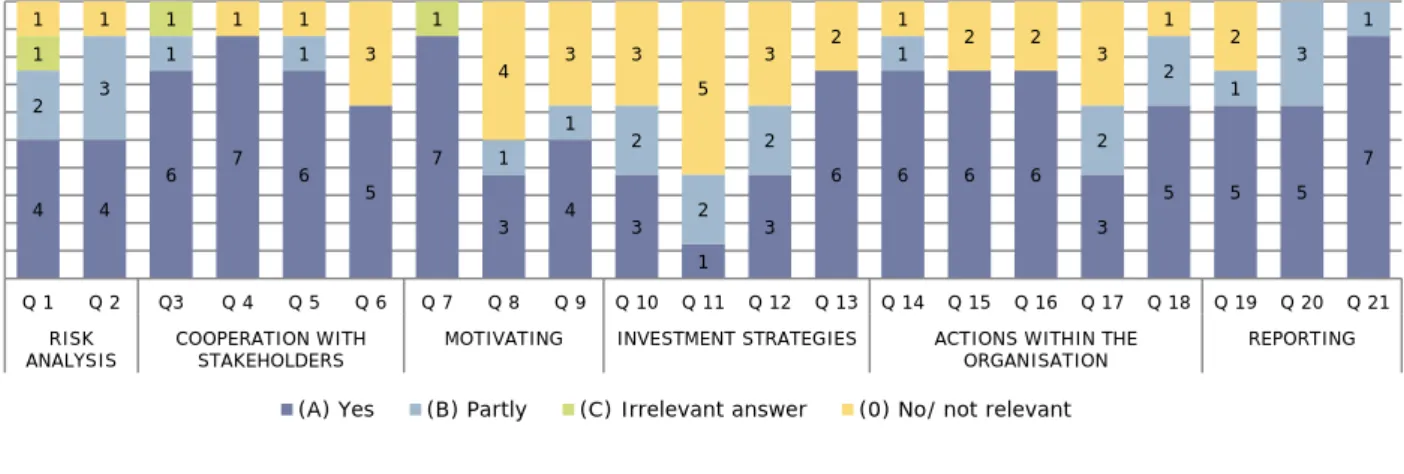
The 8 Danish companies participating in the survey in 2013, cover 78,5 % of the Danish non-life insurance market. This is a 10 % increase since 2009. The equivalent number of non-life insurance companies were 17 in 2009, however they were totalling a lower market share (71,5%).
Fig. 2 Denmark: Breakdown of survey answers per question.
On average, the majority of the Danish companies qualified for either “Yes” or “Partly” on most of the questions (the blue fields). This figure only shows the number of answers, and not the actual market coverage.
Fig. 3 Denmark: Breakdown of survey showing the weighted answers based on the market share for non-life companies, in 2009 and 2013.
4 4 6 7 6 5 7 3 4 3 1 3 6 6 6 6 3 5 5 5 7 2 3 1 1 1 1 2 2 2 1 2 2 1 3 1 1 1 1 1 1 1 1 3 4 3 3 5 3 2 1 2 2 3 1 2 0 % 10 % 20 % 30 % 40 % 50 % 60 % 70 % 80 % 90 % 100 % Q 1 Q 2 Q3 Q 4 Q 5 Q 6 Q 7 Q 8 Q 9 Q 10 Q 11 Q 12 Q 13 Q 14 Q 15 Q 16 Q 17 Q 18 Q 19 Q 20 Q 21 RISK
ANALYSIS COOPERATION WITHSTAKEHOLDERS MOTIVATING INVESTMENT STRATEGIES ACTIONS WITHIN THEORGANISATION REPORTING Breakdown of answers per question
2013
(A) Yes (B) Partly (C) Irrelevant answer (0) No/ not relevant
0% 10% 20% 30% 40% 50% 60% 70% 80% 90% 100% 20 09 20 13 20 09 20 13 20 09 20 13 20 09 20 13 20 09 20 13 20 09 20 13 20 09 20 13 20 09 20 13 20 09 20 13 20 09 20 13 20 09 20 13 20 09 20 13 20 09 20 13 20 09 20 13 20 09 20 13 20 09 20 13 20 09 20 13 20 09 20 13 20 09 20 13 20 09 20 13 20 09 20 13 Q 1 Q 2 Q3 Q 4 Q 5 Q 6 Q 7 Q 8 Q 9 Q 10 Q 11 Q 12 Q 13 Q 14 Q 15 Q 16 Q 17 Q 18 Q 19 Q 20 Q 21 RISK
ANALYSIS COOPERATION WITHSTAKEHOLDERS MOTIVATING INVESTMENT STRATEGIES ACTIONS WITHIN THEORGANISATION REPORTING Market share per question
2009 and 2013
Fig. 4 Denmark: Breakdown of survey showing the market share for non-life companies with A and B-rated answers
Figures 3 and 4 compare the market coverage of each question, comparing the answers in 2009 and 2013. On all but three questions (Q2, Q11 and Q17), the rate of either “Yes” or “Partly” rated questions has increased significantly, showing that there is a generally improved awareness on climate in all the survey categories.
3.2 Sweden
The 9 Swedish companies participating in the survey in 2013, cover 83,4 % of the Swedish non-life insurance market. This is a stable development since 2009, even though the number of responding companies in 2009 were 11 (market share 83,7%).
The Swedish companies participating in the survey responded the following:
Fig. 5 Sweden: Breakdown of survey answers per question.
The Swedish companies have a similar or slightly better responding rate than the Danish companies, and the respondents cover a larger part of the non-life market. The majority of the Swedish companies qualified for
0% 10% 20% 30% 40% 50% 60% 70% 80% 90% 100% Q1 Q2 Q3 Q4 Q5 Q6 Q7 Q8 Q9 Q10 Q11 Q12 Q13 Q14 Q15 Q16 Q17 Q18 Q19 Q20 Q21 RISK
ANALYSIS COOPERATION WITHSTAKEHOLDERS MOTIVATING INVESTMENT STRATEGIES ACTIONS WITHIN THEORGANISATION REPORTING
Marke
t s
h
are
Market share per question with positive answers ("Yes" or "Partly") 2009 and 2013 2009 2013 6 7 7 7 5 8 6 4 6 5 3 4 7 8 7 8 3 8 6 3 6 1 1 2 2 2 2 2 1 2 1 4 1 6 1 1 1 1 3 1 1 2 2 3 1 2 1 2 4 3 1 1 2 1 2 2 0 % 10 % 20 % 30 % 40 % 50 % 60 % 70 % 80 % 90 % 100 % Q 1 Q 2 Q3 Q 4 Q 5 Q 6 Q 7 Q 8 Q 9 Q 10 Q 11 Q 12 Q 13 Q 14 Q 15 Q 16 Q 17 Q 18 Q 19 Q 20 Q 21 RISK
ANALYSIS COOPERATION WITHSTAKEHOLDERS MOTIVATING INVESTMENT STRATEGIES ACTIONS WITHIN THEORGANISATION REPORTING Breakdown of answers per question
2013
10
|
B e s t P r a c t i c e i n I n s u r a n c e
the lowest marking is question 11, “We have asked the companies that we invest in to report on how they tackle climate change and what kind of reduction targets they have set for their emissions”. This figure only shows the number of answers, and not the actual market coverage.
Fig. 6 Sweden: Breakdown of survey showing the weighted answers based on the market share for non-life companies, in 2009 and 2013.
Fig. 7 Sweden: Breakdown of survey showing the market share for non-life companies with A and B-rated answers
Figures 6 and 7 compare the market coverage of each question, comparing the answers in 2009 and 2013. On all but one question (Q17), the rate of either “Yes” or “Partly” rated questions has increased, often significantly, showing improved awareness on climate in all the survey categories.
0% 10% 20% 30% 40% 50% 60% 70% 80% 90% 100% 20 09 2013 2009 2013 2009 2013 2009 2013 2009 2013 0920 2013 2009 2013 2009 1320 2009 2013 2009 2013 2009 2013 2009 2013 2009 2013 2009 2013 2009 2013 2009 1320 2009 2013 2009 2013 0920 2013 2009 2013 2009 2013 Q 1 Q 2 Q3 Q 4 Q 5 Q 6 Q 7 Q 8 Q 9 Q 10 Q 11 Q 12 Q 13 Q 14 Q 15 Q 16 Q 17 Q 18 Q 19 Q 20 Q 21 RISK
ANALYSIS COOPERATION WITHSTAKEHOLDERS MOTIVATING INVESTMENT STRATEGIES ACTIONS WITHIN THEORGANISATION REPORTING Market share per question
2009 and 2013
(A) Yes (B) Partly (C) Irrelevant answer (0) No/ not relevant
0% 10% 20% 30% 40% 50% 60% 70% 80% 90% 100% Q1 Q2 Q3 Q4 Q5 Q6 Q7 Q8 Q9 Q10 Q11 Q12 Q13 Q14 Q15 Q16 Q17 Q18 Q19 Q20 Q21 RISK
ANALYSIS COOPERATION WITHSTAKEHOLDERS MOTIVATING INVESTMENTSTRATEGIES ACTIONS WITHIN THEORGANISATION REPORTING
Marke
t cove
rage
Market share per question with positive answers ("Yes" or "Partly") 2009 and 2013
3.3 Norway
The 7 Norwegian companies participating in the survey in 2013, cover 71,2 % of the Norwegian non-life insurance market. This is a 23 % decrease since 2009. This is due to a few larger companies not participating in this years’ survey. The equivalent number of non-life insurance companies were 12 in 2009, covering almost the whole market (92,4 %).
The Norwegian companies participating in the survey responded the following:
Fig. 8 Norway: Breakdown of survey answers per question.
The few Norwegian participating companies have similar responding profiles as the Swedish market, having a few small companies with less matured climate management. The Norwegian respondents cover less of the non-life market than the Swedish and Danish respondents.
The majority of the Norwegian companies qualified for either “Yes” or “Partly” on most of the questions (the blue fields), and as in Denmark and Sweden, the question returning the lowest marking is question 11, “We have asked the companies that we invest in to report on how they tackle climate change and what kind of reduction targets they have set for their emissions”. This figure only shows the number of answers, and not the actual market coverage.
Fig. 9 Norway: Breakdown of survey showing the weighted answers based on the market share for non-life companies, in 2009 and 2013. 4 6 6 6 5 6 5 3 4 3 3 4 6 6 6 6 2 6 5 3 5 1 1 1 2 2 1 1 1 4 1 4 1 1 1 2 1 1 1 1 1 2 1 2 3 2 1 1 1 1 1 1 2 0 % 10 % 20 % 30 % 40 % 50 % 60 % 70 % 80 % 90 % 100 % Q 1 Q 2 Q3 Q 4 Q 5 Q 6 Q 7 Q 8 Q 9 Q 10 Q 11 Q 12 Q 13 Q 14 Q 15 Q 16 Q 17 Q 18 Q 19 Q 20 Q 21 RISK
ANALYSIS COOPERATION WITHSTAKEHOLDERS MOTIVATING INVESTMENT STRATEGIES ACTIONS WITHIN THEORGANISATION REPORTING Breakdown of answers per question
2013
(A) Yes (B) Partly (C) Irrelevant answer (0) No/ not relevant
0% 10% 20% 30% 40% 50% 60% 70% 80% 90% 100% 20 09 2013 2009 2013 2009 2013 2009 2013 2009 2013 0920 2013 2009 2013 2009 1320 2009 2013 2009 2013 2009 2013 2009 2013 2009 2013 2009 2013 2009 2013 2009 1320 2009 2013 2009 2013 0920 2013 2009 2013 2009 2013 Q 1 Q 2 Q3 Q 4 Q 5 Q 6 Q 7 Q 8 Q 9 Q 10 Q 11 Q 12 Q 13 Q 14 Q 15 Q 16 Q 17 Q 18 Q 19 Q 20 Q 21 RISK
ANALYSIS COOPERATION WITHSTAKEHOLDERS MOTIVATING INVESTMENT STRATEGIES ACTIONS WITHIN THEORGANISATION REPORTING Market share per question
2009 and 2013
12
Fig Fig all inc dro an3.
On com for Fig Ba an Marke t s h are 1 2 3 4 5 6 7 8 9 102
|
B e s t
. 10 Norway: Br gures 9 andbut five que creased show
op in market d Swedish m
4 Finland
nly one comp mpanies par r the single c . 14 Finland: sed on the alysis canno 0% 10% 20% 30% 40% 50% 60% 70% 80% 90% 100% Q1 RIS ANALY 0% 10% 20% 30% 40% 50% 60% 70% 80% 90% 00% 20 09 20 13 20 09 Q 1 Q RISK ANALYSIS
P r a c t i
reakdown of sur 10 compare estions (Q3, wing improve t share for p markets.d
pany particip rticipated, bu company in Breakdown of single respo ot be made. Q2 Q3 Q4 KYSIS COOPESTAK
20 13 20 09 20 13 20 09 20 13 2 Q3 Q 4 S COOPERASTAKEH
c e i n I
rvey showing th the market Q9, Q10, Q ed awarenes positive answ pated, and th ut the total m 2013 is estim f survey answ ondent in 2 4 Q5 Q6 RATION WITH KEHOLDERS Market sha 20 13 20 09 20 13 20 09 20 13 Q 5 Q 6 ATION WITH HOLDERS (A) Yn s u r a n
he market share coverage of 11 and Q17 ss on climate wers, the No his company market share mated.wers per quest
013 and the
Q7 Q8
MOTIVATING are per questio
20 09 20 13 20 09 20 13 20 09 Q 7 Q 8 Q MOTIVATING Mar es (B) Partly
n c e
e for non-life co f each quest 7), the rate o e in all the s rwegian mar y responded e was not di tion e limited co Q9 Q10 Q1 G INVESTME on with positi 2009 and 2 2009 2 20 13 20 09 20 13 20 09 20 13 Q 9 Q 10 Q 11 INVESTMEN ket share per 2009 and 20 (C) Irrelevant mpanies with A ion, compar of either “Ye survey categ rket is show on behalf of isclosed for a overage of t 1 Q12 Q13 NT STRATEGIES ive answers ( 2013 013 20 13 20 09 20 13 20 09 20 13 1 Q 12 Q 13 NT STRATEGIES question 013 answer (0) No and B-rated an ing the answ s” or “Partly ories. With 5 ing less impf all the Nord all companie he Finnish n Q14 Q15 Q ACTIONS W ORGAN "Yes" or "Part 20 09 20 13 20 09 20 13 20 09 Q 14 Q 15 Q ACTIONS W ORGAN o/ not relevant nswers wers in 2009 y” rated ques 5 questions provement th
dic countries es, and the m
non-life mar Q16 Q17 Q18 WITHIN THE NISATION rtly") 20 13 20 09 20 13 20 09 20 13 16 Q 17 Q 18 WITHIN THE ISATION 9 and 2013. stions has showing a han the Dani
s. In 2009, 4 market share rket, a reali 8 Q19 Q20 REPORTIN 20 13 20 09 20 13 20 09 20 13 8 Q 19 Q 20 REPORTIN On ish 4 e stic Q21 G 20 09 20 13 Q 21 NG
4.
Conclusion
This report shows the current status of the insurance industry in the Nordic countries, regarding investments, risk assessment and implemented measures, related to climate change and social responsibility. In addition to collect best practice answers, the aim of the 2013 survey was to investigate whether the non-life insurance market has improved in the efforts to tackle climate change.
In spite of fewer companies taking part in the survey in 2013, these companies still represented the majority of the markets in the respective countries. Only the Norwegian companies covered significantly less of the market in 2013 than in 2009. The Finnish companies have not taken an active part in this survey, and can therefore not be evaluated.
On average, the answers from companies have improved significantly, and it is evident that the Nordic non-life insurance market is well involved and taking active measures to prepare for future climate changes. The companies taking part in this survey are predominantly the market leaders in each country, and the smaller companies are not well represented. In order to give a realistic picture of the market coverage and customer base, the data is analysed based on market shares instead of number of participating companies.
The Nordic insurance market is made up by a few large companies with 15-30% market share and several small companies with market share around 2-3 % or less. There is a clear gap between the climate adaptation efforts among smaller companies and larger companies. The larger companies are more affected by reporting standards, stakeholder interest, and have more resources invested in management systems and CSR in general. The larger companies are communicating more with their customer base and are developing new products and services in relation to climate mitigation. This may further distance the leading companies from the more local players. The front runners in the Nordic market are the pan-Nordic insurance companies, as they often manage to create positive synergies in all the countries they operate in. The results are therefore predominantly mirroring the results of these large companies, and the absence of a larger sized company will affect the statistics greatly. This is evident for instance in the Norwegian market.
The Climate Wise methodology does not allow a nuanced evaluation of the positive answers, so a company with a “Yes”/A-rating of a question might have one single implemented measure or several measures. This means that there is broad range of answers qualifying for an “A”-rating, possibly penalizing the “best in class” companies.
Some companies are previously known to have measures on certain topics, but have misunderstood these questions or answered erroneously and thus not achieved an “A” or “B” mark. This may have affected the final result to some extent. The evaluation is only based on the actual answers and not by previous knowledge of a company’s performance.
Based on the answers given in the survey, the Swedish market has a more “climate change adapted” profile that Norway and Denmark, even though all the markets are fairly even. Sweden has a better coverage of the market, and on average a higher level of positive answers. The Danish and Norwegian respondents are similar and have also many companies in common. For all countries, the topic with the lowest rate of positive answers and improvement is investment strategies, and the companies’ efforts to interact with stakeholders and encourage them to increase their environmental efforts.
The Best Practice list demonstrates some very good examples, for instance, how to motivate policyholders, to provide climate friendly options, and offering green products and services. The customers receive information on how to, for example, lower their premium rate by minimizing risks due to climate change.
The regulations that are in place will affect the companies to a greater extent in the future and there will most likely be more regulations in the years to come. This will lead to bigger differences between the companies in each of the Nordic countries, depending on how strict the regulations are. The survey shows that the larger companies are well prepared, whereas the smaller companies may be in financial risk in the future, with the increase of climate related damage claims, should they not increase their climate mitigation efforts. It is therefore advisable to raise the awareness among the smaller companies and include them more in the insurance industry programs.
14
|
B e s t P r a c t i c e i n I n s u r a n c e
5.
Abbreviations and explanation
CDM Clean Development Mechanism (United Nations)
CDP Carbon Disclosure Project
CER Certified Emission Reduction
CICERO Center for International Climate and Environmental Research
Climate Consortium Denmark Official focal point for all Danish business-related activities leading up to the UN Climate Change Conference
CONCITO Danish green think tank
CSR Cooperate Social Responsibility
Decision makers Danish council for sustainable business development, business panel on climate change, climate consortium Denmark. Norwegian government consultant agency on environment and social responsibility, county administrative board
FSPOS Financial sector Private - Public cooperation Group
GHG protocol Green House Gas Protocol Initiative
GRI Global Reporting Initiative
ICC International Chamber of Commerce
ISS Integrated Services Solutions
MSB Swedish Civil Contingencies Agency
NGO Non- governmental organisation: WWF, Friends of the Earth, Nature and Youth, Nordic Ecolabel, The Natural Step, the Future in Our Hands (Norway), the Swedish Society for Nature Conservation, The Swedish Association of Green Motorists.
NHO Confederation of Norwegian Enterprise
Norwegian Computing Center Research in the area of applied statistical modelling etc.
OECD Organisation for economic co-operation and development
SAI Social Accountability international
SIND.NO Sustainable Insurance and Finance Development
SINTEF Norwegian research organisation
SIWI Stockholm International Water Institute
The Geneva Association The International Association for the Study of Insurance Economics
The Swan Nordic Ecolabel
UN GC United Nations Global Compact
UN PRI United Nations Principles of Responsible Investments
UNEP FI United Nations Environment Programme Finance Initiative
Appendix
I.
Overview of submitted answers
The following tables give an overview of all the submitted answers from each of the 67 companies. Each company has an own, anonymous number. The company can benchmark itself with the other companies without knowing the identity of the other companies. The specific measures are listed in the Best practice section. Q 1 Q 2 Q 3 Q 4 Q 5 Q 6 Q 7 Q 8 Q 9 Q 10 Q 11 Q 12 Q 13 Q 14 Q 15 Q 16 Q 17 Q 18 Q 19 Q 20 Q 21 Denmark 1 A A A A A A A A A A A A A A A A A A A A A Norway 2 A A A A A A A A A A A A A A A A A A A A A Sweden 3 A A A A A A A A A A A A A A A A A A A A A Sweden 4 A A A A A A A A A A B B A A A A B A A B A Denmark 5 A A B A A A A B A A O A A A A A A B A A A Norway 6 C A A A C A A C A A A A A A A A B A A A A Sweden 7 C A A A C A A C A A A A A A A A B A A A A Norway 8 A A A A A A A C B A A A A A A A B A A B O Sweden 9 A A A A O A B C A A A A A A A A A A A B O Finland 10 A A A A A A A A A O O O A A A A B A A B A Denmark 11 A A A A A A A A A O O O A A A A B A A B A Norway 12 A A A A A A A A A O O O A A A A B A A B A Sweden 13 A A A A A A A A A O O O A A A A B A A B A Denmark 14 A B A A A A A A A B O B A A A A A A B B A Norway 15 A B A A A A A A A B O B A A A A A A B B A Sweden 16 A B A A A A A A A B O B A A A A A A B B A Denmark 17 B A A A A A C O B B B A A A A A B A A B A Norway 18 B A A A A A C O B B B A A A A A B A A B A Sweden 19 B A A A A A C O B B B A A A A A B A A B A Denmark 20 C B A A B O A O O A B B O A A A O A A A A Denmark 21 B B C A A O A O O O O O A B O O O B O A A Sweden 22 A O O O O A B C O A O O O A B A O A O B O Sweden 23 O A O O O O A O B O O O B O B B O O O A B Denmark 24 O O A O O O A O O O O O O O O O O O O A B Norway 25 O A O O O O B O O O O O B O O O O O O A O Rep.
Company Cooperation with stakeholders
Policy holders and suppliers
Investment strategies
Actions within the organisation Risk