PCBs 595
7. ANALYTICAL METHODS
The purpose of this chapter is to describe the analytical methods that are available for detecting, and/or measuring, and/or monitoring PCBs, its metabolites, and other biomarkers of exposure and effect to PCBs. The intent is not to provide an exhaustive list of analytical methods. Rather, the intention is to identify well-established methods that are used as the standard methods of analysis. Many of the analytical methods used for environmental samples are the methods approved by federal agencies and organizations such as EPA and the National Institute for Occupational Safety and Health (NIOSH). Other methods presented in this chapter are those that are approved by groups such as the Association of
Official Analytical Chemists (AOAC) and the American Public Health Association (APHA). Additionally, analytical methods are included that modify previously used methods to obtain lower detection limits, and/or to improve accuracy and precision.
Methodology for PCB analysis includes several steps: sample collection and storage, extraction, cleanup, and determination (EPA 1995c, 1999k; Hess et al. 1995). Care must be taken to assure that the sample collection follows quality assurance protocols and that equipment and containers are free from
contamination. Most sample collections are by grab sampling; however, PCBs may be concentrated from water or air onto sorbents. PCBs are typically separated from the sample matrix by solid-phase extraction (SPE), separatory funnel extraction, continuous liquid/liquid extraction (CLLE), Soxhlet extraction, or Soxhlet/Dean-Stark extraction. PCBs may be difficult to extract from oily matrices in which they are soluble. Some problems that may occur during extraction include evaporative losses during
concentration, sorption onto labware, and contamination of samples. Cleanup steps are necessary to remove compounds that may interfere with the determination. Chromatography (e.g., gel permeation, silica gel, Florisil, activated carbon, high-performance liquid) is often used to remove matrix
interferences, and sometimes to fractionate PCBs into several groups. Cleanup by chromatography has been used extensively to separate the non-ortho and the mono-ortho CBs from the remaining congeners before quantitative analysis (Hess et al. 1995). The identification and quantitation of PCBs are most often accomplished by gas chromatographic (GC) techniques. Capillary or high resolution gas chromatography (HRGC) columns capable of separating a substantial proportion of the congeners are indispensable, and GC detectors possessing high selectivity and sensitivity for the PCBs are required. The more universal and less sensitive flame-ionization detector (FID) is used much less often than the electron capture detector (ECD), which has exceptional sensitivity to multiply chlorinated compounds. The mass spectrometer-selected-ion-monitoring (MS-SIM) or ion-trap mass spectrometer (ITMS) detectors have sensitivities somewhat lower than ECD, and they have even greater selectivity for PCBs and can
PCBs 596 7. ANALYTICAL METHODS
distinguish and individually measure homologs that may coelute on a particular HRGC column (EPA 1999k).
Some methods in use are multi-residue methods in which PCBs along with many other analytes such as pesticides, are determined. In general, PCB methods analyze for Aroclor mixtures, PCB homologs, or individual PCB congeners. Until recently, packed column GC/ECD was used most often for the
determination of PCBs as Aroclor mixtures. The Webb-McCall technique was used for quantitation. The weight percent and homolog identification were determined for several Aroclors. Response factors were generated to calculate the amount in each sample peak; with packed columns, each peak contains several congeners. The amounts found in each sample peak were then summed (Webb-McCall 1973).
Alternately, the total area in the Aroclor region of the chromatogram was used for quantitation. However, Aroclor analyses are estimations that are prone to error as a result of the subjective assignment of Aroclor speciation and response factors. Also, the practice of comparing CB patterns in environmental samples with those of technical mixtures can be misleading since mixtures emanating from different sources are mixed at differing rates by diffusion, evaporation, and adsorption onto solids. Many congeners are metabolized, while others bioconcentrate in lipophilic material. Therefore, the final pattern in the environment is often highly modified and may not resemble the original commercial formulation or mixture of formulations (Draper et al. 1991; Duinker and Hillebrand 1979; Hess et al. 1995). The maximum detection limits (MCLs) for Aroclors vary in the range of 0.054–0.90 µg/L in water and 57–70 µg/kg in soils (EPA 1995c). Another approach is to determine PCBs by level of chlorination (or homolog group). One PCB for each homolog (isomer group) is typically used for calibration. Total PCB concentration is obtained by summing isomer group concentrations (Alford-Stevens et al. 1986).
However, since the congener distribution is not determined with this method, an accurate calculation of PCB toxic equivalency (TEQ) can not be accessed. Recently, capillary or HRGC has made it possible to achieve lower detection limits and better separation of individual PCB congeners for quantitation (Frame 1997; Mullin et al. 1984; Newman et al. 1998), although complete separation of all PCB congeners on a single column has not yet been achieved (Duebeleis et al. 1989). The commonly used capillary columns (DB-5, C-18, DB-1701, SE-54, SIL-8, SP-2330, and CP-SIL-8) provide poor or no resolution for the following groups of congeners: 15/18, 28/31, 49/52, 66/95, 77/110, 84/90/101, 118/149, 138/163/164, 105/132/153, 170/190, and 182/187 (Liem 1999; Schantz et al. 1993b). Nevertheless, the trend is toward congener-specific analysis by HRGC. Recent advances include analytical methods that are able to quantify individual PCBs congeners to enable TEQ calculations (EPA 1999k; Frame 1999; Patterson et al. 1994). EPA Method 1668 (Revision A ) is the current methodology used to measure individual PCB congeners in water, soil, sediment, and tissue by HRGC/high resolution mass spectrometry (HRMS)
PCBs 597 7. ANALYTICAL METHODS
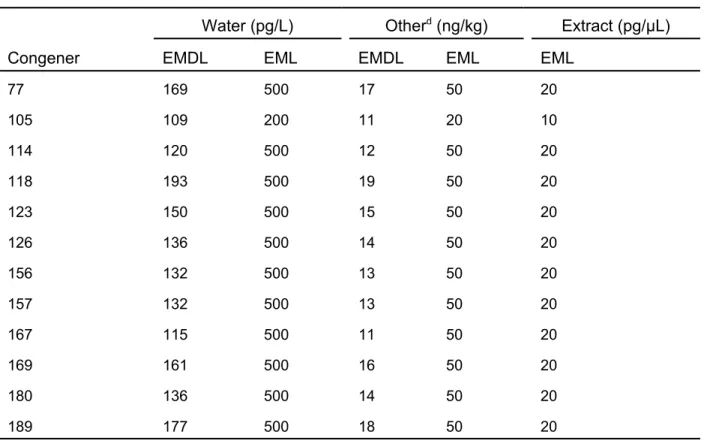
(EPA 1999k). Estimated detection limits (EDL) of selected PCB congeners range from 109 to 193 pg/L for water and 11–19 ng/kg for soil, tissue, and mixed-phase samples. EDLs are listed in Table 7-1 for EPA Method 1668 (Revision A; EPA 1999k). This method has been used to measure specific PCBs in EPA projects such as the assessment of PCBs in fish consumed by four Native American tribes in the Columbia River Basin in Washington state (EPA 1996f). As for all analytical methods, determining the quality and usability of Aroclor, PCB homolog, or specific congener data by formal data validation procedures is recommended; EPA has developed data validation guidelines for HRGC/ECD Aroclor data and HRGC/LRMS (low resolution mass spectrometry) PCB specific congener data (EPA 1994h, 1995g).
7.1 BIOLOGICAL SAMPLES
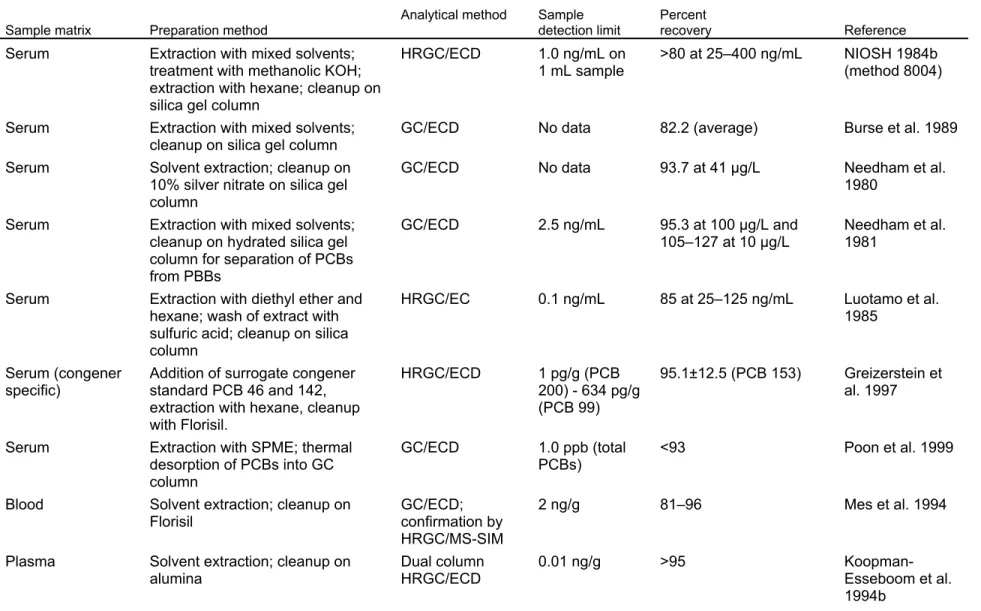
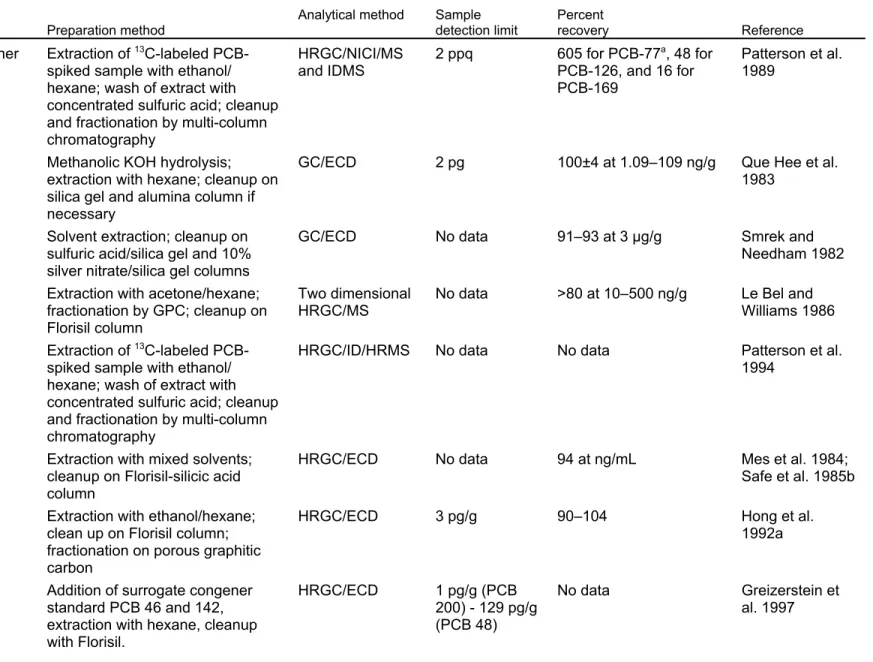
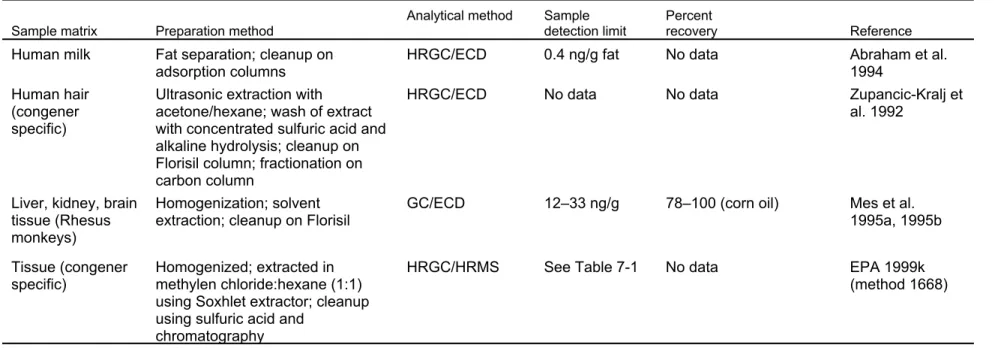
The quantitation of PCBs in biological samples usually consists of three distinct steps: extraction of PCBs from the sample matrix by a solvent or a combination of solvents; cleanup of PCBs from impurities on single or multiple columns; and finally, quantitation by GC with a suitable detector. A summary of some available methods for biological samples is shown in Table 7-2.
PCBs are extracted from blood or serum by solvent extraction techniques using hexane (EPA 1980; Needham et al. 1980), benzene (Mes et al. 1994, 1995a, 1995b, 1995c), or mixed solvents such as hexane/ethyl ether (Koopman-Esseboom et al. 1994b; Luotamo et al. 1985; Needham et al. 1981), or by solid phase micro-extraction techniques (Poon et al. 1999). A variety of adsorbents may be used for cleanup and/or fractionation of extracts: deactivated silica gel (Burse et al. 1989), Florisil (Mes et al. 1994, 1995a, 1995b, 1995c), alumina (Koopman-Esseboom et al. 1994b), or multiple columns (Patterson et al. 1989). GC/ECD is used most often for determination of biological samples (Burse et al. 1989; Mes et al. 1994, 1995a, 1995b; NIOSH 1984b; Schantz et al. 1994). Confirmation by mass spectrometry is recommended (Burse et al. 1994; Mes et al. 1994). Detection limits are in the low- to sub-ppb range (Luotamo et al. 1985; Mes et al. 1994, 1995a, 1995b; Needham et al. 1981; NIOSH 1984b; Poon et al. 1999). Recovery, where reported, ranges from .80 to 96% (Koopman-Esseboom et al. 1994b; Mes et al. 1994; Needham et al. 1980, 1981; NIOSH 1984b; Poon et al. 1999). The accuracy and precision of the results of PCB analysis in serum using a packed column GC/ECD method were studied in a collaborative study. The mean recovery (for Aroclor 1254) was 82.2%; inter-laboratory precision was <21% for samples spiked at 10–100 ng/mL (Burse et al. 1989). Cord blood, which is the most direct marker of fetal exposure, requires especially sensitive analytical methods for accurate PCB analysis because of its
PCBs 598 7. ANALYTICAL METHODS
Table 7-1. EPA Method 1668-Estimated Method Detection Limits (EMDL) and
Estimated Minimal Levels (EML) of Selected PCB Congeners
a,bDetection limits and minimal levels-matrix and concentrationc
Water (pg/L) Otherd (ng/kg) Extract (pg/µL)
Congener EMDL EML EMDL EML EML
77 169 500 17 50 20 105 109 200 11 20 10 114 120 500 12 50 20 118 193 500 19 50 20 123 150 500 15 50 20 126 136 500 14 50 20 156 132 500 13 50 20 157 132 500 13 50 20 167 115 500 11 50 20 169 161 500 16 50 20 180 136 500 14 50 20 189 177 500 18 50 20 aSource: EPA 1999k
bfor SPB-Octyl gas chromatography column
cEMDLs and EMLs with common laboratory interferences present. Without interferences, EMDLs and EMLs will be
respectively, 5 and 10 pg/L for aqueous samples, and 0.5 and 1.0 ng/kg for soil, tissue, and mixed-phase samples, and EMLs for extracts will be 0.5 pg/µL.
dsoil, tissue, and mixed-phase samples
EMDL = estimated method detection limits; EML = estimated minimal levels; EPA = U.S. Environmental Protection Agency
Table 7-2. Analytical Methods for Determining Polychlorinated Biphenyls in Biological Samples
Analytical method Sample Percent
Sample matrix Preparation method detection limit recovery Reference
Serum Extraction with mixed solvents; treatment with methanolic KOH; extraction with hexane; cleanup on silica gel column
HRGC/ECD 1.0 ng/mL on 1 mL sample
>80 at 25–400 ng/mL NIOSH 1984b (method 8004)
Serum Extraction with mixed solvents;
cleanup on silica gel column GC/ECD No data 82.2 (average) Burse et al. 1989 Serum Solvent extraction; cleanup on
10% silver nitrate on silica gel column
GC/ECD No data 93.7 at 41 µg/L Needham et al. 1980
Serum Extraction with mixed solvents; cleanup on hydrated silica gel column for separation of PCBs from PBBs
GC/ECD 2.5 ng/mL 95.3 at 100 µg/L and 105–127 at 10 µg/L
Needham et al. 1981
Serum Extraction with diethyl ether and
hexane; wash of extract with HRGC/EC 0.1 ng/mL 85 at 25–125 ng/mL Luotamo et al. 1985 sulfuric acid; cleanup on silica
column Serum (congener
specific) Addition of surrogate congener standard PCB 46 and 142, extraction with hexane, cleanup with Florisil. HRGC/ECD 1 pg/g (PCB 200) - 634 pg/g (PCB 99) 95.1±12.5 (PCB 153) Greizerstein et al. 1997
Serum Extraction with SPME; thermal desorption of PCBs into GC column
GC/ECD 1.0 ppb (total
PCBs) <93 Poon et al. 1999 Blood Solvent extraction; cleanup on
Florisil GC/ECD; confirmation by HRGC/MS-SIM
2 ng/g 81–96 Mes et al. 1994
Plasma Solvent extraction; cleanup on
alumina Dual column HRGC/ECD 0.01 ng/g >95 Koopman-Esseboom et al. 1994b PCBs 599 7. ANALY T ICAL METHO D S
Table 7-2. Analytical Methods for Determining Polychlorinated Biphenyls in Biological Samples (
continued
)
Analytical method Sample Percent
Sample matrix Preparation method detection limit recovery Reference
Serum (congener Extraction of 13C-labeled PCB HRGC/NICI/MS 2 ppq 605 for PCB-77a, 48 for Patterson et al.
specific) spiked sample with ethanol/ and IDMS PCB-126, and 16 for 1989 hexane; wash of extract with PCB-169
concentrated sulfuric acid; cleanup and fractionation by multi-column chromatography
Blood Methanolic KOH hydrolysis; GC/ECD 2 pg 100±4 at 1.09–109 ng/g Que Hee et al. extraction with hexane; cleanup on 1983
silica gel and alumina column if necessary
Adipose tissue Solvent extraction; cleanup on GC/ECD No data 91–93 at 3 µg/g Smrek and sulfuric acid/silica gel and 10% Needham 1982 silver nitrate/silica gel columns
Adipose tissue Extraction with acetone/hexane; Two dimensional No data >80 at 10–500 ng/g Le Bel and fractionation by GPC; cleanup on HRGC/MS Williams 1986 Florisil column
Adipose tissue Extraction of 13C-labeled PCB HRGC/ID/HRMS No data No data Patterson et al.
and serum spiked sample with ethanol/ 1994 (congener hexane; wash of extract with
specific) concentrated sulfuric acid; cleanup and fractionation by multi-column chromatography
Human milk Extraction with mixed solvents; HRGC/ECD No data 94 at ng/mL Mes et al. 1984; cleanup on Florisil-silicic acid Safe et al. 1985b column
Human milk Extraction with ethanol/hexane; HRGC/ECD 3 pg/g 90–104 Hong et al. (congener clean up on Florisil column; 1992a specific) fractionation on porous graphitic
carbon
Human milk Addition of surrogate congener HRGC/ECD 1 pg/g (PCB No data Greizerstein et (congener standard PCB 46 and 142, 200) - 129 pg/g al. 1997 specific) extraction with hexane, cleanup (PCB 48)
with Florisil. PCBs 600 7. ANALY T ICAL METHO D S
Table 7-2. Analytical Methods for Determining Polychlorinated Biphenyls in Biological Samples (
continued
)
Sample matrix Preparation method
Analytical method Sample detection limit
Percent
recovery Reference
Human milk Fat separation; cleanup on adsorption columns
HRGC/ECD 0.4 ng/g fat No data Abraham et al. 1994
Human hair (congener specific)
Ultrasonic extraction with acetone/hexane; wash of extract with concentrated sulfuric acid and alkaline hydrolysis; cleanup on Florisil column; fractionation on carbon column
HRGC/ECD No data No data Zupancic-Kralj et al. 1992
Liver, kidney, brain tissue (Rhesus monkeys)
Homogenization; solvent
extraction; cleanup on Florisil GC/ECD 12–33 ng/g 78–100 (corn oil) Mes et al. 1995a, 1995b Tissue (congener
specific) Homogenized; extracted in methylen chloride:hexane (1:1) using Soxhlet extractor; cleanup using sulfuric acid and
chromatography
HRGC/HRMS See Table 7-1 No data EPA 1999k (method 1668)
aThe high recovery for PCB 77 was due to interference from other congeners. The low recovery for PCB 126 and PCB-169 is not critical since ID/MS makes correction for recovery unnecessary.
ECD = electron capture detector; GC = gas chromatography; GPC = gel permeation chromatography; HRGC = high resolution gas chromatography; HRMS=high resolution mass spectroscopy; ID/HRMS = isotope dilution high resolution mass spectrometry; IDMS = isotope dilution mass spectrometry; KOH = potassium hydroxide; MS = mass spectrometry; MS-SIM = mass spectrometer-selected-ion-monitoring; NICI/MS = negative ion chemical ionization mass spectrometry; PBBs = polybrominated biphenyls; PCBs = polychlorinated biphenyls
PCBs 601 7. ANALY T ICAL METHO D S
PCBs 602 7. ANALYTICAL METHODS
relatively low fat content. Analysis of breast milk does not present this difficulty. While analytical techniques have improved enormously in recent years, the low concentration of fat in cord blood may still present difficulties in achieving accurate and reliable PCB levels.
Methods for determining PCBs in adipose tissue are similar to those for blood. Solvent extraction is used to separate the PCBs along with other soluble organics from the tissue. The PCBs are then separated from the lipids, usually by column chromatographic techniques. Most procedures include a step for determining the percent fat since results are often reported on a percent fat basis. Very little performance data are available for PCBs in adipose tissue. Detection limits of 51–144 ng/g have been reported for adipose tissue from Rhesus monkeys (Mes et al. 1994, 1995b).
A congener-specific analysis of a commercial PCB preparation and the PCB composition of a human milk sample were reported originally by Safe et al. (1985b). Recent studies have demonstrated the analysis of non-ortho coplanar and mono-ortho coplanar PCBs in breast milk (Dewailly et al. 1991) and coplanar PCBs in serum and adipose tissue (Patterson et al. 1994). Determination of these congeners (PCBs 77, 126, 169) is useful in assessing the toxic potential of breast milk for infants.
Recently, supercritical fluid extraction (SFE) has been utilized for extraction and cleanup of biological samples. The procedure is quick and avoids the use of flammable or toxic organic solvents (Anitescu and Tavlarides 1998; Djordjevic et al. 1994). Packed-column GC techniques are still widely used; however, HRGC has made it possible to achieve better separation of PCB congeners for quantitation (Ballschmiter and Zell 1980; Mullin et al. 1984).
The congeners to be determined in samples may be selected on the basis of their abundance in the samples, their toxicity, or the availability of analytical standards. The coplanar, non-ortho-substituted congeners are PCB-77, PCB-126, and PCB-169. The mono-ortho-substituted congeners, PCB-28, PCB-74, PCB-105, PCB-118, and PCB-156, are also frequently determined, along with the non-ortho substituted PCB congeners. PCBs 138, 153, and 180 are frequently measured in higher amounts than other congeners (Safe 1993; Schecter et al. 1994) and are often included in sets of congeners for quantitation.
Variables in sampling methods greatly influence results. For example, PCB levels in milk fat may decrease during lactation, with maternal age and weight, and with number of children born (Jensen 1987). It has been shown by Lawton et al. (1985b) that random error, inter-laboratory variations in procedure,
PCBs 603 7. ANALYTICAL METHODS
and methods used for reporting data may have considerable impact on the reported PCB levels in human tissues. Caution should be exercised when comparing exposure estimates or health effect studies reported by different investigators unless similar analysis methodologies are employed. Also, without the
separation and quantitation of individual PCB congeners during analysis, PCB concentrations can not be directly correlated to toxic equivalency. Currently, EPA Method 1668 (Revision A) is a standard method for analysis of individual PCB congeners in biological tissues (EPA 1999k).
7.2 ENVIRONMENTAL SAMPLES
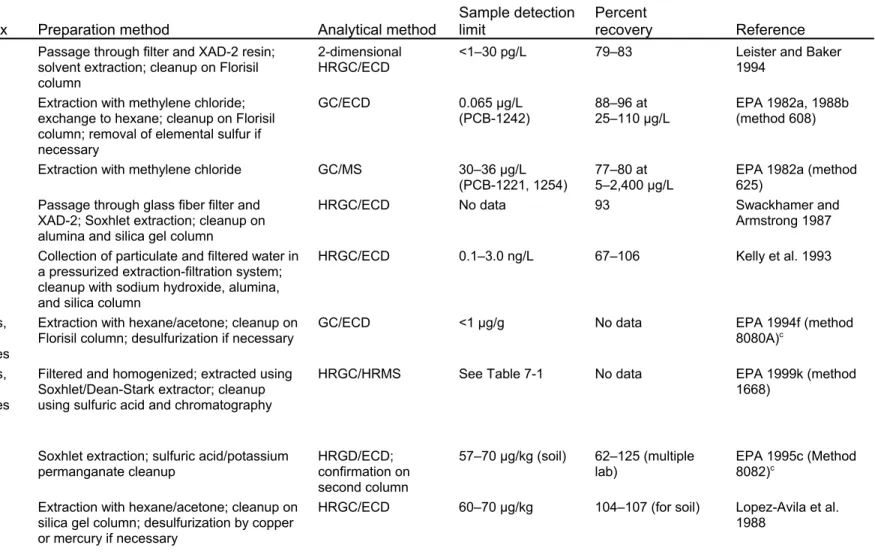
An overview of PCB analysis, including sampling technique, extraction, cleanup procedures, and quantification is reported in EPA Method 1668 (Revision A; EPA 1999k). A summary of representative methods is shown in Table 7-3. The table includes methods that have been standardized by NIOSH, EPA, American Society for Testing and Materials (ASTM), AOAC, and Food and Drug Administration (FDA). Most of these methods were developed for the determination of Aroclors (noncongener-specific PCBs) in environmental samples.
Air samples are usually collected by pumping air through a sampler containing a glass fiber filter and adsorbent trap to separate the particle bound and vapor phase fractions. Adsorbents used most often include Florisil (Lin and Que Hee 1985, 1987; NIOSH 1984a), XAD-2 (EPA 1988b; Hippelein et al. 1993), and polyurethane foam (PUF) (Bremle and Larsson 1998; EPA 1988b). Florisil traps are solvent desorbed (Lin and Que Hee 1985, 1987; NIOSH 1984a) and XAD-2 traps are Soxhlet extracted (Bremle and Larsson 1998; EPA 1988b; Hippelein et al. 1993). PCBs are determined by GC/ECD (Bremle and Larsson 1998; EPA 1988b; Irvine and Loganathan 1998; Lin and Que Hee 1985, 1987; NIOSH 1984a) or HRGC/MS (Hippelein et al. 1993). Detection limits depend upon the volume of air sampled; however, detection limits in the low ng/m3 (EPA 1988b) to low pg/m3 (Hippelein et al. 1993) have been reported.
Recovery, where reported, is good (>80%) (Bremle and Larsson 1998; Brownlow and Que Hee 1985; EPA 1988b; Irvine and Loganathan 1998; Lee et al. 1996; Lin and Que Hee 1985, 1987).
EPA Method 1668 (Revision A ) is the current methodology used to measure specific toxic, dioxin-like PCB congeners in surface, ground, and drinking water by HRGC/HRMS (EPA 1999k). Drinking water samples are typically extracted with solvent prior to analysis by GC/ECD, HRGC/ECD, and
HRGC/HRMS (EPA 1989c, 1999k). Detection limits are in the sub-ppb range and recovery is good (>80%) (EPA 1989c). Preconcentration techniques may be used for extraction of large water volumes, thus lowering the method detection limit (Leister and Baker 1994; Swackhamer and Armstrong 1987).
Table 7-3. Analytical Methods for Determining Polychlorinated Biphenyls in
Environmental Samples
Sample detection Percent
Sample matrix Preparation method Analytical method limit recovery Reference
Air (occupational) Adsorption on glass fiber filter and Florisil; GC/ECD 0.0006 mg/m3 for No data NIOSH 1984a
hexane desorption 50 L sample (method 5503)
Air Adsorption on water-deactivated Florisil;
hexane desorption; perchlorination GC/ECD No data 84–103 at 4–49 µg/m3 Lin and Que Hee 1985, 1987 Air Adsorption on Florisil or Chromosorb 102 or GC/ECD 10 µg/m3 for >80 at 300 µg/m3 Brownlow and
Tenax GC or XAD-2; hexane desorption 4 L sample Que Hee 1985
Ambient Air Sample collection on glass fiber filter and GC/ECD >1 ng/m3 36–94 EPA 1988b (method
PUF cartridge; Soxhlet extraction; alumina TO-4)
column cleanup
Ambient air Sample collection on glass fiber filter and HRGC/MS low pg/m3 No data Hippelein et al. 1993 (target XAD-2 trap; Soxhlet extraction; adsorption (calculated)
congeners) column cleanup and fractionation
Water (congener Extracted using SPE, SFE, CLLE; cleanup HRGC/HRMS See Table 7-1 No data EPA 1999k (method
specific) using sulfuric acid and chromatography 1668)
Drinking water Extraction with hexane HRGC/ECD 0.08–0.15 µg/L 84–97 (tap water) EPA 1989c (method 505)
Finished drinking Extraction with methylene chloride; solvent GC/ECD or No data No data EPA 1989c (method
water and exchange to methyl tert-butyl ether HRGC/ECD 508)
groundwater
Drinking water Extraction with methylene chloride; solvent GC/ECD or 0.14–0.23 µg/L 82–136 ng/g EPA 1989c (method
(screening) exchange to chloroform; perchlorination to HRGC/ECD 508A)
decachlorobiphenyl
Drinking water Extraction on SPE cartridges or disks; HRGC/MS 0.045–0.24 µg/L 65–100 EPA 1987f (method
elution with methylene chloride 525)
Drinking water Sample spiked with 13C-labeled PCBs; HRGC/HRMS 0.02–0.04 pg/L No data Miyata et al. 1993 (congener solvent extraction of sample (filtered water
specific) and particles); cleanup and fractionation by adsorption chromatography PCBs 604 7. ANALY T ICAL METHO D S
Table 7-3. Analytical Methods for Determining Polychlorinated Biphenyls in
Environmental Samples (
continued
)
Sample detection Percent
Sample matrix Preparation method Analytical method limit recovery Reference
Rain water Passage through filter and XAD-2 resin; 2-dimensional <1–30 pg/L 79–83 Leister and Baker
(congener solvent extraction; cleanup on Florisil HRGC/ECD 1994
specific) column
Waste water Extraction with methylene chloride; GC/ECD 0.065 µg/L 88–96 at EPA 1982a, 1988b exchange to hexane; cleanup on Florisil (PCB-1242) 25–110 µg/L (method 608) column; removal of elemental sulfur if
necessary
Waste water Extraction with methylene chloride GC/MS 30–36 µg/L 77–80 at EPA 1982a (method (PCB-1221, 1254) 5–2,400 µg/L 625)
Lake water Passage through glass fiber filter and HRGC/ECD No data 93 Swackhamer and
XAD-2; Soxhlet extraction; cleanup on Armstrong 1987
alumina and silica gel column
Sea water Collection of particulate and filtered water in HRGC/ECD 0.1–3.0 ng/L 67–106 Kelly et al. 1993 (congener a pressurized extraction-filtration system;
specific) cleanup with sodium hydroxide, alumina, and silica column
Soil, sediments, Extraction with hexane/acetone; cleanup on GC/ECD <1 µg/g No data EPA 1994f (method
and other solid Florisil column; desulfurization if necessary 8080A)c
sample matrices
Soil, sediments, Filtered and homogenized; extracted using HRGC/HRMS See Table 7-1 No data EPA 1999k (method
and other solid Soxhlet/Dean-Stark extractor; cleanup 1668)
sample matrices using sulfuric acid and chromatography (congener
specific)
Solid wastes Soxhlet extraction; sulfuric acid/potassium HRGD/ECD; 57–70 µg/kg (soil) 62–125 (multiple EPA 1995c (Method
(Aroclors or permanganate cleanup confirmation on lab) 8082)c
congeners) second column
Hazardous Extraction with hexane/acetone; cleanup on HRGC/ECD 60–70 µg/kg 104–107 (for soil) Lopez-Avila et al.
wastes silica gel column; desulfurization by copper 1988
or mercury if necessary PCBs 605 7. ANALY T ICAL METHO D S
Table 7-3. Analytical Methods for Determining Polychlorinated Biphenyls in
Environmental Samples (
continued
)
Sample detection Percent
Sample matrix Preparation method Analytical method limit recovery Reference
Soil/sediment Extraction with methylene chloride/acetone GC/ECD 80 µg/kg (required No data EPA 1987a (CLP)b (low level) (1:1); cleanup by gel permeation and micro quantitation limit)
alumina column
Sediment Ultrasonic extraction with acetone/hexane; HRGC/ECD No data 70–93 Fuoco et al. 1993 (congener sulfur removal; cleanup on Florisil;
specific) fractionation by HPLC
Sediment Supercritical fluid extraction; mini-Florisil HRGC/ECD; No data .90 Lee and Peart 1994 column cleanup sulfur removal confirmation by MS
Railcar paint Extraction with 90% methylene HRGC/ECD 1 mg/kg 74–86 Welsh 1995
scrapings chloride/10% methanol; cleanup on Florisil column
Fly ash Soxhlet extraction; optional column cleanup GC/ECD or GC/MS- No data 80–100 Ko…an et al. 1994 SIM
Fish (congener Extraction of homogenized tissue with HRGC/NICI/MS 0.2–3 pg 65–115 Schmidt and
specific) petroleum ether/ethyl acetate; cleanup by Hesselberg 1992
gel permeation chromatography
Fish (congener Homogenized; extracted in methylene HRGC/HRMS See Table 7-1 No Data EPA 1999k (method
specific) chloride:hexane (1:1) using Soxhlet 1668)
extractor; cleanup using sulfuric acid and chromatography
Fish, fish egg, Extraction of homogenized 13C-PCB labeled HRGC/ECD 0.1–0.73 ng/g 62–92 Schwartz et al. 1993 and bird egg tissues with methylene chloride; removal of (lipid)
(congener lipid by gel permeation or dialysis; cleanup specific) by multi-layer and multiple chromatography;
fractionation by HPLC
Mammal blubber Sample ground; solvent extraction; micro- dual column 30 µg/kg 95.2 (mean) Newman et al. 1994
Florisil column cleanup HRGC/ECD
Marine animals Microextraction GC/ECD 1 ng 95 (Aroclor 1254) Wirth et al. 1994
Cow's milk Mixing of sample fortified with 13C-labeled HRGC/MS 0.1–0.5 pg/g (fat) 50–60 Van der Velde et al.
(congener PCBs with sodium oxalate and methanol; for tetra- to hexa 1994
specific) solvent extraction; cleanup and congeners of PCB
fractionation by porous carbon and alumina
PCBs 606 7. ANALY T ICAL METHO D S
Table 7-3. Analytical Methods for Determining Polychlorinated Biphenyls in
Environmental Samples (
continued
)
Sample matrix Preparation method Analytical method
Sample detection limit
Percent
recovery Reference
Eggs, fish Supercritical fluid extraction combined with
Florisil separation GC/ECD No data 91–95 Alley and Lu 1995
Fatty foods Solvent extraction; liquid-liquid partitioning; cleanup on Florisil column
GC/ECD No data No data AOAC 1990
aThis method converts the different congeners to decachlorobiphenyl and cannot differentiate between commercial mixtures (e.g., Aroclor 1242, 1260). bAs required by Contract Laboratory Program
cMethod 8080A is proposed for deletion from SW-846; method 8082 is proposed for inclusion in SW-846.
CLLE = continuous liquid/liquid extraction; ECD = electron capture detection; GC = gas chromatography; HPLC = high performance liquid chromatography; HRGC = high resolution gas chromatography; HRMS = high resolution mass spectrometry; MS = mass spectrometry; NICI/MS = negative ion chemical ionization mass spectrometry; ng = nanogram (10-9 g);
pg = picogram (10-12 g); PUF = polyurethane foam; SIM = selected ion monitoring; SFE= separatory funnel extraction; SPE = solid phase extraction
PCBs 607 7. ANALY T ICAL METHO D S
PCBs 608 7. ANALYTICAL METHODS
Detection limits in the low pg/L range have been reported (Leister and Baker 1994). Some of the methods are noncongener-specific; that is, the results are reported as PCB mixtures (Aroclors) (EPA 1982a, 1989c), and some are congener-specific (EPA 1987f, 1999k; Kelly et al. 1993; Leister and Baker 1994; Miyata et al. 1993). EPA Method 508A, which converts all of the PCBs to decachlorobiphenyl, is a screening method for quantifying total PCBs (EPA 1989c). The method is likely to show interference due to perchlorination of biphenyl or related compounds (EPA 1991b) and the method cannot quantify individual commercial Aroclors in a PCB mixture. Some waters, particularly surface and waste waters, may require cleanup on adsorption columns prior to analysis (EPA 1982a, 1988b; Miyata et al. 1993). SPE media may be used, reducing the use of flammable or toxic solvents (EPA 1987f).
Soil, sediment, and solid waste samples are usually Soxhlet extracted (EPA 1994f, 1995c, 1999k). Ultrasonic extraction with various solvent combinations (Fuoco et al. 1993) and SFE (Lee and Peart 1994) are utilized as well. Recoveries using these methods are comparable to Soxhlet extraction (80–100%). Cleanup procedures include sulfur removal (EPA 1994f; Fuoco et al. 1993; Lee and Peart 1994; Lopez-Avila et al. 1988) and separation on adsorbent columns (Bandh et al. 1996; EPA 1994f; Fuoco et al. 1993; Lee and Peart 1994; Lopez-Avila et al. 1988). HRGC/ECD is used most often for determination of PCBs (Fuoco et al. 1993; Lee and Peart 1994; Lopez-Avila et al. 1988). Detection limits are generally in the ppb range (60–80 µg/kg) (EPA 1987a, 1995c; Lopez-Avila et al. 1988). Recovery of 62–125% of PCBs in clay and soil samples has been reported for a multiple lab study (EPA 1995c). Methods using the enzyme-linked immunosorbent assay are commercially available for screening PCB contamination in soils (Baek 1993; EPA 1995d). These methods are inexpensive and have a fast turnaround time.
Methods are available for measuring the concentration of PCBs in fish and animal tissues. Tissues are homogenized, and then dried by blending with anhydrous sodium sulfate prior to Soxhlet or column extraction (EPA 1999k; Newman et al. 1994). Direct extraction has also been utilized (Schwartz et al. 1993). After cleanup, PCBs are determined by HRGC/ECD (Schwartz et al. 1993), dual column HRGC/ECD (Newman et al. 1994), or HRGC/MS (Schmidt and Hesselberg 1992). A micro extraction method for very small sample masses (25 µg) has been developed (Wirth et al. 1994). A limit of detection of 1 ng/kg sample, and good recovery (95%) and precision were reported (Wirth et al. 1994). Few methods are available for the determination of PCBs in foods. Little performance data have been reported as well. A method is available for the determination of Aroclors in poultry fat, fish, and dairy products (AOAC 1990).
PCBs 609
7. ANALYTICAL METHODS
A number of Standard Reference Materials (SRMs) with certified PCB congener concentrations are available from the National Institute of Standards and Technology (NIST); these include SRM 1588, PCBs in Cod Liver Oil; SRM 1939, PCBs in River Sediment; SRM 1941, PCBs in Marine Sediment; and SRM 1974, PCBs in Mussel Tissue (Schantz et al. 1993a, 1993b). These SRMs are useful in validating the accuracy of methods for the determination of PCBs, and for verifying that the method remains within acceptable levels of error in during analysis. A summary of available SRMs with certified PCB
concentrations is shown in Table 7-4. SRMs with non-certified concentration data for PCBs are included in the table as well.
7.3 ADEQUACY OF THE DATABASE
Section 104(i)(5) of CERCLA, as amended, directs the Administrator of ATSDR (in consultation with the Administrator of EPA and agencies and programs of the Public Health Service) to assess whether
adequate information on the health effects of PCBs is available. Where adequate information is not available, ATSDR, in conjunction with the National Toxicology Program (NTP), is required to assure the initiation of a program of research designed to determine the health effects (and techniques for developing methods to determine such health effects) of PCBs.
The following categories of possible data needs have been identified by a joint team of scientists from ATSDR, NTP, and EPA. They are defined as substance-specific informational needs that if met would reduce the uncertainties of human health assessment. This definition should not be interpreted to mean that all data needs discussed in this section must be filled. In the future, the identified data needs will be evaluated and prioritized, and a substance-specific research agenda will be proposed.
7.3.1 Identification of Data Needs
Methods for Determining Biomarkers of Exposure and Effect. Several investigators have
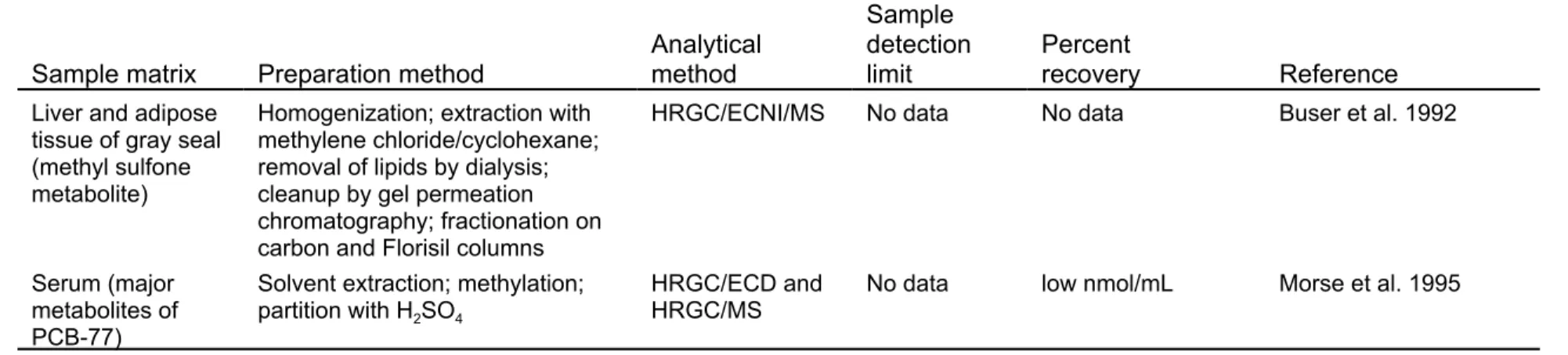
used whole blood, serum, breast milk, and hair as biomarkers for environmental exposure to PCBs (Brown and Lawton 1984; Fait et al. 1989; Furst et al. 1994; Luotamo 1988; Safe et al. 1985b; Zupancic-Kralj et al. 1992). Consequently, levels of PCBs in these media can provide estimates of exposure to PCBs. Analytical methods of satisfactory accuracy are available for determining congener- and noncongener-specific PCBs in blood, serum, breast milk, and human hair; these methods are shown in Table 7-2. Some methods for determining biomarkers are shown in Table 7-5. The method developed by several investigators can be used for the determination of the three non-ortho substituted PCB congeners
Table 7-4. NIST Standard Reference Materials for the Determination of Polychlorinated Biphenyls (PCBs)
aSRM Description PCBs certified PCBs quantified
1589 PCBs (as Aroclor 1260) in human serum 1b
1588 Organics in cod liver oil Surrogate for a tissue extract with high lipid 4 43 content
1649 Urban dust/organics Air particulate material 10 1939 PCB congeners in river sediment Sediment with high levels of PCB congeners 3 17 1941a Organics in marine sediment Collected in Baltimore Harbor 15 1974 Organics in mussel tissue Frozen powder-like homogenate 13 1945 Whale blubber Frozen blubber homogenate 26
aSource: Schantz et al. 1993a bcertified as Aroclor 1260
NIST = National Institute of Standards and Technology
PCBs 610 7. ANALY T ICAL METHO D S
Table 7-5. Analytical Methods for Determining Biomarkers for Polychlorinated Biphenyls
Analytical
Sample
detection Percent
Sample matrix Preparation method method limit recovery Reference Liver and adipose Homogenization; extraction with HRGC/ECNI/MS No data No data Buser et al. 1992 tissue of gray seal methylene chloride/cyclohexane;
(methyl sulfone removal of lipids by dialysis; metabolite) cleanup by gel permeation
chromatography; fractionation on carbon and Florisil columns
Serum (major Solvent extraction; methylation; HRGC/ECD and No data low nmol/mL Morse et al. 1995 metabolites of partition with H2SO4 HRGC/MS
PCB-77)
ECD = electron capture detection; ECNI = electron capture negative ionization; HRGC = high resolution gas chromatography; MS = mass spectrometry
PCBs 611 7. ANALY T ICAL METHO D S
PCBs 612 7. ANALYTICAL METHODS
(77, 126, and 169) in human milk, adipose tissue, and serum at levels normally found in these tissues of control population (Harrad et al. 1992; Hong et al. 1992a; Patterson et al. 1989, 1994).
While blood, serum, breast milk, adipose tissue, and hair have been used as biomarkers of exposure, the possible equivalency of these biomarkers has not been intensively investigated. At least two of these biomarkers, serum and breast milk, did not appear to give equivalent measures of exposure even when expressed on a lipid basis. (The theory of equivalency is based on the assumption that the steady state concentration of a persistent lipophilic substance in different body compartments is the same when expressed on a lipid basis.) Greizerstein et al. (1999) compared levels of PCB congeners between serum and milk from seven women in the New York Angler Study. The congener profiles for serum and milk samples were similar for each individual, but different among all subjects. The sum of the congener concentrations was used to estimate the total PCB concentration. The ratio of serum to milk
concentrations in the women ranged from 0.18 to 1.66 with a mean of 0.65±0.49, showing no consistency among individuals. Considerable differences were also found in the lipid-adjusted concentrations of PCBs among individuals. The range of lipid-adjusted serum-to-milk ratios was 1.1–2.8 with a mean of 1.9±0.5. The lipid-adjusted serum levels were also >1 for the most abundant congeners, PCBs 118, 153, 138, and 180. The lipid-adjusted ratios of these four non-planar congeners in serum and milk were similar to those found by Koopman-Esseboom et al. (1994b) in a study involving 418 mother-infant pairs. This latter study found that correlation coefficients between PCB congener levels (PCBs 118, 138, 153, and 180) in maternal plasma, human milk (lipid-basis), and cord plasma were highly significant within one biological sample (0.71–0.98) as well as between different biological samples. However, the correlation between other PCB congeners in human milk varied considerably. The study by Greizerstein et al. (1999) was small and collection of blood and milk samples was not uniform for all subjects. Therefore, more data are needed to establish whether equivalency factors can be established between various measures of body burden so as to allow normalization of measurements between different studies. Biomarkers of effects of exposure to PCBs are detailed Chapter 3 (Section 3.8.1). No single effect or combination of effects that could be used specifically as an indicator of exposure to PCBs are being developed to screen large numbers of food samples for PCBs and related compounds (J.K. Huwe et al. of Agricultural Research Service, Fargo, North Dakota). New screening methods for trace detection of PCBs in the environment and feeds are being developed by M. Franek et al. (Ministerstvo Zemedelstvi, Czech Republic). Development and application of semipermeable membrane devices (SPMDs) as environmental dosimeters for PCB contaminants in water, air, sediment, and soil is the subject of ongoing
PCBs 613 7. ANALYTICAL METHODS
research by Huckins and Petty at Columbia Environmental Research Center in Missouri. Also at the Columbia Environmental Research Center, C. Orazio et al. are developing analytical methods for determining PCBs in environmental matrices. A reliable method for continuous monitoring of PCBs in incinerator stack gas emissions using resonance-enhanced multiphoton ionization spectroscopy in conjunction with time-of-flight mass spectroscopy (REMPI/TOFMS) is the topic of current research by T.A. Cool at Cornell University. No additional information or ongoing studies regarding analytical methods for determining PCBs in environmental and biological samples resulting from exposure were located. Accordingly, new and improved analytical methods for trace detection of PCBs that could be used specifically as indicators of exposure in environmental and biological samples to PCBs are needed.