WORKFLOW OPTIMIZATION IN DISTRIBUTED COMPUTING
ENVIRONMENT FOR STREAM-BASED DATA PROCESSING MODEL
SAIMA GULZAR AHMAD
Faculty of Computer Science and Information Technology
UNIVERSITY OF MALAYA
KUALA LUMPUR
2017
WORKFLOW OPTIMIZATION IN DISTRIBUTED
COMPUTING ENVIRONMENT FOR STREAM-BASED
DATA PROCESSING MODEL
SAIMA GULZAR AHMAD
THESIS SUBMITTED IN FULFILMENT
OF THE REQUIREMENTS
FOR THE DEGREE OF DOCTOR OF PHILOSOPHY
FACULTY OF COMPUTER SCIENCE AND INFORMATION
TECHNOLOGY
UNIVERSITY OF MALAYA
KUALA LUMPUR
UNIVERSITI MALAYA
ORIGINAL LITERARY WORK DECLARATION
Name of Candidate: (I.C./Passport No.: )
Registration/Matrix No.: Name of Degree:
Title of Project Paper/Research Report/Dissertation/Thesis (“this Work”):
Field of Study:
I do solemnly and sincerely declare that: (1) I am the sole author/writer of this Work; (2) This work is original;
(3) Any use of any work in which copyright exists was done by way of fair dealing and for permitted purposes and any excerpt or extract from, or reference to or reproduction of any copyright work has been disclosed expressly and sufficiently and the title of the Work and its authorship have been acknowledged in this Work;
(4) I do not have any actual knowledge nor do I ought reasonably to know that the making of this work constitutes an infringement of any copyright work;
(5) I hereby assign all and every rights in the copyright to this Work to the University of Malaya (“UM”), who henceforth shall be owner of the copyright in this Work and that any reproduction or use in any form or by any means whatsoever is prohibited without the written consent of UM having been first had and obtained;
(6) I am fully aware that if in the course of making this Work I have infringed any copy-right whether intentionally or otherwise, I may be subject to legal action or any other action as may be determined by UM.
Candidate’s Signature Date
Subscribed and solemnly declared before,
Witness’s Signature Date
Name: Designation:
ABSTRACT
With the advancement in science and technology numerous complex scientific ap-plications can be executed in heterogeneous computing environment. However, the bottle neck is efficient scheduling algorithms. Such complex applications can be expressed in the form of workflows. Geographically distributed heterogeneous resources can execute such workflows in parallel. This enhances the workflow execution. In data-intensive workflows, heavy data moves across the execution nodes. This causes high communica-tion overhead. To avoid such overheads many techniques have been used, however in this thesis stream-based data processing model is used in which data is processed in the form of continuous instances of data items. Data-intensive workflow optimization is an active research area because numerous applications are producing huge amount of data that is increasing exponentially day by day.
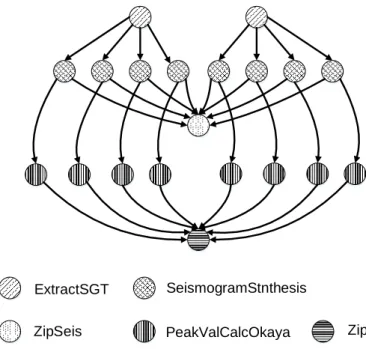
This thesis proposes data-intensive workflow optimization algorithms. The first algorithm architecture consists of two phases a) workflow partitioning, andb) partitions mapping. Partitions are made in such a way that minimum data should move across the partitions. It enables heavy data processing locally on same execution node because each partition is mapped to one execution node. It overcomes the high communication costs. In the mapping phase, a partition is mapped on that execution node which offers minimum ex-ecution time. Eventually, the workflow is executed. The second algorithm is a variation in first algorithm in which data parallelism is introduced in each partition. Most com-pute intensive task in each partition is identified and data parallelism is applied to that task. It reduces the execution time of that compute intensive tasks. The simulation results prove that proposed algorithms outperform from state of the art algorithms for variety of workflows. The datasets used for performance evaluation are synthesized as well as workflows derived from real world applications. The workflows derived from real world
applications include Montage and Cybershake. Synthesized workflows were generated with different sizes, shapes and densities to evaluate the proposed algorithms. The sim-ulation results shows 60% reduced latency with 47% improvement in the throughput. Similarly, when data parallelism is introduced in the algorithm the performance of the algorithm improved further by 12% in latency and 17% in throughput when compared to PDWA algorithm. In the real time stream processing framework the experiments were performed using STORM with a use-case data-intensive workflow (EURExpressII). Ex-periments show that PDWA outperforms in terms of execution time of the workflow with different input data size.
ABSTRAK
Dengan kemajuan dalam bidang sains dan teknologi, pelbagai aplikasi saintifik yang kompleks boleh dilaksanakan dalam persekitaran pengkomputeran heterogen. Walau ba-gaimanapun, kesuntukan ialah algoritma penjadualan yang cekap. Aplikasi yang kom-pleks sebegini boleh dipersembahkan dalam bentuk aliran kerja. Sumber heterogen yang teragih boleh melaksanakan aliran kerja ini secara selari. Ini memperbaikan pelaksanaan aliran kerja. Dalam aliran kerja data intensif, pergerakan data besar-besaran berlaku di seluruh nod-nod pelaksanaan. Ini menyebabkan overhed komunikasi yang tinggi. Untuk mengelakkan overhed pelbagai teknik telah digunakan. Namun begitu, dalam tesis ini model pemprosesan data berasaskan penstriman digunakan di mana data diproses dalam bentuk data item diproses dalam aliran berterusan. Pengoptimunan aliran kerja data in-tensif adalah bidang penyelidikan yang aktif kerana banyak aplikasi menghasilkan data yang besar semakin meningkat dengan pesat dari hari ke hari.
Tesis ini mencadangkan algoritma pengoptimunan aliran kerja data intensif. Seni bina algoritma pertama terdiri daripada dua fasa a) pemetakan aliran kerja, dan b) pe-metaan pemetakan. Pemetakan dibuat di mana data yang bergerak di seluruh pemetakan adalah minimum. Ia membolehkan pemprosesan data yang banyak pada nod pelaksanaan yang sama kerana setiap pemetakan dipetakan kepada satu nod pelaksanaan. Ia mengatasi kos komunikasi yang tinggi. Dalam fasa pemetaan, pemetakan yang dipetakan pada nod pelaksanaan yang menawarkan masa pelaksanaan yang minimum. Akhirnya, aliran kerja yang dilaksanakan. Algoritma kedua adalah variasi algoritma pertama di mana keselarian data diperkenalkan dalam setiap pemetakan. Kebanyakan tugas pengiraan intensif dalam setiap pemetakan dikenal pasti dan keselarian data digunakan untuk tugas tersebut. Ia mengurangkan masa pelaksanaan itu tugas pengiraan intensif. Keputusan simulasi mem-buktikan bahawa algoritma yang dicadangkan melebihi jangkauan algoritma-algoritma
terkini untuk aneka aliran kerja. Dataset digunakan untuk penilaian prestasi termasuk yang disintesis dan yang diperolehi daripada aplikasi aliran kerja dunia sebenar. Aliran kerja yang diperolehi daripada aplikasi dunia sebenar termasuk Montage dan Cybershake. Aliran kerja disintesis telah dihasilkan dengan saiz, bentuk serta kepadatan yang berbe-za untuk menilai algoritma yang dicadangkan. Keputusan simulasi menunjukkan masa pedam dikurangkan sebanyak 60% dengan peningkatan 47% dalam daya pemprosesan. Begitu juga, apabila keselarian data diperkenalkan dalam algoritma prestasi algoritma bertambah baik sebanyak 12% dalam kependaman dan 17% dalam daya pemprosesan berbanding dengan algoritma PDWA. Dalam rangka kerja pemprosesan aliran masa nya-ta, eksperimen telah dijalankan dengan menggunakan STORM dengan aliran kerja data intensif kes kajian (EURExpressII). Eksperimen menunjukkan bahawa PDWA melebihi jangkauan dari segi masa pelaksanaan aliran kerja dengan saiz data input yang berbeza.
ACKNOWLEDGEMENTS
This dissertation has been made possible with the supervision of Dr. Chee Sun LIEW. I would like to pay my heartiest gratitude to him for his priceless guidance and encour-agement that gives me confidence to complete this thesis despite of many obstacles. I am also thankful to my co-supervisor Dr. Ehsan Ullah Minur for his immense help, invalu-able advice and moral support. Without the help of my supervisors and their support I probably would not be able to complete this dissertation.
In addition to my supervisors, I would like acknowledge the support I received during my research work from Dr. Samee Ullah Khan and Dr. Mustafa Rafique. They provided valuable guidance for my research publications. Not to forget my lab peer, Mr. Kheng Ghee NG, who did great efforts with me to perform the evaluation of proposed work in real-world frame work. I thank him for his collaboration in this research and hope to continue work with him even after I finish PhD.
I would not forget my funding agencies. This research was supported by the Ministry of Education, Malaysia (FRGS FP051-2013A and UMRG RP001F-13ICT). I am obliged to Dr. Chee Sun LIEW to facilitate this work by arranging these funds.
Finally, I am thankful to my family for their understanding over the years. My deepest gratitude goes to my parents for their unconditional love, acceptance and moral support.
TABLE OF CONTENTS
Abstract ... iii
Abstrak... v
Acknowledgements... vii
Table of Contents ... ix
List of Figures ... xii
List of Tables... xv
CHAPTER 1: INTRODUCTION... 1
1.1 Data-Intensive Workflows... 2
1.2 Motivation ... 4
1.3 Problem Statement and Research Objectives... 7
1.4 Contributions... 9
1.5 Thesis Organization ... 10
CHAPTER 2: LITERATURE REVIEW... 11
2.1 Scientific Workflows ... 12
2.2 Workflow Classifications ... 15
2.3 Workflow Life Cycle... 17
2.4 Workflow Scheduling... 20
2.4.1 Workflow Scheduling Techniques ... 23
2.4.2 Data-intensive Workflow Scheduling Techniques... 24
2.4.3 Workflow Scheduling Objectives ... 32
2.5 Stream-Based Data Processing Model (SDPM) ... 36
2.5.1 Data Stream ... 36
2.5.2 Data Stream-based System... 37
CHAPTER 3: SCIENTIFIC WORKFLOW SCHEDULING USING
HYBRID GENETIC ALGORITHM... 40
3.1 Introduction... 40
3.2 Related Work ... 41
3.3 Proposed Hybrid Approach... 47
3.3.1 Initial Population and Chromosomal Representation... 47
3.3.2 Evaluation... 50
3.3.3 Selection ... 50
3.3.4 Genetic Operators... 51
3.3.5 Load Balancing in HGA... 54
3.4 Simulation Results and Discussion... 55
3.4.1 Data Sets... 55
3.4.2 Montage and CyberShake Workflows ... 56
3.4.3 Performance Evaluation ... 57
3.4.4 Gaussian Elimination ... 62
3.4.5 Synthesized Workflows ... 64
3.5 Conclusion ... 69
CHAPTER 4: PARTITION BASED ALGORITHMS FOR DATA-INTENSIVE WORKFLOW OPTIMIZATION... 70
4.1 Introduction... 70
4.2 Related Work ... 72
4.3 Partition Based Approach ... 74
4.3.1 Throughput Estimation of Pipelined Schedule... 75
4.3.2 Latency Estimation of Pipelined Schedule... 76
4.3.3 Algorithm Architecture ... 76
4.4 Data Parallelism Based PDWA (I-PDWA)... 81
4.4.1 Illustration with an Example ... 85
4.5.1 Performance Evaluation Using Synthesized Workflows ... 91
4.5.2 Performance Evaluation Using Real-World Applications... 94
4.6 Conclusion ... 99
CHAPTER 5: EVALUATION OF PROPOSED ALGORITHM USING A REAL-WORLD USE CASE IN STORM...101
5.1 Introduction... 101
5.2 Execution Platforms... 102
5.3 STORM... 107
5.3.1 STORM Architecture ... 107
5.3.2 Fault Tolerance in STORM ... 109
5.3.3 Tuple Grouping Strategies in STORM ... 110
5.4 EURExpressII ... 111
5.5 Computing Environment for Experiments ... 113
5.6 Results and Discussion ... 115
5.7 Conclusion ... 121
CHAPTER 6: CONCLUSION AND FUTURE WORK...122
6.1 Summary and contributions to knowledge... 122
6.2 Future Directions ... 124
LIST OF FIGURES
Figure 1.1: Research Phases... 8
Figure 2.1: Literature Review: An Overview ... 11
Figure 2.2: Scientific Workflow: Montage (Deelman et al., 2005)... 13
Figure 2.3: Different Workflow Patterns. ... 15
Figure 2.4: Workflow Classifications ... 17
Figure 2.5: Workflow Life Cycle ... 20
Figure 2.6: Taxonomy of Workflow Scheduling ... 23
Figure 2.7: Taxonomy of Workflow Scheduling Techniques... 25
Figure 2.8: Taxonomy of Data-intensive Workflow Scheduling Techniques... 33
Figure 3.1: Taxonomy of the Workflow Scheduling Algorithms... 42
Figure 3.2: Chromosome representation... 49
Figure 3.3: Corresponding schedule of example chromosome shown in Fig. 3.2. ... 49
Figure 3.4: Single Point CrossOver... 52
Figure 3.5: Double Point CrossOver. ... 52
Figure 3.6: Single Point Mutation... 53
Figure 3.7: Double Point Mutation. ... 53
Figure 3.8: Workflow benchmark: Montage (Deelman et al., 2005) ... 57
Figure 3.9: Workflow benchmark: CyberShake (Deelman et al., 2005)... 58
Figure 3.10: Performance of CyberShake workflows. ... 61
Figure 3.11: Performance of Montage workflows. ... 62
Figure 3.12: Performance of CyberShake and Montage workflows of different sizes. 63 Figure 3.13: Gaussian elimination workflow for matrix size 6 (20 nodes)... 64
Figure 3.14: Performance results with Gaussian Elimination workflow... 65
Figure 3.15: Performance results with random workflows with increasing number of processors... 67
Figure 3.16: Performance of synthesized workflows. ... 68
Figure 3.17: Performance results of HGA with and without load balancing with increasing number of nodes... 68
Figure 4.1: An example DAG and execution environment. ... 76
Figure 4.2: PDWA partitioning process for DAG shown in Fig. 4.1a... 80
Figure 4.3: Pipelined schedules of example in Fig. 4.2. ... 82
Figure 4.4: Example Task Parallel Graph ... 82
Figure 4.5: Task Parallel Execution ... 83
Figure 4.6: Data Parallel Execution ... 83
Figure 4.7: Pipelined Execution ... 84
Figure 4.8: Data Parallel Technique... 85
Figure 4.9: An example workflow to illustrate the proposed algorithm. ... 85
Figure 4.10: Execution environment for example workflow shown in Fig 4.9... 86
Figure 4.11: Corresponding schedule of example workflow shown in Fig. 4.9 using I-PDWA... 90
Figure 4.12: Corresponding schedule of example workflow shown in Fig. 4.9 using PDWA. ... 90
Figure 4.13: Impact on latency with increasing workflow size using synthesized workflows. ... 92
Figure 4.14: Impact on throughput with increasing workflow size using synthesized workflows... 92
Figure 4.15: Impact on latency using synthesized workflows having CCR=10. ... 94
Figure 4.16: Impact on latency using synthesized workflows having CCR=1. ... 94
Figure 4.17: Impact on latency using synthesized workflows having CCR=0.1. ... 94
Figure 4.18: Impact on latency using synthesized workflows havingα=0.1... 95
Figure 4.19: Impact on latency using synthesized workflows havingα=1... 95
Figure 4.20: Impact on latency using synthesized workflows havingα=2... 95
Figure 4.21: Twenty nodes Montage workflow... 96
Figure 4.22: Impact on latency with 25, 50, and 100 nodes Montage workflows. ... 96
Figure 4.24: Twenty nodes Cybershake workflow. ... 97
Figure 4.25: Impact on latency with 30, 50, and 100 nodes Cybershake workflows.... 98
Figure 4.26: Impact on throughput with 30, 50, and 100 nodes Cybershake workflows. ... 98
Figure 5.1: STORM Physical View (Evans, 2015) ... 108
Figure 5.2: STORM Conceptual View (Evans, 2015) ... 109
Figure 5.3: EURExpressII Workflow Block Diagram (Han, van Hemert, & Baldock, 2011) ... 112
Figure 5.4: Computing Environment for Experiments ... 113
Figure 5.5: EURExpressII STORM Topology... 114
Figure 5.6: Average execution time of PDWA for execution nodes. ... 117
Figure 5.7: Speedup of PDWA for execution nodes. ... 118
Figure 5.8: Comparative AET of PDWA and STORM default scheduler for increasing datasets. ... 119
LIST OF TABLES
Table 3.1: Different Priority Criteria of List Based Scheduling Heuristics ... 42
Table 3.2: Characteristics of datasets ... 56
Table 3.3: Comparision of results with and without HEFT Seed in Initial Population 59 Table 4.1: Comparison of proposed algorithms with related algorithms. ... 73
Table 4.2: Heterogeneity model of three execution nodes. ... 81
Table 4.3: Application tasks completion time of DAG shown in Fig. 4.1a ... 81
Table 4.4: Application tasks completion time of DAG shown in Fig. 4.9. ... 86
Table 4.5: Heterogeneity model of three execution nodes. ... 86
Table 5.1: Communication Cost Table of EURExpressII Workflow for 8000 input images shown in Fig. 5.5. ... 115
CHAPTER 1
INTRODUCTION
A revolution has been observed in the emerging science and the way how technology has been used in the last two decades. Despite the facts that the development in sci-ence and technology has solved many multidisciplinary and complex problems, it has also introduced many challenges. Initially the workflows were associated with business processes only. The concept has been used by the scientific community and scientists started modeling complex experiments and applications as workflows. Major difference between business and scientific workflows is that the business workflows are mostly task-oriented and control-driven while scientific workflows can be data-driven as well as control-driven (Shields, 2007). Large-scale experimentation and extensive simulations in modern science are continuously generating huge amount of data. Such complex pro-cesses are comprised of sequences of steps, which lead to the science of workflow design, management and execution. Workflows help to make such tedious and data-intensive processes manageable by modeling its steps in proper sequence. Scientific Workflow is a term that refers to the activity of defining the sequence of tasks needed to manage any computational process. Tasks take input from preceding tasks or from data resources and carry out predefined computations on the data. The output of the tasks are then passed to the successor tasks.
Workflows are managed by Workflow Management Systems (WMS), a comprehen-sive description of number of WMS can be viewed in (LIEW et al., 2016). The basic components of WMS include workflow composition, optimization, execution, and prove-nance. At first an abstract workflow, a high level workflow is composed. The logical sequence in which the workflow steps will be executed is referred as abstract workflow.
The resources are not binded with the tasks at this stage. The workflow management system finds and map appropriate resources to finalize the execution of workflow tasks, the resulting workflow is called concrete workflow. The later stages include provenance mechanism which keeps the history of workflow data that is useful in the resource map-ping phase in determining the optimization approaches and parameters. The provenance data is important for future relevant experimentation and analysis (LIEW, 2012). Work-flows can be expressed using various languages like DISPEL (LIEW et al., 2013), BPEL (Slominski, 2007) and YAWL (van der Aalst & ter Hofstede., 2005). Some workflows management systems have their own workbench to compose and design workflows such as Taverna1.
1.1 Data-Intensive Workflows
Scientific community is experiencing a TSUNAMI of data, that needs to be manipulated. For example, Pan-STARRS2, the Panoramic Survey Telescope and Rapid Response Sys-tem has 4 X 4.1 giga-pixel resolution digital cameras that loads nearly 700 new databases which store nightly detected objects each day, merges 50,000 databases with existing 12 offline databases each week and captures greater than one petabytes of raw data and generates one terabytes into the catalog databases each year. In addition, a recent study reports (Berriman & Groom, 2011) several hundreds of petabytes of astronomical data is gathered each day and it is growing quickly day by day.
The science of workflows has made convenient to manage and handle such a big data easily. Data-intensive applications in astronomy, geology, bio-informatics, bio-medical science,and e-commerce need special consideration for enactment. These applications have led researchers to design and develop data-intensive workflow management
sys-1http://www.taverna.org.uk/download/workbench 2http://pan=starrs.ifa.hawaii.edu
tems. We can find a study and comparisons of these systems presented in (Yu & Buyya., 2005.; Deelman et al., 2009) in a comprehensive way. In contrast to task-oriented work-flows, aspects like data storage, data movement, communication and computation costs must be considered in data-intensive workflow enactment. Workflows can be classified into two groups, a) control-driven, andb) data-driven workflows. In control-driven work-flows the precedence of tasks is based on the shift of control. Workwork-flows are represented as a sequence of processes and each parent process needs to be completed before the start of child process. Data-intensive applications are modeled as data-intensive work-flows. Hence, these are mostly data-driven and the dependencies between the activities represent the flow of data. In data-intensive workflows the data workload is significantly higher than computational workload. That is why, data-intensive workflow execution re-quirements are different than control-driven workflows. Since, in data-intensive workflow huge amount of data is being processed therefore, data transfer cost between execution nodes, data storage cost, data processing cost, the resource interconnection bandwidth, resource buffering capability, and many other aspects are of major concerns in data-intensive workflows enactment. Data-data-intensive workflows can be modeled in various ways but commonly workflows are modeled as Directed Acyclic Graphs (DAGs) (Xu et al., 2013) which is a graphical representation of tasks and data flow. The vertices or nodes represent tasks and edges show the precedence of the tasks and data flow. Successor tasks cannot start execution until predecessor task provide enough data for its execution. How-ever, in the task-based workflows the successor task need complete input data to start its execution once predecessor has been executed.
In recent years streaming model of workflow has gained immense popularity in sci-entific community, especially in data-intensive applications. For instance, sensor-based scientific experimentation produces live streaming data that require minimum latency and maximum throughput to avoid loss of data and its deletion. Same parameters are crucial
for the enactment of workflows which involves data stored in databases after prior experi-mentation. The workflow enactment can be made even better using data streaming model of workflows (Liew et al., 2010). In the context of data streaming the continuous stream of data is a chain of data items produced from any scientific activity. In workflows prede-fined computations are carried out on each data item of a data stream. It is a unidirectional transformation process which means that data can only move downstream. Output of up-stream tasks is the input of downup-stream tasks. In data-intensive applications the concept of data streaming has emerged to be highly useful because processing large scale data on execution node at a time incurs high computation cost and limitations of the computing capacities of resources is also a bottle neck. Computation of large amount of data in the form of data streams causes an inherent parallelism which enhances the performance of data-intensive workflow execution. In addition data streaming model reduces overhead by reducing a) I/O to the disk, andb) instantiation cost of the workflow nodes.
Scheduling in data-intensive WMS has key importance because the performance of WMS depend on it to the significant extent. We can consider it in two parts a) mapping, and b) scheduling in execution phase of a WMS. Mapping is a logical distribution of tasks for resources while scheduling is a concrete plan and sequence in which task will be executed on certain resources. This research work revolves around the scheduling of data-intensive workflows and address the workflow optimization by improving techniques of scheduling workflows for more than one performance metrics.
1.2 Motivation
Data-intensive science has emerged as a fourth paradigm (Collins, 2009) during the last decade. It happened because of the exponential rise in data growth not only by the sci-entific community but also by social networks like Google, twitter, facebook etc. Few example of data-intensive applications are as follows
• "IBM" claims that "every day, we creates 2.5 quintillion bytes of data, 90% of the data in the world today has been created in the last two years (Aniello et al., 2013).
• DOMO, a business intelligence company recently reported (Aniello et al., 2013) that 3125 photos are added on Flickr, 34722 likes are sent on Facebook, more than 100,000 tweets are done on Twitter, each minute.
• Data is gathering so easily and quickly that has exceed the speed of its processing and management. Astronomers are collecting huge amount of data not only by volume but also with increasing complexity and verity. According to the predictions made in a study (Berriman & Groom, 2011), one petabytes of astronomical public data is electronically accessible and this volume is growing at 0.5 petabytes per year.
• Large Synoptic Survey Telescope (LSST)3, is 8.4m large synoptic survey telescope. It will survey the sky deeply in multiple colors and explore the mysteries of sky with its three billion pixel camera. This telescope will produce enormous volume of data, 20 terabytes per night leading to a database of 60 petabytes of raw data over ten years. The predictions of data size growth has been made due to emerging projects. Similar anticipations are reported for upcoming project ALMA4.
• A major decision in astronomy was taken in 2012 when it was decided to install Square Kilometer Array5(SKA) in the deserts of South Africa and Australia. SKA was installed to know the secrets of the world with world’s largest radio telescope. Raw data will be available for public project website6in the form of zip files. The 3http://www.lsst.org/lsst/
4http://www.eso.org/sci/facilities/alma.html 5https://www.skatelescope.org/
research and scientific studies behind the location of the SKA high and mid fre-quency telescopes in South Africa data is 8.7 gigabytes Zip files, while data of low frequency telescope in Australia is 16 gigabytes Zip files. The data obtained by SKA is such a huge size that collected data in a single day would take nearly millions of years to play back on an iPod. SKA central computer will have the processing power of about one hundred million PCs. The dishes of the SKA will produce 10 times the global Internet traffic.
Big data is usually characterized by with four "Vs" that is high Volume, Variety, Velocity and Value of data. In order to handle each "V", workflow management encom-passes many challenges. Value is mostly considered in business oriented scenarios. These challenges correspond to different dimensions of data-intensive workflow optimization. There is a continuous development in the infrastructure of computing systems and this process will continue to progress to tackle upcoming challenges of modern scientific de-velopment in future.
Now-a-days stream computing is the efficient solution to manipulate and compute information from such big data. The response time of big data stream applications is always required to be the minimum for gigabytes of live data streams and petabytes of archived simulated data streams. Big data stream applications modeled as data-intensive workflows are aimed to be processed with minimum latency. The main challenge in data-intensive workflow execution is to achieve reduced latency when execution nodes have to process heavy data streams.
In this research work, we propose the data-intensive workflow optimization (schedul-ing) algorithms by using stream-based data processing model. Scientific data-intensive workflows are used for simulations and experiments. The proposed work aims to reduce the latency or execution time and enhance the throughput.
1.3 Problem Statement and Research Objectives
The problem statement of this dissertation is stated as follows. The stream-based data processing model is a proven smart method to enhance the performance of data-intensive workflow scheduling. The latency and throughput of these workflows can be further im-proved by using data parallelism phenomenon. On these grounds, we propose algorithms that provide reduced latency and enhanced throughput as compared to other state of the art algorithms. It is proved by simulations and implementations in a real-time streaming framework.
This dissertation revolves around the following objectives.
• Obj.1: To propose and validate the scientific workflow optimization algorithm that reduces schedule length/execution time.
• Obj.2: To propose and validate data-intensive workflow optimization algorithm for stream-based data processing model that optimizes (reduce) latency and (increases) throughput.
• Obj.3: To apply and validate data-parallelism phenomena in order to enhance fur-ther the performance of proposed algorithm in Obj.2.
• Obj.4: To evaluate the proposed work in real-time streaming framework(STORM) using real-application based workflow.
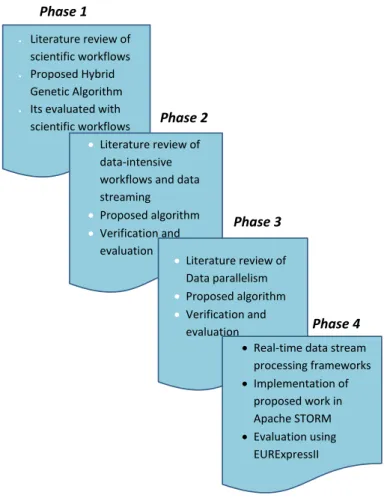
We have divided our research work into four phases to achieve the above research objectives, which are also depicted in Fig. 1.1. In the phase 1, the literature of scien-tific workflows is reviewed . To make the concepts clear, an algorithm is proposed that optimizes the makespan of scientific workflows. The proposed algorithm named Hybrid Genetic Algorithm (HGA) is evaluated and verified using scientific workflows. In the next phase, the research work is narrowed down to data-intensive scientific workflows.
Literature review of
scientific workflows
Proposed Hybrid
Genetic Algorithm
Its evaluated with
scientific workflows Phase 1 Phase 2 Phase 3 Phase 4 Literature review of data-intensive workflows and data streaming Proposed algorithm Verification and evaluation Literature review of Data parallelism Proposed algorithm Verification and evaluation
Real-time data stream processing frameworks Implementation of proposed work in Apache STORM Evaluation using EURExpressII
Figure 1.1: Research Phases
The literature of data-intensive workflows, its scheduling algorithms and stream-based data processing model is reviewed. A Partitioning based Data-intensive Workflow opti-mization Algorithm (PDWA) is proposed that reduces latency and enhances throughput of data-intensive workflows. PDWA is evaluated with the variety of workloads and per-formance results show its effectiveness. In the phase 3 of this research, data parallelism is introduced in the proposed algorithm to reduce the computation time of the data-intensive workflows. The algorithm is evaluated and simulation results prove its better performance as compared to other state of the art algorithms. Finally, the fourth phase is validation of the proposed work in real-time stream processing framework. Number of stream process-ing tools are studied and Apache STORM is selected to be the best candidate to carry out experiments. A use-case workflow (EURExpressII) is used as workload. The per-formance of the proposed work is evaluated in real-world environment with real-world
data-intensive workflow and results authenticated its better performance.
1.4 Contributions
The contributions of this thesis are summarized as follows.
1. A Hybrid Genetic Algorithm (HGA) is proposed that optimizes makespan of sci-entific workflows. It’s architecture is a hybrid approach based on a heuristic and genetic algorithm. In addition to the makespan, HGA also provides load balanced schedules. Its performance results show that the proposed algorithm outperforms for synthesized as well as scientific workflows.
2. A Partitioning-based Data-intensive Workflow optimization Algorithm (PDWA) that optimize data-intensive workflows by partitioning the workflow in order to achieve minimum inter-partition data movement. Since, each partition is mapped on one resource therefore, intra-partition data movement cost is zero. PDWA re-duces latency and enhances throughput by adapting stream-based data processing model to optimize data-intensive workflows. Its performance is significantly better as compared to the workflow optimization algorithm without partitioning.
3. Introduced data parallelism in the proposed data-intensive optimization algorithm. Data parallelism is applied on the most compute-intensive task of each partition. This strategy significantly reduced the computation overhead. The simulation re-sults prove that the proposed algorithm not only reduced latency but also enhanced throughput. It outperforms the state of the art algorithms.
4. Implementation of proposed work in real-time data stream processing framework that is Apache STORM based cluster. The cluster is established in Openstack, Vir-tual Private Cloud (VPC) network to ensure the connectivity between master node and remote worker nodes. The experiments are carried out on this cluster with a
use-case workflow, EURExpressII which is a data-intensive workflow derived from real application. The experiment results show that proposed work outperforms the default STORM optimizer in terms of reduced execution time and better speedup as well as efficiency.
1.5 Thesis Organization
This section presents the organization of this dissertation which is divided into six chters. Chapter 2 is the literature review, Scientific workflow scheduling using hybrid ap-proach is presented in Chapter 3, Chapter 4 is about partitioning based algorithm to opti-mize data-intensive workflows for stream processing, it also describes how the algorithm performance is improved by introducing data parallelism. The algorithm presented in Chapter 4 is implemented in STORM, the experiments using STORM based cluster and the results are discussed in Chapter 5. Chapter 6 presents the conclusion and future re-search directions in this important rere-search area.
CHAPTER 2
LITERATURE REVIEW
2.1. Scientific workflows 2.2. Workflow
classifications 2.3. Workflow Life cycle 24. Workflow scheduling 2.4.1. Workflow scheduling techniques 2.4.2. Data-intensive workflow scheduling techniques. 2.4.3. Workflow scheduling objectives Ch.3. Scientific workflow scheduling using hybrid genetic algorithm
3.2. Related work
Ch.4. Partition-based algorithms for data-intensive workflow optimization 4.2. Related work 2.5. Stream-based data processing model 2.5.1. Data stream 2.5.2.Data stream -based
systems
Ch.5. Evaluation of proposed work in real-time computing environment 5.2. Related work 2.6. Research Issues
Fig. 2.1 presents an overview of the literature that is reviewed in this research. In this chapter, section 1 introduces scientific workflows and its different patterns. In section 2 we present a taxonomy that classify the workflows into different categories. Section 3, briefly describes the life cycle of workflows. Workflow scheduling is presented in section 4 and a taxonomy showing different strands of workflow scheduling found in literature are cited and discussed. In addition, workflow scheduling, data-intensive scheduling and workflow scheduling objectives are also discussed in section 4. The concepts of Stream-based data processing model is presented in section 5. This chapter end-up with the research issues of data-intensive workflow scheduling in section 5.
We have covered the literature review in a general perspective in Chapter 2, but in this thesis specific related work is spread over all upcoming chapters. The detailed related study about workflow scheduling is presented in Chapter 3, Section 3.2. Similarly, the data-intensive workflow optimization algorithms are reviewed in Chapter 4, Section 4.2. In Chapter 5, Section 5.2 state of the art big data processing tools are discussed and STORM in detail, which is meant for processing data streams.
2.1 Scientific Workflows
Workflows have simplified the execution and processing of complex scientific applica-tions by introducing a step-wise approach which defines the precedence of the tasks and flow of data. Workflows are sequences of tasks or operations, that can be represented graphically as well as in the form of script. Graphically, the tasks are usually represented as workflow nodes and in the script these are the processes or the jobs for example in the form of XML document. In literature, the most common graphical way of the workflow representation is Directed Acyclic Graphs (DAGs) (Couvares et al., 2007). The nodes in the DAGs represent tasks/activities/data or data items and vertices show the precedence constraint. Workflows can also be expressed as Petri Net (Hoheisel & Alt, 2007) in which
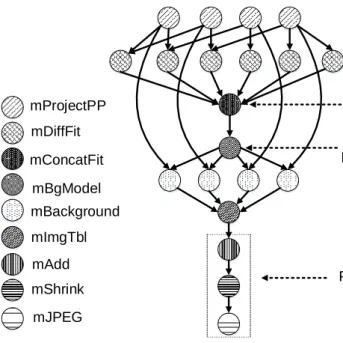
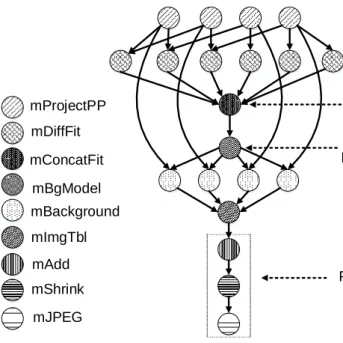
mProjectPP mDiffFit mConcatFit mBgModel mBackground mImgTbl mAdd mShrink mJPEG Data Aggregation Data Partitioning Pipline
Figure 2.2: Scientific Workflow: Montage (Deelman et al., 2005)
data is represented as tokens and processes as transitions. Other ways of representation include scripting language and modeling language (UML) diagram (de Carvalho et al., 2010). In this research work workflows are modeled as DAGs, therefore in the rest of our discussion workflow and DAGs will be used interchangeably.
Montage is an example of scientific workflow, it is an astronomical image mosaic engine created by NASA that is used to generate a mosaic of the sky. The input astro-nomical images are combined to form the final mosaic. The geometry of the final mosaic is determined by the input images that can be represented as a workflow. Fig. 2.2 illus-trates the structure of a small size montage having 20 nodes. The size of the workflow is proportional to the number of input images. Various examples of scientific workflows can be viewed in (I. J. Taylor et al., 2007). There are different patterns in the work-flow structure which depends on the nature of application which is modeled as workwork-flow. Some common workflow patterns that usually occur are discussed below (der Wijngaart & Frumkin, 2002). The NASA Advanced Super-computing (NAS) parallel benchmarks are designed for the performance evaluation of parallel and distributed systems as these
benchmarks are the workflow patterns that are most common in workflows. These are obtained from computational fluid dynamics (CFD) applications. They are in a set of four benchmarks that are Embarrassingly Distributed(ED), Helical Chain(HC), Visual-ization Pipeline(VP), and Mixed Bag(MB). Each of these consists of computational tasks achieved from NAS parallel Benchmarks (NPB). They symbolize the typical applications that run on the heterogeneous systems like grid, cloud, or any computing system.
1. ED represents an important class of workflow applications called parameter studies, in which same program is run several times independently but with different set of input parameters. The structure is shown in Fig. 2.3a.
2. HC represents long chains of sequential computations such as simulations in series of tasks. It is the execution of repeating a process or set of processes/tasks one after another. It is presented in Fig. 2.3b.
3. VP is compound of different structured processes. It contains some degree of par-allel as well as sequential flow of tasks. Its structure is presented in Fig. 2.3c.
4. The structure of MB is similar to VP but the degree of parallelism, and heterogene-ity increases. There is aggregation and split nodes as well. The structure of MB is shown in Fig. 2.3d.
For all the figures of ED, HC, VP, and MB the dotted lines represents the control flow while the solid lines represents the control and data flow. Russell et al. (2005, 2006) pro-vide vast and detailed studies of data flow and control flow patterns in a workflows. The complex and large workflows consist of usually such patterns that occur in different com-binations. In Fig. 2.2, we can see different workflow patterns as labeled. Data aggregation is a common pattern in which data from all predecessor task are aggregated in a successor
Launch Report T1 T1 T1 T1 T1 T1 T1 T1 T1
(a) Embarrassingly Distributed(ED)
Launch T1 T2 T3 T1 T2 T3 T1 T2 T3 Report (b) Helical Chain(HC) Launch T1 T2 T3 T1 T2 T3 T1 T2 T3 Report (c) Visualization Pipeline(VP) Launch T1 T2 T3 T4 T5 T6 T7 T8 T9 Report (d) Mixed Bag(MB)
Figure 2.3: Different Workflow Patterns.
task, similarly data partitioning is splitting of data into successor tasks. Pipeline pattern is tasks in processing data in a sequence one after another also found in VP and MB.
2.2 Workflow Classifications
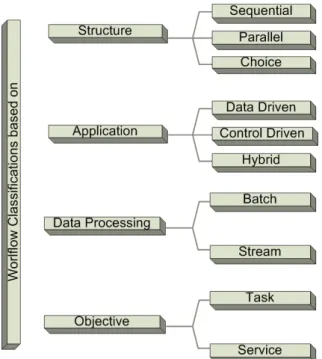
In this section, we present workflow classification based on their structure, types of work-flow applications, data processing models and objectives. We discuss each type as follows
1. Structure: The structure of the workflows depend on the nature of its application. Based on the structure of workflows, the types can be a) sequential, b) parallel, and c) choice Several applications are expressed as sequence of tasks one after another forming a sequential(linear) workflow. In a sequential workflow there is a series of tasks that are executed in a sequential manner when the parent task is completed (Agrawal et al., 2010). In the parallel structure of workflows some tasks can be executed in parallel rather than sequentially. Most of the workflows have
parallelism that can cause parallel execution of tasks ultimately reduces workflow execution time. In case of choice, at run time a task is chosen to execute when its all requirements are complete.
2. Application: Workflows can be classified as control-driven and data driven work-flows as reported in (Shields, 2007). In the control-driven workwork-flows the precedence of tasks is based on the shift of control. The workflows are represented as sequence of processes and each parent process needs to be completed before the start of child process. The data driven-workflows support data-intensive applications and the de-pendencies between the activities represents the flow of data. I. Taylor et al. (2007) presents examples of data-driven workflows. In hybrid class, both approaches are used as appropriate but workflows are usually biased as data or control-driven for instance in (Laszewski et al., 2007). Sometimes the data flow is explicit and control flow is implicit or vise-versa.
3. Data Processing: Based on the input type workflows are categorized into two classes. The workflows can be driven by a single input and successor tasks depend solely on the output of their predecessors. The output generated from predecessors serve as input to the next level of task hence, successor tasks can’t start execution unless predecessor are completed. Another type of workflows are those which take input in the from of continuous data stream (LIEW, 2012) such as the output of the sensors or simulators. Since, the output of each activity is a sequence of outputs therefore, if the successor gets enough input to start its execution then the succes-sors can start execution.
4. Objectives:The fourth classification differentiates between task-based and service-based workflows as defined by Glatard et al. (2007). It is job oriented workflow in which set of jobs represented by nodes are mapped on the set of resources.
Work-Figure 2.4: Workflow Classifications
flow is based on computing tasks which require complete dataset to start execution. On the other hand tasks are hidden under web services. Services are invoked on the execution of each node and execution can start without knowing the complete dataset.
The above discussion of workflow classification is summarized in Fig. 2.4.
2.3 Workflow Life Cycle
A workflow has a complete life cycle as presented in Fig. 2.5. There are three basic stages of workflow life cycle as discussed below.
• Workflow Composition: Initially, the workflows are developed from the data available in workflow libraries or databases. This data is usually the outcome of the previous executions of the workflows with different parameters or scenarios (prove-nance data). It can be the complex scientific experiments and simulation data saved in databases. The data and software components are obtained from databases. This information is used to develop a high level workflow called as abstract workflow
us-ing a particular representation. The workflow tasks are not binded to the resources at this stage, only the data and software components are identified. For instance, in Pegasus (Deelman et al., 2015) wings1is responsible for workflow composition. Wings helps the selection of workflow templates and data (from data repositories) to create workflow instances, which are also known as abstract workflows. Simi-larly, Taverna (Wolstencroft et al., 2013) provides an easy way for domain experts to find and design workflows through a workbench.
• Mapping:This stage maps workflow tasks on the physical resources from the exe-cution environment. The abstract workflow converts into a complete exeexe-cution plan resulting in a concrete workflow. Selection of appropriate resources and allocation to the workflow tasks can affect the performance of the workflow execution. Hence, optimized mapping strategies may help in improving the overall performance. For instance, Pegasus (Deelman et al., 2015) maps the workflow tasks on the execution resources to create the executable workflow, which has all the execution specifica-tions, that is the data to be used and its location, the computing resources selected for execution, and the required data movements. The mapping process relies on three important catalogs, a) site catalog, which describes the compute resources known as the sites, that are used to run the workflow. A site can be cluster, virtual machine in cloud, or local machine. Pegasus works with heterogeneous and dis-tributed computing environments, b) replica catalog, it is used for data discovery to resolve input/output files in the workflow. It keeps mapping logical files ids to physical file ids, andc) transformation catalog, which maps logical transformation to physical executable on the system. This thesis focus optimization of mapping and discussed with details in chapter 4.
• Execution: It performs the mapped workflow enactment in the execution environ-ment and monitors the executions. This stage schedules the tasks on the mapped resources and collects the resulting data. The output and provenance data is then saved in the workflow repositories which may then accessed again to compose a workflow. Provenance mechanism that keeps the history of workflow data which is also useful for the resource mapping phase in determining the optimization ap-proaches and parameters. In addition, provenance data is important for future rel-evant experimentation and analysis. Pegasus (Deelman et al., 2015) is a workflow planner and has no capability to execute workflow. However, it can run on various execution engines for example, Condor DAGMan2 and Globus3. The input to the execution engine is a concrete workflow for instance in Condor DAGMan file is input for execution.
Mapping and execution are the optimization stages of workflow. Since, mapping and scheduling of workflow tasks are performed in these stages therefore, the performance of workflow execution depends on it. In this thesis, these stages of workflow life cycle is optimized that enhances the execution performance.
Workflow composition, mapping and execution for complex scientific applications is a tedious process, therefore scientific community have proposed Workflow Manage-ment Systems(WMSs) to automate the procedure. Some examples of WMSs are Pega-sus (Deelman et al., 2015), Taverna (Wolstencroft et al., 2013), Kepler (Ludäscher et al., 2006), Swift (Y. Zhao et al., 2007), Trident (Barga et al., 2008), Meandre (Llora et al., 2008), and KNIME (Berthold et al., 2009). Each WFM has its own mechanism to compose, map and execute the workflows on resources, however the overall cause is to optimize the management and execution of the workflows.
2http://www.cs.wisc.edu/condor/dagman/ 3http://toolkit.globus.org/toolkit/
WF Composition Abstract WF WF Libraries/ Data Bases Input to WF Stages WF Stages output of WF Stages
Figure 2.5: Workflow Life Cycle
2.4 Workflow Scheduling
As discuss in previous sections, the performance of workflow execution depends on it mapping and scheduling on appropriate resources therefore, the its optimization can en-hance the system efficiency. In this section, we discuss various aspects that workflow scheduling involves. In grid, workflow scheduling is the allocation of workflow tasks to distributed available resources, while in case of cloud resources are in the form of ser-vices because a cloud can provide Iaas(Infra structure as a service), Paas(Platform as a service) or Saas(Software as a service). Efficient scheduling is crucial for the optimal workflow execution on every execution platform. Scheduling exploits the content of par-allelism in workflows to enhance the performance but according to the Amdahl’s law the advantage of parallelism is limited by the sequential part of the workflow. However, effi-cient scheduling plays a vital role in the workflows execution. Scheduling is affected by various types of parallelism. Task Parallelism is the simultaneous execution of different tasks on the same data item. It helps to reduce latency in workflows. Pipelined paral-lelism is the simultaneous execution of two different tasks of same workflow on same data item. It helps in enhancing the throughput. Replicated parallelism also helps in in-creasing the throughput as the different copies of same task executes on different data
items concurrently. This is useful when the resources are more in number than workflow tasks. Data parallelism corresponds to the parallelism present within the task inherently. Many processing elements execute the same task for same data item. Data parallelism is a mechanism in which multiple instances of task run simultaneously on different datasets.
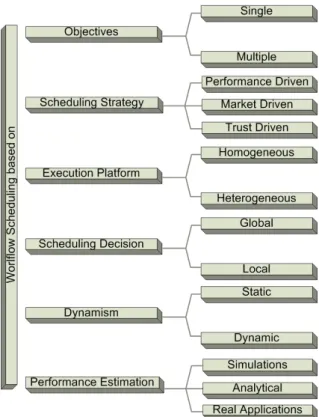
1. Objectives: Most of the scheduling algorithms are single objective that optimize the run time and makespan like (Topcuoglu & Wu, 2002; Daoud & Kharma, 2008a). However there are numerous multi objective algorithms available in literature that optimize the parameters based on the requirements or application (Wieczorek et al., 2009).
2. Scheduling Strategy:Scheduling policies can be grouped into performance driven, market driven or trust driven. In performance driven strategies the scheduling aim is to improve the performance of workflow execution like execution time, through-put or cost algorithms like MinMin, MaxMin, Suffrage (Braun et al., 2001) focus to optimize the performance of the workflows. Market driven strategies focus the mar-ket oriented parameters like budget, deadline, reliability, profit or other QoS based aspects (Lee et al., 2012). Trust driven scheduling policies perform the resource allocation based on their trust levels. By using this type of scheduling strategies the scheduling reliability and security increases (S. Zhao & Lo, 2005).
3. Execution Platform: Based on the execution model, workflow scheduling can be differentiated by homogeneous and heterogeneous environments. In homoge-neous execution platforms the resources have identical characteristics like in clus-ters (Wieczorek et al., 2005), while in heterogeneous environment, resources differ from each other based on execution time, storage capacity, communication time and I/O read time. Grid and cloud are example of heterogeneous environment (Khan, 2012). Scientists have experimented heterogeneous clusters and clusters developed
in grid or cloud environment which have characteristics of previous both categories (Issa et al., 2013).
4. Scheduling Decision: Scheduling decision can be local or global depends upon the scheduling policy. In local scheduling decision the scheduling strategy will apply for only one task or a part of workflow, which may effect the overall performance of the workflow. However, the global workflow scheduling algorithms apply for entire workflow scheduling. It is observed that global workflow scheduling policies provides better performance results as compared to local.
5. Dynamism:We can differentiate scheduling algorithms based on dynamism. When the scheduling process carried out at runtime then scheduling is called dynamic (Bansal et al., 2011). The resources and the jobs to be scheduled are not known prior to the scheduling phase. It is possible that jobs are accumulated to form a batch and then scheduled. This type of scheduling is also called as non determin-istic scheduling. In case of static scheduling all the information regarding tasks and resources are already in hand prior to scheduling. Most important aspect of scheduling workflows is its validation.
6. Performance Estimation: We have classified the workflow scheduling based on performance estimations methods. Researcher used various methods to evaluate the performance of new scheduling algorithms in existing literature. Simulations based validation involve simulators like cloudsim, gridsim, simgrid on the other hand some researchers also used real-time data to analyze their work, which shows the behavior of algorithm in real environment. Simulation are useful to check the performance for large datasets. In case of analytical modeling the performance of workflow on given set of resources is predicted based on the analytic metric. In
Figure 2.6: Taxonomy of Workflow Scheduling
some situations the hybrid approach is used. The workflow scheduling classifica-tions discussed in this section are summarized in Figure 2.6.
2.4.1 Workflow Scheduling Techniques
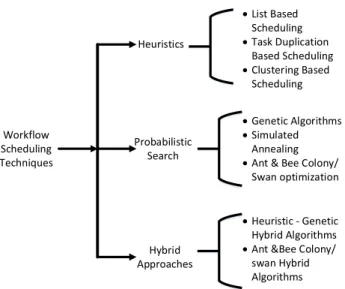
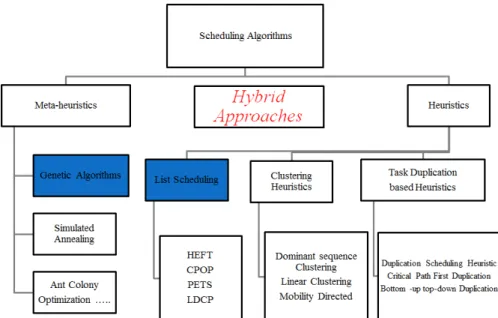
In the literature there are number of methods which have been adapted for solving work-flow scheduling problem. We have proposed a taxonomy of various scheduling poli-cies found in literature. We have divided the scheduling strategies into three groups.
a) heuristics,b) probabilistic search,andc) hybrid approaches.
• Scheduling is an NP-Hard problem and heuristics are mostly used to solve such problems. Heuristics are time effective solution for specific scenario of problem space. Heuristics are further of various types most common is list based scheduling heuristics, which generates a priority list of tasks based on some specific criteria and then tasks are allocated to resources (Topcuoglu & Wu, 2002). Resources al-location is also dependent on the attribute used to select resources for tasks. Some
workflow application are communication intensive, task duplication based heuris-tics use the task duplication technique to multiple resources to avoid the setup and communication cost (Agarwal & Kumar, 2009). Many clustering-based heuristics are also available in literature (Y. Zhang et al., 2008). In clustering heuristics tasks are clustered based on certain criteria to enhance the over all performance of work-flow.
• Probabilistic search is another broad category of scheduling algorithms which in-clude genetic algorithms, Simulated Annealing (Abdulal et al., 2012) and ant colony or swarm optimization. Working principle of these algorithms are from real world. Genetic Algorithms are well suited for large problem space and by starting from initial population after number of generations the algorithm converge to an opti-mal solution (Omara & Arafa, 2010). Lot of attention has been paid to ant colony (Srikanth et al., 2012) and swarm optimization (L. Zhang et al., 2006) to solve the scheduling problem. In both techniques the natural behavior of ants and swarm are adapted to solve the scheduling problem.
• In hybrid approaches the above mentioned strategies are combined to enhance the performance of algorithm like in (Guo-ning et al., 2010a) genetic algorithm is hy-bridized with simulated annealing while in (Daoud & Kharma, 2011) heuristic and genetic algorithm is hybridized. J. Liu et al. (2008); Srikanth et al. (2012) use the combination of ant colony and genetic algorithm.
The taxonomy of workflow scheduling strategies is presented in Fig. 2.7.
2.4.2 Data-intensive Workflow Scheduling Techniques
The key rationale behind data-intensive workflow management is the storage and move-ment of large volume of data. Data storage and movemove-ment incur huge cost. With the
Workflow Scheduling Techniques Heuristics Probabilistic Search Hybrid Approaches List Based Scheduling Task Duplication Based Scheduling Clustering Based Scheduling Genetic Algorithms Simulated Annealing Ant & Bee Colony/
Swan optimization
Heuristic - Genetic Hybrid Algorithms Ant &Bee Colony/
swan Hybrid Algorithms
Figure 2.7: Taxonomy of Workflow Scheduling Techniques
emergence of big data, scientists have to focus in various domains to overcome the chal-lenges. We can broadly group these research efforts in three major domains that include modifications in a) architectures, b) programming models andc) data-intensive work-flow optimization strategies. In (Givelberg et al., 2011) authors proposed a concept of architecture for data-intensive computer based on data-intensive operating system that can manage data in Petabytes. The proposed architecture can be run with high perfor-mance computing clusters. The architecture exploits the parallel access (read/write) of massive databases through an intermediate layer of operating system that runs on differ-ent servers. Local data processing mechanism during workflow execution has been pro-posed in (Reimann et al., 2011), which improves the optimization of the data-intensive workflow execution.
MapReduce (Dean & Ghemawat, 2008) is widely used as a parallel and distributed programming model for data-intensive applications. Hadoop framework is most common implementation of MapReduce that has been used extensively by researchers to handle data-intensive applications in scientific systems. Researchers exploited Hadoop frame-work in many ways for example, G-Hadoop is a MapReduce based frameframe-work proposed in (L. Wang et al., 2013) that enable distributed data-intensive computing across multiple
clusters. Hadoop is integrated in Kepler (Ludäscher et al., 2006) an existing workflow management system as described in (J. Wang et al., 2009). This integration facilitate users to compose and execute MapReduce applications in Kelper.
This section describes the data-intensive management and scheduling techniques, also presented in Fig. 2.8. The data-intensive workflow scheduling techniques can be grouped into four major categories, a) data locality,b) data transfer, andc) data footprints. Each category is described as follows citing the previous work which has been done in that area.
1. Data Locality: In data-intensive workflow execution large amount of data is re-quired to move between the execution nodes that causes significant delays depend-ing on the size of data and network capacity. Therefore, most of the data-intensive workflow scheduling techniques target on the optimization of the data transfer by exploiting the data locality. This strategy can be further classified into a) spatial clustering,b) task clustering, andc) worker centric.
• Spatial clustering: This scheme develops the workflow based on the spa-tial relationship of files in the input dataset. The clusters of jobs are created depending on the spatial proximity. The clustered jobs are then submitted to the execution nodes on the same site. Hence, the data-intensive workflow scheduling in this technique improves the data reuse and reduces the data transfer between the execution sites, that reduces the network traffic. It also enhances the execution performance.
Meyer et al. (2006) presents an algorithm for spatial clustering that make use of data locality technique through dynamic replication of data and schedul-ing the workflow tasks in such a way that reduces the number of replicas and the data files transfers when workflow is executed. Quality of Service (QoS)
aware Workflow Language(QoWL) is developed in (Brandic et al., 2006), which is the extension of Business Process Execution Language(BPEL). It provides the facility to the users to customize (define) preferences of the exe-cution location affinity for jobs/tasks with high security and legal constraints. QoS parameters restrict the system to move sensitive data from agreed do-mains for confidential applications.
• Task clustering: In this technique small tasks are grouped together in order to reduce the data movement between computing nodes. In the grouped tasks the data/files transfers between computing nodes are minimum. Hence, the tasks within one group can access data locally. This technique reduces the transfer of intermediate data files between tasks that are grouped to single computing node. In addition it also reduces the overhead of running small tasks individually.
In (G. Singh et al., 2005), the authors restructures the workflow in order to reduce the data dependencies. Independent tasks of same level in workflow are clustered, but it is not necessary that tasks in none cluster will be executed on same computing node. The authors present workflow performance in two scenarios, a) tasks are submitted centrally by a master node, andb) tasks are submitted by multiple and distributed nodes. In the first case, the complete workflow is submitted and executed by single host. To increase the execution performance in the distributed job submission scheme, there are multiple job submission hosts and slave nodes. The workflow is restructured with multiple clusters at each level. The clusters and submission hosts at each level are always same in number. The scheduler on the host selects the suitable worker nodes for the execution of submitted jobs.
Pandey et al. (2009) apply the concept of task scheduling for a workflow based on medical application. The clustering is based on execution time of tasks, data transfer,and level. The most compute-intensive tasks are executed without clustering and the rest of the tasks are clustered, that enhances the makespan of the workflow execution.
• Worker centric: In this category of workflow scheduling technique, locality of interest present in the execution environment is exploited to schedule the workflow tasks. For instance, Ko et al. (2007) presents an algorithm, that allo-cates the workflow tasks to the workflow node upon receiving a request from worker node. The algorithm determines the weight of unscheduled tasks and submit to suitable node. The weight calculation involves the data files already present on the worker node and any additional data required to perform the task on that particular worker node. This algorithm reduces the transfers of data files and increases the chance of using same data which has been used in the past. The performance measured in terms of number of files transfers between the node and the results show better performance of proposed algo-rithm.
2. Data Transfer: In literature, several techniques are available that reduces the time of data transfer. These are a) data parallelism, b) data streaming, and c) data throttling.
• Data Parallelism: It refers to a process of computation of data fragments simultaneously with minimum performance loss. This technique processes independent data items on different computing nodes by replicating the work-flow task. In (Glatard et al., 2008), a workwork-flow engine MOTEUR is presented. The proposed algorithms that combine well-defined data composition
strate-gies and fully parallel execution. Tasks and data is scheduled in such a way that most datasets are computed by independent resources without violating the precedence constraints. The performance of the proposed research work is carried out using a medical imaging application that run on the Enabling Grids for E-Science EU IST project4(EGEE) grid.
The technique of data parallelism and related work is discussed in detail in Chapter 4, section 4.4 and section 4.2.
• Data Streaming: In data streaming real-time real time streams of data gen-erated by simulations and experiments are processed at high throughput, low latency and robust way. Bhat, Parashar, & Klasky (2007); Bhat, Parashar, Liu, et al. (2007) address data-streaming and design self-managing data-streaming service that enables efficient data transport in scientific workflow execution. The proposed system provides adaptive buffer management schemes as well as QoS management policies. The proposed work shows that online streaming can significantly effect the performance of workflow execution. The detailed literature review of scheduling algorithms for data-streams are presented in Chapter 4, section 4.2.
• Data Throttling:It is the process to control and select the data rate that can be delayed in the transfer from one compute node to the other. The data-intensive tasks have to wait for long time for the generation of data from predecessors and to transfer that large amount of data. Data throttling is a mechanism in which such data-intensive tasks are identified and further delays are caused purposefully by using slow network link to transfer data. The delay time can be used by computation nodes for the execution of tasks with high priority or 4http://www.eu-egee.org
urgency.
The limitation of existing systems are identified in (Park & Humphrey, 2008), that are firstly, no control on the data arrival time, and secondly, rate of data transfer between nodes. In this research work, a data throttling-based frame-work is proposed that controls that rate of data transfer between frame-workflow tasks. The scheduler in the proposed system determines before hand that the data when/where will be executed and the data transfer rate also. It also spec-ifies the data transfer delays in the system. The delays caused by this scheme helps to create balance between the execution time of workflow branches by reducing the extra usage of bandwidth that results efficient execution. Di-rected Acyclic Graph MANager (DANMan5) is a workflow execution engine used in WMS, Pegasus (Deelman et al., 2015). Pegasus uses DAGMan to ex-ecute the executable workflow. Data throttling phenomena is also used in this system.
3. Data Footprints: WMS use several methods to use data footprints. These methods can be classified as a) cleaning jobs, b) restructuring of workflow, and c) data placement and replication.
• Cleaning Jobs: This mechanism is used in workflow execution to remove the data files from the resources which are no longer in use. The workflow tasks are scheduled to those nodes which have enough storage capacity to store input and output data files. In short, the scheduling is done based on the storage capability of compute resources.
Two algorithms proposed in (Ramakrishnan et al., 2007) reduces the data foot-prints of the workflows. In the first algorithm, the data files are cleaned up 5http://www.cs.wisc.edu/condor/dagman/
that are no longer in use or being transferred (as data is replicated to multi-ple nodes) to permanent storage. In the second algorithm, an improvement in terms of reduced number of clean up jobs is done. It reduces the system to establish and replication of data to multiple nodes. Hence, it reduces the data footprints but as a consequence the workflow execution.
A storage constrained algorithm is proposed in (G. Singh et al., 2007), that that schedules data-intensive workflows on storage constrained resources. In the proposed algorithm, resource disk space availability is considered and then based on the resources computing power priorities are generated. The algo-rithm looks for the suitable resource that can accommodate the data files for the task to be scheduled on it. If no such resource is available then algorithm halts. The algorithm allocates that task to the resource which offers earliest finish time. Earliest finish time is the sum of data transfer time and execution time of the task. Eventually, the algorithm cleans up all the unwanted files from the resources.
• Restructuring of Workflow: The workflow structure determines the data footprints. Restructuring of the workflow is the change in the workflow struc-ture that effects input/output data is placed, transferred, replicated, and cleaned up. Usually, task clustering and workflow partitioning are used to restructure the workflow in order to minimize the data transfer, increase in the data re-use, to balance the storage and compute resources, and so on.
Pegasus (Deelman et al., 2015) has a characteristic to map and schedule the portions of workflow by partitioning it. Deelman et al. (2015) proposed a level-based partitioning algorithm. The level of the workflow is its depth, hence the tasks of each level are partitioned. In algorithm (Blythe et al., 2005),
Pegasus waits for the execution of preceding workflow partition and then map the dependent partition. The precedence constraint is maintained even after the partitioning. The partition level failure recovery is also carried out in this algorithm.
• Data Placement and Replication: In this category of data-intensive work-flow scheduling technique the data is strategically placed before and during the execution. Data replication is common method to make data available on multiple resources. In data-intensive workflow scheduling data replication may or may not be useful based on the optimization objectives of the work-flow.
A scheduler Stork for data placement in grid is proposed in (Kosar & Livny, 2004). In Stork, data placement is considered as a separate job apart from data computational jobs. Inclassads, i.e. job description file, users clearly define the data placement jobs. Stork is used in DAGMan to manage data placement jobs. The precedence between computational jobs handled by Condor and Stork jobs are not violated as defined in workflow. Stork classify data place-ment jobs into three categories, a) transfer jobs, transfer data files between physical locations,b) allocation jobs, allocate bandwidth of network and data storage space at the destination resources, andc) release jobs, release the re-sources which were allocated before.
2.4.3 Workflow Scheduling Objectives
Workflow optimization involves various objective functions depending on the nature of workflow application and modeling. The data-streams produced by simulations and ex-periments are delivered at low latency and high throughput, therefore the processing sys-tem at the receiving end must be synchronized with the incoming data speed. Hence, in