Restricted Substances List
(“RSL”)
Levi’s® Dockers® dENiZEN™
Signature by Levi Strauss & CO.™
For any questions, please e-mail:
[email protected]
Concerning Materials, Parts, Chemicals, Components, Packaging,
and Other Goods (including Sundries)
Issue: July 2014
Supersedes all previous versions for products distributed during
S3:2015 Season and thereafter.
Introduction
LS&CO. is committed to conducting its business in an environmentally sustainable manner that protects consumers, workers, the environment and the LS&CO. brands. We do so by building principally upon three pillars: (1) the Restricted Substances List (RSL); (2) Environmental Sustainability; and (3) Worker Health and Safety Requirements. These pillars, and all other requirements set out on LS&CO.’s website www.levi.com, apply to all Suppliers as well as Sources in LS&CO.’s global supply chain. These terms are explained below and in Appendix 2: Definitions. The balance of this document addresses LS&CO.’s RSL.
Please note that the RSL applies to all materials, parts, chemicals, components, packaging and other goods (including sundries), that are sourced or supplied for direct or eventual use in products to be labeled and/or distributed by LS&CO. This listing includes, but is not limited to, finished products, including apparel, non-apparel, footwear, accessories, packaging and other products1. Throughout the remainder of this RSL, all such
materials, parts, chemicals, components, packaging and other goods (including sundries), will be referred to, collectively, as "Materials, Chemicals and Other Goods".
Restricted Substances List
The objectives of the LS&CO. RSL (July 2014) are to:
(a) Ensure that Materials, Chemicals and Other Goods, used or supplied for the fabrication, manufacture or processing of LS&CO. labeled and/or distributed products, comply with the applicable chemical content and chemical exposure laws of every governmental jurisdiction in which those products are fabricated, manufactured, processed or distributed; and
(b) Protect the health and safety of consumers and others handling LS&CO. labeled and/or distributed finished products.
Application
LS&CO. requires that all Materials, Chemicals and Other Goods provided by Suppliers and Sources (as defined on page iv) comply with the “Limit Value Final Product” (LVFP) levels specified in this RSL. To ensure finished products meet the LVFP concentrations set out in Sections 1-3 of this RSL, Suppliers and Sources must implement an appropriate program of testing and quality assurance.
In addition, Suppliers and Sources must ensure that the chemicals used or supplied in the manufacture of LS&CO. labeled and/or distributed products are used in a manner consistent with Technical Data Sheet and any other specifications and warnings provided by the chemical Supplier or Source.
The RSL is an important part of LS&CO.’s product stewardship and environmental sustainability programs, and Suppliers must share the RSL with all Sources of all Materials, Chemicals and Other Goods supplied or distributed to produce LS&CO. apparel, accessories and other products. Among other things, Suppliers are responsible for ensuring that all Sources supply or otherwise deliver to Suppliers Materials, Chemicals and Other Goods that are in compliance with (a) the prohibitions, limitations and other requirements described or referred to in the RSL and (b) the applicable laws of every country and other jurisdictions in which they are to be fabricated, manufactured, processed or distributed.
1 Products that are subject to the RSL also include LS&CO. promotional items and nominal “give-away” items provided to customers and business partners.
Using the RSL
The RSL contains four core sections: Restricted Substances List requirements (Sections 1 & 2), Obligation to comply with REACh and All Other Governmental Requirements (Section 3), and Chemical Information Log (Section 4). The appendices to the RSL (beginning at page 25) provide supplementary guidance to assist our Suppliers, Sources and other business partners in understanding and complying with the RSL requirements. We require our Suppliers, Sources and other business partners to study this document carefully, implement management processes in their operations to comply with the RSL, and comply with the applicable legal requirements of every country and other jurisdiction in which their Materials, Chemicals and Other Goods are to be fabricated, manufactured, processed or distributed, as well as comply with all relevant contracts with LS&CO. and its affiliates. We also obligate our Suppliers and Sources to communicate these requirements to their relevant internal teams. This July 2014 RSL supersedes all prior versions of the RSL with respect to products distributed during Season S-3 2015 and thereafter.
Throughout this document, references are made to Supplier(s) and Source(s). LS&CO. defines them for the purposes of the July 2014 RSL as follows:
Supplier(s) are defined as factories and other businesses, including licensees, that contract with LS&CO. to produce finished products, apparel, accessories and other products for LS&CO. Suppliers may also contract with Sources for Materials, Chemicals and Other Goods for direct or eventual use in fabricating, manufacturing or other processing of LS&CO. labeled and/or distributed apparel, accessories and other products.
Source(s) are defined as business partners of Suppliers that provide Materials, Chemicals and Other Goods for direct or eventual use in fabricating, manufacturing or other processing of LS&CO. labeled and/or distributed apparel, accessories, and other products.
For a glossary of other terms found in this July 2014 RSL, please see Appendix 2 on pages 26–27.
Suppliers’ and Sources' Commitment
Each Supplier or Source of Materials, Chemicals and Other Goods (a) to LS&CO., and (b) to any LS&CO. contractor when the Materials, Chemicals and Other Goods will be used during the fabrication, manufacture or other processing of a LS&CO. labeled and/or distributed product represents and warrants that each of its Materials, Chemicals and Other Goods comply with all provisions of the RSL (including, but not limited to, the RSL’s prohibitions, restrictions, other requirements and all applicable national and other legal requirements). Supplier will defend, indemnify and hold LS&CO. harmless, against any allegation, claim, loss, damage, or other detriment resulting from any such Supplier’s or Source’s non-compliance.
As a Supplier of LS&CO. products or raw materials for LS&CO. products, you are required to understand the RSL product standards and deliver only compliant products. You are also responsible for seeking guidance from LS&CO. in any situation where you may have doubts or uncertainties about your product’s compliance with LS&CO.’s RSL. Compliance with LS&CO.’s RSL is a mandatory condition in satisfying each and every order placed by LS&CO.
• Validate only materials and chemicals meeting the RSL requirements are used on LS&CO. products.
• Conduct inspections, audits and other quality control practices to ensure compliance with your obligations under the applicable RSL.
• Regularly check process control variables (e.g. pH, curing temperatures, duration, liquor quantities and ratios as per recipes) to validate proper chemical application.
• Perform analytical laboratory testing with random sampling as a routine and random RSL compliance verification processes.
• Appoint a liaison (designated as the RSL Technical Representative) in the factory.
• Contact LS&CO.’s RSL team with any questions or to request training.
• Communicate with and educate all personnel concerning the RSL whose acts or omissions could affect compliance with the RSL.
• Communicate copies of all appropriate information concerning the applicable RSL to all of your Suppliers and Sources whose acts or omissions could affect compliance with the LS&CO. RSL.
• Ensure that you and your Suppliers and Sources comply with all applicable legal requirements of the countries and other jurisdictions in which you/they do business, as well as all countries to which they ship any Materials, Chemicals and Other Goods which may be used with respect to LS&CO. labeled and/or distributed products.
Suppliers’ Management System Approach Supporting
LS&CO. RSL Compliance at the Factory
• Replace unknown Materials, Chemicals and Other Goods with Materials, Chemicals and Other Goods that meet LS&CO.’s RSL.
• Do not ship Materials, Chemicals and Other Goods if you are in doubt about compliance. Verify RSL compliance through laboratory testing and other appropriate quality control/ quality assurance procedures and consult LS&CO. RSL team at the same time. • Investigate the root causes of any actual or
potential RSL non-compliance situation and act effectively and efficiently to both notify LS&CO. and restore full compliance.
• Purchase only Materials, Chemicals and Other Goods which comply with LS&CO.’s RSL requirements.
• Request updated Safety Data Sheets (SDSs), formerly known as Material Safety Data Sheets (MSDSs), from your chemical Sources for every chemical purchased.
• Be sure that employees are familiar with the precautions set out in the SDS’s.
• Understand all the chemical inputs to your production by requesting fully completed Chemical Information Logs (see Section 4 of this RSL) from your chemical Sources. • Contact all your Materials, Chemicals and
Other Goods Suppliers and Sources to ensure their understanding of LS&CO.’s RSL and their commitment to supplying only RSL-compliant chemicals and materials.
• Conduct internal staff training.
• Document all dyeing, coating, finishing, printing formulations.
• Follow the parameters as listed on the latest TDS's (Technical Data Sheet) and document all chemicals use and process control variables (e.g., pH, curing temperatures, durations, liquor quantities and ratios) as actually used in production.
• Implement the processes as defined in the chemical recipes or their equivalents.
Section 1. Substances Which May be Found in Some Apparel, Accessories and Other Products ...1
A. Aromatic Amines from Azo Colorants ...2
B. Disperse Dyes and Other Colorants ...3
C. Biocides ...4 D. Chlorinated Aromatics ...4 E. Isocyanates ...5 F. Flame Retardants ...5 G. Metals ...6 H. Organotin Compounds ...8 I. Solvents ...8 J. Phthalates ...9
K. Components and Residuals from Auxiliary Manufacturing ...10
L. Polycyclic Aromatic Hydrocarbons (PAH) ...12
M. Restriction on Packaging ...13
N. Alkyl Phenols and Alkyl Phenol Ethoxylates (APs & APEOs)...13
O. RoHS—Electrical and Electronic Equipment ...13
P. N-Nitrosamines ...14
Q. PVC ...14
Section 2. Other Substances ...15
A. Dioxins and Furans ...15
B. Asbestos ...16
C. Pesticides ...17
D. Other Organic Chemicals ...19
E. Monomers ...19
F. Fluorinated Substances ...20
Section 3. Obligation to Comply with REACh and All Other Governmental Requirements ...21
Section 4. Chemical Information Log ...24
Appendix 1: Contact Information ...25
Appendix 2: Definitions ...26
Appendix 3: Product Testing & Data Management ...28
Appendix 4: Azo Dyes which, through reductive cleavage, may form restricted substances (Amines) ...33
Appendix 5: Colorants which, through reductive cleavage, may form restricted substances (Amines) ...34
Appendix 6: Approved Laboratories & RSL Data Management ...35
Section 1:
Substances Which May Be Found in Some Apparel,
Accessories, and Other Products
Application
The prohibitions and restrictions listed in this section apply to all Materials, Chemicals and Other Goods supplied for use in LS&CO. labeled and/or distributed products. Each Supplier and Source of Materials, Chemicals and Other Goods—(a) to LS&CO. and (b) to any LS&CO. contractor when the Materials, Chemicals and Other Goods will be used during the fabrication, manufacture, processing or distribution of a LS&CO. labeled and/or distributed product, represents and warrants that each of its Materials, Chemicals and Other Goods) complies with all provisions of the RSL (including, but not limited to, the RSL’s prohibitions, restrictions, other requirements and all applicable legal requirements) and that the Supplier and Source will defend,
indemnify and hold LS&CO. harmless from any allegation, claim, liability, loss, damage, or other detriment, resulting from any such Supplier’s non-compliance.
Purpose
LS&CO. is committed to upholding health and safety by producing safe products. This section identifies the substances of primary interest to LS&CO. and presents those substances along with the corresponding prohibitions or limitations. In addition, analytical test methods for use by the laboratory are given for each substance. Testing for compliance with any edition of the RSL must be conducted by a laboratory approved in advance by LS&CO.
LS&CO. may test Materials, Chemicals and Other Goods for the RSL listed substances. LS&CO. Suppliers and Sources have a non-delegable duty to comply with the prohibitions, limitations, and other requirements of the RSL. The presence of a substance on the RSL or on any previous RSL should not be interpreted as suggesting that the substance is, or ever was, present in any LS&CO. labeled and/or distributed apparel, non-apparel, footwear, accessories, packaging and other products.
Outline of LS&CO. RSL Prohibitions, Limitations, and Requirements
The prohibitions, restrictions and other requirements in the RSL are based, in part, on global legislation regulating chemicals usage in the manufacturing and/or distribution of the types of products distributed by LS&CO. The European Union has developed the “Regulation Concerning the Registration, Evaluation, Authorization and Restriction of Chemicals” or REACh which is aimed at ensuring the protection of human health and the environment from risks that might be posed by certain exposures to certain doses of specific chemicals. Other countries have developed or are developing similar regulations, such as, but not limited to, China, Canada, Mexico, Indonesia, Serbia, Vietnam and South Korea. In the United States, many states, including, but not limited to, California, Illinois, Maine and Washington, have adopted laws regulating chemicals in consumer products. These and other regulatory requirements were considered in preparing this edition of the RSL.
Laws and regulations concerning substances are constantly changing as more scientific and other technical information becomes generally accepted, leading to an enhanced understanding of chemicals and any potential effects they might have at certain doses by certain routes of exposure on human health and the environment. Accordingly, LS&CO. will endeavor to publish an updated RSL on a regular basis. That said, it remains the responsibility of each Supplier and Source to identify and comply with all applicable requirements as set out in this RSL, in REACh and the applicable laws of each country and other jurisdictions in which each Supplier and Source conducts business and into which it ships Materials, Chemicals and Other Goods.
A. Aromatic Amines from Azo Colorants
2Chemical Substance
CAS Number
Limit Value
Final
Product
(mg/kg)
3Test Method
44-Aminoazobenzene
560-09-3
Not Detected
Products for all markets
except China:
Textiles
(natural & synthetic):
EN 14362-1
Natural leather
:
ISO 17234-1
[RL=20]
Products for China market:
China Standard: GB18401
Textiles
:
GB/T 17592
China Standard: GB20400
Natural leather
:
GB/T 19942
[RL=20]
o
-Aminoazotoluene
97-56-3
4-Aminodiphenyl
92-67-1
2-Amino-4-nitrotoluene
99-55-8
o
-Anisidine
90-04-0
Benzidine
92-87-5
p
-Chloroaniline
106-47-8
4-Chloro-
o
-toluidine
95-69-2
p
-Cresidine
120-71-8
2,4-Diaminoanisole
615-05-4
4,4´-Diamino-diphenylmethane
101-77-9
3,3´-Dichlorobenzidine
691-94-1
3,3´-Dimethoxybenzidine
119-90-4
3,3´-Dimethylbenzidine
119-93-7
3,3´-Dimethyl-4,4´-
diamino-diphenylmethane
838-88-0
4,4´-Methylene-bis-(2-chloraniline)
101-14-4
2-Naphthylamine
91-59-8
4,4´-Oxydianiline
101-80-4
4,4´-Thiodianiline
139-65-1
2,4-Toluenediamine
95-80-7
o
-Toluidine
95-53-4
2,4,5-Trimethylaniline
137-17-7
2,4-Xylidine
95-68-1
2,6-Xylidine
87-62-7
2 See Appendices 4 and 5 for a partial list of azo dyes and pigments which, through reductive cleavage, may form restricted substances (amines). 3 Any reference to the term “Not Detected” indicates that the substance must not be detected in the final product.
4 The test method indicated shall be used by the LS&CO. approved laboratory to determine compliance with the RSL. The method’s Reporting Limit is provided with designation (“RL”).
5 Use test method §64 LFBG 82.02.9, EN14362-3, or GB/T 23344 for analysis of 4-Aminoazobenzene. Use ISO 17234-2 for leather products. 6 3,3’-dichlorobenzidine has been reported to be found when printing using a combination of Pigment Black 7 with either Pigment Orange 13 or
7 The result for test method DIN 54231 is reported in milligrams of dye per liter of extract.
8 An azo colorant that is a mixture of: disodium(6-(4-anisido)-3-sulfonato-2-(3,5-dinitro-2-oxidophenylazo)-2-naphtholato)(1-(5-chloro-2-oxidophenylazo)-2-naphtolato)chromate(1-) -CAS Number 118685-33-9 and trisodium bis(6-(4-anisidino)-3-sulfonato-2-(3,5-dinitro-2- oxidophenylazo)-1- naphtolato)chromate(1-).
9 No allocated CAS number. (Blue colorant: CAS Number not allocated, Index number 611-070-00-2, EC number 405-665-4). REACh regulation (EC) 1907/2006 Appendix 9.
B. Disperse Dyes and Other Colorants
Chemical Substance
CAS Number
Limit Value
Final
Product
(mg/kg)
Test Method
DISPERSE DYESNot Detected
DIN 54231
7
Units in mg/l
[RL=5]
Disperse Blue 1 2475-45-8 Disperse Blue 3 2475-46-9 Disperse Blue 7 3179-90-6 Disperse Blue 26 3860-63-7 Disperse Blue 35 12222-75-2 56524-77-7 56524-76-6 Disperse Blue 102 12222-97-8 Disperse Blue 106 12223-01-7 Disperse Blue 124 61951-51-7 Disperse Brown 1 23355-64-8 Disperse Orange 1 2581-69-3 Disperse Orange 3 730-40-5 Disperse Orange 11 82-28-0 Disperse Orange 37/59/76 13301-61-6 Disperse Orange 149 85136-74-9 Disperse Red 1 2872-52-8 Disperse Red 11 2872-48-2 Disperse Red 17 3179-89-3 Disperse Yellow 1 119-15-3 Disperse Yellow 3 2832-40-8 Disperse Yellow 9 6373-73-5 Disperse Yellow 23 6250-23-3 Disperse Yellow 39 12236-29-2 Disperse Yellow 49 54824-37-2 OTHER COLORANTS Acid Red 26 3761-53-3 Basic Red 9 569-61-9 Basic Violet 14 632-99-5 Direct Black 38 1937-37-7 Direct Blue 6 2602-46-2 Direct Red 28 573-58-0Blue Colorant8 Not Allocated9 Usage Ban
[TR=10]
Extraction in solvent and detection with HPLC-DAD
C. Biocides
10Chemical Substance
CAS Number
Limit Value
Final
Product
(mg/kg)
Test Method
CHOROPHENOLSPentachlorophenol (PCP) 87-86-5 Not Detected §64 LFGB 82.02.811 [RL=0.5]
Mono-, Di-, Trichlorophenols (TriCP) and Tetrachorophenol
(TeCP) Various Not Detected §64 LFGB 82.02.8
12 [RL=0.5]
4-Chloro-3-methyl phenol 59-50-7 Not Detected §64 LFGB 82.02.8 [RL=0.5]
OTHERS
Dimethyl fumarate (DMFu) 624-49-7 Usage Ban [TR=0.1]
Solvent extraction / GC-MS, LC-MS for confirmation o-Phenylphenol (OPP) 90-43-7 100 Sensitizing Isothiazolinones 26530-20-113 26172-55-4 2682-20-4 2634-33-5 50 1 1 50
D. Chlorinated Aromatics
Chemical Substance
CAS Number
Limit Value
Final
Product
(mg/kg)
Test Method
Chlorinated benzenes
14Various
Usage Ban
[TR=1]
DIN 54232
Chlorinated toluenes
15Various
Usage Ban
[TR=1]
10 Any biocide use to impart properties to the final products is not allowed to be used without prior approval of LS&CO. 11 EXCEPTION: PCP analysis for leather substrates requires test method ISO 17070.
12 EXCEPTION: TriCP and TeCP analysis for leather substrates requires test method ISO 17070.
13 For leather products for which there would be no reasonably foreseeable direct and prolonged skin contact during normal usage, the limit is 150 mg/ kg for 2-octyl-4-isothiazolin-3-one.
14 Chlorinated benzenes include monochlorobenzene (108-90-7), all isomers of di-, tri-, and tetra-chlorobenzenes, pentachlorobenzene (608-93-5) and hexachlorobenzene (118-74-1). 10 mg/kg is applied for 1,2-dichlorobenzene (95-50-1).
16 Use of blocked diisocyanates (oxime/pyrazole- or self-blocked) based on any other diisocyanates and pre-polymers listed on the garment/fabric finishes and/or prints needs prior approval from LS&CO. Product Safety.
17 MDIs include monomers, isomers, oligomers and polymers with various CAS Numbers. 18 TDI restriction applies to both 2,4-TDI (584-84-9) and 2,6-TDI (91-08-7), individually.
19 No Flame Retardants are allowed on LS&CO. products. Upon request, listed flame retardants are to be tested.
20 Isomers of HBCDD: Alpha-hexabromocyclododecane (CAS 134237-50-6), Beta-hexabromocyclododecane (CAS 134237-51-7) and Gamma-hexabromo-cyclododecane (CAS 134237-52-8).
E. Isocyanates
16Chemical Substance
CAS Number
Final Product
Limit Value
(mg/kg)
Test Method
Diphenylmethane
diisocyanates (MDI)
17Various
Blocked: 50
Free: 1
Analysis of free isocyanates:
Solvent extraction / HPLC
Analysis of releasable (blocked)
isocyanates:
Solvent extraction / GC-MS
with injector block temperature
at 300ºC, confirmation at 180ºC.
Hexamethylene
diisocyanate (HDI)
822-06-0
Blocked: 50
Free: 1
Isophorone
diisocyanate (IPDI)
4098-71-9
Blocked: 100
Free: 1
Tetramethylxylene
diisocyanate (TMXDI)
2778-42-9
Blocked: 100
Free: 1
Toluene diisocyanate
(TDI)
18584-84-9
91-08-7
Blocked: 15
Free: 1
Napthylene-1,5,di-isocyanate (1,5-NDI)
3173-72-6
Blocked: 50
Free: 1
F. Flame Retardants
19Chemical Substance
CAS Number
Limit Value
Final
Product
(mg/kg)
Test Method
Hexabromocyclododecane20 (HBCDD) 25637-99-4 3194-55-6 Usage Ban [TR=5] Solvent extraction / GC-MS Polybrominated biphenyls (PBBs) VariousPenta-bromodiphenyl ether (pentaBDE) 32534-81-9 Octa-bromodiphenyl ether (octaBDE) 32536-52-0 Deca-bromodiphenyl ether (decaBDE) 1163-19-5
Tri-o-cresyl phosphate 78-30-8
Tris(2,3-dibromopropyl) phosphate (TRIS) 126-72-7 Bis(2,3-dibromopropyl) phosphate 5412-25-9
Tris(1-aziridinyl)-phosphine oxide (TEPA) 545-55-1 Usage Ban [TR=5]
KOH digestion / headspace analysis of ethyleneimine fragment by GC-MS
Tris(2-chloroethyl) phosphate (TCEP) 115-96-8
Usage Ban
[TR=5] Solvent extraction / GC-MS or LC-MS 2,2-Bis(bromomethyl)-1,3-propanediol (BBMP) 3296-90-0
Tris(1,3-dichloro-isopropyl) phosphate (TDCP) 13674-87-8 Tetrabromobisphenol A (TBBPA) 79-94-7
G. Metals
21Restrictions for Textiles (including Artificial Leather) and Leather (Natural & Coated)
Chemical Substance
CAS Number
Final Product
Limit Value
(mg/kg)
Test Method
Total Digestion Metal Content
22,23Cadmium (Cd)
Various
Usage Ban
[TR=50]
EN 1122
Lead (Pb)
Various
Usage Ban
[TR=50]
CPSC-CH-E1002-08
Modified EPA 5051 / ICP-MS
Modified ASTM E1613-04
CPSC-CH-E1003-09
Arsenic (As)
Various
Usage Ban
[TR=10]
Microwave Digestion followed by
ICP-MS (based on EN 1122)
Mercury (Hg)
Various
Usage Ban
[TR=5]
Extractable Metal Content
Antimony (Sb)
Various
30
Extraction in acidic perspiration as
per EN ISO 105-E04 / ICP-MS
Arsenic (As)
Various
Usage Ban
[TR=0.2]
Cadmium (Cd)
Various
Usage Ban
[TR=0.1]
Chromium (Cr)–total
24Various
1
Cobalt (Co)
Various
1
Copper (Cu)
Various
25
Lead (Pb)
Various
Usage Ban
[TR=0.2]
Mercury (Hg)
Various
Usage Ban
[TR=0.02]
Nickel (Ni)
25Various
1
Chromium (Cr6
+) -
hexavalent
26Various
Not Detected
ISO 17075 (RL=3)
21 Metal restrictions are separated into 2 major categories: (1) Restrictions for textiles and leather (artificial, natural & coated leather), (2) Restrictions for Sundries and Jewelry (children & adults). The concentration is calculated at element level. However, metals can be found in products both at ele-ment level and in ionised form(s) (including metal compounds) with various CAS numbers.
22 Total digestion metal content—the sample is digested by concentrated acid and the total metal content in the sample is measured. 23 Applicable for leather (artificial, natural, and coated) only.
24 Chromium (Cr) total means all including Cr (iii) and Cr (vi). This restriction is applicable to all except Natural Leather. 25 Restriction for nickel (Ni) is applicable only for Textiles and Artificial Leather.
26 Chromium (Cr6+)–hexavalent restriction is applicable only for leather. Testing is to be performed after aging (aging condition: 24 hours at 80°C & 20%
G. Metals (continued)
Restrictions for Sundries and Jewelry
27(Children
28& Adult)
Chemical Substance
CAS Number
Final Product
Limit Value
(mg/kg)
Test Method
Total Digestion Metal Content
Cadmium (Cd)
Various
100
EN 1122
Lead (Pb)—surface
coating and substrate
Various
90
CPSC-CH-E1002-08
Modified EPA 5051 / ICP-MS
Modified ASTM E1613
CPSC-CH-E1003-09
Releaseable Metal Content
Nickel (Ni)
29Various
0.5 µg/cm
2
/week
0.2 µg/cm
2/week
(pierced part)
EN 1811
30
Extractable Metal Content
31Antimony (Sb)
Various
60
ASTM F963
Arsenic (As)
Various
25
Barium (Ba)
Various
1000
Cadmium (Cd)
Various
Not Detected
[RL=5]
Chromium (Cr)—total
Various
60
Mercury (Hg)
Various
60
Selenium (Se)
Various
500
Chromium (Cr
6+) -
hexavalent
32Various
Not Detected
ISO 17075 (RL=3)
27 Jewelry includes stones and crystals. Man-made leaded crystals are prohibited from use on any children’s products. 28 Children’s products are defined as products designed or intended primarily for children age 12 and below.
29 Applicable to metallic parts when the metallic part surface has direct and prolonged skin contact.
30 For metallic parts without a surface coating or plating, test in accordance with method EN 1811. For metallic parts with a surface coating or plating, perform EN 12472, then test in accordance with method EN 1811. The same limit value of 0.5 µg/cm2/week applies regardless of the test method
used.
31 Extractable Metal Content Restrictions applicable for sundries and jewelry for children only.
32 Chromium (Cr6+)–hexavalent restriction is applicable only for leather. Testing is to be performed after aging (aging condition: 24 hours at 80°C & 20%
H. Organotin Compounds
Chemical Substance
CAS Number
Final Product
Limit Value
(mg/kg)
Test Method
Mono-, Di- & Tri-butyltin derivatives Various Usage Ban [TR=0.5] (Sum of all) Solvent extraction + ISO 17353 [RL=0.05] Mono-, Di- & Tri-methyltin
derivatives [TR=0.5] (Sum of all)Usage Ban Mono-, Di- & Tri-phenyltin
derivatives [TR=0.5] (Sum of all)Usage Ban Mono-, Di- & Tri-octyltin
derivatives [TR=0.5] (Sum of all)Usage Ban
I. Solvents
Chemical Substance
CAS Number
Final Product
Limit Value
(mg/kg)
Test Method
Benzylchloride 100-44-7 2
Solvent extraction / GC-MS or LC-MS
Ethylbenzene 100-41-4 15
Benzene 71-43-2 Usage Ban [TR=5] N,N-Dimethylformamide (DMF) 68-12-2 1,000 Ethoxyethanol 110-80-5 80 Ethoxyethanol acetate 111-15-9 80 2-Methoxyethanol 109-86-4 25 2-Methoxyethanol acetate 110-49-6 40 2-Methoxypropanol 1589-47-5 1,000 2-Methoxypropanol acetate 70657-70-4 1,000 2-Phenoxyethanol 122-99-6 400
N-Methylpyrrolidone (NMP) 872-50-4 Usage Ban [TR=10] N-Ethylpyrrolidone (NEP) 2687-91-4 30 Tetrachloroethene (Perchloroethylene) 127-18-4 1 Formamide 75-12-7 1000 Trichloroethylene (TCE) 79-01-6 40 Toluene 108-88-3 1,000 1,2-Bis(2-methoxyethoxy)ethane (TEGDME, triglyme) 112-49-2 1,000 1,2-Dimethoxyethane, ethylene glycol
dimethyl ether (EGDME) 110-71-4 1,000 1,2-Diethoxyethane 629-14-1 500 N,N-Dimethylactamide (DMAC) 127-19-5 1,000 Methyl ethyl ketone (MEK) 78-93-3 1,000
Methanol 67-56-1 1,000
J. Phthalates
Chemical Substance
CAS Number
Limit Value
Final Product
(mg/kg)
Test Method
All esters of Ortho-phthalic acid. Including, but not limited to, the following33:
Di(ethylhexyl) phthalate (DEHP)
117-81-7
Usage Ban
[TR=200 (total
phthalates)]
Textiles
:
CPSC-CH-C-1001-09.3
Footwear
:
ISO-TS 16181
Di-n-octyl phthalate (DNOP)
117-84-0
Di-iso-butyl phthalate (DIBP)
84-69-5
Di-iso-nonyl phthalate (DINP)
28553-12-0
68515-48-0
Di-iso-decyl phthalate (DIDP)26761-40-0
68515-49-1
Butyl benzyl phthalate (BBP)85-68-7
Dibutyl phthalate (DBP)
84-74-2
Diethy phthalate (DEP)
84-66-2
Di-C6-8-branched Alkyl phthalates (DIHP)
71888-89-6
Di-C7-11-branched Alkyl phthalates
(DHNUP)
68515-42-4
Di-n-hexylphthalate (DNHP)
84-75-3
Di-(2-methoxyethyl) phthalate (DMEP)
117-82-8
Dinonyl phthalate (DNP) 84-76-4
Di-n-propyl phthalate (DPRP) 131-16-8 Di-cyclohexyl phthalate (DCHP) 84-61-7 Di-iso-octyl phthalate (DIOP) 27554-26-3 N-pentyl-isopentylphthalate (NPIPP) 776297-69-9 1,2-benzenedicarboxylic acid, dipentyl ester,
branched and linear 84777-06-0
Di-isopentyl phthalate (DIPP) 605-50-5 Dipentyl phthalate (DPP) 131-18-0 Diisohexyl phthalate (DIHP) 68515-50-4
K. Components and Residuals from Auxiliary Manufacturing
34Chemical Substance
CAS Number
Final Product
Limit Value
(mg/kg)
Test Method
Acetophenone 98-86-2 50
Solvent extraction / GC-MS
Chlorinated paraffins35 Various Usage Ban [TR=30]
Formaldehyde36 50-00-0 Textile Children: 16 Adults: 65 Natural Leather Children: 16
Adults (with direct skin contact)37: 65
Adults (without direct skin contact)38: 250
Textile:
ISO 14184-1
Natural Leather:
Products for markets other
than China:
ISO 17226-2
Products for China market:
GB/T 19941
Perfluorooctane sulfonate
(PFOS) Various [TR=1 μg/mUsage Ban 2]
Solvent extraction / GC-MS
or LC-MS
Perfluorooctanoic acid (PFOA) Various [TR=1 μg/mUsage Ban 2]
p-Phenylenediamine 106-50-3 50 Hexamethylenetetramine 100-97-0 50 Bis(2-ethylhexyl) maleate 142-16-5 1,000 Di(2-ethylhexyl)fumarate 141-02-6 100 Tris(2-ethylhexyl) phosphate 78-42-2 50 Mono-2-ethylhexyl phosphate 1070-03-7 50 Bis-iso-octyl phosphate 27215-10-7 50 Bis-2-ethylhexyl phosphate 298-07-7 50 Mono-iso-octyl phosphate 26403-12-3 50
34 Melamine based resins are: a) prohibited for use as coating; and b) require LS&CO.’s prior approval for use as cross-linker. 35 Including chlorinated paraffin from C10 to C30, where chlorine content 20% to 70%. Use LC-MS for C20 to C30.
36 EXCEPTION: For baby products (age 0–24 months) intended for the Japanese market, the formaldehyde concentration must be below an absorbency (A–A0) limit of 0.05 using JIS L1041, Method A.
37 Direct skin contact means any part of the product (such as collar, cuff, body or sleeves) that has direct prolonged contact with the skin. An example is leather gloves without inner lining.
38 Without direct skin contact means that during normal use only a portion of the product may occasionally contact the skin during normal use (such as leather jacket). The product must have a lining which meets the RSL requirement. Leather products without linings are considered direct skin contact.
K. Components and Residuals from Auxiliary Manufacturing
34Chemical Substance
CAS Number
Final Product
Limit Value
(mg/kg)
Test Method
Mono-bis-2-ethylhexyl phosphate 12645-31-7 50 Solvent extraction / GC-MS or LC-MS 2-Ethylhexyl diphenyl phosphate 1241-94-7 50 Triphenyl phosphate 115-86-6 500 Bis-2-ethylhexylphosphite 3658-48-8 50 Tris-isononylphenylphosphite (TINPP) 26523-78-4 10 Tris-2-ethylhexyl phosphite 301-13-3 50 Triethylamine 121-44-8 50 Tri-iso-butylphosphate 126-71-6 50 Tri-n-butylphosphate 126-73-8 50 Glyoxal 107-22-2 100Aminoethyl Ethanol Amine
(AEEA) 111-41-1 50
Diethanolamine (DEA) 111-42-2 50
Ethyleneimine 151-56-4 Not Detected[RL=0.1] Propyleneimine 75-55-8 Not Detected[RL=0.1]
Epichlorohydrin 106-89-8 1 Hexamethylene diamine 124-09-4 50 2-Butanone oxime 96-29-7 50 1,3-Dimethylpyrazole 694-48-4 50 Benzylbenzoate 120-51-4 200 2-Ethylhexanol 104-76-7 50
Phenol 108-95-2 Usage Ban[TR=60]
L. Polycyclic Aromatic Hydrocarbons (PAH)
Chemical Substance
CAS Number
Final Product
Limit Value
(mg/kg)
Test Method
Benzo[a]pyrene
50-32-8
1
ZEK 01.4-08/GC-MS or
LC-MS
Benzo[a]anthracene
56-55-3
Dibenzo[a,h]anthracene
53-70-3
Benzo[e]pyrene
192-97-2
Benzo[b]fluoranthene
205-99-2
Benzo[j]fluoranthane
205-82-3
Chrysene
218-01-9
Benzo[k]fluoranthene
207-08-9
Dibenzo(a,e)pyrene
192-65-4
Dibenzo(a,h)pyrene
189-64-0
Dibenzo(a,i)pyrene
189-55-9
Dibenzo(a,l)pyrene
191-30-0
Acenaphthene
83-32-9
10
[Sum of all PAH]
Acenaphthylene
208-96-8
Anthracene
120-12-7
Benzo[ghi]perylene
191-24-2
Fluoranthene
206-44-0
Fluorene
86-73-7
Indeno[1,2,3-cd] pyrene
193-39-5
Naphthalene
3991-20-3
Phenanthrene
85-01-8
Pyrene
129-00-0
Cyclopenta(c,d)pyrene
27208-37-3
1-Methylpyrene
2381-21-7
39 If GCMS screening or PAH analysis shows only naphthalene, apply limit value for final product as 100 mg/kg. But If GCMS screening or PAH analysis shows naphthalene together with other PAHs, limit value for final product is 10 mg/kg for all PAH including Naphthalene.
M. Restriction on Packaging
40Chemical Substance
41CAS Number
Limit Value
Final Product
(mg/kg)
Test Method
Cadmium (Cd) Various
Usage Ban
[TR=100 total] CEN/TR 13695-1Acid digestion with ICP analysis
Lead (Pb) Various
Chromium (Cr6+)—
hexavalent Various
Mercury (Hg) Various
PVC 9002-86-2 Usage Ban Beilstein Test for screening, FTIR for confirmation Dimethyl fumarate
(DMFu) 624-49-7 Usage Ban [TR=0.1] Solvent extraction / GC-MS, For confirmation, LC-MS
N. Alkyl Phenols and Alkyl Phenol Ethoxylates (APs & APEOs)
Chemical Substance
CAS Number
Final Product
Limit Value
(mg/kg)
Test Method
NP & OP Various including 104-40-5 & 140-66-9
Usage Ban [TR=5
(sum of all)] Extraction in Methanol; detection and quantification by GC-MS and LC-MS
NPEO & OPEO (EO)1-20 Various Usage Ban[TR= 250 (sum of all)]
O. RoHS
42—
Electrical and Electronic Equipment
Chemical Substance
43CAS Number
Final Product
Limit Value
(mg/kg)
Test Method
Cadmium (Cd) Various 100
RoHS Directive (2002/95/EC) 111/54/CDV: IEC 62321, Ed. 3 Chromium (Cr6+)— hexavalent Various 1,000 for each Lead (Pb) Various Mercury (Hg) Various Polybrominated biphenyls (PBBs) Various Polybrominated diphenyl
ethers (PBDE) Various
40 Packaging means transportation packaging as well as product packaging, i.e., any material used for the containment, protection, handling, delivery, and presentation of finished goods (article).
41 For metals, concentration is calculated at element level. However, metals can be found in both at element level and in ionised form(s) (including metal compounds) with various CAS numbers.
42 RoHS refers to the Restriction of the use of certain Hazardous Substances in electrical and electronic equipment. RoHS applies to electrical and electronic products. NOTE: The limits listed are by weight of homogeneous material (i.e., single material that is separated mechanically).
43 For metals, concentration is calculated at element level. However, metals can be found in both at element level and in ionised form(s) (including metal compounds) with various CAS numbers.
P. N-Nitrosamines
Chemical Substance
CAS Number
Final Product
Limit Value
(mg/kg)
Test Method
N-Nitrosodimethylamine
62-75-9
Usage Ban
[TR=0.5]
GB/T24153-2009
44N-Nitrosodiethylamine
55-18-5
N-Nitrosodipropylamine
621-64-7
N-Nitrosodibutylamine
924-16-3
N-Nitrosopiperidine
100-75-4
N-Nitrosopyrrolidine
930-55-2
N-Nitrosomorholine
59-89-2
N-Nitroso-N-methylaniline
614-00-6
N-Nitroso-N-ethylaniline
612-64-6
Q. PVC
Chemical Substance
CAS Number
Final Product
Limit Value
(mg/kg)
Test Method
PVC
9002-86-2
Usage Ban
Beilstein Test for screening,
FTIR for confirmation
Section 2:
Other Substances
Application
The prohibitions and restrictions listed in this section apply to all Materials, Chemicals and Other Goods supplied for the production of LS&CO. labeled and/or distributed apparel, non-apparel, footwear, accessories, packaging and other products.
Purpose
The purpose of this section is to identify certain substances not commonly found in apparel, footwear, non-apparel, accessories, or other products but nonetheless might infrequently be intentionally or inadvertently introduced into these goods. As with Section 1, this section notes each substance and details the appropriate test method for determining RSL compliance. Suppliers and Sources commit to implementing best business processes to achieve compliance with the restrictions in this section.
A. Dioxins and Furans
Chemical Substance
Number
CAS
Final Product
Limit Value
(mg/kg)
Test Method
Group 1
2,3,7,8-Tetrachlorodibenzo-p-dioxin
1746-01-6
Unavoidable traces
acceptable up to 1
µg/kg for Group 1
U.S. EPA Method
8290
1,2,3,7,8-Pentachloro-dibenzo-p-dioxin
40321-76-4
2,3,7,8-Tetrachlorodibenzofuran
51207-31-9
2,3,4,7,8-Pentachlorodibenzofuran
57117-31-4
Group 2
1,2,3,4,7,8-Hexachloro-dibenzo-p-dioxin
39227-28-6
Unavoidable traces
acceptable up to 5
µg/kg for sum of
Groups 1 & 2
U.S. EPA Method
8290
1,2,3,7,8,9-Hexachloro-dibenzo-p-dioxin
19408-74-3
1,2,3,6,7,8-Hexachloro-dibenzo-p-dioxin
57653-85-7
1,2,3,7,8-Pentachlorodibenzofuran
57117-41-6
1,2,3,4,7,8-Hexachlorodibenzofuran
70648-26-9
1,2,3,7,8,9-Hexachlorodibenzofuran
72918-21-9
1,2,3,6,7,8-Hexachlorodibenzofuran
57117-44-9
2,3,4,6,7,8-Hexachlorodibenzofuran
60851-34-5
Dioxins and Furans, continued
Chemical Substance
Number
CAS
Final Product
Limit Value
(mg/kg)
Test Method
Group 3
1,2,3,4,6,7,8-Heptachloro-dibenzo-p-dioxin
35822-46-9
Unavoidable
traces acceptable
up to 100 µg/kg for
sum of Groups 1,
2, and 3
U.S. EPA Method 8290
1,2,3,4,6,7,8,9-Octachlorodibenzo-p-dioxin
3268-87-9
1,2,3,4,6,7,8-Heptachlorodibenzofuran 67562-39-4
1,2,3,4,7,8,9-Heptachlorodibenzofuran 55673-89-7
1,2,3,4,6,7,8,9-Octachlorodibenzofuran 39001-02-0
Group 4
2,3,7,8-Tetrabromodibenzo-p-dioxin
50585-41-6
Unavoidable
traces acceptable
up to 1 µg/kg for
Group 4
U.S. EPA Method 8290
1,2,3,7,8-Pentabromo-dibenzo-p-dioxin
109333-34-8
2,3,7,8-Tetrabromodibenzofuran
67933-57-7
2,3,4,7,8-Pentabromodibenzofuran
131166-92-2
Group 5
1,2,3,4,7,8-Hexabromo-dibenzo-p-dioxin
110999-44-5
Unavoidable
traces acceptable
up to 5 µg/kg for
sum of Groups
4 & 5
U.S. EPA Method 8290
1,2,3,7,8,9-Hexabromo-dibenzo-p-dioxin
110999-46-7
1,2,3,6,7,8-Hexabromo-dibenzo-p-dioxin
110999-45-6
1,2,3,7,8-Pentabromodibenzofuran
107555-93-1
B. Asbestos
Chemical Substance
CAS Number
Final Product
Limit Value
(mg/kg)
Test Method
Actinolite
Various
Not Detected
U.S. EPA/600/R-93/116
Amosite
Anthophylite
Chrysotile
Crocidolite
Tremolite
C. Pesticides
Chemical Substance
CAS Number
Final Product
Limit Value
(mg/kg)
Test Method
Aldicarb
116-06-3
Not Detected
U.S. EPA Methods:
8081A / 8151A
[RL=0.5]
Aldrin
309-00-2
Chlordane
57-74-9
Chlordimeform
6164-98-3
1,2-Dibromo-3-Chloropropane
(DBCP)
96-12-8
p,p-Dichlorodiphenyl-dichloroethane (p,p-DDD)
72-54-8
o,p-Dichlorodiphenyl-dichloroethane (o,p-DDD)
53-19-0
p,p-Dichlorodiphenyl-dichloroethylene (p,p-DDE)
72-55-9
o,p-Dichlorodiphenyl-dichloroethylene (o,p-DDE)
3424-82-6
p,p-Dichlorodiphenyl-trichloroethane (p,p-DDT)
50-29-3
o,p-Dichlorodiphenyl-trichloroethane (o,p-DDT)
45789-02-6
2,4-Dichlorophenoxy-acetic acid,
its salts and compounds
4697-75-7
Dicofol
115-32-2
Dieldrin
60-57-1
Endosulfan (Thiosulfan)
115-29-7
Endrin
72-20-8
Ethylene Dibromide (EDB)
106-93-4
Hexachlorocyclohexane (HCH), all
isomers
47608-73-1
Heptachlor
76-44-8
Heptachlor epoxide
1024-57-3
Isodrin
465-73-6
Kelevan
4234-79-1
Kepone
143-50-0
Malathion
121-75-5
Methoxychlor
72-43-5
Methyl Parathion
298-00-0
Mirex
2385-85-5
45 Amount to be calculated on the free acid.
46 Different salts and compounds of 2,4-Dichlorophenoxy-acetic acid with various CAS numbers. Amount to be calculated on the free acid. 47 All isomers of HCH, including alpha (319-84-6), beta (319-85-7), delta (319-86-8), epsilon (6108-10-7), and gamma (lindane, 58-89-9).
Pesticides, continued
Chemical Substance
CAS Number
Final Product
Limit Value
(mg/kg)
Test Method
Paraquat
1910-42-5
Not Detected
U.S. EPA Methods:
8081A / 8151A
[RL=0.5]
Parathion
56-38-2
Perthane
72-56-0
Quintozene
82-68-8
Strobane
8001-50-1
Telodrin
297-78-9
Timiperone (DTTB)
57648-21-2
Toxaphene
8001-35-2
2,4,5-Trichlorophenoxyacetic acid
(2,4,5-T), salts, compounds
Various
2-(2,4,5-Trichlorophenoxy)
propionic acid, salts,
D. Other Organic Chemicals
Chemical Substance
CAS Number
Final Product
Limit Value
(mg/kg)
Test Method
Bisphenol A
80-05-7
Not detected
[TR=0.1]
Solvent extraction /
GC-MS or LC-MS
Halogenated biphenyls,
including:
•
Polychlorinated biphenyl
(PCB)
Various
Usage Ban [TR=1]
Halogenated diarylalkanes
Various
Halogenated naphthalenes
Various
Halogenated terphenyls,
including:
•
Polychlorinated terphenyl
(PCT)
Various
Halogenated diphenyl
methanes, including:
•
Monomethyl-dibromo-diphenyl methane
4899688-47-8
•
Monomethyl-dichloro-diphenyl methane
4981161-70-8
•
Monomethyl-tetrachloro-diphenyl methane
5076253-60-6
E. Monomers
Chemical Substance
CAS Number
Limit Value
Final
Product
(mg/kg)
Test Method
Acrylamide
79-06-1
0.1
Solvent extraction / GC-MS
Acrylonitrile
107-13-1
1
Multiple headspace / GC-MS
Butyl acrylate
141-32-2
50
Solvent extraction / GC-MS
Butyl methacrylate
97-88-1
50
Ethyl acrylate
140-88-5
10
Ethyl methacrylate
97-63-2
50
Methyl methacrylate
80-62-6
50
48 Also DBBT.49 Also Ugilec 121 or Ugilec 21. 50 Also Ugilec 141.
F. Fluorinated Substances
Chemical Substance
CAS Number
Limit Value
Final
Product
(mg/kg)
Test Method
Sulfur hexafluoride - SF
62551-62-4
Not Detected
GC-MS
Hydrofluorocarbons (HFCs)
HFC-23 - CHF
375-46-7
HFC-32 - CH
2F
275-10-5
HFC-41 - CH
3F
593-53-3
HFC-43-10mee - C
5H
2F
10138495-42-8
HFC-125 - C
2HF
5354-33-6
HFC-134 - C
2H
2F
4359-35-3
HFC-134a - CH
2FCF
3811-97-2
HFC-152a - C
2H
4F
275-37-6
HFC-143 - C
2H
3F
3430-66-0
HFC-143a - C
2H
3F
3420-46-2
HFC-227ea - C
3HF
7431-89-0
HFC-236cb - CH
2FCF
2CF
3677-56-5
HFC-236ea - CHF
2CHFCF
3431-63-0
HFC-236fa - C
3H
2F
6690-39-1
HFC-245ca - C
3H
3F
5679-86-7
HFC-245fa - CHF
2CH
2CF
3460-73-1
HFC-365mfc - CF
3CH
2CF
2CH
3406-58-6
Perfluorocarbons (PFCs)
Perfluoromethane - CF
475-73-0
Perfluoroethane - C
2F
676-16-4
Perfluoropropane - C
3F
876-19-7
Perfluorobutane - C
4F
10355-25-9
Perfluoropentane - C
5F
12678-26-2
Perfluorohexane - C
6F
14355-42-0
Perfluorocyclobutane - C
4F
8115-25-3
51 Substances of Very High Concern (SVHC) are defined as CMR 1, CMR 2, PBT or vPvB substances as given in the legal text of REACh, Annex XVII for CMR, and on the European Chemicals Agency website, http://esis.jrc.ec.europa.eu/index.php?PGM=pbt. The listing is inclusive of SVHCs, candidate substances and pre-candidate substances, as defined below:
Candidate substances can be found at http://echa.europa.eu/candidate-list-table
Pre-candidate substances are found at http://echa.europa.eu/registry-of-current-svhc-intentions
Section 3:
Obligation to Comply with REACh and All Other
Governmental Requirements
While for convenience this section of the RSL discusses some of the requirements of REACh, the
obligation remains with Suppliers and Sources to identify and comply with all applicable requirements
as set out in REACh and by the applicable laws of each country and other jurisdictions in which each
Supplier and Source conducts business as well as each country into which each Supplier and Source
ships any Materials, Chemicals and Other Goods.
REACh: The European Union’s Regulation Concerning the Registration,
Evaluation, Authorization and Restriction of Chemicals
Application
This section applies to all Suppliers and Sources manufacturing or supplying Materials, Chemicals and Other Goods for use in LS&CO. labeled and/or distributed products, including, but not limited to, apparel, non-apparel, footwear, accessories, packaging and other products which are intended for distribution or sale in any country within the European Economic Area.
Purpose
The information provided below is intended to assist our Suppliers and Sources to comply with REACh [Regulation (EC) Number 1907/2006 of the European Parliament and of the Council]Every LS&CO. Supplier and Source agree to inform LS&CO. of any substances listed in the candidate or pre-candidate list in European Chemicals Agency (ECHA website: www.echa.europa.eu) present in any and all Materials, Chemicals and Other Goods intended for use in any LS&CO. labeled and/or distributed apparel, non-apparel, footwear, accessories, and other products. In supplying this information, LS&CO. does not intend to assume all or any part of our Suppliers’ and/or Sources’ duty to comply with the regulation.
What Suppliers and Sources Should Do
All LS&CO. Suppliers and Sources shall visit the European Chemicals Agency (ECHA) website (www.echa. europa.eu) regularly and comply with the published obligations and guidance regarding chemicals and consumer articles.
To help ensure that all products supplied to LS&CO. comply with REACh, each Supplier and Source is obligated to track not only the current SVHCs, as listed on the ECHA website, but also the entire list of potential SVHCs51.
Suppliers and Sources shall map each step in their supply chains, including the sourcing and processing of Materials, Chemicals and Other Goods ingredients, and immediately inform LS&CO. according to the Information Duty (Article 33) of all cases where a substance listed in the "SVHC List or Candidate List or Pre-candidate List" is present in the product or other Materials, Chemicals and Other Goods provided for use in any LS&CO. labeled or distributed product. Additionally, authorization requirements in REACh regulation shall be considered by any Suppliers or Sources situated in Europe.
Others
Other countries have developed or are developing similar laws and regulations, such as, but not limited to, China, Canada, Mexico, Indonesia, Serbia, Vietnam and South Korea. In the United States, many states, including, but not limited to, California, Illinois, Maine and Washington have adopted laws regulating chemicals in consumer products. These and other regulatory requirements are incorporated into the RSL.
Lists of restricted substances are constantly changing as more information from scientists and health professionals becomes available, leading to an enhanced understanding of chemicals and their effect on human health and the environment. Accordingly, LS&CO. will endeavor to publish an updated list on a
regular basis. That said, it remains the responsibility of each Supplier and Source to identify and comply with all applicable requirements as set out under these regulations / requirements by each country and other jurisdictions in which each Supplier and Source conducts business and into which it ships any Materials, Chemicals and Other Goods.
Section 4:
Chemical Information Log
Application
LS&CO. Suppliers and Sources must communicate with their chemicals Sources about the LS&CO. RSL. Suppliers and Sources must request a comprehensive Chemical Information Log from each and every chemical Source. Chemical Sources must review LS&CO.’s RSL to determine which substance(s) in their preparations (chemical mixtures), if any, has the potential to violate any provision of the applicable LS&CO. RSL if used in Materials, Chemicals and Other Goods intended for use in any LS&CO. labeled and/or distributed apparel, non-apparel, footwear, accessories, packaging and/or other product.
The CIL must be sent to LS&CO. by e-mail ([email protected]).
The CIL must be completed for each preparation used in the manufacture of any LS&CO. product. The CIL includes 6 columns. The first column must be completed with the chemical trade name, as indicated on product packaging documents, MSDS and label. For each preparation, the chemical supplier shall indicate whether such chemical:
(1) contains an RSL substance, or
(2) may form an RSL substance during normal processing conditions.
When a preparation contains, or may form, an RSL substance in a concentration that could cause an LS&CO. product to exceed corresponding RSL restrictions, the chemical Supplier must identify the RSL substance and concentration on the CIL. The concentration set forth on the CIL must be the concentration of the RSL substance in the chemical preparation.
Purpose
LS&CO. acknowledges that superior knowledge of specific chemical data may reside with the chemical Source. It is therefore imperative to compliant product manufacturing that the chemical Source properly communicates to their customer (the Supplier) the existence of any RSL listed substances in Materials, Chemicals and Other Goods it furnishes to the Supplier.
Chemical Information Log (CIL)
For RSL July 2014Date of Log:
Name of Chemical Source:
Address of Source:
Instructions: If any Materials, Chemicals and Other Goods which you furnish to the LS&CO. Supplier,
Source or to LS&CO. constitute, contain, or form any substance whose nature or concentration might
exceed or cause the concentration on the final consumer product to exceed any prohibition, limitation,
other requirement in the LS&CO. RSL or other applicable legal requirement, please provide the
following information:
Trade Name Yes—Contains RSL Substance [ check if true] Yes—Forms RSL Substance [check if true]RSL Substance CAS No. Concentration in preparation
The undersigned is an owner, director, officer, or managing agent of the Chemical Source,
authorized to sign this document on behalf of the Source identified below:
Name (Please Print):
Signature:
Position:
E-mail:
Company Stamp:
Appendix 1:
Contact Information
General contact e-mail:
rsl
@
levi.com
Should you have any questions, please contact your regional RSL representative:
Canada and United States of America
Elena Pidgeon
Levi Strauss & CO.
1155 Battery Street
San Francisco, California 94111
USA
Tel:
+1.415.501.6523
Fax: +1.415.501.7691
E-mail:
[email protected]
Latin and South America
Gene Croyle
Levi Strauss & CO.
3249 Steven Drive
Plano, Texas 75023
USA
Tel: +1.972.839.2212
E-mail:
[email protected]
Global
Alex Ho
Levi Strauss Global Trading Co. II Ltd.
Level 23
Standard Chartered Tower, Millennium City 1
388 Kwun Tong Road, Kowloon
HONG KONG
Tel:
+852.2412.8076
Fax: +852.2414.1756
E-mail:
[email protected]
Asia
Lawrence Lai
Levi Strauss Global Trading Co. II Ltd.
Level 23
Standard Chartered Tower, Millennium City 1
388 Kwun Tong Road, Kowloon
HONG KONG
Tel: +852.3793.6955
Fax: +852.2414.1756
Appendix 2:
Definitions
Accessories
—Products other than typical pants and shirts. Accessories can include both apparel
and non-apparel products such as belts, caps, shoes, handbags, gloves, socks, scarves, eyewear,
watches, home textile products, and wallets. The examples covered here are neither exhaustive nor
all inclusive; they simply provide examples of products defined as accessories. All accessories are
covered by LS&CO.’s RSL.
Allowable Trace (TR)
—Identified by the TR designation in the Limit Value column. The trace amount
represents the permitted unavoidable trace presence of a substance that is allowed to be found on the
garment when the substance has been prohibited from use.
Chemical Abstract Service (CAS) Number
—A unique number that identifies a particular chemical
structure. While there may be various synonyms for a chemical and different naming conventions,
there is only one CAS number. Mixtures of chemicals do not have CAS numbers, only individual
chemical components have CAS numbers. When there is doubt about the chemical name used in the
RSL, always check the CAS number.
Children’s Products
—An article which is designed for or intended primarily for use by children age 12
and under. All Girls size 0–16 and Boys size 8–20 are presumptively included within this definition of
children's products.
Concentration Limit
—The concentration limit is set for each substance as measured on the final
product and represents the maximum allowable amount of the respective substance which can
be found in a RSL compliant product. The concentration limit is shown in the Limit Value column.
The limit is specified as the amount of the substance on the amount of substrate, by weight (e.g.,
milligrams substance per kilogram of product [mg/kg]). Concentration limits are applicable to any
single part of a garment or accessory, not an average over the whole product. If the limit is given for
a group of substance with various CAS numbers, the concentration should be calculated on basic
substance of the group generally given with its name in the name column.
For example, with regard to methylene diphenyl diisocyanates (with isomers, homologs, oligomers
and polymers), all MDI type isocyanates must be measured and calculated to the monomer
4,4’-methylenediphenyl diisocyanate). Another example is the metals which may be present in the
apparels in the form of several salts which are measured together and must be calculated as the
elemental metal content. On the other hand, sometimes the analytical method measures a substance
containing many chemicals. For example, measuring the tin content with ICP gives the summary
for the elemental tin content as well as several dialkyl tin carboxylates. In other cases the analytical
method gives results for a pure chemical which may be added to the product only as a component of a
mixture or a constituent of a substance, e.g. phthalates.
Detection Limit
—Specifies the test method detection sensitivity that a laboratory must be able to
achieve when measuring the substance in the product.
LS&CO. Product(s)
—LS&CO. final products covered by the RSL include all LS&CO. branded products,
including Levi’s®, Dockers®, dENiZEN™ and Signature by Levi Strauss & CO.™ products as well as
LS&CO distributed products. LS&CO. Products include those sourced directly by LS&CO., products
sourced by an agent, and those designed and sourced by our licensee partners.
Non-Apparel Products
—Products that are made from materials other than fabric or leather. Some
products included in non-apparel products are mobile phones, home furnishings, ties, hats, watches,
jewelry, eyewear, and electronics. All non-apparel products are covered by LS&CO.’s RSL.
Polyvinyl Chloride (PVC)
—Polyvinyl chloride, or PVC for short, is a hard plastic that may be found
in packaging materials, flashers, and screen printing. PVC is prohibited for use in packaging for
all LS&CO. products. Alternatives to PVC packaging include polyurethane (PU), polyethylene (PE),
and polyethylene terephthalate (PET). In addition, PVC screen printing,
which utilizes phthalates
, is
prohibited for products.
Preparation
—A mixture or solution composed of two or more substances.
Reporting Limit (RL)
—The lowest concentration the laboratory is allowed to report. If the laboratory
detects an amount of the substance below the RL, the laboratory report must state “Not Detected.”
Source(s)
—Business partners of
Suppliers
that provide Materials, Chemicals and Other Goods for
direct or eventual use in fabricating, manufacturing or other processing of LS&CO. labeled and/or
distributed apparel, accessories, and other products.
Substance
—A chemical element and its compounds in the natural state or obtained by any
manufacturing process, including any additive necessary to preserve its stability and any impurity
deriving from the process used but excluding any solvent which may be separated without affecting
the stability of the substance or changing its composition.
Sundries
—Items that are permanently attached to the garment or footwear and may include zippers,
rivets, buttons, care labels, name labels, and tags.
Supplier(s)
—Factories and other businesses, including licensees, that contract with LS&CO. to
produce finished products, apparel, accessories and other products for LS&CO. Suppliers may
also contract with Sources for Materials, Chemicals and Other Goods for direct or eventual use
in fabricating, manufacturing or other processing of LS&CO. labeled and/or distributed apparel,
accessories and other products.
Usage Ban
—A prohibition of any use of the substance during any and all stages of product
manufacturing. However, the RSL identifies an allowable trace amount of some substances due to
unavoidable contamination.
Appendix 3:
Product Testing & Data Management
Product Testing
LS&CO. currently maintains various product testing programs to validate RSL compliance. Notwithstanding LS&CO.’s testing programs, the Suppliers and Sources are fully responsible for obtaining all necessary knowledge and information required to understand and execute business processes that ensure RSL compliance. The Suppliers and Sources are also responsible for performing analytical testing on Materials, Chemicals and Other Goods to verify their compliance to all RSL requirements. The Suppliers and Sources must test products only at LS&CO. approved laboratories (Appendix 6).
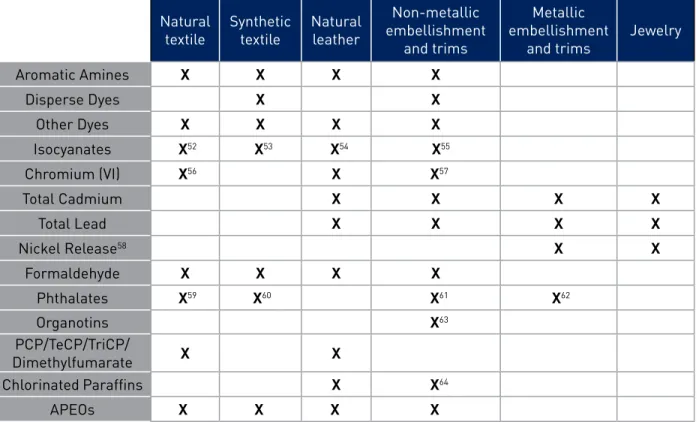
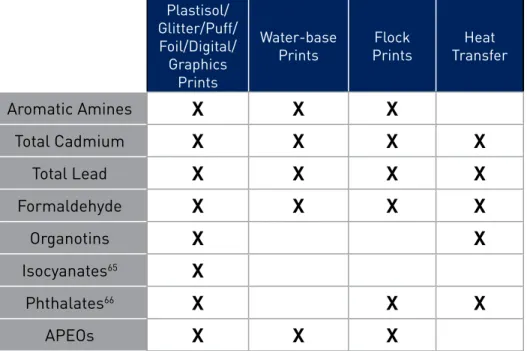
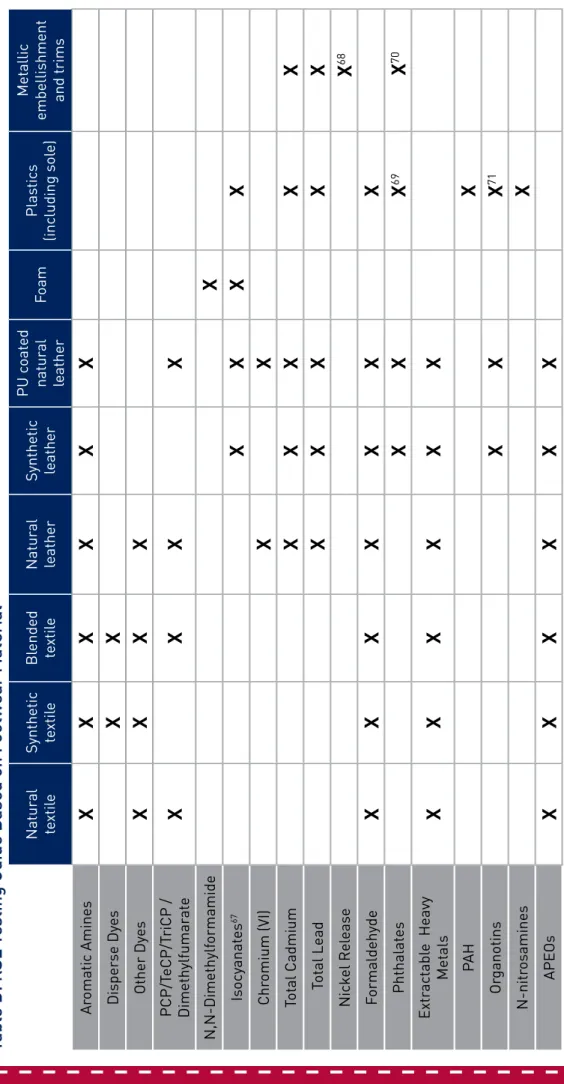
As a general matter, Materials, Chemicals and Other Goods should be tested as indicated in the following tables. Table A provides general testing guidance based on material type. Table B provides general testing guidance based on finish type; Table C provides general testing guidance for screen prints. Table D provides general testing guidance for footwear material. Given the risk that a particular Source or Supplier might use an unanticipated ingredient in the formulation, manufacture or processing of any given type of Materials, Chemicals and Other Goods, these tables necessarily suggest, but do not definitively prescribe the tests
necessary to ensure compliance with the RSL. It is the Source’s and Supplier’s absolute and non-delegable duty to ensure compliance with the RSL. Moreover, LS&CO. may at any time require additional testing to validate compliance with the RSL. All costs associated with testing are the responsibility of the Suppliers and Sources.