A
University
of
Sussex
PhD
thesis
Available
online
via
Sussex
Research
Online:
http://sro.sussex.ac.uk/
This
thesis
is
protected
by
copyright
which
belongs
to
the
author.
This
thesis
cannot
be
reproduced
or
quoted
extensively
from
without
first
obtaining
permission
in
writing
from
the
Author
The
content
must
not
be
changed
in
any
way
or
sold
commercially
in
any
format
or
medium
without
the
formal
permission
of
the
Author
When
referring
to
this
work,
full
bibliographic
details
including
the
author,
title,
awarding
institution
and
date
of
the
thesis
must
be
given
A Service Oriented Mobile Augmented Reality
Architecture for Media Content Visualization in
Digital Heritage Experiences
By
Sasithorn Rattanarungrot
A thesis submitted in fulfillment of the requirements for the degree of Doctor of Philosophy at the University of Sussex
School of Engineering and Informatics Department of Informatics
University of Sussex Brighton BN1 9QT
Declaration
The work described in this thesis, carried out in the school of Engineering and Informatics, I hereby declare that this thesis has not been and will not be submitted in whole or in part to another University for the award of any other degree.
Signed:
Sasithorn Rattanarungrot
Acknowledgements
This thesis has been accomplished by the supervision of Dr Martin White and Dr Paul Newbury. I really appreciate their time, support, and kindness. I also would like to thank Dr Ben Jackson who has given me some help and advice. Another group of people who have encouraged me during my PhD study is my colleagues at Walailak University, Thailand. I am grateful to have known these people. Nevertheless, I would like to thank the Royal Thai Government who supports me financially for the PhD study and the living in the United Kingdom.
I have been obliged and delightful to be a daughter of my parents (Boonsub Rattanarungrot, Pranee Rattanarungrot), a sister of my two brothers (Aroon Rattanarungrot, Arthid Rattanarungrot). I really appreciate their encouragement, love and understanding. Moreover, I would like to thank all of my lovely friends and family members who are always with me. Finally, I am really grateful to have known Chatsuda Knowthong, my dearest friend. I would like to thank her for moral support and good friendship.
UNIVERSITY OF SUSSEX
Sasithorn Rattanarungrot
Submitted for the degree of Doctor of Philosophy
A Service Oriented Mobile Augmented Reality Architecture for Media
Content Visualization in Digital Heritage Experiences
Abstract
Mobile augmented reality has become an influential tool for digital content representation and visualization of media content in terms of enhancing users’ experience and improving the adaptability and usability of typical augmented reality applications, such as in e-commerce shopping, virtual museum, or digital heritage scenarios. This research proposes a new Service Oriented Mobile AR Architecture called SOMARA, which includes a novel mobile AR client application.
SOMARA takes advantage the ability to integrate third party content through service-orientation. The SOMARA architecture enhances traditional standalone mobile AR applications with embedded media content by uniquely integrating a web service framework into an augmented reality client application to create more efficient and flexible mobile augmented reality applications that efficiently supports novel media content acquisition and visualization through appropriate access parameters.
The proposed architecture requires access to media content through specific media content service providers, e.g. a museum commissioning an augmented reality based museum interactive — predetermined media content, or any third party with their own service APIs, e.g. the Victoria and Albert Museum API — related external media content. This approach allows relevant third party media content to be ‘mashed’ via their public API with museums’ augmented reality interactive’s ‘embedded’ media content in the SOMARA mobile AR client. In this way novel mobile AR interactive applications, such as a museum augmented reality interactive, can be created based on particular museum environment scenarios that integrate a museum visitor’s experience with the interactive’s cultural objects.
Such experiences based on a SOMARA type museum augmented reality interactive can also be saved allowing visitors to take home their museum experience. SOMARA thus allows museum interactive experiences based on visualization of museums and third party media content physically located in the museum to be migrated to the visitor’s home environment for further study, enjoyment and understanding. This unique feature, ability to effectively replay the experience at home, of the proposed system utilizes service-orientation to integrate third party media content, which is currently deficient from commercial augmented reality solutions.
List of Publications
Conference papers
1. S. Rattanarungrot, M. White, and P. Newbury, “A mobile service oriented multiple object tracing augmented reality architecture for education and learning experiences,” in Proceedings of the International Conference on Mobile
Learning, IADIS Press, 2014, pp. 327–334.
2. S. Rattanarungrot, M. White, Z. Patoli, and T. Pascu, “The Application of Augmented Reality for Reanimating Cultural Heritage,” in Virtual, Augmented and Mixed Reality. Applications of Virtual and Augmented Reality SE - 8, vol. 8526, R. Shumaker and S. Lackey, Eds. Springer International Publishing, 2014, pp. 85–95.
3. S. Rattanarungrot and M. White, “A service-oriented mobile augmented reality architecture for personalized museum environments,” Virtual Systems & Multimedia (VSMM), 2014 International Conference on. pp. 277–284, 2014. 4. S. Rattanarungrot, M. White, and B. Jackson, “The Application of Service
Orientation on a Mobile AR Platform - A Museum Scenario,” in International Congress on Digital Heritage - Theme 2 - Computer Graphics And Interaction, 2015.
Glossary
2D Two Dimensions
3D Three Dimensions 6DOF Six Degrees of Freedom AR Augmented Reality
ARC 3D Automatic Reconstruction Cloud Three Dimensions API Application Programming Interface
AREL Augmented Reality Experience Language AR-PDA Augmented Reality Personal Digital Assistant BBF Best-Bin-First
BIM_WPVS Building Information Models-Web Perspective View Service CAD Computer-Aided Design
CLONALG Clonal Selection Algorithm
CV Computer Vision
FERN Fast Keypoint Recognition Algorithm GIS Geographical Information Systems GPS Global Positioning System
HTML Hypertext
HTTP Hypertext Transfer Protocol
IDE Integrated Development Environment JSON JavaScript Object Notation
LM Levenberg-Marquardt MCaaS Media Content as a Service MLA Museum Learning Activity NFT Natural Feature Tracking OGC Open Geospatial Consortium OS Operating System
RANSAC Random Sample Consensus RCH Reanimating Cultural Heritage REST Representational State Transfer RFID Radio-Frequency Identification RGB-D Red Green Blue Depth
RSS Rich Site Summary
SOA Service Oriented Architecture SDK System Development Kit
SIFT Scale Invariant Feature Transform SLAM Simultaneous Localization and Mapping SOAP Simple Object Access Protocol
SOMARA Service Oriented Mobile Augmented Reality Architecture UDDI Universal Description, Discovery, and Integration
UI User Interface
URI Uniform Resource Identifier URL Uniform Resource Locator
VM Virtual Museum
VR Virtual Reality
WSDL Web Services Description Language XML Extensible Markup Language
Table of Content
1 Introduction 15
1.1 Augmented Reality 17
1.2 Media Content as a Service 19
1.3 Museum Environment Scenarios 20
1.3.1 Multiple object tracking 21
1.3.2 Photogrammetry to acquire 3D content 22
1.4 Closed AR Architectures 23
1.5 Open AR Architectures 25
1.6 Research Question and Potential Benefits 28
1.7 Contribution to Knowledge 30 1.8 Thesis Organization 31 2 Service-Oriented Mobile AR 33 2.1 Augmented Reality 33 2.2 Mobile AR System 34 2.2.1 Computer vision 36 2.2.2 Object tracking 36 2.3 Mobile AR SDKs 38 2.3.1 ARToolKit 38 2.3.2 Qualcomm Vuforia 39 2.3.3 Metaio 39
2.4 Mobile Application Development Tools 40 2.5 Service-Oriented Architecture 41
2.5.1 Web services 42
2.5.2 Web service mobile AR platform 46
2.6 Photogrammetry Services 48
2.6.1 Arc3D and MeshLab 48
2.6.2 123D Catch 49
2.7 Web Service-based Photogrammetry 49
2.8 Web Service Providers 50
2.9 Summary 52 3 Mobile AR Scenarios 54 3.1 Architectural Requirements 54 3.1.1 Service-orientation 55 3.1.2 Content acquisition 60 3.1.3 AR environment personalization 61
3.2 Museum Learning Scenarios 62
3.2.1 Museum-based learning scenario 67 3.2.2 Home-based learning scenario 67
3.3 System Specifications 69 3.4 Summary 71 4 Architectural Design 72 4.1 Mobile Client 74 4.1.1 Mobile interface 75 4.1.2 AR application 75
4.2 Web Service Framework 94
4.3 Web Service Providers 95
5 A SOMARA Application Development 97 5.1 Development Tools — XCode and iOS SDK 98
5.2 AR View 98
5.3 Tracking and Content Configuration 101 5.3.1 Museum-based learning scenario 101 5.3.2 Home-based museum learning scenario 106
5.4 Object Augmentation 110
5.5 Service Request and Response 111 5.5.1 Museum-based learning scenario 111 5.5.2 Home-based museum learning scenario 113
5.5.3 XMLParser 114
5.5.4 NSJSONSerialization 116
5.6 Third Party Service Request 117 5.7 Interaction and Object Selection 119
5.8 Saving Selected Content 120
5.9 Taking Photos and Photogrammetry Service Request 124
5.10 AR Browser 126
5.11 Summary 130
6 System and Unit Testing 131
6.1 Museum-based Learning Scenario 132
6.1.1 Object tracking 133
6.2 Home-based Learning Scenario 139
6.2.1 Object tracking 141 6.3 AR Environment Personalization 143 6.4 AR Browser 145 6.5 Photogrammetry Service 151 6.6 Summary 153 7 Conclusion 154
7.1 The Research Accomplishment 154
7.1.1 SOMARA 154
7.1.2 The SOMARA-based mobile AR framework and application 155
7.1.3 The Metaio AR SDK 155
7.1.4 SOA-based content acquisition and utilization 155 7.2 The Limitations and Problems 155
7.2.1 Metaio AR SDK 156
7.2.2 Web service providers 157
7.2.3 Photogrammetry service 157
7.3 Future Development 158
References 160
Appendix 170
A. Web Service Provider APIs 170
B. Tracking Configuration for Home-based Learning Scenario 196 C. Tracking Configuration for Home-based Learning Scenario 200
D. The 3D Maps of Reference Objects 206
E. Installing the Metaio Augmented Reality SDK 213
Vision-based tracking 221
Object recognition 231
Table of Figures
Figure 1.1 Closed mobile AR platform 24
Figure 1.2 Service Oriented Mobile AR Architecture 26 Figure 2.1 The continuum of reality and virtuality [49] 33 Figure 2.2 Snapshots of Juanio and Aurasma AR browsers 41 Figure 2.3 Service request and response process using SOAP 43 Figure 2.4 An example of a SOAP request message 43 Figure 2.5 An example of a SOAP response message 44 Figure 2.6 Service request and response process using REST 45
Figure 2.7 HTTP service request 45
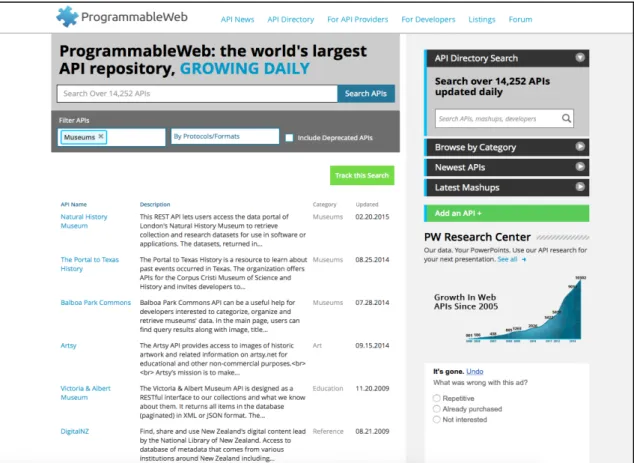
Figure 2.8 HTTP response header message 46 Figure 2.9 Response document in XML format 46 Figure 2.10 The API directory website [81] 51 Figure 2.11 Europeana service API [93] 52 Figure 3.1 SierraLeoneHeritage API [98] 58 Figure 3.2 Victoria and Albert Museum API [99] 59
Figure 3.3 Google Maps APIs [100] 60
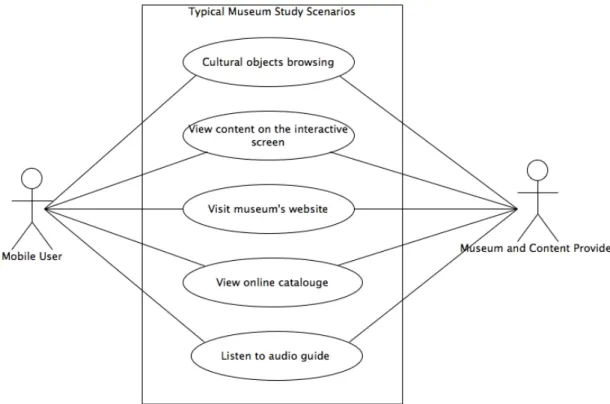
Figure 3.4 The use-case diagram of general museum learning 64
Figure 3.5 SOMARA use-case diagram 66
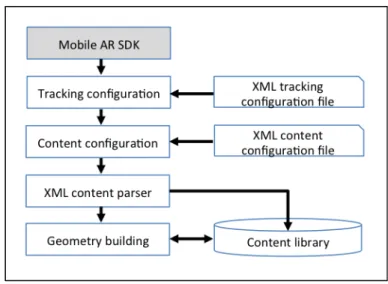
Figure 3.6 Home-based museum learning use-case diagram 69 Figure 4.1 Service-Oriented Mobile AR Architecture 73 Figure 4.2 Metaio native AR SDK (www.metaio.com) 76 Figure 4.3 Tracking and content configuration process 79 Figure 4.4 Tracking and API configuration process 79 Figure 4.5 The process of tracking and content acquisition in museum-based scenario 81 Figure 4.6 The process of service and content requests 82 Figure 4.7 The process of tracking and content acquisition in home-based scenario 83 Figure 4.8 The service and content request in the home-based museum learning 84
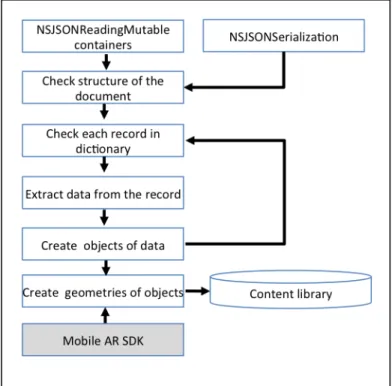
Figure 4.9 JSON document processing 85
Figure 4.10 The process of reading the XML response document 86 Figure 4.11 The object augmentation process in museum-based and home-based
museum learning scenario 88
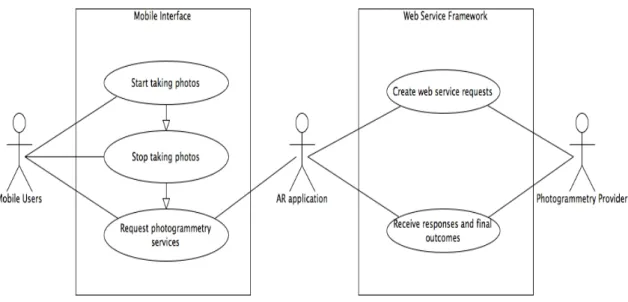
Figure 4.13 The process of photogrammetry service request done by mobile users 91 Figure 4.14 The process of creating personalized AR environments 92 Figure 4.15 Use-case diagram of AR environment personalization 92 Figure 4.16 The process of visualizing personalized AR environments using AR
Browser 93
Figure 4.17 The use-case diagram of AR Browser 94
Figure 4.18 Web service framework 95
Figure 4.19 Web service framework and the implemented service providers 96 Figure 5.1 iOS and XCode development framework 98 Figure 5.2 The mobile AR View of the museum-based learning scenario 99 Figure 5.3 The mobile AR View of home-based museum learning scenario 100
Figure 5.4 The AR Browser view 100
Figure 5.5 The UI View showing a Google Map image 118 Figure 5.6 The Data Model of the application 122 Figure 5.7 A View Controller supporting a Camera View 124
Figure 5.8 The Collection View Cell 125
Figure 5.9 The Camera View 125
Figure 5.10 The UITabBar Controller of the Table views 127 Figure 6.1 The main application page running on an iPad 132 Figure 6.2 The AR View of museum-based learning scenario 133 Figure 6.3 The related media content of a targeted object 134 Figure 6.4 The obtained associated content of a tracked physical object 135 Figure 6.5 The JSON response from the Victoria and Albert Museum API 136 Figure 6.6 The service APIs in a content configuration file 136 Figure 6.7 The obtained related content of a tracked physical object 137 Figure 6.8 The web service response document in JSON format 138 Figure 6.9 The associated content of a targeted sample object 139 Figure 6.10 The AR view of home-based museum learning 140 Figure 6.11 The URLs of participating content providers 140 Figure 6.12 The related content of a trigger image representing a targeted cultural object
141 Figure 6.13 The tracked trigger image 142 Figure 6.14 The web service response and acquired content 143 Figure 6.15 Selected content and the Alert View asking for a preference name 144
Figure 6.16 A screen shows selected content and preference name 145
Figure 6.17 User's preference names 146
Figure 6.18 A personal AR environment 147 Figure 6.19 Saved content acquired from a museum-based learning scenario 148
Figure 6.20 The list of museums 149
Figure 6.21 A map of the area around the British Museum 150 Figure 6.22 A service request in URL format of Google Static Maps API 150 Figure 6.23 The map presenting the source of a preferred object stored in the Victoria
and Albert Museum 151
Figure 6.24 The Camera View 152
Figure 6.25 The Collection View displaying photographs taken of a sample object 153 Figure A.1 Victoria and Albert Museum 171 Figure A.2 Victoria and Albert Museum API 172
Figure A.3 The API Query Builder 172
Figure A.4 The outcome of a service request 173
Figure A.5 SierraLeoneHeritage 186
Figure A.6 SierraLeoneHeritage API 186
Figure A.7 The SierraLeoneHeritage result page 189
Figure A.8 Google Maps APIs 190
Figure A.9 Google Maps Web Service APIs 191 Figure A.10 Google Places API Web Services 191
Figure A.11 Text Search Requests 192
Figure A.12 Google Static Maps API 194
Figure A.13 The Google Static Maps URL request 194
Figure D.1 Metaio Toolbox on iOS 207
Figure D.2 The created map of a sample object 208
Figure D.3 Metaio Creator on Mac 209
Figure D.4 A selected 3D map file of a sample object 209 Figure D.5 The 3D map of a sample object 210 Figure D.6 The tracking configuration files exported from a 3D map 210 Figure D.7 The 3D map of a sample object 211 Figure D.8 The 3D map on Metaio Creator 211 Figure D.9 The 3D map file and tracking configuration file 212 Figure E.1 The Metaio development frameworks 214
Figure E.2 iOS development framework 215 Figure E.3 The mobile AR application development environment 215 Figure E.4 The frameworks and libraries in the development environment 216 Figure E.5 The application registration page on the Metaio developer portal 217 Figure E.6 The MetaioLicenseString in the development environment 218 Figure E.7 The Metaio SDK folder containing the required files 218 Figure E.8 The project of the mobile AR application and the
MetaioSDKViewController 219
Figure F.1 Markers for Studierstube Tracker [114] 222
Figure F.2 Marker-less tracking 224
Figure F.3 Natural feature tracking [113] 225
Figure F.4 Handy AR [117] 226
Figure F.5 Model-based tracking [123] 227 Figure F.6 Tracking-by-detection [61] 228 Figure F.7 Shape augmentation using recursive tracking [129] 230 Figure F.8 3D object recognition using 3D model recognition [133] 234
Chapter I
1
Introduction
Cultural heritage has been continuously improved so much in terms of assisted technologies, content representation and innovative applications supporting cultural heritage study, learning and digital content consumption. The European Work Program 2016-2017 has stated technologies that support access and utilization of digital cultural heritage in Virtual Museum (VM) that allow visitors to access content before, during and after a visit. Technologies that effectively enhance VM are Virtual Reality (VR) and Augmented Reality (AR) in terms of digital content representation and interpretation that can be applied in physical museum, online or heritage sites [1].
Mobile AR has become an influential tool for digital content representation and visualization of media content in terms of enhancing users’ experience and improving the adaptability and usability of typical AR applications, such as in e-commerce shopping, virtual museum or digital heritage scenarios. This research proposes a new Service Oriented Mobile AR Architecture called SOMARA, which includes a novel mobile AR client application, which takes advantage the ability to integrate third party content through service-orientation (e.g. Media Content as a Service — MCaaS).
Recent evolutions in mobile technologies such as screen resolution, processing speed, embedded cameras and mobile network bandwidth have continuously led to an enormous improvement in mobile applications and implementations. Furthermore, advanced developments in mobile graphics processors, application programming interfaces (APIs) and displays have increased the processing potential in real time graphics tasks for instances of 3D rendering, visualization and interaction. Because of these advanced developments, many mobile applications today can provide graphic features and content, which hitherto where mostly found in desktop graphical user interface or in 3D rendering found in game development approaches.
Mobility, as in the ability to take application mobile or a users’ penchant to use applications in a mobile context, has strongly influenced both the quality and performance of mobile technologies and applications in terms of greater potential for use of hardware (e.g. mobile devices) and development software (mobile applications), the quality of a mobile or wireless network, the scalability in application developments and service providers and finally, the usability and ubiquity of mobile services. Most mobile devices have a network connection module so mobile applications can be efficiently implemented in a client-server framework. This mobile network connectivity facilitates solutions for remote rendering on a mobile device. The most computational operations are processed on servers, which then send the output to mobile clients for visualization.
Nevertheless, cloud computing has currently been implemented in many client-server applications such as web service-based mobile applications [2] and service-oriented cloud computing [3]. Cloud computing is an enormous challenge adapting the traditional client-server architecture to cloud-based infrastructure on the Internet. The infrastructure relies on clients and services on the cloud computing architecture such as processing services and data services. For example, rendering 3D graphics on a cloud-based service infrastructure extremely improves the efficiency of the real-time rendering of 3D content [4][5]. Some 3D rendering services on the cloud infrastructure services are ArcGIS for Server [6] and 123D Catch on Autodesk® Cloud [7].
Advanced technologies utilized in hardware such as powerful mobile processors [8][9] and high quality smartphone cameras [10], software such as Swift [11] , hybrid and HTML5 development tools [12] combined with mobile network approaches such as cloud networking [13] and advanced mobile networks [14] for mobile computing that are now available on many platforms such as smart phones and tablet PCs have enabled mobile 3D computer graphics to be a part of an evolution and innovation in mobile applications. In the context of this thesis advanced interactive graphics development software is of particular interest. Currently, there are two state-of-the-art mobile graphics software architectures: OpenGL ES and M3G that both are configured as APIs for C/C++ and Java programming respectively [15] [16] that are very useful in developing mobile AR applications.
The following sub-sections discuss briefly the key concepts critical to the development of novel mobile AR applications, such as SOMARA, AR, mobile AR, MCaaS, museum environment scenarios, closed versus open AR platforms. These key concepts lead toward a consideration of the research question, potential solutions and a set of technology objectives. This chapter closes with a statement of the research contribution and organization of the thesis.
1.1
Augmented Reality
AR has recently been an influential technology utilized to efficiently enhance users’ perception through computer-generated media content overlaid on real physical environments [17][18] . The types of media content that can be visualized on AR scenes are 3D models, labels, text, images, videos, etc. [19]. AR has become a powerful tool in many scenarios designed for particular approaches such as advertising, museum experiences, e-commerce, education and many other scenarios. In addition, AR applications are currently found in many platforms such as hand-held devices, PCs, wearable devices and even specially designed monitors and projectors for museum or advertising approaches [20][17][18]. In the context of this thesis the application scenarios discussed will focus on museum (digital heritage) experiences as described in the author’s papers [21][22], but SOMARA could equally apply to other AR based interactive scenarios in different domains as described in the author’s first paper [23].
AR application development requires important functions or AR tasks, including tracking, recognition and visualization, to enable AR applications to work simultaneously with cameras and computer screens. Traditional AR tracking is able to recognize markers and then overlay relevant media content on top of the markers. Marker AR is generally found in various scenarios, however using markers still has some restrictions in terms of flexibility and usability of AR application utilization. Applying marker-less AR is a solution that improves the functionality of AR applications by enable the applications to track and recognize marker-less such as images or 3D objects and then augment media content on the marker-less environment. This marker-less approach remarkably improves the implementation and experience of AR in various scenarios [24][19][25].
While AR scenarios can affect peoples’ activities and lifestyles in positive ways, implementing mobile AR can prove to be a particular technological challenge.
Nevertheless, mobile AR has become the most recent trend in indoor and outdoor scenarios such as location-based AR, gaming or potential graphics applications, which allow users to experience static or interactive content on the real scene. Mobile AR systems require a tracking module including marker, marker-less and Global Positioning System (GPS) in order to recognize reference objects or identify current location of a user and the system will then augment related media content of a tracked object or user’s current location [26].
Mobility is a powerful and influential structural concept that has been found in mobile technology and platforms including mobile devices, wireless networks, pervasive computing and ubiquitous networks. Current AR systems on mobile platforms enable mobile users to participate in virtual content and services at anytime and anywhere. Mobile devices are available on small and handheld devices (smartphone, tablets, etc.) that are lightweight and much more convenient to be carried. With such devices, wireless or mobile network connection will enable mobile devices to automatically connect to the Internet everywhere. A typical mobile’s advanced hardware and software features can process interactive 3D graphic in real time enabling good human-computer interaction to be created. Because of these qualifications, mobile devices have become powerful tools that people can access and also utilize services and applications easily in the progressive and interesting ways. Mobile AR will potentially enhance users’ new experiences in visualization and interaction with 3D models on mobile platforms by using embedded cameras, displays and graphical user interfaces — the basic 3 components needed for mobile AR scenarios embedded in a single mobile device.
Mobile AR has been implemented in various innovative applications such as gaming, shopping guides, advertising, edutainment, travel guides, museum guides, medical visualization, etc. However, these AR applications often provide limited flexibility because their media content are usually embedded within the application in advanced and they rely on marker-based approaches [27] [15]. Therefore, current AR applications can be enhanced by improving visualization, tracking, recognition, interaction, displays and user interface design of such AR applications both within the real and virtual environment.
AR applications work by superimposing or combining interactive virtual objects with real world environments in real time, and in this way AR application providers exploit
software and hardware video (camera and tracking) techniques to represent computer generated models together with real objects to create visualization services based on interactive graphics representations. In addition, users can view and interact with virtual objects in a real environment through the AR application interface or through virtual interaction techniques such as hand tracking [28] or mixed-reality interfaces [29]. In such AR systems, cameras, displays and graphics libraries are currently the most important modules on mobile devices for implementing computer vision techniques such as 3D object tracking and recognition on AR environment [27]. This thesis proposes to add a new service-orientation module to this AR architecture to enable a new generation of mobile AR applications that can integrate MCaaS.
1.2
Media Content as a Service
MCaaS in the context of this thesis exploits the well-known Service-Oriented Architecture (SOA) approach, which is a web 2.0 technology that has been empowering sharing and acquiring digital content, data and services over open and interoperable networks. SOA and APIs often go hand-in-hand to provide flexible and efficient access for end-users to open data (e.g. media content) that is consumed in web applications. Currently, there are many open and interoperable networks and providers on various platforms, which interactively offer versatile data and content to other applications.
Open and interoperable network applications that consume or share data via service-orientation are usually based on web service architectures. They make data accessible over the Internet, perhaps as a mobile network, and are often configured client-server applications exploiting a private or public API. Examples of web service providers are Web Map Services, mash-up services, geospatial and social networking data [30][31][32].
This thesis investigates how to efficiently exploit open and interoperable networks (web services and APIs) to provide access to digital media content for mobile AR environments (using museum scenarios as an example). Through a web service approach, AR based media content are presented as virtual media or digital content on see-through AR browsers (on a mobile tablet or smartphone), which can be used instead of web browsers in outdoor AR environments or real scenes.
This SOA approach supports very well a client-server scheme over a mobile/wireless network. Thus, SOA and client-server architectures are well suited to developing mobile AR architectures, such as SOMARA. Additionally, integrating media content via an API allows the AR application to obtain more associated valuable content and significantly increase the usability and functionality of the proposed mobile AR application. So, a key features of SOMARA proposed in this thesis includes the integration of a web service framework into a mobile AR application.
This feature could be extensively implemented in indoor or outdoor AR scenarios, for which the AR browser is an application based on a web service framework to show media content in a real environment. The mobile AR client proposed in this thesis offers a key advantage (over current museum based AR systems) from being deployed on a service-oriented architecture. That is, it provides third party open services to access related digital media content from third party digital content providers [33][34].
1.3
Museum Environment Scenarios
Generally, museums basically allow visitors to physically view cultural objects, read details on small cards and take away some leaflets. Currently, some museums also provide a website that also exhibits digital cultural content and enable users to search catalogues online. Thus, the museum learning activities (MLAs) can be now performed online anytime and anywhere inside or outside the museum.
For the enjoyment of the casual or professional visitors, many museums have integrated technologies into their ‘collections environments’ (e.g. online or in a physical display) such as VR, AR and mobile technologies in order to revolutionize cultural object exhibits as well as enhance visitors’ experiences in participating the learning activities offered by the museum itself [35][36][37][38]. The next generation of museum exhibits could effectively be organized as AR exhibits on mobile platform exploiting SOA in order to create a tool or application on mobile devices that support effective learning scenarios where visitors will have opportunities to perform cultural objects study or view virtual exhibitions through a mobile device. These novel mobile AR applications will then be able to support content acquisition where associated cultural media content from any open services or repositories can be requested and the content will be presented to visitors on the AR environment.
Photogrammetry or image-based reconstruction is a technique that usefully supports content acquisition that could be beneficially applied in MLAs where visitors are able to obtain a 3D model of a preferred cultural object and utilize the acquired model in mobile AR environments. The photogrammetry could be integrated into the novel mobile AR applications in order to enhance typical museum learning where visitors are not allowed to take photographs or take away anything related to exhibited objects. The photogrammetry and its features are discussed further in section 1.3.2, and 2.6.
Additionally, the proposed mobile AR platform also supports multiple object tracking that enable the novel mobile AR applications to track and recognize several targeted objects individually. Multiple object tracking allows providers to create an AR exhibition of a group of cultural artifacts composed of reference cultural objects that will be tracked and related content of each object that will be visualized on top of the real environment. The multiple object tracking is discussed further in section 1.3.1, and Appendix F.
1.3.1
Multiple object tracking
Object tracking is one of the AR tasks that mobile AR applications firstly perform through the embedded-camera of a mobile device in order to detect and then recognize a reference object, which could be a marker or marker-less. Typical indoor mobile AR applications are particularly designed to track one single object and augment a related content on top of the real scene. For example, a mobile AR game allows users to download a marker or an image from which the application will augments an interactive game and mobile users can then have interaction with the active content on the screen. In order to create more functional and adaptable mobile AR applications, multiple object tracking could be another option in order to provide object augmentation to various reference objects in the same environment or scenario. This feature usefully enhances the concept of mobile AR in museum or learning scenarios that support content utilization in rich media environments where users are able to track a selection of reference objects and visualize associated content of each tracked object. In addition, mobile users are able to participate in the AR environments where they can create personal AR environments from the visualized content of preferred objects.
Multiple object tracking also enhances more flexible AR applications which is another level of improving the usability of mobile AR applications and providing various digital
media content augmented from physical objects or images in AR environments. The new mobile AR applications can offer a broad range of reference objects and multiple related media content particularly specified for each object. The multiple object tracking can generate richer learning environments, which can be combined to other obtained media content, to mobile users so that they can efficiently view and utilize media content in AR environments. Typical mobile AR SDKs provide single object tracking and it can be improved to multiple object tracking by creating a tracking and content configuration file for reference objects. Thus, performing multiple object tracking and media content augmentation requires more preparation and processing compared to single object tracking.
1.3.2
Photogrammetry to acquire 3D content
Photogrammetry is an advanced technique for reconstructing 3D virtual objects from original objects. 3D model reconstruction tasks are mainly composed of matching and merging multiple images [39]. Photogrammetry requires photographs of a targeted object in order to create a virtual 3D model from the prepared photographs and the final outcome will be given away to the users. Image-based reconstruction or photogrammetry could be effectively used as a tool to perform 3D content acquisition in the novel mobile AR applications beneficially applied in MLA scenarios. Providing photogrammetry services to visitors is another technological strategy for physical museums that allow visitors to participate in selecting preferred objects, sending photogrammetry service requests and taking away obtained 3D models that can be done on a mobile device and the novel mobile AR application based on SOMARA. Photogrammetry applications currently are based on client-server architecture where users are able to upload photographs of a target objects to the server by using an application client on mobile devices, PCs or a web-based application.
Another platform of photogrammetry applications is the open photogrammetry services which expose service APIs and allow any applications to create connections with the services through a web service framework. Photogrammetry web services can then be integrated into mobile AR applications and the services can be requested directly from the client-side applications. As the result, the outcome of the service, which is virtual 3D models, is able to be instantly visualized in AR environments and taken away for presenting in other situations.
1.4
Closed AR Architectures
Most current mobile indoor and outdoor AR applications nowadays are implemented as ‘standalone’ or ‘closed platforms’ that provide users with a limited amount of embedded data or content on top of the real scene [5][40]. In this context a standalone platform means a single AR application not connected to any form of dynamic update, but can connect to the app store for a new version. On the other hand, a closed platform means that the AR application can be dynamically updated, for example, with commercial advertising, usually on a client-server framework. However, neither solution offer a communication channel to download or obtain dynamic content from other third party media that are related to the actual AR application’s media content in real-time. For example, if this was a museum app displaying cultural objects there is no way to add or integrate third party digital cultural object media content. This means the AR application is fixed and inflexible, i.e. cannot be dynamically updated with ‘meaningful’ media content. Therefore, these AR applications have no ability to provide content sharing between mobile end-users (e.g. museum visitors) and third party AR data providers because of the closed platform approach. Therefore, obtaining new content generally relies on application providers or application stores to update the AR applications.
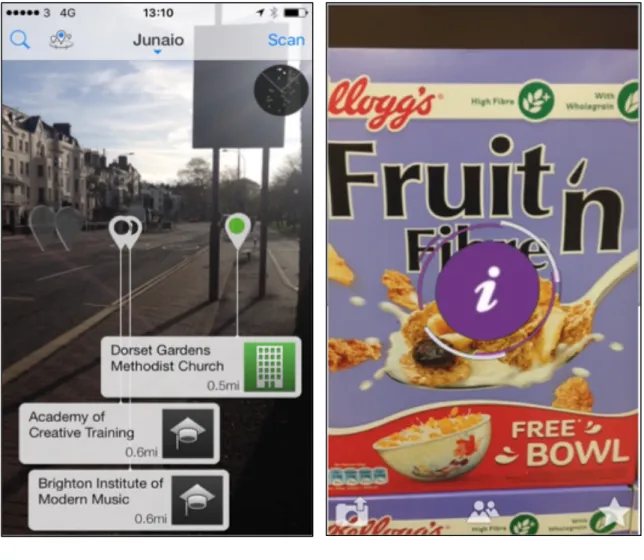
For example, commercial outdoor AR applications such as Aurasma [41] and Layar [42] offer an interface or tool to create personal AR environments and upload media content to their server for use in the AR application. These tools then allocate an account to each individual mobile user and a channel to an AR environment so that they can visualize their own AR environments. However, dynamic advertising does take place in that commercial organizations (e.g. KFC, Tesco, whoever) can provide media content that are also displayed on the AR application (part of the revenue model for Aurasma, etc.). However, because the AR applications themselves are implemented on a closed platform where only their members (in thus case the application developer and any commercial advertiser) can place their preferred content (the developer, for example, could be a museum, and they also allow through the tool a channel for advertising media content that are displayed with their cultural content) on the AR environment, they are effectively inflexible and not truly dynamic, because they cannot exploit user-generated content.
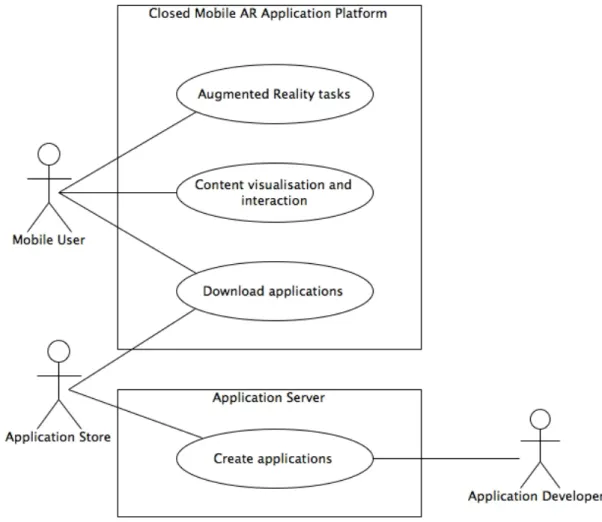
Figure 1.1 illustrates the structure of typical AR applications on a closed platform and the process of updating the content that mobile users can only be done through the application store when the providers have launched an updated version of the application.
Figure 1.1 Closed mobile AR platform
AR applications lend themselves to the display of 3D objects. However for any mobile 3D graphic application, 3D virtual models still have to be created and designed in desktop computers and then transferred to mobile devices for running or rendering on applications just as they do for mobile games or other interactive media applications (e.g. web 3D apps). Although new generation mobile devices can generate good performance 3D graphics content, some complicated rendering tasks still require more processing power such as digital cultural heritage scenes, 3D virtual cities or complicated 3D models. Therefore, processing complicated tasks such as image-based reconstruction or 3D photogrammetry exploiting multiple images matching and 3D model building cannot be completely done on mobile devices because of the mobile
device’s limited resources. Unfortunately, closed architectures such as that described above preclude the ability to access photogrammetry (and other media) services to alleviate 3D content generation.
1.5
Open AR Architectures
In contrast, an open AR platform (open architecture) exploiting SOA, as illustrated in Figure 1.2, offers many more advantages, such as the ability to integrate third party or user-generated content. SOA is an open architecture that enables any application to participate with an open network where valuable content and services from potential providers can be accessed and requested. Thus, in an open architecture mobile AR applications are able to exploit a web service framework in order to create applications on an open platform, rather than a closed platform.
There are many advantages to utilizing an open architecture (or open platform). For example, it is relatively easy to integrate a web service framework (e.g. based on REST) into a mobile AR platform in order to create a novel open mobile AR application, as proposed in this thesis. Open architectures are able to apply service API calls, create enhanced interactions (between embedded and third party media content), request both local (e.g. British Museum AR exhibition content) and third party (e.g. Victoria and Albert Museum) media content and integrate them into the same mobile AR client application, and also share the results with other potential applications or service providers.
Additionally, mobile AR clients are capable of applying mash-up services, again through third party APIs, by requesting and presenting value-added media content such as geolocation and social networking data on AR or mixed reality environments. For example, an object from the British Museum (Mende Mask) and another object from the Victoria and Albert Museum (another Mende Mask) collocated in digital space (i.e. in the mobile client AR application) can be integrated with a Google map showing their shared location of origin (Sierra Leone).
The structure of SOMARA from a use case perspective is illustrated in Figure 1.2. Here, the critical components that comprise the open architecture or platform are composed of a mobile AR client, web service framework, and content or service providers. The
mobile user is typically a museum visitor (or a shopper in a retail scenario) browsing augmented content.
Figure 1.2 Service Oriented Mobile AR Architecture
The mobile AR client performs AR tasks that support the interaction between a user and the novel mobile AR application in order to view augmented content of a targeted object on the screen. This new type of open mobile AR application effectively supports content acquisition where existing media content on the real scene can be augmented with media content from third party sources. Because, an open architecture can consume related third party media content, it will enhance the end-user experience
further than is normally associated with closed platform AR — because there are richer media content in the AR environment that could lead to a greater understanding of the objects being studied.
Another valuable service that could be applied to a mobile AR platform is 3D model building from photographs or photogrammetry — alluded to in sections 1.3.2 and discussed further in section 2.6. Photogrammetry is an image-based 3D reconstruction method that requires high performance machines and plenty of resources to perform complex modeling, rendering and reconstruction tasks. At the moment, there are some closed photogrammetry applications that allow users to use their application tools for uploading a stream of photographs of a target object and then the systems will create a 3D virtual model and send it back to the user. This application will help users acquire 3D virtual models and utilize such models in their applications with time and cost saving. Typical examples of the photogrammetry applications are 123D Catch [7] and Autodesk ReCap [43]. Also, there are several potential European consortiums working on the concept of mobile photogrammetry for cultural heritage applications, in particular exploiting RGB-D cameras [44].
Another key feature required for enhancing mobile AR applications beyond so called marker-based AR is marker-less object tracking used to track and recognize physical targeted reference objects. This is a necessary requirement to build ‘usable’ AR applications such as those needed in shopping, museums and other environments where an end-user has the need to visualize associated media content collocated with the physical object (e.g. a museum artifact or a product in a shop, etc.). In this context, this thesis presents a mobile AR application based on marker-less AR by enhancing the Metaio AR SDK [45] i.e. with multiple object tracking, recognition and content visualization that demonstrates the efficacy of a new service-orientation approach [21][22][23][46].
Associated or related content can now be revealed on the real scene by augmenting the physical objects. In the mobile AR application proposed in this thesis, the tracking module is designed to perform marker-less tracking, which requires 3D object tracking (and image tracking) so that the system can recognize physical objects. Moreover, the proposed mobile AR system can augment various content of one reference object — as mentioned, this will lead to a richer AR environment in terms of media objects
associated with the reference object. That is, multiple objects tracking has the potential to greatly enhance the interpretation of mobile AR scenarios and their environments where mobile users can obviously view a greater variety of media content from a reference object on the screen. Mobile AR applications can also offer some features for the users to manage and utilize those revealed content, e.g. saving an AR scenario for future use.
1.6
Research Question and Potential Benefits
Factors introduced above concerning open and closed AR architectures, scenarios of use, etc. lead to the consideration of an overarching research question posed in this thesis. This research question further leads towards consideration of potential benefits that will drive the design and development of the SOMARA framework in which key technology components (SOA, multiple object tracking, content acquisition and utilization) are implemented to demonstrate the efficacy of an open AR architecture.
Overall Research Question:
• How can a typical mobile AR application based on a closed architecture (or closed platform) be enhanced through service-orientation to create a more flexible open architecture that can acquire valuable MCaaS from participating open sources for museum (and other) interactive experiences?
This thesis proposes potential benefits to this research question: Service Oriented Architecture on a Mobile AR platform (SOMARA) that
• Exploits an open architecture through service-orientation: SOA is able to enhance typical mobile AR applications in order to obtain valuable associated content from participating open providers and extensively increase the adaptability and functionality of typical mobile AR applications on closed platforms (closed architecture). Therefore, integrating a web service framework into a closed mobile AR system efficiently improves the content acquisition and utilization of mobile AR system [40] [34] [47] [48].
• Integrates a web services framework into the mobile AR client: SOMARA is a unique implementation of a SOA on mobile AR platform where a web service framework is integrated into the AR application in order to perform interoperability tasks to acquire valuable media content that can be visualized on
the real scene and enhance the AR environment. The proposed service-oriented mobile AR application is composed of a mobile client, web service framework, and service providers.
• Exploits APIs to access Media Content as a Service: SOMARA’s web service framework accesses media content via a set of APIs including an API developed to access the Reanimating Cultural Heritage (RCH) digital archive as a test bed. The mobile AR client also integrates other existing service APIs from third party content providers, e.g. Victoria and Albert Museum, in order to verify a service-orientation approach. Web service responses are processed and the obtained content are presented on top of a targeted object in AR environments.
• Exploits APIs to access services: Another benefit from working simultaneously on a web service framework and exploiting an open platform is that of obtaining value-added content from open services or third party such as photogrammetry or image-based reconstruction, which support 3D model acquisition from photographs. In addition, the mobile AR system also effectively support content utilization feature where mobile users are able to create personal AR environments by selecting preferred content on the active scene and save it for reviewing in other situations. This feature enhances the learning experiences and interpretation by transforming typical data or metadata into rich media content on AR environments. Another useful service in proposed museum learning scenarios is Google Maps where the user may wish to see a location origin of a cultural artifact. Google Maps APIs are applied by the mobile AR client that a visitor is able to see locations origin of a collection of preferred cultural artifacts saved from the museum on the map.
• Implements a web service based museum scenario: The application of SOMARA is validated through the implementation of a prototype mobile AR museum interactive application that integrates multiple object tracking. Multiple object tracking is required in the novel service-oriented mobile AR application in order to create a series of reference objects augmentation that expand the AR content representation and enrich the AR environment. The prototype allows MLA scenarios to be implemented where the mobile AR application is developed on a web service client framework [46][21] and mobile platform that related content of cultural objects are visualized on the mobile
screen. The novel mobile client developed in this prototype beneficially supports two related modes of use: museum-based and home-based AR visualizations.
1.7
Contribution to Knowledge
This new concept of developing an open AR architecture on mobile platform by implementing SOA will provide the adaptability and improvement of typical closed mobile AR applications that limit the exploitation of AR features and content acquisition that mobile AR applications should be able to obtain valuable media content from other sources such as third party. In order to prove the proposed concept, it requires a novel open mobile AR architecture and a mobile AR client that is applied to MLA scenarios where museum exhibits is transformed into media content on the real scene and it can be viewed through the mobile screen. The novel mobile AR application augments cultural objects by presenting related content in AR environments as well as requesting associated content and services from other participating museum content providers or third party. The following is the contribution to knowledge of this research, which is the accomplishment of developing SOA on mobile AR systems.
• A Service Oriented Mobile AR Architecture to support different mobile AR scenarios [23] — Conceptual Architecture
o A new Service Oriented Mobile AR Architecture or SOMARA that is the development of a mobile AR framework based on SOA. A web service framework is applied into the architecture in order to create a mobile AR client that can access open service providers such as third party or local service providers and consume MCaaS. The connections allow the mobile AR client to send requests and receive responses, which is media content that will be visualized in AR environments.
• A prototype software framework based on iOS to demonstrate a SOMARA type application [21]— Specific Software Framework
o A novel mobile AR software framework on iOS platform is developed in order to support the concept of SOMARA. A SOMARA application is built to validate the architectural concept and software framework. The SOMARA framework requires the embedded-camera of a mobile device, AR SDK and mobile/wireless connection in order to perform object tracking and interoperability tasks respectively. The SOMARA-based
application enables mobile users to interact with visualized media content and the application itself through the touch-screen mobile interface.
• A multiple object tracking algorithm exploiting the Metaio AR SDK to support [22] — Specific Algorithm
o The Metaio AR SDK is applied as a framework performing AR tasks composed of object tracking, object recognition and content visualization. The Metaio AR SDK offers only single object tracking and single media content visualization. In order to create a mobile AR client that support rich media content augmented from different reference objects, the original object tracking has been extended in a unique way to afford multiple object tracking.
• Service-oriented content acquisition and utilization [46] — A SOA Approach o SOMARA encourages a new content acquisition approach that can be
done through a web service framework, which is the advantage of SOA and open platform. Associated media content for a particular scenario could be requested from various sources such as third party (Google Maps, Flickers) or potential open services (Photogrammetry services). Obtained media content can be visualized on the screen and AR environment where mobile users are able to create interaction with active media content.
1.8
Thesis Organization
This research focuses on the design of SOMARA and the development of a novel mobile AR application based on SOMARA. The novel application is on open platform where SOA and web service framework is required and implemented into the application in order to create the mobile AR client that effectively perform AR tasks and interoperability tasks. The following is the thesis organization that explains the process of pursuing the research and creating useful SOMARA and its application in order to accomplish the contribution to knowledge.
Chapter 1 introduces the research proposed in this thesis, and provides detailed discussions of the research concepts, technological approaches taken, architectures and components designed, and solutions provided to achieve the research goals proposed.
Chapter 2 presents detailed background, concepts and applications of each component architectural proposed in the research. This information is incorporated with related technologies and techniques that were studied and implemented.
Chapter 3 provides the AR scenarios composed of architectural requirements and museum environment scenarios. The architectural requirements explain solutions and techniques that improve the usability of standalone mobile AR applications and create a mobile AR application on open platform. This chapter also presents the implementation of SOMARA and its application in the potential museum environment scenarios that the novel mobile AR application can enhance visitors’ perception and experience in MLAs.
Chapter 4 explains the architectural design of SOMARA and its service orientation that generate a novel mobile AR application. The service orientation is composed of a mobile AR client, web service framework and service providers and each component is on client-server architecture. The processes of performing AR tasks, content acquisition and utilization are also described in this chapter.
Chapter 5 describes the implementation of SOMARA in MLA scenarios. The SOMARA-based application is developed on native development platform, Objective C, XCode and iPad mobile device. The novel mobile AR application requires an AR SDK in order to perform AR tasks and simultaneously work with the AR application and mobile interface to interact with mobile users and visualize content on the screen.
Chapter 6 explains the final mobile AR application based on SOMARA that support physical museum learning scenario and home-based museum learning scenario in testing and evaluation issues. The testing and evaluation shows how the designed SOMARA and its application can efficiently support content acquisition and utilization over a web service framework and AR platform. Therefore, the testing and evaluation will prove that the novel SOMARA is capable, useful and stable for applying in other scenarios.
Chapter 7 concludes the research accomplishment and gives some directions to future developments and implementations such as applying the system with multiple photogrammetry service providers or developing mobile client side with client-server architecture that will be able to enhance collaboration and interoperability in sharing digital AR content.
Chapter
ΙΙ
2
Service-Oriented Mobile AR
The aims of this research is to design a Service-Oriented Mobile Augmented Reality Architecture (SOMARA) and build proof of concepts and prototypes through a novel mobile AR application based on SOMARA in order to support content acquisition and utilization on mobile and AR platforms. There are three main SOMARA requirements that efficiently improve the usability and adaptability of standalone mobile AR applications including: 1) service orientation, 2) content acquisition and 3) consumption. This chapter explains the components of each requirement and the technology approaches in the literature survey including background, concepts, applications and implementation related to the significant components in a SOMARA.
2.1
Augmented Reality
Augmented Reality (AR) is a mixed reality technology that is a combination of real and virtual environments. Mixed reality consists of the real environment, AR, augmented virtuality and virtual reality (VR). Figure 2.1 presents mix reality and its elements in the scale of the continuum between reality and virtual reality.
AR combines the real environment together with computer generated virtual objects and enables users to interact with virtual content as an element of the real environment. AR is different from VR in the experience of the realistic. VR is a technique to create a virtual environment and let users be a component of that environment. Consequently, users seem to be incorporated as part of the scene and can interact with other components. AR simultaneously provides users with a realistic and a virtual experience while VR allows users to participate only within the virtual environment. Applying VR requires display technologies such as a computer screen or a head-mounted display in order to present the virtual scene or content, whereas AR functionally uses embedded cameras to track targeted objects and related content is visualized on a screen. Moreover, AR can be applied for indoor or outdoor purposes using positioning systems such as GPS in order to present content based on the user’s current location, a process, which is called location-based AR. These technologies enrich AR applications in terms of flexibility, adaptability and variety where AR has become a powerful tool in developing a broad range of applications on many platforms. Additionally, AR supports users in various activities such as marketing, education, maintenance, design, simulation, medical and personal assistance [17][18][50][51][52]. Examples of AR applications include developing an interactive coloring book [53], AR experiences for museum visitors [38][54], an AR shopping assistant [55][56] and developing AR to support mathematics and geometry education [57].
2.2
Mobile AR System
The mobility concept has become an innovative and powerful tool to create more advanced and usable applications implemented in many different scenarios. A current challenge in mobile technology is the implementation of AR on mobile platforms that focus on the convergence of AR, ubiquitous and wearable computing [27]. A mobile AR system is able to provide mobile users with media content e.g. 3D models, animations, images, videos and text visualized on a mobile screen and AR tasks can be done in both indoor and outdoor environments. Examples of mobile AR applications are:
• Virtual character-based application • Cultural heritage
• Navigation and path-finding • Collaborative assembly and design • Industrial maintenance and inspection
Examples of mobile AR applications are systems for remote collaboration [58], mobile AR for navigation and collaborative use [59] and for cultural heritage [60]. The motivation for this research focuses on designing a SOMARA, which is the implementation of a SOA on a mobile AR system, which addresses shortfalls in many of the current AR systems. For example, a SOMARA application is an open AR application on a mobile platform that is applied in MLA scenarios — current AR applications are closed to user-generated content. An open SOA allows novel mobile AR applications to be designed to accomplish AR tasks as well as interoperability tasks through a web service framework, where interaction between mobile users and the application can be done through the mobile interface. The AR tasks are composed of object tracking, recognition and content visualization. The following explains the notion of each AR tasks, which is one of the components in SOMARA.
• Object tracking is the process of detecting the real scene and finding a reference object pre-defined in the configuration file. Object tracking requires the embedded-camera of a mobile device in order to capture the video of the real scene and the tracking process will detect feature of objects in the scene.
• Object recognition is done after the system detect feature of an object in the real scene. The extracted feature will be compared with the pre-defined feature of a reference object stored in the content library. Once the reference is recognized, it will be augmented by presenting related content superimposed on top of the recognized object.
• Content visualization is augmenting a recognized object with related media content combined into the real scene. The novel mobile AR system is able to visualize various kinds of media content on the screen and users are also able to have interaction with the active content in the AR environment.
The tracking process requires an embedded camera on a mobile device that tracks reference objects and related content is visualized on the screen. The mobile AR application is applied in two MLA scenarios including a museum-based learning and a
home-based learning. These two scenarios demand physical object tracking and image-based tracking. The object tracking requires a computer vision technique whereby the embedded camera on the mobile device is used to capture video streams and perform the tracking and recognition tasks. The following sections describe the literature survey and technologies for the SOMARA and the novel mobile AR application development. The components inside the SOMARA are mainly composed of AR tasks and interoperability tasks.
2.2.1
Computer vision
Typical AR applications use computer vision as a sensing technique to work with cameras for vision-based or optical tracking. Computer vision is a powerful feature in AR due to the fact that it depends on features that are presented naturally to cameras. Moreover, it does not need any adjustment of the environment. The system detects and tracks real world objects, calculates the virtual object position and orientation and then overlays the virtual objects onto the real scene [61]. Computer vision is an area of computer graphics used for image or video frame processing that has been implemented in many types of application and platform such as face detection, 3D model building (photogrammetry), medical imaging, motion capture, robot vision, image processing, fingerprint recognition and biometrics [39]. In mobile technologies, computer vision is a technique applied in mobile AR systems for vision-based tracking. Consequently, cameras and displays are the most important modules in mobile devices for tracking and visualization. The following sections describe the concept and application of vision-based tracking.
2.2.2
Object tracking
Object tracking is the most significant task in a real-time AR approach [62] in order to detect and calculate the position and orientation of objects such as shapes, 2D images or 3D objects. The system provides virtual objects combined with the real environment at the calculated position and pose. Additionally, tracking incorporates feature extraction techniques to extract features of these objects and perform object recognition tasks. Real-time accurate tracking is a key requirement of an AR system to superimpose 3D virtual objects onto a real world scene at the right location and time. The achievement of this process is a precise composite of real objects and virtual objects, which is called
![Figure 3.1 SierraLeoneHeritage API [98]](https://thumb-us.123doks.com/thumbv2/123dok_us/1385513.2685606/59.892.178.811.108.736/figure-sierraleoneheritage-api.webp)