000 001 002 003 004 005 006 007 008 009 010 011 012 013 014 015 016 017 018 019 020 021 022 023 024 025 026 027 028 029 030 031 032 033 034 035 036 037 038 039 040 041 042 043 044 045 046 047 048 049 050 051 052 053
Classifying responses on online discussion forums
Aaron Abajian [email protected]
Abstract
There are online discussions forums covering an endless variety of topics. Each forum has many topic-specific questions with expert answers. However, the best answer is often buried somewhere in the discussion thread. Given a question on an online forum, we focus on the problem of classifying each response to the question as anansweror anon-answer. Where theanswerlabel indicates if the response made a reasonable attempt at answering the question (even if the answer is incorrect).
We train a recursive neural network (RNN) using 59,205 question-response pairs from ten online forums with true labels obtained through Amazon Me-chanical Turk. Our model reads each question-response pair from left-to-right similar to a next-word prediction RNN. The model minimizes the number of incorrectly-classified question-response pairs. After hyperparameter tuning, the model achieved a 76.3% classification accuracy. We qualitatively validate the model by showing commonnon-answerresponses such as “thanks”, “bump”, and “nevermind” result in strong neuronal activation.
Our work builds off of previous work done by Aaron Abajian as part of CS 229 and CS 221. In those classes, a logistic regression (LR) classifier and a support-vector machine (SVM) classifier were trained using hand-selected features. The SVM and LR classifiers outperformed the RNN due to hand-crafted features. We suggest ways for improving the RNN to match their performance.
1
Introduction
Online discussion forums have existed since the early days of the Internet. A forum consists of threads with one or more posts. An original poster (OP) creates a thread by posing a question pertinent to the forum’s topic. The OP can expect accurate answers because niche forums attract experts in their field.
One problem with forums is that good answers are often buried somewhere in the discussion thread. Traditional forums do not provide functionality to re-order responses based on correctness, they merely list responses chronologically. Moreover, users are free to respond withnon-answerssuch as: “I have this same problem!”, “Can you provide more information?”, “No idea, good luck.”, and “Thanks, that solved it.” None of these responses constituteanswersto the OP’s question. New visitors with the same question must invariably sift through non-answers to find answers. This often leads to the creation of a new thread with the same question and the ubiquitous non-answer response, “This has been asked many times, why not use the search function next time?”
Question and Answer (Q&A) sites are a recent trend that attempt to resolve these issues. Sites such as StackOverflow, Answers.com, Yahoo! Answers, and Quora emphasizeanswer-only responses to questions that are up-voteable by users.Non-answers, such as the examples above, are delegated to comment sections or down-voted from view.
054 055 056 057 058 059 060 061 062 063 064 065 066 067 068 069 070 071 072 073 074 075 076 077 078 079 080 081 082 083 084 085 086 087 088 089 090 091 092 093 094 095 096 097 098 099 100 101 102 103 104 105 106 107
It would be beneficial if responses on traditional forums could be up-voted automatically. In this project, we address a relaxed version of this problem. We seek to distinguishanswersfrom non-answers. We define ananswerto be any response that makes a reasonable attempt at answering the question.
We train a recurrent neural network (RNN) that assigns a probability to each question-response pair that indicates how likely the response is to answer the question. Responses with less than 0.5 probability are classified asnon-answers. Responses may be re-ordered based on their probability assignments so that non-answers are moved to the bottom of the thread. A forum search engine that excludes non-answers increases the likelihood that new visitors will find the answer to their question in a reasonable amount of time.
Note that this work builds off of previous work performed by Aaron Abajian in CS 229 and CS 221. In those projects, a support-vector classifier and a logistic regression classifier were trained on the same classification task. We compare performance of the RNN to those models in the discussion section.
2
Background / Related Work
Question-answering (Q&A) systems have received considerable attention in the past two decades. A variety of models have been trained using decision trees [1], support vectors machines (SVMs) [6] [7], and recurrent neural networks [4]. The majority of these models are trained using large databases of facts and factoids (small snippets of knowledge). Given a question, these models compute a probability distribution over all known facts and return those facts with the highest probabilities. The decision tree and SVM models typically relay uponn-gram feature vectors and cosine simi-larity. They may also include special features such as date indicators, parts-of-speech tagging, and named entity tagging. Their performance is limited because they cannot take into consideration long-distance interactions such as questions with multiple sentences and deep relationships between words, phrases and their context.
The neural network models, in particular [4], have been more successful than traditionaln-gram based word-matching schemes because they are able to take into consideration the “syntactic glue” that gives meaning to a question and its context. Higher-dimensional learned word and phrase vectors have been shown to capture deep syntactical relationships [5]. For example, Pennington, et. al. show the close proximity to the word vectors for “queen - woman” and “king - man”. Perhaps more poignant for question-answering is the ability of learned word vectors to identify new words that mean approximately the same thing. For example, “litoria” and “leptodactylidae” are both appropriate responses to the question, “What are some frog genera?” Their learned word vectors are both similar to “frog”, a fact that is quite well hidden inn-gram only features.
Fact-based Q&A systems are inherently limited by their corpus of training data. This is a problem for both SVMs and RNNs. The Internet represents a vast corpus of knowledge, but the information content is not well-structured for Q&A model training. Recent approaches have wielded question and answer data available from sites such as Yahoo! Answers and Quora [2]. The content from these sites is presented in a format that lends itself to training. Models trained on Q&A site data have similar training objectives, but their space of viable answers is greatly expanded.
Yet, the scope of Q&A sites remains small in comparison to the ubiquity of online forums. Forums are structured websites that facilitate question answering, however responses to forum questions need not answer the original question. This leniency makes it difficult to use raw forum data to train a question answering system. Given a forum question, our goal is to distinguish responses thatattempt to answerthe question from those that do not. It is a simplification of question-answering in that we are not searching for the best answer to a question. Rather, our work focuses on the general structure ofnon-answers- responses such as comments, follow-up questions, and concluding remarks. By applying our classifier,non-answersto forum questions may be removed and the resulting question-answer pairs used for subsequent model training.
108 109 110 111 112 113 114 115 116 117 118 119 120 121 122 123 124 125 126 127 128 129 130 131 132 133 134 135 136 137 138 139 140 141 142 143 144 145 146 147 148 149 150 151 152 153 154 155 156 157 158 159 160 161
3
Approach
We train a recursive neural network (RNN) that labels responses to forum questions asanswersor non-answers. Theanswerlabel indicates any response that attempts to answer the question. Our RNN model is largely based on next-word prediction RNNs. Given the first few words of a sen-tence, these RNNs predict the next word by assigning a probability distribution over the vocabulary of words. Our model reads each question-response pair from left-to-right and produces a probability distribution over the two classesanswerandnon-answer.
3.1 Model
Letxbe a question-response pair such thatx=x1x2 · · · xn. For example: <Q> What color is the sky? </Q> <R> The sky is blue. </R>
In the question-response pair above, we havex1=<Q>,x2=What,x3=color,· · ·,x13=</R>. Theanswerandnon-answerprobabilities are given by:
P(y=k|x1x2 · · · xn) =softmax
U h(t) k
= ˆyk
Thus,yˆ1is the probability of ananswerandyˆ2 = 1−yˆ1is the probability of anon-answer. We define the recursive functionh(t)similar to next-word prediction RNNs:
ht=sigmoid(Hht−1+Lxt)
WhereLxtis the column of our word-vector matrix corresponding to the wordxt.
One difficulty with our approach is that we allow for an arbitrary window size. The question-response pair xhas n tokens, resulting inn evaluations of h(e.g. t ranges from1 ton). We assign a label to the question-reponse pair after the final token (e.g. xn) is seen. Previous work has demonstrated that such models quickly lose memory due to vanishing gradients.
We address this problem in two ways - by limitingtto some fixed valuetmaxand by extending the model to include Long Short Term Memory as described by Hochreiter, et. al. [3]. In the latter case we rely heavily upon their implementation in Theano.
As noted above, our objective is to maximize the average probability of correctly labeled pairs:
1 N N X i=1 yi·log ˆyi
WhereN is the number of question-response pairs andyi is a one-hot vector representing the true label of theith pair, as recorded by Mechanical Turk workers.
4
Experiment
We trained our RNN classifier using question-response pairs from ten online forums. We examine the classification accuracy as a function oftmax(the maximum number of tokens of the questionr-response pair taken into account) and iteration number.
We also examine the words that give rise to maximal neuronal activation for thenon-answer classi-fication label.
4.1 Training Data
Our training data consists of question-response pairs from forum threads. As a simple example, consider the question, “What color is the sky?” and example responses, “The sky is blue.”, “I’m not sure.”, “It can be either blue or gray.”, “Why don’t you just Google it?”, “I think it’s purple.” These statements would lead to five training inputs:
162 163 164 165 166 167 168 169 170 171 172 173 174 175 176 177 178 179 180 181 182 183 184 185 186 187 188 189 190 191 192 193 194 195 196 197 198 199 200 201 202 203 204 205 206 207 208 209 210 211 212 213 214 215
[1, 0] <Q> What color is the sky? </Q> <R> The sky is blue. </R> [0, 1] <Q> What color is the sky? </Q> <R> I’m not sure. </R>
[1, 0] <Q> What color is the sky? </Q> <R> It can be either blue or gray. </R> [0, 1] <Q> What color is the sky? </Q> <R> Why don’t you just Google it? </R> [1, 0] <Q> What color is the sky? </Q> <R> I think it’s purple. </R>
The first, third and fifth responses areanswers(label [1,0]) while the second and fourth responses arenon-answers(label [0,1]). The beginning and end of each question and answer are delimited with special tokens. Note that the last response is an incorrect answer, but it still constitutes an answer.
4.2 Data Acquisition and Preprocessing
We built a forum crawler and downloaded 59,205 question-response pairs from ten online forums. We used Amazon Mechanical Turk to hand-label each response as anansweror anon-answer. Turk workers were instructed to select responses that attempted to answerthe question. We had two Turk workers label each response, and kept only those responses in which both workers agreed. We equalized the number of positively-labeled and negatively-labeled samples resulting in 27,682 question-answer pairs. We randomized the data and then split it into train (80%), dev (10%), and test (10%) sets. The data is summarized in the table below.
Percentage of total data set Number of question-answer pairs
Train 80 22,146
Dev 10 2,768
Test 10 2,768
The data is provided as a supplemental attachment. We preprocessed the question-response pairs by applying the following normalizations:
• Lower-case the text
• Remove all non-ASCII characters and punctuation
• Convert whitespace blocks to single spaces
• Stem words
• Remove common (e.g. stop) words
• Remove words occurring in less than 100 training samples
4.3 Evaluation Metric
We use the number of correctly classified question-response pairs from the test set as our evalua-tion metric. We also record the words that gave rise to maximal neural activaevalua-tion as a qualitative evaluation.
4.4 Results Without Memory
We initially included both the question (<Q>...</Q>) and the response (<R>...</R>), but early experiments showed that the response alone was sufficient to classify it as anon-answer. We hypoth-esize reasons for this in the discussion. We also found that our model lost memory aftertmax = 5
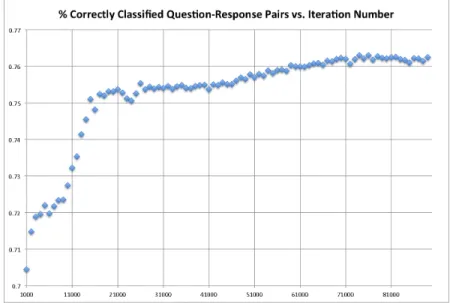
recursive steps (Figure 1). Thus we train on the first five words of each response (not counting the initial<R>). The results below are for our model withoutmemory (i.e. no Long Term Short Term Memory). As shown in Figure 2, the model quickly learned to classify roughly 70% of the training samples during the first 1,000 iterations. Additional iterations saw gradual performance improvement with a plateau around 76.3%.
In order to qualitatively evaluate the trained model, we fed each vocabulary word into the network as a one-word sample. Encouragingly, words that were strong non-answerfeatures for the SVM and LR models proved to be strong signals of non-answers in the RNN. In particular, the word “thanks” produced the highestnon-answersignal, consistent with the fact that responses starting
216 217 218 219 220 221 222 223 224 225 226 227 228 229 230 231 232 233 234 235 236 237 238 239 240 241 242 243 244 245 246 247 248 249 250 251 252 253 254 255 256 257 258 259 260 261 262 263 264 265 266 267 268 269
Figure 1: Tmax denotes the number of question-response tokens taken into consideration. Due to gradient vanishing effects, we lose accuracy with Tmax>5.
Figure 2: Accuracy as a function of training iteration for Tmax = 5. The model learned quickly during the first thousand iterations, and then slowed.
with “thanks” are very rarely answers. A selection ofnon-answerwords that qualitatively validate the model are provided in the table below.
Single-Word Input Non-Answer Probability
thanks 0.83
bump 0.80
nevermind 0.77
inappropriate 0.65
Table 1: Words with high non-answer probability. Note that the first three of these single-answer responses are typically written by the original poster. In our SVM and LR models, we include an indicator feature that records whether or not the response was by the original poster.
270 271 272 273 274 275 276 277 278 279 280 281 282 283 284 285 286 287 288 289 290 291 292 293 294 295 296 297 298 299 300 301 302 303 304 305 306 307 308 309 310 311 312 313 314 315 316 317 318 319 320 321 322 323
4.5 Results with Memory
We attempted to include Long Short Term Memory using the Theano model by Hochreiter, et. al. In theory, this model should have significantly improved our results because it would resolve issues with vanishing gradients, allowing the model to read the entire question-response pair. We started with their sentiment code as a base and attempted to modify it to train our classifier. Unfortunately, we were not able to produce a converging model. The first few iterations produced a minor im-provement (67% classification accuracy), but then stagnated at that value. We suspected a bug in our implementation, but ran out of time before we could resolve it.
5
Conclusion
We previously trained a logistic regression classifier and a support vector classifier to evaluate the feasibility of this problem. In those models, we were able to hand-select features beyond the textual data. For example, we indicated the author of the response, the index of the response, and whether the response was quoted by another response. The logistic classifier performed the best with a test-set accuracy of 89.0% using 7-gram features along with several novel features.
In SVM and LR models, we found that the question contributed little to the training accuracy. This result was confirmed by the RNN - we were able to achieve the same RNN classification accuracy using just the response text (<R>...</R>). This suggests a general structure ofnon-answersto forum questions. Our qualitative evaluation revealed that words such as, “thanks”, “bump” and “nevermind” are strongly indicative ofnon-answers. Note, however, that these words are often written by the original poster, so the post author feature may be an even stronger feature available to the SVM and LR classifiers.
The utility of a response classifier may be demonstrated using a practical example taken from the Apple Technical Support Discussion Forum:
My Apple TV will not connect to WiFi, having put in the pass code it displays connection error -3905. Can anyone help?
1. I too have an ATV2...I could only get it to work properly by uninstalling my McAfee security suite.
RNN Score: 0.21, LR Score: 0.615
2. I get the exact same problem and error code with my NetGear DG384T wireless router; when I try to configure the Wireless network the Apple TV actually lists my wireless SSID but fails to connect when I select it from the list.
RNN Score, 0.10, LR Score: 0.291
3. Take a chill pill, pal! Turn off MAC Address Filtering and you will instantly get a connection. I read a post by a housewife in Australia who nailed the problem - good on yer, Sheila!
RNN Score: 0.11, LR Score: 0.482
4. I was having the same problem with my ATV 2nd Gen. Spoke to an Apple tech, determined that the cause of my problem was wireless interference...Apparently a nearby wifi network was using the same channel that mine was.
RNN Score: 0.33, LR Score: 0.726
5. Thanks everyone for your help, I resolved the issue. RNN Score: 0.052, LR Score: 0.103
The last answer turns out to be the correct answer. Notice that the 1st and 3rd posts are attempts at answering while the 2nd post is a user who is experiencing the same issue. The last post is by the original poster. Both the RNN classifier and the LR classifier successfully reorder these posts 4, 1, 3, 2, 5. However, the RNN does not classify any of these responses asanswers(probability<0.5), likely because the first five tokens of each response is not sufficient to identify them as answers. We can see the strongnon-answerscore of the last response, almost entirely due to the fact that it starts with “thanks”.
324 325 326 327 328 329 330 331 332 333 334 335 336 337 338 339 340 341 342 343 344 345 346 347 348 349 350 351 352 353 354 355 356 357 358 359 360 361 362 363 364 365 366 367 368 369 370 371 372 373 374 375 376 377
We found that the question (<Q>...</Q>) provided little insight into classifying responses as non-answers. We hypothesize that this is becausenon-answersgenerally have a very similar structure (e.g. they might begin with a token like “thanks” or “bump”). Since we were not looking forcorrect answers, the meaning behind each question was not as important as the structure of each response. Put simply, a response such as “Just Google it” is anon-answerto a great many questions, whereas it is ananswerto very few.
We previously developed a cross-forum search engine that uses onlyanswers(probability>0.5). The search engine is available at:
http://www.gotoanswer.com
Note that this search engine relies upon the logistic regression classifier.
Our RNN did not perform as well as the SVM and LR classifiers, but there are quite a few modifica-tions that would likely improve its performance. As a next step, we suggest reducing the question-response space to a specific topic such as computer hardware repair. It is likely thatnon-answerand answerresponses within a particular subject share common structure. We saw this trend with our SVM and LR classifiers - posts within the Apple Discussion Forum that linked to specific support topics wereanswers, while the phrase “no hackintosh questions” was a commonnon-answer.
References
[1] David Azari, Eric Horvitz, Susan Dumais, and Eric Brill. Web-based question answering: A decision-making perspective. InProceedings of the Nineteenth conference on Uncertainty in Artificial Intelligence, pages 11–19. Morgan Kaufmann Publishers Inc., 2002.
[2] Benjamin V Hanrahan, Gregorio Convertino, and Les Nelson. Modeling problem difficulty and expertise in stackoverflow. InProceedings of the ACM 2012 conference on Computer Supported Cooperative Work Companion, pages 91–94. ACM, 2012.
[3] Sepp Hochreiter and J¨urgen Schmidhuber. Long short-term memory. Neural computation, 9(8):1735–1780, 1997.
[4] Mohit Iyyer, Jordan Boyd-Graber, Leonardo Claudino, Richard Socher, and Hal Daum´e III. A neural network for factoid question answering over paragraphs. 2014.
[5] Jeffrey Pennington, Richard Socher, and Christopher D Manning. Glove: Global vectors for word representation.
[6] Jun Suzuki, Yutaka Sasaki, and Eisaku Maeda. Svm answer selection for open-domain question answering. InProceedings of the 19th international conference on Computational linguistics-Volume 1, pages 1–7. Association for Computational Linguistics, 2002.
[7] Show-Jane Yen, Yu-Chieh Wu, Jie-Chi Yang, Yue-Shi Lee, Chung-Jung Lee, and Jui-Jung Liu. A support vector machine-based context-ranking model for question answering. Information Sciences, 224:77–87, 2013.