Pseudonymization and its Application to
Cloud-based eHealth Systems
Dissertation
zur
Erlangung des Doktorgrades (Dr. rer. nat.)
der
Mathematisch-Naturwissenschaftlichen Fakultät
der
Rheinischen Friedrich-Wilhelms-Universität Bonn
vorgelegt von
Liangyu Xu
aus
Beijing, V.R. China
Angefertigt mit Genehmigung der Mathematisch-Naturwissenschaftlichen Fakultät der Rheinischen Friedrich-Wilhelms-Universität Bonn.
Erstgutachter: Prof. Dr. Armin B. Cremers, Bonn Zweitgutachter: Prof. Dr. Ulrike Meyer, Aachen Tag der Promotion:
Erscheinungsjahr:
31.03.2017 2017
I
Abstract
Responding to the security and privacy issues of information systems, we propose a novel pseudonym solution. This pseudonym solution has provable security to protect the identi-ties of users by employing user-generated pseudonyms. It also provides an encryption scheme to protect the security of the users’ data stored in the public network. Moreover, the pseudonym solution also provides the authentication of pseudonyms without disclosing the users’ identity information. Thus the dependences on powerful trusted third parties and on the trustworthiness of system administrators may be appreciably alleviated.
Electronic healthcare systems (eHealth systems), as one kind of everyday information sys-tem, with the ability to store and share patients’ health data efficiently, have to manage information of an extremely personal nature. As a consequence of known cases of abuse and attacks, the security of the health data and the privacy of patients are a great concern for many people and thus becoming obstacles to the acceptance and spread of eHealth systems. In this thesis, we survey current eHealth systems in both research and practice, analyzing potential threats to the security and privacy. Cloud-based eHealth systems, in particular, enable applications with many new features in data storing and sharing. We analyze the new issues on security and privacy when cloud technology is introduced into eHealth systems.
We demonstrate that our proposed pseudonym solution can be successfully applied to cloud-based eHealth systems. Firstly, we utilize the pseudonym scheme and encryption scheme for storing and retrieving the electronic health records (EHR) in the cloud. The identities of patients and the confidentiality of EHR contents are provably guaranteed by advanced cryptographic algorithms. Secondly, we utilize the pseudonym solution to protect the privacy of patients from the health insurance companies. Only necessary information about patients is disclosed to the health insurance companies, without interrupting the cur-rent normal business processes of health insurance. At last, based on the pseudonym so-lution, we propose a new procedure for the secondary use of the health data. The new procedure protects the privacy of patients properly and enables patients’ full control and clear consent over their health data to be secondarily used.
A prototypical application of a cloud-based eHealth system implementing our proposed solution is presented in order to exhibit the practicability of the solution and to provide intui-tive experiences. Some performance estimations of the proposed solution based on the implementation are also provided.
III
Überblick
Um gewisse Sicherheits- und Datenschutzdefizite heutiger Informationssysteme zu be-heben, stellen wir eine neuartige Pseudonymisierungslösung vor, die benutzergenerierte Pseudonyme verwendet und die Identitäten der Pseudonyminhaber nachweisbar wirksam schützt. Sie beinhaltet neben der Pseudonymisierung auch ein Verschlüsselungsverfahren für den Schutz der Vertraulichkeit der Benutzerdaten, wenn diese öffentlich gespeichert werden. Weiterhin bietet sie ein Verfahren zur Authentisierung von Pseudonymen, das ohne die Offenbarung von Benutzeridentitäten auskommt. Dadurch können Abhängigkeit-en von vertrauAbhängigkeit-enswürdigAbhängigkeit-en drittAbhängigkeit-en StellAbhängigkeit-en (trusted third parties) oder von vertrauAbhängigkeit-enswürdi- vertrauenswürdi-gen Systemadministratoren deutlich verringert werden.
Elektronische Gesundheitssysteme (eHealth-Systeme) sind darauf ausgelegt, Patien-tendaten effizient zu speichern und bereitzustellen. Solche Daten haben ein extrem hohes Schutzbedürfnis, und bekannte Fälle von Angriffen auf die Vertraulichkeit der Daten durch Privilegienmissbrauch und externe Attacken haben dazu geführt, dass die Sorge um den Schutz von Gesundheitsdaten und Patientenidentitäten zu einem großen Hindernis für die Verbreitung und Akzeptanz von eHealth-Systemen geworden ist. In dieser Dissertation betrachten wir gegenwärtige eHealth-Systeme in Forschung und Praxis hinsichtlich mögli-cher Bedrohungen für Simögli-cherheit und Vertraulichkeit der gespeimögli-cherten Daten. Besondere Beachtung finden cloudbasierte eHealth-Systeme, die Anwendungen mit neuartigen Konzepten zur Datenspeicherung und -bereitstellung ermöglichen. Wir analysieren Sicherheits- und Vertraulichkeitsproblematiken, die sich beim Einsatz von Cloud-Technologie in eHealth-Systemen ergeben.
Wir zeigen, dass unsere Pseudonymisierungslösung erfolgreich auf cloudbasierte eHealth-Systeme angewendet werden kann. Dabei werden zunächst das Pseudonymisierungs- und das Verschlüsselungsverfahren bei der Speicherung und beim Abruf von el-ektronischen Gesundheitsdatensätzen (electronic health records, EHR) in der Cloud eing-esetzt. Die Vertraulichkeit von Patientenidentitäten und EHR-Inhalten werden dabei durch den Einsatz moderner kryptografischer Algorithmen nachweisbar garantiert. Weiterhin set-zen wir die Pseudonymisierungslösung zum Schutz der Privatsphäre der Patienten gegenüber Krankenversicherungsunternehmen ein. Letzteren werden lediglich genau diejenigen Patienteninformationen offenbart, die für den störungsfreien Ablauf ihrer Ges-chäftsprozesse nötig sind. Schließen schlagen wir eine neuartige Vorgehensweise für die Zweitverwertung der im eHealth-System gespeicherten Daten vor, die die Pseudony-misierungslösung verwendet. Diese Vorgehensweise bietet den Patienten angemessenen Schutz für ihre Privatsphäre und volle Kontrolle darüber, welche Daten für eine Zweitver-wertung (z.B. für Forschungszwecke) freigegeben werden.
Es wird ein prototypisches, cloudbasiertes eHealth-System vorgestellt, das die Pseudon-ymisierungslösung implementiert, um deren Praktikabilität zu demonstrieren und intuitive Erfahrungen zu vermitteln. Weiterhin werden, basierend auf der Implementierung, einige Abschätzungen der Performanz der Pseudonymisierungslösung angegeben.
V
Personal information
Liangyu Xu
Education
Since 2013 Rheinische Friedrich-Wilhelms-Universität Bonn Doctoral fellow of Computer Science
09/2004 – 07/2007 Chinese Academy of Sciences, China Study of Information Security,
Graduated with Master degree of Sci.
09/2000 – 07/2004 Tsinghua University, China Study of Electronic Engineer,
VII
Acknowledgements
The doctoral study in Germany is an unexpected period in my life. Although it was a diffi-cult decision for me in the beginning, the three years in University of Bonn finally come to me with much pleasure and many harvests. I think this is because of those kind people helping and encouraging me, and I would like to express my sincerely appreciation to them here.
First of all, I thank Prof. Dr. Armin B. Cremers. He is so farsighted and suggested me my current research topic on the security and privacy in eHealth systems. He arranged many seminars and meetings with other researchers and provided me opportunity to broad my view and improve my research. Especially, from many times of discussions with him, I benefit not only in the knowledge, but also in the thinking manner of research and work. He also spent much of his precious time to help me revise the papers and this thesis. I must also thank for his stipend during my study and the financial support for attending several international conferences to present our work and communicate with other people. During my research, I have got a lot of suggestions and help from Dr. Adrian Spalka, Jan Lehnhardt, Tobias Wilken. At many times of discussions with Dr. Adrian Spalka, he raised many challenges and comments from the viewpoint of practical eHealth systems. He also pointed out some shortcomings in my initial proposed schemes and reminded me to fix them. Jan Lehnhardt discussed with me about the technical details of the schemes and also raised some questions and improvement. What is more, Jan Lehnhardt revised some of my papers in English writing. Tobias Wilken has a lot of experience in software devel-opment and helped with the first implementation of the whole solution.
I would also like to express my appreciation to Prof. Dr. Meyer, who revised my disserta-tion carefully and gave me a lot of comments for a clearer presentadisserta-tion of the dissertadisserta-tion. At last, heartful thanks to my family members. Thanks for your company and encourages during this period of hard time. Especially my wife gave birth to our son during this time. I know that she really suffered from a lot of pain and pressure although she often says she enjoys so. I love you and hope we can have a better life in the following years with our loved son.
IX
Contents
1 Introduction ... 1
1.1 Motivation of the Thesis ... 1
1.2 Contributions of the Thesis ... 2
1.3 Structure of the Thesis ... 3
2 Background Knowledge ... 5
2.1 Pseudonym ... 5
2.1.1 Definition ... 5
2.1.2 Basic Requirements for Pseudonyms ... 5
2.1.3 Pseudonym versus Anonym ... 7
2.2 eHealth Systems ... 9
2.2.1 History of Health Records ... 9
2.2.1.1 EMR ... 9
2.2.1.2 PHR ... 9
2.2.1.3 EHR ... 10
2.2.2 Existing eHealth Systems ... 11
2.2.2.1 England ... 11
2.2.2.2 Netherlands ... 12
2.2.2.3 Germany ... 13
2.2.2.4 North America ... 14
2.2.2.5 Other Areas... 15
2.2.3 Conclusions on the Existing eHealth Systems ... 15
2.3 Important Notions ... 17
3 Security and Privacy Issues in Different Models of eHealth Systems... 19
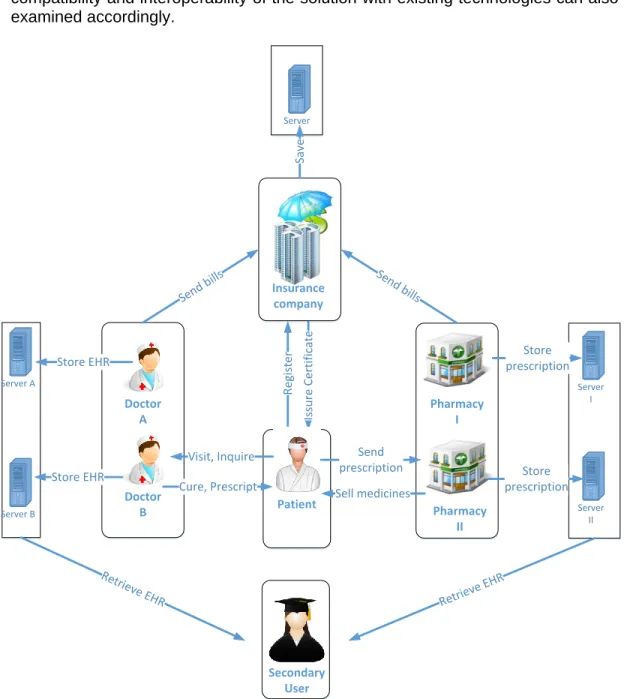
3.1 A General Model of eHealth Systems ... 19
3.1.1 Overview ... 19
3.1.2 Basic Entities in eHealth Systems ... 21
3.1.3 Basic Activities in eHealth Systems ... 24
3.1.4 IT Infrastructure ... 29
3.2 Security and Privacy Threats ... 32
3.2.1 The Owner of Electronic Health Records (EHR) ... 32
3.2.2 General Attackers ... 33
3.2.3 Healthcare Providers ... 35
3.2.4 Insurance Companies ... 36
X
3.2.6 Trusted Third Parties ... 38
3.3 A Cloud-based Model of eHealth Systems ... 39
3.3.1 Principles for the Cloud-based eHealth Model ... 39
3.3.1.1 Rule out the Fully Trusted Third Parties ... 39
3.3.1.2 Utilize Smart Card for Trust Computing Module ... 41
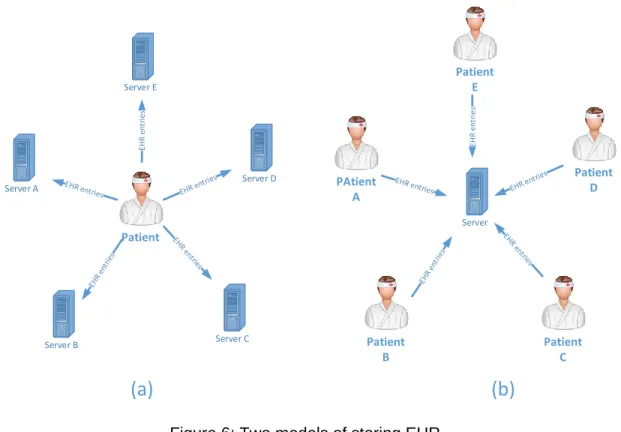
3.3.1.3 Adopt Cloud as Storage and Communication Media ... 41
3.3.1.4 Protect EHR and Messages for Security and Privacy ... 41
3.3.2 Refined Procedures and New Threats ... 42
3.3.2.1 Registration at Insurance Company ... 42
3.3.2.2 Visit to Doctor ... 42
3.3.2.3 Medicine Purchase at Pharmacy ... 43
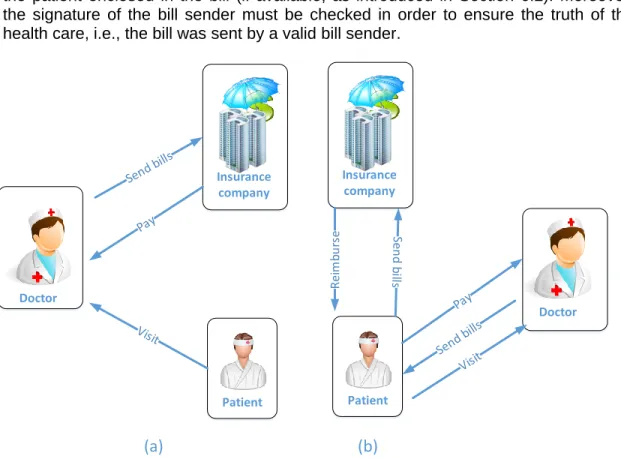
3.3.2.4 Billing ... 43
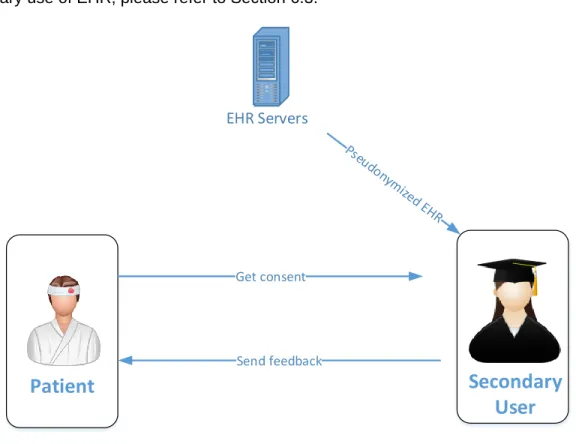
3.3.2.5 Secondary Use ... 43
4 State of the Art ... 45
4.1 Pseudonym Schemes for General Purpose ... 45
4.2 Pseudonym Schemes for eHealth Systems ... 47
4.3 Comparison of Existing Pseudonym Solutions ... 48
4.4 Expected Revolutions in Pseudonym Schemes for eHealth Systems ... 48
5 A Novel Pseudonym Solution ... 51
5.1 Features of the Pseudonym Solution ... 51
5.2 Setup of Secret Key ... 52
5.2.1 Preparation of Setup... 52
5.2.2 Algorithm for Setting up Secret Key ... 52
5.3 Algorithm for Generating Pseudonyms ... 53
5.4 Algorithm for Reproducing Pseudonyms ... 55
5.5 Authentication of Pseudonyms ... 57
5.6 Security Evaluation ... 58
5.6.1 Proof of Algorithm 2 ... 59
5.6.2 Proof of Algorithm 3 ... 59
5.6.3 Proof of Algorithm 6, 7, 8 ... 59
6 Applications of the Pseudonym Solution in eHealth Systems ... 61
6.1 Application in Ordinary Healthcare Activities ... 61
6.1.1 Cloud-based eHealth System with Pseudonyms ... 61
6.1.2 Concealing Patients’ Identities and Protecting the Security of EHR ... 63
6.1.3 Indexing EHR (Electronic Health Records) Entries ... 64
6.1.4 Retrieving EHR Entries ... 64
6.1.5 Authenticating the Ownership of EHR ... 65
XI
6.1.7 Potential Threats and Countermeasures ... 66
6.1.7.1 Cloud’s Knowledge of the PIDs of Patients ... 66
6.1.7.2 Protecting Identities against Eavesdroppers ... 67
6.1.7.3 Avoiding Guessing Attacks against Secret Keys ... 67
6.1.7.4 Dealing with Pseudonym Collision ... 68
6.1.7.5 Trust Mode of Cloud ... 69
6.1.7.6 Extra Threats from Optional Algorithms ... 70
6.2 Application in Health Insurance ... 70
6.2.1 A Refined Billing Procedure ... 70
6.2.1.1 Setting in Billing ... 70 6.2.1.2 Validating Patients ... 72 6.2.1.3 Generating a Bill ... 72 6.2.1.4 Validating a Bill ... 73 6.2.2 Pseudonymizing Bills ... 74 6.2.2.1 Initialization ... 74 6.2.2.2 Generation of Pseudonym ... 74
6.2.2.3 Generation of Pseudonymous Signature ... 75
6.2.2.4 Verification of Pseudonymous Signature ... 75
6.2.3 Potential Threats and Countermeasures ... 76
6.2.3.1 Trustworthiness of Healthcare Providers ... 76
6.2.3.2 Adapting to Practical Billing Models ... 78
6.2.3.3 The loss of smart card ... 79
6.3 Application in Secondary Use of Health Data ... 80
6.3.1 Setting of Secondary Use in Cloud-based eHealth Systems ... 80
6.3.1.1 Secondary Users ... 80
6.3.1.2 Patient’s Secrets and Certificate ... 81
6.3.2 Pseudonymized EHR from Ordinary Healthcare Activities ... 81
6.3.2.1 Visiting a Doctor ... 81
6.3.2.2 Getting Medicines from a Pharmacy ... 82
6.3.3 Secondary Use of Pseudonymized EHR ... 83
6.3.3.1 Requirements to the Pseudonyms ... 83
6.3.3.2 Searching for Participants ... 84
6.3.3.3 Contacting Target Patients for Consent and More ... 84
6.3.3.4 Responding to the Secondary User ... 85
6.3.3.5 Sending Feedback to Patients ... 86
6.3.4 Potential Threats and Countermeasures ... 87
6.3.4.1 Partial Encryption... 87
XII
6.3.4.3 Trustworthiness of Cloud ... 88
6.3.4.4 Other Potential Attacks in Secondary Use ... 88
7 Implementation ... 89
7.1 About the Implementation ... 89
7.1.1 Joint Work... 89
7.1.2 Development Environment ... 89
7.1.3 Availability of the Implementation ... 90
7.2 Architecture of the Implementation ... 90
7.3 User Interfaces ... 90
7.3.1 Patient’s Secret Key Setup ... 90
7.3.2 Visiting Doctor ... 91
7.3.3 Viewing and Managing EHR ... 91
7.3.4 Purchasing Medicines ... 93
7.3.5 Secondary Use ... 93
7.4 Performance Evaluation ... 98
7.4.1 Evaluation on the Cloud Side ... 98
7.4.2 Evaluation on the Client Side ... 98
7.4.2.1 Performance of Simulated Smart Card by Computer Software... 98
7.4.2.2 Performance Estimation of Real Smart Cards ... 100
7.4.3 Decreasing the Computation Load of Smart Card ... 101
7.5 Future Work for the Implementation ... 102
8 Conclusions ... 103
Bibliography ... 107
List of Figures ... 115
List of Tables/Algorithms ... 116
1
1 Introduction
1.1 Motivation of the Thesis
Thanks to the fast development of information technologies, electronic health systems (eHealth systems) (Eysenbach, 2001, Oh et al., 2005) have been turning into reality and becoming a hot field in academic research. eHealth systems utilize computer and network to store and transmit the data created in various healthcare activities, e.g. making ap-pointments, recording examinations and therapy details, purchasing medicines with pre-scriptions, billing health insurance companies, reusing health data for medical research. With the help of information technologies, eHealth systems greatly improve the efficiency and the quality of health care comparing to the traditional paper-based healthcare systems (Black et al., 2011). For example, in eHealth systems, a doctor is able to conveniently re-view a patient’s previous health records created even by other doctors through a computer connected to the network instead of seeking from a large pile of paper files. The efficient sharing of the health records helps the doctor to make faster and better diagnosis and treat on the patient. Hence, eHealth systems are becoming more and more popular in the world (Borycki et al., 2012, Shu et al., 2014, Stroetmann et al., 2011, Bouamrane and Mair, 2011, Rau et al., 2010).
While eHealth systems facilitate the sharing of health data, they also bring a lot of new issues in different aspects. The first one is how to efficiently store and share the electronic health records (EHR) of numerous patients created by different healthcare providers (e.g. practices, hospitals, and mobile health sensors). Because a patient may visit many hospi-tals, practices and pharmacies, EHR of the patient are stored at different locations. It is challengeable to share the patient’s EHR among different healthcare providers (Jin et al., 2009). Where to store EHR with huge size and how to share them with low time delay is still unresolved. The second issue comes from the security of EHR. The security refers to many aspects, e.g. the confidentiality, integrity, and authenticity of EHR (Wang and Wulf, 1997). Because EHR of patients need to be frequently accessed and updated in different healthcare activities by different people (e.g., healthcare providers, medical researchers, and even patients themselves), the security of EHR may be invaded from outside and even inside of eHealth systems. Another major issue is the privacy of patients. EHR, con-taining highly private information of patients, e.g. the illnesses and the identities, can be easily duplicated and disclosed over the network when they are used for different purpos-es (e.g. for sharing among doctors, medical rpurpos-esearch). The disclosure of thpurpos-ese data will seriously infringe the privacy of patients (Slamanig and Stingl, 2008). How to protect the privacy of patients while preserving the easy sharing of EHR is still challengeable. The privacy of patients involves several aspects: the identity management (patients’ identities should be only known by necessary entities), the health data sharing policy (patients’ health data should never be disclosed to unintended people) and the consent manage-ment (patients should have full control on the uses of their health data). The security pro-tection on the health data does not necessarily guarantee the privacy of patients. For ex-ample, although EHR are securely encrypted by advanced cryptographic algorithms e.g. AES (Daemen and Rijmen, 2013), some side-channel information in the encrypted data
2
(e.g., creating date/time, location, doctor’s signature) may be used to deduce a patient’s
health status and even the identity.
According to our best knowledge, these issues are far away from being solved and remain as big obstacles to hinder the development and popularization of eHealth systems. For the time being, EHR of patients are stored at different locations (e.g., hospitals and practices) independently even with different formats (Jones et al., 2010, Drees, 2007), because dif-ferent eHealth systems are used by difdif-ferent healthcare providers. As a consequence, it is difficult to share EHR among different healthcare providers due to many issues, e.g., the network connection and authorization problems. Some proposed eHealth clouds (Hu et al., 2012, Barua et al., 2011, Fan et al., 2011, Narayan et al., 2010, Sunyaev et al., 2010) at-tempt to enable patients or healthcare providers to register and upload their EHR to a pub-lic cloud for central storing and easy sharing. However, the security of EHR and the priva-cy of patients are fully controlled under the protection mechanism implemented by the cloud providers. However, the trustworthiness on the cloud providers is doubtful due to the business model of cloud, e.g., a public cloud may distribute the storage servers physically all over the world (Foster et al., 2008, Vaquero et al., 2008, Mell and Grance, 2011). In addition, these eHealth clouds only deal with the security and privacy issues in one special healthcare activity (e.g. only for sharing EHR among doctors), but they are not applicable or unknown to be generalized to other healthcare activities (e.g. for medical research). Besides eHealth systems, there exist many other information systems in our daily lives. As a result, more and more private data are stored in and transmitted over them. Our privacy is suffering from higher and higher risk to be leaked or maliciously used. Unfortunately, due to the differences in the system structure and business model, it is difficult to provide a uniform solution to deal with the privacy issues in all of these information systems. Howev-er, the idea of protecting the identities by pseudonyms is generally adopted in many
sys-tems. We are curious to know what a pseudonym solution can act to protect the users’
identities and further to protect the security of the private data in the information systems, especially in eHealth systems.
1.2 Contributions of the Thesis
We survey the business models of many existing eHealth systems, and analyze the cur-rent technical solutions in industry and academic research work. Based on the existing schemes, this thesis proposes a new pseudonym solution aiming to be widely used in ma-jor healthcare activities. In summary, the main contributions of the thesis are listed as fol-lows:
We extend the use of cloud into major healthcare activities in eHealth systems and
propose a new cloud-based eHealth model. In this model, all entities in an eHealth system are connected together by the cloud. EHR can be conveniently created, shared and managed by different entities though the cloud applications. We even re-fine the processes of several healthcare activities to be more suitable for cloud envi-ronment. Based on this new eHealth model, various security and privacy threats from different sources are analyzed. Some corresponding countermeasures are provided, and also some open questions are raised.
3
A novel pseudonym solution is proposed. The pseudonym solution can be used for
storing, accessing and sharing the private data of users in the cloud. It provably pro-tects the security of the data and enables the users to fully control their privacy. Each user generates her/his own pseudonyms and encryption keys from a secret key which is only known by herself/himself. All the private data and communications are protect-ed by the secret key only known by the user. The secret key is the only crprotect-edential to control the use of private data. Moreover, the pseudonym solution also enables users to prove their ownership of the private data without disclosing any identity information to the verifiers. Moreover, the pseudonym solution can work without a single trusted third party, which lowers the risk of disclosing the privacy of users.
We apply the proposed pseudonym solution in several major healthcare activities to
demonstrate its practicability in eHealth systems. To comply with the normal process-es of thprocess-ese healthcare activitiprocess-es, some corrprocess-esponding protocols for using the pseudo-nym solution are designed. With the new pseudopseudo-nym solution, most business models of existing eHealth systems do not need to change dramatically. Instead, the new pseudonym solution can be introduced as additional features to enhance the efficiency, security and privacy for the current eHealth systems. Moreover, using the same pseu-donym solution in different healthcare activities simplifies the design of security mech-anism, and decreases the risk of disclosing the privacy of patients due to the weak-ness in a single activity.
A prototypical eHealth system supported by the proposed pseudonym solution is
im-plemented. The eHealth system is deployed on a PaaS (Platform as a Service) cloud. It provides several major healthcare activities involving common entities in real health care, e.g., patients, doctors, pharmacist and secondary users. These entities can cre-ate, access and update EHR by web browsers connected to the cloud. Through the prototypical eHealth system, we can experience the advantages that our pseudonym solution brings, especially in the security and privacy aspects. Moreover, the perfor-mance of our implementation and the critical algorithms in our solution are examined through simulation tests and estimations. The evaluation results indicate the practica-bility of our pseudonym solution under current software and hardware conditions.
1.3 Structure of the Thesis
The next chapter 2, “Background Knowledge”, firstly introduces the fundamental notions
such as pseudonym and eHealth system. Especially for “pseudonym”, we explain it with some simple examples and also with the formal definition. Moreover, we briefly introduce the history of eHealth systems, and present some open problems in existing eHealth sys-tems.
In chapter 3, “Security and Privacy Issues in Different Models of eHealth Systems”, we describe in detail various threats to the security of health data and the privacy concerns of patients. We will begin with a traditional eHealth model, and then analyze the causes and the consequences of these security and privacy threats. Afterwards, we propose a cloud-based model for modern eHealth systems. This new model addresses many shortcomings that appeared in the traditional model, but it also introduces new challenges and threats, which are further discussed.
4
The chapter 4, “State of the Art”, reviews literatures on existing pseudonym schemes for the purpose of general uses and for using in eHealth systems. A comparison on their sup-ported technologies and features is made. Based on these existing schemes, we list the principles for designing a pseudonym scheme targeting at a cloud-based eHealth system. We present a novel pseudonym solution in chapter 5, “A Novel Pseudonym Solution”. The concrete algorithms for secrets setup, pseudonym generation and the authentication pro-tocol are formally described. Moreover, the provable security of the pseudonym solution is theoretically evaluated.
The following chapter 6, “Applications of the Pseudonym Solution in eHealth Systems”, introduces how to utilize the proposed pseudonym solution from chapter 5 in a cloud-based eHealth system. We choose several important healthcare activities in eHealth sys-tems, and show how the new pseudonym solution can be applied to solve the security and privacy problems in them.
A prototypical implementation of a cloud-based eHealth system supported by our pro-posed pseudonym solution is introduced in chapter 7, “Implementation”. The implementa-tion provides intuitive experiences on the advantages of our proposed soluimplementa-tion. Moreover, some performance tests and estimations are also presented.
The chapter 8, “Conclusions”, wraps up the thesis by emphasizing the main insights and lists prospects of future work and open research questions.
5
2 Background Knowledge
2.1 Pseudonym
2.1.1 Definition
Pseudonyms, as a general notion, are widely used in many fields with different forms (Pfitzmann and Köhntopp, 2001). One major reason for this diversity is that pseudonyms are utilized under different settings where different requirements are addressed. Pseudo-nym schemes are typically used for hiding the real identities of individuals. For example, a writer uses a pseudonym to publish articles for various reasons. However, this kind of tra-ditional pseudonyms is informal and artistic (Calisher, 1998).
With the appearance of computer science, pseudonyms are closely related to cryptog-raphy (Katz and Lindell, 2014), which makes pseudonyms more and more formal. Secret keys and cryptographic algorithms are used to generate and use pseudonyms. The relia-bility of the modern pseudonyms has been improved greatly due to the rigorousness and security of the cryptographic algorithms. Generally, a definition of pseudonym is presented as follows:
PID = pid_gen ( id, x )
Here, “x” is a secret key; “id” is the real identity of a user; PID is the pseudonym of the user; and “pid_gen” is the algorithm for generating the pseudonym. The algorithm “pid_gen”, in which the cryptographic algorithms are employed, determines the security a pseudonym scheme. The secret x is usually only known by specified persons, like administrators in the system or the user her/himself. The real identity “id” can be any kind of identifiers (e.g. name, national identity number, birthday and address) or a combination of several identifi-ers. The generated PID can be used to replace the real identifiers where the privacy of the user is concerned. In many systems, each user has only one pseudonym. However, in more complex systems, a user can possess multiple pseudonyms.
2.1.2 Basic Requirements for Pseudonyms
One basic criteria to a pseudonym scheme is that the algorithm for generating a pseudo-nym must be one-way, i.e., pid_gen should be irreversible (or computational infeasible to compute the id of a user from PID without knowing the secret x) (Mollin, 2006).
id = rev_pid_gen ( PID ) is difficult.
However, if the secret x is known, many pseudonym schemes can do the following compu-tation to reverse from a pseudonym to the real identity.
6
Actually, the one-way property of a pseudonym scheme is not difficult to ensure, thanks to many one-way functions in cryptography, such as cryptographic hash functions (Rogaway and Shrimpton, 2004), cipher algorithm like AES (Daemen and Rijmen, 2000) and public key cryptography RSA (McCurley, 1990). By using these cryptographic functions, an irre-versible pid_gen can be designed with high-level guarantee.
When a pseudonym scheme is used in an application with a lot of users, another basic requirement for pseudonyms is that they are collision-free (Lehnhardt and Spalka, 2011, Yoon and Kim, 2011). For example, in an anonymous bank, each user registers with a pseudonym computed from a secret key only known to the user. The pseudonym is the only identity code for all the financial transactions. Obviously, it must make sure that the pseudonyms of no pair of users collide (i.e., any two users A and B should not have the same pseudonym).
PIDA ≠ PIDB
The collision-free requirement is not easy to satisfy for a decentralized system where us-ers can choose the secret key x and identifius-ers separately (sometimes freely) to generate their pseudonyms, because many one-way functions in cryptography are not injective (Menezes et al., 1996). In a bad case, although two innocent users choose different identi-fiers and different secret x, they may generate the same pseudonym without knowing each other.
Another additional requirement to pseudonyms is “independence”, when each user has
multiple pseudonyms. If a user uses different pseudonyms at different organizations, it should be impossible to deduce that these pseudonyms are from a same user (Martin-Löf, 1966).
“PID1, PID2, … , PIDn” are independent with each other.
The independence is not difficult to guarantee, because there are many cryptographic functions that can produce pseudo-random outputs, such as hash functions (Blum and Micali, 1984). However, the independence of pseudonyms may be broken when users are able to use the pseudonyms or even credentials across different organizations. E.g., if a user presents his pseudonym generated by organization A at organization B, the
organiza-tion B is able to know the user’s two pseudonyms at organization A and B. Even worse,
organization A and B may collude to find out the pseudonyms of each user in order to trace the behaviors of users (Shokri et al., 2011).
The authentication is another requirement to a pseudonym scheme when users need to be validated by organizations, i.e., a user can prove the ownership of the pseudonym to a verifier without leaking the identity information (Cachin et al., 1999, Ravi Chandra and Sharad, 2006). For example, in an eHealth system, each user (patient) has many records in the server, and each record has an independent pseudonym as index. When a user wants to update a record indexed by a pseudonym at the server, the system should verify that the user is indeed the owner of the record (or the pseudonym) to avoid malicious up-dating. In order to protect the privacy of users, the server is not allowed to keep any par-ticular pre-information (e.g. secret key or any registration information) of users. Moreover, the server should not get any useful information from the verification process to deduce
7 the identities of users. There are many traditional authentication schemes in cryptography, for example, a digital signature can be a candidate solution for the authentication process above. However, if a user uses the same certificate and secret key to generate signatures for different records, the pseudonyms in these records can be easily mapped to one user (i.e., the independence of the pseudonyms is broken), because these records are signed by the same public key (i.e. certificate) (Housley et al., 2002). Even worse, the certificate in the signature may imply some information (e.g. serial number, location, date) to deduce the identity of the user.
There are also some other requirements to pseudonyms in different application scenarios. We will introduce several specific pseudonym schemes in Section 4.1 and 4.2, and more additional features of these pseudonyms will be explained. For a pseudonym scheme which can be used in eHealth systems, there are also some special requirements. Moreo-ver, due to the complexity of eHealth systems, the pseudonym scheme is also necessarily tuned to the procedure of existing and future business model. We will present our general viewpoints in Section 4.4.
2.1.3 Pseudonym versus Anonym
Pseudonym may sometimes be confused with anonym (Pfitzmann and Köhntopp, 2001).
From the literal sense of the words, anonym means “nameless”, and pseudonym means
“with fake name”. This can tell the difference between them to some degree. Formally, anonym aims at making the corresponding data totally un-linkable to the owners. It can be easily achieved by removing all the identifiers (e.g. name, gender, age, address). However, sometimes it is not necessary to do such clean removing, in order to anonymize the data. We just need to remove some chosen identifiers and ensure that each combination of the left identifiers has more than one record (Samarati and Sweeney, 1998). As an example, Table 1 shows an episode of the health records in a database. Each row in Table 1 pre-sents one record entry from one patient. The 2nd to 6th columns are the identifiers of
pa-tients and the last column contains the concrete health records (e.g. examinations, pre-scriptions), which are omitted here.
Table 1: An example of health records with real identities
No. Name Post code Gender Age Height Data
1 John 53127 Male 68 175 …
2 Bob 53128 Male 68 175 …
3 Alice 53127 Female 60 170 …
4 Mary 53128 Female 60 170 …
To anonymize the data, we could certainly remove all columns from 2 to 6. However, when the anonymized data are going to be used in medical research, the gender and age are necessary to be kept. Actually we have a better way to anonymize the data to keep as much information as possible without destroying the anonymity, as shown in Table 2. We remove all the names. Although we keep gender, age, height and even some post
8
Because each combination of the remaining identifiers has two matched rows, it makes the data impossible to be linked to the owners directly.
Table 2: An example of anonymizing the health records
No. Name Post code Gender Age Height Data
1 * 53127 Male 68 175 …
2 * * Male 68 175 …
3 * 53127 Female 60 170 …
4 * * Female 60 170 …
However, in many applications, we not only require the infeasibility of direct linking to the real identities, but also keep the ability to retrace the owners. For example, the health rec-ords used for medical research are preferable to enable “retrace” for consent management and feedback. The pseudonym can preserve the link between the pseudonymized data
and the owners. Taking the above “anonymous” data as an example, we can use the
pseudonyms of patients to replace the names as shown in Table 3.
Table 3: An example of pseudonymizing the health records
No. Name Post code Gender Age Height Data
1 pid1 53127 Male 68 175 …
2 pid2 * Male 68 175 …
3 pid3 53127 Female 60 170 …
4 pid4 * Female 60 170 …
The pseudonyms (pidi) can not be linked to the names of patients or any other identifiers
directly by medical researchers or any other curious attackers. However, patients or the administrators who know the secret keys to generate the pseudonyms can recover the linkage between real identities and pseudonyms by reversing the pseudonyms as intro-duced in Section 2.1.2. The application of pseudonym can bring benefits to medical re-search where patients’ health data are de-identified by a pseudonym scheme, because the researchers have the chance to request more data from patients and even send feedback to patients through the generators (e.g. administrators) of the pseudonyms. In Section 6.3, more details and advantages about the use of the pseudonym in medical research will be introduced.
Through the above examples, the difference between pseudonym and anonym can be clearly discriminated. In brief, they are used in different application scenarios with different purposes. Anonymity makes effort to remove chosen identifiers of the users to make the data unidentifiable, while pseudonyms use dedicated aliases to replace sensitive identifi-ers (like names, identity numbidentifi-ers) to ensure the data can not be directly linked to the real owners without knowing the secret keys for generating the pseudonyms. Being pseudon-ymous implies being anonpseudon-ymous if the replacement can prevent the direct linking from pseudonyms to real identifiers. In this thesis, we will use pseudonyms to achieve anonymi-ty for health data with many other features.
9
2.2 eHealth Systems
2.2.1 History of Health Records
According to the sharing ability of the patients’ health records, we denote different kinds of electrical health records as EMR, PHR and EHR. EMR are only used inside one hospital or practice; PHR are maintained by patients themselves and shared to persons specified by patients; EHR can be shared across different organizations. We will tell the difference among them in the following.
2.2.1.1 EMR
Traditionally, paper and films are the most common media for recording and managing patients’ health records (e.g., diagnosis, prescriptions, familial illnesses, blood group, al-lergy) during their visits to healthcare providers (e.g. hospitals and practices). The tradi-tional method is still running even in many countries and areas today. However, the diffi-culties in storing, retrieving and sharing the health records by paper have inspired the reformation of shifting to the electronic healthcare (eHealth) systems where electronic rec-ords are used instead (Hillestad et al., 2005, Fitzpatrick, 2000).
With the population of computers and network, healthcare providers individually began to deploy internal electronic systems in order to manage the internal resources, in which pa-tients’ health data are stored as electronic medical records (EMR) (Waegemann, 2003). Within the same healthcare provider, doctors can easily access the EMR on a computer via intranet, instead of seeking from piles of paper files. However, these EMR can only be used inside the healthcare provider that created them, i.e., EMR can not be shared across different healthcare providers due to various problems, e.g., network connection, different systems and format of records used, connection protocol and privacy of patients (Garets and Davis, 2006). For a workaround, patients have to carry their health records in the form of paper or discs across different healthcare providers.
2.2.1.2 PHR
Recently, some patient-centered health records (PHR) systems appear both in industry and academic research (Tang et al., 2006). Some emerging PHR systems supported by
cloud have attracted many users, such as Google Health 1 (retired on January 1, 2012),
Microsoft HealthVault 2, and ICW LifeSensor3. In the PHR systems, the health records are
created (or imported from EMR systems) and managed by patients, who also are in charge of specify the access rights of different persons to their own health records. The PHR are usually stored at a publicly available server run by a third service provider in the Internet. The third service provider is also responsible for providing solutions to ensure the security and privacy protection, e.g. user management and access control.
1 Google Health: https://www.google.com/health/ 2 Microsoft HealthVault : http://www.healthvault.com/ 3 LifeSensor: https://www.lifesensor.com
10
PHR systems enable patients to have full ability of defining role-based access rights for individual health professionals (e.g., doctors, nurses, fitness coachers) to access their PHR. On the other hand, patients have to manage the complex access policy and need to understand their implications. Moreover, the third service providers are necessary to be trustworthy, which is doubtful to many patients. As a result, many users refuse to upload their health records to these PHR systems. At last, the PHR systems require that the users have the condition (e.g. computer and network) and knowledge to upload and manage their health records, which place obstacles to those plain users. Therefore, the PHR sys-tems have their inherent limitations to be popularized in practice.
2.2.1.3 EHR
EMR or PHR, which can not be shared widely across different healthcare providers or can not cover large population, is gradually hindering the development of eHealth systems. Because the complexity of clinical trials continues to grow, the data sharing and interoper-ability become more and more important. With the comprehensive and fast knowledge of patients’ anamnesis, doctors can make quick and correct decisions especially in some emergency cases; doctors from different hospitals can cooperate and share the common examinations like x-ray images; patients’ health records can be easily obtained for sec-ondary use, e.g. medical research to facilitate the development of medicines (Tang et al., 2006, Shekelle et al., 2006).
The widely sharable health records are called electronic health records (EHR) (Garets and Davis, 2006). EHR are created by healthcare providers (not patients any more like in PHR systems), and can be shared (e.g. via the cloud) with other health professionals at any other healthcare providers if authorized. The maintenance of EHR is often done through cooperating of different roles (e.g. healthcare providers and patients). There are more ser-vices such as billing and accounting with the health insurances involved. More participants (e.g., doctors, patients, pharmacists, insurance companies) will be engaged in such kind of EHR systems compared to the PHR systems. Due to the complexity in technology and benefit competition, many current EHR systems are built upon national-wide model to in-tegrate various resources, for example, the eHealth system in Austria (Schabetsberger et al., 2006), and the Taiwan Electronic Medical Record Template (TMT) (Rau et al., 2010). Since these systems consider the practical requirements and are serving for real health care activities, more and more attention is being paid to them by the academic researchers and industrial product developers.
There are some international standards to unify the formats for storing EHR and
exchang-ing messages among different eHealth systems. E.g., Health Level Seven4 (HL7) (Quinn,
1998), a non-profit organization, focuses on the development of international standards for healthcare informatics interoperability. These standards have been well accepted and adopted by many countries to build their eHealth systems to enable the exchange of EHR among different healthcare providers (Yang et al., 2006, Nagy et al., 2010). The develop-ment of information technologies also accelerates the developdevelop-ment of EHR. E.g., the In-ternet technology and the cloud computing (Mell and Grance, 2011) (abbreviated as cloud) provide the fast and secure channel for sharing EHR. Especially, cloud computing
11 vides the accessibility everywhere and anytime by any user through network. Thus the cloud is considered as an ideal media for storing EHR and allowing all potential users to access EHR conveniently.
While EHR systems facilitate the storing, retrieving and sharing of EHR, they also bring severe problems on security and privacy. During the frequent using and sharing of EHR across different healthcare providers, the contents in EHR are prone to be attacked and duplicated. As a consequence, the private information of patients might be illegally used or even spread maliciously. Even worse, many healthcare providers have outsourced the IT service to some third parties, which makes healthcare providers lose the full control of pa-tients’ EHR. It aggravates the risk of exposing the papa-tients’ private information. In the case of public cloud-based eHealth systems, because of the public accessibility of cloud, EHR stored centrally in the cloud suffer from ubiquitous attacks from the outside and even the inside of the cloud. An instinctive solution is to encrypt EHR in the cloud to avoid malicious access. However, the encryption may affect the easy sharing of EHR if the encryption keys are not available to the intended person in time. Moreover, if the encryption keys are not managed properly, there exists risk of disclosing the patient’s privacy due to the incautious leak of encryption keys. For more discussion about the security and privacy issues in eHealth systems, please refer to chapter 3.
2.2.2 Existing eHealth Systems
2.2.2.1 England
England has a long history with eHealth. The National Programme for IT (NPfIT) in Eng-land already begun in 2002 and acted as the basis for eHealth deployments. In conjunc-tion with this, the 2002 policy paper “Delivering 21st century IT support for the NHS:
na-tional strategic programme” was created. NPfIT has prioritized the sharing of clinical data across providers and the automatic transmission of electronic prescriptions to pharmacies. To this end, the National Health Service has allocated £12.4 billion to NPfIT to build an integrated national EHR system, which will also be used by pharmacies and laboratories. Approximately 5% of prescriptions are being transmitted electronically to pharmacies till 2008. In 2008, a pilot project was the Primary Care Summary Record program, where a summary of National Health Service patient data are held on a central database covering England (Cresswell and Sheikh, 2009). The purpose of the database is to make health data readily available anywhere that patients seek treatment, for example if they are stay-ing away from their home town or if they are unable to provide information by themselves. Despite opposition from some quarters, by September 2010, 424 practices across at least
36 Primary Care Trusts had uploaded 2.7 million Summary Care Records (SCR).In 2010,
the Health Secretary announced that the coalition government would continue with the introduction, but that the records would 'hold only the essential medical information needed in an emergency – that is medication, allergen and drug reactions'. By March 2013, more
than 24 million SCRs had been created across England5.
12
In terms of ePrescription England has two programs for electronic prescribing in existence. One is the Electronic Prescription Service (EPS) which is directed at the primary care sec-tor, GPs (general practices) and clinics, and synchronizes all steps from the generation to the dispatch of the prescription (Van Dijk et al., 2011). The other, ePrescribing, is aimed at institutions such as hospitals and includes a decision support component. In 2009 the De-partment of Health confirmed that over 500,000 prescriptions had been transmitted elec-tronically in England. It is also known that some institutions have been using some form of electronic prescribing for over ten years. (Whitehouse et al., 2010)
On standards, England is included in the United Kingdom and its membership of the IHTSDO(International Health Terminology Standardisation Organisation). Alongside this, a Health Informatics Service Benchmarking and Accreditation Scheme was launched in 2008 to help health informatics providers and Information Management &Technology de-partments. Telemedicine initiatives in England are not combined under a single national programme but rather run at the local authority level. The Department of Health is currently funding three demonstrator projects, at local authority level, that aim to develop an evi-dence base for the use of telecare and telehealth in England. Aside from this, NHS direct, which provides health advice and reassurance on the phone as well as through an online library of medical advice, could also be considered as a form of telemedicine application (Whitehouse et al., 2010).
2.2.2.2 Netherlands
In the Netherlands most medical records are updated electronically and are no longer available in paper. A 2013 Survey from the National IT Institute for Healthcare in the Neth-erlands (‘NICTIZ’) and the NethNeth-erlands Institute for Health Services Research (‘NIVEL’) shows that 93% of general practitioners and 66% of medical specialists update their rec-ords primarily or exclusively electronically. There are several EHR solutions in place, for example the systems offered by ChipSoft, CSC-iSOFT and McKesson (Eijpe, 2013). There are also several systems in place for the electronic exchange of patient data insert-ed in EHR. For example, at the regional local level there are systems that connect the in-formation systems of general practitioners, GPs out-of-hours surgery and pharmacists (for example ‘OZIS-ring’). There are also systems that connect data of medical specialists or other healthcare providers who are active in the same chain of care (for example for can-cer or diabetes).
One of the current initiatives, launched by the Association of Healthcare providers for Health communication (Vereniging van Zorgaanbieders voor Zorgcommunicatie, (VZVZ)) is responsible for a system for the electronic exchange of medical data between
healthcare providers6. The exchange of medical data between healthcare providers takes
place via a National Switch Point (LSP) which provides a reference index for routing, iden-tification, authentication, authorization and logging. Nictiz has been founded and mandated by the Dutch government to create and manage the national switch point, which should form the core of medical information exchange in the Dutch healthcare sector. The objec-tive of the LSP is that any authorized healthcare practitioner is connected to the LSP, so
13 that the latest and most relevant medical information about a patient can be obtained at any time, from anywhere in the Netherlands in a simple, secure and reliable way. The LSP, which should become the heart of the ICT infrastructure for Dutch healthcare, is supposed
to regulate the exchange of health information between healthcare providers7.
The LSP can be compared to a traffic-control tower which regulates the exchange of pa-tient data between healthcare providers. At this moment LSP mainly connects general practitioners, GPs out-of-hours surgery, pharmacists and a few hospitals. In January 2014 a spokesman of the VZVZ said that 75% of the general practitioners and 83% of the phar-macists are connected to the LSP. This system has the potential to be a nationwide sys-tem, but at the moment it is not (Eijpe, 2013).
2.2.2.3 Germany
We found no single approach to eHealth systems in Germany. While major healthcare software companies have attempted to create an infrastructure for physicians to exchange clinical data, these efforts have had minimal success. Due to security concerns, many physicians prefer to store patient records on computers that are not connected to the In-ternet. Despite this obstacle to eHealth systems adoption, there are currently two pilot pro-jects focused on providing health information exchange capabilities for providers. The first one, called “D2D” (www.d2d.de) is a secure communication standard to exchange billing information and patient data. About 2300 (less than 2%) of German physicians in private practice are participating in the D2D pilot program, which conducts approximately 70,000 data transactions per month. The second program, “Vita-X” offers EHR and supports pro-vider-to-provider exchange. While Vita-X is also in its infancy, its use is expected to be-come more widespread, as it is provided by the same vendor that supplies EHR systems to 50% of the German private practices (Jha et al., 2008).
The most promising approach to eHealth systems in Germany is the electronic health in-surance card. As of October 2011, patients in several German states have been testing a new national electronic card. As well as being used to reimburse health costs, it offers us-ers access to their health records online, at a national level. The aim is for the El-ektronische Gesundheitskarte, or eGK (in German) to stand at the heart of a network of e-health services, delivered locally. The project has been underway since 2004, and has involved a number of setbacks. It was even brought to a halt in 2010, due to the concerns of many doctors and IT security specialists, regarding access to patients’ health data. The first version of the eGK, launched in 2006, stored medical details directly in the chip of each individual’s card. Deemed too risky, the project was abandoned, then relaunched in 2010 with a new format – by default the card now contains only social security and
insur-ance administrative data, enabling medical costs to be reimbursed8.
The eGK will replace current, non-secure electronic health insurance cards. It has also been designed so that it can be used for several other optional e-health services, some of
which are still in development, and all of which will be subject to the patient’s consent9:
7https://dutchhealthcare.wordpress.com/2011/04/05/the-rise-and-fall-of-the-national-ehr-initiative-in-the-netherlands/ 8 http://esante.gouv.fr/en/the-mag-issue-7/germany-and-the-challenges-rolling-out-e-health-a-large-scale
14
E-prescriptions: patient cards will be able to transmit prescriptions electronically to
pharmacies with the necessary equipment;
Emergency medical data: allergies, intolerances, current treatment, organ donation
information, and the details of the patient’s doctor can all be registered directly on the
card, so that they can be easily accessed in the case of an accident;
Treatment history and any treatment currently underway;
A messaging and document sharing service for doctors, for discharge letters, notes,
X-rays with reports, and test results, following identification via the “Elektronischer Heilsberufsausweis”, the German equivalent to France’s healthcare professional card (CPS);
Access to the patient’s electronic medical record if it exists. Each regional
govern-ment is responsible for rolling out these records. 2.2.2.4 North America
Both Canada and the United States have experienced increases in their adoption rates of eHealth. More specifically, 2012 adoption statistics reveal that the electronic medical rec-ord adoption rate in the United States is 69% and in Canada it is 57% (Borycki et al., 2012). In the United States, it seems that there is no nationwide eHealth system. However, the 2009 Health Information Technology for Economic and Clinical Health (HITECH) Act au-thorized incentive payments through Medicare and Medicaid to health care providers that use certified electronic health record (EHR) systems to achieve specified improvements in care delivery. Eligible Medicare and Medicaid physicians may receive incentive payments over 5 years, starting in 2011, if they demonstrate that they are using a certified EHR sys-tem that meets 15 Stage 1 Core Set objectives and 5 of 10 Menu Set objectives. A federal-ly funded regional extension center (REC) program was created to provide physicians with assistance in purchasing and implementing EHR systems, training staff, and addressing how they use EHR systems when they see patients. The REC program seeks to support 100,000 primary care providers, with particular emphasis given to practices with fewer than 10 clinicians and to clinicians who work in settings that tend to serve uninsured, un-derinsured, and medically underserved populations. As a result, in 2012, 71.8% of office-based physicians reported using any type of EHR system, up from 34.8% in 2007. In 2012, 39.6% of physicians had an EHR system with features meeting the criteria of a basic sys-tem, up from 11.8% in 2007; 23.5% of office-based physicians had an EHR system with features meeting the criteria of a fully functional system in 2012, up from 3.8% in 2007 (Hsiao et al., 2014).
In the U.S., much of the focus on sharing of data between providers has been organized around Regional Health Information Organizations (RHIOs). These entities have already been started in many regions. RHIOs are generally nonprofit regional organizations whose primary aims are to convene healthcare providers with the hope of initiating health data exchange. Preliminary reports suggest that only a small number (fewer than a dozen) have begun to exchange clinical data. Furthermore, the financial sustainability of RHIOs, a criti-cal factor in their long-term success, remains unknown (Protti, 2007).
15 In Canada, the most promising focus on eHealth systems is Infoway. Established in 2001, Infoway is an independent, nonprofit organization funded by the federal government. It also supports various projects on eHealth and sets up a lot of standards for the interoper-ated EHR. Across Canada, EHR are at various stages of implementation and maturity ac-cording to provincial/territorial strategies and priorities. As of February 2014, there were 11 provinces and territories reporting active EHR users. Clinicians across Canada are in-creasingly using EHR systems to support the care of their patients. In 2006, there were approximately 7,600 users of the electronic health record. By 2014, that number had in-creased significantly to over 62,000 users across Canada – an increase of more than 700 percent10.
2.2.2.5 Other Areas
Australia and New Zealand have computerized patient administration systems and many use laboratory results reporting. However, computerized documentation is limited to elec-tronic discharge summaries which are sent directly from hospitals to general practitioners and there is little to no electronic prescribing in the hospital setting (Jha et al., 2008). Current eHealth systems in Both Australia and New Zealand allows GPs with EHR to au-tomatically download pathology reports and imaging reports from a variety of public and private diagnostic sectors. In addition, both countries also have national immunization reg-istries (and Australia has a cervical smear registry, as well), which can be fed and ac-cessed electronically. Finally, in both nations, hospitals are increasingly sending discharge summaries electronically to GPs, who in turn are sending referrals and other communica-tions to hospitals and specialists electronically. Some experts suggest that the lack of a single national identifier code has hindered eHealth systems in Australia to a substantial degree. New Zealand, by contrast, which does have a single consumer health identifier, may have an easier time creating a national HIE program (Jha et al., 2008, Grant, 2012). There has been some implementation of eHealth systems in both Australia and New Zea-land with more likely to come. In Australia, the National E-Health Transition Authority (www.nehta.gov.au) has undertaken substantial planning for HIE implementation. In addi-tion, a New South Wales pilot project is encouraging hospitals and community providers to exchange clinical data for some 50,000 patients (Grant, 2012).
2.2.3 Conclusions on the Existing eHealth Systems
In previous Sections, some existing eHealth systems in the world are generally introduced, and there are also a lot of undergoing eHealth events in academic research. We are not going to get into the details of these eHealth systems, because each of them is a very complex system not only in technologies, but also in policies and laws. We draw some conclusions on these existing eHealth systems based on our survey and understanding.
10Annual Report 2013-2014 - Infoway Connects: https://infowayconnects.infoway-inforoute.ca/index.php/component/
16
eHealth Systems Are More and More Popular
Because eHealth systems have many advantages for health care compared to the paper based health systems, it is a common consensus that eHealth systems will dominate in the healthcare services in the near future. More and more companies, governments are paying attention, investing resources to the development of eHealth systems.
eHealth Systems Will Cover More Activities
In current eHealth systems, healthcare activities are still limitedly supported. For ex-ample, some eHealth systems only provide EHR storing service, without electronic prescription support. The absence of full support to healthcare activities will greatly decrease the quality of daily health care, even conceal the advantages brought by eHealth systems. Nevertheless, with the development of technology and increase of patients’ demands, we believe that the future eHealth systems will cover more activi-ties to serve the health care in our daily lives perfectly.
Long Way to Go with the Interoperation
It is a fact that different countries have been developing their own eHealth systems, and even in a same country multiple eHealth systems are being used with different support technologies. As a result, the interoperation among different eHealth systems is an urgent question, because patients are becoming more and more mobile, e.g., moving from one doctor to another, from one hospital to another, from one city to an-other, and even from one country to another. Interoperation is also necessary for sec-ondary use of EHR based on the statistics on a great amount of health data. EHR col-lected from different eHealth systems must be reformed to a common format to be an-alyzed. It is urgent to set up and adopt some international standards for the storage and exchange of health data.
Much to Do with Security and Privacy
Because the health data are electronically stored and transmitted across healthcare providers, the security of the health data and the privacy of patients will suffer from se-rious threats. Some technologies and policies regarding security and privacy have been implemented in current eHealth systems. However, when eHealth systems cover more activities, these current technologies and policies may become weak or useless. The security and privacy issues are being concerned by more and more people. They will be the critical factors to the development of the eHealth systems. Thus they should be considered carefully beforehand and it is valuable to adopt some long-term effec-tive technologies and policies to protect the security and privacy.
17
2.3 Important Notions
EHR (Electronic Health Records). Each patient owns one set EHR, which include all the health records during her/his past visits to the doctors
EHR Entry. A patient’s EHR include many entries, each of which is created during one
visit to a doctor. This entry can include any information of this visit, for example, date, ex-amination, diagnose, prescription and so on.
Security of EHR. A patient’s electronic health records (EHR) stored in server and transfer
in network should guarantee the following security requirements: Confidentiality, Integrity, Authenticity, Availability.
Confidentiality. The information in EHR is not available or disclosed to unauthorized roles. This is often realized by encryption (e.g. AES) (Daemen and Rijmen, 2013). The encryption keys are protected from the unintended roles.
Integrity. Any manipulation to the EHR should be detected by the EHR users (e.g. doctors, patients). Integrity is often realized by HMAC (Krawczyk et al., 1997) and digital signature (e.g. RSA) (Shamir, 1985).
Authenticity. The owners of EHR (i.e. the patients) have the ability to prove the ownership of the data, while others are not able to impersonate the data owners (Needham and Schroeder, 1978).
Availability. The EHR should be easily available to intended roles. For example, a doctor should be able to view a visiting patient’s EHR easily and comprehensive.
Privacy of patients. privacy of patients involves several aspects: the identity protection (i.e. patients’ identities should be carefully used and never be disclosed to unintended
roles); the health data sharing policy (i.e. patients’ health data should never be disclosed
to unintended people including the real identities); and the consent management (i.e. pa-tients should have full control on the uses of their health data).
Hash function. If not specified, it means cryptographic hash function (e.g. SHA-2) (NIST, 2002), which must resist three kinds of attacks: collision, preimage and secondary preimage (Rogaway and Shrimpton, 2004).
Pseudonym, pseudonymous and pseudonymity. A pseudonym is a special kind of identifier which can not be linked to the user’s real identity. Being pseudonymous is the state of using a pseudonym as ID. Pseudonymity is the use of pseudonyms as IDs (Pfitzmann and Köhntopp, 2001).
Anonymous and anonymity. Anonymity is the state of being not identifiable within a set of users. A user is anonymous when he/she does not differ from any other users in the system (Pfitzmann and Köhntopp, 2001).
Smart card. A smart card is composed a plastic card and the inner circuit. On the surface of the card, the photo of the holder can be printed. The inner circuit often can function for
18
encryption/decryption/signature and as protected storage for secret keys. If not specified, we mean the patient’s smart card.
Signature. If not specified, it means digital signature with digital certificate and secret key (Housley et al., 2002).
Fully /Semi- trusted third party. A fully trusted party masters all the necessary infor-mation to disclose the patients’ private data (e.g. EHR and identities), and thus it must be fully counted on to behave as expected (e.g. will not corrupt or be compromised). A semi-trusted third party only possesses limited information of patients, and thus its dishonest behavior or being compromised will not disclose the private data of patients, although that may disturb the normal process of healthcare activities.