
The State of the Art in Flow Visualization:
Partition-Based Techniques
Tobias Salzbrunn
∗ [email protected]Heike J¨anicke
† [email protected]Thomas Wischgoll
‡ [email protected]Gerik Scheuermann
§ [email protected] AbstractFlow visualization has been a very active subfield of scientific visualization in recent years. From the resulting large variety of methods this paper discusses partition-based techniques. The aim of these approaches is to partition the flow in areas of common structure. Based on this partitioning, subsequent visualization techniques can be ap-plied. A classification is suggested and advantages/disadvantages of the different tech-niques are discussed as well.
1
Introduction
Flow visualization has been a central topic in scientific visualization for over two decades with a wide variety of application examples from different engineering disciplines and sciences. Many well-established techniques have emerged that help scientists get a better understanding of their data. Early techniques such as texture-based visualizations tried to display all details in the flow. As datasets became larger and more complex, visualization techniques were developed that present a structural overview of the flow. These partition-based techniques have the benefit that they retain a view of the whole flow while being abstract enough to avoid cluttering, making them especially appealing for 3D vector fields.
1.1
Classification
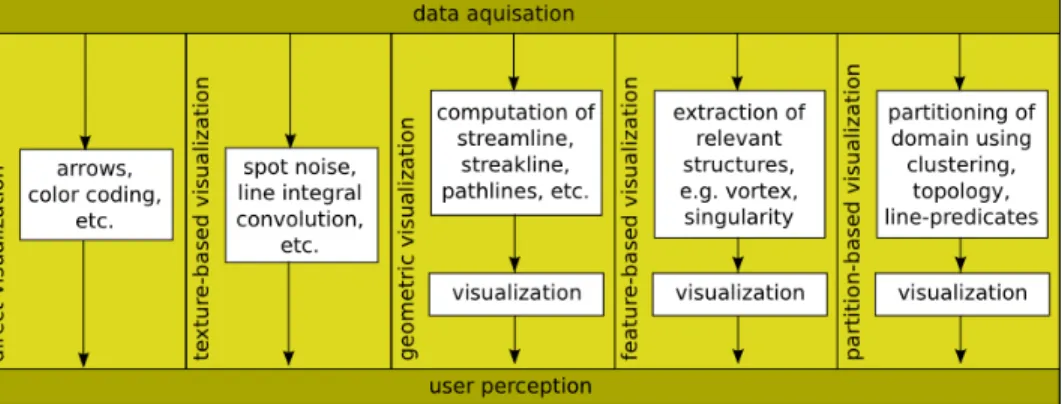
In order to structure the large variety of flow visualization techniques Post et al. [PVH+03]
suggest a subdivision into four categories: direct flow visualization, texture-based, geo-metric and feature-based flow visualization. These classes along with some representative techniques are illustrated in Figure 1. We adopt their classification scheme and add an additional class, partition-based flow visualization, that we think is so far not adequately captured.
∗Institut f¨ur Informatik, Universit¨at Leipzig, D-04009 Leipzig, Germany †Institut f¨ur Informatik, Universit¨at Leipzig, D-04009 Leipzig, Germany
‡Computer Science and Engineering, Wright State University, 3640 Colonel Glenn Hwy., Dayton, OH 45435 §Institut f¨ur Informatik, Universit¨at Leipzig, D-04009 Leipzig, Germany
Figure 1: Classification of flow visualization techniques
While the first three categories focus on the visualization of basic field quantities, feature-and partition-based methods provide a more abstract view of the data. We distinguish feature- and partition-based approaches as they differ in the objective of the visualiza-tion. Feature-based flow visualization are characterized by the well-established definition by Post et al.:
• Feature-based flow visualization: This “approach lifts the visualisation to a higher level of abstraction, by extracting physically meaningful patterns from the data sets. The visualisation shows only those parts that are of interest to the researcher, the
features. Both the definition of what is interesting, and the way these features are ex-tracted and visualized are dependent on the data set, the application, and the research problem.” [PVH+03] Post et al. [PVH+03] cover feature-based flow visualization in
detail.
In contrast to these techniques that focus on interesting structures, partition-based flow vi-sualizations subdivide the whole domain. They provide a holistic overview over the dataset and do not require a classification into interesting or not. Relevant regions can be iden-tified subsequently as a subset of the partition. Methods falling into this new group are characterized by the following definition.
• Partition-based flow visualization:This approach partitions the whole domain ac-cording to certain charateristics which are based on vector values, integral curve properties of contained features. The resulting partition defines the structure with respect to the flow’s behavior and serves as a basis for further visualizations.
Several partition-based methods use feature-based methods as basis. Flow topology, for example, needs critical points, closed orbits and boundary switch points which are all typ-ical features before the final partition of the domain is computed. One may compare the relation between feature- and partition-based approaches to the related discipline of image
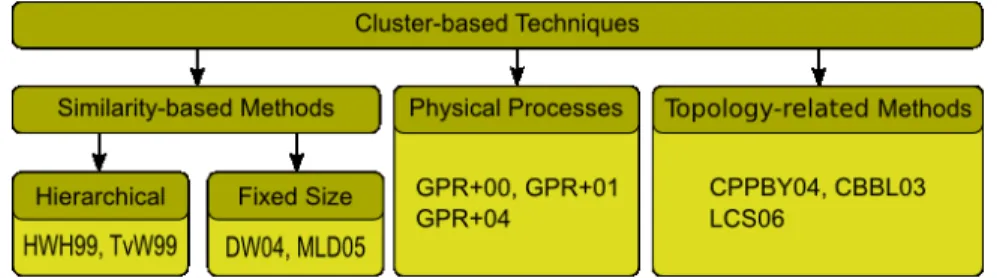
Figure 2: Classification of cluster-based flow visualization techniques
processing. In image processing, properties of pixels like local texture structure are com-puted and features, e.g. edges, are found. After this, an additional step follows quite often that partitions the domain. This step is usually called segmentation.
2
Partition-based flow visualization
When analyzing a dataset scientists and engineers are commonly interested in relevant structures in the flow and the overall behavior. While feature-based techniques focus on the visualization of interesting phenomena, partition-based visualizations try to communicate a holistic description of the flow. As a structural decomposition of the domain, we define a partition of the flow according to a similarity measure. In the field of partition-based flow visualization two conceptually different approaches can be distinguished:
• Cluster-based Approaches: Methods in this category cluster regions of the flow that feature similar vector values. This can be achieved using local or global similarity measures. After the partitioning the individual clusters are commonly represented by a single icon, e.g., a vector representing the average flow.
• Integral-Line-based Approaches: Integral-line-based approaches compute the simi-larity of integral lines with respect to a simisimi-larity measure. We distinguish topology-based and general integral line topology-based approaches. Subsequent visualizations are used to illustrate the boundaries or relevant attributes of the subregions.
2.1
Cluster-Based Approaches
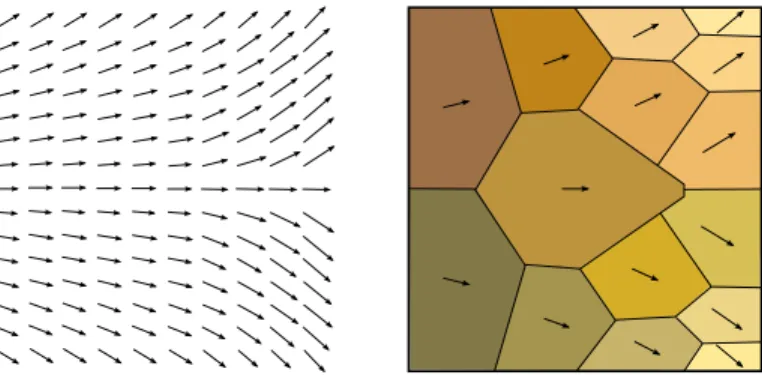
One of the first techniques used to create coarsened representations of vector fields are cluster-based approaches. These techniques subdivide the domain into different subregions (clusters) of similar vectors and represent each cluster by an icon, e.g., a vector representing the average flow in the cluster (cf. Figure 3). Three different concepts are used to define clusters:
• Similarity-based Methods: Techniques belonging to this category group positions or cells that feature similar vectors. Similarity is computed using a predefined similarity measure.
Figure 3: Clustering of a flow field: (left) Hedgehog representation of the flow (right) Image of the clusters with average vectors as icons.
• Physical Processes: These methods use a physical process, e.g., anisotropic diffu-sion, to compute a scalar field representing the structures of the flow. Afterwards the scalar field is partitioned into subregions.
• Topology-related Methods: This group contains techniques that employ concepts of topology to extract subregions.
2.1.1 Similarity-based Methods
A straightforward method to define subregions of similar behavior in a flow is to cluster those positions or cells that feature similar vectors. This can be achieved either by hierar-chical formation of clusters or by identifying a predefined number of clusters.
Hierarchical Techniques Hierarchical Techniques are divided into top-down and
bottom-up methods. Top-down methods iteratively subdivide the domain. In bottom-up methods, each vector forms a cluster in the beginning and similar clusters are merged iter-atively.
Heckel et al. [HWHJ99] proposed a top-down approach that minimizes the deviation of streamlines in the coarse field and respective ones in the original field. In each step the cluster with the largest deviation is split by a plane. The splitting direction is determined using principal component analysis. This technique results in a coarsened representation of the field consisting of convex clusters.
The bottom-up method by Telea and van Wijk [TvW99] merges clusters of highest sim-ilarity. Initially, each vector forms a separate cluster. In each step, those two clusters are merged that show least divergence in positions and orientations of the vectors in the clus-ters. Depending on the weights in the error term different shapes of clusters are favored.
Fixed Number of Clusters The hierarchical techniques introduced so far operate only
locally. To control the overall error, (Voronoi-)cell based methods were introduced that minimize a global error function.
A clustering technique based on Centroidal Voronoi tessellation was proposed by Du and Wang [DW04]. The method identifiesnpositions in the field that are used as cluster cen-ters. The surrounding Voronoi-cells form the cluscen-ters. An optimization process is used to determine those positions that minimize an error function, which measures the distances between the elements in the cluster and the center. The set of positions with the smallest error is used as centers of the Voronoi-cells.
The previous work was extended by McKenzie et al. [MLD05], who use different error metrics in the variational clustering. Amongst others, the gradient, divergence, and curl are used to control the partitioning.
A very simple clustering approach is given by the partition of the domain using an isosur-face. Here we have two clusters, one comprising all positions with values smaller than the given isovalue and the other one with larger values. A typical application example is the
λ2-method [JH95] where an isosurface ofλ2= 0is used to extract vortices (Figure 8(c)).
2.1.2 Physical Processes
Techniques inspired by physical processes were proposed to better control the global error of the simplified representation. The evolving physical process, e.g., anisotropic diffusion, creates a scalar field that reflects the structure of the flow field. The clusters are extracted by partitioning the scalar field.
The approach by Garcke et al. [GPR+01] is based on a physical clustering model, the Cahn Hillard model, which is used to describe clustering in metal alloys. When applied to a fine-grained, noise-like signal, this method creates clusters that are aligned to the flow, which determines the anisotropy of the operator. The diffusion time serves as a multi scale param-eter that leads from fine cluster granularity to successively coarser clusters. The clusters are identified by extracting connected components with values≥0in the diffusion solution. A similar approach was taken by Griebel et al. [GPR+04], who define an anisotropic
dif-fusion tensor based on the flow direction. This tensor induces an anisotropic differential operator, which defines strong (flow-aligned) and weak (flow-orthogonal) couplings be-tween mesh neighbor points. The anisotropic differential operator is discretized using fi-nite elements. Thus, a stiffness matrix is obtained that is progressively simplified using the algebraic multi grid method. The supports of the basis functions delivered by the algebraic multi grid method are used to decompose the flow structure into clusters.
2.1.3 Topology-related Methods
For the partitioning of vector fields, topology-related clustering techniques group together similar vectors that are associated with the same singularities according to the dominant topological structure of the respective vector fields.
A modified normalized-cut algorithm is used by Chen et al. [CBHL03] for hierarchical vec-tor field segmentation. The basic idea is to model a vecvec-tor field as an undirected, weighted graph. The connection weight between each pair of nodes in the graph results from a sim-ilarity measure that takes into consideration both Euclidean distance between point pairs and the difference in vector values. In a next step, the segmentation method based on nor-malized cut is applied to linear vector fields. The segmentations capture the qualitative and
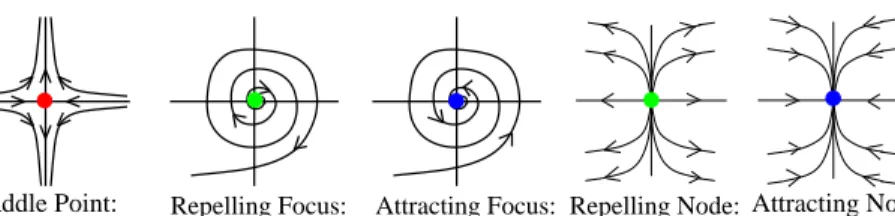
Attracting Node: R1, R2 < 0, I1 = I2 = 0 Repelling Node: I1 = I2 = 0 R1, R2 > 0, Attracting Focus: I1 = −I2 <> 0 R1 = R2 < 0, Repelling Focus: R1 = R2 >0, I1 = −I2 <> 0 Saddle Point: R1<0, R2>0, I1 = I2 = 0
Figure 4: Common first order singularity types
topological nature of linear vector fields. The method, however, works poorly for nonlinear vector fields.
Recently, Li et al. [LCS06] propose an approach for 2D discrete vector field segmentation based on the Green function and the previously discussed normalized cut algorithm. Their work is based on the Hodge decomposition [PP00], [PP02], such that a discrete vector field is broken down into three simpler components, namely, curl-free, divergence-free, and harmonic components. In this way, feature information about singularities is faith-fully transferred from vector fields to this scalar fields. The authors use the Green Function Method(GFM) to approximate the curl-free and the divergence-free components to achieve the vector field segmentation. The final segmentation curves are composed of piecewise smooth contours or streamlines and show the boundaries of the influence region of singu-larities. Their method is applicable to both linear and nonlinear discrete vector fields.
2.2
Integral-Line-Based Approaches
Integral-line-based approaches group integral lines together that show a similar behavior. Topology-Based approaches are an example and use the origin/destination of integral lines as similarity measure. Recently, other more general similarity measures were introduced. We refer to these new techniques as general integral line based approaches.
2.2.1 Topology-Based Approaches
Topological methods focus on the structural properties of the flow. A detailed introduction to various flow structures can be found in the books by Abraham and Shaw [AS84][AS88] which contain illustrative sketches explaining various vector field configurations thereby providing great understanding of these configurations. Most topological methods start with analyzing the singularities of the vector field, i.e. those locations within the flow where the vector becomes zero. Hence, singularities are also referred to as zeros or critical points of the vector field. Critical points were first investigated by Perry [PF74, Per84, PC87], Dallmann [Dal83], Chong [CPC90] and others.
Singularities are usually classified by different types with focus on first order singularities which are the only types that occur in linearly interpolated vector fields. For the classifica-tion of the singularities, the eigenvalues of the Jacobian of the vector field are considered. In a 2D vector field, this yields two complex numbers. Depending on the sign of the real parts
of the eigenvalues and the existence of an imaginary part, different types of singularities can be distinguished. Figure 4 shows some common types of singularities with their corre-sponding real and imaginary components. Singularities can have an attracting or repelling property, i.e the surrounding flow moves towards or away from the singularity. Similarly, streamlines – integral curves through the vector field – can be attracted or repelled by a singularity. Note that streamlines can only intersect at the singularities.
From a topological point of view, closed streamlines, sometimes also referred to as closed orbits, are similar to singularities. They, too, can attract or repel the surrounding flow and different streamlines can meet at a closed orbit. A closed streamline is a streamline that is connected to itself, thereby forming a loop.
The notion of flow topology was first introduced to the visualization community by Helman and Hesselink [HH89b, HH89a, HH91]. A very detailed overview of topological methods is given by Laramee et al. [LHZP07]. The idea of flow topology is to separate the vector field into regions with similar behavior. To achieve this, the fact that streamlines cannot intersect each other unless they meet at a critical point or closed streamline is exploited. For this, the saddle singularities of the vector field are identified. Saddle singularities have two major axes in direction of the eigenvectors of the Jacobian. In each of the quadrants formed by the axes, an asymptotic flow towards to the axes is present as illustrated in Figure 4. Hence, these axes separate the flow into four different areas. Then, separatrices are generated which are streamlines that start or end at a saddle singularity. Consequently, the separatrices divide the vector field into areas with similar flow. The resulting visualization consisting of the singularities and separatrices is often referred to as the topological skeleton (Figure 5). Several extensions to the original method by Helman and Hesselink were proposed. Some of these extensions – like the original method – work on two-dimensional, steady vector fields. Others extract surfaces within a 3D vector field and analyze a steady 2D vector field on top of these surfaces resulting in a 2.5D algorithm. Various methodologies that visualize the entire 3D vector field are also available as well as algorithms that follow the same categories but support time-varying vector fields. In the following, methods are grouped according to these categories.
Steady 2D vector fields Steady two-dimensional vector fields resulting from scans or
simulations are usually given on some sort of grid with vector values on the grid nodes. Commonly, linear interpolation is used to determine vectors inside the cells. However, lin-ear interpolation eliminates higher order singularities that may be present in the vector field. Therefore, Scheuermann et al. [SHK+97] employ Clifford algebra and a higher
or-der interpolation scheme in the vicinity of several singularities to preserve higher oror-der singularities. Similarly, the linear interpolation scheme changes the vector field topology since higher order singularities are misinterpreted. In order to avoid this, Scheuermann et al. [SKMR98] use their Clifford algebra method for higher order singularities to compute the correct topological skeleton of the vector field. Since closed streamlines can act like singularities in terms of the attracting or repelling behavior, streamlines emanating from a saddle singularity may end at a closed streamline. Hence, closed streamlines are an in-tegral part of topological skeletons. Therefore, Wischgoll et al. [SKMR98] introduced the first algorithm capable of detecting closed streamlines, thereby completing the
topologi-Figure 5: Topological methods (from left to right): 2D topology on planar sur-faces [WTS+07], saddle connectors [TWHS03]
cal analysis of 2D steady vector fields. Since the original algorithm by Wischgoll et al. detects a closed streamline by following the streamline and proving that it cannot leave a limited number of cells, Theisel et al. [TWHS04a] presented a grid-independent algorithm for detecting closed streamlines in 2D vector fields.
Steady 2.5D Vector Fields In order to study flow separation where the 3D flow
rep-resented by the vector field separates from a surface, often times the analysis of the vector field on that surface can help. Hesselink et al. [HH90] compute the tangential velocity field near a body in a three-dimensional flow. The topological skeleton of the resulting vector field then provides a basis for analyzing the three-dimensional structure of the flow sep-aration. L¨offelmann [LKG97] uses Poincar´e sections to visualize closed streamlines and strange attractors. Poincar´e sections define a discrete dynamical system of lower dimen-sion which is easier to understand. The Poincar´e section which is transverse to the closed streamline is visualized as a disk. On the disk, spot noise is used to depict the vector field projected onto that disk. In addition, streamlines and streamsurfaces show the vector field in the vicinity of the closed streamline that is not located on the disk visualizing the Poincar´e section. Chen et al. [CML+07] proposed a method for extracting periodic orbits based on Morse decomposition. The method is applied to cross-sections of a flow within the com-bustion chamber of a Diesel engine. The closed streamlines are then computed within the flow on these cross-sections as well as the topological skeleton.
Steady 3D Vector Fields In order to apply topological methods to 3D steady
vec-tor fields, Helman et al. [HH91] extend their original work by analyzing 3D singularities within the vector field. Similar to the 2D case, the Jacobian is analyzed and singulari-ties are visualized with their eigenvectors and eigenvalues displayed as arrows and disks. Similarly, closed streamlines may occur in 3D vector fields as well with the same topo-logical features as singularities. Hence, Wischgoll et al. [WS02] expand their detection
algorithm for closed streamlines to support three-dimensional vector fields. In 3D vector field topology, separatrices no longer are single streamlines but rather streamsurfaces em-anating from singularities with at least two distinct eigenvalues. Mahrous et al. [MBHJ03] presented an algorithm that improves on the computational effort involved in determin-ing these streamsurfaces. Since streamsurfaces tend to occlude each other, L¨offelmann et al. [LG98] proposed the use of bundles of streamlets to reduce the visual clutter. Similarly, Theisel et al. [TWHS03] introduced saddle connectors which reduce the streamsurfaces that connect 3D saddle singularities to a minimum in order to avoid occlusion. Weinkauf et al. [WTHHP04] extend this idea and reduce the streamsurfaces even further to boundary switch connectors. Mahrous et al. [MBS+04] filters the vector field first before computing separatrices in a 3D vector field to retrieve the 3D topology only for the areas of interest. Sun et al. [SBSH04] apply vector field topology to analyze a C-shaped nano-aperture. In order to extract higher order singularities in 3D vector fields, Weinkauf et al. [WTHS05] show that it is sufficient to determine the 2D topological skeleton of a closed convex sur-face around the area of interest. Once detected, the cluster of first order singularities is then replaced by a higher order singularity to yield a simplified visual representation.
Unsteady Vector Fields The methods described so far focused on a static vector field.
In order to apply topological methods to time-varying data sets, Tricoche et al. [TSH01b] interpolate the 2D vector field between time slices and track singularities throughout time which is visualized by using the third dimension. The topological skeleton is computed within the time slices. This method is then extended by Wischgoll et al. [WSH01] to track closed streamlines over time and complete the topological analysis of time-varying 2D vector fields [TWSH02]. Theisel et al. [TS03] compute a feature flow field based on a 2D time-dependent vector field to track more general features by integrating streamlines within the feature flow field. The previous methods assumed each time slice as a static vector field. In order to integrate the time-varying property of the 2D vector field, Theisel et al. [TWHS04b, TWHS05] based the topological analysis on path lines. Similarly, Shi et al. [STW+06] applied the path-line-based methodology to periodic vector fields to avoid the the short lifetime of typical path lines.
In order to extract and visualize vortices that originate from bounding walls of time-varying 3D vector fields, Wiebel et al. [WTS+07] track singularities in the wall shear stress vector
field. Then, the trajectories of the singularities are used as a basis for seeding particles, thereby leading to a new type of streak line visualization.
Topology Simplification of Static Vector Fields Vector fields with a high degree
of turbulance can lead to a very complex topological skeleton. Simplifying the topology of the vector field can improve the visualization by reducing the visual clutter. De Leeuw et al. [dLvL99b] introduce a multi-level approach for topology of 2D vector fields to al-low a user to remove clutter within the topological skeleton by only considering the more important singularities [dLvL99a]. Lodha et al. [LRR00] achieve a topology preserving compression of 2D vector fields by using a constrained clustering approach for the singu-larities. By modifying the underlying grid structure and clustering singularities, Tricoche et al. [TSH00, TSH01c] reduce the complexity of the topological skeleton. They then
ex-Figure 6: General integral line based approaches (from left to right): streamline predi-cates [SS06] and pathline predipredi-cates [SGSM07].
tended their work to eliminate the necessity of changing the grid to support a continuous topology simplification [TSH01a]. Theisel [The02] designed a scheme for generating vec-tor fields of arbitrary topology. He then applies this scheme to generate a new vecvec-tor field of the same topology as a given 2D vector field to find a compressed representation. In a dif-ferent approach, Theisel et al. [TRS03b] developed a compression scheme for vector fields based on topology preserving edge collapses. Further simplification is achieved by assign-ing weights to sassign-ingularities and separatrices and preservassign-ing only the important topological features [TRS03a]. In order to simplify a 3D vector fields, Weinkauf et al. [WTHS05] identify high order singularities and replace them by a cluster of first order critical points to achieve a simplified visual representation.
2.2.2 General Integral Line Based Approaches
The basic idea behind these kinds of approaches is to structure the flow according to a gen-eral user defined behavior. Therefore, the desired flow behavior is expressed as properties of particle traces. Grouping particles with the same properties together facilitates building a structure of the flow. The conventional flow topology as presented in 2.2.1 is a successful example of such a structure.
Salzbrunn and Scheuermann [SS07, SS06] define particle properties for steady vector fields in terms of streamline predicates. These predicates define, whether a streamline has a given property or not. All streamlines fulfill a streamline predicate are collected in the charac-teristic set of this predicate. Consequently, the characcharac-teristic set is exactly that part of the flow with the behavior as specified by the streamline predicate. A set of predicates, where every streamline fulfills exactly one, results in a set of disjunct characteristic sets. Hence, this set of predicates defines a partition of the flow which is considered a flow structure. Using feature-detection methods as preprocessing step, several streamline predicates can be formulated. The resulting flow structures are visualized by the use of isosurfaces.
Par-Figure 7: General integral line based approaches: pathline attributes [STH+07]
ticularly, this method allows for examination of the flow behavior with respect to vortices. Furthermore, Salzbrunn and Scheuermann [SS07] show that the usual flow topology can be formulated as a flow structure. In addition, acceleration strategies for the construction of flow structures are explored [SWS07]. Salzbrunn et al. [SGSM07] extend their work on 3D time-dependent flow fields with pathline predicates. There, the lifespan of a particle has to be taken into account (Figure 6). The resulting time-dependent flow structures are visualized as animated isosurfaces or particle systems.
Shi et al. [STH+07] define pathline attributes to analyze the dynamics behavior of time-dependent flow fields and give various examples. To get meaningful threshold values for the pathline attributes, information visualization approaches are used in the sense of a set of linked views (scatter plots, parallel coordinates, etc.) with interactive brushing and fo-cus+context visualization. The selected path lines with certain properties are visualized as colored 3D curves (Figure 7).
2.3
New Directions
Recently Haller [Hal01] introduced the notion of Finite-Time Lyapunov Exponent (FTLE) to characterize Coherent Lagrangian Structures. FTLE measues the exponential separation rate of closely started particle trajectories. First works from Sadlo and Peikert [SP07b], Garth et al. [GLT+07], and Sahner et al. [SWTH07] build upon this method focusing on
its applications to the structural analysis of transient flows (Figure 8(b)). Improved imple-mentations were proposed [GGTH07, SP07a] to allow for an efficient computation of the coherent structures. Further work should elaborate on the use of FTLE in flow visualization
(a) Streamlines (b) Regions of high forward (red) and backward (blue) FTLE.
(c)λ2Criterion (d) LSC of|Velocity|(left:>10) (right:>14)
Figure 8: Flow around a delta wing: (a) Important structures are the vortex core-lines and recirculating bubbles [JWSK07]. (b) Separation and attachment structures are visualized using the FTLE method [GGTH07]. (c) Theλ2 = 0 isosurface of the Jacobian of the
velocity field [JWSK07]. (d) Local statistical complexity distinguishes between regions of ordinary and extraordinary dynamics [JWSK07].
and yield to partitioning of the flow.
A further new direction of analysis was proposed by J¨anicke et al. [JWSK07] who use an information theoretic approach to automatically detect distinctive structures in time-dependent multi-fields. Local statistical complexity is used to measure the amount of infor-mation needed to predict the local future dynamics of the field given its local past. Positions with a high local statistical complexity feature regions of an extraordinary temporal evolu-tion (Figure 8(d)).
3
Conclusions and Future Prospects
This paper describes the state-of-the-art of partition-based techniques for visualizing and analyzing vector fields. To this date, partition-based techniques have shown to be capable of providing an abstract representation of the flow that captures the relevant structures. The three classes of techniques capture different properties of the flow and therefore are beneficial in different tasks. Cluster-based methods are best suited, when the visualization is supposed to display a coarsened representation of the flow. Topology- and partition-based techniques emphasize the dynamics of the flow. While topological methods describe the flow in terms of origin and destination of particles, general line-integral approaches
concentrate on attributes of particles. Depending on the aim of the visualization the user can choose the technique that is best suited. Although many different problems have been treated, the field of partition-based visualization is still rich in challenging open problems which have to be solved in order to make use of the full potential of these methodologies:
• The cognition of the results leaves open questions and needs more theoretical devel-opment.
• The visualization and correct capturing of 3D time-dependent structures is still chal-lenging.
• How accurate are the boundaries of the partitioning?
• So far only few predicates for the general line-integrals have been researched. New predicates might give a better understanding of the flow.
4
Acknowledgments
The authors would like to thank the anonymous reviewers for their helpful remarks.
References
[AS84] R. H. Abraham and C. D. Shaw. Dynamics – The Geometry of Behaviour: Bifurcation Behaviour Part 3: Global Behaviour. Aerial Press, Inc., 1984. [AS88] R. H. Abraham and C. D. Shaw. Dynamics – The Geometry of Behaviour:
Bifurcation Behaviour Part 4: Bifurcation Behaviour. Aerial Press, Inc., 1988.
[CBHL03] J.-L. Chen, B. Bai, B. Hamann, and T. J. Ligocki. A Normalized-Cut Algo-rithm for Hierachical Vector Field Data Segmentation. InProc. Visualization and Data Analysis Conf., 2003.
[CML+07] G. Chen, K. Mischaikow, R. S. Laramee, P. Pilarczyk, and E. Zhang. Vector Field Editing and Periodic Orbit Extraction Using Morse Decomposition.
IEEE TVCG, 13(4):769–785, 2007.
[CPC90] M. S. Chong, A. E. Perry, and B. J. Cantwell. A General Classification of Three-Dimensional Flow Fields. Physics of Fluids, A2(5):765–777, 1990. [Dal83] U. Dallmann. Topological Structures of Three-Dimensional Flow
Separa-tions. Technical Report DFVLR-AVA Bericht Nr. 221-82 A 07, Deutsche Forschungs- und Versuchsanstalt f¨ur Luft- und Raumfahrt e.V., April 1983. [dLvL99a] W. de Leeuw and R. van Liere. Collapsing Flow Topology Using Area
Met-rics. In IEEE Visualization 1999 Proc., pages 349–354. IEEE Computer Society, 1999.
[dLvL99b] W. de Leeuw and R. van Liere. Visualization of Global Flow Structures Using Multiple Levels of Topology. InVisSym 1999: Proc. of the Symp. on Data Visualization, pages 45–52, 1999.
[DW04] Q. Du and X. Wang. Centroidal Voronoi Tessellation Based Algorithms for Vector Fields Visualization and Segmentation. InIEEE Visualization 2004 Proc., pages 43–50. IEEE Computer Society, 2004.
[GGTH07] G. Garth, F. Gerhardt, X. Tricoche, and H. Hagen. Efficient Computation and Visualization of Coherent Structures in Fluid Flow Applications. IEEE TVCG, 13(6):1464–1471, 2007.
[GLT+07] C. Garth, G.-S. Li, X. Tricoche, C. D. Hansen, and H. Hagen. Visualization of Coherent Structures in 2d Transient Flows. InTopology-Based Methods in Visualization, Proceedings of the 2007 Workshop (to appear), 2007. [GPR+01] H. Garcke, T. Preusser, M. Rumpf, A. Telea, U. Weikard, and J. J. van Wijk.
A Phase Field Model for Continuous Clustering on Vector Fields. IEEE TVCG, 7(3):230–241, 2001.
[GPR+04] M. Griebel, T. Preusser, M. Rumpf, M. A. Schweitzer, and A. Telea. Flow
Field Clustering via Algebraic Multigrid. InIEEE Visualization 2004 Proc., pages 35–42. IEEE Computer Society, 2004.
[Hal01] G. Haller. Distinguished Material Surfaces and Coherent Structures in Three-Dimensional Flows. InPhysica D, pages 248–277, 2001.
[HH89a] J. L. Helman and L. Hesselink. Automated Analysis of Fluid Flow Topology. InThree-Dimensional Visualization and Display Techniques, SPIE Proceed-ings Vol. 1083, pages 144–152, 1989.
[HH89b] J. L. Helman and L. Hesselink. Representation and Display of Vector Field Topology in Fluid Flow Data Sets. Computer, 22(8):27–36, 1989.
[HH90] J. L. Helman and L. Hesselink. Surface Representations of Two- and Three-Dimensional Fluid Flow Topology. In G. M. Nielson and B. Shriver, editors,
IEEE Visualization 1990 Proc., pages 6–13. IEEE Computer Society, 1990. [HH91] J. L. Helman and L. Hesselink. Visualizing Vector Field Topology in Fluid
Flows. IEEE Comput. Graph. Appl., 11(3):36–46, 1991.
[HWHJ99] B. Heckel, G Weber, B. Hamann, and K. Joy. Construction of Vector Field Hierarchies. InIEEE Visualization 1999 Proc., pages 19–26. IEEE Computer Society, 1999.
[JH95] J. Jeong and F. Hussain. On the identification of a vortex. J. Fluid Mech., 285:69–94, 1995.
[JWSK07] H. J¨anicke, A. Wiebel, G. Scheuermann, and W. Kollmann. Multifield Visu-alization Using Local Statistical Complexity.IEEE Visualization 2007 Proc., 13(6):1384–1391, 2007.
[LCS06] H. Li, W. Chen, and I. F. Shen. Segmentation of Discrete Vector Fields.
IEEE TVCG, 12(3):289–300, 2006.
[LG98] H. L¨offelmann and E. Gr¨oller. Enhancing the Visualization of Characteristic Structures in Dynamical Systems. InIn Proceedings of the 9th Eurographics Workshop on Visualization in Scientific Computing, pages 35–46, 1998. [LHZP07] R. S. Laramee, H. Hauser, L. Zhao, and F. H. Post. Topology-Based Flow
Visualization, The State of the Art, pages 1–19. Springer, 2007.
[LKG97] H. L¨offelmann, T. Kuˇcera, and E. Gr¨oller. Visualizing Poincar´e Maps To-gether with the Underlying Flow. In H.-C. Hege and K. Polthier, editors,
Mathematical Visualization, Algorithms, Applications, and Numerics, pages 315–328. Springer, 1997.
[LRR00] S. K. Lodha, J. C. Renteria, and K. M. Roskin. Topology Preserving Com-pression of 2D Vector Fields. InIEEE Visualization 2000 Proc., pages 343– 350. IEEE Computer Society, 2000.
[MBHJ03] K. Mahrous, J. Bennett, B. Hamann, and K. I. Joy. Improving Topological Segmentation of Three-Dimensional Vector Fields. InVisSym ’03: Proceed-ings of the Symposium on Data Visualisation 2003, pages 203–212, 2003. [MBS+04] K. Mahrous, J. Bennett, G. Scheuermann, B. Hamann, and K. I. Joy.
Topo-logical Segmentation of Three-Dimensional Vector Fields. IEEE TVCG, 10(2):198–205, 2004.
[MLD05] A. McKenzie, S. Lombeyda, and M. Desbrun. Vector Field Analysis and Visualization through Variational Clustering. In K. Brodlie, D. Duke, and K. Joy, editors,Eurographics/IEEE-VGTC Symp. on Vis. 2005, 2005. [PC87] A. E. Perry and M. S. Chong. A Description of Eddying Motions and Flow
Patterns Using Critical Point Concepts. Ann. Rev. Fluid Mech., pages 127– 155, 1987.
[Per84] A. E. Perry. A Study of Non-degenerate Critical Points in Three-Dimensional Flow Fields. Technical Report DFVLR-FB 84-36, Deutsche Forschungs- und Versuchsanstalt f¨ur Luft- und Raumfahrt e.V., 1984. [PF74] A. E. Perry and B. D. Fairly. Critical Points in Flow Patterns. Advances in
Geophysics, 18B:299–315, 1974.
[PP00] K. Polthier and E. Preuss. Variational Approach to Vector Field Decomposi-tion. In W. de Leeuw and R. van Liere, editors,Scientific Visualization 2000, pages 147–156. Springer, 2000.
[PP02] K. Polthier and E. Preuss. Identifying Vector Fields Singularities Using a Discrete Hodge Decomposition. InVisualization and Math.Springer, 2002. [PVH+03] F. H. Post, B. Vrolijk, H. Hauser, R. S. Laramee, and H. Doleisch. The State of the Art in Flow Visualization: Feature Extraction and Tracking.Computer Graphics Forum, 22(4):775–792, 2003.
[SBSH04] L. Sun, R. Batra, X. Shi, and L. Hesselink. Topology Visualization of the Optical Power Flow through a Novel C-Shaped Nano-Aperture. InIEEE Visualization 2004 Proc., pages 337–344. IEEE Computer Society, 2004. [SGSM07] T. Salzbrunn, C. Garth, G. Scheuermann, and J. Meyer. Pathline Predicates
and Unsteady Flow Structures. The Visual Computer (submitted), 2007. [SHK+97] G. Scheuermann, H. Hagen, H. Kr¨uger, M. Menzel, and A. Rockwood.
Vi-sualization of Higher Order Singularities in Vector Fields. InIEEE Visual-ization 1997 Proc., pages 67–74. IEEE Computer Society, 1997.
[SKMR98] G. Scheuermann, H. Kr¨uger, M. Menzel, and A. Rockwood. Visualizing Nonlinear Vector Field Topology. IEEE TVCG, 4(2):109–116, 1998. [SP07a] F. Sadlo and R. Peikert. Efficient Visualization of Lagrangian Coherent
Structures by Filtered AMR Ridge Extraction. IEEE TVCG, 13(6):1456– 1463, 2007.
[SP07b] F Sadlo and R. Peikert. Visualizing Lagrangian Coherent Structures and Comparison to Vector Field Topology. InTopology-Based Methods in Visu-alization, Proceedings of the 2007 Workshop (to appear), 2007.
[SS06] T. Salzbrunn and G. Scheuermann. Streamline Predicates. IEEE TVCG, 12(6):1601–1612, 2006.
[SS07] T. Salzbrunn and G. Scheuermann. Streamline Predicates As Flow Topology Generalization. InTopology-Based Methods in Visualization, Proceedings of the 2007 Workshop (to appear), pages 65–78, 2007.
[STH+07] K. Shi, H. Theisel, H. Hauser, T. Weinkauf, K. Matkovic, H.-C. Hege, and H.-P. Seidel. Path Line Attributes - an Information Visualization Approach to Analyzing the Dynamic Behavior of 3D Time-Dependent Flow Fields. In
Topology-Based Methods in Visualization, Proceedings of the 2007 Work-shop (to appear), 2007.
[STW+06] K. Shi, H. Theisel, T. Weinkauf, H. Hauser, H.-C. Hege, and H.-P. Sei-del. Path Line Oriented Topology for Periodic 2D Time-Dependent Vector Fields. In D. Ertl, K. Joy, and B. Santos, editors,Eurographics/IEEE-VGTC Symposium on Visualization 2006, pages 139–146, 2006.
[SWS07] T. Salzbrunn, A. Wiebel, and G. Scheuermann. Efficient Construction of Flow Structures. InProceedings IASTED VIIP 2007, pages 135–140, 2007.
[SWTH07] J. Sahner, T. Weinkauf, N. Teuber, and H.-C. Hege. Vortex and Strain Skele-tons in Eulerian and Lagrangian Frames.IEEE TVCG, 13(5):980–990, 2007. [The02] H. Theisel. Designing 2d Vector Fields of Arbitrary Topology. Computer
Graphics Forum (Eurographics 2002), 21(3):595–604, 2002.
[TRS03a] H Theisel, Ch. R¨ossel, and H.-P. Seidel. Combining Topological Simplifi-cation and Topology Preserving Compression for 2d Vector Fields. In11th Pacific Conference on Computer Graphics and Applications, pages 419–423, 2003.
[TRS03b] H. Theisel, C. R¨ossl, and H. Seidel. Compression of 2D Vector Fields Under Guaranteed Topology Preservation.Computer Graphics Forum (Eurograph-ics 2003), 22(3), 2003.
[TS03] H. Theisel and H.-P. Seidel. Feature Flow Fields. InVisSym 2003: Proc. of the Symp. on Data Visualization, pages 141–148, 2003.
[TSH00] X. Tricoche, G. Scheuermann, and H. Hagen. A Topology Simplification Method for 2D Vector Fields. InIEEE Visualization 2000 Proc., pages 359– 366. IEEE Computer Society, 2000.
[TSH01a] X. Tricoche, G. Scheuermann, and H. Hagen. Continuous Topology Sim-plification of Planar Vector Fields. In T. Ertl, K. Joy, and A. Varshney, edi-tors,IEEE Visualization 2001 Proc., pages 159–166. IEEE Computer Soci-ety, 2001.
[TSH01b] X. Tricoche, G. Scheuermann, and H. Hagen. Topology-Based Visualization of Time-Dependent 2D Vector Fields. InVisSym 2001: Proc. of the Symp. on Data Visualization, pages 117–126, 2001.
[TSH01c] X. Tricoche, G. Scheuermann, and H. Hagen. Vector and Tensor Field Topol-ogy Simplification on Irregular Grids. In D. Ebert, J. M. Favre, and R. Peik-ert, editors,VisSym 2001: Proc. of the Symp. on Data Visualization, pages 107–116. Springer, 2001.
[TvW99] A. Telea and J. J. van Wijk. Simplified Representation of Vector Fields. In
IEEE Visualization 1999 Proc., pages 35–42. IEEE Computer Society, 1999. [TWHS03] H. Theisel, T. Weinkauf, H.C. Hege, and H.P. Seidel. Saddle Connectors -An Approach to Visualizing the Topological Skeleton of Complex 3d Vector Fields. InIEEE Visualization 2003 Proc., pages 225–232. IEEE Computer Society, 2003.
[TWHS04a] H. Theisel, T. Weinkauf, H.-C. Hege, and H.-P. Seidel. Grid-Independent Detection of Closed Stream Lines in 2D Vector Fields. InVMV, pages 421– 428, 2004.
[TWHS04b] H. Theisel, T. Weinkauf, H.-C. Hege, and H.-P. Seidel. Stream Line and Path Line Oriented Topology for 2D Time-dependent Vector Fields. In IEEE Visualization 2004 Proc., pages 321–328. IEEE Computer Society, 2004. [TWHS05] H. Theisel, T. Weinkauf, H.-C. Hege, and H.-P. Seidel. Topological Methods
for 2d Time-Dependent Vector Fields Based on Stream Lines and Path Lines.
IEEE TVCG, 11(4):383–394, 2005.
[TWSH02] X. Tricoche, T. Wischgoll, G. Scheuermann, and H. Hagen. Topology Track-ing for the Visualization of Time-Dependent Two-Dimensional Flows. Com-puters & Graphics, 26(2):249–257, 2002.
[WS02] T. Wischgoll and G. Scheuermann. Locating Closed Streamlines in 3d Vector Fields. InIn Proceedings of the Joint Eurographics - IEEE TCVG Sympo-sium on Visualization (VisSym02), pages 227–280, 2002.
[WSH01] T. Wischgoll, G. Scheuermann, and H. Hagen. Tracking Closed Streamlines in Time-Dependent Planar Flows. In T. Ertl, B. Girod, H. Niemann, and H.-P. Seidel, editors,Vision, Modeling, and Visualization 2001, pages 447–454. Aka, 2001.
[WTHHP04] T. Weinkauf, H. Theisel, H.-C. Hege, and Seidel H.-P. Boundary Switch Connectors for Topological Visualization of Complex 3d Vector Fields. In
Proceedings of the 6th Joint IEEE TCVG - EUROGRAPHICS Symposium on Visualization (VisSym 2004), pages 183–192, 2004.
[WTHS05] T. Weinkauf, H. Theisel, H.-C. Hege, and H.-P. Seidel. Extracting Higher Order Critical Points and Topological Simplification of 3D Vector Fields. InIEEE Visualization 2005 Proc., pages 559–566. IEEE Computer Society, 2005.
[WTS+07] A. Wiebel, X. Tricoche, D. Schneider, H. J¨anicke, and G. Scheuermann. Generalized Streak Lines: Analysis and Visualization of Boundary Induced Vortices. IEEE Visualization 2007 Proc., 13(6):1735–1742, 2007.
![Figure 5: Topological methods (from left to right): 2D topology on planar sur- sur-faces [WTS + 07], saddle connectors [TWHS03]](https://thumb-us.123doks.com/thumbv2/123dok_us/1423394.2690504/8.918.264.667.211.426/figure-topological-methods-right-topology-planar-saddle-connectors.webp)
![Figure 6: General integral line based approaches (from left to right): streamline predi- predi-cates [SS06] and pathline predipredi-cates [SGSM07].](https://thumb-us.123doks.com/thumbv2/123dok_us/1423394.2690504/10.918.176.702.227.422/figure-general-integral-based-approaches-streamline-pathline-predipredi.webp)
![Figure 7: General integral line based approaches: pathline attributes [STH + 07]](https://thumb-us.123doks.com/thumbv2/123dok_us/1423394.2690504/11.918.201.687.207.501/figure-general-integral-line-based-approaches-pathline-attributes.webp)
![Figure 8: Flow around a delta wing: (a) Important structures are the vortex core-lines and recirculating bubbles [JWSK07]](https://thumb-us.123doks.com/thumbv2/123dok_us/1423394.2690504/12.918.190.698.201.518/figure-flow-delta-important-structures-vortex-recirculating-bubbles.webp)