Strategic plan for the development of research
in
Language Technology
at the University of Gothenburg
A long range plan
with particular reference to the current research period 2009–12
Amended version, 2009-06-10
Contents
1 Language technology 1
2 Language technology research in Gothenburg 4
3 Plans for strengthening the area 6
4 Current and future projects 8
4.1 The text technology lab . . . 8
4.1.1 LT resources and tools . . . 9
4.1.2 eScience . . . 10
4.1.3 Planned research activities . . . 12
4.2 The grammar technology lab . . . 12
4.2.1 Grammar engineering . . . 12
4.2.2 Authoring support . . . 13
4.2.3 Syntactic theory . . . 13
4.2.4 Semantics . . . 14
4.2.5 Planned research activities . . . 14
4.3 The dialogue technology lab . . . 15
4.3.1 Dialogue systems . . . 15
4.3.2 Applied speech technology . . . 15
4.3.3 Mobile communication studies . . . 15
4.3.4 Planned research activities . . . 16
5 Relationship to teaching 19 6 Dissemination strategy 20 6.1 Objectives and instruments . . . 20
6.2 Scheduled activities . . . 21 7 Success indicators 22 7.1 Milestones for 2010 . . . 22 7.2 Milestones for 2011 . . . 22 7.3 Milestones for 2012 . . . 23 A Organization 24
B Application for funding 26
C GSLT’s document on a national strategy for higher education in
D GSLT’s proposal for a national masters school 32 E Amendments and additions to previous version 42
1
Language technology
Language technology (LT) consists of a wide spectrum of technologies that enable computers to handle both spoken and written natural language. It lies within the framework of information and communication technology (ICT) and is a strongly interdisciplinary field. Fundamental research in LT largely involves the develop-ment of algorithms for language processing and mathematically rigorous descrip-tions of various linguistic phenomena and methods for the automatic acquisition of linguistic knowledge from empirical language data. It also involves ascertaining the mathematical and logical properties of such descriptions and algorithms. Lin-guistic data resources play an important role in modern LT research, a significant part of which is fundamentally empirical in nature.
LT, that is the processing of natural language, has been a dream since the early days of computing when there was a great deal of investment in machine transla-tion in the 1950s which was subsequently perceived not to have met expectatransla-tions. It became an established international discipline during the 1980s with leading academic centres in the US, Europe and Japan. However, at this stage of devel-opment it was still very limited in nature, dealing with small fragments of natural language with carefully designed hand-written programs. This severely limited the usefulness of the research as a general technology and it is significant that at that stage of development the term in use to describe the field was not language technology butcomputational linguistics.
During the 1990s there was a revolution in the field which imported statistical and machine learning techniques. This has led to a technology that can handle large amounts of linguistic data and provide robust systems that cover enough of the variety of human language to provide systems that are commercially viable or clearly have commercial potential in the future. It was during the 90s that the term “language technology” first came into use and LT proper came into existence.
The first decade of the 21st century has seen a huge development in the use of language technology commercially, for example in the use of automatic dialogue systems for simple tasks such as call routing or travel information and the use of linguistic analysis is search engines such as Google. However, since 2000 there has been increasing awareness among researchers that the “statistical revolution” of the 90s has its limitations and that we need to combine the kind of detailed analyses associated with the hand-crafted theory-based approaches of the 80s with the new found power of statistical and machine-learning algorithms and large data processing capabilities. At the same time, since 2000 there has been increasing awareness that we need to be able develop computational methods for dealing with the meaning or content of language, the field of study known as semantics. This is reflected in a range of developments such as the semantic web, encoding of semantic information on linguistic data resources and the development and
increasing use of semantics based resources such as WordNet and FrameNet.1
These developments require a significant investment in linguistic data resour-ces – digitized text and speech collections, refined by the addition (manual or automatic) of linguistic annotations, and databases of lexical and grammatical knowledge. In addition to this there is a need for general-purpose or domain-specific lexical and grammatical tool resources, that is, tools which enable the use of lexical and grammatical knowledge about words, syntactic, morphological and phonological structure and semantic interpretation in LT applications. In fact, much energy in the LT community is today directed at ensuring the permanence and reusability of language resources, since it is increasingly acknowledged that the realization of language resources for even a single language are truly large-scale, very expensive undertakings. In the VR planning projectAn infrastructure for Swedish language technology2007–2008 (VR dnr 2006-6763), a national con-sortium consisting of seven partner institutions and coordinated by Gothenburg (Språkbanken) estimated the cost for building a Swedish BLARK (Basic LAn-guage Resource Kit) and a Swedish national corpus to be on the order of 130 MSEK (at the then current indirect cost rate of 35%), a figure that is on a par with similar estimates or actual costs in other countries. The consortium prepared a proposal for funding of a national basic infrastructure for Swedish LT, which is currently being processed by VR.
Figure 1 represents the interface between LT research and potential users of LT. At the core is LT theory, including basic research in linguistics, logic and computer science. Theory is used as a basis for the implementation and building of LT artifacts, such as dialogue systems, corpus processing and exploitation tools as well as web services.
All LT research is informed by the close interplay between theory and prac-tical applications. The best way to test a computational theory is almost always to implement it as a computer program. As such, the work in LT encompasses theoretical research themes on the one hand, and application areas on the other – i.e., areas that function as testing grounds for theory. This indicates a great strength of the field: even the most abstract and theoretical LT research is di-rected towards practical goals and concrete applications with ultimate commer-cial and socommer-cial potential. While many of the computer applications created to test research hypotheses are far from being marketable products, in recent years an increasing number of university prototypes have either inspired or provided the basis for commercial systems. This trend is in keeping with the fact that over the last decade, LT has been recognized not only as a promising area of academic research, but as an important growth industry as well. This is documented, for example, on websites dedicated to information about LT for the general public
ARTIFACTS NEEDS AND USE
THEORY
NEEDS AND USE ARTIFACTS GENERAL PUBLIC RESEARCH COMMUNITY Figure 1: LT research
such as<http://www.lt-world.org/>and<http://sprakteknologi.se/>, the latter a collaboration between the University of Gothenburg and the Swedish Language Council (Språkrådet).
Language technology: the future.
In a fast moving and young field like language technology it is difficult to predict what will happen even in the near future. However, there are a number of trends pointing to future developments where we feel that Gothenburg has an opportunity to make a significant contribution. These are:
wide coverage systems The ability to deal with a wide coverage of data, e.g. the processing of free text, will continue to develop. Whereas many of the techniques used now are shallow statistically based techniques, these will in the future be integrated with more exact rule-based techniques based on implemented grammars of various kinds.
linguistic resources and tools The importance of linguistic resources and tools for their enhancement and analysis has been recognized within LT. The largest development of these resources is, however, within English and other “large” languages. LT has become increasingly multilingual but there is still a long way to go if the “smaller” languages are to enjoy technological equal-ity.
semantics We use language to communicate information. A great deal of what has been successful in LT so far has to do with the form of language rather
than it contents (i.e. the semantics of language). While there has been a great deal of theoretical work on natural language semantics (much of it based on advanced techniques developed in logic during the twentieth century) it is only recently that we have gained some understanding of how semantics might be dealt with in the kind of large-scale applications which current LT is interested in. This is a growth area which from an LT perspective is still in its infancy and the challenge for the future is to find a way of matching the kind of shallow statistical techniques which are available with the deep logic-based analyses that have been developed in theoretical linguistics and linguistic philosophy.
machine learning Machine learning (ML) plays an important role in many ar-eas of LT ranging from speech recognition to machine translation. The kind of features that ML systems are trained on, however, are often shallow and not based on linguistic theory. There are good computational reasons for this. The kind of complex deep analyses that linguistic theories provide, yield hypothesis spaces which are simply too large to be computationally tractable. This has led to separate cultures based on ML and linguistic the-ory. However, in the last few years there there have appeared a few pieces of work pointing to important connections between the ML-based research and theoretical research. A new window of opportunity seems to be opening which will enable the two approaches to work together with a potential for providing new insights into how language is adapted to deal with new con-tent. A central question is how conversational agents adapt to each other’s language and a challenge is how to get machines to learn language through interacting with their human users.
expansion beyond LT The importance of large linguistic data resources and tools for enhancing and analyzing them has already been recognized within the field of LT. However, a development that is taking place now is that this is in the process of being recognized by increasing numbers of other fields from medicine to the humanities. In the future this will offer significant oppor-tunities for LT to strengthen its base and become recognized as providing resources and tools that are central both to academic research and future generations of speech and language enabled products.
2
Language technology research in Gothenburg
The development since the start of the new millenium towards incorporating more theory-based and meaning oriented technology into the statistical techniques de-veloped in the 90s means that Gothenburg, like a few other centres in the world such as the Bay Area (including Stanford and Berkeley), Edinburgh and Saar-brücken, is particularly well placed to make a significant contribution. It has a long
tradition of empirical work combined with a tradition in logic (both philosophical and computational) and the semantic analysis of natural language. Above all, per-haps, there is a concentration of leading scholars in various areas who have shown a commitment over the past ten years or so to working together on language tech-nology in a multidisciplinary environment. This commitment manifests itself in a number of joint publications and a joint LT seminar series, among other things.
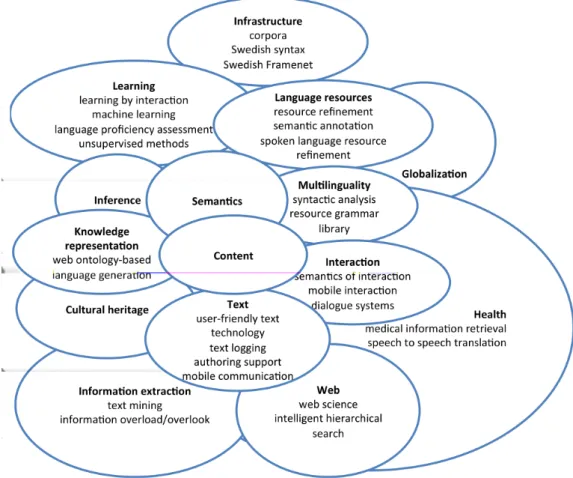
An overview of current research in LT in Gothenburg is presented in figure 2. This figure shows the diversity of topics and multi-faceted nature of LT research in Gothenburg, which is well advanced in many areas, especially of course in relation to LT for the Swedish language.2
Figure 2: Current LT research in Gothenburg
At the centre of many of the numerous research activities listed in figure 2 are
2Throughout this document, we have deliberately omitted references to publications, for
rea-sons of space. We can produce publication lists on demand, or GUP may be consulted for the group’s publications.
content andsemantics, which are increasingly becoming a central concern for a lot of our work ranging from information extraction to translation and multilin-gual applications. The unsolved research problems of language technology today are mainly those that deal with understanding of language, i.e., semantic and prag-matic processing of language, both spoken and written. Thus, work on content and semantics will form the main thrust of the plan presented in this proposal.
LT research is conducted mainly by collaborating groups from three depart-ments3representing five academic subjects: computational linguistics, natural lan-guage processing, computer science, general linguistics and theoretical philoso-phy. We are also in the process of increasing involvement by colleagues from other disciplines, who are interested in using LT as a research tool in their own area of specialization (eScience), or who are interested in LT as one of several options for human-computer interaction (interaction design).
Much of the LT research that we conduct in Gothenburg can be seen as falling into three overlapping and interacting areas, each of which is distributed across the departments where LT research is pursued. These are:text technology and lin-guistic data resources, grammar technology and linguistic theory and dialogue technology and spoken interaction. The relationship among the three is such that grammar, broadly construed to include semantics and theoretical linguistic analy-sis, feeds both text technology and dialogue technology, which in turn inform and guide the work on grammar technology and linguistic theory.
Recognizing this general tripartite nature of LT research in Gothenburg, we now propose to also formally organize our work along these lines, turning the three loosely organized research groups into three “labs”, the Text Technology Lab, the Grammar Technology Lab and the Dialogue Technology Lab. We will present more detail about our ongoing and planned research using this perspective below in section 4.
3
Plans for strengthening the area
The plan for strengthening the area comprises the following elements:
• the establishment of interdisciplinary thematic research groups (“labs”), as outlined in the previous section and detailed in section 4 below, administra-tively placed within an interdisciplinary Centre for Language Technology (CLT). One of the advantages of organizing our work in the way we are proposing is that we will be able to track developments in the three areas in a way not previously possible and make strategic decisions based on this
3(1) Department of Computer Science and Engineering, Faculty of the IT University,
Uni-versity of Gothenburg and Chalmers UniUni-versity of Technology; (2) Department of Philosophy, Linguistics and Theory of Science, and (3) Department of Swedish Language, both the latter in the Faculty of Arts, University of Gothenburg.
information. An important practical aspect of this organization will be the creation of permanent research engineer posts (two full-time equivalents) to support the computational implementation work in all three labs;
• the creation (and maintenance) of a “CLT toolkit”, a set of mutually and ex-ternally compatible state-of-the-art open-source LT tools and accompanying linguistic resources, which we expect will be of great help in speeding up LT prototyping efforts and generally in avoiding duplication of effort in our research. The toolkit will in part be based on existing tools that we have developed such as the Grammatical Framework (GF) in the grammar group and the dialogue system toolkit TrindiKit in the dialogue group as well as corpus enhancement and analysis tools developed within the text group. Part of our effort will be devoted to increasing compatibility between these various software tools so that they can be used together;
• the continuation of the CLT seminar series (featuring both local and guest researchers). This series was started with a one-time allotment of strategic funds from the University in 2007 and is ongoing, but after the initial fund-ing ended, increasfund-ingly rarely with external guests;
• a yearly CLT workshop including guest researchers and guest students;
• postdoctoral research fellowships;
• PhD student fellowships. This will be especially important if GSLT (see section 5) is not able to admit new PhD students, although there will not be sufficient funds in this budget to replace GSLT’s contribution to LT in Gothenburg;
• active forming of collaborations with researchers in non-LT disciplines at the University of Gothenburg and Chalmers University of Technology, es-pecially collaborations on eScience and interaction design;
• collaborative projects with international labs, including extended visits by research personnel (see appendix B).
By attracting recent graduates from leading graduate schools to our postdoc-toral fellowships and research positions, CLT will benefit from rapid sharing of new ideas and technologies. The ability to provide funding for visiting senior re-searchers as well as research time for local rere-searchers is essential to the establish-ment of a creative and productive research centre. CLT will provide an appropri-ate infrastructure, for example, for the organization of workshops and conferences in the area. Work within CLT will be organized so as to encourage dynamic in-teractions between fundamental research projects in LT and the development of prototype applications and systems.
4
Current and future projects
Here, we present an overview of current and planned activities in the three labs, indicating existing and planned external collaborations with academia, industry and the public sector. The following table shows current external funding and submitted project proposals per lab:
Text Dialogue Grammar
Current 14 MSEK 7 MSEK 5 MSEK
Submitted 36 MSEK 13 MSEK 38 MSEK
Note that this is a snapshot of the situation as of early 2009, rather than a picture of accumulated or average external funding over time, which accounts for the apparent uneven distribution of funds across the labs. In addition, two large collaborative proposals coordinated by the text technology group are under consideration by the Swedish Research Council:
1. a proposal by the University of Gothenburg for an initiative in the strategic research area eScience, where LT takes the central place (65 MSEK over three years, including OH) (see section 4.1.2 and p. 18 below);
2. a proposal by a seven-member national consortium for a Swedish LT in-frastructure, consisting of a Swedish national corpus and a BLARK (Basic LAnguage Resource Kit) (130 MSEK over 7 years, including the then cur-rent 35% OH).
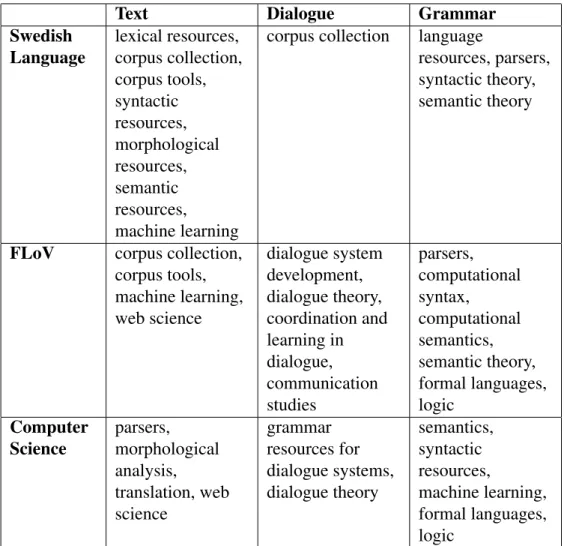
In table 1 we illustrate the interdisciplinary nature of the labs, by showing how some of the different research topics we are engaged in distribute over traditional academic subjects – represented by the Department of Swedish Language, the Department of Philosophy, Linguistics and Theory of Science (FLoV) and the Department of Computer Science and Engineering – and the research labs in this proposal.
The approximate number of refereed publications produced by the three groups over the last five years (2004–2009, as documented in GUP) are as follows:
Text technology group 60 Grammar technology group 100 Dialogue technology group 60
Below we give a brief account of some of the main research themes in each of the labs.
4.1 The text technology lab
The focus of the fundamental research in the text technology lab is on LT data resources and tools for working with large amounts of text (understood in the widest sense: transcribed speech is also to be considered text here).
Text Dialogue Grammar Swedish Language lexical resources, corpus collection, corpus tools, syntactic resources, morphological resources, semantic resources, machine learning
corpus collection language
resources, parsers, syntactic theory, semantic theory
FLoV corpus collection, corpus tools, machine learning, web science dialogue system development, dialogue theory, coordination and learning in dialogue, communication studies parsers, computational syntax, computational semantics, semantic theory, formal languages, logic Computer Science parsers, morphological analysis, translation, web science grammar resources for dialogue systems, dialogue theory semantics, syntactic resources, machine learning, formal languages, logic
Table 1: The interdisciplinary aspect of the proposal
4.1.1 LT resources and tools
Since 1975, the University of Gothenburg’s Språkbanken (Swedish Language Bank<http://spraakbanken.gu.se>) has made Swedish and other language re-sources available online to both the research community and the general pub-lic. Språkbanken possesses a unique combination of competences in the areas of Swedish text corpora, parallel text corpora, Swedish computational lexicons and LT tools for the processing, annotation and presentation of text corpora. These competences are made even more effective by being coupled with the kind of sta-ble organization required for sustained large-scale corpus processing and presen-tation. Over the years Språkbanken’s corpora and lexicons have been widely used for research, teaching and other related purposes. In particular, a good number of PhD theses in Sweden and Finland have used Språkbanken as a data source.
4.1.2 eScience
A prominent application area of the research in the lab is eScience, understood here as the use of LT-based methodologies and tools for working effectively with large amounts of digitized text as primary research data, as in many humanities and social sciences disciplines. Much of the LT research in the lab and in Gothen-burg in general can potentially be applied for this kind of eScience.
Corpus linguistics – eLinguistics
The language sciences have long made use of LT as a research tool in the form of corpus linguistics, whereby large digital text collections (corpora) are made searchable via linguistically relevant search criteria. During the 1960s Gothen-burg became a pioneer in Swedish corpus linguistics by compiling Press-65, one of the first large electronic text corpora in a language other than English. The ap-proximately 200 MW corpora now available online in Språkbanken have since the mid-1960s been used in research in computer-based lexicography and lexicology. Many of the recent large Swedish published dictionaries have been worked out by lexicographers at Gothenburg. A notable recent focus in our research are corpus-based studies of learner (second-language) Swedish and LT-informed corpus-corpus-based applications in the area of computer-assisted language learning.
The Department of Philosophy, Linguistics and Theory of Science maintains an extensive set of spoken language corpora, which have served as the basis for numerous studies of spoken language phenomena. They have also been used for comparing the properties of written and spoken language. Approximately 60% of the corpora are video recorded, making them an interesting data source for the study of multimodal communication. Along these lines, several studies have been conducted on the relationship between gestures and spoken language that have strongly influenced current research on Embodied Communication at the Zentrum für Interdisziplinäre Forschung at Bielefeld University, Germany.
Also at the Department of Philosophy, Linguistics and Theory of Science is the SweDia 2000 dialect database. The database consists of recorded speech material from 107 Swedish dialects (1200 speakers, 750 hours recording time). The record-ings were made as a joint effort by the departments of linguistics at Umeå, Stock-holm and Lund universities in 1998–2002. It has long been used as an eScience resource resulting in more than 70 publications. There are several fundamental scientific questions that may be addressed in a fruitful way by an analysis based on data of the kind contained in SweDia. The SweDia database is now hosted by the department, and work is in progress to develop the database further as an eScience resource.
Life sciences
Research on applying LT in the life sciences domain has been a focus of research at the Department of Swedish Language during recent years. The research is based on authentic text material, both clinical narratives and scientific medical content. In the medical setting, for instance, vast amounts of health-related data are con-stantly collected. These data constitute a valuable source of primary research ma-terial; however, to empower clinical researchers to locate and make highly efficient use of the knowledge that is encoded therein, the material must be better inte-grated and linked via effective automated processing. Such advanced capabilities would facilitate the construction of hypotheses based upon novel associations be-tween extracted information, the undertaking of retrospective studies based upon patient narratives, drug discoveries, the early detection of adverse drug events, the improvement of searching and browsing capabilities, and the like. It would also provide a more focused and effective means of searching and collecting patient-related information from unstructured text – a process that is currently restricted by language-inherent complexity, variation and ambiguity.
Gothenburg has an established network of academics and professionals, both in Sweden4 and in Europe,5 that are actively interested in issues related to this
field. Recently, the Swedish National Board of Health and Welfare (SoS) and Gothenburg’s LT researchers have begun to collaborate on a one-year SoS-funded research project to transform a large archive of scientific medical text material into a format that is suitable for text mining. This material is annotated with a systematically organized computer processable collection of medical terminology known as SNOMED CT (the Systematized Nomenclature of Medicine – Clinical Terms). Plans are also in the works to establish a competence center for clini-cal language technologythat will supply clinical researchers in academia and the pharmaceutical industry with LT tools and services that are customised to meet different individual needs.
Web science
An important aspect of LT is the way in which it connects to other, more visi-ble, technologies. In particular, we have reason to believe that LT will become increasingly important to web technology, making the web seem smarter, more interactive, more conversational, and more sensitive to the information needs of people with a first (and perhaps only) language not so widely used.
4Sahlgrenska University Hospital, the AstraZeneca pharmaceutical company, the Swedish
Na-tional Board of Health and Welfare, the Swedish Association of the Pharmaceutical Industry, DSV/KTH-Stockholm University.
5The National Centre of Text Mining, Manchester, UK and the NCSR Demokritos, Athens,
The web is currently largely made up of linked documents, often text docu-ments. Language technology may add value to the web by extracting some form of meaning from the human-readable text of the pages, based on rules or statis-tics – meaning that can make search more effective, or help building the semantic web, a web made up of linked data.
In line with the general interest in LT-based eScience, the Department of Phi-losophy, Linguistics and Theory of Science has recently formed a group approach-ing the emergapproach-ing field of Web Science from an LT perspective.
4.1.3 Planned research activities Fundamental research
The planned fundamental LT research in the lab will have as its centerpiece the creation of a full-scale computational lexical resource for modern Swedish – and to some extent earlier forms of Swedish, primarily the 19th century language – with rich semantic, syntactic and morphological information (“Swedish Frame-Net++”). We see this as a necessary core component for the development of methodology and tools for automatic semantic annotation of text. Further, this work will allow us to explore various corpus-based lexicon creation methodolo-gies, mixing the manual – which we master almost to perfection, but which is prohibitively labor-intensive – with experimental resource-economical machine learning approaches. This research will be conducted in collaboration with the grammar technology lab.
Applications
The main application areas that we wish to initiate or develop further in the lab are the following:
• language resources and language technology tools used for eScience and Web Science, in particular in linguistics and in medicine and other life sci-ences (as outlined above), but also in history and literature (see under Ex-pansion beyond LTon p. 18 below)
• text generation in the cultural heritage domain (in collaboration with the grammar technology lab and the Gothenburg City Museum)
4.2 The grammar technology lab 4.2.1 Grammar engineering
LT research at the Department of Computer Science (CS) started in 1997 with a Logic and Language seminar joint between CS (Bengt Nordström) and Linguistics (Robin Cooper). The interest on the CS side was mainly within the Programming Logic group, which had been working on Type Theory and the foundations of logic and programming languages since the late 1970s. The LT group was formed in 2001, at the initiative of Nordström together with Aarne Ranta, who had joined CS in 1999.
The Grammatical Framework (GF) was first created in 1998 when Ranta work-ed at Xerox Research Centre Europe; its purpose was to build systems that work on a language-neutral semantic content (expressed in Type Theory) with views in different natural languages. In GF, it is possible to translate semantic content between languages without loss of meaning. In addition to this, Type Theory also provides a model for human-computer interaction, which was later worked out into a mathematical model for dialogue systems as well.
A specific mission of the LT group at CS has been to make LT accessible for programmers without linguistic training. We see that LT in itself is seldom interesting for end users – but LT as a part of a larger system can add a lot of value to it. As a proof of this, the LT group has had joint projects with many other research groups at CS:
• Programming Logic: type-theoretical semantics, user interfaces for theorem provers.
• Functional Programming: tools for language design and implementation.
• Formal Methods: authoring tools for software specifications, automated the-orem proving in semantics.
• Software Engineering: grammars as software libraries. 4.2.2 Authoring support
The development of parsing techniques for the study of syntactic deviations in text as a support for language development of school children is the focus of research by Sylvana Sofkova Hashemi. The main goal of her research includes the devel-opment and adaptation of different tools and language resources that will support better the writing development and writing education in school, the exploration of keystroke logging tools as a didactic support and for language checking. She is also interested to study collective and collaborative writing in web 2.0 tools and the impact on language development and education.
4.2.3 Syntactic theory
Work on syntactic theory and particularly on the syntax of Swedish is carried out mainly in the Department of Swedish Language (Elisabet Engdahl). There has been a focus on the syntax of information structure and the use of syntactic struc-ture in dialogue. There is considerable work on the use of corpus materials and the appropriate way to enhance them with syntactic information as well as work on current grammatical theories such as Head Driven Phrase Structure Grammar, Dependency Grammar and Optimality Theory.
4.2.4 Semantics
Work on semantics is distributed among philosophers and linguists at the De-partment of Philosophy, Linguistics and Theory of Science (Robin Cooper, Björn Haglund, Dag Westerståhl) as well as the Department of Computer Science (Aarne Ranta). In addition, work specifically on lexical semantics is being conducted in the Department of Swedish Language. There is a concentration of work go-ing back many years on formal semantics usgo-ing logical techniques of various kinds (classical model theory, type theory, situation theory and type theory with records). There is a particular concentration on generalized quantifiers (quanti-fier expressions in natural language other than those found in classical logic), and other phenomena that go beyond standard first order logic (such as intensionality). There has also been a considerable amount of work on compositionality and dy-namic semantics, including the development of semantic theories to account for learning and interaction.
4.2.5 Planned research activities Fundamental research
One focus of fundamental research over the next few years is the development of wide coverage grammar applications that can handle free text. This applies both to syntactic and semantic coverage. A second focus, related the first, is the de-velopment of algorithms for systems that can learn incrementally from linguistic input.
Applications
The main application areas that we wish to initiate or develop further in the lab are the following:
• the extension of the GF Resource Grammar Library from 12 to 30 lan-guages, including the 23 official EU languages; this will be done by co-ordinating an international open-source effort, including a series of summer schools;
• the development of a large-coverage parsing grammar for some languages of the Resource Grammar Library, starting with Swedish; this will be done in collaboration with Språkbanken and the Text Lab;
• the development of tools for multilingual on-line translation based on Se-mantic Web ontologies and the Resource Grammar Library; this will be done in international collaboration, possibly within a European consortium (we coordinated an FP7 proposal MOLTO, “Multilingual On-Line Transla-tion”, submitted in April 2009);
• research on combining statistical and grammar-based translation methods, partly based on the use of word alignment data generated from multilingual GF grammars;
• research on robust parsing, based partly on statistical methods and partly on fuzzy matching between strings and abstract syntax trees, with results to be evaluated in the mentioned large-coverage grammars and also in systems built in the dialogue lab;
• the development of software engineering tools to support grammar applica-tion programming; one of the research engineers to be employed will play a key role in developing e.g. an IDE (Integrated Development Environment);
• authoring support for non-adult speakers of Swedish;
• general computational semantic tools giving deep analyses of constructions which are not covered by first order logic.
4.3 The dialogue technology lab 4.3.1 Dialogue systems
Spoken dialogue (between humans) has been an important research topic in Goth-enburg linguistics since the establishment of linguistics as a separate discipline in the 1970s. In the late 1990s Gothenburg began to profile itself internation-ally as a centre for dialogue systems research in the context of a series of EU-funded projects (through the work of Robin Cooper, Staffan Larsson and their co-workers). Today, Gothenburg is a main player in the international dialogue systems research community, and (together with Edinburgh and Saarbrücken) one of the main European research centres in the field. Since the early 00s, dialogue systems research in Gothenburg is largely coordinated within the Dialogue Sys-tems Lab, which conducts interdisciplinary research on the theory and practice of dialogue systems. Research in the dialogue lab has had significant impact on the field of dialogue systems research both in the form of theoretical contribu-tions such as the Information State Update approach to dialogue management and Issue-based dialogue management, as well as software in the form of the TrindiKit toolkit for dialogue systems R&D and the GoDiS dialogue system. The latter is currently being commercialised by spin-off company Talkamatic, in cooperation with Volvo Cars.
4.3.2 Applied speech technology
The phonetics section of the department of Philosophy, Linguistics and Theory of Science has a small but very active research group in the area of applied speech technology, and more specifically forensic phonetics. (Anders Eriksson, Jonas Lindh) The two major technologies are automatic speech recognition and automatic speaker recognition (in forensic case work the term now used by us is forensic speaker comparison) and the merge in between those.
4.3.3 Mobile communication studies
Researchers at the department of Applied IT are currently in the process of gath-ering previous research efforts around mobile communication into one coherent
research agenda. They explore aspects of human communication mediated by mo-bile technology. This involves the collection and detailed analysis of both written and spoken communication on and through mobile devices. The aim is to advance our knowledge about communication in mobile activities. Ylva Hård af Segerstad and Alexandra Weilenmann have for the last 10 years worked with different as-pects of mobile communication.
Hård af Segerstad has focused on text-based interaction through mobile phones (text messaging, or SMS). Data from text messaging has been gathered in two sets of corpora. The technology used for text input (e.g. predictive text technology) is one of the factors which influence language use and communication patterns in text messaging.
Weilenmann has focused on interaction on and through mobile devices, and particularly on oral communication. Conversational and ethnographic data has been collected in a number of fields, both leisure and work related.
4.3.4 Planned research activities Fundamental research
An important next step in our work on dialogue is to develop theories of how hu-mans coordinate their language and learn new language through interaction. We aim to investigate the possibilities of adapting machine learning techniques (cur-rently oriented towards training on large datasets) to incremental learning on the base of input gained from dialogic interaction. One of the promises of this re-search, as well as of related research in the area of in-vehicle dialogue systems, is the development of adaptive dialogue systems which put less cognitive stress on their users. Another goal is to make a connection between our work on speaker comparison and dialogue systems, so that, for example, systems can recognize users by their speech from among a small number of users registered with the sys-tem. A further goal is to develop methods and tools for capturing and analysing linguistic interaction involving language technologies (dialogue systems and mo-bile communication technologies).
Applications
The main application areas that we wish to initiate or develop further in the lab are the following:
• dialogue systems that can adjust their language to users
• dialogue systems that can learn language from users
• systems that can differentiate among speakers by examining phonetic and possibly other properties of their language
• tools and methods for analysing mobile communication and dialogue sys-tem interaction
Summary
As a summary we take up the five LT development areas which we introduced on p. 3 and indicate how our work in the labs addresses them. Some of the planned work continues threads which have already been developed in Gothenburg. Some of it represents innovative work in areas that are new to us.
wide coverage systems We are no strangers to dealing with large amounts of lin-guistic data and there is a long tradition in the work associated with the text technology lab of both data collection and data analysis. However, the work associated with the grammar technology lab has been largely rule-based and focussed on detail rather than wide coverage. While we have started scaling up this work, notably in the collaborative effort on functional morphology using work from both labs, there are still many challenges to be met. We believe, however, that the future of the field lies in the application of the kinds of detailed theory-based methods used in previous work associated with the grammar technology lab to the broad coverage statistical methods for shallow analysis in use today.
linguistic resources and tools While we have considerable experience in the de-velopment of linguistic resources and tools, there is still a great need of development in this area in respect of Swedish and the other languages of Sweden. While we have made a significant start on Swedish there is still a lot of new work to be done and other languages in Sweden are in even greater need of resources.
semantics There is a tradition of detailed theoretical work on semantics in Goth-enburg some of which has been applied to small scale rule-based applica-tion. In the proposed CLT organization this work will be associated with the grammar technology lab. There are, however, important aspects of seman-tics, particularly lexical semanseman-tics, which are associated with the work of the text technology lab and the dialogue technology technology lab. New techniques are emerging for connecting this kind of work to the shallow statistically-based techniques currently used in the kind of semantics which has been developed in LT over the past 3–5 years. There are still important conceptual challenges to be met in relating these two strands of work and Gothenburg is perhaps one of a handful of research centres in the world where there is sufficient expertise and interest in order to carry out the in-vestigation. One of the keys, we suspect, is the relating of machine learning techniques to semantic analysis.
machine learning Work associated with the dialogue technology lab has recently begun to move in the direction of using ML techniques to create dialogue systems that will learn new language from interaction with users. This rep-resents a new departure for our research and will involve a departure from
the standard ways in which ML techniques have been developed. ML stan-dardly involves “batch learning”, that is, the presentation of large amounts of data to a machine equipped with a learning algorithm which as a result acquires a system capable of performing a certain task. This kind of learn-ing is in contrast to human learnlearn-ing and the kind of learnlearn-ing needed for dialogue systems which learn from interaction. The new kind of learning is “incremental learning” where a small amount of data (even a single da-tum) will provide the machine with a hypothesis which it can immediately test by interacting with the user. User feedback will provide evidence as to whether the learner’s hypothesis was correct or not. A measure of success in incremental learning might mean that machines could learn more efficiently and would not need to be fed with large amounts of collected data. This is innovative work which represents a new direction for us (and for most other work in ML).
expansion beyond LT LT has now reached a stage of maturity that it can present itself as a tool for the use of other disciplines. The recent initiative in eScien-ce coming from work associated with the text technology lab shows that this development is feasible (independent of whether the particular current initiative secures funding). Our experience in the past has been that it is a non-trivial matter to get people from other disciplines to understand what LT researchers actually do. Language is something that is normally taken for granted and it is difficult for people outside the discipline to understand what the basic problems are in language processing. However, our initial work is beginning to pay dividends we feel and we could be about to embark on a period of new collaboration and understanding of the relationship of our research to other disciplines. A cross-disciplinary seminar series (Thesis Antithesis Prosthesis: Posthuman perspectives on language technologies; see <http://www.ling.gu.se/projekt/tap>) was funded by the Faculty of Arts from 2005 to 2008 and attempted to extend the interface of language technology (in a wide sense) to the humanities in general. In the eScience initiative, we have now been able to involve a number of relevant “early adopters” in various fields outside LT and Linguistics, such as Literature, History, Political Science, Education and Medicine, in some cases reflecting already existing collaborative projects or existing advanced plans for such projects. This represents a new opportunity which we are eager to pursue in the future. At the present time, one very important platform for doing this – at least on the European level – is the ESFRI CLARIN network <http: //www.clarin.eu>, where the text technology lab is represented (both by Språkbanken and the SweDia group).
5
Relationship to teaching
Since LT is a young and fast developing field where technology and methods can change rapidly from one year to the next, it is important that there be a close con-nection between research and teaching. This has meant that our teaching often in-volves the presentation of new research and students get an opportunity to become involved in work related to our current projects. It also means that our courses are revised from year to year depending on input from students, our industrial con-tacts and research developments. LT researchers at the university collaborate on degree programmes at all three levels: undergraduate, masters and PhD. There is a joint undergraduate programme in LT, coordinated by the Department of Philos-ophy, Linguistics and Theory of Science with contributions from the Department of Swedish Language and the Department of Computer Science. LT figures as a specialization in the masters degree in Computer Science which is run by the De-partment of Computer Science. The DeDe-partment of Philosophy, Linguistics and Theory of Science coordinates the national Graduate School of Language Tech-nology (GSLT) which, since its beginning in 2001, has provided the bulk of our funding for PhD students in all three departments (in addition to providing fund-ing to departments in other Swedish universities who provide graduate trainfund-ing in LT). The most recent GSLT intake was in 2008 and subsequent intakes depend on the school securing future funding. GSLT’s Academic Board (which includes three of the senior scientists involved in this proposal) is actively concerned with raising awareness of the GSLT’s crucial role in a national strategy for PhD level training in LT. (See Appendix C.) GSLT is currently actively pursuing possibilities for national training in LT at the masters level (see Appendix D). An important component in this is making LT courses available using web distribution (possibly including iTunes U now that it is available to Swedish universities) and distance learning technology and GSLT is currently working on making its courses avail-able in this way.
6
Dissemination strategy
The main dissemination strategies are: national, including Scandinavian, and in-ternational conferences, submission to peer-reviewed journals, end-user and pub-lic events, press releases, an information/open day workshop and the CLT and språkteknologi.se websites. In addition, our resources and tools will be distributed according to an open source policy whenever possible. The dissemination strategy will be continuously reviewed and refined until the end of the envisaged three year period. All members of the various CLT groups will be actively involved in this. 6.1 Objectives and instruments
The general objectives of the dissemination strategy plan are:
• to exploit the existing CLT infrastructure (tools, show cases, demos).
• to promote and publicize more the already developed CLT tools, encourag-ing as many (e)scientists as possible to start a dialog with CLT and partici-pate in CLT activities (academic dissemination)
• to exploit the links of the CLT members with other researchers in the area of eScience
• to identify new targets and develop new partnerships for all the applications related to CLT group members
• to intensify cooperation with industry partners for implementation in prod-ucts and services enabling the transition of academic thinking into industry thinking
• to engage relevant policy makers both at the local (university level) as well in the industrial and public sectors to CLT activities
• to form an advisory board with professionals from the academia (at the national and international level), industry and society
The dissemination strategy will be continuously refined until the end of the three year period taking into account the technical progress, as well as the inputs of the potential users of our tools. We emphasize the role of the project websites which we expect to become a focus of attention among researchers in other dis-ciplines and information seekers. Furthermore, we consider open-source software resources and open-source linguistic resources as an important factor in our dis-semination plan. Thus, in the context of the disdis-semination strategy the following instruments will be used:
• enrichment of the CLT website – creating web awareness about CLT and LT in general
• attending/organizing/hosting forums, events, seminars and workshops
• demonstrations of applications
• general and individual meetings with target groups, both with the research community and the general public
• press releases
• information leaflets (in English and Swedish) to be distributed at various events
• writing academic and technical papers for national and international LT con-ferences including focused ones such as in the area of medical informatics
• papers in scientific journals
• visits by CLT members to relevant LT labs and groups
• inviting prominent members of the international LT community for short or longer term visits
We consider also the advisory board (see appendix A) as another instrument to increase the dissemination of our infrastructure and visions. We anticipate that the advisory board members will provide valuable feedback to CLT but also present and discuss their views outside the CLT group.
6.2 Scheduled activities
The scheduled activities are divided into local, national and international. The lo-cal ones include: CLT members’ participation at the International Science Festival (“Vetenskapsfestivalen”) with at least one event per year during 2009–2012; the participation (preferably with students) at the Student and Knowledge Fair “Kun-skap & Framtid” (in November every year); the creation and distribution of a flyer describing aspects of Language Technology, in particular education possibilities, success stories, LT applications; participation in the university’s Annual Report at least twice between 2009-2012 and also participation at the “Universitets-TV” and create material for the I-Tunes U and YouTube. Moreover, we plan to develop on-line and user-friendly demos and tutorials and organize annual information and open day workshops, starting by the end of this year. Web publishing in English at the university, faculty and department level will also be prioritised.
At the national level we plan to write papers for scientific publications in Swedish journals, for instance there is a scheduled paper to be submitted at the Journal of the Swedish Medical Association Läkartidningen; also popular sci-ence publications in Swedish magazines: e.g.Computer Swedenand Språktidnin-genare foreseen. We plan to participate in the Swedish Society of Medicine fair “Läkarstämma” that will take place in Stockholm at the end of November 2009 with a poster and an oral presentation.
At the international level, members of the CLT groups have already submit-ted papers (or plan to submit) papers to a number of scientific LT conferences and workshops, and a book on GF is scheduled for review by the end of the year. More-over, a GF Resource Grammar Summer School is scheduled for mid-summer 2009 and a Swedish SEMEVAL-2 (SEMantic EVALuation) task is currently scheduled for the end of 2009 – beginning of 2010.
7
Success indicators
General indicators by which to gauge the success of the research program outlined here are the following:
• project proposals (approved, submitted, “ready to go”)
• initiated and completed PhD projects
• postdoc projects
• guest researcher visits
• publications
• collaborations with industry, international labs
• collaborations with disciplines outside the LT environment
• external funding
• tool and resource usage (among ourselves; by other groups, as measured by downloads and references in research papers)
In particular it will be important for us to keep track of our development in respect of the five LT development areas we have identified in this plan:
• wide coverage systems
• linguistic resources and tools
• semantics
• machine learning
• expansion beyond LT 7.1 Milestones for 2010
For the first evaluation in the summer of 2010, additional important indicators are
• that the labs are up and running
• successful appointment of research support staff (project administration of-ficer and research engineers)
• successful initiation and evaluation of internal (including postdoc) research projects
• internal conference
• GF summer school
• SemEval
7.2 Milestones for 2011
• evaluation of internal research projects
• successful initiation and evaluation of joint ventures with international lab-oratories
• internal conference
• evaluation of impact on and support for PhD training
7.3 Milestones for 2012
• evaluation of internal research projects and joint ventures with international laboratories
• evaluation of PhD training progress
• successful initiation and evaluation of industry related projects
• internal conference
A
Organization
The research activities described in this proposal will be located to the three labs – the Text Technology Lab, the Dialogue Technology Lab and the Grammar Tech-nology Lab – but conducted within the wider context of CLT (Centre for Language Technology), where seminars, internal conferences and other events are organized on a regular basis, and which will maintain a central web site with information about language technology R&D in Gothenburg.
CLT organization
CLT will be organized as a centre (“centrumbildning”) with administrative place-ment at the Departplace-ment of Swedish Language.
The centre will have a small permanent staff, including a director (scientific coordinator) (10% of full-time; initially Lars Borin), a project administration of-ficer (50%; to be appointed), and research engineers (200%; to be appointed). The technical staff will not be physically located in one place. However, in or-der to achieve the aims of harmonizing our various LT tools and applications, of developing standards and best practices for their deployment, and generally of fur-thering cross-lab synergies, it is important that the technical staff in CLT and the three labs come together regularly on an organized basis for effective knowledge and competence transfer among the labs.
The coordination and planning of the activities of CLT will be executed by a scientific board consisting of 10 members: the director and three representatives from each of the three labs. One of their first tasks will be to make a more detailed budget for the centre. The director will chair the board and be responsible for the day-to-day administration of the centre.
We plan in addition to appoint an advisory board, consisting of nationally and internationally renowned researchers in LT and industry representatives.
Lab organization
Each lab will have two co-directors, coming from different disciplines, in order to ensure the nature of the labs as interdisciplinary research platforms. The proposed lab co-directors are as follows:
Text Technology Lab
Lars Borin, professor of natural language processing, Språkbanken/NLP, Dept of Swedish Language
Aarne Ranta, professor of computer science, LT research group, Dept of Computer Science and Engineering
Grammar Technology Lab
Aarne Ranta, professor of computer science, LT research group, Dept of Computer Science and Engineering
Elisabet Engdahl, professor of Swedish language, Dept of Swedish Lan-guage
Dialogue Technology Lab
Robin Cooper, professor of computational linguistics, Dept of Philosophy, Linguistics and Theory of Science
Bengt Nordström, professor of computing science, LT research group, Dept of Computer Science and Engineering
B
Application for funding
We divide our application into three levels corresponding to the three levels of funding:
1. Laboratory facilities and junior research support
2. Junior research support and joint ventures with other international laborato-ries
3. Research training and relations with industry
Level 1: Laboratory facilities and junior research support – 3 MSEK
The lowest level of funding (3 MSEK/year) is a fairly modest amount of money, and we plan to concentrate it on enhancing our fundamental research infrastruc-ture. Our most urgent need at this time is for the kind of basic infrastructural support which is hard to fund through individual external projects. This includes research engineers(shared equally among the three laboratories) and administra-tive assistance in managing projects and project applications. On the 3 MSEK level of funding, we can also employ one fte junior researcher (post-doc, assistant professor or lecturer). This may correspond to more than one individual, depend-ing on other available research funddepend-ing, teachdepend-ing requirements, etc.
Here and below the budget item “research support” includes travel money and other research support expenses, including funds for inviting visiting researchers/ guest lecturers. On the 3 MSEK level of funding it also includes the cost of ar-ranging an annual internal workshop.
Director (10%) 0.1 MSEK
Project administration officer (50%) 0.3 MSEK
Research engineers (200%) 1.2 MSEK
Equipment, service contracts, software licenses 0.4 MSEK Junior research support (100%) 0.7 MSEK
Research support 0.3 MSEK
Level 2: Junior research support and joint ventures with other international laboratories – 2 MSEK
On the second level of funding, we would support two additional fte junior re-searchers, the aim being to have one fte per lab (although, as mentioned above, this may in fact involve more individuals).
We would also reserve funds (included under the item “research support” in the following table) for developing long-term relationships with other national and international laboratories such as Stanford, King’s College London, Edinburgh, Oslo, KTH, Lund, again broadly within the planned research topics described in section 4 above. The relationship would involve joint ongoing projects and exchange of personnel.
In keeping with the spirit of this national and international collaboration, we will use part of the funding at this level to set up an advisory board to CLT, con-sisting of international and national researchers and members from industry (see Appendix A).
Junior research support (200%) 1.4 MSEK
Advisory board 50 kSEK
Research support 0.55 MSEK
Level 3: Research training and relations with industry – 2 MSEK
We will use money for doctoral positions (doktorandanställningar) in order to involve PhD students in our laboratories’ activities. This level of funding will be sufficient to allow us to admit a total of three PhD students for the time period covered by this budget, i.e., less than one per year on average. Thus, we will be able to compensate only in small part for the fact that GSLT funding has not been secured for the future (typically, out of the five PhD students admitted every year to GSLT, one or two would be placed at Gothenburg).
We would also extend our internal research support to include development of projects which could attract collaboration with industry.
Doctoral positions (300%) 1.5 MSEK Industry oriented research support 0.5 MSEK
C
GSLT’s document on a national strategy for higher
educa-tion in language technology
Nationell strategi f¨or h¨ogre utbildning i
spr˚akteknologi
Nationella forskarskolan i spr˚akteknologi (GSLT)
29 april 2009
I Sverige bedrivs forskning och utbildning inom spr˚akteknologi p˚a flera l¨aros¨aten, vilka sedan 2001 samarbetat i den nationella forskarskolan i spr˚akteknologi, GSLT. Finansieringen f¨or GSLT kommer fr˚an den d˚avarande regeringens sats-ningar p˚a sexton utvalda forskarskolor med G¨oteborgs universitet som mottagare och v¨arduniversitet. G¨oteborgs universitet har f¨orl¨angt anv¨andningen av den per-manenta anslags¨okningen f¨or forskarskolans ¨andam˚al fram till och med 2012. Det finns n¨ar detta skrivs inget beslut om dessa medels anv¨andning d¨arefter, varf¨or GSLT inte l¨angre tar in nya doktorander. (Den sista antagningen skedde 1 januari 2008.)
Under den tid som GSLT funnits har utvecklingen p˚a spr˚akteknologins omr˚ade varit stark. F¨orb¨attrad teknik f¨or taligenk¨anning och talsyntes har lett till ¨okad praktisk anv¨andning inom omr˚aden som kundtj¨anster, undervisning och tillg¨anglighet. F¨orb¨attrade metoder f¨or analys av inneh˚all i text till¨ampas in-om in-omv¨arldsbevakning och s¨okning, och framsteg p˚a ¨overs¨attningsteknologins omr˚ade har m¨ojliggjort en snabbare utveckling av ¨overs¨attningssystem f¨or nya spr˚akpar och samtidigt lett till kraftfullare datorst¨od f¨or lokalisering och ¨overs¨attning av programvara och dokumentation. Nya tekniker bygger p˚a en kombination av specialistkompetenser som f¨orut saknat gemensamma problem och m¨otesplatser.
Denna utveckling ¨ar p˚ataglig ¨aven i Sverige. En nyligen genomf¨ord studie vid Uppsala universitet r¨aknade till 47 spr˚akteknologiska f¨oretag i Sverige varav m˚anga startats under de senaste ˚aren. Flera av dessa f¨oretag har GSLT-doktorer
0 2 4 6 8 10 12 14 16 18 2000 2001 2002 2003 2004 2005 2006 2007 2008 2009 ej GSLT delvis GSLT GSLT
Figur 1: Intagning till forskarutbildning med spr˚akteknologisk inriktning, 2000–09 anst¨allda eller i ledningen. Av 19 f¨ardiga doktorer fr˚an GSLT ¨ar i dag 11 st verksamma inom universitetsv¨arlden (varav 3 i utlandet) och 8 st i n¨aringslivet. GSLT har under perioden 2001–2008 svarat f¨or merparten av doktorandfinansie-ringen inom spr˚akteknologi. Det ¨ar d¨arf¨or angel¨aget att formulera en nationell strategi f¨or den h¨ogre utbildningen och forskningen inom omr˚adet. Figur 1 vi-sar antagningen av doktorander med spr˚akteknologisk inriktning under perioden 2000-2009 f¨ordelat p˚a antagningar som finansieras av GSLT och s˚adana som finansieras med andra medel. Forskarstuderande inom spr˚akteknologi har varie-rande bakgrund, f¨orutom spr˚akteknologi f¨orekommer datavetenskap, informatik, lingvistik, kognitionsvetenskap, filosofi och spr˚ak¨amnen.
Det nationella samarbetet inom GSLT har av b˚ade doktorander och forskare bed¨omts bidra till en kraftig kvalitetsf¨orb¨attring av forskarutbildningen i Sve-rige. Detta vidimeras i H¨ogskoleverkets rapport ”Utv¨ardering av 16 nationella forskarskolor”(Rapport 2008:16 R) som ocks˚a framh˚aller (sid. 108) att GSLT utvecklat forskarskolekonceptet och “p˚a ett ganska unikt s¨att, ˚astadkommit en nationell kraftsamling inom sitt omr˚ade”. F¨or att kunna bibeh˚alla och utveckla kvalit´en p˚a nationell niv˚a med nya generationer av forskare beh¨ovs en kritisk massa av doktorander som antas till forskarutbildning och bildar nya n¨atverk.
Vi bed¨omer att det kr¨avs minst fem nya forskarstuderande per ˚ar i Sverige f¨or att kunna h˚alla utbildningen internationellt konkurrenskraftig med regelbunden kurs- och seminarieverksamhet.
Vi anser vidare att en nationell strategi f¨or forskarutbildningen b¨or kombineras med en motsvarande strategi f¨or utbildningen p˚aavancerad niv˚a(master- och ma-gisterutbildning.). M˚alet b¨or vara att ˚atminstone 25 studerande ˚arligen p˚ab¨orjar en s˚adan utbildning med specialisering i spr˚akteknologi. Dessa studenter, som kan ha sitt huvud¨amne i datavetenskap, lingvistik, fonetik, kognitionsvetenskap eller annat relevant ¨amnesomr˚ade, kan vara f¨ordelade p˚a olika masterutbildningar p˚a de deltagande universiteten, men via det nationella spr˚akteknologiska n¨atverket, ta del av specialiseringskurser p˚a h¨og niv˚a.
GSLT:s ledningsgrupp
Robin Cooper, ordf Professor i datalingvistik G¨oteborgs universitet Lars Ahrenberg Professor i datorlingvistik Link¨opings universitet Lars Borin
Professor i spr˚akvetenskaplig data-behandling G¨oteborgs universitet Rolf Carlson Professor i talteknologi KTH S´andor Dar´anyi
Universitetslektor i biblioteks- och informationsvetenskap
H¨ogskolan i Bor˚as
Joakim Nivre
Professor i datorlingvistik
Uppsala universitet, V¨axj¨o univer-sitet
Bengt Nordstr¨om
Professor i datavetenskap Chalmers Tekniska H¨ogskola
Pierre Nugues
Docent i datavetenskap Lunds universitet
National Masters School in Language Technology
∗GSLT
May 19, 2009
Introduction
Sweden is a relatively small country and competence in language technology is spread over a number of academic institutions which have been gathered together in GSLT, the national graduate school of language technology. GSLT would now like to propose that a nationally coordinated “masters school” in language technology would offer the possibility of combining the advanced training competencies of various institutions, thereby creating a critical mass of students taken from a broad range of subjects. This will increase the possibility of attracting both national and international students to a greater degree than is possible with our current national graduate programme where commitment to a four year research degree makes it difficult to admit students who are unknown to us or who have not yet be able to show their research potential in this field through an undergraduate degree. Our proposal is that each collaborating site would have its own masters programme in language technology which would then draw on the resources, mainly courses, of the national school. In this respect the organization would be similar to that of PhD studies in GSLT where each student is registered and examined at her home organization but takes part in courses and other activities organized by the national school. It does not seem feasible that several universities in Sweden could individually attract the numbers of students needed to make a viable masters programme in this specialist area or provide the breadth that is necessary for an internationally competetive programme. We believe that a national masters school would solve this problem and allow individual universities to exploit their specialist
∗Contact people: Lars Ahrenberg (Link¨oping), Robin Cooper (G¨oteborg), Olov Engwall
profiles within the area while sharing national resources in a way that would make smaller numbers of students registered in the local masters programmes an economically feasible proposition.
Opening the Masters courses to students from other Bachelor’s programmes (and countries) is expected to attract more students from a wider range of backgrounds than is currently possible with the current degree structure.
Overview
Name of the school The name of the school shall be Masters School in Natural Language Technology (Mastersskola i Spr˚akteknologi).
Content and goals Natural Language is becoming more and more important in IT applications. Some key areas are:
• extracting information from documents on the web
• producing documentation to products and systems in a multilingual en-vironment
• localization of software to different languages and cultures
• speech-based communication with computers and also small devices (e.g. embedded in the car or home)
The goal is to provide a combination of courses that make it possible for students with an appropriate background to specialize in natural language technology. The specialization can be profiled towards computational linguistics or com-puter science, and towards a career in industry or academic research. There will, however, be a significant number of common, obligatory courses.
Number of credits The school will support two year programmes which carry 120 ECTS credits.
Targeted students Courses will be taught in English and aimed at the in-ternational student community. The programme will be open to students with
a background in language technology/computational linguistics, computer sci-ence, cognitive science and, with appropriate prerequisites, general linguistics, modern (or ancient) languages, philosophy and mathematics.
Detailed description
Degree structure and course content
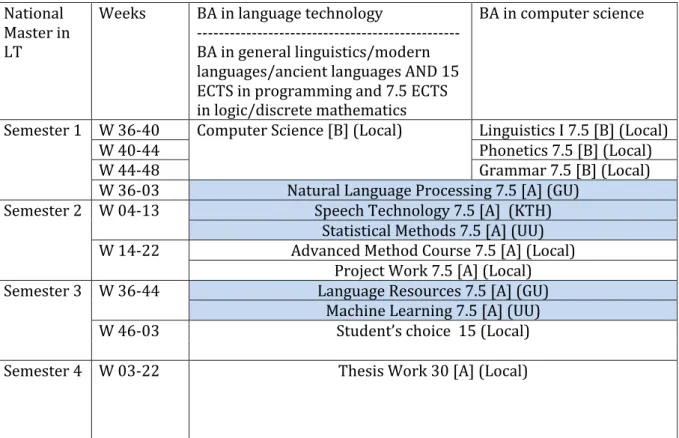
A typical curriculum that the school would support has four semesters of study each of which corresponds to 30 ECTS credits. The first three semesters will normally have four courses each carrying 7.5 ECTS credits. The final semester will be devoted to the writing of a thesis (30 ECTS credits). Students are required to take 90 ECTS course credits (45 ECTS credits at level 2, 15 at level 3) and 30 ECTS credits of thesis work. A typical recommended study programme would be:
Semester 1:
Natural Language Processing (national, level 1)
A natural language oriented programming course (local/national, level 1) Advanced methods course (local, level 1)
Linguistic resources (national, level 2)
Semester 2:
Speech Technology (national,level 1) Statistical Methods (national, level 2) two more level 2 courses
Semester 3:
Two level 2 courses `a 7.5 ECTS credits One level 3 course `a 15 ECTS credits
Semester 4:
Thesis (30 ECTS credits)
Prerequisites for the courses
Students with an undergraduate degree in language technology, computational linguistics, cognitive science or computing science would be eligible to apply for level 1 courses without further prerequisites.
Students from general linguistics, languages, philosophy, mathematics and nat-ural sciences are eligible , with the additional prerequisite of 15 ECTS credits in programming and 7.5 ECTS credits logic and/or discrete mathematics. Examination and forms of study
Teaching will be largely web-based using technology such as Marratech, Google applications and Second Life, and will, in addition to traditional lectures de-livered on the web, consist of “hands-on” lab-based exercises and projects with a problem-based orientation. The examination of courses will be a mixture of traditional examinations, course papers, practical lab exercises and program-ming projects. There will also be opportunities for students to meet physically, normally at least for initial and final sessions of courses.
Connection to research
All of the departments involved in this school are actively involved in exter-nally funded research at both the national and European level and regularly collaborate with each other on such projects. Good masters students will be encouraged to relate their work to these projects.
Market demand for graduates
Language Technology is a rapidly growing area which creates a demand for experts internationally in both industry and research.