AUTHORS: KARel CeRny, MD,SR-CRA, MeDiCAl ADviSOR, SGS life SCienCe SeRviCeS
RObeRT linS, MD, PHD.,MAnAGinG DiReCTOR, SGS life SCienCe SeRviCeS
fAbienne GOeTHAlS, PHARMD., HeAD PROjeCT MAnAGeMenT & MOniTORinG PHASe i, SGS life SCienCe SeRviCeS
eARly PHASe STUDieS in PATienTS
A MUlTiCenTeR APPROACH OffeRS new OPPORTUniTieS wiTHin enlARGeD eU
Experience shows that efficiencies can be found in the early stages of clinical trials, by implementing subject recruitment strategies at the very start of the project planning, through proper country and site allocation and selection. For instance, conducting early phase trials, FIH and Proof-Of-Concept (POC), as multicentre studies can provide significant advantages for finding the right target population and improving recruitment. Using recent experience and case studies, this paper
details the specific benefits of coordinating sites within eastern and western EU countries for early phase trials. For example, the extremely fast authorisation time lines in some western EU countries for FIH and complex study protocols, combined with the high recruitment rate of eastern EU countries (frequently several times higher than average) for in-patients early phase studies, provides strong evidence for the benefits of this multicentre, multi-country approach.
The case study sets an example of the Czech Republic, which joined the EU five years ago. The country’s legal and regulatory environments have been fully harmonised for conducting clinical trials in accordance with ICH-GCP standards. In the Czech Republic and other eastern EU countries, also outside the European Union, high quality early phase trials in patients are becoming increasingly common and an integral part of successful drug development plans.
SUMMARy
The costs of developing a new drug are continuously rising. Additional factors, such as stricter regulations and
stronger global competition, also create major challenges for the pharmaceutical industry. In today’s highly
competitive market it is critical to optimize drug development programs through better and faster go-no-go
decisions. Obtaining more information about a drug candidate, in less time, is the driving force behind many
clinical trial decisions. In the same vein, more First-In-Human (FIH) clinical trials are being conducted in-patients,
and recruitment of targeted populations further compounds the challenges of meeting development timelines.
leSSOnS fROM THe fielD
As in many other industries, clinical research quickly picked up on the trend of globalization, making early phase trials on an international multicentre level not only possible, but necessary in some circumstances. Over the last 30 years SGS has helped lead the way in many of the early phase clinical trial developments, gaining extensive experience recruiting multiple kinds of subjects for early phase trials, including healthy volunteers, specialpopulations, and patients. In addition, in the last six years, SGS has performed 500 trials, of which one third were FIH trials. As more special populations and patients were needed for some of the more complex early phase trials, the challenge of enrolment extended beyond the capabilities of just one Phase I unit, and it became necessary to switch the project to a multicentre design.
In such cases that require multiple centres in multiple countries, then the new eastern EU countries offer interesting opportunities. The case study outlined below is a prime example of how combining a country with longer regulatory approval times, but high recruitment potential (Czech Republic) with a country that has quick regulatory approval but smaller recruitment potential (Belgium) can be an extremely successful clinical trial model.
A CASe STUDy
This case study is based on a clinical trial which was an open-label, single-dose, sequential dose-escalation study of new biological treatment in patients with rheumatoid arthritis (RA). It was the first administration in humans for this particular Investigational Medicinal Product (IMP); due to the nature of the study drug it was not tested on healthy volunteers but directly into RA patients. There were several dose escalating groups and the IMP was administered as a single intra-articular injection to the target knee joint. Because this was the first administration in humans, subjects stayed overnight in the hospital after the IMP’s administration for safety monitoring. An international Safety Review Committee was convened to evaluate the safety and tolerability of the IMP within cohorts and allowed dose escalation into subsequent dose cohorts. Patients were required to complete 8 study visits. A total of 42 patients were needed to complete the study.
The study had rather challenging inclusion/exclusion criteria, with subjects with active RA currently treated by another biological therapy excluded. There were several notable organizational requirements: disease activity
assessments, joint ultrasonography, MRI evaluations. Induction of anti-IMP
antibodies, several arthritis biomarkers and PK samples were needed to be tested. Besides the obvious primary safety objectives of the FIH trial, the early phase trial also included several secondary efficacy objectives as well. SGS first set-up the study as a mono-centric trial in Belgium where Health Authority (HA) approval was obtained within 15 days after submission, allowing an immediate start of enrolment. However, due to rather complicated study specific criteria and a lot of ongoing
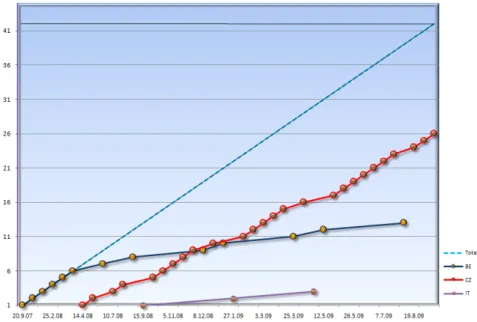
competitive trials in the same therapeutic area, the recruitment fell below the planned objectives. Consequently, SGS switched to an international multicentre design and initiated five additional clinical sites in the Czech Republic (four sites) and in Italy (one site).
This study design change had a crucial impact on the study progress and solved the enrolment challenges of the single centre design. The study enrolment data is showed at the following dynamic graph in Figure 1.
Key ReASOnS fOR SUCCeSS in THe CzeCH RePUbliC
fiGURe 1: OveRview Of STUDy enROlMenT by COUnTRy AnD TOTAl
There are a number of things that made this clinical trial successful in the Czech Republic, but in the end they boil down to six distinct points:
Well organised healthcare system
with functional referral network Investigators with extensive
therapeutic experience
High level of local involvement in
clinical research and good GCP literacy
Clinical sites provided with
appropriate equipments Regulatory and ethical approvals
within 60 days (up to 90 day in case of biotech IND)
SGS clinical operations based locally
provided with excellent knowledge of local health care environment
COUnTRy ATTRACTiveneSS inDex fOR CliniCAl TRiAlS
In devising offshore clinical trialstrategies, many pharmaceutical companies make decisions based on existing mostly traditional relationships. This is partly because they do not have enough data necessary to make right decisions. A.T. Kearney developed the Country Attractiveness Index for Clinical Trials (Figure 2). The Index provides a fact-based ranking providing a stronger foundation from which to make informed clinical offshore decisions. In the Country Attractiveness Index for Clinical Trials, it is ranked by evaluating following key areas: patient availability, cost efficiency, relevant expertise, regulatory conditions and national infrastructure.
Higher scores indicate higher levels of attractiveness. Using the data to compare the relative attractiveness of countries -besides of USA- China, India and Russia emerged as the most favourable destinations; no doubt the later three are included due to the obviously high patient pool availability and cost efficiency. On the other hand, several widely known attributes performing clinical trials in those
countries give sponsors alerted about drawbacks there: strict governmental regulations (e.g. in India not permitting foreign companies to conduct phase I trials), lesser infrastructure, substantial cultural and language differences, sporadic enforcement of intellectual property rights, taxing and customs hurdles etc.
Just behind those large, highly populated countries and alongside of UK and Argentina, emerge three eastern EU countries: Czech Republic, Poland and Hungary, all provided with well balanced proportions within patients’ availability, suitably organized infrastructure,
acceptable regulatory conditions and cost efficiency as well.
fiGURe 2: COUnTRy ATTRACTiveneSS inDex fOR CliniCAl TRiAlS1
THe CzeCH RePUbliC - SOMe fACTS AbOUT CliniCAl ReSeARCH
The number of clinical trial submissions inthe Czech Republic is steadily increasing. This increase is practically linear within past several years and proves substantial interest of pharmaceutical companies to locate new trials here (Figure 3). The major pharmaceutical companies used to conduct the majority of their
early phase clinical trials in familiar territory, with most trials taking place in the United States and western EU countries. Decisions were based on the location of key partners, internal facilities and future product marketing and sales considerations. Increasingly, eastern EU countries are becoming a factor in the decision-making process for early phase
trials. They can offer significant potential without compromising the quality. Depending on the choice of location, cost savings can range from 60 to 80% compared with sites in the United States or western EU and often provide equal or better quality.
QUAliTy in CliniCAl ReSeARCH
The number of early phase clinical trials performed in the eastern part of EU is steadily increasing. Previously held concerns about potential quality issues in the clinical trials, might have been justified some 20 years ago but presently have been dispelled, as ICH-GCP become fully harmonized for both regulatory and clinical issues there.Most eastern EU countries have well balanced advantages specifically regarding the availability of patients,
an organized healthcare infrastructure, acceptable regulatory conditions and cost efficiency.
The historic situation of CEE was characterised by non-transparent political environments, underdeveloped juridical organisation, opaque and inefficient administra tive systems, including drug regula tory systems. Today, these difficulties and prejudices are no longer valid. In order to meet conditions for EU accessions of eastern EU countries
the countries’ political and judicial conditions became much more reliable and consistent. GCP stand ards have been incorpo rated into national laws and guidelines and harmonisation with lCH-GCP has been reached. Those countries fully implemented EU and WHO norms.
inveSTiGATORS AnD TRiAl SiTeS in eASTeRn eU
Investigators in eastern EU countriesusually have a considerably high level of medical educa tion and training at established medical schools. Because of the high prevalence of clinical trials conducted in eastern EU the physicians are also considerably experienced and well qualified for conducting additional trials. Specialised clinicians are motivated to participate in clinical trials not only for receiving additional funding, but also for their interest in new trends within therapeutic approaches and possibilities for related scientific publications. The new 2007 EMEA guideline on mitigating risk of FIH trials underlines that first-in-human trials should take place in appropriate clinical facilities and
conducted by trained investigators with the necessary expertise and experience in conducting phase I-II trials. Those sites should have immediate access to a crash team available on-site and equipment for resuscitation, and also provided with full range of medical consultants, equipment and techniques through all over basic specialisations.
Such facilities within eastern EU countries are readily available. There is considerably good selection of suitable sites to involve in early phase (incl. FIH) trials complying with high standard for diagnostic and curative equipment, fully certified biochemistry, haematology, immunology etc. laboratories and well furnished pharmacies (e.g. for individual IMP storage or reconstitution).
In addition to the experienced investigators and the right patient availability, a key driving factor in the quality of clinical trials in central EU is actually the local, experienced and highly dedicated trial monitors who are very familiar with the local specific challenges and investigators and, who are equipped to perform site management and help sites successfully utilize their resources. Audit findings in eastern EU studies are similar in incidence and in scope to those in western EU. The overall conclusion of most auditors and inspectors alike is that the quality of data from trials conducted in eastern EU countries is very good, and at least as good as those in western EU.
CHAllenGeS in eASTeRn eU
The ease of conducting clinical trials in eastern EU countries should not be overstated. In the past, specific advantages for effective clinical research in eastern EU countries were:Large clinical departments
9
and nation-wide central health care centres possessing the notable potential for enrolment of big patient populations, incl. of pooled special and rare conditions
Existing hierarchical healthcare
9
systems with functional referral network
Good selection of relatively well
9
organised investigational sites Investigators willing to work
9
overtime
Pre-treatment naïve patients
9
causing lesser inclusion conflicts Faster enrolment rates with
9
good quality of data Lower dropout rates due to
9
patients´ compliance with their doctors’ instructions.
While some of theses conditions above still exist, the country, people, and subsequent clinical trials have evolved and have been brought
more in line with western EU and U.S. standards. It is important that the sponsor be aware of the obsolete advantages above and be prepared to proactively deal with the challenges in order to reap the benefits of working in eastern EU. One of the main shortfalls of eastern EU sites is the administrative support at clinical trials sites can be found lacking, both for public and private centres. Specifically, the study nurses may be less involved and the appointment of a study coordinator is not a frequent occurrence. To be
successful in conducting the clinical trial, the sponsor/CRO should be aware of these potential hurdles, and be ready to prevent the sites from running out of resources.
While the case study above showed excellent enrolment results once the Czech sites opened, this was achieved through careful research, planning, and preparation. Enrolling patients in eastern EU sites is not a foregone conclusion. After the TGN
1412 incident which was published in common media a general willingness to participate in early phase trials in eastern EU declined.
Another previously held notion that higher patients’ compliance and respect to doctors, previously frequently commented as a reason for higher willingness of CEE patients to participate in trials, has recently become more conventional and more in line with western EU and US standards
Lastly, there is still the assumption that there are a higher number of eastern EU patients which are treatment naïve or have poor early treatment due to an insufficient local health care system. However, this is not a case anymore. In terms of screening failure due to various concomitant medications, the rate can be similar to those in western countries.
Conducting early phase trials, First-in-Human (FIH) and Proof-Of-Concept (POC), as multicentre studies can provide significant advantages for finding the right target population and improving recruitment. As can be seen above, coordinating sites within eastern and western EU countries for early phase trials provides some significant advantages for meeting patient recruitment goals while still maintaining quality
With innovative study designs,
optimal facilities and strong
regulatory intelligence, SGS can
favorably impact client’s drug
development timelines and
decision-making process.
COnClUSiOn
RefeRenCeS
1 W. Bailey, C. Cruickshank, N. Sharma. Make Your Move: Taking Clinical Trials to the Best Location.
http://www.atkearney.com/index.php/Publications/make-your-move.html
2 State Institute for Drug Control (SUKL), Czech Republic, Data published at SUKL’s Annual Reports 2004-2007.
COnTACT infORMATiOn
To receive future articles on current trends and regulatory updates, subscribe to SGS’ Life Science News at www.sgs.com/lss_subscribe
eUROPe + 33 1 53 78 18 79 [email protected] nORTH AMeRiCA + 1 877 677 2667 [email protected] ASiA + 65 98 26 25 98 [email protected] www.SGS.COM/CRO