2016
Digital badge adoption: earner's perceived
educational value
Sandra Jean Schwarz
Iowa State University
Follow this and additional works at:https://lib.dr.iastate.edu/etd Part of theInstructional Media Design Commons
This Thesis is brought to you for free and open access by the Iowa State University Capstones, Theses and Dissertations at Iowa State University Digital Repository. It has been accepted for inclusion in Graduate Theses and Dissertations by an authorized administrator of Iowa State University Digital Repository. For more information, please [email protected].
Recommended Citation
Schwarz, Sandra Jean, "Digital badge adoption: earner's perceived educational value" (2016).Graduate Theses and Dissertations. 15076.
Digital badge adoption: Earner’s perceived educational value
by
Sandra Jean Schwarz
A thesis submitted to the graduate faculty
in partial fulfillment of the requirements for the degree of
MASTER OF SCIENCE
Major: Curriculum and Instructional Technology Program of Study Committee:
Ana-Paula Correia, Major Professor Barbara Licklider
Larysa Nadolny
Iowa State University Ames, Iowa
2016
DEDICATION
I would like to dedicate this thesis to my family and friends who without their support and understanding I would not have been able to complete this work. I’d especially like to thank my mom and dad. They have silently inspired and encouraged me more than they’ll ever know.
TABLE OF CONTENTS LIST OF FIGURES ... v LIST OF TABLES ... vi ACKNOWLEDGEMENTS ... vii ABSTRACT ... viii CHAPTER 1 INTRODUCTION ... 1
1.1 Purpose of the Study and Research Questions ... 5
1.2 Significance of the Study ... 9
1.2.1 How Present Study Extends Literature ... 11
CHAPTER 2 LITERATURE REVIEW ... 13
2.1 History of Military Awards ... 15
2.2 Growth in Popularity of Digital Badges ... 16
2.3 Gaming and Digital Badges ... 25
2.4 Motivation and Recognition Theory ... 32
2.5 Growing Up with Technology ... 39
2.6 Education Value of the digital badge ... 42
Summary ... 51
CHAPTER 3 METHODOLOGY ... 56
3.1 Participants and Research Design Procedures ... 57
3.2 Instruments and Methods ... 58
3.4 Research Procedures ... 61
3.5 Participants in Study ... 63
CHAPTER 4 DATA ANALYSIS & RESULTS ... 65
4.1 Participants’ Demographics ... 65
4.2 Categorical Response Analysis Based on Survey Data... 69
4.3. Results from the Follow-Up Survey ... 88
Results from the Follow-Up Survey Summary ... 92
CHAPTER 5 CONSLUSION & DISCUSSION ... 94
5.1 Contributions of this Study ... 103
5.2 Implications of this Study ... 103
5.3 Limitations of this Study and Further Research ... 105
REFERENCES ... 108
APPENDIX A - TARGET AUDIENCE EMAIL PLUS CONSENT ... 117
APPENDIX B - DIGITAL BADGES DEFINITION ... 119
APPENDIX C - ONLINE SURVEY ... 120
APPENDIX D - DEMOGRAPHIC CHARACTERISTICS ... 123
APPENDIX E - SCRIPT AND FOLLOW-UP SURVEY ... 124
LIST OF FIGURES
Figure 2.1 How Open Badges Work ... 22
Figure 2.2 Gamers by Age and Gender ... 27
Figure 2.3 Description of the Body Juggler achievement from Crackdown, Real-time Worlds .. 27
Figure 2.4 Achievement histories for Puzzle Quest... 28
Figure 2.5 Gamecard ... 29
Figure 2.6 Activision patch awarded for scoring 10,000 points in Chopper Command ... 30
Figure 2.7 Xbox Achievements ... 31
Figure 2.8 Treehouse Badge Map ... 33
Figure 2.9 Perspective on Motivation ... 34
Figure 2.10 Maslow’s Hierarchy of Needs ... 35
Figure 2.11 Social cognitive processes involved in self-regulated learning ... 37
Figure 2.12 Treehouse Badge ... 39
Figure 2.13 The Disruptive Innovation Model ... 48
LIST OF TABLES
Table 1.1 History of Required Merit Badges for Eagle Scouts ... 17
Table 4.1 Respondents by Gender ... 67
Table 4.2 Respondents by Age ... 68
Table 4.3 Respondents by Education Level ... 69
Table 4.4 Digital Badges Awareness by Age ... 70
Table 4.5 Digital Badges Awareness by Education Level ... 71
Table 4.6 Digital Badges Overall Interest Rating ... 72
Table 4.7 Digital Badges Interest by Age ... 74
Table 4.8 Digital Badges Interest by Education Level ... 76
Table 4.9 Digital Badges Value to Display by Age ... 79
Table 4.10 Digital Badges Value to Display by Education Level ... 80
Table 4.11 Digital Badges Value of Course to Earn Digital Badge by Age ... 81
Table 4.12 Digital Badges Value of Course to Earn Digital Badge by Education ... 82
Table 4.13 Display Digital Badge Earned on Website or Digital Source by Age ... 84
Table 4.14 Display Digital Badge Earned on Website or Digital Source by Education ... 86
Table 4.15 Digital Badges Types of Digital Badges Interested to Earn ... 88
Table 4.16 Digital Badges Net Promoter Score ... 91
ACKNOWLEDGEMENTS
Dr. Ana-Paula Correia, thank you for your mentorship and inspiring me to pursue my Masters degree. I truly appreciated your guidance and vast knowledge as you gently guided me through the challenges and obstacles of my journey. You have been instrumental to my success.
ABSTRACT
Digital badges are simple tools that have the potential to change the current system of credentialing, creating methods to recognize diverse learning pathways and offer opportunities for both learners and the institutions or entities that offer them. The digital badge movement is still very new, yet is growing as a method to document and communicate what an individual knows or can do. Digital badges highlight skills of the earner, who then displays the badge for someone to view, and can validate anything from mastering a skill to completion of a certain course or documenting the acquirement of a special professional experience. Digital badges have high potential to drive growth for entities that sell education as they have powerful visual
potential through the badge itself and that they be displayed across multiple digital sites to large audiences such as LinkedIn.
An earner’s motivation to participate in courses that offer digital badges and display the badge earned can drive growth for entities offering those courses or events. Current formal knowledge and skill achievement programs with recognition for degrees via a paper certificate exists through colleges, universities and some type of job related programs for those outside of school such as a Professional Project Manager certification. The output of these offerings is to get a diploma or certificate which can be displayed in a frame and/or with a line item on a resume recognizing the achievement. So if the earner valued these certificates, they either place the certificate in a frame or display it for all to see; they would add the certification as line item to their resume to share with potential employers; or if applicable, so note them on some other type of shareable medium such as a business card. This is true as well for many companies, businesses or formal certification programs outside of the official education model. Due to the growth of technology, the Internet, social media and portable electronic devices that are with
people 24 hours a day, 7 days a week and 365 days a year, people are learning and sharing information about themselves in many different ways.
As technology evolves so do the uses. There is a need for recognition of skill and knowledge achievements beyond public, private and higher education. Due to technology advancements, digital badges are a method of recognizing the knowledge and skills a learner currently has or acquires above and beyond formal institutionalized education and outside of a paper-based attendance or certificate completion. Because digital badges are still fairly new, it is important to research the awareness, value, and perceived benefits of digital badges by the earner as they are the ones who will seek to attain and ultimately display them. This will in turn guide the development of programs with digital badges through their areas of interest and create critical mass for those programs offering them.
There are three parties engaged in the transaction of a digital badge: earner, this is the person who can earn and choose to display the digital badge; issuer, this the person who has tied all the credentials to the badge and offers it to the earner; and observer, this is the person who looks at the badge displayed or offered digitally by the earner. The purpose of this study is to understand the earner’s awareness of digital badges, their interest in digital badges and the courses that offer them, and the perceived value of a digital badge and courses that offer digital badges.
The current study included one hundred twelve (112) participants completing an initial online survey that gathered characteristics of the learner and ratings on their knowledge
awareness, perceived value of digital badges and of courses with digital badges, perceived value of displaying a digital badge and the type of badges they would be interested to earn. A follow-up survey was then conducted furthering the initial survey to better understand the value an
earner placed on a course with a digital badge and what are the biggest concerns or curiosities of digital badges.
The results of the study showed that the earner who is one third of a badge transaction, with the issuer and observer making up the other two-thirds, is interested in digital badges and educational courses that offer them, do see them as valuable to have, display and earn, and do find educational courses that offer them as valuable.
CHAPTER 1 INTRODUCTION
A digital badge is a new way to capture and communicate what an individual knows and can demonstrate (Finkelstein, Knight, & Manning, 2013). With technology leading the way, the methods for presenting content to a learner has evolved out of the classroom with an instructor to learning anytime, anywhere with any technological device. In 2011, Secretary Ann Duncan remarked at the 4th Annual Launch of the MacArthur Foundation Digital Media and Lifelong
Learning Competition,
“Badges can help engage students in learning, and broaden the avenues for
learners of all ages to acquire and demonstrate – as well as document and display – their skills. Badges can help speed the shift from credentials that simply measure seat time, to ones that more accurately measure competency. We must accelerate that transition. And, badges can help account for formal and informal learning in a variety of settings” (2011).
Digital badges are an attractive and rapidly a popular trend because they serve all three parties to a badge transaction: the earner, issuer, and observer. Digital badges are a portable way to recognize achievement; any organization, application, or platform can easily issue and display them. Organizations that issue digital badges increase their potential impact by reaching new audiences and providing learning opportunities that can be recognized (Finkelstein et al., 2013). It is highly probable that there will continue to be growth in the popularity of digital badges due to the benefits of reaching a growing number of learners who want to be recognized for their knowledge and skills and it connects credentials to validate the achievement. This research study helps to establish the earners awareness, interest, perceived value and the types of digital
badges interested to earn. The ultimate goals is to determine if the earner finds interest and value in digital badges and would seek opportunities to attain and in the end display them.
Current formal knowledge and skill achievement programs with recognition for
achievement exist through colleges, universities or some type of job related program for working adults. The output of these offerings is to get a diploma or certificate that can be recognized and displayed in a frame and/or with a line item recognizing the achievement on a resume or business card. Instructor-led courses within businesses recognize achievement much the same way. The traditional way for those in the workforce to highlight their skills for potential employers is by showing them academic degrees, certifications, continuing professional education certificates, or other paper documents (Stone, 2015). Due to the growth of the technology including the
Internet, social media sites and devices that are with people 24 hours a day, 7 days a week and 365 days a year, people have access to information that applies to personal and professional life, and are learning marketable skills in multiple ways in and outside formal or work-related
courses.
Adults, who are outside of formal education, need a way to capture and communicate the knowledge and skills they currently have or attained through life-experiences, on-the-job
training, informal or formal learning, that goes beyond a paper certificate. They need a way to capture, communicate and enable validation of their knowledge/skills. Training and development programs for adult learners do exist outside of formal college or university programs, within the company the adult learner is employed by, and/or through product, system or software suppliers to that company. Learners may choose to pursue these programs; and if they do, they will want to be recognized for one or more reasons such as attendance, successful completion, specific knowledge or skill acquired, or to acquire a promotion and/or different job.
Digital badges are much more than paper certificates to hang on an office wall or mention in your resume. Digital badges are tokens that show your achievements (Stone, 2015). They are a method of digitally recognizing the knowledge and skills a learner has or acquires above and beyond formal institutionalized education that goes beyond receiving a paper certificate. Digital badges can be of particular of value to an adult learner as they have the ability to capture
knowledge and skills that may have been attained through life or job related experiences that are valuable in a workplace. This is true mostly because the digital badge carries the credentials of what was done to earn the badge and can be validated by the person observing the badge. The anatomy of a digital badge or an open badge contains the following: badge name, description, criteria, issuer, evidence, date issued, standards and tags (Parker, n.d.).
Digital badges are still fairly new in the industry and have not reached their tipping point. Gladwell (2005) describes the tipping point as that magic moment when an idea, trend, or social behavior crosses a threshold, tips and spreads like wildfire. It is important to research the value digital badges have to the earner to understand their awareness, interest, perceived value and willingness to display them in order to develop a valuable digital badge program that will drive earner motivation for attainment and participation.
A badge is a distinctive emblem worn as a mark of office, membership, achievement, licensed employment and so on (Merriam-Webster, 2003). Digital badges are electronically enabled and offer a way to validate credentials. A digital badge is an online visual representation of an accomplishment that can be viewed online such as from a website or from a digital resume. It may or may not have credentials that validate what and how the person earned it. A digital badge is a credential that represents an individual’s skills, interests, and achievements (Alliance for Excellent Education, 2013).
Many people are familiar with badges as they relate to achievement in the military or the Boy and Girl Scouts. The badges in these entities represents a visual symbol of knowledge or a skill attained, such as heroism or knot tying; and it is displayed as symbol of that achievement on the sash worn with a uniform or the uniform itself. Regardless of the branch of service or Boy or Girl Scout troupe a person is in, the specific badge is earned the same way. Others who are in or outside of the military or Scout troupe can immediately recognize the value of the badge
regardless of where they live or what they do. For Boy and Girl Scouts, the badge is
transportable from troupe to troupe as it stays with the earner and is recognized by all troupes. Scoutcraft is a term first used in 1908 to define the craft, skill, or practice of a Scout (Merriam-Webster, 2016). Merit badges in Scouting offer the opportunity to learn skills, introduce possible lifetime hobbies, or inspire a career to pursue. The Scout badge provides the recognition of achievement and motivates the desire for continual advancement of Scout
programs (Boy Scouts of America, 2015). This Scoutcraft knowledge and skills are notable as they are lifelong skills. Fast forward one hundred years from when the original 57 Boy Scout badges came out, and there is now the technology to allow digital badges to be developed with the credentials of the digital badge associated, the ability for someone to display it socially, and opportunity for people to observe the them.
Boy Scouts have over 100 badges that can be earned. The types of badges offer have ebbed and grown over time based upon popularity and interest. While Scouts can select the badges they would be interested in earning, the motivation to earn a badge is that once it is earned, it can be displayed and opportunity for a higher level badge (Eagle Scout) can be attained.
1.1Purpose of the Study and Research Questions
The purpose of the study is to evaluate the awareness, interest to attain then display, perceived educational value of digital badges and of courses that offer them, by learners who attended training at a large manufacturing company. Learners in the context of the
manufacturing facility are considered customers and do have a choice on what training they want to attend and where they to attend it. These learners provide the support in companies through roles such as being technicians or engineers. They are responsible to plant operation,
maintenance and trouble-shooting for repairs.
Since digital badges are still relatively new, it is important to first understand if the audience is aware of digital badges. And, in order to develop digital badges for adult learners who pay for and take courses that may contain them, it is important to understand if customers who are taking the courses value and recognize the benefits of digital badges; and it is important to understand the types of digital badges they would be interested in earning. The research further expands on this base information to understand if the learner would recommend a course that had a digital badge, if they could pick an equitable course with a digital badge over one without, and what are the biggest concerns and/or curiosities of digital badges. For the purpose of this study, learners who are potential earners of digital badges will be surveyed to determine the following:
1. Level of awareness, interest, and value learners have for digital badges; 2. The educational value for courses with digital badges; and
3. Their willingness to seek out and display digital badges.
The answers to these questions are the basis of understanding value, discernment of perceived value of courses with or without digital badges, and interest level to attain the digital badge. For context of this study, it’s important to understand what is meant by earner awareness,
interest, and value. First, awareness is about their knowledge level or understanding of digital badges, how they work. Awareness may come from having earned one themselves, knowing someone who has earned one or having read about them. Next, interest is about their curiosity level or how appealing they are to the earner. Interest may be driven from wanting to know how they work, having concerns on how they work and understanding how they might be of value. Last, value is about the significance of digital badges, their worth, or the importance of them. The value proposition is not only what the earner perceives for the digital badge itself but also the educational value by taking a course that offers them.
The research would provide data to facilitate further examination of the student’s perception of instructors with and without digital badges in the topics of interest to the students in order to understand the impact of instructors having or not have the digital badge the student desires to attain. An instructor with a digital badge may be perceived motivation by the learner to earn the digital badge from someone who has gone before them and displays it.
The following are terms are addressed initially to guide understanding of the study’s content. Additional terms are addressed in closer proximity to the context of where used in the content.
1. Atari: A multi-platform, global interactive entertainment and licensing company. The original innovator of video gaming, founded in 1972, Atari owns and/or manages a portfolio of more than 200 games and franchises, including world renowned brands (Atari, 2012).
2. Boy Scouts: The Boy Scouts of America is one of the nation’s largest and most prominent values-based youth development organizations. The BSA provides a program for young people that builds character, trains them in the responsibilities of
participating citizenship, and develops personal fitness. (Boy Scouts of America, 2016).
3. Digital Badge: In a broad sense, digital badges are online records of a person’s knowledge, skills, achievements and abilities represented through the use of
technology via a website on an electronic resume. They can be represented visually as recognizable online icons that contain meta-data detailing criteria and
competencies earned by the learner, as well as badge information, skill/knowledge, date of issue, date of expiration and identity of issuer. They provide easily accessible digital validity of the information credentialed by the digital badge.
4. Gamer: Person who plays electronic games.
5. Gamerscore: A points system used on the Xbox 360. Often abbreviated as just 'G'. Every Xbox 360 game has "achievements" and when you unlock these achievements you will get a certain amount of Gamerscore (GOWking, 2007).
6. Gametag: A person’s username on Xbox Live.
7. LinkedIn: Founded in 2003, LinkedIn connects the world's professionals to make them more productive and successful. With more than 400 million members worldwide, including executives from every Fortune 500 company, LinkedIn is the world's largest professional network on the Internet (LinkedIn, 2016)
8. lynda.com: An online learning company that helps anyone learns about business, software, technology and creative skills to achieve personal and professional goals. Through individual, corporate, academic and government subscriptions, members have access to the lynda.com video library of engaging, top-quality courses taught by recognized industry experts. (Lynda.com about Page, 2016).
9. MacArthur Foundation: The John D. and Catherine T. MacArthur Foundation supports creative people, effective institutions, and influential networks building a more just, verdant, and peaceful world (MacArthur Foundation, 2016).
10.Mozilla Foundation: The nonprofit Mozilla Foundation is the organizational home of the Mozilla Project, a global community and public interest initiative that believes the Web should be open and accessible to all. To protect the Web as a public resource and empower its users, we create open source products, teach 21st-century skills and spur grassroots advocacy campaigns. All this is made possible by full-time staff and thousands of volunteers around the world. (Mozilla, 1998-2016).
11.Open Badges: Digital badge with digital credentials connected.
1.2 Significance of the Study
Digital badges are still relatively new, and there are many opportunities and potential for using them to recognize an achievement for adult learners. Yet, there is needed discovery into the perceived value and benefits of digital badges along with the types of badges a target audience who may be interested to earn them. Because adult learners are autonomous and self-directed learners they seek to learn for multiple reasons, which include achievement recognizing them for promotions or other career experiences.
According to Zomick (2013), if you have spent time earning a volume of digital badges and certificates, the million dollar question is – are they worth anything? The skills that you are learning via these platforms are hard skills that can help you get employed. Digital certificates and badges are relatively new so there is very little in the way of official evidence to prove or disprove their worth. However, it is of value to better understand the potential digital nature of the icon badge to education beyond what is meant by them in programs such as Boy Scouts Merit Badges or in the gaming world of systems such as Xbox.
Traditional recognition for learning, such as a diploma, is being questioned. Employers are not seeing the skills they need represented in the diploma, and more importantly the student. The quest for reinventing credits aims at decreasing this gap by allowing students to earn digital badges, micro degrees, nanodegrees, certificates and a host of other forms of micro credentials (Lowendahl & Thayer, 2016). The digital badge has the potential to go beyond the current assumed paper certificate with high potential to be given in addition to it and ultimately disrupt the traditional model by replacing it completely.
Like certificates, digital badges need to be valued. Understanding the value of digital badges and the power that they hold over a paper certificate is important to drive the
Even with certificates or certifications there is confusion. According to Blache (2016), people use the terms certification and certificate interchangeably. Certification refers to confirming competency in knowledge and/or skill. A certificate is a non-diploma document that is issued after completing training. This confusion contributes to current digital badging practices of receiving a digital badge for attendance. This appears to not have much value unless the earner is trying to demonstrate they have attended a particular conference for the past ten years, as an example.
Perception on value and interest precedes an effort to build, to market and to
communicate digital badges. “If you build it, he will come” (Universal Studios and Phil Alden Robinson, 1989). Just because a digital badge is created, does not mean that potential earners will seek and display it. It is important to understand why a learner perceives that a digital badge has value, why a learner would choose to take a course with a digital badge over a course
without, or visa-versa, and what type of digital badges would be of interest to earn. Just because digital badges can be built, does not mean learners will flock to them. Understanding what is of value or interest and why, all comes before the effort to be undertaken to develop a digital badge system. The research helps to guide plan development prior to building.
We have five generations in the workforce with varying degrees of education. With each age level, education and job competence has taken varied paths. In the examination of results the characteristics will be examined including: gender (male or female); age (Pre 1946,
Traditionalist; 1946-1964, Baby Boomer, 1965-1976, Gen X; 1977-1997, Millennial; and after 1995, Gen 2020); and education level (Some high school, no diploma; High School Graduate, diploma or GED; some College, no degree; Trade, Technical and/or Vocational School; Associate Degree; Bachelor Degree; Master Science/Arts; and Doctorate). This will be
important to understand if there are differences based upon these characteristics and if possible why as this in turn may contribute to the design and development of a digital badge program.
Merit badges have been an integral part of the Scouting program, and are an important part of the uniform for Boy Scouts. Scouting came to the United States in 1910. Since then the Boy Scouts of America (BSA) have offered hundreds of merit badges.
Unlike fabric emblems offered through the Boy Scout program, digital badges rely on technology to communicate that they have been earned. The information in this study will help further the development of digital badges as likely outcomes for tracking and validation for formal and professional programs. It will assist in providing clarity of what and why digital badges are attractive to learners in the work place or learners seeking to be in a specific career to take courses from companies that offer the badges when they have multiple businesses extending courses, with or without digital badges, to choose from.
1.2.1 How Present Study Extends Literature
While the ecosystem of badges consists of the earner, issuer and observer with each extracting similar and different benefits to a digital badge system; little is known regarding the usefulness of digital badges and the acceptability of the digital badge by the potential earner. Digital badges are still incredibly new and there are very few published studies evaluating the earner’s awareness, interest level and perception of value for digital badges. There is a need to understand the learner’s motivation to participate in courses that offers digital badges and the entities offering them. If an earner does not find merit in exercising effort to achieve a digital badge, display it, or communicate its value to others, then it may not matter how good the badge system is that has been created by the issuer, who offers it or and contributes to where it can be
displayed, because the earner would not exercise effort to achieve it. Thus, if the earner does not display it, then whoever are potential observers are taken out of the equation to have the
opportunity to observe and thus the issuer has created something that is not being sought after or used.
This research study extends the literature by researching the perceptions of earners as it relates to digital badges because they are a new disruptive technology to paper-based certificates. While the research is segmented to a population of learners within a manufacturing community, its population can be a strong correlation to other types of companies or entities. The learners can potentially consist of people with a limited education, such as those with a GED to very educated people, those with a Doctorate; and Traditionalist born 1945 and before/Baby Boomers born 1946-1965, to Gen 2020 born after 1997. This study will focus on if the learner, as a potential earner of a badge, is aware, has interest, values digital badges, values courses with digital badges and if they would display the digital badge once earned. It also evaluates if they would recommend courses with digital badges to friends or colleagues, would take a course with a digital badge over one without one, and what their biggest concern and/ or curiosity would be.
CHAPTER 2 LITERATURE REVIEW
This chapter defines and discusses history of badges leading up to the present discussion and future possibilities of digital badges. The chapter starts with definition and discussion of the history of military awards. This will include information as far back as the Greeks and the value of the laurel wreath. It also will discuss the evolution of medals within America and why they were used by the armed services to bestow on the men and women of the military. This
discussion will cover the governance of the medal system and what was considered to make an impactful program for the armed services. This is important to discuss due to the limited general understanding of digital badges. Additionally, it is important to understand the value of a well-defined badge model and what this means to the success of digital badge programs.
The chapter will discuss the growth of digital badges in popularity through projects facilitated through the Mozilla and MacArthur Foundation. Digital badges provide a visual symbol of an achievement and have credentials digitally attached that are verifiable. This is an evolvement from well-known cloth badges displayed by Boy Scouts or certificates put in frames recognizing achievements that a company or institution may offer. Digital badges are on a path to be an effective type of recognition bringing value to the earner who values and wants to display them, and potential growth for the entities that plan and build them right.
The chapter will review the impact made to motivation, participation and recognition. This chapter also provides research as to what drives motivation and participation in learning events for learners and what practices of recognition drive growth in attendance and
participation. This will include review of theories of motivation, participation and recognition. Badges, as proved in Scouting, have the ability to drive the need for achievement. The chapter will also address what features in digital badges align well with trends in adult education.
The chapter will expand on the history of digital badges by reviewing the impact of the gaming world using digital badges as recognition for achievements in online games offered by Atari and Xbox. It will discuss the transfer of gaming motivation to achieve badges. Using badges in gamified environments motivates learners by creating highly engaging, skill related, and successive sets of learning tasks (Dicheva, Dichev, Agre & Angelova, 2015). Establishment of digital badges as a form of achievement through learning, motivation to attain them, and desire to display them by learners, will be discussed.
This chapter will also review motivation, recognition and drive for participation by characteristics of the learner and looking at gender and age. Digital badges serve multiple parties with a badge transaction. The earner is served by attaining and displaying the digital badge; the issuer is served by the earner displaying the badge earned from them; and the observer is served through finding earners that are displaying the digital badge achieved. While all play a part in the process, the issuer and observer are both served through the earner displaying the digital badge. If motivation by the earner does not exist to attain then display a digital badge, the effort may be for not for the issuer. It will also review the value of the badge specifically for the earner as specific age groups have grown up with technology.
This chapter will define and discuss the three key groups that drive perception of digital badge value: earner, issuer and observer. The evolution of mobile device technology –
smartphones and tablets - and the applications that fueled them saturated the market. Is there any wonder that badges are a growing trend? The United States Secretary of Education, Arne
Duncan, called badging “a game-changing strategy” and offered a $25,000 prize for the best badge concept serving veterans seeking skilled jobs (Waters, 2013). The earner is a key
component of the groups that drive perception of digital badge value because if they do not want to earn and display badges, the efforts to create them are irrelevant.
Last, this chapter will review criticism and skepticism of digital badge programs. There is still more to learn about the design and development of digital badge programs and how they are perceived by the earner and what motivates them to earn a digital badge. Exploring some of the criticism and skepticism of current digital badges will help to mitigate mistakes in developing these offerings.
2.1 History of Military Awards
The history of military awards dates as far back to the Greeks, who crowned citizens who were outstanding in war, athletics, literature and oratory with the laurel wreath (Wright, 2014). Today the laurel wreath is still highly recognizable and part of America’s highest award for valor. A resolution of the Continental Congress approved on March 25, 1776, gave the first medal to General George Washington. In the first winter of the Civil War, a feeling developed that a way must be found to recognize and honor the heroism and valor of American soldiers who had distinguished them on the battlefield. A Navy and Marine Corps medal was approved by President Abraham Lincoln on December 21, 1861, and on July 12, 1862, a Medal of Honor was provided to award enlisted men of the Army who distinguished themselves through gallantry in action, and other soldier-like qualities (Wright, 2014).
The reflective quality of understanding the history of badges is centered on the feeling of receiving the medal by the men and women who earned them. In order to accomplish this, a reputable program of medals offered as awards needed to be established. Several governing factors went into the thought process of the medals as awards.
First, they were considered a powerful stimulus to pride of service and a method to encourage heroism or achievement. Second, in order to make them of value, they had to be given to those who truly earned them. And last, they needed to be given in a timely manner therefore appropriately recognizing the earner. The medal as visible evidence of the act or service the individual attained would then be displayed on the earner’s uniform. Back then this was one of the few ways to tie the award to the individual. Recognizing people for efforts put forward is a positive way to motivate people. Medals are one way that the armed services have been able to publicly recognize achievements. Earners displayed these medals on their military uniforms. Yet if not displayed, no one, other than the earner would know of the achievement.
2.2 Growth in Popularity of Digital Badges
Youth programs and other organizations both within and outside of traditional schooling have long used badging systems to recognize what a person knows (learning), has done (skills), or has become (role within a community). More recently, digital badges (i.e. digital images used instead of a physical badge) have been implemented for the same purposes within educational communities (e.g., Khan Academy) or social networks (e.g., Foursquare), (Randall, Harrison, West, 2013).
Digital badges provide a visual symbol of an achievement and can have credentials digitally attached that are verifiable. This is an evolvement from well-known cloth badges displayed by Boy Scouts or certificates from issuing entities recognizing achievements. Digital badges are on a path to be an effective type of digital recognition bringing value to the earner who wants to display them and potential for growth for the entities that strategically plan and build them.
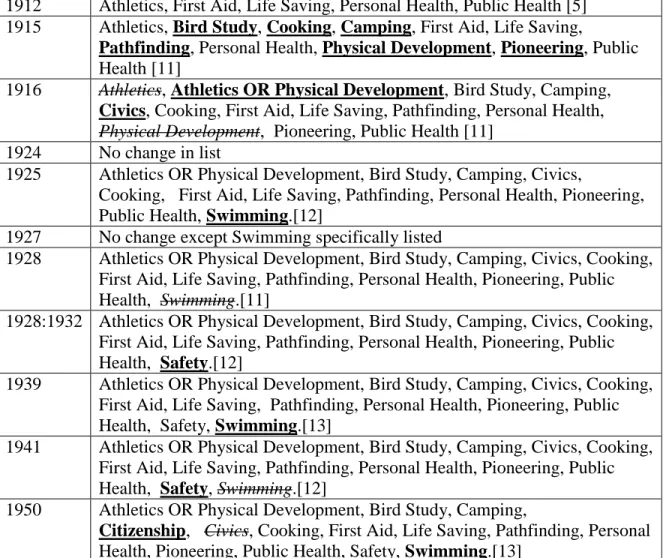
Over the course of 104 years of Boy Scouts, from 1912 to present, the number and type of specifically required badges has changed to earn the rank of Eagle Scout (See Table 1.1). The relevance of this information is that there is significance in understanding the needs of the audience in relation to the outcome and what the audience perceives to be of value in order to create a desired and respected program. A badging program such as with Scouting has proven to be quite successful over time, and has changed based upon the needs of the Eagle Scout program for preparedness. This has been reflected in the number and types of badges to be earned.
Table 1.1 History of required merit badges for Eagle Scouts
1912 Athletics, First Aid, Life Saving, Personal Health, Public Health [5] 1915 Athletics, Bird Study, Cooking, Camping, First Aid, Life Saving,
Pathfinding, Personal Health, Physical Development, Pioneering, Public Health [11]
1916 Athletics, Athletics OR Physical Development, Bird Study, Camping,
Civics, Cooking, First Aid, Life Saving, Pathfinding, Personal Health,
Physical Development, Pioneering, Public Health [11] 1924 No change in list
1925 Athletics OR Physical Development, Bird Study, Camping, Civics,
Cooking, First Aid, Life Saving, Pathfinding, Personal Health, Pioneering, Public Health, Swimming.[12]
1927 No change except Swimming specifically listed
1928 Athletics OR Physical Development, Bird Study, Camping, Civics, Cooking, First Aid, Life Saving, Pathfinding, Personal Health, Pioneering, Public Health, Swimming.[11]
1928:1932 Athletics OR Physical Development, Bird Study, Camping, Civics, Cooking, First Aid, Life Saving, Pathfinding, Personal Health, Pioneering, Public Health, Safety.[12]
1939 Athletics OR Physical Development, Bird Study, Camping, Civics, Cooking, First Aid, Life Saving, Pathfinding, Personal Health, Pioneering, Public Health, Safety, Swimming.[13]
1941 Athletics OR Physical Development, Bird Study, Camping, Civics, Cooking, First Aid, Life Saving, Pathfinding, Personal Health, Pioneering, Public Health, Safety, Swimming.[12]
1950 Athletics OR Physical Development, Bird Study, Camping,
Citizenship, Civics, Cooking, First Aid, Life Saving, Pathfinding, Personal Health, Pioneering, Public Health, Safety, Swimming.[13]
Table 1.1 (Continued)
1952 Athletics OR Physical Development, Bird Study, Camping,
Citizenship, Cooking, Firemanship, First Aid, Life Saving, Nature,
Pathfinding, Personal Fitness,Personal Health, Pioneering, Public Health, Safety, Swimming, one from the Outdoor Sports group, one from any of the following groups - Animal Husbandry, Plant Cultivation,
Communication, Transportation, or Building, one from the Conservation group, three from the Citizenship group.[16] 1954 No change in list
1959 Camping, Cooking, Firemanship, First Aid, Life Saving, Lifesaving (name change only), Nature, Personal Fitness, Public Health, Safety, Swimming, one from the Outdoor Sports group, one from any of the following groups - Animal Husbandry, Plant Cultivation, Communication, Transportation, Building, one from the Conservation group, three from the Citizenship group[16]
1961 No change in list
1965 one from the Conservation group, three from the Citizenship group,
Camping, Citizenship in the Community, Citizenship in the Nation, Cooking, Firemanship, First Aid, Lifesaving, Nature, Personal Fitness,
Public Health, Safety, Soil and Water Conservation, Swimming, one from the Outdoor Sports group, one from any of the following groups - Animal Husbandry, Plant Cultivation, Communication, Transportation, Building,
one from the Conservation group, three from the Citizenship group.[11] 1966 No change in list
1967 Camping, Citizenship in the Community, Citizenship in the
Nation, Conservation of Natural Resources, Cooking, First Aid,
Lifesaving, Nature, Personal Fitness, Safety, Soil and Water Conservation, Swimming.[11]
1972 Camping, Citizenship in the Community, Citizenship in the Nation,
Citizenship in the World, Communications, Conservation of Natural Resources, Cooking, Environmental Science, Emergency Preparedness OR Lifesaving, First Aid, Lifesaving, Nature, Personal Fitness, Personal Fitness OR Swimming OR Sports, Personal Management,
Safety,.Swimming.[10]
1979 Camping, Citizenship in the Community, Citizenship in the Nation, Citizenship in the World, Communications, Emergency Preparedness OR Lifesaving, Environmental Science, First Aid, Personal Fitness OR Swimming OR Sports, Personal Management, Safety.[11]
1989 No change in list 1991 No change in list 1993 No change in list
1994 Camping, Citizenship in the Community, Citizenship in the Nation, Citizenship in the World, Communications, Emergency Preparedness OR Lifesaving, Environmental Science, Family Life, First Aid, Personal Fitness OR Swimming OR Sports, Personal Management, Safety.[12]
Table 1.1 (Continued)
1999 Camping, Citizenship in the Community, Citizenship in the Nation, Citizenship in the World, Communications, Cycling OR Hiking OR Swimming, Emergency Preparedness OR Lifesaving, Environmental Science, Family Life, First Aid, Personal Fitness, Personal Fitness OR Swimming OR Sports, Personal Management, Safety.[12]
2010 Camping, Citizenship in the Community, Citizenship in the Nation, Citizenship in the World, CommunicationsCommunication, Cycling OR Hiking OR Swimming, Emergency Preparedness OR Lifesaving,
Environmental Science, Family Life, First Aid, Personal Fitness, Personal Management.[12]
2013 Camping, Citizenship in the Community, Citizenship in the Nation, Citizenship in the World, Communication, Cycling OR Hiking OR Swimming, Emergency Preparedness OR Lifesaving, Environmental Science OR Sustainability, Family Life, First Aid, Personal Fitness, Personal Management.[12]
2014 Camping, Citizenship in the Community, Citizenship in the Nation, Citizenship in the World, Communication, Cooking, Cycling OR Hiking OR Swimming, Emergency Preparedness OR Lifesaving, Environmental Science OR Sustainability, Family Life, First Aid, Personal Fitness, Personal Management.[13]
Table 1.1 History of Required Merit Badges for Eagle Scouts. Adapted from Stallings, J. (2013, July 30). History of Required Merit Badges for Eagle Scouts. Retrieved from
http://www.usscouts.org/eagle/EagleHistory.asp
Badging initiatives are predicted to fulfill a growing business need for highly skilled workers by increasing educational equity in order to grow the pool of talent workers available to meet job market demands (Young, 2012). Henno, Jaakkola, and Makela (2014) point out that by 2020 over two thirds of all jobs will require post-secondary education. With the rapid rate of technological change occurring in most industries, higher education will not be able to satisfy the demand for knowledge workers with the prevailing credentialing structures (2014).
Digital badges that represent competencies attained by a learner and issued by school districts, industries and businesses, are rapidly growing in popularity and expanding with
exploratory competency-based programs. The reason for growth is that badges are a symbol that shows group membership or represents community, such as wearing college sweatshirts adorned
with the icon of one’s alma mater. They communicate hierarchy and order, such as badges that imply one’s rank in the military or an advanced degree of higher education (e.g. PhD, MA, BA, and so on). Badges also signal an unspoken understanding of the skills or knowledge that one has acquired in order to earn a given credential (Ahn, Pellicone, & Butler, 2014).
According to Alexander Halavais (2012), associate professor in Arizona State University’s School of Social and Behavioral Sciences, people are very excited about the possibility of opening up new pathways for learning, of making it possible for students coming out of high schools, but not necessarily going to college, to show competence. He goes on to say that the college career path is a very narrow one, and it is expensive. Everyone should not have to follow the same path, and digital badges have the potential to provide a system for giving credit for doing valuable, marketable things outside of school (Waters, 2013). Badging systems of all kinds help people prove what they have learned, not only in school, but also outside school with on-the-job and life experiences.
Colleges, universities, businesses and organizations are experimenting with badges and communicating their findings. This is driven by people who are searching for alternatives of attaining recognition for their knowledge and skills, rather than a college degree, to better reflect their qualifications. Southern California’s (USC) service-learning division, for example is trying a new badge platform. The platform is called the Joint Educational Project; and the USC
program works with professors to run community-service projects that grant students extra credit for volunteer work (Young, 2012). While no one expects badges to replace what schools,
colleges and universities are doing today, there is still an ever-growing interest in the potential of badges to drive motivation and assessment as it relates to competencies. This effort goes beyond
formalized programs that higher education offers and extends into businesses, organizations and other entities looking to offer an alternative.
There continues to be experimentation. The MacArthur Foundation projects could produce the most significant impact of badging technology on K-12 through its ability to allow certification to come from somewhere other than the school (Waters, 2013).
Notable digital badge supporters are the MacArthur Foundation whom had spearheaded the digital badge movement in partnership with the Humanities, Arts, Science and Technology Advanced Collaborator (HASTAC) (Young, 2012). The Mozilla Foundation is leading
initiatives particularly in the technology and infrastructure areas with a mission that fosters openness, innovation, and participation on the Internet (Catalano, 2013).
The Mozilla Foundation, the group that develops the popular Firefox Web browser, is designing a framework to let anyone with a Web page – colleges, companies, even individuals – issue forgery-proof digital badges that will give potential employers details about an applicant’s training at the click of a mouse (Young, 2012). Due to the Internet, this is possible. It was not possible twenty years ago. Mozilla’s Open Badges provide a digital image, but also include metadata that details the issuer’s information, criteria for earning the badge, and if desired, a URL to evidence the earner’s mastery (Randall et al., 2013).
A digital badge is an online representation of a skill earned. Open Badges take that concept one step further, and allow for verification of skills, interests and achievements through credible organizations. And because the system is based on an open standard, multiple badges can be combined from different issuers to tell the complete story of earner achievements – both online and off (Mozilla, 1998-2016). This effort by Mozilla has distinguished them from traditional badges that do not offer the metadata.
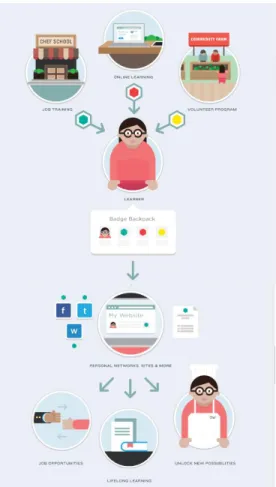
Mozilla Open Badges are not proprietary and use free software and an open technical standard. This means that any organization can create, issue, and verify digital badges, and any user can earn, manage and display these badges all across the web. The badges can build upon each other, joining together to tell the full story of the earner’s skills and achievement. Each badge has important data built in that links back to the issuer, the criteria was issued under and evidence verifying the credential. Earners then use a backpack, which is an all-inclusive way to collect badges in a single location and display skills and achievements on social networking profiles, job sites, personal websites and more (Mozilla, 1998-2016), Figure 2.1.
Figure 2.1 How Open Badges Work. Adapted from Mozilla. (1998-2016). OpenBadges About Page. Retrieved from http://openbadges.org/en-US/about.html
The excitement and experimentation may be better communicated from an education perspective, that entity is not the only player interested in badging. Increasingly diverse types of organizations are issuing open badges, including community organizations, museums and
libraries (Ahn et al., 2014). As organizations and companies better understand badges, they look at them for motivation, competency acknowledgement and growth in the business of education. A good example is badges for Vets programs that recognize military job skills. It is hard for Vets to get recognition for these skill sets even though they are easily translatable into civilian skill sets. The Veterans Administration (VA) and its partners have translated Military Occupational Specialty codes to job-relevant skill and competency badges (Finkelstein et al., 2013). These badges are then used with digital resumes and tell the complete story about the earner.
Badges have the potential to fulfill the needs of the earner and those interested in that earner’s skill set they will be displaying. There are some notable evolving badge systems that are gaining in industry-wide acceptance: EDUCAUSE, Intel International Science and
Engineering Fair, The American Association for State and Local History and the Yale Center for Emotional Intelligence (Finkelstein et al., 2013).
Another program that exists is in the finance discipline. Institute of Management
Accountants (IMA®) is forging ahead in the movement to offer digital badges to promote career success. Previously, members received medallions for their accomplishments in the IMA Leadership Recognition Program, part of the IMA Leadership Academy (IMALA). Now they will receive digital badges. The five ascending levels of achievement (Pewter, Bronze, Silver, Gold, and Platinum) are based on amount of service, courses completed, and other criteria (Stone, 2015).
The gains in popularity are due to the interest in badges by the earner, followed by the issuer and observer respectively. If done right, badges have the potential to tell the bigger competence story of the learner regardless of their path for arriving. The use of digital badges in K-12, and organizations outside the school system are key indicators that digital badges are not going away, and it is only a matter of time where they are typical and be what earners look for and expect.
This is acknowledged by the digital badge programs being developed. As noted by librarian Laura Fleming, who created a digital badge system for about $300 which to date, has been accessed far and wide. Fleming (2013) says that her site, launched in October 2013, provides a fun way for educators to motivate themselves, and be rewarded for their efforts for continuous learning specifically to keep up with technology.
Most adults were taught in a traditional and passive classroom. Online learning environments are also new to instructors, who have to learn new methods for teaching in this kind of setting. Learners and instructors both need to adapt and change as they learn how to use this new medium (Cercone, 2008). The example by Fleming, the New Milford High School digital badge project, supports the need to educate teachers, who will be instrumental to promote and grow digital badges within the school structure. As technology convergence and integration continues to increase generally in our society, it is paramount that teachers possess the skills and behaviors of digital age professionals (Fleming, 2013).
Adult learners are different from traditional college students. Many adult learners have family and job responsibilities including transportation, childcare and household chores that can interfere with the learning process. Most adults enter educational programs voluntarily and
manage their classes around these responsibilities. For the most part adult learners are highly motivated and task-oriented (Cercone, 2008).
Malcom Knowles, who pioneered the field of adult learning, identified the following characteristics of adult learners: autonomous and self-directed; accumulated foundation of life experiences and knowledge; goal-oriented; relevancy-oriented; practical; and need to be given respect (Lieb, 1991). Additionally in order to motivate the adult learner there are six sources of motivation including: social relationships; external expectations; social welfare, personal
advancement; escape/stimulation; and cognitive interest. (Lieb, 1991). How adult learners learn and what motivates them has been studied and questioned for years. The characteristics and sources of motivation are the sources and characteristics central to that effort. Today several studies and theories attempt to explain adult learning, and one of the most well-known is the theory of andragogy, the art and science of helping adults learn by Malcolm S. Knowles
(Cercone, 2008). Andragogy is a learning theory that is designed to address the particular needs of adults, and it is based on the idea that there are significant differences in learning
characteristics between children and adults (Knowles, 1980).
2.3 Gaming and Digital Badges
According to Grubb, the industry advocacy group Entertainment Software Association (ESA), which operates the Electronic Entertainment Expo tradeshow and lobbies on behalf of publishers and developers, revealed a number of facts and figures about the gaming industry Figure 2.2; and the report finds that 59 percent of Americans play games and that the average household in the United States has at least two gamers. According to the ESA in Grubb’s (2014) article, the average of someone who plays online games is 31 years old. In fact, more
gamers are over the age of 36 than between the ages of 18 to 35 or under the age of 18. They are also mostly men, but only by a slimming margin.
Xbox Live Achievement System is a Microsoft product that introduced badging or Xbox termed achievements Figure 2.3. The way achievements work is that every retail game for the Xbox 360 must have 1000 gamerscore points. These are divided between up to fifty
achievements. Xbox Live Arcade games have 200 points usually split between twelve achievements (Jakobsson, 2011).
Figure 2.2 Gamers by Age and Gender. Adapted from Gaming advocacy group.
Venturebeat (Grubb, 2014). Retrieved from
http://venturebeat.com/2014/04/29/gaming-advocacy-group-the-average-gamer-is-31-and-most-play-on-a-console/
Figure 2.3 Description of the Body Juggler achievement from Crackdown, Real-time Worlds. 2007. Xbox 360 Achievements, www.xbox360achievements.org )
If someone (an observer) wanted to look up the achievement information of other players on Xbox.com, they could as long as they know the player’s gametag, which is the person’s username on Xbox Live. They also could go directly to the person’s gametag if they have the person on a friend’s friends list or in the recent players list. Players (earners) can turn off other people’s access to their friends, and restrict the access to their gaming history to friends only or completely block it (Jakobsson, 2011). Achievement, like knowledge, is only of value if an earner can share it. Sharing achievements by the earner provides the observer, with information about the earner’s gaming ability. The information about a gamer’s achievements includes
detailed information about when each separate achievement was unlocked (Jakobsson, 2011) Figure 2.4.
Figure 2.4 Achievement history for Puzzle Quest Adapted from Jakobsson, M. (2011). The Achievement Machine: Understanding Xbox 360 Achievements in Gaming Practices. Game Studies. Retrieved from
https://www.hastac.org/blogs/scott-beattie/2014/06/30/types-digital-learning-badges-drawing-xbox-achievement-experience
“
A notification pops up on the screen informing a player of the gamerscore value and name of the unlocked achievement when received by a player (Jakobsson, 2011). The earner then can create gamecards, Figure 2.5, for use on websites, blogs and forums, which promote who they are and their gaming history.
Xbox 360 achievements concept has spread to other platforms such as PlayStation and Battle.net. Achievements are, however, nothing new. The Atari 2600 had a similar system in place almost 30 years ago. For some of the Activision games, the manual listed challenges, for instance to score ten thousand points. If the player managed to do this, they took a picture of the TV screen, and sent the photo to Activision, who then would in return send a decorative patch, Figure 2.6, made of fabric to the player.
Figure 2.5 Gamecard. Adapted from Jakobsson, M. (2011). The Achievement Machine: Understanding Xbox 360 Achievements in Gaming Practices. Game Studies. Retrieved from
https://www.hastac.org/blogs/scott-beattie/2014/06/30/types-digital-learning-badges-drawing-xbox-achievement-experience
Part of the appeal of digital badges is the wide range of learner motivations that badges might speak to (Beattie, 2014). As demonstrated, the Xbox achievements, Figure 2.7, took on a life of their own with gamers, motivating them to engage with games to be gathered from. Rounding out a foundation for the digital badge community to start thinking about the next stage in learner badge evolution and attainment, are the types of learning badges that can be offered, based on the Xbox Achievement experience (Beattie, 2014).
Figure 2.6 Activision patch awarded for scoring 10,000 points in Chopper Command. Adapted from Jakobsson, M. (2011). The Achievement Machine: Understanding Xbox 360 Achievements in Gaming Practices. Game Studies. Retrieved from
https://www.hastac.org/blogs/scott- beattie/2014/06/30/types-digital-learning-badges-drawing-xbox-achievement-experience
Xbox Achievements
BADGE NAME DESCRIPTION
Completion Completion of a task with specified outcomes or standards, in a way similar to a conventional assignment or task. These are a weak form of game achievement but can be a way of capturing those who might not otherwise go out of their way to start collecting.
Participation Badge for ‘coming along’, i.e. no performance expectation or
standards. Generally this is seen as a weak learning badge as it does not connect with evidence of learning and a fairly weak game achievement as well.
Waypoint Marks partial completion through a task, can act as a guide to progress and as feedback. Some games have their own badging system that runs parallel to the achievement system such as the
Borderlands 2 ‘Badass Rank’ and these use waypoint badges to add further levels of detail.
Difficulty Earned for achieving a goal with an additional, optional condition that makes it more difficult. For example, completing within a certain time, solving a more difficult problem, getting a perfect score, scoring a number of ‘wins’ in a row.
Competitive Awarded on the basis of competition with other learners, e.g. the top score on a drill, the first to complete, the top ten on peer feedback scores.
Collaborative Awarded when a group achieves an outcome. Each member of a group can have its own specific role, so that this badge first requires gathering a team with appropriate skills.
Affiliation Join a group or community. Could include additional requirements such as a participation/introduction task.
Exploration Awarded for exploring additional content, meeting objectives which are not necessary to complete the core of a task.
Collection Another badge directed at additional content, meeting a set of criteria that is rewarded when each item on the list is met.
‘Easter egg’ A badge for finding a secret or hidden feature. For learning badges this may be awarded for only the first or first few, to locate the Easter egg because word will quickly spread.
The widespread use of games in the social lives of youth has fueled educators’ interests in developing and investigating game-based learning (GBL) tools (Ebner, & Holzinger, 2007; Huizenga, Admiraal, Akkerman, & Dam, 2009; Van Eck, 2006). Like digital badges, the use of Figure 2.7 Xbox Achievements. Adapted from Jakobsson, M. (2011). The Achievement
Machine: Understanding Xbox 360 Achievements in Gaming Practices. Game Studies.
Retrieved from https://www.hastac.org/blogs/scott-beattie/2014/06/30/types-digital-learning-badges-drawing-xbox-achievement-experience
gaming or game-like activities in learning is still very new. There is very little guidance on how to design a course as a game (An & Bonk, 2009; Fang & Strobel, 2011; Kim, Park, & Back, 2009). Just like course design with game models, mapping a model for digital badges is still very new. Models for educational badges share many of the same features of the Boy Scout Merit badges and video-game models. Like merit badges, educational badges are more often offered for learning that occurs outside of traditional educational institutions. They are viewable on a learner’s online profile by observers, similar to how videogame badges are viewable to other players and how scouts display cloth merit badges on the sashes they wear (Abramovich, Schunn, & Higashi, 2013). And while models are emerging with companies, organizations or entities that are offering digital badges or like, there is little guidance on their practice or design.
One such example of recognizing achievements that exists in LinkedIn, which has been around for approximately ten years, is the practice of endorsements. Endorsement symbols can be found as a word in the section of a member’s profile. Anyone, including the profile owner, can endorse a skill in a profile. According to LinkedIn, accumulating a high number of
endorsements for a skill adds credibility to your profile because it shows that your professional network recognizes you have that skill (Stone, 2015).
Members endorse their connections for skills or proficiencies based upon their
knowledge or observation of the skill of the person they are endorsing. While someone cannot control endorsements that are added to their profile, they do have the ability to remove anything that they feel is inappropriate or not to their advantage. This ability places the profile owner, or so to speak the earner of that endorsement, in control of what is displayed. Like a digital badge, the earner is the one who chooses to make the digital badge visible to others.
Portable and stackable credentials represent a new approach to allowing the affordable earning of marketable credentials across an entire career (Lowendahl et al., 2016). Treehouse is a website that embraces gamification. Not only are the Treehouse badges a symbol for an earner to share for observers to view, they are a guide for a learner to know the curriculum of badges to earn before unlocking a higher designation badge. As noted by Treehouse, badges are used to guide the user through the curriculum in a way that makes the most sense. Treehouse’s badge map, Figure 2.8, for the HTML badge cannot be achieved without first unlocking all of the child badges. This creates academic structure and flow in a fun and rewarding way. It also means there is no shortcut around learning and understanding tables to unlock the HTML badge, due to the hierarchy of the badge.
2.4 Motivation and Recognition Theory
What drives motivation and participation in training courses by people who want to take classes and have work experiences that broadened their knowledge and skills to do their job? Do practices of recognition drive growth in course participation? Features of digital badges lend
Figure 2.8 Treehouse Badge Map. Adapted from Treehouse Island, Inc. (2016). Treehouse.com Inside Treehouse-badges Page. Retrieved February 20, 2016 from http://blog.teamtreehouse.com/inside-treehouse-badges
themselves well with trends in adult education. Due to the ability to be online anytime and anywhere through the use of mobile technology, there are more opportunities to observe, record and note achievements and milestones. This creates the potential to convey a bigger picture about identity, knowledge, capacity, and achievement, which makes digital badges a powerful and efficient vehicle to bring meaningful data to observers that reflects their achievements (Finkelstein et al., 2013).
Two new research studies that Achor (2016) has been a part of are shaping understanding of the impact of using digital platforms, like social recognition programs, to improve happiness and business outcomes. In short, these two studies suggest that effective digital recognition programs can help scale organic praise, have a high ROI, and lead to significantly higher levels of employee performance and engagement, as well as increased customer loyalty, as measured by net promoter scores (Achor, 2016).
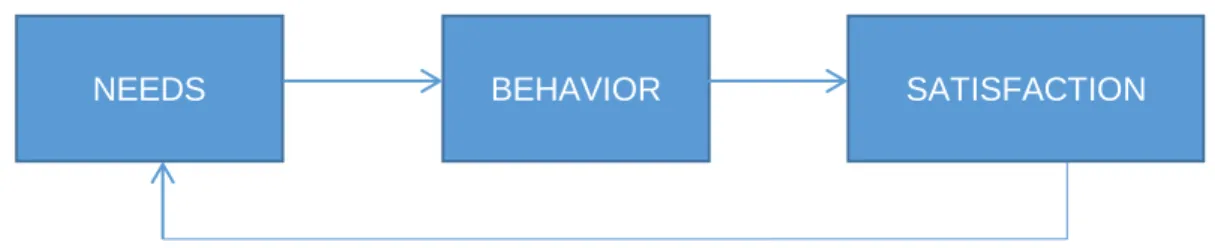
Overall, the basic perspective on motivation looks something like this:
A variation of this model would be to insert a reward or recognition box between behavior and satisfaction. This model could then be viewed from the basis that 1) employees
NEEDS BEHAVIOR SATISFACTION
Figure 2.9 Perspective on Motivation
This figure displays that you have certain needs or wants, and this causes you to do certain things (behavior), which satisfy those needs (satisfaction), and this can then change which needs/wants are primary (either intensifying certain ones, or allowing you to move on to other ones). Adapted from “Introduction to Organizational Behavior – 2001” Borgatti, Professor. 2002. Retrieved from
have a need to learn about products and systems or software to do their job at a company (needs); 2) then take training to develop the knowledge and skills (behavior); 3) are recognized and/or rewarded to developing the knowledge and skills (reward/recognition); and 4) are satisfied by the achievement of knowledge and skills and the reward and recognition.
Since people are different and have different needs, identifying the learner’s perceived value of the reward/recognition is important to be able to design a desirable system for
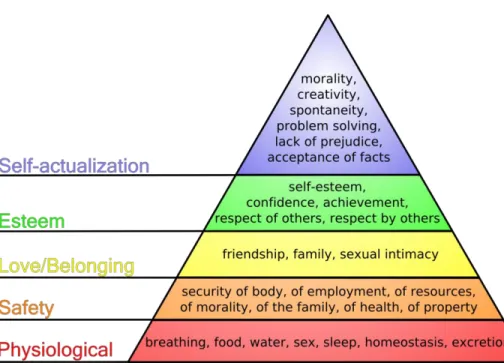
achievement and recognition. Digital badges may not motivate everyone and may produce the opposite effect. Maslow’s Hierarchy of Needs is a theory in psychology that Abraham Maslow proposed in his 1943 paper, A Theory of Human Motivation (Berger, 2005). According to Maslow’s theory, the lower the need the higher the priority, Figure 2.10.
Figure 2.10 Maslow’s Hierarchy of Needs
This figure displays each level of Maslow’s hierarchy that outlines a specific category of need, each of which must be accomplished in a bottom-up order. Adapted from “Maslow’s Hierarch of Needs” CC BY-SA 4.0. Copyright 2016 by Boundless.com. Retrieved from
https://www.boundless.com/management/textbooks/boundless-management- textbook/organizational-behavior-5/employee-needs-and-motivation-46/maslow-s-hierarchy-of-needs-171-7621/images/maslow-s-hierarchy-of-needs