1. This research was supported through a grant from the National Sciences and Engineering Research Council of Canada (NSERC) to the second author.
Abstract
Java has emerged to dominate the network programming world. This imposes certain requirements on its virtual machine instruction set architecture and on any processor design that intends to support Java. The purpose of this study is to carry out a behavioral analysis of the different aspects of Java instruction set architecture. This will help in extracting the hardware requirements for executing Java bytecodes. Recommendations for architectural requirements for Java processors will be made throughout this study.
1.
Introduction
Java was introduced to deal with heterogeneous networks, which require building software that is platform-independent [1,2]. This means that a compiled software shipped around the network needs to be able to run on any CPU it lands on (which is formulated as “write once, execute anywhere.”) In addition, designed to be a modern high-level language, Java includes all modern features like modularity and object-orientation. To achieve all these goals, Java targets an intermediate virtual platform, instead of direct execution on the host CPU [3,4,5,6]. All we need to execute cross-platform programs on the Internet is to port this virtual layer to the CPU/OS combination we want to run Java on. But, this comes at a high price. The special features supported by Java have a tremendous impact on the overall system performance and impose certain requirements on the Java system [7]. A number of schemas have been proposed to improve Java performance as a tool for programming on the web and networking in general [8,9,10,11,12,13,14]. Some of the promising directions incorporate hardware solutions. Building microprocessors for Java or simply modifying other general-purpose processors to boost Java are among these hardware options [15,16,17,18,19,20,21,22,23,24]. Designing hardware for Java requires an extensive working knowledge about its virtual machine
organization and functionality. Java virtual machine (JVM) instruction set architecture (ISA) defines categories of operations that manipulate several data types, reached through a well-defined set of addressing modes [25,26,27,28,29]. JVM specification defines the instruction encoding mechanism required to package this information into the bytecode stream. It also includes details about the different modules required for processing these bytecodes. At runtime, the JVM implementation and the execution environment affect the instruction execution performance. This is manifested directly in the wall-clock time needed to perform a certain task and indirectly in the different overheads associated with executing the job (e.g. memory management) [30]. The goal of this research is to conduct a comprehensive behavioral analysis of the Java virtual machine instruction set architecture [31,32]. Observing the Java instruction set architecture while it is executing Java benchmarks will reveal a lot about the details of the Java environment. This will be reflected in the form of suggestions for the actual hardware improvements and additions to boost the performance of Java. Revised encoding formats and devised hardware organizations (including a certain level of parallelism, pipelining, caching, functionality, ... etc.) with insights about the internal details of Java will lead to better performance. Our rationale for conducting such a study is based on the simple observation that modern programs spend 80-90% of their time accessing only 10-20% of the instruction set architecture [33]. To be most effective, optimization efforts should focus on just the 10-20% part that really matters to the execution speed. ISA study is of great importance for every attempt to devise a certain arrangement to boost Java performance. The results collected here affect the way of encoding Java instructions into a binary representation for execution by any CPU supporting Java. It also affects the internal processor datapath design for any architecture that targets Java. It is worth noting that although JVM ISA shares many general aspects with traditional microprocessors, it has its distinguishing features. This stems from the fact that it is an intermediate layer for a high-level language.
Quantitative Analysis for Java Microprocessor Architectural Requirements:
Instruction Set Design
1M. Watheq EL-Kharashi
Fayez ElGuibaly
Kin F. Li
Department of Electrical and Computer Engineering, University of Victoria P. O. Box 3055, Victoria, BC, Canada, V8W 3P6
For example, the branch prediction model of the underlying hardware affects the overall Java performance, which is the case of all modern microprocessors. On the other hand, JVM-supporting hardware will be unique in the way its stack model handles method invocations. To undertake these objectives, a Java interpreter was instrumented to produce a Java trace. Pendragon Software's CaffeineMark 3.0 was selected as the benchmark as it is computationally interesting and exercises various JVM aspects [33]. It is a synthetic benchmark that runs 9 tests to measure Java performance. The machine used in the evaluation is an UltraSPARC I/140 running at 143 MHz and 64 Mbytes memory. The OS is Solaris 2.6. Based on the data gathered, general requirements for Java processors are drawn. In doing this study, we followed the methodology used by Patterson and Hennessy in studying the instruction set design [34]. This paper is organized as follows: Section 2 analyzes access patterns for data types. Addressing modes are studied in Section 3. Section 4 is concerned with the different instruction encoding aspects.
2.
Access patterns for data types
Here we study the access patterns for different data types. Data types that are heavily used need more attention in case of designing certain hardware architecture to support Java [30]. This information will prove useful when decisions are made about storage allocation.
2.1. Single-type operations
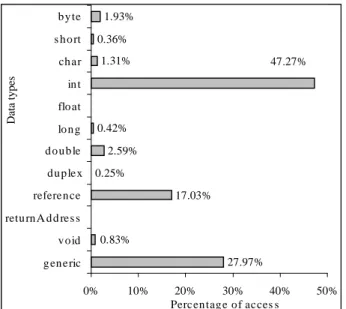
Figure 1. Distribution of data accesses by type.
Figure 1 shows the distribution of data accesses by type. From this figure we see that integer data types dominate the typed operations, followed by the reference data type. Architectural support for Java object-orientation therefore needs to give privileges to integer and reference data types in hardware. Also from this figure, we see that 32-bit data types are used the most. This will have an impact on the size of the register file and CPU datapaths. Furthermore, a superscalar design may want to provide multiple functional units that process integer and reference data types. From the ALU point of view all integer operations need efficient support.
2.2. Type conversion operations
JVM has a set of instructions that converts data of a certain type to another. This is necessary for a strongly typed language like Java. Figure 2 shows that the conversion from integer dominates all type conversion operations (especially to character.) This information combined with the results from the previous subsection implies that integer conversion operations are the most used. For better Java performance, the ALU design needs to perform this conversion in one clock cycle or less.
Figure 2. Frequency of type conversion instructions.
3.
Addressing modes
This Section is concerned with the use of the JVM addressing modes. The traditional concept of addressing modes, as used in general-purpose processors, is not exactly applicable to JVM that uses a stack-based intermediate language. This, together with the object-orientation approach, is reflected in the combination of traditional and non-traditional addressing modes [30].
0% 20% 40% 60% 80% double long float int Input type
Percentage of the resultant type
double long float int char byte 27.97% 17.03% 0.25% 2.59% 0.42% 1.31% 0.36% 1.93% 47.27% 0.83% 0% 10% 20% 30% 40% 50% g en eric v o id retu rn A d d res s referen ce d u p lex d o u b le lo n g flo at in t ch ar s h o rt b y te Data types
The result of addressing mode usage patterns is shown in Figure 3. Local variable access dominates all other modes. Also, of importance are the immediate access and the quick reference. These hardcoded addressing modes (in which the operand value is encoded in the instruction itself) occupy more than one third of the total addressing modes used. We conclude here, that a Java processor needs to support at least local variables, immediates, quick referencing, and stack addressing modes.
Figure 3: Usage of memory addressing modes.
4.
Instruction encoding
JVM specifications require Java bytecodes to be provided as a stream of bytes grouped in variable-length instructions. However, it hardly mentions a general instruction format for the adopted instruction [1] This irregular format might stand against the generality and efficiency of hardware execution of Java bytecodes. This section quantitatively analyzes the different fields that constitute JVM instructions. We aim at determining the optimum number of bits required for encoding these fields. The analysis presented here should not be considered contradicting with the JVM specification that tells exactly the size of each instruction field. Architectures that provide support for Java might select to have a native instruction format that is different from the JVM one in the addressing modes, data types, etc. This approach will help attaining generality and efficiency. 4.1. Immediates
As a stack machine, JVM does not rely a lot on immediates for ALU operations. Immediates in JVM are either pushed on the stack or used as an offset for a control flow/table switching instruction and could have a
length of up to 32 bits. As shown in Figure 4, immediates used in CaffeineMark are up to 18 bits in length with an average of 4 bits (standard deviation of 2.07 bits.) The peak occurs at 3 bits. Three bits are enough to cover more than 50% of immediate usage and 5 bits can cover more than 75%. Based on the statistics shown in Figure 4 we suggest using 8 bits to encode immediates values in JVM instructions, which will cover 98% of the cases. Situations that will require more bits can be handled by the compiler using a special wide format.
Figure 4: Distribution of immediate number of bits.
4.2. Array indices
Figure 5: Number of bits representing an array index.
Java technology carries array information down the hierarchy to the JVM. At runtime, the index required to access an array is popped from the operand stack. Although the index can be up to 32 bits, Figure 5 shows that CaffeineMark does not require more than 13 bits to access arrays (with an average and standard deviation of 3
0.13% 0.10% 46.34% 22.20% 13.37% 7.37% 10.50% 0% 10% 20% 30% 40% 50% Quick Reference Object Reference Array Indexed Constant Pool Indexed Stack Local Variable Immediate
Addressing mode
Frequency of the addressing mode usage Non-Hardcoded Hardcoded 0.00% 5.00% 10.00% 15.00% 20.00% 25.00% 30.00% 0 2 4 6 8 10 12 14 16 18
Number of bits needed for an immediate value
Percentage of Immediate Value Usage
0% 2% 4% 6% 8% 10% 12% 14% 16% 18% 0 2 4 6 8 10 12 14
Number of bits needed for an array index
and 2.79, respectively.) For instruction encoding, we see that 3-bit index size covers more than 50% of array accesses and 5 bits cover more that 80%. The graph shows an interesting pattern: the maximum occurs at 0 then follows a decaying behavior with a sudden drop after 6 indicating that about 90% of array accesses take place in the first 64 element. This could give useful guidelines in data caching—the first few elements (up to the 64th) of an array should be cached. This could also have an impact on Java processor’s cache organization, such as block size, replacing strategies, etc.
4.3. Constant pool indices
JVM constant pool is a collection of all the symbolic data needed by a class to reference fields, classes, interfaces, and methods. A constant pool index size is either up to 16 bits, or 32 bits if it is in a wide format. From Figure 6, we see that 16 bits cover almost all constant pool accesses (the average is 8 and the standard deviation is 2.9.)
Figure 6: Number of bits for a constant pool index.
4.4. Local variable indices
As mentioned before, instead of specifying a set of general-purpose registers, JVM adopted the concept of referencing local variables. As Figure 7 shows, Java methods typically require up to 32 local variables (with an average of 2 and standard deviation of 1.31), though the specifications allow referencing up to 255, or 65535 in case of wide instructions. The graph also shows nearly no preference in accessing these variables. In designing hardware support for Java, this graph suggests allocating the local variables on-chip. In this case, general-purpose register file can be configured to work as a reservoir for local variables, allowing Java programs to run faster.
Figure 7: Number of bits for a local variable index.
4.5. Branching distances
Java bytecodes only deliver the offset in branches and JVM converts it internally to the corresponding absolute address. As Figure 8 (dots) shows, CaffeineMark requires a target offset width of less than 10 bits (with an average of 4 and standard deviation of 1.49), though up to 16 bits are allowed. In the design of an instruction format, 8 bits appear enough to cover more than 98% of the offset distances. Furthermore, if a branch target buffer (BTB) is used for branch speculation, a size of 512 bytecodes (256 forward and backward) is sufficient. Figure 8 (triangles) also shows statistics of absolute jump-to address. Although this information depends on the run time environment, it does indicate a typical behavior.
Figure 8: Number of bits for an address.
0.00% 5.00% 10.00% 15.00% 20.00% 25.00% 30.00% 0 1 2 3 4
Number of bits needed for a local variable index
Percentage of class pool index
0% 5% 10% 15% 20% 25% 30% 0 4 8 12 16 20 24 28 32
Number of bits needed for a class pool index
Percentage of class pool index
0% 10% 20% 30% 40% 50% 60% 70% 0 5 10 15 20 25
Number of bits needed for branching distance
Percentage of branching distance
Target Offs et Jump-to Address
5.
Conclusions
In this work we conducted a behavioral analysis of Java virtual machine instruction set architecture. In the light of the results collected from each part, we drew conclusions about the general architectural requirements for designing microprocessors that support Java. Our study clearly shows that the advanced features of Java are its weakest points in terms of performance. Hardware support is required to increase the efficiency of Java.
6.
References
[1] J. B. Gosling, B. Joy, and G. Steele, The Java Language
specification, The Java Series, Addison-Wesley, Reading,
MA, 1996.
[2] J. Gosling and H. McGilton, “The Java Language Environment, A White Paper,” Sun Microsystems, Mountain View, CA, October 1995.
[3] J. Gosling, “Java Intermediate Bytecodes,” ACM
SIGPLAN Notices, January 1995, pp. 11-118.
[4] M. Lentczner, “Java's Virtual World,” Microprocessor
Report, March 25, 1996, 8-11,17.
[5] T. Lindholm and F. Yellin, The Java Virtual Machine
Specification, The Java Series, Addison-Wesley, Reading,
MA, 1997.
[6] J. Meyer and T. Downing, Java Virtual Machine, O'Reilly and Associates, Inc, Sebastopol, CA, 1997.
[7] P. Wayner, “How to Soup Up Java: Part II,” Byte, May 1998, pp. 76-80.
[8] B. Case, “Implementing the Java Virtual World,”
Microprocessor Report, March 25, 1996, pp. 12-17.
[9] P. Halfhill, “How to Soup Up Java: Part I,” Byte, May 1998, pp. 60-74.
[10] C.-H A Hsieh, W.-M. W. Hwu, and M. Conte “Compiler and Architecture Support for Java,” a Tutorial presented
in the ASPLOS-VII Conference, Boston, October 1-5,
1996.
[11] C.-H A. Hsieh, M. T. Conte, T. L. Johnson, J. C. Gyllenhall, and W.-M W. Hwu, “Optimizing NET Compilers for Improved Java Performance,” IEEE
Computer, June 1997, pp. 67-75.
[12] C.-H A. Hsieh, J. C. Gyllenhall, and W.-m. W. Hwu, “Java Bytecode to Native Code Translation: The Caffeine Prototype and Preliminary Results,” Proc.of the 29th
Annual International Symp. on Microarchitectures (MICRO-29), IEEE Computer Society Press, Los
Alamitos, CS, December 2-4, 1996, pp. 90-97.
[13] H. McGhan and. J. M. O’Connor, “picoJava: A Direct Execution Engine for Java Bytecode,” IEEE Computer, October 1998, pp. 22-30.
[14] J. M. O'Connor and M. Tremblay, “picoJava-I: The Java Virtual Machine in Hardware,” IEEE Micro, March/April 1997, pp. 45-53
[15] B. Case, “Java Virtual Machine Should Stay Virtual,”
Microprocessor Report, April 15, 1996, pp. 14-15.
[16] B. Case, “Java Performance Advancing Rapidly,”
Microprocessor Report, May 27, 1996, pp. 17-19.
[17] M. Watheq El-Kharashi and F. ElGuibaly, “Java Microprocessors: Computer Architecture Implications,”
Proceedings of the PACRIM’97, Victoria, BC, Canada,
August 20-22, 1997, pp. 277-280.
[18] R. Grehan, “JavaSoft’s Embedded Specification Overdue, but Many Tool Vendors aren’t Waiting,” Computer
Design April 1998, pp. 14-18.
[19] Patriot Scientific Corporation, PSC1000 Microprocessor home page, http://www.ptsc.com/psc1000/
[20] M. Tremblay and J. M. O'Connor, “picoJava: A Hardware Implementation of the Java Virtual Machine,”
Hotchips Presentation, 1996.
[21] T. Turley, “MicroJava Pushes Bytecode Performance,”
Microprocessor Report, October 28, 1997, pp. 28-31.
[22] T. Turley, “Most Significant Bits,” Microprocessor
Report, August 4, 1997, pp. 4-5, 9.
[23] T. Turley, “Sun Reveals First Java Processor Core,”
Microprocessor Report, November 17, 1996, pp. 9-12.
[24] P. Wayner, “Sun Gambles on Java Chips,” Byte, November 1996, pp. 79-88.
[25] Sun Microelectronics, “Sun Blazes Another Trail – Introducing the microJava 701 microprocessor,” Press
Releases, October 1997.
[26] Sun Microelectronics, “The Burgeoning Market for Java Processors. Inside The Networked Future: The Unprecedented Opportunity for Java Systems,” white
paper 96-043, October 1996.
[27] Sun Microelectronics, “Sun Microelectronics' picoJava-I Posts Outstanding Performance,” white paper 0015-01, October, 1996.
[28] Sun Microelectronics, “picoJava-I Microprocessor Core Architecture,” white paper 0014-01, October, 1996. [29] A. Tanenbaum and J. Goodman, Structured Computer
Organization, Fourth Edition, Prentice Hall, Englewood
Cliffs, NJ, 1999.
[30] B. Venners, Inside the Java Virtual Machine, McGraw-Hill, NY, 1998.
[31] M. Watheq El-Kharashi, F. ElGuibaly, and K. F. Li, “Hardware Adaptations for Java: A Design Space Approach,” Technical Report ECE-99-1, Department of Electrical and Computer Engineering, University of Victoria, January 25, 1999.
[32] M. Watheq El-Kharashi, F. ElGuibaly, and K. F. Li, “Architectural Requirements for Java Processors: A Quantitative Analysis,” Technical Report ECE-98-5, Department of Electrical and Computer Engineering, University of Victoria, November 9, 1998.
[33] Pendragon Software, CaffeineMark Benchmark Home Page http://www.pendragon-software.com/pendragon/cm3 [34] D. A. Patterson and J. L. Hennessy, Computer
Architecture A Quantitative Approach, second edition,
Morgan Kaufmann Publishers, Inc. San Francisco, CA, USA, 1996.