CORRUPTION AND INTERNAL CONTROL WEAKNESSES.
CASE STUDY ROMANIA
Luminiţa IONESCU Spiru Haret University, Bucharest E-mail: [email protected]
Abstract
Corruption represents one of the major causes of poverty all over the world and European Union is fighting against it. In the last few years, the corruption phenomenon registered a high level in some European countries and became one of the most problematic factors for doing business, due to the evolution of the perceived top five global risks: interstate conflict and regional consequences, extreme weather events, failure of national governance, state collapse or crises, high structural unemployment or underemployment (WEF-Global Risk Report 2015, p. 14).
One of the modalities in combating corruption is implementing the internal control and most of the governments and organizations adopted strong control techniques. Most of the control weaknesses are related to the financial procedures and the number of controllers. Some of the controllers do not have enough financial expertise or do not understand the importance of informatics systems.
Keywords: corruption, government, fraud, internal control JEL Classification: D72, H11, H26, M42
Introduction
In this paper we investigate the relation between economic risks, corruption,
and the internal control weaknesses. The global economic risks have changed in
the last five years and the companies must implement a strong internal control in
order to reduce corruption, fraud and inequality. Fraud could be a cause of growing
corruption, but fighting corruption in many countries has proved difficult
(Treisman, D., 2000).
There are also more likely to be identified internal control weakness, if the
controllers are not independent. Also, it would be important to implement external
control in order to prevent the fraud risks.
In Romania, corruption is considered one of the problematic factors for doing
business, but the modernization of accounting systems and new European
regulations improved the financial system and reduced the inefficient government
bureaucracy.
Literature Review
This paper is related to several recent papers on the determinants of internal
control, corruption and economic risks:
Global Risks Report 2015 (World Economic Forum) presented how fragile
societies are under a lot of pressure. A major driver of social fragility is big
socio-economic inequality within countries, and rising structural unemployment drives
both inequality and social pressures. According to this Report, there are some
global economic risks of highest concern, such as: unemployment or
underemployment, fiscal crises, asset bubble, failure of financial mechanism or
institution, energy price shock, deflation, failure of critical infrastructure,
unmanageable inflation. European countries are still recovering after the recent
economic crises and the global financial system is undergoing massive structural
change. In this context, we could observe how banks’ regulatory rules have been
revised, resulting in stronger capital requirements, the first-ever globally agreed
liquidity standards, and new standards for constraining large exposures and
improving risk management (Global Risk Report 2015, p. 19).
The international community is finalizing a basic solvency requirement for
global insurers who are systemically important, because the bank and the insurer
system are affecting the global economy. International accounting standards are
being changed, in particular to make loss recognition more forward-looking (such
as IFRS9) and COSO Internal Control Framework has been updated.
Zhang, Yan et al (2007) in “Audit committee quality, auditor independence,
and internal control weaknesses” explained how the relation between audit
committee quality and internal control weaknesses is being developed. They
observed how the audit committee not only plays an important monitoring role to
assure the quality of financial reporting, but also serves as an important governance
mechanism. It was discovered that firms with high-quality audit committees are
less likely to have internal control weaknesses than firms with low-quality audit
committees. The research presented some firms that are more likely to be identified
with an internal control weakness, if their audit committees have less financial
expertise or, more specifically, have less accounting financial expertise and
non-accounting financial expertise. In this case study, it was identified that internal
control is weak, if the auditors are more independent and other firms with recent
auditor changes are more likely to have internal control weaknesses.
The Updated COSO Internal Control Framework (2013) continues to
emphasize the importance of management’s judgment in evaluating the
effectiveness of a system of internal control. The Framework explained how
external parties, including external auditors and regulators, are not part of the
system of internal control and cannot be considered a source of detection and
assessment of internal control deficiencies. In this case, the responsibility for
identifying and assessing internal control deficiencies rests with the controllers or
internal auditors, in the normal course of companies’ activities. According to the
Principle 8 of Internal Control, many companies integrate their evaluation of the
effectiveness of controls mitigating fraud risk with the evaluation of other controls
embedded within the organization’s processes. It is generally accepted that control
activities are an integral part of making business processes work, but control
activities are in place within the process to reduce “financial reporting assertion
risks” to an acceptable level, including the risk of fraud. In conclusion, the COSO
Internal Control – Integrated Framework provides an overall framework for
addressing the effectiveness of internal control in providing reasonable assurance
that operational, reporting and compliance objectives are achieved.
The Evolution of Corruption in European Countries
We noticed that corruption is growing in European countries despite the
efforts of European governments, public institutions and non-profit organizations.
Cross-country data for European countries is used to analyse the role of
government bureaucracy, tax regulations and the effect of policy instability.
According to the Global Corruption Barometer (2013), every day, all over the
world, ordinary people bear the cost of corruption and in many countries corruption
affects people from birth until death. It was observed that citizen action can lead to
the exposure of corrupt acts and put pressure upon reluctant governments to do
more in the fight against corruption. In this global context, The Global Corruption
Barometer (2013) underscores the pressing desire of citizens to get involved in
stopping corruption.
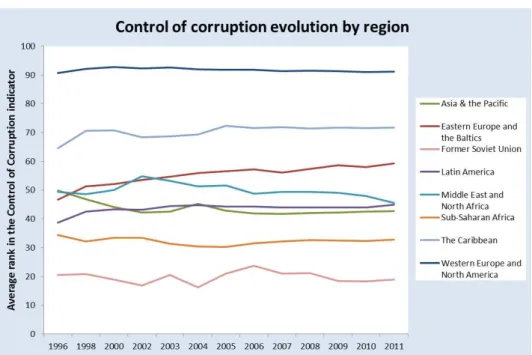
Fig. no. 1. The evolution of corruption by regions
Corruption continues to be a challenge for Europe – a phenomenon that costs
the European economy around 120 billion euros per year (Anti-Corruption Report
2014). We notice that corruption is increasing in European countries over time, but
it is still lower in comparison to developing economies, and the cleanest economies
are developed ones. Also mass-media is concentrated on the international
dimension of the corruption and how to adopt the effective measures to fight
against corruption.
According to the EU treaties (Council of EU – Thematic paper on corruption,
Corruption crimes in relation to public procurement, November 2012, p. 5), it is the
role of the European Commission to monitor and to verify the correct
implementation of EU law into national law. Thus, all the member states are
responsible for the correct implementation of EU legislation in order to identify the
causes of corruption and the effects over the society.
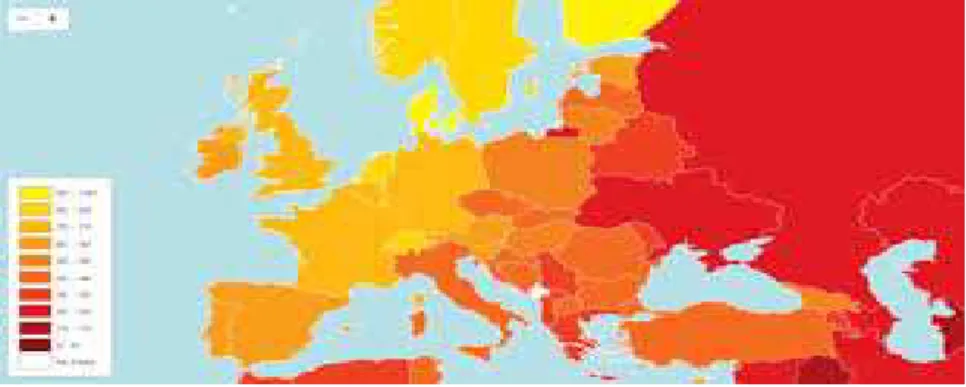
We could observe in the figure below that corruption is larger in Asian
countries and lower in the European countries, as a result of European regulations
and enforcement of the internal control and audit for public and economic entities.
The red areas are indicated as the corrupted countries and the yellow colour
indicates the clean countries. We notice that the North European area is very clean
compared to the South-East European area:
Fig. no. 2. Corruption in Europe
Source: http://www.europe-forum.info/index
There are some candidate countries to join EU, where corruption index is
significant in the last few years, as a consequence of international crises, growing
bureaucracy and political instability. For this reason EU adopted a set of conditions
to reduce corruption, which have to be met by the candidate countries in order to
join the EU. The EU candidate countries are Iceland, Macedonia, Montenegro,
Serbia and Turkey. There have been several years since the accession negotiations
were opened with these countries, as follows: Turkey in October 2005, with
Iceland in July 2010 and with Montenegro in June 2012. EU supports reforms for
the candidate countries with financial help and the Instrument for Pre-accession
Assistance (IPA). According to the EU data base, for the period 2007-2013 IPA
had a budget of some € 11.5 billion; its successor, IPA II, will be built on the
results already achieved by dedicating € 11.7 billion for the period 2014-2020.
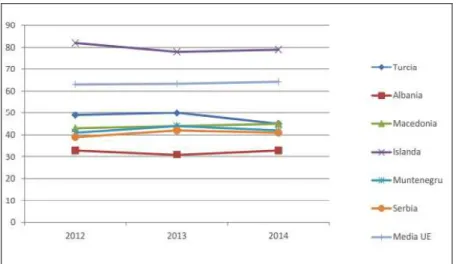
Fig. no. 3. Corruption Perception Index for Candidate Countries
Source: http:// www.transparency.org.ro/politici_si_studii/indici/ipc/2014
The Corruption Perceptions Index presents on a scale from 0 (perceived to be
highly corrupt) to 100 (perceived to be very clean) the corruption all over the world
and is based on expert opinions of public sector. We observe in the figure no. 3
how scores for Turkey is reduced in Turkey from 50 in 2012 to 45 in 2014. In the
same time, Island is a very clean country with a very good score in 2012 (82) and
almost the same in 2014 (79). The rest of the candidate countries maintain the same
score during 2012-2014.
The Evolution of Corruption in Romania
Corruption in Romania is one the barriers of the economic development with
long term consequences on the Romanian society. Unfortunately, the last economic
crisis had a large and lasting impact on the Romanian economy (European
Commission – Country Report Romania 2015, p. 4). After a strong economic
growth in the period 2003-2008, a large drop follow in 2009 and a potential growth
has started with a very timid recovery. According to the European Commission, the
economic growth is forecast to reach 2.9 % in 2019, which is 0.5 % lower than the
average potential growth in the pre-crisis period.
Post-crisis the tax mix has improved, but tax policy is changing frequently
and revenue collection remains weak. This tax rates instability is a major cause for
the low level of investment in Romania and remains above EU average. According
to EU-Country Report Romania 2015, EU funds’ absorption is lagging behind, at
only 52.2 % of the available structural and cohesion funds as of end of 2014.
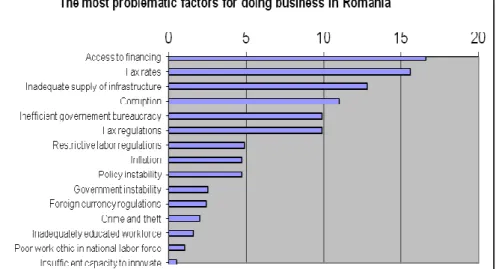
However, corruption is still one of the most problematic factors of doing business
in Romania (table no. 1).
Fig. no. 4. The most problematic factors for doing business in Romania
Source: Global Competitiveness Report 2014-2015, WEF Geneva 2015