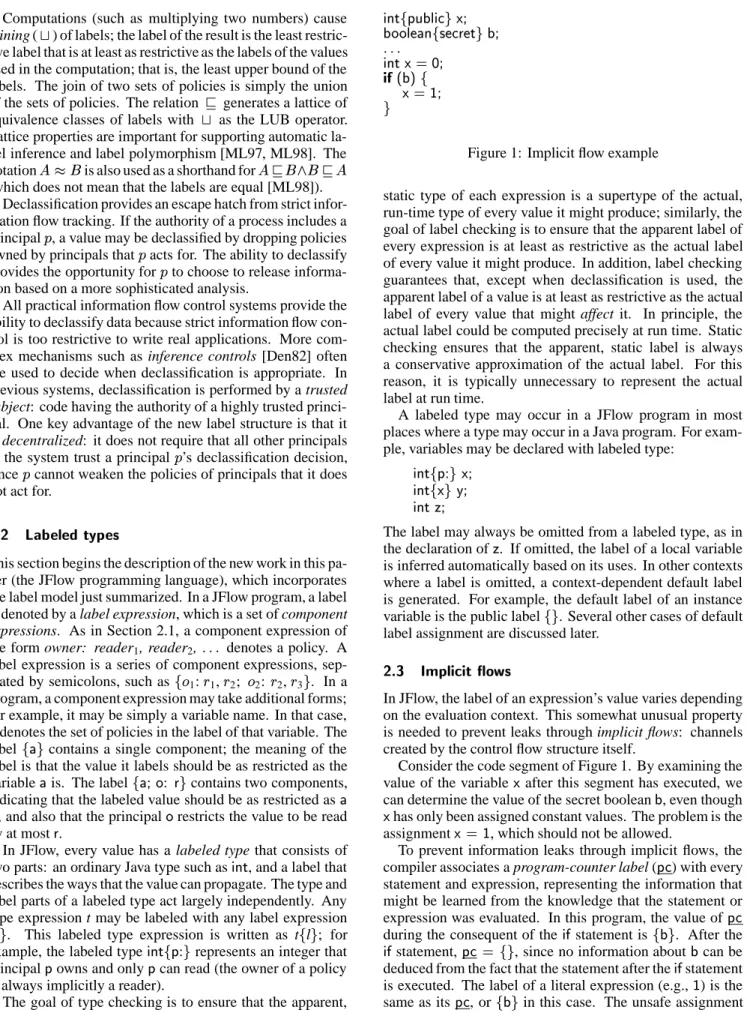
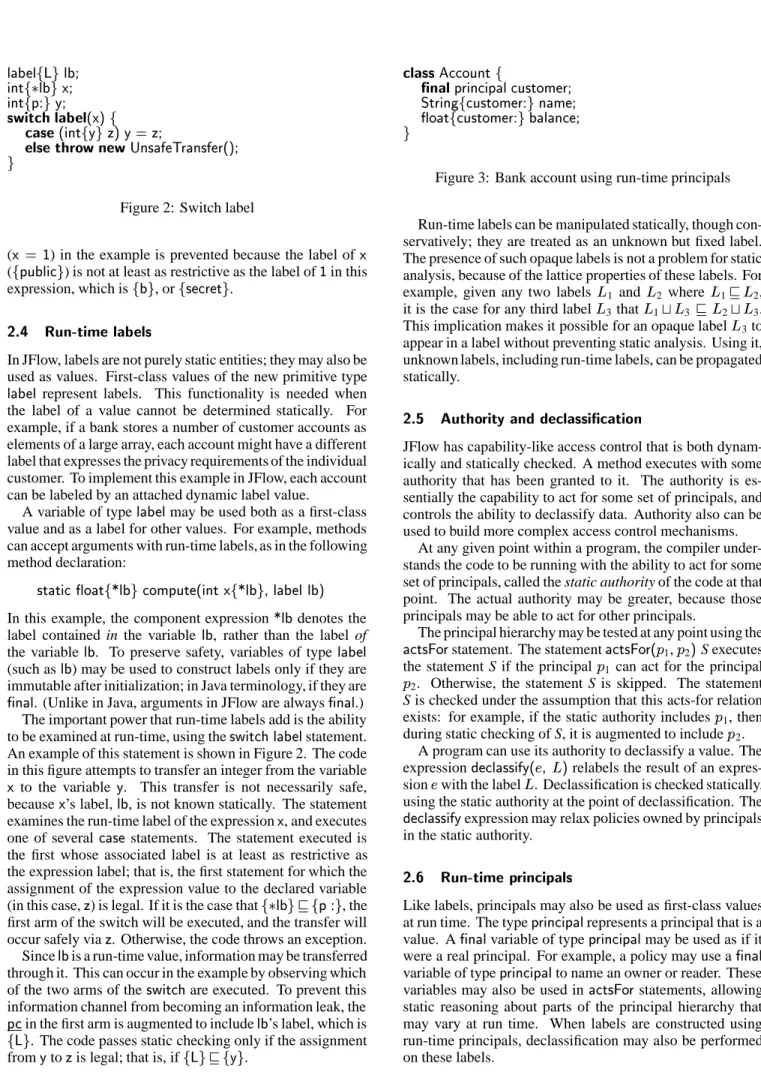
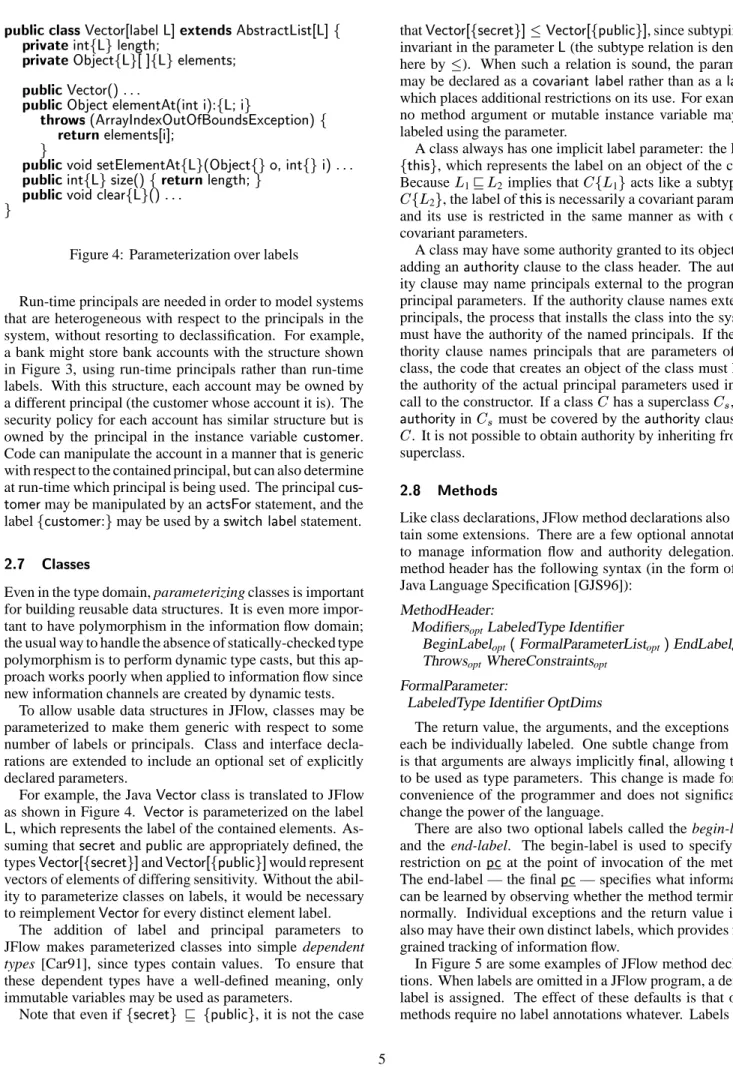
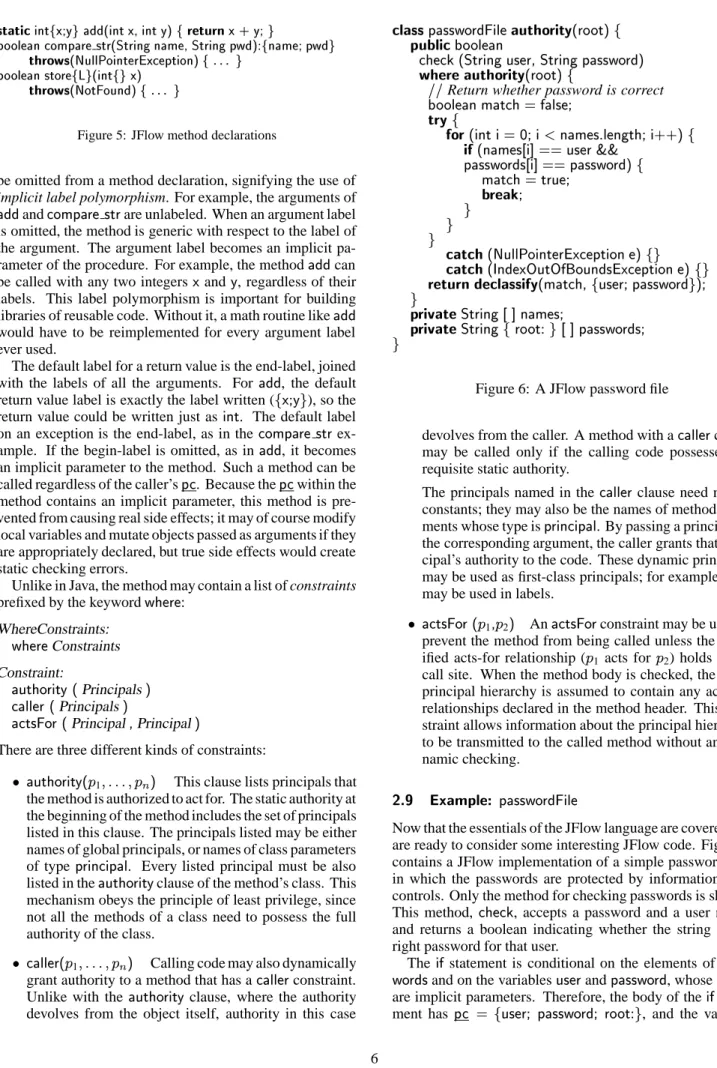
Proceedings of the 26th ACM Symposium on Principles of Programming Languages (POPL ’99), San Antonio, Texas, USA, January 1999
JFlow: Practical Mostly-Static Information Flow Control
Andrew C. Myers
Laboratory for Computer Science Massachusetts Institute of Technology
http://www.pmg.lcs.mit.edu/~andru
Abstract
A promising technique for protecting privacy and integrity of sensitive data is to statically check information flow within programs that manipulate the data. While previous work has proposed programming language extensions to allow this static checking, the resulting languages are too restrictive for practical use and have not been implemented. In this pa-per, we describe the new language JFlow, an extension to the Java language that adds statically-checked information flow annotations. JFlow provides several new features that make information flow checking more flexible and conve-nient than in previous models: a decentralized label model, label polymorphism, run-time label checking, and automatic label inference. JFlow also supports many language features that have never been integrated successfully with static infor-mation flow control, including objects, subclassing, dynamic type tests, access control, and exceptions. This paper defines the JFlow language and presents formal rules that are used to check JFlow programs for correctness. Because most check-ing is static, there is little code space, data space, or run-time overhead in the JFlow implementation.
1 Introduction
Protection for the privacy of data is becoming increasingly important as data and programs become increasingly mobile. Conventional security techniques such as discretionary ac-cess control and information flow control (including manda-tory access control) have significant shortcomings as privacy-protection mechanisms.
The hard problem in protecting privacy is preventing pri-vate information from leaking through computation. Access control mechanisms do not help with this kind of leak, since
This research was supported in part by DARPA Contract F30602-96-C-0303, monitored by USAF Rome Laboratory, and in part by DARPA Contract F30602-98-1-0237, also monitored by USAF Rome Laboratory.
Copyright c1999 by the Association for Computing Machinery, Inc. Permission
to make digital or hard copies of part or all of this work for personal or classroom use is granted without fee provided that copies are not made or distributed for profit or commercial advantage and that copies bear this notice and the full citation on the first page. Copyrights for components of this work owned by others than ACM must be honored. Abstracting with credit is permitted. To copy otherwise, to republish, to post on servers, or to redistribute to lists, requires prior specific permission and/or a fee. Request permissions from Publications Dept, ACM Inc., fax +1 (212) 869-0481, or [email protected].
they only control information release, not its propagation once released. Mandatory access control (MAC) mecha-nisms prevent leaks through propagation by associating a run-time security class with every piece of computed data. Every computation requires that the security class of the re-sult value also be computed, so multi-level systems using this approach are slow. Also, these systems usually apply a security class to an entire process, tainting all data handled by the process. This coarse granularity results in data whose security class is overly restrictive, and makes it difficult to write many useful applications.
A promising technique for protecting privacy and integrity of sensitive data is to statically check information flows within programs that might manipulate the data. Static checking allows the fine-grained tracking of security classes through program computations, without the run-time over-head of dynamic security classes. Several simple program-ming languages have been proposed to allow this static check-ing [DD77, VSI96, ML97, SV98, HR98]. However, the focus of these languages was correctly checking information flow statically, not providing a realistic programming model. This paper describes the new language JFlow, an extension to the Java language [GJS96] that permits static checking of flow annotations. JFlow seems to be the first practical pro-gramming language that allows this checking. Like other re-cent approaches [VSI96, ML97, SV98, HR98, ML98], JFlow treats static checking of flow annotations as an extended form of type checking. Programs written in JFlow can be statically checked by the JFlow compiler, which prevents information leaks through storage channels [Lam73]. JFlow is intended to support the writing of secure servers and applets that ma-nipulate sensitive data.
An important philosophical difference between JFlow and other work on static checking of information flow is the focus on a usable programming model. Despite a long history, static information flow analysis has not been widely accepted as a security technique. One major reason is that previous models of static flow analysis were too limited or too restrictive to be used in practice. The goal of the work presented in this paper has been to add enough power to the static checking framework to allow reasonable programs to be written in a natural manner.
This work has involved several new contributions: JFlow extends a complex programming language and supports many
language features that have not been previously integrated with static flow checking, including mutable objects (which subsume function values), subclassing, dynamic type tests, and exceptions. JFlow also provides powerful new features that make information flow checking less restrictive and more convenient than in previous programming languages:
It supports the decentralized label model [ML97,
ML98], which allows multiple principals to protect their privacy even in the presence of mutual distrust. It also supports safe, statically-checked declassification, or downgrading, allowing a principal to relax its own privacy policies without weakening policies of other principals.
It provides a simple but powerful model of access
con-trol that allows code privileges to be checked statically, and also allows authority to be granted and checked dynamically.
It provides label polymorphism, allowing code that is
generic with respect to the security class of the data it manipulates.
Run-time label checking and first-class label values
pro-vide a dynamic escape when static checking is too re-strictive. Run-time checks are statically checked to en-sure that information is not leaked by the success or failure of the run-time check itself.
Automatic label inference makes it unnecessary to write
many of the annotations that would otherwise be re-quired.
The JFlow compiler is structured as a source-to-source translator, so its output is a standard Java program that can be compiled by any Java compiler. For the most part, trans-lation involves removal of the static annotations in the JFlow program (after checking them, of course). There is little code space, data space, or run time overhead, because most checking is performed statically.
The remainder of this paper is structured as follows: Sec-tion 2 contains an overview of the JFlow language and a rationale for the decisions taken. Section 3 discusses static checking, sketches the framework used to check program constructs in a manner similar to type checking, and both for-mally and inforfor-mally presents some of the rules used. This section also describes the translations that are performed by the compiler. Section 4 compares this work to other work in related areas, and Section 5 provides some conclusions. The grammar of JFlow is provided for reference in Appendix A.
2 Language overview
This section presents an overview of the JFlow language and a rationale for its design. JFlow is an extension to the Java language that incorporates the decentralized label model. In Section 2.1, the previous work on the decentralized label model [ML97, ML98] is reviewed. The language descrip-tion in the succeeding secdescrip-tions focuses on the differences between JFlow and Java, since Java is widely known and well-documented [GJS96].
2.1 Labels
In the decentralized label model, data values are labeled with security policies. A label is a generalization of the usual notion of a security class; it is a set of policies that restrict the movement of any data value to which the label is attached. Each policy in a label has an owner O, which is a principal whose data was observed in order to create the value. Principals are users and other authority entities such as groups or roles. Each policy also has a set of readers, which are principals that O allows to observe the data. A single principal may be the owner of multiple policies and may appear in multiple reader sets.
For example, the labelL=fo1:r1,r2;o2: r2,r3ghas two
policies in it (separated by semicolons), owned byo1ando2
respectively. The policy of principalo1 allowsr1 andr2to
read; the policy of principalo2allowsr2andr3to read. The
effective reader set contains only the common readerr2. The
least restrictive label possible is the labelfg, which contains
no policies. Because no principal expresses a privacy interest in this label, data labeled byfgis completely public as far as
the labeling scheme is concerned.
There are two important intuitions behind this model: first, data may only be read by a user of the system if all of the policies on the data list that user as a reader. The effective policy is an intersection of all the policies on the data. Second, a principal may choose to relax a policy that it owns. This is a safe form of declassification — safe, because all of the other policies on the data are still enforced.
A process has the authority to act on behalf of some (pos-sibly empty) set of principals. The authority possessed by a process determines the declassifications that it is able to perform. Some principals are also authorized to act for other principals, creating a principal hierarchy. The principal hi-erarchy may change over time, but revocation is assumed to occur infrequently. The meaning of a label is affected by the current principal hierarchy. For example, if the principalr
0
can act for the principalr, then ifris listed as a reader by
a policy,r 0
is effectively listed by that policy as well. The meaning of a label under different principal hierarchies is discussed extensively in an earlier paper [ML98].
Every variable is statically bound to a static label. (The alternative, dynamic binding, largely prevents static analysis and can be simulated in JFlow if needed.) If a valuevhas label L1and a variablexhas labelL2, we can assign the value to
the variable (x:=v) only ifL1can be relabeled toL2, which
is written asL1vL2. The definition of this binary relation
on labels is intuitive:L1vL2if for every policy inL1, there
is some policy inL2 that is at least as restrictive [ML98].
Thus, the assignment does not leak information.
In this system, the label onxis assigned by the programmer
who writes the code that usesx. The power to select a label
for x does not give the programmer the ability to leak v,
because the static checker permits the assignment toxonly if
the label onxis sufficiently restrictive. After the assignment,
the static binding of the label ofxprevents leakage. (Changes
in who can read the value inxare effected by modifying the
principal hierarchy, but changes to the principal hierarchy require appropriate privilege.)
Computations (such as multiplying two numbers) cause
joining (t) of labels; the label of the result is the least
restric-tive label that is at least as restricrestric-tive as the labels of the values used in the computation; that is, the least upper bound of the labels. The join of two sets of policies is simply the union of the sets of policies. The relation v generates a lattice of
equivalence classes of labels with t as the LUB operator.
Lattice properties are important for supporting automatic la-bel inference and lala-bel polymorphism [ML97, ML98]. The notationABis also used as a shorthand forAvB^ BvA
(which does not mean that the labels are equal [ML98]). Declassification provides an escape hatch from strict infor-mation flow tracking. If the authority of a process includes a principalp, a value may be declassified by dropping policies
owned by principals thatpacts for. The ability to declassify
provides the opportunity forpto choose to release
informa-tion based on a more sophisticated analysis.
All practical information flow control systems provide the ability to declassify data because strict information flow con-trol is too restrictive to write real applications. More com-plex mechanisms such as inference controls [Den82] often are used to decide when declassification is appropriate. In previous systems, declassification is performed by a trusted
subject: code having the authority of a highly trusted
princi-pal. One key advantage of the new label structure is that it is decentralized: it does not require that all other principals in the system trust a principalp’s declassification decision,
sincepcannot weaken the policies of principals that it does
not act for.
2.2 Labeled types
This section begins the description of the new work in this pa-per (the JFlow programming language), which incorporates the label model just summarized. In a JFlow program, a label is denoted by a label expression, which is a set of component
expressions. As in Section 2.1, a component expression of
the form owner: reader1, reader2,::: denotes a policy. A
label expression is a series of component expressions, sep-arated by semicolons, such asfo1:r1,r2; o2: r2,r3g. In a
program, a component expression may take additional forms; for example, it may be simply a variable name. In that case, it denotes the set of policies in the label of that variable. The labelf
a
gcontains a single component; the meaning of thelabel is that the value it labels should be as restricted as the variable
a
is. The labelfa; o: r
gcontains two components,indicating that the labeled value should be as restricted as
a
is, and also that the principalo
restricts the value to be read by at mostr
.In JFlow, every value has a labeled type that consists of two parts: an ordinary Java type such as
int
, and a label that describes the ways that the value can propagate. The type and label parts of a labeled type act largely independently. Any type expression t may be labeled with any label expressionflg. This labeled type expression is written as tflg; for
example, the labeled type
int
fp:
grepresents an integer thatprincipal
p
owns and onlyp
can read (the owner of a policy is always implicitly a reader).The goal of type checking is to ensure that the apparent,
int
fpublic
gx;
boolean
fsecret
gb;
:::int x
=0;
if
(b)
fx
=1;
gFigure 1: Implicit flow example
static type of each expression is a supertype of the actual, run-time type of every value it might produce; similarly, the goal of label checking is to ensure that the apparent label of every expression is at least as restrictive as the actual label of every value it might produce. In addition, label checking guarantees that, except when declassification is used, the apparent label of a value is at least as restrictive as the actual label of every value that might affect it. In principle, the actual label could be computed precisely at run time. Static checking ensures that the apparent, static label is always a conservative approximation of the actual label. For this reason, it is typically unnecessary to represent the actual label at run time.
A labeled type may occur in a JFlow program in most places where a type may occur in a Java program. For exam-ple, variables may be declared with labeled type:
int
fp:
gx;
int
fx
gy;
int z;
The label may always be omitted from a labeled type, as in the declaration of
z
. If omitted, the label of a local variable is inferred automatically based on its uses. In other contexts where a label is omitted, a context-dependent default label is generated. For example, the default label of an instance variable is the public labelfg. Several other cases of defaultlabel assignment are discussed later.
2.3 Implicit ows
In JFlow, the label of an expression’s value varies depending on the evaluation context. This somewhat unusual property is needed to prevent leaks through implicit flows: channels created by the control flow structure itself.
Consider the code segment of Figure 1. By examining the value of the variable
x
after this segment has executed, we can determine the value of the secret booleanb
, even thoughx
has only been assigned constant values. The problem is the assignmentx = 1
, which should not be allowed.To prevent information leaks through implicit flows, the compiler associates a program-counter label (
pc
) with every statement and expression, representing the information that might be learned from the knowledge that the statement or expression was evaluated. In this program, the value ofpc
during the consequent of theif
statement isfb
g. After theif
statement,pc
=fg, since no information aboutb
can bededuced from the fact that the statement after the
if
statement is executed. The label of a literal expression (e.g.,1
) is the same as itspc
, orfb
gin this case. The unsafe assignmentlabel
fL
glb;
int
flb
gx;
int
fp:
gy;
switch label
(x)
fcase
(int
fy
gz) y
=z;
else throw new
UnsafeTransfer();
g
Figure 2: Switch label
(
x = 1
) in the example is prevented because the label ofx
(fpublic
g) is not at least as restrictive as the label of1
in thisexpression, which isf
b
g, orfsecret
g.2.4 Run-time labels
In JFlow, labels are not purely static entities; they may also be used as values. First-class values of the new primitive type
label
represent labels. This functionality is needed when the label of a value cannot be determined statically. For example, if a bank stores a number of customer accounts as elements of a large array, each account might have a different label that expresses the privacy requirements of the individual customer. To implement this example in JFlow, each account can be labeled by an attached dynamic label value.A variable of type
label
may be used both as a first-class value and as a label for other values. For example, methods can accept arguments with run-time labels, as in the following method declaration:static oat
f*lb
gcompute(int x
f*lb
g, label lb)
In this example, the component expression
*lb
denotes the label contained in the variablelb
, rather than the label of the variablelb
. To preserve safety, variables of typelabel
(such aslb
) may be used to construct labels only if they are immutable after initialization; in Java terminology, if they arenal
. (Unlike in Java, arguments in JFlow are alwaysnal
.)The important power that run-time labels add is the ability to be examined at run-time, using the
switch label
statement. An example of this statement is shown in Figure 2. The code in this figure attempts to transfer an integer from the variablex
to the variabley
. This transfer is not necessarily safe, becausex
’s label,lb
, is not known statically. The statement examines the run-time label of the expressionx
, and executes one of severalcase
statements. The statement executed is the first whose associated label is at least as restrictive as the expression label; that is, the first statement for which the assignment of the expression value to the declared variable (in this case,z
) is legal. If it is the case thatflb
gvfp
:g, thefirst arm of the switch will be executed, and the transfer will occur safely via
z
. Otherwise, the code throws an exception. Sincelb
is a run-time value, information may be transferred through it. This can occur in the example by observing which of the two arms of theswitch
are executed. To prevent this information channel from becoming an information leak, thepc
in the first arm is augmented to includelb
’s label, which isf
L
g. The code passes static checking only if the assignmentfrom
y
toz
is legal; that is, iffL
gvfy
g.class
Account
fnal
principal customer;
String
fcustomer:
gname;
oat
fcustomer:
gbalance;
gFigure 3: Bank account using run-time principals
Run-time labels can be manipulated statically, though con-servatively; they are treated as an unknown but fixed label. The presence of such opaque labels is not a problem for static analysis, because of the lattice properties of these labels. For example, given any two labels L1 andL2 whereL1vL2,
it is the case for any third labelL3thatL1tL3 vL2tL3.
This implication makes it possible for an opaque labelL3to
appear in a label without preventing static analysis. Using it, unknown labels, including run-time labels, can be propagated statically.
2.5 Authority and declassication
JFlow has capability-like access control that is both dynam-ically and statdynam-ically checked. A method executes with some authority that has been granted to it. The authority is es-sentially the capability to act for some set of principals, and controls the ability to declassify data. Authority also can be used to build more complex access control mechanisms.
At any given point within a program, the compiler under-stands the code to be running with the ability to act for some set of principals, called the static authority of the code at that point. The actual authority may be greater, because those principals may be able to act for other principals.
The principal hierarchy may be tested at any point using the
actsFor
statement. The statementactsFor(
p1,p2)
S executesthe statement S if the principalp1 can act for the principal p2. Otherwise, the statement S is skipped. The statement
S is checked under the assumption that this acts-for relation
exists: for example, if the static authority includesp1, then
during static checking of S, it is augmented to includep2.
A program can use its authority to declassify a value. The expression
declassify(
e,
L)
relabels the result of anexpres-sionewith the labelL. Declassification is checked statically,
using the static authority at the point of declassification. The
declassify
expression may relax policies owned by principals in the static authority.2.6 Run-time principals
Like labels, principals may also be used as first-class values at run time. The type
principal
represents a principal that is a value. Anal
variable of typeprincipal
may be used as if it were a real principal. For example, a policy may use anal
variable of typeprincipal
to name an owner or reader. These variables may also be used inactsFor
statements, allowing static reasoning about parts of the principal hierarchy that may vary at run time. When labels are constructed using run-time principals, declassification may also be performed on these labels.public class
Vector[label L]
extends
AbstractList[L]
fprivate
int
fL
glength;
private
Object
fL
g[ ]
fL
gelements;
public
Vector()
:::public
Object elementAt(int i):
fL; i
gthrows
(ArrayIndexOutOfBoundsException)
freturn
elements[i];
g
public
void setElementAt
fL
g(Object
fgo, int
fgi)
:::public
int
fL
gsize()
freturn
length;
gpublic
void clear
fL
g()
::: gFigure 4: Parameterization over labels
Run-time principals are needed in order to model systems that are heterogeneous with respect to the principals in the system, without resorting to declassification. For example, a bank might store bank accounts with the structure shown in Figure 3, using run-time principals rather than run-time labels. With this structure, each account may be owned by a different principal (the customer whose account it is). The security policy for each account has similar structure but is owned by the principal in the instance variable
customer
. Code can manipulate the account in a manner that is generic with respect to the contained principal, but can also determine at run-time which principal is being used. The principalcus-tomer
may be manipulated by anactsFor
statement, and the labelfcustomer:
gmay be used by aswitch label
statement.2.7 Classes
Even in the type domain, parameterizing classes is important for building reusable data structures. It is even more impor-tant to have polymorphism in the information flow domain; the usual way to handle the absence of statically-checked type polymorphism is to perform dynamic type casts, but this ap-proach works poorly when applied to information flow since new information channels are created by dynamic tests.
To allow usable data structures in JFlow, classes may be parameterized to make them generic with respect to some number of labels or principals. Class and interface decla-rations are extended to include an optional set of explicitly declared parameters.
For example, the Java
Vector
class is translated to JFlow as shown in Figure 4.Vector
is parameterized on the labelL
, which represents the label of the contained elements. As-suming thatsecret
andpublic
are appropriately defined, the typesVector[
fsecret
g]
andVector[
fpublic
g]
would representvectors of elements of differing sensitivity. Without the abil-ity to parameterize classes on labels, it would be necessary to reimplement
Vector
for every distinct element label.The addition of label and principal parameters to JFlow makes parameterized classes into simple dependent
types [Car91], since types contain values. To ensure that
these dependent types have a well-defined meaning, only immutable variables may be used as parameters.
Note that even iff
secret
g v fpublic
g, it is not the casethat
Vector[
fsecret
g]
Vector[
fpublic
g]
, since subtyping isinvariant in the parameter
L
(the subtype relation is denoted here by). When such a relation is sound, the parametermay be declared as a
covariant label
rather than as alabel
, which places additional restrictions on its use. For example, no method argument or mutable instance variable may be labeled using the parameter.A class always has one implicit label parameter: the label
f
this
g, which represents the label on an object of the class.BecauseL1vL2implies thatCfL1gacts like a subtype of CfL2g, the label of
this
is necessarily a covariant parameter,and its use is restricted in the same manner as with other covariant parameters.
A class may have some authority granted to its objects by adding an
authority
clause to the class header. The author-ity clause may name principals external to the program, or principal parameters. If the authority clause names external principals, the process that installs the class into the system must have the authority of the named principals. If the au-thority clause names principals that are parameters of the class, the code that creates an object of the class must have the authority of the actual principal parameters used in the call to the constructor. If a classChas a superclassCs
, anyauthority
inCs
must be covered by theauthority
clause of C. It is not possible to obtain authority by inheriting from asuperclass.
2.8 Methods
Like class declarations, JFlow method declarations also con-tain some extensions. There are a few optional annotations to manage information flow and authority delegation. A method header has the following syntax (in the form of the Java Language Specification [GJS96]):
MethodHeader:
ModifiersoptLabeledType Identifier
BeginLabelopt
(
FormalParameterListopt)
EndLabeloptThrowsoptWhereConstraintsopt
FormalParameter:
LabeledType Identifier OptDims
The return value, the arguments, and the exceptions may each be individually labeled. One subtle change from Java is that arguments are always implicitly
nal
, allowing them to be used as type parameters. This change is made for the convenience of the programmer and does not significantly change the power of the language.There are also two optional labels called the begin-label and the end-label. The begin-label is used to specify any restriction on
pc
at the point of invocation of the method. The end-label — the finalpc
— specifies what information can be learned by observing whether the method terminates normally. Individual exceptions and the return value itself also may have their own distinct labels, which provides fine-grained tracking of information flow.In Figure 5 are some examples of JFlow method declara-tions. When labels are omitted in a JFlow program, a default label is assigned. The effect of these defaults is that often methods require no label annotations whatever. Labels may
static
int
fx;y
gadd(int x, int y)
freturnx
+y;
gboolean compare str(String name, String pwd):
fname; pwd
g throws(NullPointerException)
f::: gboolean store
fL
g(int
fgx)
throws(NotFound)
f::: gFigure 5: JFlow method declarations
be omitted from a method declaration, signifying the use of
implicit label polymorphism. For example, the arguments of
add
andcompare str
are unlabeled. When an argument label is omitted, the method is generic with respect to the label of the argument. The argument label becomes an implicit pa-rameter of the procedure. For example, the methodadd
can be called with any two integersx
andy
, regardless of their labels. This label polymorphism is important for building libraries of reusable code. Without it, a math routine likeadd
would have to be reimplemented for every argument label ever used.The default label for a return value is the end-label, joined with the labels of all the arguments. For
add
, the default return value label is exactly the label written (fx;y
g), so thereturn value could be written just as
int
. The default label on an exception is the end-label, as in thecompare str
ex-ample. If the begin-label is omitted, as inadd
, it becomes an implicit parameter to the method. Such a method can be called regardless of the caller’spc
. Because thepc
within the method contains an implicit parameter, this method is pre-vented from causing real side effects; it may of course modify local variables and mutate objects passed as arguments if they are appropriately declared, but true side effects would create static checking errors.Unlike in Java, the method may contain a list of constraints prefixed by the keyword
where
:WhereConstraints:
where
Constraints Constraint:authority (
Principals)
caller (
Principals)
actsFor (
Principal,
Principal)
There are three different kinds of constraints:
authority(
p1;:::;pn
)
This clause lists principals thatthe method is authorized to act for. The static authority at the beginning of the method includes the set of principals listed in this clause. The principals listed may be either names of global principals, or names of class parameters of type
principal
. Every listed principal must be also listed in theauthority
clause of the method’s class. This mechanism obeys the principle of least privilege, since not all the methods of a class need to possess the full authority of the class.
caller(
p1;:::;pn
)
Calling code may also dynamicallygrant authority to a method that has a
caller
constraint. Unlike with theauthority
clause, where the authority devolves from the object itself, authority in this caseclass
passwordFile
authority
(root)
fpublic
boolean
check (String user, String password)
where authority
(root)
f//
Return whether password is correctboolean match
=false;
try
ffor
(int i
=0; i
<names.length; i
++)
fif
(names[i]
==user &&
passwords[i]
==password)
fmatch
=true;
break
;
g g gcatch
(NullPointerException e)
fgcatch
(IndexOutOfBoundsException e)
fgreturn declassify
(match,
fuser; password
g);
gprivate
String [ ] names;
private
String
froot:
g[ ] passwords;
gFigure 6: A JFlow password file
devolves from the caller. A method with a
caller
clause may be called only if the calling code possesses the requisite static authority.The principals named in the
caller
clause need not be constants; they may also be the names of method argu-ments whose type isprincipal
. By passing a principal as the corresponding argument, the caller grants that prin-cipal’s authority to the code. These dynamic principals may be used as first-class principals; for example, they may be used in labels.
actsFor (
p1,
p2)
AnactsFor
constraint may be used toprevent the method from being called unless the spec-ified acts-for relationship (p1 acts for p2) holds at the
call site. When the method body is checked, the static principal hierarchy is assumed to contain any acts-for relationships declared in the method header. This con-straint allows information about the principal hierarchy to be transmitted to the called method without any dy-namic checking.
2.9 Example:
passwordFile
Now that the essentials of the JFlow language are covered, we are ready to consider some interesting JFlow code. Figure 6 contains a JFlow implementation of a simple password file, in which the passwords are protected by information flow controls. Only the method for checking passwords is shown. This method,
check
, accepts a password and a user name, and returns a boolean indicating whether the string is the right password for that user.The
if
statement is conditional on the elements ofpass-words
and on the variablesuser
andpassword
, whose labels are implicit parameters. Therefore, the body of theif
state-ment haspc
=fuser; password; root:
g, and the variableclass
Protected
fnal
label
fthis
glb;
Object
flb
gcontent;
public
Protected
fLL
g(Object
fLL
gx, label LL)
flb
=LL;
//
must occur before call tosuper()super();
//
content
=x; //
checked assuminglb==LL gpublic
Object
fL
gget(label L):
fL
gthrows
(IllegalAccess)
fswitch label
(content)
fcase
(Object
fL
gunwrapped)
return
unwrapped;
else throw new
IllegalAccess();
g g
public
label get label()
freturn
lb;
g g
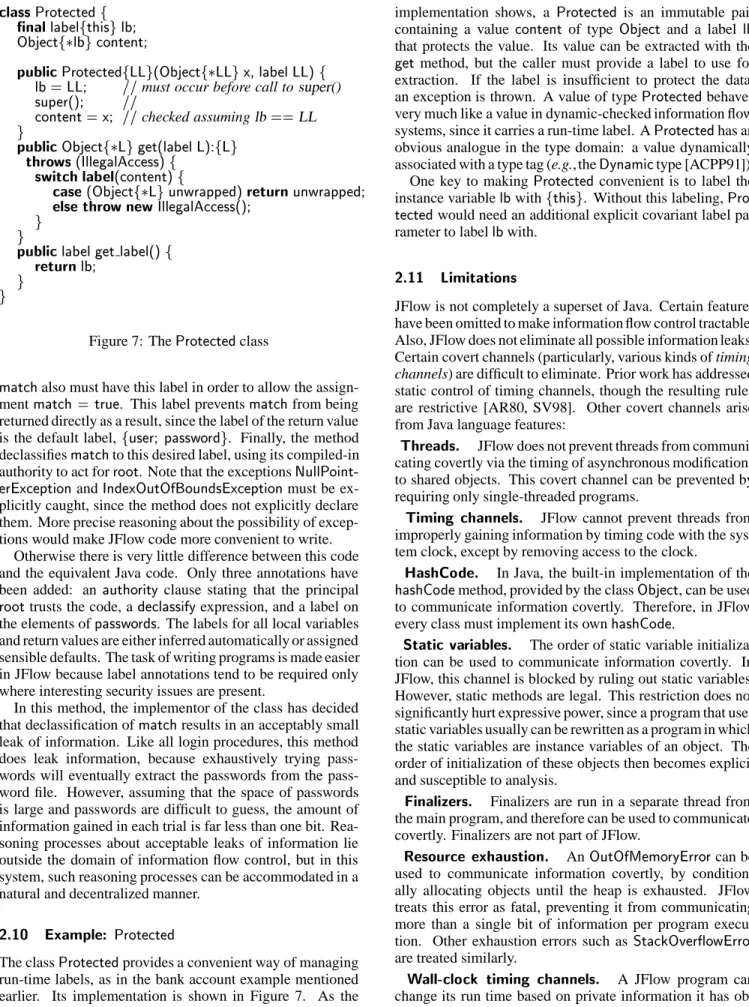
Figure 7: The
Protected
classmatch
also must have this label in order to allow the assign-mentmatch = true
. This label preventsmatch
from being returned directly as a result, since the label of the return value is the default label,fuser; password
g. Finally, the methoddeclassifies
match
to this desired label, using its compiled-in authority to act forroot
. Note that the exceptionsNullPoint-erException
andIndexOutOfBoundsException
must be ex-plicitly caught, since the method does not exex-plicitly declare them. More precise reasoning about the possibility of excep-tions would make JFlow code more convenient to write.Otherwise there is very little difference between this code and the equivalent Java code. Only three annotations have been added: an
authority
clause stating that the principalroot
trusts the code, adeclassify
expression, and a label on the elements ofpasswords
. The labels for all local variables and return values are either inferred automatically or assigned sensible defaults. The task of writing programs is made easier in JFlow because label annotations tend to be required only where interesting security issues are present.In this method, the implementor of the class has decided that declassification of
match
results in an acceptably small leak of information. Like all login procedures, this method does leak information, because exhaustively trying words will eventually extract the passwords from the pass-word file. However, assuming that the space of passpass-words is large and passwords are difficult to guess, the amount of information gained in each trial is far less than one bit. Rea-soning processes about acceptable leaks of information lie outside the domain of information flow control, but in this system, such reasoning processes can be accommodated in a natural and decentralized manner.2.10 Example:
Protected
The class
Protected
provides a convenient way of managing run-time labels, as in the bank account example mentioned earlier. Its implementation is shown in Figure 7. As theimplementation shows, a
Protected
is an immutable pair containing a valuecontent
of typeObject
and a labellb
that protects the value. Its value can be extracted with theget
method, but the caller must provide a label to use for extraction. If the label is insufficient to protect the data, an exception is thrown. A value of typeProtected
behaves very much like a value in dynamic-checked information flow systems, since it carries a run-time label. AProtected
has an obvious analogue in the type domain: a value dynamically associated with a type tag (e.g., theDynamic
type [ACPP91]). One key to makingProtected
convenient is to label the instance variablelb
withfthis
g. Without this labeling,Pro-tected
would need an additional explicit covariant label pa-rameter to labellb
with.2.11 Limitations
JFlow is not completely a superset of Java. Certain features have been omitted to make information flow control tractable. Also, JFlow does not eliminate all possible information leaks. Certain covert channels (particularly, various kinds of timing
channels) are difficult to eliminate. Prior work has addressed
static control of timing channels, though the resulting rules are restrictive [AR80, SV98]. Other covert channels arise from Java language features:
Threads.
JFlow does not prevent threads from communi-cating covertly via the timing of asynchronous modifications to shared objects. This covert channel can be prevented by requiring only single-threaded programs.Timing channels.
JFlow cannot prevent threads fromimproperly gaining information by timing code with the sys-tem clock, except by removing access to the clock.
HashCode.
In Java, the built-in implementation of thehashCode
method, provided by the classObject
, can be used to communicate information covertly. Therefore, in JFlow every class must implement its ownhashCode
.Static variables.
The order of static variable initializa-tion can be used to communicate informainitializa-tion covertly. In JFlow, this channel is blocked by ruling out static variables. However, static methods are legal. This restriction does not significantly hurt expressive power, since a program that uses static variables usually can be rewritten as a program in which the static variables are instance variables of an object. The order of initialization of these objects then becomes explicit and susceptible to analysis.Finalizers.
Finalizers are run in a separate thread from the main program, and therefore can be used to communicate covertly. Finalizers are not part of JFlow.Resource exhaustion.
AnOutOfMemoryError
can beused to communicate information covertly, by condition-ally allocating objects until the heap is exhausted. JFlow treats this error as fatal, preventing it from communicating more than a single bit of information per program execu-tion. Other exhaustion errors such as
StackOverowError
are treated similarly.Wall-clock timing channels.
A JFlow program canob-served. As an extreme example, it can enter an infinite loop. JFlow does not attempt to control these channels.
Unchecked exceptions.
Java allows users to defineexceptions that need not be declared in method headers (unchecked exceptions), although this practice is described as atypical [GJS96]. In JFlow, there are no unchecked ex-ceptions, since they could serve as covert channels.
Type discrimination on parameters.
JFlow supportsthe run-time cast and
instanceof
operators of standard Java, but they may only be invoked using classes that lack parame-ters. The reason for this restriction is that information about the parameters is not available at run time. These operators could be permitted if the parameters were statically known to be matched, but this is not currently supported.Backward compatibility.
JFlow is not backwardcom-patible with Java, since existing Java libraries are not flow-checked and do not provide flow annotations. However, in many cases, a Java library can be wrapped in a JFlow library that provides reasonable annotations.
3 Static checking and translation
This section covers the static checking that the JFlow com-piler performs as it translates code, and the translation process itself.
3.1 Exceptions
An important limitation of earlier attempts to create lan-guages for static flow checking has been the absence of usable exceptions. For example, in Denning’s original work on static flow checking, exceptions terminated the program [DD77] because any other treatment of exceptions seemingly leaked information. Subsequent work has avoided exceptions en-tirely.
It might seem unnecessary to treat exceptions directly, since in many languages, a function that generates excep-tions can be desugared into a function that returns a
discrim-inated union or oneof. However, there are problems with
this approach. The obvious way to handle oneofs causes all exceptions to carry the same label — an unacceptable loss of precision. Also, Java exceptions are actually objects, and the
try
:::catch
statement functions like a typecase. This modelcannot be translated directly into a oneof.
Nevertheless, it is useful to consider how oneof types might be handled in JFlow. The obvious way to treat oneof types is by analogy with record types. Each arm of the oneof has a distinct label associated with it. In addition, there is an added integer field
tag
that indicates which of the arms of the oneof is active. The problem with this model is that every assignment to the oneof will require thatftag
gvpc
,and every attempt to use the oneof will implicitly readf
tag
g.As a result, every arm of the oneof will effectively carry the same label. For modeling exceptions, this is unacceptable.
For each expression or statement, the static checker deter-mines its path labels, which are the labels for the informa-tion transmitted by various possible terminainforma-tion paths: nor-mal termination, termination through exceptions, termination
through a return statement, and so on. This fine-grained anal-ysis avoids the unnecessary restrictiveness that would be pro-duced by desugaring exceptions. Each exception that can be raised by evaluating a statement or expression has a possibly distinct label that is transferred to the
pc
ofcatch
statements that might intercept it. Even finer resolution is provided for normal termination and forreturn
termination; for example, the label of the value of an expression may differ from the label associated with normal termination. Finally, termina-tion of a statement by abreak
orcontinue
statement is also tracked without confusing distinctbreak
orcontinue
targets. The path labels for a statement or expression are repre-sented as a map from symbols to labels. Each mapping represents a termination path that the statement or expres-sion might take, and the label of the mapping indicates what information may be transmitted if this path is known to be the actual termination path. The domain of the map includes several different kinds of entities:The symbol
n
, which represents normal termination. The symbolr
, which represents termination through areturn
statement.Classes that inherit from
Throwable
. A mapping froma class represents termination by an exception.
The symbols
nv
andrv
represent the labels of thenor-mal value of an expression and the return value of a statement, respectively. They do not represent paths themselves, but it is convenient to include them as part of the map. Their labels are always at least as restrictive as the labels of the corresponding paths.
A tuple of the formh
goto
Li represents terminationby executing a named
break
orcontinue
statement that jumps to the targetL. Abreak
orcontinue
statementthat does not name a target is represented by the tuple
h
goto
i. These tuples are always mapped to the label >since the static checking rules do not use the actuallabel.
Path labels are denoted by the letterX in this paper, and
members of the domain ofX(paths) are denoted bys. The
expressionX[s]denotes the label thatXmapssto, and the
expressionX[s := L] denotes a new map that is exactly
like X except thatsis bound to L. Path labels may also
map a symbols to the pseudo-label ;, indicating that the
statement cannot terminate through the paths. The label;
acts as the bottom of the label lattice;;tL=Lfor all labels L, including the labelfg. The special path labelsX
; map
all paths to;, corresponding to an expression that does not
terminate.
3.2 Type checking vs. label checking
The JFlow compiler performs two kinds of static checking as it compiles a program: type checking and label checking. These two aspects of checking cannot be entirely disentan-gled, since labels are type constructors and appear in the rules for subtyping. However, the checks needed to show that a
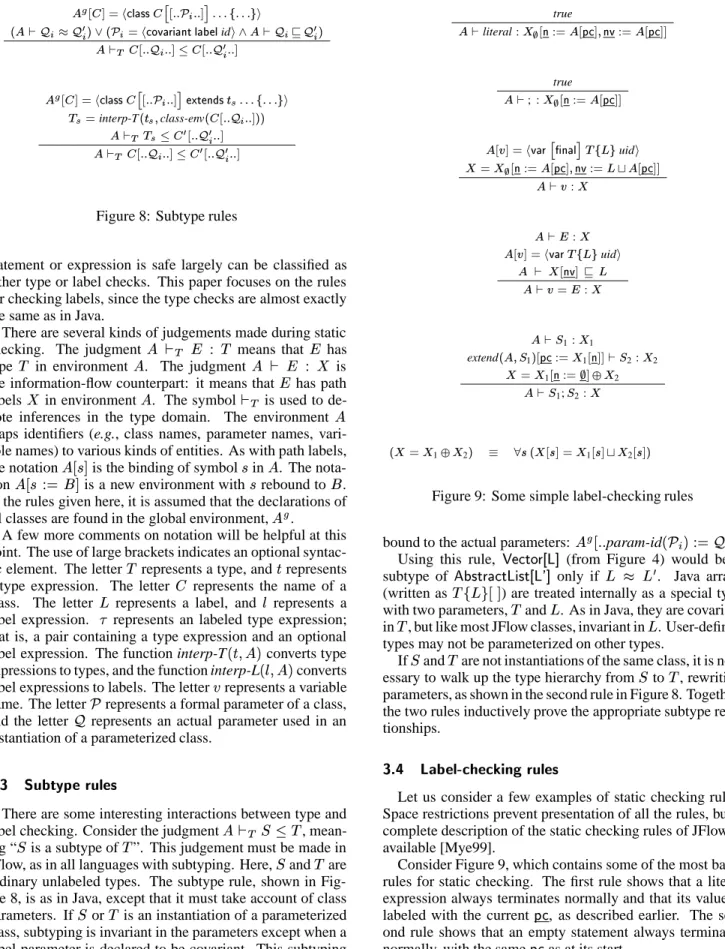
A
g[C
]=hclassC
[::
Pi::
]:::
f:::
gi (A
`QiQ 0 i)_(Pi=hcovariant labelidi^A
`QivQ 0 i)A
`TC
[::
Qi::
]C
[::
Q 0 i::
]A
g[C
]=hclassC
[::
Pi::
] extendst
s:::
f:::
giT
s=interp-T(t
s;
class-env(C
[::
Qi::
]))A
`TT
sC
0 [::
Q 0 i::
]A
`TC
[::
Qi::
]C
0 [::
Q 0 i::
]Figure 8: Subtype rules
statement or expression is safe largely can be classified as either type or label checks. This paper focuses on the rules for checking labels, since the type checks are almost exactly the same as in Java.
There are several kinds of judgements made during static checking. The judgmentA `
T
E : T means that E hastypeT in environmentA. The judgmentA ` E : X is
the information-flow counterpart: it means thatE has path
labelsX in environmentA. The symbol`
T
is used tode-note inferences in the type domain. The environment A
maps identifiers (e.g., class names, parameter names, vari-able names) to various kinds of entities. As with path labels, the notationA[s]is the binding of symbolsinA. The
nota-tionA[s :=B]is a new environment withsrebound toB.
In the rules given here, it is assumed that the declarations of all classes are found in the global environment,Ag.
A few more comments on notation will be helpful at this point. The use of large brackets indicates an optional syntac-tic element. The letterT represents a type, andtrepresents
a type expression. The letterC represents the name of a
class. The letter L represents a label, and l represents a
label expression. represents an labeled type expression;
that is, a pair containing a type expression and an optional label expression. The function interp-T(t;A)converts type
expressions to types, and the function interp-L(l;A)converts
label expressions to labels. The lettervrepresents a variable
name. The letterPrepresents a formal parameter of a class,
and the letterQ represents an actual parameter used in an
instantiation of a parameterized class.
3.3 Subtype rules
There are some interesting interactions between type and label checking. Consider the judgmentA`
T
ST,mean-ing “Sis a subtype ofT”. This judgement must be made in
JFlow, as in all languages with subtyping. Here,SandTare
ordinary unlabeled types. The subtype rule, shown in Fig-ure 8, is as in Java, except that it must take account of class parameters. IfS orT is an instantiation of a parameterized
class, subtyping is invariant in the parameters except when a label parameter is declared to be covariant. This subtyping rule is the first one shown in Figure 8. The function class-env, used in the figure, generates an extension of the global envi-ronment in which the formal parameters of a class (if any) are
true
A
`literal :X
; [n:=A
[pc];
nv:=A
[pc]] trueA
`; :X
; [n:=A
[pc]]A
[v
]=hvar nalT
fL
guidiX
=X
; [n:=A
[pc];
nv:=L
tA
[pc]]A
`v
:X
A
`E
:X
A
[v
]=hvarT
fL
guidiA
`X
[nv]vL
A
`v
=E
:X
A
`S
1:X
1 extend(A;S
1)[pc:=X
1[n]]`S
2:X
2X
=X
1[n:=; ]X
2A
`S
1;S
2:X
(X
=X
1X
2) 8s
(X
[s
]=X
1[s
]tX
2[s
])Figure 9: Some simple label-checking rules bound to the actual parameters:Ag[::param-id(P
i
):=Qi
::]Using this rule,
Vector[L]
(from Figure 4) would be a subtype ofAbstractList[L']
only if L L0
. Java arrays (written asTfLg[]) are treated internally as a special type
with two parameters,TandL. As in Java, they are covariant
inT, but like most JFlow classes, invariant inL. User-defined
types may not be parameterized on other types.
IfSandTare not instantiations of the same class, it is
nec-essary to walk up the type hierarchy fromS toT, rewriting
parameters, as shown in the second rule in Figure 8. Together, the two rules inductively prove the appropriate subtype rela-tionships.
3.4 Label-checking rules
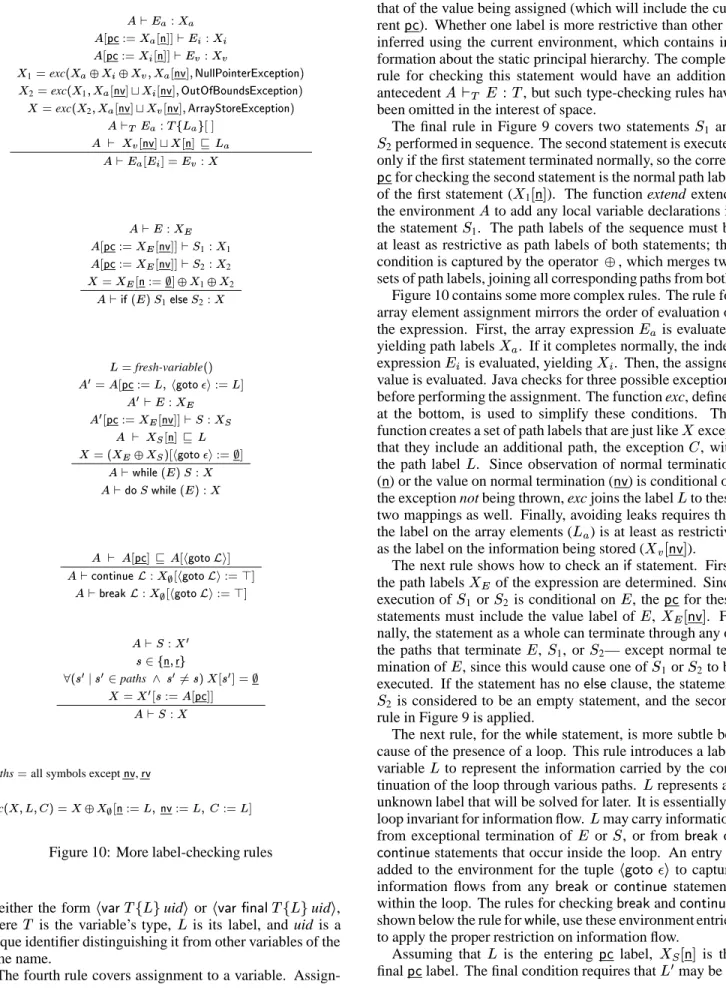
Let us consider a few examples of static checking rules. Space restrictions prevent presentation of all the rules, but a complete description of the static checking rules of JFlow is available [Mye99].
Consider Figure 9, which contains some of the most basic rules for static checking. The first rule shows that a literal expression always terminates normally and that its value is labeled with the current
pc
, as described earlier. The sec-ond rule shows that an empty statement always terminates normally, with the samepc
as at its start.The third rule shows that the value of a variable is labeled with both the label of the variable and the current
pc
. Note that the environment maps a variable identifier to an entryA
`E
a:X
aA
[pc:=X
a[n]]`E
i:X
iA
[pc:=X
i[n]]`E
v:X
vX
1=exc(X
aX
iX
v;X
a[nv];
NullPointerException)X
2=exc(X
1;X
a[nv]tX
i[nv];
OutOfBoundsException)X
=exc(X
2;X
a[nv]tX
v[nv];
ArrayStoreException)A
`TE
a:T
fL
ag[]A
`X
v[nv]tX
[n]vL
aA
`E
a[E
i]=E
v:X
A
`E
:X
EA
[pc:=X
E[nv]]`S
1:X
1A
[pc:=X
E[nv]]`S
2:X
2X
=X
E[n:=; ]X
1X
2A
`if(E
)S
1elseS
2:X
L
=fresh-variable()A
0 =A
[pc:=L;
hgotoi:=L
]A
0 `E
:X
EA
0 [pc:=X
E[nv]]`S
:X
SA
`X
S[n]vL
X
=(X
EX
S)[hgotoi:=; ]A
`while(E
)S
:X
A
`doS
while(E
):X
A
`A
[pc]vA
[hgotoLi]A
`continueL:X
; [hgotoLi:=>]A
`breakL:X
; [hgotoLi:=>]A
`S
:X
0s
2fn;
rg 8(s
0 js
0 2paths ^s
0 6=s
)X
[s
0 ]=;X
=X
0 [s
:=A
[pc]]A
`S
:X
paths=all symbols exceptnv,rv
exc(
X;L;C
)=X
X
;[n:=
L;
nv:=L; C
:=L
]Figure 10: More label-checking rules
of either the formh
var
TfLguidior hvar nal
TfLguidi,whereT is the variable’s type, Lis its label, and uid is a
unique identifier distinguishing it from other variables of the same name.
The fourth rule covers assignment to a variable.
Assign-ment is allowed if the variable’s label is more restrictive than that of the value being assigned (which will include the cur-rent
pc
). Whether one label is more restrictive than other is inferred using the current environment, which contains in-formation about the static principal hierarchy. The complete rule for checking this statement would have an additional antecedentA`T
E : T, but such type-checking rules havebeen omitted in the interest of space.
The final rule in Figure 9 covers two statementsS1 and S2performed in sequence. The second statement is executed
only if the first statement terminated normally, so the correct
pc
for checking the second statement is the normal path label of the first statement (X1[n
]). The function extend extendsthe environmentAto add any local variable declarations in
the statementS1. The path labels of the sequence must be
at least as restrictive as path labels of both statements; this condition is captured by the operator , which merges two
sets of path labels, joining all corresponding paths from both. Figure 10 contains some more complex rules. The rule for array element assignment mirrors the order of evaluation of the expression. First, the array expressionE
a
is evaluated,yielding path labelsX
a
. If it completes normally, the indexexpressionE
i
is evaluated, yieldingXi
. Then, the assignedvalue is evaluated. Java checks for three possible exceptions before performing the assignment. The function exc, defined at the bottom, is used to simplify these conditions. This function creates a set of path labels that are just likeXexcept
that they include an additional path, the exceptionC, with
the path labelL. Since observation of normal termination
(
n
) or the value on normal termination (nv
) is conditional on the exception not being thrown, exc joins the labelLto thesetwo mappings as well. Finally, avoiding leaks requires that the label on the array elements (L
a
) is at least as restrictiveas the label on the information being stored (X
v
[nv
]).The next rule shows how to check an
if
statement. First, the path labelsXE
of the expression are determined. Sinceexecution ofS1or S2 is conditional onE, the
pc
for thesestatements must include the value label ofE,X
E
[nv
].Fi-nally, the statement as a whole can terminate through any of the paths that terminateE,S1, orS2— except normal
ter-mination ofE, since this would cause one ofS1orS2to be
executed. If the statement has no
else
clause, the statementS2 is considered to be an empty statement, and the second
rule in Figure 9 is applied.
The next rule, for the
while
statement, is more subtle be-cause of the presence of a loop. This rule introduces a label variableL to represent the information carried by thecon-tinuation of the loop through various paths. Lrepresents an
unknown label that will be solved for later. It is essentially a loop invariant for information flow.Lmay carry information
from exceptional termination ofE orS, or from
break
orcontinue
statements that occur inside the loop. An entry is added to the environment for the tuplehgoto
ito captureinformation flows from any
break
orcontinue
statements within the loop. The rules for checkingbreak
andcontinue
, shown below the rule forwhile
, use these environment entries to apply the proper restriction on information flow.Assuming that L is the entering
pc
label, XS
[n
] is thefinal
pc
label. The final condition requires thatL 0A
`TE
:classC
f:::
gA
`E
:X
EX
=exc(X
E;X
E[nv];C
)[n:=;]A
`throwE
:X
A
`S
:X
S pci=exc-label(X
S;C
i)A
[pc:=pci; v
i:=hvar nalC
fpcigfresh-uid()i ]`S
i:X
iX
=( L iX
i)uncaught(X
S;
(::;C
i;::
))A
`tryfS
g::
catch(C
iv
i)fS
ig::
:X
A
`S
1:X
1A
`S
2:X
2X
=X
1[n:=;]X
2A
`tryfS
1gnallyfS
2g:X
exc-label(X;C
)= F C0: (C 0 C_CC 0 )X
[C
0 ] (X
0 =uncaught(X;
(::;C
i;::
)))X
0 [s
]=(if(9i
(s
C
i))then;elseX
[s
])Figure 11: Exception-handling rules
most as restrictive asL, which is what establishes the loop
invariant.
The last rule in Figure 10 applies to any statement, and is important for relaxing restrictive path labels. It is intuitive: if a statement (or a sequence of statements) can only terminate normally, the
pc
at the end is the same as thepc
at the be-ginning. The same is true if the statement can only terminate with areturn
statement. This rule is called the single-pathrule. It would not be safe for this rule to apply to exception
paths. To see why, suppose that a set of path labels formally contains only a single exception pathC. However, that path
might include multiple paths consisting of exceptions that are subclasses ofC. These multiple paths can be discriminated
using a
try
:::catch
statement. The unusual Java exceptionmodel prevents the single-path rule from being applied to exception paths.
However, Java is a good language to extend for static flow analysis in other ways because it fully specifies evaluation order. This property makes static checking of information flow simpler, because the rules tend to encode all possible evaluation orders. If there were non-determinism in evalua-tion order, it could be encoded by adding label variables in a manner similar to the rule for the
while
statement.3.5 Throwing and catching exceptions
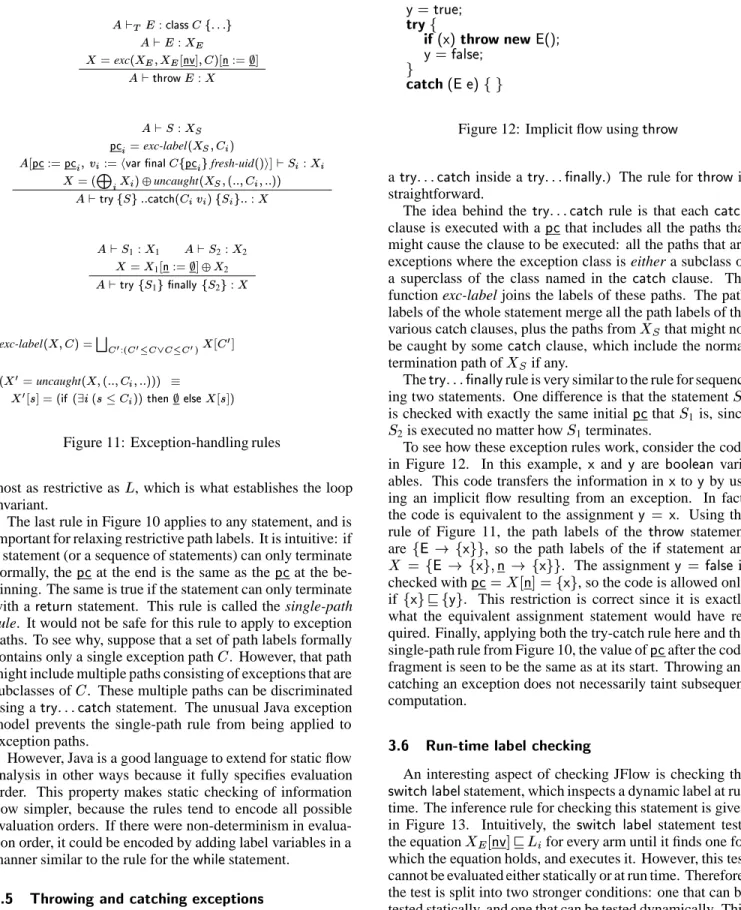
Exceptions can be thrown and caught safely in JFlow using the usual Java constructs. Figure 11 shows the rule for the
throw
statement, atry
:::catch
statement that lacks anally
clause, and a
try
:::nally
statement. (Atry
statement withboth
catch
clauses and anally
clause can be desugared intoy
=true;
try
fif
(x)
throw new
E();
y
=false;
g
catch
(E e)
fgFigure 12: Implicit flow using
throw
a
try
:::catch
inside atry
:::nally
.) The rule forthrow
isstraightforward.
The idea behind the
try
:::catch
rule is that eachcatch
clause is executed with a
pc
that includes all the paths that might cause the clause to be executed: all the paths that are exceptions where the exception class is either a subclass or a superclass of the class named in thecatch
clause. The function exc-label joins the labels of these paths. The path labels of the whole statement merge all the path labels of the various catch clauses, plus the paths fromXS
that might notbe caught by some
catch
clause, which include the normal termination path ofXS
if any.The
try
:::nally
rule is very similar to the rule forsequenc-ing two statements. One difference is that the statementS2
is checked with exactly the same initial
pc
thatS1 is, since S2is executed no matter howS1terminates.To see how these exception rules work, consider the code in Figure 12. In this example,
x
andy
areboolean
vari-ables. This code transfers the information inx
toy
by us-ing an implicit flow resultus-ing from an exception. In fact, the code is equivalent to the assignmenty = x
. Using the rule of Figure 11, the path labels of thethrow
statement are fE
! fx
gg, so the path labels of theif
statement are X = fE
! fx
g;n
! fx
gg. The assignmenty = false
ischecked with
pc
=X[n
]=fx
g, so the code is allowed onlyiff
x
gvfy
g. This restriction is correct since it is exactlywhat the equivalent assignment statement would have re-quired. Finally, applying both the try-catch rule here and the single-path rule from Figure 10, the value of
pc
after the code fragment is seen to be the same as at its start. Throwing and catching an exception does not necessarily taint subsequent computation.3.6 Run-time label checking
An interesting aspect of checking JFlow is checking the
switch label
statement, which inspects a dynamic label at run time. The inference rule for checking this statement is given in Figure 13. Intuitively, theswitch label
statement tests the equationXE
[nv
]vLi
for every arm until it finds one forwhich the equation holds, and executes it. However, this test cannot be evaluated either statically or at run time. Therefore, the test is split into two stronger conditions: one that can be tested statically, and one that can be tested dynamically. This rule naturally contains the static part of the test.
Let L
RT
be the join of all possiblerun-time-representable components (i.e., components that do not mention formal label or principal parameters). The static test is that X
E
[nv
]tLRT
vLi
tLRT
(equiva-A
`E
:X
EL
i=interp-L(l
i;A
)A
`X
E[nv]vL
itL
RTA
`TE
:T
A
`TT
interp-T(t
i;A
) pc0=X
E[n] pci=pci ;1 tlabel(X
E[nv]tL
i)A
[pc:=pci;v
i:=hvar nalT
ifL
igfresh-uid()i ]`S
i:X
iX
=X
E( Li
X
i)A
`switch label(E
)f::
case(t
ifl
igv
i)S
i::
g:X
Figure 13: Inference rule for
switch label
lently, X
E
[nv
]vLi
tLRT
); the dynamic test is that XE
[nv
]uLRT
vLi
uLRT
. Together, these two testsim-ply the full conditionX
E
[nv
]vLi
.The test itself may be used as an information channel, so after the check, the
pc
must include the labels ofXE
[nv
]andeveryL
i
up to this point. This rule uses the label functionto achieve this. When applied to a label L, it generates
a new label that joins together the labels of all variables that are mentioned inL. However, the presence of label in
constraint equations does not change the process of solving label constraints in any fundamental way.
3.7 Checking method calls
Let us now look at some of the static checking associated with objects. Static checking in object-oriented languages is often complex, and the various features of JFlow only add to the complexity. This section shows how, despite this com-plexity, method calls and constructor calls (via the operator
new
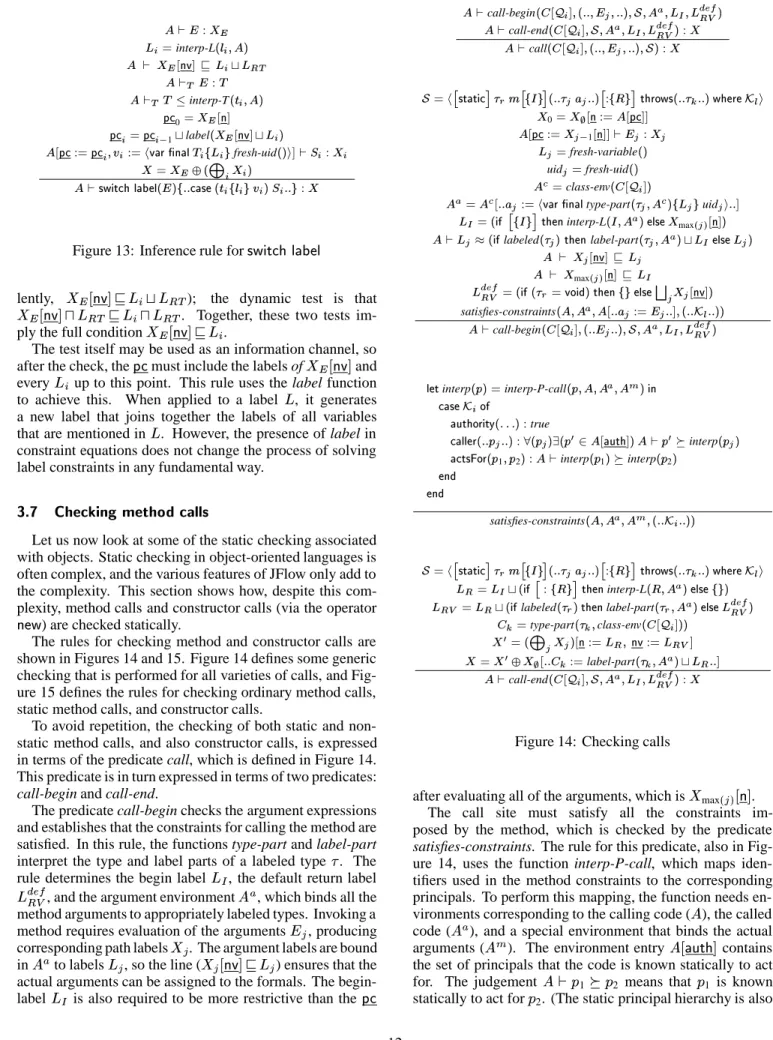
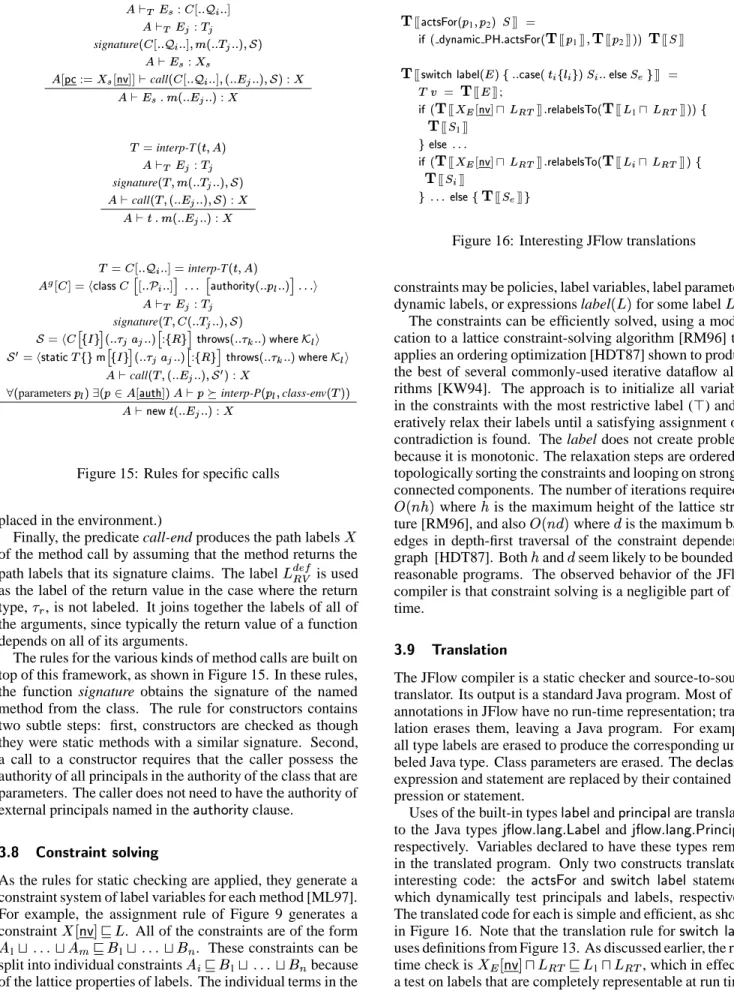
) are checked statically.The rules for checking method and constructor calls are shown in Figures 14 and 15. Figure 14 defines some generic checking that is performed for all varieties of calls, and Fig-ure 15 defines the rules for checking ordinary method calls, static method calls, and constructor calls.
To avoid repetition, the checking of both static and non-static method calls, and also constructor calls, is expressed in terms of the predicate call, which is defined in Figure 14. This predicate is in turn expressed in terms of two predicates:
call-begin and call-end.
The predicate call-begin checks the argument expressions and establishes that the constraints for calling the method are satisfied. In this rule, the functions type-part and label-part interpret the type and label parts of a labeled type. The
rule determines the begin labelL
I
, the default return label LdefRV
, and the argument environmentAa, which binds all themethod arguments to appropriately labeled types. Invoking a method requires evaluation of the argumentsE
j
, producingcorresponding path labelsX
j
. The argument labels are boundinAato labelsL
j
, so the line (Xj
[nv
]vLj
) ensures that theactual arguments can be assigned to the formals. The begin-labelL
I
is also required to be more restrictive than thepc
A
`call-begin(C
[Qi];
(::;E
j;::
);
S;A
a;L
I;L
defRV)A
`call-end(C
[Qi];
S;A
a;L
I;L
defRV):X
A
`call(C
[Qi];
(::;E
j;::
);
S):X
S=h static rm
fI
g (::
ja
j::
) :fR
g throws(::
k::
)whereKliX
0=X
; [n:=A
[pc]]A
[pc:=X
j ;1 [n]]`E
j:X
jL
j=fresh-variable() uidj=fresh-uid()A
c=class-env(C
[Qi])A
a=A
c[::a
j:=hvar naltype-part(j;A
c)fL
jguidji::
]L
I=(iff
I
gtheninterp-L(
I;A
a)elseX
max (j)[n])
A
`L
j(iflabeled(j)thenlabel-part(j;A
a)tL
IelseL
j)A
`X
j[nv]vL
jA
`X
max (j)[n]v
L
IL
defRV =(if(r=void)thenfgelse Fj
X
j[nv])satisfies-constraints(
A;A
a;A
[::a
j:=E
j::
];
(::
Kl::
))A
`call-begin(C
[Qi];
(::E
j::
);
S;A
a;L
I;L
defRV)letinterp(
p
)=interp-P-call(p;A;A
a;A
m)incaseKiof authority(
:::
): true caller(::p
j::
):8(p
j)9(p
0 2A
[auth])A
`p
0 interp(p
j)actsFor(
p
1;p
2):A
`interp(p
1)interp(p
2)end end satisfies-constraints(
A;A
a;A
m;
(::
Ki::
)) S=h static rm
fI
g (::
ja
j::
) :fR
g throws(::
k::
)whereKliL
R=L
It(if :fR
gtheninterp-L(
R;A
a)elsefg)L
RV =L
Rt(iflabeled(r)thenlabel-part(r;A
a)elseL
def RV)
C
k=type-part(k;
class-env(C
[Qi]))X
0 =( L jX
j)[n:=L
R;
nv:=L
RV]X
=X
0X
; [::C
k:=label-part(k;A
a)tL
R::
]A
`call-end(C
[Qi];
S;A
a;L
I;L
defRV):X
Figure 14: Checking calls
after evaluating all of the arguments, which isXmax (
j
)[
n
].The call site must satisfy all the constraints im-posed by the method, which is checked by the predicate
satisfies-constraints. The rule for this predicate, also in
Fig-ure 14, uses the function interp-P-call, which maps iden-tifiers used in the method constraints to the corresponding principals. To perform this mapping, the function needs en-vironments corresponding to the calling code (A), the called
code (Aa), and a special environment that binds the actual arguments (Am). The environment entry A[
auth
]containsthe set of principals that the code is known statically to act for. The judgement A`p1p2 means thatp1 is known