Multiobjective Optimizer
Thanh-Do Tran, Ramiro Varela, In´
es Gonz´
alez-Rodr´ıguez, El-Ghazali Talbi
To cite this version:
Thanh-Do Tran, Ramiro Varela, In´
es Gonz´
alez-Rodr´ıguez, El-Ghazali Talbi. Solving Fuzzy
Job-Shop Scheduling Problems with a Multiobjective Optimizer. The Fifth International Conference
on Knowledge and Systems Engineering (KSE), Oct 2013, Hanoi, Vietnam. Springer, 2013,
<10.1007/978-3-319-02821-7 19>.
<hal-01058073>
HAL Id: hal-01058073
https://hal.inria.fr/hal-01058073
Submitted on 26 Aug 2014
HAL
is a multi-disciplinary open access
archive for the deposit and dissemination of
sci-entific research documents, whether they are
pub-lished or not.
The documents may come from
teaching and research institutions in France or
abroad, or from public or private research centers.
L’archive ouverte pluridisciplinaire
HAL, est
destin´
ee au d´
epˆ
ot et `
a la diffusion de documents
scientifiques de niveau recherche, publi´
es ou non,
´
emanant des ´
etablissements d’enseignement et de
recherche fran¸
cais ou ´
etrangers, des laboratoires
publics ou priv´
es.
with a Multiobjective Optimizer
Thanh-Do Tran1?, Ramiro Varela2, In´es Gonz´alez-Rodr´ıguez3, and
El-Ghazali Talbi1
1 DOLPHIN Team, Inria Lille – Nord Europe and LIFL, Universit´e Lille 1, France 2 A.I. Centre and Department of Computer Science, University of Oviedo, Spain 3
Dept. of Mathematics, Statistics and Computing, University of Cantabria, Spain
Abstract. In real-world manufacturing environments, it is common to face a job-shop scheduling problem (JSP) with uncertainty. Among dif-ferent sources of uncertainty, processing times uncertainty is the most common. In this paper, we investigate the use of a multiobjective ge-netic algorithm to address JSPs with uncertain durations. Uncertain du-rations in a JSP are expressed by means of triangular fuzzy numbers (TFNs). Instead of using expected values as in other work, we consider all vertices of the TFN representing the overall completion time. As a consequence, the proposed approach tries to obtain a schedule that op-timizes the three component scheduling problems (corresponding to the lowest, most probable, and largest durations) all at the same time. In order to verify the quality of solutions found by the proposed approach, an experimental study was carried out across different benchmark in-stances. In all experiments, comparisons with previous approaches that are based on a single-objective genetic algorithm were also performed.
1
Introduction
Job-shop scheduling problems (JSPs) are known to be one of the hardest classes of combinatorial problems. They have formed an important body of research since the late fifties, with multiple applications in industry, finance, and sci-ence [23]. In fact, JSPs are not only NP-complete but also among the worst NP-complete class members [21]. Therefore, they have usually been solved by using heuristic techniques, rather than exact methodologies.
During the past two decades, various proposals based on genetic algorithms have been introduced to solve large JSP instances: [4], [27], [22], and [15], to name but a few. Even though most proposals deal with crisp JSPs, i.e. all relevant information is assumed to be concrete, in many real-life situations, it is often the case that the exact duration of a task is not known in advance [10]. Instead, based on previous experience, an expert may have some knowledge about this duration and it is therefore possible to estimate this processing time. In such a
?TDT was supported by the ECSC Scholarship Program of the Master in Soft
Com-puting and Intelligent Data Analysis at the European Centre for Soft ComCom-puting and, currently, is supported by a CORDI-S Doctoral Fellowship of Inria.
situation, it is neither possible nor plausible to represent processing times with concrete numbers.
Depending on the available knowledge and the representation technique being used, the information about durations can be modeled by an interval for the possible processing times or its most typical values. When deeper knowledge of the problem is available, fuzzy intervals—which are considered as an alternative to probability distributions—can also be used; however, this technique usually requires complex computation [13]. When only little knowledge is available, we can use a confidence interval to represent the uncertain duration of a task. In this context, if some values in the interval appear to be more probable than others, it is natural to extend the representation to a fuzzy interval or fuzzy number [13]. In this work, following [10], triangular fuzzy numbers (TFNs) are employed to represent uncertain durations in a JSP. By this representation, only the sum
and maximum operations are needed to calculate the completion time of each taskin a job. Then, thecompletion time of each jobis computed via a semi-active schedule builder [12]. This job completion time is also represented by a TFN. When completion times of all jobs have been determined, theoverall completion time of the JSP (aka makespan) is taken as the maximum completion time over all the jobs. By taking the expected value of the overall completion time as an objective function, genetic and memetic algorithms have been successfully applied to search for a (near-) optimal schedule to the problem [11,14,24].
Being a single number, an expected value cannot fully represent the overall completion time that is expressed by a triangular fuzzy number. Consequently, using the expected value as an objective function implies an approximation of the problem to be solved. Such approximation might, to some extent, result in the loss of information; and therefore the obtained schedule might always be different from the true optimal one in some situations. To overcome this conspicuous drawback of the current techniques, we have investigated a new approach based on a multi-objective genetic algorithm.
This new approach enables us to take into account all three vertices of a TFN representing the overall completion time in the objective function. As a consequence, this approach considers at the same time three different scheduling problems corresponding to the lowest, most probable, and largest durations. With the use of a multi-objective genetic algorithm, the proposed approach tries to obtain a schedule that optimizes the three component scheduling problems all at the same time. In order to verify the quality of solutions found by the proposed approach, an experimental study has been carried out across different benchmark instances. Then a new proposal on analyzing the tolerance for the imprecision of knowledge representation is presented.
2
Job-Shop Scheduling with Uncertain Durations
2.1 Crisp Job-Shop Scheduling Problems
A general JSP [16] can be defined as scheduling a set ofnjobs {J1, J2,· · ·, Jn} on a set ofmphysical resources or machines{M1, M2,· · ·, Mm}, subject to a set
of constraints. For a jobJi to be completed, a series of tasks have to be done in a predefined order. Those tasks are enumerated by an index j, and, obviously,
j is at most equal tom. The jobJi is then said to be composed of tasks θij’s, wherej = 1,2,· · ·, m. It is noteworthy that a task denoted byθij does not imply that it will be processed on thej-th machine. The indexj is used only for task enumeration of the jobJi.
In such a general JSP, the predefined orders of tasks form precedence con-straints; that is,m tasks{θi1, θi2,· · ·, θim} of the jobJi, wherei= 1,2,· · ·, n, have to be sequentially scheduled. Also, there are capacity constraints; that is, each taskθij requires the uninterrupted and exclusive use of one of the machines for its whole processing time. A solution to this problem is a schedules—which is an allocation of starting times for all the tasks. Such a solution, besides be-ing feasible (i.e. all the constraints hold), has to be optimal accordbe-ing to some criteria, for instance, the makespan is minimal [10].
Without loss of generality, let us now consider a JSP instance of sizen×m
(i.e.n jobs andm machines), letpbe a duration (aka processing time) matrix andv be a machine matrix such thatpij is the processing time of taskθij and
vij is the machine required by θij, where i = 1,2,· · ·, n and j = 1,2,· · ·, m. Letσ be a feasibletask processing order, i.e. a lineal ordering of tasks which is compatible with a processing order of tasks that may be carried out such that all constraints hold. A feasible schedulesmay be derived fromσusing a semi-active schedule builder [17,12]. LetSij(σ,p,v) andCij(σ,p,v) denote the starting and completion times of the taskθij. According to the semi-active schedule builder, the starting and completion times can be computed as follows:
Sij(σ,p,v) = Ci(j−1)(σ,p,v) ∨ Crs(σ,p,v), (1)
Cij(σ,p,v) = Sij(σ,p,v) + pij, (2) where θrs is the task preceding θij in the machine according to the processing orderσ,Ci0(σ,p,v) is assumed to be zero and, analogously,Crs(σ,p,v) is taken to be zero if θij is the first task to be processed in the corresponding machine. The completion time of job Ji will then be Ci(σ,p,v) =Cim(σ,p,v), and the makespan Cmax(σ,p,v) is the maximum completion time of any job under a
given candidate scheduleσ:
Cmax(σ,p,v) = ∨1≤i≤n
Ci(σ,p,v)
. (3)
For the sake of notation simplicity, we follow [10] to write Cmax(σ) when the
problem (and thuspandv) is fixed or evenCmaxwhen no confusion is possible.
2.2 Modeling Uncertain Durations with TFNs
In real-life applications, it is often the case that the exact duration of a task, i.e. the time it takes to be processed, is not known in advance. However, based on previous experience, an expert may have some knowledge, usually uncer-tain, about the duration. The most straightforward representation for uncertain
durations would be a human-originated confidence interval. If some values ap-pear to be more plausible than others, a natural extension is a fuzzy interval or fuzzy number [14]. The simplest model for this case is a triangular fuzzy num-ber (TFN) [19], which use an interval
p1, p3
of possible values and a modal valuep2in between. For a TFNA, denoted byA= (p1, p2, p3), the membership
function takes the following triangular shape:
µA(x) = 0, x < p1 x−p1 p2−p1 , p 1≤x≤p2 x−p3 p2−p3 , p 2< x≤p3 0, x > p3. (4)
In the JSP, we essentially need two operations on fuzzy quantities: thesum
and themaximum. These operations are obtained by extending the correspond-ing operations on real numbers uscorrespond-ing the so-calledExtension Principle. However, computing the resulting expression is cumbersome, if not intractable [10].
For the sake of simplicity and tractability of numerical calculations, we fol-low [7] toapproximate the results of these operations by a TFN. In other words, we evaluate the sum and maximum operations on only three defining points of each TFN. The approximated sum coincides with the sum of TFNs as defined by the Extension Principle; thus, for any pair of TFNsM andN, ifS=M+N
denotes their sum, we have:
S = m1+n1, m2+n2, m3+n3. (5) Unfortunately, for the maximum of TFNs, there is no such simplified expres-sion. For any two TFNsM andN, letF =N∨M denote their [true] maximum, andG= (m1∨n1, m2∨n2, m3∨n3) itsapproximated value, an illustration of
the distinction between the maximum and its approximation is given in Fig. 1. It is interesting to note that such an approximated maximum can trivially be extended to the case of more than two TFNs [13].
0 1 2 3 4 5 6 7 8 9 10 11 12 0 0.25 0.5 0.75 1 M N F G universe of discourse μ
Fig. 1.Exact (magenta) and approximated (red) maximum operations. Besides being simple, it is clear that this approximation possesses another nice property of preserving the support and modal value of the true maximum. It is however remarkable that, at all α-cuts, the lower and upper bounds of
the approximated maximum are either smaller than or equal to the lower and upper bounds of the true maximum, respectively. More formally, let [f
α, fα] and [g
α, gα] be theα-cuts ofF andG, respectively, it holds that:
∀α∈[0,1], fα≤gα and fα≤gα. (6) In possibility theory, the membership functionµQ of a fuzzy quantityQcan be interpreted as a possibility distribution on real numbers; and this allows us to define theexpected value of a fuzzy quantity. For a given TFNA= p1, p2, p3
, a typical model [20] for defining its expected value E[A] is given by:
E [A] = 1
4 p
1+ 2p2+p3. (7)
Importantly, the expected value coincides with theneutral scalar substitute
of a fuzzy interval [28]. The neutral scalar substitute is among the most natural defuzzification procedures proposed in the literature [3]. The expected value can also be obtained as the center of gravity of itsmean value, or using thearea compensationmethod proposed by Fortemps and Roubens [8]. Most importantly, it induces atotal ordering ≤Ein the set of fuzzy intervals [3,7]. For any two fuzzy
intervals M and N, M ≤E N if and only if E[M] ≤E[N]. Obviously, for any
two TFNs A= a1, a2, a3and B = b1, b2, b3, if ai ≤bi ∀i, then A ≤E B;
the reverse, however, does not hold.
2.3 Fuzzy Job-Shop Scheduling Problems
The fuzzy JSP considered in this study is the JSP with uncertain processing times (durations). Since processing times of operations are fuzzy intervals, the sum and maximum operations used to propagate constraints (in Eqs. 1 and 2) are taken to be the corresponding operations on fuzzy intervals, and approxi-mated for the particular case of TFNs as explained in Sect. 2.2. The obtained schedule will be a fuzzy schedule in the sense that the starting and completion times of all tasks as well as the makespan are all fuzzy intervals. However, the task processing ordering σthat determines the schedule sis crisp—there is no uncertainty regarding the order in which the tasks have to be processed.
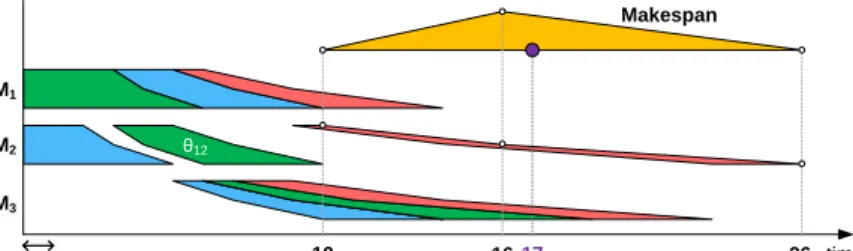
In order to demonstrate the graphical representation of a fuzzy JSP and a particular schedule for one of its instances, let’s consider an instance with 3 jobs and 3 machines, having the following machine allocation and fuzzy processing time matrices: p= (3,4,6) (2,3,4) (1,2, 5) (1,2,4) (2,3,4) (1,2, 3) (2,3,5) (2,3,4) (1,2, 4) , v= 1 2 3 1 3 2 2 1 3 . (8)
For a task processing orderσ= (θ31, θ11, θ32, θ12, θ21, θ33, θ13, θ22, θ23), we have the corresponding Gantt chart as shown in Fig. 2. This Gantt chart uses each particular color for all tasks that belong to each particular job; tasks associated with different jobs are accordingly colored differently.
M3 M2 M1 1 10 16 26 time Makespan 17 θ12
Fig. 2.A sample Gantt chart for a fuzzy JSP instance.
Since we could build a feasible schedule s from a feasible task processing order σ, we would therefore restate the goal of the fuzzy job-shop problem as finding an optimal task processing orderσ, in the sense that the makespan for the schedule derived from that task processing order is minimal.
In [10], the authors employed a single-objective genetic algorithm that is enhanced by a local search to optimize the expected value of the makespan. However, the expected value does not account for the width of a makespan. For instance, the expected value cannot distinguish between two fuzzy makespans
A= (2,6,10) andB = (4,6,8), since both have the same expected value 6, but one would think B = (4,6,8) is better because it is less uncertain and thus it provides more accurate information on the possible values of the makespan.
On the other hand, the approximated maximum operator has identical sup-port and modal value to its exact version. As a consequence, the induced fuzzy makespan also has identical support and modal value to the exact fuzzy makespan. Thanks to this nice property, we could try to take into consideration the three
exactvertices of a fuzzy makespan—instead of itsapproximated expected value— in searching for an optimal schedule to the JSP. Such an idea naturally calls for the use of a multiobjective optimization algorithm. As more information from the exact fuzzy makespan is considered, the schedule obtained under this per-spective is expected to be more reliable and robust than those returned when considering only the modal value or the expected value of the makespan.
3
An Evolutionary Approach to the Fuzzy JSPs
In order to apply a genetic algorithm to solving a combinatorial problem in gen-eral and a JSP in particular, we need to define a chromosome encoding strategy. Among different proposals available in the literature, the two most popular en-coding schemes are the conventional permutations (CP) [2] and permutations with repetition (PR) [1]. In both cases, a chromosome expresses a total ordering of all operations of the problem [26]. For example, if we have a problem with
n= 3 jobs and m = 4 machines, one possible ordering is given by the permu-tation (θ21, θ11, θ12, θ31, θ32, θ22, θ33, θ13, θ23, θ24, θ14, θ34), whereθij repre-sents the task j of the job i(where i =1, 2,3; andj = 1, 2,3,4). In the CP scheme, operations are codified by the numbers 1,2,· · ·, n×m, starting from the first job, so that the previous ordering would be codified by the
chromo-some (5,1,2,9,10, 6,11,3,7,8,4,12). Whereas in the PR encoding scheme, an operation is codified just by its job number; hence the previous order would be given by (2,1,1,3, 3,2,3,1,2, 2,1,3) [26]. Also in [26], the authors have demonstrated that PR scheme is better than the CP. Taking that result, we will use the PR encoding scheme in this work.
After initialized randomly, each chromosome undergoes the crossover and mutation stages. New chromosome will then be created and selected to the next generation based on their fitness values—which are the expected makespans of the schedule they encode—by the well-known binary tournament selection strat-egy. To create new offspring, the job order crossover (JOX) [1,12] and a simple swap mutation are employed. Specifically, given any two parents, the JOX se-lects a random subset of jobs from the first parent and copies the associated genes to the offspring at the same positions as they appear in that parent. Then, the remaining genes are taken from the second parent such that they maintain their relative ordering. The second offspring is produced in the same manner but considering the second parent first. Following the JOX, the simple swap mu-tation operator randomly selects and swaps two consecutive genes that encode two different jobs (i.e. having different values). For the single-objective GA, the generational-with-elitism survivor selection is employed; that is, the whole off-spring population replaces the parent population except for the best chromosome in the parent population being copied directly to the offspring population.
The feasible search space for a JSP is usually very large; we therefore need to enrich GAs with some advanced algorithm that can somehow limit the feasible space to a narrower one but still guarantee the existence of optimal schedules. The algorithm proposed by Giffler and Thompson [9]—which is commonly re-ferred to as the G&T algorithm—is the best known algorithm for that aim. In fact, this algorithm can be regarded as a transfer function that transforms a candidate schedule to a very similar yet better one in terms of makespan. In this sense, different candidate schedules might be transformed to a unique bet-ter schedule by this algorithm. In this work, for both single- and multi-objective GAs, we use the extendedG&Talgorithm for the fuzzy JSP as proposed in [13]. Our main aim in this work is to optimize simultaneously the three vertices of a makespan. Thus, we need to employ a technique in evolutionary multiobjec-tive optimization (EMO) to handle these three objecmultiobjec-tives all at the same time, and to evolve a population of candidate solutions over generations in such a way that they get gradual improvements in all objectives. With the framework presented above for a single-objective GA, it is straightforward to extend the algorithm to a multiobjective version by the application of one of the existing EMO techniques. Among various EMO algorithms, the non-dominated sorting genetic algorithm (NSGA-II) [25,5,6] has gained a lot of popularity in the last few years, and becomes a landmark against which other EMO algorithms are often compared. In this work, we will therefore employed NSGA-II as a multiob-jective optimizer to address the fuzzy JSP. The job order crossover and simple swap mutation described above will replace the simulated binary crossover and polynomial mutation in the original design of NSGA-II [6].
4
Analyzing the Tolerance for Knowledge Representation
A set of experiments has been conducted to examine the ability of the proposed approach to tolerate the imprecision inherent in representing the expert knowl-edge about task processing times by TFNs. This imprecision is due to the fact that the expert might not be completely sure about his specification of the fuzzy numbers. In other words, the specification of a fuzzy number is fuzzy itself. The location of the modal value as well as the support of a TFN is naturally imprecise. Accordingly, for a certain task, the processing time might be specified by various fuzzy numbers that are slightly different from each other. Another context can also be the case, that is, when more-than-one experts are jointly specifying the processing times of tasks. Obviously, they may have different knowledge about the tasks, and therefore the TFNs specified by each of them might be different from those specified by the others.
In the experiments, we have selected three typical benchmark instances from a famous library of 40 instances proposed by Lawrence [18]. On the other hand, three genetic algorithms that share common components have been implemented to enable a fairer comparative analysis. These algorithms are: (1) GAcrisp is the single-objective genetic algorithm considering only the most probable pro-cessing time of tasks, which is equivalent to a crisp JSP; (2) GAfuzzy is the single-objective genetic algorithm considering the expected value of the fuzzy makespan as the objective function; and (3) NSGAIIis the multi-objective ge-netic algorithm (i.e. NSGA-II) considering at the same time the three vertices of a fuzzy makespan as its objectives. In all algorithms, we have used the binary tournament selection, the JOX with a crossover rate of 0.85, and the simple swap mutation with a mutation rate of 0.1; a randomly initialized population with 100 chromosomes will evolve across 100 generations.
The three benchmark instances that have been used are LA04 (10×5), LA09 (15×5), and LA18 (10×10). For each benchmark, we randomly sample 10 fuzzy instances in the following manner. The modal value (p2) for each fuzzy
pro-cessing time (pij) is sampled uniformly at random in an interval having the crisp processing time as its center (p), with the lower and upper bounds being 95%pand 105%p. Then, the left (p1) and right (p3) extremes of that fuzzy
pro-cessing time is uniformly sampled at random in the intervals [50%p,95%p] and [105%p,150%p], respectively. An example to illustrate this procedure is given in Fig. 3. In this illustration, the red triangle is a randomly sampled fuzzy pro-cessing time, which has the three vertices being sampled in the blue, violet, and green intervals.
For each benchmark, each of the ten sampled fuzzy instances is tested on the three algorithms, repeated 10 times with different initial populations in each repetition. With 3 algorithms tested on 3 benchmarks having 10 sampled fuzzy instances for each, and repeated 10 runs, we have done 3×3×10×10 = 900 runs. ForGAcrispandGAfuzzy, we obtain a single best solution in each of the runs. This is however not the case forNSGAII;NSGAIIreturns a set of non-dominated solutions in the last generation. To facilitate the comparison withGAcrisp and
t p3 p2 p1 p [50%p,95%p] [105%p,150%p] crisppij fuzzypij sampled
Fig. 3.Sampling fuzzy processing time.
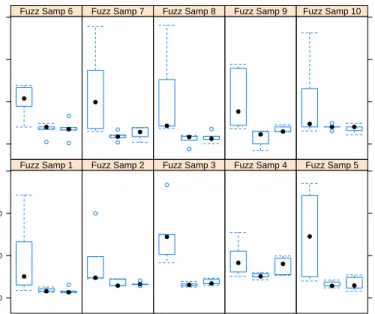
nominated. For that purpose, we calculate the expected value of each solution in the Pareto-optimal set and select the one with the best (minimal) expected value of the makespan. In this way, we could reach a single best solution in each run of all the algorithms, and the results from the 10 runs can be summarized by box plots as presented in Fig. 4 for LA04. In this figure, each box contains 10 results from the 10 runs of a corresponding algorithm on a single sampled fuzzy instance. Also, the three algorithms referred to asCrisp,Fuzz, andNSGAIIare the GAcrisp, GAfuzzy, and NSGAII, respectively. In addition, the ten sampled fuzzy instances are enumerated as Fuzz Samp 1toFuzz Samp 10.
mak
espan
600 650 700
Crisp Fuzz NSGAII
Fuzz Samp 1
Crisp Fuzz NSGAII
Fuzz Samp 2
Crisp Fuzz NSGAII
Fuzz Samp 3
Crisp Fuzz NSGAII
Fuzz Samp 4
Crisp Fuzz NSGAII
Fuzz Samp 5
Fuzz Samp 6 Fuzz Samp 7 Fuzz Samp 8 Fuzz Samp 9
600 650 700
Fuzz Samp 10
Fig. 4.Results on asymmetrically sampled fuzzy versions of LA04 (10×5). Taking a look at Fig. 4, it is not difficult to realize thatCrisp—which is the GA working with only the most probable task processing time in the sampled fuzzy instances—has makespans varying from instance to instance; whereas, the other two algorithms, i.e. Fuzz and NSGAII, are less sensitive to the random sampling. In addition, their expected makespans are much better (lower) than those of the Crisp on average. It should be noticed that, due to the space
limitation, only the boxplot for LA04 is presented here; the similar plots for LA09 and LA18 also exhibit completely the same trend.
The comparison betweenFuzz(i.e. the GA working with the expected fuzzy makespan) andNSGAII(i.e. the NSGA-II working with the three vertices of the fuzzy makespan) is however not intuitive. In fact, their results are close together for LA04 and LA18; and for LA09, their results look identical. (Notice again that the results for LA09 and LA18 are not shown here). Besides, the boxes forCrisp is larger than those for the other algorithms, which would suggest that under the current experimental setting of the algorithms (100 chromosomes evolved over 100 generations), Fuzz andNSGAII converge better thanCrisp. Consequently, their results from different runs do not vary so much as those of the Crisp. Nonetheless, we have initialized the three algorithms by the same random seeds and they also share the same common structural components of the GA. In such a context, a more plausible explanation could be that, taking into consideration the triangular fuzzy processing time of tasks instead of only the most probable one, we could always gain benefits regardless of whether the expected value or all the three vertices of a makespan is utilized as the objective function(s).
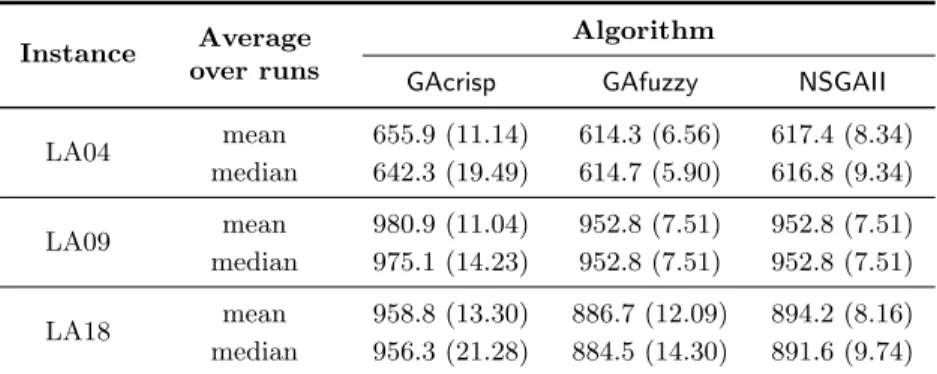
What still remains interesting to know is how these algorithms perform on average in terms of the mean and variation of makespans over all the sampled fuzzy instances. To answer this question, we first take the mean (or median, alternatively) of each box, i.e. we are averaging the 10 runs. Then we calculate the mean and standard deviation of these ten means (or ten medians, alternatively). In other words, we are averaging the results of the 10 sampled fuzzy instances. As we have run each test only 10 times, the use of median could be a better estimate of the actual performance of the algorithms. Respective results from these calculations are fully presented in Table 1.
Table 1. Mean and standard deviation (SD) of approximated makespans of all fuzzy samples. For each fuzzy sample, the approximated makespan is either the mean or median makespan over all 10 runs of an algorithm. Numbers in brackets are SD.
Instance Average over runs
Algorithm
GAcrisp GAfuzzy NSGAII
LA04 mean 655.9 (11.14) 614.3 (6.56) 617.4 (8.34) median 642.3 (19.49) 614.7 (5.90) 616.8 (9.34) LA09 mean 980.9 (11.04) 952.8 (7.51) 952.8 (7.51) median 975.1 (14.23) 952.8 (7.51) 952.8 (7.51) LA18 mean 958.8 (13.30) 886.7 (12.09) 894.2 (8.16) median 956.3 (21.28) 884.5 (14.30) 891.6 (9.74)
The results shown in Table 1 suggest that NSGA-II has a promising ability to tolerate the imprecision in representing the expert’s knowledge about the fuzzy processing time. Under different randomly sampled fuzzy processing time, the final results of NSGA-II clearly exhibit less variation than those of GAcrisp
on all the benchmarks. However, more extensive experiments are advocated in order to draw a further conclusion about whether NSGA-II is better than the single-objective GA using the expected value of the makespan as its objective function. In fact,NSGAIIhas the same variation as GAfuzzy on the benchmark LA09, and a better (smaller) variation on LA18, but a worse (larger) variation on LA04, in comparison withGAfuzzy.
5
Conclusions
In this work, we have investigated the application of a multi-objective genetic algorithm — the NSGA-II — to solving JSPs with uncertain durations, where uncertainty is modeled by triangular fuzzy numbers. The novelty of the investiga-tion is that, we have considered the three vertices of a triangular fuzzy makespan all at the same time as three objectives of NSGA-II, rather than just using a representative which is the expected value as in previous work.Such a new pro-posal is often preferable to the existing approach in terms of offering the decision maker more options in selecting a scheduling strategy according to his preference to the earliest, most probable, or latest completion time. To validate the pro-posed multi-objective approach, a set of experiments has been performed. Even though the simulation results on a limited number of benchmarks do not strongly demonstrate the superiority of the proposal, they have provided some evidence for the imprecision tolerance ability of the obtained schedules with respect to the knowledge representation of the experts. The results have also suggested that a more comprehensive validation on a larger set of benchmark instances as well as a more extensive simulation would bring about a clear insight into the difference between the proposal and other available approaches.
References
1. Bierwirth, C.: A generalized permutation approach to job shop scheduling with genetic algorithms. OR Spektrum 17(2-3), 87–92 (Sep 1995)
2. Bierwirth, C., Mattfeld, D.C.: Production scheduling and rescheduling with genetic algorithms. Evolutionary Computation 7(1), 1–17 (1999)
3. Bortolan, G., Degani, R.: A review of some methods for ranking fuzzy subsets. Fuzzy Sets and Systems 15(1), 1–19 (1985)
4. Cheng, R., Gen, M., Tsujimura, Y.: A tutorial survey of job-shop scheduling prob-lems using genetic algorithms—I. representation. Computers & Industrial Engi-neering 30(4), 983–997 (1996)
5. Deb, K., Agarwal, S., Pratap, A., Meyarivan, T.: A fast elitist non-dominated sorting genetic algorithm for multi-objective optimization: NSGA-II. In: Parallel Problem Solving from Nature PPSN VI, pp. 849–858 (2000)
6. Deb, K., Pratap, A., Agarwal, S., Meyarivan, T.: A fast and elitist multiobjec-tive genetic algorithm: NSGA-II. IEEE Transactions on Evolutionary Computation 6(2), 182–197 (2002)
7. Fortemps, P.: Jobshop scheduling with imprecise durations: a fuzzy approach. IEEE Transactions on Fuzzy Systems 5(4), 557–569 (1997)
8. Fortemps, P., Roubens, M.: Ranking and defuzzification methods based on area compensation. Fuzzy Sets and Systems 82(3), 319–330 (1996)
9. Giffler, B., Thompson, G.L.: Algorithms for solving production-scheduling prob-lems. Operations Research 8(4), 487–503 (1960)
10. Gonzalez-Rodriguez, I., Puente, J., Vela, C., Varela, R.: Semantics of schedules for the fuzzy job-shop problem. IEEE Transactions on Systems, Man and Cybernetics, Part A: Systems and Humans 38(3), 655–666 (2008)
11. Gonzalez-Rodriguez, I., Vela, C., Puente, J.: A memetic approach to fuzzy job shop based on expectation model. In: IEEE Int. Conf. on Fuzzy Systems. pp. 1–6 (2007) 12. Gonz´alez, M., Vela, C., Varela, R.: Scheduling with memetic algorithms over the spaces of semi-active and active schedules. Lecture Notes in Computer Science, vol. 4029, pp. 370–379. Springer Berlin / Heidelberg (2006)
13. Gonz´alez-Rodr´ıguez, I., Vela, C., Puente, J.: A genetic solution based on lexico-graphical goal programming for a multiobjective job shop with uncertainty. Journal of Intelligent Manufacturing 21(1), 65–73 (2010)
14. Gonz´alez-Rodr´ıguez, I., Vela, C.R., Puente, J., Hern´andez-Arauzo, A.: Improved local search for job shop scheduling with uncertain durations. In: Nineteenth Int. Conf. on Automated Planning and Scheduling (ICAPS-2009). pp. 154–161 (2009) 15. Gon¸calves, J.F., de Magalh˜aes Mendes, J.J., Resende, M.G.C.: A hybrid genetic algorithm for the job shop scheduling problem. European Journal of Operational Research 167(1), 77–95 (2005)
16. Jain, A.S., Meeran, S.: Deterministic job-shop scheduling: Past, present and future. European Journal of Operational Research 113(2), 390–434 (1999)
17. Jensen, M.T.: Improving robustness and flexibility of tardiness and total flow-time job shops using robustness measures. Applied Soft Computing 1(1), 35–52 (2001) 18. Lawrence, S.: Supplement to “Resource constrained project scheduling: An ex-perimental investigation of heuristic scheduling techniques”. Tech. rep., GSIA, Carnegie Mellon University, Pittsburgh PA (1984)
19. Lin, F.T., Yao, J.S.: Using fuzzy numbers in knapsack problems. European Journal of Operational Research 135(1), 158–176 (2001)
20. Liu, B., Liu, Y.K.: Expected value of fuzzy variable and fuzzy expected value models. IEEE Transactions on Fuzzy Systems 10(4), 445–450 (2002)
21. Nakano, R., Yamada, T.: Conventional genetic algorithm for job shop problems. In: Proceedings of ICGA. pp. 474–479 (1991)
22. Park, B.J., Choi, H.R., Kim, H.S.: A hybrid genetic algorithm for the job shop scheduling problems. Computers & Industrial Engineering 45(4), 597–613 (2003) 23. Pinedo, M.L.: Scheduling: Theory, Algorithms, and Systems. Springer, 3rd edn.
(2008)
24. Puente, J., Vela, C.R., Gonz´alez-Rodr´ıguez, I.: Fast local search for fuzzy job shop scheduling. In: Proceedings of ECAI 2010. pp. 739–744. IOS Press (2010) 25. Srinivas, N., Deb, K.: Muiltiobjective optimization using nondominated sorting in
genetic algorithms. Evolutionary Computation 2(3), 221–248 (1994)
26. Varela, R., Serrano, D., Sierra, M.: New codification schemas for scheduling with genetic algorithms. In: Mira, J., ´Alvarez, J. (eds.) Artificial Intelligence and Knowl-edge Engineering Applications: A Bioinspired Approach, Lecture Notes in Com-puter Science, vol. 3562, pp. 15–20. Springer Berlin / Heidelberg (2005)
27. V´azquez, M., Whitley, D.: A comparison of genetic algorithms for the static job shop scheduling problem. In: Parallel Problem Solving from Nature PPSN VI, LNCS, vol. 1917, pp. 303–312. Springer Berlin / Heidelberg (2000)
28. Yager, R.R.: A procedure for ordering fuzzy subsets of the unit interval. Informa-tion Sciences 24(2), 143–161 (1981)