The Lean and Environment Toolkit
www.epa.gov/lean
◆
Improve Environmental Results
◆
Identify and Eliminate Waste
Toolkit Format and Icons
The toolkit uses icons in the page margins to help you find and follow important information in each chapter.
Key Point Identifies an important point to remember
Key Term Defines an important term or concept New Tool Presents a technique or resource that helps capture, communicate, or apply new knowledge How-to Steps Describes sequenced actions to implement a tool
Chapters also include one or more “To Consider” text boxes that contain questions to help you explore how the information relates to your organization.
Lean and Environment Toolkit
Table of Contents
Preface ... i
Acknowledgments ...iii
Chapter 1 Introduction: Getting Started with Lean & Environment ... 1
Chapter 2 Identifying Environmental Wastes ... 11
Chapter 3 Value Stream Mapping ... 21
Chapter 4 Kaizen Events ... 35
Chapter 5 6S (5S+Safety) ... 49
Chapter 6 Conclusion and Implementation Strategies... 61
Appendices
Appendix A Lean Methods ... 67Appendix B Basic Environmental Measures for Lean Enterprises ... 74
Appendix C Lean Event EHS Checklist ... 77
Appendix D Pollution Prevention Resources ... 79
Lean and Environment Toolkit
Preface
This Lean and Environment Toolkit assembles practical experience collected by the U.S. Environ mental Protection Agency (EPA) from a group of partner companies and organizations that have experience with coordinating Lean implementation and environmental management. The toolkit builds on work conducted and research sponsored by EPA’s Lean Manufacturing and Environment Initiative (see http://www.epa.gov/lean).
The EPA’s intent in developing this toolkit is to enable Lean practitioners to improve both their busi ness performance and their environmental performance by identifying and eliminating environ mental wastes at their organizations. The toolkit offers practical strategies and tools for integrating environmental considerations into Lean initiatives in ways that support Lean’s focus on the elimina tion of waste and non-value added activity.
This is the second iteration of the Toolkit. EPA welcomes your comments and reflections on this document, as well as other ideas you have for Lean and environment strategies, tools, and resources which can be incorporated in future versions of the toolkit. Please contact EPA to share your experi ences with Lean and the environment and/or to discuss partnership opportunities by using the form found at http://www.epa.gov/lean/auxfiles/contact.htm.
Lean and Environment Toolkit
Acknowledgments
The U.S. Environmental Protection Agency is very grateful for the invaluable assistance of its part ners in developing this toolkit. EPA’s partners shared their experiences, tools, and techniques for integrating Lean and environmental management, and worked collaboratively with EPA to develop, test, and refine the content of this toolkit.
EPA’s Lean and Environment partners include: Baxter International, Chicago Manufacturing Center, CONNSTEP, HNI Corporation, Robins Air Force Base, Rockwell Collins, and the U.S. Army Materiel Command. Participating Offices at EPA include: the National Center for Environmental Innovation; the Office of Pollution Prevention and Toxics; and the Office of Solid Waste.
In addition to these organizational partners, this toolkit has benefited from the collective expertise and ideas of many individuals. In particular, EPA would like to thank the following individuals for their thoughtful contributions:
Pat Bartholomew of Baxter International
Kate V. Bates of Earth Tech, Inc., working with Robins Air Force Base Dave Bury of Robins Air Force Base
Jenni Cawein of Baxter International Angie Coyle of Delphi Corporation Rob Currie of Baxter International
James Ellor of Elzly Technology Corporation, working with the U.S. Army Materiel Command
Mike Fisher of Baxter International Vicki Fisher of Rockwell Collins
Antonia Giardina of the U.S. Army Materiel Command Scott Lesnet of HNI Corporation
Alistair Stewart of the Chicago Manufacturing Center Karen Wan of the Chicago Manufacturing Center Megan Wertz of The George Washington University Judy Wlodarczyk of CONNSTEP, Inc.
This toolkit was prepared for the U.S. Environmental Protection Agency by Ross & Associates Environmental Consulting, Ltd. in association with Industrial Economics, Inc.
CHAPTER 1
Introduction: Getting Started with Lean & Environment
Chapter Contents
Purpose of This Toolkit
Key Questions Addressed by the Toolkit
Why Use This Toolkit
1. Learn to See Hidden Environmental Waste
2. Enhance the Effectiveness of Lean Implementation 3. Deliver What Customers and Employees Want
How to Use This Toolkit
Toolkit Structure and Chapters Toolkit Format and Icons
Conclusion
Summary Your Thoughts
Chapter 1: Introduction—Getting Started With Lean & Environment
Purpose of This Toolkit
The Lean and Environment Toolkit offers practical strategies and techniques to Lean imple menters about how to improve Lean results—waste elimination, quality enhancement, and delivery of value to customers—while achieving environmental performance goals. The toolkit also provides tools to help your organization get better environmental performance from Lean ef forts on the shop fl oor.
Benefits of Coordinating Lean & En
vironment
✓ Reduce costs✓ Improve process flow and reduce lead times
✓ Lower regulatory non-compliance risk
✓ Meet customer expectations
✓ Improve environmental quality
✓ Improve employee morale and commitment
The “Lean” methods discussed in this Toolkit are organizational improvement methods pioneered in the Toyota Production System. Lean production and Lean manufacturing refer to a customer-fo cused business model and collection of methods that focuses on the elimination of waste (non-value added activity) while delivering quality products on time and at a low cost. The toolkit assumes that you are familiar with Lean methods and their implementation. For those who want to learn more about Lean methods discussed in the toolkit, see Appendix A.
Key Questions Addressed by the Toolkit
Lean works well when it focuses on identifying and eliminating non-value added activity. Environ mental improvement efforts that have potential to distract Lean efforts from this prime focus will likely not get much traction. By contrast, this toolkit contains strategies and techniques that can seamlessly enable Lean practitioners to easily identify environmental wastes and improvement op portunities alongside the myriad other wastes and improvement opportunities uncovered by Lean. To accomplish this, the toolkit aims to answer the following questions:
What is environmental waste?
Environmental waste is an unnecessary or excess use of resources or a substance released to the air, water, or land that could harm human health or the environment. Environmental wastes can occur when companies use resources to provide products or services to customers, and/or when customers use and dispose of products. Chapter 2 defines and provides examples of environmen tal waste.
Chapter 1: Introduction—Getting Started With Lean & Environment
Why should I identify environmental waste in my processes?
Environmental wastes do not add value to the customer. Environmental wastes can also directly af fect production flow, time, quality, and cost—making them ripe targets for Lean initiatives. In many cases, the costs associated with pollution and wasted energy, water, and raw materials can be signifi cant. This chapter (Chapter 1) discusses the business case for eliminating environmental waste.
How will I know when I see environmental waste?
Some environmental wastes are easy to see. Containers of solid and hazardous waste are visual indications of environmental waste. Health and environmental risks posed by certain chemicals or materials can be more difficult to see, although they can represent costly non-value added aspects of a process or product. Chapter 2 provides examples of environmental wastes and describes organi zational strategies that will make it easier to know when you see them.
Where should I look for environmental wastes?
Environmental wastes can be found in almost any process. Processes requiring environmental per-mits—such as painting, metal finishing, and hazardous waste management processes—are often a good place to look for environmental improvement opportunities. If your organization has an environmental management system (EMS), your Environmental, Health and Safety (EHS) personnel may have already identified key environmental impacts associated with each of the organization’s processes. Chapter 3 discusses how value stream mapping (VSM) tools and techniques can be used to help Lean practitioners see environmental wastes in processes. Chapter 4 discusses how to identify and address environmental wastes during kaizen rapid improvement events.
How do I measure the environmental impacts of a process?
Measurement of key environmental wastes associated with a process can pinpoint those wastes that are most important to track over time. For example, chemical use and hazardous waste generation may be important to measure for one process, while water use may be most important to measure for another process. Chapter 3 discusses techniques for integrating environmental metrics into value stream maps. Appendix B includes information on environmental metrics that are often used by companies and facilities.
Where can I find environmentally preferable alternatives to my current process?
EHS professionals in your organization may have ideas and information regarding environmentally preferable processes, equipment and materials. In addition, numerous organizations, including EPA, have developed technical assistance resources and programs to assist organizations in improving the environmental and operational performance of processes. Chapter 4 discusses several useful resources and technical assistance networks. There are also Pollution Prevention Resources in Appendix D.
Chapter 1: Introduction—Getting Started With Lean & Environment
Why Use This Toolkit
Explicit consideration of environmental goals and opportunities during Lean implementa tion can create significant value for an organization—helping to deliver quality products and services that customers want, when they want them. Research sponsored by EPA and others shows that environmental performance benefits typically ride the coattails of Lean efforts, yet these efforts may overlook other opportunities to reduce wastes and non-value added activity. Adding environ mental considerations to Lean efforts can increase value, accelerate Lean implementation, decrease material costs, and reduce liability and the risk of compliance violations.
Business Case for Integrating Lean & Environment
1. Learn to see hidden environmental waste.
2. Enhance the effectiveness of Lean implementation. 3. Deliver what customers and employees want.
Below are three key reasons why business leaders, Lean practitioners and EHS managers have pur sued efforts to coordinate Lean and environmental management activities.
1. Learn to See Hidden Environmental Waste and Hazards
Learning to see and eliminate waste is a cornerstone of Lean initiatives. There is one type of waste, however, that often goes unaddressed (or under addressed) by Lean initiatives—environmental waste. When grouped together, environmental wastes can result in huge costs to business. These costs include raw material and disposal costs, as well as costs for compliance management activities and pollution control equipment.
Lean’s focus on eliminating non-value added activity is excellent at driving down the volume of ma terial, water, energy, chemical usage, and wastes, producing important competitiveness and environ mental benefits. The environmental risk and full lifecycle impacts that materials and chemicals pose to human health and the environment, however, are rarely considered during Lean implementation. Learning to see environmental wastes during Lean efforts can open significant business improve ment opportunities, further strengthen Lean results, and improve environmental performance.
Environmental wastes are often a sign of inefficient production, and they frequently indicate opportunities for saving cost and time. The chemicals and hazardous materials used in a process often demand costly support activities, such as regulatory compliance management and reporting activities, use of personal protective equipment, and the investment, operation, and maintenance of pollution control equipment. These activities do not add value to the customer, and they can create unnecessary risks to worker health and safety.
Chemical substitution, process changes, and other strategies can reduce the need for such non-value added activities. For these reasons, learning to see and eliminate environmental wastes can greatly improve the time, quality, and cost results of Lean initiatives.
Chapter 1: Introduction—Getting Started With Lean & Environment
2. Enhance the Effectiveness of Lean Implementation
Explicit coordination of Lean and environmental initiatives can lead to compelling organizational and environmental improvement results. For example, Lean thinking can be applied to various environmental management processes, such as chemical and waste management. Companies have found that as much as 40 percent of their chemical supplies were going unused and directly be coming hazardous waste as they expired on the shelf or became obsolete. Using Lean principles to improve chemical and waste management processes can have big pay-offs for environmental perfor mance and bottom-line results.
Case Study: Lockheed Martin Corporation
Lockheed Martin Corporation, the world’s largest defense contractor, has been implementing Lean techniques corporate-wide since the late 1990s. Lockheed Martin’s Manassas plant conducted improvement events to ap ply Lean thinking to its chemical and waste management activities because a significant amount of warehoused chemicals were going directly to the hazardous waste stream without ever being used, expired on-shelf, or were no longer used for research or production. Lockheed Martin sought to move toward a just-in-time chemical management system, with chemicals delivered three times a week in “right-sized” containers to meet real-time demand. The Lean events reduced chemical inventories, freed capital tied up in inven tory, increased chemical inventory turns and chemical utilization rates, and eliminated the chemical warehouse and chemicals expiring on the shelf.
Proactive Lean and environment coordination can also anticipate and ease environmental constraints to leaning “monument” processes, thereby enabling large performance gains. Mon uments are production processes or process steps that have large equipment and/or other physical or environmental regulatory constraints that make them very difficult or costly to move, which can complicate Lean efforts. Typical monuments include painting and metal finishing processes. Making changes to monument processes can require approval or permits from environmental regu latory agencies, as well as special work practices or control measures, all of which can be difficult to accomplish within rapid timeframes. EHS personnel can help to identify environmentally friendly process alternatives, and ensure that process changes can be made as quickly as possible.
Chapter 1: Introduction—Getting Started With Lean & Environment
Case Study: Apollo Hardwoods
Apollo Hardwoods used Lean methods to manufacture custom “cut-to-size” cherry plywood for cabinetry. The company’s founders and investors discov ered that a “right-sized” veneering process would require less expensive equipment, use a wider variety of logs, and produce less wood scrap, with out compromising product quality. The company sought to find a veneering process that would also address product quality, flow time, and cost. Since such a process did not exist, Apollo Hardwoods recruited a team to develop a Lean veneer slicing and drying process and associated equipment using the pre-production planning (3P) method. The Lean veneer manufacturing process incorporated one-piece flow cells that eliminated the piling of inven tory in between steps. The “right-sized” equipment requires less capital than conventional machinery (or “monuments”), uses less energy, fits into small production cells, and allows Apollo Hardwoods to fabricate the same amount of finished product using fewer logs and generating less wood scrap.
3. Deliver What Customers and Employees Want
Most customers who purchase products do not want to buy environmental wastes, impacts, or risk.
Companies that can deliver products and services with fewer environmental impacts have the potential to capture significant competitive advantage, provided that there are not sacrifi ces in time, quality, or cost. In many markets products with superior environmental performance can attract new customers.
Explicit consideration of environmental waste in Lean initiatives can also improve the work envi ronment for employees. Similar to ergonomic concerns, eliminating environmental hazards can reduce potential worker exposure to toxic substances and create a cleaner and safer workplace. In addition, employees want to do the right thing. When employees take pride in their work because they believe it has broader benefits to their community and the world, there can be a substantial posi tive effect on organizational morale. This can empower employees and further enhance productivity.
To Consider
• How could your company benefit from improved Lean and environmental per formance? (Think about time and cost savings, reduced risks and liabilities, added value to customers, etc.)
• How well coordinated are Lean and environmental management activities in your organization?
• Do EHS personnel participate in Lean events and initiatives at your company?
Chapter 1: Introduction—Getting Started With Lean & Environment
How to Use This Toolkit
This section describes the structure and organization of the Lean and Environment Toolkit (Ver sion 1.0), as well as icons that are used to help you navigate the information easily. The toolkit is designed so that you can work through the full content in an ordered manner or skip to specific methods that are of most interest.
Toolkit Structure and Chapters
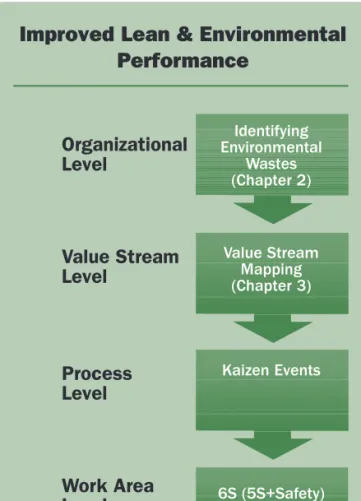
The toolkit is structured in chapters, each focusing on strategies, tools, and techniques to enhance the success of Lean initiatives while improving environmental performance. Chapters 2–5 focus on core Lean methods and how-to strategies for leveraging environmental considerations to enhance Lean results. The diagram below illustrates how these chapters focus on coordinating Lean and en vironmental activities on different organizational levels—the value stream level, the process level, and the work area level. Chapter 6 provides summary points and guidance to assist you in putting the strategies and techniques discussed in the toolkit to work in your organization.
Figure 1: Diagram of Toolkit Components
Identifying Environmental
Wastes (Chapter 2)
Improved Lean & Environmental Performance Organizational Level Value Stream Level Process Level Work Area Level Value Stream Mapping (Chapter 3) Kaizen Events 6S (5S+Safety) (Chapter 5)
Chapter 1: Introduction—Getting Started With Lean & Environment
Conclusion
Summary
This toolkit provides practical strategies, tools, and techniques for incorpo rating environmental considerations into already existing Lean initiatives in an effort to improve Lean results and add value to your organization. There are three key reasons why business leaders, Lean practitioners, and EHS managers pursue efforts to coordinate Lean and environmental man agement activities.
1. Learning to see and eliminate hidden environmental wastes during Lean implementation can lead to more efficient production by improving the time, quality, and cost results of Lean initiatives. Chemical substitution, process changes and other strategies can reduce the need for non-value added activities—such as regulatory compliance management and invest ment in pollution control equipment—that might otherwise be overlooked by Lean alone.
2. Coordination of Lean and environmental management can facilitate more process improvement and make it easier to apply Lean to processes with environmental regulatory constraints. EHS personnel can assist Lean implementation by anticipating and addressing environmental constraints such as the need to obtain permits, and by identifying environmentally friendly process alternatives.
3. A significant competitive advantage can be attained by providing customers with products and services with less environmental impacts, and by improv ing the work environment for employees.
Chapter 1: Introduction—Getting Started With Lean & Environment
Your Thoughts
Now that you have finished this chapter, reflect on what you read by answering these questions:
• What did you learn in this chapter that was particularly useful? • Do you need any more information to fully understand the business
case for identifying and eliminating environmental waste? How strong is the business case for doing this in your organization?
• What ideas do you have for helping your organization learn to see environmental wastes?
CHAPTER 2
Identifying Environmental Wastes
Chapter Contents
Introduction to Value Stream Mapping
Definition of Environmental Waste
The Link Between Environmental Waste and Lean’s Seven Deadly Wastes
How to “Learn to See” Environmental Waste in Your Organization
Overview of Organizational Strategies
1. Add Environmental Metrics to Lean Metrics 2. Show Management Commitment and Support
3. Include Environmental Waste in Lean Training Efforts
4. Make Environmental Wastes Visible and Simple to Eliminate 5. Recognize and Reward Success
Conclusion
Summary Your Thoughts
Chapter 2: Identifying Environmental Wastes
Introduction to Identifying Environmental Wastes
This chapter defines environmental waste and describes strategies to encourage employees to iden tify and eliminate environmental waste as part of Lean efforts.
Definition of Environmental Waste
Environmental waste is any unnecessary use of resources or a substance released into the air, water, or land that could harm human health or the environment. Environmental wastes can occur when companies use resources to provide products or services to customers, and/or when customers use and dispose of products. Practically speaking, environmental wastes include:
• Energy, water, or raw materials consumed in excess of what is needed to meet customer needs.
• Pollutants and material wastes released into the environment, such as air emissions, wastewater discharges, hazardous wastes and solid wastes (trash or discarded scrap). • Hazardous substances that adversely affect human health or the environment during their
use in production or their presence in products.
Like other Lean wastes, environmental wastes do not add customer value. They also represent costs to the enterprise and society in general.
The Link Between Environmental Waste and Lean’s Seven Deadly
Wastes
The focus of Lean is on eliminating any non-value added activity, or waste, from production. Lean typically targets seven so-called deadly wastes:
1. Overproduction 5. Defects
2. Inventory 6. Over Processing 3. Transportation 7. Waiting 4. Motion
Chapter 2: Identifying Environmental Wastes
Case Study: Rejuvenation
Rejuvenation, a manufacturer of period-authentic reproduction lighting and hardware, operates on the philosophy that the reuse and improvement of old properties has environmental benefits. Using an environmental management system based on The Natural Step and Lean manufacturing, Rejuvenation has reduced its environmental wastes and increased quality and profit. Prior to Lean implementation, finished products were not inspected until the end of the line at a quality control center, causing expensive rework if mistakes were found. Through Lean events, the quality control center was eliminated, quality control became everyone’s job, and customization errors are now corrected before moving on to the next process. Rejuvenation also regularly implements other Lean tools such as 5S, kaizen events, and value stream mapping.
Environmental wastes, such as hazardous materials released to the environment, are not explic itly included in the seven deadly wastes of the Toyota Production System. However, this does not mean that the deadly wastes are unrelated to the environment. In fact, your company may have al ready seen large environmental gains from implementing Lean, because environmental wastes are embedded in, or related to, the seven deadly wastes.
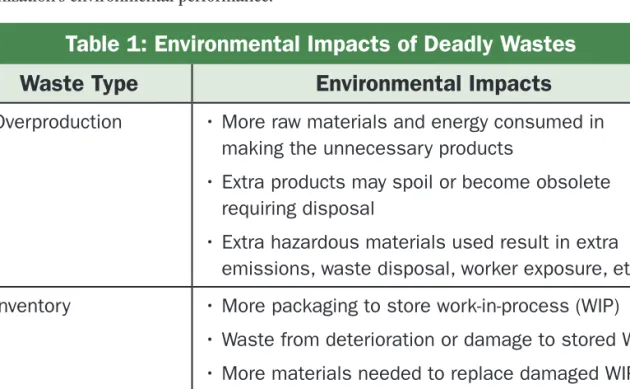
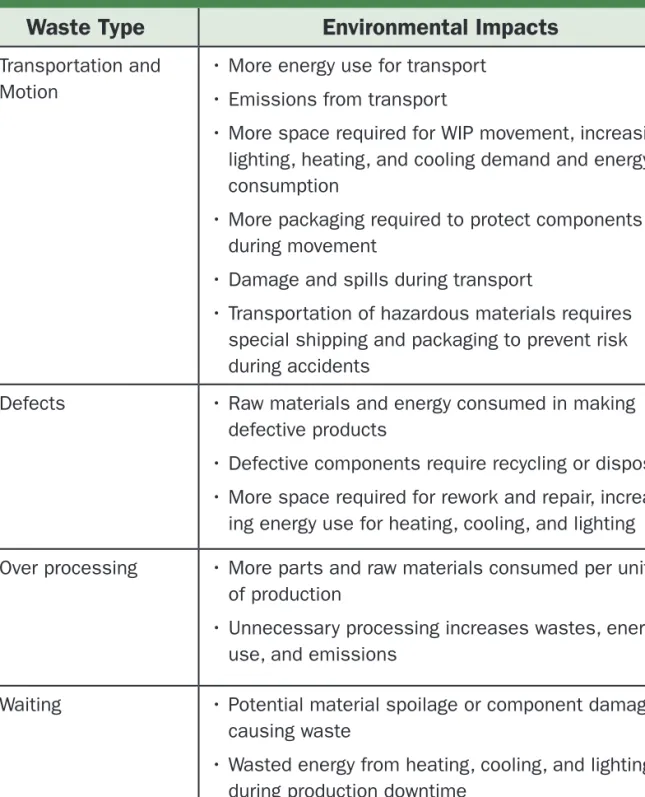
The table below lists environmental impacts that are associated with the deadly wastes targeted by Lean methods. By reducing these production wastes through Lean efforts, you can improve your organization’s environmental performance.
Table 1: Environmental Impacts of Deadly Wastes
Waste Type
Environmental Impacts
Overproduction • More raw materials and energy consumed in making the unnecessary products
• Extra products may spoil or become obsolete requiring disposal
• Extra hazardous materials used result in extra emissions, waste disposal, worker exposure, etc. Inventory • More packaging to store work-in-process (WIP)
• Waste from deterioration or damage to stored WIP • More materials needed to replace damaged WIP • More energy used to heat, cool, and light inventory
Chapter 2: Identifying Environmental Wastes
Table 1: Environmental Impacts of Deadly Wastes (continued)
Waste Type
Environmental Impacts
Transportation and • More energy use for transport Motion • Emissions from transport
• More space required for WIP movement, increasing lighting, heating, and cooling demand and energy consumption
• More packaging required to protect components during movement
• Damage and spills during transport
• Transportation of hazardous materials requires special shipping and packaging to prevent risk during accidents
Defects • Raw materials and energy consumed in making defective products
• Defective components require recycling or disposal • More space required for rework and repair, increas
ing energy use for heating, cooling, and lighting Over processing • More parts and raw materials consumed per unit
of production
• Unnecessary processing increases wastes, energy use, and emissions
Waiting • Potential material spoilage or component damage causing waste
• Wasted energy from heating, cooling, and lighting during production downtime
Despite these relationships between Lean “deadly wastes” and environmental wastes, Lean imple mentation efforts often overlook opportunities to prevent or reduce environmental wastes. Your company can enhance its Lean performance by ensuring that environmental wastes are ex plicitly identified during Lean events and activities. This can be done by extending Lean waste identification activities to consider wasted materials, pollution and other non-product outputs. This toolkit provides you with some tools to identify and eliminate environmental waste—including some that are well hidden—and to maximize the environmental gains from Lean implementation.
To Consider
• What types of environmental performance gains has your company seen from implementing Lean methods? (For example, have you re duced chemical use in a process, generated smaller quantities of hazardous waste, or reduced vehicle travel thereby reducing exhaust emissions and fuel use?) If you don’t know, how will you find out? • Name three examples of environmental wastes you could reduce at
your company. What steps could you take to eliminate those wastes?
How to “Learn to See” Environmental Waste in
Your Organization
Overview of Organizational Strategies
As Lean leaders know, people are the key to successful Lean implementation. In much the same way, organizational culture is an important aspect of effective integration of environmental, health, and safety objectives into Lean improvement efforts. While each organization has different needs, several organizational strategies will help to accomplish your company’s Lean and environment efforts.
1. Add environmental metrics to Lean metrics. 2. Show management commitment and support. 3. Include environmental waste in Lean training efforts. 4. Make environmental wastes visible and simple to eliminate. 5. Recognize and reward success.
1. Add Environmental Metrics to Lean Metrics
Chapter 2: Identifying Environmental Wastes
One simple way to understand how your company’s Lean efforts are affecting the environment is to add one or more environmental performance metrics to the metrics used to evaluate and track the success of Lean implementation. See the textbox below for examples of types of environmental metrics and Appendix B for a detailed list of environmental performance metrics.
Chapter 2: Identifying Environmental Wastes
Types of Environmental Metrics
✓ Scrap/Non-product Output ✓ Air Emissions✓ Materials Use ✓ Solid Waste
✓ Hazardous Materials Use ✓ Hazardous Waste
✓ Energy Use ✓ Water Pollution/Wastewater
✓ Water Use
Using environmental metrics in Lean efforts will allow your company to document the environmen tal benefits that are part of Lean implementation, as well as identify targets for future improvement efforts.
2. Show Management Commitment and Support
It is important that senior management—both facility management and EHS management—at your company show their support for improved Lean and environment initiatives. While it is pos sible to build management support from the bottom up through pilot projects, securing top-down management commitment helps to ensure the long-term success of Lean and environment efforts. Management can show support through the following types of activities:
• Invest in Lean and environment training.
• Provide resources, tools and incentives to enable employees to succeed.
• Include Lean and environment concepts in speeches, newsletters and other communica tions.
• Encourage Lean managers and EHS managers to collaborate.
• Set performance goals and objectives related to Lean and environment.
• Track Lean and environment progress and hold individuals accountable for meeting those objectives.
• Recognize and reward Lean and environment accomplishments.
3. Include Environmental Waste in Lean Training Efforts
One important way to help employees learn to see environmental waste is to integrate it into gen eral Lean training programs. Here are a few suggestions:
• Your company might want to include a section on how to identify and eliminate environ mental waste in introductory Lean training presentations.
• Consider modifying Lean’s seven deadly wastes to include an eighth waste—environmental waste—in training presentations and materials.
Chapter 2: Identifying Environmental Wastes
• Consider conducting a “waste walk” during Lean trainings where workers walk the shop floor and write down environmental wastes they observe.
• Develop checklists or a pocket guide with common environmental wastes to use during events and waste walks.
Two other types of Lean and environment training might be useful:
• Lean training for EHS personnel—to enable them to more effectively support Lean activi ties and help with identifying environmental waste; and
• Advanced environmental training—to enable employees to understand environmental and human health risks associated with materials selection and with product and process design. Chapter 4 of this toolkit has suggestions for training Lean teams to recognize when process changes may cause potential harmful environmental impacts. In addition, EPA developed a series of Lean and Environment Training Modules that are a useful resource for designing training programs.
4. Make Environmental Wastes Visible and Simple to Eliminate
Your company can take advantage of Lean’s focus on visual controls to support your company’s Lean and environment efforts. Here are a few suggestions:
• Prominently display how individual production areas or departments are doing relative to targets for environmental metrics alongside Lean metrics.
• Incorporate environmental wastes into activity and production control boards, one-point lessons, and other signs about wastes on the shop floor.
• Apply 6S and mistake-proofing concepts to work areas where chemical use, chemical man agement, waste collection and waste management activities occur. Use colors, signs, and other visual controls to reinforce proper chemical handling and waste management and environmental procedures.
5. Recognize and Reward Success
An initial step in your company’s Lean and environment journey may be to recognize what environ mental gains your company has already accomplished with Lean. Production managers and line operators may not be accustomed to receiving awards or other recognition for environmental improvements, but they will be more likely to seek additional ways to improve once they do. Recognition can be as simple as an announcement in a company newsletter, or can be set up as a competition between production areas to achieve the greatest gains.
Your company may not always succeed with its Lean and environment efforts, so that makes it all the more important to recognize and reward successful efforts, to learn from any mistakes, and to continually try new things and work to improve your company’s performance.
Chapter 2: Identifying Environmental Wastes
To Consider
• What are three things you could do to explicitly include environmental wastes in your company’s Lean implementation efforts?
• What ideas do you have for involving employees at all levels of your com pany in efforts to identify and eliminate environmental wastes?
• What environmental goals and targets does your organization have?
Conclusion
Summary
Environmental waste is any unnecessary use of resources or a substance released into the air, water, or land that could harm human health or the environment.
Environmental wastes, although not considered one of Lean’s seven deadly wastes, are embedded in or related to the wastes targeted by Lean meth ods. Like other Lean wastes, environmental wastes represent costs to your company. Making them an explicit target of Lean events can help your com pany to:
• Continually improve performance by expanding on the reduction of produc tion wastes through Lean efforts;
• Identify and address areas of potential environmental benefits that might be overlooked by Lean alone; and
• Identity and eliminate hidden risks and wastes.
Using environmental performance metrics in Lean efforts enables managers to understand key areas for improvement. Types of environmental metrics include:
• Use of energy, materials and water; • Air emissions;
• Water pollution and wastewater; and
• Hazardous waste and non-hazardous solid wastes.
Chapter 2: Identifying Environmental Wastes
Summary
(continued)
There are five organizational strategies that can help to integrate Lean and environmental waste reduction efforts:
1. Add environmental metrics to the metrics considered in Lean efforts to better understand the environmental performance of production areas. 2. Show management commitment and support for improved Lean and en
vironmental performance by holding collaborative meetings and providing resources and recognition.
3. Integrate environmental wastes into Lean training programs. This can be as simple as adding a few additional slides to a presentation or as ad vanced as holding a special Lean training for EHS personnel.
4. Make environmental wastes visible and simple to eliminate by using signs and other visual controls in the workplace.
5. Recognize and reward environmental success accomplished through Lean.
Your Thoughts
Now that you have finished this chapter, reflect on what you read by answer ing these questions:
• What did you learn in this chapter that was particularly useful?
• Do you need any more information to fully understand organizational strate gies for eliminating environmental waste? Would any other tools be helpful?
CHAPTER 3
Value Stream Mapping
Chapter Contents
Introduction to Value Stream Mapping
Definition of Value Stream Mapping What This Chapter Will Help You Do
How to Incorporate Environmental Considerations into Value Stream Mapping
Overview of Value Stream Mapping Opportunities
1. Use Icons to Identify Processes with EHS Opportunities
2. Record Environmental Data for Processes in Value Stream Maps 3. Analyze Materials Use Versus Need in a “Materials Line” for
Value Stream Maps
4. Expand the Application of Value Stream Mapping to Natural Resource Flows
5. Find Lean and Environment Opportunities in Future State Value Stream Maps
Conclusion
Summary Your Thoughts
Chapter 3: Value Stream Mapping
Introduction to Value Stream Mapping
While the last chapter discussed how to raise awareness about environmental wastes across your organization, this chapter will show you how to target Lean improvement efforts within a product’s value stream. The chapter describes ways to enhance value stream mapping to uncover hidden sources of material wastes, identify process improvement ideas, and anticipate regulatory compli ance needs.
Definition of Value Stream Mapping
Value stream mapping is a Lean process-mapping method for understanding the sequence of activi ties and information flows used to produce a product or deliver a service. Lean practitioners use value stream mapping to:
• Identify major sources of non-value added time in a value stream; • Envision a less wasteful future state; and
• Develop an implementation plan for future Lean activities.
The power of value stream mapping lies in walking the plant floor, talking to workers, and closely observing how a product is actually made from start to finish. See Appendix A for more information on value stream mapping.
Case Study: General Motors
General Motors has been integrating Lean manufacturing and environmen tal initiatives since the 1990s, including kanban, kaizen events, and value stream mapping (VSM). In a more recent effort, the company conducted a kaizen event with a key supplier to enhance the cost competitiveness and on-time delivery of steering column components. GM used VSM and Toyota’s “five whys” technique and observed delays when steering col umn shrouds were shipped to an outside vendor for painting. Because the shrouds were only painted to cover flaws caused by the die, GM suggested improving the quality of the die and molding the part using a resin of the de sired color. The supplier began using a new molding process that removed the need for the painting step. This project saved the supplier $700,000 per year, shortened lead times, and improved on-time delivery to GM.
Chapter 3: Value Stream Mapping
What This Chapter Will Help You Do
This chapter will help you identify and address the following wastes that can be overlooked in value stream mapping:
• Raw materials used by processes versus materials needed for the product; • Pollution and other environmental wastes generated in the value stream; and
• Flows of information to regulatory agencies about environmental compliance management activities.
Analyzing these fl ows in value streams at your company could reveal substantial opportunities to re duce costs, improve production fl ow, and save time, as well as improve environmental performance and the health and safety of the workplace. Early attention to environmental considerations and involvement of EHS staff when planning for future Lean improvement efforts in a value stream can also help your company address potential regulatory compliance issues, minimize delays, and avoid the need for costly rework.
How to Incorporate Environmental Considerations
into Value Stream Mapping
Overview of Value Stream Mapping Opportunities
There are at least five ways to explicitly address pollution and natural resource wastes using value stream mapping.
• Use icons to identify processes with EHS opportunities.
• Record environmental data for processes in value stream maps.
• Analyze materials use versus need in a “materials line” for value stream maps. • Expand the application of value stream mapping to natural resource flows. • Find Lean and environment opportunities in future state value stream maps.
1. Use Icons to Identify Processes with EHS Opportunities
Some processes warrant a special focus on EHS issues because they can pose hazards to workers, have permits and other regulatory requirements, and/or represent good opportunities to reduce pol lution and material costs. To raise awareness about these risks and opportunities, use a red dot or an EHS icon to identify these processes on value stream maps.
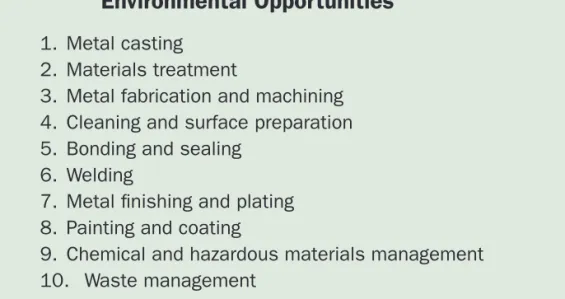
Staff with EHS expertise can help your value stream mapping team determine where to place EHS icons on value stream maps. The following textbox lists some common manufacturing processes with environmental opportunities.
Chapter 3: Value Stream Mapping
10 Common Manufacturing Processes With
Environmental Opportunities
1. Metal casting 2. Materials treatment
3. Metal fabrication and machining 4. Cleaning and surface preparation 5. Bonding and sealing
6. Welding
7. Metal finishing and plating 8. Painting and coating
9. Chemical and hazardous materials management 10. Waste management
It is essential for EHS staff to participate in planning for and conducting Lean events on these pro cesses because of the potential risks of non-compliance and the potential hazards to workers. EHS staff can also bring fresh ideas and new tools to add to the solution set. Chapter 4 provides more information about how to identify and address EHS issues during kaizen events, which are rapid process improvement events.
2. Record Environmental Data for Processes in Value Stream Maps
A second way to uncover environmental wastes in value stream mapping is to select one or two envi ronmental performance metrics to measure for each process in the value stream. A list of types of environmental metrics you could use can be found on page 16; Appendix B provides more detailed information about metrics.
If your company does not already have these data available at the process level, you may need to invest additional time and/or resources to collect environmental data about the current state. For example, you could weigh the amounts of scrap and solid wastes generated by each process during a shift, or use energy meters to estimate typical energy use. This extra investment in data collection will allow you to appropriately target Lean improvement efforts on the highest priority problems, and thereby achieve the greatest benefi ts.
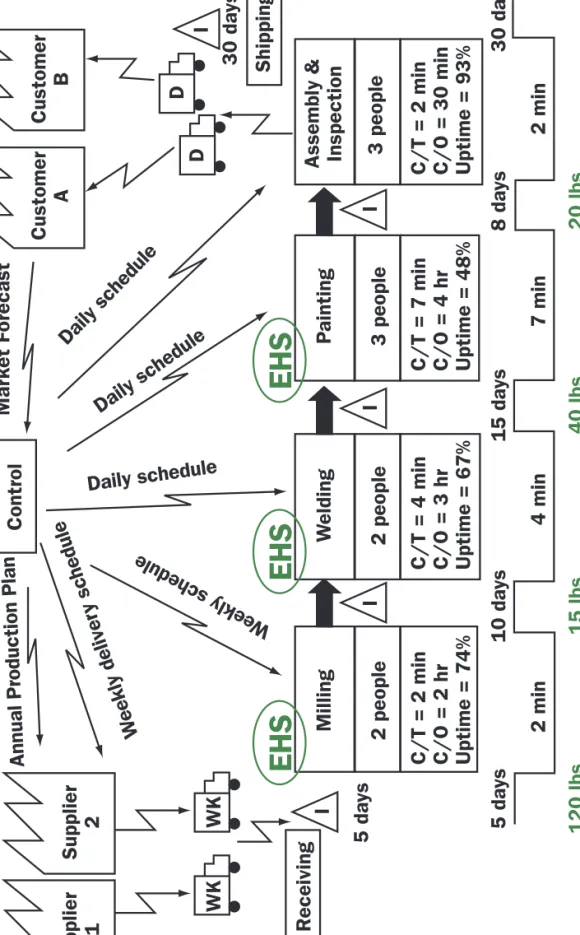
Figure 3 shows a current state value stream map that includes both EHS icons and environmental data for each process. In this case, each process box lists the amount of hazardous waste generated by that process per shift in addition to commonly collected data on cycle time (C/T), changeover time (C/O), and machine uptime.
Chapter 3: Value Stream Mapping
Chapter 3: Value Stream Mapping
To Consider
• Which environmental metric(s) would you choose to include in value stream maps at your company?
• Does your company or facility have environmental goals and targets that could be identified on value stream maps?
• What processes at your company do you think might have the greatest op portunities for environmental improvement?
3. Analyze Materials Use Versus Need in a “Materials Line” for Value
Stream Maps
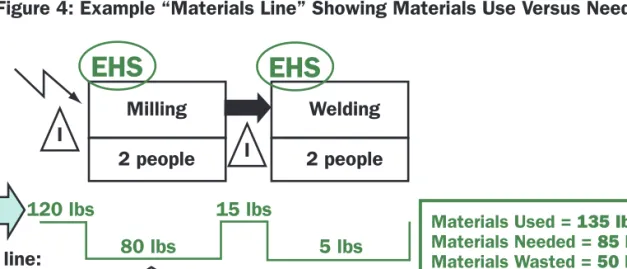
Value stream maps typically examine the time it takes to produce a product and the proportion of that time that is value added, but they do not focus on the resources consumed and wasted in the development of that product. Raw materials are often a large source of a product’s costs, so looking explicitly at the material flows in a value stream is another way to leverage greater gains. One way to do this is to draw a “materials line” on the bottom of a value stream map that shows two types of data:
• Amount of raw materials used by each process in the value stream; and
• Amount of materials that end up in the product and add value from a customer’s perspective. The materials line is analogous to the “timeline” on value stream maps, and can be developed for any type of resource (e.g., water, energy, total materials, and/or a critical substance used in the product). Figure 4 shows an example of a materials line. In this example, the milling and welding processes consumed 135 pounds of materials, but only 85 pounds were actually needed and added to the product. Fifty pounds of materials were wasted.
Figure 4: Example “Materials Line” Showing Materials Use Versus Need
Chapter 3: Value Stream Mapping
Once you collect data for the materials line, you may notice large differences between the amount of material used and the amount needed for the product. This can help you target Lean improvement efforts on the largest sources of waste. Figure 5 shows a complete example of a value stream map with a materials line.
4. Expand the Application of Value Stream Mapping to Natural
Resource Flows
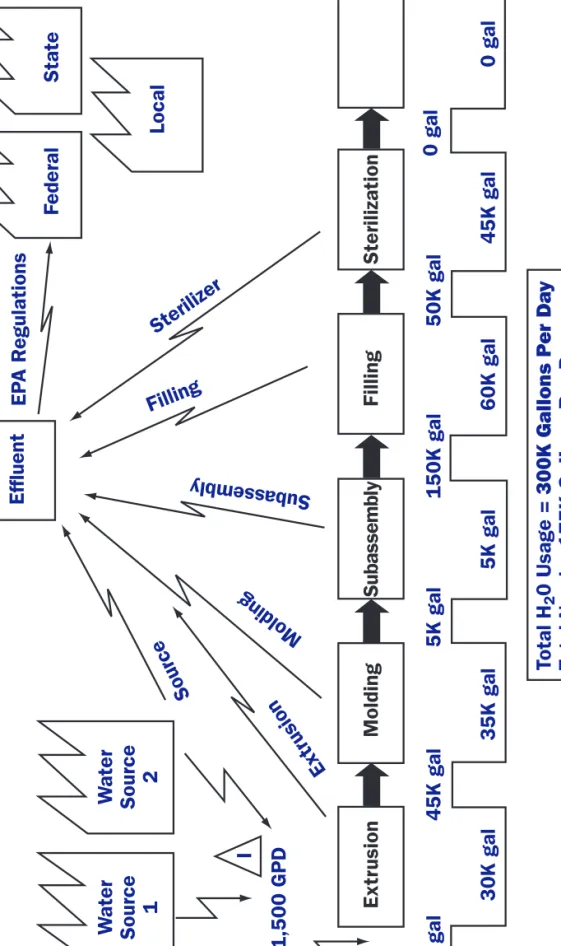
In contrast to adding a materials line to a conventional value stream map (as discussed above), you can also use value stream maps to look in more detail at the inputs, outputs, and information flows associated with the use of energy, water, and/or materials. Along with comparing materials use versus the need for each process in the value stream, you can examine environmental waste streams (i.e., non-product outputs such as air emissions, wastewater, hazardous wastes, and trash) and the flows of information to environmental regulatory agencies.
Figure 6 displays a water-use value stream map for a product that contains water (e.g., a medical IV bag). This value stream map includes a materials line summarizing the amount of water that is used and needed by each process in the value stream. There are arrows showing the flow of waste water from each process to the sewer and another arrow depicting the flow of information about wastewater discharges to regulatory agencies.
This type of detailed examination of material flows can help you find hidden sources of waste in the value stream. All three elements of a materials-flow value stream map—the materials line, environ mental waste flows, and regulatory information flows—can also be targets for future Lean efforts.
Chapter 3: Value Stream Mapping
Figure 5: Current State Value Stream Map with Materials Line
Chapter 3: Value Stream Mapping
Chapter 3: Value Stream Mapping
5. Find Lean and Environment Opportunities in Future State Value
Stream Maps
All the tools and techniques described thus far in this chapter—EHS icons, environmental metrics, addition of a materials line, and materials-flow tracking— can help you identify environmental wastes in the current state of the value stream as well as identify targets for future Lean implemen tation activities.
Consider the following Questions about the Future State of a Value Stream when developing the future state value stream map. These questions, along with input from any EHS staff participating in your team, can help to:
• Envision ways to eliminate environmental wastes in the value stream; and
• Recognize when Lean improvement events could raise EHS compliance issues and, there fore, require involvement of staff with EHS expertise.
Questions About the Future State of a Value Stream
✓ Where are kaizen events (discussed in Chapter 4) needed to address thebiggest areas of environmental wastes? These might include: • Processes with high energy, water, and/or materials use; and
• Processes that generate large amounts of solid waste, hazardous waste, and/or pollution
✓ Will any changes be made to the layout of processes marked with an EHS icon or to the chemicals used by those processes? (These changes could have potential implications for regulatory compliance practices.
✓ Can one process use the “waste” material from another process instead of using virgin materials?
✓ What would an ideal state for the value stream look like with zero wastes, where products and processes posed no risks to health or the environment, and where there was no need for permits?
✓ What steps can be taken now to get to that ideal state?
Figure 7 depicts a future state value stream map that includes kaizen starbursts for environmental improvement opportunities as well as changes to establish a “pull” system to control inventory levels and improve production flow.
Chapter 3: Value Stream Mapping
Chapter 3: Value Stream Mapping
When developing the kaizen implementation plan associated with the future state value stream map, remember that Lean events on certain processes (including processes with environmental regulatory requirements and others labeled with EHS icons) may require special attention to EHS issues.
Case Study: Baxter International Healthcare Corporation
Baxter Healthcare Corp., a worldwide leader in manufacturing global medi cal products, adopted a number of Lean techniques to reduce its environ mental footprint. Baxter integrated environmental metrics with traditional Lean manufacturing tools, helping the company double in size and revenue while keeping total waste generation close to 1996 levels. Several company plants completed a value stream map (VSM) to find ways to reduce water and energy consumption. One plant developed a VSM and implementation plans by walking through the production process and highlighting water us age and major processing steps. In the VSM, 96 opportunities were priori tized with many graphically represented by starbursts; these opportunities were also included in three future state VSMs. Through the VSM event, Bax ter developed an action plan that should save $17,000 over three months and 170,000 gallons of water per day.
It is critical to involve staff with EHS expertise early in planning for Lean events on processes with EHS opportunities. EHS staff can:
• Anticipate changes needed to environmental compliance practices from Lean activities and help implement those changes as quickly as possible;
• Bring a different perspective to Lean activities and additional ideas for waste-reduction op portunities; and
• Ensure that Lean activities improve or cause no harm to worker health, safety or the envi ronment.
In the next chapter you will learn more about how to integrate environmental considerations into the implementation of kaizen events at your company.
Chapter 3: Value Stream Mapping
Summary
Value stream mapping is a Lean process-mapping method for understanding the sequence of activities and information flows used to produce a product or deliver a service. Conventional value stream mapping can overlook three types of environmental considerations:
• Raw materials used in products and processes;
• Pollution and other environmental wastes in the value stream; and • Flows of information to environmental regulatory agencies.
There are at least five ways to explicitly address pollution and natural re source wastes using value stream mapping:
1. Use icons to identify processes with EHS opportunities in value stream maps, and involve EHS staff in planning Lean events on those processes. 2. Record environmental performance data for processes in value stream
maps, and consider these data in developing a vision for the future state. 3. Analyze materials used by each process versus materials actually needed
for the product, and summarize this information in a “materials line” be low the timeline on value stream maps.
4. Expand the application of value stream mapping to natural resource flows such as energy and water use, by including additional information on ma terials use, waste streams, and regulatory information flows in the maps. 5. Consider Lean and environment questions, as well as environmental data included in the current state map, when developing the future state map. EHS professionals can help to:
• Collect environmental performance data for processes in the value stream; • Identify processes with environmental opportunities in value stream maps;
and
• Make sure that changes to those processes are managed safely and effectively through Lean implementation.
Chapter 3: Value Stream Mapping
Your Thoughts
Now that you’ve finished this chapter, reflect on what you read by answering these questions:
• Do you need any more information to fully understand how to integrate en vironmental, health and safety considerations into value stream mapping? Would any other tools be helpful?
• What other ideas do you have to improve the environmental performance of your company with value stream mapping?
Notes:
CHAPTER 4
Kaizen Events
Chapter Contents
Introduction to Kaizen Events
Definition of Kaizen
What This Chapter Will Help You Do
How to Establish a Lean and Environment Change Management System
Overview of Process Steps
Step 1: Train Lean Team Leaders to Recognize EHS Impacts Step 2: Identify an EHS Contact for Kaizen Event Teams
Step 3: Use an EHS Checklist for Lean Events to Identify EHS Needs Step 4: Proactively Involve EHS Staff in Kaizen Events
How to Identify and Find Solutions for Lean and Environment Opportunities in Kaizen Events
1. Questions to Identify Lean-Environment Opportunities
2. Hierarchical Process Mapping to Drill Down from Value Stream Maps 3. Process-Specific Resources for Kaizen Implementation
Conclusion
Summary Your Thoughts
Chapter 4: Kaizen Events
Introduction to Kaizen Events
This chapter looks at one of the main vehicles for change in Lean—kaizen or rapid process im provement events—and discusses how to find environmental improvement opportunities, mitigate regulatory constraints, and implement new waste-reduction tools through kaizen events on pro cesses in the value stream.
Definition of Kaizen
Kaizen means continual improvement in Japanese. Kaizen events—also known as rapid process improvement events—are a team activity designed to eliminate waste and make rapid changes in the workplace. They are a primary means of implementing other Lean methods, ranging from 6S (5S+Safety) to cellular manufacturing. See Appendix A for more information about kaizen events.
What This Chapter Will Help You Do
The rapid and fundamental process changes that occur during kaizen events create powerful win dows of opportunity to reduce material wastes and pollution, but they also can result in regulatory compliance violations and/or cause health and safety hazards for workers if they are not properly managed. This is especially the case for the 10 Common Manufacturing Processes with Environ mental Opportunities listed on page 24.
This chapter presents strategies and tools to help accomplish two objectives:
1. Develop a change management system for kaizen events to prevent regulatory compliance issues and maximize waste-reduction benefits; and
2. Find opportunities to enhance Lean results and environmental outcomes by asking key ques tions and deploying new process-improvement tools.
How to Establish a Lean and Environment Change
Management System
Overview of Process Steps
In addition to involving EHS staff in value stream mapping teams (see Chapter 3), there are four steps your company could take to make sure that process changes from kaizen events do not cause unwanted EHS impacts.
1. Train Lean team leaders to recognize EHS impacts. 2. Identify an EHS contact for kaizen event teams.
3. Use an EHS Checklist for Lean events to identify EHS needs. 4. Proactively involve EHS staff in Lean events.
Chapter 4: Kaizen Events
Step 1: Train Lean Team Leaders to Recognize EHS Impacts
While a key strategy for effective Lean and environment integration is to involve EHS staff in plan ning for and conducting Lean events on processes with environmental opportunities, it is useful for all staff to recognize what process changes can trigger EHS impacts. Simple training can go a long way to help kaizen event team leaders and team members identify issues and operational changes that may require additional EHS expertise. As described in more detail in Chapter 2, con sider adding slides to Lean training presentations about how to identify environmental wastes and issues during Lean activities.
Use the list of Common Operational Changes That Trigger EHS Involvement below as a guide for when to seek additional EHS expertise for Lean events.
Common Operational Changes That Trigger EHS Involvement
✓ Changes to the type, volume, or introduction/issuance procedure for chemicals/materials used by employees. Affects chemical exposure, regulatory compliance, and reporting needs.
✓ Changes to the type or volume of waste generated by a process, includ ing all media such as air emissions, water discharges, and liquid and solid waste. Affects compliance with regulatory and permitted limits, as well as pollution control and management capacity.
✓ Changes to the physical layout of the processes (e.g., moving work or stor age areas), to equipment and technologies used, or to the facility (e.g., moving, replacing, or installing vent hoods, stacks, floor drains or process tanks). Affects compliance with regulations and permits, as well as work practice requirements.
If not properly conducted, these types of operational changes could harm the health and safety of workers, or cause violations of EHS regulations. For example, moving hazardous waste collection ar eas from central locations to work cells could affect compliance with the Resource Conservation and Recovery Act. Similarly, replacing existing, permitted air pollution control equipment with right-sized equipment would require permit modifications under the Clean Air Act.
Step 2: Identify an EHS Contact for Kaizen Event Teams
Lean managers and kaizen team leaders need to know who to contact with EHS questions and needs. Since EHS specialists cannot participate in all Lean events, it can be helpful to assign a general EHS contact to address unexpected issues and concerns that arise during kaizen events.
Chapter 4: Kaizen Events
Your company may wish to have a single EHS contact for all events, or assign EHS staff to specific production areas. Here are a few things to keep in mind when identifying an EHS contact.
• Keep it simple. Have a single point of contact for the event.
• Provide EHS contact information. Give kaizen event team leaders information on how to
reach the EHS contact.
• Assign EHS contacts who can be highly responsive. Even a one-day delay in response
to a question or issue can disrupt progress in an event.
Step 3: Use an EHS Checklist for Lean Events to Identify EHS Needs
An EHS checklist for Lean events is a simple tool you can use to identify operational changes planned during a kaizen event that may cause an EHS impact. Checklists are particularly useful when there is no team member with EHS expertise involved in an event. They also reinforce training information.
See Appendix C for a sample Lean Event EHS Checklist. If your company has other checklists or forms used during Lean events, you could add EHS-related information to them. You may also want to include questions that prompt team members to look specifically for environmental improvement opportunities.
Step 4: Proactively Involve EHS Staff in Kaizen Events
In Chapter 3, you learned how to identify processes with environmental opportunities on value stream maps and that you should involve EHS staff in Lean events on those processes. The Lean Event EHS Checklist can also serve as a trigger for EHS involvement. Kaizen event teams should consult the EHS contact immediately during an event if any EHS involvement flags are triggered when completing the checklist. Failure to involve EHS staff can result in risks due to unsafe work conditions or non-compliance with regulations.
Chapter 4: Kaizen Events
Case Study: Goodrich Corporation
Goodrich, a supplier of products and services to the aerospace industry, be gan implementing Lean techniques in 1995, adapting tools from the Toyota Production System. Kaizen events serve as the driving force behind a waste elimination-focused culture change with the company conducting over 350 events each. Goodrich has used kaizen events to assess hazardous envi ronmental waste streams, identify and implement pollution prevention and process improvement techniques, and to target environmental, health, and safety (EHS) issues. EHS objectives must be identified for all kaizen events, and efforts must also be made to involve EHS personnel if an event is likely to have important environmental dimensions, risks, or opportunities. Sever al Goodrich sites have also converted to cellular manufacturing while other facilities have shifted to Lean point of use chemical management systems to eliminate wasted worker movement, which also reduced chemical use.
While involvement of EHS staff can sometimes result in the identification of constraints to making certain operational changes, their participation can also expand the solution set. In some cases, EHS staff may even be able to work with regulatory agencies to tailor permit requirements and compliance strategies to accommodate your plant’s Lean operating environment (see Air Permitting Strategies textbox below).
Air Permitting Strategies to Reduce Constraints to
Making Operational Changes
The U.S. Environmental Protection Agency and various States have pio neered innovative approaches to air permitting that can streamline a plant’s ability to make many types of operational changes. Many of these fl exible air permitting techniques are being piloted by companies implementing Lean. To learn more about innovations in air permitting, use the form found at http://www.epa.gov/lean/auxfiles/contact.htm to get in touch with an EPA Lean and environment specialist.
To Consider
• What EHS issues and questions have arisen during kaizen events in your organization? Which ones have recurred?
• Identify at least three ways to improve coordination between Lean and EHS personnel regarding kaizen events.
Chapter 4: Kaizen Events
How to Identify and Find Solutions for Lean and
Environment Opportunities in Kaizen Events
While the previous chapter described how to identify processes with EHS opportunities in value stream maps, this chapter presents several tools and resources for finding Lean and environment opportunities within specific processes targeted for kaizen implementation. These resources include:
• Questions to Identify Lean-Environment Opportunities;
• Hierarchical Process Mapping to Drill Down from Value Stream Maps; and • Process-Specific Pollution Prevention Resources.
These kaizen implementation resources can help Lean teams discover ways to improve environmen tal and operational performance. They are particularly useful when planning for kaizen events and during initial brainstorming activities.
1. Questions to Identify Lean-Environment Opportunities
Asking the right questions when preparing for and conducting a kaizen event can uncover hidden waste reduction opportunities, such as chemicals that could harm human health and the environment, water and energy utilities, and compliance support infrastructure and costs that may be buried in facility overhead.
The Key Questions for Identifying Lean-Environment Opportunities listed below can assist your kaizen team to explicitly identify and consider opportunities to boost environmental performance while also enhancing operational performance.
Chapter 4: Kaizen Events
Key Questions for Identifying Lean-Environment Opportunities
Water Use
✓ How much water is used in the process and how is it used?
✓ How can you reuse water and/or reduce overall water use?
✓ Can you reduce contaminants in wastewater and discharges?
Energy Use
✓ How much energy is used in the process and how is it used?
✓ How can you reduce overall energy use?
✓ Is equipment running or are lights on when not being used?
✓ Are you using efficient light bulbs?
✓ Can you save energy by consolidating operations and/or storage space?
✓ Can you shift to a cleaner source of energy?
Chemicals and Materials Use
✓ What types and quantities of chemicals/materials are used in the process?
✓ How can you reduce the overall amount of chemicals and materials used?
✓ Can you switch to less harmful chemicals?
✓ Can you eliminate any non-value added use of chemicals or materials from the product or process (excess packaging, unneeded painting, etc.)?
Solid Waste
✓ What types and quantities of solid waste are generated by the process?
✓ How can you reduce the overall amount of solid waste generated?
✓ How can you reuse or recycle solid wastes?
✓ Is there a local composting facility that the waste can be taken to?
Hazardous Waste
✓ What types and quantities of hazardous waste are generated by the process?
✓ How can you reduce the amount or toxicity of hazardous waste generated?
✓ Can you better isolate and separate hazardous wastes from other wastes?
Air Emissions
✓ What types and amounts of air emissions are generated by the process?
✓ How can you reduce the overall amount or toxicity of air emissions?
Chapter 4: Kaizen Events
2. Hierarchical Process Mapping to Drill Down from Value Stream
Maps
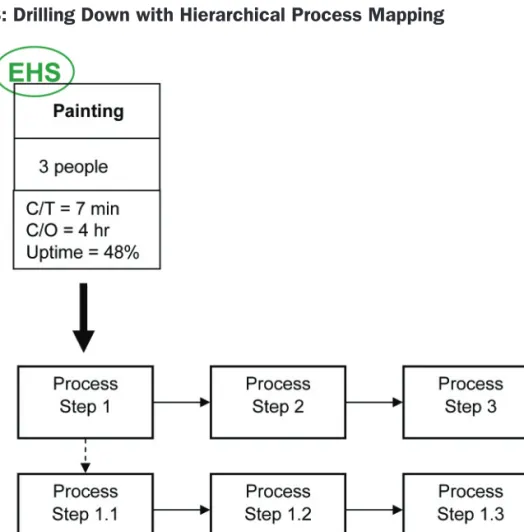
The value stream mapping tools described in Chapter 3 can help identify which processes generate large amounts of environmental wastes. Sometimes, however, it is useful to drill down further to identify the specific sources of waste within a single process. This detailed information can be par ticularly useful when preparing for or conducting a kaizen improvement event. Hierarchical process mapping is one tool to conduct this more detailed analysis and thereby uncover new waste-reduc tion opportunities.
Hierarchical process mapping is a tool that creates a workflow diagram to bring forth a clearer understanding of steps within a specific process.1 For example, a plating process might involve
several individual operations. A hierarchical process map presents process steps in tiers—it pres ents a high-level map of up to six process steps, and then maps the specific steps that lie within each high-level step, and so on with tiers of increasing detail. Figure 8 shows how hierarchical process mapping can be used to drill down within a process in a value stream.
Figure 8: Drilling Down with Hierarchical Process Mapping
1 This section draws on pioneering work on process mapping by Robert B. Pojasek (www. pojasek-associates.com). S ee Robert B.
Pojasek, “Mapping Information Flow Through the Production Process,” Environmental Quality Management, 13 (3), 2004.
Chapter 4: Kaizen Events
There are six main steps associated with process mapping.
1. Select the target process and determine map perspect