No. 2010–83
EXCLUSION THROUGH SPECULATION
By Cédric Argenton, Bert Willems
July 2010
Exclusion through speculation
1Cédric Argenton
2Bert Willems
3 CentER, TILEC, Tilburg UniversityThis version: 29 July 2010
Abstract
Many commodities are traded on both a spot market and a derivative market. We show that an incumbent producer may use financial derivatives to extract rent from a potential entrant. The incumbent can indeed sell insurance to a large buyer to commit himself to compete aggressively in the spot market and drive the price down for the entrant. It can do so by selling derivatives for more than his expected production level, i.e. by taking a speculative position. This comes at the cost of inefficiently deterring entry.
JEL codes: D43, D86, K21, L12, L42
Keywords: exclusion, monopolization, contracts, financial contracts, derivatives, risk aversion, speculation
1 Both authors thank Georges de Ménil and Jens Prüfer for comments as well as seminar
participants at TILEC/Tilburg University, University of Luxemburg, and ACLE/University of Amsterdam. The authors are responsible for any mistake. Bert Willems is the recipient of a Marie Curie Intra European Fellowship (PIEF-GA-2008-221085).
2 Email: [email protected] web: http://center.uvt.nl/staff/argenton/ 3 Email: [email protected] web: www.bertwillems.com
1
Introduction
Many commodities are traded on both a spot market and a derivatives market. On this latter market, financial instruments are used to take positions on the spot market price. The use of such instruments has exploded. In June 2008, before the financial collapse, the notional value of outstanding over-the-counter commodity derivatives worldwide was estimated at 13,229 billions of US dollars (BIS, 2010; p. A121), about 28 times the 1998 value.4 A large fraction of those instruments were held by financial firms. Nonetheless, back in the 90s, surveys already indicated that about 50% of US non-financial firms used derivatives and that 56% of those perceived commodity prices as a relevant source of risk (Bodnar, Hayt and Marston, 1998). In specific industries, usage of commodity derivatives appears to be widespread. Examples include the gold mining industry (Tufano, 1996, 1998) or the energy sector (Haushalter, 2000). 5
In this paper, we explore the possibility for incumbent firms with market power in the product market to use financial instruments so as profitably to deter the entry of a more efficient rival. We show that an incumbent producer and a large buyer may have a joint interest in trading derivatives to extract rent from a potential entrant. This comes at the cost of inefficiently deterring entry.
The intuition is as follows. In the seminal paper by Aghion and Bolton (1987), an incumbent convinces a large buyer to sign a sales contract that forces an entrant to charge a low price upon entry. Indeed, because of contractual penalties, breaching the contract is costly to the buyer. Hence, in order to remain competitive, the entrant must compensate the buyer for the penalty by posting a lower price. This price
4 Notional values are not available for exchange-traded derivatives but in June 2010 about
37.6 millions commodity futures and 20.6 millions options were outstanding (BIS, 2010; p. A127).
5 For additional empirical evidence on the use of commodity derivatives by firms, see, inter
alia, Nance et al. (1993), Mian (1996), Berkman and Bradbury (1996), Hentschel and Kothari (2001), Graham and Rogers (2002), Guay and Kothari (2003), Adam and Fernando (2006).
reduction discourages entry but, through the transfers specified in the contract, accrues to the incumbent in cases where entry does occur.
Our model extends the logic of Aghion and Bolton (1987) to the case where the incumbent offers the buyer a purely financial contract (call option or forward contract) instead of an exclusivity contract.6 The incumbent can use this contract to “commit” himself to compete aggressively in the spot market and drive the price down for the entrant. It can do so by selling more financial contracts than his expected production level, i.e. by taking a speculative position. Importantly, the exclusionary scheme can be operated even when the identity of parties to a deal in financial markets is not observable.
Currently, competition authorities do not routinely monitor the financial positions taken by dominant firms. We argue that on certain markets, this may be needed to counter the incentives for incumbents to commit to (overly) aggressive pricing. This paper relates to several strands of economic literature. First, there is now a voluminous literature on corporate risk management.7 It is typically interested in explaining the hedging behavior of firms, in spite of the possibility for claimholders (such as shareholders) to diversify their portfolio. Leading explanations resort to conflicting objectives between managers and shareholders (Stulz, 1984, 1991), agency problems between firms and investors leading to credit rationing, thus providing firms with an incentive to smooth out their cash flow (Campbell and Kracaw, 1990;
6 As noted by Rey and Tirole (2007; footnote 91), the contract in Aghion and Bolton (1987) can
be given a physical option interpretation: the buyer pays a fixed fee in order to acquire the right to acquire the good at a pre-specified price. Thus, physical options can be used to exclude. We here focus on purely financial instruments: contracts that are settled in cash and do not involve the physical delivery of the product, as is the norm on derivatives markets. As will become clear later in the paper, the exclusion scheme becomes more costly for the incumbent with financial rather than physical options under risk aversion. Although the mechanism is different, this outcome resonates with results regarding electricity distribution congestion pricing showing that financial transmission rights are less harmful to social welfare than physical transmission rights in the presence of market power; see Joskow and Tirole (2000).
7 It is impossible to do justice to all contributors. For a state-of-the-art survey of corporate
Froot, Scharfstein and Stein, 1993), or tax distortions (Smith and Schultz, 1985; MacMinn, 1987). At the same time, it is known that some factors lead firms not to hedge their income flow. Market power is one of them. Forward sales reduce monopoly power and, in the absence of reinvestment needs, a monopolist would find it optimal never to hedge income.8 We push the logic one step further by showing that a monopolist can actually favor taking a risky position for the sake of deterring entry.
Second, a growing literature looks at the interaction between derivatives markets and product markets in oligopoly settings. The main message in this literature is that firms may use financial derivatives strategically to affect the equilibrium in the spot market and increase their overall profit. The precise strategy depends on the nature of competition. If oligopolists compete à la Cournot, then they will sell forward contracts (or integrate vertically) to compete more aggressively in the market, in an attempt at increasing their market share at the expense of the other participants (Allaz and Vila, 1993).9 Willems (2005) shows that those results also hold for option contracts. On the other hand, if oligopolists compete à la Bertrand, then they have an incentive to buy forward contracts, and commit to being less aggressive (Mahenc and Salanié, 2004).10 We show that even under price competition, financial instruments can be used by an incumbent to increase the intensity of competition but with deleterious effects on entry incentives.
Third, predation constitutes a prominent link between financial markets and product markets. Bolton and Scharfstein (1990) were the first to provide theoretical underpinnings to the "long purse" predation theory, according to which cash-rich firms can drive out rivals with limited access to internal funds in the presence of
8 See Tirole (2006; section 5.4)
9 Hughes and Kao (1997) extend the analysis to the case where forward contracts are not
observable and show that they can still be used for strategic purposes.
10 See Adam, Dasgupta and Titman (2007) for a model in which only a subset of symmetric
firms choose to hedge. Starting with Brander and Lewis (1986) (for Cournot competition) and Showalter (1995) (for Bertrand competition) a parallel literature developed on the interaction between corporate financing choices and product market competition.
agency problems.11 Scott Morton (1997) indeed finds that "financially weaker" entrants tended to be fought more often by nineteenth-century shipping cartels. Chevalier (1995) and Campello (2003, 2006) report some evidence that rivals of highly-leveraged firms increase investments so as to gain more market share and drive the financially-constrained firms out of business. Froot, Scharfstein and Stein (1993) argue that the use of corporate derivatives can protect firms from this predatory risk. Haushalter, Klasa and Maxwell (2007) indeed present some evidence that the extent of the interdependence of firm's investment opportunities with rivals is positively associated with its use of derivatives. Most modern theories of predation involve asymmetric information and some manipulation of (the entrant's or its creditors') beliefs.12 Our model shows that below-cost pricing can also arise in a perfect information model when an incumbent has an interest in taking a financial bet on low prices. It also suggests that the availability of derivatives, although useful to the prey, can also be useful to the predator.
Fourth, our paper relates more generally to the large literature on exclusion.13 We show that the range of exclusionary contractual practices is not limited to instruments with obvious entry restrictions, such as exclusivity contracts, but that apparently innocuous contracts such as standard derivatives can also be misused. Some authors have explored the role of corporate financing choices in product market exclusionary strategies. McAndrews and Nakamura (1992) investigate entry deterrence possibilities in a quantity competition model and show that when demand is uncertain, an incumbent can use debt to discourage a Cournot entrant without deviating from the all-equity monopoly output. Showalter (1999) shows that in an industry with uncertain costs and Bertrand competition, an incumbent monopolist can occasionally deter entry by using debt to commit to a sufficiently low
11 See also Benoît (1983) (exogenous financial constraints) and Fudenberg and Tirole (1986)
(“long-purse” interpretation of their “signal-jamming” predation model).
12 As examplified by the presentations in Bolton, Brodley and Riordan (2000) or Motta (2004). 13 The literature on entry deterrence is enormous. See Ordover and Saloner (1989) and Wilson
(1992) for surveys of early pieces. Exclusion by means of (exclusivity) contracts was most recently surveyed by Whinston (2006) and Rey and Tirole (2007).
price. Cestone and White (2003) show that, if credit markets are imperfectly competitive, commitment problems on the part of the investor lead to the choice of equity as the way to fund an incumbent so as to prevent rivals from accessing credit. In this paper, we look at derivatives markets, rather than debt or equity markets. Fifth, there is small literature about price-increasing entry, a feature of our model. Rosenthal (1980), Hollander (1987) and Perloff, Suslow and Seguin (2006) show that on a market for differentiated products, composition effects on the demand-side may cause prices to increase when an additional variant is introduced. Chen and Riordan (2008) use a discrete choice model of product differentiation to analyze how more consumer choice can change the price elasticity of demand. Satterthwaite (1979), Schulz and Stahl (1996) and Janssen and Moraga-González (2004) stress the role of endogenous search costs. We show that on a market for a homogenous good, the exclusionary strategy of an incumbent can give rise to the phenomenon.
The paper is structured as follows. The model is presented in Section 2. In Section 3, we conduct the main analysis. Section 4 extends the model by assuming that the identity of the parties to the financial contract is not observable. Section 5 concludes.
2
Model
We study the subgame-perfect equilibria of a game between three players: the buyer, the incumbent and the entrant. With the exception of risk preferences, the model follows Aghion and Bolton (1987).
The buyer has unit demand for the good. His reservation price is equal to 1. He is risk-averse and his preferences are represented by a von Neumann-Morgenstern utility function U . His expected utility when consuming 1 unit of the good is equal to
[ (1 B)]
E U − p (1)
where expectations are taken over the different states of the world, and pB is the price faced by the buyer in a specific state. The utility function of the buyer is
upward-sloping and concave (U'>0 and U''≤0), and so normalized that
U
(0)
=
0
.14
The incumbent producer is risk-neutral and has a production cost cI <1. He seeks to maximize expected profit.
The entrant producer is also risk-neutral and has a production cost cE which, for
simplicity, is drawn from the uniform distribution over
[0,1]
. The cumulative distribution function of her production costs is thus F c( E)=cE. Uncertainty aboutE
c is the only source of uncertainty in our model.15 The entrant strives to maximize expected profit.
The game consists of four stages. In stage 1 the incumbent makes a take-it-or-leave-it offer to sell to the buyer x call options with strike price s and fee
f
. According to this contract(
x f s, ,)
, the buyer pays x times the fixed fee f upfront in order to acquire the right to be paidx times the difference between the spot market pricep
and the strike price s (which he will exercise as long as this difference is positive). Hence, the buyer’s financial gains from the contract are given by
(
max{
, 0})
x
⋅ − +
f
p s
−
(2)In stage 2 of the game, the buyer decides whether he accepts the contract offered by the incumbent or not.
In stage 3 the entrant and all other players in the game observe the financial position of the incumbent and the buyer and learn about cE.16 The entrant decides whether
she enters the market.
14 Risk aversion provides a justification for the very existence of a derivatives market. Our
exclusion result can, however, also be derived with a risk-neutral buyer.
15 We solve for pure-strategy equilibria. Hence, there is no additional, ‘strategic’ source of risk
in the model.
16 Accounting rules often provide for some form of disclosure of the financial positions taken
by public firms. See, for instance, International Financial Reporting Standard (IFRS) 7,
Financial Instruments: Disclosures, issued by the International Accounting Standards Board (IASB).
In stage 4, Bertrand competition takes place in the spot market. Firms who are active in the market post bids (pI and pE for the incumbent and the entrant, respectively)
and the buyer decides with whom (if any) to transact. The payoff of the entrant directly depends on the spot market price and sales. The utilities of the buyer and the incumbent producer depend not only on the spot market sales but also on the financial contract that they may have previously signed.17
3
Analysis
3.1 Taking a financial position so as to hedge
Before looking for the equilibrium of this game, we will first study the benchmark case where players use financial contracts for the sole purpose of hedging their activities.
We therefore restrict the incumbent to offer a forward contract for one unit of production, that is, a contract with x=1 and s=0. This contract perfectly insures the buyer against any price change in the spot market and, as demand is inelastic, leads to perfect hedging. In effect, the forward contract specifies that the buyer can transact at price f .
Suppose that this contract has been accepted by the buyer and that the entrant has decided to enter the market. In stage 4, the buyer is indifferent between buying from the incumbent or the entrant, given that he is perfectly insured.
If he makes the sale, the incumbent is perfectly hedged against the variations in the spot market price. However, he is willing to cut his price if that is needed to prevent the entrant from making the sale and leaving him with financial liabilities only. He
17 We assume that derivatives contracts have to be executed. Renegotiation-proofness is an
issue in models of inefficient exclusion by means of contracts, as shown by Spier and Whinston (1995) in the case of the original Aghion and Bolton (1987) model. The general issue is the one of the commitment value of contracts towards third parties. Asymmetric information may restore commitment power; see, e.g., Dewatripont (1987), Katz (1991) or Caillaud, Jullien and Picard (1995). We note that financial contracts typically involve intermediaries and that agents have to execute the promised trade in order to remain in good standing with the exchange or the broker.
will do so as long as pE >cI. Note that the incumbent never wants to sell below his own cost. The entrant always wants to undercut any price pI >cE posted by the incumbent, as in standard Bertrand competition. So, in equilibrium, both sellers post the same price pI = pE =max
{
c cI, E}
and the buyer buys from the firm with the lowest marginal cost.18By backward induction, the entrant will enter only if her marginal cost is small enough to allow her to make profitable sales:
( ) 0.
E cI cE π = − >
That is, the entrant enters only when she is the most efficient firm. Given our assumption that cE is uniformly distributed, the probability of entry under hedging (subscript H) is:
.
H cI
φ = (3)
In case the entrant stays out, then the incumbent (and the buyer) will subsequently be indifferent between all prices. For determinacy (and without any impact on the results, which depend only on the entry pattern), we assume that the incumbent will post a price pI equal to the monopoly price, 1 (as would be the case if any additional buyer, however marginal, were present on the demand side).
In stage 1, the incumbent will thus offer the buyer a contract ( ,f xH =1,sH =0)
solving max (1 ) . . ( ) ( ) 1 (1 ) H I H I f H I H I f c c s t i c ii U f U c φ φ φ φ − − − = − ≥ − (4)
The objective function reflects the fact that the incumbent is perfectly hedged: in any case, he collects the fixed fee f for selling the forward contract. Upon entry, which occurs with probability φH, the entrant makes the sale and the incumbent has to pay
the market price (cI) to the buyer. When the entrant chooses to stay out, the incumbent makes the sale and earns the spot market price p=1 but because of the forward contract he pays it back to the entrant, while he incurs production cost cI.
Constraint (i) reflects the anticipation of entry. Inequality (ii) stands for the participation constraint of the buyer: in order to accept the contract, he must be left with at least as much utility as when he refuses it (in which case he makes a surplus only when entry occurs and the price drops from 1 to cI).
Observe that with the forward contract there is nothing that the incumbent can do to affect entry. The program thus boils down to providing insurance to the buyer and extracting as big a fraction of risk-sharing gains as possible from the buyer through forward price f . Having all bargaining power, the incumbent will thus hold the buyer to his reservation utility level by setting forward price fH so as to make (ii) bind, i.e.U(1−fH)=φH(1−cI).
Note that entry will be efficient. The entrant will enter whenever her cost of production is smaller than the incumbent’s. Thus, the presence of the financial contract is efficient as production is performed by the lowest-cost firm and the risk-averse buyer is fully insured.
3.2 Taking a financial position so as to exclude
Assume now that the incumbent can offer x call options with strike price s and fee f to the buyer. The buyer will exercise his options whenever p≥s. If the strike price is high (s≥cI), then the option will, in equilibrium, have no effect on the product market outcome.19 It follows that the incumbent cannot improve his payoff by selling
19 The reaction function of the incumbent will be affected by the sales of the options, for price
bids of the entrant which lie above the strike price of the option. In particular, the incumbent will price more aggressively. This reduces the equilibrium profit of the entrant, if the entrant's cost is above the strike price. However, the entrant will only enter if its costs are at least lower than the one of the incumbent. Hence, options with a high strike price will only affect those subgames which are not reached in equilibrium.
such options. Therefore, in what follows we will assume that the strike price is smaller than the cost of the incumbent: s<cI.
In Stage 4, following entry, the profit of the incumbent is the following
{
}
max 0, ( )
I x f x p s pI c qI I
Π = − − + − (5)
where
p
is the spot price, pI denotes the price posted by the incumbent, and qI thesales made by him. Those sales equal 1 when the buyer buys from the incumbent and 0 when he buys from the entrant. The incumbent sells the options at fee
f
(first term), insures the buyer when the spot price is high (second term), and makes an operational profit on his activity as producer (third term).The profit of the entrant is given by
( )
E pE c qE E
Π = − (6)
where qE∈{0,1} stands for her sales in the spot market.
The buyer maximizes his utility by choosing whether he accepts the incumbent’s offer or the entrant’s:
{
}
(
)
{ , } max 1 max 0, B I E B p ∈ p p U −p +x p−s (7)where, by definition, pB stands for the price at which the buyer transacts, and
min{ I, E}
p= p p is the spot market price. We assume that the buyer cannot affect the spot market price
p
by switching to a more expensive supplier and pay a priceB
p > p. (Again, this would be the case in the presence of any additional buyer, however marginal.) As a consequence, the buyer will always buy from the firm that offers the lowest price. 20
20 That is to say, in our model financial contracts are defined with reference to the (publicly
observable) spot market price, and not the price at which the contracted buyer transacts. This is a plausible assumption. The contracting parties would be wary of moral hazard when indexing a transfer on a price which could be manipulated by one of them. Besides, options are typically defined with respect to the spot price, as quoted on an exchange, and not the price observed in individual over-the-counter transactions.
3.2.1 Pricing subgame
We now study the pricing behavior of the incumbent and the entrant. The behavior of the entrant is straightforward. As in a standard Bertrand game, she will undercut any price posted by the incumbent as long as this price is above her production cost
E
c .
The behavior of the incumbent depends on his financial commitments. He will undercut as long as the financial gains from decreasing the price outweigh the operational losses from selling below cost. By not undercutting, the incumbent does not make the sale (qI =0), and receives from (5) a profit equal to
{
}
max E , 0 .
x f −x p −s (8)
Upon undercutting (qI =1), he makes
{
}
max I , 0 ( I I)
x f −x p −s + p −c (9)
If the entrant bids below the strike price (pE <s), then the option is not exercised and the incumbent will not undercut the entrant as it would only obtain a negative operational profit (since we assumed that s<cI). If the entrant bids above the strike price (pE ≥s) and the contract is such that x>1, then, upon undercutting, the incumbent will drop its price to the strike price pI =s to get rid of his financial
liability.21 In this case his profit is:
I
x f + −s c (10)
Comparing (8) and (10), dropping the bid to the level of the strike price is profitable as long as *
E
p >p , where * cI s x
p ≡ +s − . Note that s≤ p*≤cI, and that the incumbent will undercut the entrant even when the price of the entrant is below his own marginal cost.
21 If x≤1, the operational profit is always bigger than financial losses, so that the subgame
We proceed with deriving the equilibrium price,
p
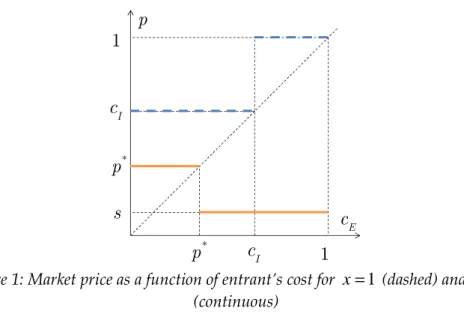
, as a function of the cost of the entrant, cE. Several cases must be distinguished.(1) If cE ≥ p*, then any profitable bid by the entrant is matched by a bid pI =s by the incumbent. Thus, the equilibrium prescribes that pI =s,
*
E
p ≥p and the buyer buys from the incumbent (qI =1,qE =0). That is, as the entrant's cost is relatively high, she cannot post a price that overcomes the incentive for the incumbent to price so low as to avoid financial losses. We call this a type A equilibrium.
(2) If s≤cE < p*, there are several equilibria. The type A equilibrium still constitutes a Nash equilibrium (pE ≥ p*,pI =s,). Yet, there is another class of equilibria in which the incumbent and the entrant bid the same price,
*
E E I
c ≤ p = p ≤p and the buyer buys from the entrant. As in the standard Bertrand game, we only take an interest in the highest price equilibrium in this class of equilibria. 22 Hence, in this type B equilibrium *
E I
p = p = p . This multiplicity raises an equilibrium selection problem. In the type A equilibrium with market price s, the profits of the incumbent and the entrant are as follows:
, 0
I s cI xf E
Π = − + Π = (11)
In the type B equilibrium with market price p*, the profits of the incumbent and the entrant are:
* *
I s p xf E p cE
Π = − + Π = − (12)
22 In a standard Bertrand game with asymmetric yet constant marginal costs, a similar
multiplicity problem arises. The price can be lower than the second lowest marginal cost because the high-cost firm, although he doesn't make any sale, constrains the price of the lowest cost firm by bidding low. Such equilibria do not survive standard refinements such as trembling-hand perfection or elimination of weakly dominated strategies.
Thus, the type B equilibrium brings strictly more profit to both firms given that p*<cI. We therefore assume that it is the one played by firms.23
(3) If cE <s, only type B equilibria exist.
To summarize, if the marginal cost of the entrant is high (
c
E>
p
*), then theequilibrium price is equal to the strike price, (
p
=
p
I=
s p
,
E≥
p
*), and the sale is made by the incumbent. If the marginal cost of the entrant is low (c
E≤
p
*), then theequilibrium is given by p= pE = pI = p*, and the sale is made by the entrant. Interestingly, the spot price is higher when the entrant has a low cost. This is of course due to the incentives introduced by the presence of financial bets. If there is no entry in the market, then the incumbent, who is making the sale for sure, wants to minimize his financial losses by charging the strike price pI =s.
3.2.2 Entry decision
Anticipating this pattern, the entrant will thus enter only if *
E
c ≤p . The probability of entry under speculation (subscript S) is then equal to
φ
S=
p
*. So, in the absence ofentry, the spot price is s, while it is p*>s following entry. Therefore, the presence of a large volume of option contracts between the incumbent and the buyer gives rise to the phenomenon of price-increasing entry. See Figure 1.
3.2.3 Program of the incumbent
In stage 1, the incumbent maximizes his profit by offering x option contracts with strike price s and fee
f
to the buyer. Under the proviso that x>1, his program is(
)
* , , * * * max ( ) (1 )( ) . . ( ) ( ) ( ) 1 (1 ) 1 (1 ) I I f x s c s x I I xf x p s s c s t i p s ii U p x p s f U s xf c U c φ φ φ φ φ − − − + − − = = + − + − − + − − − ≥ − 23 There is some experimental evidence that in coordination games with Pareto-ranked
equilibria, players manage to achieve coordination in a number of environments. See Devetag and Ortmann (2007).
Figure 1: Market price as a function of entrant’s cost for x=1 (dashed) and x>1 (continuous)
By substitution of variables, this optimization problem can be simplified to:
, max . . 1 (1 ) 1 (1 ) I F I I I F c s t U F c U F c U c φ φ φ φ − − + − + − − ≥ − (13) where cI s x s
φ= + − is the probability of entry, and F ≡ xf +s, the generalized price of the contract. Along with the constraint, which will bind as F is a transfer, the optimal contract is characterized by the following condition:
1 I 1 ' 1 I
U −F +c −φ−U −F =φU −F +c −φ (14)
The left-hand side of equation (14) is the marginal benefit of allowing additional entry (the good is obtained from the entrant at cost φ instead of being produced by the incumbent at cost cI ), while the right-hand side is the marginal effect on the
buyer’s expected utility of the increase in the post-entry price that comes with additional entry. Together with the participation constraint of the buyer, equation (14) then determines the optimal entry rate and the optimal fee structure. Observe that there are infinitely many choices of f , s and x that allow the incumbent to implement the optimal rate of exclusion so as to maximize his rents.
It is easily seen that in case of risk neutrality
(
U x( )=x)
expression (14) simplifies to2
I
c
φ
= . If the buyer is risk averse (U"<0), then the optimal level of entry will be larger than under risk neutrality (φ
>cI 2). This follows directly from the concavityI
c
Ic
*p
*p
1
s
1
Ec
p
of the utility function. The average increase in utility from receiving extra income I
c −
φ
is larger than the marginal utility evaluated at the end income level24:[1 ( )] 1 ' 1 . ( ) I I I U F c U F U F c c φ φ φ − + − − − > − + − − (15)
Combining this expression with (14) gives
φ
>cI 2. That is, risk aversion obliges the incumbent to allow for more entry than joint-surplus maximization would dictate. The intuition for this result is clear. Atφ
=cI 2, any change inφ
has second-order effects on the surplus extracted from the entrant. At the same time, allowing for entry improves the terms of the lottery faced by the buyer, which is a first-order effect under risk aversion.25Interestingly, among the infinitely many combinations of s, x, and f that allow the incumbent to achieve optimal exclusion (from his point of view), there is an optimal contract with s=0, i.e. a forward contract. Hence, exclusion does not require the use of (somewhat) complicated option contracts. Simple forward contracts can be used.
3.3 Equilibrium
We are now in the position to assert our main result: for any level of risk aversion, the incumbent will offer (and the buyer will accept) a speculative contract that leads to an inefficiently low level of entry.
To this purpose, it is sufficient to compare the profit of the incumbent under the optimal hedging (section 3.1) and optimal speculative (section 3.2) contracts, respectively. Observe that when faced with program (13) (when restricted to x>1), the incumbent can reproduce the solution to program (4) (when restricted to x≤1) by choosing s=cI , in which case the objective function takes the same value in both
24 For a strictly concave utility function, it must hold that
U x
(
+ −
y
)
U x
( )
>
U x
'(
+
y y
)
, forany x and
y
.25 If physical options were available, the incumbent would not have to expose the buyer to
risk. Selling at fee f one option for buying the good at price φ obliges the entrant to price at φ while perfectly hedging the buyer. Thus, the incumbent would not have to compensate the buyer for the extra risk and the exclusion scheme would more profitable to the incumbent.
programs. Hence, the incumbent can always do at least as much as by perfectly hedging the buyer. As matter of fact, it is easy to show that it can do strictly better. From equation (14), when
φ
=cI, the net marginal benefit of increasing entry isstrictly negative, indicating that the incumbent can strictly win by choosing
φ
<cI .Proposition 1. In subgame-perfect equilibrium, the incumbent offers, and the buyer accepts, a contract
(
x f s, ,)
characterized by * * * * * * * * * * * 1 1 ' 1 1 (1 ) 1 (1 ) I I I I I U F c U F U F c U F c U F c U cφ
φ
φ
φ
φ
φ
− + − − − = − + − − + − + − − = − (16) where * cI s x sφ = + − and F* =xf +s. There are infinitely many such contracts but they are all such that x>1, s<cI and
* H
φ φ
<
.4
Extension
Until now we have assumed that the buyer and the entrant knew that the contract was offered by the incumbent, who would price more aggressively upon entry. The buyer was willing to pay a premium for the contract, as he expected lower prices in the future. We now relax the assumption that the buyer and the entrant observe the identity of the contract’s offerer and instead suppose that they only observe the contract characteristics. This may be more realistic. Bilateral, over-the-counter contracts are typically struck through a bank or a broker and trades in a centralized market remain anonymous. The question then arises as to whether the exclusion mechanism we identified above can survive non-observability of the contracting parties’ identities. In particular, if the counterparties to the contract were not observed, would it be profitable for other agents (say, arbitrageurs) to mimic the contract that the incumbent is supposed to offer? Given that the buyer is willing to pay a premium for the contract when the counterparty is the incumbent, such mimicking behavior could be very profitable.
We model this environment as a signaling game where different option sellers (the incumbent and some arbitrageurs) submit bids into the derivatives market. The specifications of the bids are observed by the entrant and the buyer, but the identity
of the bidders is not. The entrant and the buyer must thus form beliefs about the type of bidders based on the bids they submit.
We show a separating equilibrium can arise, in which market participants believe that only the incumbent can profitably offer exclusionary, speculative contracts. (There are other equilibria. As is well-known, asymmetric information games typically admit many equilibria.)
Our basic model is thus modified as follows. We add n risk-neutral arbitrageurs who in stage 1, along with the incumbent, simultaneously post the terms
( , , )
x f s
of the option contract they are willing to sell. The buyer will be randomly presented withone of the n+1 contracts. The buyer can accept or reject the contract, and will not be presented with another contract.26 The identity of the contract offerer is not revealed. In stage 2, the buyer decides whether he accepts the contract on offer. The contracting position of the buyer is observed by the entrant and the game then proceeds as in the original model. Again, other game protocols are possible. Our goal is not to model the microstructure of financial markets but to highlight the potential incentive problem arising from anonymity.
We construct an equilibrium in which the incumbent offers one contract ( , , )x f sI I I , the arbitrageurs another one ( , ,xA f sA A), the buyer accepts any offer put to him and correctly anticipates (as does the entrant) that only the incumbent is able profitably to offer the first contract. We will show that the incumbent can actually implement the same exclusion scheme as in the original model.
On the equilibrium path, an arbitrageur offers a contract that identifies him as such. So, the buyer and the entrant believe that spot market prices will not be affected by acceptance, and entry will be efficient. An arbitrageur maximizes his payoff by
26 The probability with which various contracts are presented to the buyer does not affect the
structure of the equilibrium, as long as it is non-zero. By contrast, if the buyer were presented with, and could accept, more than one contract, then his outside option would become endogenous and the participation constraint could become tighter as a result, increasing the cost of entry deterrence. In addition, the belief structure would have to depend on the entire set of contracts offered, which raises thorny conceptual difficulties.
insuring the buyer against the price risk under efficient entry and, as it has all bargaining power, he can extract all gains from risk-sharing. That is, he will offer a forward contract ( , ,xA f sA A) such that sA =0, xA=1 and fA= fH.
In a separating equilibrium, the incumbent’s actions are constrained by the presence of other sellers of financial instruments. The incumbent must make an offer that cannot be profitably mimicked by arbitrageurs. In order to prevent arbitrageurs from masquerading as an incumbent, it must be the case that the incumbent’s contract brings them less utility than their equilibrium contract.
Suppose that an arbitrageur deviates from the candidate equilibrium by offering the same contract as the incumbent. If this contract happens to be presented to the buyer, then the latter will choose to accept it, under the (mistaken) belief that the offerer is the incumbent. The entrant, upon observing the financial position of the buyer, will hold the same (mistaken) belief. Hence, she will choose to enter only when *
E
c <p , and the probability of entry will be
φ
S. In stage 4, she will follow her equilibriumstrategy by bidding
p
*. This deviation is not profitable to the arbitrageur if the financial gains from the contract are negative.27 That is,
(
)
(
)
* * without entry with entry 1 (1 ) 1 0. S S fixed fees p p p x f φ x p s φ x s = = ⋅ − ⋅ ⋅ − − − ⋅ ⋅ − ≤ (17)Using the same change of variables as before, the constraint can be rewritten as
2 (F−cI)<x(1−φ) (18) with F ≡xf +s and cI s x s φ = + − .
On the equilibrium path, one can thus write the program of the incumbent in stage 1 as follows:
27 As a matter of fact, it would be sufficient that the net gains from mimicking are lower than
their net gains on the equilibrium contract (which are positive). We make the task of the incumbent harder by requiring the net gains to be negative.
(
)
(
)
(
)
, , 2 max . . ( ) (1 ) 1 1 1 ( ) (1 ) . I F x H I I I F c s t i U F U F c U c ii F c x φφ
φ
φ φ
φ
− − − + − + − ≥ − − < −This is the same program as in Section 3, except for the additional separating constraint, (ii), which prevents arbitrageurs from mimicking the offer of the incumbent. It is not clear that this constraint is well-behaved. However, it will be shown that there exists a solution of the initial program in Proposition 1 (in fact, many) which does not violate this additional constraint, and is therefore optimal under the constrained program.
Proposition 2. There exists a perfect Bayesian separating equilibrium in which the incumbent offers a contract
(
xI,f sI, I)
such that F=F* and φ φ= *, and the arbitrageurs offer a contract ( , ,xA f sA A)=(
1,fH, 0)
.Proof. Given
F
* andφ
*, choose a sufficiently large number of option contracts xI >1 such that (1* * 2)I F c I x φ − −
> . For this quantity xI, set
* 1 I I c x I x s − φ − = , and * I F s I x
f = + . The entrant and the buyer observe the contract that has been offered. When the entrant and the buyer observe
(
xI,f sI, I)
, they believe that the contract was offered with probability one by the incumbent and the entrant enters whenever cE ≤ p* and prices atp
*
. They buyer accepts the contract out of indifference. When they observe any other contract they believe that the contract was offered with probability one by an arbitrageur and the entrant enters whenever cE ≤cI and prices at cI. The buyer acceptsthe contract if it gives at least the certainty equivalent of the lottery under efficient entry,
φ
HU(1−cI).The incumbent has no incentive to deviate: he offers the buyer the best contract compatible with the latter’s equilibrium outside option. Mimicking arbitrageurs would lead to a decrease in his profit and any other contract cannot be simultaneously accepted by the buyer and profitable to him.
Arbitrageurs do not want to deviate either. They have no incentive to offer better insurance terms to the buyer, since that would only lower their profit. Offering worse insurance terms would not be accepted by the buyer. Suppose they mimicked the incumbent and offered the contract ( , , )x f sI I I as well. Given the belief structure their contract would be accepted by the buyer, but they would then make a loss, as constraint (ii) is met.
□
This result is intuitive if we compare the incumbent’s profit with the profit of the mimicking arbitrageurs. The profitability of selling the contract differs only when there is no entry, that is, in those cases where the incumbent makes the sale. If the contract of the mimicking arbitrageur has been accepted and the entrant stays out the market , then the incumbent will set a price
p
=
1
as there is no competitive pressure from the entrant. The arbitrageurs then will have to refund the buyer for high spot prices (xI(1−sI)). If the incumbent sells the contract himself and the entrant stays out, then he will get rid of financial liabilities by setting a price equal to the strike pricep
=
s
and, by selling below cost, making a loss equal to (cI −sI). Thus, by increasing the number contracts that is sold, the cost of mimicking can be increased to any arbitrary level without affecting the profit of the incumbent.Note that the incumbent’s scheme cannot be implemented with a standard forward contract, as the separation constraint would then be violated. The availability of option contracts allows the incumbent to set a low f and a high x while still keeping control of the probability of entry through the choice of s.
Thus, even if no market participant can be certain that it is the incumbent that is taking a large speculative position, in equilibrium everybody infers that he is the only one with an interest in doing so. As a result, each time the incumbent manages to sell to the buyer, entry is restricted below social optimum.
5
Conclusion
We have shown in a very simple model that an incumbent is able extract rent from an efficient entrant by taking a speculative position in the derivatives market,
inefficiently deterring entry. To do so, he will sell more option contracts than its underlying volume of spot market transactions. This speculative position will give him an incentive to behave more aggressively in the spot market, both in situations where entry occurs, and in situations where it does not.
The incumbent is able to recoup the low prices it charges to the buyer by adjusting the price for which it sells the option and the number of contracts. Interestingly, the exclusionary outcome can also be attained under perfect information by using a simple forward contract.
When the buyer is risk-neutral, the contracting pair solves a problem that is akin to a standard monopsony problem, trading-off the likelihood of entry against the level of the post-entry price. When the buyer is risk-averse, the pair is led to allow for more entry, as a way to improve the terms of the risky lottery that the buyer faces as a result of uncertain entry.
The optimal contract is such that the incumbent prices below costs in all circumstances. In a sense, through the use of financial instruments, the incumbent commits to predatory pricing, although this way of presenting the case may be misleading. Indeed, there is no profit sacrifice in the short-term: given his financial commitments, the incumbent does what is optimal for him in a static fashion. For this reason, the competition abuse we identify in this paper might not be caught by current case law about predation, which requires short-term losses recouped by future gains.
When the identities of the parties to a financial contract are not public (but the contract characteristics are observable), the incumbent and the buyer are still able inefficiently to deter entry. The reason is that nobody but the incumbent has an incentive to bet a large amount of money on low prices. Thus, in equilibrium, everybody rightly infers from the availability of such contracts that reduced entry will ensue.
This paper thus raises the possibility that routine financial transactions may be used by incumbent firms to exclude efficient rivals. As far as we can judge, there is very little recognition of this concern and, indeed, competition authorities do not typically
monitor the financial positions of dominant firms. We argue that on certain markets, such as the electricity, gas, or gold markets, in which big producers and big buyers are both active on the spot market and the derivatives market, there might be reasons to start doing so. Warning signs of an operative exclusion scheme can be found in the fact that a dominant firm takes financial positions way in excess of its underlying production operations, that buyers are willing to pay a premium over the normal price of insurance and that spot prices increase upon entry.
References
Adam, Tim R. and Chitru S. Fernando (2006). "Hedging, speculation and shareholder value." Journal of Financial Economics, 81, 283-309.
Adam, Tim, Sudipto Dasgupta and Sheridan Titman (2007). "Financial constraints, competition, and hedging in industry equilibrium." Journal of Finance, 62, 2445-2473.
Allaz, B. and Vila, J. L. (1993). "Cournot competition, forward markets and efficiency." Journal of Economic Theory, 59, 1-16.
Aghion, Philippe and Patrick Bolton (1987). "Contracts as a barrier to entry."
American Economic Review, 77, 388-401.
Benoît, Jean-Pierre (1983). “Entry with exit: an extensive-form treatment of predation with financial constraints.” IMSSS TR #405, Stanford University.
Berkman, H. and M. Bradbury (1996). "Empirical evidence on the corporate use of derivatives." Financial Management, 25(2), 5–13.
BIS (Bank for International Settlements) (2010). Quarterly review, June 2010. Basel: Bank for International Settlements.
Bodnar, Gordon M., Gregory S. Hayt, and Richard C. Marston (1998). “1998 Wharton survey of derivatives usage by US non-financial firms.” Financial Management, 27(4), 70-91
Bolton, Patrick and David Scharfstein (1990). "A theory of predation based on agency problems in financial contracting." American Economic Review, 80, 93-106.
Bolton, Patrick, Joseph F. Brodley and Michael H. Riordan (2000). "Predatory pricing: strategic theory and legal policy." Georgetown Law Journal, 88, 2239-2330.
Brander, J. and T. Lewis (1986). “Oligopoly and financial structure: the limited liability effect.” American Economic Review, 76, 956-970.
Caillaud, B., B. Jullien and P. Picard (1995). “Competing vertical structures: precommitment and renegotiation.” Econometrica, 63, 621-646.
Campbell, T.S. and W.A. Kracaw (1990). “Corporate risk management and incentives effects of debt.” Journal of Finance, 45(5), 1673-1686.
Campello, M. (2003). "Capital structure and product market interactions: evidence from business cycles." Journal of Financial Economics, 68, 353-378..
Campello, M. (2006). "Debt financing: does it hurt or boost firm performance in product markets?" Journal of Financial Economics, 82, 135-172.
Cestone, Giancinta and Lucy White (2003). “Anticompetitive financial contracting: the design of financial claims.” Journal of Finance, 58(5), 2109-2141.
Chen, Yongmin and Michael H. Riordan (2008). "Price-increasing competition." Rand Journal of Economics, 39, 1042-1058.
Chevalier, J. A. (1995). "Do LBO supermarkets charge more? An empirical analysis of the effects of LBO's on supermarket pricing." Journal of Finance, 50, 1095-1112. Devetag, Giovanna and Andreas Ortmann (2007). “When and why? A critical survey
on coordination failure in the laboratory.” Experimental Economics, 10, 331-344. Dewatripont, Matthias (1988). “Commitment through renegotiation-proof contracts
with third parties.” Review of Economic Studies, 40, 377-390.
Fudenberg, Drew and Jean Tirole (1986). “A ‘signal-jamming’ theory of predation.”
Rand Journal of Economics, 17(3), 366-376.
Froot, K. A., D. S. Scharfstein and J. C. Stein (1993). "Risk management: coordinating corporate investment and financing policies." Journal of Finance, 48, 1629-1658. Graham, John R. and Daniel A. Rogers (2002). "Do firms hedge in response to tax
Guay, Wayne and S.P. Kothari (2003). "How much do firms hedge with derivatives?"
Journal of Financial Economics, 70, 423-461.
Haushalter, G. (2000). "Financing policy, basis risk, and corporate hedging: evidence from oil and gas producers." Journal of Finance, 55, 107–152.
Haushalter, David, Sandy Klasa and William F. Maxwell (2007). "The influence of product market dynamics on a firm's cash holdings and hedging behavior."
Journal of Financial Economics, 84, 797-825.
Hentschel, L. and S. Kothari (2001). "Are corporations reducing or taking risks with derivatives?" Journal of Financial and Quantitative Analysis, 36, 93–116.
Hollander, Abraham (1987). "On price-increasing entry." Economica, 54, 317-324. Hugues, J.S. and J.L. Kao (1997). “Strategic forward contracting and observability.”
International Journal of Industrial Organization, 16, 121-133.
Janssen, M.C.W. and J.L. Moraga-González (2004). “Strategic pricing, consumer search and the number of firms.” Review of Economic Studies, 71, 1089-1118. Joskow, P.L. and J. Tirole (2000). “Transmission rights and market power on electric
power networks.” Rand Journal of Economics, 31, 450-487.
Katz, M. (1991). “Game-playing agents: unobservable contracts as precommitments.”
Rand Journal of Economics, 22, 307-328.
MacMinn, R.D. (1987). “Forward markets, stock markets and the theory of the firm.”
Journal of Finance, 42(5), 1167-1185.
Mahenc, P. and Salanié, F. (2004). "Softening Competition Through Forward Trading." Journal of Economic Theory, 116(2), 282-293.
McAndrews, James and Leonard Nakamura (1992). “Entry-deterring debt.” Journal of Money, Credit, and Banking, 24, 189-238.
Mian, S. (1996). "Evidence on corporate hedging policy." Journal of Financial and Quantitative Analysis, 31, 419–439.
Motta, Massimo (2004). Competition policy: theory and practice. Cambridge: Cambridge University Press.
Nance, D., C. Smith, and C. Smithson (1993). "On the determinants of corporate hedging." Journal of Finance, 48, 267–284.
Ordover, Janusz A. and Garth Saloner (1989). “Predation, monopolization and antitrust.” In R. Schmalensee and R. Willig (eds.), Handbook of Industrial Organization, vol. 1, Amsterdam: North Holland, 537-596.
Perloff, Jeffrey M, Valerie Y. Suslow and Paul J. Seguin (2006). "Higher prices form entry: pricing of brand name drugs." Avalaible at http://are.berkeley.edu/~perloff/PDF/match06.pdf (August 5, 2009).
Rey, Patrick and Jean Tirole (2007). "A primer on foreclosure." In Mark Armstrong and Rob Porter (eds), Handbook of Industrial Organization, vol. 3, Amsterdam: North-Holland, 2145-2220.
Rosenthal, Robert W. (1980). “A model in which an increase in the number of sellers leads to a higher price.” Econometrica, 48(6), 1575-1579.
Satterthwaite, Mark A. (1979). “Consumer information, equilibrium industry price, and the number of sellers.” Bell Journal of Economics, 10(2), 483-502.
Showalter, Dean (1995). “Oligopoly and financial structure: comment.” American Economic Review, 85, 647-653.
Showalter, Dean (1999). “Debt as an entry deterrent under Bertrand competition.”
Canadian Journal of Economics, 32(4), 1069-1081.
Schulz, Norbert and Konrad Stahl (1996). "Do consumers search for the highest price? Oligopoly equilibrium and monopoly optimum in differentiated-products markets." Rand Journal of Economics, 27, 542-562.
Scott Morton, Fiona (1997). "Entry and predation: British shipping cartels 1879-1929."
Journal of Economics & Management Strategy, 6, 679-724.
Smith, C.W. and R.M. Stulz (1985). “The determinants of firms’ hedging policies.”
Spier, Kathryn E. and Michael D. Whinston (1995). “On the efficiency of privately stipulated damages for breach of contract: entry barriers, reliance, and renegotiation.” Rand Journal of Economics, 26, 180-202.
Stulz, René M. (1984). “Optimal hedging policies.” Journal of Financial and Quantitative Analysis, 19(2), 127-140.
Stulz, René M. (1990). “Managerial discretion and optimal refinancing policies.”
Journal of Financial Economics, 26(1), 3-26.
Tirole, Jean (2006). The theory of corporate finance. Princeton: Princeton University Press.
Tufano, Peter (1996). “Who manages risk? An empirical examination of the risk management practices in the gold mining industry.” Journal of Finance, 51(4), 1097-1137.
Tufano, Peter (1998). “The determinants of stock price exposure: financial engineering and the gold mining industry.” Journal of Finance, 53(3), 1015-1052. Whinston, Michael D. (2006). Lectures on antitrust economics. Cambridge: MIT Press. Willems, Bert (2005). “Physical and Financial Virtual Power Plants” K.U.Leuven CES
working paper No. 0512.
Wilson, Robert (1992). “Strategic models of entry deterrence.” In R.J. Aumann and S. Hart (eds.), Handbook of Game Theory with Economic Applications, vol. 1, Amsterdam: Elsevier, 305-329.