City, University of London Institutional Repository
Citation: Forth, J. ORCID: 0000-0001-7963-2817 and Bryson, A. (2019). Management
practices and SME performance. Scottish Journal of Political Economy, doi:10.1111/sjpe.12209
This is the accepted version of the paper.
This version of the publication may differ from the final published
version.
Permanent repository link: https://openaccess.city.ac.uk/id/eprint/21470/
Link to published version: http://dx.doi.org/10.1111/sjpe.12209
Copyright and reuse: City Research Online aims to make research
outputs of City, University of London available to a wider audience.
Copyright and Moral Rights remain with the author(s) and/or copyright
holders. URLs from City Research Online may be freely distributed and
linked to.
City Research Online: http://openaccess.city.ac.uk/ [email protected]
1
Management practices and SME performance
John Forth and Alex Bryson
Abstract
We examine the association between management practices and SME performance in Britain over the period 2011-2015, using a unique dataset which links survey data on management practices with firm performance data from the UK’s official business register. We find that SMEs are less likely to use formal management practices than larger firms. However, such practices appear to have demonstrable benefits for those SMEs who use them, being positively associated with firm survival, growth and productivity. Our results add further weight to policy initiatives which seek to encourage SMEs to improve their management skills and capabilities. Key Words: SMEs; small and medium-sized enterprises; employment growth; high-growth firms; productivity; workplace closure; management practices; HRM; recession.
JEL Codes: L25; L26; M12; M52; M53 Authors:
Alex Bryson
Professor of Quantitative Social Science University College London
20 Bedford Way, London, WC1H 0AL Tel: 020 7331 5254
E-mail: [email protected]
John Forth
Senior Lecturer in Human Resource Management Cass Business School
City University of London 106 Bunhill Row
London, EC1Y 8TZ, UK Tel: 020 7040 0093
2 Acknowledgements
This paper presents research based on data from the 2011 Workplace Employment Relations Survey (WERS). We acknowledge the Department for Business, Innovation and Skills, Acas, the UK Commission for Employment and Skills, the ESRC and the National Institute of Economic and Social Research as the sponsors of the Workplace Employment Relations Survey, and the National Centre for Social Research as the data collectors.
The report also presents research based on data from the Business Structure Database (BSD), produced by the Office for National Statistics (ONS). The data are Crown Copyright and reproduced with the permission of the controller of HMSO and Queen’s Printer for Scotland. The WERS and BSD were supplied by the Secure Data Service at the UK Data Archive. The use of the WERS and BSD data does not imply the endorsement of the WERS sponsors, the ONS or the Secure Data Service in relation to the interpretation or analysis of the data. This work uses research datasets which may not exactly reproduce National Statistics aggregates. Funding
We gratefully acknowledge funding from Acas who funded the original work on which this paper is based under their programme on workplace productivity and growth.
3
1. INTRODUCTION
Small and medium-sized enterprises (SMEs) have long been viewed as an important source of job creation and output growth (e.g. Birch, 1981; OECD, 2002; Hijzen et al, 2010; Criscuolo et al, 2014). Indeed, over 70 per cent of the growth in UK employment between 2010 and 2016 was located within SMEs; turnover in SMEs rose by almost one firth over the same period (NESTA, 2017). However, as concerns about the UK’s persistently weak productivity growth has
deepened, attention has increasingly turned to small and medium-sized firms’
over-representation within the long tail of low-productivity firms (Aradanaz-Badia et al, 2017). At the same time, a growing body of evidence has emerged to show that firms which engage in more extensive use of data collection and analysis, target setting and performance-focused human resource practices are more productive – and have higher levels of productivity growth – than firms with fewer of these formal management practices (see Bloom et al, 2014, for one review). The evidence is particularly strong for manufacturing industries, where the majority of these recent studies have been located, but it is growing for service industries too (ibid., pp.23-24).
Most of the accumulating evidence is, however, based on samples of medium-sized and large firms.i It is apparent from survey-based studies that smaller firms make less use of formal management practices (e.g. Forth et al, 2006), but it is less clear whether such practices really benefit those that use them. One perspective sees practices such as target-setting, training and performance management as universally applicable, such that firms of all sizes should see positive returns from their implementation. Under this perspective, the lesser use of formal management practices among smaller firms might be attributed to a lack of knowledge about their benefits or greater difficulties in adopting new methods (Bloom et al, 2011). An alternative perspective argues that small firms have distinctive characteristics which can make the extensive
4
use of formalised practices inappropriate (e.g. Kitching and Marlow, 2013). Greater use of such practices cannot then be expected to deliver performance benefits and may even be harmful. We contribute to the literature by examining the association between management practices and firm performance among SMEs in Britain over the period 2011-2015, using a unique dataset which links high-quality survey data on management practices with longitudinal data on firm performance from the UK’s official business register. This linked dataset provides us with detailed information about the internal organisation of the firm alongside longitudinal,
accounting-type data on the firm’s employment and sales. We find that SMEs are less likely to use formal management practices than larger firms. However, such practices appear to have demonstrable benefits for those SMEs who use them, being positively associated with firm survival, growth and productivity. The returns appear to be strongest for those investing in human resource management practices, such as rigorous recruitment and performance appraisal, and those setting formal performance targets.
Ours is the first study (that we are aware of) to investigate the association between formal management practices and firm performance among SMEs in Britain using a nationally
representative sample which has longitudinal, accounts-type data on performance outcomes. Our results do not have a strict causal interpretation, but they extend the growing body of evidence on the benefits of formal management practices in large firms, suggesting that such practices also give positive returns among SMEs. The findings thus add further weight to policy initiatives which seek to encourage SMEs to improve their management skills and capabilities.
The paper proceeds as follows. Section Two reviews the existing literatures on the impact of management practices and discusses the potential for heterogeneity by firm size. Section Three introduces our linked data on management practices and firm performance, and outlines the methods used in our quantitative analysis. Section Four presents the results of our analysis of the prevalence of formal management practices among SMEs and of their association with SME
5
performance, based on the linked dataset. Section Five concludes and discusses some of the implications of the analysis.
2. THEORY AND PRIOR EVIDENCE
In recent years, there has been a growing interest in the potential benefits that may accrue to firms that make extensive use of ‘formal’ management practices. Motivated in part by a substantial body of evidence which documents persistent heterogeneity in the performance of firms, even within narrowly-defined industries, this literature has focused on the extent to which such heterogeneity may be explained by observable differences in firms’ use of operational and human resource practices (see, for example, MacDuffie, 1995; Ichniowski et al, 1997; Lazear, 2000; Black and Lynch, 2001; Bloom et al, 2016a; Brynjolfsson and McElheran, 2016a). Whilst the proposition that management matters is far from new, the development of datasets that link information on management practices with accounts-type data on firm performance has allowed this aspect of the firm to be subject to a greater degree of formal scrutiny.
One strand of research in this vein has focused primarily on human resource management (HRM) practices. Studies in this area have sought to investigate the contention that HRM practices can aid firm performance by: (a) helping the firm to acquire and develop its human capital; (b) structuring jobs in such a way as to encourage employee participation in process improvement; and (c) motivating employees to direct their efforts in line with organisational goals (see Bailey, 1993; Appelbaum et al, 2000). Research has thus focused on the performance effects of practices such as: recruitment tests and structured employee training; team-working and quality circles; and appraisal and incentive pay. Huselid (1995), for example, studied a cross-sectional sample of 1,000 US companies, finding that greater use of such HRM practices was associated with higher productivity (sales per employee) and better financial performance
(Tobin’s q and gross rate of return on assets). Guest et al (2003) undertook a similar study of 366 UK companies with longitudinal data on firm performance; in their sample, an index of HRM
6
practices was positively associated with profitability (not productivity) but the association was non-significant after controlling for prior performance. A third study is that of Black and Lynch (2001), who analysed a sample of 636 US manufacturing establishments, again with longitudinal data on firm performance, finding that regular work-focused meetings and the use of profit-sharing schemes were positively associated with productivity, but other practices such as teamworking were not. The evidence from this strand of work on the performance benefits of HRM practices has thus been somewhat equivocal.
Another strand of research has focused primarily on operations management practices and performance incentives. The work of Bloom et al (2012, 2014, 2016a, 2016b) is prominent in this field. Building on discussions with management consultants and prior academic research, their work focuses on the performance effects of 18 practices under three broad headings: (a) performance monitoring (i.e. information collection and analysis); (b) target setting; and (c) people management (i.e. selection, development and performance-focused reward). The proposition is that those organisations which continuously monitor their processes, set comprehensive targets and pay close attention to the performance of their workforce will perform better than those which do not monitor their operations, have few targets and do little to address employee under-performance. Such management practices are thus viewed as being akin to a ‘technology’, in that they serve as an output-increasing factor of production (Bloom et al, 2016a). In a large, multi-country panel sample of manufacturing firms, greater use of such practices is associated with higher labour productivity, a lower probability of bankruptcy/closure, better stock market performance and faster sales growth (ibid.). Similar results have been
obtained in single-country studies of manufacturing firms that focus on the same set of practices: see Bloom et al (2017) and Brynjolfsson and McElheran (2016a) for evidence from the USA, and Broszeit et al (2016) for evidence from Germany. There is also similar evidence for the service sector, with studies showing positive returns from the more extensive use of formal management
7
practices in education (Bloom et al, 2015) and healthcare (Bloom et al, 2014: 24). Efforts to break down the management index in such studies have been somewhat limited, though Brynjolfsson and McElheran (2016a) find that there are specific returns from the intensive collection and use of performance-related data, while Broszeit et al (2016) find returns from the more intensive use of monitoring and incentives, but not from the more intensive use of performance targets.
One general feature of all of these studies, and of many others which map the incidence of formal management practices (e.g. Forth et al, 2006; Wu et al, 2015), is that smaller firms tend to be less extensive users of such operational and human resource management practices than larger firms. There may be a variety of reasons for this. Evidence suggests that SMEs find it more difficult than larger firms to identify and adopt innovative technologies and working methods due to their weaker internal resources (Roper and Hart, 2013), with research focusing in particular on the lower (average) levels of managerial human capital and employee human capital in smaller firms, and the lesser involvement of SMEs in managerial networks (see Bloom et al, 2011; Wu et al, 2015). To the extent that SMEs are more likely to operate in smaller, more-localised markets, this may also hold back the pursuit of ‘best practice’ by limiting the
incentivising effects of competition (on the general effects of competition, see Bloom et al, 2011; Bloom et al, 2017). Under this perspective, if the returns to such practices are indeed universal, then the less extensive use of formal management practices among smaller firms may be seen as sub-optimal.
However, an alternative perspective points to the possibility of heterogeneity by firm size in the returns to such practices, indicating that formal practices may be inappropriate, and possibly even harmful, to SMEs (Kitching and Marlow, 2013). Such a scenario may arise if there are economies of scale in the adoption of data-driven management practices relying on information technology (as suggested by Brynjolfsson and McEleheran, 2016b), or scale economies in the
8
development of employee appraisal systems and off-the-job training programs (as suggested by De Grip and Sieben, 2009). It may also arise if the close networks that exist between managers and employees in small firms allow such firms to share information and knowledge without the costs of formalisation.
Broszeit et al (2016) explicitly investigate the impact of formal management practices on SME performance, finding that such practices have a positive effect, but one which is weaker than that found among larger firms. There are, however, to our knowledge no studies of SMEs in Britain which link data on management practices with accounts-type data on firm performance to permit a similar investigation. Those studies which do exist have used subjective ratings of performance provided by the same respondents who report on the firm’s use of management practices. Wu et al (2015), Lai et al (2016) and Sheehan (2014) all find positive associations between the use of formal management practices and performance among SMEs. However, the nature of the performance measures means that each study is open to concerns about common-method bias.ii We contribute to the literature by examining the association between management practices and firm performance among SMEs in Britain over the period 2011-2015, using a unique dataset which links high-quality survey data on management practices with longitudinal data on firm performance from the UK’s official business register. We first examine the extent to which formal management practices are used among SMEs, and the factors that are associated with greater use. We then go on to look at the association between the use of such management practices and firm survival, growth and productivity.
3. DATA AND METHODS
Data:
Our analyses are based on data from the 2011 Workplace Employment Relations Survey
9
Database (BSD) (Office for National Statistics, 2015). WERS is a linked employer-employee survey which provides nationally representative data on workplaces in Britain with five or more employees. The strength of the survey lies in the richness of data collected on workplace policies and practices. The 2011 WERS was undertaken between February 2011 and June 2012 via face-to-face interviews with managers responsible for employment relations at the workplace. The WERS survey included a Financial Performance Questionnaire, but responses were received from relatively few workplaces, meaning that accounting-type data on firm performance must be sought from elsewhere. We link part of the sample (see below) to the Business Structure
Database, taking advantage of the fact that both sources ultimately trace back to the Inter-Departmental Business Register (IDBR) – the UK’s official register of businesses and the sampling frame for official surveys of business activity.
The 2011 WERS comprised two elements: a panel sample of around 1,000 workplaces and a refreshment sample of around 1,700 workplaces. The panel sample consisted of around 1,000 workplaces which had each been interviewed in the previous wave of the survey in 2004. This part of the 2011 sample cannot effectively be linked to the BSD as it lacks up-to-date IDBR reference numbers, having been originally sampled in 2003.iii However, the refreshment sample was drawn (using stratified random sampling) from the IDBR in September 2010. In 92% of these refreshment sample workplaces, the managerial respondent to WERS gave permission for their survey data to be linked to other research datasets and, in these cases, an up-to-date (2010) IDBR enterprise reference number is provided with the dataset to allow one to link the
workplace data to other business datasets which also trace back to the Register. We focus on the private sector workplaces within this linkable sub-sample, of which there are 1,073. Sampling weights are provided which make this WERS sample representative of all private sector
workplaces in Britain with five or more employees, with the exception of those in agriculture and mining which are excluded from the survey. Among our sample of 1,073 workplaces, 343 belong
10
to small firms (those with 5-49 employees), 182 belong to medium-sized firms (50-249 employees) and 548 belong to large firms (250 or more employees). When weighted to be representative of the population, 57% of the sample are small firms, 11% are medium-sized firms and 32% are large firms.
The BSD comprises annual ‘snapshots’ taken from the IDBR and contains records on all firms with turnover above the VAT threshold and all firms with PAYE schemes (a total of over 2 million firms).iv Firm-level records in the BSD are linked over time via their unique IDBR enterprise reference number so the database provides a dynamic view of firm entry, exit and growth. The number of variables found in the BSD is small relative to other data sources, but it contains data on employment and turnover, taken from VAT and PAYE records. The strength of the database therefore lies in its comprehensive coverage of all but the very smallest firms in the UK economy; this means that we can expect a very high match rate with the WERS sample described above. Indeed, the comprehensive coverage of the BSD gives it a considerable advantage in SME analysis over the more-detailed Annual Business Survey, which samples less than one-tenth of small firms and follows each sampled firm for only two years.v
We use the IDBR enterprise reference number to link the WERS 2011 refreshment sample workplaces to their appropriate firm-level records in the BSD. It is then possible to use the longitudinal administrative data contained within the BSD to measure the performance of the firm from 2011 onwards, whilst also controlling for its rate of growth prior to 2011. We can then use the linked BSD-WERS sample to explore the characteristics associated with firm
performance in a way that has not previously been possible in Britain. We are thus able to generate unique and valuable insights into the factors associated with survival, growth and productivity among a nationally-representative sample of SMEs.
In trying to explain the role of workplace practices on SME performance, we use the surveyed WERS workplace to characterise the whole of the firm, even though the firm may have other
11
workplaces that are unobserved in our sample and which might differ from the surveyed
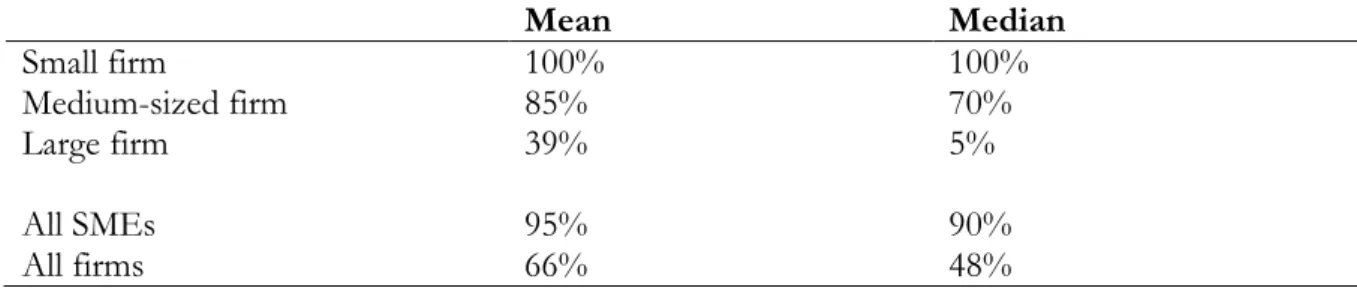
workplace. In practice, the degree of such measurement error is likely to be small, at least among SMEs. If we compare the employment numbers recorded for the workplace in WERS with those recorded for the whole firm in the BSD, we find that the WERS workplace accounts for 95% of the firm’s total employment on average within our SME sample (see Table 1 below). For
workplaces belonging to firms with 5-49 employees, the average is 100% and for those with 50-249 employees it is 85%; by comparison, the average for workplaces belonging to firms with at least 250 employees is just 39%.vi Consequently we do not attempt a specific investigation of the performance effects of management practices in large firms using the linked WERS-BSD sample. We do provide some results for the full sample (SMEs and large firms combined), for comparison with the results from our SME sample, but SMEs remain the focus of our
discussion.
In those analyses which are presented, we include a control for the share of total firm
employment that is accounted for by the WERS workplace. We also cluster our standard errors to account for the intra-class correlation that is likely to exist between workplaces that have siblings in the sample from the same large firm (a situation which applies to around one fifth of the workplaces belonging to large firms).vii
Table 1: Share of enterprise employment accounted for by the sampled WERS workplace
Mean Median Small firm 100% 100% Medium-sized firm 85% 70% Large firm 39% 5% All SMEs 95% 90% All firms 66% 48%
12 Measuring management practices
In measuring management practices, we take our cue from the various strands of literature summarized earlier in the paper (pp. 5-6). These literatures overlap to some degree and so we develop a schema which organizes the practices into three main groups. The first group
comprises ‘human resource’ practices covering recruitment, training, appraisal and incentive pay. These management practices are focused around ensuring that employees have the knowledge and skills required by the organisation, and that they are motivated to contribute towards organisational success (the ‘ability’ and ‘motivation’ elements of the
Ability-Motivation-Opportunity (AMO) framework (Appelbaum et al, 2000), which is a common reference point in the HRM-performance literature). The second group comprises practices relating to the
organisation of work within the firm, specifically covering the use of semi-autonomous teamworking, employee involvement in problem-solving and just-in-time processes. The first two practices in this set are focused around ensuring that employees have the opportunity to deploy their skills and tacit knowledge effectively (the final part of the AMO framework), whilst the use of just-in-time processes reflects efficiency concerns that are prominent in the operations management literature. The final group focuses on the use of organisational performance targets. The use of such targets helps managers to be informed about whether the organisation is
performing appropriately: alerting them to potential problems and to the need for appropriate actions. The use of such performance targets is a key part of the emerging literature on data-driven management practices (Brynjofsson and McElheran, 2016a, 2016b).
The full list of practices captured in our index is presented below. Descriptive statistics showing the incidence of each practice in our unweighted sample can be found in Appendix A.
Human resource practices: Performance tests used in recruitment for the largest occupational group; Performance appraisals for at least 80% of the largest occupational group; Any off-the-job training given to the largest occupational group (excluding health and safety training); Any
13
performance-related pay (merit pay, payment-by-results, profit-sharing or share-ownership) for any group of employees.
Work organization: Use of teamworking arrangements where team members jointly decide how work is to be done; Use of problem-solving groups or quality circles; Just-in-time methods of production or service delivery.
Target setting: Whether targets are set for: Volume of goods produced/services delivered; Total costs; Profits/return on investment; Unit labour costs; Productivity; Quality of product or service.
Our primary index of management practices comprises a simple count of these practices,
hypothetically ranging from 0 to 13. To examine the incidence and effects of its components, we also divide the index into its three constituent parts, compiling indices for the number of human resource practices (ranging 0-4), the number of work organization practices (0-3) and the
number of production targets (0-6).
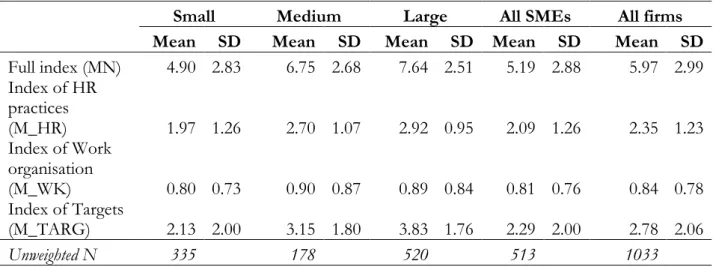
Descriptive statistics for our survey population are shown below. Among SMEs, the mean number of management practices is 5.19 (out of 13), with a standard deviation of 2.88. A comparison between small, medium-sized and large firms indicates that the use of formal management practices is positively correlated with firm size, although the correlation is weaker for the count of work organization practices than for the counts of HR practices and production targets.
14
Table 2: Mean number of management practices, and standard deviations, by firm size
Small Medium Large All SMEs All firms
Mean SD Mean SD Mean SD Mean SD Mean SD
Full index (MN) 4.90 2.83 6.75 2.68 7.64 2.51 5.19 2.88 5.97 2.99 Index of HR practices (M_HR) 1.97 1.26 2.70 1.07 2.92 0.95 2.09 1.26 2.35 1.23 Index of Work organisation (M_WK) 0.80 0.73 0.90 0.87 0.89 0.84 0.81 0.76 0.84 0.78 Index of Targets (M_TARG) 2.13 2.00 3.15 1.80 3.83 1.76 2.29 2.00 2.78 2.06 Unweighted N 335 178 520 513 1033
Source: WERS-BSD linked sample. Mean values computed using survey weights.
When utilizing these measures of management practices in regression analysis, we standardize the full index, giving it a mean of 0 and a standard deviation of 1. We take the same approach for the three sub-indices and, when these are used, we also include a dummy variable which
identifies workplaces that are above the mean on all three sub-components. Measuring firm performance
We utilize a variety of measures of firm performance. First, we look at the probability that a firm remains in the population (i.e. does not close down). This can perhaps be thought of as the strictest test of the efficacy of formal management practices: are they associated with an increased probability of firm survival in the medium-term? Second, we look at rates of firm growth. The BSD allows us to measure growth in employment and total sales. The recent UK literature on high-growth firms tends to focus primarily on employment growth (e.g. Anyadike-Danes et al, 2009; Hijzen et al, 2010), but we follow the official statistics on business
demography (e.g. Eurostat-OECD, 2007) in looking at growth in employment and total sales. This recognises that, whilst job creation is an important social and economic outcome, firms are likely to have growth objectives focused around revenue, since sales ultimately indicate market success. We focus on growth in employment and growth in turnover separately. However, we
15
also analyse a binary variable which identifies those firms that meet the Eurostat-OECD
definition of ‘high-growth’, that is: growth of at least 20 per cent per annum on either measure). Our third and final performance measure is productivity growth, which is the conventional measure of efficiency.
In order to analyse these performance outcomes, we observe firms over three periods: 2011-2013 (a two-year follow-up); 2011-2014 (three years); and 2011-15 (four years). The choice of a variety of follow-up periods reflects a tension between the desire to keep the time period for measuring performance outcomes reasonably close to the time point for measuring management practices, in case practices change over the intervening period, and the desire to have a
reasonable observation window over which performance outcomes can play out. The former would imply a shorter follow-up period; the latter a longer follow-up. Our preference is three years, but we include two and four-year follow-ups to show the sensitivity of our results to this choice.
Out various measures of performance are thus defined as follows:
Firm exit (death): A binary variable (0/1) indicating whether the firm ceased to trade at any point between 2011 and year t (where t=2013, 2014 or 2015). This is identified using the ‘date of death’ on the BSD, which marks the date on which the firm ceased trading.viii Following Welpton (2009), this measure of exit is preferred to one which simply traces the year that a firm leaves the BSD panel, since firms can remain on the register for some years following cessation of trading. Employment growth: Measured as the log change in the firm’s employment between 2011 and year t, i.e. ln(Et/E2011)
Turnover growth: Measured as the log change in the firm’s gross sales (turnover) between 2011 and 2014, i.e. ln(Tt/T2011)
16
High-growth firm: A dummy variable equal to 1 if the firm posted average growth of 20%+ per annum in either employment or turnover over the period between 2011 and year t.
Productivity growth: Measured as the log change in the firm’s labour productivity between 2011 and year t, i.e. ln(LPt/LP2011), where labour productivity is measured as turnover per employee (T/E).ix
Analytical approach:
In our analysis of the use of management practices, we use OLS regressions to estimate the probability that a firm is using a more extensive array of formal management practices. These analyses regress the full, standardized index of management practices on a measure of firm size, along with a set of firm characteristics shown to be informative in the previous literature, including firm ownership, internationalization and product market competition, plus standard firm-level controls such as industry and region.
Our regression analyses of survival/exit use a probit estimator to analyse the relationship between management practices present in 2011 and the probability of exit over the subsequent period, after controlling for a variety of other firm characteristics, including its level of financial performance, all collected in 2011.x The coefficients are presented in terms of marginal effects. Our measures of employment growth, turnover growth, high-growth and productivity growth are, necessarily, observed only for the subset of firms that survived (i.e. the subset for which exit=0). Among these surviving firms, we use OLS regressions to analyse the relationship between management practices and employment growth, turnover growth and productivity growth, and a probit estimator to analyse the relationship between management practices and the probability of being a high-growth firm (with the probit coefficients again presented as marginal effects). We measure performance in the three years prior to the WERS survey (2008-2011) and use this ‘prior trajectory’ as a control variable in our regression analyses, alongside a set of firm
17
characteristics.xi We also compute the inverse Mills ratio (IMR) from the probit regression of firm exit and include this ‘hazard rate’ among the covariates of each performance regression in an attempt to correct for any upward bias that may result from focusing only on survivors. The variable omitted from the regressions of firm performance is the WERS respondent’s subjective assessment of the workplace’s financial performance relative to others in its industry sector in 2011, which previous studies have found to be a strong predictor of workplace closure (e.g. Machin, 1995) and which is statistically significant in our exit regression.xii
Analyses are weighted by the WERS workplace sampling weights so that they reflect figures for the population from which they were sampled, rather than merely within-sample estimates. Standard errors account for the use of variable probability sampling in the survey design and (as noted earlier) for the inclusion of multiple workplaces from some large firms.
Although our data include indicators of many potential drivers of firm performance, they do not include some drivers that are argued to be important in the literature. One such is access to credit, which became more difficult for SMEs in the aftermath of the financial crisis, albeit without clear evidence of a depressing effect on productivity (Riley et al, 2014). Another absentee is a measure of firms’ growth ambitions, although the available evidence suggests that these are not strongly predictive of actual growth outcomes once other characteristics are controlled for (Department for Business Innovation and Skills, 2016). Despite these omissions, our range of firm characteristics is wider than is typically available.
Our study is still limited, however, by our inability to make causal inferences about the link between management practices and firm performance. We are able to account for the
performance trajectories of firms prior to 2011, so that the comparisons we make partial out the potentially confounding dynamic effects that might otherwise bias our estimates of the links between practices and performance. But we are unable to account for the fact that a firm’s
18
choice of management practices may partly be based on its performance trajectory and thus endogenous.
4. RESULTS
The presentation of results proceeds in two parts. First, we present analyses of the types of firm that use formal management practices, showing the variation by firm size and also the correlation with other firm characteristics, such as the type of owner. We then go on to present analyses of the association between the use of management practices and our chosen measures of firm performance. In each case, our primary focus is on the sample of SME firms. We also discuss some results from the wider sample that additionally includes larger firms (those with 250+ employees) for comparison. However, we are less confident to draw firm conclusions from that sample about the link between management practices and performance because the units of observation for management practices and firm performance diverge to a greater extent among larger firms (see Table 1).
Which firms use formal management practices?
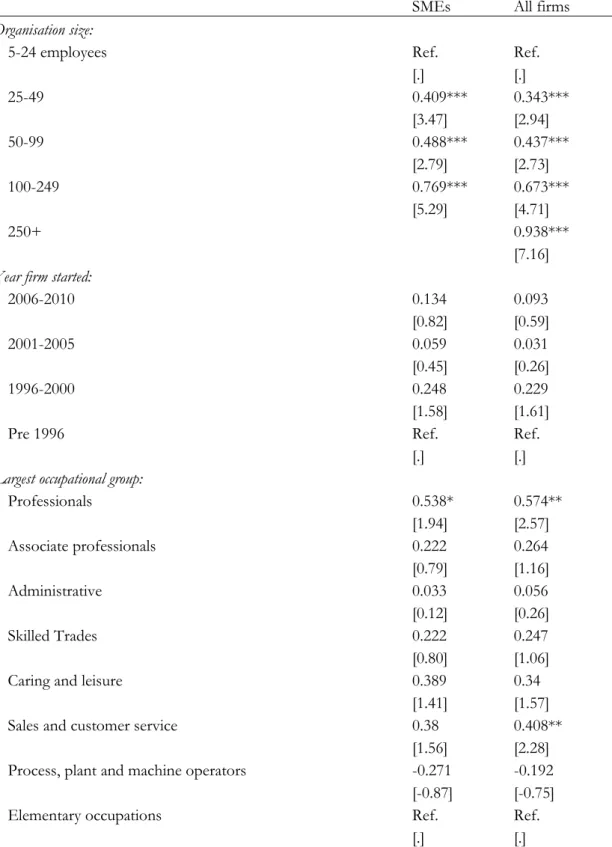
Table 3 reports an OLS regression analysis which identifies the workplace and firm
characteristics that are associated with greater use of our chosen set of formal management practices. Column 1 presents the results for our sample of SMEs, whereas column 2 presents the results for the sample of all firms.
Many of the results shown in Table 3 are in line with expectations. In keeping with the existing literature (e.g. Forth et al, 2006; Wu et al, 2015) – and in line with the bivariate analysis presented in Table 2 – we find that the use of formal management practices increases monotonically with firm size. However, the gradient is not steep. After controlling for other factors, the average number of practices used by medium-size firms (those with 100-249 employees) is around
three-19
quarters of a standard deviation (0.769) higher than the number used by micro firms (those with 5-24 employees) (Table 3, column 1). This equates to an average difference of 2.2 practices. Table 3: OLS regression of the number of formal management practices in use
SMEs All firms
Organisation size:
5-24 employees Ref. Ref.
[.] [.] 25-49 0.409*** 0.343*** [3.47] [2.94] 50-99 0.488*** 0.437*** [2.79] [2.73] 100-249 0.769*** 0.673*** [5.29] [4.71] 250+ 0.938*** [7.16]
Year firm started:
2006-2010 0.134 0.093 [0.82] [0.59] 2001-2005 0.059 0.031 [0.45] [0.26] 1996-2000 0.248 0.229 [1.58] [1.61]
Pre 1996 Ref. Ref.
[.] [.]
Largest occupational group:
Professionals 0.538* 0.574** [1.94] [2.57] Associate professionals 0.222 0.264 [0.79] [1.16] Administrative 0.033 0.056 [0.12] [0.26] Skilled Trades 0.222 0.247 [0.80] [1.06]
Caring and leisure 0.389 0.34
[1.41] [1.57]
Sales and customer service 0.38 0.408**
[1.56] [2.28] Process, plant and machine operators -0.271 -0.192
[-0.87] [-0.75]
Elementary occupations Ref. Ref.
[.] [.]
20
Table 3 continued
SMEs All firms
Owner-manager -0.016 -0.007
[-0.21] [-0.13]
Foreign-owned 0.372* 0.261**
[1.89] [2.21]
Main market is international 0.480*** 0.491***
[3.56] [4.00]
Degree of market competition:
High/Very high Ref. Ref.
[.] [.]
Neither high nor low -0.08 -0.013
[-0.64] [-0.11]
Low/Very low -0.266* -0.157
[-1.64] [-1.20]
Count of employer networks 0.147*** 0.172***
[2.66] [4.19]
Unions recognised 0.26 0.342***
[1.44] [2.94]
Constant -0.745* -0.628**
[-1.95] [-2.00]
Industry dummies Yes Yes
Region dummies Yes Yes
N 499 983
adj. R-sq 0.232 0.315
Notes:
1. t statistics in brackets
2. p<0.10, ** p<0.05, *** p<0.01
3. Regressions include seven industry dummies (SIC(2003) Sections D-F, G, H, I-K, M, N, O) and 11 region dummies (Government Office Regions)
Source: WERS-BSD linked sample
There is no statistically-significant association with firm age. However, firms in which the largest occupational group are Professionals use the highest number of management practices, on average. This is in line with prior evidence which suggests that the adoption of formal
management practices is more extensive in firms with higher levels of employee human capital (Bloom et al, 2012, 2017). Turning to firm ownership characteristics, firms with an owner-manager do not differ in the number of management practices from those where the roles of owner and manager are separated. Owner-managed firms exhibited particularly low use of formal
21
management practices in Bloom et al.’s original work (Bloom et al., 2012), leading them to suggest that family ownership may depress managerial quality by reducing the pool of available managerial recruits. However, an indicator of family-ownership is non-significant in Broszeit’s multivariate analysis for Germany (Broszeit et al, 2016), and so the evidence is mixed on the importance of owner-management. The evidence is more consistent on the importance of internationalization and competition, however. In line with Bloom et al (2012) and Broszeit et al (2016), we find that foreign-owned firms and those who operate in international product markets are more extensive users of formal management practices. We also find that greater levels of product market competition are positively associated with the use of formal management practices: a relationship which Bloom et al (2017) have plausibly shown to be causal.
Wu et al (2014) have previously shown that extensive use of management practices is more likely when the firm is embedded in a larger array of employer networks, and we replicate this result here. Our analysis counts the number of different types of membership association to which the firm belongs (a 0-5 count variable, based on membership of: an employers’ association; an industry or trade associations; a Chamber of Commerce; the Federation of Small Business; or some other similar group), and finds a positive and statistically significant association between this count variable and the number of management practices in use. Each additional network raises the number of management practices in use by around 0.15 standard deviations (or 0.4 practices), on average.
Finally, the presence of recognized trade unions is positively associated with the number of management practices, but the association is only statistically significant in the full sample of all firms. The positive and statistically significant association for all firms stands against the non-significant association between works councils and management practices in Germany (see Broszeit et al., 2016) but British unions and German works councils are rather different in form and function; our result is in line with recent research in Britain which shows that unionized
22
firms are more extensive users of high-involvement management practices (Askenazy and Forth, 2016).
Is the use of formal management practices associated with better firm performance?
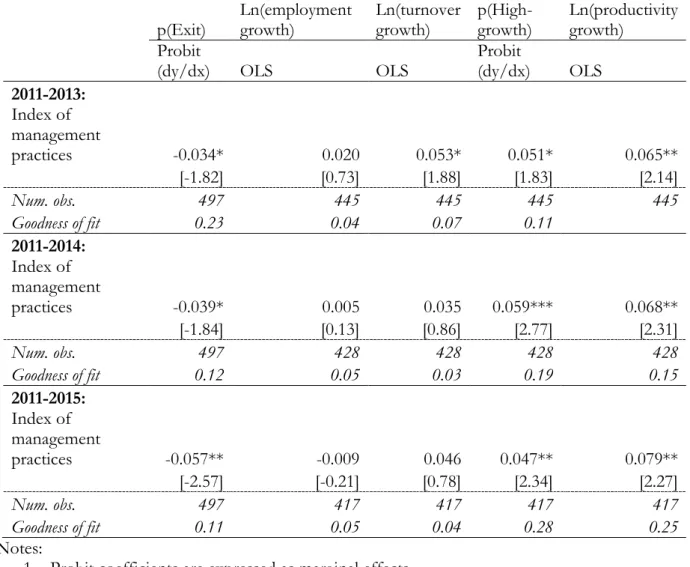
Table 4 reports the results of the first in a series of regression analyses in which we investigate whether firms that have more extensive use of formal management practices have superior performance to less extensive users. In this first set of results, we employ a parsimonious specification in which we control for a limited set of firm demographics (industry, region and age), alongside the controls for the firm’s prior performance trajectory. The set of controls is extended in subsequent specifications presented in Table 5. In both tables, the first panel presents results for the two-year follow-up period (2011-13), with results for the three and four-year follow-up periods presented below. A full set of coefficients for our preferred follow-up period (2011-14) are presented in Appendix B.
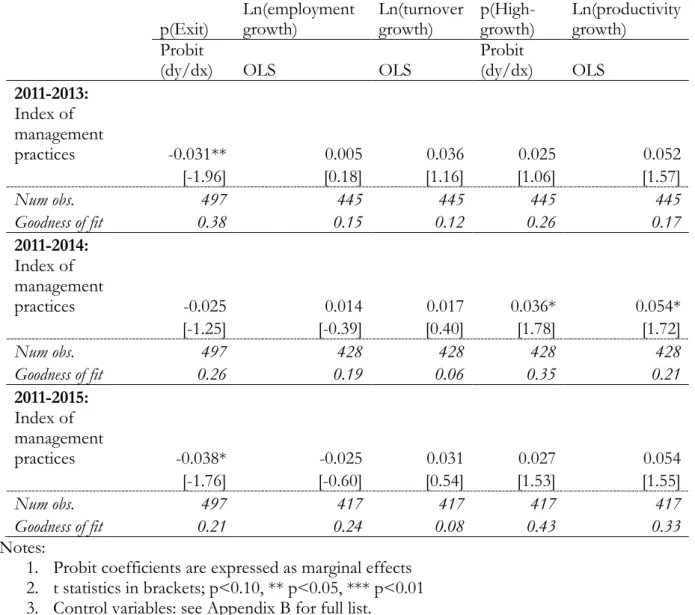
Column 1 of each table shows the marginal effect of a one standard deviation increase in the management index on the probability that a firm exits the population (closes down) over the follow-up period. As noted earlier, this is a strict test. Bloom et al (2016a, 2017) find, in their samples of manufacturing plants, that firms using more management practices are less likely to close down. In our parsimonious specification (Table 4), we find a negative and statistically significant correlation with the probability of firm closure in all three periods. The magnitude of all three coefficients falls as we enter additional control variables (see Table 5), but a statistically significant negative association remains in two of the three periods (2011-13 and 2011-15). The coefficient of -0.031 for 2011-13 implies that a one standard deviation increase in the
management index (equivalent to an increase of 2.88 practices – see Table 2) is associated with a fall of 3 percentage points in the probability of SME exit over this period. Around one in ten SMEs exit the population over this period and so, if causality could be established, this would represent a considerable impact.
23
Table 4: Management index and SME performance: parsimonious specification
p(Exit) Ln(employment growth) Ln(turnover growth) p(High-growth) Ln(productivity growth) Probit
(dy/dx) OLS OLS Probit (dy/dx) OLS 2011-2013: Index of management practices -0.034* 0.020 0.053* 0.051* 0.065** [-1.82] [0.73] [1.88] [1.83] [2.14] Num. obs. 497 445 445 445 445 Goodness of fit 0.23 0.04 0.07 0.11 2011-2014: Index of management practices -0.039* 0.005 0.035 0.059*** 0.068** [-1.84] [0.13] [0.86] [2.77] [2.31] Num. obs. 497 428 428 428 428 Goodness of fit 0.12 0.05 0.03 0.19 0.15 2011-2015: Index of management practices -0.057** -0.009 0.046 0.047** 0.079** [-2.57] [-0.21] [0.78] [2.34] [2.27] Num. obs. 497 417 417 417 417 Goodness of fit 0.11 0.05 0.04 0.28 0.25 Notes:
1. Probit coefficients are expressed as marginal effects 2. t statistics in brackets; p<0.10, ** p<0.05, *** p<0.01
3. Control variables: industry sector; region; year firm started; prior growth in employment (column 2); prior growth in turnover (columns 3 and 4); prior growth in productivity and level of productivity (column 5)
4. Goodness of fit: probits = pseudo r-squared; OLS = adjusted r-squared. Source: WERS-BSD linked sample
24
Table 5: Management index and SME performance: full specification
p(Exit) Ln(employment growth) Ln(turnover growth) p(High-growth) Ln(productivity growth) Probit
(dy/dx) OLS OLS Probit (dy/dx) OLS 2011-2013: Index of management practices -0.031** 0.005 0.036 0.025 0.052 [-1.96] [0.18] [1.16] [1.06] [1.57] Num obs. 497 445 445 445 445 Goodness of fit 0.38 0.15 0.12 0.26 0.17 2011-2014: Index of management practices -0.025 0.014 0.017 0.036* 0.054* [-1.25] [-0.39] [0.40] [1.78] [1.72] Num obs. 497 428 428 428 428 Goodness of fit 0.26 0.19 0.06 0.35 0.21 2011-2015: Index of management practices -0.038* -0.025 0.031 0.027 0.054 [-1.76] [-0.60] [0.54] [1.53] [1.55] Num obs. 497 417 417 417 417 Goodness of fit 0.21 0.24 0.08 0.43 0.33 Notes:
1. Probit coefficients are expressed as marginal effects 2. t statistics in brackets; p<0.10, ** p<0.05, *** p<0.01 3. Control variables: see Appendix B for full list.
4. Goodness of fit: probits = pseudo r-squared; OLS = adjusted r-squared. Source: WERS-BSD linked sample
25
Columns 2 and 3 of the tables show the association between a one standard deviation increase in the management index and the rate of growth in employment and turnover respectively. Again, our coefficients have the same sign as in the studies of Bloom et al (2016a, 2017) but, here, with only one exception, they are statistically non-significant across both the parsimonious and full specifications. Greater use of management practices cannot therefore be said to be associated with faster rates of firm growth, on average, within our SME sample. However, the index does appear to have some traction in the upper tail of the growth distribution. Specifically, column 4 of Table 4 shows that a one standard deviation increase in the management practices index is associated with an increase of approximately 5 percentage points in the probability of a firm registering ‘high-growth’ (defined as a growth rate of at least 20% per annum in either
employment or turnover over a period of three years). Again, the coefficients are smaller under the full specification, falling to around 3 percentage points, but the coefficient in our preferred follow-up period (2011-14) remains statistically significant from zero at the 10 per cent level. Finally, in column 5, we investigate the association between our index of management practices and firm productivity growth. The studies of Bloom et al (2016a, 2017) and Broszeit (2016) each show positive and statistically significant associations between the greater use of formal
management practices and productivity. We also find some evidence of this in our sample of SMEs. In the parsimonious specification, there is a positive and statistically significant
association in all three follow-up periods. The association remains statistically significant in our preferred period under the full specification, where a one standard deviation increase in our index of management practices is associated with a 5% increase in the growth rate of firm
productivity. The coefficients for the adjacent periods are of a very similar magnitude but fall just short of statistical significance at the 10 per cent level.xiii
The results for the various performance metrics therefore vary depending on the period of observation, but we find a statistically significant, positive association between management
26
practices and firm survival in two of our three follow-up periods (2011-13 and 2011-15) and a statistically significant, positive association with firm growth and productivity in our preferred period (2011-14).
These associations with firm growth and productivity are robust to sample selection caused by firm exit. In our full specifications, we compute the inverse Mills ratio (IMR) from the probit regression of firm exit and include this ‘hazard rate’ among the covariates for the subsequent performance metrics, in order to correct for any upward bias that may result from focusing only on survivors. The coefficient on the IMR term is typically negative, as we would expect,
indicating that those firm characteristics which are associated with a higher probability of exit are also associated with lower levels of performance among survivors. However, the term only reaches statistically significance in the employment growth regressions.
We do not dedicate much discussion to the results for the full sample of firms (SMEs plus large firms), for the reasons outlined earlier. However, when we apply the full specification for the 2011-14 follow-up period to the complete sample of firms, we find that the results for this larger sample are qualitatively similar to those for SMEs. There is a suggestion that the association between the management practices index and the probability of ‘high-growth’ is slightly weaker in this sample (β=0.031; t=2.03), and the association with productivity growth slightly stronger (β=0.064; t=2.55), but the differences are relatively small. Detailed results are presented in Appendix C.
As noted earlier, the full index of management practices is based on a total of 13 practices, which can be conceptually divided into three sub-indices: human resource practices; work organisation; and target setting. We explore the relative importance of these different components by creating a standardized score for each of the three sub-indices and entering these into the full
specification for our preferred period (2011-14) in place of the full index. The results are
27
tests, off-the-job training, performance appraisal and incentive pay) is significantly associated with turnover growth and the probability of being a high-growth firm.xv The HR index is also positively associated with productivity, but the coefficient falls just short of statistical significance at the 10 per cent level. The index of work organisation is not significantly associated with any measure of firm performance, whereas the index of target setting is positively and significantly associated with labour productivity growth.xvi This pattern of results differs somewhat from that shown by Broszeit et al (2016), who find that their index of HR practices and monitoring practices are more strongly associated with productivity than their index of target setting. However, direct comparisons between the two studies are made difficult by the lack of a complete overlap in the practices captured by their respective survey instruments. Table 6: Management practices (sub-indices) and SME performance, 2011-14
p(exit) Ln(employment growth) Ln(turnover growth) p(High-growth) Ln(productivity growth) Probit
(dy/dx) OLS OLS Probit (dy/dx) OLS SMEs: Index of HR practices -0.010 0.054 0.080* 0.073*** 0.055 [-0.48] [1.50] [1.86] [3.85] [1.56] Index of work organisation 0.016 -0.059 -0.074 -0.011 0.008 [0.94] [-1.40] [-1.33] [-0.58] [0.26] Index of target setting -0.016 -0.045 0.014 0.005 0.062** [-0.77] [-1.15] [0.31] [0.21] [2.01] Above average on
all three indices -0.068 0.101 -0.021 -0.015 -0.161 [-1.07] [0.79] [-0.13] [-0.27] [-1.55]
Num. obs. 497 428 428 428 428
Goodness of fit 0.27 0.20 0.07 0.37 0.22 Notes:
1. Probit coefficients expressed as marginal effects 2. t statistics in brackets; p<0.10, ** p<0.05, *** p<0.01 3. Control variables: see Appendix B for full list
4. Goodness of fit: probits = pseudo r-squared; OLS = adjusted r-squared. Source: WERS-BSD linked sample
28
5. DISCUSSION AND CONCLUSIONS
Researchers and policy makers have long recognised the contribution that SMEs make to job creation and output growth. However, as the search goes on to understand more fully the causes the UK’s weak productivity growth, attention has increasingly turned to the long tail of low-productivity firms, where smaller firms are over-represented.
Those seeking to explain firm-level heterogeneity in productivity (and other measures of firm performance), have long suspected that such variance may be explained by observable
differences in firms’ use of operational and human resource practices. With the development of datasets that link quantitative measures of a range of management practices to accounts-type data on firm performance, this question has become the subject of considerable research activity. Building partly on earlier contributions from researchers in the field of HRM, economists are now collating a considerable body of evidence which shows that firms which engage in more extensive use of data collection and analysis, target setting and performance-focused human resource practices perform better than firms with fewer of these formal management practices. Yet much of this evidence is based on samples of medium-sized and large firms, with few studies (either from HRM or economics) seeking to explicitly investigate the returns to formal
management practices among SMEs. This is an important omission, since some have suggested that the use of formalised practices may be inappropriate and counterproductive in smaller firms. We examine the association between management practices and SME performance in Britain over the period 2011-2015, using a unique dataset which links survey data on management practices with firm performance data from the UK’s official business register. We find that SMEs are less likely to use formal management practices than larger firms, even after controlling for a range of other factors. Nevertheless, such practices appear to have demonstrable benefits
29
for the SMEs that use them. Results vary depending on period of observation, but we find a statistically significant, positive association between management practices and firm survival in two of our three follow-up periods, and a statistically significant, positive association with firm growth and productivity in our preferred period (2011-14). When we break down the overall management index into its sub-components for this period, human resource practices, such as recruitment tests and performance appraisal, have the strongest association with the probability of being ‘high-growth’, whilst target setting practices (specifically those focused on productivity and profits) have the strongest association with growth in labour productivity.
Our linked data are limited somewhat by the absence of longitudinal information on management practices. Instead, we are only able to observe the association between the management practices that firms have in place in 2011 and their performance over the subsequent 2-4 years (2011-13, 2011-14 and 2011-15). We also lack any formal means of identification, and so we are unable to say definitively that the associations seen here are causal. However, our study has an advantage over all previous studies for Britain in being able to call upon a nationally-representative sample of SMEs which can be linked to longitudinal, accounts-type data on firm performance. Our results are broadly in line with other quasi-experimental and experimental evidence which points to a causal link between the more extensive use of formal management practices and firm performance (see Bloom et al, 2017).
Our results thus extend the growing body of evidence on the benefits of formal management practices in large firms and add further weight to policy initiatives which seek to encourage SMEs to improve their management skills and capabilities.
30 REFERENCES
Anyadike-Danes, M., Bonner, K., Hart, M. and Mason, C. (2009) Measuring Business Growth: High-growth firms and their contribution to employment in the UK, London: NESTA.
Appelbaum E et al (2000) Manufacturing advantage: Why high performance work systems pay off. London: ILR Press.
Aradanaz-Badia A, Awano G and Wales P (2017) Understanding firms in the bottom 10% of the labour productivity distribution in Great Britain: “the laggards”, 2003 to 2015, London: Office for National Statistics.
Askenazy P and Forth J (2016) “Work organisation and human resource management: does context matter?”, pp.141-178 in Amossé T, Bryson A, Forth J and Petit H (eds.) Comparative Workplace Employment Relations: An Analysis of Britain and France, Basingstoke: Palgrave Macmillan.
Bailey T (1993) “Organizational Innovation in the Apparel Industry,” Industrial Relations 32(1) (1993), 30–48.
Birch D (1981) “Who Creates Jobs”, The Public Interest, 65: 3-14.
Black S and Lynch L (2001) “How to compete: the impact of workplace practices and information technology on productivity”, Review of Economics and Statistics, 83, 3: 434-445.
Bloom N, Lemos R, Qi M, Sadun R and Van Reenen J (2011) “Constraints on developing UK management practices”, BIS Research Paper No. 58, London: Department for Business Innovation and Skills.
Bloom N, Genakos C, Sadaun R and Van Reenen J (2012) “Management practices across firms and countries”, NBER Working Paper No. 17850.
31
Bloom N, Lemos R, Sadun R, Scur D and Van Reenen J (2014) “The new empirical economics of management”, Occasional Paper No. 41, London: Centre for Economic Performance.
Bloom, N., Lemos, R., Sadun, R. and Van Reenen, J. (2015) “Does management matter in
schools?”. The Economic Journal, 125(584), pp.647-674.
Bloom N, Sadun R and Van Reenen J (2016a) “Management as technology”, CEP Discussion Paper No. 1433, London: Centre for Economic Performance.
Bloom N, Lemos R, Sadun R, Scur D and Van Reenen J (2016b) “International data on measuring management practices”, American Economic Review, 106, 5: 152-156.
Bloom N, Brynjolfsson E, Foster L, Jarmin R, Patnaik M, Saporta-Eksten I and Van Reenen J (2017) “What drives differences in management?”, CEP Discussion Paper No. 1470, London: Centre for Economic Performance.
Broszeit S, Fritsch U, Görg H and Marie-Christine Liable (2016) “Management practices and productivity in Germany”, IAB Discussion Paper No. 32/2016, Nuremberg: Institute for Employment Research.
Brynjolfsson E and McElheran K (2016a) “Data in action: data-driven management in US manufacturing”, CES Working Paper 16-06, Washington DC: Centre for Economic Studies. Brynjolfsson E and McElheran K (2016b) “The rapid adoption of data-driven decision making”,
American Economic Review: Papers and Proceedings, 106, 5: 133-139.
Criscuolo C, Gal P and Menon C (2014) “The dynamics of employment growth: new evidence from 18 countries”, CEP Discussion Paper No. 1274, London: Centre for Economic Performance.
32
De Grip A and Sieben I (2009) “The effectiveness of more advanced human resource systems in small firms”, International Journal of Human Resource Management, 20, 9: 1914-1928.
Department for Business, Innovation and Skills (2016) Business growth intentions among SME leaders – changes over time and links to growth (final report), BEIS Research Paper, London: Department for Business, Innovation and Skills.
Department for Business, Innovation and Skills, Advisory, Conciliation and Arbitration Service and National Institute of Economic and Social Research (2014) Workplace Employee Relations Survey, 2011 [computer file]. 6th Edition. Colchester: UK Data Service [distributor]. SN: 7226,
http://dx.doi.org/10.5255/UKDA-SN-7226-4
Eurostat-OECD (2007) Eurostat-OECD Manual on Business Demography Statistics, Luxembourg: Office for Official Publications of the European Communities.
Forth, J., Bewley, H., Bryson, A. (2006) Small and Medium-sized Enterprises: Findings From the 2004 Workplace Employment Relations Survey. London: Department of Trade and Industry.
Guest D, Michie J, Conway N and Sheehan M (2003) “Human resource management and corporate performance in the UK”, British Journal of Industrial Relations, 41, 2: 291-314.
Hijzen A, Upward R and Wright P (2010) “Job creation, job destruction and the role of small firms: firm-level evidence for the UK”, Oxford Bulletin of Economics and Statistics, 72, 5: 621-647.
Huselid M (1995) “The impact of human resource management practices on turnover,
productivity and corporate financial performance”, Academy of Management Journal, 38, 3: 635-672.
33
Ichniowski, C., Shaw, K. and Prennushi, G. (1997) “The effects of human resource management
practices on productivity: A study of steel finishing lines.” The American Economic Review, 87, 3:
291-313.
Kitching J and Marlow S (2013) “HR practice and small firm growth: balancing informality and formality”, in Saridakis G and Cooper C (eds) How Can HR Drive Growth?, Cheltenham: Edward Elgar.
Lai Y, Saridakis G, Blackburn R and Johnstone S (2016) “Are the HR responses of small firms different from large firms in times of recession?”, Journal of Business Venturing, 31: 113-131.
Lazear E (2000) “Performance pay and productivity”, American Economic Review, 90(5), pp.1346-1361.
MacDuffie J (1995) “Human resource bundles and manufacturing performance: Organizational
logic and flexible production systems in the world auto industry”. ILR Review, 48(2),
pp.197-221.
Machin S (1995) “Plant closures and unionization in British establishments”, British Journal of Industrial Relations, 33(1), pp.55-68.
NESTA (2017) The State of Small Business: Putting UK Entrepreneurs on the Map, London: NESTA.
OECD (2002) High Growth SMEs and Employment, Paris: OECD.
Office for National Statistics (2010) Quinquennial Review of the Annual Business Survey (ABS), London: Office for National Statistics.
Office for National Statistics (2012) Annual Business Survey (ABS): Technical Report, London: Office for National Statistics.
34
Office for National Statistics (2015) Business Structure Database, 1997-2014: Secure Access. [data collection]. Colchester: UK Data Service [distributor]. SN:
6697, http://doi.org/10.5255/UKDA-SN-6697-9
Riley R, Rosazza-Bondibene C and Youn G (2014) “The financial crisis, bank lending and UK productivity: sectoral and firm-level evidence”, National Institute Economic Review, 228, 1: R17-R34.
Roper S and Hart M (2013) “Supporting sustained growth among SMEs – policy models and guidelines”, ERC White Paper No. 7, Warwick: Enterprise Research Centre.
Sheehan M (2014) “Human resource management performance: evidence from small and medium-sized firms”, International Small Business Journal, 32, 5: 545-570.
Welpton R (2009) “Business Structure Database: The Inter-Departmental Business Register (IDBR) for Research”, Economic and Labour Market Review, 3, 6: 71-5.
Wu N, Bacon N and Hoque K (2014) “The adoption of high performance work practices in small businesses: the influence of markets, business characteristics and HR expertise”, The International Journal of Human Resource Management, 25, 8: 1149-1169.
Wu, N., Hoque, K., Bacon, N., Llusar, B. and Carlos, J. (2015) “High‐performance work systems
and workplace performance in small, medium‐sized and large firms”, Human Resource
35
6. APPENDIX A: DESCRIPTIVE STATISTICS (UNWEIGHTED)
All firms SMEs
N mean SD N mean SD Continuous?
Management index (0-13) 1,007 7.10 3.00 499 5.87 2.89 Y
Sub-index: Training and incentives 1,007 2.72 1.12 499 2.34 1.20 Y
Performance tests 1,007 0.51 0.50 499 0.38 0.49
Performance-related pay 1,007 0.66 0.47 499 0.60 0.49 Performance appraisals 1,007 0.71 0.45 499 0.62 0.49 Off-the-job training 1,007 0.84 0.37 499 0.74 0.44
Sub-index: Work organisation 1,007 1.06 0.87 499 0.89 0.82 Y
Teamworking 1,007 0.28 0.45 499 0.25 0.44
Problem-solving groups 1,007 0.25 0.43 499 0.15 0.36 Just-in-time approach 1,007 0.52 0.50 499 0.48 0.50
Sub-index: Targets 1,007 3.33 2.04 499 2.65 2.03 Y
Volume of goods/services produced 1,007 0.70 0.46 499 0.63 0.48
Total costs 1,007 0.62 0.49 499 0.49 0.50
Profits/return on investment 1,007 0.59 0.49 499 0.50 0.50
Unit labour costs 1,007 0.40 0.49 499 0.28 0.45
Productivity 1,007 0.46 0.50 499 0.34 0.48 Quality of product/service 1,007 0.56 0.50 499 0.39 0.49 Firm exited 2011-2014 1007 0.06 0.24 499 0.11 0.31 Ln(employment growth 2011-2014) 937 -0.05 0.56 463 -0.05 0.60 Y Ln(employment growth 2008-2011) 950 0.26 0.65 458 0.33 0.68 Y Ln(Turnover growth 2011-2014) 939 0.07 0.72 463 0.03 0.77 Y Ln(Turnover growth 2008-2011) 951 0.24 0.79 459 0.21 0.82 Y High-growth firm 937 0.13 0.34 463 0.17 0.37
Ln(Labour productivity growth 2011-2014) 937 0.13 0.63 463 0.10 0.71 Y Ln(Labour productivity growth 2008-2011) 950 -0.04 0.77 458 -0.13 0.79 Y Ln(Labour productivity in 2011) 1,005 4.11 1.25 497 4.02 1.12 Y
Financial performance:
A lot better than average 1,007 0.12 0.33 499 0.10 0.30 Better than average 1,007 0.40 0.49 499 0.38 0.49
About average 1,007 0.37 0.48 499 0.40 0.49
Below average/A lot below average 1,007 0.07 0.26 499 0.06 0.25 No comparison possible 1,007 0.04 0.19 499 0.05 0.21 Organisation size: 5-24 employees 983 0.24 0.43 493 0.48 0.50 25-49 983 0.09 0.28 493 0.17 0.38 50-99 983 0.08 0.28 493 0.16 0.37 100-249 983 0.09 0.29 493 0.18 0.39 250+ 983 0.50 0.50 continued…
36
Appendix A continued
All firms SMEs
N mean SD N mean SD Continuous?
Industry sector (SIC2003):
D-F: Manufacturing, Construction, Utilities 1,007 0.19 0.40 499 0.20 0.40 G: Wholesale and retail 1,007 0.16 0.37 499 0.15 0.36 H: Hotels and restaurants 1,007 0.10 0.30 499 0.10 0.30 I-K: Transport and communications, Finance,
Business services 1,007 0.27 0.44 499 0.26 0.44 M: Education 1,007 0.06 0.25 499 0.05 0.23 N: Health 1,007 0.10 0.30 499 0.10 0.30 O: Other services 1,007 0.11 0.31 499 0.14 0.35 Region North East 1,007 0.04 0.19 499 0.03 0.18 North West 1,007 0.13 0.33 499 0.13 0.33
Yorks & Humberside 1,007 0.09 0.29 499 0.08 0.27
East Midlands 1,007 0.06 0.24 499 0.06 0.23 West Midlands 1,007 0.07 0.26 499 0.06 0.25 East of England 1,007 0.09 0.28 499 0.09 0.29 London 1,007 0.15 0.36 499 0.14 0.35 South East 1,007 0.16 0.36 499 0.17 0.38 South West 1,007 0.09 0.29 499 0.10 0.30 Scotland 1,007 0.10 0.30 499 0.09 0.29 Wales 1,007 0.03 0.18 499 0.04 0.19
Year firm started:
2006-2010 1,007 0.08 0.27 499 0.14 0.35
2001-2005 1,007 0.15 0.36 499 0.25 0.43
1996-2000 1,007 0.12 0.32 499 0.19 0.39
Pre 1996 1,007 0.65 0.48 499 0.42 0.49
Largest occupational group:
Professionals 1,007 0.14 0.35 499 0.12 0.33
Associate professionals 1,007 0.11 0.32 499 0.12 0.32
Administrative 1,007 0.10 0.30 499 0.10 0.31
Skilled Trades 1,007 0.10 0.30 499 0.15 0.36
Caring and leisure 1,007 0.10 0.31 499 0.11 0.31
Sales and customer service 1,007 0.18 0.38 499 0.17 0.37 Process, plant and machine operators 1,007 0.10 0.30 499 0.08 0.27 Elementary occupations 1,007 0.16 0.37 499 0.15 0.36
Owner-manager 1,007 0.60 0.74 499 0.76 0.68
Foreign-owned 1,007 0.14 0.35 499 0.06 0.24
Main market is international 1,007 0.17 0.38 499 0.16 0.36
Degree of market competition:
High/Very high 1,007 0.72 0.45 499 0.72 0.45
Neither high nor low 1,007 0.13 0.34 499 0.16 0.37
Low/Very low 1,007 0.15 0.36 499 0.13 0.33
37 7. APPENDIX B: FULL MODELS FOR SMES, 2011-14
p(exit) Ln(employment growth) Ln(turnover growth) p(High-growth) Ln(productivity growth)
Probit OLS OLS Probit OLS
Financial performance:
A lot better than average Ref.
[.]
Better than average 0.519
[0.95]
About average 0.89
[1.64]
Below average/A lot below average 1.505**
[2.36] No comparison possible 1.439** [2.16] Ln(Employment growth) 2008-2011 0.134** [2.51] Ln(Turnover growth) 2008-2011 -0.063 -0.179 [-1.15] [-1.19]
Ln(Labour productivity growth) 2008-2011 -0.044
[-0.79]
Ln(Labour productivity) 2011 -0.250***
[-5.23]
Organisation size:
5-24 employees Ref. Ref. Ref. Ref. Ref.
[.] [.] [.] [.] [.] 25-49 -0.186 -0.108 -0.088 -0.149 0.027 [-0.74] [-1.04] [-0.80] [-0.45] [0.28] 50-99 -0.625 0 0.063 -0.102 0.032 [-1.52] [-0.00] [0.57] [-0.24] [0.31] 100-249 -0.901** 0.309*** 0.215* 0.521 -0.075 [-2.21] [3.20] [1.76] [1.48] [-0.79]
Industry sector (SIC2003):
D-F: Manuf., Construction, Utilities Ref. Ref. Ref. Ref. Ref.
[.] [.] [.] [.] [.]
G: Wholesale and retail -0.186 -0.061 -0.294* -0.32 -0.066 [-0.43] [-0.52] [-1.78] [-0.82] [-0.57] H: Hotels and restaurants 0.031 -0.1 -0.369** -0.621 -0.410**
[0.06] [-0.66] [-2.21] [-1.14] [-2.19] I-K: Transport and communications,
Finance, Business services 0.056 0.007 -0.143 -0.338 -0.289** [0.14] [0.06] [-1.01] [-1.04] [-2.26]
M: Education -0.593 -0.02 -0.606** 0.397 -0.735***
[-0.81] [-0.11] [-2.53] [0.70] [-3.01]